|
|
FAQs on Freshwater Worms of All Sorts,
Identification Related Articles:
Invertebrates for Freshwater Aquariums by
Neale Monks,
Choose Your Weapon: Freshwater Fish Disease
Treatment Options by Neale Monks,
Related FAQs: Freshwater Worms
1, Freshwater Worms 2,
Planaria,
FW Worm Behavior,
FW Worm Compatibility/Control,
FW Worm Selection,
FW Worm Systems, FW Worm Feeding,
FW Worm Disease,
FW Worm Reproduction & FAQs on: Worm
Caused Diseases, Worms as Foods,
FW Invert.s 1,
Aquatic Insects, Crustaceans, Shrimps, Terrestrial
Hermit Crabs, |

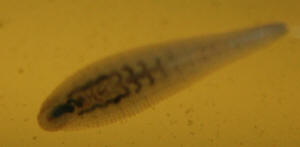
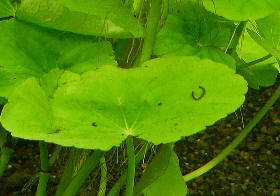
What's that on your plant? A leech!
|
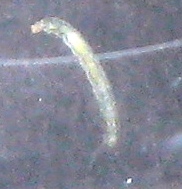
little clear worms in fish tank 10/7/09
hi i have a bunch of tiny clear worms in my tank and i was wondering if
you can help me figure out what they are and how to get rid of them.
<Likely nematodes or planarians that consume uneaten food and organic
waste. Although not harmful, they do indicate chronically poor hygiene,
i.e., you aren't keeping the substrate particularly clean and/or you're
allowing too much organic matter to accumulate in the tank. Clean the
tank properly, and remove uneaten food and faeces, and the worms will
die back.>
they are very small and clear, if the water gets a little low some will
cling to the glass above the water. i notice some times when feeding the
fish very small white looking flies come off the top of the water
probably smaller than a fruit fly. when i clean the tank i such up as
many of the worms as i can, but can't get rid of them. i have probably
had them for a year they don't seem to hurt anything just a nuisance
because my wife finds them little flies dead on the counter by our
kitchen sink. tank is a 55 gal fresh water with a Texas cichlid and a
Pleco. thanks in advance for your help.
<Cheers, Neale.>
The Worms Go In, The Worms Go Out.... 09/24/2009
Hi,
<Hello.>
My daughter has a 100 gal tank with fresh water fish in it and I have a
30 gal tank. Recently we found really tiny but long wiggly worm look
things swimming around in our tanks. What we would like to know is what
are they
<Without a MUCH more detailed description and preferably a good image,
only guesses can be had. But I'd wager dollars to donuts that they are
one of many harmless worms that can be found in freshwater tanks.
Planarians, nematodes.... lots of possibilities. Of course, there is the
less likely possibility that these are some sort of parasite. I consider
this less likely because you state that they are "swimming around" in
your tanks.>
and how do we get rid of them and keep them away?
<Well, once again, too little information to go on. I would guess that,
like many other pest infestations, conditions are favorable for the
worms and so they are proliferating. Make the conditions less favorable
for them (reduce the amount of nutrients in your tanks) and the numbers
should dwindle. Take a good look at your water conditions - Ammonia and
Nitrite must be zero, Nitrate less than 20ppm. Do some hefty water
changes if this is not the case. Siphon debris from the substrate, and
check to see if your filter media might need to be changed - change it
on a different day than when you siphon. Make sure the biomass in the
tank is not too much for the tank or your filtration to handle.>
All of our fish seem fine but this is really baffling to us.
<Again, probably harmless. Remove the reason they're there (clean the
tank, basically) and continue to do water changes as necessary, and
their numbers will dwindle. You may never be "completely" rid of them,
but they will likely become unnoticeable in very little time. Almost
everyone's tanks have some sort of interesting life - worms and much
more - and this is essentially normal. For them to be in such huge
numbers as to be that noticeable to you basically just means there's too
much "stuff" in the tank/water.>
We would appreciate any information you can provide us with.
<There are more options you can pursue.... Chemical means of
eradication.... But these options are last resorts only, and will do
more harm than good. Try upping your tank maintenance for a while and
see how things go. I bet you'll find that they mostly go away on their
own, with a clean, healthy aquarium. Let me recall to you a bit of a
panicked experience of my own.... Some years ago, I had a smallish reef
tank, 40 gallons or so. I had only one fish, and when I returned from
vacation, went to check things and make sure he was doing okay. Though
he was fine,
the tank was literally cloudy with worms - thin, long, squiggly worms -
swimming about. As it turns out, the roommate feeding the one fish had
gone against my rules of feeding him only twice while I was gone. The
fish
(and thus the tank) was fed daily with far more food than the little guy
could eat. There was debris on the bottom, and Nitrate tested
unbelievably high. A large water change and two days later, the worms
were basically
gone. I'm sure they were always there to an insignificant degree, but
WOW, it was downright startling to see the tank utterly clouded with the
things.
Makes my skin crawl just to think about it.>
Thanks
<You're quite welcome.>
Very concerned, Mrs. Denise Petersen
<Hopefully I've at least eased your mind some, Mrs. Petersen. Best of
luck to you, -Sabrina Sharp.... formerly Fullhart.>
|
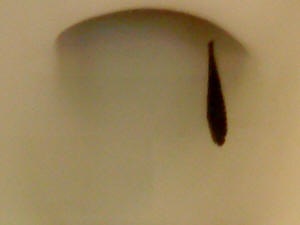
What could this be???!!! Hirudinean
8/10/09
We live in rural Midwest Indiana (farmland). My boys go down to the
creek and play in the water. (which has cow pastures nearby). Not sure
that has any bearing at all.... but I just discovered this THING in my
toilet!!!! I'm totally grossed out. It is dark colored, flat,....leach
like
Any idea???
<It's a leech. Most leeches are harmless, feeding on invertebrates and
the like. They are fascinating animals and you certainly shouldn't be
"grossed out" by these little marvels. Some will bite people for a blood
meal (a trait famously used in the past for "blood letting" but not used
as a therapy after certain types of surgery). How this leech got into
your plumbing is a mystery to me, but it is possible one your kids
picked a
blood-sucking leech up when playing, and the thing fell into the water
in the toilet bowl sometime later. It is very, very rare for them to
carry diseases that can infect humans. People who have been bitten by
leeches
typically have circular wounds on the skin with 3 distinct tooth marks.
If you're concerned, place the leech in a jar of water, take it to your
local medic to identify, and ask for assistance. Here at WWM we aren't
qualified to offer medical advice. Cheers, Neale.>
|
 |
Re: what could this be???!!!
8/10/09
thank you so much for taking the time to respond....and quick!
<My pleasure. Cheers, Neale.> |
Identify Worm 11/23/08 I live in coastal SC and I
kept my turtle tank outside during the summer and fall. I just
brought it in for routine cleaning and because of cold weather.
The tank had some strange "worms" that looked a little like
"naked caterpillars with long string-like tails." The ones that
were moving were a fleshy tan color. There were also some that
were black or dark brown and very hard. Some of them were in the
water but some were attached together by the "strings" and
hanging off of a rock in the tank. I have looked on many
sites and tried many different search terms but am not coming up
with an answer. Please help me identify this strange little
creature. Brandi <Hello Brandi. What you're describing is
almost certainly a "rat-tailed maggot", a distinctive fly larva
that inhabits stagnant water. The long "tail" is a breathing
tube. They're pretty much harmless, and in England at least very
common in small, unfiltered ponds. Fish (and likely turtles)
don't seem to eat them, or at least my fish don't! Cheers,
Neale.>
Little white worms in bathtub
10/14/08
I have been finding little white worms in the bathtub for about 5 days now. They
are maybe 1/8 " long with a brownish red head on them. They are all different
sizes sometimes smaller. I can't see where they are coming from. I looked in the
ceiling and can't find any evidence. please help me. <My gut feeling is
these are insect larvae of some type. Fly larvae ("maggots") often appear
worm-like and commonly have eyes or heads sufficiently distinct enough in colour
to look like what you are describing. Will likely be infesting some decaying
animal carcass or rotten organic matter (like wood) somewhere nearby. Look
around, initially working on the assumption the worms are falling downwards,
either from the ceiling or via the plumbing. Best advice is to collect some of
the worms and show them to someone qualified at identifying/controlling
household pests. Cheers, Neale.>
help! Little wormy things 9/25/08 Hello, I just
realized that in my baby guppy tank that there are these hair like worms that I
can barely see. They are always vertical and they squirm around like a snake.
Umm...they are white and they are about 1/8 of an inch. Are there any
medications? I don't want to lose all of my baby guppies. Please reply quickly!
-Sarah <Almost certainly harmless nematodes of some sort. They do thrive in
dirty tanks, so seeing them is more likely a warning that you don't keep your
tank clean than anything else. Cheers, Neale.>
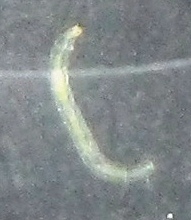
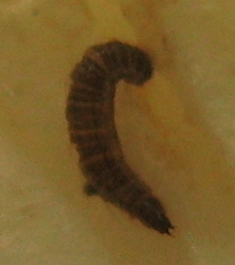
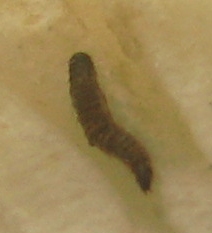
Worms 09/04/2008 Hi
I have a 29 gallon freshwater tank it is a fairly new tank only been up
for about 7 weeks.. I just got done battling ick on my swordtail fry and
then today I noticed these brown worm looking things on the glass of the
tank near the top ,but they were not in the water at the time I found
them they were actually just above the surface.. I wiped them off but
not sure if they are a worm or some type of insect larvae.. I have
attached 2 photos, not the best because they are very small.. I tried
looking it up myself but all I can find is references to white worms
which these are not white.. Are they harmful? I already did a 20% water
change while vacuuming the gravel today.. Thanks Trish <Hello
Trish. The "worm" in question appears to be an insect larva. Certainly
to my eyes it seems to be segmented and possesses small appendages of
various types. In other words, a maggot. No immediate threat to the
fish, but a good sign that there's a lot of decaying organic material
somewhere in or around the tank. Otherwise the parent fly (or whatever)
wouldn't have laid its eggs here. So time for an early spring clean!
Cheers, Neale.>
Re: worms 09/04/2008 Thank You.. I did
vacuum the gravel out today after finding the worm like things.. and
there was a lot of food in the gravel.. I didn't realize I was
overfeeding , I only feed them once a day but I guess I need to cut down
on the amount I am giving each day.. Thanks so much for your speedy
response. Trish
<Hi Trish. Overfeeding is easy to do, and much more difficult than to
under-feed! Remember the two golden rules: Firstly, little but often.
Snacking is better than gorging. The fish are more likely to eat all the
food, and they'll also extract more nutrition with less wastage.
Secondly, use the minimum quantity, and it should all be gone within a
minute (for the average greedy community fish). Remove anything
leftover; a turkey baster is a great tool for this, allowing you to
pipette out stuff without buckets or getting your hands wet. Cheers,
Neale.> |
 |
"Slash" our Oscar, concerns w/ "worms"
in the tank 8/12/08
we got an Oscar about 4 months ago, and he has come around pretty quick!
he is an amazing fish, as he is our first Oscar. he has had these little
"worm" looking things on the inside of the tank, they are extremely small,
and move around. they have not attached to him, and don't seem to be bugging
him, but they are driving me absolutely crazy!! we feed him a high grade
pellet food, and about 1-2 times a week he gets frozen treats like meal
worms, or brine shrimp. he is in a 55gal tank, with a power filter for 50-60
gal (up grading to a canister filter), we also do about a 30 % water change
weekly. I know its hard without seeing it, but what could these "worms" be?
and how the heck to we get raid of them!? thanks for the help!!
Desiree, Todd and "slash"
<The "worms" are most likely Planarians, in other words flatworms. They feed
on the food you've given the Oscar. As you know, Oscars are very messy fish.
The fine particles they produce get everywhere, especially if the tank is
inadequate and water changes are infrequent. In both regards, you're at
fault here: cichlids need BIG filters, and you should be using a filter
offering NOT LESS than 6 times the volume of the tank in turnover per hour.
Forget about the rating on the box telling you X filter is for Y sized
tank... these estimates are based on best-case situations where a tank
contains few, small fish, Neons for example -- not Oscars! You also should
be doing AT LEAST 50% water change per week, with the gravel cleaned on a
regular basis. It's the stuff you're not removing that the Planarians are
eating. While harmless in themselves, they're a "wake up call" telling you
of an underlying problem. Long term, excessive nitrate in the water will
lead to issues such as Hole in the Head that are a real bother to treat. So
please, upgrade your tank (too small for adult Oscars), upgrade your filter,
and step up the water changes. Do this and the Planarians should fade away
in time. Do see here:
http://www.wetwebmedia.com/FWSubWebindex/oscars.htm
Cheers, Neale.>
PLANTED TANK
WORMS - 7/24/08
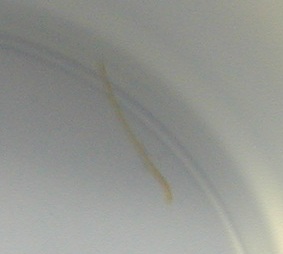
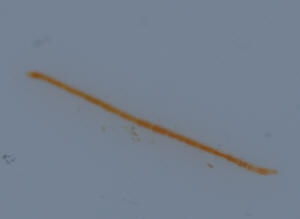
I spotted this tiny brown worm on three of my freshwater aquarium
plants this morning. Some are so small they look like dust. I
removed them all with a turkey baster. My research didn't turn up
anything. Can you identify them by the attached photo? Should I be
concerned? Thanks for any help you can give me. You guys do a great
job.
Bob
<Hi Bob. The photo is a bit small to say anything sensible, but my
guess (and that's all it is) is that this is nothing more serious
than some sort of insect larva. Common enough in freshwater
habitats, but usually get eaten by fish if they end up in aquaria!
In any event, very, very unlikely to cause any harm. If you're
concerned, remove them and feed them to your fish. I'd be tempted to
rear them in a small container of water just to see what they turned
into. They aren't mosquitoes or anything noxious like that. Cheers,
Neale.>
Re: PLANTED TANK WORMS
Thanks Neale!
<You're welcome, Bob.> |
|
 |
|
Worm Identification 4/17/08
Good Afternoon,
<Jerry>
I've searched the net and can't find an identification for what I've found. The
Agricultural Extension in my count cannot identify it either and they have the
only one of what I found. Here is a description of the worm and where it was
found.
The worms were each about 1 1/4 inches long and 1/2 inch wide. They rather
looked like an adult human beings thumb. They were of a dull grayish color. One
end was tapered and the other had a flat surface with a "lip," for lack of a
better biological term, all around the flat surface. The flat end vaguely
resembled what I've seen as the end of a tapeworm that has the hooks on it.
These were found in a small bottle of 6% acidity Balsamic vinegar that was in a
dark cabinet for about 3 years.
They appeared to be dead, but I don't know.
<Me neither... do you have a means of making, sending a micro-photographic
image?>
My agricultural extension said they were "vinegar eels," but when I checked on
line, vinegar eels are long and stringy looking.
<A general term for a few species of acid-environment nematodes... Some are
cultured as fish food for fry...>
The folks at the agricultural extension disposed of everything. I'm really upset
about this because, although I haven't every seen anything like this around the
house, they could be elsewhere and I'd like to know what I'm dealing with.
<Mmmm, not everywhere... But this phylum is very common in the biological
world... Take a read on the Net...>
By my description, is there anything that you can tell me. I very much
appreciate your efforts.
Thank you,
Jerry Ascione
<Can only guess... sans more information, image work. Bob Fenner>
Re: Worm Identification
4/18/08
Mr. Fenner,
<Jerry>
Thank you for your really quick reply. As it turns out, the agricultural agency
disposed of the "worm" after they took a biopsy from it, but they didn't tell me
that.
It turns out that it wasn't a worm. It was, as they called it, "Mother of
Vinegar."
<Interesting: A chemical/physical manifestation:
http://en.wikipedia.org/wiki/Mother_of_vinegar>
They agreed that at first glance it looked much like a worm and even had a
texture that would be consistent with that of a worm. But, it wasn't.
Again, thank you very much for your time.
Jerry Ascione
<Thank you for this follow-up. BobF>
|
Leeches in my
Discus Tank -03/28/08
I have attached a picture of what I believe to be leeches after much
research. They are living in the gravel of my fully planted 80 gal
discus tank. All water conditions are within specs for discus and the
discus and plants are growing like crazy. I have been feeding the live
black worms, do you think they could have come from them? What can I
do????? Please help.
Thank You
Deb
<Hello Deb. Yes, those are leeches. Contrary to popular belief, the vast
majority of leeches do not eat blood. They are certainly predators, but
they go after small prey such as insect larvae and molluscs. It is very
likely that the leeches you have are harmless towards your fish, and
most probably came in with the live food you have been using. A little
time spent with a book on native freshwater invertebrates will probably
yield sufficiently accurate identification for you to decide if this is
a safe species of leech or not. As a precaution though, you might elect
to remove them to another aquarium or pond. It probably goes without
saying that large carnivorous fish (e.g., puffers) will happily eat
leeches. Alternatively, why not set up a little "critter" aquarium just
for them and any other small beasties like shrimps and snails you
across? Such tanks don't need heaters or lights, and a sunny (but not
south-facing) windowsill is usually a fine location, allowing for some
floating aquatic plants and algae to be kept as a base for the food
chain. Such tanks are great fun, being more like reef tanks than
anything else. Cheers, Neale.> |
|
 |
|
George in Greece...
worms, copepod... ID 03/16/08
Dear Bob,
As you can see in the photo there are two types of worms and one type of
copepod (freshwater).
<Can barely make these out>
We are extremely interested in finding out the following:
a) species and if not, genus or even family.
b) are they harmful to fish (esp. fry)
Your response will be greatly appreciated.
George & Marina
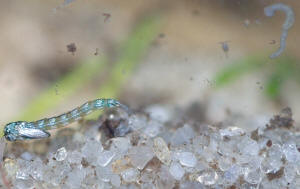
<The blue thing is obviously some sort of dipteran larva; the red
things perhaps small oligochaetes, but it's difficult to say. In either
case they're fish food rather than a problem!
Fish fry *might* be harmed -- I've lost baby Corydoras to planarians,
for example. But I suspect that the usual problem is that if the water
(or substrate) are "dirty" (bacteria-laden) enough to support these
small life forms, newly-hatched fish are at greater risk of fungal
infections. So in my case at least, the planarians didn't kill the
Corydoras fry, but simply attacked the moribund ones. That'd be my
guess, anyway.
Cheers, Neale> |
|
 |
Leeches???
Hi
<Hello>
I have had guppies for a few years and not experienced any problems. A few
months ago I added a small Pleco followed by two elephant nosed fish. Shortly
after introducing them to the tank I developed white spot.
<Hopefully your fishes... not you!>
I managed to cure this but lost a few guppies and one of the elephant nosed
fish. I since read up on the elephant nose fish on the internet where it said
not to keep them in pairs as the weaker one would be killed by the stronger.
<Yes, very often... particularly in small systems>
Since I have had all of these problems, I did a gravel clean and disturbed
only what I can describe as a leech. It was about an inch long, white and had a
sucker. At first I thought it was a dead fish. All of the info I have found on
leeches describe them as fairly small and I have not found any of this colour.
This leech (?) is bigger than some of my guppies. I cleaned the tank and a
couple of days later found another one. I know they can be introduced by new
fish...
<Or live food/s>
...but surely I would have spotted them when I bought them. How can I determine
that it is a leech and if so make sure there are not any more, I am really
unsure of what to do.
<Mmm, you could look at them carefully... leeches/hirudineans are pretty
distinctive... Take a look on the Net re: their superficial morphology... from
your description already, I am pretty sure this is what you have>
Can you please help?
Many thanks
<By thoroughly cleaning, gravel vacuuming your tank, you have very likely
removed all the leeches from your tank. There are chemicals that to a large
degree will poison just these worms... but I would not use them. Bob Fenner>
Freshwater Bristle Worm?
Hi,
I hope you can help me! I used to keep a marine tank about four years ago and
gave up and said that was it no more fish. Well now I have set-up a small
freshwater tropical planted fish tank, it has been running for about five or six
months now. My question is we have seen the fish go mad over a worm found in the
tank, it was about two inches long, alive and being eating by a small angle fish
and a Congo tetra. This worm was identical to the bristle worms we had in our
marine tank but did not think you could get them in fresh water is this correct?
<Yes> But how could it get there as we have not added any rock only dry gravel
plants and fish. And could these cause problems to the tank inmates?
< There are lots of little freshwater creepy crawlies that come into a
freshwater aquarium. Usually they come in as eggs or larvae attached to the
plants. They grow to a point until the fish realize that they are around and
soon become live food. Some become parasitic on fish but I think you would have
seen them by now.-Chuck>
Kind Regards
Grahame Brown
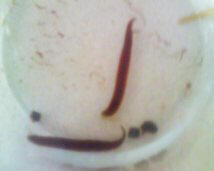
What worm be this? Planarian?
>>Good day, Michael, Marina to help you here.
>I started only 3 weeks ago and bought the following :
a.. 3 small fantail goldfish
b.. Plexiglas tank (4.5 gallons)
c.. air pump
d.. submerged power filter (mechanical filtration only)
e.. gravel siphon cleaner
I treat tap water by allowing to stay in a bucket for 24 hours and before
carrying out a partial water change I add dechlorinator.
>>Very good.
>I usually carry out water changes of 50-80% every day but I am planning to
build a Plexiglas tank of 70 gallons capacity and add another goldfish. Tanks
in Europe are very expensive -- I bought the 4.5 gallon tank for USD 68 (Euros
57).
>>Holy canoli!
>Once a week I clean the filter element of the power filter.
During the 3rd cleaning I noticed many small red worms in the filter element
which were clinging in the sponge and could not be removed by washing with tap
water. I fitted a new sponge element in the filter. The biggest worms were
about half an inch long -- please see attached photo. Can you please advise if
these worms are dangerous for my fish and how can I treat the water so that they
will not appear again?
>>The photo is not very clear, but I am guessing some sort of planarian. I do
not think they will pose any threat to your fish. I have not had any experience
with them, but I think that if you added some salt to the tank it would be
enough to prevent them. This is actually a help to the fish, and is helpful in
preventing or alleviating the incidence of some maladies. Use either Kosher or
sea salt (anything that has not been iodized--very common here in the States),
at a ratio of 1 teaspoon/gallon. I believe that one teaspoon U.S. = roughly
5cc. And 1 gallon (US) = 3.8 liters. I do hope this helps, and best of luck to
you in sunny Athens, Michael! Marina (in what is *supposed* to be sunny
southern California, but it's 62F and RAINING here! What first day of summer??)
What are these things?? More planarians?
Good evening crew.
<Good evening, Susan! Sabrina here>
I sent the following message Saturday but haven’t seen any answer as of
yet….soooo I thought I might try again. Know you all are busy but any help you
can give me would be much appreciated.
<I'm so sorry I wasn't able to get back to you last night; I've been battling an
illness in my wild angels and totally stressing about it, so I've been quite
preoccupied.... many apologies>
Since I sent the request I have been doing as much research as I can. I’m now
about 99% certain these guys are planarians and I know they are supposed to be
“harmless” but I also understand they will eat eggs.
<What I know/can find, planarians really are harmless, and I've never heard/read
about them eating eggs, but I'm certainly not positive about it. Can you
describe the worms? You mentioned in your original message that they were
white, flat, wider towards the middle, and about 3/4 of an inch long. The size
alone is suggesting to me that they may not be planarians, which (from my
understanding) are typically 10mm or smaller. Do they have a "V" shaped
head? That's pretty much a dead giveaway that they are, in fact, planarians.>
I would really like to get rid of the planarians before breeding my fish.
<I can certainly understand!>
Also, I inadvertently spread the problem to my 30-gallon community tank by
“seeding” the smaller tank with mature filter media from my big tank.
<Oh, ugh....>
This happened before I knew there was a problem in my 125G. I also forgot to
mention that we are on well water if it makes a difference.
<Mm, possibly, but I wouldn't think so. Worm infestations can happen in tanks
that use the best of water. Usually, huge amounts of worms are the result of
overfeeding, or otherwise excessive nutrients, and most often seen in predator
tanks, like yours (several large predatory cichlids, an electric catfish, and an
ever-messy plec, in a 125 gallon tank, yes?). Try cutting back extensively on
feeding for a while and see how that affects the worm population. Also, keep up
with hefty gravel vacuuming to see if you can pull some of the little suckers
outta there.>
I treat any new water (with Prime) before adding to the tanks. Even though we
test our well….you just never know. I have talked to the three LFS I patronize
and two advised Copper... NO WAY was I going to put this in my tanks.
<Ugh! No.... Avoid this desperately! Especially with your scaleless plec and
catfish. Bad LFS, bad! Deserves a swat on the nose!>
One finally suggested a fluke eliminator. But he was a little hesitant and
unsure so I haven’t done anything except vacuum and perform water changes in
both tanks and cut the food by ½.
<Ah, yes, perfect. Keep it up for a couple weeks, and see what happens with the
wormies. Also, I'd like to mention that I had the occasional planarian showing
up in my plant tank (well, lots of 'em, really), and they seem to have been
eliminated by a very minute amount of Fenbendazole (proprietary name Panacur)
that I used to rid my tank of (shudder) hydra. I certainly haven't seen a
single planarian (or hydra!) in a month or two. But then again, my planarians
were about 2-3mm long. Tiny. The Fenbendazole did not affect my bacteria bed
in the slightest, nor did it have any effects on any plants, shrimps, or
fish. It is usually sold as a goat-worming medicine, but can even be used as a
wormer for discus.>
My water parameters have not changed and all the fish are fine. I still have all
14 new Platy babies and they are growing like crazy. And I still have a
gazillion “creatures” that give me the creeps.
<Well, keep up with what you're doing, for the time being, and see if the worms
start to die out. I'd also like to mention our chat forum
http://wetwebfotos.com/talk/ as we have rather recently had another
fellow with a similar problem - perhaps you guys can compare notes.>
Thanks in advance for any assistance you can provide.
<Glad to help, and again, sorry for the late response!>
Planarians
Hello.
<Hi. Sabrina with you today.>
I have a 20 gallon cichlid tank with a Fluval 4 plus filter very good water and
pH, NO2, NO3, KH, GH.
<I assume ammonia checks out, too? Can you give us your test results for your
water parameters?>
Same problem back again with little white worm type things on glass front and
sides and back. Tried salt and methylene blue and they seemed to have
gone. Two weeks later they're back again, about 50 of them. When I have the
light off for a day they're all out on glass but soon as I turn the light on
most disappear only 5 or 6 left on tank front.
<These are probably planarians. Harmless to fish, these show up usually as a
result of overfeeding.>
One of my keyholes has red marks around face and did have a bit of fungus on
side fins but gone now with MelaFix, but red marks remain. All fish rubbing on
rocks and flat stone.
<All of this might be attributable to water quality issues/overfeeding - how
often do you do water changes? Gravel vacuum? Clean out the filter?>
Please can you give help on what they are and how to get fid of them?
<Do some good sized water changes, and some rigorous gravel vacuuming. Check
your filter and clean. Decrease the amount you feed your fish for a
while. This should all help reduce the amount of Planaria, if that is in fact
what they are. Basically, when their food source is gone, they'll be gone,
too.>
I don't know if they're parasites or something else. The worm things are about
1 cm to 1 1/2 cm long white thin body.
<Planaria are particularly easy to tell, with their classic "V" shaped head.>
Thank you for your time.
Planarians - Part 2
Good evening Sabrina
<Hello again, Susan!>
Thanks for responding so quickly! I do hope you are successful with your angels.
My research of turbellarian flatworms (freshwater planarians) indicates they can
be up to 1 inch in length. I was able to capture one of these little buggers and
compared it to pictures found at www.planarians.org and it looks like the
picture. Yes... they have a V shaped head (upside down V ).
<Yeah.... "V" shaped heads almost always mean planarian, IME.>
For now I am going on the assumption they are planarians and I am trying to
obtain some Panacur. However, I am a little uncertain about the dosage.
Somewhere on the Internet I read that the dose for hydra is 0.5 grams per 100
liters. What dosage did you use?
<Honestly, I used so little, I don't know the actual dose. Likely less than a
gram in my 72 gallon tank (filled to ~60 gallons). It took a couple of days to
wipe out the hydra completely, and I'm really not sure about whether it nailed
my little planarians or not, but I used to see 'em frequently, and since
treatment have seen none.>
Assuming that I treat both tanks this will work out to about 3 grams of Panacur.
Also, do you think I can safely use this in the tank with the Platy fry?
<Possibly, but if you can, perhaps wait a couple weeks for the fry to grow up a
bit, if you can, just to be on the safe side.>
I worked on the large tank some more today...moving rocks, vacuuming, cleaning
the pump lines and changing the water. Didn't see as many critters today, so
maybe I am getting them under control.
<Hope so! Sounds like you're doing a good job of reducing their chances of
getting a meal, so they may very well die out on their own. Give it some time,
and keep doing as you're doing, especially if you think you're seeing results
already.>
Thank you again for your help. Susan
<Glad to be of service! -Sabrina> |
Planaria, or Parasites?
I have 2 10 gal. tanks with feeder guppies that have been breeding. There
is a parasite in the tanks that looks like a clear, small leech. What do I need
to do to clear the tanks of these "leeches". Our local pet store told us that
these are probably beneficial parasites that the guppies will feed on, but this
information was supplied without their seeing the parasite. We have not seen
any of these on the fish themselves but on the sides of the tanks and in the
filter. Please advise.
<Well, if they're not attached to the fish, if they're only on the glass or
other areas of the tank, I doubt that they're parasites of any sort - "parasite"
means that it's something that attaches to or lives in the fish and hurts the
fish. What you have are probably Planaria. A planarian is a small worm,
usually just a few millimeters long, and are best identified by a "V" shaped
head - take a look at this: http://www.naparcd.org/planarian.htm
. The presence of these little wormies suggests an overabundance of "stuff" in
your tank that they are feeding on. To get rid of them, simply eliminate their
food source - more frequent water changes, being sure to vacuum the gravel, and
cleaning out the filter will help with this. They are essentially harmless, but
it'd be a good idea to clean up the tank a bit to reduce their numbers or
eliminate them completely. Hope all goes well, -Sabrina>
Janet
Small worms in freshwater tank (11/06/03)
<Hi! Ananda here this afternoon>
We have a 29 gallon regular fish tank, we have 2 angel fish and some small
plants, lately the water has started turning green and now we have some kind of
small worms on the inside of the tank and was wondering what they are and what
we can do about it?
<Well, the water turning green is an algae bloom. That's usually triggered by an
excess of nitrates and phosphates. To combat that, you'll want to do more
frequent water changes. Also make sure you aren't over-feeding -- if there is
any food your fish don't eat, it adds to the phosphates in the tank. You might
get a phosphate test (I like the SeaTest/FasTest one for freshwater) and some
phosphate remover (like Phosguard) if your phosphates are high even after
several water changes. Once you get the nutrients (nitrates and phosphates) out
of the tank, the algae should die off, and the worm population should decrease.
I'm not sure exactly what you have, but they are most likely not harmful for
your fish. --Ananda>
Lair of The White Worm!
Do you know anything about white worms. in freshwater tanks.
<These are Planaria. Planaria are flatworms and members of the Platyhelminthes
phylum. Planaria are often found in aquariums with uneaten food. The
Planaria won't hurt the fish, but they are a symptom of too much gravel
containing too much uneaten food, and that is not good for fish. You
should do a water change and vacuum your gravel to help remove the uneaten food
and some of the worms. Doing this will reduce the number of worms in your
tank. Good luck -Magnus>
White Worms, and a Bit More Info - III - 02/10/2004
Ok I put some food in the tank and the lobster never ate it. So I got worms
from uneaten food. Now there are a lot of white worms in my tank little white
ones.
<With this as the most (only) information that you've given us, I can guess that
you probably have some sort of nematode or Planaria infesting the tank.... not
so much a direct threat to the crayfish or other inhabitants, but a sign of less
than adequate husbandry.... Do not overfeed, be sure to remove uneaten food,
change water regularly, vacuum gravel properly, change filter media as
necessary.... basically, remove the food and nutrients that is fueling these
worms, and they will gradually die off on their own. On such little info,
that's the best I can give you. I hope it helps. Wishing you well, -Sabrina>
White Worms In Gravel
Hello, I have a 55 gallon aquarium and have noticed small white worms in my
gravel.
The fish I have in the tank are guppies and two Plecostomus. I have had no
problems until now and just need some advise to get rid of them. Thanks, mike
<<Dear Mike. It sounds like Planaria, in which case, you will also see them on
the tank glass. This is generally caused by overfeeding. Cut back on the
feeding, vacuum your gravel with each water change, and this problem should
rectify itself quickly. Some fish, like gourami's, will eat Planaria. However,
you do need to be careful to keep your tank clean, and keep up with your regular
partial water changes. HTH -Gwen>>
Re: Tiny white worms in my aquarium - II
Hi Gwen,
Thanks for the info. I don't think I've been getting deep enough into the gravel
when vacuuming, even though my water changes have been several each week, approx
20% each time, I think I will have to vacuum more thoroughly. I saw a
cardinal tetra eat one of the worms that I knocked off of the glass when
cleaning tonight. Thanks so much. Mark.
<<Mark, you are most welcome :) -Gwen>>
I think I have Worms
Hey, AGAIN sorry to be such a pain I realize yo u guys got lots of letters.
Anyway I got these worm like things in my tank well they look like very very
tiny maggots all most they are like 3 mm long and very thin are they parasitic?
please get back to me.
Thanks for reading, Aaron
<<Dear Aaron, they sound like Planaria. Are they on the glass? Is this a
freshwater tank? This is generally caused by overfeeding and improper
maintenance. Try to cut back on the amount of food going into the tank, and make
sure you vacuum thoroughly with a siphon when you do your water changes. Once a
week is a good idea, specially till your worms go away...which they will when
they no longer have a food source. -Gwen>>
Strange red worm like thing
Hello <Hey Lukas, MacL here with you on this fine day.>
Lukas here. I have recently observed a odd looking red worm like things at the
bottom of my 90 gallon and on some of my plants in my Betta enclosure. It seems
to be growing at the top of the Betta tank on some plants. <Sounds like algae to
me.> But in my 90 gallon its at the bottom around the gravel. I try to suck
this stuff up when I do my water change but it keeps coming back. If you need a
pic I can get you one on Tuesday. <Pictures definitely help, send it to me if
you don't mind.> What is this stuff and is it bad for my fish? Thank you L
White worms crawling on the glass of my aquarium
I have a 90 gal. tank with four discus in it which is also planted. I have
noticed what appears to be small white worms crawling on the glass and swimming
freely, can you tell me what they are?
<Not specifically... as in down to species. But I assure you, these are likely
some sort of innocuous earthworm-like animal (oligochaete annelid) and not
harmful to your fish or system. These sorts of critters "pop-up" quite often,
particularly in aquariums that have excess food, too little
circulation/filtration... and very often "disappear" of their own accord. Do
keep your eye on water quality and in time you will likely find they have gone.
Bob Fenner>
FW worm 6/23/06
Hi Bob. I have a tank with an African brown knife, mollies, ghost cats. This
morning I saw what appears to be a tiny, tiny black worm crawling at the
bottom of my tank. What can this be?
<Mmm, could be an oligochaete (something akin to an aquatic earthworm)...
even a hirudinean (leech)...>
Everyone is eating & appears healthy. Water is good. Thanks!
Diana
<What is that Ted Nugent lick? "Where in doubt I take it out... it's a free
for all"... I would remove this mystery creature just in case. Bob Fenner>
Not urgent. Calcium, and worms. 11/01/06
Hello Crew!
<<Hi, Rachel. Tom>>
I know you're all terribly busy, and this isn't terribly important, so please
feel free to skip over this one!
<<Can’t do that Rachel. Your’s is important to you which makes it important to
us.>>
I have a 2.5 gallon tank with a 25-watt heater, 10-watt fluorescent lighting,
and in-tank Whisper filter set on low, in which I keep a spoiled-rotten Betta of
about a year and a half old. The system was started about a year ago, and was
moved/remodeled two months ago. About a month ago I added a Java fern and some
red Ludwigia. I added a lovely blue mystery snail (Pomacea bridgesii) a week
ago, and he is doing a remarkable job on eating the algae (working on getting
the plants to thrive instead!).
<<I completely understand…>>
Temperature is 80, ammonia and nitrite 0, nitrate usually under 5 now since
adding the live plants... I think the pH is 7.4, though I'm not at home right
now to look it up. I try to do 25% water changes every week or two, though I've
been lax lately.
Anyhow, my water is on the soft side, and the snail's shell is already looking a
little worn. I am planning to add "something" to the tank for calcium. I've
heard of crushed coral or marble. However, since I also keep a cockatiel, I have
cuttlefish bone handy as a source of calcium for the bird. Could I put a
well-rinsed (and obviously unused) piece in the aquarium?
<<I’ve not run across this for aquatic snails but I have for land snails.
Frankly, I find it a good option to try especially given that your pH is already
at ~7.4.>>
And how big a chunk are we talking?
<<Try a piece with a surface area of about one square inch, or so.>>
The bones are about five inches long by two or three inches wide, half an inch
thick, and can easily be snapped into smaller pieces. Was just planning on
tucking it behind a rock somewhere with a little water flow to help it dissolve.
Right?
<<You might find that your snail will actually “feed” on the bone as land snails
do. (I’m somewhat curious about this myself.) Obviously, you’ll want to monitor
pH levels though I don’t believe that this should prove to be a problem.>>
Secondly, I've noticed "the little white worms" floating around and wiggling on
the tank walls. White, threadlike, about 1 cm long. I had these once maybe nine
months ago. Up until yesterday I was assuming they are harmless Planaria, and I
was stepping up the water changes as I know these are a sign of excess
nutrients. However, yesterday I noticed Terrence the Betta eating them as they
floated by. If they're just free-living Planaria I'm pretty sure this is
harmless, but is there any
chance these could be parasitic worms which Terrence has passed and he is
re-infecting himself somehow?
<<Parasites, by definition, require a “host” in order to survive. In all
likelihood, they’re Planaria.>>
His feces are never stringy-white, but very occasionally his normal feces will
include some little clear sections that look like mucus. I believe I'm just
paranoid, but better safe than sorry! He is acting quite normally, swimming
around, flaring and nipping at the snail, eating voraciously -- he has even
started to pick at the algae wafers for the snail, and will steal them out from
under him!
<<Don’t be overly concerned about the occasional clear sections in his feces.
This isn’t uncommon or an indication of a problem any more than a very
occasional sneeze means you’re getting a cold. Just happens…>>
Thanks for all your hard work!
Rachel
North Carolina
<<Thank you kindly, as well, Rachel. Best regards. Tom (Michigan)>>
Round worms in swimming pool 12/11/06
I know this isn't a typical question you get... but.. thought you may be
able to help.
We have a salt-water swimming pool and we recently noted 2 worms in the pool
we've never seen before.
They were about 7-10 inches long, round (not flat), very very thin (think 0.5mm
pencil lead). They were swimming just fine in our hot tub - the water was not
hot. When we brought them out of the water, they flip flopped around somewhat
spastically with both ends moving independently. There were a brown-ish/yellow
color. Their skin/skeleton was quite "crunchy" when we tested to see how tough
it was. :)
Any idea what this could be?
-Bruce
<Mmm, as you state, could be Nematodes... if you have a good magnifying loupe,
you could cut through (make a coronal section) through the esophagus (just a bit
back from the head...) and look/see if this is tri-radiate (three-sided)...
diagnostic for the Phylum... could be Horsehair worms... other "wormy"
possibilities. Not toxic, or dangerous to human health assuredly. Bob Fenner>
FW Plant Leech 03/23/07
Hi Crew! Hope all is well with you, you've helped me so much in the
past. To make a long story short, I have a 10 gallon tank that has been
used as a plant refuge for when I thin plants out of the aquariums. I
throw them into this tank. At one time the tank was a failed attempt to
raise daphnia, I never cleaned it out after that, just started throwing
plants into it. After a few months I was given some cherry shrimp that
were too small to go into the main tanks, so I put those in there. When
I added the shrimp I put in a sponge filter and heater. I don't perform
routine water changes on this tank. This tank has been a fascinating
biological experiment of sorts because it has a blanket of live
blackworms now that must have accidentally come in there on plants. (I
feed the fish live blackworms a couple of times a week.) The tank is
full of shrimp that have bred like crazy and hitchhiker snails. The
water is green, and amazingly there is no algae in the tank, whatsoever.
However, it is time for me to transform it into a usable tank and I was
thinking of putting a couple of killies and a group of sidthmunkis in
there, of course making sure the parameters are good first. I really
wouldn't want to see all of this "food" go to waste. Sound like a good
idea? Probably not... But anyhow, I also have these in my tank. Do
you have any idea what they are? Are they good slugs/flatworms? Or bad
slugs/flatworms? Should I just forget my dream of giving some lucky
fish the feast of their lives and clean the tank out before I introduce
any fish into it? Thanks!
Take care, Mary.
< This is a typical FW plant leech. Fish don't eat them but they really
aren't much of a problem.-Chuck> |
FW Plant Leech 03/23/07
Hi Crew!
<Hello Mary!>
Hope all is well with you, you've helped me so much in the past. To
make a long story short, I have a 10 gallon tank that has been used as a
plant refuge for when I thin plants out of the aquariums. I throw them
into this tank. At one time the tank was a failed attempt to raise
daphnia, I never cleaned it out after that, just started throwing plants
into it. After a few months I was given some cherry shrimp that were
too small to go into the main tanks, so I put those in there. When I
added the shrimp I put in a sponge filter and heater. I don't perform
routine water changes on this tank. This tank has been a fascinating
biological experiment of sorts because it has a blanket of live
blackworms now that must have accidentally come in there on plants. (I
feed the fish live blackworms a couple of times a week.) The tank is
full of shrimp that have bred like crazy and hitchhiker snails. The
water is green, and amazingly there is no algae in the tank, whatsoever.
<Because it's balanced. In balanced tanks, the rate of algal growth is
checked by the growth of plants and predation by algae-eating animals.
In aquaria (and ponds, and eutrophic waters in the wild) the balance is
lost, and often the algae prosper because their natural limiting factors
are taken away.>
However, it is time for me to transform it into a usable tank and I was
thinking of putting a couple of killies and a group of sidthmunkis in
there, of course making sure the parameters are good first.
<You'll lose almost all the fun, I suspect. To reach a balance with
fish, you need a *lot* of water volume per fish. Look for a copy of the
excellent book "Dynamic Aquaria" for a scientific (and highly detailed)
investigation of balanced aquaria with complete ecosystems. Certainly
possible, but very challenging if you include fishes, miles easier with
just inverts.>
I really wouldn't want to see all of this "food" go to waste. Sound
like a good idea? Probably not... But anyhow, I also have these in my
tank. Do you have any idea what they are? Are they good
slugs/flatworms? Or bad slugs/flatworms? Should I just forget my dream
of giving some lucky fish the feast of their lives and clean the tank
out before I introduce any fish into it?
<Those are small leeches, annelid subclass Hirudinea. Now, the vast
majority of leeches are predators on invertebrates. Very, very few are
bloodsuckers. But obviously those that are can be very damaging to fish,
particularly very small fish. Identifying leeches to species level is
difficult, and definitely a job for your friendly neighbourhood
freshwater ecologist or parasitologist. Identification beyond subclass
level is below me, I'm afraid! In the meantime though, don't kill it out
of hand. Leeches are lovely animals, and if you can encourage it to go
swimming you will be treated to one of the most beautiful little
spectacles in the animal kingdom. They also have a very cute "inchworm"
mode of walking. The sucker at the front (blunt end) is armed with teeth
with which it catches its prey, and most species suck up the "juices" of
whatever they've caught either directly or through a neat little stylet.
You can also see the digestive system quite nicely in your photo, too.
All in all, charming, if weird, animals.>
Thanks!
<No problem.>
Take care,
<Will certainly try! Neale>
Mary. |
|
 |
Dear Brandon,
<Hello again Jason.>
I know putting the BTA in my 180 gallon was a bit premature however
its
previous 55 gallon tank had sprung a leak and I had to transfer it over.
<You gotta do what you gotta do. I was just illustrating that these
animals need established systems that's all. Further, I suggested that you
read up on the care of these critters, because you seemed shocked by what is
an ordinary occurrence.>
Most of the fish I was able to store in my QT tank however I did not
want to combine
the BTA in that small an environment as it is crowded already with the
fish.
<Likely a stressful event.>
My question is what should I be looking for in the anemone to see if it
is
doing O.K. or if it is in distress?
<Droopy mouth, staying closed all the time, turning to goo.>
The water levels are normal 0 ammonia, 0 nitrates, ph 8.4
<Nitrite, Calcium, Alkalinity?>
The tank has 3- 250W MH with 2 rows of actinic bulbs, a 30 gallon
trickle
sump and a 2- gallon mud refugium with mangroves.
<Interesting setup.>
Thanks again,
<You are welcome. Brandon.>
Jason
QA@aquaticeco.com
Date: Thu, 22 Mar 2007 16:25:34 -0400 (EDT)
Hello
This is a Quality Assurance message to check on our level of customer service.
On 03/17/2007 12:06:38 we received a message from you through our support
center.
This message is to make sure your question was answered to your satisfaction and
give you an opportunity to let us know.
We appreciate your business and look forward to serving you in the future.
Please reply to this message if you wish to comment on our level of service.
Our Regards,
AES Customer Support Staff
<Mmm, still waiting for a call-back re your marketing... Bob Fenner>
Re: shark rehabilitation/release/placement
Thank you Bob,
I wasn't sure that you would be for such an undertaking.
<Mmm, oh yes. To be clear, I am all in favor of what preserves life, the
environment that allows such... Your efforts are confluent with mine, our
philosophies match>
You may use my letter, but please remove Wildlife World Zoo and Brian Joseph's
name, as I have not asked his permission to have his name on a chat site just
yet. When we get this going, we will come up with some formal name for your
viewers who might be in need.
<Ahh... would you please send along the original? Per your request I deleted our
correspondence>
I would like to contact those other organizations that you mentioned. I guess
that I should be able to find them on the internet?
<Oh yes... they are as stated... place the info. in your search tool/s>
Thanks again. I have Scott's book. It is fantastic.
Will keep in touch.
Sharmie
<I look forward to this. BobF>
"Bruce Ulmer"
<bruce_ulmer@casco-group.com>
Date: Wed, 21 Mar 2007 08:09:14 -0700
Hey Bruce! Very nice piece... Do you have this in a format that we might post on
our sites? And great to see at least the UK has an aquatics trade 'zine... Hope
trust you enjoyed your stay in the UK... Brrrrr! And that all is well with you,
your health. Cheers, Bob Fenner>
Bruce Ulmer
Senior Vice President
CASCO Group, Inc.
17719 Valley View St,
Cerritos, CA 90703
714-522-8373 ex 202
714-562-6502 Direct Line
800-537-3415 ex 202
714-690-9273 Personal Fax
bruce_ulmer@casco-group.com
<mailto:bruce_ulmer@casco-group.com>
http://www.casco-group.com <http://www.casco-group.com>
Hi Bob,
I'll find out if we have something you may use. How have you been?
<Fine my friend, thank you>
I enjoyed my time in the UK but you are so right...too damn cold. :)
Bruce
<Heeee! I do hope to see you about someday soon. Cheers, BobF>
Bob, leave here: Call on
OmegaSea Marketing 3/20/07
Dear Bob Fenner,
I'm not sure if you're the person I need to speak with but I am the
new head of marketing at OmegaSea, Ltd (OmegaOne fish foods) and I
wanted to first off introduce myself as well as try and get in
contact with the appropriate person to discuss our advertising on
your site. I believe we have done so in the past.
If you could give me a proper contact it would be much appreciated.
Thank you,
Rachel Latina
Graphic Designer/Head of Marketing
OmegaSea, Ltd
rachel@omegasea.net
<Pleased to make your acquaintance Rachel... Tis I or Mike Kaechele you likely
want to chat with. Have you seen the banner we made/placed for Omega Sea? Your
time in advertising was pre-paid and ran out the middle of last year... We've
continued it as a courtesy, promotion of our new Banner Ad program... Please see
here if you'd like to continue in some capacity:
http://www.wetwebmedia.com/WWMAdminSubWebIndex/wwmsponsors.htm
Cheers, Bob Fenner>
Aquatic Eco-Systems 3/20/07
Hello
Thank you for checking with Aquatic Eco-Systems. Your email has been forwarded
to our marketing department. Please let me know if I can be of further
assistance.
Best regards
Kevin Quinn
M.S. Zoology
Aquatic Eco-Systems
2395 Apopka Boulevard
Apopka, FL 32703
<Thanks Kevin... I will wait a few days and give a call there. Bob Fenner>
www.aquaticeco.com
407-886-3939
Fax 407-886-6787
Hello my name is Bruce you may direct your advertising inquiries to myself.
Thanks,
Bruce Vizueta
<Oh! Bruce. Should I give you a call? Would you make known what time might be
best? Have you perused our outline/offer, with links to our stats servers here?:
http://www.wetwebmedia.com/WWMAdminSubWebIndex/wwmsponsors.htm
Am an old timey aquarist/lake management type... who used to buy from you folks
way before your interest in more ornamental aquatics... Look forward to chatting
with you, Bob Fenner>
Market Analyst
Aquatic Eco-Systems, Inc.
2395 Apopka Blvd.
Apopka, FL 32703
Phone: 407-886-3939
Fax: 407-886-0800
Re: Ben, Ken? About your Overall Marketing, your Website, It's
Promotional/Advertising Potential
Hi Bob,
Can you tell me the stats of the site? Can you forward the weblogs?
<All posted here:
http://www.wetwebmedia.com/WWMAdminSubWebIndex/wwmsponsors.htm>
Also, would you be interested in an affiliate set-up?
<Mmm, don't see the particulars of this proposal on your site>
What number can I call you at to discuss?
<858 549 XXXX. Bob Fenner>
Wayland
"US Tetra Consumer"
<Consumer@tetra.net>
Date: Tue, 20 Mar 2007 13:55:06 -0400
Hello Bob,
I am going to forward your email to Linda Staley, but I'm not sure if
she is the right person or not. If so, she will contact you.
Otherwise, she will forward you on to the correct person in marketing.
Regards,
Tetra
<Thanks much. Bob Fenner>
-----Original Message-----
From: Bob@WetWebMedia.com [mailto:Bob@WetWebMedia.com]
Sent: Saturday, March 17, 2007 12:52 PM
To: US Tetra Consumer
Subject: TW -- General Contact Us Request
A Contact Us email has been sent from the Tetra Site. Here is the
information.
Email: Bob@WetWebMedia.com
Message:
Whom might I contact there re your Website advertising?
"Euro-Reef, Inc. Marketing Group"
<er.marketing@euro-reef.com>
Reply-To:
<er.marketing@euro-reef.com>
To: "'Robert Fenner'"
<By Bob Fenner>
Subject: RE: The Big Island... Notes to Bob and Jeff
Date: Tue, 20 Mar 2007 10:40:15 -0700
Hi Bob,
I passed the Kona info to Robert and Jeff for their vacation, thanks very much.
Looks like a go from this end on our ad deal, yeehaw! Please invoice us and
fax or email it to Jennifer Macare er.admin@euro-reef.com
<Yay! You can use PayPal, or I'll bill you folks in arrears... The addy?>
Also, Jeff will get you our banner and static logo to place on your site.
<Am looking forward to it!>
The Kona house looks awesome and I will contact Pete to get an idea of rental
fees and calendar for available time. If I can afford it I would rather give the
money to someone I know than the Hilton Hotel!!!
<Am in total agreement... My principal raison d'etre for buying such places...
Makes me go there... and I am "forced" to enjoy myself!>
Thanks for the free stay offer and I might take you up on that if I come up
alone or with my lady friend sometime.
Let's get this ad campaign reelin' and a-rockin"!
<I'll say! Bob Fenner>
Sincerely,
Rene Macare
Dir.of Marketing
Euro-Reef
ph:(949)770-9913 x16
fx: (949)770-3099
www.euro-reef.com
From: "Euro-Reef, Inc. Marketing Group"
<er.marketing@euro-reef.com>
Subject: RE: The Big Island... Notes to Bob and Jeff
Date: Mon, 19 Mar 2007 14:42:40 -0700
Bob thanks again for your time on the phone today. I mistakenly called your Kona
home number thinking I would reach you in San Diego....OOPS! I do not have your
local home number but here is what I need form you for us to make a decision
today on the ad:
<Oh, our SD number is 858 549 XXXX for your records>
You mentioned a two for one deal but no specific cost related to that. To be up
front it may be easier to let you know what our budget is that we have to work
with and we can get for that. We are looking at $300 max per month at this time.
We will monitor the success (ROI) from this and decide if it makes sense to
throw more $$$ at it as we grow our business.
<The offer I make is the right shared border (the "static" ad space of 100 by X
pixels...) PLUS the Rotating Banner Ad (468 by 60)... For the low, low price
of... what you're offering... the Three Hundred U.S. per mo.>
Thanks again for your help with this and for the great Kona info as well!
<I do hope we can/will all make it out there sometime soon. Oh, forgot Pete's
email last time... He's cc'ed above...>
P.S. - Bob, when you have a moment can you provide me with the contact
name/phone number or email address to get info on your house rental fees etc.
<Ah yes... the Jabulani addr. there above... and his phone: 858 722 XXXX...
FWIW, you're welcome to come out sometime when I'm there (go out every few
months, generally for a month or so at a time, more if folks will be coming to
visit/stay) for free... Do keep in touch re times...>
I am planning to head out to Hawaii sometime later this year with my girls and
my girlfriend (the plein air painter) and son may join. Is there is
web site with info on the house or can you tell me a little about the location,
number of bedrooms, sleeping room, etc., have any pictures? Thanks a bunch!
<Oh, the house, addr. can be seen here:
http://www.wetwebmedia.com/holualoaproperty.htm
BobF>
Sincerely,
Rene Macare
Dir.of Marketing
Euro-Reef, IncT
ph:(949)770-9913 x16
fx: (949)770-3099
www.euro-reef.com
Subject: The Big Island... Notes to Bob and Jeff
Hey Rene! Thank you for taking the time to chat this AM... For your kin's
upcoming visit:
Do make sure to pick up a cooler either at the King's Shops or Costco, Kmart,
Wal-Mart... these are great places on the Big Island... for packing sodas et al.
during your stay... going to, from the hotel... Though is a haul over the rough
hallways there at the Hilton in Waikoloa... Maybe two coolers.
While you're there, do call on Gerald Heslinga (if he'll see you... he's more
than a bit of a recluse) at Indo-Pacific Sea Farms... and Carol and Craig at
OceanRider (they're listed in the local phone books)... down at NELHA (just
south of the airport/Keohole...
Make sure and get in a "pizza night" down at Kona Brewing Company... in town
(Kailua Old Industrial)...
And the usual pitches for nice beaches... Hapuna (public) and Mauna Kea's
(private, go early to get a parking placard... it's free otherwise)... Up
for adventure? Got to make a run down to Kilauea Volcano Park... a day or so
at Hilo's waterfalls et al... (do bring some lightweight rain gear if you have
it... and flashlights if you're going to stay till dark to see the lava...
And Waipio... a haul but real fun...
And Parker Ranch has many attractions for young folks... Do look in "101 Things
to do on the Big Island"... a circular at the Airport... esp. for the coupons
for discounts, two-fors...
And don't be shy re asking the locals what they do, where they eat et al...
there are many great things to experience there... I will be out (at "A" Bay
just south of where you're staying) for the Lavaman tri, but leaving
unfortunately a day ahead of your arrival... Do send along your cell numbers (I
don't have one...) and I'll call you if I extend. Our house number there is 808
331 0889. Cheers, Bob Fenner
Dear Brandon,
<Hello again Jason.>
I know putting the BTA in my 180 gallon was a bit premature however its
previous 55 gallon tank had sprung a leak and I had to transfer it over.
<You gotta do what you gotta do. I was just illustrating that these
animals need established systems that's all. Further, I suggested that you read
up on the care of these critters, because you seemed shocked by what is an
ordinary occurrence.>
Most of the fish I was able to store in my QT tank however I did not
want to combine
the BTA in that small an environment as it is crowded already with the
fish.
<Likely a stressful event.>
My question is what should I be looking for in the anemone to see if it
is
doing O.K. or if it is in distress?
<Droopy mouth, staying closed all the time, turning to goo.>
The water levels are normal 0 ammonia, 0 nitrates, ph 8.4
<Nitrite, Calcium, Alkalinity?>
The tank has 3- 250W MH with 2 rows of actinic bulbs, a 30 gallon
trickle
sump and a 2- gallon mud refugium with mangroves.
<Interesting setup.>
Thanks again,
<You are welcome. Brandon.>
Jason
Thin Clear - Whitish Worms -
Nematodes/Planaria 7/21/07
Dear WWM,
<Andrea with you tonight, Jean>
Today I had noticed a several thin, clear, whitish worms crawling up the side
walls of my 6.6 gallon freshwater aquarium tank (visible by a bright aquarium
light).
<Planarians or nematodes, most likely. Sign of overfeeding. Cut back to once
every other day, only what your fish can eat in about two minutes. Net out any
uneaten food remaining.>
Once a week, I maintain my tank by vacuuming the gravel and performing a 20
percent water change. I always premixed my water with aquarium salt and stress
coat, a night or two before I perform my tank maintenance.
<Fantastic regimen. You can dump the salt, it is worthless as a tonic, and can
actually harm some fish. I prefer Prime as a water conditioner. Less used per
water change, and no additives other than what is needed for neutralizing
chloramines/chlorine from tap water. Prime is a great product. I highly suggest
it.>
Recently, I treated my Betta with Jungle Parasite Clear because he had
contracted a parasite. This parasite problem was due to me feeding him live
black worms, which I stopped feeding him.
<Shame. I bet he loved the live feeders. Don’t discount them in the future as a
treat. Bettas love them. Perhaps another live feeder provider?>
My question is, can those thin, clear, whitish worms crawling up the side walls
of my tank be a parasite? <Not likely.> Is this dangerous to my Betta?
<He will likely eat them. Not a danger.>
If so, how can I get rid of them?
<Reduce feedings, water changes, deep gravel vacuum.>
Treat my tank with Jungle Parasite Clear again? <No, unless the fish is sick.>
Please give advice. Thanks again for all your help; your site is the greatest.
<Anytime, we are here to help!>
Jean
What are these tiny brown worms in my 10
gallon aquarium? 7/21/07
Hi my name is Donna, I've had my 10 gallon fish tanks for about 3 yrs I was
changing the filter tonight and I noticed a couple of little brown looking worms
that are located on some of my artificial plants that I let float in the top of
my tank for my baby guppies to hide in are they dangerous to my guppies and
platies ? what are they ? and how do get rid of them ? should I completely break
down my tank I was hoping to be able to wait a couple of weeks before breaking
down my tanks until my new mobile home is set up so could put all my fish in my
55 gallon will my fish be ok till then ?
<Hello Donna. These worms are almost certainly planarians. These are usually
flat and liver-coloured, and around 5 mm long. The slide along things rather
than wriggle. Sometimes they slide along the surface of the water. They are
harmless, although they will eat fish eggs and are a nuisance in tanks where
egg-laying fish are being bred (been there, done that!). Otherwise all they do
is eat microscopic organisms and detritus. In a tank with guppies and other
livebearers they are harmless. Besides, getting rid of them is difficult and
only worthwhile if they cause a problem. Some fish will eat them (paradise fish
are famous for this). They're interesting animals and worth reading up on when
you get a chance. Cheers, Neale>
|
Red Worm ID (Royal
Plec)... Insect 11/19/07
I've had a 3 1/2" Olive Royal Plec alone in quarantine for 10 days
or so. I dewormed with Praziquantel last week at the recommend dosage
(76 mg/10 g) as I know they're wild caught and don't want to pass
anything onto my own fish. He went into a 20 gal tank with new aged
water and a fully cycled Penguin 280 bio-wheel filter from another tank.
I did his 25% water change today (after leaving the Praziquantel in 5
days) and found these live red worms (pic attached) in the water I
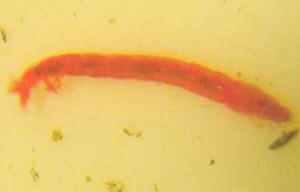
syphoned off the bottom of the tank. Pretty wiggly and entertaining
under the microscope but I can't figure out what they are via the FAQ's.
If they weren't alive I'd have thought they were frozen bloodworms.
I'm hoping it's a harmless worm that can be treated as the Plec is
eventually going in with my much loved Severum. I promise not to bother
you anymore, but maybe the picture will help others.
Mitzi
<Looks like a chironomid larva (a.k.a. midge larva or bloodworm) to me.
Probably got in with some live food. Usually get eaten by fish, so not
common in aquaria. But if this tank was empty for a while, then it's
possible a midge laid some eggs there. In any case, harmless. Cheers,
Neale.>
Re: Red Worm ID
(Royal Plec) 11/19/07
Thanks, Neale. I feel stupid then but thankfully that's good news. I
never feed live food, but the driftwood in his tank had been soaking for
a month in a large kiddie pool outside. I rinsed it off real well but I
bet that's where the bloodworms came from. (The tank had been empty and
stored before he went in it).
What a relief!
Mitzi
<Mitzi, Glad we have a happy ending here! Cheers, Neale.>
|
|
 |
Worms in fresh water aquarium
11/29/07
Hi WWM
My sister has a fresh water Aquarium which she just cleaned out on the weekend,
and a few days later we have noticed these worm like creatures in the filter
tubes no where else but in them. They have small legs and are hatching out of
these things that look like cocoons and if you look carefully at them they have
small mouths. There very disturbing to look at and gross us out. There's so many
of them please help!
Jessica
<Hello Jessica. Without a photo its impossible to say what they are. But given
they have obvious limbs and mouthparts, one must assume they are some sort of
insect. Aquatic insects vary in their danger to aquarium fish: most are simply
fish-food, but a few, particularly dragonfly (Odonata) and beetle (Coleoptera)
larvae, can turn the tables and will catch and eat small fish. If you can send a
picture, we can try and identify your visitors with a bit more precision.
Cheers, Neale.>
Is this a
worm? FW polychaete of size! 2/10/08
Hi there,
I have a freshwater tropical tank with 13 guppies, 3 fry, 2 Corydoras
and 2 Bristlenose in an 80 litre tank (2ft wide, 2ft high, 1 ft from
front to back). It is planted with java fern and one wisp of wisteria.
There are also small snails that have arrived with earlier plants.
I do a 25% water change each fortnight and the water parameters stay
fine, though the PH runs a little on the high side. The adult guppies
are from fry dropped by an earlier batch of fish that were lost to (I
think) columnaris.
One or two earlier males also went from dropsy.
I suspected parasitic problems last October, the fish were a bit
listless and had pale faeces. There were a few casualties and I treated
with Para-ex (20 mg Trichlorphon). This sadly killed our original
Bristlenose and our baby Corydoras but the guppies have gone on well
aside from the occasional undiagnosed fatality.
One month ago I bought 2 more Bristlenose to replace the original and
help keep the tank clean (we were getting increased algal growth). This
has been the only introduction to the tank from outside for approx. 6
months. Yesterday, while doing the water change, I was disturbing the
gravel to syphon out waste matter when I unearthed a wriggling worm type
creature. I attach a photo. It is about 4 cm long and wriggles in the
way of a snake. It has a multitude or what look like legs along the
length of its body. There are 2 discernible eyes under magnification.
What is it? Is it a danger to the tank? How do I treat/cope with it?
A suggestion was made that I get a couple of loaches to hopefully eat it
(and its offspring?) as a 'natural' form of management (rather than
treat with Para ex again and have to try to manage the health of the
Bristlenose) but I am concerned that they are a more aggressive fish
than my current inhabitants. Or is it not a parasite at all?
I am concerned for the state of my tank, particularly given the size of
this creature and my assumption that it's not likely to be the only one.
Any advice or info would be gratefully received.
Sharon
<What you have there is a freshwater polychaete. It is no risk to your
fish and will not be carrying parasites. So the appearance of this worm
and the death of your fishes are entirely unrelated. Freshwater
polychaetes are comparatively uncommon; they are overwhelmingly a marine
and brackish-water group in terms of success and diversity. I'm guessing
yours is a member of the family Namanereidinae, perhaps one of the many
species of Namalycastis. Regardless, the freshwater species are not
predatory (unlike some of the larger marine species) and feed primarily
on decaying vegetation and rotting wood. They may also be taking
micro-organisms of various types. I suppose they might also eat fish
eggs, but then so will snails and fish. Actually rather a lovely find,
and you may decide to set up a special aquarium just for these worms --
they are not at all commonly seen in fish tanks and would be well worth
observing in more detail. I'm really quite jealous! Cheers, Neale.>
Re. Is this a worm? FW
polychaete of size! 2-14-08
Hi Neale,
<Sharon,>
Thank you very much for your response and info about my newly discovered tank
resident. I had separated it out as a precaution but have returned it to the
community on your advice. A shy chap, I don't know if we'll see it again! At 4
cm, is this a large or small specimen and what do we expect now?
<About the going rate. I'd be surprised if he got very much larger.>
Does it have special needs I should be aware of?
<If a true freshwater species, then likely perfectly happy where he is.>
Is it likely to be the only one?
<I've never see these worms in tanks as accidents, so if you have one at all,
that's pretty amazing. To have more than one would be outrageous fortune! They
don't breed in aquaria, so far as I know.>
By the way, I don't know if you send a reply email to the questions as well as
posting, but I originally sent the question from my husband's email (as it is
the mail default on the computer). If you replied, he has trashed it, I guess,
not recognising the sender. Sorry! I send from my mail now.
<Questions get returned to the original e-mail PLUS a copy is posted to the WWM
web site.>
Thank you again for your help. I am much relieved!
Sharon
<Enjoy your new pet! If you have a biology interest, read up on Polychaete
Worms, and you'll find out that freshwater examples are very rare. What you have
is a really nice beastie to treasure. They do get sold on eBay and the like, I'm
told, but have yet to see them in the UK. Cheers, Neale.>
|
|
A very nice pic. RMF |
|
|