|
FAQs on Mastacembelid, Spiny Eel Behavior
Related Articles: Spiny Eels, The truth about spiny
eels; A closer look at these popular
but problematic oddballs by Neale
Monks, Husbandry of
the Barred Spiny
Eel, Macrognathus
panacalus by Marco
Lichtenberger,
Related FAQs: Spiny Eels,
Spiny Eel Identification,
Spiny Eel Compatibility,
Spiny Eel Selection, Spiny Eel Systems, Spiny Eel Feeding, Spiny Eel Disease, Spiny Eel Reproduction,
By Species: Fire Eels, Peacock Eels, Tire Track Eels,
|
|
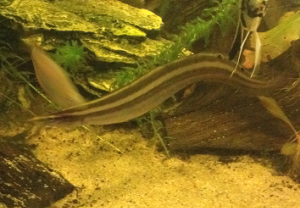
Peacock Eel, beh.; fdg. 8/22/18
I have a peacock Eel for roughly 8 months now. At first he hid all the
time but now he is very active. Wondering if this is normal.
<Yes; this is normal behavior for spiny eels. Most are very shy
initially, becoming more bold with acclimation, a dearth of bothersome
tankmates>
I'm thinking he's hungry because he's out. And have been feeding him
pretty much every day for the past 3 days and he comes to eat every
time. Do I need to give him more at feeding times so he can go back to
hiding. Or is he comfortable now?
<I gauge how fit fishes are as folks do in the fisheries industries; by
apparent "girth" of the specimen. If it appears full, it is likely fine
food-wise. Better by far not to over-feed; shortens life spans and
presents
more maintenance>
Thank you much,
Jessica
<Thank you for sharing. Bob Fenner>
Unidentified Spiny Eel Fast Respirations
7/26/`14
Greetings Crew, I wanted to give you guys an update on my new Spiny Eels. I
bought this 20g tank second hand(actually given to me), which included 2
eels, 2 Panda Corydoras and a pair of guppy. This tank is heavily
planted with Elodea densa, Amazon swords, hornwort, Java moss and recently what
looks like blanket weed(seems like a very tough algae to the touch)
<Most likely some type of Rhodophyta, colloquially "red algae". Difficult to
eradicate directly; physical removal (of infected leaves/rocks), then prevention
of further growth is what works. Favours tanks with indifferent plant growth,
low to middling water currents, ample light, and medium to high nitrate levels.
Rarely seen in tanks with lots of water movement, fast-growing plants (floating
Indian Fern ideal for a quick fix) and sensible nitrate/phosphate levels.>
and thick sand substrate. I've never encountered this blanket weed before, but
I'm trying to remove it from tank. I would say the blanket weed has taken about
5% of tank. This tank is only filtered by a HOB filter but I do 25% water
changes every three days and keep nitrate almost at zero. This tank is unheated,
but I just took a temp reading of 77.8F and PH of 8.1. My water supply is
"hard".
The eels initially hid for about two weeks but come out regularly now.
Although I use a moonlight LED and still haven't got an ID on these guys but I
will say they are peaceful to one another and Corys (very mellow). I have been
feeding them guppy fry and red wiggler compost worms. Also tank is outside so
they may get additional foods(lots of midges around). They are very plump.
<Do send along a photo if you can. Relatively few species are regularly traded
-- Macrognathus siamensis (often as Macrognathus aculeatus), Mastacembelus favus
(often as Mastacembelus armatus) and of course the famous Fire Eel,
Mastacembelus erythrotaenia. But occasionally you'll see Macrognathus pancalus,
Macrognathus aral, Macrognathus circumcinctus, Macrognathus mekongensis and
various "Afromastacembelus" species from the Rift Valley and Congo.>
My concern is one of the eels is breathing rapidly.
<How warm is the water? Is there enough oxygen, specially at the bottom of the
tank, an often overlooked aspect. Increasing/improving water circulation will
help, and possibly adding extra aeration too (e.g., a spray bar or venturi). Is
water chemistry odd for the species? Hard water should be fine for most provided
it isn't extreme, but some are pickier than others. What's water quality like?
None of the spiny eels is "hardy" in the aquarium sense of the word, despite
being pretty adaptable creatures in the wild.>
He will raise his head out of sand for long periods of time. He has seemed
active and is feeding. I was wondering if the tank was lacking oxygen but the
other eel doesn't seem to show same symptoms. Could the blanket weed be
irritating?
<Not as such, but may indicate lack of water flow.>
Also he doesn't show any outward sign of infection in any way. I'm hoping this
isn't a parasite issue. What are your thoughts? Also should I eradicate blanket
weed 100% or permit a little to grow?
<Rhodophyta are rarely welcome in aquaria, and rarely seen in stable, healthy
aquarium; would review and act accordingly.>
Thanks for the great site. Aloha Brandon
<Most welcome. Neale.>
Re: Unidentified Spiny Eel Fast Respirations
7/27/14
Thank you for the timely response Neale. I did research Rhodophyta and
luckily its not the one.
<Do recall that Red Algae, Rhodophyta, are so named because of how they
appear when preserved, not in life. The freshwater species aren't red.
They're usually some shade of green in fact. Aquarium varieties of brush
algae, hair algae and beard algae are all Red Algae, taxonomically
speaking.>
This is a green algae that grows almost as little algae hairs that are
actually branched. Seems very tough to tear apart. A few sites, mostly
out of UK were calling it blanket weed, seemed to be a good match.
<Indeed, Cladophora spp; common pond species here. Not as often seen in
aquaria as similar-looking Red Algae. The famous "Marimo Moss Balls" are
very closely related, so if you know what the algae in these "plants"
looks like, you'll recognise Cladophora. Fortunately, Cladophora are
consumed by Siamese Algae Eaters, algae-eating shrimps, etc.>
Unfortunately I'm unable to sends pics, I've lost the connection to my
camera. Thanks for your help. Brandon
<Welcome. Neale.>
|
One-striped peacock spiny eel growth &
feeding 4/15/12
Hello,
About 8 months ago I bought a one striped peacock eel (Macrognathus aral).
As far as I can tell he's been fine all along; he's actually rather
active and he's easily the most gluttonous fish in the tank.
<Good!>
One thing I've noticed is that perhaps he isn't growing as much as he
should be. I can't really tell if he's really grown at all since I got
him. Besides putting on some weight he hasn't really grown to be as
large as I thought he should be. He's pretty much remained the same size
in my eyes.
<Yes.>
Currently he's about 15cm, which is about 6 inches. He's in a 55 gallon
tank with some common small fishes. I feed him earthworms which I get
from the local angler store, since he doesn't really eat anything else
I've tried.
<Earthworms are like crack cocaine to Spiny Eels…>
Frozen bloodworms he sniffs, but refuses to eat. Live bloodworms he does
eat, but I stopped buying those. Doesn't eat live Artemia (brine
shrimp?) either, nor does he eat any frozen food.
<Have you tried small bits of prawn and tilapia fillet? Mine always liked
these.>
I do have a lot of earthworms, since he goes nuts over those, but I'm not
sure that could be the reason he's not really growing? I thought they
contained many nutrients & whatnot.
<Correct.>
He's also pretty much the only fish in the tank who can devour earthworms,
so yes he's definitely receiving plenty of those.
Is this growth pattern 'normal'?
<Yes. Spiny Eels tend to be slow growers, and Macrognathus spp.
especially. So long as he looks plump around the abdomen, don't worry
too much.>
I know these guys should be able to become pretty large but I'm not quite
seeing mine get there yet.
<He may well not grow much above 20, 25 cm -- while Macrognathus aral is
said to reach 60 cm, I've never seen one that big.>
Thanks a lot
Kind regards,
Nigel
(I've attached a pic of my eel)
<Real nice. Cheers, Neale.>
|
|
tire-track eel swimming
abnormally -- 05/07/11
Greetings,
<Salud>
I have a sick tire-track eel and I am at a loss as to what I should do.
I have a 500 lt. "paludarium" setting that is 3/4 full of
water, with carnivorous plants above water level and lots of floating
plants. Water parameters seem fine: ammonia 0 ppm, nitrate <10 ppm,
pH 6.0 (last checked.)
Water temperature is 28 C. Tankmates are: an 14'' Arowana, two
BGKs, two Senegal bichirs, and several smaller spiny eels. Here are
some pictures, though I haven't updated in a while.
http://s1082.photobucket.com/albums/j368/Whirlflux/
The tire-track is approx. 12'' long, and has been a resident of
our tank for months. I've been feeding it on a diet of
anchovy pieces,
<Pieces? This type/family of fishes can be a bit too fatty... Please
read here re spiny eel nutrition:
http://wetwebmedia.com/FWSubWebIndex/spinyeelfdgfaqs.htm>
with the occasional shrimp. I always remove the fishbone carefully
before feeding.
The tire-track eel was a voracious eater and quadrupled in size since I
got him. (I got him from a pet store where it had been starving for a
month.)
It was a very timid creature, always nestling inside the huge sea
urchin shells I bought for him. A week ago, however, something went
wrong. The eel left his urchin shell and started wandering around. We
considered that happy news at first, but two days later I observed that
the eel was swimming abnormally, often turning upside down
<A very bad sign>
and staying motionless for moments. I immediately did a 40% water
change and tested the water, but everything was normal.
<... for what you have tests for>
I have done two more smaller water changes since, and I've cut down
feeding just in case. A week has passed and nothing has changed. The
eel is still active, swimming to every corner of the tank, sometimes
upside down and sometimes normally. I also find it contorted in an
S-shape from time to time. He stays motionless in that position. There
is no visible bloating.
He has not accepted any food since the symptoms began.
<Try other foods>
I considered using medication for internal parasites, but I read that
they can kill your fish, so I'm waiting your advice on that.
<I too would not treat for parasites. The problem here is likely
environmental. "Something" is amiss chemically, physically
here. Perhaps one of the plants of the paludarium is poisoning the
water...>
Your website is a
genuine encyclopedia. I've read the FAQ section on spiny eels but
couldn't find anything that applies to my case, so I'm
bothering you with this e-mail. All help appreciated!
Regards,
Emre
<I would utilize a good deal of high quality (activated) carbon,
maybe the product PolyFilter in the water flow path... keep doing large
water changes, NOT use Anchovy OR shrimp in this fish's diet. IF
the symptoms and non-feeding continue more than another week or two,
I'd be moving the tire track, possibly all the fishes here. Bob
Fenner>
Eel behavior --
04/16/10
Crew,
<Hi Matt.>
I saw in a recent FAQ answered by Marco that someone's eel had been
opening it's mouth as if to yawn. Marco noted that he has seen this
behavior before with his eels and is not indicative of stress or any
emergent issues. I must also say after keeping spiny eels for a little
while that I also see this behavior in my healthy eels as well.
I've never been able to pinpoint why my eels do this. I see it may
be the adjusting of their jaw or possibly to keep unwanted visitors
away, but either way it seems pretty normal and I'm glad I found
that others have observed this as well. Just wanted to note this, maybe
you can post this in an eel FAQ for others to see if they were
wondering about this behavior as well. Thanks as always crew, I read
everyday,
<Thanks for your input. For what it's worth I've seen and in
part photographed such 'yawning' like movements by many other
fishes, too.
Puffers show it quite often as well as groupers, some damsels.
Certainly not limited to eel like fishes.>
Matt
<Cheers, Marco.>
Re: Eel behavior 4/17/10
Great to know Marco as I will be stocking my first brackish tank very
soon with gobies and a puffer. Grazie. Matt
<Welcome. Marco.>
Mastacembelus erythrotaenia...
beh./fdg... comp. with their own kind 9/27/09
hey Guys pls help cause I love my eels
Ok. It's been a year now since I had my fire eels in a 65g tank(by
the end of the month I will move them to my newly built 400g tank in my
apt) The bigger one(around 16'' is thriving in my tank and he
eats well e.t.c and has grown a lot since I bought him. As for my
second one, it's a bit smaller(around 14'' and thinner) has
stop eating earthworms or shrimps from my hand . It's been 3 weeks
since he was eating from my hands and generally since then he's
been acting very strange and I hereby fear the worst. He hasn't
eaten anything for 3 weeks now and has started to get thinner, the food
goes in front of him and he's scared and won't even smell it
and last but not least he's started doing some speed laps around
the tank and sometimes he even crashes on the tanks walls or the
driftwood e.t.c. No visible fungus or fin rot or anything. On the
outside he seems quite healthy. What can I do to save my little buddy?
Any suggestions on what he may be having fellas? Please help
me...:o(
<Greetings. The short answer is that the larger Spiny Eels of the
genus Mastacembelus are rarely sociable (unlike their smaller, more
gregarious Macrognathus relatives) and it's entirely possible the
bigger of your specimens is bullying the smaller. Once moved to a
larger aquarium, this problem may solve itself, especially if each
Spiny Eel has a suitable home, such as a clay pipe, at opposite ends of
the aquarium. But I wouldn't bank on this being the case!
Mastacembelus erythrotaenia is, like all Spiny Eels, sensitive to
bacterial infections for reasons not altogether clear.
Scratches and other types of physical damage often serve as starting
points of such infections. Gravel, as opposed to sand, substrates seem
to exacerbate this when the Spiny Eels are small. The addition of a
small amount of tonic salt to the water apparently helps; Baensch
recommends 1-2 level teaspoons per 2.5 US gallons. If you suspect a
bacterial infection, prompt treatment with an antibiotic such as
Erythromycin may be helpful. Do read here for more:
http://www.wetwebmedia.com/FWsubwebindex/spinyeelsmonk.htm
Cheers, Neale.>
Re: Mastacembelus
erythrotaenia 9/27/09
Thank you so much for you super prompt i really appreciate it. As i
said , no visible scratches or signs on the boy, last night i put an
earthwork wiggling in front of his nose and he didn't even pay
attention!
<This is why I suspect the problem might be psychological rather
than merely physiological. Move the smaller Spiny Eel into another
aquarium, and see if it starts feeding again.>
He just went away. I started today some MARACYN II treatment from
Mardel because i can only suspect internal parasites or infection. Is
the Maracyn II ok for this kind of treatment?
<I honestly don't think the problem is bacterial. If there
aren't any symptoms of bacterial infection, then there is no
particular reason to add an antibiotic.>
Thank you guys you're doing an excellent type of work here, i
really admire you guys!
<Kind of you to say so. Cheers, Neale.>
Re: Mastacembelus erythrotaenia
9/29/2009
What are the symptoms of a bacterial infection by the way if i may
ask?:o)
<On Spiny Eels, the most common signs are first excessive amounts of
white mucous on the skin, then bloody sores on the skin and fins,
lethargy, and then eventually death. Spiny Eels can of course get the
other bacterial problems that other fish get: Finrot, Columnaris,
Dropsy, etc.>
And as for the eels living together, it's been 7 months now since i
got them and they never had a problem or bite one another, or chase or
whatever.
<Sure... when they're young, they're gregarious. Once
sexually mature, that's when the problems begin. Much like any
other territorial fish.>
And what about the speed laps around the tank?
<Certainly a possibility.>
I was watching the whole thing, the bigger eel was in it's pipe and
the smaller one was acting like crazy hitting the tanks walls and the
driftwood e.t.c. That why i am a bit fuzzed.
<I'm not phased at all. Mastacembelus erythrotaenia is well
known to be intolerant of its own species under aquarium
conditions.>
Sorry for bothering you guys...
<Cheers, Neale.>
Peacock Eel Floating?
3/18/09
Dear Crew,
<Hello,>
In my 30 gal tank I have had a ~9 inch peacock eel for years who is
generally happy and shy and hides in the plentiful plastic plants and
small rock caves. When threatened, it burrows into the round pebbles
but
normally is comfortable enough to just hide in the plants. The other
fish (various tetras, Leaffish, algae eater, swimmers, etc) leave the
eels alone.
<Not a big fan of pebbles in Spiny Eel tanks: sooner or later the
fish gets scratched, and then secondary infections set in. Small
species like Macrognathus siamensis should be kept in tanks with smooth
silica sand. Do see here:
http://www.wetwebmedia.com/FWsubwebindex/matacembelids.htm>
Recently it became so bloated that it floats when still, so has to
anchor under some plants or position itself under rock ceiling. I
change water and vacuum every 2-3 weeks and chemistry is OK except
nitrites/nitrates can occasionally get on the high end of acceptable. I
add aquarium salt according to directions.
<How much salt? And why? Macrognathus siamensis isn't a brackish
water fish, and while there may be value to salt as a therapy under
some situations, continual exposure to salt can cause problems for
freshwater fish. One reaction is bloating, and indication that their
osmoregulatory system has been overloaded in some way. Unless
you're keeping one of the truly brackish water species, like
Macrognathus aral, there's no need to use salt.>
Other fish in tank get flakes. Ran out of frozen bloodworms for eels
and switched to frozen brine shrimp for the last month or so. I hand
feed this eel and my other younger peacock eel. Every now and then I
put in some pieces of cooked egg or salmon for variety.
<Don't use egg. Not a natural part of their diet, and can cause
constipation.>
I have noticed some bubbles coming from the big one's anus on two
different occasions so wondering if this is just a bad case of gas that
will work itself out or if something else is going on.
<So far as I know, spiny eels aren't air breathers, so I
wouldn't expect them to expel gases out of their vent in the same
way as certain air-breathing fish.>
Ready to lay eggs?
<Possibly; female Spiny Eels are distinctly laterally compressed
because they are substantially deeper bodied than the males. Sometimes,
certain fish become egg-bound in captivity if not kept with males: even
if the eggs don't develop into fry, the simple act of spawning
"clears out" the female reproductive tract.>
I adore my eels and would appreciate any help you can give.
<Very difficult to say precisely what the problem is. As mentioned
above, there are at least three possible factors. Gravel simply
doesn't work with spiny eels in the long term, and nondescript
bacterial infections are the almost invariable result. The regular
addition of salt to freshwater aquaria causes more problems than it
fixes, and isn't recommended because it can cause precisely the
sort of bloating problems you're experiencing here (see, for
example, Malawi Bloat). Finally, egg binding is an occasionally
reported problem among species of fish that refuse point-blank to spawn
in captivity. While there isn't much you can do about egg binding
beyond adding a male and hoping for the best, I'd also recommend
treating with a suitable antibiotic (e.g., erythromycin or Minocycline)
while adding Epsom salt at a dose of 1 teaspoon per 5 to 10 US gallons.
These will have the combined effect of (hopefully) killing the
bacterial infection while
restoring the osmotic balance within the fish. Stop with the regular
salt though!>
Thanks very much!!
Dianne
<Cheers, Neale.>
Peacock Eel looking
pale 2/3/09 Hi, I have a peacock eel who is
becoming very pale, almost pinkish, and his spots seem to be
transparent. He's about 6-8'', and I've had him for a
year now in a 55 gallon tropical tank. I've had past problems with
bacterial infections due to sick feeder fish, and over the course of
several months lost the majority of my fish. The eel never seemed
affected though. I treated it and decided to change my tank to African
cichlids since I only had 7 fish left. The tropical tank was kept at 80
degrees with a pH of 7.8. I had colorful decorations with dark blue and
purple pebbles. The eel was always the typical color, light brown with
a lighter belly and dark eye spots. When I changed to a cichlid tank 2
days ago, I changed the dark larger gravel to a sand colored crushed
coral which upped the pH to 8.2, temp is still 80 degrees. I also added
some brown flagstone for the cichlids (I only have 4 yellow labs under
2"so far). The eel has been very active since the majority of fish
were lost, and he eats well. His behavior hasn't changed since the
tank was switched over, there are no sores and his skin is smooth and
intact, but his color has definitely paled. My question is this: Can a
peacock eel change colors to better match it's surroundings? or,
Could it be the pH? I really love my eel, and want to do whatever I can
to keep him healthy. I would hate to know I'm causing him to fail
in this tank. Any advice would be appreciated. Thanks, Beth <Hello
Beth. The answer to your specific questions are [a] yes, fish do change
their colours somewhat, depending on their mood and environment; and
[b] pH is possibly an issue here. But let's expand this slightly.
Spiny Eels are notoriously prone to bacterial infections, and
shouldn't be brought within a mile of feeder fish. End of story.
Whether or not they actually eat the feeder fish is immaterial, simply
putting feeder fish in the tank is an unacceptable risk. Secondly,
Spiny Eels are very easily damaged by anything other than smooth sand.
Gravel and pebbles are totally unacceptable for the smaller species.
Most people who try eventually end up with a dead Spiny Eel. This
happens so often I just consider it mandatory to keep the small
Macrognathus species Spiny Eels in tanks with a smooth silica (silver)
sand substrate. Always take care not to use things like Tahitian Moon
Sand as these are "sharp" sands. The manufacturers actually
state that these sands are incompatible with burrowing fish, but too
many aquarists ignore this, and wonder why their Spiny Eel gets
shredded and eventually infected with a bacterial infection of some
type. Crushed coral is inadvisable for a variety of reasons; partly
because it raises the pH and hardness, and partly because Spiny Eels
can't burrow through it. Coral sand could be mixed with silver sand
at a ratio of up to one part coral sand to four parts silver sand, but
any more than that would also raise the pH and hardness excessively.
There are Spiny Eels from Lakes Tanganyika and Malawi, but the Peacock
Eel (Macrognathus siamensis) is not one of them, and consequently has
no place long term in a Rift Valley Cichlid aquarium. Even if the water
chemistry won't kill it immediately, the aggressive behaviour of
the cichlids will, either directly, or through making it difficult for
the Spiny Eel to feed. The native Spiny Eels are "used" to
cichlids and actually prey on them, or more specifically, their fry.
They don't burrow but instead hide in the rocks, and while not
commonly traded they are available from time to time. If your Spiny Eel
has changed colour, my gut feeling is that this may be partly to
"blend in" but could equally easily be a stress reaction.
This fish doesn't belong in this tank, and shouldn't be kept
with Malawi cichlids, period. Do see here:
http://www.wetwebmedia.com/FWSubWebIndex/spinyeelsmonk.htm Hope this
helps, Neale.>
Re: Peacock Eel looking pale
(Time to get creative!) 2/3/09 Thank You, <Most
welcome.> Here's my next question... I don't know anyone
with a tropical tank I would trust not to kill my eel. I'm also
afraid to give it to a fish store just to suffer elsewhere. Do you have
any suggestions for where I could look if I need to give him up?
<The best advice is to get in contact with a local fish club. Many
have an online forum, so even if you can't travel, you can still
communicate. That's probably your best way to learn the better
stores or fishkeepers in your area. I'm in England, so my knowledge
of the aquarium hobby in Florida is somewhat limited!> I spoke with
at least 4 different fish store guys (not PetSmart) all told me the eel
would do fine in the cichlid tank. <It's possible they were
thinking of the African species of Spiny Eel, such as Mastacembelus
ellipsifer, which do indeed cohabit with (some) cichlids quite well.
But the reality is that people sometimes know rather less than they
think they know. It's always important to research topics
independently, though stuff that's been edited by experts, whether
books, magazines, or web sites like this one. In this case the problem
is that, for example, Malawi cichlids and Spiny Eels need completely
different food. Mbuna are mostly herbivorous, but will eat meaty foods
if offered, and this makes them sick if given to excess. Spiny Eels are
carnivores, but slow ones, so most insect larvae or whatever put in the
tank will be eaten by Mbuna long before the Spiny Eels find them.
Again, the pH and hardness suitable for Malawi cichlids is much to high
for Asian Spiny Eels. Yet again, the cichlids want coral sand and lots
of rocks, whereas the Spiny Eels need soft sand and feathery plants.
It's difficult for me to see how you can satisfy the needs of the
Spiny Eels and the Mbuna in the same system, even hoping that the Spiny
Eels will be smart enough to avoid being bitten or harassed by
aggressive cichlids.> My choosing cichlids was dependent on the
ability for the eel to thrive, and they all claimed the crushed coral
was not so coarse as to damage him. <Coral sand probably won't
scratch him, but it's far from ideal.> Today he's hanging
out over the aerator bubbles and he's jumped into the filter once
(he only did that when I treated the tank with Pimafix and it irritated
him) so I know he's not happy. <Indeed.> I really can't
set up another tank, but I want to see him where he'll be happy,
and he likes a lot of space. Thanks for your time <Here's my
workaround. You have so far only Yellow Labs, right? Go back to a
regular planted community tank. Yellow Labs have been bred so much in
captivity known they should adapt to such conditions. Keep the pH
around 7.5, keep the hardness around, say, 12-15 degrees dH, and make
sure the water is well oxygenated. Use plants that do well in such
conditions (most will be fine). Use soft silica sand on the bottom, and
arrange some rocks in heaps for the cichlids to use, while leaving
plants in other areas. Don't get any more Malawi cichlids (at least
not without talking to me first!) and just stick with species that
should adapt to such conditions. All else being equal, I'd expect
such a community to just about work. Yellow Labs are hardy and not
aggressive, so compared with Malawi cichlids generally, they're
fairly good in communities. You will need to feed the Spiny Eels at
night to make sure they get enough to eat, but other than that, I
can't see any major problems. Not textbook cichlid keeping, but
viable. Cheers, Neale.>
Re: Peacock Eel looking
pale 2/3/09 I apologize for all the questions,
but... I forgot to add that I also added 2 tablespoons of salt to my 55
gallon tank on Saturday (advised by the fish store guy after checking
the water) and I wondered if the salt would irritate him more than the
pH which was increased from 7.8 to 8.2. Our house has a water softener,
which was never a problem before. If I do some slight water changes
will this help him until I can figure out what to do? Will the salt
burn his skin, or is the alkaline just way too high? Thanks, and again
sorry for all the here and there questions <Who told you to add salt
to a tank with Malawi cichlids? There's a fair consensus that salt
is one cause of Malawi Bloat, and should not be used as an additive in
this way. As a component alongside Epsom salt and baking soda, marine
salt mix can be used to create a home-brew Malawi salt, but it should
not be used alone. You also shouldn't use water from a domestic
water softener. Very bad for fish. Spiny Eels are actually fairly
tolerate of salt, and some species occur in brackish water. But just to
be clear: use plain, un-softened tap water, with no salt, in your
aquarium (but with dechlorinator, of course). Cheers,
Neale.>
Re: Peacock Eel looking
pale 2/3/09 THANK YOU SO MUCH! For future
reference, what other types of cichlid can I add. I want to stay with
the less aggressive. Are "electric blue" or
"peacock" ok? They were suggested by the fish store. Thanks,
Beth <No, I wouldn't go with Aulonocara spp. in the tank I
described earlier. Even the Labidochromis is pushing it, but
they're fairly small, peaceful and adaptable. To be honest, I
wouldn't add any other cichlids until I had seen the tank running
stably for a while, three months at least. Concentrate on midwater
things if need be, barbs and the like. Cheers,
Neale.>
Re: Fiddler crabs versus peacock eel
10/21/08
Thank you so much for the fast response!
<Most welcome.>
Well I do have a sand/gravel substrate, however the aquarium store had
large gravel.
<Hmm... in my opinion, plain smooth silica sand is the way to go,
particularly with small (sub-20 cm) specimens.>
And the eel was buried in there when I got it. Do you think it is
possible that the eel got the infection at the store?
<Quite possible.>
I watched the eel quite intently and he never buried himself.
<Possibly prefers the hiding places available above the substrate.
In any case, they feed by pushing the rostrum (the "trunk" on
the nose) into the sand to uproot insect larvae and worms. So even at
that level, sand helps.>
He actually spent most of his time swimming near the top of the
water.
<They do indeed like swimming among the roots of floating plants.
They're great escape artists though, so be warned that they're
also apt to jump out, if they can.>
Also do you have any suggestions on what I could do to get my tank
better prepared for a peacock eel?
<Do read my article; that's everything I know about
them!>
I have three small Cory cats, will they be a problem for the eel?
<Does rather depend on the size of the tank and how much food you
put in. Assuming you were generous with the food, these fish might get
along just fine. The real problems come with "bullies" like
loaches and Plecs that will keep the Spiny Eel away from its dinner.
Earthworms are the secret to success with the Mastacembelidae, and they
will thrive on these tasty morsels.>
I guess I should let you know that I have a 55 gallon tank with a
mostly sand substrate. There is some small white gravel mixed in with
the sand.
<Hmm...>
I have got platies, swords, mollies, tiger barbs, 2 rainbow fish,
paradise fish, the Cory cats, and the crabs. Everybody lives perfectly
fine together. I usually put a small amount of aquarium salt in the
water. Would this be recommended for an eel?
<I suspect the Fiddlers are on borrowed time. They're amphibious
and will spend all their time trying to get out. The vast majority of
specimens in freshwater aquaria last but a few months. It's a shame
they're sold at all, to be honest. Adding "small amounts of
salt" won't really have much effect either way. They won't
make any of these animals healthier, but if you want to waste your
money on boxes of salt, then go ahead, you aren't doing any harm
either.>
Ashley
<Cheers, Neale.>
Twitching Eel? 1/9/08 Hi guys! <Ave!> I own
2 Macrognathus siamensis (Peacock Eels) and I recently moved them to a
20gal tank. One of them keeps on twitching, any ideas why? <Quick
question: gravel or sand? Spiny eels in tanks with gravel are
notoriously sensitive to bacterial infections. So while this might be
nothing more serious than Ick, it might also be the start of something
more critical. The lifespan of Spiny eels in gravel tanks is
distressingly short because of this often ignored issue. Replace gravel
with soft sand (silica sand is ideal).> I'm hoping to get an
e-mail back soon. <You can certainly hope.> Thanks! a concerned
friend. <Cheers, Neale.>
Odd spiny eel behavior? 6/3/07 > hey,
just wondering, is it normal for a spiny eel to be agitated by it's
own reflection? my peacock spiny eel every night swims around the
aquarium a couple times (looking for food?) but gets distracted once or
twice on his way around each time by his own reflection, then starts
like butting the sides with his nose. is this normal? at any rate, is
it bad? should i try to cover some of the sides so he doesn't see
himself? or is he just narcissistic? <He's unhappy. Spiny eels
are relatively intelligent fish and when kept improperly stay nervous
and almost always end up jumping out the tank, being found in the
morning dried up on the carpet. I cannot stress this too strongly:
spiny eels are not "regular community fish" and you need to
make a BIG EFFORT to keep one happy. The smaller species, including all
the Macrognathus spp (which is what yours is) seem to be sociable, so
it's worth adding one or two more specimens. Provide them with a
variety of hiding places. Hollow ornaments are ideal. Replace the
gravel with sand -- without sand for digging your eel will never be
happy and will likely die from a skin infection caused by abrasion
anyway. The mode of foraging for small spiny eel species is primarily
using their snout to uproot worms in the sand. Expecting them to feed
in any other way just isn't realistic. So once you have the sand in
the tank, add some live bloodworms and (clean) Tubifex to the tank at
night, switch the lights off, and then let your spiny eel feed
normally. After a few weeks of this, your spiny eel will be acclimated
to aquarium life and will be much tamer. My specimen would happily feed
during the day time and ate frozen prawns -- a totally low-maintenance
oddball. But getting to that point requires dedication.> >
thanks! Tori <Good luck, Neale>
Luring out a fire eel -- 04/24/07 I have had my
fire eel for about 7 months now. He is about 9-10". He originally
hung out all day with the clown knife and in their caves. The eel would
eat freely out of a syringe. The eel and the clown both got along great
in our 75 gallon set-up with several pvc and rock caves. The
fire eel lately has taken to hiding under the gravel for months on end
with no sight of him. Every time I think he has to be dead he will show
up swimming around for 5-10 minutes maybe once a month. We recently put
two small Oscars in and I feed them bloodworms 3 times a week hoping
that some food will make its way to the bottom and hopefully the fire
eels mouth!! My question is, is there a way that I can get
him comfortable coming out again? <Try to lure him out
with live earthworms/nightcrawlers. Use a pair of tweezers to be sure
he gets them. Check his skin for sores, scratches and pale areas.>
He used to never bury into the rock and I have no idea why he would
start then. <Did he start to bury when you added the Oscars? Any
other fish added? Changes in lighting/decoration? Any short term
problems with water parameters in that time? Ensure that the holes in
your rocks are wide enough. Getting stuck and eventual death is a
standard scenario with spiny eels.> Any help would be great. I just
feel that in some way he is unhealthy even though the water is fine and
the overall tank is ultra healthy. <ultra healthy with regard to the
requirements of your species?> I don't want him to die. Thanks
again. <You are welcome. Marco.>
Why does my fire eel have yellow markings? >Hi,
>>Hello, Marina tonight. >I have had a fire eel (now about
9") for almost a year. He was about 4" when we got
him. He used to live in a 25 Gallon Eclipse (eel proof) until I bought
the new 90 gallon tank back in March. Quick cute story- thought I lost
him last winter. Went missing for about 2 months. Turns out
he was living in the hidden compartment eating bloodworms as they got
sucked up the tube. No worse for were, but bigger. Didn't suspect a
problem until the water level on the filter was way too high. Anyway,
he lives with a couple of zigzags, a black ghost, a golden Gourami, 4
pearl Gouramis, 5 red Serpae, and a tiger barb. Normal for the tank is
flake, frozen beef heart and frozen bloodworms. The big question.
Whenever I see a photo of a fire eel it has red markings. Mine is dull
yellow. Any ideas? Thanks in advance either
way. Great site! >>I've seen them both ways, and
have always assumed that it's just a variance on
coloring. Try this link for some ideas http://www.wetwebmedia.com/FWSubWebIndex/matacembelids.htm
>>I hope this helps. Marina

