|
FAQs on Mastacembelid, Spiny
Eel Health/Disease
Related Articles:
Spiny
Eels, The truth about spiny
eels; A closer look at these popular but problematic
oddballs by Neale Monks, Husbandry of
the Barred Spiny
Eel, Macrognathus
panacalus by Marco
Lichtenberger,
Related FAQs: Spiny Eels,
Spiny Eel
Identification, Spiny Eel
Behavior, Spiny Eel
Compatibility, Spiny Eel
Selection, Spiny Eel
Systems, Spiny Eel Feeding,
Spiny Eel Reproduction,
By Species: Fire Eels, Peacock Eels,
Tire Track
Eels,
|
|
|
Tanganyikan spiny eel skin problem
9/23/19
Hello!
<Gerald>
A few weeks ago I acquired 3 recently imported Mastacembelus ellipsifer
Tanganyikan eels. They're all about half grown, 8-10" TL. I'll move them
to larger quarters before long, but at present I am keeping them in a
55-gal aquarium with a couple of inches of fine, smooth sand and much
artificial rockwork.
<Good... do you know how these Mastacembelids were treated ahead of your
receiving them?>
I use untreated private well water which after being aerated and warmed
to aquarium temperature settles in at pH 8.2 and is quite hard; my
Tanganyikan cichlids are thriving in it. One of the eels started eating
frozen mysis and krill immediately, a second joined in soon afterward,
and the third finally started eating only a few days ago. It's that
third fish that concerns me.
This fish arrived with what appeared to be a few slightly damaged dorsal
spines, and now that it spends more time in the open and I can see it
better (it was quite shy for the first couple of weeks), I believe they
look somewhat worse, maybe even with a very slight white cottony look to
them.
I have also now noticed at least one white dot on the fish's side near
to the damaged spines.
Aside from maintaining best water quality, which I do assiduously, what
would you recommend I do to treat this fish?
<In the trade years (decades) back we used to treat all incoming spiny
eels w/ 250 mg.s per ten gallons with a "Furan" compound... changing
half the water every three days, three times... the water quality/color
is strikingly disimproved by this treatment>
(Actually I'll be treating all three eels together, as their present
aquarium serves as my quarantine
tank.) Salt? Medication? Both? I much prefer to get on top of
problems/solve them quickly and completely than to wait and see how they
go, and it is my understanding that spiny eel skin problems can get very
serious very rapidly.
<Yes>
Also, the more specific your advice, the more I and my eel will benefit
from it. :^/
Thank you very much!
Gerry Binczik
<Not knowing the make-up of your well water makes me leery re advising
adding salt/s. I would go w/ the Nitrofurantoin or such alone. Bob
Fenner>
Re: Tanganyikan spiny eel skin problem
11/1/19
Hello again!
<Hello Gerald.>
I only just discovered that you replied to my 9/22/19 enquiry (below) online
at
http://www.wetwebmedia.com/FWSubWebIndex/spinyeeldisfaqs.htm
rather than by return e-mail.
<Nope; we email a reply first, and copy it onto the web page only as an
archived message. Even then, it's only archived a few days after being on
the Daily FAQ page. Just check your spam filter isn't blocking our messages,
maybe?>
(I should have known to look there - D'oh!) Without the benefit of your
reply, I had cobbled together what seemed to be an appropriate treatment for
my ailing M. ellipsifer eel from the various earlier posts on that webpage.
I'm writing today to let you and interested readers know what I did and how
things went.
<Thank you!>
By the time I began treatment, two clearly de-pigmented spots (not quite
completely white or fuzzy, but rapidly heading there) which were each about
1 cm in diameter had formed in the affected area on the eel's side, and the
dorsal fin adjacent to that area had a clearly ragged appearance. I decided
to throw the kitchen sink at it:
<Indeed!>
I removed chemical filtration and treated the water with aquarium salt dosed
at 75 g/10 gal, KanaPlex at 125 mg (= 1 "scoop")/5 gal and MetroPlex at 125
mg (= 1 "scoop")/5 gal. Every other day I changed 20% of the water, replaced
the salt removed thereby and re-dosed with fresh KanaPlex and MetroPlex, for
a total of 3 doses of the medications. The eel was much improved -
remarkably, the spots looked at least somewhat better almost instantly! -
but still affected, so I immediately repeated the entire process through 3
additional doses.
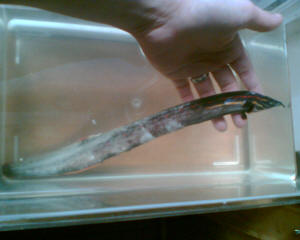
Now, a month later, the eel looks fantastic!!! (See attached picture.)
Very active, always hungry, great color! Its dorsal fin isn't quite intact,
but I'm sure that will come with a bit more time.
I'm extremely grateful for the helpful advice I found on your webpage, and I
hope that this contribution will likewise help others in the future.
My best, Gerald.
<Thanks for this useful and clear method, which I am sure will be helpful to
others. Cheers, Neale.>
|
 |
|
Very sick Black spotted eel
3/9/19
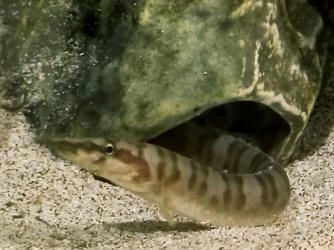
I write to you because I am at the end of my rope with this poor guy, his name
is Bartleby, I bought him and his 4 friends (who are all lighter in color then
him) from a exotic fish store 12 days ago.
<Do bear in mind that Mastacembelus species tend not to be social. If this
really is the Black Spotted Spiny Eel, Mastacembelus dayi, then you can expect
adults around 50 cm in length. I'm a little skeptical that these really are
Black Spotted Spiny Eels because that species is very rarely traded and
expensive, but if you did get some, well done! They're nice fish.>
He was in better shape, not as ragged as he is now, but cloudy eye. One of the
others has a could eye too, but is active and eating and doing awesome after I
treated them. Then live in 125 gallons with two bichirs. The guy at the fish
store said they hurt themselves because they were in very coarse gravel tank and
sent me home with Methylene blue and said they'll be fine.
<Nope. Methylene Blue is essentially and anti-fungal treatment, and your
retailer really should know better. Your Spiny Eel has a bacterial infection,
almost certainly caused by the rough substrates he has been exposed to. The
substrate you have is MUCH too coarse for these fish; just looking at it made me
wince. Either smooth lime-free sand for these fish, or else something organic
such as coir fibre or peat. Never, ever gravel.>
I treated as it says on the bottle and got zero relief for him.
<Indeed.>
The guy said well I don't know then, he'll live or die. My water parameters are
good for the species and no one else is like this.
<When you say, "good", what do you mean? Please do send us the water test kit
results next time. To recap, neutral water chemistry is ideal for Spiny Eels,
with the addition of a little salt (not enough for brackish, but 1-2 gram/litre)
often being helpful. Indawgyi Lake, where your species comes from, has slightly
soft to medium hardness and an around neutral pH, so I'd suggest pH 7, maybe
5-15 degrees dH. Avoid extremes. Obviously zero ammonia and nitrite, as with any
fish. Replace the substrate with smooth silica sand (such as pool filter sand,
though check this is soft and lime free first) and medicate as per Finrot using
the best antibiotic or antibacterial remedy you can get; Seachem KanaPlex would
be a good choice if you live in the US or somewhere else antibiotics are sold in
aquarium shops. Alternatively, a proper antibacterial, such as eSHa 2000 or
Waterlife Myxazin. A little salt, as described above, will help. Do not use any
general purpose or New Age cures such as Melafix as these are completely useless
even at the best of times, and your Spiny Eel needs urgent help. It won't
recover in a tank with gravel, so if changing the gravel today isn't an option,
use a hospital tank with no substrate but several hollow ornaments he can hide
in. Also, bear in mind what a white substrate like yours will stress any fish,
so really, needs to be disposed of just for their sanity, let alone physical
health. Fish despise upwelling light as it is so unnatural.>
I've been reading through everything I can on here and I'm just not sure what to
do for him. I'm willing to try anything, we've grown very attached to him.
<I would imagine! These are superb fish, so a good catch.>
Maddie
<There's a bunch of reading I'm going to direct you to, here:
http://www.wetwebmedia.com/ca/volume_4/v4i3/Spiny_Eels/Spiny%20Eels.htm
http://www.wetwebmedia.com/fwsubwebindex/spinyeelsmonk.htm
http://www.wetwebmedia.com/fwsubwebindex/matacembelids.htm
Hopefully these'll get you some more information for long-term success.
Cheers, Neale.>
|
|
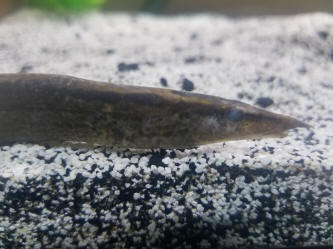
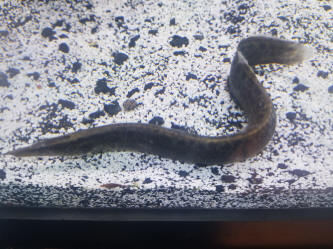
Re: Very sick Black spotted eel 3/14/19
Unfortunately our little Bartleby was too sick to save, he passed the morning
after I emailed you.
<Sorry to hear that. The sad truth with Spiny Eels is that it is a
million times easier to keep them healthy than to heal them when sick.
So it really pays off to ensure substrate, water chemistry, and diet are all
correct.>
I am absolutely determined to make the rest of them happy in their glass home
though. Is this better for them? I've replaced all substrate and got a second
filter for absolute pristine water.
<Sounds good. Did you send a photo? Nothing arrived. In any case, a clean tank
with a soft, smooth substrate will help. Beyond the substrate, the other major
cause of mortality is escaping the tank, so check for openings in the hood. As
with all predators, a varied diet is key. Earthworms are the ideal staple (so
readily taken they're like crack cocaine for these fish!) but a mix of seafood
and white fish fillet will do fine. Smaller specimens enjoy bloodworms. I've
avoid Tubifex because of how they are
farmed in essentially dirty water, though these are very readily taken.
Prawn and mussel meat is popular, but rich in thiaminase, so ensure only a small
part of their diet.>
They all seem much more interested in me now.
<Good. When healthy and happy, these fish are widely recognised as being
intelligent.>
Coming to greet me when I come home and swimming right up to the front of the
glass. The littlest is even burrowing again! I feel like an idiot but you live
and learn :)
<Indeed you do!>
Thank you,
Maddie
<Most welcome and good luck, Neale.>
Re: Very sick Black spotted eel 3/14/19
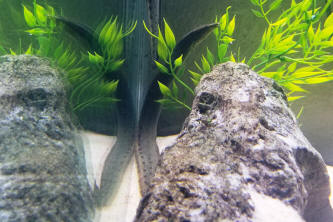
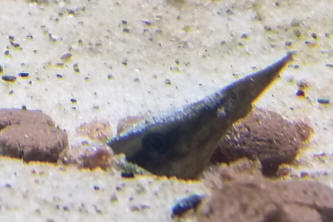
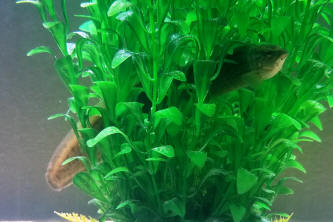
<<Looks much better with the sand. When you get a chance, I'd suggest replacing
the rough rocks with smooth cobblestones too, and ideally, if the plastic plants
feel sharp, replace them too. I'd strongly suggest floating Indian Fern.
Floating plants do two key things. Firstly, Spiny Eels will "burrow" in a thick
layer of floating plants, making them easier to watch.
Secondly, it inhibits their tendency to jump, so you're less likely to find them
dead on the carpet. The bottom of the tank need only have sand; anything else is
clutter as far as they're concerned, but anything hollow (like ceramic ornaments
or clay pipes) will be used as hiding places.
Cheers, Neale.>>
|
  |
|
|
Spiny Eel Identification and Possible Problem
6/7/18
A few weeks back, I bought some Spiny Eels from my aquarium supply store whose
supplier identified them as Macrognathus pancalus. They now live in my 55 gallon
tank and are the only fish in the tank (I will not be adding any more fish). As
they've gotten a bit bigger, I've noticed some differences in their coloring and
markings so I've been trying to get a picture of them to send you in the hopes
you could help me identify the different subspecies. I finally accomplished that
this morning. The pictures aren't that great, but they're the best my camera can
do, and when I looked at the picture of the lighter colored eel with the yellow
tinge in its tail I noticed what looks like redness around his/her gills.
<These photos are too blurry. One of them, with the oblique dark bands, might be
Macrognathus circumcinctus. The other one is much too vague to see anything at
all. But I would direct your attention to two additional species, Macrognathus
pancalus and Macrognathus siamensis. Macrognathus pancalus has a speckled upper
half of its body, plain lower half, and in between a distinctive row of
'dashes'. Macrognathus siamensis is the Peacock Eel, so-named for the series of
large eyespots on the dorsal fin
near the tail.>
As soon as I got the picture, the eel dashed off to hide, so I can't get a
better look at him/her. The reason I'm concerned is because last Saturday I was
watching my neighbor's kids for a while so she could run to the store and while
I was outside trying to stop the 4 year old from setting my horses free, the 7
year old dumped an entire almost new 1.2 ounce package of flake food into the
eel tank (eels don't like flake food).
<Yikes!>
It took some work, but I've got most of it cleaned up. I've been testing and the
biological filter is handling it well as no ammonia or nitrite has shown up, but
the nitrate has climbed up around 30 ppm (very dark orange, but no red), so I've
still got some work to do. As a precaution, I put the appropriate amount of
Prime in, so even the higher-than-normal nitrate shouldn't be bothering them and
all the other eels look and act normal. Is this something to be concerned about
and can you shed any light on the differences between these two subspecies?
Renee
<Spiny Eels aren't especially sensitive, and a series of water changes should
handle the water quality damage here. Assuming you've netted out and/or siphoned
out most of the flake food, I'd still change 50% today, and perhaps another
similar amount tomorrow. You want to keep nitrate below 40 mg/l with most
tropical fish, so that's your danger zone. The addition of a little salt may be
helpful with Macrognathus species, particularly if they're stressed or
off-colour, but isn't essential by any means. Salt
does, however, reduces the toxicity of nitrate a bit, which makes it helpful at
times. I'd not go beyond 2-3 gram/litre, though some species can handle
considerably more. I will direct you to some useful reading, here:
http://www.wetwebmedia.com/ca/volume_4/v4i3/Spiny_Eels/Spiny%20Eels.htm
Cheers, Neale.>
|
  |
|
Re: Spiny Eel Identification and Possible Problem
6/7/18
Thank you.
<Most welcome. Neale.>
|
Spiny Peacock eel fungus... Mis-stocking iatrogenic prob.s, no reading
5/3/15
<... what re the punctuation here? Are you a non-native speaker?>
first of all I'm resuming it the best I can, I'm using your saltwater question
because sincerely, the website is confusing and the freshwater help, didn't help
a little bit, I have just got 29 may, a peacock eel, it was in my 66gal
tank, with 8 discus,
<Not compatible.... Mastacembelids like very different water quality than
Symphysodon>
18 tetra neons, 7 ember tetra, 4 checkerboard cichlid, 1 Polypterus senegalus
and 2 p. delhezi,
<.... What? You have Bichirs in here too? You need another few tanks to sort
these disparate species out... READ on WWM re each species requirements and
compatibilities. What you have here will NOT work>
and 4 gold sport dwarf Pleco (please don't bother me about number of fish in
tank,
<You already know?>
as the discus will pair up they are going to 30g breeding tanks, the smaller
fish(all but the Polypterus) are going to be relocated, the final fauna plan is
to be 3 P. senegalus, 2 P. delhezi and the discus that don't pair(and hopefully
the peacock eel)) It was beaten bad, I don't know by whom, but it was, i didn't
saw it since she was hiding most of the time in the
driftwood, until today morning she was normal, I was worried about her feeding
habits, was giving Tetra ColorBits, frozen shrimp and a national fish food(name
is Poytara, but they have no English website),
<Ahh; I see you are a NNS>
I didn't saw it eating so I just put some frozen shrimp at night and hoped it
would eat when the others were not active, this morning it appeared almost
upside down, I immediately separated it in a 15gal hospital with a (don't
remember the English name, but the black pieces you put under gravel, though
without gravel, just ceramic rings) and driftwood, put some national medicines
(being one based in Acriflavine for fungus and one based in green malachite,
Methylene blue, magnesium sulfate, potassium chlorate and copper sulfate
that one for bacteria), am on my way to get some Melafix
<Worthless. READ before writing us... PLEASE!>
or anything they may offer at the best LFS around here,
<?>
and am wanting help as to what to do to try to save it's hale
<.... Let's have you start reading here:
http://wetwebmedia.com/FWSubWebIndex/spinyeelsmonk.htm
and the linked files above. READ Gustavo... w/o your delving into matters here,
your spiny eel and likely other fishes will perish. You need to separate them
ASAP by their water quality needs and temperaments. Bob Fenner>
Re: Spiny Peacock eel fungus
Me again, just read that copper is no-good-idea for them, there should be about
0,015 grams of copper sulfate(30 drops = 1,5ml, there is 1g for 100ml in the
medicine) in these 15gal, equal to 0,00025g of copper per liter, I am going to
make a 5 gallon water change without the copper based medicine anyway, just
wanted you to know
<You ARE reading! Good. BobF>
Fwd: Spiny Peacock eel fungus 6/4/15
Would you please elaborate WHY they should not be together ?
<... this TOO is archived on WWM. No need for me to re-key over and over>
"*Water requirements:* Soft, acid water preferred" taken from your link, discus
also like soft and acid water (on that we agree right?)
<And quite warm...>
Where Polypterus are different, they can take a huge range of water parameters,
I'd like to know why would it be a bad mix ?
<Simply that the group of fishes you listed don't have much overlap in
preferences, tolerances...>
Also, it currently has the anti-fungus and MelaFix that I got earlier, it is
still breathing but in bad shape, could the crew please first and foremost
address the emergency and later talk about water param.s ?
<...>
BTW does NNS stands for Non Native Speaker or something else ?
<This is it; yes>
That's all, yes, I might have done some useless or dumb thing, it was my
emergency protocol, do you have some better one to teach me ? Sorry by
any typo I made, writing in the cell while in a moving vehicle(I am not the
driver, relax)
<Read or go elsewhere. Bob Fenner>
|
Help with my spiny eel! 11/16/14
Hey guys! I have a problem with my Zig-Zag Eel i was hoping you could
help me with. I noticed in one of your earlier posts someone was having
a problem with his eels chasing each other and that his zigzag had a
"protrusion" coming out that he wasn't sure if it was genitalia or not.
Well my eel has literally the exact same thing, but he also seems to be
sick. His feces is more like a thick white mucous, and he seems to have
these "spaz" attacks in which he'll rub himself against the gravel
aggressively. He now seems to have a small bloodspot behind one of his
gills, and i worry about infection. (i know now that gravel is bad for
him, and I'm am currently working on fixing the issue. I am not able to
remove all the gravel as i have live plants that need a strong
substrate, so i think I'm going to clear a large area of the "floor" and
build Plexiglas
borders that will create a box for me to fill with sand.
<Ah yes; or a plastic/glass tray of size that you can fill, fit in
somewhere>
I think it would look nice and give him a good area to bury himself in,
while still keeping some gravel for the plants.) Any help would be
appreciated. He's still relatively small, about 3-4 inches.
His tankmates
are 1 angelfish, 1 Pleco, 5 neon tetra, 1 GloFish (rescue from a
friend), and 1 elderly guppy. (retired from the breeder tank. lol)
Thanks again guys!
<Welcome. Bob Fenner>
Help with my spiny eel! 11/16/14
Hey guys! I have a problem with my Zig-Zag Eel i was hoping you could help me
with.
<Fire away.>
I noticed in one of your earlier posts someone was having a problem with his
eels chasing each other and that his zigzag had a "protrusion" coming
out that he wasn't sure if it was genitalia or not.
<Indeed. Oftentimes male fish have their visible 'spawning tubes' (genital
papillae) some days before spawning, whereas those on females are hardly ever
visible except at the precise time of spawning.>
Well my eel has literally the exact same thing, but he also seems to be sick.
<Ah, now that's different.>
His feces is more like a thick white mucous, and he seems to have these "spaz"
attacks in which he'll rub himself against the gravel aggressively.
<Often/usually a sign of bacterial infection of the skin and/or protozoan
infection of the skin/gills. Gravel is very bad for Spiny Eels, so their
attempts to "rub off" the annoyance damages the skin, making bacterial infection
even more likely. Things get worse and worse, eventually the Spiny Eel ends up
red and bloody, then dies.>
He now seems to have a small bloodspot behind one of his gills, and i worry
about infection. (i know now that gravel is bad for him, and I'm am currently
working on fixing the issue. I am not able to remove all the gravel as i have
live plants that need a strong substrate, so i think I'm going to clear a large
area of the "floor" and build Plexiglas borders that will create a box for me to
fill with sand. I think it would look nice and give him a good area to bury
himself in, while still keeping some gravel for the plants.)
<Plants prefer sand. Gravel is useless to them. As one aquarist put it, when was
the last time a gardener planted a rosebush in a gravel driveway?
Spiny Eels are somewhat incompatible with plants, so at the end of the day,
choose to optimise the tank in one direction. That said, sturdy plants (Amazon
Swords, Vallisneria, larger Cryptocoryne spp.) do just fine with
Spiny Eels, especially if planted first so they have time to root themselves in.
A couple of pebbles placed on the sand around the plants will dissuade all but
the most seriously industrious Spiny Eels from uprooting them. Floating plants
and epiphytes attached to rocks (Java Fern, Anubias, etc.) are of course fine
with Spiny Eels, and in fact floating plants are probably essential, both for
their happiness and by preventing them from jumping out.>
Any help would be appreciated. He's still relatively small, about 3-4 inches.
His tankmates are 1 angelfish, 1 Pleco, 5 neon tetra, 1 GloFish (rescue from a
friend), and 1 elderly guppy. (retired from the breeder tank. lol) Thanks again
guys!
<Much reading to do...
http://www.wetwebmedia.com/fwsubwebindex/matacembelids.htm
http://www.wetwebmedia.com/ca/volume_4/v4i3/Spiny_Eels/Spiny%20Eels.htm
http://www.wetwebmedia.com/fwsubwebindex/spinyeelsmonk.htm
The routine addition of small amounts of salt (2-3 gram/litre) is an excellent
idea with Spiny Eels and shouldn't cause problems for the Guppy at least, nor
Common Plecs. The others won't be so happy about it. Salt at treatment levels
for Whitespot (2 gram/litre) will be safe for all concerned across a 2-week
period though. Antibiotics can be used to treat infections. Avoid copper and
formalin. Good luck, Neale.>
Re: Help with my spiny eel! 11/23/14
Hey guys! Sorry it's taken so long to reply, but i took your advice. Few
more questions though. So, i followed what you said and treated the tank
with aquarium salt for a few days, and as of last night, i changed out
ALL the gravel and replaced it with a sand substrate.
<Two useful steps.>
In order to change out the substrate, i had to remove all the fish and
place them into my second 60 gal and then empty out all the of the water
while removing the gravel. (only took me 5 hours! XD lol)
<Does indeed take a while! You can change the substrate with the fish in
place though. Water will get murky however, and the fish won't be too
happy (of course, they're not happy in a bucket or standby aquarium
either).>
The second 60 gal already has fish in it, so i set up a divider to keep
the two tanks away from each other. (it has an angel and 2 Plecos in
it). Now i know that i completely disrupted the cycle and i was
wondering how soon would it be safe to put them back into their tank?
<If you left the filter running while you changed the substrate, the
filter bacteria should be fine. If you switched the filter off, removed
the media and kept it damp or partially covered in water in a bucket
open to the air, the bacteria will be fine for a day at least. If you
switch the filter off, left the media damp but cooped up inside the
filter with little access to fresh air, the bacteria start to die after
20 minutes (supposedly) and while some will remain, they'll be a bit
knocked back in status when the filter is reconnected, so for the next
day or two keep a close eye on water quality. If you switch the filter
off and the bacteria dried out, then
you'll almost certainly have to start a whole new cycle (though dry
bacteria spores in the media should speed things up to some degree).>
The tank that they're in is now overstocked, and i don't want to keep
them in there for any longer than i have to. (the angels hate each
other, and it's really cramped because of the divider.) I placed all of
the old (unwashed) ornaments back into the tank, kept all the old
filters in it, placed a plastic bag full of the old gravel into it to
help with the BB, and treated the tank with aquarium bacteria i have
from my first set up.
(also treated tank with SeaChem prime.) So basically my question is, how
soon can i put at least the eel back into the tank, as well as the other
fish.
<See above.>
And is it a good idea to put the Pleco back in their. seeing as none of
the plants have had a chance to root and he's notorious for ripping
everything up.
<Answered your own question there, I think. Common Plecs and plants
don't really mix well; Ancistrus spp. are much better choices.
Alternatively, choose plants that tolerate uprooting (Giant Vallisneria,
once settled or started off in a pot seems to be one) or can't be
uprooted, such as Java Fern attached to rocks.>
Thanks for yall's help, you guys literally have the best aquarium help
site I've ever found and i will follow your instructions to the T. lol
Thanks again yall! (one pic is of the new tank with the sand, the second
pic is the tank all of the fish are currently staying in until it's safe
to be returned.)
<Bright white sand will freak the fish out a bit to begin with because
it reflects more light than gravel, so adding some floating Indian Fern
will be a huge plus here, providing nice shade. Otherwise the upwelling
light causes fish to "fade" their colours to blend in. Sand does age
with time though, and over a few years (!) you'll notice it getting
steadily darker.
Cheers, Neale.>
|
.JPG) .JPG) |
|
Re: Help with my spiny eel!
11/26/14
Ok cool! Thank you. Indian Fern is otw (had to order it as no lfs has any).
<Often the case. But do read Bob F's comments on this superb addition to
almost any FW aquarium, here:
http://www.wetwebmedia.com/plantedtkssubwebindex/ceratopteris.htm
Always worth having some to share with other aquarists, too.>
But I do have one last question. I placed all my fish (except the Pleco)
back into the aquarium and all seem to be doing fine. I also moved over my
rainbow shark from the second tank and put him in with the others, since i
wouldn't be moving over the Pleco. I figured it might help the tank seem a
little less empty for now. The problem I'm having is the rainbow shark seems
to be aggressive (mainly to the eel, angel, and tetras) and now I'm worried
about my eel. I know eels don't shed their skin, but i found what looks to
be exactly that on the "floor" of the tank. Could it possibly be his slime
coat?
<To a degree, yes, but not as a visible "sheet" usually.>
Do they shed those as one whole piece like a snake?(visually of course).
<Nope.>
and if so, what does it mean and should i be worried.
<Would wait a few days. Sometimes fish do odd things when their environment
changes, such as shed mucous that traps silt, but a day or two later,
they're fine again.>
I have since moved the rainbow shark back to his original tank with the
Plecos (he won't mess with those big guys. They don't put up with it.)
<Indeed. The "fish we call sharks" are not really community safe, and best
kept with bigger fish that won't take any nonsense. As you observe, the
larger L-numbers will pay back any transgressions in kind!>
But I'm worried about the eel. Any answer is greatly appreciated.
<Give it a day or two before panicking. Turning down/off the lighting often
helps a great deal. Check the Spiny Eel can't jump out though -- this is a
critical phase, if he's not feeling settled. Write back if he hasn't settled
down and/or isn't eating. Cheers, Neale.>
|
Unidentified Spiny Eel Fast Respirations
7/26/`14
Greetings Crew, I wanted to give you guys an update on my new Spiny Eels. I
bought this 20g tank second hand(actually given to me), which included 2
eels, 2 Panda Corydoras and a pair of guppy. This tank is heavily
planted with Elodea densa, Amazon swords, hornwort, Java moss and recently what
looks like blanket weed(seems like a very tough algae to the touch)
<Most likely some type of Rhodophyta, colloquially "red algae". Difficult to
eradicate directly; physical removal (of infected leaves/rocks), then prevention
of further growth is what works. Favours tanks with indifferent plant growth,
low to middling water currents, ample light, and medium to high nitrate levels.
Rarely seen in tanks with lots of water movement, fast-growing plants (floating
Indian Fern ideal for a quick fix) and sensible nitrate/phosphate levels.>
and thick sand substrate. I've never encountered this blanket weed before, but
I'm trying to remove it from tank. I would say the blanket weed has taken about
5% of tank. This tank is only filtered by a HOB filter but I do 25% water
changes every three days and keep nitrate almost at zero. This tank is unheated,
but I just took a temp reading of 77.8F and PH of 8.1. My water supply is
"hard".
The eels initially hid for about two weeks but come out regularly now.
Although I use a moonlight LED and still haven't got an ID on these guys but I
will say they are peaceful to one another and Corys (very mellow). I have been
feeding them guppy fry and red wiggler compost worms. Also tank is outside so
they may get additional foods(lots of midges around). They are very plump.
<Do send along a photo if you can. Relatively few species are regularly traded
-- Macrognathus siamensis (often as Macrognathus aculeatus), Mastacembelus favus
(often as Mastacembelus armatus) and of course the famous Fire Eel,
Mastacembelus erythrotaenia. But occasionally you'll see Macrognathus pancalus,
Macrognathus aral, Macrognathus circumcinctus, Macrognathus mekongensis and
various "Afromastacembelus" species from the Rift Valley and Congo.>
My concern is one of the eels is breathing rapidly.
<How warm is the water? Is there enough oxygen, specially at the bottom of the
tank, an often overlooked aspect. Increasing/improving water circulation will
help, and possibly adding extra aeration too (e.g., a spray bar or venturi). Is
water chemistry odd for the species? Hard water should be fine for most provided
it isn't extreme, but some are pickier than others. What's water quality like?
None of the spiny eels is "hardy" in the aquarium sense of the word, despite
being pretty adaptable creatures in the wild.>
He will raise his head out of sand for long periods of time. He has seemed
active and is feeding. I was wondering if the tank was lacking oxygen but the
other eel doesn't seem to show same symptoms. Could the blanket weed be
irritating?
<Not as such, but may indicate lack of water flow.>
Also he doesn't show any outward sign of infection in any way. I'm hoping this
isn't a parasite issue. What are your thoughts? Also should I eradicate blanket
weed 100% or permit a little to grow?
<Rhodophyta are rarely welcome in aquaria, and rarely seen in stable, healthy
aquarium; would review and act accordingly.>
Thanks for the great site. Aloha Brandon
<Most welcome. Neale.>
Re: Unidentified Spiny Eel Fast Respirations
7/27/14
Thank you for the timely response Neale. I did research Rhodophyta and
luckily its not the one.
<Do recall that Red Algae, Rhodophyta, are so named because of how they
appear when preserved, not in life. The freshwater species aren't red.
They're usually some shade of green in fact. Aquarium varieties of brush
algae, hair algae and beard algae are all Red Algae, taxonomically
speaking.>
This is a green algae that grows almost as little algae hairs that are
actually branched. Seems very tough to tear apart. A few sites, mostly
out of UK were calling it blanket weed, seemed to be a good match.
<Indeed, Cladophora spp; common pond species here. Not as often seen in
aquaria as similar-looking Red Algae. The famous "Marimo Moss Balls" are
very closely related, so if you know what the algae in these "plants"
looks like, you'll recognise Cladophora. Fortunately, Cladophora are
consumed by Siamese Algae Eaters, algae-eating shrimps, etc.>
Unfortunately I'm unable to sends pics, I've lost the connection to my
camera. Thanks for your help. Brandon
<Welcome. Neale.>
|
eel is sick 7/4/14
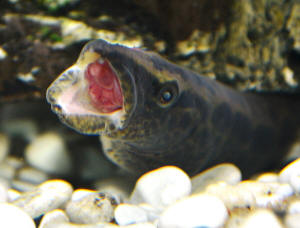
Hi, I have a black spotted eel,
<A Mastacembelid... spiny (freshwater) eel>
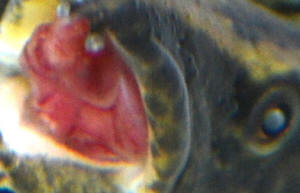
I have attached pictures of it. It has some sort of growth in his mouth,
<Yes; looks tumorous>
he can’t close his mouth anymore, breathing very hard, behaving and
eating normally. This has been there for a at least 2 months. I have
never seen this before. He eats brine shrimp
<Variously nutritious... though I do eat popcorn most every night>
and frozen shrimp, in with cichlids. Hard water, an established tank. Is
this something that can be treated?
<Not as far as I'm aware unfortunately. As with human growths of these
sorts, the treatment options are limited to surgery, chemo-therapy...
Most I would do would be ameliorative...>
Pls help,
thanks,
Ella
<Will keep on WWM for Neale's reply. Bob Fenner>
|
 |
|
eel is sick /Neale's go
7/5/14
Hi, I have a black spotted eel, I have attached pictures of it.
<More commonly called the Tyre-Track Eel, Mastacembelus armatus -- though in
fact it is possibly a related species, Mastacembelus favus.>
It has some sort of growth in his mouth, he can’t close his mouth anymore,
breathing very hard, behaving and eating normally.
<Indeed. Clear damage to the mouth, bacterial secondary infection. Serious.
Treat with antibiotics. Don't forget to remove carbon while in use.>
This has been there for a at least 2 months. I have never seen this before.
He eats brine shrimp and frozen shrimp,
<Needs more variety than this; shrimp isn't a nutritious diet, too lacking
in Thiamin and other vitamins. Earthworms a better choice, plus small pieces
of tilapia fillet, seafood, etc.>
in with cichlids.
<What sort? Hopefully not "African Cichlids" in the Rift Valley, Mbuna
sense. Tyre-Track Eels are somewhat predatory but not overtly aggressive
(except towards their own kind) so are best kept with active midwater
characins and barbs, for example Silver Dollars, Spanner Barbs, etc.>
Hard water, an established tank. Is this something that can be treated?
<Yes. See above. Do also review the aquarium. The substrate is one possible
problem here. These Spiny Eels are easily damaged by gravel, and should only
be kept in tanks with sand or very fine gravel.>
Pls help,
<Do read:
http://www.wetwebmedia.com/fwsubwebindex/spinyeelsmonk.htm
http://www.wetwebmedia.com/ca/volume_4/v4i3/Spiny_Eels/Spiny%20Eels.htm
Virtually all problems with Spiny Eels come from shortcomings in the
environment or diet. They're actually quite adaptable in all other regards.>
thanks,
Ella
<Most welcome, Neale.>
Re: eel is sick 7/5/14
Thank you for your reply,
<Welcome.>
I will try to move him to a tank of his own today, I'll put some Epsom salt.
What antibiotics should I use??
<Seachem KanaPlex is a good first choice. Unlike many other antibiotics,
it's one of the better ones for treating external damage.>
I have general cure, but I don't think this will work. How much Epsom salt
should I put per gallon?
<Epsom salt at 3 teaspoons per 5 US gallons/20 litres.>
He is in with African cichlids, they don't bother him at all, he's not
predatory
<He should be! These fish can easily manage a Platy; made that mistake when
I first kept one circa 1991. A mixed diet, with at least occasional white
fish fillet pieces, is recommended.>
and he's pretty big and gets plenty of shrimp when I give it to him, 2 times
week. Earthworms, I have plenty of those in the yard. Do I cut them up in
pieces? Do they need to be washed? It's going to be a challenge though to
feed him that.
<Feed whole. Choose the right size, drop in front, and Spiny Eels generally
take them right away. Some soil on the body of the worm isn't a problem.>
The eel has been in the same aquarium set up for 5 yrs nothing new. The only
thing I can think of, one day during a cleaning and water change I decided
to take out the ornament he's been living in, I have rocks and this ornament
doesn't fit in with the décor. So, he freaked out like crazy and burrowed
himself under the huge and heavy rock pile, he did scrape himself pretty
hard.
<A possible factor.>
But it all went away. the issue with his mouth was already present before
the incident only now it's much worse looking.
<Indeed.>
The substrate is mixed in with round gravel and sand.
<Would remove gravel, replace with sand or very fine pea gravel.>
Sent from my iPad
<Sent from my computer. Cheers, Neale.>
Re: eel is sick 7/18/14
Hi, here's an update. I moved the eel to a tank of his own. He hasn't
been eating for 3 weeks now.
<A bad sign.>
The medicine or the Epsom salt helped a bit with his issue, as the
growth is not as big or as red.
<Good. Repeat/continue as possible.>
He's breathing very hard still.
<Optimise aeration and/or oxygenation as far as practical; robust
circulation, supplemental aeration, etc.>
Unfortunately, it's not curing it.
<Indeed. I know Bob thought/think this cancerous, in which case
a cure is unlikely; I'm not sure, but would bow to his greater
experience.>
Do you have any other suggestions.
<A vet?>
Thanks, Ella
<Good luck, Neale.>
Re: eel is sick 7/22/14
Hello, my eel is still alive, and still not eating, probably 3-4 weeks
now.
He has a cloudy eye on one side,
<Do read previous FAQs, here:
http://www.wetwebmedia.com/popeyefaqs.htm
http://www.wetwebmedia.com/fwsubwebindex/SaltUsePopEyeF.htm
Epsom salt often useful.>
plus I noticed cottony growth on that growth in his mouth.
<Columnaris perhaps?>
What do I treat it with?
<Again, do read:
http://www.wetwebmedia.com/fwsubwebindex/ColumnarisF.htm
A bacterial infection, despite the "mouth fungus" moniker.>
Thanks, Ella
<Welcome, Neale.>
|
Peacock eel sick? 2/22/14
Hi
<James>
We have a peacock eel in a 60 gallon planted tank with gravel. We did
try to make him a hiding area in the gravel with a pvc pipe, but he
showed no interest.
<A faux rock or log works better>
We have had him for several months and he has always been very energetic
with activity and feeding. Yesterday, he started just laying at the
bottom of the tank lethargically and seems to have stopped eating. We
tried hand feeding him but he sort of shook his head and backed away (we
have been able to hand feed him before). We have never done any live
worms but often feed him the frozen blood worms.
<Unfortunately; these sewer fly larvae have such issues... Better to at
least mix in some other foods>
He also seems to be "breathing" heavy. We really love our atypical peacock
and were hoping you'd have some advice as to whether or not he is sick
<Is sick... nutritionally>
and if we can do anything to help him. We tested the water and everything
was in the safe zones. Water temp stays between 76-78 degrees. We have
community fish plus tiger barbs, a clown loach (to eat baby snails that
we didn't know reproduced so well), and other bottom feeders.
Thanks!
-James Shelton-
<Do look into live or frozen/defrosted blackworms... Spiny eels
(Mastacembelids) find them very hard to resist. Oh, and please peruse
the archived files on this family of fishes on WWM. Bob Fenner>
Re: Peacock eel sick? 2/22/14
Thanks for the quick response. We are making changes today.
<Ah good. BobF>
|
Tire track eel with what I thought were scrapes
9/28/13
I have a one year old approx foot long tire track eel. He lives in a 125
with a group of rope fish a Senegal and three juvenile pair of
Eartheaters.
The tank has two hob filters and two sponge filters due to the eel and
the Geo's need for clean water. The parameters are all spot on.
<Meaning what, precisely? Tyre-Track eels are best kept in neutral to
slightly basic, moderately hard water; some would say slightly brackish
conditions are useful too.>
The tank has been running for two years no problems.
My eel takes to pushing rocks around and making a ruckus. So we put
bigger rocks we thought he wouldn't be able to move. And even siliconed
them together with aquarium safe of course. But he woke me up the other
night flinging rocks around and the next morning he had a white patch an
the end of his nose and a patch on his side that looked like scuffs. I
put him into a 40g hospital tank to be sure I can keep the tank star
clean as to prevent infection. Now there is a spot of red in the center
of the scrape on his side. Just looks like the scraped skin came off.
He is very active and friendly still not acting weird n any way but that
he isn't eating. But I don't know if that is cus of the move or not.
I have treated him with a half dose off furan 2 because I was unsure if
he needed or would be sensitive to medication. Any advice would be
greatly appreciated.
Thank you, Timbra
<Antibiotics are generally safe with Spiny Eels (certainly safer than
copper and formalin) and should be used promptly where indicated. Spiny
Eels often get damaged in tanks with rocks and gravel; they should be
kept in tanks with smooth ornaments (ceramic tubes are great) and either
very fine gravel or (ideally) sand. Once their skin is damaged,
secondary infections are very common -- and often fatal. The addition of
tonic salt at about 2 gram/litre seems to be useful and is often
recommended. Ropefish and most cichlids will tolerate this just fine. Do
read:
http://www.wetwebmedia.com/ca/volume_4/v4i3/Spiny_Eels/Spiny%20Eels.htm
And follow the links. Most problems with Spiny Eels are best avoided
rather than treated. Cheers, Neale.>
Tyre track eel 9/30/13
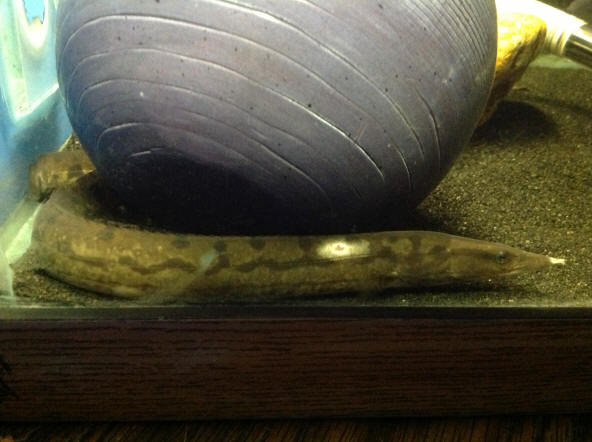
This is my buddy we have been chatting about. As you know the Internet
is almost useless when researching these guys to any major extent. He
was sold to me as a tire track but I have always been skeptical of
whether that is right or no. I have another eel the same size that is
the typical dark brown reddish tire track you see and he just isn't the
same. Any input?
Thanks a ton.
<Ah yes, it is one of the species sold as "Tyre-Track Eel" but precise
species could be difficult to pin down. Often we call this fish
Mastacembelus armatus, but another species, Mastacembelus favus, is very
similar in size and shape, but with somewhat different markings. There
are likely some other similar species, subspecies and/or regional
variants. On the plus side, they're all very similar. Big (to 70 cm),
predatory (made the mistake of keeping one with Swordtails!), somewhat
jumpy (prone to escaping from aquaria), and arguably best kept in very
slightly saline conditions (1-2 gram tonic salt/litre of water).>
P.s. that was the first day and he actually is looking much better.
Still no appetite though. Well see.
<Indeed. Does seem to be an external bacterial infection. If at all
possible remove to an aquarium without any ornaments or sand except for
a ceramic pot, but failing that, do medicate appropriately (Maracyn 1
and Maracyn 2 would be a good combination) and keep water quality
excellent.
Cheers, Neale.>
Re: Tyre track eel 9/30/13
Thanks for the info. It's much appreciated. That was the morning I woke
to find him sick. He had since been moved to a bare bottom hospital tank
with his pot. His course of meds is almost done and the spot on his nose
is gone and the one on his side is all but gone. And his appetite is
back with a vengeance lol. Thank you again for your help. You are a
credit to the hobby.
Timbra
<Thanks for the kind words, and hope this fishy friend gets well soon!
Neale.>
|
 |
|
Spiny Eel Relationship Troubles; comp. f'
5/29/13
Hello again! Thank you for your advice with my 90 gallon tank setup.
<Glad WWM could help.>
Following it, I have decided to go with fresh water (80 degrees,
planted) for this one. Currently stocked are two female Senegal bichirs,
one male, (two are 4" one female is 6"), 4 leopard Ctenopoma (2-3"),
a brown and black ghost knife fish (5",4" respectively.
<All sounds good and broadly compatible, though do watch the Knifefish
(they aren't famous for tolerating one another, to say the least).>
I'd consider this pairing a "test" as I'm not sure on how they'll get
along, keeping a close eye, peaceful so far),
<Agreed. But since the African Knifefish is not an electric fish, the
Black Ghost may well ignore it. On the other hand, both will be
competing for the same sorts of lairs and food.>
Pseudotropheus socolofi (3" temporarily banished from my 40g cichlid
tank),
<Doesn't belong.>
a high fin spotted Pleco for cleanup (3"),
<For now… if you're talking about Pterygoplichthys gibbiceps, these get
massive, and quickly. We're talking 45 cm/18 inches within 2-3 years.>
and finally the focus of my troubles, a peacock eel and a Macrognathus
circumcinctus (so many common names for this one, what is the
most widely used one?)
<I'd stick with the Latin names. Much more consistent.>
Both are 6-7", but the peacock is about half as rotund.
<Ah now, female Macrognathus are substantially deeper-bodied than males
of similar length.>
First of all is this overstocked minus the cichlid?
<In 90 gallons, no, not at the moment, but I'd remove the Gibbiceps
catfish anyway, since it's liable to compete strongly (too strongly) for
foods such as bloodworms and krill that the Spiny Eels and Knifefish
will need. If you wanted cats, I'd stick with something small and
harmless, perhaps a trio of Synodontis nigriventris.>
I do have several other tanks I can put fish into if need be. Anyway, my
main troubles are that both eels seem to like each other very much (they
curl up together quite often, touch noses) but I have seen the
Macrognathus circumcinctus chase the Peacock Eel twice today and bite
his/her tail, recently causing a little tear.
<Does happen, as there is some territoriality once the males become
sexually mature, but overall Macrognathus species are very tolerant of
one another, especially in groups of 3+ specimens. This contrasts with
Mastacembelus spp Spiny Eels that seem to be much more territorial and
aggressive, sometimes lethally so.>
I figure it has something to do with either the heat, mating, or maybe
just attitude problems.
<Agreed.>
Also should I remove the Peacock Eel?
<I don't think so; in 90 gallons they should come to some sort of
accommodation, especially if there are plenty of floating plants (which
are what the male Spiny Eels want most of all).>
The peacock has always been very delicate and shy, whereas the Mac is
quite energetic and I wouldn't want to be responsible for him hurting
her.
<I see. Try adding some more Peacock Eels.>
One last thing regarding the Macrognathus circumcinctus while I'm at it.
I noticed since I rescued him (her?) That he has a not so subtle
appendage near his rear. Is this a sexual reproductive organ?
<Not to my knowledge. Do be aware of what Camallanus worms look like,
and act accordingly.>
I looked and looked and not one other Macrognathus circumcinctus (or any
spiny eel for that matter) on an image search had this "appendage", my
other spiny certainly does not. Again thank you so much for your time to
help out the less knowledgeable. Regards, Austin
<Most welcome, Neale.>
|
 |
Re: Spiny Eel Relationship Troubles (RMF, Marco
-- genital papilla?) <<Don't think so. RMF>>
5/29/13
Good morning/afternoon. Thank you for the fast reply! All sounds swell, yes
the cichlid is leaving that tank asap. Just wanted to give his tank mates a
break and a chance to better establish their own territories. As for worms,
I have checked and it does not even remotely resemble Camallanus worms
(breath of relief). I have included a cropped picture of it, as good
of one as I can get. It's hard to see in the picture but it perfectly
matches the Macrognathus circumcinctus' color markings, and it doesn't
appear to be protruding from the anus. Again any help with this
trivial matter is still appreciated. Thanks, Austin.
<Do agree that this is an odd structure. Never seen this on my Spiny Eels.
A quick search on Google Scholar suggests that the genital papillae (or
pores) on Mastacembelids tend to be quite small, which this isn't. But I
didn't do an in-depth review, and without seeing pictures, it's hard to
compare your specimen to others. Have Cc'ed Bob F and Marco, who may know
better. In any event, you could deworm as a preventative, but if the fish is
fine and maintaining a healthy body weight, I wouldn't worry overmuch.
Cheers, Neale.>
Re: Spiny Eel Relationship Troubles /Marco
5/29/13
Good morning/afternoon. Thank you for the fast reply! All sounds swell, yes
the cichlid is leaving that tank asap. Just wanted to give his tank mates a
break and a chance to better establish their own territories. As for worms,
I have checked and it does not even remotely resemble Camallanus worms
(breath of relief). I have included a cropped picture of it, as good
of one as I can get. It's hard to see in the picture but it perfectly
matches the Macrognathus circumcinctus' color markings, and it doesn't
appear to be protruding from the anus. Again any help with this
trivial matter is still appreciated. Thanks, Austin.
<Do agree that this is an odd structure. Never seen this on my Spiny Eels.
A quick search on Google Scholar suggests that the genital papillae (or
pores) on Mastacembelids tend to be quite small, which this isn't. But I
didn't do an in-depth review, and without seeing pictures, it's hard to
compare your specimen to others. Have Cc'ed Bob F and Marco, who may know
better. In any event, you could deworm as a preventative, but if the fish is
fine and maintaining a healthy body weight, I wouldn't worry overmuch.
Cheers, Neale.>
<<Hard to tell from the picture. I don't think this is the genital papilla.
Are you really sure this is not feces? Or a piece of protruding colon? A
parasite would be another option. Marco.>>
Re: Spiny Eel Relationship Troubles (RMF, Marco -- genital papilla?)
5/29/13
Hmm, well I have had him for over two months and the size, shape, and colour
have remained constant. I really doubt poop. How would a protruding colon
come about? And can I do anything to fix it if that is the problem?
<No specific cure as such, but time and a fibre-rich diet (in this case,
things like frozen brine shrimp) can help. See here for many cichlid
examples:
http://www.wetwebmedia.com/fwsubwebindex/neotropcichdisfaqs.htm
You might also consider using Metronidazole and Nitrofuranace as a good
general treatment for intestinal parasites like Hexamita.
http://www.wetwebmedia.com/metranidazole.htm
Cheers, Neale.>
Re: Spiny Eel Relationship Troubles (RMF, Marco -- genital
papilla?) 6/1/13
After a day of searching the corners of the web for Spiny Eel
information, I've come to a near certain conclusion that the
Macrognathus circumcinctus is bullying the Peacock Eel due their mating
habits.
<Possible. Increasing the numbers of the smaller/weaker species may help
diffuse tension, else remove.>
Several sites have stated that during mating they will chase each other
violently after spinning in circles together, and mine are doing just
that.
<Interesting.>
It also says that they will lay eggs in floating plants within two or
three days.
<The few times Spiny Eels have been bred, yes, this is what has been
observed.>
I haven't seen any eggs in my Duckweed and am assuming the two species
cannot interbreed, is this correct?
<Likely so.>
Would getting more Peacock Eels still help settle them or just create
more violence?
<Hard to predict. If possible, separate them. Else getting more of the
picked-upon species would be the more likely solution, though adding one
or two of the other species, if you had four or five of the weaker
species, might encourage the bigger species to interact with themselves
rather than the smaller species.>
If so how many would you recommend getting? My Peacock Eel stopped
eating for a few days (ate again today) and his/her dorsal fin is
damaged. Should I just separate the two and be done with it? Your help
is much appreciated.
Thanks again, Austin
<Welcome, Neale.>
|
Fire eel swollen and floating –
11/20/12
Hi my name is Brenden. I have had my fire eel for about half a year now
and I have never had any problems with him before. But just the other
day I noticed that he was not eating. At first I was like ok maybe he's
just not hungry. But then last night I noticed that he was not able to
swim normal and had not control of where he was swimming. Due to this
fact I took him out of the tank because I did not want him getting stuck
to the filter or causing any more harm to himself but running into rocks
or driftwood. I put him into a container that was ok size and I could
fit a small heater in it.
I used the water from the main tank to fill it up so it would not stress
him out. But getting to the point he's not moving very much anymore,
there is swelling in his stomach area, he's floating, and he's losing
his color.
I've have been keeping fish for about 8 years now, and this is the first
time I have ran into a problem with eels that I'm not sure about. I
don't know what's causing this but I may have a clue/guess. What I
think is happening is that he is having problems digesting food, which
is causing the swelling or bump on him and also causing air to build up
there. The only other thing i can think of that may has caused this is
that my old heater was not working right, causing it to heat the tank to
much and then not heating it enough, so i had to replace it, but i was
not a huge change and i saw it fast enough to fix the problem, i think.
I just hope that you had give me some help/information about what may be
going on and how to fix it, if its not too late. Stuff
about my tank: 60 gallons, have a nice fine sand in it, I normally keep
the temperature at about 81-82 degrees Fahrenheit, I try to do water
changes about twice a month or once every 2 weeks if i have the time, I
took a water sample into PetSmart and the results were Ammonia:0
Nitrite:0 Nitrate: 20-40 mg/L pH: 7.8 Alkalinity:120
mg/L Hardness: 150 mg/L Chlorine And Chloramine: 0
So everything is where it should be/ within the normal range
I also do add aquarium salt when doing water changes, i normally add it
every other water change Also when I went to PetSmart the lady
there, I know I can trust her because I've knew her for awhile and she
also keeps fire eels, said that it could be the digesting problem or
maybe due to the temperature change and she told me about how people use
small amount of Epsom salt to help with fish digestive problems so i
added a small amount of that to the container. If
there is any of stuff that you need to know just ask me.
Also I'm going to add some pictures of my eel to show you what I'm
talking about. Never mind, In the pictures I was going to show you, its
too hard to see the swelling/bump.
Also I almost forgot that he is also having seizure like things
every now and then. I hope you can help me out and
thanks for your time.
<I'm not optimistic, but do try adding Epsom salt at 1-3 teaspoons per 5
gallons/20 litres, raising the temperature to 28-30 degrees C/82-86 F,
and treating with a reliable antibacterial or antibiotic medication
(ideally, a combination like Maracyn 1 and Maracyn 2 that covers both
gram-positive and gram-negative bacteria for best possible chances of
success). Spiny Eels are very sensitive to bacterial infections, which
are often started through physical damage caused by gravel or sharp
rocks. The Epsom salt will act as a laxative and muscle relaxant, both
of which can help deal with some types of swelling. Generally, aim to
use aquarium salt (sodium chloride) in Spiny Eel tanks at around 1-2
gram/litre, even for freshwater species like yours.
Hope this helps, Neale.>
Golden weather loach, hlth. 10/13/12
I have a golden weather loch and after pulling a dead Gourami out of my
tank noticed that the back half of the loach's body has become a very
dull and looks almost whitish. Also there are tons of tiny hard to see
red spots on it's body. The tail fin looks as though it's collecting
blood and I noticed one of my ghost shrimp nibbling on it. now I do know
I had a high ammonia level recently and have been treating the tank for
a week now to combat that. What is happening to my poor loach and what
can I do to help him and keep my other fish safe. I have 2 peacock eels,
3 tinfoil barb's, 3 small albino barb's, and two Ruby shark in the tank.
I'm hoping you can help save my fish.
<Something is very wrong with this aquarium. The combination of dead
white skin (the hard flakes on the body) and the red areas are classic
symptoms of bacterial infection, likely Finrot, but could equally easily
be some sort of "Slime Disease" type infection (Costiasis for example).
In any case, review the aquarium thoroughly: something is VERY wrong if
a Weather Loach is showing this sort of damage -- they're normally very
hardy. Look at the type of substrate (soft sand or gravel, nothing
sharp); water quality (0 ammonia and nitrite); water temperature (not
too high, 25 C or less); and no aggression or fin nipping. For just the
three Tinfoil Barbs you'll need an aquarium upwards of 100 gallons, so I
assume this is a very big aquarium, but if it isn't that large, plan on
upgrading soon.
Furthermore, the (albino) Tiger Barbs are "nippy" if kept in groups of
fewer than 6, so there's another source of problems. Ruby Sharks are
aggressive, both towards each other and towards other fish they don't
like, which could include the Loach (same sort of shape, habits as the
Sharks).
How long have you had the Spiny Eels? They're notoriously difficult to
maintain in generic community tanks. They must of course have a soft
sand substrate -- never gravel -- and feeding them is a real chore if
they're kept with other bottom feeders. Anyway, lots of stuff to think
about.
Cheers, Neale.>
re: Golden weather loach, spiny eels as well
10/13/12
I have had the eels for about three weeks and they are happier than
ever. I have a fine gravel base like what they were kept in at the fish
store they came from.
<I cannot stress too strongly how important it is to use the right
substrate with Macrognathus species. Anything even remotely scratchy
will eventually lead to skin damage, and from that, bacterial
infections. Been there, done that. Hmm… have a read:
http://www.wetwebmedia.com/ca/volume_4/v4i3/Spiny_Eels/Spiny%20Eels.htm
http://www.wetwebmedia.com/fwsubwebindex/spinyeelsmonk.htm
Generally, spiny eels die prematurely because they either starve, jump
out, or get skin infections.>
I have spent hours watching my tank and all of my aggressive guys chase
their own kind and that's it.
<Not necessarily a good sign. If they're chasing each other, there's
something amiss.>
I am planning on moving the tinfoil barb's to their own much bigger tank
soon.
<Real soon…>
Currently they are small, 1-1 1/2 inches. I have a 35 gallon tank.
<Whoa!>
The largest of my creatures are the eels and they spend near 2/3 of the
day buried heads out.
<What they do, and why their skins are so easily damaged.>
As far as the loach goes until today (ghost shrimp nibbling) I have
never seen anything touch him short of the eels using him as a pillow.
If is a fin rot, or even a mucus disease what type of treatment should
be provided to help him out.
<Review Costia/Slime Disease, and treat accordingly.
http://www.wetwebmedia.com/fwsubwebindex/CostiaF.htm
http://wetwebmedia.com/FWSubWebIndex/loachdisfaqs.htm
Quite common. Primarily caused by a protozoan (rather like Whitespot,
and often treated similarly) but bacterial infections frequently set in.
Cheers, Neale.>
re: Golden weather loach 10/13/12
Thank you for the info, unfortunately the loach has passed on and now I
have discovered dropsy (bloated and scales out) on one of my albinos.
I'm going to be changing the floor substrate to sand as Well as do a
large scale cleaning. I have done 10-15% water changes weekly and I did
have a massive ammonia spike about a week ago that I believe is the root
of some
of this evil. I also think I'm going to set up my spare 10 gallon for
quarantine of the albinos. At this point I'm very confused as to Why
it's happening but I'm pointing my finger at the ammonia spike. When I
say spike I mean, on the teat it was green almost black. Very strange
explosion of ammonia. I hope I can get this under control and save
these fish. I'm also in the process of setting up my 55 and 75 gallon
tanks and moving my Tinfoils to bigger and better.
<Sounds like you have a good plan. Don't feed the fish while ammonia
isn't zero. Changing the substrate shouldn't affect biological
filtration, but do take care with the filtration. Non-zero ammonia
levels imply some sort of biological filtration issue: too many fish,
too much food, not enough filtration (media, current). Review, and act
accordingly. Upgrade the filter if needs be. Usually adding better or
more filtration fixes ammonia problems. Remove carbon (if used) to make
space for more biological media.
Don't add any more fish, obviously, until ammonia remains firmly at zero
for some weeks. Cheers, Neale.>
Peacock eels wasting away? 9/19/12
Hi, very informative site you have here. I believe I have an issue with
my peacock eels. I originally had two and just lost one. The tank is 65
gallons in a community setup.
<Mmm, hard to keep an eye on such spiny eels in large settings, get them
fed amongst competing tankmates>
The smaller peacock was about 4 inches, I had him or her for about 6
months and then it refused to eat. Being that I have a few very spastic
weather loaches in the tank I was worried that they were scaring him
away from the cut red wigglers
<Might well need smaller food/s. See WWM re >
I've been feeding them, so I moved him back into a 20 that I keep as a
hospital tank until his demise. My other peacock eel is still in the 65,
and is starting to worry me. He seems more active but a lot of his
activity is spent running up and down the tank walls, he still eats and
the loaches don't seem to bother him, I usually feed an appropriate
sized worm every other day or so. Recently the six inch eel has began to
appear skinny though, and I'm worried that something is wrong and I'm
going down the same track. Water conditions are 6.8 ph, 0 ammonia, and
around 10 on nitrates.
<These are okay>
I do about a 15% water change bi weekly
<I'd change at least this amount, more likely 25% every week>
and replenish any evaporated water every few days. Filtration is an
Aquaclear 110 modified to give the tank some current.
<Keep the top covered to prevent these fishes leaving>
It's got about 8 separate pieces of driftwood and many live plants. Are
internal parasites common in spiny eels?
<Mmm, yes. Folks in the import part of the trade are encouraged to batch
treat (via foods) w/ an anti-protozoal (usually Metronidazole) and
anthelminthic (typically Praziquantel)>
That's kind of what I'm leaning towards but could definitely be wrong. I
just don't see how he can be eating and getting thinner. I haven't saw
<seen> any of his waste. In this tank I also have my prized possession,
a 5 inch fire eel that seems very plump and healthy(his much larger tank
of the future is a work in progress but coming soon). I don't want to
see him get sick. Everything else in the tank seems very healthy. What
should I do?
<I might move the six inch Peacock to a smaller system... easier to
observe, determine what is going on. Bob Fenner>
Cloudy eyes in my tire track eel, no data
9/5/12
I Just purchased a medium sized tire track eel about three days ago. The
second day I noticed that her eyes were very cloudy then today I noticed
they were puffy.
<Mmm, water quality? Often Mastacembelids have their sensitive eyes
scraped in being netted, moved...>
She is still swimming around, and she actually ate half a night crawler
yesterday which surprised me because I know they are hard to get to eat.
<Actually; not this species>
I took my water to be tested at three different places and each one told
me the same thing, "your water is perfect, nothing is wrong with the
ammonia, nitrates, or the PH." I called the store where I got her and
told them the situation and they told me, and I quote, "that it is
probably a change in PH and her eyes were burned".
<Need values, not subjective statements>
I told them that I had my water tested three times and that nothing was
wrong and they said "Well bring the water here and we will test it for
you." What that tells me is that they are just trying to cover
themselves, so now since I can obviously rule out help from them, I am
turning to you guys for advise on what to do. She is a beautiful girl
and I would hate to lose her so I'll do anything. The place I got her
from kept her in a tiny ten gallon tank with two other tire track eels
and a catfish of some sort, and yes they actually had them on gravel! I
have a non abrasive sand in my tank so she can't hurt herself, but I
know that she had some abrasions on her nose when I got her home. I am
at a loss for what to do at this point, any advise you can give me will
be extremely helpful and appreciated. I have attached some photo's of
her below just so that you can see what she looks like.
<.... Please read here:
http://www.wetwebmedia.com/FWSubWebIndex/spinyeeldisfaqs.htm
and the linked files above. Bob Fenner>
Re: Cloudy eyes in my tire track eel 9/5/12
I have already read all of these, and none of that is happening to her.
Its just her eyes.
<I see>
I was told today that it could be a fungus
<Not likely a true fungus... much more likely a bacterial infection...>
so I started treatment, but I'm not so sure because she has no other areas
that concern me. What would you do?
<Nothing treatment wise. IF this were a wholesale/producer operation w/
many animals involved I might treat w/ soluble Oxytetracycline and a bit
of aquarium salt. BobF>
Sick Peacock Eel? White on tail and head?
5/24/12
Firstly, I just wanted to say thank you for volunteering to help fellow
aquarists with their problems, it is greatly appreciated.
<Thanks for the kind words.>
Here's some background: I have a 75 gallon with a built in corner
overflow/and underneath wet dry filter, 80F, with 1 piece of driftwood,
2 smooth large rocks, 2-4" of pool filter sand substrate, and live
Anubias, wisteria, java fern, recently added Vallisneria, and just added
yesterday, Salvinia minima. Current stock is 1 ~5-6" peacock eel, 2 ~4"
Senegal bichirs, and 1 ~4" African Brown Knife, 1 mystery snail, and
various other snails. Water change regime is 30% every 3-4 days, and
they are all being fed frozen bloodworms, frozen Mysis shrimp, and
frozen brine shrimp daily currently, I am looking for live blackworms
and probably will try to get some small earthworms as well, since I know
bloodworms aren't the best foods.
<All sounds good.>
I got my ~5-6" peacock eel probably 3 weeks ago or so (I got him from
PetSmart, in a tank that had gravel, which now I know was bad right from
the get go),
<Can be bad, yes. Once their skin is damaged, bacterial infections are
very common.>
and right from the beginning he has had odd behavior. (I intended to QT
him, but my QT tank sprung a leak, so into the main tank he went) The
first day was normal, he spent the whole day buried with just the tip of
his rostrum out, night time he would come out. Second day, he spent with
his head out, night time he would be out. Third day he spent 75%
swimming about happily in the open, and since then he doesn't burrow
himself anymore at ALL, he is out and about 100% of the time, swimming
around happily. I see him more frequently then I do my bichirs. He eats
the bloodworms quite voraciously, and will nibble on the Mysis shrimp
sometimes.
<All sounds good and normal.>
When I first got him, on the 3rd day I noticed that he had a small kinda
clearish whitish bump underneath his chin, but I wasn't sure if it was
an illness, or if it was just how their heads look (I've never had spiny
eels before). I've kept an eye it, and it hasn't grew at all, however,
yesterday I noticed a very small white bump on his "spine" by his tail
(it's not Ich). And looking closely this morning, it looks like he has a
little bit of a white/clearish layer on the side of his snout. His
behavior is very normal though (well normal for him), actively swimming
in the tank during the day.
<I see.>
From what I've read, I am assuming its the start of a bacterial or
fungal infection?
<Could easily be. I would treat aggressively, ideally in a quarantine
tank, but if you must, in the display tank. I'd use salt/heat together
as per Whitespot, and also treat with a reliable antibiotic for
bacterial infections such as Finrot (Maracyn 1 and 2 for example work
together very well). Other types of medications might be used, but
copper and formalin MUST be avoided as Spiny Eels react to them in a
very unpredictable (and often fatal) way.>
If so, what would be the best treatment given his current tankmates and
the fact I have live plants? I was planning on using 2 teaspoons of
aquarium or non iodized table salt per gallon of water, and that was it
so far. I've used Melafix/Pimafix combo when my bronze Cory a few years
ago had a severe cotton fungal infection that ate both her side fins and
tail and was on half her body, and she pulled through and her fins even
grew back to my surprise, so I have high praises for it, though recently
have read many bad reviews on how it "killed their fish." so I am
unsure. I can't afford to buy a new QT tank at the moment, so whatever
treatment has to be used to treat the display tank.
<Bob F. isn't a big fan of Melafix, and frankly, given what it is, I
wouldn't use it to medicate any fish once it was sick. But yes, some
people have had good results with it. Corydoras are tough animals right
out of the box, so it's not impossible for them to get better even with
mild medications like Melafix. If your Spiny Eel is feeding and happy,
you might try the Melafix alongside the salt/heat, and give that a go
for the next 2-3 days. But if the white area on the head shows any sign
of expanding, I'd switch to the antibiotics. And honestly, I'd skip the
Melafix myself and go straight to the antibiotics. Do also be aware of
Lymphocystis, a fairly common problem among Spiny Eels. Not fatal, but
unsightly, and apparently connected with environmental issues even
though it's immediate cause is a virus.>
Thank you very much in advance!
<Welcome.>
Danielle
<Neale.>
Dying Spiny Eel. I'm
desperate. 2/2/12
Hi,
I have a Spiny Eel, about 10 inches long, approximately four years old.
The day before yesterday he was fine, up and about interested in food,
generally healthy. Early this afternoon, I went to my tank and he was
just ghastly looking, it broke my heart. At this point in time,
he's on the bottom of the tank, on his side, gasping for air
(harder than you can imagine). He's lost all of his colour, and
seems to be slightly swollen, and somewhat stiff. He's unable to
move, occasionally, he will try to turn over if I approach the tank to
check on him, but that's about it. I'm heartbroken, and there
have been more than a few tears shed over my fish baby.
I've completed a 30% water change, and added aquarium salt, along
with some Ammo Lock. The few harlequin Rasboras I have in with him look
fine, along with my Bristlenose plecostomus (although, they're both
hardy enough it would take a fair effort to kill them).
Water parameters look fine, and as I said nothing else looks sickly.
The only change I can think of is the heat which has taken a turn for
the worst, my tank is sitting at about 34 degrees Celsius. But, this is
not uncommon with our climate, and it isn't the first time, nor the
last that the tank gets that warm.
Please, any information or direction to try and fix this would be
greatly appreciated. I fear it may be too late for him, and am prepared
to euthanize him if necessary, but he's been a loyal fishy
companion for quite some time now, I'd like to try and help him
before I give up. Although, seeing him suffer just makes me cry.
Thanks, Sarah.
<Hello Sarah. Do you have gravel in this tank by any chance?
Bacterial skin infections (which need treatment with antibiotics) are
very common with Spiny Eels when they get scratched by the substrate.
Do read here:
http://www.wetwebmedia.com/fwsubwebindex/spinyeelsmonk.htm
http://www.wetwebmedia.com/ca/volume_4/v4i3/Spiny_Eels/Spiny%20Eels.htm
http://www.wetwebmedia.com/fwsubwebindex/spinyeeldisfaqs.htm
http://wetwebmedia.com/euthanasia.htm
The high temperature may be a factor too; some of these Spiny Eels come
from fast-flowing streams and dislike the low oxygen levels typical of
warm water. Cheers, Neale.>
Re: Dying Spiny Eel. I'm desperate.
2/2/12
Hi Neale,
Thank you so much, for a quick response. Unfortunately my eel, Ick as
he was lovingly known, died about an hour ago, shortly after writing
the email.
<Ah, too bad.>
I had had him for four years, so it's quite a loss. He was an
awesome, intelligent creature, I'd trained to take food from hand,
always leaving his random hiding space to greet me when I came to the
tank. He was very much a pet, and will be very, very missed.
I would like to know what happened to him though, so in answer to your
question, yes, I did have a gravel in my tank. I realise now that was a
mistake on my part, however, in the four years of having him he was
never sickly and never appeared injured.
<And therein lies the problem. Spiny Eels clearly can do well in
tanks with gravel. But it does seem that skin infections spread across
Spiny Eels extremely quickly, and scratchy gravel is very likely one
cause. Perhaps it's not so much the algae as, say, not cleaning the
gravel properly one time, so that there's a little more dirt in the
gravel than usually is the case. I just don't know.>
Even looking at him after he has gone, he does not appear to have any
physical signs of injury or illness. As I stated, the symptoms he had
were some slight swelling (although that may have been because he
wasn't his usual lithe, quick moving self), a complete loss of
colour, almost white, and the gasping. He was absolutely fine the day
before yesterday, foraging for food in the tank, hiding in his PVC
tube, poking about for attention;
and then bam, it was all over.
<Yes.>
I Googled anything and everything to try and find a solution, scoured
your sites pages, but it appears it was fast hitting, and without
resolution, unfortunately. That being said, I greatly appreciate your
fast response, and your site (especially that faq page on Spiny Eel
Health/Disease), it was the only information I was able to find that
offered any serious recommendations (as opposed to the thousands of
forum pages arguing water quality or overstocking, which is fine, but
in a hour of need you require solid information quickly).
<Quite so. With Spiny Eels, prevention really is the key. A soft
substrate and ideally a very low salt concentration (1-2 grammes/litre)
seem to be the things that minimise problems.>
Thank you again, I wish I could have saved my fish baby, but in the
least I'm hoping I can find a cause, and my information help
someone else when and if they should need it.
<Surely the case.>
Sarah.
<Cheers, Neale.>
fire eel seizure
10/31/11
Hi I have had a fire eel for 2 years now we have had a few other fish
they did not survive I think we had to many the tank has only had her (
or so we call her Jeanie or Houdini ) for 3 months now water changes
and all she only eats red worms from a fish store today she seized
started twitch and seizing lost all her color and seemed dead I held
her in the water and kept stroking her side about 14 minutes later she
seemed to be coming out of it gaining color back her eyes are still
cloudy for about 20 minutes she
stumble around like drunk now she seems aware of everything and
swimming but not totally herself. what is going on please help Greg we
just bought new worms yesterday temp is 82
<Very strange... and frightening. I would label this behavior as you
have... some sort of seizure. Other than the usual "good
husbandry", perhaps expanding the diet or simply supplementing it
w/ the soaking in
vitamin/HUFA preparation ahead of offering, I don't know what
further you could do. Have you read on WWM re Mastacembelids? Start
here:
http://wetwebmedia.com/FWSubWebIndex/matacembelids.htm
and the linked files above. Does anything in your reading "jump
out" for you? Bob Fenner>
Re: fire eel seizure 11/1/11
Thank you so much Bob for replying the site was very informative happy
to say I put salt in the tank last night 35 gallon tank sea salt trying
to be safe about 3 tablespoons and put her old tube back in that is the
only thing I can think of that has change there is wood in the bottom
but not enough for her to completely hide I read on your site I believe
that light can cause erratic behavior and the tank was recently put in
front of a window maybe that caused it?
<May be... but I suspect something else... Perhaps the wood
rotting/decomposing a bit has changed some aspect of water quality. I
will say that 35 gallons is small for a larger species, specimen of
spiny eel, and that they can be very sensitive to accumulation of
metabolites. Best to super size their systems, have redundant
filtration and be VERY regular re water changes and other
maintenance>
today she came out of her tube and ate like nothing had ever happened
skimming the surface and nosing us for food she is a strange one I hope
her tube back in will stop what happened. what else could we offer her
aside from worms she is around 9" or so.
<See where you were referred to... the FAQs, feeding...>
I will be stopping at store tomorrow to test water and pick up vitamins
we tried moving her over to frozen shrimp and she refused along with
the other worm places is it common for them to be picky? Greg P.S you
guys are awesome
<Welcome. BobF>
Striped Peacock Eel black edge on
tail 10/6.5/11
Hello,
<Hi there Nigel>
I recently bought a striped peacock eel (Macrognathus aral) for my
55gal tank and though he's been doing fine so far, I grew a bit
concerned about a small spot it has on the tail fin (so the actual fin
connected to the end of the tail, not the one running through the
length of the body). It appears he has a black/brown-ish spot at the
end of his tail fin, running throughout the most of the height of the
fin. In addition, his tail fin isn't completely shaped like a half
circle, though the dent is only very minor.
I'm not sure it's normal for the tail fin to be completely
symmetrical though.
<It is... is this spot on both sides of the tail?>
It looks a bit like a burned edge on paper (though maybe more like a
smudge), that's as close as I can describe it.
I was kind of wondering if this could be fin rot.
<Not likely, no>
His other fins look completely normal. On a side note I haven't
noticed it spread since I got him, it's not quite like his whole
tail is getting consumed (for now at least). I didn't see any fish
nipping his tail fin either. I have no experience with how fin rot is
supposed to look on eels.
Besides that he's a very active eel, which I did not expect because
I used to have a smaller one that kind of died unexpectedly and he was
a lot more timid, spending most of his time in the cave or behind some
cover. This guy swims all the time, doesn't actually really hide
for longer than a few minutes and is very curious. I actually started
spoon feeding him less than 2 weeks since I got him (he swims to the
surface). He eats very well so I'm happy about that.
<Good>
Thanks for your help, I'm just wondering if I should start getting
worried or not.
Kind regards,
Nigel
<Not to worry. This sounds/reads as a normal growth characteristic.
Bob Fenner>
Re: Striped Peacock Eel black edge on tail, and fdg. --
10/07/11
Hello,
<Hey Nigel>
Thanks for your amazingly fast response. I've been watching the eel
for a bit. It's very hard to tell exactly if the spot is on both
sides of the tail or not, he never sits still.
For now I would say it's on both sides, though on one side it does
seem to be less intensive so I wouldn't exclude it simply being
visible through the other side of his tail.
<Ok>
On a side note, he only seems to eat live bloodworms.
<Spoiled... best to try weaning on to other foods... Don't
worry, this fish won't starve>
I also have frozen ones but he just bites and spits them out
immediately without actually eating.
He hasn't responded to other (frozen) food at all yet (such as
daphnia, Artemia and white worms/mosquito larvae), he just ignores
those. It also means I am kind of forced to always feed live
bloodworms, which someone told me I shouldn't feed them every day
because they're very fat. Is it OK for the eel to only eat (live)
bloodworms and how about the other fish?
<Not okay>
I have some fairly common fish like platys, zebra Danios, glass catfish
and an angelfish...so they basically eat anything. That said I do also
feed them dried food and other frozen foods occasionally so it's
mostly the eel I'm trying to feed properly. How can I get him to
eat frozen food and what other types of food would you recommend?
<Earthworms are best... whole if small enough, cut up if not>
Thanks a lot!
Nigel
<Mmm, do read here as well: http://wetwebmedia.com/FWSubWebIndex/spinyeelfdgfaqs.htm
BobF>
Mastacembelus randomly dying --
07/02/11
Hello WMM.
In the past I have had terrible luck with my Mastacembelus sp. dying
unexpectedly on me. My first occurrence was my beloved Mastacembelus
cryptacanthus. We had him in the LFS tanks for months and he was doing
fine and then I brought him home and he got used to the tank quickly
and after 3-4 months died unexpectedly with no warning signs at all. My
tank had no ammonia or nitrate and nitrates were <10. My next
experience with these fish was with some Mastacembelus sp. "Starry
Night Eel" that we had at our wholesaler at work. All of the fish
in the tank had the same shape as M. cryptacanthus and a few had the
same pattern too. Most of them did have a more spotted pattern though.
I ended up purchasing four. Two suddenly died in a few weeks, one
squeezed through a hole in the new aquarium and one ended up surviving.
Again, none of these fish posed any problems and the water parameters
were even better in this aquarium with nitrates at 5ppm.
Now I saw this beautiful Mastacembelus brichardi but I don't want
to spend a large amount of money on a fish that could very well die
unexpectedly from unknown conditions. It may also help if I mention
these fish are from Africa and not farms and many of our Reedfish from
Africa seem to come in even worse.
Do you have any ideas on what this could be? I am completely baffled as
to what this could be.
Thanks! Tyler from Buffalo, NY.
<Tyler, there are a bunch of issues with Spiny Eels. One is that
they're difficult to feed. While you may be offering the required
earthworms and river shrimps, the exporter, wholesaler, and retailer
may not. So your specimens could be severely underweight once you buy
them. Buying specimens as soon as they arrive at your local retailer,
quarantining new specimens until they feed well, and then introducing
them to tanks where they can feed comfortably (no loaches, no catfish!)
will help here. Secondly, bacterial (and perhaps external protozoan)
infections are a problem with Spiny Eels across the board. Typical
symptoms including wasting as well as bloody sores and/or white slime
on the body. I'm not aware of any established protocol for dealing
with this in terms of antibiotics, but you certainly want to avoid
specimens with any sign of physical damage and also to ensure your
aquarium has nothing liable to scratch their fins (no sharp rocks, no
gravel, etc.). Design the tank specifically for these easily-damaged
fish -- smooth silica sand (pool filter sand in the US), water worn
bogwood, round cobblestones, no openings at the top of the tank,
floating plants to inhibit jumping. Aquarium cleanliness needs to be
very high, so besides good water quality you want lots of water
movement at all levels, and you need to ensure that detritus at the
bottom is regularly removed. The addition of a small amount of salt,
1-2 g per litres, does appear to be very beneficial for Spiny Eels,
particularly in the first few months, though some writers, e.g.,
Baensch Aquarium Atlas, suggest it's added all the time. I should
report that once settled I've never found Spiny Eels particularly
delicate, but those were Southeast Asian species, and it may well be
that the established exporters from Asia and the Rift Valley lakes are
better at distributing these fish than the exporters from Central
Africa. Do also note that the Blind Spiny Eel, Mastacembelus brichardi,
is a fast-water species, so you will need to create a tank with very
high water flow as well as caves and cobblestones. Cheers, Neale.>
Re: Mastacembelus randomly dying 7/4.5/11
Thanks for the info Neale, you guys at WWM never let me down!
<Glad to help, and thanks for the kind words! Cheers,
Neale.>
tire-track eel swimming abnormally --
05/07/11
Greetings,
<Salud>
I have a sick tire-track eel and I am at a loss as to what I should do.
I have a 500 lt. "paludarium" setting that is 3/4 full of
water, with carnivorous plants above water level and lots of floating
plants. Water parameters seem fine: ammonia 0 ppm, nitrate <10 ppm,
pH 6.0 (last checked.)
Water temperature is 28 C. Tankmates are: an 14'' Arowana, two
BGKs, two Senegal bichirs, and several smaller spiny eels. Here are
some pictures, though I haven't updated in a while.
http://s1082.photobucket.com/albums/j368/Whirlflux/
The tire-track is approx. 12'' long, and has been a resident of
our tank for months. I've been feeding it on a diet of
anchovy pieces,
<Pieces? This type/family of fishes can be a bit too fatty... Please
read here re spiny eel nutrition:
http://wetwebmedia.com/FWSubWebIndex/spinyeelfdgfaqs.htm>
with the occasional shrimp. I always remove the fishbone carefully
before feeding.
The tire-track eel was a voracious eater and quadrupled in size since I
got him. (I got him from a pet store where it had been starving for a
month.)
It was a very timid creature, always nestling inside the huge sea
urchin shells I bought for him. A week ago, however, something went
wrong. The eel left his urchin shell and started wandering around. We
considered that happy news at first, but two days later I observed that
the eel was swimming abnormally, often turning upside down
<A very bad sign>
and staying motionless for moments. I immediately did a 40% water
change and tested the water, but everything was normal.
<... for what you have tests for>
I have done two more smaller water changes since, and I've cut down
feeding just in case. A week has passed and nothing has changed. The
eel is still active, swimming to every corner of the tank, sometimes
upside down and sometimes normally. I also find it contorted in an
S-shape from time to time. He stays motionless in that position. There
is no visible bloating.
He has not accepted any food since the symptoms began.
<Try other foods>
I considered using medication for internal parasites, but I read that
they can kill your fish, so I'm waiting your advice on that.
<I too would not treat for parasites. The problem here is likely
environmental. "Something" is amiss chemically, physically
here. Perhaps one of the plants of the paludarium is poisoning the
water...>
Your website is a
genuine encyclopedia. I've read the FAQ section on spiny eels but
couldn't find anything that applies to my case, so I'm
bothering you with this e-mail. All help appreciated!
Regards,
Emre
<I would utilize a good deal of high quality (activated) carbon,
maybe the product PolyFilter in the water flow path... keep doing large
water changes, NOT use Anchovy OR shrimp in this fish's diet. IF
the symptoms and non-feeding continue more than another week or two,
I'd be moving the tire track, possibly all the fishes here. Bob
Fenner>
|
bubbles on eyes 3/1/11
Hi and Good morning. I have done some searches and can't find
ideas on what may have happened to my black spotted eel.
<I see a Mastacembelid w/ an opaque eye...>
I've had him for many months and he's been thriving and
growing rapidly.
He's probably 13 inches long. He's the king of the tank.
However last night when I was feeding my fish, I noticed my eel
wasn't coming to the surface to get his food (he eats from my
hands). I found him and he had bubbles formed over his eyes. He
also looks to have some swelling around his mouth. He was fine
the day before. Do you know what may have caused this and how to
treat it?
<Not given the paucity of information here... need to know
water chemistry, the other livestock, set-up, maintenance...
Likely a physical injury though>
I don't have any fish with him that could possibly harm him
besides maybe a match against a Pictus catfish. His tank mates
are a Ropefish, an angel fish, a parrot cichlid, a diamond tetra,
3 silver dollars, a rainbow fish, a Farlowella catfish, and of
course the Pictus.
<Mmm... not a good mix water quality wise>
Please let me know your thoughts. Attached is a photo. Thanks for
all your time!
<Do read re the ranges, needs of the species you list...
measure water parameters and report back. Bob Fenner>
|
|
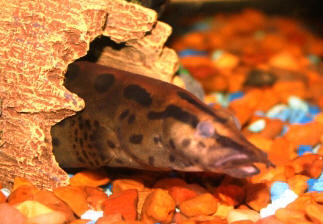
|
Re: bubbles on eyes 3/1/11
Thanks for responding so quickly....
Ok, water chemistry:
Ammonia 0
nitrite 0
ph 8.3 (always been this high, fish are used to it)
<Ah, no... go back, read our prev. corr... Check out the needs
of your livestock. B>
livestock...Ropefish, an angel fish (3" from tip to tip), a
parrot cichlid (young 50 cent piece body), a diamond tetra, 3
silver dollars (largest being about 3 " around) , a rainbow
fish, a farlowella catfish, and of course the Pictus about 4"
long. I know it's a strange mix but they all get along.
Well sometimes the diamond tetra chases the silver dollars around
which is funny b/c she's half their size.
We do a 50% water change once a week with the last change being
Sunday. I add freshwater salt (1 tbls per 5 gallons) and stress
coat to the water.
The water is well water.
I hope I answered everything.
I know from the first photo his eyes just look clouded but they are
actually
swelled up bubbles. They are like half a bubble on each eye and his
lips look swelled too. I'm attaching more photos so hopefully
you can make out the bubbles. Should I treat him with meds? If so
which kind is safe for eels? I have Melafix???
This is my favorite fish, so please help. Thanks for all your
time!
<... keep reading> |
new Fire eel, Neale's go 10/25/10
Hey guys, I just got in a new 7inch fire eel and it looks ok, but I
noticed that while it was in the fish store they had it in gravel and
any time I would go look at it b 4 taking it home it would be buried in
their regular size round gravel. In my tank I've got white and back
sand, and sum plants and stuff for him to hide and feel more
comfortable. my question is, is there a reason he is not burying
himself in the sand but keep chilling at the top of the water in the
plants? I've read that ppl talk about this but they say their eel
is on its side or upside down. mine is not its just up there not really
doing n e thing. don't get me wrong at night he moves around and
stuff. but .. how come no burrowing?!? it that ok or what?
thanks for the help guys at WWM :)
Bless! Brad
<Hello Brad. If you have plants at the top of the tank, especially
floating plants, it is very normal for Spiny Eels to tangle themselves
up in those plants. In fact spawning seems to take place in floating
plants. So if your chap otherwise looks healthy, and better yet, is
eating, I wouldn't worry about it. Cheers, Neale.>
new Fire eel, BobF's turn 10/25/10
Hey guys, I just got in a new 7inch fire eel and it looks ok, but I
noticed that while it was in the fish store they had it in gravel and
any time I would go look at it b 4
<Please, no "net speak">
taking it home it would be buried in their regular size round
gravel.
<... please read here:
http://wetwebmedia.com/FWSubWebIndex/spinyeelsysfaqs.htm
and the linked files above re Mastacembelids>
A/the choice of substrates with spiny eels is crucially
important>
In my tank I've got white and back sand, and sum plants and stuff
for him to hide and feel more comfortable. my question is, is there a
reason he is not burying himself in the sand but keep chilling at the
top of the water in the plants?
<Likely this gravel is too coarse, sharp... painful to its
skin>
I've read that ppl talk about this but they say their eel is on its
side or upside down. mine is not its just up there not really doing n e
thing. don't get me wrong at night he moves around and stuff. but
.. how come no
burrowing?!? it that ok or what? thanks for the help guys at WWM :)
Bless! ..Brad
<Brad, in future, please run your missals through a spelling/grammar
checking ahead of sending.
Bob Fenner>
Re: Sick Eel with White Patches
Thanks, unfortunately the eel did not recover and had to be
removed.
<Sorry to hear this.>
This was an extremely fast-moving infection, especially for such a
large fish (3'). From zero symptoms to dead in 3-4 days.
<Indeed, very fast.>
Nitrates were tested at 30 or less (per color scale) every month or so,
but it is a 400 gallon tank with only 3 fish and 2 (now 1) eels so the
biological load is light. Has about 250 lbs of live rock in the main
tank and a bioball filtration system in the sump. Water changes 40
gallons every 10 days. I don't have a PH score right now but most
likely it is fine given this maintenance.
<Yes, sounds OK.>
Both eels came from LFS about 6 months ago that was trying to get rid
of them due to lack of demand. Neither one can be described as
aggressive eaters in the sense they will dash out and grab at food,
have to put the food on a stick and put it near their mouth before
another fish grabs it. So they got plenty food but maybe not the
strongest to start. Maybe that is why the LFS was getting rid of them.
I will watch the remaining one and continue to monitor tank conditions
and consider the hospital tank at the first sign of trouble.
<I'd also add vitamins to its food regularly (at least once a
week) to replace anything lost due to freezing and thawing processes.
Cheers, Marco.>
Fire Eel Sick
10/21/10
I have a Fire Eel whom I have had for a couple months now.
<Nice fish.>
He just recently started to have these white spots appear on him and is
losing the color in his rostrum.
<Oh dear.>
They appear to be discoloration and are not on the outside of his skin.
I'm pretty sure that it is not Ich but I'm not sure what it
is.
<Fire question. Do you have gravel or sand? Gravel damages the skin
of Spiny Eels, and since they use their nose to dig into the substrate,
the nose is often the first part of their body to get damaged. Small
specimens are particularly at risk, and while large spiny eels --
upwards of 45 cm/18 inches -- might be okay with smooth, fine gravel, I
personally would never, ever keep a spiny eel in a tank with gravel.
It's just too risky, and the evidence gravel damages them is
overwhelming.>
He recently fell on the carpet and was out of the water for a short
period of time.
<Exposure to air is in itself not a disaster, provided the fish is
quickly returned to the tank.>
I got him back in the aquarium quickly, but right after that is when he
started to show signs of an illness.
<Yes, likely damage to the skin. As with gravel, drying can cause
damage to the skin, and the longer the fish is exposed to air, the more
serious the risk of damage. Spiny eels are incredibly sensitive to this
sort of thing, and once the skin is damaged, opportunistic bacterial
infections aren't far away.>
The tank is kept at 80 degrees Fahrenheit with a small amount of
aquarium salt.
<How much? I'd add at least 2-3 grammes/litre, just as if
treating Ick.
This won't stress the other fish, and will be a preemptive strike
against Ick.>
Nitrates are at 10 ppm, Nitrites at 0 ppm, hardness is 75 ppm (soft), 0
chlorine, low alkalinity, and 6.8 pH. 45 gallon tank with a 20 gallon
sump (I know I will need to get a larger tank once he grows).
<I'll say! These fish are gigantic. Average specimens in aquaria
are about 75 cm/30 inches.>
Tankmates include a Featherfin Synodontis and an Ornate Bichir both of
which are small.
<Okay. Potentially good tankmates, though I'd tend to favour
salt-tolerant species simply because spiny eels do better when salt is
used regularly.
Siamese Tigerfish and some of the cichlids make good companions because
of this.>
Tank has lots of hiding spots. Feeding the Eel and Bichir earthworms
and the Featherfin sinking carnivore tabs. Could the disease be velvet,
or something else entirely? If so, what should I do? Thanks in
advance.
Ben
<Unfortunately, my guess would be a bacterial infection, and I'd
treat with an antibiotic. Spiny eels are finicky fish and difficult to
maintain if you don't do EVERYTHING right. Do be sure to read
everything you can about these fish, and act accordingly. Both Marco L.
and myself have kept these fish and written articles about their
needs:
http://www.wetwebmedia.com/ca/volume_4/V4I3/Spiny_Eels/Spiny%20Eels.htm
http://www.wetwebmedia.com/FWsubwebindex/spinyeelsmonk.htm
Cheers, Neale.>
Re: Fire Eel Sick - 10/21/10
Thanks for the quick reply,
<No problem.>
I have sand in the tank so it shouldn't scratch him when he buries
himself.
<The sand is smooth, right? Not sharp? Bear in mind that some sands,
for example Tahitian Moon Sand, are abrasive, and these must not be
used with Spiny Eels.>
He was only out of the water for thirty seconds max so hopefully his
skin didn't dry out to much.
<Agreed.>
I have put in two tablespoons of salt in the tank already so I will add
some more.
<As per dosage.>
What medications would you recommend to treat him with?
<Antibiotics are safe, but otherwise avoid medications where
possible, especially copper and formalin.>
Should I start a hospital tank to treat him?
<Would leave him in situ.>
Thanks again.
Ben
<Cheers, Neale.>
Re: Fire Eel Sick
10/24/10
Thank you very much!
I have done as you said and will go out to get some antibiotics today.
The sand is smooth so it will not hurt him. I deeply appreciate the
help.
Best Regards,
Ben
<Glad to help Ben. Good luck! Cheers, Neale.>
Fire eel question (Bob, some questions about your Spiny Eel
piece)<<Ok>> 10/19/10
Hey Guys,
<Salve,>
I was at my LFS and came across some amazing Fire Eels.
<Beautiful fish, though very difficult to keep for a variety of
reasons.>
A fish that I had only ever seen in videos on YouTube. I knew right
then that I wanted to bring one of them home with me. I've got a
8'x2'x2' tank, crushed coral substrate and smooth black
river rocks making caves with 6, 5" Fronts, 2 4" blue
dolphins, 1 9" black Arowana and 2 4" Altolamprologus.
<Here's the deal. Hard water isn't a major problem as such,
but crushed coral will probably raise the hardness and pH well above
the comfort zone for these essentially soft water fish. They really
need something in the range 5-20 degrees dH, pH 6-8. Yes, there are
spiny eels in both Lakes Malawi and Tanganyika, but not Fire Eels! Any
of the Malawian or Tanganyikan species would get along fine with all of
these fish, except the Arowana, who has no business being in a hard
water community at all, and in
any case, will soon start seeing the smaller fish as food.>
<<And crushed coral is a very poor/unsuitable substrate for
keeping Mastacembelids>>
In the research that I've been doing over the weekend I think the
Fire Eel would do ok in my tank with the fish I have now.
<Not quite. The tank is big enough, and Fire Eels have certainly
been kept with Arowanas, particularly the relatively peaceful South
American Arowanas. On the other hand, the water chemistry required by
Malawian and Tanganyikan cichlids is far towards the hard/alkaline end
of what Arowanas and Southeast Asian spiny eels appreciate. In short,
not a textbook combination of species.>
Question 1) will it?
<Does depend on water chemistry, about which you've said
nothing. Also, the substrate needs to completely smooth, I'd
recommend smooth silica sand, or failing that, very fine, rounded
gravel. Crushed coral and/or coral sand is right out. Any rocks need to
be smoother than smooth, baby's bottom smooth.
Anything with any sharp or even rough edges is putting your Fire Eel at
severe risk of death. The danger is, as I hope you understand, damage
to the skin. Once scratched, these fish are astonishingly prone to
bacterial infections. They react badly to copper and formalin, and even
antibiotics have a poor track record when it comes to treating sick
fish. Obviously, this predisposition to disease is another reason why
"feeder fish" should never be used, and diet has to be very
carefully controlled to include lots of thiaminase-rich foodstuffs.
Earthworms are the single best food around for spiny eels.>
the eels at the store are about 6" to 7".
<Babies.>
I have a cover on the tank now but are they really that adapt at
escaping?
<Yes. If they can escape, they will. DO NOT delude yourself
otherwise!>
Those are the basic questions I have, my main concern would be the
small white blob spot on the tail of one of the eels. From what
I've read it could be Ick, as the eels had just got to the shop a
day before, and if so adding salt and increasing the temp in the tank
would help kill the bacteria?
<Salt/heat will treat Whitespot just fine. As for bacteria, there is
some argument, e.g., in Baensch vol. 1, that maintaining slightly
brackish conditions improves the health of Fire Eels and indeed Spiny
Eels
generally. I kept my Tyre-Track Eel in brackish water for several years
alongside mollies, Rainbowfish and other salt-tolerant tankmates.
Baensch recommends 1-2 teaspoons per 2.5 US gallons, or about 6-12
grammes per 10 litres. This is a very low dosage, far below what is
officially brackish water and not enough to stress freshwater fish in
most cases, but do observe your other fish and see how they
react.>
However in one of the articles I found on your site,
http://www.wetwebmedia.com/FWsubwebindex/matacembelids.htm
Bob Fenner said "Should any of the spiny eels in the system
exhibit red areas, particularly near fin origins, or white, blotchy
markings, leave all of them. They are likely to be soon dead."
<Bob is on the money here. Fire Eels and spiny eels generally are
extremely prone to these bacterial infections, and if the retailer has
done stupid things like keeping them in tanks with gravel, or has fed
them feeder fish, then all bets are off. You might take a gamble on a
healthy specimen alongside one or more sickly ones, but for the best
chance, pick a healthy fish from a batch of healthy fish.>
What is this 'white blotchy marking' on the tail?
<It's essentially Finrot, some sort of Pseudomonas or Aeromonas
infection of the skin. You're looking for patches of white mucous
initially, followed by reddening, dead white skin, cloudiness of the
eyes, and then death as the disease progresses.>
is it really that bad,
<Yes.>
is there nothing I can do about it
<Antibiotics may help with minor infections, and maintenance in
slightly salted water is probably a plus. But once a spiny eel gets
really sick, they are notoriously difficult to treat.>
so I can bring one home and nurse it back to health, or should I just
stick to admiring these fish on YouTube Videos? Thanks for your help
guys! :)
<Do be sure to read everything you can about these fish, and act
accordingly. Both Marco L. and myself have kept these fish and written
articles about their needs:
http://www.wetwebmedia.com/ca/volume_4/V4I3/Spiny_Eels/Spiny%20Eels.htm
http://www.wetwebmedia.com/FWsubwebindex/spinyeelsmonk.htm
The bigger species of Mastacembelus are perhaps less sensitive to
substrate type than the smaller Macrognathus, but apart from the
rock-dwelling Malawian and Tanganyikan species, all spiny eels should
be kept in environments as free from sharp edges and rough surfaces as
possible.>
Bless! Brad
<Cheers, Neale.>
fire eel. Mastacembelid sys., hlth.
6/10/2010
Hello, I found your site doing a search on fire eels.
<A lovely fish.>
I bought one a few weeks ago and I put him in my tank with gravel. I
noticed he was digging so I took all of the gravel out of the tank and
made my tank suitable for fire eels. I now see white scrapes on his
body with a couple of white spots.
<Yes, this is the classic problem. Smooth, round gravel is just
about okay if their are lots of bogwood roots and caves where the Fire
Eel can hide.
But if he feels the least vulnerable, he will try to dig, and when they
dig, they get scratched.>
He is eating fine and is quite happy.
<Excellent.>
I am concerned about the white scrapes/spots. Do I need to medicate or
will the scrapes/spots go away?
<I wouldn't medicate directly, but a small amount of aquarium
salt can help. Baensch recommends 1-2 teaspoons per 2.5 gallons, which
isn't very much. For whatever reason, small amounts of salt seem to
minimise the risk
of secondary infections where spiny eels are concerned. Note that they
aren't brackish water fish, so marine salt isn't what you want
here; marine salt mix would raise the pH and hardness, not just the
salinity. Just plain vanilla aquarium/tonic salt, sodium
chloride.>
I have done so much research and don't know if I should medicate.
The spots have been on my eel for about 3 days. Your help would be much
appreciated!
Best Regards, Jennifer
<A cheap, easy fix here Jennifer, so be of good cheer! In clean,
clear water he should heal just fine. Don't forget to keep him nice
and warm though; these eels are hothouse flowers, and need to be kept
around 25-28 C/77-82 F. If they're chilled, their immune systems
will weaken. Cheers, Neale.>
re: fire eel 6/11/2010
Thanks Neale for the quick reply!
<No problem.>
The tank is at the right temperature and I did add some aquarium salt
this morning.
<Cool.>
I will keep a good eye on him and if I see things worsen, what kind of
medication would be best for my newest family member?
<As stated, salt is the best tool for prevention as well as treating
things like Ick. Otherwise antibiotics, possibly Methylene blue. Avoid
copper, formalin and malachite green.>
He is an awesome fish and we have become quite attached to him.
<Indeed he is.>
I will do what ever it takes not to lose this guy.
<Quite right!>
Thanks Again! Jennifer
<Cheers, Neale.>
Escaped zigzag eel 5/26/2010
Hello All.
<Hello,>
I have a major emergence here. Two days ago my zigzag ell spent about
20 minutes crawling around on the carpet.
<Ah yes, a favourite hobby of spiny eels generally.>
He was still alive when I found him, but was covered in cat hair and
dust.
I had a pail of aquarium water close so I picked him up, put him in and
as gentle as possible wiped it off.
<Okay.>
He is now in a 10 gal. hospital tank, but not in very good shape.
<Indeed not.>
The tank has an eclipse filter-water at 81deg,-air stone running. He is
3yrs old, about 7ins long. The main problem is approximately 2in. of
skin is missing on his right side from the tail forward.
<I see.>
He just lays in one spot on his left side and very seldom moves. Is
there anything I can do for this injury or should I put him out of his
pain?
<I'd be doing two, maybe three, things. The two things I'd
definitely do would be to add a little aquarium salt to the water, 3-4
grammes per litre is ample. That will reduce some of the salt loss
through the damaged tissue. The second thing I'd do is add a
product like Stress Coat to the water. Again, this helps deal with
damaged mucus and skin, reducing the risk of subsequent stress and
infection. The third, optional, thing would be to add a broad spectrum
antibiotic. That would minimise the risk of Finrot and speed up
healing. In the meantime, find out how the spiny eel escaped: these
fish are notoriously good at getting out of aquaria through small gaps
in the hood. Floating plants help inhibit this behaviour, but even so,
you need to make sure the hood is secure. Hang-on-the-back filters
are completely unsuitable for spiny eels, since by definition they need
a whopping great gap at the back of the hood. The best filters are
internal canister filters, since these require only a small hole for
the power cord, and you can further plug that hole with filter floss if
needs be.>
Thank you for any advice
Dave H.
<Cheers, Neale.>
Fire eel problems...hlth., English --
04/22/10
ill try to make this short
<Complete sentences and proper spellings would be nicer.>
fire eel
17inch and fat
purchased about a week ago ate first day earth worms second day ate
fine third day ate fine then began to lay on side breathing heavy then
next day was fine fed again
<Hmm... Mastacembelus species are notoriously sensitive to bacterial
infections, dips in water quality, waterborne toxins including copper
and most medications, and generally anything that might cause stress.
It's absolutely crucial to react to even the slightest signs of ill
health quickly. That means not assuming things will get better by
themselves, but immediately trying to establish the possible causes of
any problems like rapid or laboured gill movements. The obvious things
to check are sudden pH changes, non-zero nitrite and ammonia levels,
and dips in oxygen content, e.g., because the filter is running
slowly.>
now this time he was on his side breathing heavy then an hour later he
would be right side up but still breathing heavy this has been going on
for 2 days now of constant breathing heavy and on being on his side off
and on
he keeps mouth open
no sign of visual damage
fins look fine
no white film around body
no fungus
looks healthy body wise
could this be parasite infection?
<Probably not.>
from worms?
<Not earthworms, no.>
I feed all other fish in tank worms though and there fine.
<Generally earthworms are a good staple for Spiny Eels
generally.>
thing I am doing to try to help turn all lights off incase he just
stressed?
<Certainly darkness reduces stress, but in and of itself it
won't cure problems.>
dont no from what he was fine when I put him in the tank almost a week
ago <"A week is a long time in politics...">
running two air stones raise temp to 83 degrees
<A bit warm, to be honest, and if oxygen content is an issue,
warming up the water will only make things worse. An ideal temperature
would be around 25-26 C, 77-79 F.>
my tank
6ft
135 gallons
stock list:
1 Oscar
2 Severums
1 Pleco
fire eel (fish in question)
Filtration
FX5
AC 110
two air stones
bare bottom tank
<Something Spiny Eels hate; if you can, use *smooth* silica sand so
they can burrow freely. Avoid gravel. But absolutely avoid bright
light/reflections from underneath. Install floating plants, e.g.,
Indian Fern, for shade. The use of floating plants doubles the lifespan
of Spiny Eels simply by inhibiting their tendency to jump out of
aquaria. If I sold fish, I'd given away a clump of Indian Fern with
every Eel sold!>
PVC for the eel only
<What about the catfish? Spiny Eels are easily damaged by aggressive
Loricariidae. It isn't so much the size of the catfish, but their
ability to cause superficial wounds with their spiny bodies. Once
damaged, infections set in super fast.>
my water test results are as followed
0-0-5
please help
<Mastacembelus erythrotaenia is a notoriously difficult fish to
maintain.
It is a highly sensitive fish, and should not be exposed to sudden
changes in pH or hardness. Water quality needs to be excellent, and
that includes taking precautions against chloramine, copper and ammonia
in your tap water. Water chemistry needs to be middling, not too soft
and not too hard; 10-15 degrees dH, around pH 7 is ideal. The use of a
little tonic salt is often essential. Baensch recommends 1-2 teaspoons
per 2.5 US gallons, something I'd agree with from my experience
with the similar species Mastacembelus armatus. It is important to
never use "feeder fish" around these Spiny Eels; they'll
eat them readily enough, but the risk of simply exposing them to
bacterial infections, let alone parasites, is just too great. Since
this is a new specimen, the possibility of either Velvet or Ick is
something to consider; Velvet especially tends to go for the gills
before the body, and Spiny Eels are prone to ciliate parasites even
under the best of conditions. Again, the use of salt will help here.
Cheers, Neale.>
Re: fire eel problems -- 04/22/10
ok were do you recommend going from here with the info I gave you?
<Do read:
http://www.wetwebmedia.com/FWsubwebindex/spinyeelsmonk.htm
http://www.wetwebmedia.com/FWsubwebindex/matacembelids.htm
>
should I use a combo of Melafix and pima fix?
<Minimal value.>
add salt
<As stated.>
bring temp down a bit?
<Unless treating for Whitespot, in which case the combination of
heat and salt. Cheers, Neale.>
HELP!! Mastacembelus erythrotaenia
1/16/10
Help for my 25'' fire eel. I had it now for a year and last
night I noticed he has a few white spots on it's tail and it's
fins but until last night he was eating well. What can I do?
<A few white spots... on the fins and tail? I'd keep a watch
out, but not add anything here... Possibly raise temperature... along
with aeration, circulation, to the mid 80's F. if you really think
this might be a Protozoan>
I just performed a 30% water change with RO water and I added two
teaspoon of salt. All my parameters are ok. ph 7.2 nitrates 0.
Basically my parameters are the same as they were one year ago and I
perform tests every 2 weeks.
Let me know please I don't want to loose him!!!
<Or lose it... What would Doug Adams likely write? "Don't
panic!" This may be "nothing". Treatment could
definitely be worse.
Bob Fenner>
Re: HELP!! Mastacembelus erythrotaenia 1/16/10
> Hi Bob,
> In my experience, spiny eels are very prone to bacterial
infections, especially in tanks with gravel rather than sand. Once
sick, they seem rarely to recover.
> Baensch recommends 1-2 (presumably level) teaspoons per 2.5
(presumably US) gallons to ward against ciliate infections. Would
certainly advise being a little more aggressive than "wait and
see" with these fish -- adding salt would be sensible. Having an
antibiotic to hand would be wise if the infection is a bacterial one
rather than, say, Ick.
> Cheers, Neale
<If you can find the querior's addy, do feel free to send along
your input. IMExperience, "some" spottiness is not nearly as
dangerous, and likely transient with spiny eels than "most"
treatments. B>
RE: HELP!! Mastacembelus erythrotaenia
Will keep an eye on him and watch if he eats sufficiently and I will
let you know
Thank you very much for your prompt reply!
<There is a message from a fellow crewmember I'm
prompting...>
RE: HELP!! Mastacembelus erythrotaenia
Will keep an eye on him and watch if he eats sufficiently and I will
let you know
Thank you very much for your prompt reply!
<Hello Antonis. With Bob's permission, I'm going to offer a
second opinion here. In my experience, spiny eels are very prone to
bacterial infections, especially in tanks with gravel rather than sand.
Gravel scratches the skin, and this allows secondary infections
comparable to Finrot (and very likely Aeromonas, Pseudomonas spp.
infections). Once sick, they rarely seem to recover even if treated
with antibacterials. Quite likely organic dyes, formalin and especially
copper are toxic to them, so these kill the Spiny Eels even if viable
treatments for the bacteria. Furthermore, Baensch recommends 1-2
(presumably level) teaspoons salt per 2.5 (presumably US) gallons to
ward against ciliate infections (Ick, Velvet, etc.). I would advise
being a little more aggressive than "wait and see" with these
fish. Having an antibiotic (rather than a copper, formalin or organic
dye antibacterial) to hand would be wise if the infection is a
bacterial one rather than a ciliate one. If you suspect a ciliate
infection, add salt; Spiny Eels are very salt tolerant, so there's
little risk involved.
Understand the differences between them, and act accordingly. And do,
of course, review any potential problems with the tank -- water
quality, abrasive gravel/rocks, aggressive tankmates, etc. Cheers,
Neale>
Re: HELP!! Mastacembelus erythrotaenia
1/17/10
I was actually looking for your reply Neale!
<Oh?>
My gravel is rounded so no risk there and I only have Anubias and 2
ghost knives in my tank so no danger there my tank is 500ltr so how
many spoons of salt I shall put.
<<The Knifefishes will NOT like the salt addn. RMF>>
<The standard recommendation for treating Ick with salt and heat is
to add 2 to 3 teaspoons of salt per US gallon, while raising the
temperature to 82-86 F (28-30 C). It's best to use tonic salt
rather than marine salt mix so that you don't alter the pH and
hardness. 500 litres is nominally 132 US gallons, but by the time you
allow for gravel, rocks and such, you can usually knock 10% of the
volume, so your tank probably holds more like 120 US gallons.>
<<And this much salt added may well destroy or at least send your
nitrifying microbes into a metabolic check. RMF>>
As for medications I have JBL's Punktol (especially for white spot)
that I know from experience that is very good but I don't know haw
harmful it can be to spiny eels.
<I am not overly familiar with this medication, but it is based on
malachite green, an organic dye, rather than copper or formalin.
Organic dyes tend to irritate sensitive fish, so I'd recommend
against using this medication. Plain salt/heat is best for Ick or
Velvet, potentially raising the salinity up to SG 1.003 (about 6
grammes per litre) if needs be.
Antibiotics would be preferable for bacterial infections.>
What do you recommend. I already raised the temp to 29.5 just in case
and I'll try to feed him earthworms tomorrow because he hasn't
eaten since yesterday :o(
<Wouldn't try feeding until you've identified the problem
and started the treatment. Cheers, Neale.>
Ellipsifer eel question, hlth. --
09/22/09
I have had two ellipsifer eels for about three years now.
<Mastacembelus ellipsifer, put into the genus Aethiomastacembelus by
some.>
One died recently, she was the larger female prone to what I thought
was egg binding...her middle would get very fat and her vent would
protrude a lot. Epsom salts would help to clear that up. This happened
on and off for 8 months maybe.
<Maybe this was not caused by egg binding or solved by Epsom
salt.>
A few months ago, the larger female just stopped eating. Nothing
visibly wrong with her. Same diet, same tank, no new tank mates. After
a long period of not eating, all other tank occupants remained fine,
except my second female ellipsifer. Her appetite started to wane. She
never got a bloated belly though. I decided to medicate the tank with
metro. Didn't work. The larger eel died a week or so later, the
smaller of the two eels stopped eating completely and hasn't eaten
for about 2 weeks now. She doesn't look sick in any way, just
won't eat. She normally eats frozen mysis shrimp. Doesn't want
it. Offered her frozen bloodworms, doesn't want it. Tried soaking
the food in garlic, not interested. All other tank occupants are fine,
and I've since stopped using metro as it didn't seem to be
helping and I don't really know what's wrong anyway. Not sure
what to do at this point.
<My first approach would be to check the water parameters of the
tank. These eels are from lake Tanganyika (they are endemic and occur
in nowhere else in nature) and need corresponding water (alkaline, very
hard, nitrates below 20 ppm) to stay healthy. See here for details:
http://www.wetwebmedia.com/ca/Volume_5/RV_Cichlids.htm . You can try
small earthworms/nightcrawlers from a toxin free garden or live
bloodworms. Most spiny eels love both. Livebearer fry would be another
alternative. Mysis shrimp should not be the only food item, but rather
compose a small percentage of your eels' diet. If you are using
frozen foods you may want to feed vitamins on a weekly basis to help
the immune system.>
She is in a hospital tank. What medication could I try on her that
would be safe for an ellipsifer?
<Since we cannot tell from the symptoms of not eating and dying what
your eel has, I'd aim for an improved environment if necessary and
try different food items (live worms of any kind). With regard to a
possible disease I can just guess that there might be some internal
bacterial infection. Spiny eels can be treated with the common
antibiotics like Maracyn, but as noted above I believe this might
rather be environmentally caused or deficiency disease related. For
general information on the family also see these three links:
http://www.wetwebmedia.com/FWsubwebindex/matacembelids.htm
http://www.wetwebmedia.com/FWsubwebindex/spinyeelsmonk.htm
http://www.wetwebmedia.com/ca/volume_4/V4I3/Spiny_Eels/Spiny%20Eels.htm
.>
Thanks, Kelly.
<Good luck. Marco.>
Mastacembelus erythrotaenia; diet; health -
7/16/09
Hi
<Hello,>
I am starting to get really worried about my fire eel. He has always
loved prawns as his main diet, rarely touching anything else.
<Prawns contain a lot of thiaminase; over time, this causes Vitamin
B1 deficiency. Use prawns only once or twice per week, and handsomely
outweigh them with foods that don't contain thiaminase, such as
earthworms.
http://www.wetwebmedia.com/ca/volume_6/volume_6_1/thiaminase.htm
>
Water conditions are perfect, I change at least 25% once a week and he
has always been active and seemed happy, never tried to escape or have
any problem with tank mates. 6 days ago he stopped eating and wont eat
anything I try to temp him with (blood worm, river shrimp, muscle,
prawn).
<Oh dear. Earthworms are, without fail, the things Spiny Eels enjoy.
So try them. Offer them at night, or else using long forceps, so other
fish can't steal them.>
I noticed a couple of days ago a small white rotten looking patch at
the end of his tail and have treated the tank with ESHA 2000. He has
become a bit more active than he was initially ( when I first noticed
he wouldn't eat, he stopped coming out of his tunnel) but is acting
strange and still wont eat. He used to investigate everything, now he
is just sitting on the bottom, or as I saw earlier with his head at the
top and balancing on his tail at the bottom (not for O2 as there are 2
air stones in the tank with more than enough O2).
<Spiny Eels are tricky fish, and if given a monotonous diet, they
are prone to malnutrition and hunger strikes. There's also the fact
bacterial infections seem to affect them more quickly than most other
freshwater fish. You're wise to treat what might be a bacterial
infection promptly; in the meantime, review the basics, and if needs
be, starve the fish until it takes some other types of food.
http://www.wetwebmedia.com/FWSubWebIndex/spinyeelsmonk.htm
Baensch recommends adding a little salt; 2 to 4 teaspoons per 5
gallons.
While this isn't something you'd want to do all the time, it
might well be helpful in this situation as it helps detoxify nitrate
and nitrite.>
He is about 35 cm long and in a 50 gal tank. I have had him about 6
months.
Please give me some advice.
Kristal
<Cheers, Neale.>
Re: Mastacembelus erythrotaenia; diet; health -
7/16/09
thanks for your quick response. I will try earthworms to temp him back
to eating.
<Good.>
With regards to salt, I had heard that its not advised to put any salt
in with Corydoras. I have a sailfin Pleco, 2 gold nugget Plecos, 6
clown loaches, 7 bronze Corydoras, a Firemouth cichlid, 2 silver
sharks, a pair of dwarf Gourami and a Siamese fighter. Would the salt
still be a good option as everyone else is happy and healthy?
<This dose of salt is harmless as a short-term therapy. In any
event, Mastacembelus erythrotaenia shouldn't be kept with most of
these fishes.
The Betta is live food, as is the Dwarf Gourami. Corydoras are choking
hazards. Silver Sharks and Clown Loaches can be good companions, given
sufficient space and assuming they're big enough not to be
eaten.
Mastacembelus erythrotaenia is a darn big fish when mature, and a
voracious predator. Suggest you go through your fish, and sort out
accordingly.>
Thanks.
<Cheers, Neale.>
Re: Mastacembelus erythrotaenia; diet; health --
08/04/09
Hi, thanks for your advice previously. Thankfully, after more than 2
weeks of not eating, Mr eel started to eat again. But only prawns.
<I see.>
What is the best way to get him to try new food? we have tried trick
him with muscle in-between bits of prawn. He eats it initially then
spits it out! He wont touch any dried foods, not that i thought he
would.
<Indeed.>
There isn't really anywhere for me to dig up worms close by.
<Any bait shops? They usually sell earthworms ("night
crawlers") and you can even buy worm farms from about
£30 upwards that turn the stuff you put into the green
recycling bin into earthworms. These are clean, don't smell, and
are small enough to fit easily on a patio, in a shed, or somewhere else
cool and dry.>
And he ate river shrimps once when we first got him, but every other
time he ignores them. Even when they land on his nose!
<How odd!>
I am eager to try as you said prawns are not a great diet for him.
<Have you tried hand feeding? Spiny Eels are famously willing to
feed this way, once settled. Long forceps help, and initially at least,
use foods he takes, such as prawns. Once he gets used to feeding this
way, you might try other foods, such as strips of squid, lancefish
(which you get from fish shops) and of course earthworms. Cheers,
Neale.>
Re: Mastacembelus erythrotaenia 10/2/09
Kind reminder. Still no reply received . And now my eel has started
scratching like he has ick or something but still no visible signs of
any illness! I tried to catch him but they're too damn fast and i
cannot get to him!
<Replied to your question days ago. Check your inbox. If you
can't find it there, it's up on this page, here:
http://www.wetwebmedia.com/FWSubWebindex/spinyeelfdgfaqs.htm
Cheers, Neale.>
This is BobF, I place all daily... And have seen the responses to your
queries... Please check that you don't have this email
inadvertently blocked (e.g. in your "junk" folder).
Re: Mastacembelus erythrotaenia
Thank you so much. Did not find it in my inbox but saw it on your
webpage.
Cheers guys
<Happy to have helped. Cheers, Neale.>
Re: Mastacembelus erythrotaenia -- 10/3/09
Hi there guys!!! Current update!! My eel has started to lean on one
side to scratch on the driftwood, substrate e.t.c.. but still no visible
marks on his skin only some areas are "light grey" which i
assume is from scratching himself on the wood maybe??? Please help.
I'm really puzzled here!
<As I have said repeatedly, likely stress between specimens, the
weaker one now steadily losing good health as it eats less and spends
more time hiding. The point is that this species CANNOT be kept in
groups. Remove the second eel to its own aquarium, and it should get
better. The grey mucous may be a sign of environmental irritation, but
if you suspect bacterial infection, treat with a suitable antibiotic.
Cheers, Neale.>
Re: Mastacembelus erythrotaenia, hlth...
10/7/09
Hey Neale buddy,
<Antonis,>
It's been two and a half days since i put the smaller eel onto a
hospital tank(100 ltr) with only a pvc tube in and an Anubias, no
gravel no nothing else. Still not eating he's too scared I've
never seen him like this and i
fear for the worse.
<Likely unhappy in such a small aquarium. Mastacembelus
erythrotaenia is a big, delicate species.>
Still no visible illness signs or whatsoever and i honestly don't
know what to treat it with (Waterlife PROTOZIN maybe due to the fact
that he was scratching its sides on the wood????)
<Do not treat with this product. It contains formalin (formaldehyde
solution) and copper, both of which are toxic to Spiny Eels.>
Don't know what else to do...
<It needs to be re-homed. Cheers, Neale.>
Re: Mastacembelus erythrotaenia... please
refer 10/8/09
I'm planning to finish my monster tank within a month but i
don't know if he can last that long...And one last thing. The
nitrates have gone up to 2.0 and i used water from my other tank which
nitrates are 0.0! No foods left in or anything else. What is causing
the nitrates to rise so quickly?
<Fish will produce ammonia whether you feed them or not, and ammonia
ends up as nitrate once its been through the biological filter. Cheers,
Neale.>
Re: Mastacembelus erythrotaenia... reading....!
10/8/09
So will daily water changes help?
<Apropos to what? Yes, multiple small water changes rather than one
big one is usually a good idea. But provided you have 0 ammonia, 0
nitrite, and relatively low nitrate (20 mg/l or less) then your Fire
Eel should be happy. I'd expect a 25% water change per week
adequate under most circumstances.>
For the health of the fish too? (This way maybe he'll survive for
another month)
<Certainly won't do any harm.>
He ate one small earthworm today but didn't want more... Good sign
i suppose...
<Indeed.>
Thank you for all your support Neale and really sorry for bothering you
this often.
<It isn't any bother.>
It's just because i love that little guy and i don't want to
lose him :o(
<I sympathise; Spiny Eels are lovely pets, and Mastacembelus
erythrotaenia in particular one of the nicest and best-looking fish in
the hobby. But they aren't sociable, and aggression between
individuals (perhaps the
sexually mature males?) is common. Cheers, Neale.>
Sick Peacock Eel?? 6/11/09
I have a 125g tank that we recently switched from aggressive ( we had
two Oscars for 6-7 years that died) to a semi-aggressive tank. It
contains six silver dollars, three gold and three blue gouramis, a
Plec, a spotted cat, four tiny Cory cats, and two peacock eels.
<I see. Now, you do understand that Spiny Eels aren't easy to
keep, and small species like your Macrognathus siamensis find it very
difficult to compete with other fish for food? While the gouramis and
characins should be fine, the catfish might be unacceptable rivals at
dinner time.>
I have had one of the eels for about three months and the other for
about one month. They seemed to be thriving for a while, hiding during
the day either in two small caves, the large shipwreck, or under the
gravel, and coming out at dusk and traveling the tank all night.
<Another problem here: gravel. Without exception, the smaller
Macrognathus species are best kept in tanks with smooth silica sand.
Gravel damages their skin, and the result is a bacterial infection that
starts off with streaks of white mucous and dead skin, then bloody
patches, and eventually death. I have written about this here at WWM,
here:
http://www.wetwebmedia.com/FWSubWebIndex/spinyeelsmonk.htm
Much as I like Spiny Eels, I don't rate them very highly as species
for the casual hobbyist, and the vast majority of spiny eels die quite
soon after purchase.>
Recently after a water change (which we do weekly) one of the eels (the
newest) came out and was writhing around and twitching almost as if it
were having a seizure. This was about a week ago and since the eel has
been rather lethargic hanging in the plants or hiding only its head.
Today and yesterday it managed to find one of the caves and is staying
inside with his head poked out. I noticed that its snout appears to be
injured or maybe just pale.
<A suitable antibiotic such as Maracyn might help turn things
around, but you certainly need to replace the gravel with sand as well,
if you end up euthanising the one fish and hoping to keep the
other.
http://www.wetwebmedia.com/euthanasia.htm
>
I haven't seen him eating, but I rarely do as we feed the eels
after turning out the lights.
<Earthworms are their favourite foods, though wet frozen bloodworms
and Tubifex work well too. They will never, ever eat dried foods,
whether freeze-dried, flake or pellets. Needless to say, those
specimens that aren't scratched to death by gravel often end up
starving to death because they're offered the wrong food or forced
to compete with catfish and loaches. As I say, these are NOT easy fish
to keep.>
Our water conditions are ideal, as we check them weekly also. Any
suggestions for treatment or a difference in care? Should I move him to
a hospital tank, and if so treat with what?
Thanks!
<Cheers, Neale.>
Re: Sick Peacock Eel?? 6/11/09
Thank you for your fast reply!!
<Most welcome.>
Here's an update on the situation: We knew when buying the eels
that they are not easy to keep. We're really not what you would
call casual hobbyists, we have five different tanks and have been
raising and even
breeding multiple types of aquatic life for several years. It just so
happens that we've never been exposed to the spiny eels before and
don't know much about them.
<OK.>
We did research before buying the eels, the only bad advice it seems we
obtained was that gravel is an acceptable substrate.
<Indeed; you cannot expect to keep these Spiny Eels for long in
tanks with gravel, period, end of discussion. They need a substrate
made from smooth silica sand (be careful when selecting other types of
sand to make sure they're "burrower friendly"). Floating
plants are another key addition.>
We do feed the eels bloodworms and place them in the caves with the
eels where the catfish cannot fit to take them.
<Hmm...>
I haven't seen any white mucous on the eel, only the damage to its
snout, it appears that he has either rubbed off or scratched off the
tip of his snout. After getting a better look at it, I can see a small
white dot
directly in the center of the snout that looks like bone!
<This is precisely how things start to go wrong. These fish burrow
by pushing their heads into the sediment. In the wild, that would be
mud, sand, and organic detritus such as leaf litter. So the head is
plenty strong enough to work its way through without damage. But gravel
is far too hard, scratches away the skin, and eventually creates wounds
that become infected. Once the infection begins, these fish are
difficult to treat, and anything other than the most minor infections
seem to be fatal in most cases. It's actually quite obvious why you
can't keep them in tanks with gravel when you think about it, which
makes it even more of a shame that so few retailers and hobbyists seem
to be aware of the issue.>
Is there anything I can do to heal the wound? Is Maracyn still the
recommendation?
<Yes, together with a different substrate. Cheers, Neale.>
Fire eel, fdg., hlth. 6/6/09
Hello my name is Crystal
<Hello,>
i have owned my pride and joy(fire eel) for almost 2 years not and she
is doing great with in the last 2 - 3 weeks she has been getting really
picky with food (which i know is normal)
<Indeed; but few Spiny Eels resist tasty, juicy earthworms! So if
you have an "organic" garden (one where sprays aren't
used) go collect some earthworms from under stones, flower pots and
rotting wood! Leave your Spiny Eel to starve for a couple days, and
then introduce one or two live earthworms at dinner time.>
and she's not nearly as active as she normally is she is in a 90
gal tank but today i noticed that she has a red sore or bump on her
cheek/ mouth
<Could well be a bacterial infection following physical damage,
e.g., from trying to dig into gravel or from fighting with another
fish. Treat with an antibiotic such as Maracyn promptly to prevent
further problems.>
i have salt all ready in the tank and the normal chemicals with the
right levels for everything
<A bit concerned you mention salt, since this species doesn't
really need salt. But in any case, review water chemistry and water
quality: you want moderately hard water, an approximately neutral pH, 0
ammonia, and 0 nitrite. There's no real need to add salt, since
these fish don't come from brackish water habitats.>
just wondering if this maybe an injury or could it be a parasite as i
have never have seen anything like this
<Yes, they can get parasites, but the usual way this happens is when
people make the BIG mistake of feeding them feeder fish. Spiny eels
certainly don't need live fish in their diet, and goldfish and
minnows would be doubly bad because these are rich in fat and
thiaminase. Used over the long term, goldfish and minnows can cause
major, probably irreversible, problems. So, assuming you haven't
used feeder fish, then parasites are probably not an issue. If
you've used feeder fish, then almost anything could be wrong, and
only a vet can tell you precisely what the matter is.
In case I'm not making my point clear, aquarists should not use
feeder fish they've purchased from pet stores or bait shops, and if
they must use them for obligate piscivores (which your eels aren't)
then those feeder fish need to be home-bred and gut-loaded members of a
"non toxic" species, such as Mollies or Killifish.>
thank you and just looking for a response on if i should worry thank
you hope to here from you soon
Crystal & Jess
<Do see more about Spiny Eels, here:
http://www.wetwebmedia.com/FWSubWebIndex/spinyeelsmonk.htm
Cheers, Neale.>
HELP!! My peacock eel is dying!! 03/29/09
Hello All!
<Hi,>
My spiny eel is dying; breathing rapidly, jerking, flopping all over
the tank.
<Oh. Doesn't sound good.>
Water condition is ideal, I can detect no visible signs of
disease/trauma on the eel, everything appears ideal, everything is
great except all of a sudden he is acting strange, even laying on the
sand upside down and on his side.
<If water quality and water chemistry are good, I'd actually be
suspicious of toxins: paint fumes, varnish fumes, anything children
might "accidentally" have dumped in the aquarium. Spiny Eels
are fairly sensitive fish, so toxins, copper, formalin and various
other things can cause them to reach badly. In this case, I'd do a
big (75%) water change to flush out any potential toxins, taking care
the new water matches the old in terms of pH and hardness.>
Is there anything I can do to make him better or help him out in any
way?
What could have caused this? Please help!
Lana
<Do have a peruse of this article:
http://www.wetwebmedia.com/FWSubWebindex/spinyeelsmonk.htm
Cheers, Neale.>
Re: HELP!! My peacock eel is dying!!
03/29/09
Thank you, Neale, for such a fast response.
<My pleasure.>
I have been up all night watching my eel. I actually did a 70-80% water
change at about 2am and I do think that helped.
<Cool.>
I don't know if you remember my other letter, the one where my eel
disappeared? It appears as if I have found him/her. I was vacuuming my
larger Gourami tank (the one that the eels were in originally and the
one disappeared from) and after removing the large artificial rock I
looked to the bottom of the tank and, lo and behold, there he was, big
as life!
<Great!>
I quickly removed him and put him in my eel tank and he has been fine
since. He must have been hiding inside the rock because I completely
emptied the tank, sand and all when I moved the eels.
<Does happen. Back in the prehistory of the hobby (i.e., pre-1990)
it was very common for people to discover colonies of fish living
inside (underneath) their undergravel filters, often things like Kuhli
loaches.>
It is very curious though, because I drained all of the water out of
that rock no less than 4 times to vacuum the tank, so if he was in that
rock he was without water for 15-20 minutes at a time.
<Many fish will tolerate long periods out of water, provided they
are damp. At least some Mastacembelidae have an air-breathing
ability that allows them to tolerate swampy conditions, so these would
be good candidates for a list of fish able to live out of water for
many minutes.>
There is no way he could have been in the gravel because I used a
rather large substrate that would have been impossible for him to
burrow in. It is the other eel that appears to be ill.
<OK.>
After the water change this morning he did eat some and did some sort
of fast moving dance with the other eel on and off for most of the
night. Is it possible for them to be mating?
<These are Macrognathus siamensis, right? That's a fairly
sociable species, so may be merely some sort of dominance assertion
ritual. Spiny Eels breed extremely infrequently, and when it happens,
it seems more luck than anything else. Females are much deeper bodied
than the males though, so sexing two similar sized specimens of the
same species should be fairly easy. Males are broadly circular in
section, maybe a little compressed from side to side, but females are
dramatically more compressed, especially when sexually mature.>
One of them is most definitely more full-bodied than the other, since I
bought them at the same time, from the same shop.
<OK; well, given this, may well be a male and a female. Little is
known of their precise breeding habits. In Baensch, reference is made
(under the incorrect name, Macrognathus aculeatus) to one breeding
success. The male was 11 cm, the female 19 cm, so those are possible
sizes they need to be to breed. Mating was described (translated) as
"vehement" (heaven's only know what the original German
word was, though presumably this means it was boisterous) and a 1000
eggs about 1.2 mm across were produced. These hatched after 3 days, and
after another 3 days the fry became mobile and
started feeding on Radiolaria and Cyclops nauplii. Conditions: 24-26 C,
pH 7.2, 39 (!!!) degrees dH. Other reports from memory include one
where the eggs were laid among floating plants. So far as I know, the
adults do not extend any kind of broodcare, and should probably be
removed after spawning. Or put another way, if you came across some
eggs, I'd remove them to, e.g., a floating trap so you could watch
them. If they did spawn, I'd like to hear about it! It's really
extremely rare.>
So I do think he is better, but now it is day time and while the other
eel has gone under the sand this one still is out. My plan is to
perform daily water changes until he is back to normal. Any other
suggestions?
<Not really; observation is the order of the day, and perhaps tempt
them with some earthworms if you have some (yet to meet a Spiny Eel who
wouldn't take these yummy morsels!).>
Should I add some Pimafix just in case?
<Possibly, but if you use either this or Melafix, understand these
are at best preventatives (like dabbing a cut with antiseptic ointment)
and not really much of a remedy otherwise.>
Lana
<Good luck, Neale.>
|
Re: HELP!! My peacock eel is dying!!
3/30/09
Alright, my eel is still alive, but will not bury herself and
just lays on her side. She does have some red marks on her. I
have attached pics.
<Yes, I see them. Does look like a bacterial infection;
Erythromycin or similar will be the only option that I can think
of. Spiny Eels are prone to these infections. The addition of a
small amount of salt may benefit; Baensch recommends 1-2
teaspoons per 2.5 gallons.>
Also, while we're at it, can you identify her for me?
<Macrognathus siamensis. See for example, here:
http://nas.er.usgs.gov/queries/FactSheet.asp?speciesID=2261
In the hobby, this fish is often called Macrognathus aculeatus or
the Peacock Eel.>
I have two identical, one more deeper-bodied, but identical all
the same. They are supposed to be Peacock Eels but you know
how that goes...
<This is what they are, likely a boy and a girl.>
Anyway...I have removed her to a hospital tank with sand, heater
and airstone. I even put in a plastic floating plant so she would
feel more secure. I have not added Pimafix to the water yet as I
wanted to ask you what you thought of a salt bath.
<At dose mentioned, though as a *supplement* to the
antibiotic, not an alternative. This is bacterial, and it does
require a systemic approach to fix.>
I was not sure if a salt bath would harm her or not so I wanted
to ask first.
<Spiny eels tolerate salt well, so unlikely to do
harm.>
She seems listless whilst in the tank but when I was trying to
net her she really gave me a run for my money, so that makes me
feel a little better. I really do not want to lose her. I
have spent hours upon hours watching her eat, and watching her
watch me. What do you think the red marks are?
<Specifically, they're signs of inflammation, or where the
blood vessels have been blocked by bacteria.>
She did not have those until last night. I went to work about
midnight and they were just starting and I got home about an hour
ago and she looks like this. That's when I put her in the
hospital tank. Everyone else in the tank is fine, as far as I
know.
<Quick, treat her!>
Thank you a million times for your help. I am rather new to the
hobby and have read many of your articles and letters before
buying my eels.
<Try Maracyn first; if that doesn't work, switch to
Maracyn 2 as that catches different types of bacteria.>
Thank you, thank you, thank you!
Lana
<Good luck, Neale.>
|
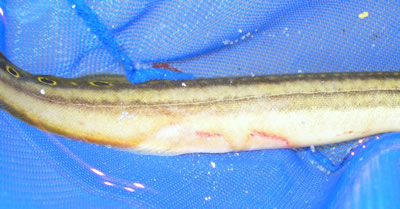 |
|
Re: HELP!! My peacock eel is dying!!
3/30/09
Thank you again and again!
<You're welcome.>
Just so I am clear...dose with Maracyn,
<Several doses, across several days; follow instructions to
the letter! Remember to remove carbon, if used.>
Pimafix
<Unnecessary.>
and add salt?
<I would, at the dose suggested by Baensch.>
Or should I leave off with the Pimafix for now?
<Pimafix won't fix anything Maracyn can't.>
And also, are we talking table salt or aquarium salt?
<Aquarium ("tonic") salt, though non-iodised cooking
salt will work too. Don't use marine salt mix: that
would alter the pH and hardness.>
Sorry for all the dumb questions, but I really want to get this
right.
<The only dumb question is the one not asked...>
Also, a friend recommended using Lifeguard; it's made by
Jungle, and it almost seems as if I have used it before in my
son's tank. Will this be safe for my eel?
<No personal experience. Would recommend not to mix
medications.>
How do I know if it is safe or not?
<Depends on the ingredients; would tend to avoid copper,
formalin when treating Spiny Eels.>
Also, the picture of the eel you sent does not look like my eel
at all. She has spots on her tail but she has dark stripes
running along her sides.
<The only sharp photos you sent me are of the back end, and
that matches Macrognathus siamensis. But do also check
Macrognathus aral, another commonly traded "peacock
eel".>
Again, thanks a million for all of your help.
Lana
<Cheers, Neale.>
Re: HELP!! My peacock eel is dying!!
3/30/09
I have attached a couple photos I took a little while ago.
<Appears to be Macrognathus aral, or something similar. Do see
here to peruse some other members of the family:
http://www.fishbase.org/identification/specieslist.cfm?famcode=432&areacode=
>
I ended up putting her back in my eel tank because I noticed my
heater wasn't working properly and she was acting decidedly
worse. I added the Maracyn to the tank; it comes in little
packets of powder and the directions say to just dump it in but
as you can see in the photos it leaves little white clumps
everywhere.
<How odd.>
Will it be ok to dissolve it in water next time?
<That's what I'd do. Add the powder to a cup of water,
stir well, and then pour across the top of the aquarium in a
zig-zag motion from left to right, so that the solution gets
evenly distributed.>
Again and again, thanks!!
Lana
<Happy to help. Cheers, Neale.>
|
Re: HELP!! My peacock eel is dying!!
4/1/09
Hello again!
<Hello Lana,>
I have enclosed a photo of my poor eel taken this morning.
I am broken-hearted.
<Eek!>
She is still breathing, but that is about all. With as
advanced as her infection is, do you think she has a chance
of pulling through?
<Unlikely.>
I just don't know what to do. I started her on the
Maracyn -2, or whatever it is called, the other one you
suggested, yesterday.
<Good.>
Part of me wants to believe that the fact that she is still
alive shows she is getting better, but the logical part
feels like she is just slowly dying and needs to be put out
of her misery (that sounds so awful).
<I doubt she'll recover. The problem with Spiny Eels
is once they get sick, it really is difficult to heal them.
I don't really know why this is, but to prevent this
happening in the first place is my usual approach, e.g., in
terms of soft sand rather than gravel.>
I have looked deep into myself and I absolutely CANNOT end
this eel's life.
<Never easy. Is she showing any signs of getting better?
E.g., more movement, healed skin. If not, would recommend
overdosing with Clove Oil.
This first sedates the fish, and then eventually the fish
suffocates as its breathing rate slows down.
http://www.wetwebmedia.com/euthanasia.htm
It's a peaceful way to go, according to vets. A litre
of water with 20-30 drops of clove oil should do the trick.
Stir well, and then add the fish.>
I trust your opinion, so I am asking you what you think:
Should I end her suffering (or find someone who can) or let
this go on and see what happens?
Lana
<Sorry this isn't ending well. Good luck either way,
Neale.>
|
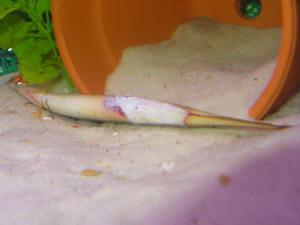 |
Re: HELP!! My peacock eel is dying!! --
04/07/09
Hello Neale,
<Hello Lana,>
I am sorry to say that my poor eel is gone. I used the clove oil
yesterday morning. I feel absolutely horrible. I know that it was
the right thing to do because she was suffering horribly, but I
still feel sad.
<I sympathise, and am sorry to hear this.>
Thank you so much for all of your help with this. It is such a
good feeling, knowing that there is someone I can count on for
help during times like these.
<Thank you for saying this.>
When I was first thinking about buying eels I Googled
"peacock eel" and came across the Wet Web Media site; I
sat for hours reading the articles you wrote on spiny eels. When
I say I couldn't have done it without you, I really mean I
couldn't have done it without you. Thank you so much for
that.
Lana
<I do hope the other eels are healthy and happier. Once
settled down and feeding they can be long lived, even hardy fish.
But they don't travel well. Good luck, Neale.>
|
Peacock Eel Floating? 3/18/09
Dear Crew,
<Hello,>
In my 30 gal tank I have had a ~9 inch peacock eel for years who is
generally happy and shy and hides in the plentiful plastic plants and
small rock caves. When threatened, it burrows into the round pebbles
but
normally is comfortable enough to just hide in the plants. The other
fish (various tetras, Leaffish, algae eater, swimmers, etc) leave the
eels alone.
<Not a big fan of pebbles in Spiny Eel tanks: sooner or later the
fish gets scratched, and then secondary infections set in. Small
species like Macrognathus siamensis should be kept in tanks with smooth
silica sand. Do see here:
http://www.wetwebmedia.com/FWsubwebindex/matacembelids.htm>
Recently it became so bloated that it floats when still, so has to
anchor under some plants or position itself under rock ceiling. I
change water and vacuum every 2-3 weeks and chemistry is OK except
nitrites/nitrates can occasionally get on the high end of acceptable. I
add aquarium salt according to directions.
<How much salt? And why? Macrognathus siamensis isn't a brackish
water fish, and while there may be value to salt as a therapy under
some situations, continual exposure to salt can cause problems for
freshwater fish. One reaction is bloating, and indication that their
osmoregulatory system has been overloaded in some way. Unless
you're keeping one of the truly brackish water species, like
Macrognathus aral, there's no need to use salt.>
Other fish in tank get flakes. Ran out of frozen bloodworms for eels
and switched to frozen brine shrimp for the last month or so. I hand
feed this eel and my other younger peacock eel. Every now and then I
put in some pieces of cooked egg or salmon for variety.
<Don't use egg. Not a natural part of their diet, and can cause
constipation.>
I have noticed some bubbles coming from the big one's anus on two
different occasions so wondering if this is just a bad case of gas that
will work itself out or if something else is going on.
<So far as I know, spiny eels aren't air breathers, so I
wouldn't expect them to expel gases out of their vent in the same
way as certain air-breathing fish.>
Ready to lay eggs?
<Possibly; female Spiny Eels are distinctly laterally compressed
because they are substantially deeper bodied than the males. Sometimes,
certain fish become egg-bound in captivity if not kept with males: even
if the eggs don't develop into fry, the simple act of spawning
"clears out" the female reproductive tract.>
I adore my eels and would appreciate any help you can give.
<Very difficult to say precisely what the problem is. As mentioned
above, there are at least three possible factors. Gravel simply
doesn't work with spiny eels in the long term, and nondescript
bacterial infections are the almost invariable result. The regular
addition of salt to freshwater aquaria causes more problems than it
fixes, and isn't recommended because it can cause precisely the
sort of bloating problems you're experiencing here (see, for
example, Malawi Bloat). Finally, egg binding is an occasionally
reported problem among species of fish that refuse point-blank to spawn
in captivity. While there isn't much you can do about egg binding
beyond adding a male and hoping for the best, I'd also recommend
treating with a suitable antibiotic (e.g., erythromycin or Minocycline)
while adding Epsom salt at a dose of 1 teaspoon per 5 to 10 US gallons.
These will have the combined effect of (hopefully) killing the
bacterial infection while
restoring the osmotic balance within the fish. Stop with the regular
salt though!>
Thanks very much!!
Dianne
<Cheers, Neale.>
Peacock Eel looking pale 2/3/09 Hi, I
have a peacock eel who is becoming very pale, almost pinkish, and his
spots seem to be transparent. He's about 6-8'', and
I've had him for a year now in a 55 gallon tropical tank. I've
had past problems with bacterial infections due to sick feeder fish,
and over the course of several months lost the majority of my fish. The
eel never seemed affected though. I treated it and decided to change my
tank to African cichlids since I only had 7 fish left. The tropical
tank was kept at 80 degrees with a pH of 7.8. I had colorful
decorations with dark blue and purple pebbles. The eel was always the
typical color, light brown with a lighter belly and dark eye spots.
When I changed to a cichlid tank 2 days ago, I changed the dark larger
gravel to a sand colored crushed coral which upped the pH to 8.2, temp
is still 80 degrees. I also added some brown flagstone for the cichlids
(I only have 4 yellow labs under 2"so far). The eel has been very
active since the majority of fish were lost, and he eats well. His
behavior hasn't changed since the tank was switched over, there are
no sores and his skin is smooth and intact, but his color has
definitely paled. My question is this: Can a peacock eel change colors
to better match it's surroundings? or, Could it be the pH? I really
love my eel, and want to do whatever I can to keep him healthy. I would
hate to know I'm causing him to fail in this tank. Any advice would
be appreciated. Thanks, Beth <Hello Beth. The answer to your
specific questions are [a] yes, fish do change their colours somewhat,
depending on their mood and environment; and [b] pH is possibly an
issue here. But let's expand this slightly. Spiny Eels are
notoriously prone to bacterial infections, and shouldn't be brought
within a mile of feeder fish. End of story. Whether or not they
actually eat the feeder fish is immaterial, simply putting feeder fish
in the tank is an unacceptable risk. Secondly, Spiny Eels are very
easily damaged by anything other than smooth sand. Gravel and pebbles
are totally unacceptable for the smaller species. Most people who try
eventually end up with a dead Spiny Eel. This happens so often I just
consider it mandatory to keep the small Macrognathus species Spiny Eels
in tanks with a smooth silica (silver) sand substrate. Always take care
not to use things like Tahitian Moon Sand as these are
"sharp" sands. The manufacturers actually state that these
sands are incompatible with burrowing fish, but too many aquarists
ignore this, and wonder why their Spiny Eel gets shredded and
eventually infected with a bacterial infection of some type. Crushed
coral is inadvisable for a variety of reasons; partly because it raises
the pH and hardness, and partly because Spiny Eels can't burrow
through it. Coral sand could be mixed with silver sand at a ratio of up
to one part coral sand to four parts silver sand, but any more than
that would also raise the pH and hardness excessively. There are Spiny
Eels from Lakes Tanganyika and Malawi, but the Peacock Eel
(Macrognathus siamensis) is not one of them, and consequently has no
place long term in a Rift Valley Cichlid aquarium. Even if the water
chemistry won't kill it immediately, the aggressive behaviour of
the cichlids will, either directly, or through making it difficult for
the Spiny Eel to feed. The native Spiny Eels are "used" to
cichlids and actually prey on them, or more specifically, their fry.
They don't burrow but instead hide in the rocks, and while not
commonly traded they are available from time to time. If your Spiny Eel
has changed colour, my gut feeling is that this may be partly to
"blend in" but could equally easily be a stress reaction.
This fish doesn't belong in this tank, and shouldn't be kept
with Malawi cichlids, period. Do see here:
http://www.wetwebmedia.com/FWSubWebIndex/spinyeelsmonk.htm Hope this
helps, Neale.>
Re: Peacock Eel looking pale (Time to get
creative!) 2/3/09 Thank You, <Most welcome.>
Here's my next question... I don't know anyone with a tropical
tank I would trust not to kill my eel. I'm also afraid to give it
to a fish store just to suffer elsewhere. Do you have any suggestions
for where I could look if I need to give him up? <The best advice is
to get in contact with a local fish club. Many have an online forum, so
even if you can't travel, you can still communicate. That's
probably your best way to learn the better stores or fishkeepers in
your area. I'm in England, so my knowledge of the aquarium hobby in
Florida is somewhat limited!> I spoke with at least 4 different fish
store guys (not PetSmart) all told me the eel would do fine in the
cichlid tank. <It's possible they were thinking of the African
species of Spiny Eel, such as Mastacembelus ellipsifer, which do indeed
cohabit with (some) cichlids quite well. But the reality is that people
sometimes know rather less than they think they know. It's always
important to research topics independently, though stuff that's
been edited by experts, whether books, magazines, or web sites like
this one. In this case the problem is that, for example, Malawi
cichlids and Spiny Eels need completely different food. Mbuna are
mostly herbivorous, but will eat meaty foods if offered, and this makes
them sick if given to excess. Spiny Eels are carnivores, but slow ones,
so most insect larvae or whatever put in the tank will be eaten by
Mbuna long before the Spiny Eels find them. Again, the pH and hardness
suitable for Malawi cichlids is much to high for Asian Spiny Eels. Yet
again, the cichlids want coral sand and lots of rocks, whereas the
Spiny Eels need soft sand and feathery plants. It's difficult for
me to see how you can satisfy the needs of the Spiny Eels and the Mbuna
in the same system, even hoping that the Spiny Eels will be smart
enough to avoid being bitten or harassed by aggressive cichlids.> My
choosing cichlids was dependent on the ability for the eel to thrive,
and they all claimed the crushed coral was not so coarse as to damage
him. <Coral sand probably won't scratch him, but it's far
from ideal.> Today he's hanging out over the aerator bubbles and
he's jumped into the filter once (he only did that when I treated
the tank with Pimafix and it irritated him) so I know he's not
happy. <Indeed.> I really can't set up another tank, but I
want to see him where he'll be happy, and he likes a lot of space.
Thanks for your time <Here's my workaround. You have so far only
Yellow Labs, right? Go back to a regular planted community tank. Yellow
Labs have been bred so much in captivity known they should adapt to
such conditions. Keep the pH around 7.5, keep the hardness around, say,
12-15 degrees dH, and make sure the water is well oxygenated. Use
plants that do well in such conditions (most will be fine). Use soft
silica sand on the bottom, and arrange some rocks in heaps for the
cichlids to use, while leaving plants in other areas. Don't get any
more Malawi cichlids (at least not without talking to me first!) and
just stick with species that should adapt to such conditions. All else
being equal, I'd expect such a community to just about work. Yellow
Labs are hardy and not aggressive, so compared with Malawi cichlids
generally, they're fairly good in communities. You will need to
feed the Spiny Eels at night to make sure they get enough to eat, but
other than that, I can't see any major problems. Not textbook
cichlid keeping, but viable. Cheers, Neale.>
Re: Peacock Eel looking pale 2/3/09 I
apologize for all the questions, but... I forgot to add that I also
added 2 tablespoons of salt to my 55 gallon tank on Saturday (advised
by the fish store guy after checking the water) and I wondered if the
salt would irritate him more than the pH which was increased from 7.8
to 8.2. Our house has a water softener, which was never a problem
before. If I do some slight water changes will this help him until I
can figure out what to do? Will the salt burn his skin, or is the
alkaline just way too high? Thanks, and again sorry for all the here
and there questions <Who told you to add salt to a tank with Malawi
cichlids? There's a fair consensus that salt is one cause of Malawi
Bloat, and should not be used as an additive in this way. As a
component alongside Epsom salt and baking soda, marine salt mix can be
used to create a home-brew Malawi salt, but it should not be used
alone. You also shouldn't use water from a domestic water softener.
Very bad for fish. Spiny Eels are actually fairly tolerate of salt, and
some species occur in brackish water. But just to be clear: use plain,
un-softened tap water, with no salt, in your aquarium (but with
dechlorinator, of course). Cheers, Neale.>
Re: Peacock Eel looking pale 2/3/09
THANK YOU SO MUCH! For future reference, what other types of cichlid
can I add. I want to stay with the less aggressive. Are "electric
blue" or "peacock" ok? They were suggested by the fish
store. Thanks, Beth <No, I wouldn't go with Aulonocara spp. in
the tank I described earlier. Even the Labidochromis is pushing it, but
they're fairly small, peaceful and adaptable. To be honest, I
wouldn't add any other cichlids until I had seen the tank running
stably for a while, three months at least. Concentrate on midwater
things if need be, barbs and the like. Cheers, Neale.>
Red fire eel with a spot 1/10/09 Hello
My name is Karen B. and I have a 40 gallon tank that has been running
for the past 22 years with fresh water tropical fish. The tank has two
power heads, 4 inches of gravel, 40 pounds of decorative rock, many
live plants, an under gravel filter plates. I do my water changes every
other week and vacuumed part of the bed every month. Many years ago I
worked in a fish only shop where I fell in love with fish keeping. I
used to breed fresh water fish and got my red fire eel as a one inch
baby from a customer. He's now almost 20 years old, about 22 inches
long, a good eater (hand feed Calf. black worms) and has had many tank
mates over the years. Most have died of old age and some he did eat in
the beginning. About a month ago he developed a spot on his side,
it's round and looks a little fuzzy it's about the size of a
small pea. He's had this spot for a while and it never got any
bigger or seemed to bother him. I did treat the tank with a fungal
medicine for a week with no help because I didn't know what else to
do for him. Now I've done my water changes and in the past few
weeks he has developed several white freckles on his belly running the
full length. I've been web searching and found very little
information on how long fire eels live or anything about his spot(s). I
talked to the local pet shop who told me to try here. So here I am
question in hand. None of his tank mates are ill or have any spots. I
know eels don't do well in medicated tanks for long periods of time
because they are skin fish I really don't want to loose him.
Worried Karen <Hello Karen. Fire Eels (Mastacembelus erythrotaenia)
are -- in common with all Spiny Eels -- prone to skin infections. Left
untreated, these can quickly cause the death of your fish. The usual
problem is that people decide to keep their Spiny Eel in a tank with
gravel and/or jagged rocks. Spiny Eels are burrowers, and their small
scales are easily removed if they try to burrow into gravel. Once the
scales are gone, their first line of defense against opportunistic
infections is breached, and the chances of things like Fungus and
Finrot dramatically increase. I really can't stress this point
strongly enough: small Spiny Eels (like peacock eels) should never be
kept in tanks with gravel, and the larger species, such as Fire Eels,
should only be kept with smooth gravel and smooth rocks. Also check how
clean the gravel or sand in your tank is: over time, both become
"dirty" and should really be cleaned with each water change.
While the bacteria on the gravel or sand are usually harmless, in large
quantities they can cause problems, the classic example being bacterial
erosion of catfish barbels. I mention this because damage to a Spiny
Eel's belly is very common the first sign of bacterial problems.
Now, given your specimen is a whopping 20 years old there's no way
you're a "newbie" at this, and your basic mode of
fishkeeping must be essentially sound. But I would recommend looking
through your tank for anything dirty, sharp or jagged, and removing it.
On the other hand, I suspect your fish is to some degree getting old,
and his immune system may be getting weaker, and even in the best
aquarium, he may become more prone to infections, no matter what. Next
up, how to treat! Spiny Eels are sensitive to copper or formalin. An
antibiotic would be a good first pass treatment, something like Maracyn
or, if that doesn't work, Maracyn 2 (these treat different sets of
Finrot bacteria). Apply any medications carefully, and as always, take
care to increase aeration of the water during the treatment and keep a
close eye out for signs of distress. Alternatively, look for a
copper-free medication suitable for use in marine tanks and/or with
copper-sensitive species such as Stingrays and Mormyrids. The addition
of a small amount of tonic (not marine) salt to the water may be useful
too; when keeping this species, Baensch recommends 1-2 teaspoons (about
6-12 grammes) per 2.5 gallons (about 10 litres) and I don't have
any quibbles with that. Spiny Eels generally tolerate salt extremely
well and tonic salt won't affect pH or hardness (as opposed to
marine salt mix, which would). Higher salinities might be used to treat
Fungal infections directly, though by itself salt doesn't have much
impact on bacterial infections like Finrot. I'd expect a Fire Eel
to handle salinities up to SG 1.003 without any fuss at all, and quite
possibly a little higher. Tea-tree oil treatments such as Melafix might
have some beneficial support function, but I wouldn't rely on them
to treat the infection at hand here. Spiny Eels are fantastic fish, and
the Fire Eel in particular. Wishing you luck, Neale.>
Re: red fire eel with a spot 1/11/09
thanks for your quick response I am worried about my old man in the
tank. I did a water change today and will do another partial tomorrow.
I've printed out the email and will head out the pet shop today.
Thanks again. Karen <Happy to help. Cheers, Neale.>
|
Egg bound Aethiomastacembelus elipsifer eel
Female African Eel Full Of Eggs 8/23/08 Hello. I
have an Aethiomastacembelus elipsifer eel that is frequently very
full of eggs. I've had her for about two years now. I tried
to get a male for her, but unfortunately the young eel I bought
turned out to be another female. My problem is that my eel is egg
bound. She did not want to eat a few days ago, so I put in about
2 tablespoons Epsom salts per 10 gallons into her tank, and
raised the tank temperature a little over a degree so that it is
now 80.8 degrees F. She became active the next day, and begged to
eat, but she still looks pretty big. I have not fed her for three
days because I want to give her body time to reabsorb the eggs.
She normally eats frozen mysis shrimp with liquid vitamins or
freeze dried Tubifex worms. I did look at some of the old
WetWebMedia files, and found where it was mentioned using a bath
of 1 tablespoon Epsom salt per gallon of water, but she's in
a heavily rocked large tank and I'd rather not have to
dismantle all the rocks to get her out. I will probably give her
a light feeding today. I hope that she will be okay. My thought
was, if she doesn't continue to improve or goes downhill,
would it be okay to roll her mysis shrimp with some Epsom salt so
that she would ingest a grain or two? She eats from my hand, so
I'm sure it wouldn't be too difficult to do if it would
be safe. Thank you. Kelly IMG_8236.JPG < With freight being so
expensive and the dollar losing its value in the world market,
shipments of wild Lake Tanganyikan are becoming increasingly rare
and very expensive. Not many retailers are willing to spend the
time and money to bring in wild fish. Trying to find a rare
African eel can be very difficult these days. In 2002 I was
diving in Lake Tanganyika and we found many baby eels in the
shallower areas of the lake near weed beds. The water temp there
was 84 F. This makes me think that maybe the eels are coming up
to the shallower areas to spawn and the elevated water temps may
aid in spawning. Since you have already elevated the water temp
and have observed some recovery, I would suggest trying a couple
more degrees instead of adding the salt to the diet and see if
things get any better.-Chuck>
|
|
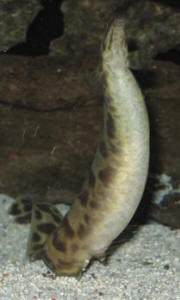
|
|
Sick fire eel 7/4/08 Hello, <Hi there> I am
desperately seeking help for my sick fire eel. I have had several
fire eels in the past and have done very well with them but I
have a very Sick one on my hands right now. My eel is about 25
inches long and very was very healthy looking, about 3 inches
tall and nice and full, I have never had one That was this big
before. <Is very good size> Then one day I noticed (and I
check on my fish every day, so it looked like the eel was fine
one day and was having problems the next) my eel was upside down
in his tube. My eel kept trying to get upright but would just
keep rotating around, (I don't know his sex but I'm just
going to refer to my eel as he) he looked fine on the outside, he
has No visible marks or sores but he is starting to breath very
heavy. I have a feeling it might have something to do with his
diet, since he is so big I have been feeding him minnows and
almost everyday. <Mmm...> From what I have read from your
web it wasn't the best thing for him and he may have
overeaten? <This or parasites... a lack of some
nutrient...> I went to the fish store and have read the
questions on your web site, but I haven't had any luck making
him any better. Myself and the fish store I deal with thought it
must be some kind of parasite or infection inside (from the
minnows) <Yes, most likely> so I bought some prose-pro
<Something like this... Praziquantel is only for worms... what
if this is a protozoan?> and tried that. No luck. I did water
changes and went back to the fish store and they suggested trying
TC Tetracycoline <Mmm, not this antibiotic either>
(spelling might be off I'm at work and don't have the box
with me) I have tried a full cycle of that with water changes and
still no luck. It has been over a week and he is getting worse, I
feel so bad for him, he is breathing really labored and heavy at
times, I feel so helpless. He now just Hangs upside down at the
top, it's almost like he is paralyzed, he try's to move
sometimes but just can't. The only other fish I have in the
tank are My discus, so I want to be careful I don't stress
them out either. Please Help, Thank You, Cherie <Read on WWM
re the one-time use of Metronidazole/Flagyl. Bob Fenner>
Re: sick fire eel 07/07/08 Thank You for the advise it
sounds like it might have helped but unfortunately he died this
weekend, it just killed me to see him suffer. Now I know for the
next time that your site exists and I can go there for Help. It
was a very sad loss Thanks again, Cherie <Ah yes. Thank you
for this follow-up Cherie. BobF>
|
|
Peacock eel seems sick
2/16/08 Hello I have a 30 gallon freshwater tank. I set up my
tank about 3 weeks ago, and I bought a peacock eel about 5 or 6
days ago, and he seems sick now. We bought him at Wal-mart (yes I
have learned my lesson about that) and they couldn't really
tell us anything about him. <Never, ever buy a fish that
neither you nor the store clerk knows anything about. I cannot
begin to tell you the number of disasters that begin this
way.> Luckily, I read online that he ate dried bloodworms,
which I had on hand from a while ago. <No chance, and
certainly not when newly imported from the wild, which will
likely be the case here. Newly introduced Spiny Eels
overwhelmingly need live foods, ideally earthworms, Tubifex, or
bloodworms. Once settled in they will eat (wet) frozen bloodworms
and the like. But not dried foods. Also, they will not compete
with other benthic fish, so cannot be kept in tanks with, for
example, loaches or catfish.> Unluckily, he doesn't seem
to want to eat them. <No surprise at all.> He seemed fine
for a few days, he was swimming around quite a bit, mostly
seeming to chase his own reflection against the glass.
<He's trying to get out from this puddle he's trapped
in (an aquarium) that completely lacks any edible foods.>
Yesterday we noticed he wasn't swimming around as much, and I
started becoming more concerned about the fact that I had not
seen him eat. <I'd be worried, too. Go into the garden and
dig up a couple of small earthworms. Put in the tank and let the
eel eat them at his leisure, i.e., without competition.> So
today we went to our local fish store and they sold us some
feeder fish (the very small kind, since he is only about a three
inch eel). <No no no. These fish should not be given feeder
fish. Spiny Eels are among THE most sensitive fish on the planet
when it comes to infections, and sticking cheap fish bred in
squalid conditions (i.e., a feeder fish) is sort of like asking
Typhoid Mary to cook your lunch.> The woman assured us that he
would eat them. <She told you she knew nothing about the fish,
and then assured you this was the correct diet? You should have
smelled a rat.> But when we got home we noticed the eel was
just laying over the plunger that is holding the heater onto the
tank. We added the feeder fish and he was completely uninterested
in them, even when they went so far as to swim around his head.
<Not his normal diet. He eats worms, insect larvae, and small
benthic invertebrates of various types. Mostly taken from on and
in the sand. One of the common mistakes people make is to keep
these fish in tanks with gravel. This you MUST NOT do. These
small Macrognathus spp. Spiny Eels forage by burrowing through
the sand, using their prehensile "nose" to winkle out
prey. In a sandy tank they will dig in during the day, and
slither about at night. In a tank with gravel they often starve.
On top of that, gravel damages the mucous layer on their bodies,
making them INCREDIBLY sensitive to bacterial infections. By far
the majority of Spiny Eel deaths come from: starvation, bacterial
infections, and fish jumping out. Anyone wanting to keep these
fish MUST plan around these, and set up the tank accordingly. Do
please see here:
http://wetwebmedia.com/FWSubWebIndex/spinyeelsmonk.htm > The
woman at the fish store had also informed us that the temperature
might not be ideal for him, so I first turned the heater up, and
now the temperature is at about 76 degrees F. I am trying to
bring it down to about 73, to accommodate the other fish in the
tank, but the temp does not seem to be going down. That is my
first question, how do you bring the temp down? <Takes
time.> After the temperature was right I did some more
research, and discovered that ammonia could also be a big
problem, so we tested it and discovered it was a bit high, so we
added some ammonia reducing tablets. <There's no such
thing as a "bit" high, any more than being a
"bit" pregnant. If you detect ammonia, it means you
have a major problem: too much pollution in a tank that
doesn't have enough of a filter to deal with it. The amount
of ammonia is largely irrelevant. Review whether the stocking of
the tank is appropriate to the size of the tank, whether the
filter is mature and/or sufficient capacity. Check whether you
are overfeeding.> The ph was also a little high so I added
some ph reducer. <NO NO NO NO NO -- inexperienced aquarists
shouldn't EVER mess about with pH reducers (or raisers).
Please understand: the pH value itself doesn't really matter;
what matters is how fast pH changes. If you're testing the pH
but have no idea what the general and carbonate hardness levels
are in your aquarium, then you shouldn't be messing about
with the pH because you likely (certainly) don't have enough
knowledge to do so safely. So forget about this. Instead check
whether the pH is the same a week after a water change as it is
immediately after you do the water change -- that will tell you
if the pH is stable or not. Do please read here:
http://wetwebmedia.com/FWSubWebIndex/fwh2oquality.htm > I also
did a partial water change of about 20% and added some stress
coat. I thought maybe one of these factors might have been what
was causing the eel to be distressed, but he is still hanging on
the side of the heater. <I bet.> He does seem to be swaying
a bit more now, but I am really starting to get worried. It even
got to the point where we thought he was dead because we saw the
other fish sucking on him. Luckily when we tried to scoop him out
of the tank he swam away, which was a huge relief. <To be
honest, I think this fish is doomed UNLESS you [a] make sure the
aquarium is appropriate (i.e., has sandy substrate, no bottom
feeding fish, good water quality) and [b] you start offering
healthy live foods that this fish can eat. Yes, it will eat (wet)
frozen bloodworms later on, but right now we're talking
triage, and that means live earthworms small enough for the fish
to eat easily. For a 3-4 inch Spiny Eel, we're talking 1-inch
worms. There's no discussion here. If you don't do these
things, he'll be dead in a week. Period. End of story.> I
even tried to load the dried bloodworms into a turkey baster and
squirt them right in front of his face. He still did not respond,
except for to move a little. He certainly did not show interest
in the food. I read that they would eat earthworms. I am thinking
about going and buying some worms from my local bait shop
tomorrow and seeing if he will eat these. <YES!!!> What
should we do? <Read the articles linked above, and ALWAYS read
before buying your fish. Spiny Eels are in my top 10 fish
beginners should NEVER keep. They are very difficult fish for so
many reasons. Are they nice fish? Yes. Are they intelligent?
Very. Can they be tamed and fed from your hand? Certainly. Are
they a fish for the average community tank. Not a chance.> I
am new at this hobby and do not know how to tell what is wrong.
My first instinct is that it is he is not eating, but I am also
worried he is sick with something. I have some multi-purpose
medicine but I have also read that you shouldn't use most
medications on them since they do not have scales. Any advice you
could give would be greatly appreciated. Thanks, Erin <Good
luck, Neale.>
Re: Peacock eel seems sick 2-16-08
Thank you so much for your advice. He is doing much better today.
I woke up and he was swimming around the tank, and some of the
feeder fish are gone. <Very good. But I can't stress too
strongly that feeder fish are poor food for most fish, and should
be avoided where possible. The risks of introducing diseases, as
well as malnutrition, are simply far too great. Once settled,
Spiny Eels will even eat chunks of prawn; so really the issue up
front is to get them eating a few earthworms just to fatten up a
little.> I am now regretting that we got them at all though
since now I am worried about him getting sick. <Don't be
*too* disheartened. These are rewarding fish, and once settled
in, not difficult to keep. The problems are setting up the tank
"just so" and then getting a wild-caught fish feeding.
Most people fail in these regards, and end up with a dead Spiny
Eel.> I am definitely going to go today and get the sand
substrate and earthworms. <Cool.> To clear one thing, the
woman at the fish store was supposed to know what she was talking
about. It was the people at Wal-mart that didn't, but when we
went and got the feeder fish we went to a different local fish
store ran by people that were supposed to know what they were
doing. Needless to say, I will not be going back there for
advice. <Too bad. A good aquarium shop is an amazingly useful
asset. Regardless, with a bit of reading and a good aquarium book
to hand, you'll be fine. Trust me: this is how many of us
start!> I must say, I feel rather silly about this whole
thing. I thought keeping fish would be much easier than this, but
I have definitely learned my lesson. <Keeping animals is never
"easy", whether cat, dog or fish. But in the big scheme
of things, fish are pretty straightforward, especially once you
understand the basics and take care to choose fish appropriate to
your local water chemistry and skill level.> I will be much
more careful and do much more research in the future, as I would
hate to think that a poor animal died because I was too ignorant
to take care of it. <Indeed!> Thanks! Erin <Enjoy your
fish, and good luck! Neale.>
|
Fire eel with pop eye and cloudy eye --
10/30/2007 Hello All- <Emily.> I am so glad I have found WWM!
I happened to stumble upon your page while doing research for my sick
Eel. I'll try and keep this short. For the last 3 weeks my fire eel
has had cloudy bulgy eyes. (almost looks like he's wearing goggles)
Is this pop eye? <Yes sounds like a bacterial infection of the
eye.> His appetite is a little decreased but he is still nibbling at
his blood worms each day (not as much so in the last 2 days). He has
also gone pale in color over the last week. I really don't want to
loose him, I'm a novice fish owner! He's in a 75 gallon tank
and I've had him for about 6 months. He has lots of hiding places
and none of the other fish bother him. Last week I started treating him
with Ampicillin <...is for gram negative bacteria.> every other
day for 5 days since Erythromycin <...is for gram positive
bacteria.> and tetracycline <...treats gram negative as well
negative bacteria of some types.> has not helped. I have also done
two 50% water changes within the last week. His color has improved a
little but his eyes are still very cloudy. He just lays on his side
hiding in his cave all day. He has always been a pretty mellow eel. I
had my water tested at a local fish store and everything seemed fine.
<Numbers would help, especially hardness and nitrates.> What
should I be doing for my eel? <Although fire eels most commonly
occur in soft water habitats like some streams, swamps and even flooded
rice fields and only rarely are found near estuaries, they may do much
better in hard to slightly brackish water in captivity. The exact
reasons therefore are unknown and may be related to some interaction of
ions (hardness, salinity, carbonate hardness) and the accumulation of
possibly toxic compounds in the tank water (e.g. nitrates), that, due
to dilution, does not occur in nature to such extent. Although adding
salt to the standard fish tank can well be considered an antique
technique from times when the need for partial water changes was
unknown, I'd suggest to increase the salinity of the water to reach
a specific gravity of 1.002 (roughly 3-4 grams marine salt from the pet
store per litre). That should improve the constitution of the fish and
won't kill your filter bacteria. In addition I'd try to improve
the diet by offering a variety of foods, because if he only ate
bloodworms, he may also suffer from a lack of vitamins. Try earth
worms, little shrimps and also soak the blood worms in vitamins from
time to time prior to feeding. You have already used a lot of
antibiotics, so I'd get a test kit and check if nitrites are 0 all
the time. Nitrates should be below 20 ppm for good healing conditions.
If another antibiotic has to be used (I hope not), try Maracyn.>
Thank you and warm regards! -- Emily <Also have a look at
http://www.wetwebmedia.com/FWSubWebIndex/matacembelids.htm
and the linked files above. Hope that helps and your eel gets well
again. Marco.>
Tire track eel medicine need help 6/30/07
Hi my name is Donna, <Ahh, "the lady", and one of my
sisters praenomens> My husband and I have a 40 inch tire track eel
<Nice!> that was with an Oscar who came down with an internal
parasite <... of what sort, nature?> I know what to treat her
with but what is safe for the eel and spiny eel (spiny not showing
symptoms yet). He has all the same symptoms the Oscar did. Curled up,
not eating and on the bottom of tank. Also had 2 hi-fin banded sharks
that were in there also need to treat everybody. Do you know of any
medicine we can buy that is safe. <Mmm, best to treat sequentially
with an antiprotozoal (my choice is a one-time administration of
Flagyl/Metronidazole) and an anthelminthic (Prazi/quantel or
Levamisole...). All protocols, cautionary statements for this are
posted/archived on WWM... These are relatively safe, efficacious
compounds. Bob Fenner>
New peacock spiny eel, sys.,
fdg. 6/2/07 Hi! thanks for all your advice > I
got the eel, he's about six inches long and looks well fed. no
white blotches on his skin or signs or irritation. <Very good.>
> he is hiding under the gravel in my tank right now, but there is a
cave in there that I hope he will move into when he feels more
comfortable. <Please replace the gravel with sand as soon as
possible. In my experience, small spiny eels die when kept in tanks
with gravel. The problem is that they try to dig into the gravel,
scratch their skins, and get infected with various bacteria. Once sick,
they are impossible to treat. I have seen this happen so often that
keeping small spiny eels in tanks with gravel strikes me as a virtual
death sentence. Now, changing to sand is neither difficult not
expensive. Silica sand (also known as silver sand) can be obtained at
any garden centre for very little money. Choose the "smooth"
not "sharp" grade for obvious reasons! A 25 kg (~50 lb) bag
of the stuff costs about £3 ($6) at my local garden centre,
so in other words there is no excuse for not buying and using the
stuff. Plants love it, as do most fish. The main problem it causes is
getting into the filter if big fish (like Plecs) splash it about. It
can potentially become anaerobic if you allow organic material to decay
under a great depth of the stuff. To avoid this, simply keep it clean,
use Malayan livebearing snails to aerate the sand, or just keep the
depth to a minimum, say, 5 cm (2 inches). If you go for the shallow
sand bed approach, you obviously can't keep plants with roots, but
epiphytes such as Java fern and Anubias are fine.> > my question
is, I've tried both frozen bloodworms and live mealworms so far,
both of which he has left uneaten. he appeared to smell the mealworms a
little, but didn't eat any. I have been able to find live
butterworms, waxworms, and Superworms, whatever those are, are any of
these suitable food? or would I be better off trying earthworms?
<Spiny eels are 100% nocturnal when imported, so be sure and put the
LIVE bloodworms and/or Tubifex in at NIGHT. Remove anything likely to
compete, such as catfish and loaches. Catfish and loaches are simply
NOT at option with small spiny eels. Earthworms are also very popular
with spiny eels, and perhaps the ideal reconditioning food for helping
settle newly imported specimens in. Once you know the fish is eating,
then you can wean them onto frozen alternatives. To be honest, spiny
eels have to be close to the top of the list of fish that should be
quarantined first so you can get them feeding before being placed in a
community tank. They just aren't, by any measurement, "good
community fish" -- they need a great deal of special care, and the
vast majority of specimens die within a few months. Although basically
hardy and very adaptable in terms of water chemistry, their demands for
sand and live foods make them among the most difficult
"common" fish in the trade. Larger species, ironically, are
easier to care for, being indifferent to whether you use sand or gravel
and being relatively easy to feed with things like earthworms, live
river shrimp, or even (home-bred) feeder guppies. The small species,
including all those sold as "peacock spiny eels" are simply
difficult fish best kept by experienced fishkeepers in single-species
or at least specially designed aquaria.> > there were also a lot
of small snails in the tank I got him from, and I was wondering if he
was maybe eating those, since he appears well fed. he looks like
he's of a good girth, and explored all around his tank last night.
if he has been eating snails, are they a good long term food source
that I could maybe raise in a separate tank? <No, your eel isn't
eating the snails. He lacks the jaw structure for that. Snail-eating
fish tend to have strong jaws and flat teeth for crushing the shells:
things you see on puffers, loaches, and certain cichlids and catfish.
Spiny eels are nocturnal opportunist predators. They have deeply-cleft
jaws that allow them to swallow surprisingly large prey. The smaller
species feed primarily on worms and insect larvae, while the bigger
species are more or less piscivorous (though in captivity are easily
fed on prawns and other chunky invertebrate foods). > thanks! >
Tori <Hope this helps, Neale>
Spiny eel with grey patches -- 05/04/07
Hello Wet Webbers! My name is Linda <Hi Linda. Marco here with you
today.> and have a question for you. I have done some
research and have not found the info I am seeking, so I hope you
don't mind my long question. <Please see http://www.wetwebmedia.com/FWSubWebIndex/spinyeeldisfaqs.htm
for similar questions.> I enlarged the print cause I just had Lasik
done and am having some trouble reading my computer screen. <Hope
you get well soon.> I added an 8" fire eel to my 150 gallon FW
community cichlid tank. His tank mates are 3 keyhole
cichlids, 2 port cichlids, 2 gold and 1 green Severum, three fire
mouths, one 5" chocolate cichlid <quite some competition for
the eel with regard to food.> a handful of Corys, a few rummy nose
tetras, half a dozen tiger barbs and three clown loaches. He
was fine for the first six months, but about 6-8 weeks ago he started
"peeling". He has gray "bald" spots on
part of his body now. He swims well and is a hearty eater. <Good to
hear.> A couple weeks ago I did have a very bad outbreak of ick (saw
a chocolate cichlid that I just had to have and didn't set up a
quarantine tank, I should know better) I had to treat the whole tank
with copper safe. <I'd use copper products in bare bottom
hospital tanks only. Now you have to get rid of it with water changes
and by filtering with activated carbon, and hope none remains in the
substrate.> Everyone survived and all is well except for
Earl. He continues to look worse. Since the
"bald" spots are the only symptom, I thought I would give him
some time to heal on his own. I also thought maybe he was
molting, or something <No, certainly not.>. His gray blotches do
not look like fuzzy fungus or bacterial spots. Just large patches.
<Spiny eels are prone to skin diseases such as the one you describe.
It probably is a bacterial infection possibly associated with a
fungus.> I have spent a great deal of time watching the tank lately
and have never witnessed any of his tank mates attacking or picking on
him. I do 75% water changes every two weeks. <The latter two actions
are good practice.> The pH is 7.5-8, 0 nitrites and well below 20ppm
of nitrate. He eats frozen bloodworms and brine shrimp. I am
going to set up the quarantine tank and move him tonight to see if
maybe someone is harassing him at night. Can you give me any
suggestions as to what may be going on with Earl? Should I medicate him
or just observe him since he is eating well? <If filtering your
display with activated carbon does not improve the situation,
quarantine him and add 1g/l marine salt. This is a mild treatment often
successful in similar cases. Also be sure to provide pristine water
quality in the quarantine tank. If that does not show any improvement
in about 10 days to 2 weeks you should consider the use of antibiotics
in your hospital tank. Also, read the FAQ linked to above. > If
someone is picking on him, I would guess it is the Firemouths. Oh yes!
I have a mixture of small to med. gravel size <hope the grains are
well rounded, because spiny eels like to bury.>, soft driftwood,
smooth rocks, a large strawberry pot, and plastic plants in the decor.
The temp. is right around 77 degrees. Thank you so much, you guys
provide a great and valuable service to the tropical fish world. Linda
from WI. <You are welcome. Hope your eel gets well
again.>
Spiny eel with grey patches II -- 05/05/07 A few
more facts on my eel. When I feed my fish their frozen
food, I throw a chunk of bloodworms in a 2 quart pitcher and
fill it with tank water. When the worms are defrosted, I
swirl it around to break apart the chunk and dip the pitcher into the
tank. I hold it below the surface enough for Earl to slip in and eat
his fill before I dump it out for the rest of the
fish. Using the large pitcher works well because when you
dump all the water out it swirls around and disperses well so everyone
has a chance of eating. This way I know Earl is getting enough food.
<Nice feeding technique. Could be improved by avoiding the polluted
thawing water getting into the tank.> Also I have never seen him
burrow into the gravel. <He'd do that if he was harassed by the
cichlids.> He hangs out under the driftwood and will also hang on
the water intake tube support. For the salt treatment, I am guessing
1g/l marine salt is one gram per liter? <Yes.
Cheers, Marco.>
Fire Eel Disorientation 4/26/07 I
contacted you guys quite a few years ago about my 130 gallon tank being
infected with Cyanobacteria. Ever since then I've never
been able to get rid of it but once a week I siphon off the slime algae
carpets off the bottom and it looks good for another two days or so.
<Cyanobacteria ("blue-green algae") grow in tanks without
aquarium plants usually because the water has high levels of nitrate
and phosphate. There's really not much you can do about it in the
average "tank buster" aquarium without actively reducing the
nutrient levels in the water. Oh, and by "without plants" I
mean any tank not set up specifically for rapid growth of higher
plants. A couple of Java ferns won't make any difference either
way!> I've tried more powerful lights, no lights (made the
Cyanobacteria grow slower but made everything else worse), phosphate
filters, etc and none of it has ever stopped or even slowed down the
speed of the growth. <Phosphate (and nitrate) filters generally
can't help the eutrophic conditions in heavily stocked tank buster
aquaria. They are designed for use in marine tanks and planted
freshwater tanks where the water quality is already very good. These
chemical filters "polish" the water a little more, by
scrubbing out the phosphate (or nitrate). But they are utterly
overwhelmed when placed in a tank buster tank unless used in vast
numbers and replaced/recharged on a weekly basis.> I've had the
tank set up for over 5 years now and the inhabitants are a clown knife
fish, fire eel, spiny eel, and three rope fish. <Nice collection of
fish.> I've heard before that clown knife fish shouldn't
have any tankmates smaller than them but I guess these guys have
learned to live with each other or something, 'cause they never
pick fights. <Often, fishes are inoffensive towards fish they grow
up with -- they view them as part of the scenery, I suppose.> When
I'm cleaning the eels' caves the even sometimes hide behind the
clown knife in the corner and he has no problem with it. Anyways, I
discovered recently that erythromycin apparently kills off
Cyanobacteria while being quite safe for plant life, the fish, and it
also doesn't harm the biological filter all that
much. So, I picked up some Maracyn 1 and followed a dosing
schedule that I found while researching on the internet. It
said it was a rather ful powerful dosage to kill the Cyanobacteria
rather than create a resistant strain of it, yet it was far less than
the Maracyn instructions listed to cure bacterial infections and
such. It said to add 2.5 mg/L of it one day 1, 2, and
4. Then 1 mg/L on day 8. Between these days I
should do frequent water changes and siphoning dead Cyanobacteria and
debris out of the tank. Due to having only two packages of
Maracyn 1, I ended up actually adding only about 2.0 mg/L for the first
few days. <Honestly, in my opinion a totally pointless exercise. The
Cyanobacteria grows in your tank because of the nutrients in the water.
Even if you killed off any single bacterium in the tank (which
won't happen) more would get in from the air and in a month or two
you'd be back where you started. Unless you reduce the phosphates
and nitrates to as close to zero and keep them there permanently, the
Cyanobacteria are going to come back. Period.> So, here's my
problem now. I added the first dosage two days ago and then
the second dosage yesterday. I could already see that the
slime algae was beginning to thin out, but when it came to feeding time
I saw that something was wrong with my 5 year old fire
eel. He wouldn't eat and he was swimming around
restlessly and seemed disoriented. He was also swimming
completely upside down the entire time. When he hid
underneath his cave he would lie upside down as well. <First: check
water quality. Second: perform 50% water change. Third: perform another
50% water change. Quite obviously you've done something the fish
doesn't like, and it's good odds that the massive die-off of
bacteria that's causing pollution in the water, using up oxygen,
and perhaps releasing toxins in the water as well.> I added some
aquarium salt at one teaspoon per gallon and boosted the temperature
from 80F to 83F. <Why are you doing this? Fire eels aren't
brackish water fish and don't need salt. Raising the temperature
and adding the salt both reduce the amount of oxygen in the water,
further aggravating one likely problem. Please, unless you have a clear
reason for doing so, NEVER change the water chemistry or aquarium
conditions simply as a knee-jerk reaction. Fish don't like changes.
Oh, and bin the tonic salt. It's useless stuff. Honest.> This
morning the fire eel was lying on top of a tall piece of driftwood
upside down, and he rarely lies out in the open. <Sounds extremely
serious. Have you done those 50% water changes yet?> There's no
visible wounds or discoloration on him and he doesn't look bloated
or breathing quickly. I tested the water and the ammonia was
0 ppm, nitrite was 0 ppm and nitrate was 32 ppm. <Well, the nitrates
are part of the blue-green algae problem...> I hope you have some
suggestions as to what I should do 'cause I really don't want
to lose my eel. <Do the water changes. Increase oxygenation in the
water. Present a votive offering to the Fish Gods.> It's strange
that it happened as soon as I added the Maracyn 1, but everywhere I
read it shouldn't be causing any problems to the
eel. Thanks for your help. <My basic philosophy is that
without medical or veterinarian advice, aquarists shouldn't use
antibiotics, period. There's a reason people go to medical (or vet)
school to learn about those drugs. Unfortunately, in the US at least,
some antibiotics are freely available. Please resist the urge to use
them needlessly. As you're discovering, they are powerful
medications that can have unpredictable results to those not trained in
their use. In the meantime, just do more water changes to bring the
nitrates and phosphates down, and remove the Cyanobacteria the
old-fashioned way: with elbow grease.> Dayton <Cheers,
Neale>
Re: Fire Eel Disorientation
4/26/07 Thanks for the information. After I
sent the last message yesterday I went home and did the 50% water
change, but I guess that I should have done another one afterwards.
<You can never do too many water changes, assuming water chemistry
remains constant.> I was also planning on doing another water change
today and every day until he gets better. <Good idea.>
Unfortunately, I really don't think he'll even survive the rest
of the day. I woke up this morning and he's floating at
the surface of the water, just barely breathing. <Definitely not
promising. If this was me, I'd change all the water NOW. Nothing to
lose at this stage, and my assumption is the antibacterial treatment
and/or dead Cyanobacteria is the cause of the problem. Siphon out
everything organic in the tank, thoroughly sluice the gravel in the
process to remove everything organic that is decaying. Replace with
100% new water at identical pH/hardness/temperature. Use dechlorinator
but otherwise don't add anything. Maximize aeration. Keep
temperature at a steady 25C/77F. Switch the lights low/off to reduce
stress. My hope would be by returning to optimal water conditions ASAP,
your fire eel might recover.> About the Cyanobacteria though... is
the chance that great that I'll get more of it in my tank simply
from the air? <Yes. Bacteria travel as air-borne spores, among other
ways. When some blue-green algae dries up somewhere, some of that
becomes encysted, floats away on the breeze, and settles out wherever.
That's why you find the stuff in gutters, bird baths, etc.> I
had the tank set up for about a year with no problems, but then I added
some aquarium plants that weren't fully cleaned and quarantined I
guess. <You have to be ruthless here: strip away *any* leaves with
blue-green or hair algae on sight. Usually, the algae colonize sick
plants (or leaves, anyway) so you're not losing anything by
trimming the plant.> That's what brought in the
Cyanobacteria. I have 4 other tanks (smallest one 30
gallons) and none of them have ever had problems with Cyanobacteria
before. <Blue-green is very difficult to predict in terms of where
it will occur. "We" as a hobby know the conditions it likes,
but as you say, sometimes it's a problem, sometimes not.> But, I
added a decoration to one of my tanks just last month (the decoration
was in the 130 gallon 2 years ago and has been dried out since) and
within a week I noticed Cyanobacteria growing in that one. I figured
that as long as I keep the supplies I use with the infected tank away
from the clean tanks, I won't have any problem. It's
been working so far for 5 years now. <Maybe, maybe not. I'd not
put any money on this. But blue-green algae is more a visual problem
than a life-threatening one, so I'd always recommend manual removal
of blue-green during water changes rather than chemical (algicide)
treatments. Massive die-offs of algae (or plants for that matter) can
consume oxygen rapidly and dump unwanted pollutants into the tank. The
advantages of getting rid of the algae quickly do not, in my opinion,
offset the risks of the other. Cheers, Neale>
Re: Fire Eel Disorientation -
05/02/07 So, since last Thursday I did a 50% water change on
Thursday and Friday night, then switched to 30% water change every day
since then. <Sounds a good start. Water changes help with most fish
problems considerably.> On Friday morning instead of having trouble
swimming the fire eel was floating at the top of the
water. Once in awhile he'd try to swim down again but he
couldn't even get down a few inches. <Sounds very odd, but
swimming problems can be caused by all kinds of
diseases/injuries/environmental factors. I've seen dwarf cichlids
swim upside down because I put too-cold water into the tank.> I was
hoping the water changes would be helping but they don 'seem to
be. I figured he'd be gone within a day or two but now
that it's Tuesday I'm starting to think that there's
something else wrong with him. He's still breathing
normally and has no discoloration but he still can't get below the
surface. He looks slightly bloated maybe so I was wondering
if eels have a swim bladder like fish do? <A very good question.
Most benthic fish have reduced/absent swim bladders so that they stay
close to the bottom of the river or sea without being caught up by the
currents. I do not know if spiny eels have swim bladders, and
haven't been able to check in my usual references. My *guess* would
be they have them, but of a reduced size and importance.> I think
that he's fine other than the fact that he can't swim
downwards. I even gently lowered him to the bottom of the
tank and when I let go you flew quickly to the surface as if he was
full of air. My girlfriend wants me to euthanize him and if
I can't do anything else that's what I'll end up doing, but
it just seems to me that if I could figure out what's making him
float he'll be fine. <Provided he's feeding and remains in
good condition otherwise, I'd tend to leave things to settle down
for a while. Swim bladder problems will often fix themselves over time.
Provided good water quality, keep the temperature constant, avoid
stressing the fish, and try and get it to eat if you can.> If it was
a bacterial infection it should've been cleared up when I added the
Maracyn so maybe he ingested a rock or something? <Swim bladder
disorders are what medics call "multi-factorial", meaning
no-one really knows what causes them in every case. Possibilities
include lack of fibre, mechanical damage, genetics, etc. Since a spiny
eel doesn't eat plant material, lack of fibre probably isn't
the issue here. But I'd certainly raise the temperature a little
(by 3-5 degrees C) and continue using something mildly antibacterial
such as Melafix or even tonic salt. Whilst I don't usually
recommend the use of salt in freshwater tanks, spiny eels are one group
where small amounts (around 1 gramme/litre) have been used
therapeutically with success.> Thanks. Dayton <Good luck!
Neale>
Re: Fire eel with disorientation -- 05/02/07 I
had previously added salt when he was first showing the strange
symptoms and was then told that I shouldn't have. <Fire eels are
not among those spiny eel species that have been caught in estuaries,
but they won't be killed by 1-2 g salt /l. However, it is mostly
used to treat skin diseases and should not be in their tanks
permanently.> I guess that I'll just leave him floating there
and try to keep feeding him but tomorrow will have been a week since he
first started having trouble swimming. The main problem that
I'm worried about is that when he's floating about 1 1/2 inches
of his belly is slightly above the surface of the water and gets dried
out. <You are right. That can be a problem.> Every morning and
every hour or two when I'm at home I hold him gently under the
water for a bit to moisten the skin again, but I'm worried that the
drying of the skin is hurting him. His belly seems to be
getting a blotchy look to it where it's submerged and is tacky and
slightly dry whenever I push him back under. What can I do
to keep his entire body underwater and wait till he gets better?
<For puffers that swallowed air and had similar difficulties, I used
a large net to keep them down until the air was spit out again. You may
want to try that, too. There is some gas in your spiny eel, but it is
unclear in which part of his body and how long it takes until it
leaves. I'd speculate, aside an possible internal bacterial
infection, the use of Maracyn in the display let to the death of some
bacteria (maybe your Cyanobacteria), which as part of their
decomposition released some toxic substance. But that's just a
theory. Keep on doing water changes to keep the nitrates and any other
possible toxins down as Neale suggested. Hope the best. Marco.>
Dayton
Fire eel with white scuff -- 04/12/07 Hi, <Hi
John.> I have a fire eel and I am reasonably sure he has a internal
bacterial infection. He has white scuff like marks on his body and
labored breathing and hasn't eaten in some time (2 weeks). <You
probably mean external bacterial infection, since you can see white
scuff on the outside. Internal refers to the interior of the fish and
is hard to diagnose. In addition it would be good to know, if there are
any other fishes in this tank.> I've been treating him for some
time with Maracyn but no luck. I know it's imperative to get him to
ingest his medicine but since he won't eat, do you have any ideas?
<First of all I'd use antibiotics only in a hospital tank. They
tend to disintegrate when exposed to light, tank substrate and tank
water. Some even kill beneficial bacteria and can mess up the nitrogen
cycle (Mardel, the producer of Maracyn, states their product shows no
adverse effects). Test your water, especially nitrites, nitrates and
pH. Large water changes won't hurt. Spiny eels are not prone to
bacterial infections when high water quality is provided. If your pH is
around 7 slowly increase it to 7.5-8.0. Fire eels show a higher
resistance to bacterial and fungal infections in hard water and lower
end brackish water, so you may slowly raise your specific gravity to
1.003. In addition you need a better diagnosis. Search WWM for
freshwater diseases, especially Columnaris and read the related FAQs.
If you still think your eel has a bacterial infection, use baths as an
alternative to treatment in the display tank. Do daily one hour aerated
and pH adjusted baths in two times the Maracyn concentration
recommended for a permanent treatment in the display tank. Repeat for
at least 5 days, even if the disease seems to be gone. If this
treatment does not work and the eel is still alive, do the same with an
antibiotic for gram negative bacteria such as Maracyn Two.> Also, is
Maracyn the most appropriate choice of antibiotic? <It works well
for gram positive bacterial infections, which are the most common type
of bacterial pathogens in freshwater.> I know things look bleak but
do have any suggestions? <Check water quality; do water changes,
slowly adjust the pH to 7.5-8.0 and (if you can do that) the specific
gravity to 1.003 (over one week), get a better diagnosis and treat
accordingly. Good luck. Marco.>
| Re: Sick Fire Eel (FOLLOW-UP) -
1/22/07 Hello again, this is Katey in regards to the sick fire
eel (update). I've got the water quality (nitrates)
much better using frequent small changes and distilled
water. <Ah, good> The gray slimy splotches on the
eel are now gone, with her stripes becoming a little brighter.
<Very good!> She is more "with it," still eats
well, and is active and curious. However, she seems
different, not her usual self... she'll sometimes lounge kind
of sideways or curved upside down, like she's just free
floating. <Behavioral improvement will "take time"...
perhaps months> When I look in at her she'll notice me and
immediately turn up smartly and watch me alertly, so it's not
like she's stuck that way, semi-unconscious. Also,
while the colorless splotches on her cheeks filled in black again,
she now has an almost reticulated pattern on her body of colorless,
bleached skin, with a pale underbelly. <Stress coloration...
this too will pass> I've managed to get a few
good pictures of first her belly, then her net pattern going down
her body. From these pictures, is there anything you
recognize? She is, besides the skin and seeming loss of
equilibrium, much better. Your help and time is very
appreciated! Thanks, Katey <Thank you for this
update... stay the course here. Bob Fenner> |
| Re: Sick Fire Eel (FOLLOW-UP)
1/24/07 It was very heartening to hear these last symptoms will
pass, and she's over the hump. Keep up the good work
with WetWebMedia, and thanks for your assistance with my sweetest
eel! <Thank you my friend. Life to you. BobF> |
|
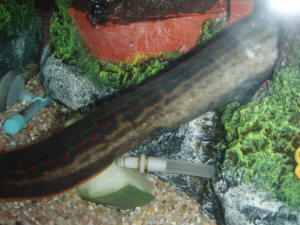 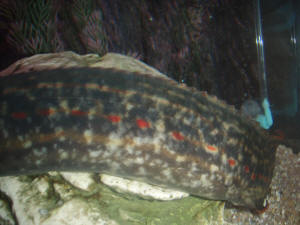
|
Injured peacock eel - please help - 1/22/07 Hi Crew,
<Kim> I've searched site and can't find the info that I
need, and I'm pretty desperate, so I'm writing in hopes that
you can give me some advice. <Will try> I have a peacock eel who
is about 5 inches long. He lives, happily until today, in a 75 gallon
planted tank with gravel substrate. Today my 11 year old daughter
picked up the large castle decoration in the tank to look for a snail
that she couldn't find. She sat it down and when she saw that it
was crushing one of the plants, she pushed it over. My eel was
apparently next to the bottom of the castle and got pinned under it. I
walked in the room right as she was pushing it over and since she's
not supposed to ever stick her hands in the tank, immediately rushed
over to see what in the world she was doing. I saw the eel sticking out
from under the castle, about two inches below his
head. Needless to say, I got the castle off of him in a
flash. He swam (if you can call it that) away, but under his gills is
red and he looks bent in the middle when he's still. I managed to
scoop him up in a small plastic container and moved him to my hospital
tank. The thing is, I don't have a clue what to do for him now, or
even if there is anything that I can do for him. <Mmm, not much
"to do"... their gills are red naturally... and if in initial
good shape, Mastacembelids/spiny eels do tend to heal rapidly... I
would move this fish back into the main system myself> As I write
this, he is laying on the bottom of the tank, curved in a loose C
shape, but he's moved a couple of times since his transfer. Any
suggestions are greatly appreciated. Thanks! Kim <No
medications suggested... Just time, patience and hope. Bob Fenner>
-- Kim Jones
Sick Fire Eel 12/26/06 Hello, I'm
Katey, and I was hoping you could help me with a problem with my fire
eel. A week or so ago she began getting pale spots on her
face, as if the color was bleached out. <A bad sign> She also
began acting listless, letting her head droop sideways instead of
alertly poking it out of her hiding place. <Something amiss here
environmentally...> However, she still ate ghost shrimp (her
favorite food) just as voraciously as before. I did massive
research but didn't find anything that really fit... she didn't
have "fungus" on her yet. Water
tested o for nitrites but nitrates were high (close to 80
ppm?). <Yikes... way too high> However, I had just done a 45%
water change a week or so before. <Too much percentage at one go...
Please read here: http://www.wetwebmedia.com/FWSubWebIndex/fwh2ochgs.htm and
the linked FAQs file above> A few days after presenting
with the pale spots, she developed a grayish, slimy material on her
body in various areas. This sounded like Columnaris (except
nothing really around her mouth), so I began treatment with Maracyn
plus after a 15% water change for the nitrates (Tuesday will be day
5). My concern is that she is also occasionally having crazy
frantic thrashing spins around the tank (lasts 5-10 seconds), and
I'm not even sure it's Columnaris! <Is not... primarily...
something in the water... perhaps consequent with the massive water
change...> She still acts lethargic but I thought her skin cleared
up a little, though not sure. Her appetite is good but she
is definitely not herself. Her tank-mates, a tire track, 2
clown loaches, and an African butterfly, show no sign of disease and
are acting very healthy. Any ideas/help would be very
appreciated!! Thank you very much for your
time! Katey <What re your water quality tests? I would
use activated carbon, a pad of PolyFilter in your filter flow path
here... Stat! Bob Fenner>
Re: Sick Fire Eel, need to
add... 12/26/06 Hi, Katey again...I wanted to add
onto my last email about my sick fire eel. She is REALLY
flipping around now...she seems to be absolutely desperate to itch. She
goes on 100mph spins that looks like she is trying to itch her body
with her nose. Even worse, she beats herself against the
wall, decorations doing this... I'm afraid she'll kill herself
doing that! I hope this gives you more clues... Thanks! <... your
water... Bob Fenner>
Re: Sick Fire Eel 12/27/06 Thanks so
much for your advice...my water tests are the Jungle 5-in-1 strips...
I've heard that they could be inaccurate, but that's all I have
at the time... hope to be getting better tests though. I
will follow your advice, and update you with (hopefully) a good
report! Oh, and I did read that linked article...I will be
switching to 15% every 2 weeks. Again, thanks very
much!! Katey <Thank you for this update Katey. Bob
Fenner>
Starving Eel 9/2/06 Hi, <Hi
Gillian, Pufferpunk here> I have a problem with my yellow spiny
eel. (At least that's the name it was sold to me
as.) It's very small, only about 2.5
inches. I've had it for about 5
months. I've had no problems up until now. I
have read that some people have problems with eels not eating and as a
result, they lose them within a few weeks. <True but it
can take longer sometime, for an animal to slowly starve to death.>
I figured that wasn't a problem since my eel has been around so
long and although I haven't seen him eat (but I do think I've
seen him darting at daphnia), he's looked well fed. Just
yesterday I noticed that he looked terrible. He is very thin
and seems to have no strength. I moved him into a smaller
tank by himself over night with food. <Most spiny eels
only eat live food. Mostly blackworms. That's
what their long nose is for--to scrounge the substrate for worms.> I
was a little worried that maybe some of his tank mates have been
stealing all his food and that might have been the cause of the problem
(he's in with 3 neons, a ghost shrimp and a panda Cory
cat). However, he didn't seem to eat any of the food
offered to him. I put him back in the tank with the others
and he still swims around, but he still seems weak, unable to burrow
and he'll stop swimming in funny positions, like on his
side. The problem is that I don't know what to
do. If he's not eating, I'm not sure how to make him
eat. If it's some kind of infection, I'm not sure
what it is. His fins, colour and skin all seem
fine. He just seems unbelievably thin and his gills look red
(although I'm really not sure if his gills seem red because
he's so thin or if it's some kind of infection). The
water chemistry's a little off, which I plan on fixing right away
with water exchanges, and I've added a little bit of salt (one tbs/
5 gallons). <Weekly water changes are necessary to keep the water
clean & livable.> I'm not sure if I should try a salt
treatment. Or if I should try something like Melafix (even
though I'm aware that he doesn't seem to have any of the
symptoms Melafix says it treats). I'm not sure how much
longer the fish will last. Please help. <Neither can
hurt. I'd try offering live worms. ~PP>
Thanks Gillian
Eels Healing from Injuries Hello Once again Dr Fenner!
<Anthony Calfo in your service, my friend, whilst Bob travels the
great continent of Australia. I'm hoping he brings me back a cool
accent instead of a tee-shirt when he returns <smile>> I need
your advice regarding these 3 fire eels that I want to buy. The
aquarium houses them together with a grown Cichlid in a 2 ft tank. I
think the Cichlid must have attacked them before 'cos I can see
that 2 of them have slight injuries. <a shame...mitigated by the
cramped tank I'm sure> The 3 eels are about a foot long and are
very fat. The injuries are such that I can see the whites of the flesh.
The body is jet black but then I can see breaks in the skin that reveal
the whites. It actually looks like a small scratch made by a needle.
The injuries look very minor but I do want them to heal if I decide to
purchase them. Its very rare over here (Singapore) to get eels at this
size. <perhaps because they are delectable <wink>> Do you
have any recommendations for medication? What can I do to help the eels
heal faster? <yes... an antibiotic combination of Furazolidone
and Nitrofurazone (Jungle brand "fungus eliminator" for
example). Eels are one of the few fish prone to true fungal infections.
It will guard against bacterial infections as well> If I just put
them in my tank will the injuries eventually heal?
<perhaps...especially if your tank is larger (it really must be)>
I went back to the aquarium about a week and a half later but the
injuries were still apparent. <unusual and not a great sign...
perhaps you should take them sooner to a better tank> They look
pretty relaxed in the tank though but I think they'll be better off
without the Cichlid. <certainly agreed> On a separate note, what
kind of medication are suitable for eels with fungus or other skin
problems? <above listed...and antibiotics in general are safe> I
read that they are very sensitive to metals in the water and also some
'itch' medicine. <yes... avoid copper and organic dyes
like malachite and Victoria green and Methylene blue> Should I put
in some capfuls of Blackwater into the tank? Will this help them relax?
<dim lights will work the same or better> You helped me identify
the Caecilian I have several weeks ago and I really am grateful! =) I
look forward to your reply once again. Yours Faithfully, Leonard
Emmanuel <with kind regards, Anthony>
Tiretrack Eels 10/14/03 They have not had an appetite for 3
weeks and I am getting worried so please can any one that is an expert
on them please help me. <I really could use more
info. These are Tiretrack eels? How long have you
had them? What kind of food have you
offered them? How big is their
tank? What are their tankmates? Have you tested
the water? How often do you change the
water? After you answer all of these questions I'll be
much better equipped to help your fish. Just to let you
know, the only food I have ever seen my eels eat is live
Tubifex/black/bloodworms.> and if there is a phone # I
could call to give more detail please tell me. <I'm sorry, we
have no phone service. Emails to this address is the best we
can do.> thanks Jeff <Your Welcome, Pufferpunk>
Boiled Eel.. >Hi, >>Hello. >Wow incredible site.
>>Thank you. >My sister has a tire track eel and it's
sick, it has boils (?) on its back. That's how she described it to
me. >>Sounds like ulcers, an open sore is my take on
it. This isn't good, though. >What might it be and
how can we fix it? >>We see ulcers of this type most commonly on
goldfish. It's called septicemia (see here: http://www.fishbase.org/Diseases/DiseasesSummary2.cfm?discode=809
) >Do you have any good references for info on curing disease/sick
tire track eels? >>Not specific to tire track eels, but you can
also search for treatments for SCALELESS fishes. >I read on your
site that if it has sores it's likely to die soon? >>Maybe
not so soon, but these afflictions can be very difficult to deal
with. It should NOT be treated in the main display, however.
>She's very found of this eel as she says it has a lot of
personality! >>I'm sure it does, and if you can, search
further on http://www.fishdisease.net/ as well as
looking for freshwater fish forums and sites. Because these
infections can by caused by many bacteria, treatment is rather like
"blasting" with antibiotics. Marina >Thanks,
Cindy
Sick eel please help I have a Aethiomastacembelus elipsifer
Tanganyika eel and it does not look like he is eating and has gotten
very skinny. I was wondering if there was anything I could do to fatten
him up. He is not very active and does not look very good. I have him
in a 55 gal. with mainly a Tanganyika/Malawi setup. I have tried
feeding him bloodworms, freeze-dried plankton, and flake food at night
after I have turned the lights out and the other fish have already been
fed. I even tried holding it in front of him and he will not eat it. He
used to bury himself all the time and now he just stays in one spot out
all the time. I am very worried about him. What should I
do? < These eels are very cool. I saw many different
species in lake Tanganyika as few years ago. They ranged from little
small 4 inch eels that would swim around like little sea horses to very
large ones like fire eels. In the wild we saw them feeding on small
shell dwelling cichlids in around the rocks. We caught them at night in
minnow traps using very oily fish as bait in the trap. I would catch
the eel and place him in a separate tank that is well covered so he
won't jump out. Place a layer of fine sand on the bottom and a rock
or cave that he can hide in. Make sure the water temp is at least 80
degrees. I would first try some live washed earthworms or some well
washed black worms. Then I would get some feeder guppies and throw them
in the tank. See if the eel will take the guppies out of your hand. If
this doesn't work then maybe small strips or raw fish cut to bite
sized chunks. In a large community tank these eels are reluctant to
feed because of all the commotion the cichlids create. You eel may end
up needing live fish all the time. -Chuck> Thanks, Jessica B.
Feeding peacock eels I just purchased a small peacock eel and
was wondering if I was feeding correctly. He/she is about 4-5 inches
long and I'm feeding shrimp pellets. I read in the information on
spiny eels that they won't bite and chew their food. I don't
think my eel's mouth is large enough yet to eat the shrimp pellet
whole but I dropped a pellet near him (he's burrowed and sticking
his head and part of his body out) earlier and it's gone now. Will
they eat the pellets once they've softened? Or do I need to resort
to frozen food (I live in a college dorm that allows only fish tanks
and I don't have access to a store that sells live food so my
method of feeding is rather limited)? <Please read here: http://wetwebmedia.com/FWSubWebIndex/matacembelids.htm
> In addition to that, I was wondering what would be the best
remedies for the most common infections, like ick. I'm using a
product currently with my other fish called CopperSafe by Mardel
(Active ingredient: Chelated Copper Sulfate) in combination with a
product called MelaFix (it says it's safe to use with scale-less
fish). CopperSafe seems to work really well with my other fish,
including a pictus cat, who came in with ick. But you mentioned that
metallic medications don't work well on eels. What should I look
for in an anti-ick medication when it comes to peacock eels? Should I
just dose the tank with non-iodized salt? Sarah <Please read over
WWM using the Google search tool there, with these questions, product
names... I would not use Melafix for anything, nor copper compounds on
Mastacembelids or Pimelodid cats... Read my friend, before purchasing
livestock, using toxic chemicals on them. Bob Fenner>
Fire eel 11/3/05 Dear Robert, I wrote to in July with regard
to my 10 year old fire eel (in 90 gallon tank) that I have always
treated with the Maracyn and CopperSafe. You recommended I get a copper
(ion) test kit to monitor the copper level because StressCoat (which I
use all the time) can remove it over time. I purchased a freshwater kit
by Aquarium Pharmaceuticals which reads from 0.25 thru 4.0. My
measurement today is .25. Is this a treatment level? <Yes...
tween 0.15 and 0.30 ppm of free cupric ion> My old kit by Aquarium
Systems (which I cannot find replacement packets for) read 0.15 thru
0.2 on the chart and it stated that this is a therapeutic treatment if
maintained for 10-14 days. I also would like your opinion on
this: my fire eel has these blister like, or more like welts, on his
sides. He has had these for sometime - they are not new. It reminds me
of a hive like a human would get on their skin. And, he has grown up
with a Pleco that appears to have an uncanny affection towards him.
It's like their glued together, though I suspect the Pleco is
sucking the slime off of him. <May be> Again, this has been going
on for years. Your comments, please. Thank you. Linda I. <I
would keep an eye on the Pleco... try to keep it weaned away from the
eel... perhaps with algae wafers... offered toward the evening/lights
out. Bob Fenner>
Fire Eels, Cestodes, and Praziquantel - 11/01/2005 Hello
Crew! I have a 2 1/2 foot Fire Eel that appears to have tapeworms. He
appears very healthy and gregarious in all respects, but periodically
he discharges some white, flat, many inches long, substance which
appears to cause him some discomfort, resulting in thrashing about the
tank to dislodge it. Does not appear to be normal waste or a normal way
to evacuate based on the discomfort involved and the color.
<Could indeed be tapeworms.... or other worms.> I have not been
able to isolate any of this substance as the rest of his tank mates
devour it immediately, <Ugh.> which of course means they also
have worms if that is what they are. <Agreed.> He is fed
live worms and I know they can be carriers of tapeworms which has
caused my concern. <Good concern.> I know he shouldn't have
any medications with copper, and I was also concerned because he is
scaleless, or nearly so anyway. Some of his tankmates are also loaches
and Botias, so I have to worry about them as well since he is too big
to quarantine and they and the rest of his tankmates would probably
have to be treated as well, anyway. However, all his tankmates also
appear to be quite healthy. What medication or treatment would you
recommend? <Praziquantel would be my first choice, followed by
Levamisole or Piperazine.... There are a number of products available
for aquarium use, one being "Prazi-Pro". Any of these
medications (or others for Cestodes) will need to be administered via
food, I believe.> Thank you for your time. He is a sweet little
fiend, and I don't want the worms to cause him problems in the
future. I wasn't able to find anything by performing a search for
this item in your website. <Glad to hopefully be of service.>
Marcia <Wishing you well, -Sabrina>
Fire eel, copper use 7/22/05 Dear Robert: <Linda> I
have had my fire eel about 10 years and he is about 18-19 inches and
very well rounded. <How nice... great pets, very intelligent> He
is very aggressive and spooks easily and has had several injuries to
his body over the years. Only on one occasion did I almost
lose him - my local aquarium shop said it sounded like an infection in
his gills - heavy breathing - not eating or swimming. I
treated the tank with Maracyns I and II and CopperSafe and
he recovered. I have used these products ever since, and
having read on your webpage that eels are sensitive to copper I wonder
if I should stop. <Mmm, no... just "be careful"... not to
over-expose> I recently moved ( and the fire eel) to a new home
which is on well water and I regularly treat the water with StressCoat
and CopperSafe. May I have your opinion on this treatment
plan. Thank you. Linda Itoh <Mmm, I would get, use a
copper (ion) test kit... and know that StressCoat will
remove/precipitate copper. Bob Fenner>
| Poorly eel... Ps. Sorry for such a long
email, but I thought I'd tell you as much as I
could,,, also forgot to add, All the other fish seem ok... And the
eel never seemed to eat anything... I got some maggots from the
local fishing shop.. the other fish liked them, and the eel showed
more interest in them than bloodworms, or anything else I'd
been trying to feed him, and looked as if he was trying to eat one,
he made a move towards it, but didn't get it in his mouth,,, so
I'm not entirely convinced he's eaten too much since I got
him.. (about 3 weeks ago) hope you can help.... Sami <This spiny
eel is extremely mal-affected by a bacterial infection... though
often termed fungal... A very quick administration of antibiotics
to the system (Chloramphenicol if you can get it, Spectrogram
(product) if not... at double dose... 250 mg. per five gallons,
addition of a teaspoon of aquarium salt per five gallons... in a
separate treatment system, attention to water quality while
there... offering Tubificid worms as food... Might save this
specimen, but doubtful at this stage. Bob Fenner> |
|
|
Sores on Aethiomastacembelus elipisfer 3/10/06 I
just bought a Aethiomastacembelus elipisfer about a month and a
half ago. This week I see a sore on its
side. Also, it is not very active, preferring to
"make like grass" in the plants. I am not sure it
has been eating, but have fed guppies and will continue to
do so. do you have suggestions on treatment for these sores?
Thanks Pei <Mmm, yes... from Oliver's input and mine posted on
WWM (Please use the Google search tool or read here: http://wetwebmedia.com/FWSubWebIndex/spinyeelfaqs.htm
These matters need to be addressed aggressively. Bob Fenner>
Fire Eel Issues - 04/05/2006 I have a fire eel
(approximately eighteen inches) in a freshwater tank - think he might
about 15 years old - not sure. <Nice!> A couple weeks
ago he stopped eating, became lethargic (not sure I spelled that
right), <I believe you did.> and appeared to have labored
breathing. I dosed the tank with Maracyn II for five days,
<Why?> and then another five days with Maracyn.
<Again, why? Did you see symptoms of anything aside from
the heavy breathing/lethargy? Did you have reason to suspect
a bacterial infection?> I have only used Mardel products on him
including CopperSafe and occasionally Maroxy. <....
should try not to use medications unless you know there's a disease
that must be treated....> He has a couple injury sites that have
turned white. <Disturbing. How did he become
injured? Tankmate squabble? Escape attempt?>
After the second week of antibiotic treatment, he improved, regained
his appetite and was swimming like usual. Last night, he
stopped eating again. I'm not sure what to do this time
around. I/m afraid he might be dying from old
age? <In all honesty, this is possible....> I am
doing 20-25% partials every 5-7 days. <Ammonia, nitrite,
nitrate, pH readings?> He has a small area of whitish skin on the
side of his face. Please give me some suggestions. Linda
Itoh Hello, I wrote to you a little earlier and I need to add a symptom
I just noticed with my fire eel - his stomach is bloated.
<The bloated belly and refusal to eat are troubling.... I
would first check (and correct, if necessary) his water
quality.... Next, there are a number of things to
consider. First, simple constipation. Foods high
in roughage content may help with this (adult daphnia, adult brine
shrimp....). Secondly, these dropsical symptoms may indicate
an internal bacterial infection; if that's the case, there may be
little you can do, depending upon what, exactly, is troubling
him. You might consider trying to feed with an antibiotic
medicated food, though this will (obviously) be difficult if the fellow
refuses to eat.... Maintaining optimal water quality and
hoping for the best with foods to help reduce constipation may be your
best first start.> Linda Itoh <My best wishes to your eely
friend, -Sabrina>
Fire Eel Issues - II - 04/22/2006 I have not been
doing well with my fire eel. His belly is still bloated and he is not
eating. <Yikes!> I have been doing water testing and
the results as of last night were: ph 7.5, copper .5 to 1.0,
<I still don't understand what you are treating with the
copper? Our correspondences haven't let me to believe
that you are dealing with ich or other parasites....> nitrite .09,
<This should test as zero.... likely you need to do more
frequent water changes right now; the copper has destroyed your
biological filtration.... And again, why copper?> nitrate
(I am still having problems figuring out) I am using tetra test NO3 and
color in test-tube matches 25mg on color chart with kit; <Mm,
it's in parts per million, no?> however if I divide that by 4.4
I believe that number is 5.68, is that good or
not? <You've lost me here; why are you
dividing? Is it not displayed as parts per million,
or....? And what about your ammonia readings?> I think he
has an infection and needs to be treated with antibiotics.
<.... this is possible, but not seeing the fish, not having all the
data, I really can't tell you what he might need at this
point.... If you do suspect an internal bacterial infection,
Kanamycin or Nitrofurazone in food is my
recommendation.... or at least orally if not in food, if in
any way possible.> I have only used Mardel products in the
tank. The white injury sites are from him trying to cram
into a castle which is too small for him now which I have not taken out
yet because he is so panic stricken when I work in the tank I'm
afraid he is going to jump out. <If there is an item in the tank
responsible for the injuries to the animal, PLEASE get it out of there
IMMEDIATELY. Replace it with more decor of a more desirable
nature, large enough not to damage the poor fellow. This is
imperative; if he's getting wounds from this castle, it needs to
go, pronto, in favor of something that won't wound him.> Some
years ago I was working in the tank and he took off like a rocket right
out of the tank, in the air, and landed on a tile floor. He
did recover but has not been the same since.
<Yeeee-ikes! I can imagine! Sneaky little
fellows.... give him more appropriate hiding spaces, things
to make him feel secure, things that won't wound him.> I also
have been using well water for the past 3.5 years which I treat with
StressCoat when I partial. Please give me some
suggestions? <This bloating and refusal to eat is
hopefully something that can be passed.... I would add a
tablespoon or two of Epsom salts (Magnesium Sulfate) per ten gallons of
water; this may very well help him pass any
blockage. Secondly, I would absolutely quit with the copper,
unless you are treating for ich or some such.... adding
copper is shooting yourself in the foot right now, with regards to
water quality. If you are highly confidant of a bacterial
infection, I would recommend treating with Kanamycin and/or
Nitrofurazone, again, preferably orally and preferably in food.>
Right now, I am just doing partials about every 4-5 days.
<You may need to increase this to *daily* with the copper in your
tank destroying your biological filtration.... Be testing,
*daily*, for ammonia, nitrite, nitrate, pH....> Thank
you. Linda <All the best to you, Linda, and don't get
disheartened. Spiny eels are resilient fellows, and
hopefully yours, aged though he is, can pull through
this. Wishing you well, -Sabrina>
Fire Eel Issues - III - 04/23/2006 Sabrina, thank you for
your response with regard to my fire eel. I had been
treating the tank with copper because the injury sites were not healing
like they have in the past. <Copper really isn't
very useful for aiding wounds in healing....> I did about a 30-35%
water change yesterday and my copper level today is 0.5. I
plan on not adding anymore copper. I was thinking if I
maintain a therapeutic level of copper it would keep him from getting
parasites. <Mm, for the most part, you're not so
likely to see parasite issues pop up unless you introduce them;
it's bacterial complaints that you need to have concern over.> I
have always maintained a level of copper in the tank for as long as
I've had him. <With regards for parasite prevention, a more
useful and less toxic substance to use is just aquarium
salt. Spiny eels don't much like it, but tolerate it FAR
better than copper.> Today my nitrite is 0.3 mg/liter, and NO3 is
50mg/l. I am using tetra tests with color charts measures
reading in mg/l. <I see. mg/L is the same as
ppm (parts per million). Thus, you have .3ppm nitrite and
50ppm nitrate. You most certainly need to do some hefty (or
heftier) water changes; spiny eels don't appreciate high
nitrates.... I would quickly strive to bring this much
lower; 20ppm at a maximum, less if possible.> The only test chart I
see with ppm's is the copper chart. I am thinking I need
to another partial today; but I just don't know.
<Yes, absolutely.> My ammonia is 0 according to the
tetra test color chart reading from 0 thru 5.0. <Get the nitrite to
zero, and the nitrate down.> Interestingly, after I did the 30-35
partial he actually ate some food last night;
<Ah! Good!> but still looks very uncomfortable, and is
still bloated. I thought the bloating was due to a bacterial infection
which is why I'm thinking he needs antibiotic. Can you
tell me where I can Kanamycin in the oral form? <You
might have to mix it yourself, or take a look at http://flguppiesplus.safeshopper.com/234/cat234.htm?590 -
they have an antibacterial medicated flake with Oxytetracycline, which
might also be effective.> The only antibiotic I keep on hand are the
Maracyns. I did not put Epsom salts in the tank
yesterday because of the partial and he seemed to have gotten some
relief from it. <The Epsom cannot cause him harm, even
if he were in perfect health, and may help *immensely*.> I'm so
distraught over the possibility of him not making it through
this. <Get the nitrate down.... Discontinue
copper.... Add Epsom.... Maintain impeccable
water quality (ammonia and nitrite at ZERO, nitrate less than 20ppm and
preferably closer to 5ppm).... Wait a few days, then begin
with antibiotics in food if no improvement is seen. At
least, that's what I would do.> Thank you for your
help. -Linda <All the best to
you, -Sabrina>
Fire Eel Issues - IV - 05/13/2006 Hi
Sabrina, <Hi, Linda!> I'm writing again with regard to my
bloated fire eel. He is hanging in there; but he is
obviously not comfortable. I added the Epsom and have
discontinued the copper since April 25th no copper. The
copper level is holding at 0.25 ppm, <I continue to urge you to get
this to zero.> 0 ammonia, 25 mg/l nitrates, <Really needs to be
lower still.> <0.3> nitrites, <Needs to be zero. ph is
holding at 8. <Yikes!> I have read that fire eels
like a lower ph so the 8 concerns me. <Yes, me too, a
great deal.> However, at this point I'm so frustrated with what
to do, maybe the pH8 is not a significant problem. <Mm,
it is a problem, I think. Many/most fishes are very tolerant
of a wide-ish range of pH, but spiny eels really should not be in a pH
this high. Dangerous.> After our last email conversation
he was not eating so I put Maracyn II in the tank for 10 days, he
starts eating and swimming around. He will not eat flake
food, shrimp, bloodworms or earthworms. <Disconcerting
that he won't take worms....> He eats shrimp pellets and algae
wafers. Since I stopped the copper his welt-like blisters
are getting white-ish and he is scraping along the bottom of the
tank. <Still signs of irritation, perhaps at the
nitrite, nitrate, copper, or that very high pH - or something else in
the water, even.> I have done partials every 2-4 days, however he
seems really stressed after a partial. I am on well water
here and I did a hardness test on it - 14 dGH - and 13 dKH.
<Kinda high, there.> I have always used water right from the
well, and am now wondering if I should be using water from the tap
which is ran through a softener. The tap water reads 1dgh and 12 dKH.
<I would advise against the softened tapwater; this can be even more
trouble than it's worth. The very hard, high pH of the
current water, though, is troubling. I would like to suggest
that you try doing a couple of water changes (carefully, and spaced
apart in time) with some water from a Reverse Osmosis filtration unit
or even store-bought bottled water - I don't know where you are,
but many places have water stores where you can fill up a 5g water jug
for a buck or so with straight RO water. Just BE CAUTIOUS of
this, as the pH of the purified/bottled water will be much, much lower
than the pH of the tank - you do NOT want to lower his pH too
quickly.> My aquarium readings as of yesterday are 18dgh and 10 dKH.
I had to have my husband help me with these tests. Very complicated for
me. <And very kind of your husband, too - thank him for
me.> Seems like he has skin problems since we moved from city water
to well water. <Bingo....> I'm probably just
grasping at straws at this stage. <I very strongly feel
that the bulk of this animal's problems are
environmental. I would actually hold of from medicating at
all (aside from the Epsom salt, I would use that again after your next
water change). I would like to see this critter VERY slowly
(as in, 0.2 a day) go down to below a 7.0 pH with as close to zero
nitrate as possible (below 20ppm at the least), zero ammonia, zero
nitrite, zero copper, and lower hardness with the use of RO/bottled
water. I really think a more accurate environment may be the
whole key here.> I have purchased Maracyn Plus Biospheres
Antibacterial (Sulfadimidine and Trimethoprin). Do you think
this would help with the skin welts?<Mm, I would hold off on
medicating this animal any more than absolutely necessary at this point
and see how an improved environment affects him.> Please give me
your thoughts. <You've got 'em now, and I hope
they help some.> Thanks, -Lyn <All the best to you and
your eely buddy, -Sabrina>
Fire Eel Issues - V - 05/15/2006 Hi Sabrina, <Hi,
Linda!> I'm writing with an update on my fire
eel. After I read your last reply, I did a small
partial - only five gallons of aquarium water - did I replace with
store-bought bottled water. I'd like to explain
something to you that my husband explained to me before I give you the
numbers. I have been testing the PH with a tetra test kit
that reads from 5,0 thru 10,0 and the aquarium water has been reading
an 8,0. He brought in the ph kit for our pool water that
reads in tenths from 7.0 thru 8.0. We tested the aquarium
water (before small partial) to see if it matched my ph of
8. It did not - it read 7.6. <A big
difference.... I would test this against another aquarium
test kit, perhaps at your local store; many/most stores will test your
water for you for free.> We did the partial and the ph on
the tetra kit read 7.5 and the pool kit read 7.4. <This
is a difference that could be charted up to human
error.... is very close.> This was on May
14th. Tonight, I just did the ph readings and they are
unchanged. The nitrites and nitrates are also
unchanged. The dGH is still 18 but the kH is down to
8. <One last time. Ammonia and Nitrite MUST
be ZERO. Nitrate MUST be as low as possible; below 20ppm at
the least, preferably even at or below 5ppm for this sensitive
animal. These things aren't options, but criteria on
which your eel's life hinges. The pH is next in line of
importance.> The magnum filter was clogging up pretty good so I
changed that tonight. <Likely a/the "source"
of high nitrate in your tank.> My fire eel has stopped eating again
- 3rd night in a row - since I stopped the Maracyn II - he has stopped
eating. <This could very well be coincidence, to be
quite honest. These animals can sometimes stop eating once
in a while.> I feel like I need to treat him with something
especially since he has stopped eating again. <Bob and I and a few
other folks were just talking about this tendency in aquarists; a
desire to throw a medication at a problem.... This is a
very, very unfortunate tendency, and probably kills more organisms than
it saves.... Granted, I do not know you or your pet, but I
still feel that throwing medication at the fellow's condition when
there are KNOWN problems with the water that must be corrected is
folly.> What would be in the Maracyn II to make him eat?
<Can actually be coincidence.> I can't determine if he is
breathing easier or not since the partial - I don't think
so. IF he starts to look worse and I decide to medicate him,
would it be safe to use the Maracyn Plus Biospheres? <I
can't recommend either, to be honest. Not until the
water quality is rectified. Fixing the water quality is
*imperative*.> In your last reply, you had suggested doing a couple
of water changes carefully spaced apart. <Mm, as far as spacing them
apart, what I'm most concerned about is not decreasing the pH too
quickly.> Do you think another water change should be done in the
next day or two, or more towards the end of the week? <I
would say NOW, and urgently so, until that nitrate reading is down.>
And, I'm thinking another 5 gallons of bottled water and 5-10
gallons well water. By the way, with regard to CopperSafe -
I was reviewing my emails with you guys and noticed the very first one
a Bob Fenner replied to and I got the impression he was okay with using
CopperSafe. I was just wondering about the difference of
opinion. <I am actually sitting with him now, he's
right next to me.... We've talked, and he does agree
that maintaining copper on spiny eels is not a good
idea. They just don't do well with many
medications. If you like, a direct quote from his
Mastacembelid article: "Spiny eels don't respond
well to toxic dye and metal medications." http://www.wetwebmedia.com/FWSubWebIndex/matacembelids.htm
. I do believe he misunderstood that you had intended to use
copper as a constant preventative in the water.... I
believe, and I feel that he does too, that this is a bad idea.>
Thank you for your reply - again. Lyn <Please do go
ahead and read over the article and the FAQs file linked to it, if you
would.... hopefully you might find some other piece of
insight that would be of help to you. Wishing you
well, -Sabrina>
Fire
"Eel", Eye Damage - 10/12/05 Hello <Good morning.>
I hope you can help me to help my Fire Eel. When we were cleaning the
tank 10 days ago, my eel got a fright and decided to have a 100mph swim
round the tank! <Yikes! Hopefully this system is not too small
for him to feel secure....> I think he must have hurt himself as I
have now noticed that his one eye is totally white (looks blind) and he
has a patch above the eye which seems to be getting whiter by the
day. <Definitely a concern.... Probably did scratch/damage
himself during his speedy stint about the tank.> He is also off his
food, not having eaten for three days (very unusual for him).
<And not a good sign....> I have bought some Potassium
Permanganate (Condy's crystals), but don't know if I can use
this as he is 'scaleless' and I have been told to be careful of
medications as not all are suitable for eels. <You are correct. Do
not use this.... Very, very caustic - will more than likely kill the
eel, and can be hazardous to deadly even on stronger fish.> Please
help. I am worried about my fat boy! <Bob's recommendation (and
I agree wholeheartedly) is to add aquarium salt (the stuff marketed for
freshwater aquaria, not marine salt), perhaps at one or two tablespoons
per ten gallons, possibly also add Maracyn I & II (erythromycin and
Minocycline) as a preventative.... and of course, maintain optimal
water quality. Try feeding stinky, attractive foods like bloodworms
(live if you can get 'em) or even redworms/tiny earthworms you
collect yourself from an area uncontaminated by
pesticides/herbicides.> Thanks, -Wendy
|
|

