Become a Sponsor

 
Home
Information Pages:
Marine Aquarium
Articles/ FAQs
(enter words you'd like highlighted in this page)
Freshwater Aquarium
Articles/ FAQs
Planted Aquarium
Articles/ FAQs
Brackish Systems
Articles/ FAQs
Popular Pages:
Features:
Daily FAQs
FW Daily FAQs
SW Pix of the Day
FW Pix of the Day
Conscientious Aquarist Magazine
New On WWM
Helpful Links
Hobbyist Forum bb.WetWebMedia
Ask the WWM Crew a Question
Calendars
Search Feature
Admin Index
Cover Images


FAQs about Limpet Snails, Acmaeidae, Fissurellidae and more, Scutus, Stomatella

Related Articles: GastropodsSea SlugsMollusksAbalone

Related FAQs: Marine Snails 1Marine Snails 2Marine Snails 3, Marine Snails 4, Snail ID 1, Snail ID 2, Snail Behavior, Snail Selection, Snail Compatibility, Snail Systems, Snail Feeding, Snail Disease, Snail Reproduction, MollusksSea SlugsAbalone

"Thrummmm!"

Hoof limpet - 11/07/09
Hello,
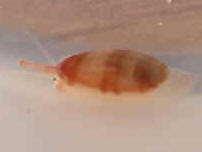
I have attached a picture of what I believe to be Hipponicidae sp. residing on the back of one of my snails!
<Looks like it!>
I have 'Googled' around and found some supporting information but wondered whether this was a true example of symbiosis
<Mmm, of a sort... I'd label this animal as a "space parasite"... as the "host" appears to be harmed to a degree, and definitely doesn't seem to benefit from the Limpet>
or just an accident. The forked proboscis (if that's the right term) extends significantly from the shell during feeding as it picks around the areas that the snail is grazing so I assume is diet is basically the same.
I not been able to narrow down to species level but suspect that it is a harmless hitchhiker as the 'host' seems to be unaffected.
<Mmm... I don't know... having something so large, heavy on ones shell...>
I found it interesting and have not seen any similar pictures on the web so wondered whether you would be interested too.
<Yes. Thank you for sharing>
Forgive my ignorance if it is actually common and I'm just bad at web searches but if it is unusual I can think of no better place to share it.
Your site has helped me a great deal over the years and continues to be my favourite reference as the reliability and accuracy of information here is in my humble opinion, above question.
Many Thanks,
Chris
<Welcome Chris! Bob Fenner>

Snails? Yep... Stomatella 10/4/09
HI,
<Hello>
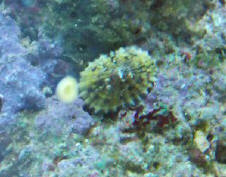
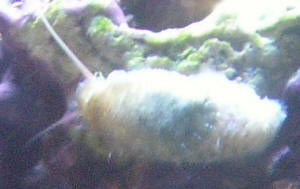
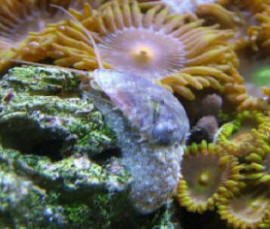
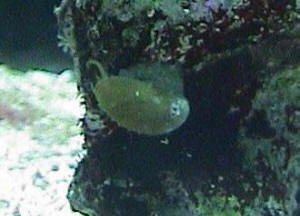
I had purchased a lettuce Nudibranch for my algae that disappeared as fast as I put it in. I never saw it again. Then about a month later I saw TINY versions of something that are now this size. Are these offspring or some evil snail that must be removed.
<Nah>
Never saw these before I had that lettuce Nudibranch. They come out at night and do not like to be photographed. Sorry for the lame pics, this was the best I could do. I figured with enough pics you could help me to identify them. The 4th pic is sort of a HEAD ON view.
Thanks!
<Read here:
http://wetwebmedia.com/MolluscPIX/Gastropods/Prosobranch%20PIX/Limpets%20Scu
tus/LimpetF1.htm
Bob Fenner>

Yellow Mobile Unknown Hitchhiker 9/10/09
Hello,
<Howsit?>
I have a very colorful hitchhiker that showed up about 3 months ago. It was smaller than a pencil eraser at that time but over the months it has grown to about the size of a quarter. It does move around on the rocks,
not very fast but fast enough to make me look for him every morning and evening. He is circular and mostly flat, except in the center. Looks to be a mouth but I'm just guessing at that. I took a photo this evening and
as I was focusing, it spit out a white speck from the "supposed" mouth.
Is this something beneficial or is it harmful to my reef aquarium.
<More the former... I think this is the Limpet Lucapina aegis. Bob Fenner>
Thank You
Beth

Re: Yellow Mobile Unknown Hitchhiker 9/10/09
Hello Again,
<Waking up now!>
After months of looking for the name of this hitchhiker, I finally ask for assistance in identification and of course, in the meantime, I keep looking for the answer. I used a different search engine and different key words and I think that I found the id. Is the answer Keyhole Limpet?
Thank You,
Beth
<A different Limpet (Thrumm!). BobF>

Re: Yellow Mobile Unknown Hitchhiker 9/10/09
Morning Bob,
<And you Beth>
Grab a cup of coffee and wake up.
<Am trying>
Just got your note, I am assuming the "different limpet" means that I have the wrong species?,
<Mmm, yes... but such are the dangers of common appellations>
I was going to go with Fleshy Limpet but the information I found states that these are Keyhole Limpets as well.
<"You say tomatoe"... Megathura is the genus of our (Calif.) Keyhole...>
However, the information also states that they are about the size of a shield limpet or smaller. I have a shield limpet and my yellow limpet is much bigger than the shield limpet.
Of course you could be stating that it is just a unusual looking limpet.
In which case, I totally agree.
I am getting conflicting information about limpets and cannot decide if they are beneficial or harmful. Do you have any thoughts about the benefits or harm that they can cause to coral and or live rock?
Thanks Again,
<... Please read on WWM re such Archeogastropods.... BobF>

re: Yellow Mobile Unknown Hitchhiker 9/10/09
Morning Bob,
<Still?>
Please ignore last post. I read your response to my second post and did not see your answer to my original inquiry until a few minutes ago. Yahoo sent it to my Spam folder.
Thanks
Beth
<Velkommen! B>

Incredible Mr. Limpet Multiplying 7/13/09
Hello all.
<Thrummm!>
I would like to start by saying you have a great site. I've found most of my answers to my seemingly endless dumb questions here.
And on with the show... A little background info, my sister had a ten gal. tank for about 1 year. In this tank she had a fuzzy dwarf lion,
<Mmm, crowded...>
a few blue legs, button polyps, mushrooms, live rock, and ONE quarter sized limpet. She gave the tank to me roughly 10 months ago. About 2 months ago the limpet died from an unknown cause.
<"Variable water quality" likely>
About 3 weeks ago I noticed 15 tiny (1/8 inch) limpets roaming around.
Nothing has been added to the tank in the last 14 months. So here is the questions. Can limpets reproduce asexually?
<Mmm, not as far as I'm aware. They release eggs or sperm into the water column, cued environmentally...>
Have they been in there the whole time unnoticed?
<Possibly...>
All of my research says they reproduce sexually (w/eggs and sperm) around stormy times of the year, but I only had ONE. Since I first noticed them 3 have almost doubled in size, so I have a hard time believing they've always been there unnoticed.
Thanks in advance,
Derek from Holiday, Florida
<Thank you for sharing Derek. Bob Fenner>

Stomatella varia, sel./source   04/02/09
I've spent a hours searching the web for a place to purchase Stomatella Varia. So far I've come up with very little and nothing reliable. I've spoken to people at my LFS's and they are keeping an eye out for me as
they do their water changes. However, in my searching I've found numerous others on many forums stating that they wish they could find a place to buy these.
So my question is 2 fold:
1) Are there places online where these snails can be purchased online w/o buying a whole 'refugium kit'?
<Yes, please see here:
http://www.inlandaquatics.com/prod/tr_invert.html>
2) Why are they so hard to find?
<Good question! They are definitely some of my faves.>
The only suggestion on how to get them that I've seen is "buy live rock..you'll likely get some". But with so many looking in vain I can't help but wonder why no one seems to sell them.
Thanks!
<Do please contact Morgan L. of Inland Aquatics. I have bought these snails from him many times and they always arrived healthy.
Cheers,
Sara M.>

Keyhole Limpet: Lucapina sp. – 1/17/09
<Hello there!>
I am trying to identify this keyhole limpet. It came from Florida with an order from ccritters.
<Neat>
I can’t find this particular one in any pictures.
<It appears to be what’s commonly called a fleshy limpet, in the genus Lucapina (possibly Lucapina suffusa). Please see the photos at the following link for comparison:
http://z14.invisionfree.com/Conchologist_Forum/index.php?s=3d4adb02ec7886bb7914cf50fad8f838&showtopic=984&st=0&#last
I wanted to see if it is one of the bad ones.
<Fleshy limpets are not usually a problem in captive reef systems. I’d leave it in place and enjoy! For more information, please see the “Limpets” section at the following link. The last paragraph specifically relates to Lucapina species. http://reefkeeping.com/issues/2004-06/rs/index.php >
Any help would be greatly appreciated.
<You’re very welcome. Looks like you’ve got a gorgeous little limpet! Take care, Lynn>

Snail-like creature ID: Limpet  12/3/08
<Hello, Lynn here this evening.>
I looked for these, I really did, but no luck. So I turn to you.
<Okie doke>
These act like aquarium snails. From the bottom, they even look like them. From the top, though...not really. They look like little cones. Recognize 'em?
<Yep. They appear to be Limpets of some sort, and more than likely harmless grazers. Please see the following links for more information: http://www.wetwebmedia.com/gastropo.htm
Several FAQ�s at this page re: http://www.wetwebmedia.com/mollusca1.htm >
Feel free to use the images if they are useful to you. It's the least I can do for your help.
<Thank you very much! Take care, Lynn>


Identify- Fleshy Slug AKA Fleshy Limpet 10/22/08
Hello crew...
<Hello Jessy here>
I am baffled by this ...shall I say....shell-less slug?? It moves all over the tank sometimes on the glass but usually on the rockwork. The first picture is very grainy but I wanted you to see it from the front also and this was the best I had. Thanks in advance for the help.
<Donna, by my estimation that is a fleshy limpet. See here for further ID http://www.melevsreef.com/id/fleshy_limpet.html>
Regards, Donna
<Regards, Jessy>

Hitchhiker Snail Reproduction: Stomatella varia - 1/17/08
Hello WWM,
<Hi there!>
Thanks for all you do.
<It's a pleasure, indeed!>
I have a hitchhiker snail that I saw trying to reproduce in my tank. I tried to get some pictures but they were hard to take with the xenia in the way.
<Understandable - can be tough to get good photos of such small subjects - especially considering water flow/movement.>
What are the chances something like this can reproduce in my system? I've only seen one of these in my tank.
<What you’ve got is a Stomatella sp., likely Stomatella varia. They’re harmless/beneficial little herbivores/grazers, highly variable in color, reproduce readily in our tanks, and can get up to ~1.25” in length. With such a small shell and so much exposed foot, you’d think that this species would be very vulnerable to predation. After all, how can it possibly protect itself if it can’t retract into a shell? Well, nature has allowed for this. Stomatellids are mostly nocturnal, can move *very* rapidly, and have the ability to detach the hind portion of their "foot" (the “metapodium”). This is similar to some lizards detaching a portion of their tail when threatened. The sacrificed segment wriggles and writhes, thus distracting the predator and supplying it with a tasty tidbit – allowing the snail to escape. Potential predators of Stomatellids include the usual “pickers” - hermits, shrimps, and crabs. Some fish also find them tasty, but the snails’ mostly nocturnal nature helps to eliminate them from the menu.
Sometimes confused with sea slugs, Stomatellids are actually in the family Trochidae, which includes the more familiar/recognizable Trochus spp. (Trochus/Top Snails), Margarites spp. (Margarita Snails), and Norrisia sp (Moon Snails).
Regarding reproduction, unfortunately, if you have only the one female in your tank, the eggs she released were not fertilized and are therefore not viable. They will simply become part of the foodchain. Hopefully, there are some small, not yet mature candidates around for future spawning events. As far as method, Stomatella spp. are broadcast spawners. The male releases sperm into the water while the female releases her eggs. In most cases, this means that the young have very little chance of survival in our tanks. However, such is not the case with Stomatellids. What tips the scale in their favor is the fact that the young have a very short pelagic larval stage, during which they don’t need to eat. After several days of drifting about in the current, they settle to the rock/substrate as miniature versions of their parents, and begin to graze. All in all, they’re fascinating little creatures and make terrific additions to a reef tank!>
Thanks,
Jesse
<You're very welcome! Take care. -Lynn>

Question about the supply of limpets.
Bob:
It seems that I have purchased some Man made Florida rock here and there and received some very unusual creatures called Limpets. I i.d.'d the critter from "The Modern Coral Reef Aquarium" Volume 1. Svein A. Fossa & Alf Jacob Nilsen.
An example of the scientific name and picture on Page 188 is Scutus Unguis. And yes the animals look very close to a Nudibranch, except they carry a cone-like shell that looks like a volcano. Some species cover the shell with what looks like a mantle.
These critters seem to mow down more hair and slime algae than 5 or 7 turbo snails together.
Q: Where may one find a supply of these? None seem to be listed on the FFE web pages?
I still have one that looks more like a moving volcano that does not wrap it's mantle, and the other was flame orange that did wrap it's mantle. And it looked just a Nudibranch of sorts. Very pretty!! But the seem not to like medications.
This animal seems to be very low maintenance and very tolerant of water quality,
versus what most Nudibranchs require to stay alive.
Am I looking for this animal in the right place? CH
>>
Well, I looked around for limpets as well and couldn't find anyone listing them for sale... But do want to say a few things about them. I agree totally with your observations... and assessment... these archaeogastropods are great and innocuous cleaner uppers.
Having worked with local (S. Calif.) limpets with different projects, I suspect that they're not specifically offered for two reasons: They're hard to extract from hard substrates w/o damaging them... and Folks just don't know about their usefulness as yet...
Unlike Nudibranchs, many limpets have wide, generalized diets (micro and macrophagous herbivores)... and also unlike the "naked gill gastropods", they don't have a tendency toward toxicity... Instead of being poisonous, limpets have a shielding "home" on their backs... and lastly, as you observe, many live in "marginal" and variable environments in the wild... and are therefore reasonably tolerant of the same in captive situations.
Thanks for writing. Bob Fenner

Limpets
A year ago I noticed two limpets in my aquarium. It is a 90 gallon (6'x1'x2'). My guess is they came in on the live rock I added 7 months before. The curious thing is this.
It took 7 months to see the first 2, and I now have roughly 100 more. They are black with a white stripe on their back and are actually not unattractive despite their numbers.
They do a good job keeping the glass, and everything else, clean. They range in size from 1/4 inch to 1 1/2 inch and are found everywhere from the skimmer collection cup (always a few small ones on the cup of a CPR Back-pak), to the live rock, to the glass. I have about 80 pounds of Fiji live rock, a 1 inch aragonite sand bed, the CPR, and a couple Hagen 802's for circulation. I also have Naso, yellow, and regal tangs (1 of each--all about 3.5 inches), a coral banded shrimp, a false percula clown, and about a dozen snails and small hermits. There are no corals or anemones.
Ammonia and nitrites are 0. Nitrates are close to 50. S.G. is 1.024. Temp. is 76 and pH is 8.0. I add no chemicals and have 0 algae other than coralline which covers most everything and has to be scraped from my glass at least every two weeks.
I have two questions. First, is this an extremely unusual occurrence? In order to identify these things I had to post pictures to a newsgroup since the few inexpensive books I have don't even mention them. Second, I'll be adding a dwarf lionfish and snowflake moray to the system tomorrow.
Will either/both decide to make a feast out of the limpets?
If they do, it would probably be good for them, since, in their numbers, I think the limpets would be able to sustain enough of a population to meet their dietary requirements.
By the way, when I first set up this system roughly two years ago, I dosed Kalkwasser for about 2 months to try and get the coralline to grow, and it didn't. Ever since, I have added no chemicals (other than synthetic salt and frozen food for the fish) to the aquarium, and the coralline is almost out of control. It's a great problem to have. By the way, I have 6 24" fluorescent bulbs. Four were bought at home depot (cheap bulbs), while the other 2 are actinic.
I also have a large population of feather dusters growing out of the rock and some have even built tubes of up to 2 inches and are living in the sand bed. Is this extraordinary luck, or did I accidentally hit on the aquarium conditions that the worms, coralline, and limpets thrive in (i.e., low light and not-so-low nitrate)? If my experience is unusual, I'll probably try to replicate the environment (minus the fish) in a 29 gallon, devote some study to all three, and write a paper detailing the conditions for anyone that might want to duplicate them (though their suitability would be limited to a fish only situation). Any guidance would be appreciated. Thank you in advance for your time.
Sincerely, Richard Weatherly
>>
Wow, what an outstanding query, relating of experience and uplifting story... Congrats to you. And I think you may be on the verge of a great commercial success. I have only seen a few cases where the snails called limpets were so abundant as yours... and they are a blessing... And your lion and eel will not consume them (different diets all the way around), but I would do as you say, and save some of these "Chinese Hats" in another system... if for no other reason, for just safekeeping. And do "share the wealth" and supply some to fellow hobbyists...
Your relating of the non-supplement use and results is exemplary by the several meanings of the term... Thank you for writing... please do consider tallying up your observations and sending them to one of the hobby magazines... Very useful.
Bob Fenner

Gastropods/Snails/Limpets and an Over Abundance  12/5/05
I'll save space and your having to read by not listing our tank setup - if you need to know the setup to answer this question, let me know and I'll oblige.
<Okay.>
We setup 90 gal tank with 130 pounds Fiji and Marshal island live rock about 5 months ago. Within a week, we found a large cap snail hitchhiker...5 months later, there's so many in the tank (also a few in the refugium) we lose count to get an exact number. I've read if you know how many snails you have, you don't have enough,
<This sounds like a retailers slogan…I to have heard such ludicrous rules of thumbs such as this one and the common “One hermit and snail per gallon rule” which is to say the least ridiculous.>
but is there such a thing as TOO MANY CAP SNAILS?
<If you have an overabundance this means that there is sufficient algae to support them. The algae is fueled by nutrients. So if you want the herd to be naturally thinned out I would check your system for detritus build-ups and watch how much you feed. Water changes are your friend.>
If so, is there a natural predator for them?
<Yes likely any mollusk and crustacean predators such as wrasses and puffers. However they will not limit their predation to just your snails, your microfauna population would be adversely affected as well as any other small critters in your tank.>
cheers
<To you too.>
Donna
<Adam J.> 

Snails Everywhere!
Hi everyone , I am a little concerned about crustaceans that are in my tank. I seem to have small , about a quarter inch, snails and also limpets in my tank , I have soft corals as well as mushrooms and polyps. Are these critters harmful to any of my other occupants . Thanks Rich
<Well, Rich- without seeing them for myself, I can only generalize (gulp!)...Most of the commonly encountered snails and limpets are harmless...I'd keep an eye on population levels, and if you start noticing damage or excessive populations, you may need to remove some. The upcoming "Reef Invertebrates" by Bob, Anthony, and Steve Pro may be a big help in identifying these little guys. Take care! Regards, Scott F>

Tech - I from Kent Marine, and limpets 5/22/04
Good morning to all,
<and to you in kind>
Just a few questions for you, hopefully you can help. You usually have all the answers. I am curious if tech-I iodine supplement from Kent is okay to use. The label says it has free iodine. My test kit says it is a bad thing.
<somewhat subjective here. There seems to be two "camps" regarding advocacy of Lugol's strong iodine solution (the nutritive iodine of color/odor) versus clear Potassium Iodide solutions.  The other troubling thing is several keyhole limpets in my hospital tank. I believe both can be useful, both can indeed be abused/overdosed too. I favor Lugol's based solutions FWIW. I'm not a bog fan of some bottled supplements though... then ones that do not date their products for products with a definable lifespan/shelf-life. Iodine loses efficacy over time once mixed ion solution>
scoured WWM and have found two different opinions. Bob says okay and Anthony says they will eat soft coral flesh. I did find a big one sitting on my flower leather, so I pulled him off.
<some Limpet species are algae grazers, and some are predators on various reef invertebrates including corals (these tend to be the colorful ones with frilly/fleshy mantles). It depends on the species.)
Thank you for always being there for me and my tanks. Thanks,
Hopeless reef keeper- Daniel
<best of luck, Anthony>

Thanks, and a Story re Stomatella Snails (beh.)  1/29/07
Dear Bob, et. al.:
<Greetings John, Mich with you this evening.>
First of all, many thanks to all of you for your fine WWM resources. You have all helped me gain a tremendous amount of valuable insight into the reef aquarium hobby, at times calming my fears, at others helping me form new strategies, and most always helping me to stay out of (too much) trouble.
<Hehe, this is good.>
It is a constant learning experience, and the challenge is greatly alleviated by useful knowledge and sense.
<Glad to hear!>
I have a 75g reef tank with about 100 lbs. of live rock and a 3" sand bed. This tank had been set up for at least a couple of years by the prior owners, but had been sadly neglected -- inadequate lighting, insufficient water changes and regular maintenance, etc., and the live rock and sand were really not very "live" at all. The sand was absolutely full of detritus. After moving the entire works, setting things back up, adding a new skimmer (AquaC Remora Pro), 300w of 10k and 70w of 20k MH lighting, some new additional live rock and sand and 4 months of babying, this microcosm is now doing extremely well, and has some very good diversity of life... not all to my own credit, because you and your advice also deserve some of the credit. Some "Live Sand Activator" from Coral Dynamics really kick started the sand bed, and a couple of other live micro-critter inoculations have the now very active sand bed well on its way to a stable equilibrium. The tank never did cycle (measurably, at least), and has never registered any reading for ammonia, nitrites, nitrates, or phosphates.
<Awesome!>
The tank now houses the 2 yellowtail damsels which came with the original setup, a black velvet neon damsel (which was rescued from another marine tank after being attacked nearly to death by other damsels, and who has doubled in size in 3 months), a lawnmower blenny, and a powder blue tang (which I had great trepidation about adding, but who is healthy, growing, and truly thriving). I've gradually been adding corals over the past couple of months - a couple of Acropora frags, two Montipora, a Pocillopora, a pumping Xenia, and most recently a yellow Fiji leather. All are thriving (though the Xenia is rather finicky), have plenty of space, and I am done adding anything for the foreseeable future. WWM and Bob's and Anthony's books have really helped me tremendously.
<The website and the books are an invaluable asset to this hobby.  I too would have been at a total loss without them.>
I don't have a question today, but do have a comment / story to share.
<Very good.>
After adding something six or so weeks ago, I began noticing tiny slug-like creatures which grew quickly to about 1/4" to 3/8" length. Within a couple of weeks there were hundreds of these animals in the tank, most notably after dark. They were hard to see on the rock since they were well-camouflaged, but they moved around very quickly, much more so than the Cerith, Astrea, and turbo snails. After seeing one of the larger of these spewing milky stuff one morning (obvious to me that this was a reproductive event), I earnestly needed to find out what these things were, fearing a pending plague. After much searching, I finally determined that they were Stomatella, and that I did not indeed have a problem after all. Their population has by now become self-regulating, and there is always a full range of sizes of these snails in the tank.
<Most excellent!  These are a great addition to any saltwater tank.>
Yesterday I took out two Maxijet 1200 powerheads with Hydor Flo rotating heads (an absolutely wonderful product for the money, IMO) to (experimentally, at least for now) replace them with Hydor Koralia powerheads. (So far I'm very impressed with these, and the general water movement in the tank is much improved, though time will tell the tale). Upon removing the Maxijets, I picked off several Stomatella, putting them back into the tank. After about 30 minutes (with the Maxijets sitting in the kitchen sink, rinsed in tap water), I got around to their complete disassembly and cleaning. I found several more of the Stomatella inside the powerheads, and was very surprised to find them still alive.
<Yes, pretty hardy creatures.>
Assuming that following what they had just been through they were almost certainly doomed, I took three of them back to the tank and dropped them into the water anyway.
<Always good to be an optimist.>
Fluid dynamics being as it is, all three floated to the bottom and landed on their backs. They squirmed around for a few seconds trying to right themselves (they are really adept at that when they land on rock), but none were able. Then all three squirreled their heads around and began picking up grains of sand, placing them on their "bellies" (feet), and moved the grains along to the back end of their feet. After doing this with 4-5 grains of sand, they had gained enough weight (apparently) to squirm one more time and roll over, after which they took off on their merry ways. I was pretty amazed -- what a remarkable behavior this was! Is this a great hobby or what??!!
<What a world!!!  Amazing isn't it?!?>
Sorry for the length of this message, and again, thanks so much for all your insight and assistance.
<No apologies please!  Thank you for the kind words and sharing your delightful story!  -Mich>
Kind Regards,
John

Turbo Snail Issues 6/3/06
I had 3 zebra turbo snails. After a couple weeks I now have 1. It went to the back of the tank where I have some algae planted and released black pellet looking things. <Waste pellets, snail poop.> I don't know if its relieving its self or what but its all around it in the sand and on its shell. Hopefully  you know what this is. Thank you for your time. Love the site.
<Chris>

Reef Tank Newbie With Unknown Slug: Stomatella sp., Overcrowding Issues – 8/27/08
Hi guys,
<Hi there KC, Lynn here this afternoon.>
I have a 34 gallon Solana cube that has been up and running for a little over three months now, one month of which was spent cycling. It has approximately two inches of live sand
<Hmmm, please see this link for more information regarding sand bed depth: http://www.wetwebmedia.com/dsbdepth.htm>
..and about 30 pounds of live rock. I am running a 250w MH SunPod lamp 10 hours a day and have a CPR Bak Pak skimmer hanging off the side of the main display. I also have the stock skimmer doing whatever it thinks it is doing in the back sump. I wanted to move the CPR to the built-in sump, but found out that the pump would not fit back there because of the limited space even after removing the stock skimmer,
<Yep, that’s frustrating all right.>
so I thought it wouldn't hurt to run both.
<No, it could be redundant - but that's not always such a bad thing! If the stock skimmer isn’t producing good skimmate (either in quality or quantity) you could try running without.>
The water readings are:
calcium – 460
<Would let this fall a bit, to under 450. That is, assuming that the numbers here are correct (the test kit’s reliable, not out of date). For more information regarding calcium, please see this link (as well as related links at the top): http://www.wetwebmedia.com/calcalkmar.htm>
pH - 8.4
nitrate – 0
phosphate - 0
alkalinity - (I use the Red Sea pH & Alk test kit and it doesn't give a
specific number for this. It has a color chart that shows my water is in the "Normal Range - 1.7 - 2.8")
<Not good – you need specific numbers instead of a range. I personally use/prefer Salifert for KH/alkalinity testing. It’s quick, easy to use, and most importantly, has a distinct color change for better/more reliable results.>
These are the only things that I am testing for, should I be testing for more?
<Other than listing salinity/specific gravity, what you have sounds fine to me. If you were having problems maintaining your calcium level, I’d recommend a magnesium test kit, but that doesn’t seem to be necessary. Just keep in mind that if you ever do consider adding supplements such as iodine/iodide, magnesium, etc you’ll need to first acquire those specific kits. It’s important to get a base-line reading as well as monitor the levels as you increase them (not to mention making sure they stay within recommended range thereafter.>
I am still new to this and am not too sure which elements I should be testing for.
<You should be good to go. Just be sure to keep up with regular water changes. These make a big difference in helping to maintain the extra supplements I mentioned (and more).>
For inhabitants, I have:
1 Fire Angel
<I’m not familiar with this term. I’m guessing it’s a Flame Angel (Centropyge loriculus)? If so, wow are they beautiful.>
1 Velvet Damsel
1 Three Stripe Damsel
<These damsels can become *very* aggressive, especially in small/crowded systems such as this.>
1 Ocellaris Clown
<Would be nice to have a pair, but at this stocking point, I wouldn’t add one.>
1 Scooter Blenny
2 Fire Shrimp
<These are truly beautiful shrimp, if a bit shy (especially in systems with strong lighting.>
1 feather duster
<Can be difficult to keep.>
1 2" Tridacna crocea
<I would not have added this until the tank was 6-12 months old at the very earliest.>
1 Turbo snail
<Terrific herbivore.>
5 Margarita snails
<Unfortunately, these are cooler water snails that don’t live long in reef systems. The warmer water speeds up their metabolism. It’s a case of “the candle that burns twice as bright, burns half as long”.>
2 Cat Eye snails
<These, plus the Turbo listed above, have big appetites and will need a lot of algae to survive. If there isn’t a sufficient amount existing in the tank, they’ll starve to death. You may need to supplement with dried seaweed/Nori sheets (available at most regular grocery stores and Asian markets).>
10 or so hermits
<Hmmm, careful here. Hermits are neat, but many reef keepers (like me) choose to avoid them. They tend to be opportunistic little fellows that can cause trouble (picking at things, stealing food from corals, killing small snails, even fellow hermits). This is especially true when they’re in high numbers, as is the case here. It just makes for more competition for food. Keeping them well fed, along with supplying plenty of (larger) empty shells, will help deter (but not necessarily prevent) unwelcome behavior.>
1 hammer coral
1 torch coral
1 small Acropora frag
1 plate coral
a tiny patch of green star polyps that never come out
<Watch out. If/when these do come out, they can spread and take over like you wouldn’t believe. They’ll even climb up the sides of your aquarium. It’s best to keep these separate and away from your main rockwork so they can’t spread and cause problems.>
a small rocks with a few Zoanthids on it
2 red mushrooms
<'Shrooms can also take over too, so watch them.>
4 other bluish mushrooms that were given to me and I don't know the names of.
<Yikes, this is an overcrowded tank, especially considering the fact that it’s only 3 months old! I would have skipped the Damsels, the Margarita snails, the two “Cat eye” snails, the feather duster, clam, and at least 8 (or all) hermits. There’s also a potential for serious trouble down the road with the various corals you’ve listed. In smallish systems such as this, you should really limit the variety of species to those that will get along best in the long run. Corals are like any other animal in that they’ll fight to ensure their survival. They do this in a variety of ways, including chemical warfare or “allelopathy” (for example many soft corals/Gorgonians), direct contact with either sweeper tentacles that sting (Euphyllids, like the hammer and torch coral you have are particularly notorious for this) or mesenterial filaments that digest the neighboring coral’s tissues, or by simply overgrowing (for example: green star polyps). Be sure to keep enough space between the corals you have and move/remove as necessary. I’d give the torch and the hammer corals at least a 6" buffer zone all the way around them, and keep an eye on those green star polyps and mushrooms. Mushrooms (Actinodiscus), although seemingly harmless, can sting adjacent, less aggressive corals.>
Each feeding, I soak the food in V3 Triple Strength. The food alternates between flake, Cyclops-eeze pellets, krill, and mysis. For the corals, clam and feather duster, I dose DT's live marine phytoplankton once every other day, and dose Marine Snow once a week.
<I’m not personally crazy about this last product, but hey if it works for you! Just be careful with these two additives and decrease if you notice excessive algae production.>
Unfortunately, I bought basically every inhabitant in the tank before learning the error of buying prior to research, and am trying to keep them healthy and correct errors I have made.
<Good for you.>
Is my tank overcrowded?
<Oh yeah.>
When I bought all the equipment, sand, and rock, the LFS told me to cycle it for a month, which I did. Other than that, they happily sold me whatever I wanted and I admit that I lost a rose tip anemone and Nudibranch that they sold me not long after I bought them.
<Oh no. What a shame.>
It wasn't until that point that I started doing research on the internet about trying to keep the rest of the inhabitants alive. I didn't want to lose any of the remaining inhabitants and felt like a real jerk for losing what I did.
<Well, we've all made mistakes in this hobby. I know I've made my share and then some! The important thing is that we learn from them. In your case, it sounds like you just trusted people that were either lacking in knowledgeable or that were more concerned with selling their livestock (or both). The good news is that now you know better. You know to always do your research *before* purchasing. That combined with quarantining new livestock will save many lives and much frustration.>
That was when I stumbled across your guys' site and have learned TONS of invaluable information.
<Excellent!>
That was less than a week ago, and it has already saved my Zoanthids from Zoa-eating Nudi's. <Yikes!> I cannot thank you guys enough for your wisdom!
<LOL While I would never doubt the wisdom of Bob or my fellow crew-members, the closest I personally come to being wise is wisecracking!>
My question: I have had a couple of these slugs running around the tank and was not sure if it was harmful to a reef tank or my inhabitants.
<Nope, not at all. They’re absolutely harmless and beneficial.>
I was wondering if you guys could ID it for me.
<Yes we can. Oh, you want to know what it is! It’s a species of Stomatella (possibly Stomatella varia), a commonly seen hitchhiker that reproduces readily in tanks and is frequently seen grazing film algae.>
I tried to search through your guys' vast resources, but I could not find what this slug is, or if it is harmful to my reef tank.
<No worries, it’s a good guy.>
I might have missed it though in the ID section, as I was trying to find it during work hours, but I was hoping you could give me a hand.
<Sure thing. For more information on Stomatellid snails, please see the following link:
http://bb.wetwebmedia.com/viewtopic.php?f=25&t=181
Be sure to also check out the many FAQ’s regarding these neat little snails at WWM. Just go to our Google search engine, and enter the term Stomatella: http://www.wetwebmedia.com/WWMAdminSubWebIndex/question_page.htm >
Thanks in advance, your site has really opened my eyes to aquariums and I would have no doubt lost everything in a matter of time if I didn't stumble across your Web site. Thanks again!
KC
<You’re very welcome! Take care, -Lynn>
Flatworm Or Nudibranch... Or Maybe Not... (Not) – 03/28/08
Hello guys,
<<Adam>>
I have an interesting creature in my tank, I've read through the forums and search across the Internet and I cannot get a positive ID on it (Even checked the sea slug site you guys listed as a resource.).
<Okay>>
It resembles a Nudibranch, although the one picture I found of something that resembles it, you guys ID'd it as a flat worm. (http://www.wetwebmedia.com/fltwmid.htm, second picture from the top, question titled Nudibranch or Flatworm.)
<<Mmm, not a good picture is it? Regardless…what you have is NOT a flatworm>>
Flat worms are generally not as large as this animal is, or at least I thought they weren't.
<<Some do get large>>
The guy is around 2 - 2.5" and only comes out at night, I have seen what seems to be "antennae" protruding from it.
<<Yes>>
I tried several different ways of taking the shot, one strictly with LED's, others with flashes and/or an LED flashlight. I have attached a few shots.
<<I see them>>
One peculiar thing I witnessed last night was a split in the animals back.
<<Hee-hee! A clue!>>
Down the center, which opened slightly and receded when I placed the light over him. Any ideas?
<<Indeed…see below>>
I am at a loss and don't know whether to enjoy the little guy or eject him. I monitored him for about an hour the other night when I saw him open up down the middle and never really saw him feeding on anything and he stays around a rock in the tank with Zoanthids, and a piece of orange Monti. Only thing I could guess is filter feeding or feeding off the worms and such in/on the rock.
Thanks again,
Adam
<<Well Adam, I’ve seen a couple of these before. What you have there is Scutus antipodes (Black Limpet, Elephant Snail, etc.). The “split” you saw is where the mantel parted (the mantel comes up from both sides to cover the shell on the animals back). This critter is reputed by some to be reef safe...others to be a Cnidarian muncher…but all seem to agree it's a good algae grazer and a prolific breeder. Regards, EricR>>

No text?  1/8/08
<See... Stomatella... BobF>

Re: ? Snail ID ayer    1/9/08
Bob -
<Joel... Oh there you are!>
My apologies. I don't know what happened to the content and subject line. I would not be so rude as to intentionally do such a thing. I wrote an email describing my tank setup and how much you and your crew have helped me get 6 months into the hobby with nary a problem that wasn't foreseen. Thanks for the response to what my question was - "any idea what these might be, perhaps some sort of Nudibranch?" I will read up on Stomatella now. Thank you again.
Regards,
Joel Pippin
<Looked like S. varia to me. Cheers, BobF>

Black Slug... actually is a snail... Scutus spp 12/03/2007
I found this in my tank and thought I would share the photo.
<Thank you for sharing!>
I did some research and found the slug to be (Scutus sp.)
<Actually is a snail, not a slug.>
Order: VETIGASTROPODA Superfamily: FISSURELLOIDEA Family: Fissurellidae.
<Yes, more here: http://www.seaslugforum.net/factsheet.cfm?base=scutus >
Our slug is about 2 1/2 inches and may grow to 5 inches in length. This is a nocturnal slug and I found it by mistake a few weeks back.
<Well you found it nonetheless.>
Just wanted to share.
<Thanks again!>
Have a great day, Lis
<Thanks Lis, you as well! Mich>

Well done Mich/Mitch... RMF.

Scutus pics 9/5/07
Hi,
<Make me smile>
If there are any Scutus fans out there, here are some fun pics I took of one of mine. :)
Best,
Sara
<What did the Incredible Mr. Limpet say? Thrum!!! BobF>

Mystery visitor, ID Stomatella Snail - 02/11/2007
Hi,
<Hi Sean, Mich with you today.>
Ok, first the flattery - the Conscientious Marine Aquarist has been a huge help to me in getting started in this completely addictive, humbling, and bankrupting hobby
<Hehee!>
and I've just bought Reef Invertebrates (online from the US, delivered to a friend of mine in the US because they won't deliver to Canada, and its not available anywhere up here!)
<Oh NO!>
Can't wait to find out when you are going to be putting out additional volumes. Any hints?
<If I tell you, I'd have to kill you.>
Second, I noticed a snail that I have not seen before in my tank (see attached), and while he seems to be harmless enough, I thought I'd better check. Is this a Stomatellid?
<Yes!  A happy addition!>
My tank is a 46g, going on about 2.5 years old, with live rock, a couple of clowns, 1 evil "other-fish-hating"
<Hehee!>
Blue Devil Damsel, and some crabs. As my tank matures, is the chance of new members to the community just popping up something to be expected?
<Happens!>
Thanks!
<Welcome!  -Mich>
Sean Musson
Stouffville, ON

Is this a snail? ID Stomatella Snails, Cont'd - 02/11/2007
You guys do a great service to all of us hobbyists.  
<Glad you think so!  Thanks!>
Quick question, from these pics do these little guys look like snails?  
<Yes, they are Stomatella Snails.  Lucky you!  A happy addition!>
They are white, with what looks like a half shell on their backs, but doesn't nearly cover there whole body.  They also move very fast (20 inches in less than 30 seconds.)  They have appeared in ,add quantity, (probably around 30-40 of them in my 55 gallon tank)  
Are they good to have?  
<Yes!>
Will they bother anything?
<No!  Hopefully they will continue to reproduce in your tank!>
Thanks again guys!!!!
<Welcome!  -Mich>
The Incredible (Mr.) Limpet   2/24/06
I've recently noticed this small oval something in my 55 gal reef tank.  It is green in color and comes to a point in the center, almost like a mountain.  It typically stays in the same spot, but I recently noticed it moving about.  I've looked over your website to try to find something that looks similar, but no luck. Any help would be appreciated.
<An archaeogastropod... of benefit. Bob Fenner>

Snail ID - 3/27/07
Hello everyone.
<Hey Elaine, JustinN with you today.>
  Can you please tell me what this is?
<I'll give it a shot, for sure!>
Sorry the photo's are not good I am new to cameras.
<No worries>
I found this thing in my small cube reef tank. I have attached quite a few photos because he looks so different in shape in 1 photo to another. Only way to describe him is he looks like a slug with a hump and 2 antennas. On 1 photo he looks like a torpedo shape but on the other he seems to have a slug looking appearance. He is quite rough looking and stone in colour with a hint of green on his back. Is he safe to leave in my reef tank or dose he need to go?
  If he is safe what do I feed him on? Any advice is much appreciated thanks for your time.
  Elaine
<Say hello to your new Stomatella varia snail, my friend! These are very common hitchhikers on live rock, beneficial detritivores, happily munching away on your wastes and algae! No supplemental feeding is necessary, nor concern. He will be a perfect citizen, and may even produce a few more friends! -JustinN>

Re: Snail ID 3/27/07
Justin thanks ever so much for the reply I am so glad he can stay. By the way I think I have 3  of them so hopefully they can all become buddies. now I can get back to enjoying watching my tank instead of worrying about these things. Ugly though they are.
  Thanks again Elaine
<Anytime, Elaine. This is what we're here for, and we're glad to help! -JustinN>
Flatworm or Nudibranch? I.D. please
I posted this guy after I found him clinging to the underside of my hammer coral. He's about an inch or so long, 1/2 an inch wide, and about 4-5 mm thick. I've looked on the net and books for an I.D. but thought maybe you guys could help out. Here's a link to where I posted a pic of this fella.
Thanks, Mike
<Mmm, is a Stomatella... a beneficial mollusk... as others have already pointed out. Bob Fenner>

Over Population of Unknown Origins  9/28/05
Bob,
<Mark>
I've been looking thru the FAQ's and Articles for a "snail" that is basically multiplying like rabbits in my tank.
<Surprised you missed this one>
I've attached a photograph, albeit a poor one, of one of these things.  I've been unable to find anything close to this on the site.  They seem harmless and are eating algae and the "gunk" on the glass.  It appears to have a shell but it's not like a "normal" snail.  I looked at the slugs and this doesn't fit there either.
It may be some sort of abalone but it didn't quite fit the description or pictures here either.  Not really sure what to make of it but it really reproduces fast.  I have hundreds of the little guys in my tank and a couple of big ones (assume mom and dad).  The largest is probably a 3/4" long and they are brown with a mostly brown shell.
<Looks like a Stomatellid to me... plug this family name into Google/WWM>
They really seem to be exploding in population while my tank goes fallow.
I'm trying to slay Crypt the dragon.
<Heee!>
  I'm winning the battle slowly.  I don't think that any of the fish I have were keeping the population down.
I think these guys were in the live rock and were so small I didn't see them until they got big.  LR was labeled Marshall Island at the LFS.  It's beautiful rock with lots of purple and red in it.  There were only 2 of the little buggers so I didn't really think anything of it.  They were kind of cool to watch.  Several months later and there are hundreds of little ones.
At some point the population boom has to slow down or I'm going to have to start removing them.
<Likely you can sell them!>
I know you will know what they are.  I'm sure they are very common if I've got em.  They sure don't look very exotic.
Mark
<Are useful algae eaters... about as "reef safe" as gastropods come. Bob Fenner>

Re: Over Population of Unknown Origins
Bob,
<Mark>
Thanks for the reply.  The difficulty in finding something like this is not being smart enough to know where to start.  Even after having the starting point of Stomatella It took a bit to find the matching picture  Found it here, http://www.wetwebmedia.com/snailidfaq5.htm.  
I was looking in the wrong spot before.  This is a very good match to what I have but the one in this picture is better looking, better color.
<Yes>
Sell them, now you're talkin.  How much are these things worth?  I'll have to ask the LFS If they want any.
<Mmm, I'd look about locally... take some to your bigger shops that are privately owned/managed... and to the fish clubs... trade will get you far more than cash sales...>
Thanks again,
mystery solved
Mark
<Welcome. Bob Fenner>

Mollusk ID - Limpet 1/7/03 
Hi Guys and Gals, 
<whassup G-money?> 
This thing appeared the other day from my live rock. It's like a white hovercraft with a blowhole in the center. 
<its a keyhole limpet (Mollusk... "snail" so to speak)> 
I was thinking some kind of worm maybe, but really don't have a clue. 
<false on the former, true on the latter <G>> 
It is not very flat. Read through Reef Invertebrates, but nothing looked similar. 
<look again my friend... page 202, the pic labeled Acmaea. Then look to the text for info on Limpets> 
It's about 3/4" long. Any guesses? 
<limpets are relatively harmless although not entirely reef safe (may eat coralline algae... other desirable benthic growths... sometimes coral tissue> 
Thanks, and thinks for all the terrific help you guys provide. Jim P. 
<with kind regards, Anthony> 

ID Snail/Slug ?? (with pictures) 4/6/04 
Hello crew, These two guys came with two soft corals I recently picked up. I noticed them just before putting the pieces in my tank so I took them off and have been trying to figure out if they are friend or foe. My tank has all soft corals (polyps, pulsing xenia, zoos etc) 
<Good to be cautious! Unknown hitch hikers are a good reason to quarantine.> 
One has a green "hump"/shell on his back and the other has a hump but it is not as green. Another one was able to get in my tank and I have yet to find him/her. 
<Your pic is a bit fuzzy, but the critter is almost certainly Stomatella Varia (AKA "cap snail"). If you do a Google search, you should be able to find a very good pic to compare to.> Good or Bad? 
<One of the very best critters to have in your tank, IMO. They are nighttime algae grazers, harmless to all other animals in in many tank they are prolific spawners that provide a lot of coral food.> 
Thanks again for all your help. 
<It's always a pleasure!>

Orange Frilly Limpet - Lucapina aegis
Can you ID this?
<yep>
It's in a reef tank. Is it bad or good , Friend or foe..
<foe... as most limpets ultimately are. They are somewhat indiscriminate feeders on benthic life forms. The brighter colors are usually a giveaway (noxious and freely predating on desirable reef life - perhaps corals or sponges). Its best to remove this species and a tank without reef invertebrates. Best regards, Anthony>

Unknown Critter 12/9/03
Hey there crew I got a problem here. about a month ago I noticed a odd looking creature on my LR. It is a snail like creature, it has a half shell on its back which is pink and white, it moves pretty fast moving around like a slug,
<sounds like a Stomatellid... harmless as we know>
now the weird part is its feeding mechanism, it looks just like a elephants trunk it feeds just like a vacuum cleaner its trunk is attached to the rock with another type of mechanism going up and down inside the trunk.
<hmmm... perhaps not a Stomatellid if it has a proboscis>
The shell is very small compared to the body which when it is on the move is almost a inch and a half in length. I wasn't to concerned until as of late because now it is growing pretty quickly and spots of my coralline are bare (not bleached) I believe it is eating the coralline because the patches that are missing are circular in appearance.
<not the case here... a proboscis on a snail/gastropod is not "designed" to rasp coralline algae... instead look for another grazer (limpet, urchin) with short sturdy mouthparts (radula) to do this job>
I will attach a couple pics of the monster if you could please identify him and if I should remove him or be looking for another culprit.
<Yikes... these pics or over 5K kb and clogging our mailbox, mate. What's worse is that they are not clear at all. Please do resize all pics to small web-sized images (a few tens to a mere couple hundred kb max) and also please fill the frame with the subject (the snail is tiny here)>
The other tank mates include 3 pepp shimp,1 Blood red cleaner,15 or so blue leg hermits,3 star shell snails and 10-15 Nass. snails. The only corals in the tank are a small frag of xenia and a small frogspawn which incidentally just started shrinking and spit out some brownish material (should I be concerned about this)
<could simply be digestion or (worse) zooxanthellae expulsion if stressed>
also a small false percula clown. One last thing I believe I spotted a mantis shrimp also I was feeding on day and a very small shrimp came flying out of a small piece of grape macro and snatched a piece of flake. He was brown in color and appeared to look a lot like a mantis shrimp.
<most mantis are small smasher species and are fairly harmless... some do not exceed 1" by much as adults and are very harmless in fact. Please read through our archives/Reef Invert book to learn the diffs between smashers and spearers and species IDs>
Well sorry for the book I wrote here but your help would be greatly appreciated. Thanks Jeremy from buffalo
<wish I could have been more help... do send a better pic if you can. Best regards, Anthony>

Limpets
Hi everyone , I have a tank full of small copepods that I know are beneficial.
<indeed... I myself am Cuckoo for Copepods>
But , and their is always a but, I have an unknown crustacean that I want to try to identify .
<his name is Joey... Joey bag-O-doughnuts>
This thing has a hard outer shell that looks like the hats that the Vietnamese people wear , almost to the letter .
<a "Limpet" species... do use that name in a keyword search of the web... few pics posted yet on WWM of this critter. Common though>
They are oval in shape , about a quarter inch in length ,have a white coloring and look like a pointed hat . Any ideas ?
P.S.  Sorry about the ethnic description , but its the only thing I could think of that looked like these things . My LFS said they were Lipids Rich
<no worries... understood and clear. And I don't think Vietnam will be calling for an apology... they love those little hats too. Your silly little "snail" is a Limpet dude. Best regards, Anthony>

Unknown Snail?
Hi Bob and Gang,
I browse your web site regularly and I find it very informative.
I was wondering if you could tell me what kind of snail (I think) this is?
Is it harmful to anything?
<No>
What does it eat?
<Microalgae and life associated with them>
Should I leave it in my tank?
<Yes>
Thanks,
John
ps. You Can use these pictures if you want to.
<Thank you. This is some sort of limpet (as in the incredible Mr.), an archaeogastropods mollusk. Please see WetWebMedia.com (the Google search tool on the homepage) re. Bob Fenner>

Nemo-aka the Blue Tang, and Gary the Stomatella
Howdy again, fellow Wetheads!
  I have a healthy, one-year-old 20-gallon reef tank into which I will introduce (after quarantine) a small juvenile Regal/Pacific Blue Tang (yes, my kids insisted on their own "Dory" fish after seeing previews of "Finding Nemo"). I've been studying up on the Blue Tang's weaknesses, such as ick, and hazards (tailhooks!), and I feel ready for the new arrival.<good to hear>
  The tank's inhabitants (2 little clownfish, a ravenous but friendly Royal Pseudochromis, candy-cane coral, a few small brown/green mushrooms, some Montipora digitata, many scarlet hermits, Astraea+Cerith+Nassarius+Trochus snails, copepods, small worms, mucho coralline algae, LR+LS, etc) will relocate with the Tang into a planned
60-gallon tank very soon,<this tang will need this tank soon :)> and when the Tang acts cramped in the
60-gallon, we'll start an even larger tank.<good> Meanwhile I need to modify the ecosystem in the existing 20-gallon tank so that tang-edible macroalgae has a better chance at growing "a little," while not overwhelming the corals and coralline algae.<agreed>
  Obviously, I'm only counting on the tank itself to provide a tiny portion of the Tang's algae diet, but I'd like to have him/her at least enjoy a little more macroalgae decor to nibble upon between real meals.
I plan to return a few of my larger snails to the Local Fish Store.
-- First question - Does this Tang REALLY eat "bubble algae" (esp. Valonia)?<have never seen this species eat bubble algae...and haven't read about it either>
Since I've sworn off bubble-munching Mithrax crabs (too
omnidestructive), I'd love for the Tang to relieve me of my occasional bubble-scratching responsibilities.<will probably not eat bubble algae>
-- Second question - Is there anything which conveniently dines on the STOMAT ELLA VARIA (sporty little half-snails!),<well I was thinking more towards a wrasse from the genus Pseudocheilinus, I know they eat can/will eat hermit crabs-but they might eat helpful creatures as well> which have been a very helpful ally against algae in my tank but now are too numerous (and keep everything so clean that the larger algae-seeking snails suffer)?
This landscape will seem too barren to the Tang. But my instinct is that any carnivore nasty enough to eat Stoma Ella might also attack....corals? fish? my fingers? My hope is that you folks know of a cute, tiny, highly-specialized mantis shrimp (can I ask for iridescent-red?) or whatever that chews Stoma Ella yet eschews other stuff. Fantasy, right? <A mantis shrimp will eventually consume ALL of your small fish and your little crustaceans/snails too>
  By the way, one additional REALLY irritating aspect of having Stomatella in your tank is that their low-rider bodies occasionally find their way through even the narrow slots in pump-intakes; the sound made by Stomatella's "paper shells" when they suddenly seize up a miniature pump impeller is "schwing" (as in the movie "Wayne's World").
Easy to fix but a pain.
  Concerning Stomatella, I found questions by "C" from Pittsburgh, PA,
(and Anthony Calfo's answers) in....
http://www.wetwebmedia.com/algcontfaq3.htm
  ....and I'd like to reinforce Anthony's comment about this creature's "highly variable color." I started with maybe 3 or 4 TINY Stomatella (LR hitchhikers), soon had a population boom which subsided, and now there's seven or eight color/pattern variations, each apparently tuned to different LR surroundings. Not exactly crowd-pleasers, but they zip
around like crazy, especially when the lights go out. On that note, goodnight and MANY thanks!<your welcome, I really don't believe there is a fish that specializes on
Stoma Ella so it would be risking the lives of the other invertebrates in your aquarium, IanB>
Bruce Mewhinney

Stomatella Questions
Ah, the reference I had read about Tangs eating(?) bubble algae was in a WWM page....<well have been around this species of fish for about 5 years now and have never seen them even touch bubble algae, Bob has been around these fish longer so he might be right.>
http://www.wetwebmedia.com/tangfaqs.htm
  ....in which Bob Fenner replies to a reader ("Tangs Eating Bubble Algae"). Having said that, I haven't seen my newly-arrived Pacific Blue Tang touching MY bubble algae yet (I'm patient). But he/she is already happily chowing on sprigs of Red Gracilaria algae on a suction-cup clip; also flake algae etc.<normal for them to eat macro algae (softer easier to pick on, etc, bubble algae is to hard for one of those little 1-2" hippo tangs to eat>
Back on topic --
Regarding possible predators upon the Stomatella varia snails, I did some subsequent search-engine sleuthing and came up with a few specifics....http://www.mindspear.com/reef/detrivore.htm
   ["cleaner shrimp" eating smaller Stomatella?]<re: my other email>
http://www.reeflounge.com/forum/viewtopic.php?p=4267
   [peppermint shrimp "cleaned out" tankful of Stomatella]<maybe you should try them>
For now I'm going to try peppermint shrimp (not banded coral shrimp), and in future maybe a few of the wrasses as you suggest, or even arrow crabs (in a much larger tank).<good luck with Stomatella control, IanB>
Thanks again for help! Bruce Mewhinney

Snail id: Stomatella species "Paper Shell snail" 6/11/03
Howdy oh Wet ones!
<not touching that one with a ten foot pole>
I have found a bunch of snails in my tank, a type I have never seen before.  I have not be able to get a good picture of one yet, but I will describe it to you to see if it rings any bells.  It really looks like a land based slug, about 3/4 inch for the biggest one, maybe a little less.  It is a light speckled sandy color.  The strange thing about it is that the shell is only about 1/3 the length of the whole slug looking body, and it matches the body color and pattern pretty closely, so it was hard to even see the shell.  It is a rather flat shell, almost like an abalone shell.  
<the last observation is the giveaway... you have a Stomatella snail species. Do use that genus name for a better web search. They are wonderful algae grazing snails... as harmless and reef-safe as it gets>
It really looks like it has a great big tail because the shell is so small.  Now looking through the WWM site, I did not see any pictures of a snail that resembles it.  Does it sound like anything you have heard of or seen before?  I just want to make sure it is not a problem.  It cruises around the live rock like any other snail, but ya never no.... Thanks, Paul
<just enjoy them and watch that S car Go! Kindly, Anthony

Limpets and Coralline
Crew:
Well after trying to figure out what I can't grow coralline algae in my tank, I think I have finally identified a suspect.  I have a few of those odd little creatures known as limpets (Elephant Snail, Keyhole, etc.) and according to an article by someone named "Steneck"
http://academics.smcvt.edu/dfacey/AquaticBiology/Coastal%20Pages/Limpets.htm
These things only eat coralline!!   It really makes sense now because I could see little patches of coralline one day, only to wake up the next morning to find them vanished!  All water parameters, Ca, dKH, etc. are all perfect - no phos, no nitrates, etc.  I guess I'll continue to let them battle it out (I refuse to attempt to remove one of the limpets for fear of damaging him) and see who wins - right now, it's no contest!  You agree that this is possible?
<Definitely. These are voracious grazers.  Best, Chris>

Stomatellid Snail... a Good Guy - 9/20/03
I have your latest invert. book and I found the creature I'm looking for which came with some live rock I bought but it doesn't mention whether it is harmful to soft corals or other reef creatures
<hmmm... do check again, my friend: page 202 photo caption (underfoot pic) of Stomatella... "a harmless, nocturnal herbivore to be shared among aquarists." They are very strict herbivores in fact and are completely safe with corals>
also I have a crab about the size of a quarter that is a grayish black large front claws and a rough texture doesn't like light in fact they seem quite common in live rock I had them before (good or bad)
<most crabs are risky as opportunistic omnivores... I rarely recommend crabs for reef aquaria. I suggest you remove it to another aquarium. Kindly, Anthony>

Removing Limpets
Hello! How are you?
<Not too bad this morning.>
I have quite a few keyhole limpets in my tank, and I would like to send some of them to another member of our seahorse group. There were a lot of limpets on the glass of my tank a few days ago, so I thought it would be easy just to swoop them out with a net. Wrong! Every time I even touched them with the net they would lock down with incredible force. I read somewhere that they can lock down with 70 lbs of pressure. Do you have any suggestions on how I could get a few of them out so that I can honor my promise to send some to my co-hobbyists?
<If you grab hold of them and twist, you should be able to free up a couple. Removing from the glass is best. It would be very hard to remove them from the rocks without damaging them.>
Thanks, Kevin
<You are welcome. -Steven Pro>

Limpet Attacking a Flame Scallop?
Last night I saw a Limpet attached to the bottom of my Flame Scallop and I didn't think anything of it until I looked at my Scallop this afternoon and when I tried to get the Limpet off of my Flame Scallop he felt like he was locked on my Scallop, and I had to actually pry him off.
<Yes, it is very difficult to remove a Limpet from any surface. They have an incredible suction power.>
My Scallop looks like he was dying.
<Agreed>
He is shrinking up on the inside and I don't know what is wrong with him.
<Please perform a search of Flame Scallops on www.WetWebMedia.com for the reasons.>
He is not responding to touch like he used to, his shell does not close right away when he is touched, and when you try to close him it feels like he is almost locked in the open position. I did some research on Limpet's this evening and I didn't like what I read on some of them.
<Perhaps do some research on Flame Scallops. I am positive you will not like what you find about them.>
Is it possible the Limpet was boring a hole in him and getting ready to eat him?
<Nope, your scallop is and has been starving to death.>
My scallop was fine for months until now.
<No, you just did not notice its duress.>
Please give me your suggestions on what could have happened to him
<It is starving just like almost all do.>
and what his chances of survival are.
<Next to none.>
Thank you for you great expertise! Connie
<Please research your animals and their care prior to all purchases. -Steven Pro>

Black limpet snail- Scutus sp
Hi:  I wonder if you can help me with identification of this new creature in my reef.  The reef is a year old but new things keep popping up.  This guy looks like a leach but is about 4 inches in length and about 2 inches wide and relatively flat.  He comes out at night.  The picture is of poor quality but may help.  He is black and has "frilly" edges.  I blasted him with a gush of water from the turkey baster and he slid back into the reef, so he isn't very shy.  Is he harmless?  Thanks, Jim
<your creature is a mollusk of the genus Scutus (almost started to sound like  Dr. Seuss rhyme with the alliteration of 3 of the last 5 words <G>). AKA Black Limpet, is a mostly desirable snail. It may nibble on coral (of course, so do tangs and dwarf angels), but is an otherwise excellent algae eater and breeds well in captivity. Perfect for soft coral tanks... less so for LPS coral displays. Best regards, Anthony>

Question about the supply of limpets.
Bob:
It seems that I have purchased some Man made Florida rock here and there and received some very unusual creatures called Limpets. I i.d.'d the critter from "The Modern Coral Reef Aquarium" Volume 1. Svein A. Fossa &
Alf Jacob Nilsen.
An example of the scientific name and picture on Page 188 is Scutus unguis. And yes the animals look very close to a Nudibranch, except they carry a cone-like shell that looks like a volcano. Some species cover the shell with what looks like a mantle.
These critters seem to mow down more hair and slime algae than 5 or 7 turbo snails together.
Q: Where may one find a supply of these? None seem to be listed on the FFE web pages?
I still have one that looks more like a moving volcano that does not wrap it's mantle, and the other was flame orange that did wrap it's mantle. And it looked just a Nudibranch of sorts. Very pretty!! But the seem not to like medications.
This animal seems to be very low maintenance and very tolerant of water quality, versus what most Nudibranchs require to stay alive.
Am I looking for this animal in the right place? CH
>>
Well, I looked around for limpets as well and couldn't find anyone listing them for sale... But do want to say a few things about them. I agree totally with your observations... and assessment... these Archaeogastropoda are great and innocuous cleaner uppers.
Having worked with local (S. Calif.) limpets with different projects, I suspect that they're not specifically offered for two reasons: They're hard to extract from hard substrates w/o damaging them... and Folks just don't know about their usefulness as yet...
Unlike Nudibranchs, many limpets have wide, generalized diets (micro and macrophagous herbivores)... and also unlike the "naked gill gastropods", they don't have a tendency toward toxicity... Instead of being poisonous, limpets have a shielding "home" on their backs... and lastly, as you observe, many live in "marginal" and variable environments in the wild... and are therefore reasonably tolerant of the same in captive situations.
Thanks for writing. Bob Fenner

Limpets
A year ago I noticed two limpets in my aquarium. It is a 90 gallon (6'x1'x2'). My guess is they came in on the live rock I added 7 months before. The curious thing is this.
It took 7 months to see the first 2, and I now have roughly 100 more. They are black with a white stripe on their back and are actually not unattractive despite their numbers.
They do a good job keeping the glass, and everything else, clean. They range in size from 1/4 inch to 1 1/2 inch and are found everywhere from the skimmer collection cup (always a few small ones on the cup of a CPR Bak-Pak), to the live rock, to the glass. I have about 80 pounds of Fiji live rock, a 1 inch aragonite sand bed, the CPR, and a couple Hagen 802's for circulation. I also have Naso, yellow, and regal tangs (1 of each--all about 3.5 inches), a coral banded shrimp, a false percula clown, and about a dozen snails and small hermits. There are no corals or anemones.
Ammonia and nitrites are 0. Nitrates are close to 50. S.G. is 1.024. Temp. is 76 and pH is 8.0. I add no chemicals and have 0 algae other than coralline which covers most everything and has to be scraped from my glass at least every two weeks.
I have two questions. First, is this an extremely unusual occurrence? In order to identify these things I had to post pictures to a newsgroup since the few inexpensive books I have don't even mention them. Second, I'll be adding a dwarf lionfish and snowflake moray to the system tomorrow.
Will either/both decide to make a feast out of the limpets?
If they do, it would probably be good for them, since, in their numbers, I think the limpets would be able to sustain enough of a population to meet their dietary requirements.
By the way, when I first set up this system roughly two years ago, I dosed Kalkwasser for about 2 months to try and get the coralline to grow, and it didn't. Ever since, I have added no chemicals (other than synthetic salt and frozen food for the fish) to the aquarium, and the coralline is almost out of control. It's a great problem to have. By the way, I have 6 24" fluorescent bulbs. Four were bought at home depot (cheap bulbs), while the other 2 are actinic.
I also have a large population of feather dusters growing out of the rock and some have even built tubes of up to 2 inches and are living in the sand bed. Is this extraordinary luck, or did I accidentally hit on the aquarium conditions that the worms, coralline, and limpets thrive in (i.e., low light and not-so-low nitrate)? If my experience is unusual, I'll probably try to replicate the environment (minus the fish) in a 29 gallon, devote some study to all three, and write a paper detailing the conditions for anyone that might want to duplicate them (though their suitability would be limited to a fish only situation). Any guidance would be appreciated. Thank you
in advance for your time.
Sincerely, Richard Weatherly
>>
Wow, what an outstanding query, relating of experience and uplifting story... Congrats to you. And I think you may be on the verge of a great commercial success. I have only seen a few cases where the snails called limpets were so abundant as yours... and they are a blessing... And your lion and eel will not consume them (different diets all the way around), but I would do as you say, and save some of these "Chinese Hats" in another system... if for no other reason, for just safekeeping. And do "share the wealth" and supply some to fellow hobbyists...
Your relating of the non-supplement use and results is exemplary by the several meanings of the term... Thank you for writing... please do consider tallying up your observations and sending them to one of the hobby magazines... Very useful.
Bob Fenner

Accidental mollusk 
Hi Bob, 
Thanks for the answers to my previous questions. 
Today during my weekly maintenance I noticed somebody new and was wondering if he's bad news. It is some sort of brown slug, 23 mm long, with a 12 mm shell on his head. It is the kind of shell I've seen thousands of times on Southern California beaches but always thought it was one half of a little clam. It is a shallow (almost flat) triangular shape shell. He was chewing around the base of some Halimeda and squirting out clouds of white from his mouth area several times for no apparent reason. 
I have him sequestered in my quarantine tank until I hear from you. Should he stay or should he go? I am planning to add one or two "beginner" soft corals in the near future if that matters. 
Thanks, 
Brian Battles
<I say "stay"... almost feel like a latter day Caesar with my thumb up! This is likely some sort of Limpet (as in the Incredible Mr.), and I know what you mean re the many Acmaea along the coast (I live in San Diego)... these are very beneficial creatures to have in a reef tank... are microphagous herbivores that greatly aid in filamentous/pest algae control. Count yourself lucky and enjoy it/hopefully "them". Bob Fenner, By Bob Fenner, www.wetwebmedia.com>

Question about limpets
HI Robert,
I found your article on Mollusks: An overview on the internet and decided you would know the answer to my questions.
We watched two limpets in a display last night in our tank that we think might have been their reproduction process but we are unsure. Both key hole limpets were on the glass, the smaller one ( 1 1/4 in long) was releasing from the key hole an almost clear liquid that would disperse into the tank. It looked almost like smoke. The other, larger one ( 1.5 in long) was higher up on the glass and the release from this limpet was whiter, thicker and dispersed slower. They did this back and forth for at least 30 minutes that we were aware of. Were we watching the release of eggs and sperm?
<Likely so>
If so, how long will it be before we will see tiny limpets in the tanks? Is this common? If not, what were we watching?
<... probably won't see limpet young... the products here will probably be collected by your filtration... removed by skimming... pelagic larval stages have tough times in captive systems. Bob Fenner>
Please email your answers to XXXX. Thanks!
Carol Griffith


Featured Sponsors:
Google
 
Web www.WetWebMedia.com