|
Related FAQs: Sea Slugs, Seaslugs
2, & FAQs on: Seaslug Identification, Seaslug ID 2, Seaslug ID 3, Seaslug ID 4, Seaslug Behavior, Seaslug Compatibility, Seaslug Selection, Seaslug Systems, Seaslug Feeding, Seaslug Disease, Seaslug Reproduction, & Marine Snails 1, Marine Snails 2, Marine Snails 3, Marine Snails 4, Snail ID 1, Snail
ID 2, Snail ID 3, Snail ID 4, Snail ID 6, Snail ID 7, Snail ID
8, Snail ID 9, Snail ID 10, Snail ID
11, Snail ID 12, Snail ID 13, Snail
ID 14, Snail ID 15, Snail ID 16, Snail ID
17, Snail ID 18, Snail ID 19, Snail ID
20, Snail ID 21, Snail ID 22, Snail
ID 24, Snail ID 25, Snail ID 26,
Related Articles: Abalone, Prosobranchs, Nudibranchs, Mollusks, Algae
Control
/The Conscientious Marine
Aquarist
The Stomach-Footed Mollusks, Class Gastropoda,
Subclass Opisthobranchia, Sea Slugs
|
|
|
by Bob Fenner
|
Aplysia californica... Coldwater...
|
Subclass Opisthobranchia, Sea Slugs, Largely are missing or
have reduced shells. Have other (chemical, biological defenses),
camouflage. Comprise five living Orders: Anaspidea (Sea Hares),
Cephalaspidea (Bubble Shells and Headshield Slugs), Notospidea
(Side-Gilled Slugs), Nudibranchia (Nudibranchs) and Sacoglossa
(Sap-Sucking Slugs). Opisthobranch means "gills behind" where
most of these gastropods have their gills and anus situated (as opposed
to the Prosobranch snails with their anus and gills up front).
Opisthobranchs are hermaphroditic, both functional females and males in
one body, though cross-fertilization is the rule. Laid eggs in clusters
or bands hatch out to pelagic trochophore larvae which metamorphose
into veligers, finally settling down as miniatures of their parents.
There are some 2,000 species worldwide, and about 150 of these can be
found in Hawaiian waters.
Order Anaspidea, Sea Hares: Named
for their rabbit ear-like projections called rhinophores (used for
taste, current detection), and two anterior-projecting oral tentacles.
Some can swim in the water column. Herbivorous, eating Red, Green,
Brown Algae and Seagrasses. Can be dangerous in captivity if disturbed
to the point of releasing fish-repelling purple "ink"...
Family Aplysiidae: In old Hawai'i sea hares were
called Kualakai and some were cooked in an imu wrapped in
ti leaves... and consumed.
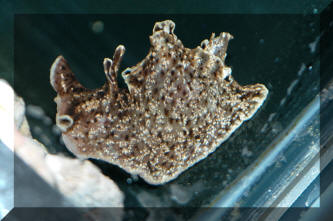
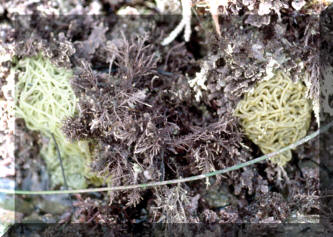
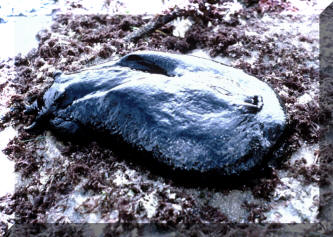
| Aplysia californica, the California Sea
Hare. Found off the two Californias... Baja and the U.S....
coldwater (NOT tropical). To fifteen inches, several pounds. At
right, one being mis-offered as a tropical in a South Carolina
retail store. Below: one off of San Diego, intertidal egg masses
(resemble tangled spaghetti, can be of many colors) and large
individual left high (and moist) with a minus-tide event. http://www.seaslugforum.net/factsheet.cfm?base=aplycali |
|
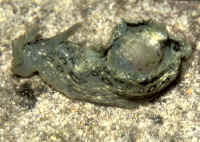
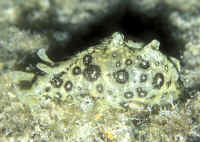
| Aplysia dactylomela, the Spotted Sea Hare.
3-6 inches usually, 12 in. maximum. Shallow to 120 feet in depth.
Worldwide, circum-tropical distribution. Feed on algae. Discharge
purple "ink" if disturbed... may be problematical in
captive conditions. Two photographed at night off of Cozumel. |
|
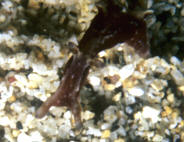
| Petalifera ramosa. To 2 cm. S. Japan to
Indonesia. Usually found on Caulerpa. Here on the substrate in N.
Sulawesi. |
|
Order Cephalaspidea, the
Headshield Slugs: Worldwide, often have shells (often reduced,
internal), often with operculums. Burrowing marine forms mainly that
eat bristleworms, other worms, Foraminiferans, bivalves,
snails. Named for wedge-shaped heads that many use to plow through
the sand, generally living just below its surface.
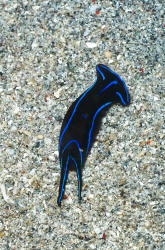
| Chelidonura amoena, E. Indian Ocean
to S. China Sea over to Hawaii. Raja Ampat 08. |
1%20MD.JPG)
|
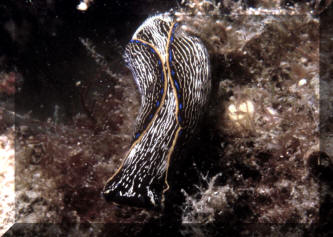
| Chelidonura inermis, the Striped Sea Slug.
San Diego coastal image. |
|
| Chelidonura
inornata Indonesia and trop. Australia. To 4 cm. Raja
Ampat 08. |
%20MD.JPG)
|
| Chelidonura varians Eliot
1903, THE Flatworm Eating Sea Slug!
Tropical Indo-West Pacific. To seven cm. in length. This one off of
Northern Sulawesi, Indonesia. Similar to Philinopsis gardineri,
but with much longer rear projections. |
%20MD.JPG) |
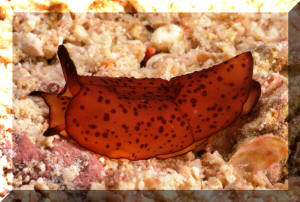
| Philine rubrata Gosliner, 1988. West,
Central Indo-Pacific. To 3.5 mm... yeah, small. Fiji pic. |
|
| Philinopsis gardineri (Eliot 1903). Likely feed on
Polychaete (bristle) worms rather than opisthobranchs. Similar to
Chelidonura varians, but with much shorter rear projections. |
|
| Sagaminopteron psychedelicum. Psychedelic Batwing
Slug. Indo-W. Pacific; incl. Hawaii and Fiji. Bali 2014 |
%20MD.JPG)
|
Family Bullidae: Bubble Snails/Headshield Slugs.
| Bulla striata, the Striate Bubble. Tropical
West Atlantic. 1- 1 1/2" |
|
Order Notospidea: Sidegill
Slugs: May have a shell inside the body, outside, or absent
entirely. The group is named for the location of their large plume-like
feathery gills (between their mantle and foot on the right side of the
body). Nutritionally their grazing carnivores, preying on sponges, sea
squirts and other bottom-dwelling invertebrates, even fishes, with
their large radulas and wide jaws. They are rarely preyed upon due to
the release of self-produced sulfuric acid when bothered.
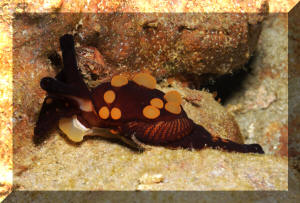
| Berthella martensi Pilsbry 1896, Highly variable in
color, markings. Sponge feeder noted for shedding its mantle in three
pieces. S. Leyte 2013. |
 |
| Pleurobranchus sp. Lembeh Strait 08. |
%20MD.JPG) |
Order Sacoglossa: Sap-Sucking
Slugs: Specialized feeders on algae, mainly seaweeds in shallow
waters (Common name for having a radula of one row of piercing teeth
for suctorial feeding on algae... whose chloroplasts they sometimes
retain and use for solar-powered sources of sugars). Shelled and
shell-less/slug-like. Elysia, Alderia, Berthelina.
| Costasiella kuroshimae,
Kuro Sapsucking Slug. To 7 mm/.25". Indo-West Pacific. Bali 2014 |
%20MD.JPG)
|
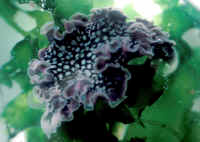
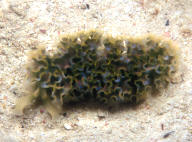
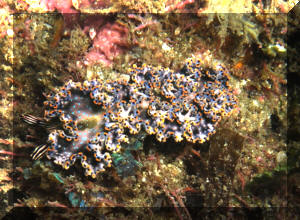
| Elysia (Tridachia) crispata,
the Lettuce Sea Slug (not a Nudibranch), may be brown, green or
yellow in general coloration. Needs live rock, algal growth for
food. Take care to screen pump intakes as this animal is often
sucked into them. To 1 1/2 inches in length. Aquarium and Bonaire
photos. |
|
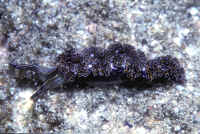
| Elysia diomedea, Mexican Dancer. Bears black
and yellow lines on the frilled parapodial folds. Sea of Cortez to
Panama. To 2 inches in length. This one off of Cabo San
Lucas. |
|
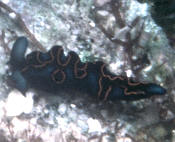
| Elysia expansa. W. Australia, Indonesia. To
3 cm. Here in N. Sulawesi. |
|
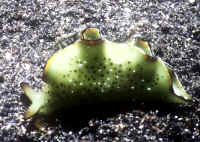
| Elysia ornata (Swainson 1840), known
to science as the Ornate Sap-Sucking Slug. This genus is often sold
to aid in the control of marine aquarium algae overgrowth,
particularly Bryopsis. Much easier to control such outbreaks by
limiting nutrients, providing competitors for light, food, using
more generalized herbivores. To about an inch and a half in
length. |
|
Bigger PIX:
The images in this table are linked
to large (desktop size) copies. Click on "framed" images
to go to the larger size. |
|
MD.JPG)
|
Bigger PIX:
The images in this table are linked
to large (desktop size) copies. Click on "framed" images
to go to the larger size. |
|
%20MD.JPG)
|
Genus Stiliger:
| Stiliger ornatus Ehrenberg 1828. Trop.
Indo-W. Pacific. Bali 2014 |
%20MD.JPG)
|
Genus Thuridilla: 13 species, 11
Indo-Pacific.
| Thuridilla bayeri. Madagascar to
Marshall Islands. Indonesia. To 2 cm. One the size of a
ladybug/bird or eraser head in Raja Ampat. |
%20MD.JPG)
|
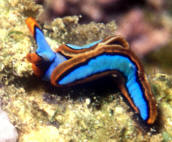
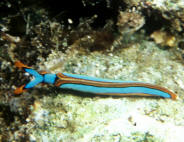
| Thuridilla lineolata. Indonesia. To 2
cm. N. Sulawesi pic. |
|
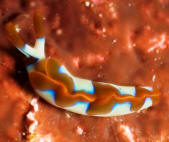
| Thuridilla undula, Gosliner
1995. Blue bodied, with black and orange markings.
S. Sulawesi pic. |
|
| Thuridilla sp. Pemuteran, Bali, Indo. 2014 |
%20MD.JPG)
|
Order
Nudibranchia- Naked-gill sea slugs
Bibliography/Further Information:
The Sea Slug Forum
(great online scientific resource)
South west Indian ocean Seaslug: http://seaslugs.free.fr/index.htm
|
|


%20MD.jpg)
%20MD.JPG)
%20MD.JPG)
%20crispata%20COZ16%20(2)%20MD.JPG)
%20MD.JPG)
%20MD.JPG)
3MD.JPG)