Logo

Wet Web Media is a Reference site and best used with the following tools
Step 1: Search us with Google
Step 2: Enter terms of interest to highlight
Home
Information Pages:
Marine
Aquariums
Freshwater
Aquariums
Planted
Aquariums
Brackish
Systems
Ponds, lakes
& fountains
Turtles &
Amphibians
Aquatic
Business
Aquatic
Science
Features:
Daily FAQs
FW Daily FAQs
SW Pix of the Day
FW Pix of the Day
New On WWM
Helpful Links
Hobbyist Forum
Ask the WWM Crew a Question
Calendars
Search Feature
Admin Index
Cover Images


Related FAQs: Marine Snails 1, Marine Snails 2, Marine Snails 3, Marine Snails 4, Marine Snails 5, Snail ID 1, Snail ID 2, Snail ID 3, Snail ID 4, Snail ID 5, Snail ID 6, Snail ID 7, Snail ID 8, Snail ID 9, Snail ID 10, Snail ID 11, Snail ID 12, Snail ID 13, Snail ID 14, Snail ID 15, Snail ID 16, Snail ID 17, Snail ID 18, Snail ID 19, Snail ID 20, Snail ID 21, Snail ID 22, Snail ID 24, Snail ID 25, Snail ID 26, & Snail Behavior, Snail Selection, Snail Compatibility, Pest Snails (Pyramidellids...), Snail Systems, Snail Feeding, Snail Disease, Snail Reproduction, Snail Reproduction 2, Sea SlugsAbaloneMarine Algae Eaters,

Related Articles: Abalone, Opisthobranchs (Sea Slugs), Nudibranchs, Mollusks, Algae Control, Nutrient Control and Export, 

/The Conscientious Marine Aquarist

The Stomach-Footed Mollusks, Class Gastropoda, Subclass Prosobranchia, Part 1

To: Part 2:

by Bob Fenner

Spotted Cyphoma

The following taxonomic scheme is largely framed after Robert Barnes Invertebrate Zoology 5th Ed., with modifications from http://sn2000.taxonomy.nl/Main/Classification/35476.htm

Snails Commonly (and not) Encountered in the Marine Pet-Fish Interest:

The Class Gastropoda, the Snails: are divided into two Subclasses: Prosobranchia and Opisthobranchia, 

Subclass Prosobranchia: In turn divided into three living Orders: Archaeogastropoda, Mesogastropoda and Neogastropoda. Marine, freshwater and terrestrial. Name refers to the position of the internal organs and mantle cavity; anterior vs. the opisthobranchs where these are located posteriorly in the body. Aquatic species with one or two gills,  Most have a shell and operculum (closeable cover). Most are dioecious (separate sexes). 

Order More primitive forms. Include abalones, limpets, turbans, neritids. Inadvanced species, typically with two bipectinate gills (right one may be reduced or absent), two auricle, two nephridia (osphradium simple, ridgelike). 

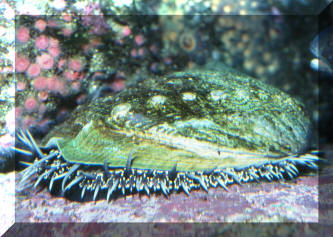
Superfamily Pleurotomariacea: Slit shells and Abalones. Have shells with a notch, slit or openings, and two gills. Pleurotomatia, Perotrochus, Scissurella, Haliotis

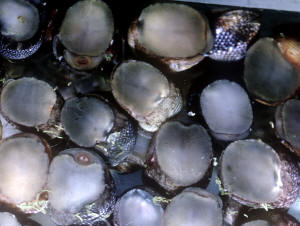
Family Haliotidae, the Abalones

Superfamily Fissuellacea: Keyhole Limpets. Have shells with just one (apical) hole, and two gills. Emarginula, Diodora, Fissurella.

Superfamily Patellacea (Docoglossa): Limpets that lack a hole or notch in their shells. Have a single auricle, single bipectinate gill, secondary gills, or  may have no gills. Acmaea, Collisella, Patelloia, Lottia, Patella, Cellana, Lepeta.

Superfamily Trochaea: Top shells, Turbans, Star shells. Conical shells, possess an operculum, single bipectinate gill. Topshells and Turbans. Genera of note: Astraea, Margarites, Tegula, Trochus, Turbo, Astraea.

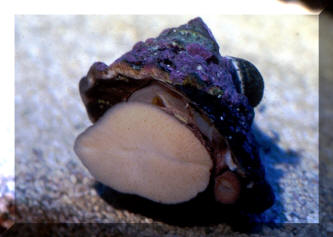
Turbo fluctuosus (at right)

Aquarium favorite as an all-around algae eater. Western Mexico to Peru. 

Superfamily Neritacea: Globose operculate snails. Single nephridium and complex reproductive structures sometimes distances this group from other archaeogastropods by taxonomists, but do have a single bipectinate gill. Nerita, Neritina, Theodoxus, terrestrial Helicinidae. 

Family Neritidae 

Nerita funiculata, Nerites.


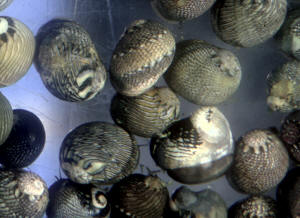
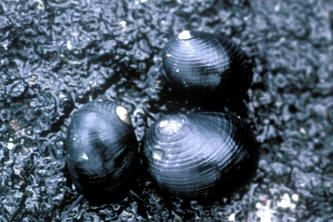
Nerita picea (Recluz 1841), the Black Nerite (Pipipi in Hawaiian). A Hawaiian endemic. To about a half inch in length. Found in the splash zone to high and dry above there (but below Periwinkles), more actively grazing at night. Shiny black globose shells with fine gray spiral lines. 

Order Mesogastropoda: Intermediate Gastropods. Four Superfamilies. Have simple monopectinate gills, one auricle, one nephridium and their osphradia are simple (ridgelike). Have complex reproductive structures (usually a penis). Their radulas (rasping "tongues") are taenioglossate (with seven teeth per transverse row). Principally marine, but many freshwater and terrestrial species as well. 

Superfamilies Cyclophoracea and Vivparacea. All terrestrial, lack gills. Includes the freshwater aquarium snails of the genera Viviparus, Pomacea and Pila

Superfamily Littoinacea: Intertidal Littoinidae; Littorina, Tectarius, Lacuna and terrestrial Pomatiasidae; Pomatias

Superfamily Rissocea: A large grouping of small conical marine, freshwater and terrestrial snails. Hydrobia, Bulimus, Rissoa, Alvania, Cingula.

Superfamily Cerithiacea. Turret Shells, Worms Shells. Marine, freshwater. Have pointed shells, small, generally less than an inch in length. Turritelidae; Turritella. Vermetidae; Vermetus, Serpulorbis, Petaloconchus, Dendropoma. Siliquaridae; Siloquaria, Caecum, Goniobasis, Pleuroceta, Cerithrium, Bittium, Batillaria. 

Ceriths.  Excellent diatom and soft green algae eaters (even some Cyanobacteria). Hardy and long-lived in tropical marine aquariums. Cerithium litteratum shown. 

Superfamily Epitoniacea: Pelagic Violet Snails; Janthina.

Superfamily Eulimacea. Predators, commensals and parasites of echinoderms. Eulima, Stilifer, Entoconcha, Entocolax, Enteroxenos

Superfamily Calyptreacea: Limpet like snails and Slipper shells. Protandrous. Most have a cap-like or limpet like shell. Capulus, Calyptraea, Crepidula. 

Superfamily Cypraecea: Cowries. Spires enclosed in last whorl of shells. Cypraea, Trivia...

Family Cypraeidae: Cowries.

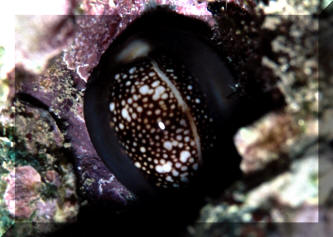
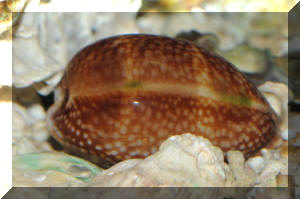
Cypraea species (not all...) Cypraea annulus Linnaeus 1758, the Gold Ringed Cowry (family Cypraeidae). A great animal for reef aquariums with algae to trim! Flattened top with bright golden rim... similar to the Money Cowry (C. moneta). Indian Ocean, Red Sea, to Central Pacific, including Hawai'i's leeward islands and the Cooks. To about half an inch in length. This one in my friend Maurice's tank at home!

Cypraea caputserpentis Linnaeus 1758, the Snakehead Cowry. Indo-Pacific, including Hawai'i. To about an inch and a half in shell length. This one off of Maui, Hawai'i.

Cypraea cervus Linnaeus 1771, the Atlantic or Deer Cowry. Here at the TX State Aq. in Corpus Christi.

Cypraea miliaris Gmelin 1791. If shell is visible it's orangish to yellow with many fine white dots of different sizes. Mantle is brown to blackish, covered with many branchlike papillae. Active at night. West Pacific; Malaysia, Japan, Philippines. N. Sulawesi image. 

Cypraea spadicea, the California Cowry. Cold water tanks only. Aquarium photo.

Verticals (Full/Cover Page Sizes Available)
Cypraea maculifera Schilder 1932, the Reticulated Cowry. Shallow water to fifty feet, in cracks and crevices, usually in caves. Common throughout its range in the Central Pacific. To 2 1/2". This one in Hawaii.

Cypraea tigris Linnaeus 1758, the Tiger Cowry. Too common as a "curio", this is no doubt the best know Cowry (or at least most recognized as a sea animal in the group). South Africa, Red Sea, Hawai'i, Society Islands. To four inches shell length. One off the Gilis, Lombok, Indonesia, another with a flashlight for size comparison where they "come the biggest", off of Hawai'i. 

Egg Cowries, Shuttle Shells, Family Ovulidae:

Cyphoma gibbosum (Linnaeus 1758), the Flamingo Tongue. Tropical West Atlantic. To about an inch in length. Found principally on the Gorgonians Gorgonia flabellum and G. ventalina. Bahamas photos.

Verticals (Full/Cover Page Sizes Available) Linked
Bigger PIX:
The images in this table are linked to large (desktop size) copies. Click on "framed" images to go to the larger size.

 
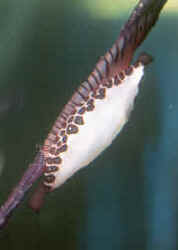
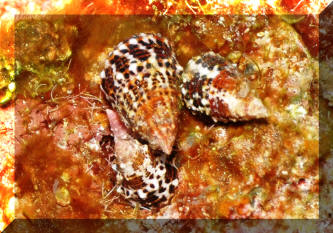
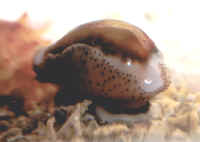
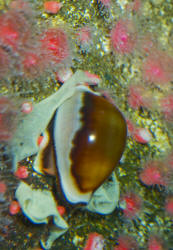
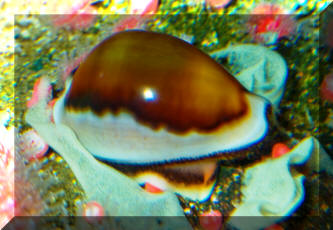
Cyphoma macgintyi , the Spotted Cyphoma (an Allied or Egg Cowries, family Ovulidae, Subclass Prosobranchia, Class Gastropoda...). This delightful small snail discovered at a LFS in San Diego (Fountain's) on a branch of an imported Gorgonian (which they feed on)

Dentiovula dorsuosa (Hinds 1844). Pink markings at either end of their shells. Mantle appears as red colored fingerprint... with short, small papillae. Western Pacific; Indonesia, Malaysia, Japan. N. Sulawesi pic. 

Ovula ovum. N. Queensland, Austr. pic of two. and one eating a soft coral of the family Alcyoniidae in N. Sulawesi.

Verticals (Full/Cover Page Sizes Available)
Phenacovolva rosea (A. Adams 1854). Long (to 50 mm.) reddish shell, with middle white band. Mantle has small brown/black spots, rounded papillae. N. Sulawesi pic feeding on a gorgonian. East Africa to the West Pacific. 

Bigger PIX:
The images in this table are linked to large (desktop size) copies. Click on "framed" images to go to the larger size.

To: Part 2:


Become a Sponsor
Featured Sponsors: