 |
|
| Home | Marine Aquariums |
Freshwater Aquariums |
Planted Aquariums |
Brackish Systems |
Ponds,
lakes & fountains |
Turtles & Amphibians |
Aquatic Business |
Aquatic Science |
Ask the WWM Crew a Question |
| Please visit our Sponsors | ||||
Re: Oodinium? Desperate in Massachusetts! 6/5/12
Sickness... Velvet, no reading 12/23/2009 True Percula Clownfish possibly infected with Amyloodiniumiasis 2/18/09 Dear WWM Crew, <Chad> I bought a pair of True Percula Clownfish four days ago. I have a large QT setup but couldn't use it. I was medicating another fish with Cupramine (copper) for ich and didn't want to subject my new clowns to the medication. Normally I would've held off on the clowns but I'd been looking for a pair like this for a very long time. I felt the safest place to put them was the refugium. In hindsight I should've set up another QT. They both looked good at the store, the male ate right away, the female was a bit more hesitant but did eventually eat. Over the last few days in the fuge, the female has eaten but the male has not. They've been acting relatively normal save for their breathing. The male's been breathing rapidly the entire time. The female's been breathing rapidly as well but not quite as bad as the male. I also noticed that their gills seem to be puffed out a bit. Like they're swollen. I've noticed no lesions on their bodies, no white spots, no mucus. At first glance they look perfectly normal and healthy. They haven't been hanging out near the surface and have not tried to scratch themselves on anything. After some research I realized however that I may have a case of Oodinium on my hands. <Mmm, doubtful on two counts... these fishes would be dead, and the rest of the fish in the system afflicted> I immediately set up a hospital tank and treated them with the recommended amount of Cupramine. <... won't treat what they likely have> I realize copper is not a very good medication for Oodinium but It's the only medication I had on hand. I'm also not 100% sure they're infected with Oodinium. <I'm almost positive it's not> I've noticed some stringy poop coming from the female. Could this be a sign of an internal parasite? <Mmm, yes> For now my clowns are in a 21 gallon hospital tank with a powerhead and a heater. I don't have a small HOB filter so I'll be doing 50% water changes every few days. My question to you is this. Do you think I'm dealing with Oodinium? <... no> If so, you recommend freshwater dips and formalin correct? <Is one approach> I have three fish in my display tank that are very dear to me. Do you think it's possible that I took the infected fish out before the Oodinium had a chance top jump off and infect the tank? <Over days time? No... t'were this Amyloodinium, your fishes would likely be all dead> I'm guessing time will tell on that one. Should I observe the clowns in copper for a few days? Just wait it out? Should I begin freshwater dips and Formalin? <Mmm, no, no, and something else> I really want to avoid killing my fish with the cure if you know what I mean. Some info regarding my system: 225 gallon reef (about 3 months old) 75 gallon sump/fuge ammonia = 0 Nitrites = 0 Nitrates = 0 PH = 8.2 - 8.3 Phosphates = 0 CA = 410 Mg = 1250 KH = 8 Any help would be greatly appreciated. Regards, Chad <Please start reading here: http://wetwebmedia.com/brooklynfaqs.htm and the linked files above. Bob Fenner> Re: True Percula Clownfish possibly infected with
Amyloodiniumiasis 2/18/09 Interesting, Brook was my first
thought but I didn't see the tell tale white mucus coating.
Unfortunately both clowns perished last night. The stress of the move
to the hospital tank coupled with the copper treatment must've sped
up the process. <Agreed> Cupramine recommends half concentration
for the first two days, I guess it was still too much. <Yes...
Clownfishes and other close invertebrate symbionts are often housed in
retail, wholesale and collecting stations apart from other fishes (with
invertebrates) to avoid copper exposure period. They are quite
sensitive to it> Without proper intervention on my part I feel these
clowns were doomed from the start. <Might I ask... were they
wild-collected, or likely, at least housed in water, a system confluent
with wild-collected Amphiprionines?> I'm relieved that you
don't think it's Velvet. I lost sleep worrying about my other
fish. This close call has strengthened my resolve to QT EVERY new
arrival. <Ah yes> There's nothing like coming close to a loss
to make you realize how important something is to you.
<Unfortunately so> In this case a 7" Blonde Naso Tang with
3" streamers, a Yellow and a Purple Tang that hang out with each
other and do not fight. Thank You Mr. Fenner! Regards, Chad
Amyloodinium/Cryptocaryon, microscopic ID 11/20/2008 Hi all! <Mariusz> I've had a break out of Amyloodinium or crypt in both my quarantine tanks. Quarantine tank 1 with 2 clowns (died) had symptoms of Amyloodinium (powdery dust). Quarantine tank 2 has brown powder brown tang and a strawberry dotty but with symptoms of crypt (salt like dots). I've taken wet smears of the fish from both tanks. Both showed the same parasites microscopically. Tank 2 all the fish behaving normally (looks like crypt), Tank 1 all dead (looked like Amyloodinium). My question is that I'm have a tough time differentiating Amyloodinium and crypt under the microscope. I've looked at images in P.T.K Woo's book (Fish Diseases and disorders vol. 1, 2nd edition) of Amyloodinium tomonts. I see structures that resemble single Amyloodinium tomonts of various sizes, huge to small. Then I also see something very similar to these tomonts but if you look carefully they have very small active cilia. <This last may be spurious> I figure I may have both Amyloodinium and crypt. Also these samples have copper in them but from what I understand copper doesn't effect tomonts of Amyloodinium or crypt. <Usually not... unless very high dosage/concentration...> So my confusion is ciliated versions and non-ciliated version of 2 very similar things, i.e. what is what? <I would look for two (macro, micro) nuclei here for the Ciliate... the Dinoflagellate is easily stained with iodine...> Part of me thinks the ciliated versions are crypt tomonts and non-ciliated are crypt tomonts that are mature and no longer have cilia and have tomites dividing. With all these things that look so similar how am I to differentiate what is Amyloodinium or Cryptocaryon microscopically from smears/wet mounts? <The above is what I use... Do look for a copy of Ed Noga's "Fish Disease, Diagnosis & Treatment" for more here> oh forgot there are red dots in some (not all) of these tomont looking things. <Mmm, the dinospores of Amyloodinium have red stigma...> Can wait to get my camera for the scope...this would be so much easier you think?...lol Thanks again!
Amyloodinium problems I discovered I had Amyloodinium in my tank on December 13th. I was able to confirm this by looking at some scrapings from gills, scales and fins of two fish that died recently (one frozen and one not). I checked these under my microscope and verified it with microscope photos I found online. Other symptoms included: - labored breathing - cloudy eyes - loss of colour - tiny powdery spots - refusing food - blood streaks and/or splotches Some unusual behavior I observed: - listlessness, hovering weakly in one spot, usually near the surface - flashing, flicking, scratching on the substrate - hovering in the direct flow of one of the pumps I read everything on Wetwebmedia, and several other sites, about Amyloodinium and decided I needed to act quickly. I lost 5 fish in a very short time but still have 7 left. Dead are: - 5" Pakistani butterfly (I suspect this is the fish that brought it to my tank) - 3" Red Sea Chevron butterfly - 3" Red Sea Raccoon butterfly - 7" Male Squarespot Anthias - 1" Emperor Angel *sob* On December 15th I removed the 7 remaining fish from the 300g tank and put them in a 75g hospital tank with the following: - bare bottom, no rock or sand - plastic and resin hiding places - huge Eheim canister filter filled with porcelain and ceramic biomedia (rings, balls, etc. - running since last August) - air curtain with large air pump - Maxijet 1200 powerhead - temp 84F (I read that this would speed up the lifecycle of the parasite) - SG 1.018 (I read that this would be better for the fish, I normally keep my tanks at 1.026) - pH 8.0 (I have had to add Kalkwasser once a day to keep it up. Does Cupramine lower pH?) - lab grade filtered natural seawater (I use nothing but in all my tanks with RO/DI for top off) All fish had a freshwater dip on their way to the hospital tank. Dip time depended on how each fish was tolerating it, minimum of 4 minutes, maximum of 8 minutes. I am treating the hospital tank with Cupramine (copper) and keeping it at a level of 0.5 and testing twice a day to be sure it stays there. <That is kind of high if the level is PPM.> These are the fish in the hospital tank and their condition: 6" Copperband butterfly - Excellent, I've had this fish for years, raised it from a 1" baby, she didn't show any symptoms at any point. 5" Golden butterfly - So this guy did have some powder on him, some blood streaks and rapid breathing. He's much better now and is eating well. The freshwater dip really seemed to help him. There are still some very faint red streaks but his breathing is good and I don't see any powder spots. He wasn't eating much before the dip but his appetite is back to normal now. 3" Longnose butterfly - Excellent. I haven't had this fish long but he didn't show any symptoms. 2" cleaner wrasse - Very good now but was going downhill before the dip. He is eating but hides a lot more than he used to, could just be the new surroundings though. Is eating well but not quite as much as he used to in the large tank, he was a real pig. 2" cherub angel - Good now but has either major slime coat damage or could be scale damage. Odd sheen to body overall but not really the powder spots, just not quite right. No colour loss. Is eating well. 2" royal Gramma - Seems to be coming around, I thought I was going to lose this one. Has some clouding in the eyes still and one looks a bit protruded but the fish is eating and the eyes seem to be improving. Is eating small amounts. 2" Lubbock's fairy wrasse - This fish wasn't showing symptoms before the dip but really didn't tolerate it very well and is quite stressed in the new tank. Hiding almost constantly but today she's coming out for short periods and has started eating again. I don't see any Oodinium symptoms though. I did a 30g water change on the 75g hospital tank yesterday (3rd day) siphoning the bottom well while doing it to hopefully get as many of the parasites in the tomont stage as possible and plan to continue to do this while they are in the tank. QUESTIONS - Is there anything you would recommend I do in addition to this or perhaps instead of what I am doing? I really want to give my fish the best possible chance of surviving this parasite without doing too much damage with the copper. <Do not freshwater dip the wrasses again. They are very sensitive to freshwater dips. Make sure you are not over dosing with copper. That too can be a problem.> I'm also concerned about getting all the parasites out of the big 300g tank. I am not treating it with anything but I have the temperature up to 84F and I'm hoping that if I leave the tank fallow long enough with the UV sterilizer that I can starve out the parasite. <That will take 6 to 8 weeks.> 300g Equipment: 300g (8'x2'x2.5') Tenecor Acrylic tank 6' LifeReef Protein Skimmer 40W Rainbow LifeGuard UV Sterilizer 350 Magnum canister filter with micron cartridge only (runs the UV Sterilizer) VHO Lighting 2 Tunze Stream pumps (model 6100, pushes 3100 gph each) Livestock: The system was setup mainly for butterflyfish. It's not what I would consider a reef tank but I do have a number of inverts, this is what's in the tank now: 300lbs Fiji liverock 300lbs CaribSea sugar fine sand (approx. 3" deep) 4" blue reef lobster 2 cleaner shrimp 1 coral banded shrimp 40 Baja cerith snails 20 Nassarius snails 5 large turbo snails 5 small margarita snails 2 emerald crabs 2 strawberry conchs 1 long Spined Diadema urchin 1 pincushion urchin assorted mushrooms & Ricordea green tree coral button polyps and Zoanthids anthelia yellow polyps QUESTIONS - Is there anything else I should be doing?<No, I think you are O.K.> Or something I shouldn't be doing? Are water changes beneficial at this point?<As long as the water warrants a water change.> How long would you recommend I leave this tank fishless to be sure all the Oodinium parasites are gone?<6-8 weeks.> I REALLY don't want to do this again. Here's the kicker. I have a 20g quarantine tank that has been set up for over 2 years. I didn't use it because I have a baby volitans lionfish in there while I'm trying to teach him to eat frozen foods. Unfortunately this lionfish may prove to be even more stubborn than myself and it's taking forever. The 75g that I'm using as a hospital tank was meant to be his permanent home. This has been a very hard lesson - I can assure you I will not be skipping the quarantine procedure EVER again. Any suggestions would be greatly appreciated. Susan <Susan, you are doing everything correct and you know your mistakes. You will be fine and hopefully your fish will come around. Put the live food for your lion fish on a feeding stick. The fish will get used to the stick and recognize that the stick means food. Then change the food on the stick to frozen food or krill. This will take some time but it has worked for me every time. good luck. MikeB> Amyloodinium - need advice Thanks Mike, I really appreciate your taking the time to reply. At a time like this I want to be sure I'm doing all I can for my fishy friends. The copper I'm using is Cupramine by SeaChem. 0.5 mg/L is the recommended dosage: http://www.seachem.com/products/product_pages/Cupramine.html Thanks so much for the advice for weaning the lionfish onto frozen food. That's about the only thing I haven't tried! Now I just need to figure out how to get a live ghost shrimp onto a feeding stick :) The lionfish is a baby volitans, about 3" long. Susan <Susan, I am glad to help and the copper dosage is right now that we have the units. As far as feeding the baby lion I would take this route. Buy some rigid airline tubing (the kind for an undergravel filter) and wedge a paperclip inside it to make it like a spear. I would then try and use rosy minnow or the ghost shrimp. It won't be easy at first but it will work. The one thing you want to absolutely do is to make sure the paperclip is strongly secured (so the fish doesn't pull it out or eat it). Good Luck. MikeB.> Marine velvet Bob, I have discovered that I definitely have
marine velvet in my system. This is a mature system with a static
population of soft and hard corals, live rock, inverts and fish. The
only source I can think of was a pre-used (still damp powerhead from
another aquarist's tank?) as there have been no other additions.
<Bummer> Anyhow, I love my fish/tank dearly but I have a family
crisis at the moment with my mother in the end stages of cancer, and
this tank is in her bedroom in our home. I cannot then really break it
down/cause too much disruption. Can I achieve a long-term result for my
fish by removing all fish to quarantine tank and treat there with
freshwater dips and medication leave live rock in place in main tank
and raise temperature and lower salinity? What can I do with my
shrimps/snails? There appears to be velvet on my blood shrimp.
<What? No... this is something else> I think if I have understood
correctly, that salinity/treatments could harm them. <Yes> Would
this combined approach avoid me having to break down the system. I am
truly struggling at the moment. I can leave main tank fallow for as
long as it takes. Appreciate your time and efforts. If I have missed
what you have previously explained on-site, please excuse me as I am
all sixes and sevens at present. Jackie <Mmm, I would NOT panic...
take your time here... please explain to me exactly what leads you to
believe your first sentence above... Symptoms? Appearances? Do NOT add
anything to the water, do NOT change the environment at this point.
Only fishes are affected by Amyloodinium, NOT invertebrates. Bob
Fenner> Re: marine velvet Thanks Bob, for your patience ( I have flapped a bit!!!!!) <Happens> I am now in process of trapping/dipping each fish in freshwater dip, putting them in a quarantine tank. Last questions: should I treat them with anything? I have asked chemist to get Meth blue ASAP. I was given Hex-a-Mit (Metronidazole) antibiotics but didn't want to be hasty. <Mmm, I would NOT use Metronidazole/Flagyl to treat Velvet... Copper compounds... better with formalin... as detailed on WWM> Can I put shrimps in with fish (wouldn't have meds in quarantine tank)? Should I remove snails? <Invertebrates need to be kept separate from the fish, treatment system> As I cannot break down tank, in relation to Mum's condition, how long could I leave main tank fallow to cure this problem from the system? <At least a month> Thanks for this. I have learned a valuable lesson re: not just quarantining livestock but the importance of not putting hardware such as powerheads in without letting them stand fallow. Many Thanks, Jackie <Steady on my friend. Bob Fenner> Crushing Velvet...(Amyloodinium) Dear Crew of WWM, <Scott F. at the helm tonight, Captain> Thanks for the invaluable advice from the individual FAQs! They're fantastic! <We have as much fun bringing this to you as I hope you have reading it!> Here's a question regarding fish disease. I flipped through the disease section of WWM and several other books and couldn't find any pictures like the one I attached. The Emperor belongs to my friend. He claims that in the morning, his Emperor had these whitish blotches and by evening, it was lying on its side. He claims that the fish was desperately gasping till its death. <Well, this sounds (and looks, from your picture) like the symptoms of Marine Velvet (Amyloodinium). The gasping, blemished skin, and listlessness are classic symptoms. The blotched appearance of the fish's skin is essentially the spots on this fish where the tissue has been liquefied by the parasites...You don't always see the "dusting" of the parasites themselves (They are really too small to see individually). Most of the time, you only see the collateral damage...> I am particularly concerned, as I have had a French Angel, unquarantined (my bad, my bad) that had similar symptoms - pale skin (as though the skin was peeling off) and gasping. The French died and its tank mates - Multicolour angel, flame hawk etc... died within the next 2 days of the same symptoms. <Yep...that sounds a lot like Amyloodinium...It presents all of the symptoms that you described, and kills with horrifying rapidity if left unchecked...A nasty disease...> Question: What is what is this strange disease that acts so quickly and fatally? I thought it was velvet initially, but I did not see discrete nodules on the fish, neither did it seem like a light dusting... it was just blotches of whiteness all over the fish. Fins were slightly tattered at the edges too. <Again- it sounds like Amyloodinium to me...Just think "collateral damage"...> Is there any cure for this disease? As a desperate attempt, I advised that my friend isolate the fish and give it a pH adjusted FW dip as there was no time to get medications of any sort. It didn't help apparently... Thank you very much! <Well, the FW dip may provide some relief, but once the disease advances, and the damage really starts to become evident, you need to get aggressive...Copper sulphate is really the best way to treat this disease, IMO. And- the display tank just HAS to be left fallow for a month or so...This disease is SO contagious, and so virulent, that you need to follow through on this technique...Action must be taken immediately upon diagnosing the illness...Hours can literally mean the difference between life and death...No garlic, no hyposalinity (at least, not as a "stand alone" remedy)...this is one disease where I am confident in the use of copper sulphate as the way to go. I'd always keep a supply on hand, along with a good copper test kit...Best of luck to you in your counter-attack efforts...Regards, Scott F> Attacking Amyloodinium! I wanted to let you know that today I noticed something different - erosion of his gills. I did some more searching around and found that he might be suffering from Oodinium. The description seemed to fit - loss of appetite, uncoordinated movements, darting movements, respiratory distress as the gills are targeted. <Sounds like it...> I inspected him again at night with a flashlight (as recommended to be the best viewing time of these parasites), and did not see any white spots. Although, I suppose it's a good thing considering this is a more progressed stage of the disease. <Usually, you'll see lots of mucous, and obvious tissue damage caused by the parasites as they liquefy the infected fish's tissues...Seeing the actual parasites themselves is unlikely...You're looking for the "collateral damage"> I have CopperSafe, but am leery of using it after learning of the side effects. I thought I would use Metronidazole or quinine hydrochloride. What about Revive? Additionally, should I use Maracyn-two? Please advise. Thank you so much! <Frankly, I'd use the CopperSafe. If you follow the directions to the letter (as you should with any medication), and test for copper concentration, you should enjoy success. Metronidazole may also work...but I favor copper. The Maracyn is an antibiotic, and really should only be used if you experience a secondary infection after defeating the Amyloodinium. Alas, be sure to run the main system fallow for a month or so, just as you would for Cryptocaryon...This is a much more virulent and contagious disease than Cryptocaryon, but it can be effectively treated if you act quickly...Good luck! Regards, Scott F> Crushing Velvet! Hi Guys <Hi there! Scott F. with you today!> Writing to you from South Africa <Glad to hear from you!> This is the first time that I am actually writing to you, I have been visiting the website everyday and I have gained a world of knowledge from the questions and answers. <Glad to hear that you enjoy the site! It's a lot of fun for all of us!> I am not new to the hobby and have been keeping marine's (fish & inverts) for 10 years, Here is my problem. I have a 1000 Gallon Reef tank, this tank is my pride and joy and I almost love it as much as I love my wife (I'm lying- "maybe a bit more") <Hope she doesn't read that! LOL> It contains various inverts, too many to mention and various fish species. All has been going well, water parameters excellent "I have a filter system that friend at Sea World - South Africa designed and that most aquarist only dream of, but this morning I noticed that some of the clown fish and angels have what looks to me like marine velvet , I have no idea what to do as their is no way in hell that I would be able to catch these fish in the reef, I have no idea what caused the sudden illness. These are the symptoms please confirm if you agree with me on the type of disease as well as what possibilities there are in curing them without having to rip apart a reef that has been like this for a good couple of years: Rapid gill movement <Yep> Cloudy eyes <Possibly> Body looks slimy <Yep> Eyes bulging <Could be a secondary infection> Scratching on rock and coral sand <Yep> I would really appreciate your help , I have never had to deal with sick fish in this reef before, I did it the good old way Let mother nature take its coarse and up to now I have been really successful and have not lost a lot of fish, I hate medication but I have had these guys for a few years and they are like part of the family I do not want to loose them "HELP" <Okay- here is my thinking: It really does sound a lot like Amyloodinium ("Velvet"), which is an incredibly contagious and lethal disease...It can and will kill rapidly if left unchecked. Regrettably, I cannot, in all honesty, recommend a course of action that does not involve removing all of the fish to a separate tank for treatment. Even the so-called "reef safe" medications are dangerous and unreliable here...The best course of action (in terms of success, IMO) is to remove all fishes to a separate aquarium for treatment with a legitimate over-the-counter medication. Meanwhile, the main tank would run fallow, without fishes, for a month or so. This disease is much more difficult to attack than ich, and it is very tough to eradicate without letting the system run without host fishes...As much as it pains me to recommend tearing apart the tank to get to the fishes, I just don't see another way that is more reliable. Medicating the tank would be an absolute mistake, IMO...I know this sucks, but I really believe it to be the way to go here...> P.S. I would recommend your site to anybody interested the hobby, They need not look further for good advice. Regards, Robert <Well, Robert. I hope that things take a turn for the better. This is an agonizing problem...You can prevail, but it won't be fun for a while... Good luck! Regards, Scott F> More Velvet Blues >Hey Bob, >>Wrong Bob, you've got Marina tonight. >Hope the holidays were parasite free for you. >>Indeed. >I myself on the other hand believe I have some nasty parasites in my tank. >>Not good. >Clowns and Damsels appear to be coated with little spots that look like sugar. -rapid breathing -scratching -hanging out near top of tank >>You sure make it sound like velvet - you'll need to act FAST. >I have my 20 QT tank running a cycle ( I cycled with live sand, bacteria, and the old filter pads from main tank) >>Cycling is a moot point when medicating, especially for something such a velvet. Handle nitrogenous wastes by water changes. >-Ammonia is .5 ppm and nitrates are 15ppm (On way down. Was at 1 for ammonia and 20 ppm for nitrates). I am waiting for the levels to go down before I quarantine. Do not want to take the fish from parasite tank to ammonia tank. >>You wait they die. The bacteria are going to die during medicating anyway. Search our site on "velvet" for treatment options - they would include hyposalinity and freshwater dipping, copper and/or formalin treatments. >Anything to speed up this process??? >>Treat your fish ASAP! >Or in theory could I just do a water change from main tank to QT tank. >>No. You're re-infecting the q/t with the velvet parasites. This creature is VIRULENT, and not at all easy to eradicate. >I think this would defeat the process of a QT tank though in this case considering the disease is in the main tank. >>You think correctly. >My plan for you to comment on (Once QT tank is ready) -Remove all fish from main tank >>Check.. -Freshwater bathe fish >>Check.. -Add fish to QT tank >>Check.. -Add copper treatment to QT tank (SeaCure) >>Cupramine is my choice, otherwise, check.. -Continue to perform routine maintenance (water changes) on both tanks >>You left out the hyposalinity for the treatment tank. Otherwise, check.. -After 60 Days return bathe fish (freshwater) and return to main tank. >>Check. Questions: Background - In main 55 gallon tank I will have -Live Rock -Cleaner, Blood, Coral Shrimp >>If coral banded, do watch these for aggression towards the Lysmata spp. -Emerald Crabs -Sifter Starfish -Arrow Crab -Snails -Colony Polyp, mushroom coral, yellow polyp (Fiji Coral) >>You sure you're comfy with an arrow AND an emerald? Search on Mithrax/emerald crabs as well as arrows to be sure you want these in a reef system. Both known troublemakers. 1. From what I read I can increase temp to say 80 degrees to speed up life cycle of parasites. Is this bad for main tank inhabitants? >>They should be fine. Don't use hypo in any system with the inverts. (Hypo for the fish would be 1.010 - 1.007.) 2. Do I apply copper just once to QT tank? >>Follow the manufacturer's directions and test to ensure maintenance of proper levels. You WILL need to correct dosage post water change! The easiest way to do this for some folks is to add copper to the make up water, test and match levels. >My assumption is my water changes to QT tank will dilute copper treatment >>Yep. >3. Should I add some Amquel to QT tank to help control levels? >>I wouldn't. I strongly advocate using water changes to eliminate nitrogenous wastes. >Thanks for your help. Hope this works. Or please stop me if I am making big error in plan. Cheers -CPN >>See above, and do search our site ASAP to work out your plan of attack, it needs to be quick, my friend. Marina Possible Velvet Problem Bob, I think I may be having a problem and I think it is marine velvet. I have a six line wrasse, a dragon wrasse, a blue angel, a tomato clown, and a Foxface. All have been doing fine and all my parameters for water quality are good. What I have been noticing though for a while is very small white spots on my blue angel and tomato clown. When I first noticed this I thought it might be ich but I thought the spots looked too small and they had disappeared by the end of the day. This went on for some time. I would notice the fish would have spots in the morning but they would be gone by the time I came home from work in the afternoon. I initially thought that the white spots in the morning might just be sand sticking to the fish when they slept at night. They all lay on the bottom at night so this seemed to make sense especially when the spots were gone by the afternoon. It has been about a month now though and I have noticed that my blue angel has started scratching himself against the rocks and seems to be breathing a little faster. He occasionally has fits where he seems to spaz out as if something is really bothering him. My tomato clown has started to get cloudy eyes and he skin is started to look gray as if his color has faded or been rubbed off. At this point I figured something must really be wrong so I took the blue angel and the tomato clown out of my main tank, gave them a freshwater dip, and put them in my hospital tank. I have since treated them with CopperSafe. They both seem to be doing fine although I occasionally see the angel scratching himself. The clown doesn't seem to have that gray color anymore. His eyes seem to have cleared up too. The rest of my fish in my main tank seem to be unaffected. All the fish have been eating well and the angel and the clown have always eaten well and still continue to have good appetites. This morning however, both the angel and the clown had a lot of white spots on the similar to the ones they used to get in my main tank except there is no sand bottom in my hospital tank and they didn't have the spots yesterday. Are the having some sort of outbreak of ich or something in the hospital tank? <Maybe... the report you render did/does sound like velvet/Amyloodiniumiasis in the first... but you may well have both parasites here> Are they having some reaction to the copper? <Doubtful that this is the cause of the latter white spots...> The copper level is good. What else can I do to treat these fish and is there anything I can do to make sure that my main tank is clear of all remaining parasites if there are any. <Environmental manipulation in the main and quarantine/hospital systems for sure... and the use of purposeful non-obligate cleaners when the copper is no longer in use... See the marine parasite pieces, FAQs and links posted on the www.wetwebmedia.com site... there's a bunch there, so do take your time> I am worried that the only reason my wrasses aren't affected is because they may be more resistant or something. <Yes, very astute> My main tank is 125 gallons with plenty of live rock and a couple of mushrooms and polyps. I would appreciate any help or advice you can give me on this. Thanks, Gianluca <Do read over the WWM site my friend. And don't despair. Your fishes salvation is in your hands and you have the ability to reason this through and cure your system. Bob Fenner> Possible Oodinium Hello again Robert, Thank you for your last
e-mail concerning lighting. I decided to get the 130 watt fixture for
my 80 gallon tank and add it to the 70 watts I already have. The lights
should be here on Tuesday! Once I get it I am going to add some macro
algae from my smaller tank. <Sounds like a plan> Now I have
another concern / problem. When I first set up my 80 gallon tank, I had
a bad case of Oodinium which killed most of my fish. I have not had any
problems with it for several months now (since March). Well, yesterday
I noticed some of the fish breathing kind of heavy, and one of my
Sharpnose puffers scratched a few times. I have not seen him scratch
since, and he is not breathing heavily, but the other Sharpnose puffer
does seem to be breathing heavy, and my gobies look like they are
breathing a little bit heavier than usual as well. Is there something
else other than Oodinium that would cause them to breath heavy? What
should I do? <A few things... maybe "biological" as in
infectious, parasitic... but maybe just dissolved gas related... do
increase water movement if you can... perhaps add an airstone...
execute a water change, removing some water from the surface (the
little aerosol, oils from cooking, what have you inside homes/offices
can play the devil here...> The water parameters are great (ammo 0,
nitrites 0, pH 8.1, nitrates about 15, I don't have a phosphate or
calcium test kit). The temperature in the tank has been pretty high
lately (84 or 85). <Ah hah! A likely clue... elevated temperatures
reduce gas solubility, and increase metabolic rates...> The
tankmates are two Sharpnose puffers, 3 gobies (1 scissor tail, and 2 of
the one that have the yellow heads and blue cheeks and sift sand), 2
blue damsels, a maroon clown, a yellow tang, a mono, a chocolate chip
star fish, and one huge turbo snail (that only comes out at night).
There is 60 lbs of live rock in the tank. <Look to reducing
temperature in the meanwhile... turn lights off, float a bag of ice...
set up a fan to blow across the tank surface (careful here those gobies
can/will jump out)... and add an airstone, pump...> Thanks again for
all of your help! Jim Moss <You're welcome my friend. Bob
Fenner> Marine velvet? Bob, Sorry to keep pestering you, but a couple of months ago I wrote to you about a problem I was having with a new reef tank: 75 gal with 100# of Fiji LR. I had lost all of my fish: mandarin goby, 2 Firefish gobies, Kole eye tank, bicolor blenny. At first I thought it was due to gas bubble disease, but have ruled this out. I now think it was caused by Amyloodinium - velvet. The symptoms were: light white powdery dusting (not the 'salt grain' ich - I've seen that), with occasional 'bursts and dashing' and rapid breathing by the afflicted fish. Then, at the end, a sudden loss of body mass (in a day) with an almost fuzzy white dust covering of the fish and lethargic behavior (sit at bottom panting). The disease just 'appeared' two mo.s after initial tank set up (all fish were fresh water dipped with methyl blue for 10 min, but alas, no quarantine prior to being added to the main tank). <Does sound like Velvet... good description> Anyway, all my SPS, leather, LPS corals are doing fine, and so are my 2 bubble anemones. And I have one fish - an Australian clown - that was never affected. Is it possible that this fish was immune, or have I misdiagnosed my problem? <It is possible the clown was unaffected. Again, I do agree with your diagnosis> Could the anemone have given it immunity by eating the velvet before it could attach/damage the clown's gills/scales? <Hmm, yes... in a manner of speaking.> The clown is completely invisible 90% of the time due to the anemone's tentacles - it truly buries itself, but does come out to feed and peek out occasionally. Anyway, my tank has been fish-free for 2 mo.s (except for the unaffected clown). Would it be wise to start adding fish (after FW dip with Methyl blue, and 2 wk quarantine) if I also put a 25 watt CSL U2 UV sterilizer on the main tank (for 2 wks prior to adding the new fish)? <After this period of time, you will have gotten about as much benefit as you're going to get from not having other fish/hosts present... I would definitely quarantine or at least dip/bathe new fish livestock... and do assure me you have biological cleaners in place already.> I'm not sure if the UV is enough to give the fish a chance, or if the 2 months of being fish-free (except for my 'unharmed' clown) would have allowed the velvet to die out. <Both definitely "help"> Should I remove the clown from the main tank, and let the tank stay fish-free and on a UV for a couple of months before trying to add new fish? <This would help as well...> Any other recommendations? <The dips and cleaners: http://wetwebmedia.com/clnrfaqs.htm> Thanks! <Thank you for the follow-up... Be chatting my friend. Bob Fenner> Velvet pics hello again bob, I have a 5inch imperator and I'm suspecting that it has velvet. its eyes are beginning to cloud a bit but now much, skin has white smudges( not visible sideways, like painted on) on the other side... its not scratching, is eating very well. it seems that its the only fish affected in the aquarium. my emperor killed my bicolor and keyhole. I never really see some serious aggression when I'm viewing the tank but I think he's the suspect. what I really want to make sure is 1 how to diagnose velvet <See our site re Marine Diseases (www.WetWebMedia.com)> 2 do you have pics? <yes, there> 3 is it fatal? <Can be, easily> 4 treatment 1,2,3 I seem to have not found these on your website... can you fill me in on these? thanks bob <Time to go back... perhaps use the "Google Search" tool there. Bob Fenner> Marine velvet Hi Bob, Great web site, it's very informative and ideal for a newbie to keeping a reef aquarium. <Ahh, great to hear, thank you.> My tank has been up and running for 8 weeks and all water parameters are spot on. I have been gradually introducing some live rock, no fish so far but I have added some turbo snails, bumble bee snails and a blue legged hermit. Recently I have begun to notice some white spots on the aquarium glass, they seem to be oval shaped with a small tails, they are less than 1mm in size. I'm just a little concerned that these are velvet parasites as they seem to fit the description on your website although I have no fish in the tank. What do you think? Could they be velvet parasites and will they die off without a fish for a host or I'm I worrying about something harmless. <Nothing to worry about... very likely a transient form of worms, possibly crustaceans or mollusks... will pass with the aging, development of your system... not a problem> Any advice much appreciated Regards, Chris Young <Be chatting my friend. Bob Fenner> |
|

|
Features: |
|
| Featured Sponsors: |
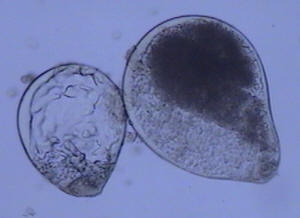
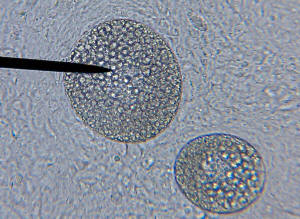
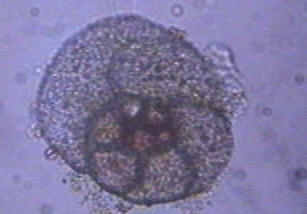 Foram most
likely
Foram most
likely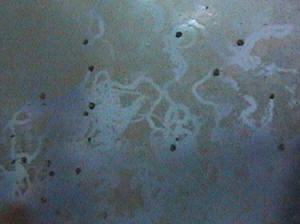 Got me...