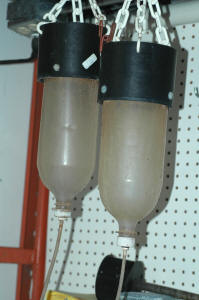
|
|
| Home | Marine Aquariums |
Freshwater Aquariums |
Planted Aquariums |
Brackish Systems |
Ponds,
lakes & fountains |
Turtles & Amphibians |
Aquatic Business |
Aquatic Science |
Ask the WWM Crew a Question |
| Please visit our Sponsors | ||||
Brine shrimp... as a strict diet for Bettas, Corydoras
3/20/16 Baby Banggai Cardinal & Clowns ; Artemia poss. 4/10/12Hello, We have become accidental fish breeders. We have been doing ok for the most part. Our first batch of babies was discovered 12/1/2013. There were 11. We put them in a separate nursery until they started eating frozen food. We only lost one during that transition. All along some of them would swim or kind of bounce at a 45° angle instead of swimming straight. Now there are two left that do that. One actually got beat up so I moved him back to the nursery with our second batch of babies. I did not think he would make it, but its been a month and he is healed up. However, he now bounces vertically. Pretty much all the time. The other guy in with the bigger tank is still at 45°. I was resolved to thinking they were my special needs fish as everything seems normal with both of them. <Neurological?... perhaps poor development (lack of essential nutrient/s), foods/feeding related> Today I bought 2 baby clowns. LFS said they were about 8 weeks and 5 weeks. I fell in love with them and figured I'm already hatching brine for my babies, why not? They swam normally at the store. They swam normally when I got them in the nursery. They swam normally when eating and seem to get along just fine with the baby cardinals. But before bed we noticed the little guy was swimming more vertically. <Does happen; and very likely related to Artemia being used... shells, gas inside the fish... Switch foods; now> Not exactly like the cardinal but its making me worry. The other babies are all swimming normally. My husband said that brine eggs and shells can constipate fish. <This is so> Would that make them swim weird? Could they live for a month constipated? What would make them swim at a 45° angle? <Yes, yes, and yes> What else should I be looking for? Any answers or guidance you can give is greatly appreciated! Heather Sent from my NOOK <You may want to search, read on WWM re the use of Epsom Salt (MgSO4)... Otherwise; discontinue the use of Artemia. Bob Fenner>
hatching nauplii powerhead vers airstone
2/10/14 An Assortment 5/16/2011 Supplemental reef tank feeding with brine
shrimp -- 1/22/10 Artemia salina feeding question
9/2/08 Hi! <Hello> I am currently working at an
aquaculture facility <Have removed location info... but am very
aware re> but would prefer that this isn't divulged on your
website - :-) ) where both Artemia salina and Tigriopus californicus
are cultured. The T. californicus tank was recently cross-contaminated
with adult Artemia and subsequently all T. californicus
"disappeared." <Mmm> The theory is that the brine
shrimp ate the copepods, but I can find nothing online that confirms
that brine shrimp are predatory or capable of such action. Would you
happen to know if this is possible? <Mmm... not as far as I'm
aware. Artemia consume mostly single celled algae... greens and
diatoms...> And if not, do you think the more likely scenario is
that the copepods were simply out-competed by the brine shrimp and
therefore died off? <Maybe this, yes. Perhaps the Harpacticoid
requires a higher concentration of foods...> Much thanks in advance!
KR <You might write Randy Reed (Reed Mariculture) or Adelaide
Rhodes,
http://faculty.washington.edu/acer/index.shtml as they will
doubtless have more input here. Cheers, Bob Fenner> Possible Intestinal Blockage +Epsom Salt In Main Display, Artemia cyst involvement? 8/8/08 Hi, Bob & gang. This is a follow-up to my earlier question about my yellow Tang that suddenly stopped eating. After doing more searches throughout your site, I believe my Yellow Tang has some sort of intestinal blockage. <Not actually all that uncommon... Like most Surgeonfishes, Zebrasomas consume goodly amounts of hard material... thought to aid in nutrition... that can clog...> The front of his stomach is very bloated while the back (near the tail) is emaciated. I'm afraid it may have been caused by him swallowing some unhatched brine shrimp cysts that were accidentally mixed into the tank a few days ago. <Would have to be a bunch, but these can really be a source of trouble here> After thinking back to when this started happening, it's too coincidental that the Tang stopped eating the day after I fed them brine shrimp (and accidentally included some unhatched cysts (!)). I'm definitely going to decapsulate my brine shrimp eggs before hatching them in the future! <Highly recommended> Per your advice in the FAQ section, I want to try dosing with Epsom salt to try and get the Tang to pass out whatever's blocking his intestines. However, I'm having a VERY TOUGH time trying to catch him. I tried for the best part of 2 hours trying to catch him. <Do use, practice with two nets...> Since my tank has many live rock caves, it's close to impossible to catch him without severely stressing him out. So, rather than stress him and all the other inhabitants out, I'd like to try adding the Epsom salt directly into my main tank. <Can be done> Your original advice to another guy with the same problem was to apply a dip of 1 tablespoon of Epsom salt in 1 gallon of ph-buffered & dechloraminated freshwater. Since I'm not able to successfully catch him, can I just add the Epsom salt directly into the display tank? <Yes> I have a Coral Beauty, 2 true percula clowns, a lawnmower blenny, a Flame Hawk, Black-Cap Basslet plus a Scarlet Skunk Cleaner Shrimp in the tank. It also contains some soft corals plus a couple of snails. <... may obviously affect the invertebrates...> I understand it's safe to add the Epsom salt if it's no more than 1 tbsp per 5 gallon of water. This is much lower than your original prescription. Should I stick to the "safe level" or your original prescribed amount? <Yes> Please help since I REALLY want to save the Tang while protecting all my other tank inhabitants. Thank you very much! Charles Tang (yeah, I'm a "Tang" too ;-)) <Neat! I would go ahead as you state... Very likely "This too shall pass". Cheers, Bob Fenner> The nutrition data and sized of Artemia 1/5/07 Dear Sir/Madam, In my recent emails, I had introduced our different grade Artemia. In order to let you know our Artemia products perfectly. I want to send you some useful information on nutrition data and cysts size of our Artemia products. If you don't like this email, please reply me soon, I will remove your email from our list. Thanks. I understand that many of customers order Artemia cysts from Great Salt Lake, Utah, U.S.A at present. We are a new Artemia supplier for the world market. We will do our best to penetrate one part of the world Artemia market with our premium quality, competitive price, steady supply and comfortable service. Most of our Artemia are collecting from Bohai Bay salt ponds, China. It has long been acknowledged that the HUFA composition of Artemia is largely determined, not by genetic factors, but by environmental factors. The most important of these factors is the HUFA profile of the diet supporting the adult Artemia population. In the Bohai Bay, the HUFA content of the plankton which the adult Artemia feed upon provides abundant sources of the critically important 20:5w3 and 22:6w3 HUFA??s. The following is the nutrition data: Origin: Bohai Bay, China (Grade A) Hatching Data: Parameter Average Unit Nauplii Count 220,000 Nauplii per gram Cyst Count 250,000 Cysts per gram Percent Hatch 88 % Nauplii Length 480 um Cyst Length 226 um Nutritional Data HUFA Profile and analysis data of Bohai Bay Artemia Cysts mg/g 16:0 12.06 16:1 17.65 18:0 3.33 18:1 11.35 18:2 2.49 EPA 25.03 DHA 20.86 Our Artemia products are packed in vacuum can. 425 grams per can, 12 cans per case. Some part of our Artemia is in Premium quality (+90% hatch rate). Most of our Artemia is in good quality (+80% hatch rate). The hatching condition is just as same as GSL Artemia, salinity 20 ppt, PH 8.5, temperature 28-30 centigrade, light 1500 lux, pump the air, hatching time 24 hours. If you need, I could sent the Artemia samples to you for evaluating Artemia quality. If you have any problem, please email me freely. Your any reply will be appreciated. Qinghai Delingha Gahai Lake Artemia Co.,Ltd 150 Qingtacun, Yongdinglu Nankou, Beijing,100039,China Email:zhuzuyang@21cn.com http://artemia.6to23.com Tel/Fax:8610-60518380 Best regards, Zhu Zuyang 2007.01.05 Artemia Cysts 9/16/06 Dear President, We provide Artemia cysts/brine shrimp eggs, Artemia/brine shrimp flake, freeze dried & frozen fish food such as bloodworm, Mysis, Tubifex, daphnia, krill; Spirulina powder, chlorella powder, Spirulina flake, decapsulated Artemia and so on. We would like to inform you the best quality products as follows: 1)The best quality Bohai Sea Artemia cysts/brine shrimp eggs 90-95% hatching rate is USD110/carton CFR your port by ocean ship, every carton have 12 vacuum cans, every vacuum can is 425 gram, the moisture less than 7%,the impurity less than 1%,the nauplii is 240000-270000 per gram. 2)The best quality Bohai Sea Artemia cysts/brine shrimp eggs 85-90%% hatching rate is USD100/carton CFR your port by ocean ship, every carton have 12 vacuum cans, every vacuum can is 425 gram, the moisture less than 9%,the impurity less than 1%,the nauplii is 220000-250000 per gram 3)The best quality Bohai Sea Artemia cysts/brine shrimp eggs 80-85% hatching rate is USD90/carton CFR your port by ocean ship, every carton have 12 vacuum cans, every vacuum can is 425 gram, the moisture less than 12%,the impurity less than 1%,the nauplii is 210000-240000 per gram 4)The best quality Russia Artemia cysts/brine shrimp eggs 90% plus hatching rate is USD65/carton CFR your port by ocean ship, every carton have 12 vacuum cans, every vacuum can is 454 gram, the moisture less than 8%,the impurity less than 1%,the nauplii is 220000-250000 per gram. 5) The best quality China Western Salt Lake Artemia cysts/brine shrimp eggs 90% plus hatching rate is USD70/carton CFR your port by ocean ship, every carton have 12 vacuum cans, every vacuum can is 454 gram, the moisture less than 12%,the impurity less than 1%,the nauplii is 200000-230000 per gram. 6)The Artemia/brine shrimp flake is USD5.7/kg CFR your port by ocean ship, the packing is plastic bucket, every plastic bucket can pack 5 kg. 7)The Spirulina flakes is USD5.6/kg CNF your port by ocean ship, the packing is plastic bucket, every plastic bucket can pack 5 kg. 8)The Spirulina powder is USD8.3/kg CFR your port by ocean ship, the packing is plastic bucket, every plastic bucket can pack 5 kg. 9)The Spirulina tablet is USD10.3/kg CFR your port by ocean ship, the packing is plastic bucket, every plastic bucket can pack 5 kg. 10)The Decapsulated Artemia cyst Shell Free) is USD5.8/kg CFR your port by ocean ship, the packing is the same with Artemia cysts or per your request. 11)The chlorella powder is USD12.3/kg CFR your port by ocean ship, the packing is plastic bucket, every plastic bucket can pack 5 kg. 12)The chlorella tablet is USD14.3/kg CFR your port by ocean ship, the packing is plastic bucket, every plastic bucket can pack 5 kg. We have the agent not only in Southeast Asia Countries, but also in European countries such as Czech Republican, Sweden, Denmark and South Africa. We would like to provide the best quality for you and hope that we can do your good supplier in China. If you are free, we are very glad to invite you to visit our factory, we can pick you up at Beijing airport. We can pay all expenditure for you in China. To know details, please visit: http://www.shorelinelife.com If you have any question and request, please feel free to contact us. Best Regards, Jack Ding Cell:+86-13905433937 Bohai Sea Shoreline Aquaculture Co., Ltd No.13 Central Street, Shandong Province 251900,China. http://www.shorelinelife.com Tel: +86-543-6384337,6332537 Fax: +86-543-6329537 E-mail: a369@vip.163.com Introduce our Artemia cysts products 9/5/06 Dear Sir/Madam, <Zhu> I am glad to get your email from your web-site and other aquaculture internet information. If you don't like this email, please reply me soon. I will remove your email from our list. <No worries. Glad to help you promote your business> We know that Artemia (brine shrimp) could provide a live food - rich in protein, vitamins and other nutrients that greatly improves the diets of hatchling fin fish and shrimp. Artemia feeding results in rapid growth and, more importantly, high survival rates. No other feed is more widely accepted in the aquaculture industry. You know that Artemia nauplii is the best excellent live start food for hatchery fingerlings of TROUT, SEA BASS, SEA BREAM, TURBOT, STURGEON, MARINE SHRIMP, CRAB and other TROPICAL species fish. Most of the aquaculture hatcheries need to consume Artemia nauplii as start live food when they produce shrimp larva or marine fish juvenile fingerlings. We could provide you Artemia cysts regularly with high quality, large quantity and competitive price. I hope to set up cooperation relationship with you in the near future. In order to let you know our Chinese Artemia knowledge perfectly, and help you to make fit judgment before you place an trial order. I want to introduce our Artemia products to you completely. Our main products is Chinese Artemia cysts. We know that there are many kinds Artemia species cysts in China. Their origin, hatch rate, nauplii number, Nauplii length, nutrition data and other data is different. The best grade Artemia is Bohai Bay small sized Artemia which we named Premium Grade Artemia (hatch rate 90%) It has premium quality, better nutrition and smaller Nauplii size. It is a very good living food for shrimp larva and fish fry. But the harvest quantity is limited every year. It had been collected from the special salt ponds of Bohai Bay. Its origin is in Shandong province. It belongs to the salt ponds Artemia. The second grade Artemia is Bohai Bay common sized Artemia which we named Grade A hatch rate 88-92%) and Grade Bhatt rate +80%) Artemia. It has high hatch rate and good nutrition data. Its Nauplii is good for shrimp larva and fish fry too. We could supply this kind Artemia in large quantity every year. Its origin is around the Bohai Bay in north of China. It belongs to the salt ponds Artemia. The third grade Artemia is Gahai Lake Artemia which we named Gahai Artemia (hatch rate +85%). It has good hatch rate, better nutrition and smaller size Nauplii. It is a very good living food for shrimp larva and fish fry. But the harvesting quantity is not too much. Its origin is in Qinghai province. It belongs to the salt lake Artemia. The fourth grade Artemia is Xinjiang Salt Lake Artemia which we named Grade C Artemia (hatch rate +80%), It has good hatch rate and nutrition, but the Nauplii is little bigger than Bohai Bay Artemia. The harvesting quantity is depends on the weather and raining. Its origin is in Xinjiang province. It belongs to the Salt lake Artemia. If you want to know more information data of our Artemia cysts, please email us freely. Your any reply will be appreciated. Best Regards, Qinghai Delingha Gahai Lake Artemia Co.,Ltd 150 Qingtacun, Yongdinglu Nankou, Beijing 100039, China Email:zhuzuyang@sina.com http://artemia.6to23.com Tel/Fax:8610-60518380 Zhu Zuyang (President) 2006.09.05 <Bob Fenner> The nutrition data and sized of Artemia 8/29/06 Dear Sir/Madam, In my recent emails, I had introduced our different grade Artemia. In order to let you know our Artemia products perfectly. I want to send you some useful information on nutrition data and cysts size of our Artemia products. If you don't like this email, please reply me soon, I will remove your email from our list. Thanks. I understand that many of customers order Artemia cysts from Great Salt Lake, Utah, U.S.A. at present. We are a new Artemia supplier for the world market. We will do our best to penetrate one part of the world Artemia market with our premium quality, competitive price, steady supply and comfortable service. Most of our Artemia are collecting from Bohai Bay salt ponds, China. It has long been acknowledged that the HUFA composition of Artemia is largely determined, not by genetic factors, but by environmental factors. The most important of these factors is the HUFA profile of the diet supporting the adult Artemia population. In the Bohai Bay, the HUFA content of the plankton which the adult Artemia feed upon provides abundant sources of the critically important 20:5w3 and 22:6w3 HUFA??s. The following is the nutrition data: Origin: Bohai Bay, China (Grade A) Hatching Data: Parameter Average Unit Nauplii Count 220,000 Nauplii per gram Cyst Count 250,000 Cysts per gram Percent Hatch 88 % Nauplii Length 480 um Cyst Length 226 um Nutritional Data HUFA Profile and analysis data of Bohai Bay Artemia Cysts mg/g 16:0 12.06 16:1 17.65 18:0 3.33 18:1 11.35 18:2 2.49 EPA 25.03 DHA 20.86 Our Artemia products are packed in vacuum can. 425 grams per can, 12 cans per case. Some part of our Artemia is in Premium quality (+90% hatch rate). Most of our Artemia is in good quality (+80% hatch rate). The hatching condition is just as same as GSL Artemia, salinity 20 ppt, PH 8.5, temperature 28-30 centigrade, light 1500 lux, pump the air, hatching time 24 hours. If you need, I could sent the Artemia samples to you for evaluating Artemia quality. If you have any problem, please email me freely. Your any reply will be appreciated. Qinghai Delingha Gahai Lake Artemia Co., Ltd 150 Qingtacun, Yongdinglu Nankou, Beijing,100039,China Email:zhuzuyang@sina.com http://artemia.6to23.com Tel/Fax:8610-60518380 Best regards, Zhu Zuyang (President) 2006.08.29 Sea Monkeys as permanent residents
7/2/06 <<Hi, Robert. Tom here.>> Can Artemia live long
term and breed in a marine tank environment? <<A few months would
be "long term" for Artemia but they can/will breed if
conditions are right.>> I just noticed that my sump seems to be
full of them. I don't recall adding live brine shrimp to this
system though I could have introduced them after feeding
seahorses in another system. It has been months since I had
any brine shrimp for the seahorses though. Are they breeding?
<<Since your sump is "full of them", there's no
doubt that the little rascals are breeding. Pretty cool given their
nutritional value. Sounds like you and your Seahorses just got lucky!
Tom>> Science Fair Brine Shrimp 1/21/06
Hi, I'm a big
fan of your website; I use it all the time for references to help me
manage my reef tank. I need help with my science fair project. I want
to measure what effects Malathion (insecticide) and Atrazine
(herbicide) have on the growth and development of brine shrimp, but
what I don't really know is how to test what effect(s) they might
have on the brine shrimp. I plan to raise them from eggs and then use
them as food (probably not the ones in polluted water though). I hope
to use 60ppb Malathion in one tank (by tank I mean a bucket with an air
line), and 40ppb of Atrazine in another, and of course have one without
anything added. <And of course a control population with no
pesticide present> I can probably measure how fast they grow by
collecting exoskeletons, and how many hatch by how many eggs are still
left. Do you think the chemicals might have any effect on the physical
appearance of them once they hatch? <Possibly... would need a scope,
possibly with an attachment to your computer to make "snap
shots" (the Intel/Mattel QX3 is great here) to ascertain... good
for looking for deformities> Is there any way to measure how long
one generation lives if they reproduce in the bucket?
<Yes... if you have time... Bob Fenner>
thanks, Sammy P. Hatch Brine Shrimp In The Display? - 12/15/05 This may be a stupid question - with everyone talking about different ways of breeding brine shrimp I am curious why eggs cannot just be added directly to a marine aquarium? Thanks, John <<Well John, it has been quite a while since I hatched any brine shrimp, but seems to me that beside requiring a higher salinity than your tank can safely handle...more vigorous water movement than you would likely want... and the fact the cysts (shells) are not digestible and can kill fish...the eggs would likely all be consumed before they ever had a chance to hatch. EricR>> Artemia Hi - I am looking for some advice on Artemia please - I hatched some in the house - Hobby 'make' (with a little fish as the O in the name) and as soon as they hatched I fed them on the same make Mikrozell and some (I think they call it Zooplankton) green watery fluid - after a few days I set a 35 gallon aquarium up the garden with about 5 gallons of RO'd 2 week old salted water - 1.025 - a heater and air pump and after a couple of days the bottom of this tank (about 50% of the bottom) was covered in bubbles and a yellow/orange growth - I transferred the shrimp to this tank - that was about ten or twelve days ago - they have now gone "berserk" there are thousands of them in all stages of development - they are having young like there is no tomorrow - they a whizzing around in pairs and dropping young live ones not cysts - what I would like to know is 1) how long do they live - I do not want them dying of old age before I harvest any for my fish, and yet I want them to keep breeding as long as possible ,? <Mmm, a month or so... cultures do crash...> 2) as they are classed as Crustacea, are they as sensitive as my display tank inverts - i.e. can I just keep topping the tank up with water as they grow, or do I need to drain some old off before adding fresh solution ? <Are as sensitive... better to siphon off old before replacing> I can find plenty on the net for speed-hatching etc but nothing on maintaining a breeding system of them. <Can be done, but almost never is... as folks are more interested in feeding than raising to adults, successive generations. Bob Fenner> Brine shrimp raising question and a hatchery I made 9/1/05 Hi everyone! <Tony> First I wanted to tell you about this little hatchery I made that worked great! I went to Petco and purchased a small plastic divided Betta tank: http://www.petco.com/Shop/Product.aspx?R=2944&sku=781452&redirectURL=%2fShop%2fProductList.aspx%3fPC%3dproductlist%26Nav%3d217%26N%3d38%2b115%2b30&PC=productlist&Nav=217&N=38+115+30 for $8.49. Then I scored and broke about 1/2 an inch off the divider at the bottom. The only part I'm not sure about is the way I blackened one complete side of the tank. The outer sides, top and bottom were easy. I just painted them (not the inside of the tank of course). It scratches off easily so I had to be careful. I'll have to find better paint that sticks on plastic. I wasn't sure what to do about the divider. I didn't want to put paint in the tank water. The only thing I could come up with is a black foam rubber sheet that you can pick up at a craft stored like A.C. Moore for something like 80 cents, I picked up the paint there too. I also picked up a cheap air pump, some air line, a tiny air stone and an air flow valve at the local fish store. There are small air holes in the lid of the Betta tank. I just used a pair of scissors to (scrape) drill out the hole on the unpainted side big enough to feed an air line threw with enough room to vent excess air. Then I put about 1/4 a teaspoon of the eggs in the dark side and closed it all up. I adjusted the air flow to just a few tiny bubbles. Next day the light side was swarming with little tiny specks which I guess are the shrimp. I think the whole thing costs under $20. And the best part is the shrimp are separated from the egg shells. It's not a huge tank, but you can buy much bigger Betta tanks with dividers. Anyway, the question I had was am I supposed to feed them to the fish as soon as they hatch? They are VERY tiny and I wasn't sure if I am supposed to let them grow a bit or not. Thanks! <You can wait... even feed them for quite a while if you'd like to grow them to large size. More on this here: http://www.ncsu.edu/sciencejunction/terminal/lessons/brine.html Bob Fenner> Brine shrimp hatching. The proper method Hi Crew <Spyros> I would like some information about culturing brine shrimp. I have checked up a number of websites, but the hatching guidelines they give differ a lot. <Yes> I have constructed a BBS hatchery from a 1.5 liter soda bottle, with an airline drilled to its cap. Let's take things from the beginning. 1) Is it necessary to treat the water to be used for chlorine, or should I use simply tap water? <Should be free from chlorine, chloramine> 2) I am using Aquarium Pharmaceuticals salt (which is not intended for preparing water for saltwater aquariums). Is this ok, or should I switch to a commercial product manufactured specifically for salt water aquariums? <The latter are better> 3) Should the water be pre-mixed with salt before I add the BBS eggs? I must note here that some sites propose to put the eggs in the hatchery before salt is added (so that the eggs have already hydrated). <Yes, pre-mixed> 4) Now, coming to the water parameters. There is a lot of controversy about the ideal hatching parameters on the net! I tried the following parameters once: ph=8, salinity=1.03, T=28C, heavy aeration and a light source that was open during the whole process. However the results were not very satisfactory. After 36 hours (the company I bought the eggs from claims 24-36 hours hatching time) I cut off the air and let the water stand for 10 minutes. I examined what was going on in the bottle and here is what I found: some eggs (obviously the hatched ones) got to the surface, most of the eggs were sinking to the bottom and the nauplii were swimming here and there. I tried to direct them to the center of the bottle using a flashlight, but it seems as they didn't see it all! The unhatched eggs must have been over 50% of the initial batch! <Not good> I have read in your site that most of the hatching failures are due to bad quality eggs. I would like however to rule out any other factors, before changing to another brand. <I see> 5) How do you understand that the eggs have hatched? <Mmm, they're empty, and the nauplii are moving about from them> Is it necessary to turn off the air supply and let the mixture stand in order to look for hatched nauplii? <Yes... in order to see them> A website claimed that water turns brown-orange after the nauplii have hatched, <Not necessarily> but in my case I didn't notice any color change. Is this due to the small percentage of hatched eggs? <Perhaps quality difference, maybe just concentration...> 6) How can you harvest the nauplii? Many people suggest that after turning everything off, hatched eggs float to the surface and nauplii simply sink to the bottom. So all you have to do according to them is to siphon them through the air line at the bottom of the bottle. I HAVE TO DECLARE THAT THIS IS ABSOLUTELY NOT THE CASE! Except for the nauplii, unhatched eggs sink to the bottom too. So the harvesting procedure is not that easy. Moreover, nauplii just don't gather so easily around a lit point. What do you suggest? <If you need to separate them, moving to a larger (aquarium) container (of similar make-up water) and using a concentrated light source at one end is best> Patience or a better method? (to my understanding harvesting the nauplii from the center of the bottle is the best) 7) If you don't have a BS net, how can you collect BBS? Many people suggest siphoning the nauplii to a coffee filter, but that seems very weird to me. If the nauplii get stuck to the coffee filter how could you then get them out of there? <A fine screen mesh one made of plastic is best here or a specialty net made for this purpose... Can be purchased from your LFS or ordered> Finally, I would like to ask you about their nutritional value. I have a pair of Firemouths, each about 5 cm long. Should I feed them newly hatched BBS or bioencapsulated adult brine? <The latter are better> If you suggest me to go with the second option, what should I enrich the brine with (Spirulina, HUFA, vitamin complex)? Do you know how the bioencapsulation procedure is done? <If you're raising the brine itself, you can feed the developing Artemia with foods that are in turn high in these molecules... if not, exogenous supplementation (soaking in the fatty acid and vitamin complex, feeding the algae separately to your fishes) is called for> Thank you for your trouble answering all of this stuff! You guys are doing a great job, helping all aquarists out there! Greetings, Spyros <Do read a bit further... there are some additional techniques for testing batches of eggs, cysts for hatchability, soaking in bleach solution, even microwaving that can increase your success here. A note re your efforts, please do consider writing all up for a "real" (print) article and for sale in the Net realm, for others interest, education. Bob Fenner> Hatching Brine Shrimp Hi Scott, <Hi there!> In regards to the persons question about hatching BS I would suggest he look at seahorse. COM where they have lots of advice about it. <Absolutely! Really fine folks!> I used to have dwarf sea horses and that was the recommended food (which is probably a mistake-but that is another story). I use a very simple method that works for me ( I only feed it once or twice a week, since the carnivores love to catch live stuff). I put about 2 inches of tank water in a glass jar (quart) on a window sill. I use a small measuring spoon (smallest I could find-about 1/16 of an inch) to scoop up the eggs and I cover the surface of the water in the jar by sprinkling the eggs onto the water. I use 2 scoops. I stir the water about 6 hours later and sometimes once or twice after that. It takes anywhere between 12 to 36 hours to hatch, depending on the time of year. In the summer it is about 12 hours. The hatched shrimp will congregate at the point of the highest light. So if it is light outside they will be on the side facing outside. At night they will face the side where a light is on. They tend to be at the bottom or top - not in the middle. I harvest them using a turkey baster and attempt to avoid the eggs but you always get some. The shrimp tend to be very orange in color during the first 6 hours after hatching, which is when they have the most nutrition. You do not see this color on an individual shrimp but a congregating pack is very orange. That is where you aim the baster. Make sure to squeeze the bulb before you put the baster in the water. If you squeeze the bulb in the water it stirs it all up and you have to wait about 20 minutes before you have a group together without shells. I know this does not match the standard methods but it does work. I do not know what my hatch rate is but my pound can (which was rated at 80% and I keep refrigerated) is over 2 years old and it is still full and I am happy with the results. <Thanks so much for sharing this with our readers! Have you considered writing a more detailed review on culture techniques for possible submission to our online magazine, Advanced Aquarist? Regards, Scott F.> Rinsing / Soaking Brine Shrimp When I buy live brine shrimp at the LFS, is it best to... 1. Soak just the portion I am introducing into the tank before a feeding. 2. Go ahead and freshwater soak the entire batch for say an hour, put them back in some aquarium water, and feed over the next few days. <What I do is soak the cube or slab in a small glass of water till thawed. Then I pour the shrimp in a brine shrimp net and rinse in cool water, then put the shrimp in a small glass of tank water and put a little Cyclop-eeze in with the shrimp and let it sit overnight. I like to use the algae enriched shrimp. A lot of organics are present in the water the shrimp are frozen in as you well know, so rinsing does keep this waste out of the tank. James (Salty Dog)> Thanks, <You're welcome:)> Erik Cornelissen Sao Paulo, Brazil <Looks like James missed the word "live"... I would soak just the bit you intend to feed at the time for a good five-ten minutes... to exclude (by osmosis) parasitic disease introduction. Bob F> Brine shrimp hatcheries Hello Crew, <JK> I have read on your website that brine shrimp are a nutritionally empty food <Can be, highly variable> with the exception of newly hatched fry. So, what is your opinion of the value of using one of those hatcheries that hang on the inside of the tank? <Some have proven very useful> According to the directions you add eggs, the shrimp hatch, and the newly hatched brine shrimp to swim into the aquarium? <Yes> Would this provide a nutritious supplemental food for my freshwater tropical fish in a 30 gallon tank, or should I save my money? Thanks for your help, Judy <Frozen, dried (pelleted, flake)... foods are cheaper per unit, but no reason you can't have/try both, all. Bob Fenner> Brine shrimp... Hello Guru Crew, I feed my inverts a variety of foods including live brine shrimp. My question to you, is it ok for me to put 5 to 6 drops of Rotirich and a couple of capfuls of phytoplankton in the bag ( pint sized) to enrich brine shrimp. I let the bag sit on the window sill most of the day before refrigerating them. Does this increase the nutrition of the brine? Thanks for your web site and all of you. Jerry S. <Absolutely that's ok! Brine shrimp are mostly water to begin with unless you get the juvies that still have their egg sack, so if you can get baby brine that's even better. Good Luck! LinearChaos> Brine Shrimp Science Project Dear Mr. Fenner,<Hi Kellen, MacL here with you today. Bob Fenner is in Hawaii and I have been given the honor of answering your letter.> I am doing a Science Fair project on the effects of the ph level on the production of Brine Shrimp. My Dad uses your site to research reef aquariums.<Great to hear!!!.> For the project my assignment is for me to interview an expert on the subject of my project. I have several questions about my experiment that I hope you can help me with. <I'll do my best.> 1. What is the best way for me to measure the production of the Brine shrimp? (weighing)? <Weighing would work, also the shells fall to the bottom of the container you hatch them in so you can gauge things at least to some degree by the amount of shells at the bottom.> 2. What should I use to change the ph level of the water? <I would use one of the store bought chemicals, either Seachem or Kent just for purity but you could just use baking soda. > 3. What is the best way or conditions that are needed to raise the Brine shrimp? <Let me suggest you look here, to see problems people have had and links to exact directions. http://www.wetwebmedia.com/artemiafaqs.htm> 4. What are the different effects of ph on Brine shrimp and other marine animals? <Ahhh that's very complicated. The basic definition of ph is: (chemistry) p(otential of) H(ydrogen); the logarithm of the reciprocal of hydrogen-ion concentration in gram atoms per liter; provides a measure on a scale from 0 to 14 of the acidity or alkalinity of a solution (where 7 is neutral and greater than 7 is acidic and less than 7 is basic. Saltwater tanks generally have more acidic pHs.> 5. Do you have any background information or references on Brine shrimp? <There are sooo many references on brine shrimp. Easiest ways to find them is to go to www.google.com and do a search on the name. Just a little note for you as well. Most people believe that brine shrimp are not nutritionally complete enough for saltwater fish and that they must have something (usually some type of vitamins added to make them nutritionally complete. Also, do you just plan on tossing them once they are hatched? They can be used to feed your fathers fish!> Thanking you in advance for your input an advice for my science project. <Kellen this is fascinating. Have I answered everything you needed? Do you have any more questions? Please let me know the results of the experiments. MacL> Sincerely, Kellen Brine shrimp eggs not hatching I keep trying hatch brine shrimp and it doesn't work. I have read how simple it is. Is it possible the egg salt pre made mixture is bad? I had two packets that came in a brine shrimp hatchery and neither will hatch anything. I have light on it to heat the water and a pump to circulate. <It is entirely possible that you got some bad cysts. It could be age or they could have been exposed to extreme temperatures. I would advise getting some new eggs and trying again. Follow the instructions for how much salt to use. Aquarium salt works fine. Best Regards. AdamC> Flame scallop (Lima) clarification 11/6/04 Great site.... I read your FAQ's on the flame scallop (I understand *now* that they are a tough species to keep). I have a question or clarification. Having previously kept FW for years, including some attempts at breeding guppies, I have a large supply of brine shrimp eggs in the refrigerator. I didn't quite understand if you thought BBS needed to be blended or not... <no my friend. Blending is to reduce particle size in phytoplankton cultures and bottled food supplements. Baby brine shrimps are fine as whole foods> here's what I do now (prior to the addition of the scallop). <hmmm... you do know too that the flame scallop eats little or no baby brine shrimp? They principally eat nanoplankton - hence the reason most starve to death in aquaria in well under 2 years time (months really)> Every week or two at lights out, I remove the filter pad and put a very small amount (couple hundred probably) of eggs in my 10g micro reef. The next day, most of the eggs that haven't been eaten by the Domino Damsel or Percula hatch out. <decapsulated eggs? Hopefully> It takes a couple of days for the filter feeders and fish to track down the rest, but it seems to make everyone happy. I was wondering if, in addition to a phyto supplement, if you think the eggs/hatched baby brine shrimp would be eaten by the scallop. <I am sure they will not> On a similar note, in your opinion would the scallop be better in a high or mid-low flow area (powerhead on them maybe?). <higher flow is better> Thanks! Sincerely, Mark Ristine <kindly, Anthony> The Most Shrimp? Would you be able to tell me who the largest distributor of shrimp is in the U.S.A.??? <As in Artemia salina? Likely Salt Creek (UT). Same folks that make Ocean Nutrition foods. Bob Fenner> Brining the Main... >Hi guys and gals, happy holidays. >>Greetings, I hope yours have been happy as well. >I have two questions, and thanks yet again for you time. >>Lay it on me. >Is there any reason I should not raise brine shrimp in my main tank for food? >>Besides leaving the egg cysts in there? To the best of my knowledge, brine shrimp require a rather high salinity level to breed and hatch. In my own opinion (this is something I've never done nor seen done), I would be concerned for "pollution" issues, mainly that those that have not hatched would die, or that there may be more than what can be eaten. >I would like to donate but I need an address to send a check to. Would you be so kind as to give me a PO box or something, and who to make the check out to <left myself open for that one>? Craig B >>Oh my.. this is an entirely NEW question for me, so I'll hope that Bob, Jason, or whoever is placing this query in the dailies will be able to post this information. You may be better contacting Bob directly, Bob Fenner <by Bob Fenner>. Marina <<Mmm, mainly a concern for the removal of cysts, nauplii by the filtration... and possibly an issue with the disposition of egg shells (if used instead of cysts) causing "blockage" problems possibly in fish livestock. Some should/would hatch out in lower than brine specific gravity... but I would hatch them elsewhere at higher salt concentration, and add per need. Bob Fenner>> Nutritional values of Brine Shrimp 7/18/03 Does anyone know what the nutritional value between wild caught and aquarist hatched brine shrimp is? <I suspect that you can find this information on the big Brine shrimp dealers websites or surely by request of them. San Francisco Bay, Argent Laboratories, etc. At any rate, hatched nauplii hours old are the best when gut loaded with nutritious foods, HUFAs, etc. Anthony> - No one Likes Mysis? - My angel doesn't seem to take very well to the Mysis shrimp and neither do the other fish... NOT EVEN MY CLOWN TRIGGER that eats everything. <That's a surprise.> I hear brine shrimp is bad but all my fish seem to like that best. I only buy what they call OMEGA 3 Enriched brine shrimp. Is that any better? <Just barely, is like vitamin enriched potato chips... they are still potato chips. I would keep trying to feed the Mysis, perhaps mixed in with the brine for now. Most fish I've met and fed take very well to Mysis shrimp. Cheers, J -- > Thawing Food Especially brine shrimp? Also is it ok to thaw out the brine shrimp in fresh water, or does it have to be salt water?<I normally just thaw the food that I feed my fish in a small cup full of water from my aquarium> Sorry about the basic questions,<No worries, IanB> just making sure... Thank you, Luke Culturing brine shrimp Hi, I'm thinking about cultivating adult brine shrimp. First of all, I setup 10 gal tank with 20watt light. Filled with 1.023SG water, heavy aeration with air stone, sand bottom... Now, when the nauplii (baby brines) hatch, what can I feed them with to have them grow to adult size? I can't keep the tank outside all the time due to winder, so most likely I will not have constant supply of green water... Also, will the brine shrimp (adult) reproduce in that tank? What yield can I expect from 10gal tank, say per week?<Found some links for you- http://home.coqui.net/menace/artemias.htm http://www.projectlinks.org/shrimp/ http://www.aquariumsite.org/faqs_1.cfm?ID=139&doc=FOOD. Hope these links help, IanB> Thank you, Luke Raising brine shrimp Ian, the links you've sent me are mostly about hatching brine shrimp eggs. This I know how to do. I just don't know what to feed to the baby brines so they grow to adult size and other things that I should do after the eggs hatch...<Brine shrimp are filter-feeders and consume particles in the water column as well as inert nutrients. Newly-available enrichment formulas such as Selcon are highly recommended, but you can feed the shrimp fish meal, egg yolk, whey, soybean powder or wheat flour. Dried algae such as Spirulina can also be used. Do not overload the tank with inert foods, it leads to fouling and low oxygen levels. Continuous drip-feeding is best. Small amounts several times a day also works. Hope it helps, IanB> Luke Breeding brine shrimp? Thanks Ian, one the culture is established, will they reproduce? Or will I have to keep adding the eggs?<I believe it would be much easier to just keep adding the eggs. IanB> Thank you Feeding Brine Nauplii cysts Hi: First, thanks for this great web site. <thanks, Jim> I have a 453.6 gram (1 pound) container of Artemia cysts that was given to me about 20 years ago. <wow... a can full of shrimp mummies... almost> I recently opened the container and tried hatching the cysts in the traditional method. The hatch was successful although the percent of cysts that hatched was low. <indeed> I then started putting about 1/4 tsp of the cysts directly into my reef tank and noticed that the feather dusters seem to eat them. <trapping yes, eating- no, my friend> (I am not an expert on dusters but I can see the cysts being moved along the crown toward the tube, I am guessing by cilia or some other sort of transport mechanism) <its like anemones stinging any piece of meat that their tentacles touch even if it is too large (they simply reject or regurgitate it later> I have not noticed any adverse affects to the system after about a month now and do occasionally see various sizes of brine shrimp in the tank. <rare if at all possible. Brine shrimp are not evolved to handle aquarium/ocean currents. At best they will hatch and literally be eaten crushed or killed within minutes (they cannot handle pumps and flow). You are almost certainly seeing other natural micro-crustaceans in the aquarium> It is strictly a coral system with only one fish (Scopas Tang) Recently, however, I was reading about Artemia on a web site that sells them and got the impression that the cysts might introduce bacteria or other problems into the system. <indeed a risk however small it may be> Could you advise me if putting these cysts directly into a reef system can be harmful <more messy than anything. I suspect too that there is very little benefit from these aged eggs to make it worth the effort> and whether I am correct in my observation that the feather dusters "eat" the cysts. <almost certainly not> Thank you. Jim <best regards, Anthony> Re: introduce our Artemia products Dear Sir/Madam, I am glad to contact with you about Artemia business. If you don't like this email, please reply me soon. I will remove your email from our email list. Now, I want to introduce our products to you perfectly. Our main products is Chinese Artemia cysts. You know, there are many kinds of Artemia cysts in China. Their hatch rate, Nauplii length and nutrition and other data is not same. The best Artemia is Gahai Lake Artemia which has premium hatch rate, better nutrition and smaller Nauplii. It is the very good diets for shrimp larva and fish fry. But its quantity is not too much. Its origin is in Qinghai province. It belongs to the salt lake Artemia. The second one is Bohai Bay Artemia which has high hatch rate and good nutrition. Its Nauplii is good for shrimp larva and fish fry too. We could supply this Artemia in large quantity every year. Its origin is around the Bohai Sea in China. It belongs to the salt ponds Artemia. The third one is Aibi Lake and Balikun Lake Artemia, It has good hatch rate and nutrition, but the Nauplii is little bigger than Bohai Bay Artemia. The quantity is according to the weather and raining. Its origin is in Xinjiang province. It belongs to the Salt lake Artemia. The fourth one is Tibetan Artemia. It has good hatch rate and nutrition, but its cysts is bigger than others, the activity of Nauplii is not lively in long time. Its origin is in Tibet, China. It belongs to the salt lake Artemia. If you want to know more information data of our Artemia cysts, please email us freely. Your any reply will be appreciated. Best Regards. Qinghai Delingha Gahai Lake Artemia Co.,Ltd 150 Qingtacun, Yongdinglu Nankou, Beijing 100039, China Email:zhuzuyang@sina.com Email:zhuzuyang@21cn.com http://artemia.onchina.net Tel/Fax:8610-60518380 Zhu Zuyang (President) <Thank you for the further information. Bob Fenner, WetWebMedia.com> Artemia Hi, Bob, Antoine, Steven, and the rest of you (sorry I cant recall your names :( ) I have 2 damsel fish & I'm planning to feed them with Artemia (just to give some diverse food, and not just flakes) I bought Artemia eggs and tried to hatch the Artemia but after 3 days nothing comes out. Reading in different sites I saw that is better if I decapsulate the eggs previously, but I couldn't find the method to do it, so... can you give me some advices (or CONSEJOS in Spanish!!) one more... can I use daphnia to feed sea fish? Saludos amigos! Carlos Hello Carlos! Craig here.... Artemia, or Brine shrimp, are great for encouraging reluctant feeders to eat, but in terms of nutrition they are more like whipped air. You can soak the hatch in Selcon before feeding which will increase the nutritive value. The hatch should be close to the same with whole eggs if you have the proper temperature, aeration and light. It's best to hatch what you will use within 12 hours for the most nutritive value. A better replacement would be Mysid Shrimp which are higher in nutritive value. For more info on Brine shrimp, Daphnia and feeding fish, try: http://www.wetwebmedia.com/AqBizSubWebIndex/bizfoods.htm Good luck! Craig Salt water system feeding Hi Robert, I'm worried about introducing diseases if feeding live brine shrimps should I give them a "dip bath" with Methylene blue etc? or simply rinse them under tap water? <The latter is a good idea... no other protocol is advised> before feeding them to my fish? I just got this new fish yesterday morning and he has not eaten yet. I read that giving them live brine shrimp will help getting them started. <Good idea. Bob Fenner> thanks, Marc Removal of Butterfly I have a 55 gal reef tank. I recently purchased a Raccoon B/F to eat Aiptasia. He/she seems to be nipping at my mushrooms. I would like to get the Raccoon out of the tank. Any suggestions. Will it be ok to move some of the live rock. Thanks <no need to remove rock... One of my favorite ways to trap fishes in a rockscaped aquarium is as follows: take a small Ziploc bag filled with a concentrated slurry of live brine shrimp. Seal the bag closed. Then take a rather large plastic bag (10x22 or bigger), fold the top down a couple of inched to make a rigid collar (you'll see...) and sink the whole bag under water in the reef... making sure to get all air bubbles out. Fluff the large bag out a bit and throw the sealed small bag of brine shrimp (sans air too) into the back of the bag. Then squirt a tiny amount of live brine shrimp at the mouth of the bag. The premise is to lure fishes to the mouth of the bag to feed on the brine shrimp and entice them to swim to the back to take a shot at the "mother lode" in the sealed baggie once into the back they are often confused and run into the bag wall in an attempt to run towards the reef when you go to snatch the bag (you are sitting patiently by the tank). You might take it a step further and tie a slip noose of fishing line under the collar of the bag and run a lead of line to the bark-o-lounger that you are sitting on in wait for the silly twits to swim into the bag. Best regards, Anthony> Re: Ozone and brine shrimp questions Anthony <Cheers, Pete> Thanks very much for your efforts in sending the answer to my previous question regarding ozone use for our 600,000L tank - I did receive it via the alternative address you used, and I also read it on the WWM FAQs. Ozone sounds perfect for our application... can't wait to use it! We are now looking for an ozone generator that produces around 30g/hr, ideally for less than the AUS$20,000 for a new unit. Have some months before we'll need this so hopefully a better (i.e. cheaper) option will come up in the meantime. <I have sent some e-mails to aquaculture folks here in the states for you regarding commercial ozonizers... I'll send word when I get some figures for you here for perspective> Thanks also for clarifying the 4% protein levels found in some adult brine shrimp. Wow! Suppliers of these brine shrimp must simply hatch them and feed NOTHING while waiting for them to grow to an acceptable size for the aquarium trade. <worse... they harvest them wild unfed and without enriching them from the salt lakes here in the US> That's pretty slack isn't it!?! <heehee... its capitalism exploiting uninformed consumers, actually> There might be an opening for someone to produce adult brine shrimp properly enriched for use by aquarists. <it cannot be produced and marketed cheap enough to outcompete this wild, low grade high profit industry> It's not that hard to do! <agreed in principal> I'm glad you explained to me how this 4% protein comes about... I'm quite happy to eat humble pie for trying to correct you <G>, <no need to eat that pie at all my friend! You have reminded us of the often overlooked value of live or enriched brine. For reef keepers I strongly recommend feeding very freshly hatched brine nauplii to trip some corals to planulate (like the Pocilloporids... they planulate easily when fed)> as long as others can learn from the exchange! <agreed! With thanks> Talk again soon. Pete McKenzie. <curious question too Pete... I'm going to be in Singapore this Spring... how far of a flight is it to visit your region of Australia from there. Considering its on the other side of the globe from where I live... I'm going to visit a few places on an extended tour. I've been invited to lecture in Hong Kong (going north of Singapore!)... but from my perspective, Australia is just a hop away <G>. Bob wants to go diving in Vietnam!?! I'm more of a land tourist personally :) Best regards, Anthony> Inquiry on brine shrimp Dear Wet Web Media Crew, I like to know what is the best way to grow brine shrimp for my guppies. I have seen these devices in the PetClub store that is shape like a box and has a cylinder on top of it. It says to put the brine shrimp eggs and salt water in it and the brine shrimp will swim up to the cylinder in 24 hrs. And then the directions says to detach the cylinder from the box and <VOILA!> there goes your brine shrimp ready to feed to the guppies. Do you know anything about these devices. Are there better shrimp hatchery devices if so can you recommend me a brand and tell me where I can get it. Can you also recommend me a good book on guppies. Thanks a lot! Ann <Hey Ann, I have not used these devices myself, but they have the basic idea down. temperature, Light, and aeration are also going to have an affect on your success. There are lots of DIY instructions on the net. I have included some links below that should help you out. http://wetwebmedia.com/artemiafaqs.htm http://www.killi.net/foodarts/brine.html http://ng.netgate.net/~jlatham/Hatch.html To find a good book guppies I would see if I could find a guppy club/society/association in my area and see what they recommend. I performed a search on Google.com for guppies and found the following link: http://www.deltaguppies.com/links.htm You could also check out the selection of books at your local fish store, or library. Most books I come across are pretty informative, I do however try to avoid the ones that lean towards one specific product manufacturer, I don't trust them. Hope this helps, Gage> Raising Brine Shrimp Hi! I was trying to
raise Brine Shrimp in a 5 Gal tank but I am having some difficulty. I
really thought this would be a breeze. I am not sure what I am doing
wrong. I bought an air pump & stone and a heater. I bought the San
Francisco bay brand premix envelopes which had the eggs and salt
already together. I started this process about 10 days ago. I used RO
water and added my own salt to bring the salinity up .025. At first
they were very slow to hatch. I noticed some hatch after 72 hours but a
ton of eggs remain on the bottom of the tank. The package says you
should rinse them with fresh water after they have hatched. Is this
true? If so, is it okay to put them back into the same water from here
they were hatched? I didn't do this because it was very difficult
to fish them out of the tank because of their size but also because of
all of the unhatched eggs floating even after the air pump was shut
off. I also didn't do this because I didn't know if the remain
eggs would eventually hatch so I waited. I began to feed them a few
drops of Kent marine ChromaPlex when they hatched .the ChromaPlex is
about the micron size recommended by San Fran Bay. At this point almost
2 weeks in), It is difficult to tell because of all the unhatched eggs
but it look like hardly any brine shrimp are alive at all. Please tell
me what I did wrong. I looked on you page but really could find any
articles on raising brine shrimp. - Ron <<Hi Ron. Let's
simplify this for you, that should help. You can use old water from
your tank. The eggs hatch better at 1 level tsp per gallon in normal
sea water, 12 hours of light, vigorous aeration, at room temp. After 24
hours the maximum nutritive value is pretty much history. After 24
hours (hatching time, not after hatching) pour the hatch and water
through a fine net (brine shrimp net). Put whatever is caught in the
net into a container of cold fresh water. In 15-20 minutes the brine
shrimp will sink and the shells float. Pour or skim the shells off the
surface and container walls and the shrimp nauplii in the water can be
fed to your corals and fish. Do not re-use the hatch water. Hope this
helps, Craig>> |
|

|
Features: |
|
| Featured Sponsors: |