|
FAQs about Dead/Live "Base" Rock 2
Related Articles: Live
Rock, Reef Systems, Refugiums,
Related FAQs: Base Rock
1, Live Rock 1, LR 2, LR 3, LR 4, LR 5, Curing Live Rock, LR Life Identification, Live Rock Selection, Shipping/Moving, Placement, Lighting, Water Quality, Live Rock Studies in Fiji Collaboration
& Charts, Copper Use, Marine
Landscaping, Marine Biotope,
Sumps, Refugiums, Faux Rock,
|
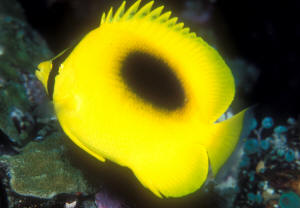
Is there anything here to
nibble on? Chaetodon
speculum Cuvier 1831, the Mirror or
Oval-Spot Butterflyfish.
|
Calcrete rock for Marine set up
3/27/18
Hi there,
<Jana>
I’m currently living in Cape Town, South Africa, and am about to set up
another marine tank.
I have come across some really nice looking pieces of ‘CALCRETE ROCK’ on
the beach on the Westcoast. This type of rock is also called ‘Caliche’
or ‘Duricrust’.
<Oh yeah; a bit of review here:
https://en.wikipedia.org/wiki/Caliche>
I read up on it a bit and it is apparently a calcium carbonate rock, a
form of limestone?!
<Well, mostly CaCO3... with impurities. Even 80-95% pure might prove
problematical>
I would like to use it in my new tank but cannot find any information
stating in particular of whether it would be suitable for a reef tank.
Could you please advise.
Many thanks,
Kind regards,
Jana Maddock
<I too am curious here. But, also cautious. Were it me/mine, I'd
experiment with this rock, in a small system for a few months, before
risking it in a large, reef system. Bob Fenner>
Re: Calcrete rock for Marine set up
4/3/18
Hi Bob,
<Jana>
Coming back to your above comment, when you mention ‘impurities’, what are we
talking about?
<Many other minerals; some are nutrients like nitrates, others involve metals,
e.g. iron. Google Caliche and other names and the word impurities.>
What would they be and what impact would they have on the set-up?
<Could fuel algal growth to poison all>
And lastly, what would I test for after a few months and how?
<I'd boil some of the rock, use the water and rock in a small tank, add some
hardier, small fish, non fish livestock and see if they live for a month or two>
Thanks in advance again,
Kind regards,
Jana Maddock
<Welcome. Bob Fenner>
|
Two birds with one stone. Stand/tank minor gap, cleaning old dry
LR 9/16/16
Hi WWM Crew,
<Hey Eddie>
As always I am eternally grateful to you all for your patient assistance.
Your website is a treasure trove of aquarium knowledge. Every time I visit I
come away richer. I have been “dry” for almost four years now, but still
considering myself a part of the saltwater hobby. I’m getting ready to get
“wet” again, and I have a LOT of questions to ask so that I do it right this
time. I’ve been studying WWM (and other sources) for several years, but
often with greater learning comes only more finely honed questions. Today I
have two sets of such questions. I guess this is a “two birds with one
stone” type email.
<Let's see>
It’s been a while since I have asked a question, and I have been busy. I’ve
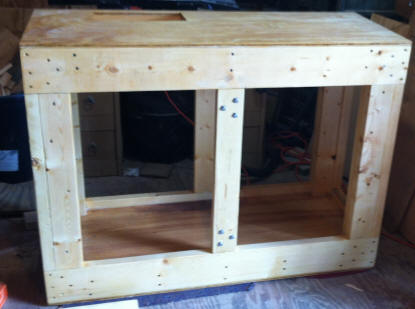
been at work building a stand for my 75 gallon tank.
<I see this in your pic. REALLY like the fastener pattern>
I wanted to do this stand right because my last stand (for my old 55 gallon)
was not made right and eventually resulted in the catastrophic failure of
the bottom of the tank. I did a ton of research on how to do it, and this
(picture) is what I came up with. I’m kind of proud of it. What you see is
the finished frame for the stand. I have already treated it with spar
urethane. I also have some quarter inch oak plywood and trim that I will use
to “skin” it (and I’ll treat that with urethane as well). While I’m working
on the skin though, I thought I would go ahead and use the frame of the
stand for a water test on my tank. It’s a slightly used glass tank with an
offset overflow (as you can see from where the cutout in the stand top is
located).
<Good idea>
The stand frame is level, and when I sat the tank on it found that it is
almost perfectly planar. On one side there was a tiny gap running several
inches where I could slide a driver’s license fairly snugly.
<This is with the tank empty? I'd fill it; see if the gap
diminishes/disappears>
At widest I would estimate it to be 1/32nd of an inch. The reason for this
is something I found out after I built the stand, but something that I’ll
pass on to any DIY-ers who read this FAQ. When boards (2x4’s, etc.) are
planed, often the very end of the board is slightly thinner than the
rest—from where it tilts slightly under its own weight coming out of the
planer. It would be wise when working with wood to cut off the last inch or
two off the end of the board to avoid this (like for the top side rails of
an aquarium stand). This is the reason for that slight dip.
<Ahh!>
I was going to use Styrofoam anyway, which brings me to my first series of
questions. I bought some ¼ inch Styrofoam sheets from Lowe’s that are 4 feet
long. I was not thinking about the fact that my stand is 48 and ½ inches
long—so the Styrofoam will not cover the entire bottom of the stand. Will
the Styrofoam “spread out” under the weight to cover this gap?
<Mmm, not likely; no>
Or (because the tank has a floating bottom) should I cut the Styrofoam into
strips—say 2 inches wide? I could have two 48 X 2 inch strips and two 18 ½ X
2 inch strips (trimmed to fit together at the corners).
<I would cut such a strip; to cover the entire 48.5" base>
I got several sheets of the Styrofoam, and I planned to use some for the
test fill (which will last a week or two at least—it will be out of the way
in the basement), and then replace it when I set up the tank. Is it even
necessary to use it for the test fill?
<I would risk filling w/o w/ the small gap you're experiencing; but if you
feel uncomfortable, insert the foam.>
I don’t want to do ANYTHING to weaken the tank (after what happened before).
<Understood>
The second series of questions has to do with my old live rock. I had about
50lbs of live rock in the old tank when it failed. I put it in five gallon
buckets (dry) and it has been sitting in my basement for almost 4 years. The
buckets have been open to whatever dust has settled on them (and whatever
bugs or rodents might have crawled over them). I want to use this rock as
base rock, and reseed it with some fresh live rock for the new tank.
<I would do this>
I read through the live rock FAQs again yesterday (2nd time through) and I’m
not sure whether I need to soak these rocks in water with bleach or if it
would be better just to rinse them.
<I'd at least blast them with a hose... No need to bleach likely>
I got the impression from the FAQs that bleaching is needed if the rocks had
something on them you didn’t want (like BGA or crypt, etc.). This was not
the case with mine. I was planning on bleaching them anyway—because they had
been dead so long and sitting in the basement, but a friend told me it would
be better to rinse them off and use them as they are—that anything dead in
them will help the tank cycle.
<I agree w/ your friend>
Do I need to bleach them? Would it be better not to bleach them?
<No bleach>
Thank you so much for all your help,
Eddie
<A pleasure to share. Do please send along a photo of the stand, set up as
it progresses. Bob Fenner>
|
 |
Cooking live rock vs. new 4/27/15
I’ve decided to hit the reset button on my ten year old 30gallon reef tank.
<Aah!>
For the past few months it’s been running mostly unlit with just live rock/sand
(no fish or inverts), due to several issues that I could never overcome despite
my best efforts (algae, digitate hydroids, vermetid snails,
parasites). The only fish from that tank, a percula, is presently living in a
QT, having recovered from parasite treatment. My plan is to drain and scrub out
the 30G tank, then start over with just liverock (no sand), the percula, and a
RBTA or a couple corals. If I simply opt for brand new live rock, what's
the most proper way to completely sterilize the old rock, so I could set it
aside as dry base rock for future projects? Soak in freshwater and let it dry
out in the sun?
<Bleach it first... ten percent laundry grade mixed w/ water; then freshwater,
then air/sun>
In the alternative, if I opt to reuse the existing live rock in the new setup by
“cooking” off all the bad stuff (i.e. 2+months in a darkened plastic tub, weekly
saltwater changes, circulation, etc.),can I be confident that after the "cook",
none of the hydroids, vermetid snails, algae and parasites will have survived?
<Not as good as bleaching.... Bob Fenner>
Chris
Dry rock and Liverock 12/27/13
Hello Crew,
<Hey Ed>
Well after a year or two of research and acquiring all my equipment
<Great>
I am ready to go from my 30 gallon tank to a 125 gallon tank. I had a
question regarding the curing and cycling of dry rock with the addition
of adding 40 lbs of established live rock from my 30 gallon that I have
had going for three years now. What are your thoughts on adding
100 lbs of dry rock with the 40lbs of established rock directly to the
new tank with live sand?
<Put the olde/live rock and sand on top of the new/dead>
or would it be better to add all to a large Brute trash can, go through
the curing and cycle process and add to the new tank?
Thanks,
Respectfully,
Ed
<Just rinse the new and install. Bob Fenner>
Dry rock question
10/20/13
<Andrei! No! Seven megs of pix... am on a limited line...>
Hello Mr. F,
How are you?
I have finally drilled the sump and started the refugium in the basement.
If I would have followed your advice from the beginning that would have
saved me a lot of time and effort.
<Ahh!>
But what had to be done was done and what had to be learned has been
learned.
Now moving on.
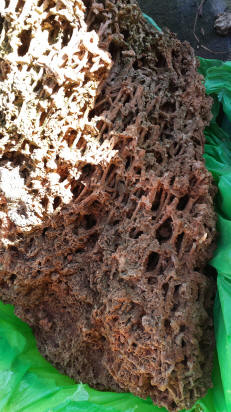
What do you think about the rock in the photo? I got it from southern Greece
( it looks to me that is coming from the sea ) with the intention to use it
in the aquarium. I never was sure about it, but now it would fit in my huge
live rock compartment. From the red color I always thought it contains too
much iron, but is just a guess. Could it function as live rock, once it gets
seeded from the already live ones?
Thank you,
<I would boil it in freshwater, let the water cool, and test for pH, nitrate
and phosphate... and if there is time, add the water to a test tank (simple
freshwater). BobF in Connecticut>
Andrei from Romania |
 |
|
Texas Holey Rock 11/11/12
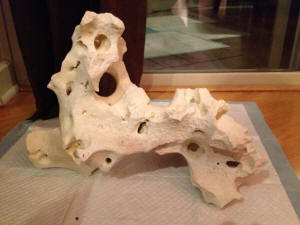
Hello Everyone. I have a question about the use of Texas Holey Rock in a
saltwater aquarium.
<Mmm, some folks have reported that this "type" of rock
releases/dissolves appreciable soluble phosphate...>
I have a 55 gallon tank that has LR in it, but I found a piece of
Texas Holey Rock at a LS that is really cool. It is my understanding
that I can't really expect much out of the biological benefits, but it
is still safe to use in my aquarium. My question is about the "curing"
process. Does it have to be cured like LR, or can I make sure it is good
and clean and place it directly into my DT?
<I'd go ahead and soak it in likely just freshwater for a few weeks...
measuring HPO4 concentration in the water before and after the soak...>
Are there any special concerns I should be aware of if I place this in my
DT?
<Mmm, well, if you need/want or don't more phosphate...>
I don't have the impression that it needs to go through a big dying off
or curing process. I appreciate your help as always.
Brent
<Cheers, Bob Fenner>
Re: Thank you & Stocking & Setup Questions, C. flavissimus sys. KevinK
11/11/12
Hello WetWebMedia Crew,
<Brent>
>>Excised piece moved below<<
I am working on creating more caves, swim-throughs, ledges because they
absolutely love the little mound on the left of my tank. It is so fun to
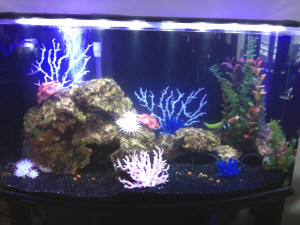
watch them play hide-n-seek. Love it! Here is my current 55 gallon
FOWLR DT. As I said, I am working on creating more hide-aways for the
right side of the tank.
I wanted to put two great looking pieces of Texas Holey Rock because it
has
so many options for little ledges and swim-throughs that I feel the
inhabitants would like. The LF had communicated how it shouldn't be an
issue with adding it into our saltwater aquarium. I had read some site
forums where people had used them. Then, I read some sites that started
saying that it threw off the pH of their system. My thoughts were I
could benefit from the added benefit of a little increase in pH, because
the local water measures a low 7.4 for pH. My understanding is my reef
inhabitants should be in a 8.1 to 8.4 pH, so I am having to increase the
pH when I dechlorinate and make up the saltwater. What I don't know is
how much the Texas Holey Rock, which I understand is Limestone, will
impact my pH. I am going to put it into a separate saltwater tank to see
how it influences the tank chemistry.
<Ah good... and do measure before, and after soaking for a week or so,
for soluble phosphate. Some of this rock is problematical re>
I am currently testing for: pH, Nitrite, Nitrate, Ammonia, Salinity, and
Temperature. Even Copper ever so often, but it has been "0" constantly.
Am I missing anything since I don't have coral?
<Not really; no>
I haven't found any chart concerning the recommendation of Texas Holey
Rock and its impact, like there is for adding LR. I know I won't be
getting the benefits of the LR, but I felt with all the current amount
of LR in the system and the large amount of biological filter in the
Fluval 400 Canister, I should have plenty to take care of that side of
things. I just don't want the Texas Holey Rock to raise pH too much.
<Not likely to do so... again, the real issue is sometimes HPO4
contribution>
Here's my logic:
if I am going to have to be raising the pH every time I make up
saltwater any way, it won't be any more of a task to instead lower pH. I
need to do more research to see if my logic is good, because I don't
know if it is harder or easier to lower pH than it is to raise pH?
<Easier to lower in most circumstances>
Or, if I can add both
of my rock pieces, which are pictured, or if I can add only one, or
none?
The Texas Holey Rock adds up to a total of 20lbs.
<Soak it, test...>
Thanks for your insight and recommendations. I hate feeling so needy.
But I am learning so much. Wish we would have found you sooner.
Brent
<Me too. Cheers, Bob Fenner>
|
  |
Base Rock, use for? Rdg. 9/11/12
Hello everyone at WWM.... I just have a quick base rock question
for you.
I am in Palm Beach County Florida. I have friends who work for the
county in the environmental department and they are starting to build
the last phase to the Snook Island project in the Intra Coastal
Waterway. He has offered me a few hundred pounds of Coquina Rock
to use as base rock in my new tank. I just wanted to know if this
would be a good idea.
thanks
<Why not? Read here:
http://www.wetwebmedia.com/baserockf2.htm
and the linked files above. Bob Fenner>
Re: Base Rock 9/11/12
I must be missing the link to the information about the coquina.
Sorry
<I see it on the corr. below... click on or copy/paste in your search
tool/s. BobF>
overflow and <base> rock question 8/22/12
Hi Bob.
I wrote to you a bit ago with questions. I have as of yet tried to
figure out if I still need reading glasses due to this site!
<Do re-size the fonts as necessary!>
I have, since our last conversations, installed a small 27qt.
<Quarts? Bigger would be that much better>
sump to the 58 gallon show tank I have. I have started removing the
bioballs slowly-maybe 1/4 per week. I have also added 15 pounds more
live base rock to the main display. I am sorry to say that after 20
years of fish only keeping, the addition of the live rock is making me
lean towards running at least a small reef of sorts. I kind of figured
this would happen after finding this terrible site of information!!!!!!!
<Heeeee!>
Couple of quick questions. My wife is complaining of the water noise
(she is the one who has insomnia and we moved the tank into the laundry
room) from the overflow. Can that return be submerged.?
<Yes; and a sieve/Dacron bag placed over the discharge end... requiring
frequent cleaning, but quieting it further>
What do you think of Marco rock out of Florida?
<Nice people, products>
or adding dry reef rock or dry Carr. rock to the sump?
<Can be easily done. Do see WWM here:
http://www.wetwebmedia.com/baserockfaqs.htm
Will it slowly propagate beneficial bacteria, or is it a waste of
money.?
<The former>
And, if I add it to the sump, do I need to light it?
<Some light would be beneficial:
http://www.wetwebmedia.com/refugltgfaqs.htm
Thank you for your book and all of your time. And to all you guys and
gals helping us make the right decisions for our animals.
On a side note. I am a professional mechanic. Don't know how many of us
that are avid fishkeepers out there, but the challenge of not putting
your greasy, contaminated hands into the tank and killing everything can
be done. Thanks to this site, and who I am I guess, I now spend over $40
a month on gloves of all sorts thanks to this hobby!!!
<A good idea... even to protect your hands, health for your line of
work>
Just wanted to thank you for everything, and let you know that anything
can be done in this hobby with a little love, patience, and, esp.
reading, understanding and care.
Thanks.
Joel
<Thank you for your kind, well-elucidated words Joel. BobF>
Question about dead live rock
4/29/12
Hello all
Thanks in advance! I am still very much a novice at this. Got my tank
running and I have not had to do much to it.
<Best to take ones time>
I have been running a 30 gallon Biocube, FOWLR tank for about 3 years.
It's been doing great with tons of coralline and fish that are growing
bigger by the month. I have been feeling sorry for these fish and wanted
to upgrade to a 65g red sea max.
<A very nice unit in my estimation>
My original plan was to just move everything to the 65g tank since my
bioload was going to be the same and add new live rock slowly. I have
been reading that I probably shouldn't bother moving my old sand as
there are probably a lot of nasties that will get kicked up during the
transfer... Is this correct?
<Not necessarily, no>
1. If I buy new live sand from my LFS, how much do I need and do I need
to cycle it first?
<Up to you... see WWM re... and not likely, no>
2. I planned to purchase more live rock, I currently have 30# and was
planning on adding another 60#. My friend just offered my his old, dead,
sitting in his garage for 10yrs rock. I'm thrilled since it will save me
a chunk of change. The rock comes with a catch. He shut down this tank
10yrs ago due to massive die off from Ick. My concern is whether the Ick
cysts can survive 10yrs? If it can, can I "cure" it of Ick? How do I do
this (if it's possible).
<Not to worry... no ich/life... just rinse off w/ freshwater>
3. When adding dead/dry rock to seed it to become live again, is it
better to add it one at a time or can I put it in all at once?
<I'd place all at once, under your newer (really) live rock>
I am in no rush, and I just want to do it the right way
Thanks again
Alice
<Welcome. Bob Fenner>
Cleaning Dry Rock 4/15/12
To whom it may concern,
How are you? Thank you for taking the time read my query!
<Hello Brent, and you're welcome.>
1 year ago a <I> tore down my 90 gallon aquarium. I dried out my
rock and have stored it in 2 Rubbermaid containers.
I am in the process of starting my 90 up again <and>
I would like to know if I should scrub the rock down with a vegetable
brush in water before I place the rock in the aquarium?
<I would just power wash or take a tub of rock to a local DIY car
wash and power wash there.>
Would the water need to be RO water? Or could I use tap? I live in
Calgary, Canada. I have asked around on my local reef forums and it is
split down the middle as far as water quality goes in the city.
<If you mean RO water for your tank, use RO if city water is
questionable.>
Any advise would be greatly appreciated.
Thanks again,
<You're welcome. James (Salty Dog)>
Brent
Sent from my iPhone
<Mmm, would take too long to reply on my iPhone....small keys, fat
fingers.>
LR vs.. dry rock?
- 3/10/12
Hi all!
<Hi Pam, Jordan here.>
I'm at a site that offers "dry rock" for about $2.00/lb.
AND free shipping!!!<Do an online search for reviews of the company.
Sometimes if it sounds to good to be true...>
I'm tempted to fill my 75 gal, 2 week old reef tank with this
product.
I do have 80lbs of LS and one 8lb chunk of LR I paid $64.00
for!!<Ouch!>
Like everyone, I'm trying to save a buck.
How long would it take for this dry rock to become "living"
as it
were?
<This will vary from system to system, but four to six weeks is a
safe estimate; possibly longer in your new system. Be aware that dry
rock can have large amounts of dead organics within and may need to be
cured outside of your display.>
Or, do you think it is not a good practice?<If you do not mind
waiting for the rock to cure, dry rock is great. It is economical and
does not come with any unwanted hitch-hikers. I have used dry rock to
some extent in all of my tanks.>
Thanks!
<You're welcome.>
Pam
<Jordan>
Tufa Rock and Hair Algae 3/1/12
Hi Crew,
<Hello Rebecca>
So I see on previous posts that Tufa rock seems to be implicated in
some cases of hair algae troubles. What exactly is it about Tufa that
could contribute to more hair algae growth than what you would get with
other rock?
<Depending on where it formed or where it was collected from, Tufa
rock may contain significant detrital components along with
phosphorous and can be problematic re nuisance algae growth. Best
not to chance it.>
Thanks
<You're welcome. James (Salty Dog)>
Rebecca Bray
|
Re: Toby and Humu....who is more aggressive to new
additions? Tufa rock question 1/12/12
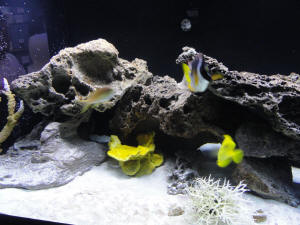
Sorry Bob to bombard you, but here is a pic of my
"lace" rock. I Googled Tufa rock and I am not sure that
is what I have.
My fish specialist has been using this rock for 15 years with
success so hopefully I will have luck to with no phosphates.
<Mmm>
I stated earlier my PO4 was .10 with an API kit. I am awaiting my
Hanna checker and I would speculate that due to my lack of algae
on the substrate, glass or rocks my PO4 is low. I do make a point
not to overfeed.
thanks for a great site.
<0.10 ppm of soluble Phosphate is not too much, and this rock
looks fine... sufficiently aged, such that it shouldn't prove
an issue. BobF>
|
|
|
Dry Live Rock and Live sand
1/7/12
Hello Crew!
I am upgrading my 75 gallon saltwater to a 220 gallon saltwater tank.
The tank has been inactive for about 4 months, the tank was drained
with only enough water to cover the live sand. I would like to use the
sand that it comes with, do you see a problem with this.
<No>
I have about 10 fish that I will be relocating to this new tank
immediately.
<Mmm, I'd leave them out for a week or so if at all possible...
to give the stagnant sand, life therein a chance to "air
out">
I also have about 100 pounds of live rock in my current tank. The new
tank comes with 500 pounds of live rock, but it is now pretty much dry
from being out of the water since October. How should I go about making
this rock live again?
<Just place some over time in an area near rock that has a good deal
of life in/on it>
Should I put it in my main tank or should I keep it in totes for a
length of time so that my water quality does not suffer in my main
tank?
<The word "some" above>
I checked out your forums for live rock, but did not find anything
relating to dry rock and making it live again....
<Oh, there's a bunch... Place your string: "dry rock and
making it live again" in the search tool (on every page on WWM)
and read. Bob Fenner>
Thanks you :)
Jess
live rock and base rock
12/21/11
Hi,
<Rudy>
I am setting up a 30 gallon FOWLR tank and need some advice.
<Ok>
I currently have 10 pounds of live rock I just put in the tank and need
to add probably another 10-15 pounds of rock.
<Need?>
Do I add more live rock ($$$) or can I put in the rest in base
rock?
<Up to you>
If I use base rock will it limit the number of fish I can initially put
in the tank?
<Anything that takes up space can limit this>
How long will it take the base rock to become live rock?
<Weeks to months>
I have about 2-3 inches of sand (not live - yet) in the tank.
<Will become live in time w/ the live rock presence>
I am using a HOT Magnum filter and plan to add a SeaClone hang on tank
protein skimmer.
Thanks,
Rudy
<Welcome. Bob Fenner>
Upgraded Tank, starting to get an interest
in Corals, am scared of making the wrong decisions! Now base rock.
6/6/2011
Hi again James
<Hello Martyn>
I have another quick question for you, if you don't mind.
<That's what we are here for.>
I have tried to search for the answer to this but cant find anything
definitive!
I'm of a mind to build up the rock work at the back of my tank,
both for aesthetics and as extra perches for corals.
I'm not concerned about using Live rock, I have plenty of that, my
question is : If I add base rock (the white holey stuff .. bleached
coral bones?) that is sold at my LFS as base rock is it inert?
IE: will it cause a cycle or mini cycle ? like I was adding more live
rock.
Or can I just go ahead and add a load.
<Will not cause your system to cycle, just rinse well before
placing. As a precaution, I would smell the
rock after rinsing just to ensure the rock wasn't cleaned with
bleach.>
Kind regards, And please extend my appreciation to everyone for such an
informative web site!
<Mmm, do not see any question on water storage.>
(by the way, I am a web developer by trade if you ever need free
help!)
<Oh, Bob may be interested in your kind offer of help if needed.
James (Salty Dog)><<Thank you for your offer Martyn. DarrelB
is coming down to visit in person... to likely read me the high-tech
riot act re how backward the site (actually myself) is. We'll see.
BobF>>
Martyn
Re: Upgraded Tank, starting to get an interest in Corals, am scared of
making the wrong decisions! Now, base rock... 6/6/2011 -
6/12/2011
Hi Again James
<Hello Martyn>
OK got the rock and rinsed it , no bleach smell.
As a precaution, Im letting it dry over night just so any chlorine
evaporates.
Apparently the rock is "Ocean Rock" I trust it not likely to
leech phosphates - or anything worse into the water ?
Also, am I correct in believing that in time this rock will seed and
become something like live?
<Yes, as long as you have a seed source such as a few pieces of
quality live rock/rubble.
James (Salty Dog)>
Kind regards
Martyn
Dead, Live Rock quandary
4/26/11
Hello Crew... I have looked into a lot of the responses and not sure if
I have found a full answer to my question, so here goes...I had a
120gal SW tank that crashed about a year ago. I was trying to bring it
back for a few months, but was not able to do so. I ended up taking out
all of my live rock and aragonite/sand and cleaning it with freshwater
and brushes to get rid of the cyanobacteria.
<Mmm, won't really "work"... unless you bleach,
otherwise nuke the spores, let air-dry...>
IT looked like the take was coming back after a while and I was feeling
good about it. Of course the job calls and I was away for a week or so
and when I came back, found that almost everything I had done was all
for naught as the tank was almost as overrun with Cyano as it was
before.
<Ah yes. Unless you change/d the predisposing conditions that
allowed/favored the BGA...>
I ended up "closing shop" until I know I can put more time
into the hobby and try again. I have all of my rock and aragonite
still, but some is in tubs and other is laying on the deck outside in
the snow and sun.
<Good>
I know this rock is now dead and believe it can be reused up to a point
in conjunction with live although it will never be quite the same. My
question is: Would it be best to start from scratch with new, live rock
and add a little at a time of this other rock, or is it possible to
take the time and re-cure all of the rock I have and use it as the
majority of my rock?
<I'd definitely re-use the old... as "base"
rock>
Once the rock has been subject to the weather changes, is it more or
less beyond all hope now for a thriving system>
Thanks and take care,
Patrick
<Mmm, do see WWM re this "used" rock's use. Bob
Fenner>
Bulk rock supplier 3/22/11
Dear WWM Crew,
Since this seems to be the place with all the hard to find answers I am
writing to ask for help. I am trying to locate a good source for
wholesale dry rock in bulk quantities. I am specifically looking for
Pukani, Tonga or other nice, light weight rock. Despite many hours of
searching I am having trouble locating any sources for dry rock, any
advice or suggestions? By bulk I mean by the ton or more.
<Mmm, are you in the trade? If not, you'll have to deal through
an intermediary... not hard to arrange. How much total weight of rock
are you considering by "the ton or more"? A friend, Walt
Smith, does collect and ship quite large (cargo containers) of this
material... I will cc him here for his response. Bob Fenner>
Any advice or assistance is appreciated.
Thank you,
Trishka
Re: Bulk rock supplier 3/22/11
Bob,
<Trishka>
Thank you for your response. I am in the trade, I am setting up a
wholesale and retail facility.
<Ahh! Congratulations>
As for the quantity that depends on the price and the most logical
method of shipment. So far everyone I have contacted either sells it by
the box or by the pallet (approx. 2000 pounds). Due to this I have been
thinking in terms of a few pallets worth at a time but if it requires
getting a significantly larger amount I am open to that possibility
also.
<I see, and agree>
I have put in inquiries to Walt Smith already due to your
recommendation of him in other WWM posts so I will wait for a response
from him unless you have additional suggestions.
<Mmm, well, he and Deb have been doing their seasonal sojourn/month
in Whistler, and are presently not at their "real work" in
Fiji (are out here in Cal. getting other things attended to... though
we'll all be out in Dallas, TX the end of the mo., then immediately
back in OC, Ca giving pitches at the MAX event)... I do think he'll
see the posts from us through WWM however and respond to you>
Thank you for your time,
Trishka
<And you for your participation in our interests. Oh! I should
mention that if it's convenient location wise, you might contact
Dave Palmer of PAF re this. Will copy him here as well. Bob
Fenner>
Re: Bulk rock supplier 3/22/11
Walt Smith International Fiji Ltd
(mailing address)
PO BOX 4466
Lautoka, Fiji Islands
+679 666 5045-phone
+679 666 7591 - fax
www.waltsmith.com
Fiji Gold, Inc
www.fijigold-inc.com
<Thanks Walt. B>
Is Tufa Rock My Problem And What Can I Do
About It? -- 02/18/11
My question pertains to a 6 month old Reef aquarium in which I cannot
beat bad algae problems.
<<Not uncommon 'and do realize that a 6-month old tank
is still quite new and likely still finding its balance, especially if
the initial stocking was 'rushed'>>
The problem is a combination of algae on the tank glass (mostly green,
occasional brownish) and extensive green long hair algae.
<<Been there my friend>>
The glass I have to clean at least twice a week and the hair algae I
can't keep up with it. What I've read in a few of your other
replies and the fact that most of the hair algae is growing on the Tufa
rock (now spreading to the live rock though) leading me to suspect this
as the cause.
<<Quite possible, yes. I've read that depending on where it
formed/was collected, the Tufa rock may contain a significant detrital
component 'this, and my own personal experiences with this
rock, does lead me to believe that it can be quite problematic re
excessive nuisance alga growth>>
What are your thoughts on this,
<<As just stated>>
is there anything else I should look at as well?
<<There could well be other factors at play here as you would
have seen perusing our site (did you look here and among the associated
links? http://www.wetwebmedia.com/algnutrcontrolfaqs.htm
), but I would replace the Tufa with good live rock as a
start>>
If you feel the Tufa is at fault is there anything I can do other than
remove it (it's the base with live rock all cemented on top of
it)?
<<Nope'¦will require removal>>
Will the Tufa eventually leach out all its phosphates?
<<At some point it may (months? years?), but changes to water
chemistry (e.g. - drop in pH) can start it again...best to remove and
replace>>
Is there any product that will neutralize it (without harming
tank)?
<<There's no magic bullets here>>
I really don't know what else to do here,
<<You do'¦>>
I was going to get a PhosBan reactor, but the way things are going I
feel it a waste of money at this point.
<<Agreed>>
I'm very confused, as most sites suggest Tufa rock in combination
with Live rock,
<<Indeed'¦ I've also used man-made rock (i.e. --
cement based rock)'¦another bad decision. It's my opinion
that if a reef hobbyist feels the need to use other than quality live
rock, the best options are dead/dry reef rock or 'rock' made of
a chemically inert ceramic material>>
your site is one of the first that seems to raise concerns about its
use.
<<Experience has shown'¦>>
Any suggestions would be much appreciated.
<<You have mine 'replace the Tufa rock with something
better>>
I've detailed my tank and my efforts below in case it helps.
My Setup:
55 Gallon Aquarium (48l x 12d x 20h) with 10 Gallon Sump
(New) SWC 160 Cone skimmer and UV filter (9W)
Two 2 strip T5 HO lights (48') -- 1 on for 9 hours other for 3
hours over noon
Substrate combo crushed coral and live sand
Approx. 30 lbs Live Rock built on top of approx. 20 lbs Tufa rock
2 Clown Fish
2 Banggai Cardinals
1 Yellow Tang
<<The tank is too small for this fish 'please see WWM
re>>
1 Flame Angel
1 Blue Damsel
1 Scooter Blenny
1 Peppermint shrimp
Approx. 15 snails (various)
Approx. 20 Hermit Crabs
1 Bubble tip Anemone
<<Not a good choice for such a young/un-balanced
system 'and always questionable when placed with sessile
inverts in such confined space>>
1 Zoanthus
8 green mushrooms
1 (small) Tree Coral
1 (small) bunch Star Polyps
Here is what I do and what I have done to combat the issue:
Water change once per week, 10 to 20% depending on need, includes
vacuuming of substrate.
<<Will do little to help until the root problem is
addressed>>
Tap Water for Salt mixed water changes and De-ionized Water for the
fresh water top up (don't have an RO system). Tap water seems low
in Phosphate (around .01 or so).
<<Phosphate is not the only concern. It's not
'always' required, but for the most part, reef hobbyists should
invest in some type of tap-water treatment methodology>>
Clean glass twice per week. Pluck Hair Algae at every water change.
Taken out and left out smaller loose rocks which were covered in hair
algae. Charcoal in Sump. Various Phosphate products in Sump over last
few months, including ROWAphos, Phos Guard and Phos-Zorb. Tried
reducing lighting even more (only one strip 7 hours a day), doesn't
help.
<<Nope'¦and maybe more damaging to your desirable
organisms than to the nuisance alga>>
Reduced feeding to once per day, very little if any ever reaches
bottom. Testing: Nitrate, Nitrite and Ammonia all 0, Phosphate hard to
get accurate test but seems to be one side or the other of .05, pH,
calcium, and carbonate all normal
Thanks in advance for any help you may be able to provide
Darrell'¦
<<You can try to 'ride it out,' but I think you're in
for a 'long battle' if you leave the Tufa rock in place.
EricR>>
Rock Type In Marine System/Base Rock
1/31/11
Hello,
<Hello Paul>
I was looking for some rock with ledge shapes to it for my marine fish
tank. A local fish store told me that I could use a rock called Lace
Rock.
He said it was used in brackish tanks but could be used in a marine
tank and he said over time it will grown with the tank (meaning
creatures and Coralline will inhibit the rock. Can you tell me if this
is true? Is this rock okay to use in my marine tank? Also, will this
rock grown Coralline Algae on it? Can you tell me any bad affects I may
get from this rock that you know of? I just wanted to ask the experts
before I add anything to my tank that could harm it.
<Lace rock is generally of volcanic origin. The orange/reddish
streaking on the rock (if present) is generally rust and/or lichen
residue. Other contaminants detrimental to marine systems may also be
present. I have heard more bad than good about it's use in marine
aquariums and I would not chance using it. May be more trouble than
it's worth, and I might add it's very heavy.>
Your information in recent weeks is second to none and I do trust all
of you at WetWeb much more than my local fish guys.
Thank you again,
<You're welcome. James (Salty Dog)>
Paul
Some "dead" live rock..
8/23/10
I recently came across some "live" rock. The guy who I got
the rock from had it stored in a Styrofoam container for awhile and it
has totally dried out.
<No longer live, base rock now!>
If I blast the rock with some water and give it a good scrub before
putting it into my tank, would it cause a spike in ammonia from any
organisms that may have been left on the rock?
<It is certainly likely.>
Would there be any other effects on the water quality?
<If there is too much left on there to rot it could cause a low Ph
also.>
There are about 7 pounds of rock and the tank I want to put it in is 55
gallons with a Lawnmower Blenny and Tomato Clown living in it. I
don't have a protein skimmer running on this tank at the time, but
I do a 5 gallon water change every week. If this isn't a good way
to clean the live rock, what method would you suggest?
<I would scrub this as you mention, then keep it in some water for a
few days to check the nitrite/ammonia level. This will tell you very
quickly if the rock needs to "cure" for a while or is safe to
put directly in the tank. Scott V.>
Base Rock and Soap 7/3/10
Hello Crew!
I have a situation I'm not sure how to deal with. I have about
30lb's of Base rock I want to add to my Aquarium. The rock was from
an old tank and I was soaking it in fresh water to get all the old
Algae off of the rock.
When I put the rock into a sink to drain I left it there overnight. The
problem is this sink is used as the drain system for our Washer. My
Fiancé© washed clothes that night and I'm afraid some of
the soap may have gotten into the rock. This was about 3-4 months ago.
Is there anything I can do to make the rock safe to add to my tank or
should I just get rid of it.
<It depends on your time table and budget. Doing a number of soaks
for a week or more would probably fix any issues. Just be sure to
change the water often. I might employ the trick of putting it in the
toilet tank (not bowl), it would get rinsed many times a day. If you
have the $$, new rock would be safer and quicker. With enough rinsing
though, I don't see it being an issue. Ideally one would cure and
seed it before adding it to an established aquarium. That would add
another safety net.>
Thank you for your help.
<Hope this was helpful, Scott T.>
Base (Dry) Rock Questions --
06/13/10
Hello,
<<Greetings>>
I just ordered 2 lbs. of base rock for a 12 gal. aquarium I am
planning.
<<Okay>>
The rock was offered by a California company called Ocean Pro. Their
product was listed as: "Bio-Rock - Base (Dry) (Aka Bio Refugium
Live Rock)."
<<Mmm, I see'¦ I don't know your situation, but you
would probably been just as well off (and maybe saved a few bucks)
going down to the local Pet Smart (or similar) and picking up some
'dry' base rock>>
I plan to keep a Tailspot blenny in the aquarium when it is ready. I
have some questions regarding base rock.
<<Shoot>>
Can base (dry) rock be stored in a dry place for long periods (months,
years)?
<<Certainly>>
And do you have to cure base rock if it has already cured?
<<Usually, no 'unless the rock was simply dried without
being cleaned first, in which case it will behoove you to give it a
good soak-and-rinse a few times>>
Can you just let base rock establish nitrifying bacteria as the tank
cycles, if you only need it to culture nitrifying bacteria?
<<Indeed you can 'do have a look here and among the
associated links (http://www.wetwebmedia.com/baserockfaqs.htm).
EricR>>
Re: Base (Dry) Rock Questions --
06/14/10
Thank you so much for your reply.
<<Quite welcome>>
And I did check with my local PetSmart before turning to the site I
mentioned in my previous e-mail.
<<Oh?>>
My local PetSmart offered me what appears to actually be gravel (loose,
smooth pebble grade). This substrate is not rocks.
<<Understood 'but I have seen 'bagged dry reef
rock' offered for sale 'perhaps a regional
offering>>
I think the gentleman who was helping me meant well. But I had some
experience before with such gravel in a freshwater tank I currently
have. This substrate is NOT like having a few small rocks. Keeping such
substrate is very messy and requires more maintenance than I am able to
handle. Bare tanks with a few rocks, ornaments, and fake plants for
decoration works much better for me.
<<Okay>>
The fish I keep seem to be healthier and happier with no substrate as
well.
<<As long as you don't keep fishes with a requirement for
such (e.g. -- burying wrasses, sifting/digging gobies,
etc.)>>
Now if a fish likes to hide in substrate, caves, or nooks and crannies
never worry never fear, I have a cave ornament they can hide in.
<<Won't work for the first mentioned (those that hide in
'substrate')>>
I had a redhead goby, a fire Dartfish goby, and a peppermint shrimp
once. They all hid together in the cave. There were other places to
hide. And there was substrate they could have burrowed in. But for some
reason all three of them chose the cave ornament. I have 3 saltwater
snails (1 Nerite, 1 Nassarius, 1 Cerith). The Nassarius and the Cerith
like to burrow in the substrate.
<<Indeed>>
But no other of my past tank occupants hid in the substrate. The Nerite
snail likes to hang out on the clear plastic viewing areas.
<<Is an intertidal species 'grazes algae and is often
'exposed' at low tide>>
It will browse on the brown algae that tends to grow there.
<<Yup>>
I like the Nerite. Out of all the snails, the Nerite is the most
active.
<<Mmm'¦that you 'see'>>
The only future occupant (other than the 3 snails) I am planning for
the 12 gal. tank I will be starting is a Tailspot blenny. I think the
cave and the rocks I am planning will be enough for the blenny.
<<Agreed>>
Let me know if I am wrong here, so I can make necessary amendments.
<<Should do fine>>
Thank you so much for your advice and help. It is most appreciated.
<<You are very welcome'¦ EricR>>
Dead Rock (seeding) --
11/25/09
Hi,
<<Hello>>
I have about 250#s of once live rock. I know it can be seeded with new
live rock. How much would it take for that amount?
<<Can be done with a little as a few pounds 'though the
more you use the faster, and likely better, the result>>
And would I be better off putting it all in 10 separate tanks, or all
in one?
<<I would place 'all in one' and add a variety of seed
rock from differing locals (or just different stores) if possible, for
the most diversity of biota>>
I was planning on buying 45#s of live. Is that going to be enough?
<<Should be plenty'¦ And the longer you can let all this
'sit''¦the better>>
Thanks,
Tim
<<Happy to share'¦ EricR>>
Live Rock (How much vs. base rock?) --
10/24/09
I am in the process of setting up a 75g FOWLR tank with no sump. I plan
to run a Rena Filstar XP2 canister filter on it and a H.O.B.
skimmer.
<<Can be done>>
To save money, I'd like to use some base rock.
<<Okay>>
Could you advise me as to how much live rock I'll need,
<<Very difficult to do as this depends greatly on the
type/quality of rock as well as terminal stocking levels and even your
filtration/husbandry/maintenance practices. My advice is to buy enough
rock to provide adequate hiding/sleeping areas for the intended
livestock while not filling the tank up so much as to not allow
swimming and growing room for same. Perhaps start with 50-60 lbs of
good quality rock and work from there>>
and what proportion of it could be base rock?
<<I guess that depends on how long you are willing to let this
tank sit and mature? I'm thinking from your statements that this
'base rock' is actually 'dry rock' (though there is
such a thing as 'live' base rock). Going on that assumption,
the higher the proportion of dry rock to live rock, the longer the tank
should sit and mature to give the seeded biota (from the live rock)
time to spread and establish sustainable colonies. The more 'show
quality' live rock versus dead base rock (or even 'live'
base rock) you can add to the tank the more biota and bio-diversity
available and indeed the better the overall outcome, in my opinion. But
'any' proportion is possible 'go with whatever you can
afford and then proceed accordingly>>
Thanks,
JD
<<Happy to share'¦ EricR>>
Live Rock/Re-seeding 10/2/09
Good Morning again crew.
<Good morning Matt>
My tank is ready to be filled up and start cycling this weekend but I
need some more live rock. I have about 40-50 lbs of base rock from an
earlier tank that has been scrubbed down and ready to use. I want to
seed this with new live rock. I have constructed some ledges and so
forth out of PVC and seems to be working well. The question I have is,
if I purchase about 20 lbs of live rock rubble, meaning just smaller
rocks, will this be able to seed my big pieces of base rock
sufficiently over time? I already have a lot of very big pieces that
are going to be used as base rock and cannot really fit more
"big" pieces in the tank. This is why I was going to try to
mix in some live rubble to help seed this larger rock. Just wondering
what your thoughts on this were.
<Base rock will eventually be covered with coralline in short time,
with good water quality, parameters, and lighting. Other critters
spreading/growing will depend largely on the fauna present on the live
rock rubble. I would suggest getting a couple of 5-6" pieces of
quality live rock with various life forms present and would not add any
fish until the base rock develops, otherwise, introduced inhabitants
are likely to pick it
clean before re-seeding can develop.>
Thanks
<You're welcome. James (Salty Dog)>
Matt
Reef Rock Question DIY Base Rock - Prep for
SW use, Slight misunderstanding re: 'cooking' the rock
10/1/2009
Hello WWM,
<Hi Kevin>
My name is Kevin. I am a long time reader and first time writer. I
really appreciate all the hard work you all do and love the site. I was
hoping you could help me answer a question I could not seem to find an
answer to.
<Will certainly try.>
I recently purchased some Florida field limestone from a local
supplier. I plan on adding this to my two mature reef tanks as base or
sump rock. I was doing some research about the preparations that are
needed before throwing this in the tank to seed and stumbled upon an
article recommending to "cook" the rock. My main interest in
doing this is to leach out the phosphates and any organic material
present in the rock. My research suggested that high phosphates could
be a problem with this type of rock for a while.
<It can.>
I prefer not to have to constantly use Phosban or other chemical means
to keep my system running smoothly. I was given this link with detailed
instructions on how to complete this process.
(http://www.dfwmas.org/Forums/viewtopic.php?p=109759)
<After reading the linked article, it will not help with what you
are proposing. That method is used to kill off any algae and foster
good bacterial growth on the rock What you want to do is try to
encourage the
phosphates to leech out before the rock goes into your tank.>
Since this is dry limestone with no SW bacteria cultures on it, can you
do a FW "cook" with tap water, RO water, or water with an
acid (vinegar) added and get the same "bacteria driven"
environment to absorb the organic material and phosphates?
<Yes, You can soak it in FW, and try to get some of the phosphates
to leech out of the rock on its own. As a result, you may get some FW
bacterial growth, and perhaps some FW algae that will consume
it.>
I really would prefer to save time, effort, and money by not wasting
salt since the rock will be colonized with SW bacteria once it is added
to the main system at a later time. I could then soak the rock in a
diluted bleach bath to kill the FW bacteria, soak in a FW bath with
dechlorinator, and then let dry for a week or so before adding it to my
SW system. It seems to make sense to me but I could not find any
references to "cooking" in FW.
<What you propose certainly would work.>
Thanks again and I hope you can help me out.
<My pleasure, MikeV>
Re-seeding Base Rock/9/30/09
Hello crew,
<Hello Matt>
I have a pretty simple question for you today. I was at my LFS the
other night and mentioned to them that I wanted to purchase a couple
pieces of live rock to re-seed the base rock that I have to set up a
new 55gal reef tank. He told me to pitch all of the base rock and buy
ALL new live rock because it would take about 10 years for the
re-seeding to actually take effect. To me this seems like he just wants
to sell me a whole new batch of live rock. Please tell me that it will
in no way take this long for base rock to re-seed? Needless to say, I
will be making my purchases elsewhere from now on.
<Nonsense. If you have quality live rock to seed the base rock,
within three months the base rock should have a nice coralline growth
at the least.
Emerging critters will largely depend what is on the live rock
purchased for this purpose. I have constructed many arches, etc., from
coral and base rock rubble with PVC-U cement, and within a couple of
months, the rock looked great. Look out for this guy. One particular
FAQ Scott Fellman answered regarding this subject is posted below.
"Dead" Rock for a Reef? Good For You! 2/24/08
Hello Crew.
<Hey there! Scott F. on board today!>
I was just wondering if I can seed dead live rock from a few Good and
Live Rocks? I know a guy who is selling his dead live rock and I just
bought a new tank with Live Rock from my LFS.
Cheers
<Absolutely! Generally, inert or "dead" rock will
"recruit" life forms almost without exception. After a
relatively short span of time, you'll see many different animals
start to colonize and reproduce on and within the rock. In fact, one of
our fine WWM supporters, Marco Rock, sells a wonderful selection of
such "dead" rock for just this purpose. Beautiful aquariums
can be developed using this material, with a little patience on the
part of the hobbyist. And, it's less expensive than
"live" rock, and has all of the benefits, without many of the
typical shortcomings of uncured live rock. It is not necessary to build
your reef structure out of entirely live material. Seed the inert rock
with some live rock/sand from a healthy, established aquarium, and/or
purchase "kits" of beneficial animals from sources like Indo
Pacific Sea Farms or other e-tailers. Coralline and other algae, not to
mention many different invertebrates, will gradually colonize the rock,
resulting in a beautiful and healthy reef. IN fact, one of the
advantages of using this inert rock is that, once given a pretty good
cleaning, you're virtually assured of starting with rock free of
pests and nuisance algae. If you elect to go this route, I say,
"good for you!"
The results of patience and letting nature run its unhurried course can
never be downplayed. Best of luck to you! Regards, Scott F.>
Thanks for your help on this
<You're welcome. James (Salty Dog)>
Matt
Live Rock/Cleaning 0/24/09
Hello All,
<Hi Matt>
I have not had a question for a while because I have been trying to
salvage my tank of all the Aiptasia and green bubble algae.
<Yikes.>
I am not even going to waste your time with system parameters because
they are obviously awful and I am going tear down the tank and start
over anyway. I do currently have a tank that I will transfer my two
clowns to however. Now to my question.....I have literally hundreds of
Aiptasia and bubbles all over my live rock. I was pretty much thinking
about killing off my live rock and starting over with it as base rock,
and then purchasing more live rock to seed it with while I cycle
through my new tank. I have read a lot about base rock and reseeding
the rock, but not much on what the best way to basically kill off the
rock is. Could you please shed some light on this for me? What is the
best way for me to kill off my rock and start over with it?
<Soaking the rock in a freshwater tub for a few days should kill
most if not all marine life forms on the rock. A good scrubbing and
rinsing under freshwater should finish the job. Some folks have
recommended adding
chlorine bleach to the soak cycle, about 8 ounces of bleach per 50
gallons of water. This will ensure a sure kill, and may be the better
way to go.
With this procedure, the rock will need to have several fresh water
rinses to eliminate any residual chlorine present on the rock. In your
case, I'd likely go with the chlorine bleach method.>
Thanks so much for your help as always
<You're welcome. James (Salty Dog)>
Matt
Re Live Rock/Cleaning 9/24/09
<Hello Matt>
Wow, Thanks for the super quick response.
<You're welcome.>
Once I get this cycled again I really want to get an eel. I was
thinking either the snowflake or zebra. Like I said, this is a 55 gal
4ft long. I only have the two common clowns right now. Would either of
these be possible in the tank with nothing else to ever be added aside
from the two clowns, and if so, which one would be the better
choice?
<I suggest you read here and linked files above.
http://www.wetwebmedia.com/morays.htm>
Thanks again for all your hard work and help.
<You're welcome. James (Salty Dog)>
Matt
Cleaning Live Rock 9/18/09
<Hi Keith>
I have about 30 pounds of live rock that has been sitting on my deck
for about a year.
<Not "live" anymore for sure.>
I washed them with the hose, and now I have them outside in a container
with an old powerful return power head that use to be in my sump. I am
going to let it run overnight with the Clorox I put in there. ( I
poured a few cups in and there is about 4 gallons in the container.
<Yikes, didn't need that much.>
Tomorrow at some point, I am again going to pressure wash them with my
hose and then put them back in the container and let them run with some
new clean water.
After that, I was thinking of baking them or boiling them to make sure
they are sterile.
<They will be sterile after that Clorox bath.>
Should this be enough to do before I add them as base rock in my
already established tank?
<Keep the rock in the freshwater (circulated) container until no
trace of the Clorox
can be detected. Smelling the rock with your sniffer will detect
this.>
Thanks!
<You're welcome. James (Salty Dog)>
Keith
aquascaping 09/14/09
I attached base rock to 12 inch by 12 inch sheets of acrylic with
silicone in my 150 reef to add stability. I attached live rock with
posts to the base rock. Have I created conditions that will allow for
anaerobic pockets under the 12 by 12"s and glass tank bottom. Plan
to add less than inch of sand once live rock cures.
be well
mike
<I think you'll be fine here Mike. Some anaerobic area/s are
beneficial in captive aquatic systems... as long as a "good
deal" of material doesn't accumulate in them and release too
much in the way of products of decomposition sans oxygen, all should be
okay. Bob Fenner>
|
Coral Skeletons/Cutting 9/11/09
Hello,
<Hi Mike>
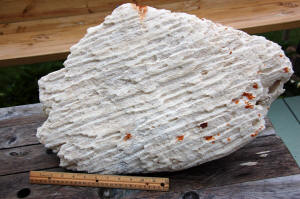
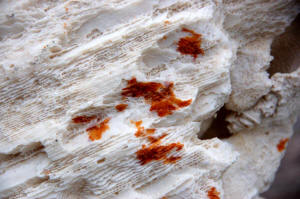
Any advice on how I can cut this piece of coral longitudinally?
Or whether I even should? Is it okay to use
old coral skeletons, provided they do not contain any harmful
substances as reef base rock?
<Sure.>
This piece was found on a sandy beach. I would like to use it to
build 2 shelf's in a reef system? Its about 4 inches thick.
Sorry I don't have a side view. Any feedback is
appreciated.
<Well Mike, most folks I know, use wet tile/brick saws to do
this.>
<<Have seen band saws used as well... not all types of
blades though. Oh, and the rust spots/marks are not a problem.
Not enough ferrous material to cause trouble here.
RMF>>
Be well,
<And you also. James (Salty Dog)>
mike
|
  |
dead rock or live rock?
Base Rock -- 08/26/09
Hello, I am currently in the process of setting up a new saltwater
tank. I was given about 150lbs of rock that has been sitting in a trash
can in a garage for about a year. I was told that the water has not
been circulated
for about 10 months. The rock is pretty much pure white with maybe a
couple of pink spots here and there. Do you think this would still be
okay to use?
<If you do, make sure you mix it with live rock, and realize that it
will need to be "cured". It is likely all dead and so the
live rock will seed it with some beneficial organisms.>
Or would I be better off buying all new live rock?
<If money is no object I suggest live rock, otherwise a mix would be
appropriate, just allow for curing and a cycle to take place.>
I appreciate any advice you can give me :)
Thanks so much!
Jen
<You're welcome
Josh Solomon.>
Dried out base rock 8/5/09
<Hi Chris<
Ok, so I went out and picked up this rock
Apparently it had been out of the water for a day or 2 and had a really
bad smell (stuff dying off of course). I was also told that there were
a fair amount of Mantis Shrimp in the rock (yea..) I brought the rock
home, put it in an empty tank, filled it with saltwater and put a
couple of power heads to circulate the water. My thinking behind this
is that there may be some life still on the rock that I can salvage. Do
you think that this is a possibility for anything else but the
shrimp?
<If it has been out of the water for a day or two, is infested with
mantis shrimp, and already stinks, I'd personally let it bake out
in the sun and kill everything off after you pressure wash it. the
algae will die off, but you do want to remove as much as you can before
it goes in your tank. I would pressure wash it, let it dry in the sun
for 4-5 days, then I would set up a bin with a powerhead and salt water
to begin curing it again. You can get a rock from the store or a
friends tank to put in there as well to help seed "good" life
back into the rocks.
Will the algae go away if I leave it in an unlighted tank...
<bake it as suggested above, mostly to remove pest algae and any
unwanted mantis shrimp>
Should I be doing anything else?
Please keep in mind that I'll probably keep it for a few months in
this manner as I just don't have the time to set up the display
tank.
Let me know
Thanks
Chris
<Regards, Jessy>
Dry Base Rock 4/25/09
Hello WWM crew, Aaron again.
<Hello Aaron, my many apologies for the extremely tardy
response.>
I was wondering about this base rock from (I believe one of your sites)
Marcorocks.com
<A sponsor.><<Mmmm, not yet. RMF>>
and I was wondering if when I get the rock can I just put it in my tank
and use the live rock in there already to cure the base rock or do I
have to go and buy the stuff to fully cure it in a separate tank and go
out and buy more fully cured live rock just to cure or can I fully cure
it in my main tank?
<This rock has no living material and should already be scrubbed
clean or done so by yourself if is has dead dried matter on it before
placement. In the end this rock will not need to be cured, just
cultured off of real living live rock.>
I just fully cycled my tank and bought live rock yesterday so what? I
only bought 3 pounds of live rock so I was hoping that I can use the 25
pound of base rock form the site to cure it at its own steady pace.
<Hmm, yes, just add all of this together and give it some time, a
period of a few weeks to establish biofiltration and for the LR to
cure.>
Thanks, Aaron.
<Welcome, Scott V.>
Texas Holey Rock - OK for Marine Tanks?
3/12/2009
Hi,
<Hi there.>
I have a 90g marine aquarium with fish and corals. I want to
re-aquascape the tank and was thinking of using some "Texas Holey
Rock". The tank has been set up for about a year and about half of
the rock in the tank was moved from a 30g that was up for about 2
years. The other half is lace rock. Is the "Holey Rock" OK
for a marine tank? How long should I cure it or cook it before
introducing it to my tank?
<It is a limestone and has been used for FW Cichlids for some time.
I would rinse the rock completely in fresh water, and then soak it in
salt water for a few days to a week before putting it in the tank. As
the rock is porous, I would not use bleach.>
Thanks,
<My pleasure>
David
<Mike>
cloudy saltwater tank, base rock use
2/2/09 thanks for reading my e-mail. I have a custom made 86
gallon tank its 5'8 long 18 tall and 18 deep. I started out with a
50g tall that i never had this problem with, it all started out when i
transferred tanks. I used all the sand, 30 pounds of live rock, about
100 pounds of limestone, <Mmm... "base rock"... this can
be problematical... take a while to stop "flaking">
filter, skimmer and sump with about 15 pounds of live rock from the 50
gallon. Since the swap the water has never been clear, its not green
just hazy. The fish don't seem stressed at all,. the new tank has
been set up for approx . 3 months now, <Yikes!> and seems to get
cloudier every water change. last week I decided to test for Alk . and
calcium for the first time. The Alk was at 16 and calcium was at 440 my
ph has always been 8.2-8.4 . I had been using tap water. I tested the
tap water and Alk was at 11. So naturally i went strait out and bought
an RO /DI filter and started doing water changes to lower the Alk .
<Mmm, "it's" not the tap> I did several 30 gallon
water changes adding the water very slowly over several hours. The Alk
is now down to 9 and the calcium is still at 440 i am using Coralife
salt. I am going to do some research on diff salts and their different
readings. The last water change was done 24 hrs ago and it looked like
it was going to clear up but now its cloudy again . custom made 86
gallon tank 45 pounds live rock 100 pounds of limestone 20 gallon sump
has filter sock on sump inlet <Good> maxi-jet 1800 return pump
CPR backpack skimmer 2 Hydor #1's 2 eco modded maxi-jet 1200's
Eheim eco filter for carbon and filter pads for now 6 NO florescent 2
6500 1 18000 1 10000 2 actinic blue specific gravity 1.024 temp 78 deg
ammonia 0ppm nitrite 0ppm nitrate 0ppm ph 8.2 alkalinity 10 dKH calcium
440 ppm phosphate .25 ppm fish 2 tank raised clowns 5 Chromis 1 coral
beauty 1 black Combtooth blenny 1 dragon goby <Neat> 1 cleaner
shrimp varies snails and hermit crabs no coral yet.... I have looked
all over WetWeb and found a lot of info on calcium snowstorms. I
thought that's what this was but since lowering the Alk there has
been no change. I know that the dragon goby could be causing some of
this but i don't see anything that looks like sand particles in the
water. thanks for your time. i know the super bowl is about to come on
so i don't expect any replies soon.. lol thanks Kent <Heeee! Was
out walking the dogs during... surprisingly uncrowded. Well, my best
guess is on/with the CaCO3 rock... not your source water, the salt mix,
or anything else... Cures? Time going by... maybe sped up with the
addition of a refugium... with macroalgae there, RDP lighting... a
DSB... to aid in biological processes that will ultimately
"settle", precipitate a good deal of this floating floc...
Please read here re: http://wetwebmedia.com/marsetupindex2.htm the
second tray down... Alternatively, you could invest in a mechanical
filter with something like Diatom filter/size/type capacity... and
sieve out the particles... while waiting for other processes to catch
up. Cheers, Bob Fenner>
Limestone rubble for live rock (base)
12/19/08 G'day WWM crew, This may seem an odd question,
but I was wondering if there is any reason why I can't use
limestone from my backyard in my aquarium that already has live rock in
it. <Mmm, can be done... if pretty much pure CaCO3...> I will
soon be requiring a lot of live rock for my new 1500l reef tank and was
hoping I might be able to use limestone which I have dug up (I have
tons, literally!) as base rock to save on costs. Should I be worried
about soil etc embedded in the limestone? <Mmm, not so much if you
do reasonable garden/hose pipe spraying to clean> Should I soak it
in freshwater first? <A good idea... perhaps there are some
more-soluble parts that will be dissolved off in this process, maybe
some more of the dirt in question above> Some pieces are yellow on
the inside which I think means it contains iron also. <Mmm, maybe...
I'd test with a magnet... should be rust colored if ferrous... best
to chip away most all of this> Any advice, recommendations would be
greatly welcome. Thanks, Ben <Do smell a bit of the chipped off
yellow part... might be sulfur... this is not so toxic to marines, but
I would try to remove a good bit of it too. Bob
Fenner> CORAL BASE ROCK - ETC -- 07/11/08
Dear Bob, <Marty> Just back from the San Antonio COA
(Conchologists of America Convention) and see your friends possible
need of a quantity of coral base rock. We have some stock here -- but
are low. A container just left yesterday with 2000 kg of coral rock --
so suggest it best to wait for this to arrive (around mid August). Just
let us know -- or have your friend contact us. <Was an open query on
WWM. Did you write them directly? I hope so> Re Charlie Vernon's
newest work A REEF IN TIME and ocean acidification -- earlier this week
there was a short blurb on exactly that -- it was on either channels 2
or 4 late news. At least it's starting to become recognized as a
real and immediate problem that needs addressing ASAP! <Ah yes...
the carbonate sink... again... but now, we happen to be here while
it's happening... Well, we did our bit... didn't reproduce>
All for now -- Regards, Marty Marty Beals Tideline <BobF>
| Refugium Technical Help / Copper Removal from Rock
Please 7/11/08 Hello Bob and the great Crew at
WWM-I'd like to start off by thanking you for the valuable
knowledge you have shared with the reef aquarium community and the
helping me create an amazing ecosystem (my super sized Rose Tip BTA
just split into two to much amusement to my gold-striped mated pair
maroon clowns who have spawned since). <Gorgeous!> I have
been battling hair algae in my reef tank for over a year now since
adding some live rock about a year ago (55 gallon, t-5 lighting,
Eheim filter, red sea protein skimmer). Its a mature tank 3 yrs+
and I dare say is overstocked (see attached pics I have higher
resolution too but I wasn't sure if they'd go through
email). <They're here> My nitrates, phosphates are at
continuously at zero (im sure their higher just not picking them up
in the tests). <Mmm, no... much more likely these are being
"scarfed up" by your photosynthetic, chemotrophic
life/processes here> I try to perform bi-monthly water changes
at 10%. I tried reduced lighting from 12 hours to 8 hours six
months ago but then my BTA and corals don't seem as full or
bright so I returned to 12 hour lighting and the hair algae has
been growing. So I have finally purchased a sump which I am
converting to a Refugium and have some technical questions which I
could not find the answers to in the library: 1) I scored about 40
lbs of gorgeous Marshall Island dead rock from a former reefer who
had used a large amount of copper in his main FOWLR tank. The rock
looks okay from afar, but on close inspection there is a slight
green tint of copper on all the rocks. <!?> I tried boiling
it but the tint is still there. What can I do to remove all copper
from this rock before I cure it into Live Rock? <Perhaps melt a
good deal off with dilute (inorganic likely) acid... I'd try
Muriatic (3 molar HCl)... diluted by at least five times... do take
care to do this with eye protection, doing as you "outta,
adding acid to water"... outdoors where there is good air
circulation> (the least expensive method would be most suitable
for me) 2) Should I place rocks that are heavily infested with Hair
Algae in the refugium or keep them in the main tank? <In the
refugium> Or will the Hair Algae go away in due time if I leave
it in the main tank and add the refugium? <More likely in the
'fuge...> 3) Should I place Rock or Macro Algae in the first
chamber where the water comes into the refugium from the overflow?
<Yes> (I will also have an ideal mud bed with live rock and
macro algae in the main refugium chamber area but I want to
maximize all chambers). Thank you so much for your help. It is
greatly appreciated. F. Alserri <Welcome. You might peruse this
area: http://wetwebmedia.com/marsetupindex2.htm the second tray
down; when you want a bit more re refugiums. Bob Fenner> |
|
|
|
Re: No question just thanks... Follow on...
Chalk as base rock -- 05/27/08 Hi crew <Hello Garry.>
Sorry just sent an Email to Bob and somebody has just asked me a
question which I have no answer for, and I wondered if you guys
could come up with an answer. <Sure.> Local to where I live
we have cliffs of Chalk rock (just like the White Cliffs of
Dover) <Nice, I'm a geologist.> being that they are
99.97 to 99.99% pure very soft (for rock anyway) Calcium
Carbonate, would it be possible to use this as a base rock for a
Reef aquarium. <I would not do that. These rocks (if
comparable to Dover) consist of the skeletons of green algae and
to a minor extent of foraminifera, Ostracods and some molluscs.
Whenever sedimentation stopped due to various reasons the
sediment layers were in part encrusted with phosphate minerals
(the natural way of removing phosphates from the water), which
while being pretty much dissoluble in water can easily be
dissolved with the help of the life in a reef tank. Phosphates
inhibit the growth of the corals' skeletal elements,
obviously stony corals are more sensitive. Even if phosphate
composes only 0.01-0.03% of the rock (while possible, these
numbers seem low to me) and 10 kg (about 20 pounds) are used
you'll have a phosphate reservoir of a little less than 1-3
grams. Depending on the specific solution kinetics in your tank
this may inhibit stony coral growth. This problem occurs with a
lot of calcareous rocks used as base rock.> From watching the
effects of the local sea water on the rock pools there is always
a degree of erosion and solubility (the water has a slightly
milky look) and if this was filtered out would the effect of this
rock be beneficial upon pH, calcium content etc. I have done some
research into this type of limestone and it is very porous with
millions of channels holes etc all the way through it so from the
point of view of bacterial "infestation" it seems an
ideal base rock, especially as it can be obtained in a very clean
non polluted form Anyway your thoughts etc would be appreciated.
Garry (in the UK). <In my opinion and experience no rock
compares to the real thing re denitrification: live rock. Maybe
if put into natural tropical water other porous rocks like the
ones you consider might develop similar characteristics, but it
will take months at least and is rather unlikely to happen in an
aquarium to the same extent it can happen in nature. If you still
wish to use the chalk be prepared to also use some phosphate
adsorbing media in the future. Cheers, Marco.>
Re: No question just thanks...
Follow on 5/27/2008 Hi Marco
<Hello Garry.> Thank you for your reply (it's nice to
meet another ologist - I'm an Ecologist ). Your reply makes
sense to me, however, the percentages of Calcium Carbonate are
correct (please read Ecology of the English Chalk by C.J.Smith
pub: Academic Press Inc. (American publication) pages 1-17).
According to this book and several others the composition of
English Chalk is Calcium Carbonate 97.89% <I can agree with
that. The last mail spoke of 99.97-99.99, which makes a
difference with regard to phosphates.> Magnesium Carbonate
0.75% Silica 0,65% Calcium Phosphate 0.22% <My original
calculation was for only 0.01-0.03%. So with this more exact
number 10 kg (about 20 pounds) of chalk will introduce a little
less than 20 g of phosphates into the system! A concentration of
only 0.3 mg/litre, which can easily be reached with this rock and
a little time, can seriously inhibit stony coral growth.> Iron
oxides 0.14% Water (combined) 0.35% Work done by Dr N.Walsh
(sorry not sure when or where published) showed English Chalks to
have a purity of between 96.77% and 99.09%. But hey I'm
getting pedantic here. <You are not being pedantic at all,
these numbers are very useful and as you see one digit here and
there makes quite a difference. It's ten times the amount of
Phosphates, that's not pedantic.> I agree that the only
real rock suitable for Reef aquaria use is or should be Live Rock
but we pay a lot for a very little here in the UK (try fuel at
over $12 a gallon) and I guess we have to try and spread our
costs whilst still providing the absolute best conditions for
whatever we keep in those little (or not so little) glass or
acrylic boxes in our homes. <I totally agree with you here
(I'm in Germany and our gasoline and live rock prices are
practically the same as in Britain. I used various types of rock
as base rock, too, but often ended with serious phosphate
problems when growing stony corals and sensitive soft corals.
Those problems had to be addressed with phosphate adsorbing media
and water changes, which also cost some money and should to be
considered. For fish only tanks it does not matter too much, just
less denitrification. For coral tanks I often use "second
hand live rock" from well running systems with low phosphate
concentrations as a cheap alternative when some hobbyist is
giving up due to whatever reason, it typically costs about 1/5 -
1/3 of the commercially sold rock and often has already some soft
coral growth.> Your comments have been noted and I will pass
them on. Cheers Garry. <Happy reefing! Marco.>
Re: No question just thanks...
Follow on... Chalk as base rock III -- 05/27/08
Hi Marco <Hello Garry.> Well, that will
annoy my friend who thought he had a cheaper alternative to
second hand base rock (he has a garden full of it with a small
cliff (the garden was part of an old quarry) I will pass your
comments on and await the results of his deliberations, no doubt
he will go the live rock route but I think he is aggrieved at the
cost. Personally I would pay whatever I had to get the results I
would want but this is an expensive hobby (lifestyle?!) and for
some the price can be just too much. <I totally agree with the
above.> Can I say that if you are German by birth, your
English is very very good, <Thank you very much, I'm
trying.> and I appreciate your time and energies confirming
what I knew but could not convince my friend of. Happy Reefing to
you Garry. <Cheers, Marco.>
|
|
|

