|
|
| Home | Marine Aquariums |
Freshwater Aquariums |
Planted Aquariums |
Brackish Systems |
Ponds,
lakes & fountains |
Turtles & Amphibians |
Aquatic Business |
Aquatic Science |
Ask the WWM Crew a Question |
| Please visit our Sponsors | ||||
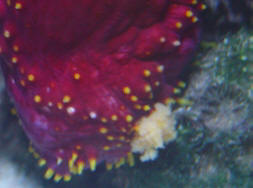
Pink and Green Cucumber 11/2/2009
Indonesian Sea Apple 8/15/07 Hey guys, love the
website and the information you so kindly provide. With that said, I
work at my LFS and have been working in aquaria for about 4 years. I
purchased an Indonesian Sea Apple for my 30-gallon community tank,
<... Yikes...> knowing (or at least thinking I did) the inherent
risks of the organism. I have had the Cuke for more than 4 months and
he receives daily doses of Marine Snow <Of almost no nutritive
value> and has appeared to be doing well (no inflating from stress,
no loss of size, no moving in the tank once established). Today however
I came home and noticed that one of my favorite fish had passed, one of
the ones I had had in the tank for a while (5-6 months). I peered into
the tank and noticed what appeared to be little green balls (about the
size of a flea perhaps?) floating all around in the water. I examined
the Cuke closely and it appeared to have strings of these little balls
wrapped around a few of its feeding feathers. Another reader had
written you about a similar experience ("little yellow balls"
in his case) and I was wondering if this is in fact the Cuke
reproducing? <Possibly this... or fecal material... or?> I
couldn't find any info on how they reproduce. Is it common for them
to reproduce in captivity? <Not uncommon> Also, if so are the
eggs simply themselves toxic? <Can be, yes> I have never done a
full change on my tank and unless I notice labored breathing or
anything of the like I don't intend to, at least until I establish
that this did in fact come from the Sea Apple. <Good point... this
material could be unrelated to the Holothuroid> Aside from him the
only other inverts in the tank are a pair of Skunkback Cleaner Shrimp
and Peppermint Shrimp, <Could be their eggs... though unusual to be
released as such> Margarita Snails, Blue-legged hermit crabs and a
small Tiger-Tail Cuke and of course the corals (mostly Euphyllia,
Toadstools, Zoos and Mushrooms). Thank you for any insight into this
odd situation! Alec Parodi Valencia, CA <Do keep a close watch on
this system... "If" something goes sideways with the Sea
Apple... all could turn into bouillabaisse in minutes... Bob
Fenner> Re: Indonesian Sea Apple 8/15/07 Thank you very much kind sir, have spent most of this morning on the site (which BTW I was excited to see referenced as a, well, reference in the last issue of Tropical Fish Hobbyist Magazine)! Alec Parodi <Ahh! Thank you Alec. Bob Fenner> Sea Cuke that likes to stay on front of Tank - 3/7/07 Hi to all. <Hello John. Brandon tonight.> I have a Sea Cucumber that I've had for about 8 months in a 58g 4"DSB . Included livestock include 1 Yellow Tang, 1 Niger Trigger <You will ultimately have to move this one to a larger tank.>, 1 Maroon Clown,& 1 OL Anthias. Inverts are 1 Porc. Crab ,1 Blood Fire Shrimp & 1 Sand Sifter Star. I HAD about 40 mixed snails <Had?>, My parameters are always : Sal. 1.023-.024,PH 8.2, Ammon. 0, Trites. 0, Trates. 0, Calc 400,Alk. 2.8,Phos 0 My Question is this: I noticed 3 days ago that my Cuke was on the front of my Tank, Curled up & like a snail. Not moving most of the time, but if it did it was maybe an inch in several hours. While cleaning my tank side yesterday, I knocked him off and now he just lays on the sand . He is still alive because when I moved him, he would move just a little. <Be careful moving it around. You DO NOT want to make it mad.> Should I remove him, or, because it may be dying, <For safety sake, and the sake of your fish, I would move it to a QT tank.> or since I've seem to of lost about a dozen snails( because of temp change), do you think maybe that may have a part in it? <Very possible. The Holothuroidea like very high quality, stable water. Please see here, http://www.wetwebmedia.com/seacukes.htm.> Don't know what kind of Cuke it is. It has yellow spikes, Gray/off white body and black specks. <Sounds like Colochirus robustus, but I really can't tell without a picture.> Thanks <You are welcome, hope this helps. Brandon.> Tiger tail seems to be stuck 7/19/06 Hi people, I have a very odd situation, bought an orange tiger tail cucumber last week to help with the cleaning. <Mmm... not really useful for this in but a few types of settings> It hid for 6 days, under inspection we discovered it's head or tail, seemed to be stuck in a large empty snail shell, <No, not stuck... can get back out of anything it can put its head into> so we dislodged it. It moved a few inches, and now seems to have its head or tail stuck in a rock crevice. What is it doing and why, should we help it, or leave it alone. Kind of worried. Thanks, Chris Wheeler <May be unhealthy for whatever reason/s, but could more likely be just "doing what they do"... Please read here: http://www.wetwebmedia.com/cukebehfaqs.htm and the linked files above. Bob Fenner> Cuke Behavior 4/1/06 Hi Crew, <Hello Tom> Sometimes animals just have their own reasons, but I'm curious if you can shed light on a change in our black sea cucumber's activity. For about a year, since we got it, this Cuke has been happy crawling around the sand bottom doing what Cukes do. But, for the last couple of days it has been cruising around the top perimeter of the tank, on the glass just below the waterline. It's in a 2 year old, healthy 125G reef tank with 9 various fish, and about 25 corals, mostly sps and a couple LPSs, 1 derasa and a couple of skunk cleaner shrimp. Tank param.s are all copasetic and stable (let me know if you want all the details). No changes to the livestock for over 6 months, and everyone else seems normal. I now worry about the Cuke getting stuck in the overflow or closed loop intakes. I've gently placed it back on the sand, but then it crawls back up to the top. I'm wondering if you know of some sort of event (maybe reproductive or age related?) in the life of a Cuke that drives this change in behavior. <I'm guessing two things. One, you may have a hydrogen sulphide buildup in the sand that the Cuke isn't fond of. (Do you vacuum the substrate during water changes? Number two, the Cuke may not be finding enough food on the bottom and looking elsewhere. Am posting a link to an article regarding the Cukes. http://www.wetwebmedia.com/seacukes.htm> Thanks, <You're welcome. James (Salty Dog)> Tom Pink cucumber ends
7/23/05 Dear Bob, <Jay> Once again thanks for all your help.
I received a pink cucumber from a friend and it has been doing
extremely well in my tank. I feed it phytoplankton about 3 times a week
with a piece of air hose and a syringe so I can release it into its
feeding tentacles. <Interesting> However on occasion I see the
feeding end close up and at the other end I see blackish/brown worm
(size of a hair) like tentacles waving around the tank, Small yellow Cuke is puking 7/6/05 I have a small yellow Cuke that has expelled its organs. I have a 29 gallon that has a ton of live rock and good circulation/adequate filtration and has been up for a year. In the FAQs you guys seem to indicate that this will not be a problem...my fish/corals seem ok. < Well I think everything else in the tank is going to be okay. But that Cuke may not do well. > Should I take him out? < No, I think that would just make things worse and stress him out. > He has only been in there for a few days. < I think this may be a sign of poor shipping/acclimation/feeding. Unfortunately this doesn't sound good, but all you can do now is just wait and hope for the best. > Thanks for the help. Matt < Blundell > Pygmy Cucumber growing ROOTS into Green Star Polyp? Hey there! The title says it all. I went to remove my pygmy cucumber from on top of a part of the star polyp and I noticed that in order to pull him off I had to pull these little 'roots' out of the coral. What's the deal with this? Is it harmful to my star polyps? Thanks again! Ray <if they came off of the cucumber, they were simply tube feet and they will regrow. Else something was growing onto the cucumber. Simple parts here... nothing else it could be from the Cucumarid. Best regards, Anthony> Where Did That Cucumber Go? Good Afternoon, Crew <Hi there! Scott F. your Crew member today> Just a quick question for you. I have a 46 gal bowfront with a few happy fish and 60 lbs of live rock. From a very reliable source it was recommended that I purchase a tiger tale cucumber to help keep the sand sifted and clean. I purchased a real beauty and added to my system last week. Have not seen him since. Do they stay hidden all the time? Do they ever come out for air? <Well, these are rather secretive creatures, and they tend to remain hidden behind rocks or underneath the substrate, so it's normal to barely see them. About the only thing that will betray their presence is usually the "droppings" that they leave, which are generally like little clumps of sand...> Just would like to know your opinion on these strange creatures as I am getting conflicting reports on their behavior. Thanks for your time. Randy S <Well, Randy, as mentioned above, these creatures tend to be secretive. They do help sift through the upper sand layers, which can be a big help in some systems. Keep a close eye out for this guy, and I'll bet you'll see him from time to time!> Sea cucumber evisceration Hi, I've just finished reading through your excellent sea cucumber web-pages and wondered if anyone has ever filmed sea cucumber evisceration? How fast does it happen? <Have seen some footage of this. Can "happen" in less than a second, or several seconds> Is it something that could be filmed happening naturally, do you think? (i.e. without having to provoke the poor old sea cucumber!). <Mmm, likely provoked. An "expensive" (biologically) thing to do... often results in loss of "parts" (respiratory apparatus, gonads...), calling for energy, time for replacement.> With many thanks for your help. Penny Allen <Thank you for writing. Bob Fenner> Girlfriend is at it again - new additions 6/20/03 First of all you guys ROCK!!! Stop blushing it's embarrassing. <I'm not blushing... that's a gin blossom. Thanks for the kudos at any rate <G>> I need to quit my job because every time I come home there is a new addition to the tank. <spontaneous creation is so cool...> This time it was a pink thorny cucumber. I think that is what it is. Anyways as she was putting it in the tank she dropped it. >Ahhh... girlfriend likes to shop. Good luck... and buy stock in Snickers> As I watched it fall 2 feet I went and got me a beer to watch the fun. Well once it landed (on the feather duster) it started to emit a ton of tan colored balls. <Oh, yeah... the old ball-ejecting dropped when from a height maneuver...> I was done half my beer by the time it was finished. I ran to the computer to get on WWM to find out if I was going to jail for murder. <depends on the nature of the balls> As lucky as I am I could find nothing solid on here about what I have and what it did. I was a little disappointed mind you. So far no ill effects are seen and it has been a week. I even saw some fish eat the balls. <no comment> They are still alive. So is the cucumber ( I think). He is sitting on top of my pink and lavender polyps which are at the top of my tank near a powerhead. I guess the question is what exactly did it emit? <could have been gametes ejected under duress. We cannot say they were fecal pellets (cast) as with detritivore Holothuroids... this filter-feeder of yours simply is unlikely to excrete that much solid waste at once> And did I just get lucky that he did not kill the whole tank? <perhaps a little... but Holothurin toxicity is overrated IMO. The production of the toxin requires great emotional energies... and they are not dispensed easily. Your Pentacta anceps cucumber however is a hardy species that reproduces readily in captivity (fission) and is longer lived compared to many others in this group> Did I mention that you guys ROCK!!!? BTW I have a 220 tank. Kenny <best regards, my friend. Anthony> "What's Wrong With Your Cucumber... It Looks Funny"- 8/23/03 I bought a pink and black sea Cuke 8/20/03 that's just a few days ago. I acclimated it to my water for about 3 hours. <please do QT all livestock... especially such potentially toxic creatures as cucumbers... in a separate tank for several weeks first> Then I put it in the tank. I notice that it did not crawl away or anything. <not sure without a pic... but you may have a filter-feeding species, which can stay in the same place for years as many Cucumarids do (like sea apples)> I had one before and I acclimated it the same way and it rolled over on its stomach and crawled away. granted it was a prickly Cuke not a red and black one. This thing just flattens and expands, but it doesn't crawl AT ALL. <hmmm... may have tossed its innards under duress from recent shipping stress on import> It move a few inches in my tank but nothing impressive. I'm wondering should I remove it or should I wait. <at this point be patient and very observant (removal promptly on it death if so)> It really doesn't look normal. it's twisted and it's mouth don't seem to touch the sand all the time. Matter of fact it doesn't eat at all. I could see it's mouth to side. It just lies there and inflate a little and deflate, maybe it my scoot down a little, but as far as movement it doesn't do much. Is this normal? <hard to say... do give it more time. And look for feeding tentacles. What do you plan to feed it? Do you even know what this species is and what it eats? (detritivore or planktivore). Alas, too many are bought by the ill-prepared> .. is it regeneration organs or something. I bought it in tact. <perhaps... could have happened days/weeks ago further back in the chain of custody on import. Best of luck. Anthony> Sea Cucumber To whom: I have an orange and white cucumber I believe it is the species: Holothuria hilla. I noticed this week it had been split in half, each end looks fine, no damage, or leakage. Both halves are moving and looking normal. Is this normal? I heard these guys can regenerate their stomachs but what about this??? Please help, is the rest of my tank at risk?? all the levels are good. Anissa <hmm...this is curious. In general, echinoderms are amazing regenerators. If behaviors look normal, it (they) should be ok. keep a close eye on it for necrosis around the edge of separation. best, Chris> Sea cucumber Can a sea Cuke spin a cocoon? <Of a sort, yes> I have what appears to be a cocoon towards the top of my saltwater tank by the filtration vents. What the heck is it? Last night I saw one of the Cukes (same one?) with a milkish like film squirt from it, the fish were quite interested in it. Is this related to the cocoon? I have another Cuke that has two small clear to milky white bubbles on it, that wasn't there yesterday. This milky white bubble stuff is what the cocoon looks like. NONE of my sea Cukes are poisonous!! :) Amy <I do hope that your sea cucumbers are indeed non-toxic. Just the same I would gingerly vacuum out/remove this "cocoon". Bob Fenner>\ Pentacta lutea (10/3/04) Bob, <Steve Allen covering> Interesting article. <Not certain which article you are referring to, but I always find Bob's articles fascinating and helpful. I'll pass along the compliment.> I have been keeping one black and two pink sea cucumbers since 1997 in a reef tank with coral and fish and have to date no adverse experience. <Glad to hear. Many succeed with these lest toxic and more hardy species. Sea Apples are another story...> Last week I purchased two 2" yellow Pentacta lutea which you list as Colochirus robustus. <As near as I can tell from Googling, these names describe the same animal, but Pentacta lutea appears to be used far less commonly.> The other day while performing janitorial duties I moved one of them and it separated into two 1" sections. I thought that I caused the separation but the other one located on another rock separated also. I now have four distinct individual sea cucumbers. Three of them seem to remain in their position with no movement and are about 1" in length. The other one moved about a foot across the tank and has grown back to 2" in length. <I used to have two of these, now I have 8.> I have read that they are capable of breeding in captivity but have never heard of them dividing. <Rather common actually. Fascinating indeed. The front half grows a new back end and the back half grows an new front, tentacles and all. They don't move unless they're dissatisfied with their current location.> I would appreciate it you know any more details about their breeding habits? <I'd say they split more often than spawning, but that's just because I've seen them do it so much. You can probably get more info by searching under Colochirus robustus. Per Foss?& Nielsen's extensively researched "The Coral Modern Reef Aquarium, Volume 4, c2002" the details of their natural reproduction are not known> Tony <Hope this helps.> One Sea Apple and Anemones Dear Mr. Bob, This is my very first time on writing to you. I hope that you can help me. <Me too> I got a Sea Apple and the name is Paracucumaria tricolor and a Sea Anemones. Both of them are very beautiful. About the Sea Anemones I have not have the detail yet. I got my Sea Apple last Saturday, and this morning I found that she was under my life rock. She keeps hiding in-it, and it looks like in the form of Vacuum type. Not as I got it last Saturday. When I bought her. She was very soft and looks very fat. But today I found that she was totally not as same as before. She looks like a Vacuum Sea Apple and was very hard. <This happens... do read over the survey piece on our site on these and other sea cucumbers: http://WetWebMedia.Com/seacukes.htm The one you have is problematical in captivity> So I am worry about is she all-right ? I picked her and put it on the live rock. Hopefully she will be fine. <Probably fine... they do have more/less turgor at times> one thing that I am very very worry because today I visit some website and found that Sea Apple will eat the Anemones. Is this correct??? <Sometimes> What does Sea Apple eat?? And is it very difficult to keep? I read some Marine Fish book mentioned that Sea Apple is very easy to keep she eat almost all kinds of left over food and green algae. Actually I got her is because my tank have lots of Green Algae. <Mainly detritus... found, sopped-up with the feeding apparatus on the front of the animal. Not algae.> Today I read some website and wasn't sure about this. They said that Sea Apple is very hard to feed and will make up the whole tank up if she die. My goodness, after I read this I am worry about this!!! <You should... this happens... If the Sea Apple "becomes upset" or should "die mysteriously" things can go downhill very quickly. As stated, not an animal I recommend for aquariums> Worst thing she will eat Anemones. Is it true that Sea Apple is very hard to keep??? <Harder to keep than many of the smaller, more appropriate Sea Cucumber species aquarists employ. The bottom line is I'd return this animal, trade it in for something less potentially toxic... and study up before purchasing future livestock> I want to know how to keep and feed her??? Pls help. Thanks for your time of reading this. sfo <Be chatting and studying my friend. Bob Fenner> Re: One Sea Apple and Anemones Dear Bob, Thanks for your replied. Actually the website that you recommended to me is the website that I went. <Oh! That's our site> Worst still this morning she totally went into it I can't see any thing. So I will go to my office to have a look after my dinner. Wish me luck..! Anyway if I found that she is still in the vacuum size what I should do??? How can I determine that she is Dead??? <Good question... hard to tell... dissolving, bad reactions of other livestock...> Pls tell me what to do?? <I would remove this animal, return it whence it came. Bob Fenner> Thanks Re: One Sea Apple and Anemones Dear Mr. Bob, This morning I observed that the Sea Apple is still as same as yesterday. As what you suggest I will send it back to the Fish Shop. Hopefully they want to accept it. <Please refer them to my opinions as posted on our website. Bob Fenner> |
|

|
Features: |
|
| Featured Sponsors: |
[1].jpg)
[1].jpg)