|
Related Articles:
Puffers in General,
Puffer Care and Information, A
Saltwater Puffer Primer: Big Pufferfish! by Mike Maddox, Boxfishes, Pufferfish Dentistry By Kelly Jedlicki and Anthony Calfo, Puffer Care and Information
by John (Magnus) Champlin, Things That My Puffers
Have Told Me by Justin Petrey,
Related FAQs: Burrfishes/Porcupinefishes 1, Burrfishes 2, Burrfishes 3, & Burrfish Identification, Burrfish Behavior, Burrfish Compatibility, Burrfish Selection, Burrfish Systems, Burrfish Feeding, Burrfish Disease, Burrfish Disease 2, Burrfish Disease 3, Burrfish Disease 4, Burrfish Disease 5, & Burrfish Reproduction, Puffers in General, Puffer Identification, Puffer Compatibility, Puffer Selection, Puffer Behavior, Puffer Systems, Puffer Feeding, Puffer Disease, Puffer Dentistry, Puffer
Reproduction, True Puffers,
Freshwater to
Brackish Puffers, Tobies/Sharpnose
Puffers,
Boxfishes
/The Conscientious Marine
Aquarist
Burrfish, Porcupine Puffers, Family
Diodontidae
|
|
|
Bob Fenner
|
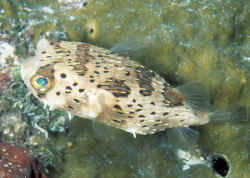
Diodon holacanthus,
Bahamas
|
Family Diodontidae are the
Porcupine or Burrfishes; their inflatable bodies are covered with
spines that are may be either permanently erect or folded down when the
animal is non-inflated. There are six genera, nineteen species in the
Atlantic, Indian and Pacific. The two genera sold, Diodon and
Chilomycterus all make excellent, if often too large in ultimate
size, aquarium fishes with limitless spunk; much too nice to be just
made into dried hang-up novelties.
Once again, here we'll highlight
the most commonly available species of Diodontids in the aquarium
interest.
| Allomycterus pilatus Whitley 1931, the
Deepwater Burrfish. Indo-west Pacific: Australia, Tasmania. To one
and a half foot in length. |
No pic
|
Genus Chilomycterus:
Irretractable spines.
| Chilomycterus affinis Gunther 1870, the
Pacific Burrfish. Tropical Pacific in distribution. To a nineteen
inches in length in the wild. Here's a one foot individual at
the end of Mexico's Baja. |
No pic
|
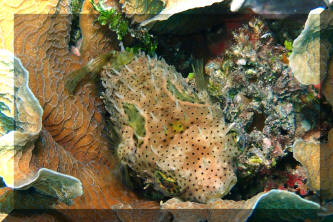
| Chilomycterus antennatus, Bridled Burrfish. Tropical
W. Atlantic. To one foot in length. Long dark patches above pectoral fins,
and one on the head; spots on body. Roatan 2016 |
 |
Bigger PIX:
The images in this table are linked
to large (desktop size) copies. Click on "framed" images
to go to the larger size. |
|
%20MD.JPG)
|
| Chilomycterus antillarum
Jordan & Rutter 1897, the Web Burrfish. Tropical western
Atlantic. To only ten inches in length. Honeycomb pattern on body w/ four
large blotches. No body spots. Note, this
genus' and Cyclichthys body spines are not
retractable. |
No pic
|
| Chilomycterus atringa (Linnaeus 1758), the
Spotted Burrfish. Western and eastern Atlantic coasts. To two feet
in length. |
No pic
|
|
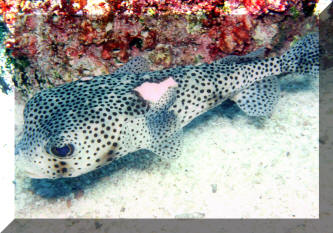
Chilomycterus reticulatus (Linnaeus 1758),
the Spotfin Burrfish. Found worldwide in tropical seas, but
uncommon. Relatively large, dark spots on body, fins. Erect,
triangular, short spines over body. To twenty two inches in
length. Here in the Galapagos.
|
|
|
Chilomycterus schoepfi (Walbaum 1792), the
Striped Burrfish. Western Atlantic coast, discontinuous in the
west Indies. To ten inches total length. Aquarium image.
|
%20MD.jpg) |
|
Chilomycterus spinosus mauretanicus (Le
Danois 1954), the Guinean Burrfish. Eastern Atlantic coast of
Africa. To ten inches in length.
|
No pic
|
Genus Cyclichthys: Eight species.
|
Cyclichthys antennatus (Cuvier 1816), the
Bridled Burrfish. Formerly placed in the genus
Chilomycterus. Tropical eastern and western Atlantic
coasts. To twelve inches in length.
|
No pic
|
| Cyclichthys hardenbergi (de
Beaufort 1939), Hardenburg's Burrfish. Western Pacific, New
Guinea to Australia. To ten inches in length. |
No pic
|
|
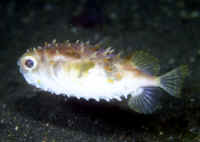
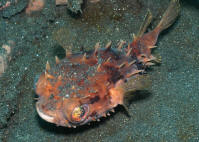
Cyclichthys orbicularis (Bloch 1785), the
Birdbeak Burrfish. Indo-west Pacific and southwest Atlantic (off
South Africa). To twelve inches in length.
|
|
Bigger PIX:
The images in this table are
linked to large (desktop size) copies. Click on "framed"
images to go to the larger size. |
%20MD.JPG) |
|
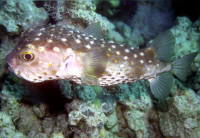
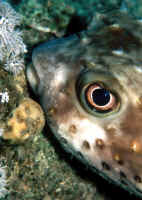
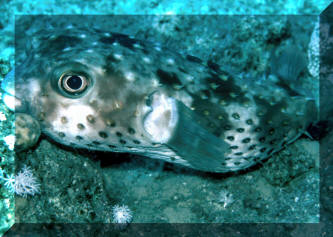
Cyclichthys spilostylus (Leis & Randall
1982), the Spotbase Burrfish. Recorded from the Indo-west Pacific
and Galapagos Islands. To thirteen inches. Formerly placed in the
genus Chilomycterus. Red Sea images.
|
|
Bigger PIX:
The images in this table are linked
to large (desktop size) copies. Click on "framed" images
to go to the larger size. |
|
|
Genus Dicotylichthys:
|
Dicotylichthys punctulatus Kaup 1855, the
Three-Barred Porcupinefish. Western coast of Australia. To
sixteen inches overall length.
|
No pic
|
Genus Diodon:
|
Diodon eydouxii Brisout de Barneville 1846,
the Pelagic Porcupinefish. Indo-Pacific. To eleven inches in
length.
|
No pic
|
|
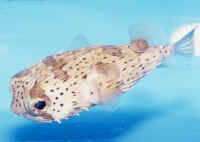
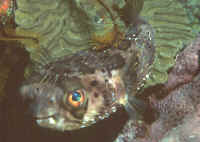
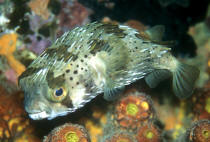
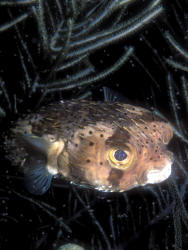
Diodon holacanthus Linnaeus 1758, the
Long-Spined Porcupinefish. Circumtropical in distribution. To
some eighteen inches in length in the wild. Can be told apart
from the similar D. liturosus by its longest spines being
on top of its head; and lacking spots on its fins. A comical, hardy addition to a fish-only
rough and tumble marine system. Aquarium, St. Lucia (Caribbean)
and Bonaire images.
|
|
|
|
|
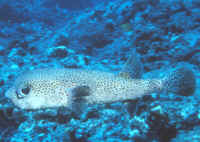
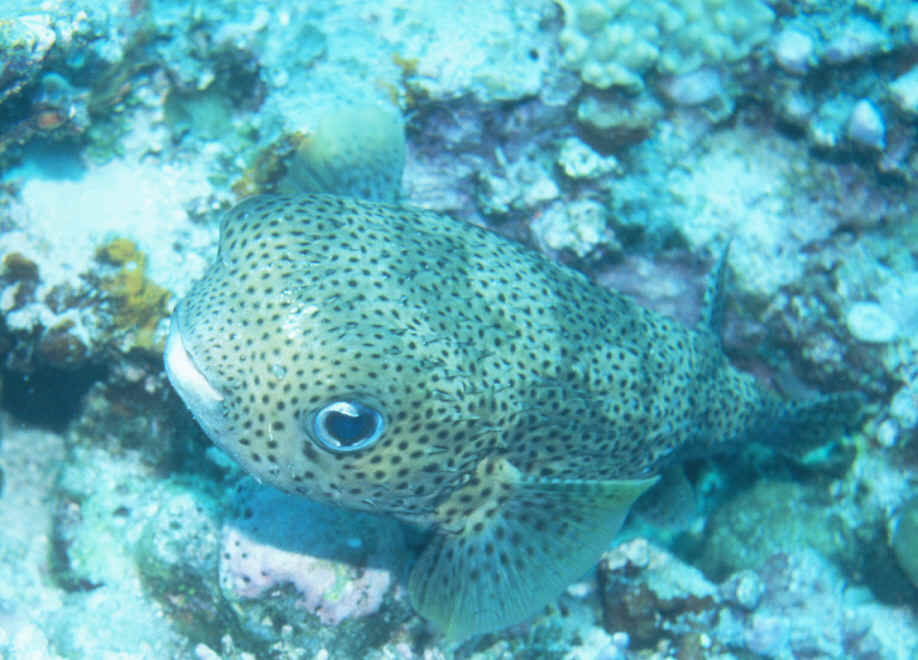
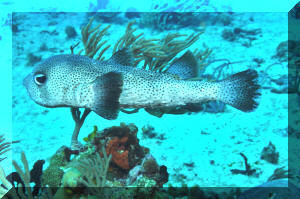
Diodon hystrix Linnaeus 1758, the Spotted
Burrfish. Circumtropical in distribution. To 28 inches in length
in the wild. Note spots on fins and long spines on body, not the head. Here are photos of specimens in Hawai'i and the
Maldives.
|
|
|
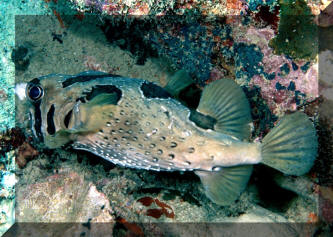
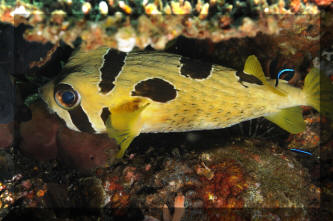
Diodon liturosus Shaw 1804, the
Black-Blotched Porcupinefish. Indo-Pacific, but not Hawai'i.
To twenty six inches long in the wild. Distinguishable from D.
holacanthus by its longest spines being just above its pectoral
fins. This one off of Pulau Redang, Malaysia.
|
|
Bigger PIX:
The images in this table are linked
to large (desktop size) copies. Click on "framed" images
to go to the larger size. |
|
|
|
Diodon nicthemerus Cuvier 1818, the Globe
Fish. Indo-Pacific. To twenty four inches in length.
|
No pic
|
|
Lophodion calori (Bianconi 1854), the
four-Bar Porcupinefish. Indo-Pacific. To twenty four inches in
length.
|
No pic
|
|
Tragulichthys jaculiferus (Cuvier 1818),
the Longspine Burrfish. Indo-west Pacific. To a foot in
length.
|
No pic
|
| Easy to avoid with careful observation. Here's a copepod
parasite on the dorsal fin of a burrfish. |
.JPG)
|
Bibliography/Further Reading:
Debelius, Helmut. Undated. Pufferfish in the marine
aquarium. Aquarium Digest International #27.
Esterbauer, Hans. 1991. The yellow-spotted Burrfish,
Chilomycterus spilostylus. TFH 12/91.
Michael, Scott W. 1997. The puffers; unique in many
ways. AFM 8/97.
Nelson, Joseph S. 1994. Fishes of the World, 3d ed. John
Wiley & Sons, NY.
Quinn, John R. 1986. Puffers & friends; a look at
the pros and cons of keeping the popular puffers. TFH 5/86.
|
|


.JPG)
.JPG)
%20MD.JPG)
%20MD.JPG)
%20MD.JPG)
%20MD.JPG)
%20MD.JPG)
%20MD.JPG)
%20MD.JPG)
%20MD.JPG)