 |
|
| Home | Marine Aquariums |
Freshwater Aquariums |
Planted Aquariums |
Brackish Systems |
Ponds,
lakes & fountains |
Turtles & Amphibians |
Aquatic Business |
Aquatic Science |
Ask the WWM Crew a Question |
| Please visit our Sponsors | ||||
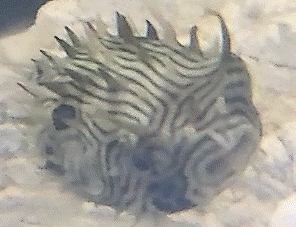
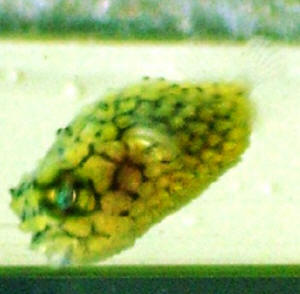
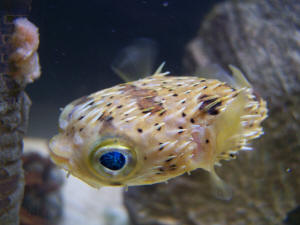
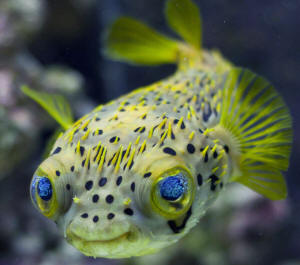
Puffer ID what kind of boxfish is this? <Hard to say for sure, but it looks like Chilomycterus schoepfi. You can find out more about these guys here http://www.wetwebmedia.com/diodontpuffers.htm and here http://www.wetwebmedia.com/puffers.htm <A HREF=" http://www.gulfspecimen.org/photographs/F-2570.GIF"> Puffer ID Follow-up I checked this page out, I never saw this one when I was looking at the puffer page for some reason. I think it more resembles Chilomycterus antillarum because I bought this fish as a "Spiny Boxfish (Brazil)." The picture of the web Burrfish looks like what I have. I looked on google to find a pic of the Chilomycterus schoepfi and it looks very similar but is mainly brown where mine has green and yellow. <I was looking at Burgess's Atlas. Both fish are fairly similar, both are Caribbean, and both max out at just under a foot long.> Thanks for the help <You are welcome. -Steven Pro> Burrfish I.D. Your website is incredible-just love it. <Thank you! Ronni here today> I bought a Burrfish yesterday that was sold as a Webb Burr Puffer (further stirring the pot 'o confusion) and after looking and looking around the internet, I just cannot determine if it is a striped Burrfish or a Web Burrfish. I keep seeing different pics on the web which are completely contradictory. Hooty's stripes are vertical down the length of his body, not horizontal across his head and he does have the occasional yellow ringed, black circle and two (devil's) horns. He's quite sharp in tan and khaki. <Hooty does indeed sound like a Web Burrfish. Go to http://www.fishbase.org and search for 'Web Burrfish' to compare him to the photo there.> I have had him 24 hours now and we continue to be on a hunger strike even though water conditions are perfect and he was offered shrimp and zooplankton.....just a battle of the wits that I'm currently losing. <Not uncommon at all for the first few days. I would assume that by now (3/26) he has begun to eat?> Being new at this I hope this question doesn't invoke a resounding belly laugh from the masses. Thanks-Julie <Nope, no laughs! Some of the fishes look so similar that even the experts have trouble telling them apart! Have a great one! Ronni> Re: Burrfish I.D. Thanks so much for your help and.......HE'S EATING!!!! ...like a little pig. <You're very welcome. It seems like Puffers never want to quit eating!> He's lovin' the krill and takes it right from my fingertips! Ummm, are they "supposed" to spit water?? He saw me standing by his tank this morning and I swear he spit water at me! <Some fish will do this as a playful gesture. Sometimes it's a sign of stress but not in this case, he was just saying 'Hello, feed me now!'> Anyhoo, is it safe to put a porcupine puffer in with Hooty? <Probably not. It's best to only have one puffer to a tank.> And, what kind of cleaner upper can I put in his tank that he won't be tempted to consume? <He's probably going to eat most any shrimp or crab that you put in the tank. He might leave some of the starfish alone, particularly the brittle stars.> Thank you again!!!-Julie <You're welcome! Ronni> Masked Puffer <These are very impressive fish. Their scientific name is Arothron diadematus. Sometimes the common dog-face puffer (Arothron nigropunctatus ) is sold as panda puffers due to some dog-faces having the black marking around their face. The Panda Puffer can get between 8-10 inches in the home aquaria depending on the diet and the tank provided. In the wild they get over a foot long. Very nice fish and a favorite of many people. Good luck with the puffer! -Magnus> Bridled Burrfish Q's Saw two great-looking specimens in the LFS, but I've had trouble finding out much of anything about this species, or Burrfish generally. Are they roughly similar to porcupine puffers as to behavior, hardiness, and dietary needs? Can you refer me to a source where I could find out more about this species? <Mmm, yes. On our site, here: http://www.wetwebmedia.com/diodontpuffers.htm and the linked FAQs, files at top... and Fishbase.org...> Definitely won't purchase from the LFS without more info. . . . <Good plan. Bob Fenner> Thanks, Joe Bridled Burrfish Q's One of your FAQ responses says that Burrfish "are not at all hardy." Does that include the bridled variety? There just isn't much info out there on how to care for this species in captivity. <Unfortunately yes, does apply... most specimens of this group are too large, roughly handled in capture, holding, shipping... and get too toxified in the long haul of going from the wild to the end-user... too often succumbing due to the ill-effects. Bob Fenner> Joe Brackish Porcupine Puffer Hi Bob! <<Actually JasonC, hello to you.>> I saw a porcupine puffer at LFS. it is listed as freshwater or brackish spices. is there a such spices? <<I looked through my limited resources of freshwater puffers and couldn't find one that is not smooth skinned. Perhaps it is mis-labeled?>> I thought porcupine puffer lives in marine water? <<The classic 'Porcupine Puffer', Diodon holocanthus is indeed a saltwater fish. Here's a link: http://www.wetwebmedia.com/diodontpuffers.htm If any of these are the fish you saw, then the store has mis-labeled it.>> Please explain..... <<I'm not sure I can. I'd be asking the fish store to explain. Cheers, J -- >> Burrfish, Spiny Boxfish, etc. (Note: make corr.) Hello Bob; I read your Burrfish article in the September 2002 FAMA with interest. I have a question regarding the identifications attached to the photos. <Thank you for this> You identify photos 54 and 55 as Chilomycterus antillarum, the Web Burrfish. The photos so identified appear to me to actually be C. schoepfi, the Striped Burrfish. <I think you're right... just looked via fishbase, Google images...> I am very familiar with these fish, having collected hundreds of them over the past three decades here in New Jersey, during late summer and early fall. They are one of he more common Gulf Stream tropical strays, and make interesting aquarium inhabitants. I presently have a 30mm specimen that I collected last month, when it was about half this size. It shares a 50 gal. aquarium with a couple of Lookdowns and other locally collected fish. It's a great little fish, totally tame, and willing to eat almost anything. <Good input> The fish that I know as the Webbed Burrfish, C antillarum, is not included in your article's photos. I have seen them often while collecting in seagrass beds in the Caribbean, but not up here. These fish have a much finer pattern of interlocking tiny hexagons, giving the appearance of a net, or web. I know taxonomy is a confusing area, with constantly shifting reclassifications. For example, I did not know that the Striped Burrfish (schoepfi) had been placed in a new genus. Nevertheless, I suspect that there may be a problem with the photo id in the article. <Indeed> I have enjoyed reading your many contributions over the years. I have been in this hobby since the 1960s, and have seen many changes. I look forward to hearing from you. Best regards, John <Thank you for this correction and useful husbandry information John. Will update the id on the morrow. Bob Fenner> |
|

|
Features: |
|
| Featured Sponsors: |
 Beauteous