|
|
| Home | Marine Aquariums |
Freshwater Aquariums |
Planted Aquariums |
Brackish Systems |
Ponds,
lakes & fountains |
Turtles & Amphibians |
Aquatic Business |
Aquatic Science |
Ask the WWM Crew a Question |
| Please visit our Sponsors | ||||
Re: Juvenile Blueface that looks like a Sixbar except.
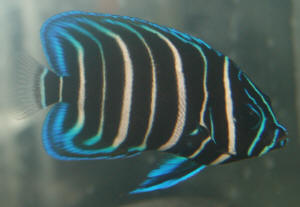
2/5/15 Juvenile Blueface that looks like a Sixbar except. Euxiphipops ID 10/24/14Hi, I have a Juvenile Angel which was about 1 inch, he was sold as a Blueface but at that size I think it is anyone's guess between a Blueface and a Sixbar. He has doubled in size and looks exactly like a Sixbar, wide white lines, no light blue lines between them, only two bars on the tail fin but he is getting the gold bar between the eyes. So I guess a lucky surprise! <Happens at times. Send along a good pic when you can> Kind regards, Adam. <BobF> Re: Juvenile Blueface that looks like a Sixbar except. 10/25/14 Hi Bob, <Adam> These guys are clever they come to the front when I stand there as they think it is yum yum time but as soon as I walk up with a camera they swim for cover, lol. I will try and take a picture he looks like a classic Sixbar, except for the Goldbar which I waited a few weeks before writing this to confirm it was. I think there is an overlap in juveniles therefore. Strangely in the UK we never saw Sixbars so the problem did not occur. I buy my fish on my retailer's word as they are about 750kms away <Wow!> and we are not allowed to take from the sea which is only about 1lm away although I have never seen them here there are meant to be around. Always see Moorish Idols which are lovely even in 1 meter of water. Kind regards, Adam. <And you, BobF>
Hi. Euxiphipops ID, and avoiding unwanted HH on DIY collected LR
8/30/14 Difference between Juvenile Euxiphipops sexstriatus and
Euxiphipops xanthometopon. 4/2/2009
Good Fish Identification Site >Hey Marina, >>Hey. >Don't know if you guys already do have a link, I did not check, any way it I was referred to it by a Marine Biologist in Hong Kong. >>Yes, it's a very good site. >My dark secret, About 3 weeks ago I bought a Majestic Angel and put it into my 50gal tank. It's a little lady about 2.5 inches and in perfect health. It's very difficult to get a healthy collected Majestics in Hong Kong. I managed to convince the guy who I buy my reef supplies/corals to get it for me (when I asked them first the response was you just have to keep buying them and hope that they survive...eeeks!!!). >>I'll say! Jeez.. >When he got this fish he called me and I just had to take it, so you understand why I took it. I paid $25 for the fish, steal huh?? >>Out here, definitely. >That's the going price here anyway. My twin daughters (5 years) just love her and call her Gabriellis (after the arch angel). I would not have got her if I did not plan to get a bigger tank later on. As you know my dream tank comes in Dec/Jan. Still, I was feeling quite guilty, and if there were any delays to my tank, I wanted to release the fish. >>Not such a good idea, my friend. >So I wrote to this Marine Biologist and enquired if there were any angels in Hong Kong waters, apparently it turns out there are 4 species which for your info are: Centropyge tibicen Chaetodontoplus septentrionalis Pomacanthus annularis Pomacanthus semicirculatus but there are no Pomacanthus Navarchus and he has requested me not to release it, so I guess I have not choice but get my tank on schedule. >>Spot on. >I am a fishing nut, I have seen damsels in Hong Kong waters and some fish that from the top look like Banggai Cardinals...not sure they spook immediately when you approach to close. Just a question on this angel, can I feed her cabbage and Broccoli? >>I see no harm, though I don't know what nutrition she'll really get from the cabbage. Nori would be excellent for her, though. >I tried it yesterday and she ate it, any side effects? >>Broccoli smells and cabbage gives me gas. I'm feeling fine, though, thank you. >She takes spinach and lettuce readily. She is a real lady, does not molest the corals in my tank. >>Do watch the LPS corals. >Very well behaved. When my large tank arrives (400 gal) I will introduce a smaller Asfur, any problems? These are my absolute two favorite fish. >>We like to avoid mixing angels of the same genus unless there's a great deal of room. Differing genus' may be worth a try, though I would watch all angels carefully. >Kind Regards, Jorell >>Do take care. Marina Blueface angel eyespot disappearing with growth Hi, <Hello there> I've been in the marine aquarium hobby about 25 years. I started way back in the "caveman" days with undergravel filters and crushed coral. I have definitely had my share of heartbreak and disappointments with ich until I "learned" the absolute essential of quarantining. I then became a fanatic about quarantining - and I do it a minimum of 6 weeks just to be sure. Since I've done this one simple step of quarantining, I've have never had ich in my main systems. I've still lost some while in quarantine, but all of my main systems have remained ich free. Yes, ich-free is possible. <Agreed> I actually started doing the transfer method (aka water change method w/ bare bottom vacuuming today) back in the late eighties. This is somewhat of an intense process, but I believe is the very best method of eliminating ich in quarantine - not to mention that it's chemical-free. I was thrilled that you guys are such proponents of intense quarantine practices upon discovering your website some years ago. It is probably the single most important thing to learn in order not to become frustrated and drop out of the hobby. <Perhaps so... vies with a lack of ready, useful information IMO> Anyway, about four years ago I moved and was able to set up my dream tank: A four hundred gallon (96"x30"x32"). FOWLR, DSB, 125 gallon sump with two Red Sea turbo skimmers - I know, I could stand to upgrade here but the newer turbo series is way better than the old venturi models that Red Sea has. Anyway, the current occupants are: 10" Blueface Angel, 6" Rock Beauty Angel (alive and doing well for over four years now :-)), 4" Flame Angel, 4" Lemonpeel Angel, 8" Blue Tang, 8" Blonde Naso Tang, 6" Purple Tang, 8" Harlequin Tusk, 5" Clown Trigger, 4" Stars and Stripes Puffer, 4" Bicolor Goatfish, 4" Yellow Goatfish, 3" four-stripe damsel, and two 2" yellowtail damsels. All are doing well and thriving. A special thanks to Bob Fenner regarding the Goatfish. <Welcome> I read his article about them which inspired me to try them - mostly for stirring up my sand. They are really cool, both behaviorally as well as functionally. Now to my question. Or, I guess it's really more of an observation. I have had the Blueface angel for about 5 years now. I got him at about 4-5 inches with his full adult coloration which included the black eyespot on the rear top fin. As he has grown this eyespot has slowly faded and has now disappeared. It is totally non-existent now. I have seen pictures of wild specimens where this eyespot is still present on similarly very large full adult specimens such as mine is now. Does anyone know if this disappearance of the blueface's eyespot with age/growth is normal? Or, is it related to something else? <Interesting possibility... perhaps the "false eyespot" has utility in the wild (where there are more predators), but whatever mechanism for its expression is somehow lost in captivity...> Thanks for all you are doing for this hobby. Tom Duck <Thank you for sharing your experiences, opinions as well. Bob Fenner> Blue Face Angel question Hello! I have a question regarding
the Blue Face Angel ( Pomacanthus (Euxiphipops) xanthometopon). I have
a juvenile, and trying to figure out what it will look like when it
grows up :-) Your picture of one is here:
http://www.wetwebmedia.com/marine/fishes/angels/pomacanthus/Pomacanthus.htm
(about 3/4 down the page, 3 pics of different stages) But here is
another:
http://saltaquarium.about.com/library/blank/blpcontestjan03critter.htm (entry
#6) <What is this?> There is quite a difference between the two -
especially with the color orange on the fins and face of one, but not
the other. Is one fish another type, one is male and the other female,
or just an older specimen? I'm trying to show my kids what this
"baby" will be, so any help you can give would be greatly
appreciated! THANK YOU! -Cathy in Texas <>< <Sorry,
don't follow where you're referring to. This species does
display a good deal of intraspecific color variation... hence both
common names, "Blue Face" "Yellow-Face"... Bob
Fenner>
|
|

|
Features: |
|
| Featured Sponsors: |