|
|
| Home | Marine Aquariums |
Freshwater Aquariums |
Planted Aquariums |
Brackish Systems |
Ponds,
lakes & fountains |
Turtles & Amphibians |
Aquatic Business |
Aquatic Science |
Ask the WWM Crew a Question |
| Please visit our Sponsors | ||||
Yet another question - Heliofungia care --
10/07/11
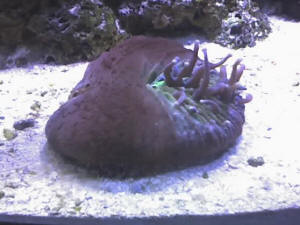
Heliofungia actiniformis - Signed Death Warrant 6/1/06 Ladies and gentlemen of WWM the service you perform is spectacular. <Wowzah! High praise indeed!> I have what appears to be a huge problem with a Purple Plate Coral. The specimen that I received has either been epoxied or puttied to a piece of live rock. <!> The rock is situated in such a way that the tissue of the coral is not rubbing against it. Because of the delicate nature of the plate coral I am reluctant to try to remove it from the rock, but everything I have read, especially here, tells me that it is a goner! <Likely so. Not a sturdy aquarium species.> I can place the specimen in such a way that tissue is not touching any rock other than the piece it is mounted to. <This is best> Do you think I should try to dislodge it, or just try to make it as comfortable as possible until the end? <This latter> It seems to be eating. I feed it a blended mixture (to try to minimize the particle size) of DT's plankton and oyster eggs, Sweetwater zooplankton, and either mysis shrimp, SF's Reef Plankton every or some other meaty foods every other day. The coral puts out it's mucus web and traps the food and takes it in. What do you think I should do? Thanks Roy <Perhaps this specimen will dislodge itself... or reproduce through fission or via acanthocauli... For browsers, our coverage: http://wetwebmedia.com/fungiids2.htm Bob Fenner> Plate coral Hi, I have a 80 gallon eclipse tank
with about 60-80 pounds of live rock and 40 pounds of coral
substrate not a sand type of bottom. I also have 1 three stripe damsel,
1 yellow damsel, 1 Gregory damsel ,and a Clarkii clown. Well I was
wondering if I were able to put a plate coral into my system; however I
only have 80 watts of illumination in blue and white spectrums. But, I
do have the tank near a kitchen sliding door where natural light shines
on the tank. not direct sunlight. Some websites say that the plate
coral need a sandy bottom is this true, because I really don't want
to go through the hassle of removing all of the substrate and replacing
it. I also add some Kent liquid calcium daily for my live rock. Overall
will this set up be sufficient enough to support these corals. If not
is there an other sorts of corals or invertebrates that would survive
in my situation. Heliofungia care 10/05/04 Hi Anthony: <cheers, Greg> Hope all is well (and the various writing projects are coming along). <plugging away feverishly at times <G>> It's been a while since I needed to solicit your advice, but.... I have a beautiful Heliofungia actiniformis (bright green body with white-tipped brown tentacles) that has begun to look very odd. At least to me. <beautiful coral... but rather difficult to keep and extremely sensitive to damage and mishandling. They must be kept on fine (sugar-sized, oolitic) sand and favor deep mature sand beds (over 4" and over 1year old) to thrive if not survive! Never place them on rocks for any reason. They are also only satisfied by Zooxanthellate symbiosis less than 80%... that means heavy feeding. Yet you cannot easily target feed them organismally (particles). Rather, they need nanoplankton which aquarists cannot readily supply... short of sand stirring of that deep mature DSB, etc. You begin to see the challenges of this coral and why many starve to death slowly in captivity after some months> I have had him on a soft sand bottom in my 110g reef tank (24" deep) for approximately a month. The tank has dual 250w MH 10K lighting and I have been feeding him fine foods two or three times a week. <all sounds good... although the lights may be a tad bright for this specimen> The problem is that he has begun to show mesenterial filaments from the base of about a dozen of his tentacles. It's as if he has a bunch of tiny holes in him. <perhaps some nibbling by a Centropyge or Zebrasoma in the tank? Common> If this had happened initially I would have though "mishandling." But it seems strange that this would show up after he has looked so good for a month. I know that's not long really, but the little "holes" are confusing me. Also, he is in light flow, so I don't think the current has caused the "injury." <Hmmm... you really do seem aware of its needs and have done the right things IMO> Any ideas would be greatly appreciated. As always, thank you and all the other volunteers for sharing your time and opinions. Certainly service to the greater good! Take care, Greg <I'm wondering if it isn't just finally showing signs of wear from the rigors or import. My advice here is to simply let it be. You are doing all the right things as far as I can tell. Best to leave the stressed beast rest quietly. Do look for possible nibblers in the meantime. kindly, Anthony> Heliofungia care II 10/05/04 Thanks for the response. I do have an Eibli in the tank, but he has been in with various species of Euphyllia, Nemanzophyllia, and Plerogyra and Physogyra for about six months <six months is hardly a track record, my friend... not safe yet <G>> and I have not had any problems with them or noticed him nipping at any of them (he is my personal fave...I'd hate to remove him without knowing he's the culprit). In your experience, do the Centropyge pick on Heliofungia more than other LPS? <they are in fact more prone to nipping corals than most other Centropyge... this is a strong candidate here> (Maybe he's mad I added something to "his" tank without proper consultation!!) As to the lights, I mounted them about 16" above the tank due to my love for the LPS, <ah, good> I hope this is high enough...that's the advice I got from various sources when I had the opportunity to pick up the lights on the cheap. <I agree with the distance... but doubt the savings on the initial purchase can compare to the expense of extra/unnecessary ongoing cost of operation> I bought the 250s because I am planning to set up a longer SPS tank in the near future and thought I could lower the lights to the proper height at that time and "strategically place" my LPS corals toward the edges of the tank so they would get bright indirect light. <yes... perhaps :)> Also, you gave me a thought. I have been feeding the Helio with zooplankton, but also with finely crushed Formula One. <both are likely too large... Cyclop-eeze might even be a little big, but very good if taken> It seems to eat both, but do you think that maybe the Formula One was too large and could have caused a massive outbreak of bacteria that has had a deleterious effect on him? <too large, yes> Just a thought. I have read several sources (including the BOCP, I believe) that said "finely shredded" ocean meats were appropriate for these corals. Anyway, what do you think? <true... very fine matter> Finally, the coral is definitely taking a turn for the worse. Everyday, fewer and fewer of his tentacles are coming out and he has started to get an abnormally thick mucus layer. <aieee! The mucus layer (if clear) is a feeding strategy! Please do not remove. Fungiids produce this daily... wait for bacteria and nanoplankton to stick to it... then suck it back in to digest it> I siphon this off, but do you think an iodine bath or other therapy might be appropriate at this point. <almost never... more harm than good (stress)> Or should I just leave him to his fate and continue "supportive therapy"? Thanks for the support. Good luck with the books. Take care, Greg <always welcome my friend> P.S., if this coral doesn't make it, I would like to try again (after an appropriate grieving period of course... reading and learning more than grieving, but still). Do you have any recommendations as to where/who has the appropriate knowledge/technique to supply well-handled, healthy specimens? <always/only local... never buy this one sight unseen> Or would your advice be to leave these guys in the ocean and break out the scuba gear? Thanks again. <there are definitely better Fungiids. DO check out Cycloseris species... some bright orange ones are imported. Anthony> Plate Coral (Heliofungia) Hi. Just a question about my plate coral. It's a brand new purchase. <FYI this coral is actually a rather delicate (primarily with regard for handling) species. NOT recommended for beginners by any stretch of the imagination. Actually significantly dependent on organismal and absorptive feedings as well. Even with "perfect" lights, this animal may only be satisfied by up to 80% (by some estimates) by photosynthesis. So, without feeding, most are remitted to slow starvation and death by 10-18 months. Do take heed and research if you were not already familiar. They must also be kept on a soft sand bottom. Never on rock (a surefire way to kill them: cycling polyp tissue abrades, or the animal simply inflates, falls and gets torn> The coral is beautiful and expanded. I was wondering about it's color and some spots on the tentacles. The color is almost exactly the same as my BTA. The coral is a light brown with lighter tips. Does this tell what part of the reef it came from or better yet, narrow down it's lighting requirements? <neither> I thought the brighter the specimen, the more light it needs. <nope... many highly iridescent coral are from very deep water. Pigmentation can be used to reflect light away or refract weak light within (amplify, sort of)> I was thinking medium. <OK> The spots I noticed, after I got it home of coarse, almost look like small tears or weak spots on the tentacles. The spots are darker brown on the outside, and look like weekend tissue on the inside. Any thoughts on this would be nice. <indeed... many wholesalers and retailers do not know how to handle this animal. If you bought it off of a perched rock or placed it so... it could get a little rough. > Also, do I need to place this coral on the substrate? <absolutely critical for survival> I know they move around, and have read about them climbing rocks. Thanks! -Becky <best regards, Anthony> |
|

|
Features: |
|
| Featured Sponsors: |
.jpg)
.JPG)