 |
|
| Home | Marine Aquariums |
Freshwater Aquariums |
Planted Aquariums |
Brackish Systems |
Ponds,
lakes & fountains |
Turtles & Amphibians |
Aquatic Business |
Aquatic Science |
Ask the WWM Crew a Question |
| Please visit our Sponsors | ||||
Re new H. melasmapomus; beh.
Panicky canary wrasse following copper treatment
2/26/16 Wrasse aggression; beh. 9/2/2013 H. leucoxanthus in hiding 12/08/12 Halichoeres chrysus swim
behavior 12/30/11
Yellow Wrasse, beh. 11/1/11 Yellow Wrasse, colour beh.
9/12/10 Christmas wrasse, beh.
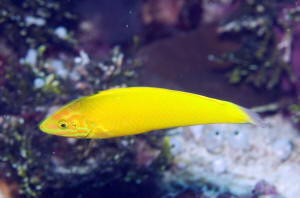
9/27/09 Canary Wrasse/Behavior 1/21/09 I recently purchased a small (1") Canary Wrasse and put it in a small 15gal tank with 2 Perculas, a small Magenta Dottyback, 1 very small Yellow Damsel, and 2 very young Yellow Tail Blue Damsels, 3 hermit crabs and 2 Trochus snails, a few soft corals and lots of different macroalgaes. Note this tank is not to be the final tank for all these fish..it is just a quarantine tank I use for new fish going into my 150 gal reef tank. <The Canary Wrasse isn't completely reef safe. It will eat Fireworms and Pyramidellid snails, protecting corals and clams. In addition, it may eat feather dusters, small shrimp, and tubeworms.> Immediately the wrasse dove into the fine sand at high speed...a few hours later he was out and swimming...and then buried himself again and then moved somewhere else. This was 4 days ago and I have not seen it since. It just does not appear to be in the tank at all. It never comes out to feed, etc. There is a small amount of live rock piled in the back. I understand that this type of wrasse will bury itself when sleeping or threatened...but is 4 days unusual? <Since most wrasses are jumpers, A tight fitting cover is needed. Have you checked the floor around the rear of the tank. You may find him there. This particular fish is a little skittish and more apt to jump than others, especially with damsels present. The Canary Wrasse should only be kept with peaceful fish.> I would think that if it had died I would see some remains--it would take more than 1/2 a day to be eaten by the tank's residence. So do I presume it dead? Or is this typical behaviour? <Can be but generally not for that long a period. You may want to stir the bottom, see if you can flush him out.> thanks <You're welcome. James (Salty Dog)> Sleeping/Hiding Wrasse, Halichoeres beh. 10/13/08 Hello crew. <Hello Jessy here> I went by the fish shop yesterday and picked up my new wrasse and I am just wondering how long until I should begin worrying about it hiding/sleeping in the sand? The fish store said that it was a h. melanurus but I think it is a h. leucurus about 4" long. I acclimated her for 2 hours using the well-known drip method like I always do and she swam around for 5 minutes then bolted into the sand bed. <Normal> I know that this is normal for them to sleep or hide in the sand bed but it has been 24 hours now and she has not come out. I am pretty sure I know where she is hiding so I am not sure if I should disturb the area where she is to see if she is alive or just leave her be and not add to the stress. <Leave her be. I had a newly introduced wrasse stay hidden for an entire week> I have had my tank up and running for over 2yrs now. It is a 55gallon w/30gallon sump/refuge and houses a cinnamon clownfish, a sleeper banded goby, various mushroom corals and polyps and about 50lbs of live rock with a 4inch sand bed. Also I was wondering if you could point me in the right direction to find out information on the h. leucurus because I have found very little information on this particular fish. <Fairy & Rainbow Wrasses and their relatives by Rudie H. Kuiter is a GREAT reference book on wrasses.> Thanks for the help. <Regards, Jessy> My Yellow Wrasse has ��Vanished�� �� 08/11/08 I recently bought a yellow wrasse or canary wrasse, banana wrasse. Whatever name you would use to refer to it. <<Mmm, Halichoeres chrysus maybe��and an exemplary aquarium species if so, in my opinion (can be seen here, about a third of the way down the page: http://www.wetwebmedia.com/halichoeres.htm >> I made one big mistake I did not research well enough to know what to expect. <<Lesson learned then>> I acclimated my fish and released in him into my QT which is set up with live rock and sand. <<It��s good that you have some structure and substrate for this fish, but this is a species I feel does not warrant the QT and will do better if introduced directly to the display tank>> This is where I went wrong. I released him, watched him for about two minutes and went to get a soda from the kitchen. When I returned it was gone. Knowing that they can be jumpers and that I have a small gap near the skimmer I searched the floor. It didn't jump out and I knew that they sleep in the sand at night so I figured he was hiding. <<Indeed�� These wrasses will often dive in to the substrate straight-away upon introduction>> After 8 hours I decided it was time to look for him. <<Best to not disturb/further stress the wrasse. I have seen these and similar behaving species hide for ��days�� at a time, especially after a stressful event such as capture/transport/introduction to a new environment. The wrasse will emerge on its own in good time>> I picked up all my rock and tried to place it back where it was. <<If the rocks are large or heavy this may pose a problem if placed atop the fish��s burial spot��removing the rock and replacing it with a single short piece of PVC pipe for the fish to hide in once it emerges might be best now>> My concerns are these. I have very fine sand, is this a problem for them to breathe under? <<Not at all�� Though they can handle a variety of grain size, the larger sizes tend to abrade and can lead to damage and infection. Sugar-fine sand is to be preferred in my opinion>> Could I have set a rock or it has dug under a rock and got trapped? <<The former is a possibility if the rock is large/heavy��but even so, I think this possibility is remote>> Do you think a 4 day wait would be a good time to see if it comes out? <<I have seen them stay buried for longer periods with no ill effect, so��yes, give the fish some time to settle/adjust>> Thanks, Gary <<Happy to assist. EricR>>
Missing Wrasse And Aggressive Yellow Tang (Environmentally Induced?) �� 03/21/08 Dusky Wrasse (Halichoeres marginatus) has disappeared. <<Ah! Halichoeres is among my top two favorite genera of wrasses (the other being Macropharyngodon)>> It was placed in the main tank 18 hours ago. <<Mmm, then this ��disappearance�� is neither uncommon nor unusual. These fish very often retreat to the substrate; sometimes for days at a time, when stressed��(as in being captured/transported to a new environment)>> I moved some upper layer rocks to try to find him, and then realized I could have crushed him in the sand. <<Is best to leave alone. Forcing the fish out of hiding only compounds the issue/the fish��s stress>>>> I then replaced all the live rock to it's original place. I checked the sand but could not find this fish. <<Again��not a good idea>> I checked behind the tank and the floor, but could not find it (I do have a dog who would have probably eaten a tasty little fish had she found it on the floor). <<The wrasse is likely still in the tank (though this genus ��will�� jump) and should (hopefully) reappear when ready>> A yellow tang was seriously harassing the wrasse, even with the lights out. <<Mmm��another stressor��>> This tang bullied three Banggai cardinals despite rockwork rearrangement. <<Hmm, not typical��you may have a ��mean�� individual��or the environment is just too small for the tang>> They died after two weeks. <<Stress��kills people too>> I would like to add four more fish; but should I be concerned that this tang is going to bully/kill all new additions? <<Does appear so>> I really enjoy watching "sunshine" as my children call him and do not wish to find him a new home. <<Perhaps just a bigger one�� And��is this fish well fed? A full belly can go far toward tempering aggressions>> Any advice you have would be greatly appreciated. <<Am trying>> I currently have 1 yellow tang, 1 lawnmower blenny, 1 neon goby, 4 blue/green chromis, 1 Firefish goby, 1 cleaner shrimp, 2 peppermint shrimp, 1 serpent sea star, mushroom coral, green star polyp coral, various reef cleaners. I have a 75 gallon AGA, <<I consider this size tank as ��marginal�� for the Yellow Tang and likely has much to do with the fish��s aggressive behavior>> 125 gallon ProClear overflow and sump, 2300 ViaAqua pump, Corallife power compact lights; 260 Watts, 125 Corallife protein skimmer, Turbo Twist UV sterilizer, 2 power heads, 40 lbs. of live sand, sea shell rubble and aragonite, 75 lbs. of live rock. Running six months now. Ammonia 0, Nitrite 0, pH 8.0, Nitrates 5 - 10. <<Nitrates should be lower with the inverts in the system��5ppm or less>> Ten gallon water change 14 - 20 days (dechlorinated tap water, circulated about 24 hours). <<The tap water is possibly a source for Nitrates��but is easy enough to test>> One last thing, if I may. <<Certainly>> I am contemplating upgrading the pump, as I have discovered by actually measuring the output that the water turnover is only about 240 gallons per hour. <<I see>> Do you have any suggestions? <<Your overflow has only a single 1�� drain��upgrading the return pump still limits you to a maximum of 300gph. The 240gph you have running through the sump is quite adequate (and a lot less noisy than a higher flow rate will be). Unless you are having problems I suggest you leave the return pump as is, and look rather to adding some supplemental flow to the display with a powerhead or two>> Sincerely, Victoria <<Regards, EricR>> Halichoeres chrysus... beh. �� 10/30/2007 Hello, <Jason> Recently I purchased a Yellow Wrasse, and I am deeply in love with it (even though I��ve seen it twice in the last three days)! <Ahh... "absence makes the heart grow..."> Other than the disappearing acts, I have experienced other strange behaviours in my tank since adding this fish. My Blue Tang seems to have developed a great admiration for this fish, and seems to copy (almost synchronised) everything that it does, which it has never done with the other aquarium fish before. I��m worried that this might be keeping the Wrasse in hiding for longer. <Mmm, not likely... are just shy, retiring> Also with my purchase, I got a nice piece of live rock which is covered on many polyps. At a closer glimpse I��ve noticed a few what I think to be clams and fan worms. What are the chances of them surviving in my 8 month tank? <Some> Also on that live rock, I��ve noticed two clear anemone-like things, which have turned into three in two days. I��m afraid that it might be glass/Aiptasia anemones. <Maybe> How can I remove them with a Yellow Wrasse in the tank? Will it give hermit crabs any trouble? Or will the crab be able to fend it off? Thanks, Jason. <... Please read here: http://wetwebmedia.com/ca/cav1i3/aiptasia_impressions/aiptaisia_impressions.htm and the linked files at the bottom. Bob Fenner> New slippery dick wrasse 9/12/05 We just picked up a juvenile slippery dick wrasse yesterday and put him in our quarantine tank (after a two hour acclimation period). He immediately went to the bottom and was laying on his side breathing heavily but not gasping. <Not atypical... this is a very active species, that in shipping, runs out of oxygen easily> He would go upright but then slowly sag to the side again. He eventually made his way into one of the pvc pipes where he spent the night. He is still there this morning, still on his side and still breathing rather heavily but not gasping. Should we be worried about this behavior? I know they like to bury themselves in the sand but had not heard about them lying on their sides like this. Thanks for your help, Sally <Need to be moved expediently, packed with oxygen (which also exerts an anesthetic effect)... in the dark... acclimated quickly... Hopefully yours will make a full recovery. Bob Fenner> Hiding Christmas wrasse 9/5/05 Hello Everyone, <Hello> I bought a Christmas Wrasse on Friday. They had just gotten there shipment in an hour ago from Hawaii. When I saw him he looked really healthy and active. I bought him and put him in my 55gal. tank as my last fish. He swam around for about 15-20 minutes I went away from the tank for a few minutes and when I came back he was gone. I do have 25lbs. of live rock so there are places to hide. I have checked around the tank and I know that he didn't jump. The tank is covered with crushed coral over an undergravel filter. The crushed coral is about 1cm. in diameter with lots of small shells in it. This is the third day of hiding. I haven't seen him since about 8pm.EST on Friday. I don't have any overly aggressive fish. When I put him in none of the fish were really bothering him other than the usual new tankmate curiosity. Thanks for your help <It's disturbing to hear from someone that purchases a fish without knowing all the requirements. Wrasses like to burrow in the sand at night, not crushed coral, it's a little rough on the skin. Please search "wrasses" on the WWM and read. James (Salty Dog)> Re: Hiding Christmas wrasse 9/7/05 I usually do lots of research on a fish before buying it. But I had a hard time finding any information on it. I did know that it is reasonably easy to keep and gets about 6". I completely forgot most wrasses like to bury themselves. Mainly because I have a blueheaded wrasse and he doesn't bury himself. Do you know if sand would work with an undergravel filter? <No, if you have live rock the UG isn't needed. They are also potential nitrate factories if not cleaned regularly.> I was wondering if it would clog it. I still have not seen the wrasse. Is it normal for new additions to hide for this long? <Very possible. Try keeping the lights off for a few days, it aids in their ability to adapt. Also, please reply to the original message in the future so we know where to direct the mail. James (Salty Dog)> thanks for your help <You're welcome> Halichoeres chrysus Good evening, <And you> Question re Halichoeres chrysus, Adult. I have a 120 gal reef tank with a few soft corals a mushroom and about 130 pounds of live rock. I have recently introduced this fine, apparently healthy specimen. Great depth of color, full, clear fins and tail. Eating like a horse. After a settling period of two days, it has started to act strangely, violently flicking itself, quick respiration and the middle black dot on it's top fin turns grey. The thing is, this fish seems to be reacting to me approaching the tank and putting on some type of defensive display? <Maybe> Is this fish known to perform this way? What else could be causing this? <"Adjustment" to the system, setting, tankmates> Water parameters are PH 8.23, Ammonia <.1, Nitrate and Nitrite are 0, temp. 25.5 centigrade, salinity 1.025. <These all are good. Bob Fenner> Many thanks, Jordon Wrasse Follow-up with a Coral Question Hello there, <Good morning.> I think I solved the mystery. The wrasse was just hungry! I have been feeding sparingly as I am still in the initial month of stocking and had clearly underestimated this fish's appetite. This evening I fed it some large krill and it wolfed them down whole until it was bulging and calmed right down. <Glad to hear it.> On another note, a recently introduced Lobophyton keeps skirting after a day or so of opening (fully and apparently very healthy). It has now done this three or so times i.e.. Open for a day, closed for three/four days. I have tried to move higher/lower and into current and out but don't seem to get him settled? Should I just leave him in "a" position for a few weeks to see if this works or keep moving? Any other thoughts? Tank stats below. <Please stop moving him around. I know it is difficult to resist that urge to do something when things do not look right, but forcing a coral to keep adapting to changing light is a very good way to kill it. Patience is the ultimate virtue in this hobby.> Many thanks, Jordon <You are welcome. -Steven Pro> Halichoeres chrysus Burying Habits The new Halichoeres chrysus is really going at the sand bed. I have a 1/2 inch of fine coral sand. Question is, does this guy NEED a deep/er sand bed? The LFS said no and I can't find any reference to any depth requirement. Should he be able to burry himself or just dig around? <It will need to bury itself. -Steven Pro> Halichoeres chrysus Burying Habits I just answered my own question! I couldn't bear looking at him dive into the glass bottom any longer and so I pushed some sand into a heap and 10 seconds later he was buried in it and has been there ever since! I think I will leave this mound there and just stir it up every now and again so it doesn't go septic. <No need to worry about stirring the sand. The wrasse will take care of that himself. Best regards, Jordon <Have a nice weekend. -Steven Pro> Disappearing Christmas Wrasse I also bought a small Christmas Wrasse and he always seems to disappear about 4 pm. Really weird and then I don't see him to the next day. Any info on him would be appreciated. <This is rather well documented. Many wrasses bury themselves at night for protection. You can begin further investigation/education here http://www.wetwebmedia.com/marine/fishes/wrasses/index.htm -Steven Pro> Subterranean Yellow Wrasse Hello Fish Guy(s), Yesterday, we purchased a Yellow Wrasse for our 35 gallon tank. The store clerk warned us that when they get scared, they burrow into the sand/rock in the tank. So, we expected that he would do this when we added him to the tank, and he did. Only, that was yesterday at about 4pm. We have seen hide nor hair of him since. No rocks moving, no head poking out, nothing. We're starting to get worried. Is this normal for the Wrasse? How long will he be indisposed? <Is normal, may spend another day or so out of sight, most nights. Do you know what species this is? May be Halichoeres chrysus... or something much larger (too large for your size system). Please see here re: http://www.wetwebmedia.com/halichoeres.htm and possibly the wrasses (diversity, in blue, at top) beyond. Bob Fenner> Thanks, Kerry Re: Yellow Wrasse It is the Halichoeres chrysus. Is this ok for a 35 gallon? Or is he one of the larger Wrasses? <One of the smaller species, but this is about the smallest system I would keep one in> Thanks for the help, hopefully our Wrasse will make an appearance soon. <Me too. Bob Fenner> - Canary Wrasse Disappearance - Hello all: I just added 2 canary wrasses to my 125G FOw/oLR. As the tanks at the LFS did not have sand beds, both wrasses happily dove into the gravel when introduced on Sunday afternoon. Both made an appearance on Monday afternoon and both ate well. However, I have not seen either wrasse since Monday. I read the articles on the website that stated that these wrasses may hide for two or three days, but this time period seems unusually long. <Not for new introductions...> How are they surviving if I feed the tank while they are buried? <They are likely going hungry for the moment.> Do you think that they will appear in due course? <I do hope so, but you might also check the floor behind the tank. These fish can fly through the air with the greatest of ease... need to keep your tank well covered to prevent accidental loss.> As always, your input in valued. Thanks, Mitch <Cheers, J -- > - Expensive Tastes - Jason: Thanks for your reply. <My pleasure.> The mystery has been solved... my porcupine puffer saw both of these fish as an opportunity to satisfy his hunger pangs. <Oh bummer... those puffers do things like that. Sorry to hear of your loss.> Mitch <Cheers, J -- > Frightened Canary (4/21/04 Hello WWM crew, <Steve Allen with you this evening.> We have had a Canary Wrasse (Halichoeres chrysus) in our tank for about 6-7 months now. He was doing great up until a couple weeks ago. He was really active, swimming around the entire tank, curious, and his feeding/sleeping schedule was like clockwork every day. But lately he's seemed out of sorts. He disappears for a day or 2 at a time and doesn't come out at his normal time for feeding like he used to. If he does come out, it's usually later at night. We feed him when he comes out and he eats, so we're assuming being hungry isn't the problem. But also, now that he's been gone for longer periods of time we've noticed the other fish (a tomato clown, and a damsel <What kind?> that's being given up for adoption soon) will chase him around and pick on him when he does come out of hiding. They never had problems getting along before. <None that you noticed anyway. I have little doubt that they started at some point before he started to hide and you just didn't happen to be there at the right moment to see it. It does not take much to spook this Wrasse.> We've tested the water, and everything seems normal. His coloring still looks normal too. The Wrasse is our favorite fish, we don't want to lose him. Any idea what might be causing his strange behavior? <The Tomato and the Damsel. They are well known to grow more aggressive with age. This Wrasse is obviously afraid. Unless you have some other aggressive fish, they're the culprits.> How long can he stay in hiding before we should start worrying about him? <You probably have to choose between the Wrasse and the other two. One thing to try first would be to remove the Tomato and the Damsel to a quarantine tank and re-arrange the rocks in the display. Then put them back in after the Wrasse has had a couple of weeks to settle down. However, I fear they will start back up where they left off fairly quickly.> Thanks, Kerry <Hope this helps.> Wrasse Impasse? (Missing Canary Wrasse) I recently bought a Canary Wrasse (4 days ago to be exact). I haven't seen him much, I am aware of wrasse behavior for the most part, but I think he has been hiding a little too long. I don't think he has been out much more than 2-3 hours since I brought him home. Should I be worried yet? I have a Neon Dottyback that seems to be a bit of a brat, a Longnose Hawk, and a Lyretail Anthias, This beautiful fish is new as well and seem to be doing well. Is it time to worry ???? Thank you, KJ <Well, KJ- I would not worry just yet. As you are aware, these guys are very adept at hiding in the sand or rockwork until they are ready to come out and be sociable! One of my favorite fishes! Even though the fish is in hiding, the fish can find food to eat in the rocks and sand. Halichoeres species wrasses can be a bit secretive, but will eventually spend lots of time out in the open where you can see their interesting behavior. I'd give him/her a little more time. If more than a week goes by without seeing the fish, then I'd start to get concerned. Although the Neon Dottyback can be a bit of a troublemaker, I'll bet that he is not harassing the clever and tough wrasse. These guys can hold their own! Hang in there, keep observing, and do be prepared to take action (removing a the fish if it is in distress, etc.) if it is required. Good luck! Regards, Scott F.> Yellow Wrasse - 05/23/05 Hey, <Hey!> Yesterday I
purchased a cleaner wrasse <Yikes! Take it back if you
can...destined to starve to death.> and a yellow wrasse for my 90
gallon reef tank. The cleaner wrasse was real busy with the other
fishes, and it eats about anything I feed with great pleasure. However,
the yellow wrasse is a different story. As soon as I introduced him
into the tank, he burst into the thick sand bed. I was worried that it
died, but today it came out wondering for half an hour then
disappeared. It missed out the feeding time. Is this fish hunting for
food in the sand? Or does it just like to sleep all day long? Is there
anyway to feed this fish or do I have to wait until it comes out of the
sand? <If this is a Halichoeres chrysus this behavior is normal. The
wrasse will eventually settle in and be seen more...and become a very
capable bristle worm predator. These fish are actually quite personable
and very hardy feeders...once acclimated to your tank. Try tempting it
to feed with thawed frozen Mysis shrimp and/or glass worms (mosquito
larvae).> Thank You |
|

|
Features: |
|
| Featured Sponsors: |