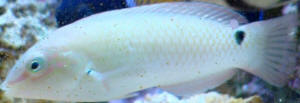
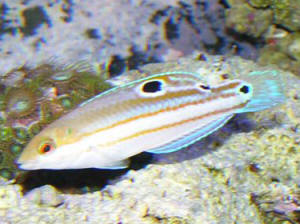
|
FAQs on
Halichoeres
Wrasse Identification
Related Articles: Halichoeres Wrasses,
Related FAQs: Halichoeres 1, Halichoeres 2, Halichoeres Behavior, Halichoeres Compatibility, Halichoeres Selection, Halichoeres Systems, Halichoeres Feeding, Halichoeres Disease, Halichoeres Reproduction, Wrasses, Wrasse Selection, Wrasse Behavior, Wrasse Compatibility, Wrasse Feeding, Wrasse Diseases,
|
|
|
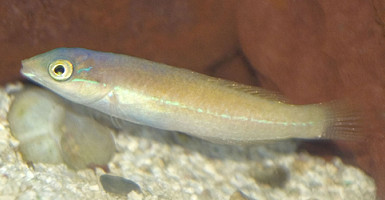
Marshall Island Wrasse ID help/request
8/15/19
<Oh yeah,
Halichoeres trimaculatus (Quoy & Gaimard 1824), the Three-spot Wrasse.
Indo-Pacific. To eleven inches in length. BobF>
Scott D Cohen
Sea Dwelling Creatures, Inc.
|
.jpg) |
|
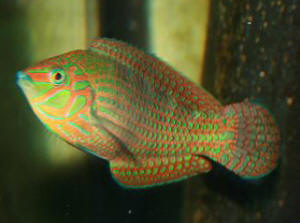
Wrasse ID 3/21/19
Hi,
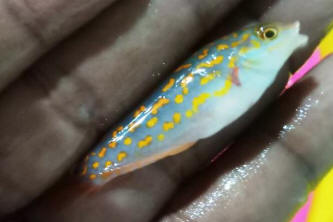
Can you please help in IDing this wrasse? Thanks.
<What the...?! Do you have other pix? Where was this collected (country,
habitat)?
Bob Fenner>
Re: Wrasse ID 3/21/19
Just this one. Collected from the Bay of Bengal, India
<Okay... will look a bit more when am back from diving. Have you used
Fishbase.org for the family and India? BobF>
|
 |
|
Re: Wrasse ID 3/21/19
It does look like Timor wrasse to me. Let me know your thoughts.
<Ah yes; I do agree. This does appear to be Halichoeres timorensis BobF>
Re: Wrasse ID 3/21/19
No I haven't Bob. Happy diving!
<Thank you Beta. B>
|
|
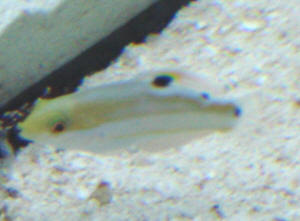
Wrasse ID 2/13/19
Hi Team,
Would appreciate an ID of the Wrasse. Unfortunately, this is the only pic that I
have.
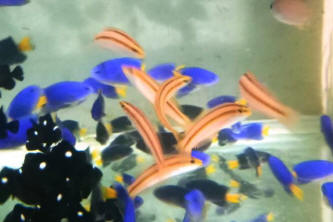
<Mmm; def. a member of the genus Halichoeres. My first guess is on juv. to
initial phase Halichoeres hartzfeldii (Bleeker 1852), Hartzfeld's Wrasse.
Second guess is H. zeylonicus.
Bob Fenner>
|
 |
|
Wrasse identification 2/14/16
Hey,
Was just trying to figure out what fish this is, thanks for the help!
<Ahh; a very nice juv. Puddingwife; Halichoeres radiatus. Bob Fenner>
|
 |
|
Re: Wrasse identification 2/14/16
Wow your good! Thanks so much.
<Heeee! Welcome. BobF>
|
|
Fish ID/s... 1/11/13
Hi WWM Crew: Thank you for all the help you have given me over the year with
your helpful website, you have make this wonderful hobby much more
accessible to all of us and save me from many mistakes that I could have
make over the years. Thank you. I did something the other day
that I know I should not have. But it was love at first sight and I
don't regret it.
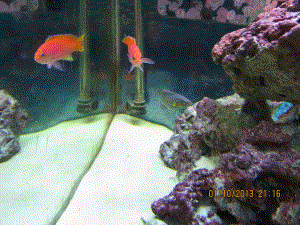
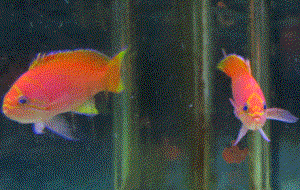
I went to my local fish store and took home two fish that I am not familiar
with. I know it was a Wrasses and an Anthias.
<One of both in your pic>
Beyond its beauty and cuteness, I don't know much about and as usual the
shop owner said it was easy to keep kind of fish.
<Mmm, not on the easy side in my opinion/experience. The Anthiine likely
lives (well) in a group setting... the Labrid is easily spooked, not
competitive w/ more eager eaters>
I took them home and now I realized I could not even ID them anywhere.
So please help me and let me know what kind of fish is it and how to take
care of them. I feed them two time a day with frozen Mysis shrimp and
they seem to be happy in the tank so far. I have a 75G tank with 120
Pounds of lives rocks, a hang on back protein skimmer, a hang on back
refugium and a canister filter. I do a 20% water change every other
week. Currently, other then the two new fish, I have a Lime Green
Wrasses that is about 4 inch long. Thanks again for all the help.
Patrick
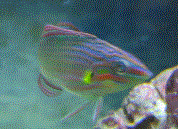
<... The orange fish, the fancy bass... you'll have to search on the Net
re... I'd try Fishbase.org, the family Serranidae... the long haul of
viewing by genus (likely Anthias)... The wrasse appears to be a Halichoeres
species, H. melanurus?
Bob Fenner>
|
 |
|
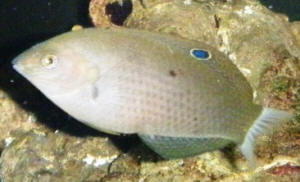
Wrasse Identification (Halichoeres marginatus? I think
so!) -- 09/28/11
I thoroughly enjoy and appreciate your website, its articles and
the information you are able to share.
<<Thank you Larry 'it is indeed, quite the
collaborative effort>>
I have used your site to answer all but one of my questions.
<<Excellent!>>
This deals with the ID of a wrasse I bought that was labeled as a
Dusky wrasse (Halichoeres marginatus). Now that it is older, it
is obviously not a Dusky wrasse.
<<Mmm'¦maybe not so 'obvious'>>
I thought at first that it might be a Geographis wrasse (Anampses
geographicus), but the eyespot on the anal fins are not
present.
<<Agreed>>
I have attached a picture that shows that there is no anal fin
eye spot. If you can help with the ID, I would certainly
appreciate it.
<<I don't know where you looked/researched the Dusky
Wrasse, but fishes sometimes display different looks due to
location/geography. I do think this is Halichoeres
marginatus'¦and more specifically, a specimen from the
Marshall Islands. Have a look here
(http://fishbase.org/Photos/ThumbnailsSummary.php?ID=5631) and
see what you think>>
Thanks,
Larry Reinecke
<<Happy to share'¦ Eric Russell>>
|
|
|
Re: Wrasse Identification (Halichoeres
marginatus? I think so!) -- 09/28/11
You nailed it!
<<Woo hoo!>>
Thanks for your help
<<Any time>>
, and keep up the good work.
<<I'm trying! EricR>> |
|
Wrasse Identification Help
8/12/11
Hello crew,
<Chris>
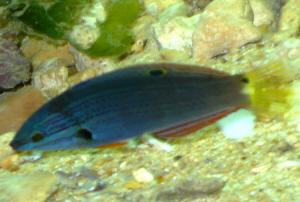
I'm having difficulty identifying a wrasse I captured out in
a reef near where I'm currently living. I am at best guess
it's in the Halichoeres family, but I can't find anything
that matches exactly. Some of the specific notes I have on this
is that it is very similar in build to the Hoeven's wrasse,
however the coloration is very different. It has a blue laterally
lined body, merged dorsal and adipose fins red in color, with a
dark spot around the adipose fin area, another spot at the base
of the tail, the tail which is yellow, red anal fin, and bright
orange pelvic fins.
The pectoral fins are clear. I have attached a photo taken of the
fish.
<I see this>
When I see these fish in the reef, they tend to stay
approximately 6 to 8 feet down, unlike most of the other similar
wrasses, which usually reside within a couple feet of the
surface. I have yet to see a specimen of this coloration more
than 3". They seem extremely territorial towards other
wrasse of the same species, and occasionally an adult blue
damsel, although in their natural setting they rarely are at the
same depth. I captured 2 of them at the same time, however the
one pictured killed the other. I normally see them picking at
rocks and coral. The area I see these wrasse at is a rocky bay in
Okinawa, along rock walls dropping down about 8 to 10 feet to a
sandy bottom.
Christopher A Cole
<Mmm, my guess is on the genus Thalassoma... do see
fishbase.org for this genus... Bob Fenner>
|
|
Re: Wrasse Identification Help --
08/13/11
Thanks, I've actually downloaded the entire Fishbase listing
for Okinawa (Ryukyus)(3697 entries) and Japan (1535 entries),
<Whoa!>
That is normally my first source for IDs when I encounter
something new.
<Is one of mine... and am out on the E. coast giving talks at
a fish health conference, so don't have access to my in-print
ref.s>
They don't have a picture that matches,
<Well... as you are likely very aware, there are MANY
variations on color and markings per some Labrid species... and
even a few as-yet, undescribed species>
but there is a large number without photos. I'm curious as to
why you said it was Thalassoma, vice Halichoeres.
<Thalassoma are more fusiform/tubular in overall profile...
which your one photo sent looks like to me... also this genus is
more prognathous than Halichoeres... whose many members are
typically more laterally compressed and truncate at the
head-end>
I found a Russian site identifying it as Halichoeres melanochir.
I Googled it to confirm, and most pictures returned looking very
similar. Again, thanks for the help.
<Thank you for sharing. BobF>
|
|
Wrasse or not a wrasse? 4/2/10
Hello crew,
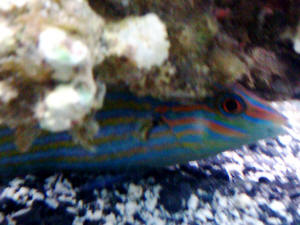
I have two main questions for you. First off, I bought what
appears to be some sort of wrasse from my LFS yesterday and they
were not able to identify it, but could only tell me it was not
the fairy wrasse that was in the same tank with it. I have it in
a newly established 25 gallon tank in which I have all the
necessary components to eliminate the chlorine and ammonia and
the like, as well as trace elements and a buffer solution. I
added a few hermits, snails, and the cleaner shrimp I had in a 5
gallon tank into this one and all seem to be doing fine. My
questions are, one, can you tell me if this is even a wrasse?
<Likely is a Labrid>
And if so what kind?
<Probably a Halichoeres species, judging by the head, mouth
and body shape, colour pattern. See here: http://wetwebmedia.com/halichoeres.htm
and the next alphabetical file linked below>
And two, he has been hiding in the substrate ever since I got him
and I have periodically poked around to scare him out to make
sure he was alive (about once a day) but he comes out for a
second then bury himself back in again. Is this normal even for
the daytime or could this be because he is in a new aquarium and
will take some time to get used to?
<Is to be expected... not to worry or poke... Needs a suitable
environment, time to settle in>
Or could it be a water quality issue? I checked on him a minute
ago and he is still alive but I am concerned. Thank you for your
help and your website is awesome.
Eric
<Welcome. Bob Fenner>
Re Wrasse or not a wrasse? 4/2/10
Hi Bob,
Boy, that looks a lot like a Two Spot Wrasse (Halichoeres
biocellatus).
Cheers,
James
<Might well be. B>
|
 |
|
Wrasse??? 3/8/2010
Dear Bob,
<Tineke>
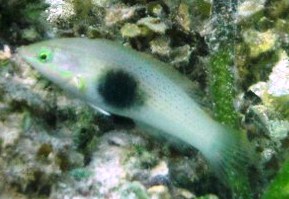
This fish puzzles me.. do you have a name for this one? I think
it is a wrasse when I look at the shape.. but I can't find it
in books and the internet.
Thanks for helping me.
This Picture is from Moalboal/Philippines
greetings,
Tineke
<Looks to be a rather juvenile, initial phase Halichoeres...
chloropterus.
Bob Fenner>
|
 |
|
Re: Wrasse??? 3/8/10
Thank you, Bob. Again a name for a fish...it gives me great
feeling! Juv. Are sometime very hard to determine. not all the
pictures of these juveniles are on the internet or in books.
<There are a BUNCH for sure. Am hoping you and I can/will be
able to get out dive-traveling and contribute more images of all.
Cheers, BobF>
Hear you next time!
Tineke
|
|
Wrasse ID? 11/15/09
Hi,
<Hello Amanda>
I recently bought a wrasse from a local pet store. They had it
labeled as a Christmas wrasse. I purchased it thinking it was
because the colorings look just like a Christmas Wrasse. The pet
store told me they are mostly reef safe though with caution
around small inverts. I researched a Christmas Wrasse to get
their exact care needs and started noticing that none of the
pictures of them looked like this one I have. I read around on
your site and finally found one that maybe looks like the one I
have...a Tubelip wrasse. Please tell me if I have a Christmas or
Tubelip or something completely different. Is this fish that I
have reef safe?
<Not with ornamental shrimp for sure.>
Where can I find specifics on its care?
<Right here.
http://www.wetwebmedia.com/halichoeresbestart.htm>
I haven't had much luck so far. I have attached a couple of
pictures of my wrasse. Sorry if the pictures are not that great,
but was hard to get a good picture of the wrasse without one of
my six camera hog tangs getting in the shot as they were swarming
in a group in front of my camera.
<Amanda, the Christmas Wrasse (Halichoeres ornatissimus) is
very likely what you have.
Do keep in mind there are many color variations both depending on
age of the fish, and area of collection.
A few areas these fish are found are Johnston Island, Marcus
Island (Japan), Marquesas Island, Moiku Manu Oahu (Bob, spelling?
I'm sure you've been diving there.), and Pokai Bay,
Hawaii, and all have a slightly different color variation.
<<Mmm, agreed re variation. I think this is actually a
Halichoeres argus. BobF>>
Thanks so much for your help!
<You're welcome. James (Salty Dog)>
Amanda
|
 |
|
Wrasse ID 11/15/2009
Hi Bob,
<Hey James!>
I looked at the species you mentioned on Fish Base and when
comparing photos of the ornate, I leaned that way. Can be
difficult in accurately ID'ing these guys.
<Oh yes!>
See here what I was looking at re argus.
http://www.fishbase.org/Photos/ThumbnailsSummary.php?ID=4857
Thanks for your valuable input.
James
<And you for yours. BobF>
|
|
Halichoeres margaritaceus A Real "Mystery"
Wrasse...(Halichoeres ID) 1/15/09 Hello and I hope all
is well with you! <And I wish the same to you!> I have
emailed twice before asking after fish I haven't been able to
get much info on and been pleased with what I've gotten. So,
here is yet another email that will hopefully get the same
results. <I feel no pressure...no pressure! Scott F. here
tonight!> I work in a strip mall and there is a generic chain
pet store in it. I use it for food and scan the fish section
every once in awhile. I admit that I despise the idea of buying
from the store's livestock section as the employees are often
inept at best, shrimp not eating starfish is one of the wonderful
things I've been told (I have a Harlequin and I had to return
a CC star because the shrimp wasn't interested and I had no
intention of keeping the star long-term, not to mention they told
me the star wouldn't eat corals when I asked out of
curiousity). I've been going once a week for the past couple
of weeks and during those two weeks, they have had a
"mystery" Halichoeres wrasse. <I LOVE Halichoeres
wrasses...and I love a good mystery. My favorite group of
fishes.> I've looked all over your page, Fishbase, and
more, and the best match I found, though far from exact, is H.
margaritaceus. When I asked the employee about it, she had to go
ask the manager. He told me that the fish is a "Sea Grass
Wrasse" which it clearly is not. The animal in question is
about 3" so I thought it was possibly a juvenile, so I
checked to make sure the Sea Grass Wrasse doesn't have a
juvenile phase that looked like this fish. From what I could
find, it doesn't. <Ahh, the danger of common names- a
number of species of various genera go by this moniker! It's
a bit tough to determine what species you're talking about
based on this...A photo would really help! I'm thinking about
H. chloropterus as a candidate. This species is actually found in
seagrass/macroalgae biotope. Of course, this species looks
nothing like a H. margaritaceus, so I'm really grasping at
straws here!> So, after that long back-story, I find myself
very interested in purchasing this fish and I know I can sustain
a smaller Halichoeres quite easily, already having experience
with an H. chrysus in a smaller tank, but I am understandably
wary of purchasing a fish that I can't find much information
about or even ID for certain. <I agree with this thinking!
It's always a good idea to research a fish before you
purchase it...That cute little baby wrasse could grow up to be a
big old "tank wrecker"!> The fish is eating the food
fed by the shop, but it is a little thin for my taste. The tank
it's in now is probably ~20 gallons at best with some sand,
fake rock, and fake plants, which even with regular feeding,
could explain looking a little thin. The system the fish would be
going into is a -4 mo old, 65 gallon tank, ~87 lbs of LR 29
gallon planted refugium Octopus BH 800 S HOB skimmer Eheim 1262
return pump 1 Koralia 4 and 1 Koralia 2 -Tankmates are as
follows: 2 Neon Gobies 1 Ocellaris, 1 Percula 1 C. collare
(coming out of QT in a couple of days) Do you know if this is one
of the species that is more likely to destroy my CUC? The shrimp
mentioned earlier is in another tank, so he's not at threat.
Is the information about the fish's size on your page
correct, to about 5" in length? Is there any other pertinent
info about the fish I need to know? Thanks so much, Lisa <The
size range for this species is about right...However, I'm not
sure what a "CUC" is, so I really cannot comment on
what the fish will do! However, most Halichoeres species will
prey on some of the smaller crustaceans and snails in your
system, Some can be jumpers, so do keep the aquarium covered.
Well, that's all the generic tips on this genus I dare offer
at this juncture! Send pics! Good luck! Regards, Scott F.>
Re: Halichoeres margaritaceus "Mystery"
Wrasse (Pt. 2) 1/16/2009 Scott, <Hello again!>
Thank you for the help so far. I got a picture, but unfortunately
after trying for about ten minutes the best I could do was this
picture on a camera phone. The wrasse's body is a mottled
green and silver color while the fins are predominantly red with
what isn't red being clear or a beige-ish color and it does
have an "eyespot" on the dorsal. The cardinals seem to
be about average size for the fish, so hopefully that will give
you some idea of scale. I thought that this might have been
chloropterus at first as well, but not with this much red in the
fish. I asked about the origin of the fish, but the store buys
through "corporate" and so they have no contact with
the supplier or collector to find that out.
<Hmm...unfortunately, the angle/distance on the photo was not
so good in the picture! I'm at a bit of a toss up here as to
which species it might be. Definitely not H. chloropterus, IMO.
Perhaps H. schwartzi? It's just too tough to tell from the
picture.> By to the clean-up crew, which is just a mix of
snails and hermits in this tank. The snails are all probably too
big for the wrasse to fit in its mouth currently, but some of the
hermits are very small. The tank is covered. I learned the hard
way and just treat it as though all fish will jump, just in case.
Thanks again for all the help so far, Lisa <Glad I could help.
Just not sure what we're looking at yet. If you could only
get a better pic! Thanks for trying, though. Regards, Scott
F.>
|
|
Re: Halichoeres margaritaceus
"Mystery" Wrasse- Case Solved! 01/19/09
Scott, <Hello again!> Hopefully not bothering you
with this response. <Of course not!> I posted the
same picture of the fish in a bag that I sent to you
recently on a well-known reef forum and got an ID from the
Director of Live Aquaria, Kevin Kohen. <A good guy-
he's seen lots of cool fish, so I'd value his
opinion.> He pegged it as Xenojulis margaritaceus, still
a wrasse, but the only fish in its genus and more closely
related to the Macropharyngodons than Halichoeres. I was
able to find the fish on Fishbase.org and it seems to be a
match. Do you agree with this ID and have any further info
than what is available on Fishbase? Thanks again, Lisa
<Looking at the close-up that you provided with this
email, I would tend to agree that it looks way more like a
Macropharyngodon than a Halichoeres, indeed! I think he
made a good call!. Unfortunately, I have had no experience
with this particular fish/genus, so I would have to defer
to what you can find in FishBase or other scientific
literature. Perhaps some of our readers do have experience
with this species, they will share their knowledge! Good
luck, keep good notes, and I hope that YOU will be able to
add to the body of knowledge on this fish. Regards, Scott
F.>
|
 |
|
Erratum in Halichoeres wrasse article
9/18/09 Dear Bob, <Alex> I was searching for something
on WWM and in the course of my research I have found that there seems
to be a small error on your Halichoeres wrasse page (N-Z): The
photograph captioned with "Halichoeres trispilus" seems to be
a H. leucoxanthus (nomen est omen --> white-yellow) commonly called
Whitebelly wrasse
(http://fishbase.org/Photos/ThumbnailsSummary.php?ID=7806 or http://fishbase.org/summary/SpeciesSummary.php?id=7806)
. H. trispilus is more whitish, even though it has the same three dots
(nomen est omen, again ;-)... Cheers, Alex <I do agree with you:
http://fishbase.org/Summary/speciesSummary.php?ID=7806&genusname=Halichoeres&speciesname=leucoxanthus
Will append. Stipendium peccati mors est. BobF>
Re: Erratum in Halichoeres wrasse article
9/18/09 I hope not... But the question remains what the ones
get, that do not sin ;-) Cheers, Alex <A quandary/paradox for
sure... For me, I'll take the Viking "heaven" please.
Cheers, BobF>
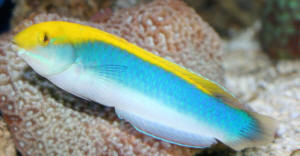
| Bob -- Pictures of my new Lightning Wrasse
(Halichoeres cyanocephalus) 2/29/08 I figured I'd send
these along to you. I acquired a 5.5" supermale Halichoeres
cyanocephalus wrasse (Lightning Wrasse) the other day at my LFS.
It's one of the most gorgeous specimens I've seen (though
I've only seen 3 besides this one and all 3 were puny and much
less colorful). Just here to share (plus I didn't like the
picture on WWM of it since it doesn't show much! ;) ). <Very
nice> PS -- The pictures where the wrasse looks lighter are with
flash on and the darker pictures are his more natural deep blue --
though it's hard as hell to get a shot of him without flash
without major motion blur! - Jon <Don't you and I know!
Thanks for sending them along Jon. Bob Fenner> |
|
|
|
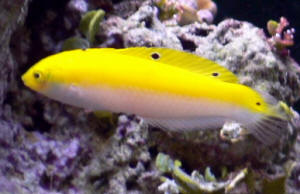
Re: Halichoeres trispilus -- 11/21/07 Oh joy Bob! The H.
trispilus is out and about and swimming famously and picking at
the rock in the 125! <It looks to be a very nice specimen
indeed> He's sturdier than I thought in that he's
taken a few shots from the Yellow Tang but simply dashes out of
the way and goes right back to his business. He's a splendid
fish! I've attached a couple pretty good pics of him for you.
Also, I have an Australian Scott's Fairy Wrasse that I
brought in to add to my 180 display (I did order this one), and
he is finally out and about as well. What a relief. I've
coveted this fish for ages and finally decided to bite the
financial bullet and bring one in for display. He's stunning.
When he gets more comfortable and shows himself more readily,
I'll send a pic. <Thank you for this> Off to scrub mix
containers. Sounds fun doesn't it? Actually, I love every
minute of it. :O) Peggy www.all-reef.com <Will post the pix
with credit to you Peggy. Thank you, BobF>
Re: Halichoeres trispilus 11/23/07 Hi Bob,
<Peggy> In looking at the H. trispilus shown on WWM, there
surely is a marked difference in the color morph. Do you think
the fish I received is actually the trispilus? I know color
morphs vary from different geographical areas, etc., but would it
be this diverse? Just curious and thought you may know. Hope you
are enjoying your holiday! Peggy www.all-reef.com <Thank you my
friend. You've seen the graphics et al. on the general Net
(Google images) and Fishbase.org for this species? Your pic does
concern me... for its resemblance to an aberrant or cross twixt
H. chrysus... and? And the stated distribution of this fish. VERY
few organisms are collected in these areas that make their way
into U.S. markets... And I see you are located in MN... Is
possible... but... BobF>
Re: Halichoeres trispilus 11/23/07 I'm
inclined to think it's a hybrid of the H. chrysus judging by
what I've seen of the trispilus info. I guess I'll never
know for sure unless someone else comes up with something similar
and it was in fact collected in the likely area, etc. It is
surely a beautiful fish, and I'm not disappointed. I love
them all. He won't be for sale so there's no concern
there. He's for display only and makes a wonderful addition.
Many thanks Bob. Let me know if you happen to learn anything
contrary to our latest discussion. Peggy www.all-reef.com
<Will do. BobF, now out in HI>
Re: Halichoeres trispilus 11/21/07 12/11/07
From the description below I would guess that the wrasse is a
white bellied wrasse (Halichoeres leucoxanthus), sometimes called
a Banana four spot. <Ahh! I do agree:
http://filaman.ifm-geomar.de/Summary/SpeciesSummary.php?id=7806>
I ordered a Golden Coris Wrasse but received the white bellied
instead. Has turned out to be a very good fish and tank mate with
two clowns, two green Chromis, a bi-color blenny, a river minnow
and an Anthias in a 36 gallon tank. Leon Gipson Blounts Creek, NC
<Thank you for this ID. Will post with. Bob Fenner>
|
|
|
Wrasse Identification 1/10/07 <Hi Mike,
Graham T. here.> Can you please help me identify this Wrasse at
my local fish store as they aren't exactly sure what type it
is. It's listed as Pastel Coris Wrasse but I can't seem to
find any information for this fish. If you have any info on this
fish like size, compatibility, etc I'd greatly appreciate the
help. Two pictures should be attached of the Wrasse in the tank at
the store. <Mike, Halichoeres hortulanus is a wide guess here,
but you need to edit these pix for inclusion to our server. Our
limit is about 10MB, and that means when you send 3+MB, then other
emails get bounced. Furthermore, I only see one picture that
managed to make it. Try editing the pictures to a more
viewable/sendable size, like 1024x768 or smaller and less than 600K
per. Will make a closer ID with the resend. Thanks -Graham
T.>>
Thank you |
|
|
| Please id my wrasse.... 12/17/06 Hello-we
have had him/her for about 6 months. He hasn't changed too much
in color - but he is bigger and fatter!) and his dark brown stripe
now goes to his tail and he seems to have very light blue /pink
lines as well. He sleeps in the sand like my red Coris. I have
researched many sites and have not found him. Thanks! ML Jones
<I make this out as an initial phase Halichoeres zeylonicus:
http://www.wetwebmedia.com/halichoeresn-z.htm A nice
specimen at that! Bob Fenner> |
|
|
Halichoeres ID 7/15/06 Hello ladies and gents,
<Howdy Eric> I recently purchased a Halichoeres wrasse which was
sold as a Halichoeres kallochroma, however, I'm not sure that the
ID was correct. <On FishBase:
http://fishbase.sinica.edu.tw/Summary/speciesSummary.php?ID=59463&genusname=Halichoeres&speciesname=kallochroma>
He's tough to get a picture of right now (as he's buried in the
sand bed), but there was one feature which struck me as possibly being
unique. The fish has a small grouping of chrome-like scales (literally
looks like polished chrome) on each side of his body just behind his
front pair of fins. Overall, the fish is green with a pink-striped
pattern on the head and to a lesser degree, the body. I'll try and
get a pic tomorrow, but if you have any ideas please let me know.
Thanks, Eric <Mmm, could be this species just the same... there is
some geographic variation... and very wide developmental differences in
coloration. Bob Fenner>
Can you ID the wrasse in the attached photo? - 05/29/06
< I will try my best! > I've looked at your site and I
think its a Coris venusta but its hard to tell. < It closely
resembles a Halichoeres melanurus male, but I have been wrong
before! > Also, when I put this three inch wrasse with a big
mouth in the tank a month ago my coral goby disappeared, do you
think the wrasse ate him? < I seriously doubt it. Not that it
couldn't happen. I would expect the wrasse to eat anything
small, but more along the lines of crustaceans and worms. >
Thanks
Matt
< You are RichardB > |
| Wrasse ID - 05/29/06 Hi <Hello there> Can you ID
the wrasse in the attached photo? I've looked at your site and
I think its a Coris venusta but its hard to tell. Also, when I put
this three inch wrasse with a big mouth in the tank a month ago my
coral goby disappeared, do you think the wrasse ate him? Thanks
Matt <Is a Halichoeres species, see here: http://wetwebmedia.com/halichoeres.htm
and yes, could have consumed the Gobiodon. Bob Fenner> |
|
|
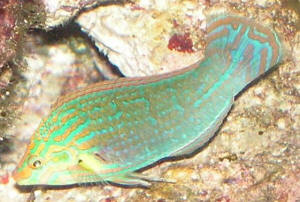
Neon Wrasse Hey Robert- Could you help me with the
scientific name for the Neon Wrasse. <Hmm, nothing comes up for the
common name on FishBase.org... Maybe this is Halichoeres iridis. See
the pic on our site here: http://wetwebmedia.com/halichoeres.htm>
I've read various articles and books mention the neon but there is
no reference to its background or requirements. <A more recent
import... about "medium" in hardiness, much like other
members of this "super-genus"... Bob Fenner> Thanks
Mike
Fish identity Hey Bob, It was nice to meet your
wife and see you again. <A delight my friend> Can you help out
and look at the attached mail and try to identify for fish. <Hmm,
well, I did what try to sharpen this image... can't make it out
very well... but it does look like a juvenile of a genus Halichoeres
Wrasse... not much help here... Please do look over the scant
photographic coverage of this "super-genus" posted on our
site: http://wetwebmedia.com/halichoeres.htm Does your friend know
which part of the world this fish was collected in? Please do look
through the resource: FishBase.org for much more in the way of
photographic listings of this genus. Bob Fenner> John Dawe the
unconscious marine aquarist <You're cracking me up John>
www.masm.org
Halichoeres cyanocephalus: Yellowcheek wrasse Hi
Bob, or Steve, or Anthony :) <whassssup?> Can you please help me
ID this little guy? <yep... unmistakable: a young male Halichoeres
cyanocephalus> It was sold to me as a "Brazilian flasher
wrasse", <AKA Yellowcheek wrasse... gets BIG, almost a foot
long and quite beautiful. There's a wicked picture of a terminal
male on fishbase.org at
http://www.fishbase.org/Summary/SpeciesSummary.cfm?ID=3662&genusname=Halichoeres
&species name=cyanocephalus > but the only fish that I see it
could be is a Sunrise Dottyback. What do you think? <nope...
different face, no yellow on the tail... two very different fishes. You
have a Yellowcheek wrasse> I have had this fish for over six months
now, and it's the only fish in my care that I am unsure of - Help!
<I hope that you have a big tank or plan for one :)> Thanks for
everything, Manuel <best regards, Anthony>
incoming!! (Jason.C digital pix from last week,
Cozumel) On the way to you via Priority Mail... a CDROM of the
images, some 400 or so... everything that is actually in focus and
the USB cable for the Olympus. <Thank you, but no rush... am not
able to review, add for a week or so.> On the images... the only
manipulation I've done is to orient/rotate the images, the rest
is up to you. Sometime, about midweek, Lorenzo talked me into using
the SHQ-JPEG mode which creates images at 2200-something by
1700-something. These images survive cropping very well as everyone
of the four mega-pixels gets used. They can easily be converted to
TIFF format if in fact they turn out well enough to go to print.
<Again... you folks may know better... but the real world of
editors want ORIGINAL TIFFs for print...> Otherwise, I'm
sure there's a picture or two that would do just fine on the
web... speaking of which, you/me/we should put up that Slippery
Dick I sent you as the one image that is on that particular wrasse
page certainly doesn't look like that. <No... may seem
ridiculous... but have left out/off due to common name. Blue Nose
Bob> Cheers,
J -- |
| almost done with the ID, Would this be a
Pudding Wife? <Nope, it's a member of the same genus
though... a terminal phase Slippery Dick, Halichoeres
bivittatus. Bob F> |
|
![]()
|
Pseudojuloides cerasinus (Halichoeres) Bob-
Attached please fine a picture of what I believe is a female
Pseudojuloides cerasinus. I was unable to find a photo on your site of
the female, so wanted to submit this to you. This is the best shot out
of about 20. :) <Thank you for sending the image along... but am
almost sure this is a Halichoeres garnoti (initial phase)... a wrasse
from the tropical West Atlantic... Please see here re:
http://www.fishbase.org/Photos/ThumbnailsSummary.cfm?ID=4851 For
Pseudojuloides cerasina http://www.fishbase.org/Photos/ThumbnailsSummary.cfm?ID=3663
and http://www.wetwebmedia.com/halichoeres.htm
For Halichoeres garnoti> I'll be working on getting some better
shots, if you have any interest at all, please let me know your
preferred sizes. <Most anything in focus, colored, balanced...
suitable for Net presentation (up to a few hundred kilobytes) is
fine... you might want to place your pix on our sister server/site:
WetWebFotos.com > Thanks for the great web site- <A pleasure to
share. Bob Fenner> Brent Barr
| Wrasse ID please! I'd like to thank you
right away for having such a fantastic source available! It's
terrific & I use your info constantly. I've been searching
in your library & forums in order to get more info on a Wrasse
that I saw at the LFS. The search is a bit daunting considering all
the wrasses species out there, and I've had no luck with
finding info on this one. The LFS have it labeled as a "neon
wrasse" and they say it's reef safe. <Mmm,
semi-"reef safe"... this looks to me to be a juvenile
Halichoeres garnoti, please see here: http://www.wetwebmedia.com/halichoeres.htm
a species seen more and more in the trade, and a real beauty as an
adult> I do trust these guys, but I always like to have more
then one source of info before I buy (so I have a better idea what
I'm getting.) I've attached a pic of the fish, and I
believe it is a juvenile. <Yes, and a very nice pic> Any more
info would be so greatly appreciated. Especially..... do they get
large? Do they become destructive to reefs when they get older?
What color is it going to be when it's older? Thank you so much
for your time & wisdom.. Jane <Knowledge perhaps a bit, am
waiting, hopeful on wisdom. Bob Fenner> |
|
|
| Re: wrasse ID please! Bob, thank you for
the fast reply! Wow! (Thanks...I used a digital camera to get the
pic I sent. and about a dozen tries to get it!) <Generally takes
me at least two, three dozen...> Thank you too for pointing me
in the right direction. It's wonderful to know more about this
fish. I think I'll go ahead and purchase one... although it
does give me pause when you said it's semi reef safe... does
that mean it will chew on corals or eat my cleaner shrimp? Thank
you again for your time & helping make this hobby better! Jane
<Likely leave both alone... but not absolutely (there are very,
very few organisms that are) reef safe... Bob Fenner> |
Good Wrasse/Bad Wrasse? I just looked up info on
the canary wrasse that you mentioned. It says it is also called a
yellow wrasse and that only an expert should try to keep it. <I
think that you are mistaken. The wrasse that I referred to is a
Halichoeres chrysus, one of the easiest of the wrasses to keep. In
fact, in Scott Michael's "Marine Fishes" (the classic
pocket reference in the hobby), he rates it a "4" (on a 1 to
5 scale, 5 being the easiest to keep fishes). Do recheck. remember,
several fishes my be known by the same common name, which is why I
referred to it by the scientific name. I've kept these fishes for
years with no troubles. They are hardy, fun to watch, and colorful.
Good luck! Regards, Scott F.>
|
|