|
FAQs on
Halichoeres
Wrasse
Disease/Health
Related Articles: Halichoeres Wrasses,
Related FAQs: Halichoeres 1, Halichoeres 2, Halichoeres Identification, Halichoeres Behavior, Halichoeres Compatibility, Halichoeres Selection, Halichoeres Systems, Halichoeres Feeding, Halichoeres Reproduction, Wrasses, Wrasse Selection, Wrasse Behavior, Wrasse Compatibility, Wrasse Feeding, Wrasse Diseases,
|
|
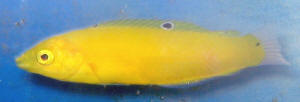
New yellow Coris wrasse 12/4/14
Bob,
>Brent>
Just purchased a yellow Coris wrasse. What do you recommend I do with this fish
before adding to display tank as I hear they may be sensitive? You recommend
dips, baths or quarantining?
<Yes; both>
Thank You,
Brent
<Welcome. Bob Fenner>
Re: New yellow Coris wrasse
Both as in dips and baths?
<Both as in these AND quarantine. BobF>
Praziquantel and amquel
1/11/14
Hi WetWebMedia Team,
I have a Vrolik's Wrasse that has been in my tank for over two years. In
the past month his abdomen has become quite swollen.
I am guessing it is worms but not sure how he got them as all other fish
are healthy.
<Mmm, might be something it ate... in the system... that doesn't "agree
with it"... worms, cnidarians...>
I have removed him to a quarantine tank and started treatment with
Praziquantel and Metronidazole.
<I wouldn't... instead; a simple immersion bath or adding Epsom is the
route I'd go>
The tank is only 12 gallons and I want to add amquel to control any
ammonia spikes but am worried the amquel may bind the medications. I
have not been able to find any clear guidance on the internet so of
course I am turning to Wet Web for advice. thanks in advance. Regards,
Doug C
<As far as I'm aware these two can be used together. If in doubt, I'd
write the manufacturers re. Bob Fenner>
|
Christmas Wrasse Needs Christmas Miracle; OVER-RXN
12/22/13
Hey WWM,
<Mike>
Happy Holidays. This is a somewhat urgent question if you can help that
would be great.
<Ok>
My Christmas Wrasse of 2.5 years, Isis, is not well. Two days ago I
noticed she was swimming oddly and would not eat. She would not sleep in
her regular spot but would just lay on the sand on her side in visible
areas.
I see no physical abnormalities on her body and she is the only fish
with this issue.
Really sad to watch and I thought to euthanize her in the freezer until
I read that it was not advised.
<I'd hold off>
I figured she only had a day left or so but she is still alive two days
after on one side breathing seemingly normally, maybe a little slower
now and moving her fin. I did not separate her because I thought the
shock would kill her so I left her in the tank to die peacefully.
If I touch her she swims around a bit awkwardly and eventually goes back
to the sand.
<And not touch>
Any help or advice would be greatly appreciated. I'd like to help but am
not sure what to do.
<... anything else going on w/ other stock here? Just patience for now.
Bob Fenner>
Re: Christmas Wrasse Needs Christmas Miracle
12/22/13
Additionally her color is a little darker than normal and she is moving
her eyes.
<Ditto>
Thank you,
Mike
Re: Christmas Wrasse Needs Christmas Miracle
12/22/13
The rest of them seem to be doing ok, I will hold off but it has been
three days now since she ate.
<Not a worry (very long interval to go sans feeding)... do keep
proffering favored food items daily... Perhaps soaked in HUFA/Vitamin
prep.
(commercially available through the fish biz). B>
Re: Christmas Wrasse Needs Christmas Miracle 12/24/13
Update:
I'm glad I didn't euthanize her, she is now making an attempt to swim
around. The issue is that she cannot move her tail it seems.
<Patience>
She moves herself clumsily around the tank until she gets tired and it
seems like she is dragging her tail along. Her stomach is very sunken
but I saw her try to eat a piece of Mysis today which I thought was a
good sign... she only picked at one piece and I'm not certain if she
ingested it or not. Her body is now showing wear and it seems that her
dorsal fin is rotting on the back. The smaller fish are now bothering
her a little when she swims too.
I am leaving her for now and continuing to feed heavily whenever I see
her about.
<Good. BobF>
Re: Christmas Wrasse Needs Christmas Miracle
1/5/14
Hey Bob,
<Mike>
Isis is still sick but, I'm happy to report that she is still alive
today.
<Very thin though>
I took your advice and have not touched her, after being missing for two
days she came out today and is trying to swim around again. Her
breathing appears normal but the body looks like it is atrophying near
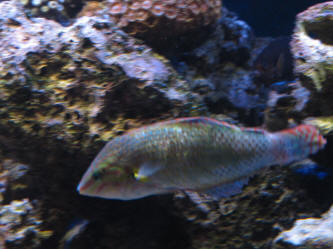
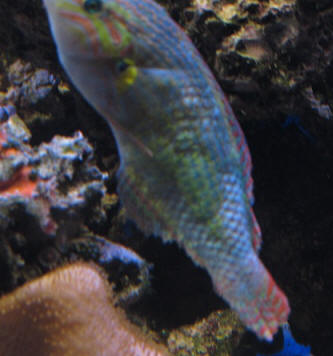
the tail which is barely moving. I have attached a few images I took of
her, I'm wondering if these show signs of any illness you can identify.
You can see that she hasn't eaten in a while and I am debating whether
putting her in a separate tank would be a good idea at this time to try
to get her to eat, but don't want to stress her further.
Happy 2014,
Mike
<I would try an open shellfish (a bivalve, from the market), perhaps
soaked in a vitamin, HUFA commercial product. Bob Fenner>
|
 |
|
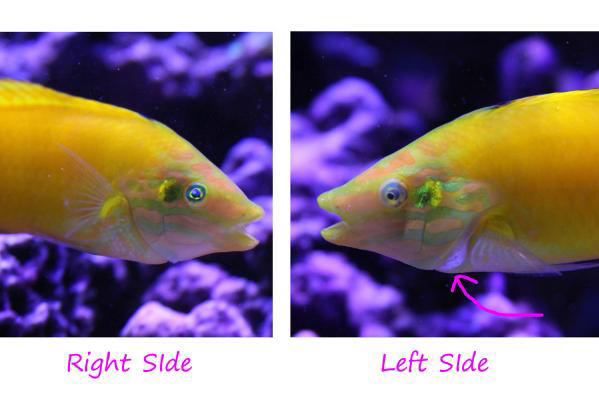
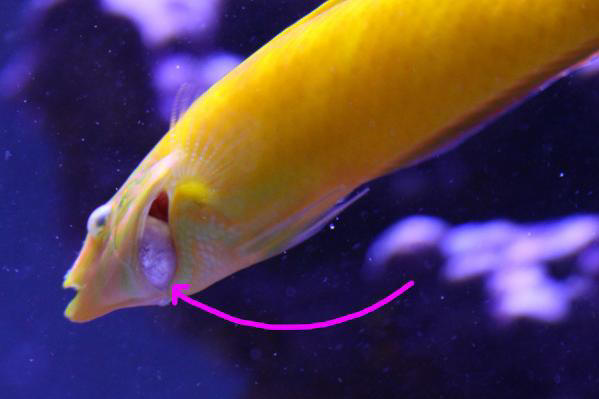
Yellow <sic> Coris <Halichoeres> Wrasse with Swollen Gill -
Please Help! 11/12/13
Dear Mr. Fenner,
<Antonio>
My name is Antonio and I have yellow Coris wrasse that has a gill issue.
I posted it in the Fish Disease forum over at ReefCental.com
<http://reefcentral.com/forums/showthread.php?t=2348310 > and
3Reef.com
<http://www.3reef.com/forums/diseases/corisswrasse-severely-swollen-gill-150695.html
> . One of the members (Newsmyrna80) on reefcental.com suggested I bring
this to your attention.
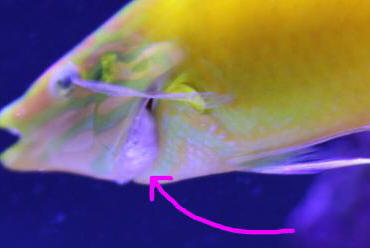
My yellow Coris Wrasse has developed a swollen gill. He started showing
signs of trouble with the gill a few weeks ago, but I left him in place
since at the time, it was very minor and he had no other outward signs
of discomfort. His eating and sleeping habits have remained normal
(always a good eater), and his energy level has remained normal until a
few days
ago.
<Mmm; not swollen per se; but some sort of tumorous growth
coming out from the cavity>
Starting on Friday - he seemed a bit more lethargic than normal, but was
still eating like he should. His gill had inflamed a considerable amount
and is now pushing out of the side of his head.
I have already setup a hospital tank and moved him into it earlier
today.
What I need help with is identifying the issue so I can make the best
decisions on treating him. Below are some close up photos of his left
gill, and a video of him swimming around.
<I would not treat... but maybe try one or more purposeful cleaner
organisms at this juncture... Perhaps a Lysmata sp. shrimp for a first
go>
I've shown this to a few other both online and at my LFS, and have
received varying opinions from parasitic infection, tumor, fungus - but
no solid consensus yet.
<... only can be discerned by necropsying the fish, area... with it dead
or killed... Embedding, sectioning... histological exam.>
History of water parameters can be viewed on my AquaticLog profile here:
http://www.aquaticlog.com/showcase/m...quariumId=2396
<http://www.aquaticlog.com/showcase/measure?aquariumId=2396>
<http://www.aquaticlog.com/aquariums/onlytono/2>
Video
<http://www.youtube.com/watch?v=bbdK5WawKbk>
http://www.youtube.com/watch?v=bbdK5WawKbk
I'm sure I've left something out here, so if you have any questions,
please
ask - thanks in advance.
Antonio Gutierrez
<Welcome. Bob Fenner>
|
Re: Dying Xenia spiking ammonia; and Yellow "Coris" (Halichoeres)
hlth. follow-up 11/15/13
Dear Bob,
Thank you, thank you, thank you! I feel much better:) I will
definitely get a better ammonia test. I've always had a hard time reading
these;)
<See WWM for recommendations here, and actual users input on bbs>
By the way, I recommended a fellow reefer get your advice on a Yellow Coris
Wrasse that had a growth protruding from the gill.
<Yes; I saw, responded to this... tumorous growth am guessing>
He took it to an aquatic facility near him where a marine biologist
attempted to excise the tumor.
<Umm, I'd suggested leaving it alone; perhaps trying some purposeful
biological cleaners>
The tumor had eroded the gill plate and had grown up to the back of the eye.
Needless to say the fish did not make it through the surgery but the
prognosis was not good anyway. Jennifer
<Aye. Thank you for this follow-up. BobF>
|
|
Wrasse bacterial infection
4/17/13
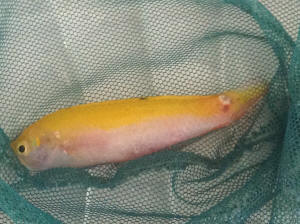
Hi crew! I've been treating a Yellow Wrasse, Flame Angel and a Goby in a
QT with PraziPro for 2 weeks. Three days ago the Wrasse hid in the small
bowl of sand I put in there for him. He didn't come out at all. Today I
got him out and he had red blotches on his belly. I figured he had a
secondary bacterial infection from the flukes.
<More likely just stress, being moved...>
I set up a hospital tank for him and by the time I went to get him out he
was dead. I took a picture of him (attached) and was hoping someone
could tell me if this is indicative of a bacterial infection? Also do I
need to worry about the other fish in the tank? Thank you! Jen
<May be bacterial... secondary. The mark dorsally on the caudal peduncle
looks more like the after-effects of a bite to me. I would be concerned
re the other fishes period. Move them back to the main/display
ASAPractical.
Bob Fenner>
|
 |
Re: Wrasse bacterial infection
4/17/13
Hi Bob! The main tank has only been fallow for 15 days. I have done a ton of
research as to the fallow period for flukes but can not find any consistent
answers. Some responses say 2 weeks, others say 12 weeks. The Flame and
Wrasse had flukes and so far the Flame looks good, eating good, etc. I have
one more round of PraziPro to go.
Should I be concerned as far as the safety of the other fish in the tank or
because of spread of infection? Thank you, Jen
<Just the overall stress level/s. BobF>
Re: Wrasse bacterial infection
Will do! Thanks Bob!
<Ah, welcome Jen. BobF> |
Re: Somewhat Of A Tank Restart; Restocking Suggestions
4/5/13
Hello Again,
Thank you for the Ich treatment insight. Will definitely keep that in
mind.
<Glad to help.>
I have done as you recommended and turned the heat down a notch, so it
should be around 78 F later tonight or early tomorrow. I have decided to
go with a school of nine Cherry (or Cheery, I like that!) Barbs, a pair
of Dwarf Gourami, and a school of seven Celestial Pearl Danios. Perhaps
I'll go with some Corydoras sp. too eventually, but for right now I'll
have to wait...it seems they've sold out completely of the Pygmies,
which are my favourites.
<Fair enough.>
Regarding the pH, it seems to be quite stable around here, but I'll be
sure to monitor it just in case. Before I go, just one more question...I
know it's generally dependent on species/behavior/degree of waste
production, but would you happen to have an idea of how well stocked the
tank would be with the three above species (Barbs/Danios/Gouramis) and
whether or not I'd have room to expand later on?
<20 gallon tank wasn't it? Six Cheery Barbs, six Celestial Danios, 8-10
Pygmy Corydoras, 1-2 Dwarf Gouramis -- job done. No problems with
overstocking. Maybe even space enough for some algae control… a
Bristlenose Plec perhaps, or 4-5 Nerite snails, and of course a few
Cherry Shrimps.>
Thank you for all of your help!
Wishing you and your wife a lovely rest of your day! :)
Regards,
Dawn
<And thanks for the kind words. Cheers, Neale.>
Green Wrasse Transfer 10/25/12
Hello,
<Ger>
This is my first time writing. After reading some of the information on
your forum I thought it might be wise to seek your advice. I have new
Green Wrasse arriving over the next couple of days.
<Halichoeres chloropterus I'll assume; a neat fish. Just "put away" pix
I shot of this in CT two wknd.s back>
I am going to introduce it to my 55 gallon aquarium that currently has two
pairs of clownfish.
<Mmm, I hope they leave it alone>
It is my understanding that you recommend a wrasse have a shorter
quarantine period compared to many other fish.
<Can>
I am wanting to know what you recommend for my introduction of the Green
Wrasse to my main tank?
When it arrives do I do a freshwater dip and put it in quarantine, or
should I simply freshwater dip it and put it directly into my main tank?
<Considering the source, it's appearance on arrival... I'd likely do the
former... and add tank water back and forth for a week or so before
introduction>
If it goes into quarantine, how long should it stay there? As for the
freshwater dip, I hear around 30 minutes is good,
<Much too long... a few minutes... Read here:
http://www.wetwebmedia.com/dips_baths.htm
depending on the fishes tolerability. Is that that same for a wrasse, or
should the freshwater dip be for a shorter period of time?
<A dip is even fine in most cases, most Labrids...>
Thanks so much for your help.
Thanks,
Gerard
<Welcome. Bob Fenner>
Re: Green Wrasse Transfer 11/2/12
Mr. Fenner,
<Msieu Barrow>
I would like to thank you for you advice recently about the addition of
my green Wrasse. I ended up doing the acclimation and then the dip
bath before introducing him into my main tank. I thought you would
like to know that it is doing wonderfully. It is such a very
peaceful and interactive mate with my clowns and gobies. This
wrasse is such an interesting and graceful addition to my tank.
Now I see why you enjoyed watching them while in CT.
<Ah, yes>
With that said, I am expecting a Carpenter's Flasher Wrasse (Male) soon
also. I wanted to get your opinion if I could about following the
same procedures I stated above when acclimating him to the main tank.
<Yes>
Then doing the dip bath and introducing him after the green wrasse and
moving some rocks around and adding more coral would be enough since I
would not be introducing them at the same time as my initial plan had
some changes out of my control? I was told by LiveAquaria that
this should be a simple fix and also the best way to avoid potential
aggression from either.
I would greatly appreciate any advice you are willing to provide.
Thanks Bob,
<I think you should be fine here. BobF>
Gerard
Halichoeres chrysus (golden wrasse). Hlth., fdg. f's
6/17/12
Dear Sir Bob and all at WWM, thank you for your quick response firstly
I'd like to let you know that everything turned out brilliantly, I did
another 25% water change to be on the safe side and we cleaned out the
filter and all my crew had no awful side affects, well not to date, I
checked all the water parameters again that evening and everything was
the same as the last tests (in other email) so no damage there either,
thank you for the reading material, I found it very educational.
<Ah good>
Unfortunately I have another problem but this time with my Halichoeres
chrysus (golden wrasse) female named Allie, yesterday at around 5 pm she
found a live Gammarus shrimp in our live rock and attacked it and held
it in her month while quite violently smacking the shrimp on to some
live rock, I'm assuming to kill it and break it in to smaller pieces,
after around 10+ smacks on the live rock, the shrimp was dead (I think
we all would have been with that violent attack) but the shrimp never
broke in to small pieces, she dropped it and I then noticed she was
hovering around with her mouth wide open and couldn't seem to close it,
so I quickly turned off the lights as I was worried about stress and
hoped she would go and rest in her comfy bed in the sand, which she did
as I made the room dark as well. This morning she has woke up just
a tad late but only by half an hour (I was so worried I wouldn't see her
today if ever) and I've noticed her mouth is still slightly open but not
as much as yesterday, she is swimming a little differently but nothing
I'm to upset about at the moment, as I'm thinking she is still stressed,
but I am about her mouth, she also every so often opens her mouth wide
open, but I have seen her do this before, also. I've seen her eat
a Gammarus shrimp before and this never happened, is there anything else
I can do?
<Mmm; no>
And will she be ok? (can you maybe run your magic wand or look into your
crystal ball for me)
<Only time can/will tell>
I feed all my crew frozen or live food from copepods to Mysis shrimp and
everything in between and I always pre soak the food in vitamins, Selcon
or Zoe. She eats all the food I offer them and also rummages during the
day on the rocks for other goodies.
I'm sorry for such a long email again, but I couldn't find anything on
your website about this same problem.
<Perhaps a piece of the shrimp stuck in the fish's throat... will work
out in time>
Kind regards again.
Jenn Bailey. England U.K
<Cheers, Bob Fenner>
Re: Halichoeres chrysus (golden wrasse) 6/18/12
Dear sir Bob, thank you for your quick response, just to inform you that
my Halichoeres chrysus (golden wrasse) is back to her normal, beautiful
self.
She is eating like she always has, like a little gluten.
<Glutton likely>
Thank you for waving your magic wand, it worked.
Kind regards. Jenn Bailey
<And you, BobF>
|
bloated fish 12/24/11
Greetings,
<Salud>
Attached are pictures of my female Christmas wrasse that I've
had for over a year, and it appears that she is very bloated.
<Mmm, yes>
She is very active, alert, and feeds greedily. I was wondering if
this is something I should be concerned about and if there is
anything I can do. I was able to observe that sunlight shines
through her body except where the bloated area is where it
appears dark.
<These situations are typically due to one of a few
possibilities... over-eating, gut impaction, gamete retention
(egg-binding), and more rarely intestinal parasitic involvement.
T'were it mine, I'd just cut back on favorite foods...
see if the condition self-improves. If it worsens, do see WWM re
the use of Epsom Salt next. Cheers and happy holidays, Bob
Fenner>
|
|
|
Which quarantine procedure do you recommend for a
Halichoeres melanurus? 9/19/10
Hello everyone at Wet Web Media (aka: my favorite site on the
web!).
First of all, I just wanted to thank Bob and everyone at WWM for
providing this wonderful forum to educate people regarding the precious
creatures that we bring into our homes.
<Welcome Jamie>
I've done a search on the quarantining of wrasses, especially
Halichoeres species and specifically Halichoeres melanurus on WWM and
the Internet and I've got lots and lots of conflicting information.
As I read another's query on WWM, Bob suggested that "<A pH
adjusted dechlorinated freshwater with
half the usual dose of formalin, heavy aeration... done in your
presence...>" as the Halichoeres melanurus tend not to fair
well in quarantine. I understand that it is stated clearly...
Here is my question. Since I've learned the dangers of not
quarantining fishes - I have a 55 gallon quarantine tank. I was
planning on using it bare bottom with PVC condo for this wrasse, but
after reading the above. I was thinking that since I need to get more
sand and live rock for my DT and I do want to quarantine "anything
wet", can I do the dip on the melanurus and then keep him by
himself in the tank with the live sand/rock for eight weeks to 12 weeks
watching for illness?
<Yes>
It will definitely be more comfortable for him and if he shows illness,
I have a 20 gallon that I can immediately make into a hospital tank to
treat for illness. What are your thoughts on this?
<Should work... do keep the top covered to prevent jumping>
Another question is more general regarding
"quarantine"...
Does keeping a fish in a tank that is established with live rock and
sand by itself for a long time equate to "quarantine"?
<Of a sort, yes... Isolation might be a better term>
I've read on WWM that part of the process with quarantine is to
stress the fish somewhat so that any
illness will show itself (I'm not sure I read that right but it
seems that way).
<Some folks endorse this idea, practice>
So, if I have a fish for three years and it is happy, healthy and
growing, showing no signs of illness can I accurately say that this
fish is disease free?
<Likely so>
The reason I ask this is that after the battle with C. irritans, I
NEVER NEVER want to risk introducing it into any of my tanks. I have
several tanks and I was wondering that if I moved my fishes from one
established tank to another, am I running any risk (if I've never
seen crypt infection for the past two years)?
<There is always some risk... This, other Protozoans, can reside
on/in hosts unexpressed... for years>
Thank your for your patience with me and taking the time and energy to
answer my questions!
You do not know how much I respect your expertise and guidance!
Best wishes,
Jamie Barclay
<And you, BobF>
Re: Which quarantine procedure do you recommend for a Halichoeres
melanurus?
9/19/10
Thanks, Bob, for your reply!
<Welcome Jamie>
I learn more and more each time I visit your site and feel encouraged
about this hobby knowing that you and others like you are just a few
key strokes away! I also thank you for sharing your philosophy on life
through out the web site - one of my favorite is "... life is a
series of compromises... what is your choice..." I work in the
mental health field and see people each day suffering from their
choices.
<Ah yes... and at other times benefiting from them>
It appeared that they don't understand or have forgotten this very
basic yet extremely important aspect
of their lives - your words come to mind and I do share it with them. I
never imagine how much personal learning and growing can be done while
being involved in this wonderful yet challenging hobby.
Sincerely,
Jamie
<Thank you my friend. B>
|
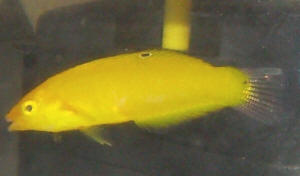
Yellow Coris Wrasse/Systems/Feeding
7/21/10
WWM Crew,
<Chris>
I bought a yellow wrasse from LiveAquaria - received it yesterday
afternoon, acclimated it in QT as per normal. I kept the room
lights dimmed to limit any stress on the fish, and it seemed to
be swimming okay.
This morning, I looked at it more closely with the lights on. Its
mouth is totally wide open, agape and not moving (picture
attached)...it doesn't close at all. Respiration looks normal
otherwise. Also, its not showing any interest whatsoever in food
(both frozen Mysis and flake), and its just hanging out in the
upper portion of the tank, not actively swimming around.
Could its jaws be damaged? I'm not familiar with how this
fish's mouth should look, but stock pictures I've seen
look "closed".
<Chris, first off, your wrasse is not a Coris species, you
have a Halichoeres chrysus ( Labridae family). Quite often they
are labeled as Yellow Coris Wrasses and why, I don't know.
The first thing that comes to mind is that the wrasse has no
security retreat in the form of a 2-3 inch fine sand bed and this
may be causing the behavior you are seeing. Most wrasses are not
comfortable without such a retreat as in nature, they do not seek
shelter/security among the rocks. Upon introduction to a new
system with the above mentioned sand bed, these wrasses generally
bury themselves immediately and are not seen for a day or so, and
that is what is leading me to believe you may not have a
"fine" sand bed. As to luring it to feed, if live Brine
Shrimp are available in your area, you might want to try that, or
a fortified frozen Brine Shrimp. Not the greatest nutritionally,
but most fish find this type of food irresistible and would be a
good start in getting the fish to feed.
Also read here and related articles/FAQ's found in the
header.
http://www.wetwebmedia.com/halichoeres.htm
James (Salty Dog)>
Chris
|
 |
Re Yellow Coris
Wrasse/Systems/Feeding 7/21/10 - 7/22/10
James,
<Chris>
Thanks for your reply.
<You're welcome.>
My biggest concern was the observation that the mouth was wide open
all the time, not making any "gasping"
movements...I've not seen that before.
<Mmm, my reply was in regard to that, uncomfortable, likely a
defensive pose with the wrasse lacking security. Another
possibility is a degenerative condition brought on by nutritional
deficiency but you would have noticed this in your dealer's
tank if you inspected closely before purchasing. I'd just
observe for now and concentrate on getting the fish to
feed.>
<<This specimen's mouth does appear damaged... not
uncommon through collection/holding/handling from the wild. Only
time, good care will prove that this fish improves. RMF>>
Regarding the issue of the substrate: It's been alone in a
temporary 10g QT with some pieces of PVC for shelter, tank is
located in a dimly lit room, no commotion that would add stress. I
didn't have sand substrate...all advice I'd received was
that QT should be bare bottom for ease of cleaning/water changing.
What do you recommend for balance of quarantine period (its only
been 2 days so far)? Should I place a bowl of sand from the main
tank into the QT?
<I would do this, will have a calming effect on this fish and
the sand will help with denitrification. Have you checked ammonia
levels in the wrasse's quarantine tank...another
possibility.>
I was planning on doing a preventative 10 day dose of quinine for
ich as a precaution.
<Not a good idea to treat fish as a precaution if no disease is
present, will just add unnecessary stress on the fish. James (Salty
Dog)>
Chris |
ornate wrasse with loss of swim bladder
6/13/10
Good evening to all and hope you are well.
<Hello there Jeanne. Sorry, have been away from the Net>
I have had an ornate wrasse ( Halichoeres ornatissimus ) in my 150
gallon reef tank for a little over 4 years now and he suddenly lost the
use of his swim bladder. He swims when the tank is being fed and eats
greedily and poops normally and will interact with a mirror when it is
placed against the tank, but spends a great deal of time lying
on his side, breathing heavily.
<Mmm, summat wrong here... either some sort of latent damage...
parasitic issue, or nutritional deficiency of some sort>
He was treated in my hospital tank with antibiotics for several weeks
(which cured his initial blindness
<This is a good clue... am now leaning toward the last of the three
aforementioned groups of possible issues>
that accompanied this swim bladder issue) but he seemed distressed in
the small hospital tank with no improvement in swimming ability, so he
was moved back to the 150.
This has been going on for about 2 months now.
My LFS says he can live indefinitely without the use of the swim
bladder, but it is distressing to watch him sink like a stone and lie
on his side, as well as struggle to swim. He is a large fish, at least
7 inches.
<Wow! A monster for this species>
He still buries himself at night but it is slapdash and he is often
halfway uncovered. Do you know what their average
life span is?
<Is at least several years. This is one of my fave species and our
olde service co. used to stock several...>
Is there anything else I can try?
<Yes... nutritional adjuncts... Micro-Vit, Selco/n... there are
quite a few good vitamin and HUFA, plus commercial products nowadays...
I'd add these to favorite foods... and switch the tank to a staple
of Spectrum pellets...>
The LFS is suggesting another regime of penicillin.
<Nah. Of exceedingly little to no efficacy here>
I would be grateful for any additional information or advice. Thank you
so much,
Jeanne
<Welcome. Bob Fenner>
Re: ornate wrasse with loss of swim bladder
6/14/10
Hi Bob and crew,
Thanks very much. I do feed food soaked in Selcon and a wide variety of
frozen food plus Cyclop-eeze and Dainichi pellets. I could put more
algae sheets in there definitely. I will try spectrum. He may just be
an old guy.
I will let you know.
Thanks again.
<Have collected a bunch! of this species in HI for the trade...
Never seen one as large as yours, so maybe it is "just old"
as you state. BobF, who is feeling "that old" himself>
Yellow Coris Dies 2/17/09 Hello Scott,
<Matt.> I've had a male and female pair of yellow Coris
wrasses for almost a year until now. I found my female Coris' nose
sticking out from a rock crevice, at first glance I thought it was just
hanging out and waited about 15 minutes to see if she would come out.
Nothing happened, checked vital signs and finally took a pair of
tweezers and pulled it out from the rock. Somebody had been eating her
tail...I could only imagine it was a nice gnarly big bristleworm within
the rock that could have done this. <Maybe, eating after the
fact.> Her face was being wiggled from side to side and I thought
she was giving birth or something...apparently it was the motion of the
worm eating her tail that made her head move back and forth. Its
upsetting cause I had the pair a long time. <I understand, sorry to
hear this.> Do you agree this was probably a bristleworm? <Not
likely. There was something surely munching on it after the
fact'¦most likely a crab if you have any in the system.>
And what's the most effective way to eliminating most of them from
the tank? traps? Any ideas which type of traps work best in your
experience. I haven't lost a fish in this tank for at least 9-10
months. <I do not suspect a worm did this in any
way'¦.there may be no reason whatsoever. All living things
just have a limited lifespan. Most of the bristleworms encountered in
our tanks are beneficial detritivores. I would really not be concerned
re bristleworms here. If you feel the need to remove them, a simple
nylon, that like used for pantyhose, wrapped around some meaty food is
as good a way to snag them as I have found.> Thanks,
Matt
<Welcome, Scott V.>
|
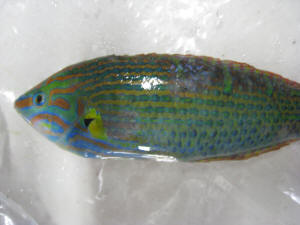
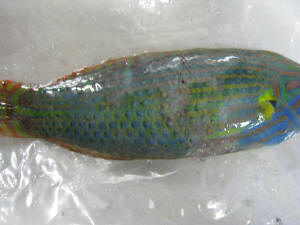
Halichoeres, hlth., quarantining
2/16/09 Dear Crew, <Eric> I finally found a
really nice H. melanurus at one of the LFS and picked it up a
little over a week ago, along with a cyaneo ( spelling?) flasher
wrasse. They have both been in quarantine since then and eating
mysis shrimp. I've been doing 25% water changes, with water
from my display tank, every couple of days to keep ammonia down
and slowly bring it to my DT's SG. Last night I noticed the
melanurus looked a little off - breathing just a little faster
than usual - but otherwise seemed like it was bedding down for
the night. A half hour ago I found it dead. The other wrasse is
behaving normally and not displaying signs of stress or sickness.
The temp is about 75 F, SG is 1.022 ( store was 1.021 ) <Both
too low....> and ammonia tested 0-.25 on a Salifert kit ( it
was white ). Any ideas what caused this? <Mmm, from the
bruised looks of the perished specimen... poss. injury>
I'd like to rule out any issues with my quarantine tank so
even though I'd be upset if I bought a sick fish, at least
I'll know I'm doing things right on my part. The only
physical signs I saw are the whitish areas where some of the
slime and/or scales seem to have come off. I'm not sure if
that was post-mortem as I did not notice it yesterday. <I have
the same perspective> I really liked this fish and hope to
have better luck with a future specimen. The quarantine tank is a
5 gallon <Way too small for such fishes> ( I know its small
but I didn't have a stand to hold a larger one at the time. I
do now and will be upgrading to a 10 gallon ) with a heater,
small hang on filter for water movement and light filtration (
the pad is kept in my DT sump when the quarantine is empty ) and
some PVC pieces for hiding places. The photos are attached as
well. Thanks, Eric <Good pix... with this genus, other
Labrids, I am much more a fan of cursory dip/bathing and placing
straight-away in DTs... they seem to too often suffer more for
the interval, process of quarantine. Bob Fenner>
[IMG]http://i109.photobucket.com/albums/n70/jejton/IMG_0875.jpg[/IMG]
[IMG]http://i109.photobucket.com/albums/n70/jejton/IMG_0874.jpg[/IMG]
[IMG]http://i109.photobucket.com/albums/n70/jejton/IMG_0873.jpg[/IMG]
|
  |
Re: Halichoeres, other sensitive wrasse
dips/baths 2/16/09
Dear Mr. Fenner, Thank you for
the quick reply. What kind of dip/bath would you recommend? I'm
aware of freshwater with and without formalin and a couple of
others but all the material seems to be contradictory ( including
your site!). What do you recommend for these fish? <A pH
adjusted dechloraminated freshwater with half the usual dose of
formalin, heavy aeration... done in your presence...> While we
are on the topic, do you have any recommendations for prophylactic
treatments ( be they dips, baths or medications while in quarantine
) for saltwater fish and/or inverts (corals, crustaceans, etc ) ?
<Only what is written, posted by me on WWM> I do know that
quarantine is the best policy but I am worried that a new fish
might survive quarantine with a parasite load that it has adjusted
to over a period of time or do not cause significant symptoms, but
once introduced into my DT, the existing fish won't be able to
tolerate the new parasites and become ill or die. <Much more
likely to die in QT... life is a series of compromises... What will
you choose here?> The material I've read in various sources
is inconclusive but rarely based on actual studies, just anecdotal
stories. Thank you, Eric <Such is the nature of our hobby. Thus
far... BobF> |
|
|
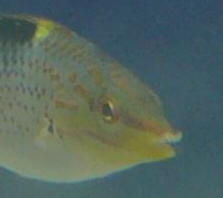
| Re: Mouth problems on Checkerboard wrasse 8/24/08
Thanks for the suggestions. I do put Selcon in all my food, what I
was doing is when I make the frozen mix, I just put a dropper full
of Selcon into it. That's about 1ml per day of Selcon fed to
the tank, I do believe. So I stopped feeding the food frozen as per
your advice, hopefully the wrasse is able to regenerate his lips.
<If not too damaged, should do so> The only reason I fed
frozen was it didn't seem to make such a mess in the water that
way. The fish all go up, chew their pieces off and then come back
and do it again and again until the hunk is gone. <Mmm, you may
well want to consider making your own... much cheaper... and using
more binder/emulsifier... to "keep together"... Read
here:
http://wetwebmedia.com/ca/cav1i3/Progressive_Recipe/Progressive_Recipe.htm
and the linked files at bottom...> When I thaw it, I get a lot
more "cloud" into the water, real small particles. I
don't have corals or any other inverts that filter feed, so
those small particles aren't doing me much good. I used to mix
the Omega One marine garlic flakes into my food, it helped bind it
together more, maybe I should start doing that again. <Oh! Good
idea> Thanks again for the help Bob! All my fish are doing
"swimmingly" and a lot of that is only possible because
of you and your crew. <Welcome Grant! BobF> |
|
Yellow Wrasse QT 08/12/2008 Hello, <<Hi there,
Andrew here>> I recently purchased a ****Yellow Wrasse****
and have him in QT. The reason for writing you today is in
regards to a question submitted on 08-12's FAQ by another
regarding his QT of a Yellow Wrasse. Eric mentioned that QT is
not necessary with this type of fish and I am curious as to why,
in this case, you do not need to QT it. I am not questioning
Eric's recommendation, as I am sure he is more than
qualified, just trying to further my knowledge. <<Regarding
this wrasse species, can you please be more specific, as the
common name of "yellow wrasse" is given to a few, which
have different needs / sizes etc etc. Please review here,
including linked articles and FAQ's, identify your specific
wrasse, and then re-submit your query. Its always best for us to
provide answers based on specific information, and not to
generalise common names or assumptions.
http://www.wetwebmedia.com/marine/fishes/wrasses/index.htm
http://www.wetwebmedia.com/marine/fishes/wrasses/coris/index.htm
http://www.wetwebmedia.com/halichoeres.htm >> Thanks, Shawn
<<Look forward to receiving your reply and species info.
Regards. A Nixon>>
Re: Yellow Wrasse QT 08/14/2008 I believe
it to be Halichoeres Chrysus. Thanks again, Shawn
<<Intrigued. Could you point to the page on which you read
this, had a look, could not find myself. Personally, yes, I would
quarantine for a few weeks. A Nixon>>
|
Wrasse question... health 9/3/07 Hi
folks, <Chris in China> I have been searching the site for an
acceptable solution before sending this off to you, but I would like to
confirm my hunch with you. We have a yellow wrasse and purple tang
currently in a 150L QT (with skimmer and external filter; pH 8.2;
salinity 1.016; ammonia 0; nitrites 0.6ppm [yes, I know these are high,
but are using the other QT to house an ich infected PBT and set this
one up in a hurry to keep these fish contained ... We do a 30% water
change daily]); both have heretofore been eating like pigs. Two days
ago, we noticed that the wrasse's upper lip was swollen and today
we've noticed it turning brown (a la a bruise). <Not atypical
symptoms/circumstances for a Halichoeres chrysus in captivity>
Moreover, we've noticed a red line develop on the right side of his
head between the corner of its mouth and eye. This also has been
accompanied by abbreviated and white stringy poop, which makes me
believe that we are dealing with a bacterial infection due to an injury
(potentially with the tang). <Maybe> I have been feeding vitamin
soaked Mysis and Marin Pearls and the wrasse prefers the latter. As a
matter of fact, he just voraciously downed 10 pellets. While his
appetite is good now, I am afraid that it could taper quickly. Is this
a Flagyl treatable situation? <Perhaps... though to point out, the
Flagyl is really a protozoan parasiticide... not useful for much in the
way of infectious problems... What really needs to happen is for you to
rid this system of the nitrites... IF the two fishes aren't
infested with something you intend to treat with that might be
absorbed... I would place a few pounds of live rock in the 150> All
the best, Chris in China <Bob Fenner in presently-too-hot San Diego,
CA, USA>
Halichoeres chloropterus acclimation/survival...
Labrid Sel... 8/24/07 I wanted to ask for some input on
maximizing the survival of a Green Coris wrasse, Halichoeres
chloropterus. I've tried twice now to get one: the first was
mail-order and dead when I opened the box. The second, a LFS got for me
2 days ago. They left it in the shipping bag, and I picked it up about
3-4 hours after they had gotten it from the airport. I drip acclimated
it into my QT over about 2 hours, and it seemed to be fine the first
evening. But all day yesterday, the fish did not look good, and by
evening, I knew it was dying. It seemed lethargic and weak. No skin
lesions of any kind, not staying at the top of the water, but breathing
more labored than it should and lying on the bottom, having to
constantly right itself from listing. <Mmmm> My QT currently has
a carpenter's wrasse, which I acquired about 1 week ago, and it
appeared normal the entire time and still does. The water never showed
any ammonia or nitrite, but I added some Prime in case my test kit was
off. I thought maybe it was from cyanide or something, so I dipped the
fish in methylene blue (in salt water) for 4 minutes, and added an air
stone to the tank to maximize oxygen saturation. It was to no avail, as
the fish seemed to progressively have trouble breathing and finally
died late last night. <Too much stress... better to place such
"touchy" species, genera in their own darkened isolation
system and leave them alone for a week or two...> The LFS is going
to order another one, and I would like to ensure another one isn't
killed. Any ideas on why the first would have died, and ways to
minimize the risk again would be greatly appreciated! I've kept
marine fish for 3 years now, and have a lot of fish and corals in 3
tanks, so the problem isn't purely my inexperience; I just am
stumped as to what would have led to the 2nd fish's demise in 1 day
like that, leaving the other unaffected. Thanks for your help and a
greatly informative site. Scott <Well... these Labrids are on the
"skittish" side and quite a few initial losses occur... as
you've experienced. Again, really doing very little with them other
than careful flushing of metabolites through acclimation... and leaving
let be is a very good idea. Bob Fenner>
| New black dots on a 8 line wrasse question
3/16/2007 Hi Guys, <Matt> Greetings from sunny Adelaide,
Australia. First off love the site and all the great work that has
been put into it. I searched the wrasse FAQ but couldn't find a
answer so here goes a email <Good> 280L tank, all the levels
are right (bar it being a little warmer than most tanks but
that's a different story) and none of the other tank mates seem
to have any issues. He's still eating as per normal (he's
doubled in size since I got him 6-7 months ago) and swimming around
like the speed demon he is. The black marks (it looks like ink
marks) on both sides appeared in the last couple of days and
therefore I'm very interested to know what they are ? <Mmm,
if this were unilateral (one-sided) I would jump (?) to the
ascertain that this was likely a mechanical injury, nervous
reaction... But both sides?> Since they are on both sides I
don't believe they are a scratch, I'm more leaning towards
a infection of some type. from my reading maybe even a UTI ?
<Mmmmm> Attached are a left & right photo and a circle
has been placed around the area of interest. Cheers Matt <Any
other livestock showing signs of distress? Anything showing up in
water quality tests? Something different done the last few days? I
still suspect this is some sort of injury reaction... Bob Fenner,
who would "wait and see" here> |
|
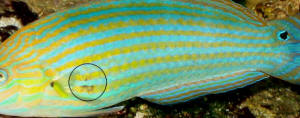
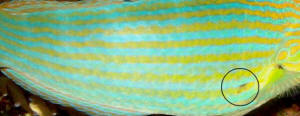
|
| Disease ID (photo attached)
6/28/06 Dear WWM crew: <Jeff> It seems I need your
generous assistance again. My yellow
"coris"/Golden/Canary wrasse (Halichoeres chrysus) has a
pale light pink "spot" near its tail fin and anal fin
(but only on the body, not the fins). In the attached
photo, you can barely make out a light pink (almost white) area
near the said fins the spans about half the height of the
fish. I hope the attached photo is good enough (the
glass is not clear and has some algae growth; and the camera is not
suited for this kind of shot). The yellow coris also
scratches itself against the rocks on that light pink
area. This is the only abnormal behavior I've
observed. He is otherwise eating, foraging for
'pods, coming out to swim during the day and burying itself in
the sand at night. Can you identify what disease this
might be? And if so what's the
treatment? Thank you for all your help. J.N.F. <Does
appear to be some sort of mild petecchia... surface bloodiness...
due to what however? I would do your best to continue to provide
good care here (low nitrates, decent nutrition) and not
specifically "medicate" per se. Bob Fenner> |
|
|
Weird unexplained wrasse problem! 9/19/05 Hi WWM crew!
<Samuel> I have used you archives many times in the past and they
have never failed me, thanks for that! <Welcome> This time, I
have found a few cases similar to mine but none were resolved or
followed up!!! (uh-oh) I have a wrasse (Halichoeres melanurus) I think
it is also called a Tailspot wrasse? <Yes, one common name> I
have had it for 18 months or so and someone else had it prior to that
for a year. I have never had any problems with it but recently
introduced a bicolour angel straight into my tank after my quarantine
tank sprung a leak after only a week of the angels quarantine. The
angel is great (if a little shy and reluctant to take food amongst
other fish) But my wrasse has several problems. It seems to have its
mouth permanently half open and constantly head butts the front glass
with its mouth (no visible damage yet!) But I have seen it quite a few
times spontaneously shaking quite violently - one time for a few
seconds (very distressing for me and him!) <Not good> It has also
had some unusual swimming patterns - up and down up and down in the
same spot. It is eating as piggishly as ever and still buries at night.
There are no visible signs of disease or parasite within 4 - 5 days of
the behaviour. My only thought is some internal parasite but I thought
they usually affected appetite! AHH Help me please! Thanks so much
crew! <Much more likely a degenerative condition born of nutritional
deficiency... I would quickly start supplementing its foods by soaking
in a prep. like Zoe, Selcon... Bob Fenner> Radiant wrasse,
Bailey's pod show 1/18/06 Dear WWM Crew, <Belinda>
:) It is with a heavy heart I tell you I found our beautiful radiant
wrasse dead in the tank today. My guess is he died a day or
so ago. I am not sure why as he had been coming out
regularly and was eating. Although he did not stay out all day he was
coming out almost every day. I did notice that when we saw
him out last he was swimming sort of humped, with a humped back and I
was afraid something might be wrong. Any ideas? <Not a
great answer, but "cumulative stress" likely> I really
hate it as we have a yellow wrasse that really liked him. At
least I think it is a yellow wrasse - it is yellow on top white on
bottom, with pretty green horizontal lines at his head and
tail. <Likely Halichoeres chrysus...> We would really
like to get another one or similar for him because he became really
excited and would try to get him to swim with him constantly. Looking
on www.liveaquaria.com site it looks like they have a yellow wrasse, a
neon wrasse, a Hoeven's wrasse, and of radiant wrasse that looks in
the same family as our yellow and white wrasse. <See fishbase.org or
WWM with the scientific names...> Do you have a suggestion as to
which might be a better friend? <Many choices> We
have tried to pair up as much as possible. Our sailfin tang
and bicolor Rabbitfish seemed to have really hit it off and constantly
swim around together. Also have you ever consider doing a radio talk
show called "aquarium talk" - something like "car
talk" :) <Yes... is done by two (quite) old friends, Nevin and
Tom Bailey... and of all things, they live in the same town (San
Diego). I should contact them to see if they have a spot. Bob
Fenner> Thanks so much, Belinda
Frightened Canary (4/21/04 Hello WWM crew, <Steve Allen
with you this evening.> We have had a Canary Wrasse (Halichoeres
chrysus) in our tank for about 6-7 months now. He was doing great up
until a couple weeks ago. He was really active, swimming around the
entire tank, curious, and his feeding/sleeping schedule was like
clockwork every day. But lately he's seemed out of sorts. He
disappears for a day or 2 at a time and doesn't come out at his
normal time for feeding like he used to. If he does come out, it's
usually later at night. We feed him when he comes out and he eats, so
we're assuming being hungry isn't the problem. But also, now
that he's been gone for longer periods of time we've noticed
the other fish (a tomato clown, and a damsel <What kind?>
that's being given up for adoption soon) will chase him around and
pick on him when he does come out of hiding. They never had problems
getting along before. <None that you noticed anyway. I have little
doubt that they started at some point before he started to hide and you
just didn't happen to be there at the right moment to see it. It
does not take much to spook this Wrasse.> We've tested the
water, and everything seems normal. His coloring still looks normal
too. The Wrasse is our favorite fish, we don't want to lose him.
Any idea what might be causing his strange behavior? <The Tomato and
the Damsel. They are well known to grow more aggressive with age. This
Wrasse is obviously afraid. Unless you have some other aggressive fish,
they're the culprits.> How long can he stay in hiding before we
should start worrying about him? <You probably have to choose
between the Wrasse and the other two. One thing to try first would be
to remove the Tomato and the Damsel to a quarantine tank and re-arrange
the rocks in the display. Then put them back in after the Wrasse has
had a couple of weeks to settle down. However, I fear they will start
back up where they left off fairly quickly.> Thanks, Kerry <Hope
this helps.>
|
|