|
FAQs on Banner Butterflyfishes
Health/Disease
FAQs on Butterflyfish Disease:
Butterflyfish
Disease 1,
Butterflyfish Disease 2,
Angels and Butterflyfishes &
Crypt,
FAQs on Butterflyfish Disease by
Category:
Diagnosis,
Environmental,
Nutritional,
Social,
Trauma,
Infectious,
Parasitic,
Treatments
Related Articles: Heniochus Butterflyfishes,
Related FAQs:
Banner
Butterflyfishes, Heniochus Identification,
Heniochus Behavior, Heniochus Compatibility, Heniochus Selection, Heniochus Systems, Heniochus Feeding, Heniochus Reproduction, Chaetodonts:
Butterflyfish Identification, Butterflyfish Behavior, Butterflyfish Compatibility, Butterflyfish Selection, Butterflyfish Systems, Butterflyfish
Foods/Feeding/Nutrition, Butterflyfish
Disease,
Butterflyfish
Reproduction,
|

|
 |
Butterflyfishes for Marine Aquariums
Diversity, Selection & Care
New eBook on Amazon: Available
here
New Print Book on Create Space: Available
here
by Robert (Bob) Fenner |
|
Heniochus chrysostomus injury? Wil's input
9/14/18
Good evening!
<Morning Melissa!>
Always loved your site and the clear information provided here! Thank you so
much!
<Ahh...thank you, glad to be helpful.>
I have a newish 50 g, my son has been sucked into the wonderful world of fish
and wanted his own tank. He is doing great and our plan is to upgrade to 100-150
g within the year
<Great, the bigger, the better>
Parameters: Ammonia 0, nitrites 0, nitrates 20-40 (working on this) not sure but
struggling with losing snails.
Stock: Heniochus chrysostomus (2.5), small sailfin 2.5”, starry blenny (4.5”),
small maroon clown (very irregular white stripes, only stripes are more like
misbar and don’t go all the way around 1.5”), Black ocellaris misbar (more like
a domino ocellaris but misbar not spot 1.5”), 2 Banggai Cardinals (1.5” they
appear to be trying to host LTA), 2 cleaner shrimp, 1 ridiculously huge LTA.
<Mmm...how old is this tank?>
Small Frags: pulsing Xenia, Goniopora, Zoas, and frogspawn, and a SLPs that
looks like a plate coral on a stalk (kinda like a lps and anemones crossed).
50 lbs live rock (found one with lots of life including an Aiptasia and
something that had what looked like long “stingers” like you would see from a
crowded coral)
<LR should´ve been bleached out to avoid introducing these pests to the tank>
All that said....
I am actually writing about our Heniochus chrysostomus. She (I just call her
“she”, don’t actually know). She is new, been a weeks with us. My qt failed and
I had to add her faster than planned (1 day) but appeared to do well, cruising
around gracefully and eating well. As expected with quick add and short qt...
along came some ich, sailfin first and the Heni was acting as a cleaner to her.
Both had minimal spots and will address after we get through this. I fed garlic
soaked food and seaweed, water changes etc... slightly lowered salinity (1.025
down to 1.021 prob not sig enough to matter) and slightly raised temp to 81 from
78
<Try to quarantine at least 4 entire weeks no matter what, it's easier than it
seems and will save you from future problems which are much difficult to fix in
the main tank, specially if you have corals/inverts.>
The point of this email.... Heni had something happen to her side, looked like
an injury... looked like a scale was falling off as a result, seemed
like no big deal. Noticed scale looking thing fell off (looked like transparent
roundish flat disc, but bigger than I would think her scale could be, maybe the
size of grape tomato seed, but super thin like a scale). So it was gone for 2-3
days and barely a spot there, had to look hard. Then in day and half the area
just expanded. I attached pics, now losing coloration, slight outline.
<Appears to be a physical trauma and it may be caused by scratching against the
rocks trying to get rid of parasites.>
She is not well. She is staying in low flow area, not swimming real strong but
not on her side. As of tonight, she is not eating anymore...
<Certainly not a good sign>
I’ve tried to ID this spot without success, but if there is anything to be done,
I need to ask for help from the experts quickly.
So after a long email, recap.... Heni with possible injury/LTA
sting/disease/parasite/or??
<Because of your LTA´s size in such confined space and the lethargy of your
Heniochus, there is a possibility that it have been stung>
and side note of snails that are either inactive/withdraw/dormant with 2 losses.
I’m so sad and want to help her, my qt is down and can’t put her elsewhere,
scared that catching her would be too stressful.
<You are right, don't stress her more>
Any help would be greatly appreciated, I’d love to help her, although without
her eating I know it’s not looking good. She is such a personality, never shy
from day one.
<The only thing that you can do is to keep the lights out and cover the tank
with something(sheets or trash bags) for a couple of days and see if this helps
to reduce stress and make her feel better, I wouldn´t try any kind of treatment
at this point.>
I eagerly await hearing from you... son is sad, actually our whole family is
sad... this was our last addition as we know we have to have a larger tank even
though the fish are small. We are going to triple our tank within the year.
<Upgrading your tank will be a good idea since Heniochus need plenty of room and
oxygenated water to feel happy and thrive.>
Thank you so much for your knowledge and willingness to share over and over
Take care
<Hope this helps, take care too and keep us posted. Wilberth>
Heniochus chrysostomus injury? Bob's go
9/14/18
Good evening!
<Hey Mel!>
Always loved your site and the clear information provided here! Thank you so
much!
I have a newish 50 g, my son has been sucked into the wonderful world of fish
and wanted his own tank. He is doing great and our plan is to upgrade to 100-150
g within the year
<Good>
Parameters: Ammonia 0, nitrites 0, nitrates 20-40 (working on this) not sure but
struggling with losing snails.
<Mmm; may be (there may be) something not right here chemical/environment wise.
Many possibilities; that careful use of chemical filtrants might greatly
alleviate. Am a huge fan of ChemiPure or eq. in the water circulation path.>
Stock: Heniochus chrysostomus (2.5), small sailfin 2.5”,
<These are small specimens; like porridge that's too cool, hot... small ones
(and large ones) are easily lost.>
starry blenny (4.5”), small maroon clown (very irregular white stripes, only
stripes are more like misbar and don’t go all the way around 1.5”), Black
ocellaris misbar (more like a domino ocellaris but misbar not spot 1.5”), 2
Banggai Cardinals (1.5” they appear to be trying to host LTA), 2 cleaner shrimp,
1 ridiculously huge LTA.
<Aye ya... This anemone may be a/the source of trouble alluded to above>
Small Frags: pulsing Xenia, Goniopora, Zoas, and frogspawn,
<And the Euphyllia, Zoanthids... this is a BUNCH of chancy life closed in such a
small system here>
and a SLPs that looks like a plate coral on a stalk (kinda like a lps and
anemones crossed).
50 lbs live rock (found one with lots of life including an Aiptasia and
something that had what looked like long “stingers” like you would see from a
crowded coral)
All that said....
I am actually writing about our Heniochus chrysostomus. She (I just call her
“she”, don’t actually know). She is new, been a weeks with us. My qt failed and
I had to add her faster than planned (1 day) but appeared to do well, cruising
around gracefully and eating well. As expected with quick add and short qt...
along came some ich, sailfin first and the Heni was acting as a cleaner to her.
Both had minimal spots and will address after we get through this. I fed garlic
soaked food and seaweed, water changes etc... slightly lowered salinity (1.025
down to 1.021 prob not sig enough to matter) and slightly raised temp to 81 from
78
The point of this email.... Heni had something happen to her side, looked like
an injury...
<Agreed; could be new... or old; consequent from capture, handling... just
showing up now. Might be a protozoan involvement (Uronema?) or bacterial
infection secondarily>
looked like a scale was falling off as a result, seemed like no big deal.
Noticed scale looking thing fell off (looked like transparent roundish flat
disc, but bigger than I would think her scale could be, maybe the size of grape
tomato seed, but super thin like a scale). So it was gone for 2-3 days and
barely a spot there, had to look hard.
<May be... or trematode... or? A freshwater dip/bath might show more settled on
the bottom, falling of the host BF>
Then in day and half the area just expanded. I attached pics, now losing
coloration, slight outline. She is not well. She is staying in low flow area,
not swimming real strong but not on her side. As of tonight, she is not eating
anymore...
<Bad>
I’ve tried to ID this spot without success, but if there is anything to be done,
I need to ask for help from the experts quickly.
<Would have to be sampled and looked at under a microscope to get a close guess>
So after a long email, recap.... Heni with possible injury/LTA
sting/disease/parasite/or??
<Exactly these possibilities>
and side note of snails that are either inactive/withdraw/dormant with 2 losses.
I’m so sad and want to help her, my qt is down and can’t put her elsewhere,
scared that catching her would be too stressful.
Any help would be greatly appreciated, I’d love to help her, although without
her eating I know it’s not looking good. She is such a personality, never shy
from day one.
I eagerly await hearing from you... son is sad, actually our whole family is
sad... this was our last addition as we know we have to have a larger tank even
though the fish are small. We are going to triple our tank within the year.
Thank you so much for your knowledge and willingness to share over and over
Take care
<Am sorry to state, the prospects for this Heni are bleak. IF you had/have
another established treatment tank, I might try a bath/lavage of formalin
enroute, then Methylene Blue as a mild disinfectant... Bob Fenner.
|
.jpeg)
 |
Heniochus diphreutes. Not eating
9/21/14
Dear WWM Crew,
<Mark>
I¹ve searched your FAQ¹s and I haven¹t found anything similar to my
situation, so hopefully you can help. One of my Heniochus has stopped
eating (3 days), which is very odd as the Heniochus are the biggest
eaters
in the tank.
<They are given to feeding strikes... IMO/E from eating something that
doesn't agree w/ them in the
system... Hydroids, Polychaetes....>
He looks normal (no swollen belly) and the only behavioral
change is that he is less active. I have a 220 gal tank (fish only) with
14
fish, including 3 Heniochus. It is a very peaceful tank. Everyone has
been
together for a year and the other fish are eating and acting normally. I
feed pellets (alternating 3 varieties) and frozen food (4 varieties)
twice a
day and put in seaweed (3 varieties) once a day, all of this to provide
the appropriate food for the carnivores and herbivores in the tank.
<Good>
I alternate
adding Selcon and garlic to the food. He has always eaten pretty much
everything. I¹m finishing up hyposalinity treatment (16 weeks)
<Oh! This will induce non-feeding easily>
to deal with
an ich outbreak that really only showed up on my yellow belly blue tang.
The Heniochus only had a couple of random spots in the beginning. Water
parameters are where they should be (save for the low salinity) and
steady.
How many days can a fish go without eating before you take action?
<Some; starting in good shape, for a few to several weeks>
My
purple tang had constipation in the past (swollen belly) and I fed peas
to
deal with that, but he was still eating a little. This Heniochus just
watches food float past his face with no interest. What, if any, actions
would you recommend I take?
<Patience at this point. Opening up a bivalve in a few days...>
Thanks,
Mark
<Welcome. Bob Fenner>
Update: Heniochus diphreutes 10/6/14
Dear WWM Crew,
<Mark>
It’s been another 14 days, and the Heniochus is still not eating. He has
been more active, schooling with the other two Heniochus, and otherwise
acting normally, except during feeding time.
<Dang! You did try the opened bivalve/shellfish? Soaking other preferred
foods with HUFAs, vitamins?>
The only physical change is that his fins have started to deteriorate.
<Likely from either the lack of nutrition of bullying.... but by whom?
The other BFs?>
I’ve spent a lot of time watching him to see if I can determine the
cause of his hunger strike. I haven’t seen any harassment by other fish.
All of the other fish are eating as usual. I’d pull him out and put him
in my hospital tank (40 gal breeder) but I don’t know what to treat him
for and it would just decrease his swimming area, so I don’t see the
benefit. Can you recommend a food to try that might spark his interest?
<All sorts. I refer you to the genus and family Feeding FAQs files on
WWM>
Any help would be greatly
appreciated - I don’t want to lose this fish.
Thanks,
Mark
<Do please keep us informed. Bob Fenner>
Re: Heniochus diphreutes
10/10/14
Dear WWM Crew,
<Mark>
I seem to be coming to the end of this particular journey. The
Heniochus is
still not eating. I did try two different bivalves, amongst a
number of different types of food, with no
luck. While he is still acting
normally he is continuing to deteriorate. His colors are fading and his
fins are degrading. If you have any suggestions on other things
to try please let me know.
<I would ASAPractical move this one fish elsewhere... to another
established, stable system of size. BobF>
Thanks,
Mark
Reviewing ick treatment for
Bannerfish... some reading, review on WWM NOW!
7/8/14
Dearest Bob & Crew,
<Joe>
Hope that this email finds you in great spirits.
<Ah yes; thank you>
Just a quick question today. I ordered some schooling Bannerfish from
Kevin at Pacific Island Aquatics in Oahu (great guy!). Unfortunately my
son had to go in for surgery and I was forced to dip them and forgo the
quarantine. My entire fish population was wiped out!
<Yikes>
I was able to order some more today and plan on doing it the correct way
this time (tank has been fallow for over 2 months). Please let me know
how this procedure looks:
1) Acclimate fish to quarantine tank- pH, temp, salinity etc. taking
about 45 minutes.
<Mmm, are you based in Hawaii? I would follow the SOP for commercial
acclimation archived on WWM IF the fish have been bagged for hours>
2) Perform freshwater dip (pH and temp matched of course). Last time I
did 2 minutes. Some of banners showed some signs of discomfort. Perhaps
longer this time?
<See WWM... re dips/baths... I would add some formalin>
3) Add to quarantine tank and monitor.
<Ok>
4) If signs of ick appear, treat immediately.
<With... CP?>
Do you think that a copper treatment or hyposalinity would be better?
I'm leaning towards treating with Seachem's Cupramine.
<See... WWM... re quinine compounds>
The banners seemed to eat fairly well last time (although pickier then
others and slower to acclimate to captive foods). Any other suggestions?
<All sorts... See WWM re Heniochus period>
Thanks so much!!!
Joe
<Welcome! Bob Fenner>
Re: Marine Ich Procedures; Heniochus 8/7/14
Thank you so much Bob,
<Welcome Joe>
Just an update on this. I had forgot to mention that the ick had come
from 3 Schooling Bannerfish that I was able to get from Kevin at Pacific
Island Aquatics in Hawaii (great guy!).
<Glad to hear/read of good experiences>
I have since ordered 3 more and added to a cycled 20 gallon long
quarantine tank. Like a broken record, the Banners contracted ick at
almost exactly the same time (or at least displayed the symptoms), about
10 days into the quarantine period. I did not have Quinine available and
decided to use hypo-salinity, dropping the water to 1.012 while keeping
pH and alkalinity near natural level (I also monitored ammonia and
performed 20% water changes every 3-4 days. I also used the Seachem
product "Paraguard" as directions stated. The fish seemed like they were
tolerating it quite well, feasting on a mix of frozen and dried food,
although they were picky at first.
<Ah yes>
The spots seemed to be unaffected at first so I performed a second pH,
temp adjusted freshwater bath which seemed to alleviate the spots and
invigorate the fish (FYI, Kevin states that this was NOT a good idea).
<... did he state why this is his opinion?>
All seemed well and the Henis seemed well on the way to recovery. About
10 days into treatment I started finding the fish dead.
My belief is that the ick took out the fish, as opposed to stress
related to the hypo or ammonia problems due to feeding.
<Likely a combination of these... who can say which is greater?>
I'm perplexed why the same problem would occur twice in a row.
<... the Heniochus likely came in infested... Very common>
Perhaps a problem with shipment? I'm saddened that I did not have the
skills/tools to fix this common ailment but at least I was smart enough
to use quarantine this time.
Any suggestions? Perhaps I should avoid the Henis all together
in the future or even perhaps fish from Hawaii?
<Mmm; am a big fan of this genus (just put out a book on Chaetodontids
for aquariums)... and a huge fan of livestock from HI. See WWM re>
Lastly, should I bring the quarantine tank SG back up to regular levels
or keep them low to eliminate whatever ick may be left faster?
<Up to you. Some friends and just acquaintances are big stompers for
hypo... I am decidedly not>
Thanks Bob!
Joe
<Cheers, B>
Re: Marine Ich Procedures 8/7/14
Thank you Bob!
<Certainly Joe>
One of the reasons that I love the Henis so much is from your
recommendations via WWM and CMA as well as the fact that you don't often
see them in reef aquaria.
<Really neat, though at times quarrelsome, animals for large displays>
Kevin did not give a reason as to why he does not endorse freshwater
dips but I have been using them for years without problems. I do not
think that they would negatively effect the fish (although the second
dip was quite long, almost 10 minutes).
<Have done such procedures on hundreds of thousands of marine fishes
over decades in the trade; taught collectors, wholesalers re; made part
of fish disease presentations, writings.... VERY worthwhile>
The Henis seemed to tolerate the Hypo just fine, eating like crazy,
leading me to believe that it in itself did not overly stress them. I am
beginning to agree with you that they hypo is not effective. Do you
think that if I had used the Quinine that they could have been saved?
<Hard to impossible to say; would use CP instead though>
I have no experience with this medication and it does not seem to be
commonly available. I will go ahead and order it though to have in the
ol' arsenal.
Thanks so much Bob!
<A hu'i hou Joe. B>
|
Urgent! Please Help!
Heni, BF hlth... secondary infectious 7/5/14
Dear Bob, et al.
<Karen>
A friend of mine has had severe issues in his 150 gallon, FOWLR,
tank. Fish inhabitants included mature emperor, juvenile emperor, mature
Koran, juvenile gray, juvenile queen, niger trigger, pink tail trigger,
powder blue, Heniochus and Pakistani butterfly. (in retrospect
overstocked and the system just couldn’t handle it).
<Aye yi yi... needs more than twice this space...>
Initially he had removed all liverock and media from tank to treat the
system for ICH. He treated with CopperSafe for six weeks and then
another six weeks roughly to get the copper out with water changes.
During this time, the Pakistani butterfly showed signs of illness, he
stopped eating and died about a week later. I thought I could see a
slight film on this fish but we didn’t think anything more about this
(perhaps our mistake).
<Well; am just finishing up an e- and direct to print book on BFs, so,
am brushed on my Butterflyfish diseases! This Heni is way overstressed,
by the crowded conditions, likely bullying by the Angels, Trigger...
likely environmental issues like high NO3... and the copper exposure...
Triple whammy!>
About three weeks after the Pakistani butterfly died, all the other fish
appeared well and with confidence my friend was about to put the live
rock and sand back into the system. He first put the sand in and almost
immediately, perhaps from irritation from the sand (so we thought) the
fish started flashing, scratching and shaking their heads. My friend
removed the sand the next morning thinking it was the sand. The fish
continued to show irritation for a few days and that’s when he decided
to treat with the CopperSafe again, thinking that there was still some
bug that had survived somehow. After two weeks of treating with the
CopperSafe, there was absolutely no improvement, in fact the condition
deteriorated; fish began opening their gill plates and struggling to
breath. He asked me to come over and give my opinion. I felt that it was
a very urgent matter and that it was probably a bacterial/fungal type
infection and that the water was toxic. We tested for ammonia, nitrite
and both were negative. I felt that the fish should be moved to a
hospital tank with clean water and treated but at that point there were
too many fish to move and no place to put them.
<Oh yes; agreed>
We changed large volumes of water and aerated the tank and added
Metroplex at the advisement of the LFS.
<Mmm... very hard on (challenged already) fish's kidneys...>
Fish started dying, first the powder blue, then mature emperor, the pink
tail trigger, the Koran; all other fish were affected and at death’s
door.
<Yes; the med.>
In desperation, I set up a 75 gallon hospital tank at my house. (I have
2 tanks 220 and 120 with large sumps and I was able to utilize the water
from these tanks to help with the situation). We added Furan 2 and
Methylene blue (in case it was a fungus).
<Plus good as an oxygen-carrier and reducer of stress by providing
shade>
Remaining fish improved almost immediately however we lost the juvenile
emperor during this treatment period and the Heniochus was questionable
for a few days; I thought we were going to lose him but he recovered.
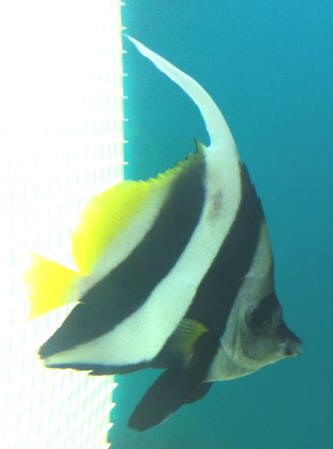
My issue today is regarding the Heniochus; he has a new issue,
black/grayish areas that seem to be under the scales. At first I though
it was bruising or scarring from the previous bacterial episode, but
these markings are getting bigger every day. Should I retreat this fish?
Any suggestions about what I should use to treat him? I am very
concerned that it could be mycobacteriosis? Probably not. He’s still
breathing normally and eating as are the rest of the fish.
<Mmm; tough call... I would likely NOT treat this BF... just hope it
recovers spontaneously given good conditions and nutrition>
I have attached 2 pictures, sorry one is blurry. but that’s pretty much
how it looks.
Sorry for the extensive details but there was a lot going on that lead
up to this final problem with this fish.
Thank you so much for you input,
Karen.
<Thank you for sharing. Oh! Do take a look on WWM. Have split up the BF
dis. FAQs into their usual 8 sub-cat.s
Bob Fenner>
|
 |
|
Re: Urgent! Please Help!
7/5/14
Thank you for your prompt response!
I have been watching and waiting to see if it gets better. It's been
about 3 days now since I noticed it and every day it gets bigger. I'm
just afraid it could be another bacterial infection under the scales. As
you said, it's a tough call. This fish has already been through so much
and I really don't want to lose him. He pulled through the first bout
and now this. I'll wait and see for now. If he stops eating again or it
spreads any more, what is the best antibiotic that would penetrate the
skin and go directly to the infected area?
<Please read here: http://wetwebmedia.com/BFInfectDisF.htm
Thanks again Bob, very much appreciated.
Karen.
<Welcome Kar. BobF>
RE: Urgent! Please Help!
7/6/14
Hi Bob, Sadly, I woke up early this morning and found the Heniochus
dead. I had decided to leave him be yesterday and see if he could fight
it off himself as he was still eating and he was in excellent quality
water. He seemed off though. He wasn't swimming around, only when the
food was offered into the tank but he was taking it.
<Mmm>
After taking the dead fish out of the tank I inspected him closely and
those dark marks were actually bleeding and again had spread even more
over night. He appeared to have just recently died when I found him.
How disheartening, to bring a fish back from death's door and have to
watch him go through that door a week later from a secondary infection.
<Yes>
I'm surprised that the fish developed this infection after being in
Furan 2 for 5 days; he almost immediately started displaying those marks
which spread each day over 3 days and then dead. I doubt that the
outcome would have been any different had I chose to treat him with
anything else. He was just too weak from the whole ordeal. Who knows?
<Even with sampling, culture, sensitivity testing... indeed>
And to know just what to treat him with? It's a guessing game.
<It is in almost all cases... In future I fully suspect that some sort
of "Star Trek" "tri-corder" like device/s will instantaneously recognize
antigens, other protein properties... perhaps ahead of "doom time" to
alert one as to impending issues>
The Furan 2
<Which/I would have advised a Furan compound...>
helped with one infection but he still developed the secondary one and
it overtook him so quickly.
I just wanted to let you know the outcome, as sad as it is. I really
wanted to see him pull through.
Thanks again for your support and advice.
Karen.
<Thank you for your compassion, sharing. Bob Fenner>
|
Re: Flame Angel lump... now Heni... hlth.
11/23/10
Hello again folks. I have over 20 different questions per week about
the saltwater hobby and after checking the forums there are always one
or two questions that go unanswered. Therefore, I contact you and I
hope not to be a bother. I have a Heniochus in qt now for about one
week and he has been scratching his gills since the day I purchased
him. I waited it out to see if any spots showed up to determine whether
or not to treat him with quinine. No spots showed so I narrowed it down
to a fluke or fish lice.
<Might be "nothing"... just stress, chemical/physical
"burn" from transport>
I went ahead and used the least harmful Med (Prazi-pro) and the day
after one of his gills were completely shut and the other moving
rapidly. Is this from the Med or is it the start of Ich/protozoa?
<Likely the former>
Thanks so Much everyone and Happy Thanksgiving !
<And you! Bob Fenner>
Re: re: Flame Angel lump... more? Re Heni, Crypt
11/24/10
Thanks for your help again. I do have another qt tank with a pb tang
(japonicus)
<...?>
and a flame angel that came down with Ich.
<All who are exposed need to be treated>
I am following the directions to the letter on the qs
<?>
container and was wondering if on the last day of treatment the fish
are free of spots and symptoms, shall I just put them back in the
display or shall I wait another week to see if anymore parasites show
up?
<... read here: http://wetwebmedia.com/ichartmar.htm
and the linked files above, till you're satisfied that you know
what you're up to here>
Last time I used qs, it killed my small Heniochus. He lost color,
stopped eating and became very lethargic and died. Wish me luck....I am
concerned. Thanks again.
<Best of luck... BobF>
SW med. reading, BFs, Velvet, Copper --
01/30/10
Hi everyone
Hi again guys lol. Ok, so I am in the middle of a two month fallow
period in my 90gal tank due to a velvet outbreak. I currently have my
3..5" Heniochus in a ten gallon
<Yikes>
QT tank with a penguin 150 HOB power filter a heater and some sand in a
pouch from my main tank to avoid a level spike (or at least help with
it). I have medium amount of circulation and an airstone for oxygen. I
just made the first dose of Cupramine.
<... I would not expose these, or most other Chaetodontids to
copper... Look into/use a Quinine compound instead. Read here:
http://wetwebmedia.com/quinmedfaqs.htm>
Now, the label says to dose this for two weeks
<Not w/o testing for free copper daily>
and your good to go (if no signs of spots or symptoms), but do you
think this is long enough?
<I suggest you read re Cu use on WWM>
I know for a face there is velvet in the water because it's the
same water that was from my display tank. If not two weeks, what amount
of time do you feel is safe enough to say the fish is free of velvet
and can be placed back into the display? And, how do you feel about the
"Prime" product by Seachem just in case I run into problems
with ammonia and water changes aren't completely
cutting it?
Thanks,
J
<Start here: http://wetwebmedia.com/mardisindex.htm
scroll down... Bob Fenner>
Recurring Pop Eye in Bannerfish 11/2/2009
Hello.
My Bannerfish, (Heniochus diphreutes),
<One specimen? This is a shoaling/schooling species... Rarely does
well singly>
has a recurring pop-eye problem and I'm stumped as to why. A little
over a week ago both of his eyes became extremely swollen. I removed
him from the display and placed him in a 30 gallon quarantine where I
treated with hyposalinity, Epsom salts and Melafix. The eyes cleared up
quickly and he was eating well. After 5 days of treatment I returned
him to the display tank, where he appeared to be fine. After several
days however, one eye has become swollen again.
The display tank is a 225 gallon mixed reef (bare bottom) with
approximately 200 lbs of live rock. It has been up and running for
eleven months. A 70 gallon sump contains a 25 gallon refugium with deep
sand bed and macroalgae (Chaeto); MR-3 skimmer with dual Becketts; and
three reactors running Rowaphos, carbon and nitrate sponge. All media
is changed once a month, and I perform a 25 gallon water change once a
week.
<Good maintenance schedule>
Water parameters are: Specific gravity: 1.025, pH 8.1 to 8.3, dKH 8,
Calcium 420, Magnesium 1380, Nitrates 10ppm, phosphates are
undetectable.
(I use Salifert and Elos kits, and test weekly).
I have had the Bannerfish for nine months and he is about five inches
long.
He has always been a good eater and gets along well with his tank
mates. No other fish shows any sign of illness. What could possibly be
causing the swollen eyes? Could there be some type of bacteria in the
tank?
<No doubt there are several species... but are any "that"
directly pathogenic?>
If so, why is it not affecting the other fishes?
<Perhaps they are less susceptible>
Thanks for any help you can give me'
Lance Foster
Vancouver, Canada
<Mmm, I would (if there is room, space) add at least another H.
diphreutes here (or an acuminatus if this is all you can find); in the
hope that the improved emotional health of the one will help with the
Pop-eye here.
Otherwise, please peruse here:
http://wetwebmedia.com/PopeyeCause.htm
and the linked files above. Bob Fenner>
Mysterious Death of Two Heniochus Acuminatus --
09/19/09
Ok I need help. I recently acquired 2 beautiful Heniochus Bannerfish.
To be precise 08/26/09- I received them from an online vendor and they
were beautiful-albeit a bit larger than I had expected ( I ordered
small and each fishes body was approximately 4" long).
They have been eating very well. I feed them krill, Mysis, Ocean
Nutrition flake, Spectrum Thera A pellets and Mega Marine Algae and
also a couple of crushed peas. I usually feed 2x a day, about a cube
per day. I don't feed all of the above in one feeding but vary it
from day to day.
Last night I observed the smaller of the 2 Heniochus acting reclusive,
and looked a little thin (despite eating well). I also had noticed that
their dorsal fins and body had blotchy marking (it would appear that
they had lost some of the white pigment in those areas and it was
turning translucent)
<A sign something is off...>
This am I couldn't see the smaller Heniochus swimming but did see
the larger one swimming in its normal space but looking rather tipsy.
30 minutes later when the actinics came on the larger fish was lying on
its side and I could see the other had died. I quickly hauled the
larger fish out figuring some parameter must be way out
<And...>
and stuck it into a qt tank I have on hand. It has since died. The rest
of the tank looks happy as can be this morning -nothing else is showing
any kind of distress.
Other tank mates: 2 false Percs, 1 small blue hippo and a red scooter
blenny and assorted snails, cleaner shrimp, sand sifting star, RBTA and
assorted softie corals. All of the listed fauna have been in the
aquarium for at least 6 months or more with the exception of the
scooter who was added in June.
Tank Specs: 90 Gallon, EuroReef 6-2 skimmer, lots of live rock, Mag 12,
T5 lighting (6x54w), 2 Koralia 3's. ATO, grounding probe.
Water test today:
Ammonia=0
PH=8.28
Temp: 81 (usually reads about a degree high) so prob 80
Alk-8.6Salinity: 1.022
I use RO/DI water for top-off and water changes. Last water change was
Monday just 5 gallons.
Nitrates-this I'm having trouble with and MAY be the culprit. My
first test (Salifert) read next to nothing. I doubted that so went to
another test kit (Tetra) I have and it shows Dark Orange which is
between 25-50 (test kit has orange at 25, red for 50, mine is dark
orange between the two)
<A factor, but...>
I know butterflies don't care for Nitrates but what are the chances
of them dying at the same time from Nitrates, and would this really be
enough to kill them?
<Not likely; no>
This really is distressing me. What else that I haven't tested for
could kill these fish overnight?
<Maybe dissolved oxygen... at this temp. and low specific gravity...
could have been a contributor>
I have already emailed the online vendor to see if they have had any
similar incidents with these fish -they haven't.
<Mmm, no... IF these symptoms would have occurred w/in a week of
your receiving these animals, "it" might have been a matter
of collecting, handling damage...>
The rest of the tank looks happy as can be this morning -nothing else
is showing any kind of distress.
I have been battling flatworms for a while (I haven't treated with
anything) and was wondering if these critters dying in the tank could
poison fish?
<Yes... what do you mean by "battling"?>
I have some Cyano bacteria in the tank but only in low flow areas.
The worse thing is this isn't completely new - I have had a history
of losing fish after about a month in this tank for a while now...and
can't figure out the problem.
Do you have any suggestions? Should I be testing for something that
I'm not?
Thanks for any light you can shed on this disaster.
Carolyn
<Summat is amiss... Please read through here:
http://wetwebmedia.com/mardisindex.htm
The second and third trays.
Bob Fenner>
Heniochus butterfly dying/Butterflyfish/Health
3/27/09
Hello,
<Hi Paul>
I have a 125 with a Blue Tang, a Yellow Tang, two clowns, Diamond Goby,
four cleaner shrimp, several snails, and several crabs. I added a
banner fish three days ago and it is looking very ill. It appears to be
dissolving right before my eyes. It's sides have a crisscross
pattern and the fin is shredding. I removed it yesterday and put it in
a 55 gal . Ammonia =0, nitrate=0, nitrite=0 in both tanks so am
confused as to what is going on, any help would be appreciated.
<Little to go on here. Did the fish appear to be in good health when
you purchased, was it eating? Were any of your other fish showing
aggression toward it? Is it eating now? James (Salty Dog)>
Paul Dodson
Re: Heniochus butterfly dying/Butterflyfish/Health
3/27/09
The fish appeared to be in great health,
<Active, I hope and not cowering anywhere.>
brought home, did the slow acclimation process and it stayed away from
other fish. After feeding that evening it ate small pieces and then it
hasn't eaten since. Didn't see any other stock messing with it
but it just appeared to go downhill the minute I introduced it to my
tank.
<If there are any lights on the 55 that he is in, I'd leave off
a few days, will have a calming effect. Also provide a few retreats for
the fish. Try feeding some small nourishing foods such as Cyclop-eeze,
see if that will trigger it to feed. The fish may have been stressed
from shipping procedures and may be slow to recover, and hopefully it
will. Do keep a close eye on him, look for signs of a parasitical
disease. You didn't mention water temperature anywhere, but I'd
take the temperature of the 55 up to around 80-81. Will speed up his
metabolism a bit and may help some. James (Salty Dog)>
Sick Heniochus 2/24/09 Hi Crew
<Michael> Thanks much for the great website and great info. I
have a 180 gal tank in my Junior High science classroom. When I came in
this morning, I found my Heniochus diphreutes <This is a social
animal... really does much better in a small shoal>
<http://www.fishprofiles.com/profiles/profile.aspx?id=654>
swimming very slowly on his side. He looks sort of dirty (brown/gray
splotches all over). I've been checking all of the levels and the
only things I've found out of whack are the specific gravity at
about 1.024 and the nitrates at 20 ppm. I cleaned out the skimmer on
Friday and am running it really wet right now so I'm going to
remove some more gunk here in a bit. I also found that a powerhead was
dead so I'm sure I don't have the circulation that I should
have right now. <All good observations, speculations> I also have
a Royal Gramma who looks a bit discolored, but he isn't acting
strange. The other fish in the tank are 3 percula clowns, 1 chalk
Basslet, 1 secretive wrasse, 1 Sixline wrasse, 1 yellow wrasse, 2 green
Chromis, and 1 flame angel. Any suggestions you have would be greatly
appreciated. Thanks much. Michael <Amongst the items presented, am
guessing that "something" to do with the skimmer cleaning is
at play here... Something triggered biochemically, or perhaps added
chemically in the cleaning? I would default to adding some GAC (carbon)
and Polyfilter to your filter flow path here... Unless you have another
established system to move the most mal-affected fishes to. Cheers, Bob
Fenner>
Re: Sick Heniochus 2/25/09 Hi again Bob
(and/or Crew) <Michael> Well, I found the Heni dead this morning.
Now, I think the tank is having an Ich outbreak. I'm seeing little
white spots on the tail of my Royal Gramma and on my flame angel. Is
the process outlined in Scott Fellman's article at
http://www.wetwebmedia.com/ichart2mar.htm the recommended course of
action? <Is one> I assume that there isn't a good option for
treatment that keeps the fish in the main tank. <Mmm, correct...
unless one wants to risk the loss of livestock... go the
"garlic" or "tough it out" hopeful immune
response> I currently do not have a hospital tank set up. Would some
water siphoned out of the main tank be suitable for the hospital tank?
<Yes... though likely infested> How much space would I need for
the fishes I currently have (listed below minus the Heni)? I have two
10gal tanks and another that's probably 30gal in my room, but the
bigger one has a crack and I've never had anything in it to see if
it holds water. Any other suggestions are greatly appreciated. Thanks
again for your help. Michael <The two tens would likely work...
I'd put more time into reading re your options... particularly the
"parasitized tanks" FAQs files. Bob Fenner>
Re: Sick Heniochus, Crypt, more reading
2/26/09 Evening Bob/Crew <Miguel> Ok, so I have my
hospital tanks ready to go and my plan is to remove the fish to there
and let the main tank fallow for the month or so to disrupt the ick
life cycle. As far as treatment for the hospital tanks, I'm still
debating on which course of action to take. Here are some
possibilities: 1. Treat with "Quick Cure."--I've read
that the flame angel won't do well with the malachite green though;
<I'd use this more as an immersion bath (longer dip), rather
than expose all longer-term to formalin> 2. Treat with Instant
Ocean's Lifeguard--I haven't seen much if anything about how
well it works or how safe it is; <... not effective IME> 3. Treat
with a copper sulfate solution--the issue here is that my LFS
doesn't carry copper medications--he was pushing Melafix on me.
<Quit this store> The solution I have is that I can mix up a
batch of copper sulfate solution myself, but I don't have citric
acid to bind the copper in solution. <Only helps to hold in solution
for a short while longer...> My mad scientist plan is that I can use
lemon juice in my solution since it contains citric acid I have used it
in my tank before to kill Aiptasia. I've worked out how much juice
to use with the copper sulfate and water so I think it will work if
copper is the best way to go. Your opinions are always appreciated and
thank you in advance. Michael <Time is wearing thin... You must
choose a route to go. BobF>
Heniochus problems 7/9/08 Dear Crew; i have been
reading your site for the past few months now and even though i
consider myself an expert in the keeping of fish i thoroughly enjoy
reading your articles.? <Me too> Well i do have one question
though and it pertains to the Heniochus species of marine butterflies.?
<?>?> While i have no problems with other members of the
family i cannot keep Heniochus acuminatus for anything and i am
told that they are one of the easier member of the family to keep.?
<Can be> The last set of three that i purchased only made it
three days.? <Mmmm> I purchased three medium fish approx 3-4
inches long and placed them in my quarantine tank. All was well, they
got along great, were very active and ate well.? I fed them Mysis
shrimp, and frozen algae and they took both with no problems, that
night i fed them oc pellets soaked in SeaChem vitality and again they
ate like champs.? The next morning one of the three was not active and
hanging out near the tank bottom, i looked him over and could not find
any problems with the fish.? He did however take some Mysis shrimp as
did they other two.? By the next morning the fish was dead and the
other two did the same thing as the dead one hanging out near the
bottom and not being active as before. Both were dead on the third
morning.? Now the particulars, i did a freshwater dip on all three with
HydroPlex, at different times.? They had no visible signs of parasites
or damage on their body and acted great, i treated the tank for
bacteria once the second two showed symptoms, i used ruby reef products
for that as well.? Water quality was 8.3 ph, 0 ammonia, nitrites and
nitrates.? I keep live rock in the quarantine tank and performed a
water change before treating.? What is the problem? oh yea the
quarantine tank is a 56 gal and had no other inhabitants except for
snails and a few hermits.? i have never seen a fish decay so quickly
from being active and eating to death as what happened to these three.?
Am i overlooking something? thanks in advance for you answer <I
don't think that these losses have anything to do with you, your
efforts... But cumulative stress, challenges of capture, holding, and
shipping of these specimens. I would try again... perhaps making sure
the new trials had some time to 'rest up' at your dealers for a
good two-three weeks before continuing on to your protocol listed
above. I have dealt with this species on many occasions... as a
collector, wholesaler/transhipper, retailer... and it is one of the
several species that "comes in good" or not... with little to
do to save it from dying anomalously. Bob Fenner>
Heniochus breathing through one gill & not
eating 6/11/08 Hello all, <Hi there> I recently
acquired a Heniochus acuminatus. He's about 3-4" and is nice
and fat. However, since I got him 5 days ago, he has been refusing to
eat. I offered the most tempting things I could think of including
frozen bloodworms, Cyclops Eeze and some of the spectrum finicky fish
food (no experience with that before this though) and got only a
miniscule amount of interest from the bloodworms/Cyclop-eeze. Any other
suggestions or should I just stay the course and hope he warms up a bit
each feeding? <Do you have a good deal of relatively
"fresh" live rock? Have you tried appetite-stimulating
additives (vitamins, HUFAs, garlic)?> In addition to this, he
sometimes breathes through just one of his gills, basically double as
fast since that one gill is doing the work of two. The other gill is of
course simply closed during this time. I'll then check back 30
minutes later and he's back to normal breathing at a leisurely pace
again. <Not to worry much re... this "happens"> I know
that this "one gill breathing" is often a symptom of gill
flukes. However, I already performed a long temp, pH adjusted FW dip
with Methylene blue prior to adding him to quarantine. He was
tolerating it extremely well with very little sign of stress so I let
him stay in there for 20 minutes. I was pretty careful making up the
dip water. Between the acclimation water (gave 5 hours to drip
acclimate), the bath water and the quarantine water there was only
about 0.1 difference in pH (measured digitally) and temp was within 1
degree. I would have assumed that this would kill off any gill flukes.
<Mmm, actually, no... Trematodes can take more than even formalin
additives sufficient to kill their hosts... oftentimes requiring
longer-term organophosphate administration> I understand a FW dip
won't knock out everything hitchhiking on a fish, but I figured
that of any place, the gill tissue would be cleared up by this. For my
QT procedure, I've previously had success swapping fish between two
bare bottom tanks that are cleaned and allowed to dry in between use.
<Good technique> Every 2-3 days I'll swap the fish to the new
presumably sterile tank essentially giving them a 100% water change
(has worked well at disrupting Ich which I've unfortunately had to
deal with a lot in the past). I'm careful that the parameters of
the water are matched and that I'm not shocking them beyond the
stress of handling. So far he's had 2 swaps. As you can tell,
I'm hoping to avoid using meds but of course I'll do whatever
is best. FWIW, I have another Heniochus acuminatus who sometimes
breathes through one gill only. I haven't seen him do it in a
while, but he also seemed sporadic. He's also currently very
happily swimming around in my main tank and gorging himself at every
feeding. <I would "move up" the process of
acclimating/quarantining here and summarily dip/bath and place the new
Heni> All of the above tactics I've learned from studying your
site as well as a few others. I tried searching for the answer, but
I'm hoping there's something I'm missing or that you
can clue me in on. My fish as well as I sincerely thank you! Best, Fred
<Thank you for sharing. Bob Fenner>
Heniochus acuminatus with Ich 6/23/06 Hi WWM crew!!
<Hi> I have an Heniochus acuminatus that show symptoms of ick.
<Uh oh> It has white spots, that look like salt. It doesn't
have that much but it still concerns me. <It should> It is still
eating well. It doesn't breathe rapidly. All the other fish are
healthy. <All other fish are infected with Ich, just not
symptomatic.> I don't want to treat the main tank, because I
have some invertebrate. <Almost always a bad idea.> I am not able
to set up a hospital tank, I don't have the space for it, since I
live in an apartment. <Really need one, doesn't need to be
always set up, can be taken down when not in use. Without a
QT/hospital tank expect to continue to have problems with communicable
diseases.> Yesterday, I have give it a freshwater bath( specific
gravity: 1.008) with blue Methylene for 10 minutes. <Provides
temporary relief, not a cure.> But, today, it still shows symptoms
of ICK. <Most likely will continue until the Ich life cycle is
broken.> What should I do to treat my fish? <If you are
unable/unwilling to get a hospital/QT tank and remove and treat all
fish and allow the tank to run follow there is not much you can
do. Provide good quality water and food and hope the
fish's immune system and fight off the Ich.> I have bought a
Formaldehyde - green malachite solution to use it in a bath, but I am
not sure if it is a good idea and how much should I use and for how
long. <Toxic stuff, I'm not a big fan of it. Baths
will help temporarily, but when the fish is returned to the tank they
will be reinfected.> Could I use copper in a bath that would last
for a long time? <Not effective.> If yes, how much should I use
and for how long? Any other treatment I could try? <Not that
wouldn't nuke the tank. Medications are not specific
enough to kill the Ich and not destroy the live rock and
biofiltration.> Thank you very very much!!! I hope
my fish will be fine, I really like it!! <Hope so.> Steve T.
<Chris>
Heniochus acuminatus with Ich Part II 6/30/06 Hi
Chris, <Hi> As per your advice, I am actually looking to setup a
hospital tank for my fish, to help to get ride of the ick problem... I
have 2 clown fish, 2 green Chromis, 1 neon goby, 1 six line wrasse and
the Heniochus. What size of hospital should I go with? <Good to
hear, at least a 20 for all those fish. If easier you could
go with a couple of smaller tanks and split up the livestock.> Today
the Heniochus have stopped to eat... :( <Uh-oh> What is my best
bet with it? Should I give it a freshwater bath until I set-up the
hospital tank? Any other ideas? <A bath may help, make sure its ph
adjusted and the right temperature. Try adding either Selcon
or garlic to the food. Both seem to stimulate the feeding
response. If it goes too long try some live brine
shrimp.> Thank you very much... Steve <Good luck and remember to
QT any new additions to avoid these problems in the future.>
<Chris>
Heniochus acuminatus with Ich Part III 7/1/06 Hi
again Chris, <Hi> Sorry to bother you again, <No bother.> I
promise I will quarantine any new addition to my tank in the future.
<Good> But, I just have a idea of what I could try to cure my
fish from ick and get it out of my main tank. I know that the WWM crew
are not big fan of hyposalinity, but could I just buy a tank (the one I
would use in the future to quarantine any new addition) and use it to
put all my hermit crab. They are the only invert I have in my system. I
would put many pieces of live rock with them. So I would not kill all
the zooplankton in LR and the crabs would be more safe... Could I lower
the SPG in the main tank to kill the ick in it? I would keep the hermit
crab apart for 6 weeks. Would it be effective? If yes, at what SPG
would it cure the fish without being stressful to the fish? I have read
from ATJ (the only name I have found of that guy) that the SPG should
be at 1.009 to kill the ick. You can see this article here : ''
http://www.petsforum.com/personal/trevor-jones/hyposalinity.html''
What do you think of that? <Well, it will get rid of the Ich if kept
at that salinity long enough. However, it will also kill off
most of your live rock, and in the process cause a huge ammonia
spike. If you remove all the LR there will probably not be
sufficient biofiltration and cause the same problem.> Thank you very
very much for your help. If I found that the better treatment is the
copper in a hospital tank, I will do it... Honestly, I don't feel
confident about my capacity to keep them all alive in a basic none
established system, though. <With lots of water changes should be
fine. Could also use Bio-Spira to jump start the
biofiltration.> Steve <Chris>
Heniochus acuminatus with Ich Part IV 7/3/06 Hi again,
<Hi> I just wanted to say that I should have listen to you one
week ago. I mean I should have treated it as fast as I could. Even if
the Heniochus had finally eaten yesterday, I have found it today in my
overflow box dead. <Sorry to hear.> I just feel like
crap. The worst thing, it was my girlfriend fish... It was her birthday
present. <Yeah, I learned that lesson the hard way too, no fish for
gifts.> I don't think she will like the tank
anymore... I feel right now like I would give up too... It is sad that
I had to make that fish die just to learn a so simple lesson!! <Been
there, done that. Almost quit after losing my possum wrasse,
loved that fish.> So, I know that I will sing the same old
song!!!!!!!!!!!!!!!!!!!!!!!!!!!!!!!!!!!!!!!! TO EVERYONE, don't be
damn stupid like me, DO QUARANTINE YOUR FISH!!!!!!!! <A convert, and
ready to give others the advice, some good out of a bad situation.>
So now that the only really sick fish is dead (the wrasse only had 2-3
spots and it is now gone), should I just wait 1 week or 2 before I
start to treat them in a hospital tank? <Start immediately.> I
mean that way I could let some sponge in my tank to have some
biofiltration ready for the quarantine process. <See if you ca find
some Bio-Spira to kick-start the biofiltration. But do not
buy it if it hasn't been kept refrigerated, some stores don't
and without it the bacteria will die.> Should I start using the
biofiltration right at the beginning or after the copper treatment so,
the copper would not kill the biofiltration? <From the
beginning.> Can I use filter pad that absorb ammonia with
a copper treatment? <No, all will also remove the copper as far as I
know, just have lots of new salt water ready for water
changes.> If not, would it be better to use hyposalinity,
so I could use absorbent resin to help to maintain good quality of
water ? <Most of the bacteria cannot survive the salinity change
anyway, so copper is probably the better way to go.> Again Thank YOU
VERY VERY MUCH for your patience Chris!!! <Anytime>
<Chris>
Heniochus acuminatus with Ich Part V + Bacterial Infection
7/11/06 Hi Chris and the WWM crew, <Hi again.> I have tried
to find information about it on Reefcentral and other forum, but even
here on WetWebMedia there were not that much information about
bacterial disease. Here is my little horror story: <Ok> I had an
ick outbreak in my main tank. So, I have set-up a hospital tank a few
days ago and decided to go with hyposalinity to get rid of the ick. So
I have lowered the SPG from 1.025 to 1.008-1.009 in 2 days. It seams to
go fine for my 2 Chromis and 2 clown fish. <Tough fish
generally.> The hospital tank is a 30 gal. <Good
size.> I have installed my pinpoint monitor on it to
follow the ph to make sure it does go too low. <ok> I have tried
to find information about it on Reefcentral and other forum, but even
here on WetWebMedia there were not that much information about
bacterial disease. <We'll try to help.> I did have some
problem to catch my sixline wrasse from my main tank. It took me 4 days
to catch it. For the first 2 days I was trying with a net. At the end,
I have try to remove as much LR as I could to catch it, but it always
have found a way to hide from me... <Quick little buggers for
sure.> So I have done some research and have found the
fish trap made from a coke bottle. After 2 other days, I have finally
caught it. <Nice> The problem is that the morning after I put it
in the hospital tank (the SPG had not been lowered yet...) I have
noticed a pink red spot on is head and the dorsal fins seam almost gone
on a small part of it. There is some white stuff around the sore and
the fish is staying on the bottom of the tank and don't swim a lot
(the swim bladder disease??). <More likely from stress
from move, new tank, injury, etc.> It does not eat
anymore. <Not good.> I have try to treat it with Pimafix, but it
does not look like it is working. <Junk, Tea Tree oil.> Anything
I could try ? Now the SPG of the hospital tank is at 1.009. Would it
work to treat it with NeoPlex from SeaChem. It contains neomycin
sulfate and it is supposed to be good against fungal and bacterial
infection. <Broad based antibiotic I believe.> What disease do
you think it is? And what do you think is the cause of it? <Sounds
like physical trauma that became infected. Probably ran into
something running from the net. Had this happed to fish
myself. With the specific gravity lowered I wouldn't add
any more stressors (medicine) for now. Good water quality is really
important now, so lots of water changes to try to help. Try
feeding "enticing" foods, frozen Mysid, bloodworms, frozen
formula 1 are all things that have made my fish go crazy for food.
Selcon also helps and adds some valuable fatty acids as
well. If desperate garlic, may help, but is at best an
appetite stimulant only in my opinion. Brine shrimp also may
help getting him started eating as well, although of limited
nutritional value. But don't worry too much if its only been a
couple of days since he last ate. Keep the lights off as
much as possible too to help reduce stress. These fish's
immune systems are quite impressive when give the right chance, so
don't give up hope yet.> My hope to save the poor fish are not
too high, but at least I would like to prevent it from happening again
and if there is anything I could do I would be willing to try it...
<Keep at it, good water quality and foods will help.> Thank you
very much Steve <Anytime> <Chris> P.S. Here is below my
communication with Chris about my ick outbreak ... I thought it could
maybe help!
Heni, Porc, Oodinium: We have a porcupine puffer & 2 H.
acuminatus amongst our 15 fish in our 95-G tank. The puffer developed
Oodinium, which we treated & appeared to have eradicated. I
understand that Henis are cleaners when they are young. I have observed
the Henis nipping at the puffer's sensitive skin & fins, which
irritates the puffer. Is it possible that the Henis' harassment of
the puffer caused the disease? If so, I am concerned hat the disease
may reappear. Will the Henis leave the puffer alone as they grow? Thanks
for your insight. >> Good observation on your part. Yes, many
Butterflyfishes are facultative (they don't have to) cleaners of
other fishes as juveniles, including the species of the genus
Heniochus. I doubt that the cleaning behavior actually caused the
Puffers outbreak... and it is more than able to reject the Heni's
attentions. And yes to the last question. These Butterflies will leave
off with much of their cleaning behavior as they grow more... stopping
at 3-4 inches in length. Bob Fenner
Heniochus woes Hi Bob: I really enjoy your site and admire
your knowledge. <Ah, good and thank you> Two quick questions:
About two weeks ago, I bought three small Heniochus acuminatus. The
tips of their long fins (dorsal fins?) <yes> have become
limp. Do you know what the cause might be? <Most likely
"just" from the move... and will return to more upright
orientation. Perhaps nutrition, water quality effects... >
Also, I have a 46-gallon tank. In it, I have the three fish mentioned
above, plus a Comet grouper, two clownfish, 5 snails and some live
rock. I'd like to add one or two more fishes if that isn't
too many. Do you have suggestions of what others will be compatible
with the group I already have? Thanks so much. Vickie J. in Vienna
Va. <Um, this is already a bit much for such a size, shape tank...
Your "Henis" will be crowded (if not so already), with
growth. I would add no more fish livestock to this system. Thank
you for writing. Bob Fenner>
Heniochus Butterfly Greetings, Bob! I've searched your
site but can find no answer to my question. I bought a Heniochus
Butterfly the other day, and the skin at the top of his long top fin
seems to have separated from the bone (about 1/8th of an inch). Is
there anything I should do for him? He's eating and otherwise okay,
but it looks uncomfortable to me. What happens if the top fin of a H.
butterfly breaks? Does it regenerate? <Good question, and a common
occurrence. Especially Heniochus acuminatus and larger H. diphreutes
have tendencies to have their trailing dorsal fins tear like this
during capture, handling and shipping from the wild... some collectors,
transhippers even purposely cut the dorsal to prevent further damage...
and yes it will, does grow back... Just try to keep the system
optimized, stable and the fish feeding...> Also, can I add an
Atlantic blue tang to my 75 gallon fish only aquarium which already
houses a yellow tang and a purple tang? <Likely yes. But wait a good
month from now plus... to allow the new social dynamic to sort itself
out, the Heni to cure> Thank you very much! I appreciate your
guidance. Yours, Sherri Lindsey <A pleasure. Bob Fenner>
Hopefully help my Heni? Hi, Sorry about the subject line...I
couldn't resist. :-) <no... pleased to proffer a possible
pedagogy> <alliteration can actually be awesome :)> One of my
two Heniochus singularius has begun to develop white spots on the
outside ends of his tail fin & side fins (sorry...don't know
the proper names). <no worries... caudal and pectoral
respectively> I looked through the 'Disease' section and the
best I could guess was lymph. I don't have a digital camera or
I'd send you a picture. The spots do look rather thick in a few
places. I don't remember seeing them yesterday, but I was gone for
most of the day & night. He's been feeding fine (and is
particularly fond of Nori!). <yes... Lymphocystis is common on
angels and butterflies. And if the spots you see are larger than a
grain of salt and/or dissimilar in size then not a parasite. Lymph is a
viral infection... not fatal or curable> Would you please
affirm/disaffirm my tentative ID of problem? <as per above... looks
lumpy and like cauliflower small scale> Also...what steps should I
take to resolve? I do have a cleaner shrimp in the tank already...
<helpful> should I just watch & wait? <yes... and be
prepared to scrape off with a razor if they grow to bother the fish>
I'm a little concerned as I'll be taking a weeklong trip 8 days
from now. I do have a friend coming by daily who also has a saltwater
tank. <no worries... its not fatal> Thanks for your counsel &
time. John PS--a photo ID section added to your 'Disease'
section would be GREATLY beneficial, allowing us to see & compare
diseases side by side! <yes... agreed... all in due time. We are
hard working, overachieving and overextended friends here. Unpaid keeps
the dream alive and very different from government work :)
Anthony>
Re: Bannerfish with Velvet I am writing with another follow
up to my Bannerfish trouble. The last time I wrote I had purchased a
Bannerfish for my main tank and placed him in quarantine when he
developed white spots and a cloudy eye and would shake like crazy while
stating in one spot of the tank. We thought it was marine
velvet so we did 10 minutes freshwater dips and put CopperSafe in the
quarantine tank. We freshwater dipped the fish for ten
consecutive days and left him in the 20 gallon quarantine tank with
CopperSafe for over three weeks. A few days into the above
treatment his eye cleared up but he kept making the shivering motion in
the water. I sent an e-mail to The Crew and someone said his
was more than likely due to the irritation from the copper and not the
parasite that was probably gone by this point. <Agreed>
I thought he was better but left him in the CopperSafe for
a total of 25 days to kill any parasites in the resting
stage. Well about a week into the above mention quarantine,
I realized the growths I was seeing on the fishes fins were Cauliflower
disease and then I read through the archives about this in your web
site and found this is not uncommon for different types of Butterfly
fish. I also read many articles where Bob described it as an
environmental disease and he stated the water conditions must be
improved for the fish to be able to fight this virus. <Yes, this is
so> In a few archives Bob even recommended placing
the fish back into the main tank for stability. <Yes> This is the
route I chose as the water conditions in my 55 gallon sparsely
populated tank with live rock were much better than the 20 gallon bare
bottom quarantine tank with no live rock or carbon due to the copper
necessary for treatment. I thought I was in the clear as the
CopperSafe would have wiped out the Velvet over the three weeks of
treatment and the move of the fish to a copper free tank would stop the
irritation to the fishes skin and stop him from
shivering. Well to my surprise, I added the Bannerfish to my
main tank and six days later, he shivers worst than ever and has a
cloudy eye again. My main tank had been stable for a long time now and
the three fish living there have been very healthy. As
of now, they seem to not have caught anything from this mysterious
Bannerfish but do you think I should move the Bannerfish back to
quarantine or allow him to beat the cauliflower in the main tank? <I
would leave it in the main tank... which is too small for this species.
Do you have a much larger system you can move it to?>
Does the shivering and the cloudy eye mean he has another
form of problem other than cauliflower? <No... all tied together
with environment> Please tell me what to do as I thought I was going
to be able to sit back and enjoy my new fish finally but now only sit
around and worry!. Thanks, Amy <No sense worrying. Re-direct your
energies, concerns to positive action. Bob Fenner>
- Bannerfish Flying at Half-Staff - I have a long fin
butterfly or Bannerfish as some people call them and his long extended
dorsal fin seems to be getting limp. Just the top inch or so. What can
cause this? <Well, this part of the dorsal fin is really like any
other - there is a ray of cartilaginous material, sometimes bone that
gives the fin its rigidity. In your fish's case, there is a break
at that point - not all that uncommon in capture/handling. Will heal in
time provided a lack of aggression from other fish and calm/quite for
the Bannerfish... will take months, but will heal.> Also my new
Ocellaris clownfish likes to lay on his side. He is new to the tank (2
days). I acclimated him along with all the others, but he is the only
one laying on his side and not moving from the corner of the tank. Any
suggestions. <Is this a constant? Does the fish ever get about
swimming? If not, things do not fare well for this fish - as you might
guess, would be a highly vulnerable position to take in the wild, and
this fish may have just given up.> My other clownfish, also
Ocellaris did this too and they died! <Yes... would be what I would
expect, sorry to say.> The pet store tested my water as well as I
did before I put them in and it was in perfect parameters. What else
can it be? <Could be compromised livestock - perhaps something you
are doing in acclimation. Please tell more about this tank - size, age,
etc.> Confused in Colorado Kelly <Cheers, J -- >
Cotton like growth / Is this fungus? Howzit Guys:
<Fine> I really enjoy your site and I refer to it as my living
marine encyclopedia. Thank you for sharing your knowledge and all your
support. <Welcome> I have a 5" Heniochus that has developed
a white fuzzy cotton like translucent growth about 1/32" round on
one of her fins. All the rest of my fish are doing well (flame angel,
yellow tang & 2 clowns) in a 100 gallon tank with live rock, 40
gallon sump w/ refugium & Chaeto, 4" sand base and protein
skimmer which has been running almost 1 year. I would like to say it is
a fungus because that's what it looks like, but understand that
fungus on live fish is not that common or am I mistaken? <Mmm, may
be a fungus... but sounds like a case of Lymphocystis...> She eats
primarily thawed brine shrimp and will not take other food stuffs,
<Not good nutrition... but a good clue> is very active and has
nice colorations. I am worried about not providing all the nutrients to
sustain her good health that may also contribute to this condition
because brine shrimp has little nutritional value. <Bingo> I
tested my water parameters and the ammonia, nitrate & nitrite are
all in check. The salinity is about 1.020, water temp @ 74 degrees and
the PH 8.3. She is the newest addition to my tank prior to a 2 week
quarantine and a 10 minute freshwater dip with Methylene blue. Please
help me identify the problem so I'm sure I know what I dealing
with, suggest a cure and provide me with some alternative foods that my
Heni may take a liking to. I have tried a mash of thawed scallops,
vitamin flakes, Nori, garlic, vitamins mixed with the thawed brine to
no success. Mahalo and Aloha, Les <Please see the pix and read here:
http://www.wetwebmedia.com/viraldislymph.htm on to the Related
FAQs linked above... Bob Fenner>
Help with Wimple, pop-eye/exophthalmia Hi Crew, <Eric>
Thanks for you help in
the past I've had great advice from you. My setup is a Juwel Trigon
350 with Live Rock, Polyps and the following tankmates: Atlantic
Anemone Bubble Anemone Bamboo Crab Hermit Crabs (Various) Turbo Snails
2 x Cleaner Shrimp Golden Cleaner Wrasse <Am wondering what species
this is> 2 x Tank bred Clowns Regal Tang Yellow Tang Wimple Fish The
problem I'm having is with my Wimple, which I just put into my tank
a week ago from my quarantine tank along with my regal tang. They both
had white spot and were cured after a long stay in the quarantine tank.
After two days I spotted a couple of white spots on the Wimple and
decided to give it a fresh water dip, which helped and hasn't had a
spot since. I've noticed now that his eye has swollen up and not
sure what it is. <One sided? Likely resultant from a physical
trauma... a bump, net whack...> I've tried to take a picture of
both eyes, which I've uploaded to http://www.jooste.f2s.com/Gill.html <Good pix... left eye
exophthalmia> I've tested the water and found everything to be
fine other than my Nitrates at 20ppm, which I'm battling to get
down, and it looks like a hint of Nitrite (testing with Salifert, which
results in a very light pink). I've been dosing the tank with
Amquel+, to try and get the Nitrates down, and I also use Kent ZOE,
Kent Iodine, and sometimes the Kent ZooPlex. If you could please help
me find out what is wrong with my Wimple and how can help him get his
eye back to normal. Thank you in Advance Eric <Please read here:
http://www.wetwebmedia.com/popeyefaqs.htm and the linked files
at top. Bob Fenner>
| Heniochus diphreutes maybe in Trouble - Urgent
- Please advise Hello WWM Crew - Need some advice. I purchased
a 5" Heniochus diphreutes about 3 days ago, which is in my 40
G quarantine tank. My quarantine tank is cycled and I don't
usually use copper in it unless I really need to. The water
parameters are: Ammonia 0, pH 8.3, Nitrites 0, Nitrates ~ 10, Temp
80. I do about a 5 - 10% water change in the quarantine directly
from my 300 Gal reef which has very stable water conditions. o.k.
-- Now the problem - The butterfly is eating very well and I feed
it vitamin enriched Mysid shrimp fairly frequently in small
quantities. It also seems to be swimming around the quarantine,
somewhat curious and looking for food all over. However, over the
past three days, I have started to see a small white growth/sore on
one of the sides of the fish. It started out looking like a small
wound, but it is starting to show some white foam like growth on
it. The fish does seem to shiver every now and then. I was
originally planning on using Melafix to see if I could disinfect
the wound, but now I am not so sure that this is not a parasite.
<I would not use this tea mixture> I have attached a picture
of the fish, and have marked the wound/parasite as well. Could you
please help me identify what this may be? Should I start copper
sulphate? Or move ahead with my plans for a MelaFix treatment.
<Likely either an "owee" from capture, transport... or
an expression of stress...> I look forward to your advice. Thank
You as always. -Azim <If it were me, my fish, system, I
would subtend the quarantine procedure in this case... dip/bath the
Heniochus... place it in your main system... where there are
hopefully biological cleaners... This is "worth the risk"
(small) of actual biological disease transmission. Bob
Fenner> |
|
|
Heniochus acuminatus health 3/2/06 Hi Bob,
<James with you today.> Just a quick question regarding H.
acuminatus. I am expecting to buy two 3" - 4" size specimens
within the next week. Is a freshwater dip with a commercial dip mix a
safe option for these fish? How long should this dip last? <I
wouldn't do a freshwater dip unless I have a valid reason to do
so. Quarantining is your best option. Plenty of
info on this on the Wet Web. James (Salty Dog)> Thanks in
advance,<You're welcome.> Joe
Re: Heniochus
acuminatus 3/3/06 Thanks James. <You're
welcome.> However I am curious as to why there is an acceptance
among the marine hobbyist community of dips/baths as a necessary step
in quarantining, when you have suggested that it need only be done when
there is a reason for it... By this do you mean visible signs of
parasite infection? <Yes...I don't take cold medication as a
precaution. Why stress the fish out if it isn't
necessary. My opinion.> In furtherance of my question
yesterday on H. Acuminatus, my quarantine tank is only 10gallons. Since
these fish require a large amount of space, will the 2-3 weeks in
quarantine be more stressful for them and outweigh the benefits of the
actual quarantine? <I'd suggest a larger QT. Putting
the fish in the main display without QT just risks possible disease
outbreak to the other fish.> Thanks, <Your
welcome. James (Salty Dog)> Joe
H. acuminatus, sel.
dis. 4/14/06 Hi Bob, <Joseph> I have a
quick question on my 2 newly acquired H. acuminatus which I bought 2
weeks ago. I picked them up from my LFS as soon as they were delivered
from a wholesaler. <Mmm, generally better to leave most all marines
at a dealers a week or more... with deposit if you "must have
them"...> They are about 3 inches in size and both looked
healthy. They have been in quarantine since then and during that time I
have noticed that one of them absolutely loves every food I give it:
brine shrimp with Spirulina, sea veggies, flakes, tiny pieces of shrimp
and squid, and Nori seaweed. This one has maintained a healthy weight.
The other fish, however, will only eat the Nori seaweed and spits out
everything else. I would like it to start eating some fleshy foods. I
have noticed that this fish has slightly lost a bit of weight. Other
than this both fish look healthy and very happy. My question is whether
I should be concerned about this fish's eating habits ahead of
it's release into the display tank next week? <Ummm, a tough
one... w/o seeing the actual specimen. But I would very likely risk
moving this/these "Heni's" in the hopes of furthering the
ones appetite... and not worry re the small risk in disease
transmission here> By the way, this is the first time I have used a
quarantine tank and I now appreciate the benefits it gives to us in not
only preventing disease, but allowing us to observe the new animals in
a much more tightly controlled environment. <Ah, bingo!> It makes
it so much easier to acclimate the fish to the water chemistry and
especially to new foods, which would be a lot trickier in the display
tank (i.e. size, competitors etc.). Thanks for the informative articles
on this topic! Thanks in advance, Joe <Welcome Joe. Bob
Fenner>
|
|
Butterflyfishes for Marine Aquariums
Diversity, Selection & Care
New eBook on Amazon: Available
here
New Print Book on Create Space: Available
here
by Robert (Bob) Fenner |
|
|

