|
FAQs about Marine Angelfish Disease/Health
4
FAQs
on Angel Disease: Angel
Disease 1, Angel
Disease 2, Angel Disease 3,
Angel Disease 4, Angels and Butterflyfishes & Crypt,
FAQs on Angel Disease by Category:
Diagnosis, Environment,
Nutrition, Social,
Trauma, Pathogenic,
Genetic, Treatments
Related Articles: Marine Angels,
The
Ultimate Angelfish Aquarium; An amazing and challenging
collection of marine angelfishes by Peter Giwojna,
The Three Sets of
Factors That Determine Livestock Health/Disease, A Livestock Treatment System
Related FAQs: Emperor Disease 1, Marine Angelfishes In
General, Angelfish ID,
Selection,
Behavior,
Compatibility, Systems,
Health, Feeding, Disease 1, Disease 2,
Disease
3,
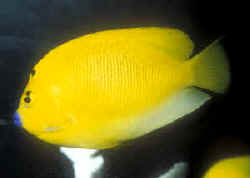
Healthy angels are full-bodied like this robust
Apolemichthys trimaculatus.
|
|
Angelfishes for Marine Aquariums
Diversity, Selection & Care
New eBook on Amazon: Available
here
New Print Book on Create Space: Available
here
by Robert (Bob) Fenner |
 |
Help with a new Potter’s Angel
8/24/19
Hello WWM Crew,
<Hey Gil!>
Hope you all are well!
<Cheers>
I am contacting you today with regard to a new Potter’s Angel. I purchased it
from Live Aquaria Diver’s Den, and he will be going in a 90 gallon Hawaiian
endemic SPS tank.
<Neat!>
After doing some research on this site and elsewhere, I’m wondering if my normal
quarantine procedures need to change for this fish.
<Let's see>
I typically only treat with Praziquantel, and observe the fish carefully for ich
for another two weeks after completing the Prazi treatment. This is done in a
2’x1’x15” tank, with a seeded sponge filter from my sump, and the smallest piece
of live rock I can safely remove from the DT. If I dose anything other than
Praziquantel, I know these are both gone forever but the live rock makes too big
of a difference in the fish’s health for me to ignore. There’s also a couple pvc
elbows for hiding in.
<Okay>
I know this is not enough space for my new angel (2.75”) and Potter’s are prone
to sudden stress related deaths. He appears healthy after 24 hours of
observation, other than attacking his reflection most of the day. Do you think
it would be wise to truncate the QT procedure and move him straight to display
in this particular case?
<I do count this Centropyge as one of the species that is generally better to
"expedite" through quarantine. UNLESS there is/are compelling reason/s otherwise
(apparent damage, disease), the majority of times it is better to use a simple
pH adjusted freshwater bath to reduce the possibility of external pathogens and
place new Potter's directly to the display/main tank.>
Thanks,
Gilbert
<Some background re here:
http://www.wetwebmedia.com/dips_baths.htm
and the linked files above. Bob Fenner>
Re: Help with a new Potter’s Angel 8/25/19
Hi Bob,
<Gilbert>
Thanks for the quick response!
<Welcome>
I heeded your advice and the Potter’s is now in my DT.
Unfortunately, now I have a second issue- my Kole tang is rather furious about
his introduction. Seriously, I haven’t seen aggression like this since keeping
Mbuna Cichlids years ago. I’ve added tons of fish since having the tang and
there was never an issue- frustrating it targeted such a sensitive fish!
<Happens... do occur in same areas, are competitors for space, algae... >
I’ve already tried rearranging aquascape to no avail. Any other tips?
<Catch the Kole (two nets, maybe two people) and place it in a floating plastic
colander (yeah, a pasta et al. strainer) for a day... with the lights out.
Likely will allow the Potter's time to become established, take some of the
vinegar out of the Ctenochaetus. BobF>
|
Watanabei/bleeding stomach
8/14/19
Hey bob, crew
<Big B>
Picked up this watanabei, 2 inch specimen two days ago.
<Mmm, really too small for Genicanthus Angels to be collected. Like Goldilocks
and the tres Ursids and porridge ave. kinetic energy, there is an ideal range of
size for gathering wild stocks... too small and they don't survive trauma,
stress of netting, holding, shipping... too large they don't adapt to
captivity...>
Had him in quarantine since, and on day 3 developed an odd swimming pattern.
He would swim head up, close proximity to surface. At times he would “pipe” at
surface. Didn’t eat last day.
<Damaged likely>
Came home and he was dead about 6 hours later. An apparent wound or lesion in
lower belly area, unilateral. Only fish in tank, no sharp rocks or edges other
than pvc. Please see photo:
Would swim bladder issue present itself as a bleeding wound? I’m thinking it
could be Uronema.
<No time for parasites... Likely as stated. Try a 3-4" specimen in good shape to
start>
Thanks, bob
<Bob Fenner>
|
.jpeg) |
|
Re: Watanabei/bleeding stomach
8/15/19
Bob,
Thank you. Didn’t realize that was still too small, I passed over 1 inch
specimens for this 2.5 inch.
<Ahh>
The lfs I acquired him from brought in two of these. The one I got, and another
one, the same size.
That one is still alive. When someone like me sees the one I got dead, who came
on same time as the one who is still alive (same size) can the hobbyist
attribute that to the one I got had 1 more move and acclimation (mine) and
that’s what did/ will do them in?
<Not enough sample size to state anything with certainty>
He offered me the other fish still there at reduced cost, but I am going to
pass.
Thanks again, Bobby
<Welcome. BobF>
|
Emperor Angel with swim bladder problem
6/13/19
Good Morning,
<Good morning Jimmy>
I have a 180g FOWLR , prob 150 – 200# LR , one Heniochus Butterfly adult 15
years old, Adult Emp Angel raised from youth now 6” adult 10 years old, 2 yellow
tail damsels, one clown, 2 brittle starfish ( 15 years old ) , 2 skunk cleaner
shrimp, 1 fire shrimp. The tank has been running for 20 years. For the last
2months there has been to water change, only minimal tank “maintenance .” Water
top off, cleaning skimmers ( 2 EuroReef ) and feeding . When I finally returned
from being away, I immediately noticed that the Emp Angel had a swim bladder
problem. ( Tilting to one side , unusual swimming pattern ) All livestock was
eating . Upon testing the water I noted that my nitrate levels were off the
scale ( over 160 ppm) as were phosphate levels. <Yikes!>
Specific Gravity was 1.028.<Too high> Zero ammonia, zero nitrite . I was
surprised that I had not lost any livestock! Through a series of daily water
changes over a couple of weeks ( with the first being a40% water change ) I have
managed to bring the nitrates down to 10-20ppm. SG 1.023. 2 weeks into the
process the Emp Angel looks 50% better but not back to norm.
<Next time please take your time to fix your writing.>
Do you think that this fish is likely to recover swim bladder function ? Any
suggestions ?
<This may be just “air gulping”... your angelfish could have been gasping at the
surface because of the too high salinity and/or high nitrates, If you have
restored water levels, just give a few days to see if it goes back to normal.>
Thanks Jimmy I apologize if this was sent twice
<You’re welcome. Wil.>
Re: Emperor Angel with swim bladder problem
6/13/19
Thank you so much .
<You're welcome>
My writing looks much different and better on my original message . Looks like
it got chopped up and re formatted . I am very sorry .
<Ohh, I see... no worries>
Thanks for your response Jimmy
<Glad to help. Wil.>
Re: Emperor Angel with swim bladder problem
7/8/19
Thank for your response.
<You’re welcome Jimmy>
I have yet another problem that has arisen with my Emperor Angel. The fish
improved a bit but not back to normal swimming with improvement in water
quality. 5 days ago, I noticed that the fish was laying down on the bottom of
the aquarium in its right side .
<Not good at all>
Later on in the day it worked itself deep inside a live rock cave, once again
laying on its side. Rapid respirations and badly discolored and very mottled. I
did a 20% water change and checked tank parameters, all OK ( nitrates 20ppm ).
<10 ppm would be far better>
I monitor ORP (no ozone, monitor only) and it was 300. I slowly dripped in some
permanganate over a few hours until the ORP reached 350 and then stopped. I fed
the rest of the fish in the tank. Remarkably the angel came out and ate a couple
of pellets ! When the fish ate I noticed that there was marked redness along the
front third of the dorsal fin with tissue loss, an area of hemorrhage but no
ulceration in the right abdominal area behind the right pectoral fin and red
streaking of the right ventral fin and moderate PopEye both eyes. Tentative
diagnosis = septicemia.
<I thought the same>
I went to my LFS and bought kanamycin as well as Nitrofurantoin powders,
dissolved the recommended amounts in 7 cc of water and soaked a tablespoon of
large pellets . As I fed the fish the emperor came out again to eat and ate 8 -
10 pellets fed one at a time. After feeding three times daily for 5 days, things
are remarkably better. The fish is hiding less and always at the top of the tank
for more food during feedings. The hemorrhagic areas are clearing up, but still
swimming with a right tilt. I noticed at night that the angel would work its way
into the rock where the skunk cleaner shrimp would be picking at the areas of
redness, presumably debriding the dead tissue. Thus far it has been a real save
! The remarkable thing about this situation is that the fish never really
stopped eating, so I was able to give antibiotics. If that were not the case I
would have quarantined. I plan on continuing the antibiotics for 7 days and will
hope the fish does not develop kidney failure as a result of the kanamycin. Is
there anything else I should be doing at this point ? Any thoughts? Again, thank
you. Jimmy
<It seems that what you are doing is working, I’d continue that route; just keep
the tank lights dimmed for as long as the treatment lasts, this way you will
reduce stress on the Angel and it will have better odds, please see the next
link and related: http://www.wetwebmedia.com/maranghealth4.htm And keep us
posted. Wil.>
|
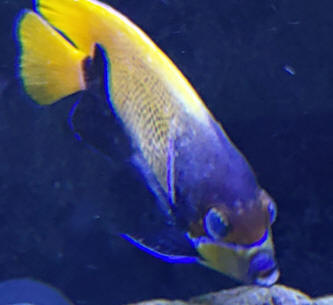
Patches on majestic angel 6/24/19
I have currently the following in the tank
1. 1 Yellow tang 2.4 inch
2. 1 Purple tang 2.5 inch
3. 1 Sailfin tang 3.5 inch
4. 1 Regal tang 1.25 inch
5. 1 Percula clown small (1 inch)
6. 1 Fox face 2.5 inch
7. 1 Pink Anthias small (1.5 inch)
8. 1 Banana wrasse 2 inch
<Wow; small starters>
9. 1 Star fish
10. 3 hermit crabs small (1-1.6 inch)
11. 1 Tomato Clown 1.25 inch
12. 1 Fire Clown
13. 1. Majestic angel ( picture enclosed)
Tank size 4 ft x 2 ft x 2ft.
<Mmm; will need a larger system...>
Water parameters are all ok . Ammonia 0 , Nitrite 0 , Nitrate between 0-4 ppm ,
PH between 7.8-8.0
<Should be a bit higher....>
Background : I noticed ick on my regal tang on 14th June 2019. I raised the tank
temp from 28 deg cent slowly between 30-31 deg cent for 10 days. Now regal tank
is without any ick and eating well. My Majestic angel has now spots near its
mouth . I see that its not ick but slightly large white patches. I am worried as
it is not eating. I suspect following :-
1. Ph is slightly low due to high temp.
2. High temperature is giving discomfort and stress.
3. Lastly it is infected with some other crypt.
Please advise. You have been extremely supporting always.
धन्यवाद,
सादर,
Bodh Raj,
<Well; could be (simply) body mucus due to stress as you hint at; might be later
expression of trematodes (see WWM re, determination, treatment)... I want to
state that Navarchus/Majestic Angels are not in general good/hardy aquarium
specimens.
IF it were my fish, I'd do some sampling of the "gunk", look under a
microscope... Maybe try a pH adjusted freshwater bath, or series of them, day/s
apart... Moving this fish to another established system after if you have one.
Bob Fenner>
|
 |
|
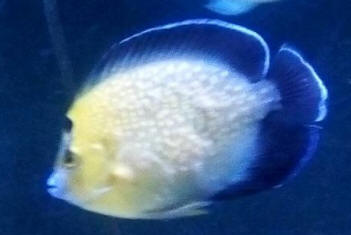
Skin issue ID 1/18/19
Good morning all (here in Thailand) Our tank is a 1800 Lt L shape with currently
only fish and life rock. The system is about 9 months old now and had cycled
around 4 months before we added any fish (cycle only took 2 weeks as we used
treated fresh ocean water and added bacteria from the start). All fish went
through a 3 weeks Cupramine treatment in a QT tank before being added to the
system. Since fish were added all fish eating well and seem very healthy eating
both dry food regular Nori sheets added and every other day we add a freshly
made frozen mix with garlic added to it.
Since a day or 2 now we have start seeing a condition on the Goldflake skin. It
does not look like Ich or Velvet to me but rather a loss of slime coat and
scales look burned or getting loose or something not really sure what to make of
it....maybe you guys can help ID with the pictures attached (bad camera though)
The fish itself is showing no effects at all still being super active not shy at
all (eats out of our hand) eating well (being one of the more aggressive eaters
in the tank even)
<Not protozoan, I agree...>
Water parameters look as good as possible to us with the following readings API
test water shows 0 Nitrates 0
<How are NO3 rendered thus?>
Phosphates 0 Ammonia Salt levels 1.025 temp 26C Ph 8.0-8.2
So not sure what is going on with the Goldflake here hope you guys can help ID
this condition.....Other fish in the tank are Black Tang, Purple Tang, Achilles
Tang, 3 Yellow Tang, Powder blue tang, Blue Tang, Foxface, Flame Angel, several
Blue Green Chromis, quit a large cleanup crew with a mix of
crabs, Hermits, snails and 4 cleaner shrimp.
<IF this fish was new; added a few days back, I'd say it had been dropped (on
the floor) while being handled, moved. I would do nothing medicine wise; just
leave the fish in place. As you state it is feeding, it will likely heal on its
own. Bob Fenner>
|
 |
Bandit angels Prazipro quarantine
2/21/18
Hi Crew,
<Hey Keith>
I've 2 bandit angels in quarantine tank. One of the bandit show signs of fluke,
which I then administer Prazipro through the recommended dosage.
After 4 days there were still showing symptoms of fluke.
<I'd now (and would have done enroute on buying, moving these fish) pH adjusted
freshwater dip/bath these Angels, with formalin/formaldehyde and aeration as
gone over on WWM>
I then did a major water change and administered the second dosage. (75% of the
recommended dosage). Immediately 1 day after the second treatment, One of the
bandit ceased to eat, however, still showed interest in the food. This got me
worried and I did another major water change. The other bandit is still eating
like a pig. Did the treatment caused one of the bandit to cease eating?
<It's possible, yes>
How Long later should I begin to worry if the bandit continue not to accept
prepared food. Both were eating fine prior to treatment. Is it normal for
Prazipro to suppress the appetite of the angel fish?
<As stated, can do so... who knows the mechanism here? Killing worms in the
lumen? >
What will be my next course of action, if any.
<As stated; the reading on WWM re dips/baths, additions therein>
Thank you
Keith
<Welcome. Do write back if your course of action isn't clear. Flukes are VERY
common on w/ wild-collected Pomacanthids. Bob Fenner>
Re: Bandit angels Prazipro quarantine
2/21/18
Hi Bob
Thank you for the reply. through observation earlier, the bandit is still
yawning/twitching. I'm assuming the 2nd dose of Prazipro would've knocked most
of the flukes off and the bandit may just be irritated by it.
<Again; a possibility definitely. A./P. arcuatus is a fave; and know that they
do twitch quite a bit naturally>
Given that I've done two dosage of Prazipro, will it be too early to commence
the dip now/soon?
<Not too soon if the fish is in good shape)>
The fish seems very interested in food but just wouldn't swallow them down.
Also, could it be a possibility that there may be an ulcer/growth inside the
mouth (since I've caught him yawning several times)?
<Maybe....>
If this is the case, will dip still be the way to go or alternatively can I
perform Mxyazin treatment for 5 days.
<.... I'd do the dip/bath>
The plus point is there's still some weight on the fish and at least he's
responsive to food being thrown into the QT :)
Thank you
Keith
<W. BobF>
Re: Bandit angels Prazipro quarantine 2/22/18
Hi Bob
<Keith>
Just performed a fw dip. Couldn't see much after the dip,
<Carefully decant the dip liquid... look for translucent small worms at
the bottom>
perhaps was the double dosage of Prazi. Fish started eating again less
than an hour after dip. It's gobbling down nls pallets. Thank you!!!
Keith
<Ah, welcome. B>
|
16 year old French Angel sick 6/3/16
Hi Guys,
<John>
I have a 240 gallon FOWLR with the French angel, 2 clowns, hippo and lemon peel.
Nothing new has been introduced in 3+ years, but now my angel is in bad shape.
My LFS said it looks to be a tumor and that nothing can be done.
<If so; about right... directly... Some folks have done 'ectomies"; and indirect
methods of using supplements (soaking foods, adding directly to water) HUFAs,
probiotics, vitamins... iodide, are of use>
His mouth looked irritated at first and now seems to be disappearing...almost
like something is eating it away. i can send you a pic. I tried a bacterial
medication, but it did not work. He hasn't eaten in 4 weeks,
but does still swim a bit and hover in the corner of the tank.
Do you think this is hopeless, or is there something else i can try?
<Can't tell from the lack of data presented... Not eating for a month is a bad
sign>
Thank you for any advice you can provide.
Thank you,
John
<Bob Fenner>
Re: 16 year old French Angel sick
6/4/16
Hi Bob,
<Hello again John>
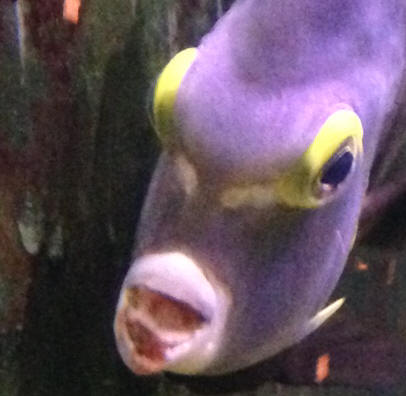
Thanks for the reply. I've attached a picture of his mouth as you can see the
skin is pulling away from his mouth. If it is hopeless, should i consider
euthanizing him? After 16 years, I'd hate to see him suffer.
<Am a "hold out" where giving up is concerned. Have seen such "sores" from
whatever cause/s spontaneously heal. Again, please see WWM re supplements (use
the word "Selcon" to find the FAQs files), and iodide/ate. I would
lace foods with these as well as add directly to the water... Marine fishes do
drink their environment. BobF>
Thanks again,
John
|
 |
|
Chrysurus angel problem
6/1/16
Hi guys it's been quite awhile since I have been on here...probably a good
thing as all has been well with the 400 gallon.
Dilemma, I have had my 3 favorite fish ( clarion angel, queen angel, and
chrysurus Angel) together for 2 yrs no problem, but out of nowhere my queen
developed some sores on side and died within a week, at the same time my
chrysurus has developed the same but is eating well and seems to be hanging
in there despite open sores. As seen in the pics, hides a lot but comes out
and feeds no problem....
Nitrates were a little high,
Ammonia was at .25 for unknown reasons
<Troubles>
And ph 8.4
All other fish doing well showing no signs of streets whatsoever:
(2 leopard sharks,
<Not compatible... is this Triakis? Cold water... Stegostoma? Get too large>
7" clarion, 3 4" hippos, 1 yellow tang, and bonded pair of yellow band
maroon clowns that are 11 yrs old that lay eggs every 20-30 days.
Thank in advance for your time and assistance on this
Kelly
<Well; the blanched flank area... could be due to... bacteria (maybe
Myco...) or an opportunistic protozoan, or... just/due to a physical trauma;
environmental degradation... I'd move the sharks, boost your bio- and
chemical filtration, the fishes immune systems via supplemented food,
addition of vitamins, HUFAs and iodide-ate added to the water.... AND
consider having the area sampled and looked at under a 'scope: the only way
to assess accurately what the cause might be here. Bob Fenner>
|
.JPG)
.JPG)
Re: Chrysurus angel problem 6/2/16
Thanku bob, I have had these 2 Triakis leopards for the last 4 years and
many more over the past 10 and have had zero problems, I keep the temp at
72, living here in Los Angeles where they were obtained I have swam with
these in 68 deg water so 72 isn't really a big jump for them.
once too large they go to my 1000 gallon in garage then to friends 4000
gallon after that.
<Ahh>
I do 90 gallon water changes every week, but missed 2 due to major elbow
surg.
<Ouch!>
Water parameters are back to zero and they sides are def not due to injury.
It's on both sides of him.
I will try the suggestions but have no way in sampling to see what it is, do
u recommend a certain hufa food?
<I like Selcon... added by several manufacturers....>
Should I move to 1000 gallon and let him relax in a larger stress free
environment?
<Yes I would!>
Thanku again.
Kelly
<Welcome. BobF>
|
|
Angelfish Disease.... more HLLE
9/6/15
Hello!
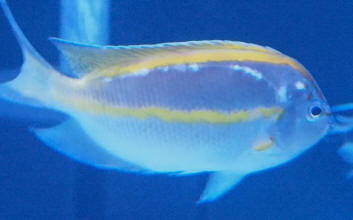
We have some sick angelfish and would like your advise on what you think it
could be.
I have attached a picture of another angelfish that shows the disease.
Thanks
<Mmm; looks to be "classic" HLLE.... due to? Most likely nutritional and water
quality issues, and able to be corrected to degrees by improving same... via
water... as marine fishes drink their environment. A few folks speculate that
carbon (filtration) is a contributor, still others, stray electrical current.
All this is gone over on WWW. Start reading here:
http://www.wetwebmedia.com/HLLESWCauseF.htm
and the linked files above. Bob Fenner>
|
 |
Sick Blueface and Emperor.
Hi,
<Again>
I decided as the Blueface had lost about 50% colour, Emperor was getting blotchy
and all fish except the pair of Clowns and Regal Tang were hiding behind rocks
it was time to change tactic. So I dosed with Cupramine a copper test kit is
essential as I had to put around three times the dose to get the copper to 0.5.
<Where is the copper going?>
This was 24 hours ago and I am glad to say the fish are more active and all
their colour is coming back so I think it was a weak strain of infection. I had
to dose copper again this morning
<At least a couple times per day; with testing>
and surprisingly the fish are not eating
<Not surprising in the least>
as they did throughout the infection this I put down to the copper making them
feel bad. However by the fact they are swimming I prefer this and hope they
adjust within a few days. What is strange is how the Regal Tang never showed
signs of the disease,
<And this; not strange>
Clownfish I understand as they have more mucus on their skin. A mate of mine
said you can get an ammonia spike and as the bubbles were not popping on the
surface quite as fast as normally I did all my tests and all ok, but the pH had
dropped this might be due to the change of bio bacteria of the copper which is
most probably.
<Re-read this last sentence...>
I use Reef Buffer by Seachem although it is a fish only tank as it seems to hold
the pH higher for longer than Marine Buff in my set up which is about 21/2 years
old. The disease might have been weakened as I used a powerful good flow UV, but
UV which must be turned off when dosing with copper.
Posting this so hopefully other people can save their fish in similar
circumstances.
<They'd know if they'd used WWM>
Will update of a few days.
Regards,
Adam.
Re: Sick Blueface and Emperor.
Only trying to help, you sound a but moody this evening in San Diego.
<Good luck, life to you. B>
All good. Child, SW Angel dis....
2/13/15
Hi,
Yesterday afternoon the fish all ate. Today all fish 1100% back to normal.
Cupramine if the fish are blotchy and not due to stress it worked for me, even
the tiny Blueface pulled though.
Regards,
Adam.
<Ok> Angelfish
; stkg. mortalities
4/17/14
Hey Bob,
<Robert>
Emailed you before about various topics. This next question is more of
your opinion than an black or white matter.
In my FO system of 155 gallons, I successfully keep an Achilles tang,
Powder Blue tang, Aussie Tusk, Sailfin Tang, Green Bird wrasse and a
Maculiceps. My parameters are good (1.022 sg, 79 degrees F, Nitrite 0,
Amm. 0, and Nitrates 40. I have in my opinion plenty of flow (2 return
pumps @ 600 gph after head pressure, and an MP40 wavemaker) I use a UV
light and oversized Protein skimmer. I also use only RO water.
For some reason, I can not keep angelfish alive. In the past
month, I have tried a Queen Angel, Koran Angel, French Angel, and a
Scribbled angel (albeit at different times) and have lost them all
within a week. The seem to follow the same fate, they eat really good,
and slowly develop cloudy eyes, random body spots (not Ich) and surely
after die.
<Strange>
My only guesses as to why are 1. overcrowding, 2. Source of these angel
fish. However, they all come in looking fine and eating.
<Mmm; and the other fishes listed... would not likely harass these
Pomacanthids>
In your opinion, are angel fish just so hit or miss, that anything
happens, or is there something I am missing? I feed Nori, 2 full sheets
daily,
<Not much food value; good for filler for tangs>
Spectrum Thera Pellets, and frozen once a day. This consist of PE Mysis,
squid, krill, clams and frozen angel and butterfly formula (san fran
brand). I also soak frozen in Selcon twice a week. I do 15 percent water
changes weekly, and have about 70 lbs of live rock.
Any suggestions or thoughts would be invaluable.
Thanks
<I'd try a better source... maybe even mail-order (Dr.s F & S)... and
quarantine the new Angel for a week or two. BobF>
Re: Angelfish 4/17/14
Thank you, Bob.
<Welcome>
One minor detail I did leave out, is upon death of the Angel fish, I
removed them at once, and placed in fresh RO water, (more so to preserve
fish until I find suitable grave, as opposed to letting them rot in the
open) and have discovered some fluke like objects popping off.
<Likely are/were Trematodes... easily defeated/removed via pH adjusted
FW (plus formalin if I were doing it) dips...>
Not many, I have seen much heavier infestations in fish that are alive.
However they are there, and I do not see them on my other fish, even
while FW dipping. Are flukes always present in the fish, and that is
normal, or could this have been the silent killer.
<... there are some flukes that are more family, genus, even species
specific. I'd be reading on WWM re... perhaps the use of cleaner
organisms.
B>
follow up, bob. SW Angel losses
4/18/14
Hey there Bob,
<Rob>
I spoke to you yesterday about my inability to keep angelfish. My lfs,
had gotten a few in this week, he claims from a different source (QM
this time).
<Likely the best source in the USA>
I wanted to really see if I could keep one, and decided before hand to
do one last check.
I bought new test strips,
<... not a fan: Neither accurate nor precise>
and threw out my old, and to my delight, my nitrates were @ 80,
my alk is a 6 dGH(sp?) and my ph appeared to be a 7!
<Zoinks!>
So I bit the bullet, and went out and bought a pinpoint ph monitor,
calibrated it, and my PH ran a 7.9 around ten pm (lights are off at 11)
and also a 7.91 at around 3 am. Prior to the lights coming on, (1030 am)
it was a 7.95. Even now, it read a 7.90.
I just did a water change two days ago of nearly 33 percent. My lfs test
strips showed low alk and ph as well, but said 7.9 was ok, not great,
and alkalinity in a fish only system is ok, and the result of a high bio
load.
My question is, should I buff the alkalinity,
<I would... see WWM re. B>
and chase it, or leave it where it is, especially since the fish seem
fine.
To mix it up, I ran an airline tube out of my skimmer intake, to an
outside window, and it did not change anything. Then again, the airline
tube doesn't quite make a complete seal, and the tubing was 25 feet in
length in order to make it outside from my basement.
angels 4/18/14
Bob,
Last thing I meant to add in. FWIW, he has brought in a 4-5 inch
Majestic, 5 inch French, and a 4 inch blue face. If they are eating, are
any of these good guinea pigs to see if my tank can handle angels?
<See WWM... the P. paru is the toughest; best choice>
help-angelfish. Using WWM; SW, hlth., flukes
5/4/14
Hey Bob-
A week or two ago I had emailed you about my continuous issue with
keeping angelfish. Well after all my other fish were doing great, I
decided to pick up a blue face angel (4 inches) and a 5 inch French
angel. They were voracious eaters the first week, everything from PE
Mysis, clam, krill, Nori, spectrum pellets and squid.
Well the last two days, each one of these angel fish has one cloudy eye.
If I look super close at the eye, I can see little objects on eye that
look like miniature contact lenses.
<... put in the WWM search tool: Angel cloudy eye.>
I am almost positive this is eye flukes (Neobenedenia?). I am also
pretty sure this is what took over on my previous angelfish I have had.
<Possibly>
I did a PH, temp adjusted freshwater dip, for about 8 minutes, but it
appears that wasn't enough.
Rather than lose a now 3rd batch of expensive angelfish, I am
contemplating using Prazi pro on the tank. From what I have read, people
have used it in reef tanks safely, and this is a fish only tank.
My question is, I just started using bio pellets about 2 weeks ago to
help nitrates. Occasionally since using them, I have gotten mild
bacterial blooms, where my ph fell from 7.9 to 7.7 (most likely due to
oxygen being used by bacteria). The Prazi says to turn skimmer off,
however, I feel I need that, certainly now for increased oxygen. Do you
think I can leave skimmer on, and to just take cup off to allow bubbling
water to return to sump?
Thanks
<And the two words: Eye Flukes. B>
RE: help-angelfish 5/4/14
Hey Bob-
<Rob>
Typically before I email you anything, I spend at least two days reading
WWM and other various sources. I then think hard and through, and if I
still am left guessing, that is when I break out the email.
<Oh? Oh.>
I see in most cases, with one cloudy eye, it is best left alone, and to
improve on its own.
<Yes>
I would love to do that, but my recent track history shows these fish
succumb to whatever it is in my tank, rather than improve. Perhaps I am
just no good at keeping angelfish.
<Mmm; I don't believe in such notions>
So this was more of me reading on RC, TRT, etc, of people experiencing
the same issue, using Prazi, and happy with the results.
<Yes...>
In hindsight, I strongly regret acquiring these fish. If my lfs would
even take them back for free, let along, say 10 percent store credit, I
would jump all over that. But he doesn't, so I want to try and make it
work.
All said and done, I feel this is my best plan. However, with the
implementation of the bio pellets, that I felt would help me long term,
I know am having some bacterial blooms, which rob o2 levels.
The thing I am unsure of what to do is, leaving skimmer on, just pouring
out of neck, to ensure better o2 levels.
<A good idea; adjunct to any treatment mode>
And now that I write this, in observing the tank, I can also tell you
the blue face has one frayed fin. I have never seen anyone harass the
fish, and it was not there last night before the lights went out, and I
manually
turned them on this morning.
Again, I would love to have it take care of itself, but for some reason
that notion in the past 12 weeks cost me >$1000
<Yeeikes!>
Thanks again, sorry for the frustration.
<Take your time... B>
RE: help-angelfish 5/5/14
Sounds good, Robby.
I will leave skimmer on, just open the gate valve wide open and have it
circulate back into sump.
Once in, how long before the flukes start to pop off would you guess?
<... depends on species and treatment. Immediately to a few days>
If a few days (day, hours?) go by, and they are still there, than would
it be safe to assume the cause is not flukes, or perhaps the product is
defective?
<Good question (as I don't know a/the answer). I would assume either the
product is defective, OR the test manner, OR that these were not
Trematodes, OR whatever was there was not treat-able per the first and
second stmt. B>
RE: help-angelfish. SW; flukes presumably
5/7/14
Hey Bob-
Ok, so it has been two days since I have placed Prazi pro in there, and
whatever I was seeing on the eyes is stills there. Perhaps what I am
seeing now is just the damage/scarring of the fluke being on the eye?
<.... these marks, markings aren't always parasites>
Also, under the direction of Hikari, I have turned my skimmer off. I
have about 20x overturn via return pumps and VorTech, so I think oxygen
is good, but my ph last night went all the way down to a 7.68, to this
morning
of a 7.78. Is that considered danger zone?
<Not good... see WWM re............>
cloudy eyes... Cu exp. 3/18/14
Hey Bob,
A week ago I had a scribbled angel who developed some cloudy eyes. It
was not unilateral, both eyes were of equal cloudiness.
<Yes; copper involvement speculated as I recall>
My uv light went out, and I am waiting for a replacement bulb to come
in, and since then my water had some fog to it. (suggesting a bacterial
bloom)
Could this bloom, have caused both eyes to become hazy?
<Not likely>
I pulled the fish out and placed in quarantine on Friday. I used Maracyn
Plus, and the eyes are clear and as good as new again. It has been 4
days since using the Maracyn, is there a need to run it a few more days,
just like people who need to run the full treatment of antibiotics?
<... the Mardel product likely is/was unnecessary>
Also, should I place him in there now, or wait till the UV light is on
again? (should have bulb this coming Monday).
<I wouldn't have the lamp influence me one way or t'other>
I checked WWM, various queries with Maracyn plus, and didn't see
anything on this particular antibiotic,
<... re-search: Erythromycin>
as well as full treatment time. The bottle says treat days 1,3,5, but
doesn't state how long after day 5 to keep him in there.
Thanks again for all you do
<W. B>
Re cloudy eyes... Cu exp. 3/18/14
Bob,
Yes copper was in place, Cupramine. I also have Cupramine in QT and the
same level, and yet his eyes are vibrant and clear. I did this because I
read on WWM that it is fine to run Cupramine and maracyn
synergistically. I also wanted to see if in fact it was the .5 Cupramine
causing this, and from what I have seen in QT, it is not.
If it wasn't the maracyn that took care of the eyes, not sure what else
it could have been, since both tanks have equal amounts of copper,
salinity. The only thing different from what I can measure, is the tank
temp is running at 82, the QT 79. (degree F of course) Both are at a
1.022 SG.
Maybe the angel didn't like the 82 degree water? Again, the only
comparisons I can make from my standpoint.
I will take him out of QT tonight, and place back into DT, with a short
acclimation.
Re cloudy eyes... Cu exp. 3/18/14
follow up
Ok, Bob, I stumbled upon something I believe matches up. Amazing what
one
more piece of literature may entail.
The cloudy eyes were a result of something off in the tank. The maracyn
may
have helped expedite the healing process, but it may come back when he
goes
in to DT. So the real cause may lie in the tank. (nitrates, bacterial
blooms, etc) In other words, it was a symptom, or secondary sign of
something else.
Well considering I personally believe my parameters, (exception of
Cupramine) are good, I may have stumbled on what caused it. From the
time I
got him, until the time he developed foggy eyes (5-6 days), he refused
to
eat. He was new, and therefore acclimating, but not eating (no
nutrition)
may have lowered immune system ability, therefore allowing an infection
to
occur, that may have not happened if he had been eating.
So perhaps rather than use antibiotics in qt, I should be focusing on
strengthening him up, getting him to feed, before re-introducing him to
DT.
I suppose initial logic and nature says to put the flames out of a
burning
house. A further superior mind says, to not keep flammables near an open
flame to begin with!
angel quarantine 3/15/14
Hey Bob,
<Robert>
I bought two angelfish last week and they are in quarantine. They are a
scribbled angel, and Koran angel, both 4-5 inch size area. The
quarantine is a basic 40b tank, with HOB filter, maxi jet powerhead for
aeration, and a heater.
I keep the tank around 80, and SG is 1.021. I do water changes every 3
days, however have yet to see any ammonia or nitrite.
I am using Cupramine at a .5 level as recommended.
<... depends on the test kit...>
I plan on doing this 28 days, followed by some Prazi. I am new to
quarantining and am looking to perfect my methodology.
2 things I have notice thus far, is the scribbled angel now seems to
have some cloudiness in his/her eyes. Not totally clouded, but getting
there, and it did not come this way. Could this be an adverse reaction
from the copper treatment?
<Yes>
Could it be flukes, or would that just be a white spec, and not cloud
the entire eye?
<Not likely Trematodes>
Secondly, the Koran angel looks like what appears to be flukes nears his
gills. Literally two, just two pieces of what I can describe as big salt
granules. I thought they were flukes, freshwater dipped in aerated RO
water, for 5 minutes, and these did not fall off.
<There you go>
I have scoured WWB <M?> and ReefCentral, but did not find anything
remotely specific. My first inclination is to lower copper level via
water change. I am also thinking of dipping the scribbled to see if that
helps eye condition. Could also be a secondary fungal or bacterial, in
which case I would think Prazi would help when I use that in a couple
weeks.
<Likely shipping damage (net scrape), stress in general AND Cu exposure.
B>
Ultimately I have a feeling of what to do, but would like some
oversight.
Thanks
Mouth Sore on Large Angelfish 3/11/14
Hi Bob,
<Ry>
I very recently purchased a regal angelfish from a local
supplier and while has been in my QT tank for around 2 days now and just
this morning i noticed a lesion/sore on its mouth and a little missing
tissue on both gills.
<Yikes... likely damage from collection, holding, shipping>
The mouth sore seems to be swollen with some tissue missing as well.
There is nothing in that QT except a few pipes to hide in and a sponge
filter along with some air stones. The angelfish, since i recently
acquired, it isn't eating yet and I of course don't want to lose him.
This sore is the reason I am sure that he is not eating.
<Likely so... I would be putting in, rotating in some very healthy live
rock pieces for its eating et al.>
I started treating with quinine sulfate on day 1 when i got him for
preventive maintenance against Ich which is what I always do before i
add any fish into my FOWLR. Aside from that, I have not added anything
else into the tank. I am not sure what else could have caused this. I
was reading on WWM and it seems most consistent with some sort of
bacterial infection. Is this assessment correct and if so, how do I get
him better?
<Just ultra good care, low-stress, and optimized, stable conditions...
and offering a wide mix of foods in small quantities...>
Thank you and any advice would be greatly appreciated.
<I wish you life. Bob Fenner>
Re: Mouth Sore on Large Angelfish
3/11/14
Yeah, I did also think it was from shipping. The strange thing was that
the first day he was there, he was totally fine. All the damage came out
on day 2.
<Happens>
Is that still possibly from shipping?
<Yes>
I contacted the supplier and they said they put copper on all their tanks
even on the angelfish. Could that possibly also be the cause?
<Is a contributor; yes>
Thank you again for the advice!
Ryan Uy
<Mabuhay, BobF>
Water param.s or disease. SW Angel discoloration cause/s
1/28/14
Hi Crew,
<Adam>
I have had a stable marine set up for a couple of years and have several
delicate fish Regal, Majestic, Blueface Angels. I recently added a
juvenile Emperor and usually get away with no problems by freshwater
dipping new specimen in pH adjusted water, a QT would be ideal but like
I say I don't generally have problems. The Emperor started
eating but has now turned blotchy after 4 days in the tank and what
worries me is the Majestic has also turned blotchy today.
<Could be "simply stress", from the new social dynamic, Imperator addn.>
I ran a pH test and all seems ok at 8.2, alk slightly high at 16
<This is more than slightly. I'd dilute by changing a good deal of water
out>
having added too much Seachem Reef Buffer but it has been like this for
three months and all good with no water changes.
<... not wise>
I have had copper in the systems for about a month
which cured a dose of Whitespot.. Blueface, Regal Angel, Regal Tang and
two Ocellaris clownfish all seem fine.
<... copper will def. bring about blotchiness (and more)>
Do you think it is water quality related or a disease and from my
research it does not appear to match any disease as the fish are still
eating, have clear eyes and breathing normally.
<Could easily be "water quality related" (or the social aspect
mentioned).
Again: I would CHANGE WATER>
Thank you in advance.
Adam.
<Cheers, Bob Fenner>
Re: Water param.s or disease. SW Angel hlth. f'
1/29/14
Hi Bob,
<Adam>
Sadly I woke up this morning to find all my fish very pale, grey and
breathing fast. The Regal Angel was lying on a rock almost dead. I did a
pH test and it had dropped to 7.8 I think perhaps it
dropped quickly, or perhaps as it was early in the morning as I have
tested before some time ago before changing water and it was 7.8 and the
fish were much better than
this. Alk was still 16 so I am surprised the pH dropped? I thought that
was impossible. So I went 1 km to the Indian Ocean where Moorish Idols
are, so the water should be good and starting collecting water. I then
drained the tank 80% (not before I had new water to avoid more stress
over time and changed the water. Amazingly the Regal Angel made it, he
is only just over 1 inch long, eats anything and is very bold coming to
the front of the tank when I view the tank and all the fish seem much
more active and better colours. I have never been so lucky in rescuing a
fish. The only fish that seems not to be recovering so well is the
Majestic, strange as the Blueface is 90% better. What is also strange is
the Regal Tang seemed ok throughout the whole episode. Bob I saw your
testimony on Chemipure Elite, how often do you think water changes need
to be done using this product once the dosage is correct for the
bioload.
<A few units per month likely in your case/setting>
Thank you for your time and knowledge Bob I have recommended a friend to
your site who has a lot large budget for fish and a larger tank so might
stretch you knowledge as he has state of the art equipment unlike myself
currently.
Cheers,
Adam.
<B>
Copper removal. 1/29/14
Hi,
I recently treated for Ich with Cupramine which cured the disease and
have now completed an 80% water change.
Do you think this is enough, previously the reading was 0.5ppm or if not
what is the best way to extract the remains, Polyfilter, carbon etc.
<Read here:
http://www.wetwebmedia.com/curemovalfaq2.htm
and the linked files above. B>
Thanks,
Adam
Re: Water param.s or disease. Re: Water param.s or disease. SW Angel hlth. f'
1/29/14 1/31/14
Glad to report the Majestic is fine now.
<Ah good. B>
|
Angelfish Anomaly?
1/23/14
Hi WWM crew, hope it's not as cold where you are as it is here right
now!
<Upper 70's F. here in San Diego where I am; thankfully>
I am writing about a Queen Angel I've had for maybe 10 months now. She's
6-7" long in a 245g tank with a 100g sump. The tank is Fowlr and some
soft "corals" like mushrooms and such. The water parameters are pretty
standard (as per the CMA book) sg 1.025, temp ~77. The tank has been set
up for years.
Anyway I noticed a month or so back that she has what look like
indentations or holes under both eyes.
<Ahh... HLLE>
I am not sure if they've been there all along, developed, worsened from
being unnoticeable, or what. Now that I've noticed, I have become
(maybe) paranoid about them. My question is, are these marks
common/natural on this fish or is it a problem? Someone suggested HLLE
but it doesn't look like my albeit limited familiarity with that
disorder. The marks are nearly symmetrical on both sides (3 marks per
side, in the same place and similar size and shape on each side).
<Ah yes: Neuromast destruction... various "causes"... mainly water
quality/nutrition (marines drink their env.)... Curable, including
scarring if it's not too deep>
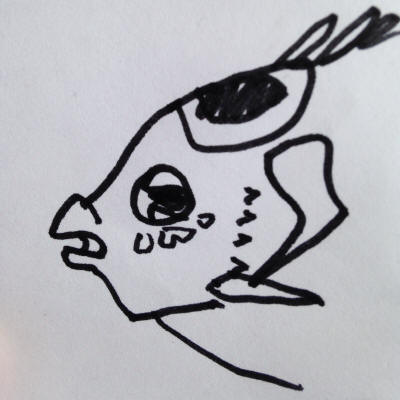
Seems to rule out any attacks by tankmates... None of my other fish have
any issues either.
If you can imagine this: it looks like when velvet peels off of a pillow
or something leaving a slight divot. Hopefully this awful drawing helps
:)
Thanks guys...You would make a mint as fish veterinarians you know!
<Too long and determinate hours. Read here:
http://www.wetwebmedia.com/HLLESWCauseF.htm
and the linked files above. Bob Fenner>
|
 Re: Angelfish Anomaly? Queen, HLLE 1/26/14
That diagnosis was my fear. I will try to improve water quality and
continue feeding Nori and some angel food diet. Thanks for the advice, I
will write back in a month or so with an update!
<I thank you. Do read where you were referred... soaking foods in
vitamin and HUFA mixes is an easy thing to do that generates discernible
improvement. BobF>
|
|
Salt water angel foggy eye
10/29/13
Hi
My 6year old Koran angel developed a foggy eye.
<Yeah... unilateral... mechanical injury...>
It started last Wednesday.
I started treating him with microbe lift actives both the Herbtana
<... of no use>
and the artemiss but it does not seem to help. He is still eating
well but a little less active than usual. It seems his eye is getting worst
for I was able to see his pupil before but now there is a redness to it as
well and I can not see the pupil anymore. I have attached pictures. Please
help
Thanks
Carlo- Electric Eel
<....? Read here:
http://www.wetwebmedia.com/mardisindex.htm
scroll down to eye issues. Bob Fenner>
|
.JPG)
.JPG)
.JPG) |
Re: Salt water angel foggy eye
10/29/13
Hi Mr. Fenner
Should I be putting him in a hospital tank and treating him with maracyn
?
Thanks
Carlo- Electric Eel
<You should be reading. BobF>
Re: Salt water angel foggy eye
10/29/13
I read up in the FAQ and what I gather is that with good nutrition
and good water quality it should go away on its <own>
<Ah yes>
but should I put something in the water to protect my angel against
bacteria infection?
<If you're going the treatment per se route, better to get "whatever this is
antimicrobial wise" into the fish... via feeding; best by injection
(intraperitoneal- or intramuscular-ly. B>
Thanks
Carlo- Electric Eel
Re: Salt water angel foggy eye
10/29/13
Do you have something to suggest I use ?
<Chloramphenicol Succinate... of course. B>
Thanks
Carlo- Electric Eel
Re: Salt water angel foggy eye
10/29/13
Thank you. I will research to see where I can get it. Thank you for your
help
<Pleasure>
Thanks
Carlo- Electric Eel Re: Salt water angel
foggy eye 11/1/13
Hi Bob
Our angel has stopped eating. Could it be something else?
<... what is "it"? Likely the injury alone could/does acct. for a loss of
appetite>
Thanks
Carlo- Electric Eel
Re: Salt water angel foggy eye 11/1/13
The it is just still his eye being swollen and reddish. He hadn't eaten
today so I was wondering if the swollen red eye could be a symptom of
something else
<Keep reading
Thanks
Carlo- Electric Eel
Re: Salt water angel foggy eye
11/12/13
Hi Bob
<CEE>
It's been a couple of weeks now and the angels eye swelling went
down but is still red. I noticed he is starting to get a couple
of red spots of the side of his body. He is also breathing a little
heavier than usual. Could he have a parasite of a bacterial
infection. ?
<... sure; how can/could you tell for sure? Sampling, 'scoping. B>
Please help. I really trying to get him better. I have been feeding food
with garlic and keeping the water quality good but he doesn't seem to be
getting better. All the other fish seem fine.
Thank you
Thanks
Carlo- Electric Eel
Re: Salt water angel foggy eye 11/12/13
What do you meaning ...sampling scooping ?
<.... 'scoping; as in microscoping...>
Can I do something to help ?
Thanks
Carlo- Electric Eel
<Re-read re eye issues of marine fishes on WWM. Just good care is all
I'd do here... HUFAs, comm. soak of foods; optimized water qual. READ!
These "eye issues" take time>
|
Re: Salt water angel foggy eye
11/17/13
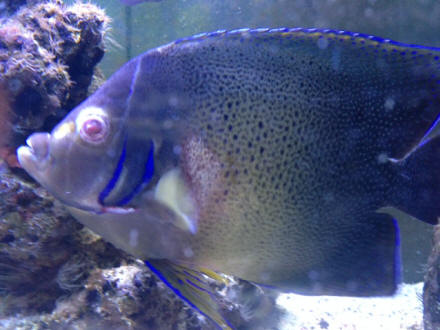
My angel really isn't doing well. He is pretty much at the bottom of the
tank leaning against a rock just breathing.
<Yeeikes!>
It seems like there is something else going on cause his fins look like
they are shedding.
<Very bad>
I included another picture . At this point is there something I can do to
save him?
<Just hope at this point. I would turn the light/s off on the system>
If I put him in a qt tank will I just make it worst ?
<I would not move this fish>
I live in Canada and I don't have access to many meds like the one bob had
suggested.
<No sense treating this fish at this point. Bob Fenner>
Thanks
Carlo- Electric Eel
|
 |
Re: Salt water angel foggy eye
11/18/13
I don't get it though ? How did it get to this point ? I mean initially it
was that he had just scraped himself right ? Did he
catch something else ? I have been soaking his food and keeping quality
levels up . I do t get it
Thanks
Carlo- Electric Eel
<... damage, stress; perhaps a bacterial infection. B>
Re: Salt water angel foggy eye
11/18/13
Ok so I closed the lights and he started swimming around a little.
Should I prep a qt tank just incase ? I have a 10 gallon that I use for my
smaller fish but my angel is pretty big. What size should I buy as a good qt
if the answer is yes ?
<?>
Thanks
Carlo- Electric Eel
Re: Salt water angel foggy eye 11/18/13
Forget my last email. He is still breathing but upside down so I don't think
he will live thru the night
Thanks
Carlo- Electric Eel |
|
Japanese Dragon Eel and clown
trigger.; now angelfish with Cryptocaryon - 06/10/10
Hi Marco,
<Hello Kellvin.>
It is me again. My angelfish is infested with Ick. I can't dose any
copper or medication because of the Japanese Dragon eel in there. What
can I do? Please advice me. Thank You.
<Separate them (for at least four weeks until the last symptoms have
disappeared) and treat the angelfish (as well as all other non-eel tank
mates) in another tank. See here (and in the linked FAQs to learn about
this disease and its treatments: http://www.wetwebmedia.com/ichartmar.htm).
A healthy eel is quite unlikely to become a host (blood toxins, toxic
mucous).>
Regards
Kellvin
<Good luck. Marco.>
Re: Japanese Dragon Eel and clown trigger.
Japanese Dragon Eel and clown trigger.; now angelfish with flukes -
10/09/10
Hi Marco,
<Hello Kellvin>
My angelfish have no Ick as mention previously. In fact they are flukes
instead.
<How can one confuse these two diseases? See http://www.wetwebmedia.com/parasiti.htm,
Trematodes (also called flukes) mostly occur only on freshly imported
fishes.>
So I am going to treat it with Praziquantel. Can dragon eels withstand
this medication?
<Eels have been treated successfully with Praziquantel. However, to
avoid negative consequences on the small and possibly larger
invertebrate life within the tank, I'd definitely treat in a
separate hospital tank. Cheers, Marco.>
|
Angelfish Juvenile Changing Color Or Disease/HLLE
4/11/10
Hello,
<Hi Bobby>
I have a juvenile angelfish that has been going through some
changes in the last week. The tank parameters are all good except
the calcium is a little low. The tank is well established.
Recently my urchin's spines are turning white and my
angelfish's head and tail look to be changing color or losing
color. Upon closer inspection it looks like
little tiny circles on his/her head I attached photos as an
reference. The fish is eating well and swimming normal as if
nothing is wrong. This is my first angel so I'm not familiar
with their diseases or color changing. Please let me know if this
looks like a disease, etc. Any help or feedback is greatly
appreciated.
<Appears that your angelfish is developing HLLE (head and
lateral line erosion), and is general*ly caused by poor
environment, nutrition, water quality, combination of all, etc.
Please look through our many FAQ's on this subject regarding
methods to reverse this syndrome.
http://www.wetwebmedia.com/hllefaqs.htm>
Thank you,
<You're welcome. James (Salty Dog)>
Bobby
|
  |
|
Ailing Angel: Looks like Lymphocystis 3/2/2010 Lymph
ID
Hello Crew,
<Hi Kirby.>
I know you've heard this a lot, but I have to compliment you
all on a fantastic site.
I use the information on a very frequent basis, but as is human
nature, sometimes I still learn things the hard way, however your
advice has saved me from myself more than once. .
<Thank you for the kind words.>
Onto the fishy business: I have an angel that the LFS claimed was
a juvenile 6 line angel.
The angel was in a 10 gallon bare quarantine tank for 2 weeks,
and all appeared well before I moved it to the main tank. While
acclimating it to the water in the main tank I gave it a
Methylene blue treatment for about 20 minutes, just as a
precaution.
The angel was ok for he first couple of days then I notices some
patches on the rear section of it's body. I thought it might
have been irritation from rubbing against the numerous Vermetid
worms in the tank, the spots on the body seemed to clear up, but
now it has several spots that I can only describe as looking like
cysts. these look like little egg pouches or something. I have
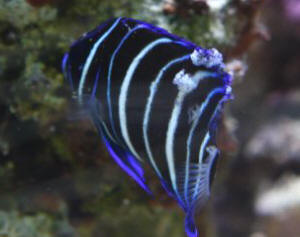
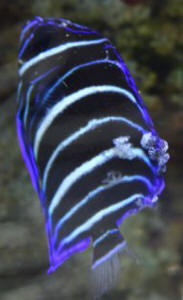
looked at a lot (not all) of the information from the WWM pages,
and have not encountered anything that fits this description. I
do believe it is some type of parasite, but so far (I don't
think it's going to stay this way) none of the other fish are
showing any signs of infection.
<The pictures are a little hard to make out, but it looks like
Lymphocystis A viral infection similar to warts and seems to be
more common on angelfish than others. Have a look here and see if
anything looks familiar:
http://www.wetwebmedia.com/lymphfaqs.htm >
I've attached some photo's to help identify the ailment,
and maybe confirm the fish's identity as well. the fish too.
Let me know if any of the pictures need to be clearer, sometimes
the picture compression process does things to the image
quality.
I know that I probably should get this little one into a hospital
tank, but I haven't had time to try to get him out. My
experience is that I need to practically tear the tank apart to
get a fish out, if there's one piece of live rock left in the
tank, all the fish will find a way to hide under it.
By the time a fish is easy to catch it's usually too far gone
to be able to be helped. So I'm looking at about a full day
to tear down and put back together the tank to get the fish out.
The wrasse is the hardest since he hides in the aragonite. Could
you help identify what the angel is afflicted with, and how I can
treat it?
<If it is truly Lymph it will clear on its own in
time.>
I'd really hate to lose this new critter, it looks so nice
(when it was healthy) and I also need to know what it is, since
it's probably going to happen to all the other fish too.
<Lymph is non contagious.>
The tank parameters are as follows
180 gallon main tank, 75 gallon sump,
SG 1.023
calcium 400
ph 8.3 to 8.4
nitrates, nitrites, ammonia, phosphates all practically not
measureable.
Sorry for the long message, but I find its good to provide as
much relevant information as I can.
<Detailed information is always appreciated.>
I appreciate your assistance, so will the critters I'm
sure.
<My pleasure.>
Thank You,
KP
<MikeV>
|
  |
Marine angel fish
Dying Angel Fish: Probable Aggression\Overcrowding
5/7/2009
Hey!
<Hi!>
I've been reading over your old stuff and there is a lot of great
information! You guys are doing a fantastic job!
<Thank you.>
Okay, well I've inherited a 275Ltr tank and I've been looking
after it for the last 2 years.
<72 Gallons for those challenged by the metric system.>
Currently there are 4 Clown fish, Purple Tang, Scopas Tang, striped
Damsel, Lunar Wrasse, 3 Chromis, and a new Scribble Angel.
<A overstocked for a 275 l, The Tangs will get to 20cm in length,
the wrasse can get to 25cm.>
Now I've had a Coral Beauty, Bi-color and a juvenile Emperor and
they all seem to die.
<Hmm.... where did they come from? All three fish can come from
areas known for cyanide use. Bi-Color angels have a terrible record in
captivity, mostly due to collection.>
I check the ph, nitrates, ammonia and its all within reason?
<Actual numbers are much better.>
For the life of me I just cant seem to understand why angels can't
survive in my tank. The juv emp was eating and dashing around the tank
and was very lively
<Lively rules out cyanide.><<Mmm, no. RMF>>
After 2 weeks it became sluggish and its colour started to fade, and
I'm scared that the same thing is happening to the scribble because
it doesn't seem to interested in the food. I try and mix it up with
flakes, pellets, Mysis, brine (frozen and live)..even dipping it in
garlic.
<So you are trying a good mix of foods, good.>
The rest of the fish are loving life, but the angels just don't
like my tank =(...is there anything you can suggest?
<Ruling out cyanide poisoning, I would looks next to aggression in
the tank. With two tangs, a damsel, four clowns, and a wrasse, you have
moderate to very aggressive fish in a rather small volume of water. It
is
likely that you are just at the limit for what you can put in the tank,
and any newcomers are bullied to the point they will not eat. I would
return this fish to the store.>
<You can read about aquarium stocking here:
http://www.wetwebmedia.com/stocking1.htmn >
thanks!...kJ
<You're welcome, MikeV>
Itchy Emperor 5/22/08 Hello again
all! It has been awhile since writing and everything was going fine
until I set up one too many tanks! That's another story, but I came
upon an emperor angel. I would say he is a beautiful Adolescent
specimen as he is about halfway changed. I have had him for about 3
months and he recently started showing anger or fright with white
blotches in his colors. within 3 days he has developed a pretty serious
"fuzzy" case of Ich. I have since quarantined <Too late
for this... now treatment tank...> him and Flame Hawk ( his only
companion as of now ) to be safe and was wondering what the best course
of action should be. <To read...> I was leaning towards
freshwater dip and then a mild copper treatment with copper power as it
says it is less toxic than other brands but that could be hoo haw.....
I was thinking 2- 4 weeks with small non copper water changes in the QT
tank every few days after the initial FW dip. <Mmm... no> Please
let me know what you think as I have read through the articles here,
and talked with a few people here in town and have gotten a somewhat
consistent yet varied enough answer to want to hear it straight from a
member of the crew. BTW before being put into the 20g QT today, he was
in a drilled 40 breeder with a 29 gallon sump, TurboFlotor skimmer,
175w halides, about 75lbs of LR throughout the whole system and a
MagDrive 1200 return for lots of flow. Nitrites 0 nitrates 10 ammonia 0
ph 8.0 and it is that time of the month for the nitrates (WC time) This
is a very temporary setup as I am in the process of putting together a
275 for him and some other friends. ( it just needs some scratches
buffed out and it will be good to go!) I would greatly appreciate your
input or suggestions on treatment for this guy as I was setting up the
275 specifically for him and a few other cool specimens and I truly
value your opinions. Douglas M. Payne Jr. (DJ) <I would
order-purchase Quinine Sulfate or Quinacrine... and treat quickly. Bob
Fenner>
Re: Itchy Emperor 05/23/08 Mr.
Fenner, <Doug> Thanks as always for the reply, I did some
research into quinine sulfate as well as Quinacrine and was wondering
where exactly you would recommend obtaining some. <Mmm, the fishy
farmacy (.com) is a ready source... if your Vet. can't get it for
you quick> Also, it seems to have many different uses in humans as
well, what exactly should the treatment protocol be? Recommended dose
for a 20g hospital tank, and is it usually powder or liquid? <Please
see WWM re... am away from my ref. works presently (out in Germany at a
trade show> Again thanks for the info, I think he is going to pull
through if I can get the medicine, his behavior hasn't changed at
all. <We'll see... keep hope alive! BobF> Douglas M. Payne
Jr. (D.J.)
Revisiting An Old
Topic...Passer Angelfish With Popeye - 05/19/08 And I hate to
revisit old topics, which means I have a recurring problem.
<<Oh?>> In this case, the Popeye seems to be returning to
my Passer Angelfish, on the same eye that had it months ago.
<<Hmm, so is a unilateral manifestation…this is likely a
physical trauma…again>> I'm curious as to whether or
not they are more likely to have a recurrence once they've had it
once. <<The original injury may have made the eye "more
sensitive" to degrading water conditions or physical contact than
it was previously, yes>> My aggressive substrate vacuuming has
really slowed the growth of this Cyano, fortunately, and water quality
is very good, with minimal nitrates < 10 ppm. <<I
see…then perhaps this is another "bump in the night" or
a result of aggression from another fish>> The only thing I can
think of is that perhaps with me moving live rock and vacuuming,
perhaps he bumped his eye, but I cannot see any damage or injury.
<<A real possibility I think, and the swollen eye is proof enough
of injury…any "damage" is likely internal and thus
invisible to casual observation>> As in the last time, no other
fish is affected, and since I removed the snowflake moray, the bio load
is at its lightest in my 200 gallon (Yellow tang, Lunare wrasse,
Passer, all about 5", and a tomato clown). <<And all are
possible aggressors>> Any thoughts on this happening again?
<<As stated>> I know that we'll have to let it run its
course again, I suppose. <<As long as good water quality and a
good diet are provided…and any aggression from other fishes is
not too overt…the Angel should recover>> Aside from the
eye, he is in wonderful health. <<Very good to know>>
Thanks again, Thomas Roach <<Happy to assist. Eric
Russell>>
RE: Revisiting an Old Topic...Passer
Angelfish with Popeye - 05/22/08 Well, it's definitely
unilateral. <<Okay>> The other eye, in fact the rest of the
fish, looks perfectly gorgeous. <<A good sign, indeed>>
Last time when this occurred, I guarantee it took every bit of 2 months
to fully return to normal. <<Not unexpected…and will likely
take a little time to resolve itself again. Adding some Epsom Salts to
the display tank (is safe to do so) at a rate of one level-teaspoon per
ten-gallons actual water volume can help to ease the swelling, though
the underlying trauma will still take some time to heal of its
own>> At first the eye cleared, then it seemed that a gas bubble
caught under the membrane of the eye worked its way 'up' and
stayed just beneath the surface until somehow it relieved itself.
I've of course been monitoring them really close, and all is well
otherwise except for this Cyano. I'm wondering if there are other
measurables besides nitrate that can indicate whether or not a protein
skimmer isn't performing well? <<Hmm…the physical
performance (bubble size/density, skimmate output) of the
skimmer…the overall health of the system (i.e. - large presence
of nuisance alga)…>> I did add another, one which I know
you guys are not a big fan of. I purchased a Prizm Pro for about $75.00
brand new, thinking that since they retail around $200 and are
'rated' for a 300 gallon tank, it would at least be worth a
test. I actually like the unit, it is producing more waste (good waste)
than the 'SeaClone 180 gallon' model has. <<Mmm,
yes…I would expect the Prizm to outperform the SeaClone...but for
a little more than the money you have invested in the pair, you could
probably have purchased a suitably sized AquaC or ASM
skimmer…with much better performance overall>> I've
left them both on the tank, thinking that you probably can't have
too much protein skimming. <<A rare occurrence indeed…in my
opinion>> At worst, if I need to purchase another skimmer, I can
sell this Prizm for a decent price on EBay. <<I do think you
would be surprised at the difference a better skimmer could
make>> It seems like it moves a great quantity of water and that
the air/water contact is really quite turbulent. <<Not
necessarily a measure of good performance>> Is Wet Web's
criticism of these units more along performance lines or due to them
being more tricky in 'tuning'? <<Both, really… A
skimmer that requires constant fiddling is not performing up to its
potential much of the time. A skimmer that is poorly
designed/constructed..well…...>> Finally - the
Cyanobacteria. It seems that this goo goes from slow growing to quick,
then back again. I'm fortunate it has remained on the surface of
the substrate and has not moved to my live rock (yet). I'm
continuing the netting of it off the substrate, along with rinsing
filter media more aggressively. This weekend we are due the 20% water
change as well. <<With "filtered" water I hope>>
I still have not had a water test with nitrates greater than 10ppm, and
it is still vexing, but not overwhelming. I've got probably 5 weeks
before adding the Atlantic Blue Tang to the tank, IF he arrives this
week and spends a few weeks in QT. I'd like to get this Cyano
cleared up prior to then, so if you can think of other
'problem' areas, please point them out. I think I've
attacked any possible causes and it still remains. <<Mmm, I
don't know what you have done previously…but I would step up
chemical filtration with the addition of a small canister filter or two
(depending on the size of the system)...adding to these some Carbon AND
Poly-Filter. I would also consider adding a small reactor with an
iron-based Phosphate remover (I would think you are feeding these large
fishes well and often…as you should be). And too, increase water
flow throughout the tank…and certainly along the
substrate>> Take care, Thomas Roach <<And you my friend.
Eric Russell>>
R2: Revisiting an Old Topic...Passer
Angelfish with Popeye - 05/23/08 That's funny, prior to
reading your reply but after writing the last question, I purchased a
Poly-Filter pad and put it in my overflow for complete pass through.
<<Excellent>> We'll see what colors we get here in a
short time. <<Likely brown to black…unless you have some
copper in your system>> Wonder what the life expectancy of one
is? <<Depends on the amount of material available for
scavenging…the quicker it turns dark, the more it was
needed>> Do you have an opinion on the large 'nitrate filter
pads' (also, Phosphate Filter Pads) that can be purchased? For some
reason I'm wary of them. <<These can be of utility on an
occasional basis. As with even the iron-based media, I would not use
these full time (I do not include the Poly-Filter here…DO use it
full time)>> True, regarding the skimmers, if I had not purchased
them in time separated by months. Not that I won't purchase another
one, but I will watch for a good deal on something that large $$ wise.
<<Okay>> Not that I don't support local fish stores,
but the only store locally that carries those brands is down in the
high society area of Houston and is ridiculously overpriced, they cater
to those beyond my means :) This Prizm Pro, though, seems to be quite
an improvement over the SeaClone. For me, it doesn't require a lot
of 'fiddling', really, once it is set. <<Very
good>> Now it may not be the best in effectiveness, but the
improvement should get me through until I can find one of the models
you recommend. I'm looking now at AquaC's website link off of
your webpage, and trying to determine what would be good for my set up.
Due to the Stand construction I cannot get a sump bigger than the
wet-dry that's already below the tank without taking the whole tank
down... so a hang on model is probably my best option at this time. The
EV-240 might work if I can configure it, it looks as though their
largest hang-on is only rated to 120 gallons. <<Thomas, send an
email to Steven at AquaC (you can tell him I sent you) and explain to
him your system and its physical limitations and he will advise/assist
you in selecting the best model to suit. I can assure you that Jason
and Steven will do everything they can to help…their customer
service is among the best>> I have had quite a recent bloom of
'nuisance algae', the green glass coating variety, but I
attributed that to recently increasing my lighting by 190 watts.
<<Indeed…but the lighting is only the catalyst…the
fuel for such blooms was/is already there>> Thomas Roach
<<Regards, Eric Russell>>
Angel Problem. HLLE On The Way? 3/10/08 In
my 6ft tank I have a King Angel that has been with me now for around 9
months, the area around its head and gills has no colour, it's as
though the top layer of skin has disappeared. The rest of the fish is
ok, and it is accepting food with no problems. In my other 7ft tank I
have a Blueface Angel that has been with me around 2 months, this fish
has exactly the same problem regarding the colour disappearing around
the head area. In both of the tanks I am keeping various other fish and
there is no problem with them. I am interested to know if there is some
problem with my tanks or the fish I have purchased have some disease.
<Alan, sounds to me like HLLE (Head and lateral line erosion). This
is mainly due to environmental conditions and nutrition. It can be
reversed by maintaining pristine water quality and a good diet. Read
FAQ's here. http://www.wetwebmedia.com/hllefaqs.htm, and here,
http://wetwebmedia.com/foodsppt1.ht m> Regards <You're
welcome. James (Salty Dog)> Alan
|
Re: Large Angelfish et.al, hypo. no 3/5/08
Bob, <Kirk> In approximately a month, I plan on getting the
large angels in my previous thread. I will be placing all the
fish in a several QTs with a salinity level around 1.014-16. I
have been reading some threads on WWM and some of the mods do not
accept the hyposalinity approach in quarantining a fish. <I am
one of these. In general doesn't produce appreciable positive
results... just stresses the fishes> What would you recommend?
<Posted...> These angels will be the most expensive
investment of my tank, so I am taking the time to research this
thoroughly BEFORE I get the fish and place them in my QT. The
last thing I want to do is place a fish in a QT tank and produce
more stress on it. Thanks, Kirk <Here:
http://wetwebmedia.com/mardisindex.htm the first tray... Articles
on Acclimation, Quarantine... BobF>
Re: Large Angelfish et.al, spg., sys.... Hlth.
f' 3/6/08 Bob, <That gentleman named Kirk> Thanks
for the information. I appreciate it. <Welcome> So if I
read your articles correctly a good salinity level for QT tanks
is between 1.021-1.023, but I noticed an article by Scott Fellman
(http://wetwebmedia.com/QuarMarFishes.htm) who suggests
1.022-1.026. Which salinity level is preferred?? Will a level of
1.019 be too stressful for the fish?? Thanks Kirk <Anything in
the stated ranges would work... raising to natural
concentration/strength with time. BobF>
|
| Chrysurus "patch"... Neuromast
destruction, tied to... 01/21/2008 hi I've tried to look
for an answer to this weird patches on my Chrysurus Angel but I
cant find anything about it. <Is a "form" of
HLLE...> I don't know what it is I think it might be going
threw <through> a change in face pattern or growth in
coloration maybe? <Is being "consumed" by some
factor/s... avitaminoses, "poor" water quality, perhaps
stray voltage...> But it has looked like this for over 4 months
now. The face gets better and then worse and it repeats this.
I'm dosing the tank with all the vitamins <Ahh!> I can
find, but it doesn't seem to do any good. I'm sending 2
pictures with this any help is greatly appreciated! Morgan <I
would consider a carte-blanche approach to improving water
chemistry (mud-filtration, a refugium with live macro-algae and
DSB, the use of chemical filtrants), improved nutrition (another
BIG plug for Spectrum pelleted foods here), and even a read and a
check for possible electrical current, installation of at least
GFCIs for all elements of 110 volt powered mechanicals here. Do
read on WWM re HLLE. Bob Fenner> |
|
 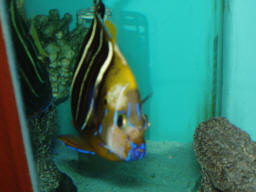
|
Adult passer angelfish, shipping trauma.
12/15/2007 <Very common... specimens more than about 4"
total length don't "ship well"> I recently received a
large adult passer angelfish from a mail order fish store which shall
remain nameless since they have been nice about this. The fish arrived
in terrible condition, dazed and confused and in ~65 degree water that
was loaded with waste. I've had it in my 175 gallon tank for a day
now and not surprisingly it won't eat and it is very sluggish
though mobile, taking laps around the tank occasionally. <The last
behavior leads me to have hope...> I wonder if any of you know what
types of stress tropical marine fish can take and what the prognosis
for such a fish is and what I can do to maximize chances of keeping it
alive and even better acting like the bold, curious fish it is supposed
to be. It really is very sad seeing such a beautiful fish like this
fall apart. Thanks, Omar. <I'd keep the lights off to low... if
you have to for other livestock... and not be overly concerned if the
fish doesn't feed, do much of anything for a few days. Again, the
swimming about behavior is a good sign. Bob Fenner, who did collect
this and other "key" (i.e. expensive) species al sur off and
on for decades.>
Re: Adult passer angelfish, shipping trauma.
12/19/07 Hi Bob and crew. The Passer has not visibly gotten
parasites or anything out of the ordinary since I last emailed you but
it is still not eating and has gotten very sluggish, lying on its side
much of the time until today. <... I would notify the shipper...
These symptoms are case-perfect for a specimen that has been chilled...
Happens... quite often... in hauling, live-shipping "up the
line" from its E. Pacific subtropical distribution...> I tried
blowing Cyclop-Eeze at its mouth last night and I don't know if it
was only coughing or eating but today it was more alert and even
elevating itself off the bottom. I know you aren't here to see this
fish but I'll ask anyway. Is this just a last burst of energy
before dying or did inhaling the Cyclop-Eeze actually help it? I've
given it Cyclop-Eeze several times today and after just about giving up
on the fish I'm once again hopeful it may live. Its eyes are still
presenting as very alert and actively scan and follow motion. It is
just the fact this guy won't eat I think that is getting him down.
Any suggestions beyond what I have done would be helpful. <There is
naught to do really... Either this fish's protein-enzyme systems
have been overly challenged and it will perish... or rally. Keep the
system, specimen stable... and hope. BobF>
Triple Sulfa and Maracyn Plus... Chaetodontoplus,
Angel dis. period 11/12/07Hi Crew, I have
a gray Poma angel that was great for 2 months at the pet store. I
brought him home and put in my 125 gallon FOWLR and was doing well for
a few weeks. His fins starting getting cloudy and frayed and he had
like white patches under his side fins that would look bloody at times.
<Environmental... possibly with a social component> Well I
removed him and treated him in a QT tank with triple sulfa and he did
great with treatment which was a 4 day treatment. I put him back in the
125 tank and it came back during the course of a week. <... same
env.> I removed again and treated again this time twice and once
again he looked great even better since I treated him for 8 days. The
instructions said I could treat twice if need be. Well this time after
treatment I didn't return him to the 125 and did 50 percent water
changes daily for the last 4 days in QT and can see his fins are
starting to turn cloudy again since he finished his 8 day treatment.
<Cumulative stress> It says I can use triple sulfa in the main
display tank without hurting the bio filter. <Yes, generally> Is
this true? I'm afraid to do that. My levels are all great. 0
Ammonia 0 nitrites and 20 and under nitrates. This fish was in a small
20 gallon for at least 2 months and did great health wise but always
looked scared and was hiding in the pet store. <Also env.> I
bring him home and he keeps getting fin rot? His tank mates are 1 clown
and a small Kole tang that have o interest in him. Its driving me nuts
and I'm afraid to put him back. I started treatment today in the QT
with Maracyn plus. The instructions were clear with the triple sulfa
but are not with the Maracyn plus except to treat on days 1 3 and 5.
Nothing about partial water changes during treatment? <Monitor water
quality, change-out as necessary, re-medicate...> Are if I do a
fifty percent daily water changes do I add Maracyn plus to make up for
the water change? One last thing the fish does not seem stressed and
eats well in the main tank and QT. He did stop eating right before I
started the original treatment is why I started and he was eating again
the second day once treatment was started. Thanks in advance <This
is NOT a pathogenic condition... What would really help is a refugium,
mud... macroalgae, DSB there... It's the environment that needs
improving... not the symptoms of the angel that need medicating. Bob
Fenner>
Sick Angel Fish, reading WWM... SW, FW?
11/3/07 <Hi Cindy! GrahamT here.> My angel fish
<Species?> has suddenly started mouthing his food (taking it in
and then spitting it out). <How long has this gone on?> He is
occasionally clamping one fin to his side, and intermittently suddenly
darting around the tank like a crazy person for no apparent reason.
What could be wrong? <Environmental...?> He doesn't look sick
<He does *act* sick, though...> and I can't find that
combination of symptoms on any website. <Try searching for them
individually. You'll find that both are often associated with
environmental deficiencies. Probably removing to a QT would be a start.
Consider our posting guidelines to allow us to assist you better. Post
your question with test results, system specifics as far as you know
them, and especially the affected species, along with tankmates.>
Thank you for your prompt response - I am so worried! <Let that
worry motivate you into becoming an expert on every subject you wonder
about. Here is the place to find every answer you need!> Sincerely,
Cinlala <Good luck! -GrahamT>
|
Chrysurus Angel Sick, sel. - 10/18/07 Hi
Crew I need help again please. I bought Chrysurus angel about a
month ago. He's been great eating well chasing my clown here
and there and what have you. The last week his side fins are
turning white cloudy and inflamed at the base <Not good>
and now he's hiding alot. <No such word> I don't
see any signs of Ich or velvet. He did eat 5 minutes ago.
He's a big fish 8 inches <Too large to start... a big part
of the issue here...> in a 220 gallon tank with few tankmates.
1 clown and a damsel and a Coris wrasse. They all have no
interest in him. I paid a lot of money for him and it is my dream
fish. Was hard to find. Am not sure how to treat and was going to
let it run its course but seems a little worse everyday. He does
rub on the rocks here and there and also another thing he has
like seizures? Like twitching. His body looks good otherwise. I
have done searches on your site and have read the angel section
but cant quit find what's wrong. Any help or thoughts would
be so much appreciated. Thanks In Advance. <Do you know the
origin (country) of this fish? As stated, for the genus and
species, this specimen should have been left in the ocean... too
difficult to ship, adapt at this age, size... What you are seeing
is likely "just" resultant from capture, handling...
Hopefully this fish will recover on its own here. No treatment is
advised but good care. Bob Fenner>
Re: Chrysurus Angel Sick 10/19/07 Thanks
for the fast response. I'm not sure of the area he was
collected from but I thought they only came from off the Kenya
coast? He is gorgeous otherwise. He was at the fish store for
about 2 months and I guess nobody wanted to spend 160.00 on him
<Likely the "freight" for this specimen was more
than half this...> but from what I have seen I thought was a
bargain. He was great at the fish store and stooped there 4 times
in 2 months and always ate and looked great. The only difference
is my SG is 1.20-1.21 while there's is kept at 1.15-1.16.
<Both too low> Said they use that for parasite control.
<Mmm, yes, and to save on salt mix, allow for greater/easier
gas diffusion...> I have already taken your advice and will
let run its course. He is still eating great and I have increased
my water changes to twice a week and not sure what else I can do.
My wife is waiting in the background to say I told you not to
spend so much on a fish. How long should I wait to take any
action do you think? <What action?> It does not effect any
other fins. His color is great also. I will try to get a good pic
to you today if I can. Do you think its fungal or a bacterial
thing? Any knowledge you will share is always appreciated. <I
think it's an "environmental thing" mostly... I
would raise the spg, check and assure "reef" type
conditions... BobF>
Re: Chrysurus Angel Sick 10/20/07 The
action I mean is if it gets worse under ideal water conditions
which are pretty good now? 0 nitrites 0 ammonia 5-10 nitrates 8.2
PH, not sure if I should treat for fungus or bacterial?
<...> I think its bacterial. I noticed today after looking
close that when he opens his pectoral fins it looks white on his
body where the fins lay against. Not sure if that was there but
I'm afraid it will spread. Thanks Again <... Please
read... on WWM re infectious disease and marine fishes. B>
Re: Chrysurus Angel Sick 10/25/07 Hi Again
I just finished with the 4 day triple sulfa treatment and what a
difference! His fins are no longer thick and white though one is
a little ragged but looks nice and clear. The blood in back the
fins is gone just a little pink. He's went right back to his
old self eating like a pig right away when I put him back in the
main tank. He's better then he was when I bought him
personality wise. I was tempted to treat him a day or two longer
like the instructions said I could but thought he would do better
now in the main tank. The triple sulfa I used was by API. It says
I can use in the main tank and will not bother the bio filter?
<Not directly, not likely> I treated in a QT though. Is
that true with triple sulfa? I learned along time ago that
everything else I used in the main tank caused more harm then
good. I don't believe the store I bought him from would take
him back. I'm going to try another place I deal with that has
a 2000 gallon tank set up and see if maybe they will trade or
what have you? I'm curious though with him eating so well and
grazing on the liverock, why wont he have a chance to make it? He
eats everything I give him? Silver sides, formula 1 and 2, frozen
formula with sponge, algae you name it. I'm not 100 percent
sure he was caught at this size or raised from a small size by
someone who traded him in? <Interesting possibility> Well
Mr. Fenner I'm sure you hear it alot but thank you and
everyone else at WWM for making this hobby less frustrating.
Without it alot of people would be lost including myself.
<Welcome... please run your correspondence through a
spellchecker before sending. BobF>
|
Live Sand Storage and Passer Angel... sel., dis.
8/3/07 Hi Crew, I just set up a 125 a few weeks ago for a Passer
Angel I bought that is 10 inches. <Needs a world of more than twice
this size... and large angels (for the species) are indeed not often
good-adaptors to captive conditions... Best to start with a
"medium size"...> I first saw him when I went to look for
a Marine Betta that he was housed with and he bit off the Bettas tail
right before I bought him. I still bought the Betta and his tail grew
back plus the clerk cut 10.00 bucks off the price. He will not be
having a rematch since they will be in separate tanks. I have the
Passer in a QT tank of 50 gallons and he came down with velvet?
<...> The pet store held him for a month for me and I bring him
home and he gets velvet in a week? <Maybe... where is the parasite
coming from?> This has happened in the past with all Angels I have
bought? None of the other fish ever get it? <???> Yesterday I
freshwater dipped him and today it was coming back and freshwater
dipped him again and put him in another QT tank or hospital tank for
his 15 day copper treatment. 125 should be done cycling by then. He
looks healed after the freshwater dip and Im shocked how fast it comes
back. In my QT tank I understand the copper will kill my bio
filtration. How much of a water change should I do to keep water decent
and how often? <As much as necessary. See WWM re> Also would I be
better off using cycled water or premixed water for the water change?
<The former... if you can be assured that it is parasite-free>
One last question and Im sorry for be long winded. I bought a used 90
gallon just for the filtration because it was to good to pass up. The
live sand I don't need right now and was wondering how I should
store it? <Yes... but not as such. That is, it won't be very
live with time going by in storage... and will need good rinsing,
perhaps bleaching and dechlorinating ahead of future use> I see it
in bags in stores but not sure if that's the right way. Thanks for
taking the time to read this and I thank all you guys for making this
complicated hobby make since! Rick <A bit of a definition
difference. There are sand products that tout being "live"...
but this is a bit of a misnomer... They may be primed for bacterial
population growth, but definitely lack higher phyla presence. Bob
Fenner>
|
Chrysurus angel sick... Mis-mix, Lymph - 7/23/07 Hello
again Bob I wrote you about 2 weeks ago, had a horrible Ich
problem and you helped me out a ton... as it stands I only lost
my queen angel.... sad she was my favorite... I transferred all
but the leopard sharks and my lion fish <Mis-placed...> to
a large 40x45x10 inch tub in my garage... I treated them with
Cupramine and all my fish made dramatic improvements ASAP.... As
for my sharks and lion I treated them in my display( I know you
hate to hear this....) but I had no choice, I treated them with
quinine sulfate from fishfarmacy.com and my lions infection
cleared up in a week. The sharks never showed any signs but I
wasn't taking any chances... I have since done several water
changes 25% each and added charcoal to the sump to filter out the
quinine sulfate. I returned all fish (imperator, passer, pair
yellow banded maroon clowns, <... am becoming very tired of
fixing your English... spaces between your sentences...> and
the Chrysurus angel, less live rock (in separate tank with no
meds) back into display. Now my Chrysurus angel is developing a
bunch of what looks like fungus on its fins, I cannot tell if it
is fungus or bacterial. I tried scraping it of but it wasn't
coming off very easily and it started to bleed a little bit, so I
returned it to tank and left him alone. His color was a bit off
from the stress but he seems to be fine, eats very well and seems
to be getting along with king dog imperator boss). any thoughts
<... This is a clear case of Lymphocystis... etiology unknown
but most are related to poor water quality, avitaminoses and
overly-stressful conditions period. See WWM re. RMF> Kelly
Craven
Re: Chrysurus angel sick. Killing Triakis...
7/25/07 Hello Bob I hope that august is treating you
well...So my baby leopard shark passed this am...and my large one
is still barely eating, he seems to have trouble swallowing the
food. (silversides, clams, squid). As for my other fish: the
imperator came down with oodium...treated all other fish with
copper....seems to be working. My problem is my Conspic is still
not eating......please help... Thank you Kelly <With? Please
use the indices, search tool:
http://www.wetwebmedia.com/WWMAdminSubWebIndex/question_page.htm
BobF>
|
|
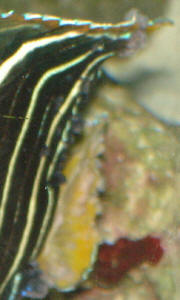 .JPG)
|
Regal Angel HLLE 3/19/07 Hello Wet Web Crew. I
hope all is well. <Quite well, thanks.> I wanted to provide some
input (maybe beneficial to some reader out there is the same boat)
about a recent experience I had with a Regal Angel and IMO a
'miracle product'. <I usually hate that term but I cheated
and read ahead, and am in agreement.> About 6 weeks ago, I obtained
a regal angel from a tank at a restaurant that I frequent. The little
guy was not looking healthy and had the beginning signs of HLLE. I
spoke to the owner of the establishment and provided my observations. I
told him that these fish are difficult at best to care for. He
explained to me that they have a company come in every two weeks to
service that tanks and he would let them know. I went back a week later
and the situation was the same. I spoke to the owner and asked if I
could take the fish. He agreed and I went the next day (before opening)
and got the fish. <Good for you and the owner.> I brought him
home and placed him in QT for 3 weeks. <Good to hear.> Initially,
I could not get him to eat anything (I believe this also to be the
problem at the restaurant). I tried Mysis, frozen angel formula, Nori,
flakes, Formula products, fresh shrimp, clams, and squid. He would not
eat anything. He would pick at LR, but that is about it. I was out of
options, until I was cleaning out a cabinet where I store my dry
products and came across some New Life Spectrum Marine Formula pellets.
I think that these were about a year old, as I had not been feeding
them to any of my tanks at the time. I had nothing to lose at this
point and dropped a few in the QT tank. I watched them sink to the
bottom and the regal was uninterested. I came back a while later, and
noticed that they were gone. I dropped a few more in the tank and the
regal went nuts. I started feeding him 3 times a day with the pellets.
He was doing so well on the pellets, that I started feeding all of my
tanks the pellets. He has now been in my 210 gal main display tank for
3 weeks now and is doing awesome. His color has returned, no signs of
HLLE, and he is now eating Cyclop-eeze along with his pellets. Aside
form that, all of my fish never looked so good. IMO, the New Life
Spectrum line is absolutely amazing stuff. This food should be a staple
for anyone who owns a marine tank period. I have also started feeding
my sun polyps the small fish formula and they seem to love it also.
This stuff is truly incredible. I hope that someone from the New Life
Company reads this. They should be proud of this product. Best Regards,
Dean Oliver <I agree, I really love this food. All our tanks, both
fresh and salt water get this line. Makes a great staple food, some
even claim to feed it exclusively, although I still won't go quite
that far. But don't minimize your work either, the QTing allowed
the fish a chance to start eating which would not have happened if
competing with tankmates. Congratulations on your success with this
difficult fish and thanks for sharing your story.> <Chris>
Another Angelfish and the Prophylactic Use of Copper )
3/14/07 Hi guys. <Leslie in for the guys this evening…>
I have a 120 gallon FOWLR which was nearly "completed"
recently. It has two 3" Regal Tangs, a 3" Yellow Tang, a
3" Coral Beauty, a 4" Purple Tang, a Longnose Hawkfish, a
Purple Firefish and a Blackcap Basslet. <Wow, that's quite a
combination there. I hope you are planning on a much larger tank
sometime in the not to distant future. I hate to be the bearer of bad
news but here goes….. your tank is not appropriately stocked. You
have 3 more Tangs than the recommended number, which would be one per
system unless you have a very large system. 120g would not be
considered very large. The Purple Firefish belongs in a more docile
environment. These fish have a tendency to hide and starve to death
when kept with more pugnacious fish.> I had recently added the
"final" addition, a very good looking BlueFace Angel. It had
been at the LFS for 4 weeks and was eating Mysis shrimp. <Very good
signs!> I got him and since my quarantine tank was only 10 gallons
and he had been looking good at the LFS a added him directly to my
tank. <Woops, a larger quarantine tank would be in order.> Of
course four days later he has velvet and dies two days after that.
<Oh no, so sorry for the loss, but not unusual.> Naturally a day
after he died, the Tangs were showing early signs of velvet too. So I
bit the bullet and took out the live rock and cleaner crew. I treated
the whole system with copper and even though the two Blue Tangs went
down to the bottom on their sides, everyone recovered. <Very lucky,
indeed.> So here is my question: I'd like to replace the Angel
with either another Blueface or an Imperator. <Your tank is really
to small for either of those fish. If you have your heart set on one of
the large Angelfish you really need a bigger tank. Please do yourself
and those fish a favor….get a bigger tank and/or return some of
those fish your LFS and re think your stocking plan.> Since the live
rock is out and the water is medicated could I add the fish while the
copper is still in as to avoid any ick or velvet breakout while adding
him? <I wouldn't. Copper is a not gentle drug. I am not a fan of
using prophylactic medication most of the time.> It's been about
three weeks with the copper in the tank. Your thoughts on this would be
appreciated. Francisco J. <Well those are my thoughts, probably not
exactly what you wanted to hear but I hope they help, Leslie>
Bubble Deaths... a lack of knowledge... 3/1/07 Do
you know why fish swim to the top, and seemingly eat the air bubbles?
<Feeding behavior, they see something that might be worth
tasting.> I purchased a 10-gal QT, put an Angelfish in it and 2
weeks later, she was swimming slowly, and seemed to be covered with
dust. <Sounds like Velvet, http://www.wetwebmedia.com/amylloodiniumart.htm .> I
looked for a Copper treatment at Petco, but she had died by the time I
got home. I did a 25% water change and 2 weeks later put in a
Cardinalfish. <The cardinal was then infected, the QT needs to be
broken down and sanitized between uses.> The next morning he was
swimming at the top, following the small air bubbles around. I watched
him sink to the bottom of the tank, so I took him out, started
acclimating him to the 55 gal, and put him in. <Not good, now the
main tank is infected, needs to run fallow 8 weeks ideally.> He swam
around some, but the next morning he was on the bottom, wings stretched
out and wouldn't move when prodded. I did 50% water change in
10-gal QT, waited 2 weeks, purchased a yellowtail damsel. <Velvet
was still in the QT, and will be until it is disinfected.> He did
fine in the 10 gal for 2 weeks. <4-6 weeks is the minimum safe time
to move for salt water fish.> I had been doing 25% weekly water
changes in the 55-gal all this time. So, Saturday I transferred the
damsel to the 55-gal. (nitrates 20-40 ppm; nitrites 0, ammonia 0, ph at
proper level). Four days later I see the same behavior as the
Cardinalfish had in the QT tank previously. I quickly moved the damsel
back into the QT but he did not survive. I have been purchasing Ocean
Marine Water from Petco. <Not the source of the problem.> I have
had my 55-gal for over a year. My LFS suggested I buy a Sea Apple last
December, and he wiped out all my livestock. <Yep, not good aquarium
stock as you know.> So now I am starting over and its causing me
great sorrow. I removed all the live rock in the 55, vacuumed the sand,
rinsed off the rocks and put them back in. I just started using
Kordon's Amquel+ for the nitrates. <Does not help with nitrates,
a DSB and water changes best for this.> Why do my fish keep swimming
to the top, eating air bubbles, and then sinking and dying? Brenda
Truitt <Please see here for proper QT methodology http://www.wetwebmedia.com/ca/volume_3/cav3i4/quarantine/Quarantine.htm
. Right now Velvet/Amyloodiniumiasis is your main cause of death.>
<Chris>
Re: Metal Halide size and T5 question, Flagfin angel
dis./recovery 3/1/07 Thanks Bob for the prompt reply, <Welcome
Larry> I think I'm going to go with the 150 HQI due to heat
issues. I just needed to make sure that I could keep SPS and clams.
<Ahh, this would be my choice as well> I'd like to share a
success story with you about a sick fish since you here so many
failures by hobbyists. <Please do> I have had a beautiful Flag
Fin angel for 3 years. It became ill when one of my older fish died and
I didn't find out till 2 days later. The angel developed bilateral
cloud eye, fin rot, hemorrhagic patches on both sides of its abdomen
and mouth. I immediately place it in my QT tank. It progressed very
rapidly and the fish just labored at the top of the tank. It was
literally knocking at deaths door and I thought about euthanizing it. I
started treatment right away with 2 antibiotics, penicillin and furan
along with every other day FW and Methylene blue dips and every other
day water changes to my QT tank. Well now I call the angel the miracle
fish. Its almost back to normal except for some residual damage to one
eye. This fish did not eat for 12 days and now its swimming around the
tank and just starting to peck at food. Its not completely out of the
woods yet, but if it starts to eat again I just may get lucky.
<Yes... your diligence has paid well> By the way, I'm a
emergency medicine physician and my wife and friends are calling me the
fish doctor. Have a great day and thanks for the help. Larry <A good
title. BobF>
Majestic Angel Getting "Thin in the Head" -
01/28/07 Hi Crew, <<Hello Jeff>> Love your site and all
the wonderful information!! <<Good to know>> I have a
beautiful majestic angel that is getting a little thin just above the
eyes. <<Likely a nutritional deficiency>> He seems to be
very healthy otherwise and eats well. The aquarium is a 210-gallon
FOWLR and (with the exception of a little hair algae), is very healthy.
I have been enjoying this hobby since the early 80's and to help
finance it I worked part time at the LFS for several years. While
working at the store I remember the manager always telling us to avoid
fish that were "thin in the head" so now I am getting a
little worried. <<Indeed>> I have been feeding this fish
with a number of foods including frozen angel formula, Nori, Mysis
shrimp, plankton, and herbivore pellets. <<A good mix of
offerings, but...>> He seems to enjoy just about everything I
feed him. Can you tell me what causes this problem and offer some
suggestions? <<These type maladies can sometimes be secondary to
environmental issues (e.g. - poisoning/less than optimum water
conditions...you may want to consider adding some Poly-Filter to your
filter flow-path) but this is almost assuredly a case of malnutrition.
Even though the fish eats well, there is something (vitamins/essential
fatty acids) deficient in its diet. I would continue feeding what you
have, but I would make the addition of New Life Spectrum pellets soaked
in Selcon to its diet. I can't tell you what it is, but there has
been anecdotal proof of the Spectrum pellets allowing some advanced
aquarists a measure of success with difficult even impossible to feed
(nutritionally) specimens such as Zanclus cornutus. I would also get a
vitamin supplement (Boyd's Vita-Chem) and alternate this with the
Selcon...the vitamins can also be simply added to the system water and
will be taken up as the fish "drinks" its environment>>
Thanks, Jeff Jones <<Happy to assist, Eric Russell>>
| Cloudy <Asfur> eye problem 1/16/07
Hello Crew: <Eric> Happy 2007! I would like to ask for your
expert diagnosis of this particular case... hope you all can help
me a little bit. please see the attachment. <See it> I have
an Asfur Angel fish, QTed it for 20 days and was put into my FOWLR
5 days ago. 3 days later it developed cloudy eye, so I first dipped
it with FW and formalin+paraguard. <Didn't I respond to this
recently? This problem is unilateral correct? One-sided?> During
dipping, I noticed 15-20 tiny little circular "stuffs"
appeared on both eyes, and also behind the fins next to the gills,
these "stuffs" are circular, about3-3.5mm across, like
hanging onto the fish. I scrub most of them off the fish gently
<You're joking... please tell me> with a toothbrush in
the dips, but the cloudy eye was pretty severe. I could see 3-4 of
them attached onto that eye. for the next couple of days I have
dipped it once a day with formalin+paraguard in FW. all other
"stuffs" have gone from the fish's body but the
cloudy eye still remain, although it is getting a "little
bit" better, I would like to know a couple things: 1. what are
those circular stuff? and is it contagious? <Is highly likely
the fishes cornea... please stop scraping, dipping> 2. what
would be the best remedy to treat the cloudy eye? I am currently
dipping it once a day and lowering salinity in QT... is there
additional things I should be doing? <To do your best at
providing an optimized, stable setting... nutrition> 3. for
ID-ing disease, can you please suggest me some readings/books and a
place for me to purchase a microscope? <A QX5... see the Net...
and Ed Noga's Fish Disease, Diagnosis and Treatment to start
with> thank you very much! Eric <No more scraping, dipping...
or I'll hope you're reincarnated as a pet-fish! Bob
Fenner> |
|
Re: Cloudy <Angel> eye problem. - 1/18/07 Dear
Bob <Eric> The fish has recovered fully, thank you very
much. <Wow! Great news> in fact, once I cleaned the visible
parasites off the fish he is more active, and breathing was
slowed down. The formalin/ParaGuard + FW did their job I believe.
Eric
<Thank you for this update. BobF>
|
|
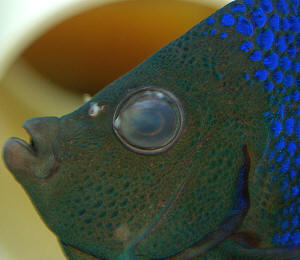
|
Please help my angelfish :) 1/15/07 Hi crew, <Rich> I
recently found your site and must say it is the most complete source of
information on marine fishkeeping I have come across to date. I sure wish I
found it sooner. I may just have avoided some headaches. <Ah, put us right up
there with your analgesics... or rather their avoidance> I have a problem with
the most recent addition to my FOWLR tank, a wild caught juvenile maculosus
angelfish (tank raised = too small = lionfish food). After many months of
waiting, one finally arrived at the LFS. He had some small signs of lymph but
was otherwise behaving and eating normally. I picked him up despite my
misgivings about his less than perfect appearance. After all, I've had fish with
lymph before that cleared up on its own and this species sounds near bullet
proof after reading much of the information available. <Yes> Well, sometimes you
have to touch the stove to learn that it is hot. I should have waited for
another specimen. <Mmm> A few days after adding him to my tank his lymph began
to spread. No alarms yet; he was just yanked out of the ocean and was
understandably stressed. He was still eating great. A couple weeks later he
develops one cloudy eye. My water parameters are all good except nitrate. <How
much?> The first day I noticed the eye he refused to eat. This alarmed me so I
checked with my LFS. They advised me to try a freshwater dip to see if it
improves and to increase my water change schedule to weekly (to address the
nitrate). If the dip helps, this would indicate a parasite. <Mmm... not
necessarily> If not, then I should QT him and treat for bacteria with
antibiotics. I was reluctant to do the dip because of the added stress so I
decided to give it another day. I also don't have a lot of confidence in
antibiotics since I have QT'd and treated two fish in the past with a medley of
them and it didn't help a bit. The next day he resumed to eat greedily. In fact,
he comes out and begs when he sees me. This is not how I would expect a
stressed/diseased fish to act. <Adaptability is a hall-mark of a successful
species, and individuals> The reason I am contacting you for help directly is
despite his good behavior, the eye continues to look worse and the lymph is not
improving. <Both... take time... often months... Cleaners...> Now the eye looks
as if there is additional tissue layered over it and I swear I thought I saw a
tiny piece of it flap. <One-sided? Likely a mechanical injury... a net scrape or
such...> I have spent several nights reading the FAQ's on your site and have
found all sorts of recommendations from treating for velvet and letting my tank
go fallow to doing nothing at all. <My choice here? The latter> Could all of
this be caused simply by high nitrate? <Mmm, could be a contributing cause...
but not the eye by itself, no> I don't want to just start taking shots in the
dark (which is sort of how I feel I am about to do) so I am seeking a second
opinion. I am preparing a fresh water dip now, but I would love to hear from you
first if possible. Thanks in advance and keep up the good work! Rich Amos. <I
would not net, dip this specimen... Reduce your nitrate below 20 ppm... See WWM
re approaches, add a cleaner organism or two... and "punt"... all should be
fine> P.S. Your articles have also sold me on the idea of NNR through a DSB
refuge. <Oh! Good... a fine approach> How do I replace the wet/dry without
cycling my tank? <Will not likely cycle... enough nitrification elsewhere in the
system to carry on...> There isn't enough room to run them both together. <No
worries. See WWM re such conversions. Bob Fenner> ....I forgot to mention
just in case... I am feeding him: Prime Reef Formula One and Two Angel
Formula (which has some sponge I believe) Chopped krill Mysis Squid Chopped
silver sides <I'm moving to your house> Usually what I do on a feeding (once
daily) is crumble one of the frozen "cubes" and pair it with one of the chopped
"animals" (that sounds morbid..). I alternate the offerings each night. Thanks
again, Rich. <Is fine... I would add a vitamin, HUFAs et al. soaking here
occasionally... esp. now. Bob Fenner>
Re: please help my angelfish :) 1/16/07 Wow,
thanks for the fast response! <Welcome> Yes, that was sort of my
gut feeling on the matter. It is always nice to hear from a pro though.
The nitrates are around 200 ppm. <Yeeowah... Oh my!!! About an order
of magnitude too much... Definitely a factor here> Part of my
problem also is lack of aggressive skimming. I currently own a Kent
marine Nautilus TE (one of my aforementioned "avoidable
headaches"). <Oh yes> I am looking at an AquaC EV180 using
your refuge design as well as weekly water changes to address this.
<All good moves> I will investigate some vitamins. Do you have
any favorites for angelfish? <Selcon...> Also, what is a HUFA
(sorry, not up on all the lingo)? <Highly Unsaturated Fatty Acids...
take a look/see on the Net... impt. for aquatic animal life and your
health...> Lastly, regarding cleaner organisms: what, if any, would
be compatible with my mix (Tuskfish, Volitans lion, yellow tang, Cuban
hogfish, maculosus)? Thanks again, Rich Amos. <Read on my friend...
BobF>
Re: please help my <Mac> angelfish :) & now
Crypt 1/23/07 Hello again, <Hi there> Thank you for the
information. I have picked up some Selcon along with some freeze dried
plankton. My efforts to reduce nitrates continue through weekly water
changes. I am finalizing measurements for the refuge and have had the
EV180 quoted. <Ah, good> The good news: The amount of lymph on my
Maculosus has dramatically reduced. I think he is actually shaking it
off. I have observed him shaking his rear fins while staying in place a
few times now. Additionally, the amount of tissue on his cloudy eye
seems reduced or "deflated". I can actually see some blue
behind it now. <Good... such viral complaints/expressions can indeed
come and go... not unlike "Warts"> The bad news: I fear I
am finally about to ride the Ich roller coaster. I came home last night
(8 hours after a 20% water change) to observe white spots the size of
small salt grains on all but my Lionfish. The Maculosus, Tuskfish, and
Cuban Hogfish all are scratching on the rock. Additionally, the
Tuskfish and Hogfish occasionally stop swimming and lay around (this
particular scratching/laying behavior in these two actually started a
week ago). The Tuskfish also appears to breathe heavily when lying
around. The Yellow Tang and Auriga Butterfly have spots, but otherwise
act normally. The Lionfish shows no signs. Everybody is still eating. I
just unplugged my skimmer to rule out the bubble theory (admittedly a
long shot here but one can hope). <Mmm... not a likely
possibility...> Assuming my diagnosis is correct, how many fish can
I treat in a QT (Tang = 5", Hog = 5", Angel = 4", Tusk =
6.5", Lion = 8", Butterfly = 4")? My current QT is a 30
gal. long. Obviously this will not support all of my fish. <Mmm,
no... and all need to be removed, treated... some species more
carefully than others... See WWM re Crypt...> I am thinking about
also setting up a 20 gal. Rubbermaid. I would then split my population
between the two. Is this still overpopulating the QT setups? <Bigger
would be better...> Will a Rubbermaid suffice for a 30 day MT fallow
period? How would you split the population given this scenario? Do you
have any other recommendations? <All sorts, and all archived on the
site... need daily testing for nitrogenous materials, copper...> I
also have a concern regarding letting the MT go fallow: since there is
no waste being produced by my fish won't this cause my nitrifying
bacteria to die off? <Mmm, not entirely... you can always "add
a pinch" of proteinaceous food if you have a concern.> Thanks
again, Rich. <Do read re Crypt, treatments... of the species you
list. Bob Fenner>
Re: Rapid Breathing Emperor 1/26/07 Bob, thanks
for your input on my "declining" situation. Yes,
unfortunately this problem has gotten worse. The day of your response
my powder blue tang began to scratch on the rocks. Just slight little
brushes. Nothing too aggressive, but still displaying some irritation.
He did this occasionally for about four days, and then I observed my
emperor angel flash on one occasion. NOT GOOD! I performed a 20% water
change. I did this in hope that there was some kind of water quality
issue that my test kit could not pick up. I watch my fish very closely,
and as of now it has been a few days since I have witnessed anything
like this. <Mmm... the Crypt will be back... is just cycling...>
They are both eating very well and appear to be calm. I have never seen
a spot on either one of them. If I was a betting man I would say that
my emperor angel has been subclinically harboring parasites this whole
time and once he was moved to the tank with my Ich magnet they are
beginning to gain the upper hand. <Agreed> I understand about the
life cycle of Ich, and I am also aware that the apparent improvement is
probably just Ich (or some other pathogen) rallying the troops for
another assault on my finned friends. <Correct> I guess because
of the fact that I have yet to see any spots I am reluctant to treat
these copper sensitive fish. Am I just being ignorant by thinking that
at this point I can beat this thing with good nutrition, vitamin
supplements, garlic( unproven, I know), and good water quality.
Obviously this would be ideal, but I fear by doing this the situation
could spiral out of control. I have read and experienced first hand how
fast these parasites can manifest themselves and kill. My first fish, a
auriga butterfly, died three days after showing spots. I don't
imagine the PBT will fair much better. Bob, I regard your opinion t be
the best available, and I could sure use it right now. Thanks a bunch,
Jim <A matter of a bunch of review, reading: http://wetwebmedia.com/ichartmar.htm and the many files
above. BobF>
Koran Angelfish melting like the wicked-witch
1/13/07 Hello: <Hi Beth, Graham T. with you tonight> I
have about a 2.5 years old Koran Angelfish that over the past year
has slowly been losing it's color and fins. It has lost
most of its fins but is still able to swim around and eats well.
<Sad story so far...> I have had the water checked and is
fine. <Mmmm... fine. I read that a lot here on WWM. Usually
closely followed by, "Fine is a relative term. Can you be more
specific?" You need to include some numbers here, and invest
in some kits for more accurate/frequent testing.> It is a 55
gallon tank with only a Clownfish in with it. What could be causing
this and is it treatable? Attached is a picture. <Oh my GOD!
That poor fish... what a shame. A whole year he has been rotting
away like that? Let me start with what I see in the background, and
speculate with what I don't see. Plastic plants and the large
shell are actually poor choices for decor in a mini-reef. (Big
shells are known to cause more problems than their attractiveness
is worth.) Was this setup based on a freshwater-to-saltwater
conversion? If so, you may not know that there are many freshwater
substrates and decorations that are totally unsuitable for marine
use, due to saltwater's corrosive nature. To maintain a
successful marine aquarium, you need to have some basic test-kits
to allow for frequent and reliable testing of water quality, mainly
ammonia, nitrite, nitrate Ph and specific gravity. Many are
discouraged from the hobby by the impression that you need a
doctorate in chemistry to achieve this success. While the degree
certainly gives you a clean grasp of the fundamentals (and more) of
what's going on in you tank, the basics are all you need to
know. Remember where these animals come from: clear pure waters.
Please reply with any specifics you are able to provide about your
system including filtration, skimming, presence/amount of
liverock/live sand, frequency and composition of water changes, and
ANY test results you have, including but not limited to salinity
(specific gravity), ammonia, nitrite, nitrate, and Ph for starters.
I want you to get the fastest turn-around on your replies from WWM,
so I grabbed this email as soon as I saw it. *BUT* I am not the
best qualified crewer to answer questions about treatment of
pathogens, so I may hand this off on it's return if I suspect
something other than environmental by your reply. I apologize for
my shocked response to your poor angel, but it seems that a year of
this wasting away is just bit long and, frankly, awful. -Graham
T.>
Thanks,
Beth |
|
Re: Koran Angelfish melting like the wicked-witch follow-up
1/13/07 Thank you for responding, I completely agree.
<Good, I didn't want to offend anyone, but that is just
too far!> The angelfish actually belongs to my younger brother
who really has no idea about saltwater fish. My dad has another
saltwater tank that does fine and he kind of just lets my brother
go on his own. <Hmmm... not very fond of that obvious failure
in guidance.> I have been bothering them to do something for
months but neither of them will do anything. I was over there
yesterday and saw how very awful it had gotten and decided to get
on line and find something out. I will try and get answers from
him on the water, but as bad as this sounds, do you think it may
be too late for this one? <Well, too late how? The fish can
still swim and get around after healing, and some color may
actually return... but this depends on whether the loss of...
everything is due to plain old toxic water or a pathogen.
Obviously, the fish is never going to look like the prototype.
Let's just see where we can get with water conditions and
maintenance information. I want to know more.> Is it more
humane to, I don't know if you would say euthanize? I
can't even believe it can swim anymore. <It is hard to
believe, but a hungry fish has a fighting chance! -Graham T.>
Thanks, Beth
Re: Koran Angelfish melting like the wicked-witch follow-up
1/13/07 Below are the water numbers: <Hi Beth, G.T.
again...> Nitrates: +100 <There's a big problem there.
BIG> Nitrites: 0.1 or below <Any measurable nitrite is
bad.> Salinity: 30 Specific Gravity: 1.022 I'm not sure
about the Ph Filtration System is a side filter without a ground
filter. <Not sure what you mean here, but I'm guessing you
either mean a filter that hangs on the back (or side in this
case) or just a powerhead. Umm, how about this: take some
pictures of the tank from all sides with your camera set to
640x480 or 1024x768, then zip them and send back.> My dad does
have the specific gravity test and nitrite test. I took the water
to our local fish store and I was talking to the owner. He
didn't see a picture but as I was explaining it to him he
said it was normal aging process. I found it kind of disturbing
that a supposedly reputable fish store would kind of downplay the
problem saying it is the aging process and that it happens the
fish just doesn't look that attractive. <Well, that angel
is still (partially) colored with it's juvenile patterns. If
you do a Google-search on the Koran angel, you will see that the
adult is very different, not to mention larger! This place is
just enabling this awful treatment. For shame!> I on the other
hand think it's awful the way this fish looks and think it
would be painful. I've made it my mission to try and salvage
what I can. I took out the shells for starters. Anymore help
would be appreciated! <If you can't take more pix then
describe the system in detail.> Thanks. <You're
welcome, and we at WWM really to applaud your effort to bring
some peace to this fish! -Graham T.>
|
|
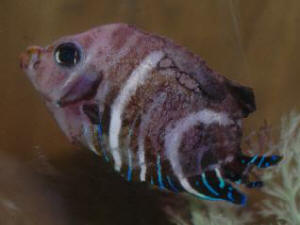
|
| grey angel with weird growth. Poor English,
Lymphocystis 1/3/07 could <Could> you please help me
identify and treat my grey angel, <.> I got him from marine
depot <Marine Depot> live and have had him in my fish only 75
for 2 months he had no signs of this growth when I got him. the
growth seems to be on his fin and lip. thanks <Looks like
Lymphocystis to me... Read here: http://wetwebmedia.com/lymphfaqs.htm and the linked FAQs
file in the series linked above. Bob Fenner> |
|
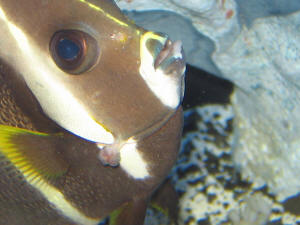
|
Medicine Cabinet 11/5/06 Hello Crew; <John>
Unfortunately, last night I lost a Coral Beauty Angel in quarantine.
While it's certainly not the first fish I have lost, I believe it
to be the first lost due to an outright infection. Don't get me
wrong, over the years I have lost more fish than I care to think about,
but, it's been due to predation by tank mates, shipping stress and
the associated anxiety (the fish, not me), or what I suspect to be
cyanide poisoning in the case of a Gramma melacara. I have suffered
almost no losses with corals, including a Sebae anemone which I've
had for 5 or 6 years. <Well-done> Anyway, the aforementioned fish
quickly developed cloudy/puffy eyes and some fin rot after getting him
from the LFS, <Centropyge bispinosus are by and large not
"hardy" as they "used to be" years back...
cumulative stress-effects from collection, holding... lack of nutrition
in transition I mostly suspect> so with some trepidation, I
performed a pH adjusted freshwater bath which cleared things up nicely
for about a week <Good mostly for treating symptoms... not so much
for causes/effects> when I noticed symptoms started to re-appear,
just before I had to work three 12 hour night shifts doncha know. So I
did a second bath, but he perished overnight (my own fault I suspect,
because while I used distilled water adjusted to pH 8.2 with baking
soda, I discovered too late that while letting the container come to
temperature overnight before dipping, the pH drifted high. Perhaps
burned his little gills). <A common, too common problem here> My
question, finally, is: since, it seems to be a truism that trouble will
strike at the most inconvenient time, what would you keep on hand in
order to treat the various maladies that can strike our captive
critters? <Ho-buoy! A cursory review of my feeble memory shows a
distinct lack of such a cogent, detailed list... and rationale. I do
wish I could commit the time/resource to generating such a
"Pathologically Speaking" series of articles... perhaps a
popular-slanted short book on the mass topic of captive marine/aquatic
organism "health", including this important topic... We/WWM
do have a brief piece by Tim Hayes: http://www.wetwebmedia.com/ca/volume_2/cav2i4/When_things_go_wrong/Oh_no.htm
that delves shallowly here...> On another topic, what are your
thoughts on a Chaetodontoplus mesoleucus in a 180 reef? <A very nice
choice IMO/E> Right now the only fish are two false Percs, a
yellowtail damsel, golden wrasse, and a pair of green Chromis. Other
desired additions are a hippo tang, Kole tang, Forcipiger butterfly,
and a fridmani Pseudochromis. <Also good choices> Currently
corals are softies and LPS, but I plan to switch more to SPS since
upgrading the tank and lighting a while back. Thanks; John <Thank
you. Bob Fenner>
Personifer Angel/Please Help... mixed Angels, Crypt likely
9/2/06 Hello Everyone: I have read just about everything I could
about the personifer (I think) I have a 180 gallon all fish and live
rock tank. My Personifer angel is about 3 ns half inches long and has
white spots that are more spread around then close together. In the
book by Robert M Fenner (great book) it looks like it could be
Amyloodinium Ocellatum more then it could be Ich but am not really
sure. <Mmm, could be either from this description... but if
Amyloodinium this fish would be soon dead... a few days> My PH is
8.4 and everything else is great and my salt level is between 1.022 or
1.024 somewhere in the middle. I have about 3 other peaceful angels in
my tank also. <Mmm, likely not compatible> I just want to know
please, how can I cure him? I have a 10 gallon tank I could set up. I
have copper, QuickCure. Please tell me directly on how to save him And
how can I look up a fish where just you guys talk about the fish only?
Please help me I really love this fish and I paid $200 dollars for him.
I live in New York and it bother me to see this. Please reply to Joey
Harper <A bit more to this... you need to treat all, including the
tank itself. Set some time aside (and soon) and read, starting here:
http://www.wetwebmedia.com/ichartmar.htm and the linked files
above. You need to formulate a plan, get more treatment tanks, start
making new water for change-outs... Bob Fenner>
Spot on Marine Angel fish... owee from decompression
procedure? 7/31/06 Hello crew, <Laurie> I've been
researching on your website, but can't seem find an exact match for
a possible issue with my marine angel. I purchased a Swallowtail angel
two week ago. She is isolated in my QT. I did not freshwater dip her
prior to putting her in the QT. <Not always advisable> A few days
after bringing her home, I noticed a small white bump on her side.
It's about the size of a scale. I thought that perhaps it might be
a single parasite, so at that time I did capture her for a buffered
(baking soda to ~8.2 pH) freshwater dip (with Methylene blue). However,
I removed her after only 1 minute, as she started to thrash, which
scared me. <Can be scary> Now, after about 10 days, it has turned
a yellow-brown. No other spots are on her. I have decided to leave her
in the QT until that spot is gone, but feel that I should know what it
is, so that I can further treat her properly, if needed. <Good. This
is what I would likely do as well> I tried to get a picture, but she
freaks out at the camera and I can't catch her in a frame! Oh - I
added a skunk cleaner, thinking that if it is a parasite,
<Excellent> or actually, anything else that needs to be cleaned
off, that he could assist. I have seen her letting him hop on
occasionally. But, the spot is still there. Would you know what this
spot might be? <Mmm, likely a "sore" from the process of
capture... most likely a/the entrance of a needle to
"decompress" this animal... Many marine fishes are caught at
depths that make such "gas bladder bleeding" expedient,
rather than the long-wait of bringing to the surface slowly...>
Thank you for your help - both past and present. Regards, Laurie O.
<Keep your eye on water quality, and don't be too wary of
moving/placing this Genicanthus sp. in your main system. Very likely it
is relatively disease free. Bob Fenner>
Re: Spot on Marine Angel fish 7/31/06 Hi Bob,
<Laur> Thank you. That's great news. I will plan on moving
her this coming weekend, then. (That will be a full 3 weeks in QT.)
<Good> Water quality is pretty good in the QT - ammonia and
nitrite at 0; nitrate at 20 ppm. I just did a 5% water change, too. I
have another, unrelated question for you, if you don't mind?
<Sure> I was poking around yesterday, and found on this page:
http://www.wetwebmedia.com/mardisindex.htm;
under the section "Biological/Pathogenic Disease: Identification,
Pathogens/Agents, a photo that shows zigzag lines/trails on what may be
live rock (or is it a fish?). <Oh! Is a pic of nematodes, Roundworms
encysted in the dermis of a Moray Eel...> It is the fourth photo
down in this section. I looked at all of the links to the left, but
could not find that photo in any of those links. Do you know what the
zigzag lines are? <Yes... please see here: http://wetwebmedia.com/fshwrmdisfaq2.htm
about mid-way down... the same pic> We've had three occasions of
something looking exactly like these in our 110 display tank.
<Mmm> Twice on the glass wall, once on a rock. We thought they
were snail eggs. But, now I'm worried, because your photo is under
the disease section! Thanks again, Laurie O. <There are many
such-appearing living "things"... likely what you saw were
actually eggs... most likely of a mollusk of some sort. Not to worry
re. Bob Fenner>
Lost my Conspic :( 7/16/06 Hello WWM Crew.
<Jeff> I had a tragic loss of my Conspicillatus Angel after two
and a half years of healthy living he is gone. I had noticed over the
last 6 months his breathing had increased and he loved the bubbles. His
appetite up until the last day was voracious as usual. I always looked
in the gill plates for any sign of problems but did not see anything
(still bright red and full). When I came home the other night I noticed
his breathing was beyond rapid. I called my fish guy at 11:00 pm to
come over and help. <... some service!> After looking at the
gills again we noticed a huge (about the size of a nickel) white
bulbous growth tucked deep inside the gill plates (because now his
gills were flared wide open to get o2). We agreed that in the morning
we would "cut " whatever it was out <!> to save the
fish because it wouldn't make it if he continued like this.
Unfortunately by 7:00 AM he past away. The fish guy did a post op on
him and said he found a "goiter" in his gill plates, <Not
uncommon> one large one and a smaller one on the other side. I
unfortunately do not have a pic of it but is it common, rare or even
possible for angels to get them (I only saw references on rays and
sharks)? <All vertebrates and some invertebrate groups are subject
to these tumorous growths... Generally associated with endocrine
malfunction, in turn related to a nutritional, chemical deficiency>
or could there have been a copepod or some type of parasite that fits
the bill? <Mmm, this is also a possibility. Would need to examine
the growth> It did look more like a "tumorous" growth than
parasitic but I would hate to search for another beautiful fish like
that and not know what I would be dealing with. Best Regards, Jeffrey
G. Schoor <Sorry to realize your loss... Might I ask, were/are you
of the habit of using vitamin/supplements and/or iodine/ide/ate on a
regular basis? Bob Fenner>
Re: Lost my Conspic :( 7/16/06 Hi
Bob, <Jeff> I do use vitamins and supplements for my fish that
contain iodine but I did not use additional iodine. I guess I should
start. My tank is 400 gallon fish only what types of supplements would
you recommend? Thanks for the quick response Jeffrey <Mmm, well, it
takes actually very little iodine to prevent Chromaffin Tissue
(homologous to Thyroid, Parathyroid in "higher vert.s) deficiency
syndromes... If you are adding such weekly (a good practice to time
with water changes, general maintenance, this should "do it".
Our collective input on this issue here: http://www.wetwebmedia.com/vitaminmarfaqs.htm
and http://www.wetwebmedia.com/iodfaqs.htm
Bob Fenner>
Coral Beauty HLLE? 7/1/06 Hi, question for you.
<Hello John> I currently have a mid size coral beauty in my
quarantine system. I purchase him 16 days ago from a LFS. While in the
QT he has developed a small patch (approx the size of a match head) on
his L side near his lateral line. The area appears to be pale in nature
and irregularly circular. At first I thought he may have just bumped
against something in the tank but now watching it over the past 15
days. It appears to have grown ever so slightly. Also yesterday I
noticed a very tiny pale patch on the R side of his head. Is this the
beginning of HLLE? <Possibly.> I feed sparsely (given that he is
in a QT) brine shrimp and Omega sea veggie flakes once a day each.
<A poor diet such as this can certainly aid in further development
of HLLE, if that is indeed what it is.> The QT is a 15 gal long
w/AquaClear 200 filter and carbon pouch. Airstone w/pump, heater, small
powerhead and PVC piping. 1 gal water is changed daily. If this is HLLE
should I attempt to treat it before placing him in my main aquarium or
place move him in after he finishes out his QT time figuring the better
diet and water quality available in my larger system will fix him.
<You've just answered your own question here. Better vitamin
(Selcon, Vita-Chem) enriched diet and excellent water quality are the
main factors in reversing HLLE. There is no medication, in my opinion,
that will effectively reverse this. Do read FAQ's on this also.
http://www.wetwebmedia.com/hllefaqs.htm>
My main system is a 65 gal w/20gal sump, live rock. Thanks for your
comments, <You're welcome. James (Salty Dog)> John
Losing
angelfish only - 06/07/06 Hi Bob and Crew, <O & R> Thanks
again for all the help you and the crew provide. Much appreciated!
I've e-mailed before and you guys and gals were very helpful. I
always try to find the answers to my problems first, before I take up
your time. This time I've had a little trouble so thought I would
drop a line. My problem has been with keeping queen and French angels.
Both juvenile and adults. I have a 135g <Not large enough...>
with powder blue tang, 2 perculas, black cap, bi color blenny, and
mandarin goby. Have 150lbs live rock, Dual Bak Pak skimmer, and emperor
400. Aquarium is about 1 year running. Water parameters have always
been excellent. All at 0. PH 8.2. Have 30g quarantine tank in place and
use it wisely. I have not had any problems with my fish except for 2
queen angels and 2 French angels. Which I've read are very hardy
and disease resistant. <Generally so> None of them have died
right away, seems to be a couple of months down the road. No signs of
disease other than minor lymphocytes here and there. <This is
telling... a large stress component> One day they start breathing
heavy or labored and then die a day or so later. I've read in your
book about size range for each and all of them would be what you would
call acceptable range. 4-5 inches. <In this small sized system,
better to start with even smaller specimens... down to 2-3 overall
inches> I do have corals in my tank as well and don't know if
these are possibilities. <Are as well... material coming off/from
these could be malaffecting these fishes> I recently pulled my
bubble tip and Sebae anemones out thinking my angels may have come into
contact with them and died from that. <A possibility> Is that a
possibility that even a larger angel can die from an anemone sting.
<Yes> Corals in my tank currently are torch coral (which my
clowns hosted after losing their bubble tip), flowerpot, branching
hammer, and frogspawn. Could any of these been the cause or am I
missing something. <Not able to tell from here/this> All my other
fish have not shown any signs of problems to date. After the fourth or
fifth queen and French I'm quite frustrated. I feed them Nori
seaweed red and green, formula one, angel food containing sponge (which
they didn't take to very well) and Mysis. A good variety I thought.
Any advice would be much welcomed. Thank you again for taking time out
of your busy schedule. Sincerely, Royce <I would look to a smaller
Pacific, Indian Ocean Pomacanthid species here. Wait till you have a
tropical West Atlantic biotopic effort to try one of these Caribbean
angels. Bob Fenner>
Emperor Angel With HLLE - 06/01/2006 Hey
guys! What are the common causes of Head and Lateral Line Disease for
Marine Angels? <Primarily dietary deficiency.... Start reading here:
http://www.wetwebmedia.com/hllefaqs.htm and note
that though freshwater HLLE is often caused by Hexamita, in marine
fishes, it's almost always nutritional.> I have a 4"
Emperor with it and I am just racking my brains trying to find the
cause. Good thing is that he is healthy as a horse and has quite the
appetite. <Ah, good.> I have read that if I can find the cause
and fix it that I can reverse its effect on the fish. Is this true?
<To an extent, yes.> I have been feeding my Angel
"Sally's San Francisco Bay Brand" frozen food for angel
and butterfly. He also gets Formula two, and on occasion brine shrimp
plus and Mysis shrimp. I feed very generous amounts of red and green
algae. I have just today switched his Angel food with Hikari Mega
Marine Angel frozen food. It seemed to have more sponge in it. <Try
Ocean Nutrition's foods, too.> I also just today began soaking
all the food in Zoe. <I would switch this to Selco/Selcon and/or
Vita-Chem.> It is not the water conditions. I have awesome water
quality. Never any algae blooms, the tank is very mature. The ph though
is a little on the low side, 8.1... <.... not awesome.> it has
always been this way no matter what I do or what I try (my husbands
tank has the very same issue). <Please try to get to the bottom of
this issue, raise to 8.3.> I have had my fish for a very long time
and the Angel is the only one showing ill health. That's why I
suspected it may be a dietary issue? <Almost definitely.>
Don't know if this has anything to do with it, but my stocking list
is 1- 6" Naso, a Sailfin Tang, 6 blue-green Chromis, an algae
blenny, a flame angel, a pair of Sebae clowns and a black and silver
cardinal. They are in a 6' long 150 gallon tank. They seem pretty
tolerant of one another. <I see no real problems with this mix; good
choices.> Any help would be appreciated. <If you don't
already, consider having live rock in the aquarium, or if your rock is
more than a few years old, consider switching some/much of it out for
new. This new rock would first need to be cured, of course, before
adding to the established tank.> Thanks, The Melendez Family P.S.
How do I check for a reply? I am not sure what this would be posted
under or how to get there from the home page. (Yes...I have to be
spoon-fed lol). <Will be posted.... under HLLE FAQs of all places!
Also on the dailies for a day, also replied to your email address. We
try to cover our bases (grin)> Thanks again. <Glad to be of
service. Wishing you well, -Sabrina>
Angel with cloudy eye
5/23/06 Dear WWM crew: I have recently introduced a moderate sized
Emperor Angel into my 150 gallon fish-only system that contains only
three other inhabitants: Achilles Tang, Maroon clown, and Spiny
Boxfish. Although the angel appeared to acclimate well and is an
assertive feeder, it has developed persistent "abrasions" on
the pectoral fins and slight clouding of one eye. The clouding is not
diffuse (appears almost like excess mucous) and not accompanied by
Exophthalmus. The fish will occasionally "rest" between
rocks, but otherwise is active and approaches anyone who goes near the
aquarium. My presumption is that the fin abrasions and eye abnormality
are bacterial in origin, <Mmm, most likely> likely secondary to
minor trauma or stress (water parameters are stable). If I'm
correct that the problem is not fungal/parasitic, would you recommend a
Nitrofurantoin-based treatment (in quarantine) such as Jungle
"fungus eliminator?" <... possibly... How long has this
been going on?> Is there any role for a freshwater bath given that
bacteria are unicellular and should not be able to osmoregulate (like
parasites)? Thanks for your advice, Dana <As stated in articles,
FAQs posted on WWM... five, ten minutes. Did you freshwater dip this
animal as part of the original acclimation procedure? This could be
something else... my next best guess is Trematodes/flukes... Need for
microscopic examination... Bob Fenner>
Re: Angel with cloudy eye - 05/23/2006 Thank you
for your reply. The duration of symptoms is now approximately 10 days
and began around 1 week post transfer from quarantine. <I see>
The other fish in the aquarium have not shown visible signs of
infection, though the Achilles Tang was darting around for a few days
(now back to normal color, swimming behavior). <Not atypical for
Acanthurus species... when new livestock, changes occur...> I did
not freshwater dip the fish before or after quarantine. As far as
microscopic examination, I do have the equipment to perform this
analysis--the issue is how to procure a specimen without further
stressing/damaging the fish. <Mmm, I see you have a medical doctor
affiliation... For what you have invested here, and into the future, I
encourage you to seek out and borrow or buy a copy of Edward Noga
"Fish Disease. Diagnosis & Treatment"... This single
reference will grant you insights as to body slime slide prep., the
current rudiments of pathology of ornamental fishes> Therefore,
since my original message, I made the decision to treat the fish in
quarantine with Jungle's Nitrofurantoin-based treatment, again
without a freshwater dip. If I understand you correctly, do you believe
that there is a role for a freshwater bath even if the assumption of
bacterial infection is correct? <Mmm... well, if I/you were going to
the "trouble" to remove, isolate this fish already, I would
elect to process it through a pH-adjusted freshwater bath enroute>
Thank you again, Dana <I do hope this is clearer. Bob Fenner>
P.S. I can try to obtain a digital image if things do not improve
<Appreciate this>
| Angelfish/Feeding 3/30/06 Hello James! (maybe Bob ?:-)
<James today> Thank you very very much for the quick reply! I
really do not want to get on your nerves, but I have another
problem. I have a Vermiculated Angelfish, and he has got white
spots all over him. See picture. Otherwise he is very healthy,
swimming a lot, and eats right. I'd appreciate any advice from
you. <Sonny, a very difficult angel to acclimate/keep to begin
with. I believe the problem you have here is largely due to
nutrition and water quality. Salinity should be kept closer to the
higher end of the scale and weekly 10% water changes are
recommended. These fish feed on tunicates, sponges, etc. in nature.
An angel formula should be fed, such as Ocean Nutrition, as it does
contain sponge and other foods they feed on. I wouldn't treat
the fish but concentrate on water quality and nutrition. I see you
mention "eats right". Just what does this include? Do
read here for more info on marine angelfish.
http://www.wetwebmedia.com/marine/fishes/angels/index.htm Thanks
again guys! Sincerely, Sonny. <You're welcome. In future
queries, please do not use italics, bold, and/or colored print.
James (Salty Dog) P.S: The fish doesn't scratch at all. Very
strange. <<This fish is being poisoned... ammonia, nitrate...
something else... RMF>> |
|
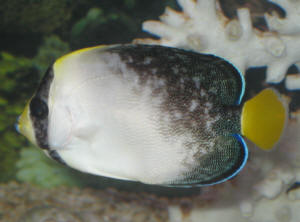
|
| White blotches on mid size Blue Face Angel 3/23/06 Love
the site, and looked over it many times before submitting this
inquiry. <Good> I have a 210 gallon with the double sump wet
dry, protein skimmer, grounding probe, and UV going. The water
quality is as such as I just measured it today: salinity is 1.019,
<Too low...> ammonia is 0.0, nitrate is 10, nitrite is 0, and
ph is 8.2 according to the 'Aquarium Pharmaceutical' kit I
use. Fish roster includes: Australian Harlequin Tusk, green bird
wrasse, 2 lookdowns (small), crosshatch trigger, blue face angel,
zebra moray, squirrelfish, and powder blue tang. <Yikes... you
need a much larger system...> They all eat a daily mixed diet of
Mysis, green and red lifeline, krill, angel formula, lancefish,
mussel, romaine, <I'd skip the terrestrial greens... almost
no food value, and trouble with pollution> cockle, and formula
one. all soaked in Selcon daily except for the romaine. Attached
are 2 pics of our 3.5-4 in Blue Face Angel which we've had for
3.5 months. As I read over your site, it looks like this could be
HLLE (of just the head for right now) or a metamorphosis to
becoming an adult. The LFS says it's most likely the latter b/c
the fish is eating like a pig. It seems to be getting worse too and
his skin on his face looks to be deteriorating. <Does look like
HLLE... water quality issue here mainly... Though what you can/do
read/seem okay...> Prior to this he was having those random
white patches that would come and go on his body (literally within
hours - it was a different picture. <Agreed... likely behavioral
reaction... more neuronal, less hormonal... now switched> think
it was that spook factor mentioned in your other write ups). What
do you think this really is? <Is an erosive condition. I would
raise your spg, do what you can with modifying the wet-dries
(switching to refugium/s... or adding, tying a live sump in
somewhere... Consider "live mud", macroalgal culture...
and purposely add the Selcon to whatever foods this fish is
taking> Thanks in advance for your time. Sincerely, Jason
Chamberlain <Thank you for writing so thoroughly, clearly, with
clear graphics, sharing. Bob Fenner> |
|
|
Possible fungal infection - 03/12/2006 Hi Crew! I have a
Potters Angel in quarantine. I have had him for almost a month. He is
in a 55 gallon quarantine that I started with water from the main
display and a power filter that I had on the display for 2 months prior
to setting up my quarantine. <Good set-up... this is a
"touchy" species for aquarium use (by coincidence I'm out
in their home waters in HI> I do 30 - 40% water changes every other
day. I feed a variety of good frozen foods and alternate Vita-Chem and
Selcon. He gets Algae strips daily. He was the picture of health at
purchase, he ate and was very alert and curious . The guy at the LFS
only used one net to catch him [I even went and grabbed another for
him, but he didn't think it necessary] <Foolish... two nets
please!> When he finally caught the fish, I thought it looked as if
his mouth was pinned to the glass with the net. He seemed fine when I
got him home, so I didn't dwell on the rough treatment of my Pretty
Angel... But then last week I noticed his fins fraying . Around that
time he lost his spunk, he was not swimming all over the tank picking
at the decor anymore. He was also not eating as well as before. He
seemed to swim more on the bottom. I started doing daily water changes
but that did not seem to help. I started treating him with Furan-2. I
was getting ready to do my morning water change after the second dose
when I noticed the Angels mouth, It looked horrible!! It almost looked
as if it had exploded! I got the flashlight out and stared at him for
an hour it seems. He has something white in his mouth. The white stuff
is also hanging out of his mouth, and parts of his mouth look torn. I
have tried to get a picture, but they all turn out too dark. <...
might well be subsequent to the net thrashing. Arggghhhh!> I want to
save my Angel. I am not sure what course of action to take next but I
feel I need to act quickly. I know fungal infections are rare but the
more I read, the more I think that's what I'm dealing with. I
purchased some Maroxy [sp?] <This is it> today and I also have
some Kanacyn, both say they treat fungal infections. I cannot decide
which to use. I need your expert opinion please! Thank you all so much
for taking the time to help!! P.S. It is 4am, I am dead tired so I hope
this letter is legible Thanks again, Kim <Either of these materials
could/can be used... if the last, the antibiotic, it's best to try
getting some into the fish via offered foods... Bob Fenner>
Sick French Angel, coral beauty dead ... flukes? - 03/12/2006
At the beginning, I had an adult coral beauty; snow flake eel, 6";
French Angel, 4"; Flame Hawk, 2". The disease appears to
start on the sides of the fish, then one eye becomes opaque and
swollen, weight loss despite good eating habits, fins become frayed and
finally, in the case of the coral beauty, death. Now a month later and
my French Angel is under the same attack. The ill fish swims constantly
against the current (my guess is that whatever it is, it is also
attacking the gills. Any ideas what this is? Suggested treatments?
Non-angel population seems fine. | <This last is an important
clue...> Thanks, Bob <... frightening... Could be a few things,
but you'll need to make a microscopic examination to be sure. I
suspect Trematodes here... A gill and body scraping of mucus... with or
w/o staining. You can read re their treatment on WWM. Bob
Fenner>
Emperor angel problem 2/23/06 Dear Bob and colleagues Please
help I have a 100 gallon home display tank and a 200 gallon sump).
There has been a sudden chain of events causing an issue with my tanks
members, especially the 3 year old emperor angel. My water parameters
are as follows;pH8.2 , ammonia 0, nitrite 0, nitrate 20ppm ,sg 1026 and
temperature 24.7 centigrade. These were taken this morning before tank
lights were switched on. Other hardware includes Deltec AP850 skimmer,
phosphate (ROWAphos) fluidized filter and wet/dry filter (maybe why I
cant get lower nitrates!) <Likely, yes> Following an Ich outbreak
on my C. Lunula, I treated the system with Myaxin solution for 5 days,
but still lost him unfortunately. It has resulted in the emperor
showing very distressed symptoms (rapid gill movements, loss of
appetite and hiding away but no obvious bodily Ich signs). During this
period I lost an Anthias with no obvious causes but the remaining tank
members seem fine (comprising 2 Hawkfish, purple tang, blue tang, green
Chromis and 3 convict blennies). The soft corals showed minor
irritation but seem fine now. When I switched the UV sterilizer(30Watt)
back on, did this result in any toxic shock chemicals? <Not
likely> I have now tried a 30% water change and the addition of
carbon filtration to try and improve matters but I am still most
concerned about my emperor. Are there any further suggestions you might
offer? Best regards Dave K from the UK <Not from the information
provided. Have you read on WWM re this species? Please do so: http://www.wetwebmedia.com/marine/fishes/angels/pomacanthus/imperator.htm
And the linked files above. Hopefully something will "pop up"
here re your situation. Bob Fenner> "The soft corals showed
minor irritation but seem fine now. Are there any further suggestions
you might offer? Best regards Dave K from the UK" <Actually...
on a moments reflection, the problem is likely the negative reaction
you list re the soft corals... These are very likely poisoning your
system, consequent from the Myxacin... I would add a good deal of
activated carbon to your filter flow path, and execute a series of
10-20% water changes every few days to dilute their effects.
BobF>
Emperor Angel mouth problem 1/25/06 Dear Crew, <Dana> I
have a 5 1/2" Emperor Angel whom I have had for just under 2
years. He has always been healthy, eats everything, and has almost
completely changed over to his adult form. He is perfect in every way
but one. Over the last six months, I noticed that his mouth looked
different than it should (I had one many years ago, plus see them in
LFS and photos). I have had no luck taking photos that clearly show
what I am talking about, so I shall attempt to describe his mouth.
Quite simply, it looks as if someone grabbed it with a pair of pliers
and pulled it forward. There does not appear to be any growths on it,
more like it has cracks in it. His mouth does protrude out, the bottom
more so than the top. I can see what appear to be blood vessels under
the skin in this area, and he is no longer able to close his mouth
completely. It does not appear to bother him, as he is still eating
quite well. But I am concerned that what originally looked like a
"not so perfect specimen" now looks like something is
obviously wrong. I did search your FAQs, and did find a couple of posts
about tumors of the mouth, but neither of the posts offered a
description for comparison. If this is a tumor, do you have any advice
for a remedy? <Maybe a tumor, perhaps a genetic anomaly... could be
resultant from a "bump" long ago... No remedy though...>
Are my other fish in any danger? <Highly unlikely, no> I am not
certain if this is related, but I have twice seen him breathing rapidly
out of a single gill only (found several posts on this as well, but no
clear answers), <Probably not a problem or related. Just something
they do at times> but minutes later was breathing normally. Oh yes -
water quality is excellent, with near zero nitrates and phosphates, pH
is 8.2, temp 77. The tank is a 240 with 200 lbs. of live rock, though
this was only added a few months ago. All other fish in the tank have
perfect health. His diet includes virtually every frozen marine fish
food on the market (I believe in variety!) fed twice a day, with dried
seaweed fed twice a week. Your help and advice is greatly appreciated.
Dana <I would soak the foods, algae in a vitamin/HUFA supplement
(like Selcon, Microvit...), but otherwise do nothing else here. If this
is a developmental disorder, or tumor as you speculate, hopefully it
will spontaneously remit. Bob Fenner>
Apolemichthys trimaculatus (three spot angel) odd behavior and
possible fin rot 12/04/05 Hello, <Hi Katja.> I have a problem
with a three spot angel. <I'm sorry to hear that.> I've
had it for about two years. Over the last week it started swimming
oddly, on the side, making loops. <Yes this is troublesome behavior.
Is it limited to this specimen (how is the behavior of the tank mates)?
Any sudden changes in environment, how is the diet?> Before he was
swimming around the whole day, while now it makes a short round and
retreats to the cave, where it is dark. He hovers a little above the
sand turned on his side. He breaths quite quickly <Possibly a sign
of trauma or even gill flukes? Have there been nay new additions to the
tank and could they be subjecting the angel to aggression or perhaps an
illness even?> and the other thing I noticed is that it seems as if
its tail is getting smaller (as being eaten away) and slightly coloured
red. The other day I noticed something like a very tiny white thread
(about 1 cm long) hanging from his tail. It later disappeared. The fish
still eats. I suspect fin rot, but I would like your opinion on this,
before I start medicating it. <Was the deterioration rapid, as in
overnight or did it happen slowly? Hard to say without seeing, even so
go ahead and search WWM re: marine angel disease and fin rot.> The
water parameters are fine, with the exception of some nitrates. Other
fish are also ok. <How much nitrates? Please be specific this is
important.> Thanks in advance for your help! Katja <Adam
J.>
Sick Koran Angel 10/11/05 Wet Web Crew: We have a 55 gallon
tank with a Koran Angel and a Puffer fish in it. The Koran is about
3-4" long and the puffer is about 3-4" long. They get along
very well. The tank has some live rock in it and also some decorative
rock. About two days ago we noticed that both fish had white spots all
over their fins and bodies. We thought it was Ich and treated them for
it. It did clear up, but when we read about the symptoms of Ich, it did
not sound like that is what they actually had. The Koran Angel now has
cloudy eyes, a swollen pink mouth and white blotches over his body. He
has been stressed over the last few days due to tank changes to treat
the Ich a fresh water dip for only a few seconds, and a lack of
appetite. The tank he was in when we thought he had Ich was dirty due
to overfeeding, something I did not know could be so harmful and the
water had a bit of a high nitrate level, but not too bad. We did a
water change, cleaned all the equipment and put the puffer and angel
back in. Today, one day after being returned to the tank, the angel
developed these symptoms. I had noticed him swimming on his side
sometimes over the last few weeks, but he was eating and acting
healthy. Do you have any idea what this disease could be and what would
cure it? I'm afraid that if we don't know something for sure
soon, the angel won't make it. We would appreciate any help. Thank
you. By the way, we view your site a lot and find it very helpful.
<David and Heather, I cringe when I read queries such as yours. A
picture comes into my mind of very poor diet, poor water parameters,
and poor maintenance which includes weekly 10% water changes and add to
the fact that your 55 is too small for keeping these types of fish as
they do grow quite large. I'm seeing a rise in ammonia due to
excess waste and a biofiltering system too small to recover. All this
leads to severe stress of the animals in question making them highly
susceptible to disease. I can suggest that both fish should be
separated for the time being either in separate Quarantine tanks or
using a tank divider if QT's are not available. Then you need to
get a product such as SeaCure Copper Treatment along with a FasTest
Copper test kit and maintain a dose of 0.015-0.020 for a minimum of 21
days. The test kit is necessary especially if you are going to treat in
the main tank. Hopefully you can save the fish. You didn't mention
what you initially treated the fish with and for how long. In the
future do more research on the fish you are buying so you know its
requirements/needs. James (Salty Dog)>
Re: Sick Koran Angel 10/12/05 Actually, our biofiltering
system is larger than what we need for the tank and when these fish
outgrow the tank they are in we are transferring them to an 80 gallon
tank. <Good news. The Koran alone would require a 70 gallon tank
when it is full grown and this is borderline, preferably a six foot
long tank.> I appreciate your advice and assure that we take good
care of our tanks. <Great> We have three of them. something just
went wrong in this one. We did a 25-30% water change before putting the
fish back in the tank and the nitrate level was never high. We checked
it very regularly. At this time, they are both small and the tank seems
big enough for the two of them. <Agreed, now it is but won't be
for long.> Can you tell me if this is true? Do they need a bigger
tank now, even though the puffer and angel are not full grown? <A
rule of thumb I use is one cubic (not length) inch of fish per five
gallons.> It sounds like you are not positive we can save the fish -
which would break my heart. <I'm always on the positive side.
Problem is if treatment is delayed the fish only gets worse and then to
the point where the copper treatment even adds further stress.> The
puffer is lethargic this morning and I don't know if he was
sleeping or whether he is not developing symptoms as well - can the
disease be spread? <Most definitely. Do you employ a quarantine tank
to put new arrivals in? Read here. http://www.wetwebmedia.com/QuarMarFishes.htm>
I really am sorry about all this. Our other two tanks are fine.
<Great> One is a reef tank and we have lost nothing from that
tank in months. We did introduce a Petco baby tank <baby tank or
tang?> into the tank with the puffer and angel - it died in two
days. Could this possibly have been the start of these diseases.
<Yes, tanks/tangs are Ich magnets and should definitely be
quarantined.> If I treat the angel with copper, does it have a
better chance of living? I have read that angel fish are extremely
sensitive to copper treatments. <Correct, that is why it is a must
to use a copper test kit to insure copper is at a safe and effective
level.> I'm sorry that the tank was not better cared for,
<You don't have to be sorry to me, but it sure sounds like you
are a caring person that will do whatever it takes to keep your stock
healthy. Please read more on the WWM. FAQ's allow you to learn from
other peoples mistakes. Again, research a fish you are interested in,
especially care level, compatibility and size of tank required.
www.liveaquaria.com has a
chart for every fish indicating the above.> but I assure you that we
did test the water and because of the filtering system on the tank,
everything always seemed fine. However, our test kit cannot test for
calcium and some of the more advanced water test items.
<Wouldn't be too concerned with calcium in a fish only tank,
although too low a level can cause the ph to drop somewhat. Do test for
dKH, 8-12dkh is recommended.> I honestly thought I was doing the
right thing and would hate to lose these fish over my lack of
knowledge. <All the knowledge you need can be had for free on the
WWM.> Any additional advice you can provide would be greatly
appreciated. Thank you very much. I know I asked a lot of questions in
this e-mail and hope you will be kind enough to answer them. <We are
here to help. Most if not all of the questions you ask can easily be
found on the Wet Web by just typing in the keyword.> The angel does
seem a bit better today and I got both fish to eat some Krill last
night. Their diet is now more varied than it was, and I hope it is not
too late. Losing these fish would break my heart because it would be my
own fault for lack of knowledge. <Again, Heather, definitely read
about what you are getting. Korans are not that difficult to care for.
They do require clean water, low nitrates, 10% weekly water changes and
a good and varied diet. Read again here. http://www.wetwebmedia.com/marine/fishes/angels/
- Good luck, James (Salty Dog)>
Tang with Ick Question 10/11/05 Hello Crew: <Hi Stan,
James here today> I currently have a purple tang and a desjardini
tang in my QT (20gal) <<RMF would NOT mix two tang species in
QT>> which I plan on adding to my 150 gal reef system once they
pass QT. They've been there for about a week and are both eating
like little pigs and seem to be doing fine. I've been feeding them
a variety of foods which includes Spectrum Thera-A Anti-Parasitic
Formula, Julian Sprung's Seaveggies, Ocean Nutrition Marine Pellets
Formula 2, Kent Marine Platinum Reef Herbivore Fish Food which are
sometimes soaked in Vita Chem. However, in the last couple of days,
I've noticed some white spots on my purple tangs body and fins.
Can't really see if the desjardini has these same spots or not
because the spots are not as contrasting as on the purple tang. I
assume it's ick, or the beginning of it. So I looked here and read
some articles that hyposalinity and/or a cleaner shrimp might do the
trick without medications. So I added a shrimp a few days ago and then
this weekend started researching how to do the hyposalinity treatment.
<<Not with the shrimp present. RMF>> Instead of finding out
how, I found more articles claiming that hyposalinity was a waste of
time and wouldn't work long term. So I guess my question is, how
would one go about treating ick long term in QT? Isn't that what a
QT tank is for? <<Not really what "quarantine is
for"... a period to review, observe health, behavior, possibly
treat there/then... but also for "rest". RMF>> I know
everyone has different opinions, but what do most people do? Medicate?
If so with what? Any help would be very much appreciated. <Stan, if
it were me, rather then stress the fish out with hyposalinity
treatment, I would treat with copper. A copper test kit is a must along
with daily testing to insure an effective and safe level is kept.
Recommended dose to maintain is 0.015-0.020ppm. <<Dude! Of what?
Free copper/cupric ion... PLEASE understand that there is a difference
in reading/s with chelated copper and their corresponding kits.
RMF>> I would treat for a minimum of 21 days @ 80 degree
temperature. The ick cyst casings are unaffected by the copper so we
have to wait till all hatch out where at this stage they can be
effectively killed by the copper. The Ich that is embedded in the skin
of the fish also is pretty much unaffected by the copper. Only in the
swimming stage, after hatching and when they have to find a host, is
when they are most vulnerable to copper. James (Salty Dog)>
Tang with Ick Question ? - Follow-up 10/11/05 Thanks James
(Salty Dog): OK. So a treatment with copper it is. Any recommendations
as to what copper brand / type to use? Isn't there chelated or non
chelated ? <Yes, there are chelated/non chelated types. If it were
me I'd go with Aquarium Systems Sea Cure Copper treatment along
with their FasTest Copper Test Kit. Fortunately for me I've never
had to treat a tank in 10+ years, but if the problem arose, the above
would be my choice.><<... three weeks... with an unchelated
copper... on tangs? I would NOT do this... I'd go with two weeks,
and a chelated make/model with accompanying at least daily tests.
RMF>> And I assume that I need to move the cleaner shrimp to my
main tank since he won't make it thru the copper treatments right ?
<Stan, all inverts must be removed. Google our WWM site on copper
treatment for more info. James (Salty Dog)>
Chrysurus Angel Help 10/4/05 Hi, <Howdy> Oliver Lucanus
suggested I drop you an email (Gwen Grignon, one of my staff, also
thinks the world of you). <Mmm, and don't know if Gwen Loiselle
is still in your employ (one of the retail outlets), and likely we know
of each other through my wife, Diana... who distributed Knop Products
in N. Am... oh, she is saying that she dealt with Dionne (sp?)> We
have, in our shop and all ready for a customer, a large Chrysurus
angel. We've had him for almost a month, though he has yet to eat.
He spits out everything we try to feed, including (in no particular
order): - frozen and freeze-dried krill - brine shrimp - Mysis shrimp -
fresh clams - fresh mussels - live sponge from Florida - Nori soaked in
garlic, Entice, Selcon - freshwater japonica shrimp - button polyps
<I see> We are getting desperate. He is in a 100 gallon holding
tank. He started off alone, but we've since added in a yellow tang
in hopes that the tang will 'show him how to eat'. <Good
idea, technique... I use genus Abudefduf damsels...> Shortly after
arrival here (via Quality Marine), he got sick with a parasite looking
more like Oodinium than ick, which we treated with Formalin bathes in
his aquarium (he was not moved, we just brought him back on system
afterwards) with quick, positive results. There is no other medication
in the system, and all other fish in the system are healthy. We are
willing to try anything to get this poor creature to eat. Do you have
any ideas? <A few... you don't mention vitamin
supplementation... this addition can really stir feeding at times... on
the food, directly to the water... Zoe, Selcon, Microvit... And freshly
opened shellfish... like the mussels you mention above... with the
shell still on... And, as odd as this may seem, jellyfish (live or
preserved), which this angel species consumes quite a bit of in the
wild. Cheers, Bob Fenner> Best regards, Brent Mills Big Al's -
Montreal, Canada
Emperor angelfish with Ich 9/28/05I have a fish only tank with live rock,
tank size is 125 gallons with over 125 pounds of live rock. I just
purchased an emperor angel that is in the stages of changing, I made
sure to take extra care in picking this fish out, no signs of problems
with it when I bought it from the fish store, brought it home and
acclimated it to my tank. The next morning I notice it had Ich on its
body and none of the other fish have anything wrong with them even my
yellow eyed tang with can get Ich very easy. I am planning on doing my
weekly 10% water change tomorrow and I am wondering should I do a
Formalin dip on the fish in a one gallon bucket with the water I take
out or should I just wait the disease out since it is only on one fish
and may be due to stress of the fish. Please let me know and I enjoy
the web site very much haven't had to ask for any help yet as
everything is on the site, thank you much. <Please check grammar,
caps etc, then resend. As most of these queries are posted, we just
don't have the time to edit queries before posting. <James
(Salty Dog)><<James... too late... this fish was not
quarantined, the whole system "has" Ich/crypt now... refer
folks to appropriate parts of the site... RMF>>
Angel Fish Deaths 9/21/05 Over the past year, we have had
multiple angel fish deaths. They have all occurred suddenly without any
apparent injury to the other fish in the tank. The saltwater tank has
been set up for two years, and we do regular water changes, and have no
abnormalities in the water. Currently, we have a damsel fish, two clown
fish, and a yellow tang, in addition to shrimp, crabs, and snails with
live rock. Each new addition to the 70 gallon tank (all have been angel
fish. a blue angel, six bar angel, coral beauty, and Flagfin angel)
have lived for a couple months, and then died suddenly. Prior to their
death, they appear well integrated into the tank, have no outward
abnormalities, no signs of trauma, and are eating well. We can't
seem to figure out what the cause of death could be. Please provide any
suggestions to help. Could there be any other hard metal abnormalities
even though that we use a RO/DI filter? Copper, lead, and iron testing
have all been negative. Thanks for the help, Dale <First impression
is you are not meeting their requirements/diet, etc. Read some of the
articles here, Dale. http://www.wetwebmedia.com/marine/fishes/angels/ James (Salty
Dog)> <<Also, most of the angels mentioned are not hardy for
aquarium use... RMF>>
Acclimation, Angel 9/12/05 Hi
<Hello> I am new to WWM but have been passively reading many many
of your articles to become better educated in the marine area. <Good
idea> I recently purchased a juvenile emperor angel and placed him
in a quarantine tank for observation before placing him in with my main
tank. I gave him a 2 minute fresh water (straight RO water at 78 F)
bath and then placed him in the quarantine tank. This is a 10 gal. tank
with a 45 degree 4" PVC elbow in it for refuge. It is again RO
water at 78 F medicated with copper,<copper should only be used when
necessary. It's adding undue stress to the fish.> and aerated
with a small stone and filtered through carbon. The first night and
next morning he (she?) looked fabulous. The fish ate a small amount of
Formula 2 and one Mysis shrimp that I offered. The fish swam around
curiously and seemed just fine. The next morning I found him at the
bottom not swimming around anymore. I decided to check the salt content
(don't get too mad here) and discovered I had messed up mixing when
I set of the tank (doh!). It was at 1.032 SG! I slowly (over 4 hours)
diluted it back down to 1.023 without replacing the copper.<Four
hours is too short a time to drop the SG that much.> He must have
found the second serving of Formula 2 as it was gone from the tank
floor by the end of the day. It has been 2 days since and the fish is
still on the bottom but now his nose is downward and he seems to be
breathing more rapidly. I am concerned I somehow injured him and fear I
will lose him. Any thoughts? <Filter the QT with a good grade carbon
or Chemi-Pure to remove the copper. I'd do at least a 30% water
change with water of the SAME salinity and 24 hours later see if there
is any improvement. If he is eating, you may want to add vitamins to
his food, something such as Selcon. James (Salty Dog)> Thanks in
advance for any help you can offer. Contrite fish-keeper, Mark
Re: New Emperor Angel acclimating trouble - need help 9/13/05
Thank you so much for the super-quick reply! <You're welcome>
I followed your instructions and so far he is still alive a day later.
He is still on his side most of the time but will move around from time
to time and his color still looks great. I guess all I need to do now
is wait to see if he recovers. Just a follow up question to my terrible
start. Do you think either the copper dosing and/or the total screw up
of the salt could have damaged this fish in a way that would not kill
him but leave him this way long term? <The angel more than likely
went into shock from too many changes at once. Do not use lighting on
his tank. It will make him feel a little more relaxed.> I know I
will find out eventually but I feel so bad to see him this way knowing
that I took a healthy fish and caused this situation. <It's a
good idea to research a fish before you buy and know it's
requirements. James (Salty Dog)> Mark
Emperor Angel and FW dips
for crypt 9/8/05 Dear Bob, Thanks so much for all of your wonderful
advice over the past couple of months. I have a 180g FO tank that had
crypt introduced into it after I added an emperor angel, yes I used a
QT 4 weeks but unfortunately still had the problem. I have had a
problem ping ponging with crypt since. I have had no fish die. <A
testament to your active, good care...> I have 3 Ich magnet tangs in
a 55g QT ( large Naso, powder blue, purple tang ) they are doing
surprisingly well though they are being treated with copper. Cupramine
used to the letter of instructions. Powder blue initially got HLLE
which is now much better since feeding with Gracilaria for a week.
These guys will eventually be cured. <I admire your resolve> As
for the other guys in the display ( Emperor 6", Majestic 5" ,
Foxface 5" 2 clown fish aggression amongst angels has not been a
problem) they are all eating and doing fine. I initially treated the
display with hyposalinity to a SG of 1.009 for 6 weeks which
predictably failed to achieve a cure. Aggressive water changes, good
diet etc have kept the fish alive but tank is infested. I now see the
Emperor is getting some white discoloration at the distal end of his
right pectoral fin. Probably crypt, <... or the result of
hyposalinity, treatment, stress...> but I have seen this type of
thing go away never to return on other fish many times. I am in the
process of preparing a QT's of 55 gallons as well as 29 gallons.
Yes That makes 3 QT's in all. Two 55gallon and one 29 gallon. QT 55
g 1 Cupramine Treated 1 Naso, 1 powder blue, 1 purple tolerating well
Aggression amongst the tangs has not been a problem <Crowding has
its benefits at times> Planned QT 2 55 G Plan to add Majestic,
Foxface, damsel 3 clowns ( these guys appear disease free ) Plan on
using copper added SLOWLY, testing twice daily Planned QT 3 29 g plan
on treating emperor alone I have well cycled large BioWheel filters
that I am planning to use on the new QT's ( used in curing live
rock ) I have read at wet web media that FW dips and daily water
changes for and FW dips for 8 days can effect a cure for crypt.
<Some, sometimes> Is it likely that treating the emperor in the
29 G in this fashion will achieve a cure ? <Not the route I would
take> The 180 gallon will lie fallow for 6-8 weeks. I will introduce
and aquascape 150 lbs of beautifully cured LR as well as cleaner shrimp
to make a new home for the fish that survive. <Good> I will most
likely reintroduce 3-5 large fish and 3-4 small fish ( hopefully the
angels, the Naso, clowns ) Do you think that this is a reasonable plan
of action ? Thanks Jimmy <I would "risk" the use of copper
(likely chelated... maybe the Cupramine product) on the Angel/s... Bob
Fenner>
Re: Emperor Angel and FW dips for crypt 9/9/05 Bob, Thanks
for the feedback. I am going to QT the angels and start Cupramine at a
very low dose and move up to the recommended level. This AM both of
these fish look great in the Display no visible signs of disease ( but
that is why they call it crypt which is Greek for hidden ) but I know
there is still crypt in the tank. <Yes and yes> I will fatten
them up a bit until things are right for the QT. As an aside. What a
difference a two foot wide tank makes on reducing stress !!! <Ahhh!
Perhaps asking folks to consider how hard it is on them to make a turn
in their car in a too-narrow street...> I think that when I put fish
in QT their biggest stress seems to be the decreased tank width ( front
to back ) of the tank until they re-adjust their swimming pattern when
they turn in the water. My experience with my hobby this summer has
taught me that there are times to act and there are times to wait.
<My friend~! You are gaining/unfolding to enlightenment> Taking
action, though important, at the right time can be detrimental when it
is time to sit fast. Aggressive tank maintenance and excellent water
conditions go a long way to allow for the fish's immune system to
work. Constantly assessing if treatment is worse than disease is
imperative. Treating in a timely manner when the disease is worse than
the treatment can save fish. Treatment when the treatment is worse that
the disease kills fish. Excellent fish husbandry oftentimes buys us
some time to make this critical decision. <Ahhhh> Thanks Jimmy
<Thank you... for the "Tao of fish keeping" insights.
BobF>
Copper & Marine Angels 9/7/05 Hello and best wishes to
the WWM crew!! <Thank you.> As always, thank you for the
wonderful bounty of information and for always being there throughout
the years. I have a question about copper and marine angels: I was
"cruising" your website as I have done countless times (and
am nowhere near seeing all of it!) and came across multiple articles
which state that copper is very, very bad for angels! This came as a
surprise because I have used copper on countless angels in the past and
have never had anything but good results. I have to wonder if it is
because I only use chelated copper (specifically CopperSafe)? Have I
just been an extremely lucky guy? <Manuel, copper can be dangerous
for all marine fish if dosed above safe levels. It has always been
recommended to used a copper test kit to ensure a proper/effective
dosage is. I've used copper on angels with no ill effects providing
of course there is no overdose. James (Salty Dog)> Many thanks in
advance, Manuel Alvarez
Re: Copper & Marine Angels 9/8/05 Thank you James, I feel
much better! :) I perform copper tests on an almost daily basis during
treatment and keep my CopperSafe level at 1.5ppm, which is the low-end
of what is recommended for the product, and it has always worked for me
at that level.
<Manuel, that is precisely why you have success with copper
treatments. James (Salty Dog)> Thanks again and take care, Manuel
Holacanthus passer losing color 9/2/05 Hello Crew and thanks for
all your help in advance. <Welcome> I have a 4 1/2 inch angel for
a year now and he has been in excellent condition until the last month.
He is now losing color around his mouth, eyes and some small spots up
on his head. The best way to describe it is the yellow color around his
mouth is becoming translucent and the spots up on his head are yellow
where his color was previously dark. <I used to collect this
species... know what you're referring to> The areas of change
don't appear to be raised or any different than the normal areas of
his body and none of his tankmates are effected. Also, all the fish are
eating well and acting fine - including the angel. I feed veggie
flakes, Spirulina, Mysis, and marine cuisine and use Selcon as a
supplement. The local fish store believes it is dietary and I have
started butterfly formula and a fresh mussel 1 time per week. <Good
idea> I don't see how a dietary deficiency would take 11 months
to manifest and now progress in a fairly rapid manner. <Does
happen... "something/s" run out> Any suggestions or
requests for more information (just to add some information: water
parameters are salinity 1.024, PH 7.3, ammonia 0, nitrites 0, nitrates
under 10)? Regards, Greg <Mmm, my "second category" guess
here would be "water quality" as cause... Having
"mud" in your filter, a refugium, a DSB, live macro-algae...
would all help. Do you have another system to move this specimen to
that has any of these? Could you add a live sump with them? I would.
Bob Fenner>
Coral beauty's mouth is swollen open 7/10/05
I've had this Coral Beauty for about 8 months. It's normally
real active as it is a big tank with few tankmates. Today I went to
feeding and he didn't come out. And immediately that sick feeling
came over me. Another dead fish you know. Anyway, 2 minutes later he
pops out like he's interested in food, but his mouth is a little
swollen and it looks like it is stuck in the open position! Might you
have any clue? <Maybe a "bump" in the night... not much
one can do but hope. Bob Fenner>
- Angel Not Eating after Quarantine - hi there, <Hi.>
First of all thanks to Bob Fenner who answered my first email, when I
asked for help about disease on my fish. After a year and a half of
normal aquarium behavior (and not adding new fishes to my 180 gallon
tank) my French angel and emperor got some weird spots on their fins,
(they weren't really spots it looked like the fins were dirty) I
observed them for a week or longer and they disappeared one day and
then came back the other, they didn't show any other symptoms or
stress and either were my two percula clownfish showing those signs. I
gave the French angel away cause he got too big and didn't come
along with the emperor that well. I waited some more days and saw that
the emperor was getting weak and was now showing white spots on his
fins only, now it was pretty obvious to me that this might be an Ich
outbreak and I decided to take them all out and put them in my
quarantine tank for treatment and let the main system go follow up for
a month or longer. As i have ordered some new fish before the disease
broke out, the new fish arrived and I put them in the quarantine as
well and treated them all together with CLOUT. It was effective after
only a few hours, the emperor looked better and the other fish seemed
fine too (the new fish added to the quarantine tank were a false
falcula butterfly, a raccoon butterfly and a yellow tang) I treated the
fish for some more days and even though the white spots seemed gone
they all kept scratching and flashing, which didn't seem like a
good thing to me at all. I used the CLOUT medication exactly as it was
on the box and after a week treating them i did a 25% water change as I
couldn't use the skimmer in the 30 gallon quarantine and it seemed
like a lot of bio-load for such a small aquarium to me (besides all the
medication added). After a day or two the raccoon and the falcula (and
only them) were covered with white spots and I was a little
disappointed cause I thought that the medicine should take care of that
problem and not allow another outbreak. (ps.: water quality was
excellent and I gave them a variety of green foods, algae, brine
shrimps and krill - a little bit of each) so I decided to a 50% water
change and finally tried to use copper (CopperSafe) as everyone said
its so effective. I put the right amount in the water and waited to the
next day. But the copper didn't do a thing, it only made it worse,
the emperor was pale, covered with white spots couldn't breathe on
one side and the two butterflies were pretty bad too, the raccoon
became some small rashes on its skin. <Angels have difficulties with
copper, and you can't expect results in a day... usually takes two
weeks to completely break the lifecycle of Cryptocaryon. Please read
here: http://www.wetwebmedia.com/ichartmar.htm > I
called the dealer and he told me that copper usually takes a few days
to work well, but i couldn't wait another few days cause my fishes
were getting worse, and another day they would have died, so i
performed a freshwater dip on them three and had to add CLOUT again.
<You really shouldn't mix medications. I'm not sure what the
active ingredients of CLOUT are, but it's bad practice to mix both
the copper and CLOUT. You should run activated carbon between
medications to make sure the previous one is removed from the water
before adding the new one.> I know mixing medications isn't the
best idea but they were literally dying from the Ich already so that
was the last thing i could do.. <Could be the active ingredient in
CLOUT is copper.> next day miraculously they improved a 90%, spots
were almost gone, no more scratching, got their color back and breathed
normally. I kept using CLOUT till a few days ago until all symptoms
finally disappeared (with copper present), then had a 25% water change
and put the right amount of copper in the replaced water (without the
CLOUT of course, as it wasn't necessary anymore) all fish have been
fine, totally recovered from Ich, BUT the emperor lost his appetite and
didn't eat for the last 4 or 5 days. I don't know what I could
do to improve his appetite (yesterday i changed 15-20% of the water and
lowered salinity from 1.021 to 1.019, I heard that this improves the
appetite and also prevents a new parasite outbreak) what could i do to
make my emperor angel eat again??? <Try some tempting foods -
perhaps some open shell fish or similar stinky, meaty item to get the
fish interested in food.> thank you in advance for your answers and
sorry for the novel... :) best regards, Sandra <Cheers, J --
>
Medications I'm sorry to bother you with this question,
I've searched the site for awhile and couldn't find a answer. I
had a dwarf flame angel, a small Koran angel and a small Hawkfish in a
30 gallon quarantine tank. Is it possible for the 2 angels in a
quarantine tank to get a disease, and not the hawk? The two angels eyes
became very cloudy. I was treating the tank with Maracyn 2, MarOxy and
copper safe. Both angel's eye's seemed to just waste away
leaving what seemed to be two blind angels. After removing the two, the
Hawkfish seems fine. It has been 4 days since taking out the angels.
I've read some things about angel disease. Is this what happened??
<Angels can be a little sensitive to copper. Did you monitor your
copper level with a test kit? The recommended level would be 0.15ppm.
Another problem is too many medications in the tank at one time.
Determine the disease and treat for that disease only. James (Salty
Dog)>
Koran Angel eye problem, needing to read WWM I have searched
your site for days and haven't found a solid answer to my question.
I have Koran angel, when bought he had a cloudy eye. I was told it was
like a black eye and it would get better, which it started to. After 2
weeks it was slowly getting better. Today I checked and both eyes are
cloudy. They are not bulging, just cloudy. The other fish in the tank
are fine, and my water quality is great........What is going on???
Please give me some advice <Trouble... please read on WWM re
Angelfish disease... you will find many references to your situation,
proposed and actual cures. Bob Fenner>
Cloudy crystal ball, Pomacanthus semicirculatus eyes My Koran
Angel's eye's are both cloudy. He/she is in a quarantine tank
and have been adding Maracyn 2, for 3 days now. How long until I can
see some results?? <Perhaps weeks, maybe never. Bob Fenner>
Emperor Angel head, HLLE Hi, My friend has an Emperor angel
with a blue tang, Columbian shark and a GSP. The angel has gotten some
pink thing on his head that my friend and I can't identify. Is it
fungus, HLLE, scratching on rocks? He also thinks that the blue tang
might have the same thing. I don't know much about his tank except
it has a little amount of live rock and it is a 30 gallon eclipse tank.
I will ask him for his water <Is HLLE... please read on WWM re...
improve nutrition, water quality... A thirty gallon system is too small
for these species. Bob Fenner>
Holocanthus passer disease = Shipping/Temperature Stress
Thank you in advance for your assistance. I purchased my king
angelfishes from Costa Rica about a week now, they started sloughing on
the second day. I did quarantine them for 4 days but decided to
transfer them when 'sloughing' began to worsen. Treated with
tetracycline & copper sulphate....when more died I tried
Praziquantel about 1.5ppm for another 3 days; still no improvement; in
fact more died. Now my other angelfishes is affected as well. Please
advise. Tony yen <This sounds very much like "shipping
stress", particularly the mal-affects of chilling. We used to
collect and ship via air or boat this species... and if they were too
long in getting to where they were going or the temperature dropped on
them, they would invariably "break down"... as yours are. I
would not add more medicine chemicals to their water, but would lower
the specific gravity to about 1.018 and add a teaspoon of Epsom per ten
gallons of water... and hope that some self-recover. Bob Fenner>
A " Lumpy" Griffiths Angel Hi <Hello>
I have a question for you, which I think I know the answer to......But
I need to ask. <Okay> In my store, I have many large reef display
tanks. One of these is a 400 Gallon, very well stocked reef. I only
have a few fish in there. a small yellow tang, medium purple, a
combfish, a Fourline red sea wrasse, a multicolour angel, medium Black
Tang, and a 3.5" Griffiths. I love the Griffiths, and I got a few
with my last shipment from Hawaii. <Mmm, you mean
"through" Hawai'i... not found here> I chose one to
keep, isolated him for 2 weeks, then put him in the tank....everything
went well for a few days, but now he appears to be a bit lumpy....like
he has a dozen or so small bumps on each side of him....he eats
readily, and I feed Live Brine, and some Tetra marine pellets 3 times a
day, but in small quantities. In fact, he seems to be first to the
food. Question....what is it?, and if I soak a few pellets for a moment
in the "yellow-green" water....and almost hand feed
him......will these antibiotics kill my reef in such small doses?
<Not likely> I know you won't want to put this on your site
as it might encourage a lot of people to do the same, with disastrous
results. <We post all> My system has a 4 inch DSB, 200kgs of
quality Live rock, and a heavy duty H&S skimmer, as well as a
trickle filter and a little activated carbon. I use natural sea water
which I UV, skim and O3 before lab testing and adding to the systems
Normally I wouldn't worry too much about the fish, as most seem to
heal very quickly in this tank, but I'm sort of attached to this
guy regards JD <I too like this genus of Angels... What yours is
exhibiting is very likely some sort of worm infestation... subdermal...
nematodes, maybe acanthocephalans... Not treatable, not likely
"too" debilitating, not catching. Bob Fenner>
Cortez Angel Trouble 28 Mar 2005 Hello, <Hey Joe, MacL
here with you today.> I recently purchased a Cortez Angelfish about
a week ago. The last couple of days I have noticed that it has white
cloudy spots on its fins but not on the body, and today its eyes seemed
a little cloudy and puffed up but I am not positive that they are
swollen. The fins also appear cut up. <Sounds like he's either
been fighting with someone. . . is there any aggression going on in the
tank or that he might have Lymphocystis. It's hard to tell without
a picture.> I am not sure if it is ick or what it could be. The fish
eats a varied diet and swims around and seems healthy, yet I also have
a coral banded shrimp and the angel will go right up next to the shrimp
and almost touch it until the shrimp pinches it. <Lots of times a
coral banded will act as a cleaner shrimp for some angels.> I am not
sure if the angel is trying to get the shrimp to clean it or not, what
should I do? <Check your water parameters before you do anything
else. Make sure that the Cortez is getting what he needs in his diet.
Take a look at some of the picture of Lymphocystis and of Ich as well
if you think that's what it might be. Do you see any aggression or
fighting going on in the tank?>
Potter's Angel 3/11/05 Still a relative newbie to things
aquatic and need help ASAP w/ a Potter's Angel purchased 4 days ago
from reputable LFS. <hmmm... a difficult angel overall... does
poorly in new/young community tanks... and is dearly in need of a
proper 4 week QT period before putting into displays to train them to
feed strong> My first tank...Have a 46 gallon tank w/ two small
percula clowns and a sixline wrasse all who have done beautifully since
introduction 6 months ago and continue to thrive. <careful with that
wrasse... very territorial> Have about 35 pounds of nicely encrusted
live rock. 2 scarlet hermits and various snails. A modest hang on tank
skimmer running that seems to be doing the job w/ my modest bio load. I
now know that the Potter's was the wrong choice for a relative
beginner such as myself... but I guess I didn't do enough pre
purchase research. <it is very difficult indeed. It is unlikely to
survive one year if even six months for you. Do take note if this is so
(or not) either way. Perhaps a hard lesson.> I seem to have a curse
trying to add fish #4. Royal Gramma died within a week of introduction
about 4 months ago. <lack of QT again and a very poor choice mixing
Atlantic fishes with Pacific. Asking for an Ich outbreak <G>>
Gave it about 6 weeks, added a Firefish and found him half eaten one
morning only days after introduction. <the wrasse likely
harassed/killed it at night. Bad mix> (Also lost an Emerald crab
about 3 weeks ago.) Waited about 6 weeks, since losing the Firefish and
added this Potter's-about 3 inches long. (Water parameters all
check out fine including calcium and alkalinity) <please read,
understand and apply the use of quarantine tanks> First few days
went fine until this morning when I noticed he was not swimming out of
the corner and his bright yellow fin on his side is half ripped off!
<*cough*... *wrasse*... *cough*> He is obviously struggling to
swim and from my limited knowledge, I think his outlook looks grim. Can
it be the little wrasse as the culprit? <does a bear bring a
Reader's Digest into the woods?> I didn't observe any
aggressive behavior but if it was disease, wouldn't I see it on the
other fin or tail as well? What to do?! <QT, QT, QT please> Can
he be saved? <pull the fish into a spacious isolation tank, add
vitamins with B12 (Vita-Chem or the like).. also get some Beta Glucan
from GNC, and perhaps vitamin E for food/water> Do I try to catch
him? Bring him back to LFS? <surely will kill it> Once a fin is
torn as badly as this is, can it heal? <easily... with vitamin E and
with HUFA/lipid rich foods (Selcon)> Am I seriously cursed? <bad
husbandry... you can learn :)> Should I not be adding any more fish
besides these 3 little guys? Help Please. MUCH Thanks... <get thee
to QT :) Anthony>
French Angel Hi Bob how are you? <James for Bob today>
I have a concern involving a 6.5 inch French angel in a hospital tank.
I just revived this angel about two weeks ago from a local fish store
and he's doing fine other than a pinched stomach and some fuzzy
white spots all over. I am currently treating with formalin and
malachite green after searching the FAQ's/forums. But, what I
can't find is how to treat a pinched stomach besides foods and
supplementation. I have tried numerous foods including frozen marine
angel food, marine algae, and all types of shrimp and supplementing
these foods when I feed with Selcon, vitamin C, garlic, etc. and
nothing seems to make this pinched stomach go away. Any suggestions?
Right now water quality and levels are just fine, and I am putting him
in my 150 gal after the Ich is gone so the water quality will be better
there. What should I do? He's beautiful with a nice personality and
I spent a lot for him so I don't want to lose him. <Christine, Is
the angel actually taking food, or are you trying all these foods with
no success? Also read the link I will post here. http://www.wetwebmedia.com/marine/fishes/angels/pomacanthus/paru.htm
. James (Salty Dog)>
Angel/Pinched Stomach Thanks James, but quite frankly with
all due-respect, that article really doesn't answer any of my
questions. I guess I wanted advice directly from the source (the more
experienced aquarists like yourself). And, yes my angel is eating VERY
well, very hearty eater of almost everything I feed him. Can you help
me or no? <Christine, now that I know the angel is eating, the only
other thing that comes to mind is that your fish may very well have
internal parasites. Here is another link you can scroll through.
http://www.google.com/custom?q=Pinched+stomach&sa=Google+Search&sitesearch=wetwebmedia.com.
Hopefully you can find some info here on the problem. I'm thinking
you may want to try a medicated food. I've never experienced a
problem like this so I am at a loss. I will direct your original
question to Mr. Fenner, He may have additional input. James (Salty
Dog)>
Re: Angel/Pinched Stomach - How to Handle? Mon, 7 Mar Bob,
forwarding to you for any more suggestions. Christine replied to this
stating a link I posted didn't help her. She has given me a little
more info but my only thought on this was internal parasite(s). I
stated this to her and sent another (Pinched stomach) link to her this
a.m. James <I would have suggested actual force-feeding at this
point/juncture... with a plastic catheter... two people (one to hold
the fish...)... a mash of meaty foods, Selcon or equivalent. Bob
Fenner>
Re: Angel/Pinched Stomach - How to Handle? II Bob, Said the
angel is eating like a pig. James <Ahh, did not see this. I would
suggest adding Metronidazole/Flagyl to this fish's foods then...
very likely a digestive protozoan at play... and this will "get
it". BobF>
Emperor with Ich Hello Crew! I have a quick
question: I have an emperor angel in QT and he just came down with a
few ICH spots. I know they are copper sensitive, what other med can I
use to get rid of this? <I would try a freshwater dip, that should
help. There really are no medications other than copper that
effectively work. When using copper for angels don't exceed .15ppm
of copper. If the fish shows stress, filter the copper out with
activated carbon. Good luck. James (Salty Dog)>
Cotton like growth on my blue face angelfish hello, I
recently noticed a cotton like growth on my blue face angelfish. the
growth appears to be close to his left pectoral fin. water quality is
good ammonia/nitrite 0ppm. fish was in qt now in main tank - eating
well color looks great. other fish are a Naso tang, yellow tang,
Picasso trigger, Bluethroat trigger, white mouth moray, zebra moray and
tiger eel. <Any one of the other fishes could have taken a bite out
of your Angel...> 180 gal tank- with wet/dry - and ozone. plenty of
water circulation. it would be near impossible to remove the fish for a
dip- can I possibly just leave him alone- will the cotton fall off? I
have been adding Zo? To his food. please help- he is a beautiful fish I
would hate to lose him. <If the fish is still eating, I would NOT
move or net it... but would bolster foodstuffs with vitamin soaking
(Selcon e.g.) and hope for a self-cure. You're going to need a much
larger tank for the livestock you list. Bob Fenner>
Re: Cotton like growth on my blue face angelfish thank you
for your advice- is Kent marine Zo? Enough for vitamin supp? <Yes.
Bob Fenner>
Flagfin angel Hello, I bought a 4-5 inch Flagfin angel last
weekend. <Not a very aquarium-hardy species> Did a 5 minute
freshwater bath and put it into my quarantine tank. I noticed slight
redness near it's pectoral fin but the fish has been active and
eating. Today the redness appears slightly more spread, almost from the
head area along the lateral line of the body. Is this fish in big
trouble or as long as it is eating will it fight off whatever is
bothering it. Looking for some advice to ensure it is healthy before
putting it in my main system. Thanks Joe <I do hope your specimen
rallies, though most who start to slide, continue to do so. I encourage
you to read over the materials archived on www.WetWebMedia.com re
angelfish systems, disease... I would supplement this fish's
nutrition by soaking its foods in Selcon or similar. Bob Fenner>
Need some advice on damaged angel Hi, After waiting almost 3
months for one, I recently purchased a very healthy Red Sea regal
angelfish. After literally seconds of being introduced to the tank it
started to pick at some of the sponges. Within a few minutes it was
even accepting flake foods. This morning I came to find that the angel
had been sucked into the strainer of the Amp Master 3000 (which was on
a closed loop), for a maximum of 4 hours. <Arggghhhh... no
strainer?> <<Actually, there is a strainer -- that's what
the angelfish was stuck to.>> The fish still swims, however, the
fishes breathing is very heavy and there is a small wound near the
stomach of the fish. The lights are off and the fish is hidden between
the rockwork. Is there anything that can be done to save the fish?
Quarantine is difficult for me to do (as far as catching the fish
comes), but It's possible if there's no other way for the fish
to live. Any advice would greatly help. Graham <Subdue the lighting,
lower the specific gravity just a thousandth or two... and hope. Bob
Fenner> <<I just picked up some Melafix. Do you know if this
would be safe to use for a reef tank? It said it's fine for
invertebrates, however, I'm not sure if this is actually indeed
safe. Any opinions? Thank you very much for your reply!>> <I
would NOT put this in my reef tank... a homeopathic leaf extract of
questionable value, unknown properties. Bob F>
Need some advice on damaged angel
Graham,
If the fish continues to eat and behave normally, I probably would
just keep an eye on it. If the wound appears to become infected, I
would remove the fish and treat the infection in quarantine. I have
seen quite a few pretty serious wounds heal quickly, but...I have
also seen them develop serious and fatal infections.
The stress of the incident probably caused the heavy breathing,
and it should return to normal. If it doesn't, it is cause
for concern.
In my limited experience with this fish (I have had mine since
May) and from talking to others, they are by no means delicate.
They are tough fish that suffer from undue shipping stress or
simply fail to adjust to captivity. Since it is eating... feed
plenty of good quality foods and it should do OK if the wound
isn't too serious. I like Ocean Nutrition's Angel
formula for it's sponge content and Pygmy Angel formula for
it's marine algae content (I tend to avoid Formula 2 for
it's terrestrial veggie content).
Good luck, and increase the diffusion that strainer inlet!
Adam
Dying dwarf angelfish Hello, <Hi there>
Yesterday I bought two fish, a long-nosed butterfly and a
dwarf angel called a blue angelfish. <Mmm, the only Blue
Angel I know is not a dwarf... is this from the Atlantic?
Species name?> I have a newly setup 55 gallon saltwater
tank (a second tank the other is a 46 g. bowfront) which
has a snail, hermit crab and a keyhole angel. <A 46
gallon tank is too small for two species of Angels> This
morning I found my new angel on top of the water. When I
disturbed it, it started swimming in circles and loops - no
control at all. I tried putting it in the older tank but it
didn't help. <No quarantine? Not smart... but from
the description, very likely this fish was damaged in
collection and/or handling from the wild to your dealers. I
would contact them, ask re possible credit from them and
their getting credit from their supplier in turn. Bob
Fenner> The tank is newly set up, by that I mean it has
had no livestock in it. I set it up and have let it run for
quite some time. The water tested perfect, 0 nitrites and
barely any nitrates (less than 20). None of the other fish
are affected, just this one. It hasn't died yet but
gets stuck on the filter siphon screens, or
"blown" around by the bubble screen, seems like
the slightest current just carries it anywhere. No damage
shows on the body, the eyes are clear, color seems good,
not breathing overly hard or fast. ??? Agnes
Re: Dying dwarf angelfish Thanks for your quick
response. As usual for me, I was confusing in my message.
In my 46 bowfront I have a Lunare Wrasse, Domino Damsel,
Clarkii, cleaner Wrasse, Firefish, Blue-Green Chromis (male
and female), Tomato Clown, 2 Yellow-Tail Blue Damsels, 2
Scooter Blennies and a Goby. Also, feather dusters,
anemones, snails and hermit crabs and one good size
decorator crab. The Lunare Wrasse is the biggest thing in
the tank; all of the others are 2 inches or less.
<Okay... crowded in a few senses.> I had the Blue
Angel (2 1/2 to 3 inches) in the 55 gallon tank with the
long-nose butterfly (3 to 4 inches), a keyhole angel (2 1/2
to 3 inches) a big hermit crab and 2 snails. The Blue Angel
was at the store for about 3 weeks before I gave in and
bought it. It seemed to be okay, no odd swimming behavior
at all. I am thinking that it suffered shock from the new
environment. <Often the signs, actual collecting damage
don't show for a few weeks...> I had no idea how big
it was going to get until I started asking questions.
<Something doesn't seem to add up here... you said
the fish was "at the store" for three weeks, yet
you "had no idea" how big it would get? You might
have "looked up" this information... on the Net,
books...> I wanted to stay with small fish for my tanks
for the variety I could have without overcrowding. I also
have the young man from PETCO come and help with my tanks
at home. He does this as a second job, in home maintenance.
He is very knowledgeable and caring about all of the
animals. I've talked to him for a couple of months at
the store and am very impressed with the change he has made
to the stores tanks in the short time he has been there.
<A few of us here also had/ran such service
companies> All of this is just to say I am trying very
hard to take care of my pets while I learn to take care of
them. <Mmm, perhaps being part of a local marine
aquarium club will facilitate your learning?> Thank you
so much for your advice. Agnes <Glad to proffer it. Bob
Fenner>
Tumors? Hello there, <Hi! Scott F. here
today> I was wondering if you could help me with my
current situation. I have a 55 gallon fish only tank for
the past 3+ years and have been pretty successful with it.
I have a Rock Beauty angel that has a growth growing from
the base of his pectoral fin. The growth is lumpy and
pinkish about the size of a head of a Q-tip. There is also
a similar much smaller growth on the side of his face. I
have treated the tank with Kanacyn and it appears
unaffected. He now is starting to hide a little more, but
is still eating. Last month, his eye was enlarged and
popping out which I treated with Kanacyn & it
immediately went away. Now a few weeks later this growth
has appeared. I was reading in one of my books that pop eye
followed by an external growth may be a symptom of a
non-infectious disease or a tumor. <That was my
thinking, too> If this is this case, what do you
recommend I treat him with? I went to my local fish store
and they gave me formalin, but I don't know that much
about it other than is kills ALL bacteria. I know that I
may lose the fish, but I'd like to try something else.
<If it is a tumor, then Formalin or other
antibacterial/antiparasitic medications will have no
effect. Really, the best things that you can do for the
fish are to provide excellent environmental parameters and
good food...Of course, further observation never hurts- it
may not be a tumor, but you need to confirm it through
observation.> I do have another tank that I may treat
him in by himself with the Formalin, but if you know
something better please advise. Thank you, Aimee N. <As
above, Aimee- I'd pass on Formalin. Just maintain good
environment and provide quality food and hope for the best.
Good luck! Regards, Scott F>
Copper As A Treatment
For Marine Angelfish? Dear Marine Crew, <Scott F. at
your service!> First. A BIG thank you for your kind
service to all of us in this wonderful marine hobby on this
planet. <We're glad to be here for you. I hope to
help hobbyists in other solar systems, too, but the ones
I've worked with on this planet are pretty cool!> I
read extensively on your articles + Q&A on your site.
Some confusion remains pertaining to the following & I
appreciate some quick clarification as my Emperor &
Majestic Angels are infested with external parasites (main
suspect : marine velvet). They are in hospital tank now
& I wait for your response before I proceed to medicate
the hospital tank. <Good procedure- using a hospital
tank is the way to go!> 1. It was mentioned sparingly in
your site that Angel fish is sensitive to Cu treatment. Is
this true & how so? Does it apply to all angels or just
the dwarf angels? <Many fish with very fine scales can
have difficulties with long-term copper exposure. In my
experience, most angels (particularly the larger varieties)
will do okay with copper, as long as you are very careful
to adhere to manufacturer's recommendations concerning
dosage and duration, and test regularly for concentration.
Observe the fish in treatment for distress or other
complications arising from the exposure to copper, and
discontinue its use if there are problems. Centropyge
angels are categorically more sensitive to copper. I have
used copper to treat Centropyge angels, but I prefer
formalin-based remedies for them.> 2. If Angels are OK
to be treated with CU (if your answer in question 1 states
that's the way), then I have the following brands at my
disposal. Namely: Seachem's Cupramine OR Mardel's
CopperSafe. Which of these two would you use as a personal
opinion? <Well, ya got me on that one! I use and
recommend both of those brands, myself. They are both
produced by quality companies with solid reputations.
Either one will do the trick, IMO> 3. If your answer to
question 1 is NOT in favour of CU treatment to Angels, then
would a Seachem's Paraguard be a good alternative?
<Paraguard is a great product, IMO. However, is composed
partially of malachite green, and is really best used as a
medication against external fungal and bacterial
conditions. I'd stay with one of the copper products,
myself.> Please be informed that I cannot get my hands
on any Formalin or Methylene blue stuff from my LFS here in
my country. Best Regards. <I'd stick with either of
the copper products that you mentioned. Best of luck!
Regards, Scott F.>
Copper As A Treatment For Angelfish? (Pt. 2) Dear
Scott, <Hello again!> I am so grateful for your
response to clear my confusion. <Glad to be of
service!> As per your advice, I have started treatment
using Cu ( but dosing only one third of dosage, hope to
increase over time to observe the angels). <I think that
you'll find copper to be very effective if administered
carefully and monitored regularly.> But major problem
is, my hospital tank is Not Cycled. It is a new tank &
I have only bio-balls & filter wool as my filter, in
additions to a protein skimmer working. I have been
changing water like 25% - 50% for the past two days &
for minimum of two times daily to minimize the Ammonia
surge , with fearful understanding that Angels are
sensitive to Ammonia & NO2 as well. (sigh.... ).
<It's a real balancing act. The difficulty is
maintaining a proper therapeutic dose of copper while
keeping ammonia and nitrite down. This is one case where
the "bacteria in a bottle" products can help. Use
water from the display tank, too. In the future, keep some
biomedia in your display tank's sump to keep them
"colonized" and ready to go at a moment's
notice> My other well matured hospital tank was occupied
by another patient, a Sohal Tang....Hence this hospital
tank is new tank. What can I do to minimize the ammonia
& Nitrite in this new tank? I understand that your site
recommends some filter wools in sump of main display tank
be used in the hospital tank. I found it not effective in
my case here. Any other suggestion? <Well, that is my
preferred method...Usually, it's a sponge filter that
can do the trick. I'd suggest media like PolyFilter,
but this stuff excels at removing copper from the water, so
you'd be sucking it up as fast as you're
administering it! Water changes are the way to go here.
Ammonia and nitrite are quite toxic, and need to be dealt
with; it's almost like you're forced to make a
choice between the lesser of "two evils", as they
say!> It is a scary exercise... Putting the angel at
risk of quality problem of water. Your experience in
situation will help to shed some light on my probing in
dark here... Thanks a lot, again. Warm regards. <Again,
I'd go for the "bacteria in a bottle"
products in the hospital tank to help speed things along.
It will be a tough battle, and no doubt stressful, but if
you stay on top of the water changes and copper levels, you
can successfully treat this disease! Good luck. Regards,
Scott F.>
Quirky Swimmer, Marine Angel Good
Morning Crew! Just a quick question. I've got an
emperor angel that swims on his side...kind of. Maybe 20-30
degrees off vertical, been doing it since I got him three
weeks ago. He seems to be in great health. Adult
coloration, maybe 5 or so inches. Eats like a teenage boy.
He's active and personable. Should I be concerned?
Thanks! Scott Critter Cabana <Mmm, concerned for this
animal's health, not likely, though it may be hard to
sell. Likely it was "damaged in collection"...
perhaps by mis "needling" (puncturing the gas
bladder with a thin diameter syringe to facilitate rapid
"decompression" from depth, or suffered some
other gas bladder damage in too-rapid ascent. Sometimes
(about half) these problems/traumas solve themselves (over
weeks to months time), other times... the fish swim at an
angle going forward. Bob Fenner>
ASFUR ANGEL Hi Chap's <Hi David, MacL here
with you tonight.> I hope you can help me. I have a 3-4
inch Asfur that is doing really well in the tank. Over the
last 3-4 months he has slowly been losing colour. It looks
like the colour pigments in he's skin has gone. At this
point it just looks blotchy, but its all over him. <You
didn't mention your water parameters, and that's
important to know, especially the pH. That can cause a fish
to lose color. You really need to check for that. Also, if
he is a juvenile and turning to his adult coloration that
could possible be the cause of any color change.> He has
a great diet of mixed food, but still the situation is
getting worse. <Which kind of mixed food. Adult angels
need some food with sponge in it.> Please help.
Regards
Dave Cornish.
Angelfishes for Marine Aquariums
Diversity, Selection & Care
New eBook on Amazon: Available
here
New Print Book on Create Space: Available
here
by Robert (Bob) Fenner |
|
|
|