|
Related FAQs: Best FAQs on Centropyge,
Centropyge Angels 1, Centropyge Angels , Centropyge Angels 3,
Centropyge Angels 4,
Dwarf Angel
Identification, Dwarf
Angel Selection, Dwarf Angel Compatibility,
Dwarf Angel
Compatibility 2, Dwarf Angel Systems, Dwarf Angel Feeding, Dwarf Angel Disease, Dwarf Angel Disease 2,
Dwarf Angel Disease
3, Dwarf Angel
Reproduction, Marine Angelfishes In
General, Selection, Behavior,
Compatibility, Systems, Health, Feeding,
Disease.
Related Articles:
C. loricula/Flame Angel, Lemon/y Dwarf Angels, A Couple of
Lemons; the True and False/Herald's (nee Woodheadi)
Centropyges Potter's
Angels, The Marine Angelfish Family,
Pomacanthidae,
/The Conscientious Marine
Aquarist
Perfect Little Angels, Genus Centropyge, pt.
1
To: Part. 2, Part 3,
|
|
|
By Bob Fenner
|
Centropyge bicolor
|
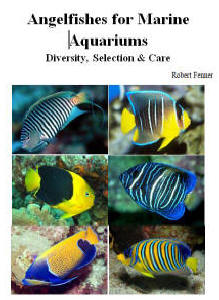
Angelfishes for Marine
Aquariums
Diversity, Selection & Care
New eBook on Amazon:
Available here
New Print Book on Create Space: Available
here
by Robert (Bob) Fenner |
 |
Amongst families of marine fishes, the marine angels are
some of the most beautiful, intelligent and hardy as aquarium
specimens. One principal limiting factor to their husbandry is their
prodigious size; many get to be too big for any but the largest of
aquariums. Fortunately there is the genus Centropyge
("sent-roe-pie-gay"), the dwarf or pygmy angels (some of the
angel genus Genicanthus are considered dwarves as well), some species
of which stay less than 3" overall, with giant members growing to
half a foot. All but a handful of Centropyge adapt well to
captive conditions and thrive in what should be the smallest of captive
systems.
There are but few "guidelines" for selecting
and maintaining these diminutive beauties; sufficient cover, matched
tankmates, adequate food. What is essential and often missing is the
knowledge of how to pick out healthy specimens and properly condition
them before introduction to the main/display tank.
Classification: Taxonomy,
Relation With Other Groups
The genus Centropyge is the largest of the marine
angel family Pomacanthidae, with some 33 and counting species
described. Can you name all nine genera of marine angels?
Apolemichthys, Centropyge, Chaetodontoplus, Genicanthus, Holacanthus,
Paracentropyge, Pomacanthus, Pygoplites, Sumireyakko, of 75 total
species.
Centropyge Species of
Interest/Use to Aquarists:
The majority of Centropyge angels make for
suitable to great aquarium specimens; however there are a few notable
exceptions. In my opinion the Colin's, bicolor, multi-barred,
Herald's, the (true) Lemonpeel, midnight, Potter's, and
venustus are on-average, less hardy by far than other dwarf angel
species. At the opposite end of the spectrum, the coral beauty (except
from the Philippines), flame, Japanese, pearl-scaled, and rusty dwarf
and most of the smaller (dwarf-dwarf) angels (C. acanthops, C. argi,
C. aurantonotus, C. fisheri, flavicauda, C. resplendens) are my
favorites as being most hardy and adaptable to aquarium conditions. The
"rest" of Centropyge species, , either lie somewhere
between the worst and best rating or my personal and recorded
experience is too limited to rank them high or low.
Here is a current listing of described Centropyge
species with brief biological notes.
|
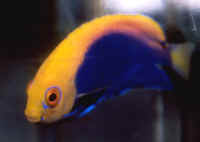
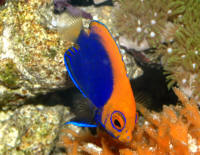
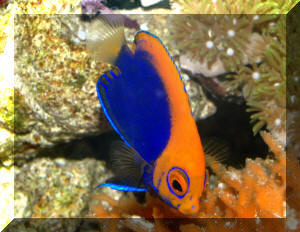
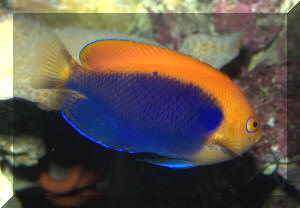
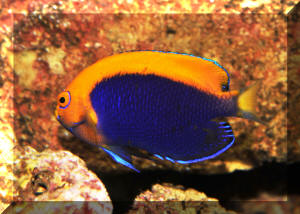
Centropyge acanthops
(Norman 1922), even more orange than the
allopatric Centropyge argi and Centropyge
aurantonotus, the African Pygmy Angel (1) can be easily
discerned as the only one of the three with a light colored,
yellow-transparent caudal fin. Coastal eastern Africa up to the
coast of Oman. Aquarium pix. Below, at right, a C. acanthops X
flavicauda cross at Rob Bray's fab House of Fins in
CT.
|
|
Bigger PIX:
The images in this table are linked to large
(desktop size) copies. Click on "framed" images to go to
the larger size. |
%20MD.JPG)
%20MD.JPG) |
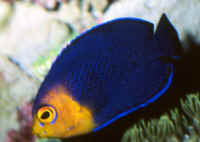
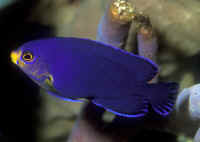
| Centropyge argi Woods &
Kanazawa 1951, the Cherub or Atlantic (Caribbean) Pygmy Angel (1).
To 2.5" overall. Bermuda on down to the coast of Brazil.
Aquarium and a Cozumel, Mexico pix of more adult, more
juvenile individuals. |
|
|
|
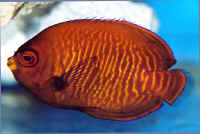
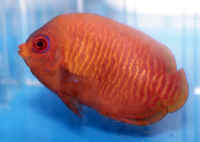
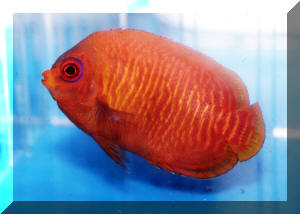
Centropyge aurantius Randall & Wass
1974, the Golden Pygmy Angel (1) is a real striker.
It's a shame that this species hides so well, necessitating
extensive breaking of coral and drug or poison use in its
collection, and hiding for so much of the time in captivity.
Western Pacific Ocean, Indonesia to Caroline Islands. Aquarium
photos of a 6 cm. specimen from Bali by Hiroyuki Tanaka and a 9
cm. one in captivity by RMF.
|
|
Bigger PIX:
The images in this table are linked to large (desktop size) copies.
Click on "framed" images to go to the larger size. |
|
|
|
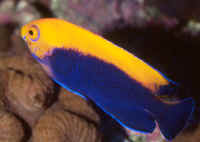
Centropyge aurantonotus Burgess 1974, the (
Brazilian) Flameback Angel (1) is very much like the more
northerly Centropyge argi with more orange color on its
back, at a much higher price. Found in southern part of the
Caribbean Sea. Note the dark blue caudal fin, distinguishing it
from C. acanthops. To 2.5" overall length. Pix
by Hiroyuki Tanaka and RMF.
|
|
Bigger PIX:
The images in this table are linked to large (desktop size) copies.
Click on "framed" images to go to the larger size. |
|
|
|
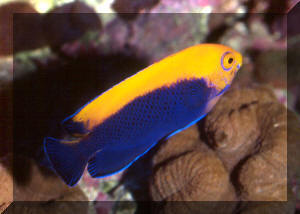
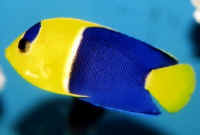
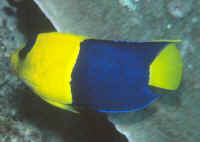
Centropyge
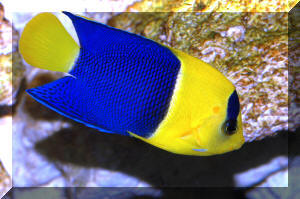
bicolor (Bloch 1787), the Blue-and-Gold, Pacific Rock
Beauty, Bicolor or Oriole Dwarf Angel (3), is highly variable in
it's survivability in captivity. Some shipments are 100% live
on arrival, others can be just the opposite within days. Better
specimens come from other than the Philippines or Indonesia. To
6" if they live. This near full-size adult off Heron Island,
GBR, Australia. Pix by Hiroyuki Tanaka and RMF.
|
|
Bigger PIX: More
Large Pix Links
The images in this table are linked to large (desktop size) copies.
Click on "framed" images to go to the larger size. |
%20MD.JPG) |
|
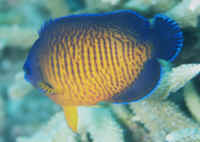
Centropyge bispinosa
(Gunther 1860),
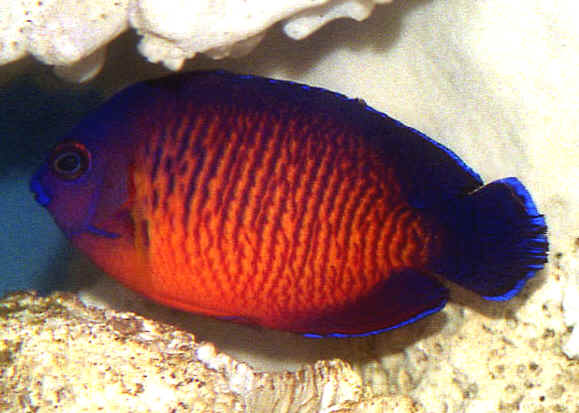
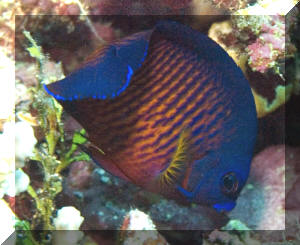
Two-Spined, Dusky or Coral Beauty Angel (2). Usually hardy from
everywhere but the Philippines. Found widespread throughout the
Indo-Pacific to central Pacific. Pix by Hiroyuki Tanaka and RMF
of one in captivity and one in Australia.
|
|
Bigger PIX: More Large Pix Links
The images in this table are linked to large (desktop size) copies.
Click on "framed" images to go to the larger size. |
%20MD.JPG)
%20MD.JPG) |
|
Centropyge boylei Pyle & Randall 1992,
Boyle's (for Chip Boyle)(2), or Peppermint Dwarf Angel. So
far only found in deep water in Rarotonga in the South Pacific
Ocean. Currently placed in the genus Paracentropyge.
|
Still saving for that rebreather, and working out
to use it!
|
|
Centropyge colini Smith-Vainz & Randall
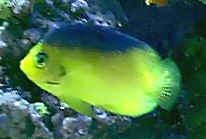
1974, Colin's Dwarf Angel (3), is a deepwater form (usually
collected below 100 feet) that does poorly as far as the genus
goes. Rare and expensive in the hobby. Indo-west Pacific to
western Pacific area. Thanks to Evan McLaughlin for this pic!
|
|
|
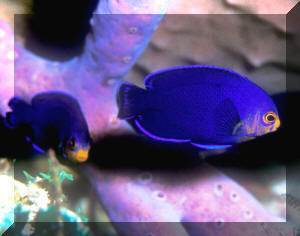
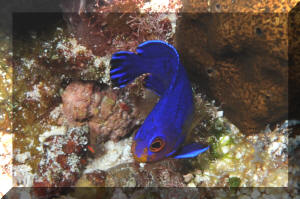
Centropyge debelius Pyle 1990,
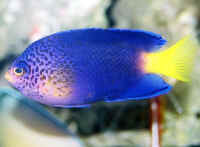
Debelius's or Blue Mauritius Dwarf Angel (2), named in honor
of Helmut Debelius, German aquarist, diver-photographer. Found
thus far only in Mauritius and Reunion in the southwestern part
of the Indian Ocean. 9 cm. specimen photo by Hiroyuki Tanaka.
|
|
To: Part
2, Part 3,
Angelfishes for Marine
Aquariums
Diversity, Selection & Care
New eBook on Amazon:
Available here
New Print Book on Create Space: Available
here
by Robert (Bob) Fenner |
|
|
|


%20MD.JPG)