|
Related FAQs: Hermit Crabs, Hermit Crabs
2, Hermit Crabs
3, Hermit ID 1,
Hermit IDs 2, Hermit IDs 3, Hermit IDs 4, & Hermit Behavior, Hermit Compatibility,
Hermit Selection,
Hermit Systems,
Hermit Feeding,
Hermit
Reproduction, Hermit
Disease/Health,
FAQs: By species: Calcinus
laevimanus (Zebra, Left-handed Hermit), Clibanarius
tricolor (Blue-Legs), Clibanarius vittatus
(a common Gulf of Mexico hermit crab),
Dardanus
megistos (Shell-Breaking Reef,
White-spot, Fuzzy Leg Hermit Crab), Paguristes cadenati (Scarlet,
Red-Legged), Petrochirus
diogenes (a and other Giant Hermit Crabs),
& Anemone Hermits, Sponge/Staghorn/Coral house
Hermits, Unknown/Wild-collected,
& Land
Hermit Crabs, True Crabs,
Marine Crab
Identification, Micro-Crustaceans, Amphipods, Copepods, Mysids, Hermit Crabs, Shrimps, Cleaner Shrimps, Banded Coral Shrimp, Mantis Shrimp, Anemone
Eating Shrimp, Marine
Scavengers, Crustacean Identification,
Crustacean Selection,
Crustacean Behavior,
Crustacean
Compatibility, Crustacean Systems, Crustacean Feeding, Crustacean Disease, Crustacean
Reproduction,
Related Articles: Squat Lobsters, Crustaceans, Marine
Crabs, Freshwater to
Brackish Crabs, Algae
Control, Marine Maintenance,
Reef Maintenance, Marine Scavengers,
Nutrient Control and
Export, Marine
Scavengers,
Hermit Crabs, Use in the Marine
Aquarium Hobby
|
|
|
By Bob Fenner
|
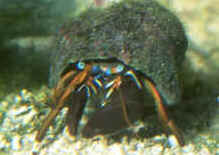
Reef Hermit, Calcinus tibicen
|
 |
New Print and
eBook on Amazon
Marine Aquarium Algae Control
by Robert (Bob) Fenner
|
To place the Hermit Crabs and their relatives in
taxonomic perspective let's do a/the usual rundown on their
systematics starting from the:
Subphylum Crustacea:
About 42,000 species of some of the most familiar
arthropods; crabs, shrimps, lobsters, crayfish, wood-lice (sow-bugs,
rolly-pollies, you know, terrestrial isopods, and aquatic, even
parasitic marine ones). Many small members in fresh and marine habitats
of importance in aquatic food chains. Primarily aquatic, mostly
marine.
Some common characteristics of the
crustaceans: 1) Their heads are more or less uniform with five pair of
appendages: they have two pair of antennae
(this feature is distinctive within the phylum); the third pair as
opposing, biting, grinding mandibles. Behind
the mandibles there are two pair of accessory feeding appendages, the
first and second maxillae. 2) Their bodies trunks are composed of
distinct segments covered by a chitinous exoskeleton strengthened by deposition of calcium salts. 3) Crustacean
appendages are typically biramous (two major elements). 4) They
typically have a carapace covering the trunk of their bodies. Enough of
this detail. We'll cover this stuff in more general survey pieces
of the mega-groups. On toward the lobsters.
A systematic resume of the Crustacea is necessarily
large and complex. Allow me to semi-skirt around a full discussion
here. The nine Classes that don't include our family of interest
enclose the primitive cephalocaridans (C. Cephalocarida), the Class
Branchiopoda (fairy shrimps, tadpole shrimps, water fleas
(Daphnia); the Class Ostracoda, Class Copepoda (Anchor worm,
Lernaea), Classes Mystacocarida, Branchiura, Tantulocarida,
Remipedia, Cirripedia (barnacles), whew! & finally, our:
Class Malacostraca:
Comprises almost three-fourths of all described species
of crustaceans and most of the larger forms, such as crabs,
lobsters, and shrimps. Characteristics: Trunks typically
composed of 14 segments plus the telson ("tail"); the first 8
segments form the thorax, the last 6 the abdomen; all
segments bear appendages. Four Superorders: Syncarida, Hoplocarida,
Peracarida, and the one we want to talk about, the Eucarida.
Superorder Eucarida
contains many of the large malacostracans. They have highly developed
carapaces displaying fusion of all thoracic segments (the
cepahalothorax). Eyes are stalked... Two living orders; the
Euphausiacea (krill) and the:
Order Decapoda includes the familiar
shrimps, crayfish, lobsters and crabs. This is the largest order of
crustaceans with @10,000 species. Decapods are distinguishable from
euphausiaceans and other malacostracans in that their first three pair
of thoracic appendages, The remaining five pairs are legs (Decapoda=
"ten feet"). Decapods are further divided into two Suborders,
the Dendrobranciata, with "tree-like" branched gills, body
laterally compressed..., eggs planktonic, nauplius as the first larval
stage (as in Artemia, our brine shrimp), Infraorders, Sections,
Superfamilies... See Barnes re their higher taxonomy.
Of animals that are Crabs ("false" and true)
there are about eight thousand described species, with about 600
venturing into or living in freshwater.
Infraorder Anomura, families of Hermit Crabs,
Sand or Mole Crabs, Crab-like Crustaceans. Depressed carapaces, third
pair of legs never chelate, fourth and fifth pair reduced....
Have a soft abdomen... live with bodies enclosed in discarded shells
for the most part.
Superfamily Galatheoidea
Family Chirostylidae
Family Galatheidae (squat lobsters)
Family Porcellanidae (porcelain crabs)
Superfamily
Hippoidea
Family Albueidae (mole crabs)
Family
Hippidae (sand crabs) Superfamily Paguroidea,
have oval carapaces, usually asymmetrical. Live either in shells or
with abdomen tucked underneath. First pair of legs as chelipeds.
Includes the Hermit Crab genera: Pomatocheles, Petrochirus,
Clibanarius, Coenobita (land Hermit Crab), Pagurus, Pylopagurus, Birgus
(the Coconut Crab), Stone Crabs like Lithodes, Paralithodes (commercial
King Crab of the North Pacific).
Family Aeglidae
Family Callianassidae (ghost shrimps)
Family Coenobitidae (land hermit crabs)
Family Ctenocheildae
Family Laomediidae
Family Lithodidae (stone and king crabs)
Family Lomidae
Family Paraguridae (deepwater hermit crabs)
Family Pylochelidae
Family Thalassinidae
Family Upogebiidae (mud shrimps) Aquarium Hermit Crabs:
Family Diogenidae (left-handed hermit crabs) and Family
Paguridae (right-handed hermit crabs):
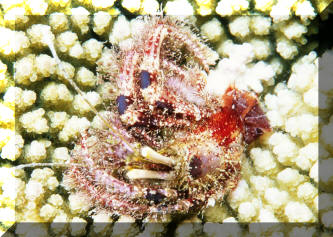
| Unusual find: a dead Hermit Crab found lying on
coral in Fiji. |
|
Best (most "Reef-Safe") Hermit Crab Species
(though no carte-blanche guarantees) for Algae Control: Even these
cannot be absolutely trusted with small fishes, invertebrates if
hungry... and they too can be meals for... Puffers, Triggerfishes,
Stomatopods (Mantis), Alpheids (Pistol Shrimp)...
Genus Calcinus:
| Calcinus laurentae Haig & McLaughlin
1983, Laurent's Hermit Crab, Family Diogenidae. Orange-yellow
antennae. Claw-limbs brown, other legs pink with white junctions
and black tips. Hawaiian endemic. Common. To about 1/5"
carapace length. Kona pic. |
|
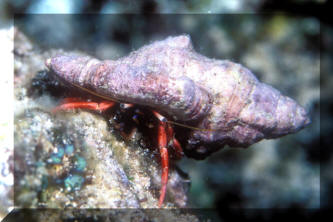
| Calcinus tibicen, the Orangeclaw Hermit
Crab, Family Diogenidae. Tropical West Atlantic. Orange antennae
and eyestalks. Eye tips white, eyes with black pupils. Unequal size
claws. 1/2 to 1". Aquarium pic. |
%20MD.jpg)
|
Genus Clibanarius: About 60 described
species.
Family Diogenidae
| Clibanarius digueti, a Mexican Hermit Crab,
aka the Blue-Eyed Spotted Hermit. To less than an inch in
length. |
|
|
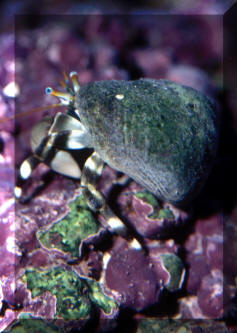
Clibanarius seurati, Dana 1852. Zebra Reef Hermit Crab. Fiji |
|
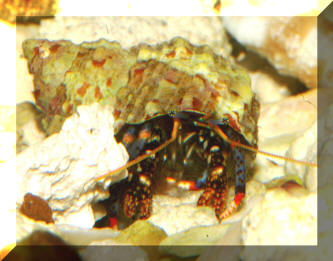
| Clibanarius tricolor, the
Blue-Legged Hermit Crab. To less than an inch in length. One
of a few "reef-safe" Hermits that stay small and almost
exclusively feed on algae (and Cyanobacteria!). Good for aiding in
aerating the substrate as well. Aquarium photo. |
|
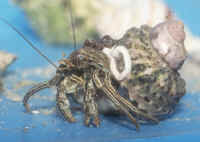
| Clibanarius vittatus, a
common Gulf of Mexico hermit crab. Very hardy... can live out of
water for days at times. "*C. vittatus* does get rather
large, 10 cm at least (Adam J. said he had one (actually, he said
it was *P. holthuisi* in a 6" shell)" Scott Allen Rauch
pic. |
|
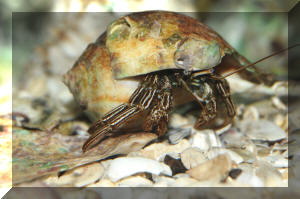
Bigger PIX:
The images in this table are linked to large (desktop size) copies.
Click on "framed" images to go to the larger size. |
|
|
Genus Paguristes:
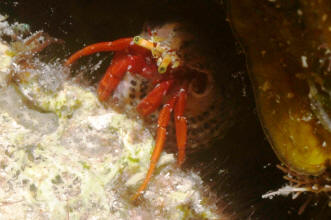
| Paguristes cadenati Forest
1954, the Scarlet or Red-Legged Reef Hermit. Tropical West
Atlantic. To one inch in length. Red carapace and legs, eyes green,
on yellow stalks. Roatan photo. |
|
Bigger PIX:
The images in this table are linked
to large (desktop size) copies. Click on "framed" images
to go to the larger size. |
|
%20MD.JPG)
|
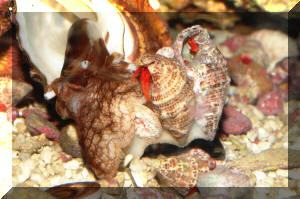
| Never entirely "reef safe"... All hermits are to
degrees opportunistic omnivores... they WILL eat your other
livestock if hungry... Here two Paguristes
cadenati are "riding" a snail... |
|
| Paguristes erythrops, the Red-banded
Hermit Crab. Tropical West Atlantic. To four inches in length. Claws about
the same length with red spots or bands. Antennae are golden, eyes blue. Cozumel
2016 image. |
%20MD.JPG)
|
|
Paguristes puncticeps, the White Speckled
Hermit Crab. Tropical West Atlantic. To 5 inches in length. Claws about
the same length with red spots. Blue eyes. White speckled eye stalks and
body. Cozumel
2017 image. |
%20MD.JPG)
|
| Paguristes sericeus, the Blue Eye
Hermit Crab. Tropical West Atlantic. To 2.5 inches in length. Claws about
the same length with red spots. Small blue eyes on red speckled stalks. Cozumel
2017 image. |
|
Genus Phimochirus:
| Phimochirus holthuisi, the Red-striped
Hermit Crab. Tropical West Atlantic. To one inch in length. One
cheliped enlarged (usually right); movable pincer white. Eyestalks
white with dark band, eyes grayish blue. |
|
| Phimochirus opercularis, the Polka-Dot
Hermit Crab. |
|
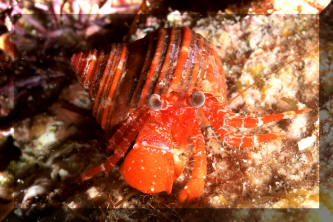
| Phimochirus randalli, the Randall's
Hermit Crab. Roatan 2017 at night |
|
Genus Trizopagurus:
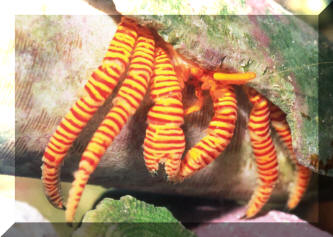
| Trizopagurus (Ciliopagurus)
strigatus (Herbst 1804), the Striped or Halloween Hermit
Crab. Indo-Pacific and Red Sea. To a little over two inches in
length. Nocturnal. Lives in empty Cone shells. Feed on live
and dead animal material. Aquarium pic. |
|
Other Species of Hermits Sometimes Offered in the Interest that are
Unusual, though not highly suitable for Aquarium use.
Other Species of Hermits Sometimes Offered in the Interest that
are TROUBLE: For (large) fish-only systems.
Genus Aniculus:
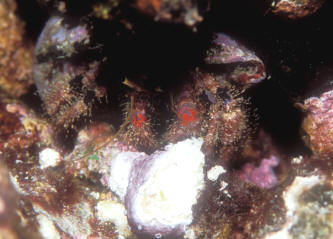
| Aniculus hopperae McLaughlin & Hoover
1996, Hopper's Hermit Crab. Sometimes imported from
Hawai'i. Not a hardy aquarium species; apparently a sponge
feeder in the wild. To an inch in length. Black eyes, yellow
eye stalks, bright red claws bear black tips. Hawaiian endemic. Big
Island pic. |
|
| Aniculus maximus, a Large Hermit Crab. Often
imported from Hawai'i. To four inches in length. |
|
Genus Dardanus:
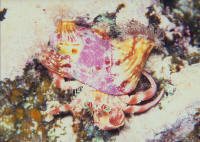
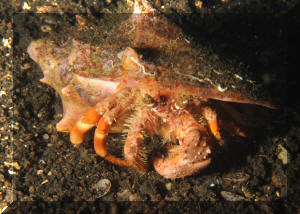
| Dardanus gemmatus H. Milne-Edwards 1848,
Jeweled Anemone Hermit Crab. To two inches carapace length. With
Calliactis anemones on its shell. Hawai'i image. |
|
Bigger PIX:
The images in this table are
linked to large (desktop size) copies. Click on "framed"
images to go to the larger size. |
 |
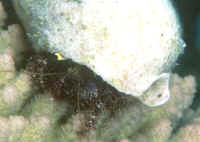
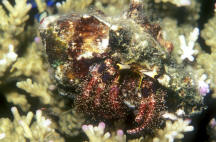
| Dardanus lagopodes (Forsskal 1775), the
Blade-eyed Hermit Crab. Indo-Pacific, including the Red Sea. To a
little over two inches in length. White eye stalks, body mottled in
maroon, brown, covered with white-tipped bristles. This one in
Aitutaki, Cook Islands and N. Sulawesi. |
|
Bigger PIX:
The images in this table are linked to large
(desktop size) copies. Click on "framed" images to go to
the larger size. |
|
|
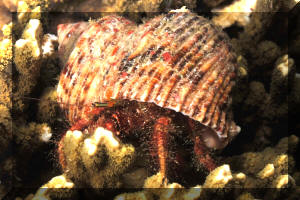
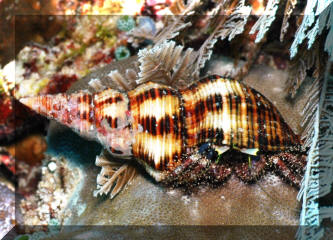
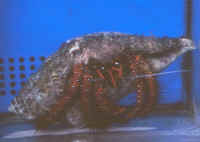
| Dardanus
megistos (Herbst 1789), Shell-Breaking Reef Hermit Crab,
often sold as the White Spotted. Members of this genus are
predaceous, and will gladly consume any fishes they can get their
claws on. To six inches. Place with large, aware fishes only.
Aquarium pic. |
|
Bigger PIX:
The images in this table are linked
to large (desktop size) copies. Click on "framed" images
to go to the larger size. |
|
%20MD.JPG)
|
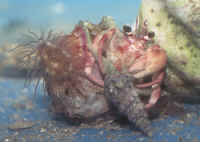
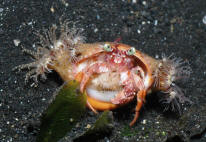
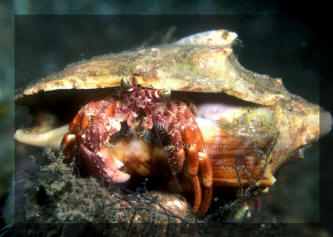
| Dardanus pedunculatus (Herbst 1804), another Reef Hermit Crab. Indo-Pacific.
Often with anemones placed on its movable home/shell. To a little
over two inches in length. Spiny chelipeds, red and white striped
eye stalks are definitive. Aquarium and N. Sulawesi
pix. |
|
Bigger PIX:
The images in this table are linked
to large (desktop size) copies. Click on "framed" images
to go to the larger size. |
|
|
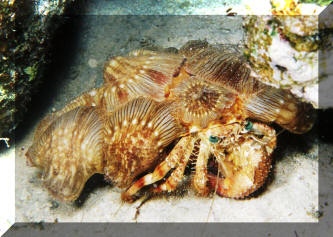
| Dardanus tinctor, a Coral Hermit Crab. This
one with its Calliactis polypus Anemones out at night
in the Red Sea. To 10 cm. Large left claw. Nocturnal; omnivorous.
Moves anemones when transferring to new shells. |
|
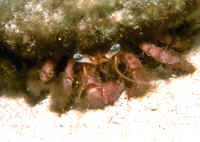
| Dardanus venosus, the Starry-eyed Hermit
Crab. 3-5 inches. Blue/green eyes, dark pupils that are star-burst
like in close view. Claws of lavender color generally. Bristly.
Cozumel pic. |
|
Bigger PIX:
The images in this table are linked
to large (desktop size) copies. Click on "framed" images
to go to the larger size. |
|
%20MD.JPG)
|
Genus Paguristes:
| Paguristes puncticeps,
White Speckled Hermit Crab. Cozumel 2011. |
.JPG)
|
Genus Petrochirus:
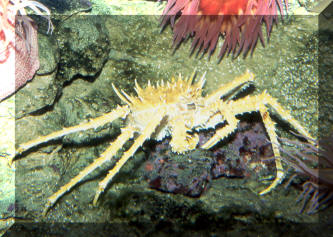
The Superfamily Paguroidea also includes Stone
Crabs like Lithodes, Paralithodes (commercial King Crab of the North
Pacific).
|
Lithodes a genus, species of king crab.SIO Aquarium image. |
|
Care Notes:
If you use them, place about one, two small Hermits per actual
gallon of your system. Use a mix of species and make sure and provide
many "upgrade" homes (empty shells) for your Hermits to move
to.
Bibliography/Further Reading:
|
|
New Print and
eBook on Amazon
Marine Aquarium Algae Control
by Robert (Bob) Fenner
|
Systematics of Crustacea:
http://www.dnr.state.sc.us/marine/sertc/Martin%20&%20Davis.pdf
http://www.marbef.org/data/ermstaxdetails.php?id=106685
http://animaldiversity.ummz.umich.edu/site/accounts/classification/Anomura.html#Anomura
Baensch, Hans & Helmut Debelius. 1994. Marine Atlas, v.1.
MERGUS, Germany. 1215pp.
Brawer, Marc. 1970. Hermit Crabs. Marine Aquarist 1:6, 70.
Burgess, Warren E. 1974. Salts from the seven seas (on Hermits). TFH
11/74.
Debelius, Helmut. 1999. Crustacea of the World. Atlantic, Indian,
Pacific Oceans. IKAN, Germany 321pp.
Friese, U. Erich. Crustaceans in the home aquarium. Hermit Crabs.
TFH 4/85.
Hoover, John P. 1997. Hawaiian Hermit Crabs, pts. I,II. FAMA
9,10/97.
Jensen, Christopher. 1998. Red Legged Hermit Crab. FAMA 4/98.
Menten, Bob. 1980. The Hermit Crab. Marine scavenger- par
excellence. TFH 11/80
Michael, Scott. 1998. Hermit danger. Some species of hermit crabs
actually consider your fish their dinner. AFM 5/98.


%20MD.JPG)