|
FAQs about Corallimorph Identification
4
Related Articles: Corallimorpharians, Cnidarians, Water Flow, How Much
is Enough,
Related FAQs: Mushroom ID 1, Mushroom ID 2, Mushroom ID 3, Mushroom ID 5, Mushroom ID 6, Mushroom ID 7,
Mushroom ID 8,
Mushroom ID 9,
Mushroom ID 10,
& Corallimorphs, Mushrooms 2, Mushrooms 3, Mushrooms 4, Mushroom Behavior, Mushroom Compatibility, Mushroom Selection, Mushroom Systems, Mushroom Feeding, Mushroom Health, Mushroom Reproduction,
Stinging-celled
Animals,
|
|
|
Interesting Hitchhiker: Pseudocorynactis --
6/14/09
Dear WWM crew,
<Hello>
I have a brand new to-be reef tank, 50 gals with 15 gal sump,
skimmer, small DSB in sump, live sand and live rock in display
tank.
<Nice>
The rock came from various local fish stores and is all
apparently Fiji rock. Some was more "dead" than
others.
<You'd be surprised what can pop out of what appears to be
barren rock after it's been in your tank for a while!>
The rock with the most life on it is really blossoming out.
<Neat!>
My parameters are pretty stable now at 1.0025 SG, pH 8.2 or 8.3,
KH 9, Ca ~450, temp 79 deg F (I live in the Calif. valley, so
it's difficult to get lower than this without going to
lengths). The live rock has several worms, maybe Spionids (2
palps); there are 2 sizes of those and one is quite scarily
large.
<It could be a similar little tube dwelling worm/Polychaete
called a Chaetopterid (family: Chaetopteridae). They have two
feeding appendages, a ringed parchment-like tube and can be
surprisingly large.>
There are also some small (really, really small) things that look
like
hydroids, but they are single stranded and perhaps only 3mm
long.
<Hmmm, do they live in a tube? If so, do they look like
what's in the following link?
http://bb.wetwebmedia.com/gallery/pic.php?mode=large&pic_id=307
If so, they're harmless Vermetid Gastropods. This common
hitchhiker reaches about 10mm or so in length and lives in hard
tubes that can break and be very sharp, so watch out. They feed
by means of casting out a single mucous thread that catches
particulate matter in the water and is then reeled back into the
mouth. If this is not what you have and you'd like to pursue
an ID, do try to get a photo or two and we'll see if we
can't get you some answers.>
There are 2 nice Sabella sp. type feather dusters and one really
tiny feather duster that I don't know.
<Many varieties>
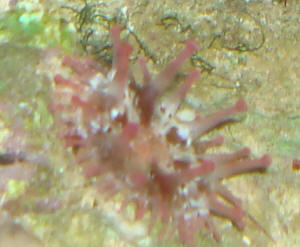
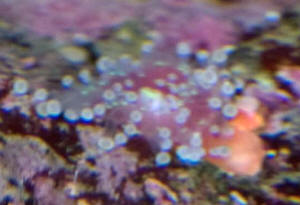
There is one polyp that is almost certainly the dreaded Aiptasia;
see attached, 1st rather blurry picture.
<Yep, looks like Aiptasia.>
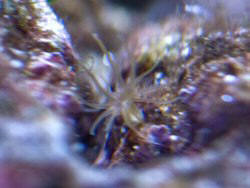
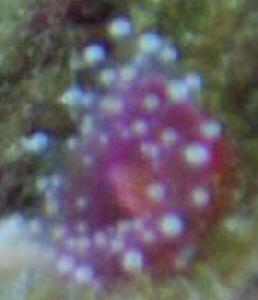
The second picture is an unknown polyp. It's pretty!
<Yes, indeed!>
Very small as well, perhaps 0.5 cm in total diameter, all splayed
out. I wondered if you could possibly try to identify it for
me?
<I sure can! It looks like a beautiful little
Corallimorpharian in the genus Pseudocorynactis. They're
harmless and usually nocturnal. Not a whole lot is known about
their care, but they're thought to feed on zooplankton/pods
and such. For more information/photos, please Google our site,
and the net, using "Pseudocorynactis':
http://www.wetwebmedia.com/Googlesearch.htm >
I used a tripod and remote shutter trigger, but it's still a
bit out of focus.
<Looks great to me!>
I have read WWM's FAQs on getting rid of Aiptasia and am
still confused. Should I try a peppermint shrimp initially since
I don't have enough food to sustain Berghia Nudibranchs and
it's too small to inject (at least for my skills)?
<I'd skip the peppermint shrimp since they come with their
own set of issues and go with a Kalkwasser (pickling lime) and
water slurry. This method works well on those small, nearly
impossible to inject anemones. Just mix Kalk powder with water
(to about the consistency of heavy cream), put it in a plastic
syringe (doesn't have to be one with a needle), turn off all
the pumps, and aim for the mouth of the anemone. As soon as you
touch it, it's going to withdraw into the rock. Chase it as
far as you can go with the syringe tip and inject the Kalk
solution. The idea is to fill and cover the hole with a small
blob of Kalk. You don't need a big mound covering the hole,
just enough to block the anemone completely. The reason you
don't want to go overboard with Kalk is that it's very
caustic and will burn whatever it touches (be sure to avoid skin
contact). It's a good idea to have a turkey baster handy,
just in case you need to remove any excess from within the tank.
Once you've covered the Aiptasia, wait about 5-10 minutes
then turn the pumps back on. That should do it, but if not, treat
again.>
Thanks much!
<You're very welcome! Take care, LynnZ>
|
  |
|
Pseudocorynactis Caribbeorum
4/26/09
Hi Crew!
<Ahh, the "sweet one". Hello Melissa>
I would like to start by saying that you guys are wonderful!? I
am on your site all the time and find everything? so helpful, so
thank you :)?? I am looking for confirmation on what I believe is
a Pseudocorynactis Caribbeorum.
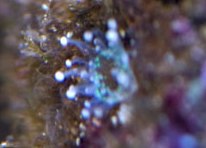
<Appears to be so>
I just notice these white tentacles on a piece of live rock that
I've had in my tank? for years, I'm guessing it was just
hanging out.? I was able to capture a nice photo which I have
attached.? Any help/suggestions are greatly appreciated!?
Thanks again and you guys are awesome!!!
Melissa
<Please see here re: http://wetwebmedia.com/mushridf4.htm
and the files above re aspects of care. Bob Fenner>
|
 |
|
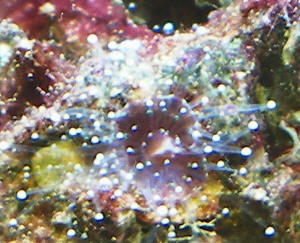
Corallimorph? ID Hi Crew <Hi Karen, Mich
here tonight.> I was doing my usual cleaning/water change on
my reef tank last weekend and out rolled the critter pictured
here - <Cool!> it seems to have been hanging out in the
substrate. <Really, unusual place for it.> I stuck it in a
hole in the rock to keep an eye on it; <I'm sure it's
happier there!> in the upper part of the tank where there is
good flow. <It will appreciate that.> It looks like a
Corallimorph; <It is.> similar to Corynactis californica;
<Close, but I believe you have a Pseudocorynactis
caribbeorum.> but if so I am at a loss to explain how a
cool-water species got into my tank. <Pseudocorynactis
caribbeorum are warmer water species.> There is one main
polyp, which when fully extended is about 1.5 cm. There also
appear to be 3 small buds attached to the main polyp (one is
visible as the pink mass on the right of the main polyp).
<Wow! I see it. Great that you were able to capture that on
film. You may want to contact Brian Plankis the founder of
Project DIBS, as there was interest in breeding this species and
he would likely find your photo helpful. Please see his post
here: http://www.projectdibs.com/forums/showthread.php?t=1153
> There is a central mouth, and the tentacles are club-tipped
and clear. They retract to direct food to the mouth. <Yes, you
can see photos of this on the site above.> The whole polyp
closes into a pea-sized ball when it has something to
"swallow". I have not seen, however it extending the
tentacles and mouth on a stalk like mushrooms do. Finally -
although it does not seem photoactive, it does have a weak
fluorescence in the club-part of the tentacles, which I take to
be due to zooxanthellae? <Yes, often the tips are orange, thus
the common name Orange Ball Anemone. These are generally
nocturnal, and are capable of locomotion, and in my experience
tend to gravitate to lower light areas of the tank.> Any idea
what this is, and is it ok in a tropical environment? <Yes and
yes.> This tank is about 5 years old; with thriving soft coral
(mostly mushrooms and green star polyps). <Highly allelopathic
animals, best to keep this tank dedicated to these animals.> I
added some pacific live rock and Florida live sand about 10
months ago; which is how I imagine it was introduced. <Likely
from the Florida sand, as this is a Caribbean species.> Thanks
for your help <Welcome.> Karen
<Mich>
|
 |
|
Anemone? ID 11/17/08 Hey Bob/Crew:
<Howdy> Hope all is well. Can you help me with an ID? I
recently rearranged the rocks in my 125 gallon tank and noticed
that there were about three of these Anemones or Zoanthids
growing on a piece of rock. I had not seen them before and am not
sure what they really are. They are each about a time in size,
pink with reddish stripes, they have a central "mouth"
in the center of the disk and white ball shaped tips on the outer
edge of what appear to be small tentacles. Sorry for the quality
of the pictures, but any idea would help to set me in the ,right
direction. I appreciate your assistance! <Mmm, actually, this
looks like a Corallimorpharian... a Mushroom... of the genus
Pseudocorynactis... please see WWM and/or the Net re this genus.
Bob Fenner>
|
 |
|
Re: Anemone? ID, Shroom
11/17/2008 Bob: <Hi John> Spot on! The photos I
was able to find are exactly what is in the tank. I appreciate
your help and knowledge :) Oh, I assume these are safe to leave
then? <Ah, yes> John <BobF>
|
|
Ghost shrimp/jewel anemone hlth/ID - 07/19/08 I
can't seem to find an answer for my questions.#1 I bought
some ghost shrimp from my LFS and I noticed they had some white
dots on their body, is this normal or some sort of disease?
<Mmm, likely more the latter... not communicable though. These
sorts of markings show up in specimens that have been kept in
poor conditions> #2 I have a large colony of jewel anemones
<There are a few species that go by this name... Is this a
Corynactis? Which do you have? and can't find any info on
them any where can you tell me or give me a link to some
information on them? Thanks for any help! <Bob Fenner>
Re: Ghost shrimp/jewel anemone 07/20/2008 Wow I
didn't think I would even get a reply yet alone a reply so
quick! So then it would be safe for my fuzzy dwarf lion to eat
said ghost shrimp his health is of great importance to me. #2 yes
my jewel anemones do resemble Corynactis and now I have their
scientific name I'm finding a lot on them. I saw tanks full
of them at Chicago's Shedd aquarium that's were I got the
jewel name from. thank you very much. I'm sure your words of
wisdom have prolonged the lives of many of our aquatic friends!!!
<<Yes, the ghost shrimp are fine for the lionfish. Really
glad you found the correct name for your anemone, all helps
towards providing a better environment for them. Thanks for the
follow-up, hope this helps. A Nixon>>
|
|
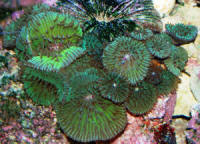
Identification question 2/23/08 Hi
you guys have great info here. I was curious if there was anyone
there who can ID these things in my tank. <Mmm, are
Corallimorphs. Please read here:
http://wetwebmedia.com/corallim.htm and the linked files
above> They look like some sort of mushroom. Several have come
off the rock they were initially growing on. Where they had been
attached has a hard stony reminder. The ones that have come off
are living happily on the bottom of my tank. These can blow up to
quite a large size, 5-6 inches across and 1.5 inches
"tall", or expel their water and get down to being just
1-1.5 inches across and maybe 1/4 inch tall when fully
compressed. One pic is taken under actinic lighting and the other
is under white light. <Very nice. Thanks for sharing. Bob
Fenner>
|
|
|
Pest? Nope, Corallimorph: Pseudocorynactis sp.
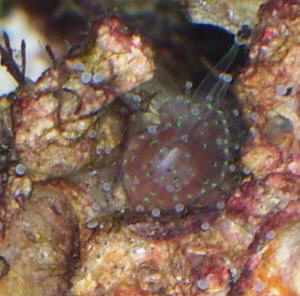
-- 1/24/08 Hi Crew, <Hi there.> Not the best pictures but
here are two of what I think are pests. <Thankfully, they're
not pests. They're neat little Corallimorphs in the genus
Pseudocorynactis, commonly called Ball Anemones, or Ball
Corallimorphs. They're mostly nocturnal, extending their
feeding tentacles at night to catch any zooplankton or pods that
might happen by.> I only see 3 in the tank but want to make sure
what they are. The third one is deep in a rock and I can only see
the white tips. <That's typical with these. For more
information, please see the FAQ at the first link, along with the
photos and FAQ's at the second:
http://www.wetwebmedia.com/mushridf4.htm
http://www.wetwebmedia.com/mushrmidfaq2.htm .> Thanks
<You're welcome. Take care -Lynn> |
|
|
Anemone or Coral Hitchhiker? Corallimorph:
Pseudocorynactis spp.- 12/19/07 Hi Crew, <Hi
Russ> I'm sorry to say that this is the second time in as
many weeks that I have darkened your door with an ID request, and
it's not for the want of looking on the web for info. <No
worries, we're here to help. Besides, it's difficult to
look something up when you don't know what it is, eh?> Last
time, it was hastily purchased snails which, it turns out, were
predatory, and had to be returned (I know, I know - but a lesson
was learned from the experience), but this time I'm not so
culpable, save for the purchase of a few small pieces of live rock.
I have, it seems, a nocturnal, bright pink soft coral or anemone
(I'm guessing anemone, but hey, I've really no idea).
<Does indeed look like an anemone, but is actually a beautiful
little Corallimorph of the genus Pseudocorynactis, commonly called
a ball anemone/ball Corallimorph. For more information/photos,
please Google our site, and the net, using
"Pseudocorynactis". If you have Eric Borneman's
"Aquarium Corals" book, see page 198. There are several
photos/some info at this WWM link to get you started:
http://www.wetwebmedia.com/mushrmidfaq2.htm.> It's only ever
fully out first thing in the morning and is back in the hole it
lives and out of sight within a minute of the lights going on,
<Typical - nocturnal.> so getting a photo with a point and
shoot camera is a little awkward (autofocus generally autoblurs,
Grrr), <Frustrating, I know - helps if you turn off all
pumps/stop water movement, and use a macro setting if available -
icon is usually a small flower.> but here's the best I
have... <<anemoneid.jpg>> <Pretty.> It's
about 1 inch across. My questions to you guys, other than 'what
is it?', are, 'is it a danger to fish/crabs/snails/corals?
<Nope. Likely more of a threat to resident pods/zooplankton that
happen by.> (I currently only have crabs and snails, and
don't want to buy fish/corals if this thing is likely to harm
them, without first removing it)', <Understandable.> and
if it's safe, does it need feeding? <Not a whole lot is
known about their care, but they're thought to feed on
zooplankton/pods and such, so you might want to offer it some meaty
bits (Mysis/fish/etc) every so often at night, when the tentacles
are extended.> I was also wondering if the white patches may
mean its not too well? <Not sure about that, may just be a
normal patterning?> Any help gratefully accepted. If you need a
better photo, I'll try to get one. <Nope, we're good to
go!> Best regards <Same to you, Russ.> Russ - Sheffield
UK
<Take care -Lynn.> |
|
|
|
|