|
FAQs about Corallimorph Identification
2
Related Articles: Corallimorpharians, Cnidarians, Water Flow, How Much
is Enough,
Related FAQs: Mushroom ID 1, Mushroom ID 3, Mushroom ID 4,
Mushroom ID 5, Mushroom ID 6,
Mushroom ID 8,
Mushroom ID 9, Mushroom ID 10,
& Corallimorphs, Mushrooms 2, Mushrooms 3, Mushrooms 4, Mushroom Behavior, Mushroom Compatibility, Mushroom Selection, Mushroom Systems, Mushroom Feeding, Mushroom Health, Mushroom Reproduction,
Stinging-celled
Animals,
|
|
|
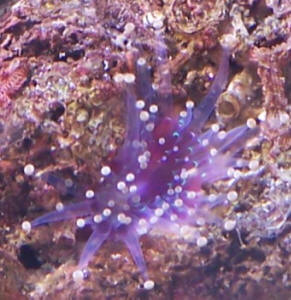
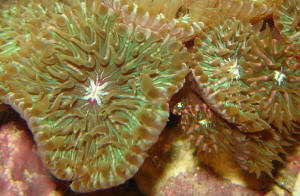
Mushroom ID 10/27/09
Hi Guys,
Can you please provide on an ID on this Mushroom?
Regards
Beta
<... a Rhodactis sp. of some sort. Bob Fenner>
|
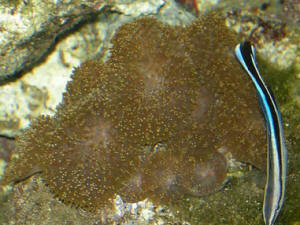 |
|
Re: Mushroom ID --
10/28/2009
Thanks Bob. These are from the Southern coast of India.
Regards
Beta
<Neat! Thanks for sharing Beta. BobF>
|
|
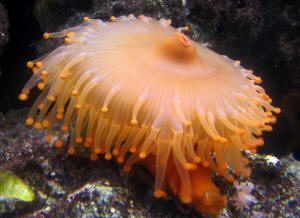
Please ID This Anemone: Corallimorph - Likely
Pseudocorynactis sp. -- 10/8/09
Hi,
<Hi Jan, Lynn here today.>
First let me say that your site is my marine bible.
<Thanks! Bob has indeed put together quite a wealth of
knowledge!>
I browse here before anywhere else. Thank you for being here.
<It's our pleasure.>
Someone in my reef club put this gorgeous anemone up for trade
[IMG]http://i210.photobucket.com/albums/bb66/janvl07/unkownanemone.jpg[/IMG]
I think it's a cold water anemone, but my knowledge is
limited.
<Hopefully, it's not a cold water species in a reef tank!
It looks like what's commonly called an orange ball anemone,
although these are actually Corallimorphs (like mushrooms --
Rhodactis, Ricordea, etc.) instead of anemones. The individual
photographed is either a species in the genus Corynactis (usually
small, tends to live in cold/cooler waters), or Pseudocorynactis
(a more tropical variety, can get fairly large). This individual
is more likely of the latter genus. For more information, please
see the following link:
http://www.advancedaquarist.com/issues/oct2002/invert.htm
>
No one knows where it's from and what it is.
<Hopefully, this information will help. By the way, it's
been noted that the larger Pseudocorynactis spp. individuals can
pose a threat to fish, so beware. I don't know the size of
the one photographed, but it looks fairly large. The hitchhiking
individuals we most commonly see are the species Pseudocorynactis
caribbaeorum. They're usually very small and fairly
innocuous. They also tend to open mostly at night although over
time, some will adapt and remain open during the day. You can
find more information within WWM's FAQs regarding these
beautiful little Corallimorphs.>
The person that had it up for trade won't tell anyone where
it's from.
<He/she might not know.>
Thank you.
<You're very welcome!>
Best regards,
Jan
<Take care, LynnZ>
|
 |
|
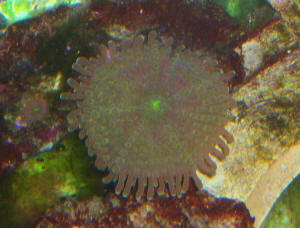
Coral ID 3/5/09 Hello Bob, Anthony and crew!
<Hello Thanassis> I bought this coral yesterday, but I
cannot locate it anywhere and I would appreciated it if you
helped me identify it. <Not real good detail in the pic, but
does appear to be a Corallimorph, likely Ricordea yuma.> Best
regards from Greece, <Cheers from Michigan. James (Salty
Dog)> Thanassis
|
 |
|
Identification help? And a whole lot more!, Shroom, and
stkg.... FO SW, & coral lighting...
12/02/08 Hi crew again-- <Hello, Mich
here.> For the purpose of trying to get as many questions
asked/answered with one email, please bear with me! <No
worries.> I am attaching a picture of what I believe may be a
Ricordea mushroom, but I cannot tell. <Looks like a Ricordea
yuma to me.> This mushroom hitchhiked in on a piece of live
rock. It has "split" once. It does much better under
actinic lighting and closer to the lighting than the other
mushrooms I have in my tank. <Ricordea are often found in
shallow waters.> I have also invested in the Pocket Expert
Guide to Marine Fishes by Scott Michael and the 101 Best
Saltwater Fishes by Scott Michael. I also purchased the Pocket
Expert Guide to Marine Invertebrates by Dr. Ronald Shimek. My
next purchase will be the Conscientious Marine Aquarist. <All
four are excellent books! You are very wise to spend some money
on educating yourself. These books are well worth the money and
very useful tools. Congrats to you.> The first three books
have helped me immensely on planning the rest of my current 75
gallon tank as well as my preparations to begin setup on a 55
gallon tank and a 30 gallon tank. My 75 gallon will be my reef
tank and the 55 gallon will be an aggressive fish only tank. The
30 gallon will be a peaceful fish only tank. Can I ask your
suggestions on my list of what I want to put in the 55 gallon?
Also what to put in the 30 (below)? <Sure, though I will defer
here to ScottF. as he is more knowledgeable in this subject
area.> I would like to put in the 55 gallon: <Hi! Scott F.
chiming in...> 1 Harlequin Tuskfish (Choerodon fasciatus)
<Yikes! In a 55?> 1 Volitans Lionfish (Pterois volitans)
<Oh my!> 1 Scimitar (Bursa) Triggerfish (Sufflamen bursa)
<Please, no! You're killing me.> 1 eel (I am undecided
on a type here) either a Whitemouth Moray (Gymnothorax meleagris)
or a Zebra Moray (Gymnomuraena zebra) or possibly a Snowflake
Moray (Echidna nebulosa) <OMG!!!!> 1 Pufferfish (again
undecided) either a Blackspotted Puffer (Arothron nigropunctatus)
or a Spiny Puffer (Diodon holocanthus) <Airway...I need an
airway!> #1 is this too big of a bio-load for a 55 gallon?
After reading about each of these, I think they should all do
fine together, but wanted your suggestions first. <Um...in a
word- YES! I didn't mean to sound too insensitive, but we
need to revisit this stocking plan. Not one of these fishes is
really even a viable choice for the short run in an aquarium of
this size. In addition to reaching sizes that are way too large
for this aquarium, these fishes are quite aggressive and
incompatible, are messy eaters, and produce copious amounts of
metabolic wastes. We need to look at some alternative fishes that
will be better suited for this aquarium. Smaller, more peaceful
choices would be a better approach. The Harlequin Tusk and the
Triggers are simply out of the question for this aquarium. A
Lionfish is a possibility, if you are willing to try a different
species, such as the "Fu Manchu Lionfish", Dendrochirus
biocellatus. This fish is almost as "sexy" as the
full-sized guys, yet reaches a more manageable 4 inches or so. It
can be a bit shy, but can easily be kept in a 55 gallon aquarium.
Like all Lionfish, it is venomous, so do exercise caution when
handling this fish. A moray Eel is really not a viable choice for
this sized aquarium, either, but you could consider a smaller
version, such as the "Golden Dwarf Moray", Gymnothorax
melatremus, which is a tiny version of the full-sized species. It
reaches a maximum size of about 6-8 inches, and is the diameter
of a pen. However, don't let the small size of the fish fool
you; these fishes can eat surprisingly large prey items! And, to
top it off- they are amazing jumpers. If you do keep one,
remember to keep the aquarium tightly covered. They can find the
smallest opening and use it to go "carpet surfing"! Oh-
and did I mention that they are pretty darned expensive, too!
Nonetheless, I think that this would be the only Eel that I would
even consider for this sized aquarium. In place of the Harlequin
Tusk, consider a smaller wrasse species, such as a Halichoeres
species, which generally top off in the 3"-4" range.
Better long-term choices for a modest-sized aquarium.> #2 what
order would you add them in? I think the trigger should probably
be added last, but not sure. <I'd add the Lionfish first,
and make sure that he's eating before another fish is added.
Then I'd go for the GDM, and the wrasse would round out the
stocking list.> Next tank I want to set up is a 30 gallon
peaceful. The following are the inhabitants I want to put in: 1
Yellow Shrimp Goby (Cryptocentrus cinctus) 1 Banggai Cardinalfish
(Pterapogon kauderni) <Some controversy with this fish. Please
see here:
http://microcosmaqx.typepad.com/ret_talbot/2008/09/banggai-cardi-2.html
http://en.microcosmaquariumexplorer.com/wiki/Portal:Letters >
1 Royal Gramma (Gramma loreto) 1 Cherub Angelfish (Centropyge
argi) 1 Coral Beauty Angelfish (Centropyge bispinosa)
<Don't mix Centropyge angelfish in this sized aquarium.
Choose one or the other. Personally, I'd pass on an angelfish
in this sized system. However, if you must have one, the C. argi
is the better choice. It can be a bit aggressive, so be careful
and observe the system often.> 2 Yellow Clown Gobies (Gobiodon
okinawae) For this group, I would add the Cherub last.
<Absolutely.> Too big of a bio-load? <Oh yes, by far.
You need to pare down the stocking list quite a bit. I'd
consider keeping the Goby, Royal Gramma, and the C. argi. That
would be it! Remember, a 30 gallon aquarium holds less than 30
gallons when you take into account the volume consumed by rock
and sand. Smaller water volumes are a great challenge to
maintain.> What order to add? <Goby, Gramma, Angelfish!>
The fish only tanks will get live sand and some live rock, but
that is it. <OK.> I will be putting a protein skimmer on
the 55, but will it be necessary on the 30 gallon? <I would
say yes. In my opinion, a protein skimmer is not an optional
piece of equipment in a marine system. I simply would not run a
marine system without one. This is my opinion, of course, but I
would be remiss if I did not attempt to convince you to utilize
protein skimming in your system, regardless of size.> Could I
do more frequent water changes in 30 instead of skimming? <You
could, but I still feel a skimmer is mandatory. There are
skimmers available for almost any size of aquarium and budget, so
do a little research and you'll find one that works for your
system.> Okay now a quick question on my 75 gallon if I may.
You guys have helped me out with other problems with that tank.
Needless to say, I did what I assume many beginning aquarists
do--I ran out and bought and bought and bought and did not
research first. I have learned the hard way that is not the way
to do it! <A terrible lesson, but at least you learned. And
the fact that you are sharing your experience with others proves
that you have progressed!> With the money wasted in now dead
livestock, I could have purchased some really awesome high dollar
fish! <Like a Golden Dwarf Moray!> Live and learn I guess!
Okay on to the question.... I am planning on purchasing a metal
halide/T-5 combo light for my 75 gallon. The following is what I
am looking at: 2 X 250 Watt Metal Halide � 15k
bulbs included 4 X 54 watt T5 HO Lights included- 4 actinic 03
bulbs 8 lunar moonlights included on fixture � 8
blue 1 watt LED's Unit has 3 Chords and 3 switches Is this
sufficient lighting for all corals, etc? <It can be sufficient
for a great many corals, and may actually be overkill for some
species! It really boils down to what kinds of corals you intend
to keep. Personally, I like the flexibility of the Halide/T5
combo, but you could actually get by with exclusively lighting
the system with T5 bulbs. They are a remarkably powerful lighting
source for a variety of corals. You also may not need 250 watt
halides over this sized system. You could do pretty well with two
150 watt DE halides over this sized system, and realize the same
flexibility and enjoy energy savings as well!> The other 2
tanks will have actinic lighting--no metal halides or anything
"fancy". Any help would sure be appreciated! Thank you
so much for being there for people! <You are very welcome!
Scott F. signing out!> Angela
|
 |
| Live Rock Hitchhiker IDs (Corallimorph and Red
Alga) -- 05/07/07 I purchased a new piece of live rock and a
few weeks later found this growing on a piece of dried out plate
coral. <<Neat>> The plate was totally bleached out and
dead when it went into the tank. These appear to be some sort of
mushrooms and I have no idea what the red stuff is in the other
picture. <<Mmm yes, perhaps a Ricordea species...and the
'red stuff' is a Rhodophyte though what species it is I
don't know...perhaps if you have a look around at
algaebase.org...>> It started out with just one small
creature and has now expanded to at least 20. <<Fast grower,
eh>> They are now about 6 months old. <<Mmm, ok...not
atypical for Corallimorphs>> There is clearly a mouth in the
middle of each one. The stalk is soft and will extend out. They
look like Blastomussa on the top surface, but as I said the stalks
extend and are soft. <<Yes...like Ricordea>> When they
are fully contracted the "fleshy" parts will look pink as
can be seen in some of the smaller ones. They can also blow up much
larger than this like an anemone. <<Typical Corallimorph
behavior>> The red stuff also appeared when the new rock was
put in. It has now spread over about 40% of this rock. It is made
up of many small -3mm or so lobes. These lobes are vertically flat.
<<The red alga 'may' become problematic/spread more
than you like. If this happens, your best bet for controlling it
(short of manual extraction) will be an urchin species. Mespilia
globulus is a good choice for smaller systems or a Diadema species
for large (100g +) tanks...but be aware it has been my experience
the latter will also sometimes graze on Acroporids.
EricR>> |
|
 .jpg)
|
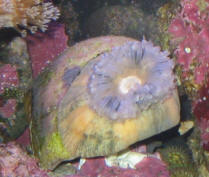
Unknown hitchhiker White Ball Corallimorph
(Pseudocorynactis sp.) 4/27/07 <Hi Jim, Mich here.> Would
you advise your best opinion as to what this creature is. <Yes,
looks to be a White Ball Corallimorph (Pseudocorynactis sp.)> I
found it on an empty snail shell in my tank. <Likely a
hitchhiker.> One opinion from another forum was that it is a
bleached majano anemone. <No. It is not a Majano anemone. Is a
lucky addition to your tank. You might try offering this coral
finely chopped fish at night or when the tentacles are extended.
They are not common in captivity so enjoy it!> <You're
welcome! Mich>
Jim |
|
|
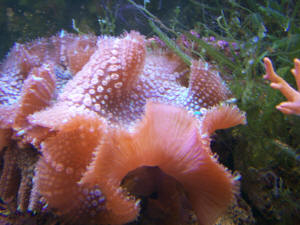
| Mushroom coral-can you please identify, Elephant
Ear mushroom (Rhodactis spp.) - 02/15/07 Hello, Peter from
Bodmin Cornwall UK <Hi there Peter from Bodmin Cornwall UK, Mich
here from the Pocono Mountain of Pennsylvania USA> Greetings,
and thank you for your advise on using Aerial polystyrene sheets
some time ago - I've had no problems. <Glad to hear of your
success> I attach a photo' of an acquirement from a piece of
living rock (origin unknown) - it appeared as a growth
approximately 5mm across within about two weeks after installing
the rock into my tank about two & a half years ago. The picture
was taken one year ago. The picture was taken by 'flash' on
a digital camera with the resultant colouring. Viewed from the tank
under blue actinic & white lighting it is a soft 'terra
cotta' colour-viewed from above a silvery blue. It has thick
stems of about 25 mm & the 'florets' of which there are
now seven are in the region of 15-20cm across. It obviously likes
my tank conditions - it is positioned in the middle of the tank -
about 20cm from the surface. Can you please identify this for me.
<Yes, looks like an Elephant Ear mushroom (Rhodactis spp.) and a
potential fish eater so be aware. Can read more here: http://www.wetwebmedia.com/corallim.htm >
Thanking you in anticipation <You are welcome! -Mich> Peter
Heath PS I have just purchased The Conscientious Marine Aquarist -
a treasure chest of information -no matter how much you think you
already know. <I wholeheartedly agree!> |
|
|
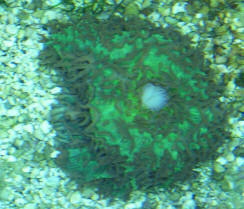
| Mushroom ID 2/13/07 Elephant Ear mushroom
(Rhodactis spp.) 2/14/07 Hi Crew, <Greetings! Mich with you
tonight.> I have this large mushroom and would like to know
exactly what it is since there seems to be a debate in a local
group as to whether it is even a mushroom. <A mushroom indeed,
of the order Corallimorpharia.> It was the size of a quarter
when I got it a few months ago and now it is about 5 inches across
and my tank is just a 10 gallon. <Growing quickly!> It has a
green background. It has a white mouth and long tan colored
tentacles that are very irregular with branches. Sometimes it
shrinks and the green is very intense as it is in this picture.
Other times it spreads out. It looks like there is a light on
behind it. At times it will roll up like a balloon with the
underside being the outside of the balloon. It does this mostly at
night. Anyway here is a picture. <Looks like an Elephant Ear
mushroom (Rhodactis spp.) and a potential fish eater so be aware.
Can read more here: http://www.wetwebmedia.com/corallim.htm Cheers!
-Mich> |
|
|
Re: another Anemone ID... Corallimorph? -
1/22/07 Hi Bob, I was wondering if there is a defining
characteristic of ... Corallimorph? <Yes... posted on our coverage
of the Phylum (Cnidaria) I watched this animal puff up his foot and go
for a walk last night. <!? Atypical!> I also fed him and he felt
sticky, which I imagined a ... Corallimorph would be more slippery like
a mushroom. <Corallimorphs are mushrooms...> My clowns were
immediately drawn to the animal which I guess is why I am skeptical of
the fact that it would be classified in the mushroom family. <Clowns
will/do associate with all sorts of Anthozoans...> I understand that
the clowns will host just about anything but they were very vigorous
about acclimating to their new home. Again thanks, Dale <This could
indeed be an Actinarian per your original query... but morphically
atypical due to present circumstances... its position, lighting,
circulation... perhaps the tentacles will elongate with time, movement.
Bob Fenner>
Nuisance anemone 1/17/06 Dear WWM crew,
<Hi Julia, Mich with you today.> First of all, thank you all for
any previous advice you have given me over the last couple of years.
Thank you for the fabulous web site. You guys (and gals) are awesome!
<Thank you for your most kind words!> I have a quick ID question
for you. I know you guys need to see pictures to know for sure, but a
picture is not feasible right now. <Would be most helpful.> I
just bought some "used" liverock and it has these tiny
anemones on it. They do not look like Aiptasia to me. They look more
like Majano, except they are perfectly clear, no tint of color
whatsoever. Just the very tips of the tentacles are whitish (and
slightly swollen, from what I can tell). Can they be bleached Majano,
or is this another species? The outer tentacles are also a little
longer than what I am used to in Majano (almost like they are half way
between Aiptasia and Majano anemone, or they look almost like a clear
dwarf sun coral polyp, just shape-wise that is). Does this ring a bell?
<Really impossible to tell with out a photo. Many possibilities
here, including many desirable creatures, could even be something like
a orange ball Corallimorph (Pseudocorynactis caribbeorum)...do a google
image search on this.> And should I do anything about these? Until
now I have had NO pest anemones (my liverock was reseeded from scratch,
so to speak), but if these guys are "bad" I would rather not
give them the chance to spread. <Understandable, but if they are
desirable I don't want to tell you to eradicate them... thus the
reason we ask for images.> My tank is not terribly nutrient rich,
but as it is a softie tank I do not want to get it too clean :) <I
hear you.> Thank you all again for your help and have a wonderful
week :) <Welcome and wishing you the same. -Mich> Sincerely,
Julia.
Re: Nuisance Anemone...No, Desirable Hitchhiker...
Pseudocorynactis caribbeorum 1/19/07 Mich, You are amazing :)
<Heehe! And you are funny!> I did an image search on google, just
like you told me, and Pseudocorynactis caribbeorum indeed does look
like my guy :). <Lucky you! It is not sold in the hobby that I'm
aware of.> Except that mine has white balls, not orange.
<Yep.> I guess I will have to do a bit of research on these
creatures since I have never ever encountered them. <Hitchhiking
nocturnal filter feeders.> I just found a picture of it on your web
site (I am attaching it, I hope you don't mind), that is almost
exactly like mine. <Very good.> Thank you so much and have a
great day! <Welcome and the same to you! -Mich> Julia
| Strawberry Anemone 3/24/06 Oh, I thought I'd include
a pic of what I've been calling the "strawberry
anemone" from what I've found on your site and others. Any
input? Oh...and I also noticed a little frag of a purple Ricordea
that we thought we'd completely lost during a past move...just
thought I'd share a happy thought. Branon. <<No real
input other than the fact that they are neat critters. If you want
it to survive and thrive, make sure it gets frequent small meals of
meaty food. Glad to hear you rediscovered a presumed missing
critter! Best Regards. AdamC.>> |
|
|
|
|

