|
FAQs about Soft Corals of the Family
Nephtheidae Identification 1
Related Articles: Soft Corals of the Family Nephtheidae,
The Soft Corals of the genus
Dendronephthya, Soft Corals, Order Alcyonacea
Related FAQs: Nephtheid ID 2, Nephtheid ID 3, Nephtheid ID 4, & Nephtheids 1, Nephtheids 2, Nephtheid Behavior, Nephtheid Compatibility, Nephtheid Selection, Nephtheid Systems, Nephtheid Feeding, Nephtheid Disease, Nephtheid Reproduction/Propagation,
Soft Coral Propagation,
Alcyoniids, Dendronephthya, Paralcyoniids, Nidaliids, Xeniids, Soft Corals/Order
Alcyonacea
|
|
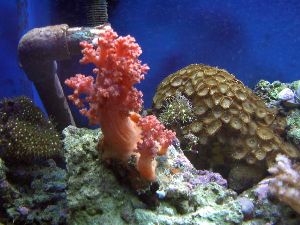
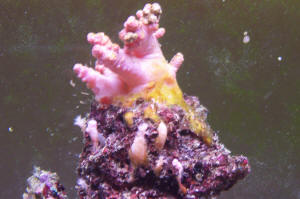
Kenya Soft Coral ID 12/28/07 Hi WWM
Crew! Please help me correctly ID this coral sold to me as a Kenya
Tree Coral. Kind Regards K. <Tis. A Capnella sp...
http://wetwebmedia.com/nephtheids.htm
RMF> |
|
|
| Numerous Cnid. Q's to look up
12/26/07 Merry Christmas! Thanks in advance for your assistance
and my apologies for the long email (questions accumulated over
some time)'¦ Firstly I'd like to thank all of the crew
for aiding fellow aquarists in many matters to which most of us are
oblivious to. I'm forever browsing through your site trying to
soak up as much as possible and one particular thing besides the
usual content which kept popping up was the infamous name of a
book. Eric Borneman's Aquarium Corals. Well with such a good
reputation, I had to purchase it! I'm in the process of reading
it and I'm truly mesmerized! What a book indeed. A true must
for anyone keeping a reef aquarium. I've already learnt more
than I could have imagined within a few chapters (and some very
long scientific words!) So I'd like to thank your site for
suggesting it (you'd think I was a critic or doing this for
money but it really is that good!) <Okay> Anyways, let me cut
to the chase. I've had this coral in my tank for around 5
months and was sold it as a pussey coral but after all my research
the closest thing I could relate it to was on your site on this
link http://www.wetwebmedia.com/softcrlidfaqs.htm Perhaps it's
in my book but I haven't even got the correct name to look it
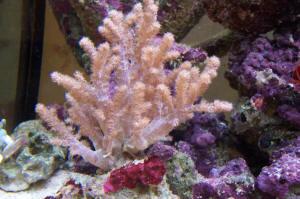
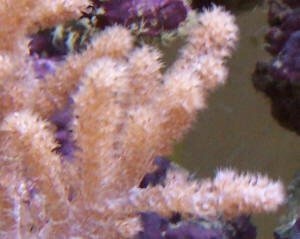
up. I've attached two pictures of it one of which shows it
shrunk down to around a third of its size with white colouration
around the top section. I have observed that this coral does close
up for long periods of time and opens up at unpredictable times. I
recall it going white like this before but it recovers and opens
again a few days if not a week or so later. Since I've had it
in the tank it has asexually produced around half a dozen
'babies' underneath itself which all seem to be doing fine
and their polyps are generally extended. Any help would be
appreciated in identifying this coral so I may do further research
into its needs to increase the chances of survival of the
'babies', especially the Latin name and common name if not
a tall order. <Is a Nephtheid... looks to me to be a Nephthea
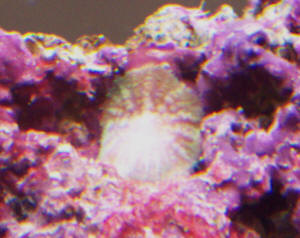
sp.> + About 2 months ago, I noticed a tiny white mushroom
growing on a small piece of rock near the back glass and after much
rummaging around managed to get to it. At this time I didn't
have any mushrooms in the tank. I placed it on a rock high up in
the tank as close to the lights as possible in a bid to give it a
fighting chance. To much delight it has grown and is now
semi-transparent and has a green glow! The picture I took when I
first moved it shows it white with brown spots halfway over but in
the second picture taken recently you can see that it's taking
on a green colour. Might be a long shot but I don't suppose you
can tell me anything about it? I'm hoping it'll grow larger
and colonise. Is this likely and what sort of time scale should I
be looking at if so. <Looks like a Corallimorph... Have you read
here?: http://wetwebmedia.com/marine/inverts/index.htm > Also
please help confirm the ID of these corals as the pictures in the
book aren't quite the same or absent altogether. The pictures
I've found on your site have certainly helped but are also not
as closely matched enough to satisfy my curiosity and reassurance
is required. Again the Latin name and common name if possible
please. Many thanks and kind regards, K. <Can't do any
better than you with the organisms in front of you, what is posted
on WWM, EricB's book... Bob Fenner> |
  |
 |
Q from GrahamT & Rick O. on Nephthea.
1/28/07 Has anyone seen the green Nephthea available as of late?
Here in Maine, we used to have a local propagator that supplied very
colorful soft corals before they went off the map. Rick says he has had
huge problems trying to get these coral in the past ten years, but I am
unsure of the dedication he put forth into the search. Anyone with info
will gain my gratitude. TIA -GT <Mmm... I haven't seen such
except on the Net on any regular basis... But will post this query for
others hopeful input... and want to tell you the nature of this field
is that new collecting areas (like getting a new outboard...) open up
surprisingly new varieties, species to collection... as does new
aquaculture techniques, promises of income... BobF> Re: Q from
GrahamT & Rick O. on Nephthea. Can crew members follow
their own instructions...Heeeheheheheeeeee... No!
1/28/07 <Hi Graham, Mich here, lets see how we can bust on
fellow crew members today.> Has anyone seen the green Nephthea
available as of late? Here in <M>maine, <Hehehehehe!!!! Please
use proper capitalization when writing into WWM!!!! We are busy and it
is time consuming to correct your mistakes!> we used to
have a local propagator that supplied very colorful soft corals before
they went off the map. <Have you tried a new map???>
Rick says he has had huge problems trying to get these coral in the
past ten years, but I am unsure of the dedication he put forth into the
search. <Heeheeee!!! Did you do a Google search like the directions
say before writing into WWM????> Anyone with info will
gain my gratitude. TIA -GT <Have you checked www.reefcentral.com
? I don't know that you will find a wholesale
propagator, but you should be able to find individuals with relative
ease. A search for green Nephthea over the past 6 months
gave the following results: Please read the following
links... just kidding... but there are some which may be useful to
you...> Thread Starter Forum Replies Views Last Post FMAS Frag Swap
Meet Sponsored by Eco Reef Aquarium chrisaggie Florida Marine Aquarium
Society (FMAS) - Miami/Ft. Lauderdale 148 2502 01/27/2007 09:45 AM by
A.T.T.R Show me your ... Green Nephthea reefnewbie54321 Soft Coral
Keepers 94 5601 01/24/2007 11:27 PM by drummereef anybody using the
current SunPod??? brett7768 Lighting, Filtration & Other Equipment
8 154 11/28/2006 10:00 PM by xraydoc ~Lets see your Nano aquascaping~
Wooden Nickel Nano Reefs 694 68894 11/15/2006 01:55 AM by Riona Can
Someone ID This For Me? Reefdrumz Soft Coral Keepers 21 540 11/07/2006
12:15 AM by ChAoTiCrEeFeR4U Thanks for hosting, Mimi gflat65 Middle
Tennessee Reef Club (MTRC) 12 119 11/01/2006 09:20 AM by
coral_reefer_25 "Frag" of the Month - September '06
Skipper"¢ "Frag" of the Month 19 2502 09/22/2006
11:27 AM by Randall_James any1 got any leathers for sale ??? reefer5060
Middle Tennessee Reef Club (MTRC) 4 116 09/12/2006 05:23 PM by
greystreet41 diverrad spotted! LCGoldman Long Island Reef Association
(LIRA) 284 2918 09/10/2006 12:38 AM by Reef Junkie I think my tanks
ready Aquarist Guru Northern Valley Reefers (NVR) 9 175 09/01/2006
10:59 PM by Aquarist Guru New to Buffalo nilo Upstate Reef Society 23
203 08/23/2006 10:41 AM by stupac21 Paly's, leather, green tree in
Wi will ship kass03 Propagated Corals & Tank Raised Livestock
Selling 30 965 08/22/2006 06:14 PM by kass03 *** Colt Coral Frags ***
For Trade castorpollux Colorado Rocky Mountain Reef Club 15 194
08/17/2006 08:35 PM by Ebmorri HTH I'll stop being a
PITA now -Mich>
R3?: Q from GrahamT & Rick O. on
Nephthea 1/30/07 Has anyone seen the green Nephthea
available as of late? Here in Maine, we used to have a local
propagator that supplied very colorful soft corals before they went off
the map. Rick says he has had huge problems trying to get
these coral in the past ten years, but I am unsure of the dedication he
put forth into the search. Anyone with info will gain my
gratitude. TIA -GT <<Graham...I have a friend in the trade who
has a couple parent colonies of a very nice fluorescent green Neptheid
(
http://www.aquariumspecialty.com/catalog/product_info.php?products_id=68). Check
it out and see what you think. Eric>>
| Sun Coral fdg. and Hitchhiker Soft Coral ID
1/25/07 Hi Bob, <Debra> Regarding that red macroalgae
that you thought might be a Galaxaura and a possible cold water
macroalgae, since I paid $30 for it I took it back for credit and
ended up getting a sun coral that came in on their Tuesday
shipment. I asked about it and was told, "Easy to
care for, just put it in a cave." <?...> After getting
it home I started reading all about it and thought, "What have
I gotten myself into now!" Anyway, I've been
doing lots of research and reading forums. <Better to do ahead
of time my friend> I've had the coral for about a week
now. It actually came on a piece of shell as opposed to
a piece of rock, which had made handling and placement very
difficult. Last night I finally used a mix of Marineland
Hold Fast (which by itself doesn't work well) and Loctite Super
Glue Gel to place it on a small Tonga branch. This will
keep the babies near the edge out of the sand and give it a more
stable base. During this process a small corner of the
shell broke and a small brownish fuzzy slime was
attached. Could I possibly have damaged the coral there?
<Mmm, maybe... but not likely> None of the coral
was detached, just a small corner of shell
underneath. The all appear to be healthy... for
now. There is no discoloration at the base, so far
it's all a peachy/pink color with no gray or black spots. I
tried counting how many there are in this colony but stopped at
35. For feeding I basically took the recipe from your
book using frozen shrimp, a small piece of red snapper filet I had
in the freezer, oysters (not frozen), and a couple cubes of Mysis
shrimp and brine shrimp all blended in a processor; placed in egg
crate to form cubes and then frozen. At feeding time I
grate a cube into a small cup and mix in some Cyclop-Eeze or
Sweetwater Zooplankton and Selcon. Last Friday (1/19) I
just started adding Kent Coral-Vite and Live Farms BioPlankton,
which I plan to continue once weekly. I also plan to
purchase this weekend some DT Phytoplankton. <Mmm... don't
eat phytoplankton...> Because this is a 10-gallon
tank I'm concerned about waste in the tank <Me too... very
easy to pollute> so I currently have rigged a plastic cereal
container cut to a depth of 5 inches with suction cups that I place
the coral in (keeping all in the tank-nothing exits the water) and
then attach the container to the inside of the tank glass so the
edge of the container is just above the tank water
level. Then I feed them inside the
container. My confusion comes in with all the different
things I've read. I see feeding requirements varying
anywhere between twice daily to once weekly. <Mmm, 2-3
times/week is likely about right... can get by on once> Based on
what I read I also thought they ate pretty fast. <Not really...
once each polyp is open... a few tens of minutes likely>
A really helpful site with pictures was at http://www.melevsreef.com/suncoral.html.
<Thank you for this> But he said his corals ate a cube of
food in 10 minutes and he feeds them once a
week. Another site mentioned something about 'slimed
the food so they could eat'. And most everything I
read gave the impression that these guys eat fairly
fast. So until yesterday I've been letting them sit
there for 30 minutes, didn't think they were eating and then
put them back in the tank; <Mmm... you will/would actually
witness the feeding...> thinking they might still be getting
adjusted and wouldn't eat. After seeing that bit
about slime, I watched them more closely last
night. They were in the container last night from lights
out at 6:30 to 9:00 p.m. and they were still
eating. These guys are super slow eaters. Is that
normal? <Depending on "circumstances", yes> I did
notice that the water around them seemed to change and food seemed
to float around them. I previously thought it was
something in the food I mixed up that caused the sliminess and that
I was polluting the water around them. So consequently I
was using a turkey baster to blow it off them.
(Duh) What exactly is their feeding process?
<Polypoid... filter out suspended zooplankters mostly> How
does this slime aid them in eating? <Helps them to glom onto
with their tentacles> Around the middle of their feeding time I
begin stirring up the food that has settled on the container bottom
and siphon some of it out with a turkey baster, replacing lost
water with water from the tank. This stirred food gets
circulated around the colony and trapped within so they continue
feeding. I notice that they swell up a lot like a
balloon being blown up. Do you know why that
is? <Activity... food stimulation> Is this normal
as well? <Yes> Especially after feeding and they're
placed back on the substrate. I have not yet seen their
polyps fully extended, just little bits here and there poking
out. I'm also concerned about this nightly moving
them about. <Not to be> Once I know they're
eating well and seem to be settled in I would like to try using the
'hat' method for feeding. Do you think that
might cause a nutrient issue in my small tank? <Oh yes.
Easily> A staff person at the LFS said he has Sun Coral in a
3-1/2 gallon and that I'm too paranoid. <... I disagree>
That I should use a product by Seachem in a filter bag that absorbs
nutrients from the water, which will turn to brown (possibly
Purigen). The product is then soaked in bleach for
cleaning and then soaked in Seachem Prime to remove the
chlorine. Do you recommend that? <Is worth trying
here> Or am I right at being concerned about
excess nutrients in the tank? <Yes> My only other tank
inhabitants are a cleaner shrimp L. amboinensis, and typical clean
up crew. I'm still considering what fish to get and
I'm considering a Cardinalfish, either Pajama or Orange
striped, and maybe a blenny. I'm still
researching. Your advice on this would be very welcome.
<Is posted... this tank is too small for any but a very small
species that doesn't move around much> The
Yellow Clown Goby I had even though I upped his feeding to hourly
and he was eating kept losing weight. <Gobiodon are SPS, mainly
Acropora spp. obligate corallivores...> I had a lot of copepods
and he was snacking on them too, but he didn't make
it. So as much as I'd love to have a clown goby
I'm afraid to try again. <Not suitable
here...> Today I went to the LFS to see if I could find a small
piece of live rock I could use to make a longer ledge over the sun
coral (although they don't seem to be bothered by the lighting-
40W PC 50/50) I did find the perfect size rock for that,
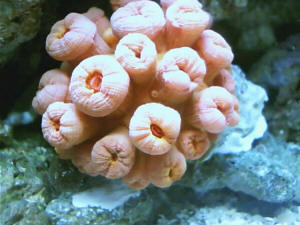
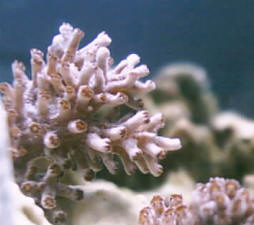
but also found a small rock with soft coral on it at the bottom of
the bin and purchased both for $3. The coral was
laying/flopped on its side. I set up a 1-1/2 gallon tank
with some PVC pipe and egg crate shelf to place them on and used a
mix of water from my 10-gallon tank and premixed change
water. I placed the rocks in there. no, I did not
acclimate the coral. started the Nano filter put in some Live Farms
BioPlankton and put a 13W 50/50 light over the
tank. Within a minute they both raised up. Is
this Capnella? <Might well be> Is this
(hopefully) a photosynthetic coral? <Is>
I also had them place on hold green star
polyps and eventually plan to get some Zoanthids. If it
is Capnella, is it a peaceful type? For a small tank
I'd prefer not to have WWIII in there. <Is
peaceful enough... given care in assembling small colonies, good
husbandry... you should be fine here> Thank you again for all
your help. Regards, Debra P. <Thank you for sharing
your adventure, odyssey. Bob Fenner> |
|
|
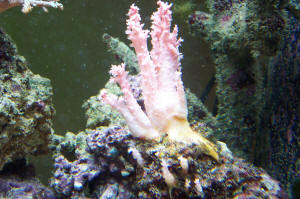
| Non-photosynthetic Neptheid 2/27/05 I
acquired this soft coral a couple days ago. I'm hoping it's
not Dendronephthya, maybe Scleronephthya. Can you ID it? <it
sadly is a non-photosynthetic Neptheid. Dismal survival in
captivity> Then I can look up its requirements here. If it needs
to hang upside down, how important is this, and what is the
advantage? Thanks for the help. Darren <do look up info
(little as there is) on the successful keeping of Dendronephthya
and like kin. It's really an awful group... most we do not know
how to keep or what they eat. Those that we do know we still
can't feed well if at all (bacteria, floc, specific plankton
species). I strongly encourage you to keep a large fishless
refugium with a DSB, and feed live plankton (phyto and zoo-).
Anthony> |
|
|
|
|

