Become a Sponsor

 
Home
Information Pages:
Marine Aquarium
Articles/ FAQs
(enter words you'd like highlighted in this page)
Freshwater Aquarium
Articles/ FAQs
Planted Aquarium
Articles/ FAQs
Brackish Systems
Articles/ FAQs
Popular Pages:
Features:
Daily FAQs
FW Daily FAQs
SW Pix of the Day
FW Pix of the Day
Conscientious Aquarist Magazine
New On WWM
Helpful Links
Hobbyist Forum bb.WetWebMedia
Ask the WWM Crew a Question
Calendars
Search Feature
Admin Index
Cover Images


Related FAQs: Nephtheids, Nephtheids 2, Dendronephthya, Neptheid Identification, Nephtheid Behavior, Nephtheid Compatibility, Nephtheid Selection, Nephtheid Systems, Nephtheid Feeding, Nephtheid Disease, Nephtheid Reproduction/Propagation, Soft Coral PropagationSoft Coral Health

Related Articles: Dendronephthya and Scleronephthya, Corals to Avoid, by Adam Blundell, Soft Corals, Order Alcyonacea

/The Best Livestock For Your Reef Aquarium:

Soft Corals of the Family Nephtheidae

By Bob Fenner

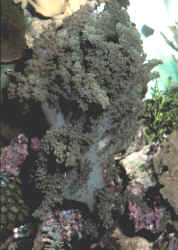
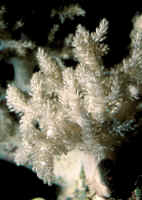
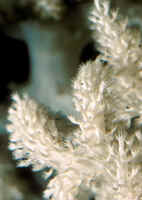
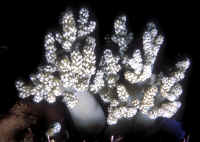
 Capnella sp.

Genus Capnella Gray 1869: (Kenya) Tree Coral. Have small arborescent headed colonies, with polyps that are non-retractile. 

Capnella sp. Indo-Pacific. Polyps found on small branches at end of only a few branchings, and are not retractable. Have club-shaped sclerites within. Often misidentified as Litophytons. Aquarium photo and close-up.

Capnella imbricata (Quoy & Gaimard 1833). Distinctive compact colonies with short branches that occur straight up from their basal stalk. Polyps are crowded and don't retract, restricted to terminus of branches. Western Pacific; New Guinea, Philippines. N. Sulawesi pix. 

Bigger PIX:
The images in this table are linked to large (desktop size) copies. Click on "framed" images to go to the larger size.
 

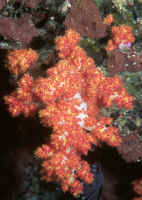
Genus Dendronephthya Kukenthal 1905: Strawberry Corals. Greatly bunched, bushy colonies. Common in many areas of the tropical Indo-Pacific. Lack zooxanthellae, dependent of nano-plankton and dissolved organics for food. Some grow exposed, many others in caves, sheltered settings, mostly "upside down". Some 250 species are said to exist... not able to be discerned in the field... must be microscopically examined. 

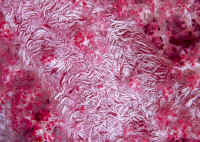
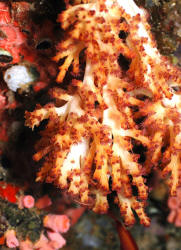
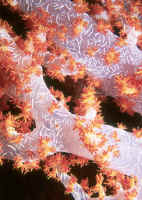
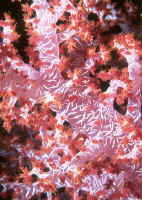
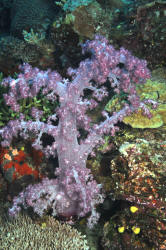
Dendronephthya sp. Indo-West Pacific. Polyps in groups of varying number on the distal branches of colonies. These are supported by internal and surface (visible) sclerites. Feed on very fine plankton and dissolved organic matter. Very difficult to maintain in captivity. Close up at right in the Red Sea, two below in   the Andaman Sea off of Thailand and one in Fiji in a typical (upside down) orientation in a cave.

Dendronephthya (Roxasia) sp. 1. Bushy to tree-like. Branched and re-branched to more slender ends. Indo-West Pacific; Red Sea, East Africa to Japan, Philippines, Micro- and Polynesia. N. Sulawesi pix. 

Dendronephthya (Roxasia) sp. 2. Similar to sp. 1, but with white branches, red/magenta polyp clusters. Often an upright grower. Western Pacific; New Guinea, Indonesia. N. Sulawesi pix.  

Dendronephthya (Morchellana) sp. 2. Tri-colored... white branches, magenta or white sclerites. Polyp clusters in umbrella like groupings. Western Pacific; Philippines. Malaysia and N. Sulawesi pix. 

Dendronephthya (Spongodes) sp. 1. Bushy, prickly colonies on few, short branches, polyps grouped in tight round bunches. Indo-Western Pacific. N. Sulawesi pic. 

Dendronephthya (Morchellana) sp. 2. Large (up to a meter tall) colonies of white branching, with roundish polyp clusters that are "spiky". Western Pacific; Madang, PNG. N. Sulawesi pic. 

Dendronephthya sp.  Here as glomerate colonies in N. Sulawesi. 


Bigger PIX:
The images in this table are linked to large (desktop size) copies. Click on "framed" images to go to the larger size.


Genus Lemnalia Gray 1868: Slender branched, tree-like soft corals with long, bare, thin stalks and branches, small roundish polyps sparsely distributed on branches, twigs, and cannot retract into body. Indo-West Pacific; East Africa to Australia, Japan.

Lemnalia sp. N. Sulawesi pix.

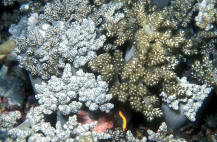
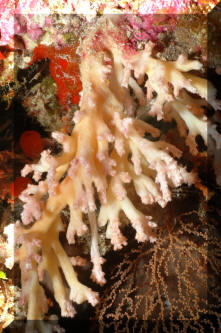
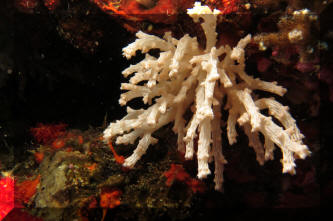
Genus Litophyton Forsskal 1775: Tree Soft Corals. Bush to tree-like in overall appearance. Up to half a meter in height. One type of polyp structure that are non-retractile, clustered terminally on branches

Litophyton arboreum Red Sea. Variable in color depending where growing, season. Red Sea and N. Sulawesi images. 


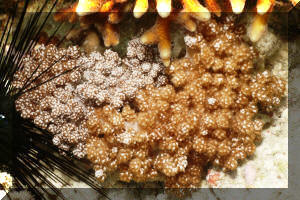
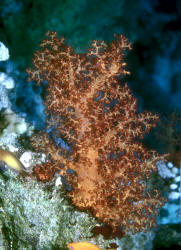
Genus Nephthea Audouin 1826: Bush- or tree-like in appearance. To a foot and a half tall. Soft to touch. One type of polyps that are non-retractile, clustered terminally on branches, lobe-like. Most often are colored brownish-yellow, but also found brownish-green to purple. Color owing to their zooxanthellae. Common to abundant in wave-protected shallow reef areas in  Indo-western Pacific reefs.

Nephthea sp. in captivity and in Australia's Great Barrier Reef. 

Genus Paralemnalia Kukenthal 1913: Shorter, more numerous branching (finger-like lobes arise from common bases) than Litophyton, Lemnalia spp. Polyps can or cannot withdraw completely, colonies are limited in their contraction.

Paralemnalia thyrsoides (Ehrenberg 1834). May be common where found. Shallow fringing reefs, slopes, flats. To 30 m depths. Western Pacific; Australia to Japan. N. Sulawesi pix.

  
Bigger PIX:
The images in this table are linked to large (desktop size) copies. Click on "framed" images to go to the larger size.
  

Genus Scleronephthya Studer 1887: Mostly small (less than 4 inch tall) colonies that are very contractile (often look like blobs at slack tides, currents, otherwise non-feeding during the day). Often uni-planar and multi-branched. One-shape polyps that are found only on branches. Lack zooxanthellae, but come in many colors (mostly orange, but pink, purple, even white.  

Scleronephthya sp. Indo-Pacific. Similar to Dendronephthya, differing by possessing highly retractile polyps that lack sclerites. Just as difficult to maintain in captivity. N. Sulawesi pix.

Bigger PIX:
The images in this table are linked to large (desktop size) copies. Click on "framed" images to go to the larger size.


Genus Stereonephthya Kukenthal 1905:


Featured Sponsors:
Google
 
Web www.WetWebMedia.com