|
FAQs about Marine Snail (Gastropod)
Reproduction 2
Related Articles: Gastropods, Sea Slugs, Mollusks, Abalone,
Related FAQs: Snail
Reproduction 1, Marine Snails
1, Marine Snails
2, Marine Snails 3,
Snail ID 1, Snail ID 2, Snail Behavior, Snail
Selection, Snail
Compatibility, Snail Systems,
Snail
Feeding, Snail Disease,
Mollusks, Sea Slugs, Abalone,
|
|
Snails, SW, repro.
Hello,
I am conducting experiments on Littorina obtusata, a common
snail on rocky intertidal shores. I noticed some egg
masses on the algae recently and started doing research about L.
obtusata reproduction and how to raise the juvenile snails in a healthy
and safe manner. I came across your website and found it to be
incredibly in-depth. I was wondering if you could tell me anything about
L. obtusata reproduction, or at least what you think would be the best
way to ensure that my snails hatch and are healthy.
Currently I have them in a container with fresh seawater and an aerator.
Thank you very much for your time,
Julia
<Hello Julia. What research have you done so far? What have you read? I
believe that these snails have direct development (no larval stage)
which is unusual for the genus. All else being equal rearing the
hatchlings should be easy assuming adequate food, salinity and
temperature. So what problems have you had so far? What conditions are
you providing (food, light, pH, salinity, etc.)? My biggest challenge
when maintaining Littorinids has been physical escapes. They dislike
being under water for any great length of time. Obviously breeding
species with planktonic larvae will be extremely difficult, probably
impossible without a good deal of research. Cheers, Neale.>
Re: Snails
I haven't been able to find anything about obtusata development, except
that fertilization is internal (most likely) and that they do not have a
larval stage (I have seen juvenile obtusata in the field and I read that
in a few places).
<Agreed.>
Since I found them on Fucus vesiculosus, that is what they have right
now.
<Hope you are having success with these... historically "wracks" haven't
always done well in aquaria, and I'm sure I read something years ago
about decaying wracks releasing toxins into the water.>
I am going collecting next week so I can supply them with more if
needed.
They are being kept at about 14 degrees Celsius, the same temperature
that the adults are kept at.
<Sounds prudent.>
I am not sure about the salinity, but the water is from where I
collected the adults, so it should be whatever they would experience in
the wild.
<Again, a logical approach, but do check if there's a relationship
between survival of juveniles and ambient salinity... could easily be
that mortality goes up as salinity goes down, and that populations in
brackish water are recruited from the sea rather than self-maintaining.>
They are in a growth chamber with light 24/7, but, again, this is no
different from how I'm keeping the adults. To prevent escaping,
you should cover the container with foil, and push it against the top of
the inside of the container.
<A good idea!>
I am taking care of ~200 obtusata at the moment and none of them have
escaped.
<Impressive.>
From what I have seen in the field, juvenile obtusata look no different
from adults, except that they are as big as a grain of sand. I
would expect that they would need similar conditions as the adults.
<Seems sensible. Good luck with the experiment. Cheers, Neale.>
Re: Snails /Neale 7/31/13
Hello,
<Julia>
As seen from earlier emails, I had some questions about raising juvenile
obtusata eggs and I would just like to thank you again for your help and
let you know that , under a microscope, I observed movement of the
juvenile snails still in their egg masses so I think that they are doing
fine.
Thank you very much for all of your help.
<Ahh; Neale is "out" presently. Will convey your msg. BobF>
Re: Snails 8/4/13
<Ahh; Neale is "out" presently. Will convey your msg. BobF>
<<And back now! Thanks for the message, and glad your project is
progressing well. Cheers, Neale.>>
Turbo snail issue 4/18/11
Hi folks!
<Adam>
I've got sort of a dirty question for you: How do you stop an
amorous turbo snail from releasing massive quantities of what I can
only assume to be sperm?
<Hard to do... adverse conditions and propitious ones lead to this
behavior>
Here's why I ask:
I have a 20 gallon Nano and a 90 gallon reef. Once several months ago I
transplanted a turbo snail from my reef to my Nano to deal with an
algae issue. The next morning, I came downstairs and thought my tank
had crashed, the water was the colour of runny milk. After a brief
panic, I realized it was the turbo snail releasing a near continuous
jet of milky white fluid, with enough force to break the surface of the
water. I hadn't really wanted a turbo in a tank that small to begin
with, so I immediately returned it to the 90.
<Good>
Now, as I've reported to you guys in the past, I'm building a
new, much larger aquarium in the wall of my new house. Unfortunately
timing hasn't been my friend, and my current place has been sold
month and months ahead of our (very overdue) scheduled completion date
of the new house, so I've spent the last two days breaking down my
90. Thankfully I found someone on Canreef (AKA Reef Central North) who
was kind enough to set up a spare tank in his workshop to look after my
coral and fish for the next few months.
<Very nice>
Unfortunately, I missed one turbo snail in the move, and found it this
morning precariously drying out in the corner of the overflow of a now
empty tank. Since my friend lives over an hour away, I put the turbo
snail in my Nano. Lo and behold, 1 hour after it went in, it also
started ejecting massive volumes of white goo in to the water column.
It's not distressed as far as I can see, the thing is motoring
along eating, but every so often it stops and... gets happy.
<I'll say>
Does the extra protein in my water column from one snail have the
potential to crash the tank?
<Doubtful>
Is there anything in the tank specifically that might be triggering
it?
<Don't know... light period/icity, temperature most likely, but
there could be many other possible cues>
The tank has a skimmer now (it didn't the first time), so the water
hasn't gone completely opaque, but it's been in there for
nearly 5 hours and it keeps doing it! I've been reading online and
other than some hilariously familiar YouTube videos, I can't find
anything to indicate why it's doing it now.
<Again: "good or bad conditions">
I hypothesize that these snails pick up on the presence of sexual
fluids in the water to try to synchronize the timing of their spawning,
and that in my 20 gallon the small volume released from one snail leads
to a concentration high enough to induce even more of this behaviour
from that same snail, like a positive feedback loop gone crazy (I could
be totally wrong), but beyond adding a sump (which I can't do) with
carbon (which I have no space for) I don't know if there's
anything I can do to stop it.
<Nothing I'd do other than remove the snails... How to put
this... many/most marine organisms are to degrees feeders on gametes,
juvenile forms... Think on this>
Thanks again for your time,
Adam
<Welcome, Bob Fenner>
Keyhole Limpets and Other Snails, repro., comp. --
3/10/11
Hi Crew,
<Hello Sam, Lynn here today.>
I have a 24 gallon Aquapod. Among my critters is a pair of Keyhole
limpets that I bought about 2 years ago. I now have a few dozen babies
and am curious as to how they manage to reproduce.
<It varies, but typically they broadcast gametes (sperm and eggs)
into the water column. Interestingly enough, some actually brood their
young.>
I seem to find the babies in the most unlikely places like in my hang
on skimmer.
<Yep, I can tell you from personal experience that they also like
hang-on filters! Judging from the fact that these limpets reproduce
successfully in home aquaria, they more than likely have a very short
free-swimming larval stage. Many likely perish during this period due
to equipment issues and predation. However, the lucky ones find
sanctuary in the relative safe haven of skimmers, filters, fuges, and
the like. There, they find an environment with sufficient food to
entice them to settle and metamorphose into tiny replicas of their
parents.>
They grow very slowly.
<Yes, they do -- or at least mine seemed to.>
My first set of babies are still about half the size of a split pea.
Aside from the fact that they are very difficult to remove as compared
to the average snail
<Heee! Hence the term 'clings like a limpet'!>
..they seem to be good algae eaters. For some reason one of the adults
does bother one Blastomussa wellsi that I have.
<Funny you should mention that. I had the same experience with one
of the limpets I had. I caught it munching on my favorite B. wellsi one
morning and promptly banished it to the fuge!>
It almost destroyed it 3 times already but each time it recovered.
<That's the great thing about Blastomussa wellsi, in good
conditions even a polyp that's been reduced to a near speck can
regenerate itself.>
I now keep the Blasto on my crushed coral figuring the limpet will not
like to pass over that and since then it has not harmed it.
<Good thinking>
I also have a few Strombus snails, the kind that lay these little round
see thru packets of eggs.
<Are they the snails typically referred to as 'Strombus
Grazers'? If so, they're more than likely Columbellids, aka
'Dove Snails'. They're wonderful little grazers that
reproduce like rabbits. Please see the following link for more
information and photos for comparison: http://bb.wetwebmedia.com/viewtopic.php?f=25&t=341
>
I used to have 6 adults but now have 2 plus 3 small ones. I still see
many egg packets but it seems that very few make it.
<Something may be preying on them or perhaps there's just not
enough food to go around.>
These things seem to go in cycles. I used to have hundreds of
Stomatella snails and now am down to a few here and there.
<Don't you just love these little snails? Sadly, other critters
love to pick at, and eat them, particularly peppermint shrimps.>
Just sharing,
<Thank you for your terrific observations!>
Sam
<Take care, Lynn Z>
What To Feed Newly Hatched Whelk? 12/2/10
Hi there - thanks for this outstanding portal of information!
<Hi Sue, and you're welcome.>
While walking the beach a few months ago I found something
"strange" and being obsessed with finding out what it was, I
brought it home and started Googling. It wasn't easy to do (since I
had no idea what words to enter in the search engine) but finally
discovered that what I had found was a string of whelk egg casings. Not
knowing if there was anything viable left in it (some of the capsules
seemed to still have some fluid in them)
<A tell tale sign is small holes in the casings indicating the newly
hatched whelk has ate its way through.>
I quickly threw together an empty 14 gallon Biocube with some live sand
and water from my reef tanks and put the casing in there. I had also
picked up some rocks and "clustered" snails on the shore so I
added them to the tank, too.
<Will soon become meals for the whelks.>
Low and behold, I have noticed several baby whelk on the glass over the
past few days! I have no idea what I'm going to do with them when
(if) they get bigger but for now I am fascinated that they hatched and
would love to keep them alive. Any idea what I should feed them?
<Most are active predators and will bore their way through snail and
clam shells to dine on the inside.>
I've learned from reading that the hatched whelks eat the
unhatched/unfertilized whelk eggs but that won't hold them for
long. I know the adult whelks dine on clams
<And snails.>
so should I start putting raw clam meat in the tank?
<You can try this, may or may not be acceptable.>
Any suggestions or advice on rearing these fosters would be
appreciated.
<May want to read through our FAQs here.
http://www.wetwebmedia.com/WhelkF.htm>
I am heavily into animal rescue and rehab but I can honestly say this
is my first attempt at orphaned
whelks!
<Mmm, any further advice Bob?><<Mmm, nope>>
Thanks in advance.
<You're welcome. James (Salty Dog)>
Sue Alexandre
|
Nassarius Snail Repro. Question/Amphiprion
Cross-breeding -- 08/30/10
Hi All!
<<Greetings!>>
Its Chris K. again - very excited as usual to be able to have a
question and something to share!
<<Hey Chris--Eric here today'¦>>
Firstly - one of my Nassarius snails is laying eggs -- I
understand that I should expect nothing from this
<<Not true necessarily'¦ I have had a breeding
population of Nassarius sp. snails for about seven years that
continually replenish their numbers>>
- but just out of curiosity - how long before they hatch?
<<Mine seem to do so rather quickly--perhaps
'days'>>
Are they in some sort of larval state before they develop a shell
and enter the substrate?
<<I'm not really sure--though I suspect they 'do
not' have a larval/planktonic stage else they would not
reproduce so successfully in my system>>
The only reason I ask is because around April my queen conch
began laying eggs - this went on for a few months. I didn't
expect much - given that most likely they would fall prey to fish
and other predators in my tank. However - one night I happened to
walk past my tank long after lights out and noticed what appeared
to be salt all over my glass. I immediately flipped on the light
and noticed that they were very small snails (I am certain that
they are not pyramid snails), I began to look closer and observed
that there were hundreds all over my rocks and glass. Apparently
they hide during the day and come out at night. Now I am merely
implying the coincidence between my conch laying eggs and then a
month or two later having an explosion of tiny snail like
critters visible in my aquarium. I am trying to stay
realistic.
<<Likely 'something' that came in with your
rock>>
They are tiny and round (white and rather fragile looking - not
the thick shelled specimen that I would expect) and I am hoping
that if I can get a decent photo - you can help me identify
them.
<<Some 35,000 species in existence [grin]>>
As a side note, they don't' seem to be attracted to any
of my coral and nothing appears to be getting damaged - so I am
in a wait and see mode.
<<They have probably been in your system for some time and
are probably harmless, if not beneficial>>
Lastly - I have two black and white Ocellaris clowns in my tank
along with two orange and white Ocellaris clowns.
<<Mmm--it is generally best to keep only a single pair,
especially of these two similar species (Amphiprion Ocellaris and
Amphiprion percula), as keeping more usually results in the
exclusion/bullying/death of those individuals outside the primary
pair-bond--unless the system is large enough for multiple
territories>>
Initially they paired off according to their color and that was
that. The dynamics have recently changed though.
<<Not to be unexpected here>>
One of the black and white clowns has exploded by almost double
in size -obviously the female.
<<Yup>>
However they are "pairing off" by color less and less -
the other three clowns seem to be following her around (even the
orange ones) and doing dances for her. Presently she is spending
most of her days with the two orange and white guys. Is it
possible for a black and white Ocellaris to mate with an orange
and white Ocellaris
<<Sure>>
- and if so - what kind of clown does that produce?
<<A hybrid thereof>>
Anything interesting?
<<That remains to be seen, perhaps small variations in
color--or these parent species may be so similar as to not
exhibit any obvious differences among offspring>>
Thanks again for all your help!
<<Quite welcome>>
As always you are a most valued reference!
Chris K
<<Happy to share my friend'¦ Eric R>>
Re: Nassarius Snail Question/Amphiprion Cross-breeding -
08/30/10
Thank you Eric for your response
<<You are quite welcome, Chris>>
- as always you make my day!
<<And it makes mine/ours to hear/know this!>>
If I were able to get a photo of the tiny snails rather than ask
you to go through 35,000 species (wow) perhaps you would be able
to give me the thumbs up or thumbs down as to whether by some
shear miracle any baby conches survived
<<We can surely take a look--though I am skeptical that
these are the offspring of your Queen Conch>>
(which you have undoubtedly figured out by now is my only real
question anyway).
<<I had a feeling'¦ [grin]>>
Fortunately, or Unfortunately depending on your outlook, I have
always taken the words "that can't be done" as more
of a challenge than a rule.
<<Mmm, okay--and hopefully tempered with reasoning when it
comes to the environmental requirements of your
animals/limitations of your system>>
I did after all manage to find a beautiful blue fish with a
personality that fits in perfectly with everything else in my
aquarium.
<<A yes--indeed you did>>
It took a few years but in this instance being relentless paid
off.....(grin). As for the clowns - I have had them for some time
now and am quite fortunate that the black and white ones have
claimed the territory near my corner over flow on the far left of
my 90 gallon. The orange and white clowns claimed an anemone
ornament which I moved long ago to the farthest right hand
corner. Each "pair" is allowed within inches of the
others territory before the obligatory charge or head but ensues
- and can often be seen roaming freely throughout the rest of the
aquarium all together.
<<Excellent>>
(Until recently - as previously stated - now the males just seem
to follow the female wherever she feels like going).
<<Ahh 'Amore'>>
If my clowns should mate is there a chance that the offspring
would survive?
<<Not likely--at least, not likely without some preparation
for such (like a plan for removing the fertilized eggs to
hatching/rearing tanks, feeding the fry, etc., etc.). If you are
so inclined, there is an excellent book by Joyce Wilkerson on
'Clownfishes' that I highly recommend you obtain and
read>>
I have no anemone
<<Is not needed>>
- I do not believe I have strong enough lighting to keep one (no
metal halides nor the more recent and seemingly way cool
LEDS)
<<Way cool and WAY expensive--and I am still not convinced
they are equal to, much less better than, Metal Halide. But the
day may well be coming'¦>>
Thanks again Eric and have a great day!
Chris K.
<<Cheers Chris! Eric Russell>>
R2: Nassarius Snail Question/Amphiprion Cross-breeding
(and now, snail ID) - 09/01/10
Hi Eric,
<<Hiya Chris>>
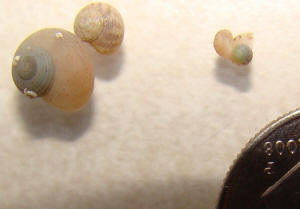
I have attached a photo of the snails that have been showing up
in my aquarium - in the various sizes that I have noticed.
<<Ah yes'¦ These look to be a species of Nerite,
or maybe a Collonista species (take a look at the operculum
covering the shell opening--Collonista spp. have a prominent
'pit' in the center). Either way, nothing to be concerned
with>>
Just a few questions - does it at all look like any of the conch
eggs could have survived?
<<No--these are not Conchs>>
If not, is this a snail that you readily recognize and under the
circumstances would you still consider it harmless or even
beneficial?
<<Yes (well, as stated at least) and yes>>
Thanks again to all for the expert direction!
Chris K
<<Always a pleasure to share, Chris'¦ Eric
Russell>>
|
 |
|
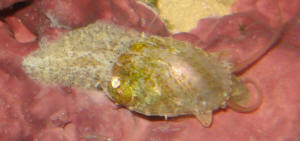
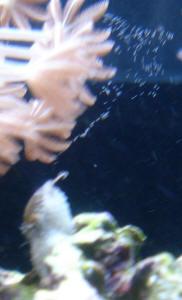
Spitting Stomatellid -- 7/14/10
Hello Everyone, Dayna here.
<Hello Dayna, Lynn here this evening.>
Fantastic Site.
<Thank you kindly.>
I have successfully identified 4 new additions to my tank,
through this site! I do have a few questions. I have 4
Stomatellids roaming around my tank.
<Love'em!>
Usually I observe them most active at night.
<Typical>
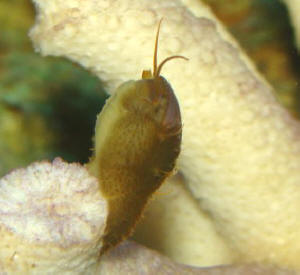
Today, however, one boldly climbed up one of my corals, posed
itself on its hind,
<Nice photo!>
..and spit out a cloud of white particles which I am only
guessing is eggs.
<Yep, it's funny to see them 'stand up' like that,
isn't it! Males release a cloud of sperm in a series of puffs
and females release what's usually a rather gelatinous mass
of eggs that settles to the substrate and soon dissolves,
releasing the embryos. Thankfully, although the young go through
a free-swimming larval phase, it's of short duration, so a
good many individuals survive to become beneficial little algal
grazers.>
How many of these little guys are too many? What is the gallon
per Stomatellids ratio that would be considered healthy?
<Hmmm, honestly I don't think I can give you a quantity
per liter/gallon. Instead, I can relay to you that in the absence
of predation, their population should be controlled by the amount
of food available. What I'd suggest is gathering up some of
the extras and giving them away to fellow hobbyists. Perhaps you
could even sell or trade some for a frag or two!>
Thank you! I love this site!
<You're very welcome and thank you!>
Dayna Macdonald,
Chief Stewardess
<Take care, Lynn Z>
|
 |
Stomatella Spawning Constantly in Nano! Help!
4/9/10
Hello!
<Hello Megan, Lynn here today!>
I have come across very little negative info about Stomatella...the
closest thing I saw to a caveat was on WWM...someone with a larger tank
than mine was assured that Stomatella spawn (unlike coral or clam
spawn) is pretty harmless in a larger tank (I think the guy had a 75
gallon) and that this is not normally a problem, "except maybe in
a Nano..."...but the crew member did not elaborate...
<Yep, usually they're a welcome addition and not a
problem.>
Well, I have a Nano....12gal.
<Uh-oh, NASA we have a problem.>
We started with one tiny Stomatella from the LR, then did not
understand why our water was cloudy for a few weeks.
<That's an awful long time to stay cloudy. Did you try checking
your parameters and running carbon?>
Then we saw new snails. Now, we have seen them spawning with our own
eyes, and so realize why water had tiny particles, back then &
now.
<Gotcha>
Back then we only had the one adult snail, water cleared up fast.
<Good>
But now we have 10-15 adults and they have been spawning every single
day for past 3 weeks!
<Yikes!>
Doing water changes actually triggers spawning even more!
<Ouch>
I do like these snails but wonder if this is good for my tank...the
fish eat the eggs, but the Crocea clam I have produces a lot of mucus
to get the eggs off of him.
<I bet. If the clam's getting irritated, then it's not
good.>
The water quality is still good...nitrate has not gone up excessively,
no ammonia, etc.
<Good>
We have persisted with weekly water changes anyways because I don't
want to have a dirty AND eggy tank.
<No kidding>
I realize we don't know what makes them spawn...so I just need to
know if this is bad and what we can do to control the snails (if not
their spawning).
<I would control their numbers. Remove and perhaps sell or give
some/most away to fellow hobbyists (try a local fish club).>
I have very peaceful fish that do not eat snails and am not too
interested to get a hunter type of fish but will consider any
advice!!
<That would be my next recommendation, but only if you want to get
rid of them all. Peppermint shrimp (Lysmata wurdemanni) reportedly prey
on Stomatella snails, along with some crabs and hermits. Unfortunately,
all of those can be pickers of other things as well and cause problems.
Personally, I would opt for reducing the population and running carbon
or something like Pura Filtration pads to help clear the water.>
Thank you as always for help with this extremely specific question.
<You're very welcome and good luck!>
Best,
Megan
<Take care, LynnZ>
Breeding saltwater snails 9/17/09
Hi folks.
<Hello Jason,>
I was wondering if you knew of the best route to take for breeding
saltwater snails for my Puffers and Triggers to munch on.
<Not much chance in most cases. The vast majority of marine
gastropods produce planktonic larvae, and reproduction under aquarium
conditions is a bit hit-and-miss. You'd likely be better off
breeding freshwater snails, and feeding those to your saltwater
durophages. Cherry Shrimps and even Crayfish might be an option too. To
be honest though, whole fresh or frozen shellfish would be cheaper. I
like to use things like North Atlantic Prawns for my pufferfish, eating
the tails myself, and letting the fish have the legs and cephalothorax.
For some reason, they love prawn eyeballs!>
Also, would my refugium be a good place to raise them as they're
safely away from the predators?
<Up to a point, but I doubt you'd be able to produce them at a
viable rate to supply even a small pufferfish adequately. This
isn't going to be like producing copepods for a
Mandarinfish.>
I know they need crunchy food for their teeth and continually replacing
crabs/snails can get expensive without a good plan.
<Do head over to the seafood counter at your local grocery store, or
check out the frozen foods at an Asian food market. Things like clams,
mussels, crab legs, crayfish and unshelled shrimp can all be pressed
into service.>
Thanks for your help,
Jason
<Cheers, Neale.>
|
Snail Eggs? Cerith -- 6/6/09
Hi Crew!
<Hi John, Lynn here today>
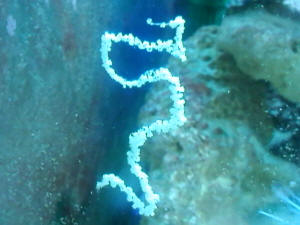
I have noticed a few of these serpentine like shapes appearing on
the back and side glass of my 125 gallon tank. The tank is about
a year and a half old and this is the first occurrence of them I
have seen.
<It's possible that they were previously placed in hidden
locations -- behind rocks, on the back glass panel, etc, or it
could be that conditions recently became favorable for
reproduction. It could be anything from water parameters to the
available food/algae supply (perhaps a recent increase?).>
A few days ago, I began removing some Aiptasia anemones in my
tank by dosing them with a mixture of pickling lime and r/o
water.
<Good method>
After reviewing the site, I think they are Cerith snail eggs?
<Sure looks like it to me.>
I do have a few in my system and I am guessing that the lime
addition to the water has raised the ph and alkalinity thus
resulting in happier snails.
<Possibly so, if those numbers (calcium as well) had been low
prior, and you were treating many, many Aiptasia - or using
copious amounts of lime solution (which I would not recommend).
Do test for pH, alkalinity, and calcium to ensure they're all
within the appropriate range.>
If my assumption is correct, is there a way to protect the eggs
as I would not mind having additional snails in the tank?
<Keep predators away -- fish, shrimps, crabs. You could use
something like a clean plastic berry holder from the grocery
store. Wedge it somehow against the glass and hope for the best.
It's either that or move the eggs to another tank that lacks
predators and has a good supply of algae. Although not exactly
commonplace, there are hobbyists who have had success raising
these snails.>
Thanks for your time!
<You're very welcome and good luck!>
John
<Take care, LynnZ>
|
 |
|
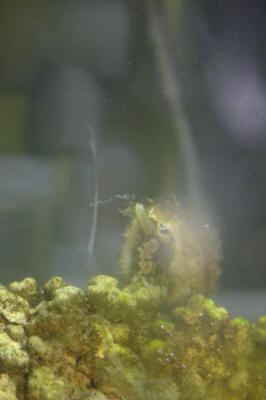
Snail Spawning... 01/07/2009 Greetings, Merry
Christmas and Happy New Year! <Thank you, y tu tambien.> I
thought I would send along this picture of what I believe is a
snail trying to procreate... <Indeed... it looks to be
dropping some eggs.> I may be grossly mistaken, however, as I
usually am :) I apologise for the poor image quality. Either way,
your thoughts on this would be most appreciated! <I think you
have it right, is procreative...> Respectfully yours,
Justin
<Best,
Sara M.>
|
 |
|
Re: Snail Spawning... 01/07/2009,
1/8/09 Ciao il mio amica. <Hehe... is this Italian? I
thought I was speaking Spanish. This is San Diego I'm writing
from... ;-) > From what I read on WWM, spawning is very hard
on a small fish tank. <Oh, this is true of clam and/or coral
spawning which are typically much larger than snail spawnings. I
would not worry too much about a single snail spawn (they usually
have little to no effect in any tank over 10g).> I have done a
20% water change, should I do another in the same day? <Unless
this is a nano tank, no, I don't think you need to.> Many
apologies for troubling you with this silly question. <Not
silly at all.> J <Best, Sara M.>
|
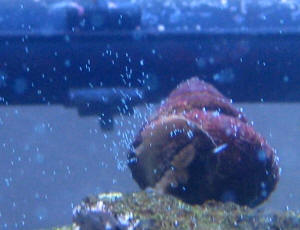
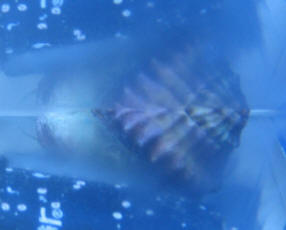
| Astraea Snail Spawning -11/2/08 I forgot the
add the pictures. Here they are <Cool pics! Thanks!> Hello
all, I have 5 Astraea snails 3 seem to be female, 1 is male, and 1
is unknown (they are at least 3.5 years old). 3 are releasing eggs,
1 is (in my guess) attempting to release eggs, and 1 is releasing
sperm. I was wondering if there is a way to keep these alive?
<The snails? ...or the spawn? If you want to try your hand at
breeding them, you can use a baster to suck up the eggs and sperm
and mix them in a "sterile" goldfish bowl full of water.
You might try an airstone for circulation in the bowl.> I placed
all the snails in a 1 gal tank and let them do their thing until
the bottom was covered with eggs and the water is so cloudy that
you can't see through the other side. <Oh, oops, I should
have kept reading your email... yes, this should work too.> The
snails are still doing their thing in the main tank. I have looked
for a few hours on many sites and can't find anything out about
these snails except that they don't reproduce in the aquarium
and only live 2 years <Well, there's always a first time for
everything.> I have attached 2 photos. One of a female and one
of a male. I have a few short videos if you are interested in them,
Thank you for your help, <Please do keep us updated. What do you
plan to feed and how do you plan to filter/circulate the tank with
the spawn, anything? You might try also posting on this on the DIBs
and/or MOFIB.> <Thanks for writing, Sara M.> |
  |
Stomatella spawning 10/8/08 Greetings to the
crew at WWM <And to you! A tardy Mich here apologizing for the
delay.> and a big thanks for all your work! My tank has benefited
greatly from the knowledge you folks provide. <Glad to hear!>
While I was feeding my fish tonight I was fortunate enough to witness a
Stomatella spawning. <Cool!> First one male released his sperm,
then a second then a female release her eggs followed by a second
female and finally a third male all within about a minutes time and
from several locations around the tank. Very cool to watch and a couple
of my Damsel's loved the eggs from one of the females! <A
treat.> I've seen a single male broadcast from time to time, but
never two simultaneously let alone a combination of both male and
female. <Neat!> My question is what triggered this event?
<Ahhh... if we only knew.> The lights had been on for about an
hour and I couldn't think of anything in their environment that
might have triggered it (no unusual temp or current changes etc.) Seems
to me, for that kind of timing, there had to be a trigger of sorts
<Likely so. What triggers many of the spawning events isn't well
understood and can be related to many different things from temperature
to literally the phase of the moon.> I already have MANY Turbo
babies and now I'm looking forward to hopefully spotting a few new
Stomatella's. <I hope you are correct!> Thanks again for your
help <Welcome, Mich>
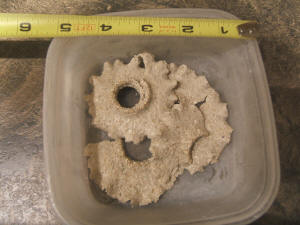
Circles of Ribbon-Like Sand: Likely Egg Collar -
9/8/08 <Hi Gerry, Lynn here this morning.> Over the
last couple of months these circles of ribbon-like sand appear in
my tank. They appear in different locations each time. The last
time they appeared was 3 weeks ago there were 2 of them. I removed
them when they appeared and took these pictures. Today I have
noticed a new one in my tank. Any idea what is making this?
<They look very much like what's commonly called a sand or
egg collar, a combination of mucus, sand grains, and eggs produced
by snails in the family Naticidae (commonly known as Moon snails).
Do you have any of these in your system? Here are some examples of
these egg masses for comparison:
http://farm3.static.flickr.com/2288/2250226721_f350b8a92a_o.jpg
http://jellyfishinthesea.files.wordpress.com/2008/04/img_4401.jpg
http://www.manandmollusc.net/Mystery_shell_pages/mystery_shell_steve.html>
Thanks, Gerry
<You're very welcome, Gerry. Take care, -Lynn> |
 |
Snails for GSPs 5/19/08 Hey guys, <Hi
Scott, Pufferpunk here.> I set up a 3 gallon eclipse tank about two
months ago to breed snails and it is going great. The snails are
breeding like crazy but they are taking longer than I thought to get
big enough to feed to my two green spotted puffers. <The rule of
thumb is: snails as big as their eye.> I have been pulling out about
six or eight at a time once a week and dropping them into the tank.
They generally do not make it to the bottom but my question is: how
many snails should I be feeding each fish to combat their teeth
growing? <The amount you are feeding is fine. Personally, I do not
feed snails very often. There are many easier to find hard-shelled
foods to feed to your puffers. See:
http://www.thepufferforum.com/forum/library/feeding/feeding-your-puffers/
> I have one GSP that is a little over two inches from tip to tail
and another that is about one and a half inches. I feed blood worms
most of the time along with black worms and sometimes raw table shrimp,
mussel or crab leg occasionally. <All good foods.> From the first
major snail spawn I have about 100 tiny snails crawling all over some
algae wafers that I am waiting to grow big enough and the bigger ones
are always laying more egg sacks around. <Zucchini might be a
better/cheaper option for snail food. It's much easier to pull out
a piece of that vegetable with snails crawling all over it, to harvest
them.> I don't want to decimate the population of mature snails
to the point where the little ones will take too long to catch up and
start laying eggs. Another quick question I have is that I have had
insane algae trouble with this tank ever since I set it up. For a few
months it was freshwater planted and when I started to add salt
coincidentally at the same time black beard algae overtook the whole
tank. <Black 'algae' may actually be Cyano. Check into
eradicating that at the WWM site.> I dealt with removing it for
about a month or more, until it choked out the plants and I had to
throw them away. At that time I removed the fluorite substrate, ran
diluted bleach through the whole tank, filters and rocks and started
over again with crushed coral substrate and I added Bio-Spira and hoped
for the best. The tank cycled ok but now there is nothing in the tank
besides the crushed coral and rock, so there is nothing to export
excess nutrients and with puffers they end up fouling their water in
like four days. Is there anything I can do to keep a brackish tank free
of algae or at least be able to manage it? <Best way to export
excess nutrients in a FW/BW tank is by doing at least 50% water changes
weekly. Be sure the puffers are housed properly--30g each adult
puffer.> I have a lot of marine experience with my reef tank but
this is my first foray into fresh/brackish water so I might be missing
something. <Although you seem to have snail breeding down pretty
well, here's an article on Basic Snail Breeding:
http://www.thepufferforum.com/forum/library/feeding/basic-snail-breeding/
~PP> Thanks, Scott
Hitchhiker Snail Reproduction: Stomatella varia -
1/17/08 Hello WWM, <Hi there!> Thanks for all you do.
<It's a pleasure, indeed!> I have a hitchhiker snail that
I saw trying to reproduce in my tank. I tried to get some pictures
but they were hard to take with the xenia in the way.
<Understandable - can be tough to get good photos of such small
subjects - especially considering water flow/movement.> What are
the chances something like this can reproduce in my system?
I've only seen one of these in my tank. <What you've got
is a Stomatella sp., likely Stomatella varia. They're
harmless/beneficial little herbivores/grazers, highly variable in
color, reproduce readily in our tanks, and can get up to ~1.25'
in length. With such a small shell and so much exposed foot,
you'd think that this species would be very vulnerable to
predation. After all, how can it possibly protect itself if it
can't retract into a shell? Well, nature has allowed for this.
Stomatellids are mostly nocturnal, can move *very* rapidly, and
have the ability to detach the hind portion of their
"foot" (the 'metapodium'). This is similar to
some lizards detaching a portion of their tail when threatened. The
sacrificed segment wriggles and writhes, thus distracting the
predator and supplying it with a tasty tidbit -- allowing the snail
to escape. Potential predators of Stomatellids include the usual
'pickers' - hermits, shrimps, and crabs. Some fish also
find them tasty, but the snails' mostly nocturnal nature helps
to eliminate them from the menu. Sometimes confused with sea slugs,
Stomatellids are actually in the family Trochidae, which includes
the more familiar/recognizable Trochus spp. (Trochus/Top Snails),
Margarites spp. (Margarita Snails), and Norrisia sp (Moon Snails).
Regarding reproduction, unfortunately, if you have only the one
female in your tank, the eggs she released were not fertilized and
are therefore not viable. They will simply become part of the
food chain. Hopefully, there are some small, not yet mature
candidates around for future spawning events. As far as method,
Stomatella spp. are broadcast spawners. The male releases sperm
into the water while the female releases her eggs. In most cases,
this means that the young have very little chance of survival in
our tanks. However, such is not the case with Stomatellids. What
tips the scale in their favor is the fact that the young have a
very short pelagic larval stage, during which they don't need
to eat. After several days of drifting about in the current, they
settle to the rock/substrate as miniature versions of their
parents, and begin to graze. All in all, they're fascinating
little creatures and make terrific additions to a reef tank!>
Thanks, Jesse
<You're very welcome! Take care. -Lynn> |
|
|
Money Cowry Eggs - 6/1/07 Hey
guys <Hey Niko> I have about 5 money cowries in my reef thank and
one of them has laid eggs on the under side of my Fluval powerhead
exhaust. <Neat!> I saw the cowry there today and decided to pick
him off of the powerhead and sure enough there was a pile of yellow
white eggs. I quickly put her back up there and she has been getting
food and protecting the babies. I am worried about the babies survival.
I have a mandarin goby, 2 cb erectus seahorses (doing the breeding
dance every morning) and a ribbon eel. I have looked on the web
everywhere to find out how to raise them but all I find is never bred
in captivity or something to that extent. <Sounds like you've
got a great opportunity to fill in some blanks in this area. I've
heard of cowry eggs appearing in tanks now and then, but unfortunately,
never of the young being successfully raised. One problem is that most
cowry species hatch into free-swimming larvae called veligers and
become food for corals and any number of other organisms in our tanks.
Other species skip the free-swimming part. They simply hatch, crawl
out, and begin their lives (direct development). Unfortunately, I
don't believe money cowries (Cypraea moneta) are of this variety.
Among other issues is what to feed the veligers once they've
hatched. I can only guess that possibly one of the Phytoplankton
products available might be worth trying. Just be careful with those.
Too much can lead to an algal bloom. By the way, please do consider
keeping records of this and any further events. If you can supplement
with photos, that's even better! Any and all information you can
gather and share, helps us all better understand and increase the
chances of one day successfully raising these beauties.> Any
suggestions on perhaps using a breeder net and algae clip or something?
<See above.> Thanks Niko <You're very welcome. Good luck
and please keep in touch! -Lynn>
Snails laying eggs, and lighting Thalassia
sys. 3/20/07 Howdy Guys, <John> I'm
attaching several pics of some snails (Cerith perhaps) laying eggs
on my aquarium glass. Maybe they'll come in handy. <Hope
so> I do have a question. I have a yellow tang and I was
wondering if he'll eat turtle grass. <Mmm, maybe... is tough
to chew> A friend of mine gave me a few sprigs and I'm not
sure about the lighting requirements, etc. My main tank is 120
gallons with about 4-5 inches of fine aragonite sand on the bottom,
two 4 foot VHO's and two 175 watt MH, the yellow tang, seven
yellow tailed damsels, many snails and hermit crabs, three urchins,
various polyps, a bubble tip anemone, and a bunch of Xenia. I could
put it in the sump but I would have to put some sand down there. I
have a couple of 2 foot fluorescent fixtures with two bulbs each I
could use for lighting, but I imagine I would have to block the
light to prevent algae growth in my skimmer. I really want to avoid
all that if possible. Oh, my main tank is 2 feet deep, 4 feet long,
and 2 feet front to back. Thanks, John Jordan
<I would try this in your main display. Bob Fenner> |
|
|
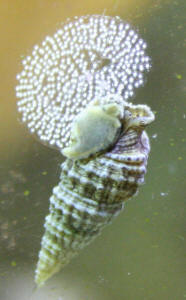
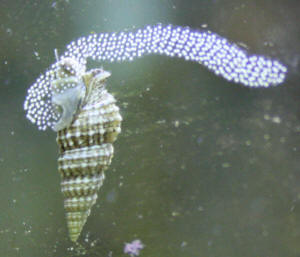
A Strange Invader? Nah,
Just Normal Reproduction. 3/16/07 Hi there! <Hi
Debbie! Mich here.> You guys were wonderful at addressing
my questions a couple weeks ago, so I thought I'd try again.
<Glad to hear. Welcome back.> I can't seem to find
the answers through previous questions on your website, so here
goes: There is some sort of feather-like deposits stuck on
the back of our 3-month old 24g Nano. One of our Nassarius
snails was near the "stuff" - so I don't know if it is
somehow related to him? <Yep! Snail eggs.>
I attached the best picture I could get of the stuff. Any
ideas what this is, and what I should do about it?
<Nothing to do but watch and enjoy!> Thanks a
bunch! -Debbie <Welcome a bunch! -Mich>
Does snail need a mate in order to reproduce? 6/20/06
<<Depends entirely on the species in question. Please
read about the species you keep on WWM.>> Little white dots in my
tank seem to be growing into little snails. My only single snail has
lived in my tank for about seven months now. I don't suppose my
damsels got her in trouble. I also have couple of hermits, one starfish
and a shrimp. 30-gallon tank. Thank you for your help. <<Glad to
help. Lisa.>>
|
Mystery Marine Snail - 06/09/06
Greetings WWM Crew, <<Morning Crystal>> First, a huge
thank you goes out to each one of you for doing what you do!
<<We are pleased to assist>> Your site has been a
tremendous help for me in setting up my tank.
<<Wonderful!>> Almost every question I've had has
been answered and clarified, so I now have a deeper (though still
'shallow' in the grand scheme of things) understanding of
how things "should" work. <<And your
"understanding" will only continue to improve...just
keep reading, researching>> So, on to my
question. I've cycled my new 47g tall tank with 45
pounds of live rock, 40 pounds of live sand and decided to start
stocking by adding a very basic, small clean-up
crew. I have two scarlet reef hermits and two
Nassarius distortus. Last night, one of the snails
popped up and stuck onto the glass while remaining very
still. This morning, when the lights came on, I found
him still there, but it had created this trail of yellow
palm-frond looking dots. <<I see them>> The entire
work measures approx. 2" long and is very
intricate. I have no idea what it is, and I've
looked over and over your site for an answer. Google
images yields no answers, and they look nothing like Nassarius
eggs. <<Agreed>> So now two questions come to mind,
the little guy looks exactly like Nassarius distortus, was sold
to me as such, and behaves as such. <<Though very difficult
to tell from the picture, but the shell of this snail looks more
narrow/elongate than the typical "Nassarius"
shell. Possibly a Cerith species>> But this is
odd - so is the answer simply that I do not actually have a
Nassarius distortus and that the snail is laying eggs?
<<Would be my guess...I have seen snails get mixed/confused
during selection/shipment before>> I don't think my
snails are happy enough to do this in just three weeks, but who
knows. <<Three weeks or three hours, wouldn't make a
difference to the snail as long as the proper environmental cues
were present>> I've included the best picture of it as
my camera could manage. <<Hmm, perhaps time for a new
camera <grin> >> Thank you in advance for any answers
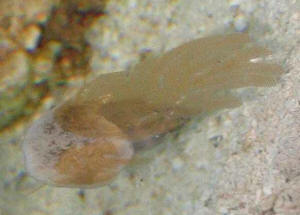
or help! Crystal <<Thank you for writing so
well. Cheers, EricR>>
|
|
|
A question about spawning from snails 9/19/05 I
perused your snail repro faq: http://www.wetwebmedia.com/snailreprofaqs.htm and am assuming
what I've had happen is that the snail is reproducing. I had
thought that snails only left trails of egg masses attached to
surfaces, and didn't spawn directly in to the water. Guess I
learned something new today. <Perhaps> This little guy was a
hitchhiker on a Zoanthid. About five minutes after placing the Zoanthid
it began to squirt and upon further inspection, this little fella was
squirting hundreds of veeeeery tiny eggs into the water (see a few of
the eggs on the right in the pic): http://static.flickr.com/26/43613507_64d22fbcd4.jpg?v=0
<"Photo currently unavailable"..> He's seemed to
have left behind a clear capsule of some sort that's half open.
Like an aborted attempt at an egg case. So I wonder if he meant to
place the eggs in the capsule or... well, I don't know. <I think
you do> My question is, do you think that it is indeed a snail
squirting eggs? <Sounds like it, yes> And also, what species is
he? I have not seen him before. From previous posts I'm assuming
the hundreds of eggs everywhere in the water are a free bloom of
nutrients and not something to worry about? <Need to see the pic...
for the ID, but not likely a problem... more food for filter feeders.
Bob Fenner> Thanks so much,
BDallas
|
|