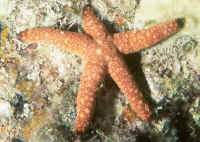
|
|
Related FAQs: Sea Stars 1, Sea
Stars 2, Sea Stars 3, Sea Stars 4, Sea
Stars 5, Brittle Stars,
Seastar ID 1, Seastar ID 2, Seastar ID 5, Seastar ID 6 & Seastar Selection, Seastar Compatibility, Seastar Behavior, Seastar Systems, Seastar Feeding, Seastar Reproduction, Seastar Disease, Seastar Disease 2, Seastar Disease 3,
Star Disease 4, Star
Disease 5, & Asterina Stars, Chocolate Chip Stars, Crown of Thorns Stars, Fromia Stars, Linckia Stars, Linckia Stars 2, Sand-Sifting
Stars,
Related Articles:
Echinoderms, An Introduction to the
Echinoderms: The Sea Stars, Sea Urchins, Sea Cucumbers and
More... By James W. Fatherree, M.Sc. Brittle
Stars, Asterina Stars,
Crown of Thorns Seastars,
Marine
Scavengers,
Sea Stars, Class Asteroidea
part 1 of 4
To: Part 2, Part 3, Part
4,
|

|
|
By Bob Fenner
|
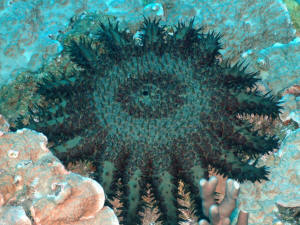
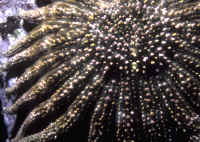
Don't touch! Acanthaster plancki
|
Sea Stars: Completely marine echinoderms of obviously overall
pentaramous symmetry. Live oral side down, feeding on a myriad of
sedentary invertebrates and detritus, detrital infauna.
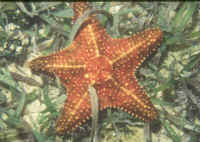
| Consider the Reticulated Seastar (Oreaster
reticulatus), a large starfish common in the Turtle grass beds
of the tropical west Atlantic. Growing to twenty inches in
diameter, it consumes mollusks, even oysters in heavily calcified,
tightly shut shells, methodically and with a voracious appetite.
Like others in this fascinating Class, the Reticulated Seastar
possesses a cleverly evolved arsenal of hydraulic tube feet
connected to an elaborate water-vascular system that encircles the
animal's mouth and extends via five radial canals down the
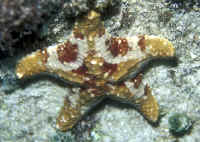
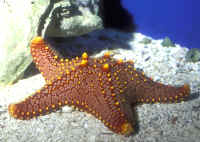
center of each arm. Below: an Oreaster in Belize's
shallows, an individual at night off Cozumel, and an aquarium
specimen. |
| Bigger PIX: The images in this table are linked to large
(desktop size) copies. Click on "framed" images to go to
the larger size. |
|
MD.JPG)
|
Numbering in the hundreds on each arm, tube feet can attach to a
food object, such as an oyster or mussel, and with relative ease, pry
open even the most defensively tightened set of bivalve shells. With
even a mere crack of an opening available, the Sea Star can force its
slippery stomach into the shell of a mollusk. There it secretes
digestive enzymes that rapidly turn the animal's flesh into a puree
that the Sea Star promptly absorbs. Momentarily satisfied, the asteroid
retracts its stomach, releases its grip, and glides away, leaving an
intact set of bivalve shells stripped as if an alien force had cleaned
them, leaving no evidence of forced entry.
Not for nothing have the invertebrates been called
"spineless wonders". Some species of Sea Stars can make
fascinating and appropriate aquarium subjects, and many of the Brittle
Stars as well, can serve as energetic, if cryptic scavengers in reef
systems.
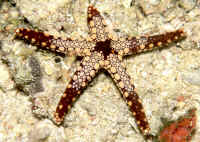
| Orange Marble Starfish (Fromia monilis):
boldly appealing and amongst the most appropriate species for
marine aquarium systems that lack big predators such as
Triggerfishes and large crustaceans. Variation in Gili Air, Lombok,
Indonesia. |

|
Classification:
Sea Stars and Starfishes make up the Class Asteroidea. Asteroids
typically have five arms radiating outward from their central disks
where their mouths open toward the bottom. All have podia or tube feet
projecting down along the grooves on the undersides of the arms. There
is no brain as such, only one or more rings of nerve tissue surrounding
the esophagus to lend some coordination to the animal's movements.
|

|
Tube feet close-up. The ambulacral system in
action. |
| Approximately 1,600 species of Sea Stars are
known. They are found free-ranging worldwide in marine
environments; over and under rocky, sandy and muddy sea bottoms.
The five living asteroid orders are divided on the basis of
structural differences in their water-vascular systems and ossicles
(endoskeletal elements). A close up of the surface of a Batstar,
Patiria miniata reveals interlocking elements. |

|
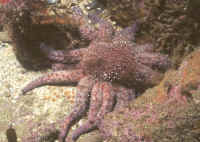
| "Your number of arms may vary". Akin to
gas mileage estimates, there are seastars with 5,6,7,8,9,
11,13,15,22,27 and more/less arms, and even a variable number per
species. Here's a "handy" species: Pycnopodia
helianthoides, a Sun Star or two off Baja California, Mexico.
Up to two feet across, and an eating machine! |
 
|
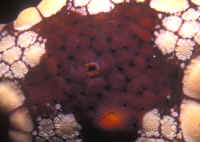
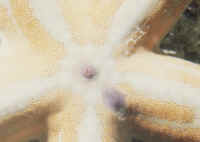
| What makes a seastar go? It's (and other
echinoderms) "water vascular or ambulacral system"... a
series of interconnected channels, tubes, valves and pumps that
coordinate to move the animal, some with such strength that they
can pries shellfish apart. Here is a close-up view of the aboral
(top) side of a Fromia star showing the Madreporite (circular,
off-center, light-colored), and anus. |

|
Selection:
Specimens of several genera are commonly offered in the trade, and
more unusual species may be special ordered through dealers. What to
look for or look out for? The individual in question should be lively,
moving and turgid-bodied, with tube feet visible in the case of Sea
Stars. A good test is to turn the animal on its back and see if it
rights itself. A limp or weak individual is a poor aquarium prospect.
Some may eventually recover, but many do not. Most losses of these, and
other spiny-skinned animals is subsequent capture and handling
trauma.
Other warning signs are dark or whitish necrotic matter and
vacuolations (missing areas). Lost arms are common and will eventually
heal over, but it is unwise to buy a specimen that is freshly wounded
as infection and rapid decline may follow. Note: not at all rare are
"comets", detached single arms that are regenerating new
bodies. This is seen as a large arm with a small body and a set of
small arms at one end. These are often very good specimens.
|

|

|

|
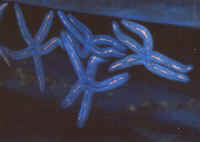
| These Linckias are healthily active, with exposed
tube feet actively holding on to the side of their tank. |
The discolored, sunken area evidenced by looking at
the oral side of this Sea Star portends trouble. |
Don't be put off on purchasing a Sea Star or
Brittle Star with missing, or smaller limbs if they're
otherwise healthy. |
Echinoderms are notable as the only animal phylum with no
parasitic members. They are hosts to many parasites themselves,
however, particularly copepods and gastropods. You should check a
prospective buy for any attached or obvious internal parasitic
problems.
Some Fave Groups, Species for Marine Aquarium Use:
The most common error in selecting Sea Stars is acquiring
species that get too large or are ravenous omnivorous predators. Not
only will many species attack various types of reef invertebrates and
fishes, they often can't get enough to eat even this way! Unless
you are willing to make a special effort to house and feed the larger,
predatory species, it is best to star with "reef safe"
choices. Among the industry favored species are the very attractive
Sand Sifting Star, Archaster typicus, the Little Red Starfish
and Orange Marble Starfish (Fromia elegans and Fromia
monilis respectively), Blue Starfish (Linckia laevigata),
and Purple "Linckia", Tamaria stria. A note of
clarification here: these are not necessarily the best suited species
for aquarium use. "Regular" Linckias/Linckias in particular
are generally short-lived. The genera and species below are our choices
for most suitable.
| Good looking, hardy and utilitarian, a Sand Sifting
Star, Astropecten polycanthus. As with dealing with all
sizable burrowing animals, make sure your rocky habitat is securely
placed on the bottom of the tank (not the substrate). And beware re
stocking these subterranean sifters... they are rapacious feeders
on all interstitial fauna... denuding systems of only hundreds of
gallons. NOT to be used in reef systems where you want to have good
populations of these beneficial organisms. <Might also note
that, because these animals do denude even large systems of all
interstitial fauna (their food source) they almost always
eventually and inevitably starve to death. -Sara M.> |

|
|
Echinaster callosus
Marenzellar 1895, the Warty Starfish. Here in S. Leyte 2013 |

|
|
Echinaster luzonicus
Fiji.
|

|
| Bigger PIX: The images in this table are linked to large
(desktop size) copies. Click on "framed" images to go to
the larger size. |
|

|
| A Fromia elegans, a brown colored one in
Fiji. |

|
| Fromia ghardaqana Mortensen 1936,Ghardaqa
Brittle Star. Red Sea endemic. To three inches in diameter. |

|
| Fromia indica (Perrier 1869), the Indian
Brittle Star. Typically reddish with black lines over aboral
surface. Indo Pacific, islands of both seas to Japan. Need mature
aquariums with plenty of green algae. To nearly four inches in
diameter. One in aquarium, another in S. Sulawesi. |
 .JPG)
|
| Bigger PIX: The images in this table are linked
to large (desktop size) copies. Click on "framed" images
to go to the larger size. |
 |
| Fromia milleporella (Lamarck 1816), a Red
Starfish. Consistently reddish appearance typically, with pores
visible on the upper surface. Looks flat and lacks tubercles.
Indo-Pacific; eastern Africa to the South Pacific. A white spotted
one in the Red Sea. |

|
| Bigger PIX: The images in this table are
linked to large (desktop size) copies. Click on "framed"
images to go to the larger size. |
%20MD.JPG) |
To: Part
2, Part 3, Part 4,
|
|