|
FAQs about Xeniid
Identification
Related Articles: Pulsing
Soft Corals, Family Xeniidae,
Related FAQs: Cnidarian
Identification, Xeniids 1,
Xeniids 2, Xeniids 3, Xeniids 4, Xeniid Behavior, Xeniid Selection, Xeniid Compatibility, Xeniid Systems, Xeniid Feeding, Xeniid Disease, Xeniid Reproduction, Soft Coral
Propagation, Soft Coral
Health, Alcyoniids,
Nephtheids,
Dendronephthya,
Paralcyoniids,
Nidaliids,
|
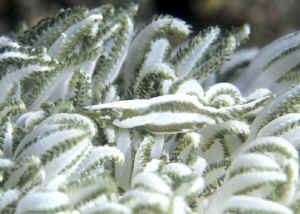
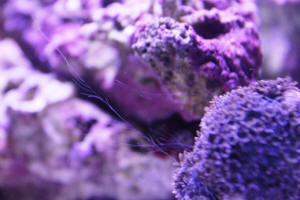
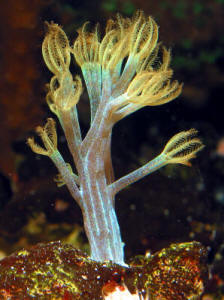
Can you make out the commensal Alpheid
amongst the Xeniid tentacles?
|
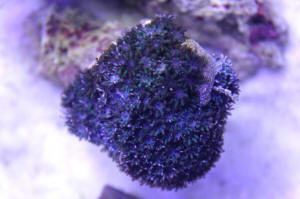
Sarcothelia edmondsoni - 5/9/2012
|
|
Hi WWM,
|
|
wwm:
Steven
|
|
I recently bought myself a piece of Sarcothelia edmondsoni (Atleast I think Sarcothelia edmondsoni?) and was wondering about its behavior and tank compatibility?
|
|
wwm:
Ahh! Have seen this Hawaiian endemic (one of two native soft corals) many times and places in Hawaii, but have never kept in captivity
|
|
Tank is a 6G, water params good, small amount Nitrate/Phosphate and I do weekly 5L water changes.
|
|
wwm:
Mmm, well; much not going for you w/ such a small volume... Hard to keep such optimized and stable
|
|
Stock: 2 Ocellaris,
|
|
wwm:
Need more room...
|
|
2 Dwarf Yellow Tip Hermits, 2 Cerith Snails, 1 Hitchhiker Pistol Shrimp, 1 Hitchhiker Crab, 2 squamosa
|
|
wwm:
?!
|
|
Some mushrooms, zoanthids, 2 hammer frags, 1 fungia, 1 BTA
|
|
wwm:
Can't be kept here long or well
|
|
(The irritated coral), some Xenia and the Sarcothelia edmondsoni. Is my ID correct? See below picture/attached.
|
|
wwm:
Unfortunately am in hospital and unable to download pix/graphics. Do see here: http://www.marinelifephotography.com/marine/cnidaria/sarcothelia-edmondsoni. htm This species is rather distinctive
|
|
And also, what are the 'threads' that the coral releases?
|
|
wwm:
A few possibilities...mesenterial filaments... sweeper tentacles... generally not good if touching other species
|
|
Unfortunately, I haven't been able to find much/any info on these guys and their tendencies. I've heard that octocorals can wage quite serious chemical warfare, and was wondering if these threads were feeding apparatus, chemical
releasing 'sweepers' or both?
|
|
wwm:
To reiterate, you really need a much larger system... 50 gallons plus; to house all you have listed here; and even then, there may well be allelopathogenic issues w/ the addn. of new Cnidarians
|
|
I havent had much experience with softies as all my previous tanks have been hardcoral/sps dominated and from my experience atleast, its pretty easy to see the sweeper tentacles off my LPS :P I've noticed that anything downwind of the
threads doesn't look too happy even though the threads are quite a distance away? And is there anything I can do to reduce the thread deployment (ie feeding?)
|
|
wwm:
Mmm, not much in this tiny tank.
|
|
Or am I just being paranoid?
|
|
wwm:
Not paranoid... Please read here: http://wetwebmedia.com/cnidcompppt.htm and the linked files above. Bob Fenner
|
|
Pic of the threads(attached).
|
wwm:
Hopefully Darrel will find, be able to match up and post
{I wouldn't hold my breath on that -- DB} lol
|
|
|
|
Hitchhiker ID: Xeniid - likely an Anthelia sp
10/29/2010
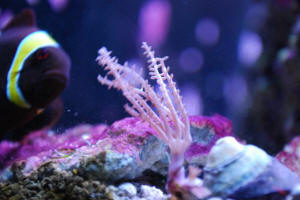
Please find attached a picture of a hitchhiker that found
it's way into my system.
I've searched your site and the best ID I can come up with is
Sinularia Mollirs (juvenile).
<No.>
It's only about an inch tall, but already has new growth near
its base ( a bit out-of-focus, but it's there). Any help is
greatly appreciated.
Thank-you!
<What you have is a Xeniid - likely a Anthelia (a.k.a. waving
hand) It is pretty when it grows up, but it can spread quickly,
Have a read here:
http://www.wetwebmedia.com/xeniidarts.htm
>
<MikeV>
|
|
|
|
Hitchhiker Coral ID/Aiptasia 10/17/10
Hey crew,
<Andrew>
I just want to start out saying that your website is just plain
amazing.
I'm really glad I found it over a year ago when I first
started keeping a salt water tank. Needless to say, it's
saved me from quite a few headaches so thank you all for all your
hard work. :)
<You're welcome.>
My question though is about a coral that seems to have hitchhiked
onto a piece of rock that came with a Colt Coral I ordered online
a while back. At first when I received my colt, I noticed there
was a small speck of something living on the rock but didn't
think much of it. Now almost half a year later that
"speck" has turned into a decent sized coral (about the
size of a quarter now) that has made it's home on the rock
with my colt and a nice piece of Xeniid that slowly traveled
across the tank. So any ideas what it could be? I've tried
looking cover to cover in Anthony's book on propagation for
anything that even closely resembles what I have with no luck.
The galaxy coral was the only thing that looked a little close
but
god forbid I have one of those so near my colt and xenia! Any
help would be greatly appreciated so I can figure out what to do
with the little guy.
Thanks in advance!
<If you are referring to the anemone like creature to the
right, this is not a coral but appears to be an Aiptasia Anemone,
an unwelcomed pest that can reproduce and rapidly take over an
aquarium. See here.
http://www.wetwebmedia.com/marine/inverts/cnidaria/anthozoa/aiptasia/aiptasia.htm
More ID photos here.
http://www.google.com/images?q=aiptasia&rls=com.microsoft:en-US&oe=utf8&um=1
&ie=UTF-8&source=univ&ei=jva6TOmYMJKqngfn8f2eCA&sa=X&oi=image_result_group&c
t=title&resnum=2&ved=0CCgQsAQwAQ&biw=1579&bih=603
James (Salty Dog)>
-Andrew
|
|
Re Hitchhiker Coral ID/Aiptasia
10/17/10 = 10/18/10 RMF, Any Idea?
Hi James,
<Hello Andrew>
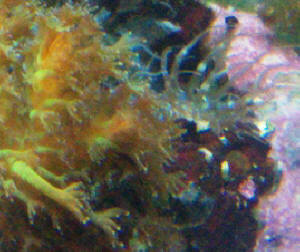
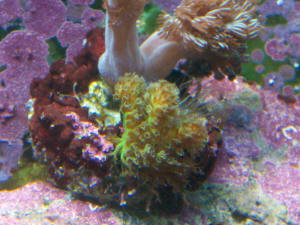
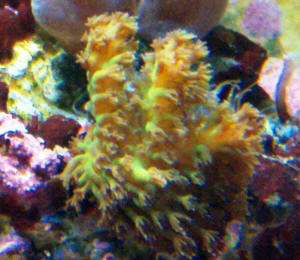
Actually I was referring to the greenish/yellow bush-like
coral in the foreground. It appears to have a yellowish
stalk-like skeletal structure, almost like an Acropora, in
which the polyps extend from except the polyps themselves
resemble those found on a Xeniid or even a Star Polyp
except they don't retract back into the structure.
<Mmm, my best guess is a Xeniidae species. Any idea
Bob?> <<I agree w/ your guess. RMF>>
I've attached a couple more photos of it for you.
<Thank you, but no need to send multiple photos of the
same image. James (Salty Dog)>
|
  |
|
|
New Guy Identification: Hitchhiker ID Octocoral or
Xeniid 3/8/2010
Hi WWM Crew,
<Hi Mike>
I have been a long time admirer of your site. I have used it many
times to find the answers to difficult questions and identify new
found creatures.
<Happy you find it useful.>
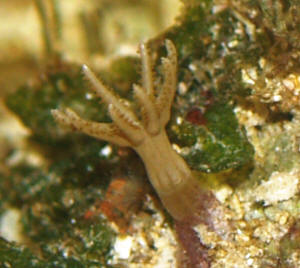
This particular creature showed up almost completely out of
nowhere.
<I had a reef urchin do that in my tank recently>
It measures only 4 to 5 millimeters. I have watched on occasion
as it pulls things out of the water with its outreached arms. It
seems to be very sturdy and does not retract but remains the same
whether it is day or night. Any help will surely be
appreciated.
<It looks like an Octocoral - but solitary Octocoral polyps
are rare. My next thought would be a Xeniid of some sort. In
either case, it is not likely harmful Do have a read on the
following pages.
http://www.wetwebmedia.com/cnidaria.htm
http://www.wetwebmedia.com/xeniidarts.htm
and go a search for 'Octocorals' >
Once again I truly appreciate your help to the community.
<My Pleasure.>
Thanks - Mike
<MikeV>
|
 |
|
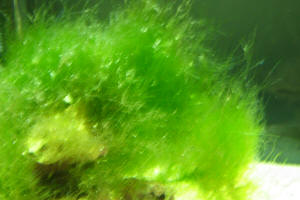
Xeniid & Algae I.D. & Compatibility
3/8/2010
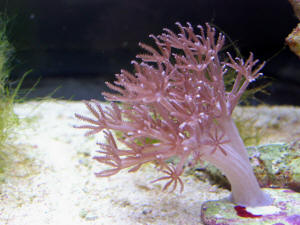
Hi, Can you please tell me what these are? Scientific and common
names would be greatly appreciated. And is the algae a threat to
the Xeniid chemically?
<Please see here: http://wetwebmedia.com/xeniidarts.htm
and the ID FAQ linked above re the Pulsing Coral; and the
green... can't tell w/o microscopic photographs>
If the pics aren't clear enough, just let me know and I might
be able to send some that are a little better.
Thank you,
Greg
<Bob Fenner>
|
  |
|
Xenia Identification, reading 4/23/08 Dear Crew,
<Jas...> I got this xenia at my LFS and they said it was a
Pom Pom however I have been suspicious of that since I purchased
it. Can you please try to identify the type for me. <Type?
Well, is a Xeniid... likely an Anthelia species... not in great
shape evidently. Please read here:
http://wetwebmedia.com/xeniidarts.htm and the linked files above.
Bob Fenner> Best regards, Jason <<Where is the graphic
Sara? Lost... RMF>>
Re: Xenia Identification... hlth. 4/24/08 Dear Bob,
<Jas> I saw you said the xenia did not look in great shape.
What seems to look wrong with it? It has looked that way since I
got it and has actually started growing more polyps out of the
side. <... the color, the physiognomy... thin, listless... see
the site (again) re what healthy colonies look, act like.
BobF> Thanks Jason
|
Xenia Coral??...Maybe anthelia 10/29/07 Hi
Guys, <Hi Peter, Mich here.> I recently got a saltwater aquarium
from a friend (for free!!). <WOW! Nice gift!.> It is true that
there is no such thing as a free gift. <Mmm, I guess that all
depends on your perspective...> I have a soft coral that I believe
to be a Xenia (sorry, no pics). <Would help...> Most xenia I see
tend to be fairly short, this one when fully extended is several inches
long. <Perhaps is anthelia... can look similar...> It does have
the "fingers" like a xenia but no pulsing which I know is not
uncommon. <Sounding more like anthelia...> I have also noticed
that some of the arms looked bruised and/or have a white spot on them.
I noticed today that what I believe to be Aiptasia anemones growing
beneath the xenia. <I would remove.> Could close contact be
what's causing this? <Maybe, but the Aiptasia WILL win this
fight... The Aiptasia needs to be eliminated. More here:
http://www.wetwebmedia.com/marine/inverts/cnidaria/anthozoa/Aiptasia/aiptasia.htm
http://www.wetwebmedia.com/ca/cav1i3/aiptasia_impressions/aiptaisia_impressions.htm
> P.S. There is a 7" engineer goby in the tank that is fairly
shy. <Dang!!! That's a big goby!!!> (Also have a Sailfin
tang, two percula clowns, one royal Gramma, one Hawkfish) in a 60 gal
tank (I know tank is on the small size). <Yes, is much, much too
small for this tang.> What is the best way to feed the goby properly
without flooding the tank with food?? <Turn off circulation so the
food doesn't get blown around, try to target feed him and feed
small frequent meals.> Thanks <Welcome! Mich> Peter
Xeniid... please forward to Anthony..thanks
Anthony, please look at my pictures of my "xenia" on the
following link:
http://reefcentral.com/forums/showthread.php?s=&threadid=918155&perpage=25&pagenumber=1
Please let me know what you think this coral might
be...xenia?...anthelia? Thank you. Chris Little <Mmm, looks like a
Heteroxenia to me of some species... and something up about the water
chemistry... I see this noted a bit further down. Antoine may be able
to be reached at his site, Reading Trees... or he may still be about at
Marine Depot.com... Bob Fenner> Can you ID this xenia species?
12/10/06 Oh ye knowers of all things wet and fishy... One of the
members of our reef club is looking for more information (and perhaps a
source) for this xenia species "from pg76 of "A Guide to
Corals for the Mini-Reef Aquarium" by Dr. Axelrod": http://www.whodah.com/albums/BoomerD/ars.sized.jpg <Mmm,
looks to be a Heteroxenia species... A Xeniid, similar to the genus
Xenia... Please see p 140 (and the pic there bottom right) of Fabricius
and Alderslade's Soft Corals and Sea Fans book re> Obviously,
"Tabby Pulsing Xenia" gets nowhere in a google search,
<Heee! Yet another HRA fabrication likely> and it doesn't
appear to resemble any of the Xeniids listed in your xenia pages. Gotta
admit, it's a pretty striking specimen... Thanks folks. <Is...
and a natural one I think. Bob Fenner>
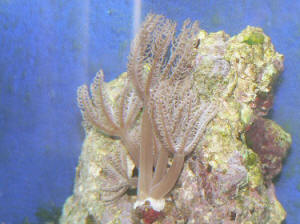
| ID for my coral. Thanks 9/2/06 Hey Crew,
<Mike> I just need a quick opinion on the name of this coral.
I bought the little frag the other day and it seems to be doing
well I would just like to know the name so I can make sure it is in
the right tank environment for what it needs. <A bit of the cart
ahead of the equine...> The picture is kind of bad but it is a
deep purple brown color and seems to like the spot it is in. I have
it in a 10 gallon with 2 AquaClear 200 filters (no media just for
flow) and 96watt 50/50 CoraLife lighting about 15 lbs of live rock
and sugar sized crushed coral substrate (2-3" deep). Thanks
again for the help. Mike <Is a Xeniid of some sort... Please
read here: http://www.wetwebmedia.com/xeniidarts.htm and the linked
files above. Bob Fenner> |
|
Re: ID for my coral. Thanks - 09/03/06 Yeah I know I
should research before I buy and normally I do. But this one was
a great catch for the price. I thought it may be Xeniid family
but I was looking more for the exact name so I could be sure the
care I took was correct. <Mmm, can "get" down to the
genus level by counting pinnules...> I just have not been able
to find an exact picture of it on the web with the scientific
name. Thanks for the help. Mike <See WWM again, Eric
Borneman's Microcosm work, V.2 of MCRA... Bob Fenner>
|
|
|
Coral ID, May Not Be Xenia - 04/17/2006 I
am having a problem with identification of a few soft corals (or
polyps) that I have acquired in my reef tank. <I hope you've
already received an answer for this. I was not aware it was in my box.
If not however, I'll see what I can offer.> I manage a fish room
in a small mom and pop pet store where I have worked for 15 years. I
order a lot of saltwater corals and I have noticed that sometimes what
our distributor calls one thing might in actuality be another. <Can
easily be the case if only using common names.> Recently I purchased
(for my own tank) what was called "blue xenia". I don't
think that this is what it is and I was wondering how to tell the
difference between Xenia and some polyps. <Look at the fine details
mostly. Do these have a single stalk that branches out or do they stem
from a common mat (the stolon)? From all the pictures I have seen they
all look so similar. <Do you mean of just the family Xeniidae?> I
have two different species in my tank that I thought were Xenia but
they don't pulse (at least not that I can see) and they are slowly
carpeting the rocks I have them on. <Hmm...carpeting. Xenia has a
single stalk and then branches out. You may have Anthelia here.>
They are both thriving and yet I was under the impression that when
Xenia fails to pulse it is not doing well. There are so many different
polyps out there, how do I know which one is which? <Time, study,
research...> Are there any forms of Xenia that don't pulse?
<Sure.> My tank condition is spot on as far as all the parameters
go and everything is thriving. Is it possible that I got gypped by our
distributor and simply got some bluish polyps? <Try researching
Anthelia, see if this is what you have. Tell the distributor that you
prefer to start using the proper scientific names from now on, this
will help avoid much confusion.> Thanks, Jenn <You're
welcome. - Josh>
Xenia library-Complete version-sorry! Hello
Crew, Thanks for being so helpful on the email below, eliminating 1
leather coral helped quite a few corals grow along with feeding
zoo/phyto plankton mix every other day. This might be a tough one.
I've compiled a list of scientific xenia names that I can find,
however, a picture to match them up with is nearly impossible.
<Mmm... such pix, without close-ups, even collecting, dissecting the
specimens, will not get you to species IDs> I've done a few
Latin translations like Multipinnata=Multiple Feathers, but uhm.. yea,
they're all feathery.. lol. There's also Stellafera=Bright
Stars, <Actually "bearing stars"... Mmm, maybe
"ferox", not fera/amphora...> uhm...I got one that fits
this, but then it's my personal opinion of this, and for all I know
there could be a fiery red xenia out there! Either way, any bit of
advice or help on trying to link names to pictures would be greatly
appreciated. <... for what purpose/s?> I've eliminated a few
names that I'm positive as to what they are already, so there's
21 out of 23 names left. I'm sure 7 more of my xenia will fill
these images, just not sure which. Thanks! X. mucosa, X. multipinnata,
X. stellafera, Xenia alcyonacea Xenia farauensis ?Heteroxenia coheni
?Heteroxenia cf. elizabethae ?Heteroxenia fuscescens (Ehrenberg) (1,2)
?Heteroxenia ghardaqensis (Klunzinger) (1) Xenia arabica Xenia
benayahui Xenia biseriata Xenia crassa Xenia aff. distorta Xenia
faraunensis Xenia hicksoni Xenia impulsatilla Xenia kuekanthali Xenia
mayi Xenia macrospiculata Xenia membranacea Xenia novaecaledoniae Xenia
obscuronata Xenia verseveldti <... Time to send you to a large
college library... to ferret out original descriptions: http://wetwebmedia.com/litsrchart.htm.
Common names? Really are just whatever is "made up" that
sticks. Bob Fenner>
Re: Xenia library-Complete version-sorry!
Don't be sorry 4/14/06 Hi there Bob, The reasons I'm
searching out all these scientific names are because mainly to satisfy
my curiosity of what I own, and because I'm building an informative
website. <Ahh! Worthwhile> I've often wondered what type of
xenia I own, and get a queasy feeling whoever I read someone go,
"I got a pom-pom xenia". They all look like Pom Poms to be
quite frank. <... and many are Anthelias, other genera...> I
realize there are a lot of corals out there, so it may not be of
interest for most to take the time out to figure out what xenias are in
our trade right now, so I guess someone's gotta do it right? :)
<Again... I do think this is of worth> Xenias have always been a
passion of mine ever since I got my first "Long Fiji Xenia"
12 years ago, at least, that's what I was told what it was
called...lol. <If you're going to do this, best to "do it
right"... I do encourage you to seek out the original descriptions
of these species, the genus, family... at/through a large college
library. Bob Fenner>
| Re: of questions and pictures.... 11/12/2005 Bob, Thanks
for the response...to both e-mails! Sorry about the double posting.
Did the pics of the coral and tank come through? <I think so...
were on the Dailies...?> <<Yes, four or five, I see no
need to re-post photos already posted just this week. Nice softie
shot, looked quite blue! MH>> I've got the 10000k MH
up and running now, as well as the protein skimmer, and the
'colt coral' is perking up somewhat, but I'm still not
quite sure what he is, even after consulting you're wonderful
site. I bought it as a colt coral, but all the pics I've seen
of colt corals have extended polyps...? <Sometimes don't
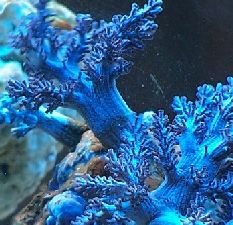
extend for quite a while from introduction...> He's a sort
of purplish color, <... unusual... Oh, I see it/them below
again. Looks to me like "Blue Cespitularia"... a very
nice group!> quite branchy (if that's a word), and even
though what I would call the polyps look 'open' there
isn't anything extended. From your FAQ I'm leaning on a
Kenya tree, but am still unsure. Could you help with the ID?
Thanks. Branon. <Bob Fenner> |
|
Re: continuation of Blue Cespitularia ID 11/16/05 Mr.
Fenner, you said that the pic I sent looked more like blue
Cespitularia. <Yes> As I've been looking for
information for Cespitularia, I've found very few pics that
look like what I have and more that seem more xenia-ish (go
figure). <See Alderslade and Fossa and Nilsen's
works...> My coral's polyps do not retract but do roll
into a sort of cup-like ball, similar to explanations of
Cespitularia. The entire stalk seems to shrink in on itself at
night. I have tried the 'flashlight-at-night' trick to
see the reflective .... whatever-it-is and haven't noticed
anything. The largest stalk of the group is about 2.5-3"
tall. I've included the best pictures I can get of her and
I've also noticed that her ... what do you call the
frond/tentacle part of the polyp?... <The tip? The tentacles,
tentacular crown?> anyway, they look very fern-like...much
like a xenia. I didn't notice any 'polyp extension'
on any of the polyps in my pictures, <Mmm, the pic you sent,
they were extended...> which are only about 3 days after
coming to my aquarium. Now, about 1.5 wk. later, almost all of
the polyps seem quite 'extended'--uncurled. They look
hungry and because I'm unsure what it is, I haven't a
clue if I should target feed, what I should feed, or anything.
When I wrote I hadn't noticed the night-time withdrawal, the
flashlight thing, or the shape of the ...frond-like parts of
her/their polyps. I also hadn't mentioned the
height...I'm afraid I didn't give you much to go on.
Could you help with ID and care instructions? Thank you. Branon.
<... Please read on WWM re Xeniid keeping... http://www.wetwebmedia.com/xeniidarts.htm
and the linked files above. Bob Fenner>
|
|
|
Xeniid IDs 8/5/05 Hello WWM crew
<<Hello - Ted here>> I wanted to first say how much I enjoy
the site. Second and most important I had a question for you :D Do you
have any links you could point me to that have to deal with the
identification of the family Xeniidae to the species level. I
understand that using pictures isn't all that accurate/practical
but I figured this would help me on my way to learning all I can about
these fascinating creatures. I have looked into Soft Corals and Sea
Fans by K. Fabricius and P. Alderslade. Looking for other references
especially concerning species identification of the families
Cespitularias, Sansibia and xenia. My search for specific species has
been pretty dry. Hoping you can help. <<Sorry, There is very
little online that you would find helpful. This link ( http://www.reefkeeping.com/issues/2004-02/ac/feature) may
help but you probably have already found it. My recommendation would be
to hit the library (preferably a large one connected with a
University).>> Thanks for any help/leads <<You're
Welcome. Good luck with your identification journey -
Ted>>
Sansibia coral ID? 1/29/05 Hi Guys,
<cheers> I need some help on a coral ID. Please see the email
below. I have yet to hear back from Dr. Alderslade. thanks! Joe <it
is very difficult to ID from pics as it is, my friend... but in your
case it is impossible. The images are not full frame shots (showing
detail of sclerites, pinnules, stolon, calyces, etc). I doubt that
anyone could ID this coral even to the genus level. The genus GARF
meant was Briareum. Anthony><<I'd cite Antoine's piece
here: http://www.reefkeeping.com/issues/2004-02/ac/feature/
RMF>>
| Xeniid shrimp id AntBuboine, can you id
this Palaemonid for me? You had said someone sent you a pic
recently... Boub |
|
|
| Hippolyte commensalis (Xeniid shrimp) Holy
cow, Bob! How did you see this little bugger?!?!? <Found by the
dive guide... I would gladly 'fess up otherwise 'twere it
so> You are the man... seriously: Hippolyte commensalis
<We're da fishmen!> a gorgeous critter on a gorgeous
coral <G>. I should not be surprised to admit it... and it
took me long enough (thanks mostly to your tireless efforts)...
but, I'm a dreaming and a hankerin to do some serious (but safe
<G>) reef diving. <Omigosh!> Still got tons to work out
at home... as you know, my grandparents were/are everything to me.
These years are precious. We took my gram to the docs today too for
more tests... there are some sobering concerns re: leukemia now.
Will be taking her for second tests next week :( And then to Cape
May, NJ for a quaint retreat for a few days thee following week (Di
knows/likes Cape May Point?... 'tis my speed :) <Okay> At
any rate... the dive vacation that I promised myself after we
finished NMARI... I will take after NMA RF <VBG>. Time and
funds allowing :) Maybe Fiji. <Let me know when, and let's
go> I thank you sincerely for your inspiration in so many ways
to me, my friend. Antoine <The feeling's mutual compadre.
Bob F> |
Coral ID II 6/18/04 Thanks for getting back
to em so quickly. Your info is priceless! Yes, I do have a minireef and
I look at myself as being moderately experience in keeping corals.
<all good... this soft coral is relatively forgiving. Have you had
experience with other Xeniids?> At the moment I a running 2 four
foot fluoros (1 ocean light actinic, 1 power glow 40watt), I have a 380
ltr aquarium, moderately stocked with soft corals. If I was to double
my lighting, would this be enough to sustain my aquarium and the corals
without too much algae growth? <hmmm... with more of the same kind
of standard fluorescent lamps (40 watt) it will not help much, I regret
to say. They simply do not penetrate the water very deep. More intense
fluorescents or metal halides are better/best. But if you do add the
extra 40 watt lamps and keep the coral in the top 20-25 cm of the
waters surface, I suspect it will fare well> Cheers, Chris
<G'day, mate :) Anthony>
Non-pulsatory Pulse coral 3/22/03 Hi I have
a pulse coral or an Anthelia glauca and I wondered why its polyp
aren't actually pulsing anymore. I have had it for a few weeks now
and it was pulsing in the dealer's tank when I bought it. Any
helpful information would be much appreciated. Laurence <among
Xeniid pulse corals, one of the most common reasons for non-pulsing
behaviors seems to be related to low pH and low Alkalinity. Do check
and be sure that you keep your pH above 8.3 for these corals (and check
too that night/AM readings don't dip too). Alk should be 8-12dKH.
Regarding the ID, there has been some mistake... Anthelia glauca
(glaucum) does not pulse naturally to any significant degree. If yours
was pulsing, it is Xenia or Heteroxenia most certainly. Best regards,
Anthony>
| Xenia tank and soft coral identification Hi
Bob, Anthony, and the rest of the all-knowing crew! Hope that this
finds you well! <Cheers, my friend... I hope you are in good
spirit as well> I am sending some pics for you to see. #1in is
the tank as it is now -- not sure how long it's been since the
leak on the other, (2 months?) but I think it is starting to come
along. I am tickled pink with the refugium (the light is on an
alternating timer) and would suggest it to anyone. <excellent.
Indeed, Reverse Daylight Photosynthesis (RDP) refugia have many
merits> There is a second skimmer hanging off the side of it.
Can't wait for the coralline algae to start on the glass again
. . . sigh. <in due time> #2 is a soft coral I got -- I had
ordered a green hairy leather and the piece came in with two
distinctly different corals on it. I'm not complaining, but I
would like to know what the are! I am assuming the one in the back
is the hairy, but what is the one in the front? It reminds me of
morels . . . <no pics attached, my dear... please resend>
Now, you remember part of the deal to set another tank up during
the leak was that my beloved hubby got dibs on my 25? Well, he
hasn't set it up yet so I call that an opportunity. <Ha!
Staked a claim, eh?> Since it is all retrofitted for reef anyway
it would be a shame to use it for freshwater. Before I had various
soft corals, mushrooms, and polyps in it. The 25 is taller more
than wide, with the eclipse hood running, and a CPR backpack
hanging on the side, in tank heater, power compacts added into the
hood, which is perfect for low light items but nothing past that.
This time I would like to have a xenia species tank, and am looking
for pointers! I have read Anthony's section on them in his
book, and yours, and was just looking for more direction. <the
common Fast-pulse Xenia, Xenia elongata would be very active, hardy
and forgiving. A good first choice. The non-pulsing Xeniid,
Anthelia glaucum, would also be a fine choice. Very hardy, likes
very low light and has very large heads with attractive large
pinnules> I want the Xenia to be the focus, so was planning on
Xenia only. There will either be no fish, or maybe two -- like a 6
line wrasse and another tiny, unobtrusive fish. Was planning on a
sand bottom, although I have to say, the glass bottom is attractive
to try . . . I am trying to decide if I would be better piling live
rock in there like before, or putting plastic shelves in and then
putting the live rock on that? <the tank is small enough to not
bother with shelves (keep good water flow easily)... rock on glass
or sand will be fine> Also, I had heard on different internet
sites that Xenia is susceptible to "crashes" . . . true?
<anecdotally with some, but I have only had this experience with
Anthelia. My mother colony of Xenia went for over five years
without any such hiccup for any reason. I think it is largely due
to husbandry. Any fast growing organism has a fast increasing need
for ever more nutrients, Thus, you have to be on top of your game
with water changes, iodine, etc. (just like with Caulerpa)> I
know that Xenia really likes the iodine, I dose my tank daily with
8 drops, which seems to be about right. <excellent (daily
dosing)> Seems like there is MUCH more that I need to know, so
if you can think of anything, throw it at me! I tried looking at
websites and there's really not as much out there as I would
like . . . mostly to have to do with propagating. <Xenia is
rather simple and hardy once established. Be prepared that all are
finicky at first. May not pulse for days or even weeks on
arrival> Here is the Xenia I already have, and how it was sold
to me. All were tank raised. If you don't agree with the
identifications, please let me know! LOL! #3 -- "regular"
xenia -- pulses like mad, much stronger than the other two, almost
in a twisting manner. Tends to like to "creep" along the
rock. #4 -- "Red Sea" xenia -- pulses, but not as
strongly as #3. Seems to be almost pink. <if Xenia umbellata,
this is one of the most demanding for light if you are to succeed
long term> #5 -- "green" xenia -- doesn't seem to
pulse except for maybe extremely weakly. Might be my imagination. I
can ALMOST convince myself that it is green when it is closed up,
otherwise it looks brown. I would like white and pompom xenia, but
being in Ohio the supply is limited unless you want to risk trying
to ship it. <hmmm... it shouldn't be too hard to find good
stock in Ohio. I've traveled most states through aquarium
clubs, stores and conferences and Ohio by comparison is not too
shabby. Cincinnati is not too shabby (stores, even a trip to the
Louisville club), Cleveland is excellent (stores and clubs)...
hmmm... Columbus is rather modest. If you can't find anything
through local cities and are willing to drive to a Western PA PMASI
meeting, I'm sure we could get some frags for you (PMASI is
just over the border exit 6 PA turnpike)> Hope this wasn't
too long, and that you're having a wonderful hump day! As
always, thanks for your help and guidance. Cari <best regards,
Anthony> |
 |
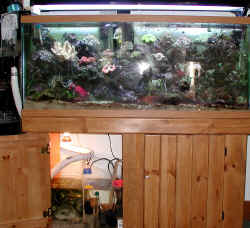 |
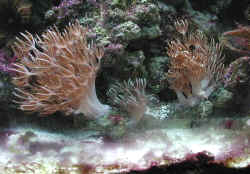
| Xenia tank and soft coral identification
<Cari, thanks for the pics... they were out of order with the
last message so I have ID them in the sequence you'll see at
the bottom here with the auto reply: pic 1: indeed a
"green" xenia, AKA Blue or Siler-tip xenia as well. Needs
heavy VHO blue actinic light to express good color. Magnificent
when it does get it. Very blue/green then. pic 2: whole tank shot
pic 3: looks like two branching corals of the same or similar kind.
Quite frankly, one or both are Capnella, the "Green Kenyan
Tree" coral pic 4: the white stalked xenia is actually one of
the Red Sea or Fiji pom-pom varieties (you have it already!). It
just doesn't look short and pom-pom like because it has adapted
and elongated under weak captive lighting. pic 5: is also a white
fast-pulse/pop-Pom species. I suspect from its morphology that this
colony is placed higher up in the tank than the one in pic 4. Else,
it is getting stronger current. best regards, Anthony> |
Xenia... are elongatas and Heteroxenia the
same thing? <nope... elongata is a species of the genus, Xenia (X.
elongata being known as the "common fast-pulse Xenia). Heteroxenia
is a genus that stands on its own with Xenia and several other genera
in the family Xeniidae. So to recap: "elongata" is species,
"Heteroxenia" is a genus> and are there really light
purple bluish ones? <yes... several Xeniids from two or more genera
are a breathtaking blue/purple and or green color. Most notably is the
Xeniid, Cespitularia which includes species that are robin's egg
blue! with spicules that reflect silver! Gorgeous!!! And more commonly
"blue Xenia" is available that is a like species or
synonymous with X. elongata types... and more specifically, the
"sliver-tip" fast pulse Xeniids. Under heavy VHO actinic
light these animals will become a striking blue or green color. Purple
depending on your perspective. Best regards, Anthony>
| Cespitularia: night shot with flash I thought to share a
pic with some of my friends that I've chatted with (or teased
with frag promises <G>) about this fave coral... <Beauty.
Nice pic> this is my former 5mm Cespitularia that is now up to a
whopping 30 mm, heehee... slowly but surely. I was trying to take a
close up of the reflective spicules at night... didn't get
close enough, but still managed a decent full frame shot. <Maybe
Santa will bring you a dual strobe set-up...?> The coral looks
more blue than this under heavy fluorescents... but also looks less
blue under standard daylight. I wish it was big enough to hug. I
know... I'm truly a reef orphan :) with kind regards to all,
Anthony <Is that the sound of a whip cracking? Back to writing
with us~ Bob F> |
|
|
Xenia How many different kinds of Xenia are
there? <Eric Borneman lists six separate species in his excellent
work "Aquarium Corals: Selection, Husbandry, and Natural
History" and mentions there maybe as many as 60 other species not
described. -Steven Pro>
Re: pulsing Sinularia...hmmm Cespitularia?
Hi Bob: Got this on the ReefCentral board and responded to it - it
isn't Sinularia - probably Xeniidae of some sort - Cespitularia,
Efflatounaria or some such critter. <Thank you Eric (Borneman). Had
a daydream about you this AM (Yikes!). About begging you to help us out
on WetWebMedia.com... and also wanted to chat with you re M/TFH (am
getting no response...). Back on the issue: have cut-pasted the boyz
input re this soft coral on the daily WWM FAQs. Will paste here for
your enjoyment... maybe amusement. Bob Fenner> Eric Pulsing
Sinularia? I bought a real beautiful nice light blue colored Sinularia
sp. a couple of weeks ago and it is doing very well. One thing I have
noticed is that all (not at one time) its tiny polyp open and close
(pulse) regularly. Most of the time they are hit and miss all over the
place and yet at other times an entire group will pulse at once. It
really is neat. I have never heard of this before and was wondering if
it was normal? Zimmy <Very interesting. Please send us a picture if
you can or some frags, just kidding about the frags. It could be a
Heteroxenia, but the picture would help. -Steven Pro>
Pulsing Sinularia? I bought a real
beautiful nice light blue colored Sinularia sp. a couple of weeks ago
and it is doing very well. One thing I have noticed is that all (not at
one time) its tiny polyp open and close (pulse) regularly. Most of the
time they are hit and miss all over the place and yet at other times an
entire group will pulse at once. It really is neat. I have never heard
of this before and was wondering if it was normal? Zimmy <Very
interesting. Please send us a picture if you can or some frags, just
kidding about the frags. It could be a Heteroxenia, but the picture
would help. -Steven Pro>
Re: pulsing Sinularia I posted about this
pulsing action of my Sinularia on Reef Central and indeed someone else
has had this. I will post a link here if you don't mind so that
others can check it out. There is also a video clip from an owner of
one such coral. It has already in less than three weeks shown good
growth promise. After six months or so I will frag it a couple of
times. Here is the thread.
http://www.reefcentral.com/vbulletin/showthread.php?threadid=27581&highlight
=pulsing+sinularia Go down about half way and there is a link to the
video clip. It is worth the download! I had to go through all kinds of
hell (Chicago rush hour) to buy it. I just wouldn't let it pass me
by. I paid $55 for it. Worth every cent. Thanks Zimmy <Zimmy...
thank you kindly for passing along this fascinating tidbit. I did look
briefly at the video and suspect that it is a Cespitularia. But
let's pass this along to our good friend and coral expert Eric
Borneman. I/we can only offer an aquaristic perspective based on trade
experience (imports and the name of the week game with pack manifests).
I'd feel better to hear from an academic. Still... I'll put my
money on a Cespitularia or something altogether uncommon in the trade.
Best regards and thank you for sharing! Anthony.>
|
|