|
FAQs About Cooter, Musk, Mud Turtles
Related Articles: Turtles, Shell
Rot in Turtles, Amphibians, Red Eared Slider Care,
Related FAQs:
Turtles 1,
Turtles 2,
Red Ear Sliders,
Turtle Identification,
Turtle Behavior, Turtle Compatibility, Turtle Selection, Turtle Systems, Turtle Feeding, Turtle Disease, Shell Rot, Turtle Reproduction, & by Species:
Softshells, Snapping Turtles, Mata Matas, Tortoises, & Amphibians, Other Reptiles,
|
|
|
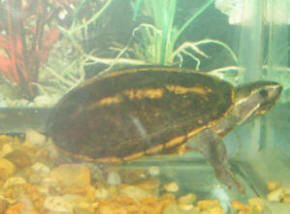
Mud Turtle; shell concern
2/12/19
Hi!
<Hiya - Darrel here>
I have a 2-year-old mud turtle named Groot.
<Cool name. Yours and his>
Over the last year, his shell has started to turn black with little holes.
I am worried that it may be shell rot but I don't know. He has a little hole on
the side of his shell that I have determined to be caused by shell rot but it is
in a different part of his shell.
<I'm looking at the picture now and what I see is normal>
He lives in a tank with a few fish and has a basking dock (that he doesn't use a
lot). We change his water every week or sometimes every other week if we are
gone. He is eating fine and is swimming fine.
<Mud and Musk turtles are very shy out of water. Unlike a Slider they rarely get
used to basking in company and will dive for the water at the first vibration
near then. Their timidity is so severe that many people who own them will swear
that they never bask... but they will do so frequently if they are able to do it
in private>
1. What can I do to help him with the blackness of his shell?
<That mottled look is common - as is the algae that grows on the shell just as I
see Groot seems to have.>
2. Does it look like shell rot?
<Shell rot is a feel (soft and mushy) and a smell (old socks when you scrape it
and sniff the scraper)>
3. Should I be worried?
<Not from what you've told me. Make sure Groot has a basking spot that is warm
and has unfiltered UV-B lighting. Feed him a high quality Koi Pellet or
Repto-Min sticks (same stuff just more expensive) with an occasional earthworm
(or teeny-tiny piece of beef or chicken liver) for added vitamins. Check every
day that he is alert, moving around and eating well.>
Thanks,
Taylor
|
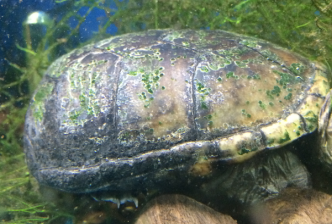 |
Musk turtle 12/8/18
Hi, I wonder if you can help me please? We have a musk turtle hatchling and we
have got to go away for a day and a half.
I have no one to turn the UVB light and the heat light on would it be better for
me to leave them both on?
<Leaving them both off would fine for a few days, assuming the house doesn't get
freezing cold. Alternatively, an inexpensive timer at the mains socket end of
the lamp's power cable can be used to switch such things on and off without
problems.>
Thank you
Sharon
<Most welcome. Neale.>
|
Turtle shell colouration/ turtles not basking
6/23/18
Hi!
<Hiya – Darrel here>
We recently adopted two 4 year old musk turtles from a friend. They seem happy
and healthy enough, although we don’t really know what to look out for in terms
of how happy they are!
<Active, alert and eating>
We’re slightly concerned for two reasons,
1 Because the turtles don’t seem to be basking. We’ve provided them with a
basking spot with uvb and heat lamp but they just don’t seem to want to go out!
How can we encourage them to bask?
<Mud and Musk turtles, along with their cousins the snapping turtles, don’t bask
much – and in addition they are shy about it. Unlike a Slider, Cooter and their
friends, a Musk will rarely if every get “used” to people or movements dive for
water at the slightest sight or vibration. Oddly, once in the safety of their
water world, they’ll be as active and excited (at the possibility that the human
is bringing food) as any other turtle.
The second concern is with one of the turtle’s shells. He has a spot of brown on
a lighter part of his shell and we have no idea if it’s just discolouration or a
problem related to a lack of basking. I’ve attached a photo of the
discolouration for you to see. There’s no indent and no smell related to the
darker patch.
<Looks like a stain to me. I wouldn’t worry about it for now>
<The general considerations on the mud and musk turtles are clean water and good
food. Even though they live in muddy, murky waters and often bury themselves,
they will experience better overall health with clean, clear, room temperature
water.>
<I personally raise them from hatchlings to adults on a good quality Koi Pellet
as a staple diet and an occasional earthworm like a nightcrawler once every week
or so.>
<Be mindful that they are frequently active, eager eaters and aware of your
presence; in other words, even if they flee from you when you walk in the room –
that means they’re alert and active!>
|
.jpeg) |
|
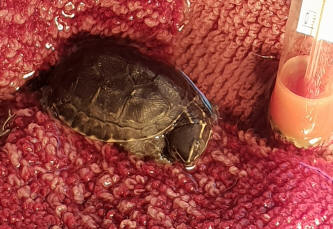
Musk turtles, hlth. 4/20/18
Hiya
<Hiya - Darrel here>
i have a 3-4 month old musk turtle and the other day i came back from school and
she/he (haven't determined sex yet) was on the bottom of the tank not moving, i
knocked on the window of the tank and the turtle didn't move, when i took the
turtle out of the water there was no control in his neck, so i thought it was
dead, then at 8pm my mom came home and i wanted to show her what way the turtle
was, i took the turtle out and showed her but then she told me it moved, i was
shook!, we've been keeping the baby warm, has a basking spot, water isnt too
high up, so now what concerns me is the turtles head stays on one side which
makes it impossible for the turtle to swim... and we have him now in a separate
tank with a warm towel and a bit of water in it, but usually the turtle finds a
small bit of water and puts his head under is this normal and what should i do?
<First of all - keep him warm and dry. When a turtle is sick their normal watery
environment is not their friend>
<Unfortunately most medical care we give our fish and reptiles is, in reality,
just an optimal environment that will do what we can to assist them in getting
better on their own.>
<In your case, because of his size, even a full medical exam wouldn't yield much
without extensive blood tests and other work ... so what we want to do is set
him up so he can just rest and breathe and relax and hope that his
strength returns. Read all about dry-docking a sick turtle here:
http://www.wetwebmedia.com/FWSubWebIndex/treating%20RES%20Dis%20DarrelB.htm>
|
 |
|
Re: Musk turtles 4/20/18
Also forgot to mention the baby is not eating for 3 days now...
<that's not a big concern right now. When he's sick he won't want to eat.
Keep him warm and dry and treat him like the article says. Bath every day (make
sure not to stick his head under water, they can drown easily) and offer him
food -- but mainly we want to help him get his strength back>
|
Musk turtle 3/13/17
Dear Crew,
<Hiya, Darrel here>
Hello, I had a question. I have a musk turtle(Hybrid) and a map turtle(Nin),
both about 5-6inches(map is slightly larger not by much) now and share a 150gl
aquarium with a 14inch basking area under a UV-B and Heat Lamp. Both are males,
both in the same aquarium for 2 years both are fine with each other and have
never bit nor snapped at each other, really they ignore one another except when
basking they try to play king of the hill on each other. The musk is about
8years old now I got him as a hatchling and the map is 4 and I got him from my
little step brother.
<All sounds good. As long as the relative size is the same, or favors the Map
Turtle, there should not be aggression problems>
Now on to my question My musk randomly started shedding a couple months back,
around the time I changed the food I don’t remember the original food(I would if
I saw it I know it had dried shrimp and food pellets in it) but I changed it to
zoo-med natural aquatic turtle food.
<Good stuff>
When I first noticed it I thought it was shell rot due to the
discoloration(edges of scutes-hope that’s the right word)
<That is the right word>
looked almost white when he was submerged) until he scratched a piece off and
underneath was, for lack of better words, shiny new and rich brown like it use
to be. He had exhibited some major discoloration before I changed food(which is
what prompted me to buy a food with more calcium) his shell had become a greyish
brown before food switch, I clean them bi-weekly with a soft bristled toothbrush
and tank is cleaned with a vac weekly with ¾ of the water changed monthly.
Anyways on to the questions.
1.)Why would he suddenly start shedding?
<The technical term is to slough (pronounced "sluff") the scutes as the shell
grows - this is a good thing
2.)Is it normal to be shedding for 2+months on musk turtles?
<yep>
3.)If not normal what actions need to be done?
<Keep doing what you're doing>
|
3-striped mud turtle shell discoloration
4/20/16
Hello, my name is Tessa
<I'm Darrel>
I just recently received a 3-striped mud turtle (a little over 3" in shell
length) about two weeks ago. I earned him from a local restaurant that
imports their crawfish from Louisiana, and he was amongst the lot. Sneaky
little guy got a few ride and meal. My neighbor was lucky enough to be there
at the time and quote: "confiscated" him to bring to me, knowing I am a
studying Herpetologist. At first it was believed to be a common snapper, and
I had every intention of releasing it back into the wild after it grew big
enough to not be devoured by any of the animals that occupy the lake I live
on. But after doing research when the shell and body markings never matched,
I found out cage's (Cajun) true identity. Found out that he is not
indigenous to Texas and that he would for ever be a small turtle (easily
edible to anything looking for a appetizer). My heart sank and I know it is
completely inappropriate, but I don't have the guts to release him now.
<Good. We never ever release captive animals into the wild>
For really two main reasons. One being that he would be considered an
invasive species, and two being that I just couldn't live with myself
knowing that his chances of survive out in our wilds would be almost
nothing. He is a legal animal to own, I made triple sure I was in no
violation of laws. So currently I'm debating on whether or not to make a
trip to Louisiana, release him into my backyard public lake, or keep him and
spoil the adorable lil' thing to no end.
<They make interesting, low maintenance pets>
But while he is in my custody, I want to keep his health in optimal
condition, and I fear currently that it's not. Just recently in the past few
days, his shell has began to discolor around the frontal portion, turning a
almost yellowy brown. And it has me scared out of my wits that he's sick
(don't trust vets anymore after they killed my chameleon), and wanted a more
expert opinion before I went down a rout that I don't feel comfortable with.
<He's fine. That's a natural discoloration that can be from the water, the
particular food OR from the scute preparing to shed. All my mud and musk
turtles develop that mottled coloration and thrive and even reproduce.>
He is currently in a 10gal tank (have eyes on a 75gal long for him) with a
pebble substrate, a submerged perch about a inch below the surface and a
above surface wood basking spot. He is currently in filtered lake water,
being of wild decent, thought that would be better than treated tap.
<Plain, ordinary tape water is all they need. No treatment necessary>
And have a red night bulb and blue uvb day bulb.
<Double check the specs on your bulbs... those colors don't sound right.
Note that he doesn't need a heat lamp at night ... he'll sleep in the water.
What he needs is a warm basking light and a UV-B light during the day. You
will rarely if ever SEE him basking, because they are shy and don't like to
be out of the water until they feel completely alone, but the DO bask and
they do still need the lighting and heat>
He is eating well and is fed once a day in the mid morning.
<I use the same diet as for the Red Eared Sliders -- Koi pellets with an
occasional earthworm>
I don't understand what it is that is going wrong to cause this discoloring,
whether it be shedding, or a calcium deficiency, but would greatly
appreciate avoiding any illness to befall this little guy. Do you by any
chances have a idea what it is that is happening?
<Yep, It's normal discoloration>
|
.JPG) |
Common Musk Turtles 3/3/16
Hi,
<Hiya, Darrel here>
I have never owned turtles before and am in the process of learning as
much as I can.
However I've a specific question;
- Do you think it's healthy/good for one turtle to have the company of
another?- If so, would two females be the best bet for a good
relationship?
<Turtles are not particularly social. Many species, such as the sliders
and cooters do live in colonies - that is to say so many living in an
area that they live, eat and bask together that they appear to be a
family. In
most cases they tolerate this very well. When basking it's not uncommon
to see later arrivals climbing over existing bask-mates to climb to the
top of a pyramid - all the indications WE would call social ... yet
there is no
real benefit to the arrangement. They get along but don't need eat
other>
<In the case of the Mud and Musk turtles, they are less social and with
the exception of mating are rarely found in close proximity. If they are
approximately the same size and otherwise well fed and cared for they
will also tolerate a degree of closeness PROVIDED the tank is arranged
so that they can get out of sight of each other when things get
stressful>
For reference I'm considering a 40 gallon tank. To provide suitable
space for this small breed.
<That would be find for one for quite a while, as they grow slowly. For
two, the challenge will be to landscape it such that they each have
their own territory that appears to each of them to be private>
Any thoughts & advice would be greatly appreciated,
Kind regards
James Olley
PLEASE HELP
9/21/15
I've owned a musk turtle for about four years now, and last
night when I came home I found him lying upside down. I took him out of the tank
and placed him right side up. His neck and arms are unresponsive and just
dangle out, but he's still blinking, opening his mouth, and his legs move.
Is this a result of staying upside down too long? Is he sick? What's going on
and what should I do? I don't live close to any vets so it'd be better if I
could help him at home... Please help
<Assuming he's not perked up in the hours since you wrote to us, you're right, a
trip to the vet is on the cards. (If he's happily moving about and eating now,
then he's probably fine.) It sounds like a bacterial infection of some sort, or
perhaps a serious vitamin deficiency, and either way the vet will be the person
to diagnose the problem and medicate accordingly.
Most vets will have been trained to handle and medicate reptiles, even if it
isn't a specialty. But maybe start here:
http://www.tortoisetrust.org/articles/herpvets.htm
I've cc'ed our turtle expert Darrel in case he wants to chime in. Cheers,
Neale.>
|
Baby turtle 4/26/15
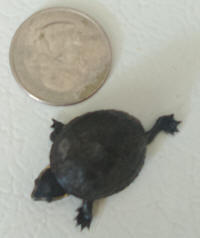
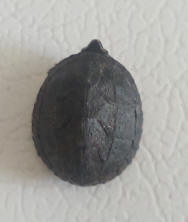
Hey I have a baby turtle that I have found and I need to know what kind
he is can you please help me
<Since Darrel's not about, I'll try and help here. This looks to me like a baby
Common Musk Turtle. Brown shell and yellow stripes along the head are the
features that suggest this to me. But a photo from the side would be very
helpful. Meantime, check it out here:
http://srelherp.uga.edu/turtles/steodo.htm
There's more here:
http://www.tortoisetrust.org/articles/oderatus.html
In short, these are small, nocturnal turtles that eat both plant and animal
foods (much like Sliders, really). The big differences between these turtles and
Sliders is that Musk Turtles are much smaller (10 cm/4 inches shell length is
typical) and being nocturnal don't really need a basking light nor a UV-B light.
All they really need is shallow water to swim in, something they can climb onto
when they need to dry off a bit (a shored-up gravel bank works fine), and some
way of heating the water. This last aspect is VERY different to Sliders, where
the water is at ambient temperature and the turtles warm up under the basking
light. Musk Turtles need the reverse, slightly warm water (22 C/72 F is ideal)
but no basking light. A standard aquarium heater can be used BUT IT MUST be
securely covered with a "heater guard" otherwise the turtle will either burn
itself on it or smash it while moving about. A smashed heater is dangerous to
both you and the turtle, so I cannot stress the need for a heater guard too
strongly. Other than that, these turtles are easy to keep. A 55-gallon tank
would be ideal. Oh, and as the common name suggests, these turtles secrete a
nasty smell from their cloaca when alarmed. They do not like being handled (few
reptiles do, to be honest) but they are considered among the more delicate
turtles so far as handling goes, easily damaged as well as alarmed. So in short,
don't handle it. Leave it in its tank. Cheers, Neale.>
|
 |
Musk turtles 4/26/15
Dead WetWebMedia,
<Since Darrel's not about, I'm going to try my best to help. I'm sure he'll
chime in if there's something he wants to add.>
I'm a zoology undergraduate so don't feel you need to water down any possible
explanations.
<Okeley dokely!>
I have (had) 2 common musk turtles who are both roughly 5/6 years old. Big tank,
space to bask out of the water, feed them (obviously)
<Cool. Nice animals.>
Recently I introduced some new plants elodea, Cabomba and some cherry barbs and
shrimp. All of which are still present.
<Plants may well become food, and in fact should be. I'd not want to be fish or
shrimp alongside these turtles though. Even assuming they don't get eaten, water
quality in turtle tanks often "stinks", literally as well as figuratively.>
However, while home for Easter I noticed the eyes of one of my turtles to be a
different colour to the other turtles, researching online I have come to the
conclusion that this phenotype doesn't exist. It almost looked as though he was
blind, eyes were milky.
<Can happen with reptiles. Do bear in mind this species is nocturnal, so bright
light is bad for it. So too is the UV-B lighting normally used for day-active,
basking turtles such as Sliders. UV-B can damage the eyes of animals pretty
quickly if they're not adapted to it. Finally, diet is always the tricky part of
reptile healthcare. We often fail to provide the sheer variety of things they
eat because finances or practicality restrict us to using just one or two
things. So a lack of vitamins or minerals is
always something to consider when things go wrong with a pet reptile.>
But, the turtle wasn't bothered by his eyes, no inflammation, no gunk or any
other symptoms, just one really happy normal turtle who was eating and
functioning fine. 2 weeks ahead I'm back and university and my turtle has died.
Could their have been any underlying conditions the turtle could have had. He
was apparently healthy and active until the day she found him and I don't want
anything to be passed on to my other turtle (we have cleaned the tank again)
<A parasitic disease seems unlikely, but I would check the shrimps aren't
pecking at your turtle in any way. Shrimps have a tendency to "clean" anything
that stays still long enough, but Musk Turtles have a reputation for having
skins that are easily damaged. In short: I'd review the set-up and diet, and
also make sure any overhead light is filtered through floating plants (Duckweed
would be ideal and edible).>
I was hoping for some enlightenment.
Kind regards,
Joe
<Good luck, Neale.>
Musk turtle 3/28/15
Hi,
I have had SP since June of 2014. She's about the size of a half dollar now. She
was eating 2 meal worms a day and about 2 weeks ago she all of a sudden stopped
eating. I've tried fresh meal worms, turtle pellets, and dried worms. All she
wants to do is hide in her cave. She'll be on the side of her cave in the
morning, but once I turn her light on she goes back in. I tried taking her cave
out and she then tried hiding under the filter. I'm not sure if she think she
should be hibernating or not. Are
there times of the year when they get like this?
<Sometimes, but usually it's an environmental or health issue. Change the light
timer to at least 10 hours and bump the temp up to 75. Make sure she has a
basking rock or tree. If this doesn't stimulate her appetite after a week or so,
then you might want to consider dry-docking her for a couple weeks.>
She looks healthy otherwise, but I'm really concerned with her lack of appetite.
Water is regulated with a heater and is about 73 deg. Any ideas that I could try
to get her to eat?
<Are there any things changed OUTSIDE the tank? Musk turtles are sensitive to
vibrations from Air Conditioners, vacuum cleaners, etc. Anything like that new
or changed recently?>
Thanks for your time,
Nicole
Re: Musk turtle 4/11/15
Thank you so much for the great advice.
<that's what we like to hear!>
I changed her water and take her out often. I got another light and keep the
tank a few degrees warmer. She doesn't have her appetite back 100% but has eaten
a bit. She also is out swimming more, which is good news!
Thanks for your help, I really appreciate it.
<Yer welcome>
some questions. Please and thank you
12/23/14
Hiya
Sorry for bothering you, but I've had a look through your articles but I
can't find anything that answers my question (thought you'll probably
tell me this is common knowledge).
Ok.
1. I have bought (three weeks next Tuesday) four musk turtles.
(Leonardo, Raphael, Donatello and Michelangelo... yes... I am 28 years
old and I still love the ninja turtles the 2003 version anyway lol).
They are babies, only about the size of a 50pence piece
if that. I'm not sure if their male or female, I think they might be too
small to really tell.
2. The tank setup (currently) is a 112 litre tank with a large cave
ornament (this will be removed when they get bigger as the caves they
like to play in now will be too small for them), some plastic plants,
and some bog wood stacked on top of each other. and some fish ornaments
with flat tops for basking.
I have a filter (which for some reason keeps making weird noises like
there's something stuck in it. I've checked, there isn't). I have a
water heater (without it the water temp sits at 15 degrees c), with it
on it sits at 22-25 degrees. The temp doesn't seem to bother them, and
Raphael sits very close to the heater a lot. There's a UV light and a
Basking lamp.
<You probably don't need the water heater, and in time my experience is
they get broken anyway. Modern thinking is that turtles do best warming
up under the heat lamp, cooling down in the water.>
3. They get fed ReptoMin daily, supa fish food every two or three days,
and calcium supplement daily. They are fed outside the tank, and I
handle them daily. Michelangelo loves it, (though I swear if he keeps
trying to throw himself off the bed just to explore the floor I will not
be pleased). They have never bitten me. I leave them out until their
shells dry.
<Do need a better diet than this. Not tropical fish food, ever, for
Sliders including Map Turtles. Much too rich. Koi Pellets are better,
ideally mixed with some fresh greens and very occasional meaty treats
such as earthworms.
Do read WWM re: turtle diet. Musk Turtles are somewhat different, of
which more will be said shortly.>
4. I'm getting a map turtle in January (Ii couldn't not get it, it
looked lonely!) which I shall call Oogway (from Kung fu Panda).
Ok, so here's my actual questions. Can Common musks and map
turtles live together without problems?
<Not really, no.>
When they get older I will be getting a second tank, I want to set up an
over tank basking area that will basically be a bridge between the
tanks.
Is this a good or bad idea?
Anyway, thanks for listening to my mad ramblings. I appreciate you
taking the time to read this.
<Bear in mind Musk Turtles are smaller (so easily pushed about by much
larger turtles, though they themselves can be snappy), somewhat
nocturnal (so feed at different times), and more omnivorous than Sliders
(so need somewhat more meaty foods, such as mealworms, fish fillet,
krill, etc. in their diet). It's a heck of a lot easier to keep turtle
species separately
when their requirements are this different. Adult Sliders and Musk
Turtles have been kept together in very large enclosures, but in a small
aquarium like yours, it hardly seems worth the risk. Cheers, Neale.> Musk Turtle Concerns
10/10/14
Hello,
<Hiya - Darrel here>
I have a few questions about my new musk turtle.
<Well, let's see if I have any answers!>
History:- We got the turtle 1 week ago-
<OK>
Name: Franklin-
<Hiya Franklin! Welcome home!>
Age: we were told the turtle is 3 months old-
<About the size of a man's thumbnail>
Breed: Common Musk-
<Sternotherus odoratus>
Environment: 75 Gallon tank, 4 inches water (79 degrees F), Basking area
with incandescent bulb (97 degrees F), UVB bulb shining on opposite side
of the tank from the basking area, driftwood, river rocks, and plants
(hornwort), filter (Fluval External 306 Canister Filter set on lowest
flow rate), air pump with air stones (pump for 5 gallon tank).
We leave the basking lamp and UVB bulb on for 12 hours/day.
<I'd put the UVB on the basking area. UV from bulbs has very little
penetration into water and Musk turtles DO bask -- usually when no one
is looking>
Problem:
Buying: We bought the on Friday October 3rd. It had just arrived at the
pet store a couple of hours before we got there. The petstore owner said
he had not fed the turtle yet, and suggested we buy pellets to feed him
the next day. The petstore owner placed the turtle in a container with
moss and water, with air holes, to transport him home in. We had a two
and a half hour drive from the pet store to our house. When we put it in
its new tank it instantly dived off the basking area, and hid under
water.
<That's what they do>
The next day it seemed less shy and even basked. We took it out and put
it into a container with some water and food to try and feed it, but it
panicked and would not eat.
<Right. The thing to do was leave him alone and give him 3 or 4 days to
acclimate>
Feeding: Since we got him, one week ago, he has refused to eat.
<Can't say that I blame him>
We have tried feeding him iceberg lettuce
<The Peanut Butter Cup of the vegetable world. -- don't>
Nutrafin Max turtle pellets with Gammarus Shrimp and vitamin D, Zoomed
Red shrimp, and Zoomed Natural Aquatic Turtle Food Hatching Formula.
Once we saw him doing what we think was eating the hornwort. Other than
this he does not seem to even notice food. We have tried feeding it in
the tank, in a separate container, and by just leaving food in the
water/on the basking platform.
<Go to a local bait shop and buy 12 nightcrawlers (earth
worms). Drop on in the water about 6 inches from him. Leave the
room. Come back in 15 minutes. If the worm is still there, fish it out
and flush it. If just pieces, scoop them out and flush. In either case,
put the remainder the fridge and feed ONE more in three days. If he's
hungry, he'll eat. After that time, those worms are probably no longer
viable. The trick is to dump the extra in your garden before they are
too old to live>
<In the alternative - this is a bit messier - a small clump of Tubifex
worms or a small chunk of beef liver placed in the water about 6 inches
from him. In either of those cases, plan on changing the water
afterwards. They are better fed in a separate bowl, but that's after
Franklin chills out. Try the worms first>
Sleeping: We have also noticed that he seems to spend most of his time
sleeping. The internet is full of many confusing information, and we
have had trouble discerning if that is a good or bad thing. We have
noticed in the last few days at night he seems to be sleeping on his
basking area, and or other dry areas in the tank. Before this, we only
saw him spending the night under water in the hornwort. During the day
he spends most of his time sleeping on his basking dock, under or on the
tank heater, or in the plants. We very rarely see him swimming for more
than long enough to get to a different place to sleep.
<He's not comfortable in his new home yet, not feeding regularly… so
nothing yet is surprising>
New Problem: Yesterday I began noticing an odd behavior. He was sitting
on his basking platform and its whole body shook and lurched. It looked
almost as if it coughed. This lurch repeated this several times. Today
it was sitting on its driftwood (not the basking area), and the same
thing happened.
Questions:
1. Is it a problem that we haven't been able to get our turtle to eat
yet? What can we do to encourage him to eat?
<See above. They are not like people -- when stressed they stop eating
rather than chowing down on junk food>
2. Is its sleeping frequently a symptom of illness or stress or anything
else?
<It can be a sign of illness - or stress>
3. Is the lurching/convulsion behavior a sign or symptom of anything?
<It's not a GOOD sign … but it's also not indicative of anything
terrible.>
4. Do any of the issues/combination of the issues indicate anything that
we should be concerned about?
5. Could these behaviors be explained by the stress of being moved?
<Yes>
6. Is there anything else we need to do that we are doing?
<First, I'd disconnect the power filter. These animals come from
relatively still waters and it's possible the flow, the noise and the
vibration are upsetting to him. It's worth a try>
7. Is there anything we are doing wrong?
<Nothing specifically - you seem to have thought everything through very
well.>
Thank you very much for your time,
Nadine
<When in doubt - ALWAYS go the "warm and dry" route. Give Franklin a few
low-pressure days: Turn off his filter, don't handle him or startle him,
try a worm near him (but don't scare him by dumping it ON him). If after
a few days he doesn't eat, then dry-dock him and treat for what we call
'respiratory infection; here:
http://www.wetwebmedia.com/FWSubWebIndex/treating%20RES%20Dis%20DarrelB.htm
now be clear, I don't think he HAS an infection… but warm and dry is a
"safer" state for a turtle that could be on the verge of contracting an
illness.>
Re: Musk Turtle Concerns 10/12/15
Hello,
<Hiya>
I just want to check in with some new symptoms Franklin seems to have
developed. We are considering taking him to a vet but only pet emergency
is open today and tomorrow in our city.
<Don't take him to an emergency vet.>
Symptoms:
- whole body shakes
- mouth breathing
- very lethargic (he had trouble walking and ended up rolling onto his
back at one point)
- He has been spending 95% of his time on his basking spot (he slept on
it last night)
- He has started scratching his head
- He doesn't seem very responsive (he didn't panic when we picked him up
to move him off his back).
As for right now, he did manage to climb the large rock on his basking
dock and is sunning himself.
<OK - I am officially upgrading from "concerned" to CONCERNED. These are
not normal or expected behaviors and Franklin is, to some extent, sick.
For reasons I can't explain I'm thinking a calcium deficiency.>
<The very first order of business is to dry-dock him as explained in the
link I sent. Right now - warm and MOIST is his enemy, not his friend.
Keep him dry, warm 24 hours a day and under the UVB lamp for at least 14
hours a day. Remember we want him warm, but not BAKED. If you are lucky
enough to find a heating pad at a drug store that does not have that
horrible "Auto-Off" feature - buy it and use that under the cardboard
box. Start on Medium heat, try to get his basic substrate into the high
80's to 90 (but not higher than 93). Every day place Franklin in a
saucer of cool water just barely up to the bottom of his chin (so that
he has to put his head down a bit to drink) and let him soak for 10
minutes.>
<Meanwhile, search your area for a veterinarian that specifically offers
reptiles in his practice. But remember, keeping Franklin warm and dry
will be the cornerstone of a professional treatment as well. I'd suggest
a Calcium/Glucose injection (in a TINY amount) and an injection of
Danofloxacin 6 mg/kg, SQ>
Thank you for your time,
Nadine
paranoid? 8/22/13
HI,
<Hiya - Darrel here>
I recently bought two Common Musk Turtles, they're only babies.
They're in a good sized tank and the water's the right temp.
<Which is what? Should be no higher than regular room temperature
(68-73f)>
I've been feeding them frozen blood worms twice a day.
<ReptoMin floating food sticks or Koi pellets are
better and cheaper>
I've never had turtles before so I don't really know what type of
behavior is right and the stuff I've read online is all really
contrasting.
<Amazing, isn't it? The power of the internet is that bad
information lives forever>
Some sites say that my turtles shouldn't really bask completely out of
water, and that's what I'm worried about. One of my turtles, Boris,
spends most of his time under the water in caves, digging in gravel,
resting on plants etc. But my other turtle, Angus, spends a lot of time
basking, sleeping for hours at a time. He also opens and closes his
mouth a lot, sort like yawning again and again. There doesn't look to be
anything wrong with him, but I've read this doesn't always mean they're
healthy.
<You are perceptive here>
Is this just a behavior quirk and I'm being paranoid new turtle owner?
<Don't worry about worrying, Becky - the Paranoids have been out to get
me for years -- and I'm fine>
<Angus is exhibiting behavior that can be just quirky or a sign that he
is ill and it's really hard for us humans to tell the difference.
Musk turtles do bask, but they are shy and nervous and spend that time
RIGHT at the water's edge and since it's a vulnerable time for them,
they don't sleep>
<The yawning you see is something we see in turtles with respiratory
issues, so when I combine the two I'd say that little Angus is
struggling.>
<The treatment is to keep him warm and dry and under UV-b lighting for 3
or 4 weeks, soaking and feeding him for about 15 minutes each day
(It's all detailed right here:
http://www.wetwebmedia.com/FWSubWebIndex/treating%20RES%20Dis%20DarrelB.htm
>
<What we're doing here is making his life and environment less stressful
and challenging so that he'll more easily recover.>
Thanks a lot, Becky
Musk Turtle Won't Go In the Water
8/4/13
Ladies and Gentlemen,
<Sounds like you're about to announce a feature act!>
About 6 weeks ago my adult female musk turtle climbed out of the water
and began burrowing into the dry gravel and has not returned to the
water since.
<I hate when they do that. No rhyme or reason to it, no pattern
that I can discern, they just do it.>
I have a large outdoor gravel enclosure with a 400 gallon tank that she
shares with an adult female red eared slider. I have been leaving
fresh shrimp near her that has been disappearing but I have never seen
her eat. If she isn't then it is the night time critters that are eating
it.
<My bet is the critters. Petunia (assuming that is her name) likes
to eat in the water. If they happen to snag something on land,
they drag it into the water to eat it>
At first I thought she was gravid but she would have laid her eggs and
returned to the water by now.
<I agree>
When I place her in the water she frantically swims about the surface
trying to get out of the water.
<OK - this is important - she's telling us she doesn't want to be in the
water>
Any ideas? I am worried that she is not eating.
<Eating in itself is not the problem, Bill. Assuming Petunia is
otherwise healthy she can go an easy 4 months without food. The
problem is what we'd call destructive behavior. It's not healthy
for her to be out of water for that long.>
<There are two things to look at, Bill. There are actually three
things, but there's only two we can do anything about: 1- perhaps
she's ill. Some turtles instinctively know that the moist aquatic
environment that sustains them becomes the enemy when they are sick and
they try to climb out and just "hunker down" until they heal. 2-
Perhaps she just doesn't like THAT pond suddenly. Not sure what
reason their would be but then again Petunia's brain is the size of a
small raisin -- roughly the same size as the San Diego Mayor's brain --
and just as inscrutable by human standards.>
<So - the treatment here, for #1 and #2 - are essentially the same: Take
her out of the pond area and "dry-dock" her indoors. A
container with UV-B light and a heat source, but not burrowing sand that
she can get lost in or makes her the target of predators.
Give her some towels or even shredded newspaper to bury herself in --
anything that will make her feel secure … but every other day, pick her
up and put her in a room-temperature dish of fresh water no deeper than
her shoulders. This will give her the ability to drink and
poop, which she needs - and then maybe offer her a small piece of
chicken or beef liver or an earthworm to see if her appetite remains.>
<Give her 6-8 weeks of this treatment and then put her at the edge of
the outdoor pond one day and see what she does. If she heads for
the sand, it's back indoors. If she heads for the water, keep a
lookout for her behavior not being back to normal>
Best Regards
Bill
<PS: Both Petunia and the Slider (Sylvia?) will do better, live longer
and be healthier if you switch their diets to something like Koi pellets
as a staple and using shrimp (better yet - FAR better yet) Earthworms as
occasional treats.>
Large Pleco and baby map or musk, incomp.
12/10/12
Hi my name is Tim from Georgia
I have a spotted Pleco that is a little over a foot long in a 75 gallon
tank with a Fluval 305 filter no gravel as of yet. I was wondering if I
can add baby turtles I plan on getting to the same environment. I plan
on getting maybe 1 razorback musk and two Texas map turtles.
<Mixing dissimilar turtle/terrapin species isn't usually a good idea. In
this case, the Map Turtles have the potential to reach around 20 cm/8
inches in shell length, while the Musk Turtles are only about two-thirds
that size. They also have rather different diets, the Map Turtle being a
definite omnivore with a requirement for fresh green foods and only
limited offerings of meaty foods (though not quite so herbivorous as
"Slider" type turtles) whereas the Musk Turtle is a definite carnivore
that eats little green food. With this said, if you carefully controlled
what sort of foods were offered and provided adequate space, they might
cohabit. Razorback Musks are among the most tolerant of the Musk
Turtles, and (males) Texas Map Turtles aren't nearly as prone to
aggression as some of the Sliders like Red Ears, so they could get on
just fine. A lot will depend on the size of the tank (I fear 75 gallons
might be pushing your luck) and the availability of basking spots under
the heat and UV-B lamps.>
I doubt I will be able to keep the razorback with the Texas Map pair
from what I have been reading on this website. If I am wrong on those
two species not being able to coexist please let me know. But my main
question would have to be can I keep either of these turtles in the same
75 gallon tank as my large Pleco?
<Even if you managed to keep two adult turtles in 75 gallons -- and it
would require frequent water changes and a very large aquarium filter, I
seriously doubt that the humble Fluval 305 would be able to keep ammonia
and nitrite at zero. Remember, turtles aren't really too bothered by
ammonia because their skin is impermeable, and provided the water
doesn't smell and is kept clear enough for you to watch your turtles
easily, then the filter is doing its job. But that's a world away from
the excellent water quality fish require. Even on its own, the Plec (as
an adult at least) would put a heavy strain on the Fluval 305 and needs
an aquarium around the 55 gallon mark! Plus, the Musk Turtle especially
is an opportunist predator, while the Map Turtle mostly eats snails, so
a Plec substantially smaller than them might be viewed as "live food" by
either species of turtle. As you know, feeder fish aren't necessary or
even a good idea for pet turtles, so the bottom line has to be fish in
one tank, turtles in the other.>
I plan on getting a turtle topper and plenty places to hide for the
musk.
Can either of these guys exist with the Pleco or can they call exist
together?
<Few turtles work well with fish, and those that do tend to be demanding
varieties such as the Pig-Nose Turtle (Carettochelys insculpta). It's
quite common to see them in giant (200+ gallon) systems with all sorts
of tankmates, even Rainbowfish and Clown Loaches!>
Thanks for your time and sorry if this question has been asked but I
could not find it.
<Maybe not asked recently, but a perennial question nonetheless. Cheers,
Neale.>
|
Turtle ID – 4/19/12
Dear Crew,
<Hiya, Darrel here>
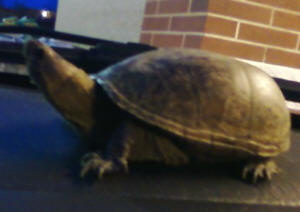
Can you please tell me what kind of turtle this is?
<Yes I can!>
Thanks.
<Yer welcome>
Sent from my iPhone
<bragger!!>
|
 |
|
Musk turtle help on WWM
4/10/12
Would you pls look, resp. to this young lady... she's written
in four times since Fri. B
Re: I think my musk turtle may be sick
Dear Crew
<Hiya - Darrel here>
Please help me with my musk turtle.
<OK>
I am very worried and would like to know if I should take it to
the vet.
There are a few white spots on its head that do dry out when it
basks.
<It does look like an infection of some sort>
Also, it looks like there is a film or something over its
eyes.
<Hard to see from the photo, but a fungal infection would do
that>
I'm worried it has trouble seeing. It has been basking a lot
more than in the water, and I'm not sure it is eating much
either.
<When a turtle gets sick, the warm, moist environment that
nurtures a healthy turtle becomes their enemy - too friendly to
fungi, bacteria and parasites>
Normally, it loved eating the pellets (ZooMed Natural Aquatic
Turtle Food Growth Formula). My turtle is only about 2.5 to 3
inches in length. The water is kept around 78-82 degrees.
<That's too hot! Should be around 68-73 degrees
(basically room temperature)>
I have it in a 40 gallon breeder tank, with approximately 15-17
gallons of water.
<Nice size and shape!>
There is a 75W basking light over the basking spot along with a
5.0 UVB compact fluorescent bulb.
<Perfect>
I also have a long 5.0 UVB fluorescent light for the rest of the
tank. I tried to feed it a carrot peel because I thought it might
have a vitamin deficiency (the eyes looked a bit swollen, but
hard to tell cause it looks like there is a film like I
mentioned), no luck eating it though. I just changed the filter
last night. Also, when I add tap water I also add Aquatic Turtle
Water Cleaner, as well as having one of the turtle shaped
conditioning blocks that last up to 45 days. I have only had this
turtle for a little over a month and the other turtle I bought
with it died in six days. Sometimes I catch it breathing with its
mouth open, so I am worried it might have a respiratory problem.
Please help as best you can, I would hate to lose this turtle
too.
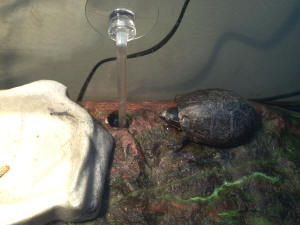
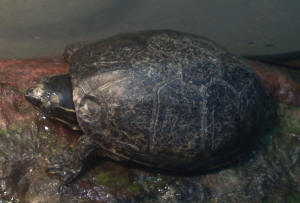
I have attached a smaller picture for viewing its head.
Sincerely,
Krissy
<Krissy - the most important thing right now is to get him
warm and dry.
Read here -- and treat exactly as it states for fungal
infections. Swab the areas daily, put him in water
for only a few minutes each day to drink, poop and maybe
eat. Feed him a few scraps of beef or chicken liver
if he'll accept that.>
<http://www.wetwebmedia.com/FWSubWebIndex/treating%20RES%20Dis%20DarrelB.htm
He can go a LONG time without being in water as long as he
can drink daily. Get him under the UV light - even 24
hours if you can - and try to get his skin swabbed.>
<Yes, if you can, I'd take him to a vet -- the problem is
that most veterinarians get 6 weeks of reptile medicine when they
are in school and never make a career out of it except for the
odd case that comes in. Call around to your local
vets and ask if they have any references for a Herpetological
Specialist in your area.>
|
  |
Re: Turtle 3/11/12
Hi again,
<Hiya - Darrel here>
I have a new problem.
<Let's see if I have a new answer>
My baby stinkpot turtle
<Let's stop right here. Stinkpot turtle??? How come no one ever
thinks about how being called a 'stinkpot' effects their self
esteem? How would YOU like to be called "Stinkpot?" Or
"Stinky?" Or "Myron?" The fact is that what you
have is technically named a Sternotherus odoratus or Common Musk
Turtle. Even THEN … the term "common" might imply she's
not capable of great things, so lets just call her a Musk
Turtle>
… keeps scratching herself. I've had her for a few months now
(she's nearly 1.5 inches), and she's been scratching all the
time I've had her. My other turtle (just a little smaller than her)
doesn't scratch.
<She sounds cute>
The water's tested and fine, I have a filter, and heater, UVB and
basking bulb.
<Thank you for doing that. People think that Mud, Musk, Snapping and
Soft-shell turtles don't bask... but they do.>
Basking spot is around 28'C, and water is 25'C.
<That's 83 degrees (f) and 77(f) for those of you that live in
the Land of Gallons>
How can I stop her from scratching?
<I guess you've already tried just talking to her? Scratching
and Cutting in young people is often a sign of psychological issues …
and after being called a Stinkpot… maybe …>
She does have a lot of loose, dead skin...
<What I would do with her is to take her out of her natural aquatic
environment and put her somewhere warm and dry for a few weeks. Place
her in a shallow bowl of water for 15 minutes a day to drink, poop and
eat, but otherwise let her stay dry and help her skin dry out. I
suspect that he has just the mildest of a fungal incursion under the
skin … just enough to keep the fresh skin irritating her. Exposure to
natural sunshine is a HUGE benefit here as well.>
Thanks.
<Yer welcome. Don’t be overly concerned. Dry-dock her for a few
weeks and it should clear right up.
http://www.wetwebmedia.com/FWSubWebIndex/treating%20RES%20Dis%20DarrelB.htm
>
<Also, mind her feedings. Both of them. Musk and Mud turtles can get
obese very quickly. I feed mine the same as the sliders - a Koi pellet
diet with a meaty treat no more than twice a
month.>
Musk Turtle Pond Size
2/10/12
Hi.
<Hiya - Darrel here>
I am planning on getting a musk turtle. I have seen a circular
preformed pond at my local home improvement store and I was wondering
if this would be suitable for an adult musk turtle.
<Yes, subject to some conditions>
It is a 35 gallon patio pond, measuring 15 inches deep and 39 inches
across. The turtle would be kept singularly and I would prefer to keep
it indoors.
<Heather, a musk turtle is an interesting choice. They're
fun to watch when in the water, on the bottom - sometimes more fun than
the more popular Sliders but they're a little less social.
What I mean is that while they DO bask and DO need places to haul out,
they'll be less likely to do either when people are around.
Of course, your turtle may vary.>
<What I'm saying is that the Musk Turtles (along with mud
turtles and even snapping turtles) need places to haul out and bask and
they prefer branches & logs and such more that crawling out on a
sandy "shore" area -- so you need to do two things: 1 -
make sure that the sides are too steep for him to crawl out and go on a
hike and 2 - provide a log, stick or other facility that reaches
straight from the bottom to a point far enough out of the water that he
can completely dry off. Direct sunshine is advisable as
well.>
<Although they live in and under the mud in nature, in captivity
they seem to do better and live longer in a less-muddy bottom.>
<Lastly, although they enjoy an earthworm or a garden snail every so
often as a treat (make sure no one used snail-bait or snail poison!)
they are best served in captivity with a vegetable-based food such as
Koi pellets or Repto-min floating food sticks>
Thank you.
<No charge!>
Common Musk Turtle Nails? 1/12/12
Hello,
<Hiya - Darrel here>
When we bought our Common Musk Turtles 'Crush' and
'Squirt' we were told to provide them with opportunities to
naturally file their nails e.g.
Allowing them to walk around on rough patio type of slabs, etc...
I've searched the internet and your site extensively but can't
find anyone/anywhere that says to do this. Do they need this?
<Well, I guess you COULD. I sure don't.
Mud and Musk turtles are much more aquatic than the Sliders and
Cooters, etc. and as a result we don't get a lot of face time with
them. For that reason, I take mine out every 5 or 6 Saturdays and
we all go get manicures. This takes care of their nails and
gives us some quality "Daddy & me" time.>
<OK - wait. That may not be ENTIRELY true. The part
about them being more aquatic is true ... the rest of it was,
apparently, some sort of momentary hallucination on my part>
<There really isn't any reason to trim their nails or provide
any particular surface area just for that. I keep mine in a tank
with typical small aquarium gravel and their natural rutting and
digging around through that is enough to keep their claws in
shape>
Your previous advice was a real help and after having them for several
months now they are thriving and seem to love their home and are very
inquisitive as to our movements.
<That's typical>
However it is a shame because every time we go to pick them up for
cleaning they really go for us (we were hoping we could tame them a
tiny bit so they don't bite when we need to clean them out),
<That's typical, too. They get quite snappy when picked
up. Here's why:
Take a look at the bottom shell (called the carapace) and you'll
see that there's not a lot to it. As bottom dwellers
they are not very well protected down there. So in nature, any
time their bottom isn't touching the sand is a time that
they're liable to be someone's dinner.>
even after the pet shop showed us how to handle them, ours just
don't seem up for it at all.
<Here's my suggestion: When they are on a flat
surface with all 4 limbs on the ground, they'll feel a bit more
secure and could be more accepting of soft stroking on their upper
shells. After they get accustomed to that, they may not retract
their head as your finger approaches and may allow you to stroke their
heads.>
<It's equally possible that they will always see your fingers as
potential dinner. Mud Turtles, Musk Turtles, Soft Shell and
Snapping Turtles all seem to live by the motto: Bite First and Ask
Questions Later>
Love the site and thank you again in advance!
<Yer welcome!>
Stacey
Poorly musk turtle? 1/5/12
Hi,
<Hiya - Darrel here>
I hope you can help as my Internet searches have not helped me.
<I'll try>
I have two musk turtles and two yellow bellied slider turtles. They
have all been fine and happy and in the tank they're currently in
for a few months now.
<OK>
My female (I'm pretty sure she's female) musk turtle has over
the last day or two been ill. She has climbed out of the water onto one
of the rocks and doesn't want to go back into the water. She will
move from rock to rock now and then, but is very lethargic. Her hind
legs also appear swollen, and she is currently opening and closing her
mouth wide about once a minute.
<She sounds distressed, yes>
The other turtles, which I think are all male, are all absolutely fine.
I have checked the water for ammonia and it's fine and it
doesn't smell (I have a super fish filter on the tank), the water
temp is about 27oC and I have a new UV lamp at the advice of the shop I
bought them from.
<The water is MUCH hotter that it should be 20c to 22c
MAXIMUM>
I've had her, and the others, for 18 months now, and the two musks
are about 7cm shell length. I'm guessing I need to take her to a
vet? But as it's new years day they're all closed :-( How do I
go about taking her to a vet without stressing her out or letting her
get cold? She is quite friendly and doesn't mind too much being
picked up and stroked.
Please help if you can.
Thanks, Lucy.
<Lucy, Musk and Mud turtles are more aquatic than the sliders, but
they also require some basking time and radiant warmth, but in your
case the water is far warmer than it ever should be, so the turtle
isn't climbing out to seek warmth, but probably just to rest.
In fact, she may be climbing out to cool down!>
<The problem is that there are not many conditions that will cause
the back legs to swell and not the forelimbs, but it's possible
that on close examination she's just getting a little fat -- at
such extreme water temperatures her metabolism is running in extra-high
gear.>
<just the same, I'd take her to the vet for
examination. If you have a container that is at room
temperature and you place a towel inside that container that is also at
room temp - you can place the turtle inside that and wrap the towel
over her and she'd be good for a heated car trip of several
hours.>
<In the mean time, read here on the basics for their care.
http://www.wetwebmedia.com/FWSubWebIndex/RESCareBarton.htm
>
Musk turtle won't go in the water
11/26/11
Dear Crew
<Hiya - Darrel here>
We have a musk turtle that's 6-7 years old. We've had her most
of her life, having found her as a very small turtle in a river.
She's kept in a 20 gal. tank with 2 filters. I typically clean the
tank and change the water every 2 months or so. There's never any
significant build-up of algae or dirt.
<For one turtle in a 20 gallon tank, that's about right>
There are no other animals in the tank. She is fed ReptoMin.
<Good choice. An occasional earthworm is a good, healthy
treat>
I use tap water to fill the tank and do not put any additives in the
water.
<That's fine, too>
Unfortunately my UV light broke a few months ago and I have not been
able to replace it yet.
<Not AS bad for a mud or musk turtle. They're need to UV is
quite a bit less than for the Sliders & Cooters, etc.>
The tank is kept indoors, so roughly room temperature.
<Also good!>
<Is there a basking (heat) lamp available, too? As I started to say,
the Mud, Musk and Snapping turtles don't bask as often as the
others, but they DO bask and DO thermo regulate when necessary>
A few days ago, I cleaned the tank in my normal way and put her back
in. Within a few minutes she climbed on the floating dock (completely
out of the water), and has not gone back in the water for several days
now. This is very uncharacteristic, as she usually spends very little
time out of the water. She otherwise looks normal, albeit dry, but
seems lethargic. I haven't seen her eat recently. Is this something
that will pass, or is this a sign of disease that needs to be treated?
She seemed perfectly normal prior to the tank cleaning. I have already
replaced the water again on the theory that something in the water was
bothering her, but it made no difference. Any help would be greatly
appreciated.
Thank you.
<Tim - my guess is that something in the tank is bothering her.
Vibrations from a filter perhaps? Micro-electrical leaks from some
other equipment? Noises (that become vibrations) from something new in
the room?>
<Place a regular old incandescent bulb over the basking area as a
heating lamp. Turn off both the filters. Check the room for different
things - remember they have no ears so they can't exactly HEAR but
they are very sensitive to vibrations.>
<If all else fails, move her some place different for a weekend. A
plastic tub with 3 inches of water in it and a rock. The bathtub with
just an inch of water (provides she's too big to go down the
drain). What we want to do is see if the behavior follows the
environment or if it follows the turtle. Make the change and giver her
a day to become accustomed before you evaluate.>
<Write back when you know more>
Mud Turtle Behavior 10/20/11
Hi,
<Hiya - Darrel here>
I recently got a baby black musk turtle (3cm long) (a week ago), and
she's doing fine. But the only concern is, is she keeps swimming
towards the black rock I use to let her bask. Even though she can't
"go through" the rock, she keeps bumping her head onto it and
it looks like she's "attacking" the rock... Is it because
the rock is black (and the turtle's blacky-brown)?
<Probably not because of it's color>
The rock is a thick, black, and flat rock. It's a rectangular
shape. And I have seen her bask on it, so there's no problem for
her to get onto the rock. Any ideas on why she does this?
<Yes>
I'm just worried that she might eventually hurt herself, I do
checkups on her often, and she hasn't got any injuries yet.
<She won't hurt herself doing this>
Will I need to replace it with a different basking item (colour
wise)?
<Chibi Mud and Musk turtles are burrowers. They spend their time on
the bottom and UNDER the bottom, buried in the mud or sand (hence the
name "mud" turtle). This is part of what gives them a sense
of security. What she's doing (most likely) is trying to find a
place to get UNDER that rock, simply because that is her nature. My
suggestion is that you take your time to find & arrange a rock
and/or log setup so that she has some sort of dark overhang that she
can get under. What's critically important is that you set it up so
that she can't get wedged in and unable to get back out - and that
nothing can shift and fall on her. I often use two small wooden
branches - one laying across the other (forming an "X") so
that they have places they can lie next to and get that secure
feeling>
<Another thing to note is that mud and musk turtles don't bask
as often as the other water turtles, but they DO bask and they DO need
the heat and UV-B. It's just that they're nervous, so they jump
back in the water and the first sign of movement. The fact that she has
let you see her bask means she's fairly relaxed.>
Thanks.
Conflicting Information...Help!
10/4/11
Hello,
<Hiya - Darrel here>
I have read every article possible on the web and spoken to 2 different
"experts" at the pet shops but they all contradict each other
when it comes to the basic care and don't go into the detail as I
have asked below. Because of this I really hope you guys can help!
<I hope we can help, too!!>
We bought 2 x Common Musk Turtles (I have no idea how
old they are or what sex they are but they measure around 2 inches) a
week ago and put them in an aquarium measuring 48" x 12" x
18" (replacing the lid for a mesh cover). We treated the water
with Aqua safe (to be replaced with Reptile safe once this has run out)
and have a Fluval4 Filter, 60W Basking Lamp set over a Floating Dock,
UV-B Light, Heater, Ornamental Plants, Rocks and Pier (with ramp),
Gravel substrate, water thermometer, air thermometer and live plants
for nibbling on!
<Excellent. Save yourself the money on Water conditioning though any
tap water you could drink is fine for them>
So far they have both been very active and seem very inquisitive as to
what we do and seem to love exploring their new home.
<They're a fun turtle to have & watch, but they are very
nippy so when you handle them, be careful>
Our Schedule at the moment is:
*Lighting/Heating*
UV-B Light is on from 9am - 9pm
60watt Basking Lamp is on from 10am - 6pm
Heater is on permanently at 21oC
<That's in range, but no real need for a water heater. Room
temperature water is just fine unless you like North of the Arctic
Circle>
*Q1 * - The air temperature rockets to 35oc when the basking lamp is on
and water to 24-25oc, is this to hot?
<Nope - that's OK>
and do we have it on long enough or too long or just right?
<Seems about right to me>
We have never actually seen them use this area yet, they are constantly
in the water and I was told by a pet store that they don't need a
basking area, which I ignored
<Kinosternon do not bask as often as the Sliders and Cooters and
their families and when they do, they usually do it privately. They are
at home in the gravel and climbing the underwater rocks and plants and
they get um nervous when they're out of water. Normally, I provide
just a log out of water for my mud and musk turtles -- that luxurious
basking, climbing and exploring areas that Sliders seem to really enjoy
is lost on the Kinosternon and families. But that doesn't mean
change it, I like your setup in every way that I can see>
*Q3* - When the lights are off at night the air and water temperatures
average 20 - 23oC, my concern is they can't warm up anywhere at
night. Do they need a warming area at night?
<Never. At night, their instinct is to hole-up or dig into the mud
(gravel) and simply be protected until morning.>
*Water Changing/Cleaning*
*Q1* - We have bought a Gravel/Tank Cleaner which we intend to use
every 3-4 weeks, is this enough?
<Unlike fish, turtles can handle quite a wide range of water
conditions. As long as the water is clean and odor-free, go easy on
yourself.>
*Q2* - When changing the water do we need to bring it up to temperature
first before adding to the tank?
<Unless you live in Antarctica, no. Just drain and re-fill. ANOTHER
advantage over fish>
*Q3* - When we add the water treatment should we treat it before adding
to the tank or just add it into the tank?
<Don't bother treating. Save time, bother & money>
*Feeding*
We are currently feeding them 1 x pellet of dried turtle food in the
morning then giving them an ice cube size of either prawn, bloodworm or
premixed turtle food of shrimp/veg, etc...
*Q1* - Do you think this is right or to much/little?
<I feed my mud & musk turtles the very same Koi pellets I feed
the sliders (different tanks, however) and they eat it greedily and
grow well>
*Q2* - How will we know to increase this as they grow?
<A major problem with our pets is that we feed them too much. All
they can eat in 5 minutes - 5 times a week when young, 4 times a week
after 2 years is all they need>
<I also toss in (pun intended) an earthworm approximately once a
month.>
I'm really sorry about all the questions but like I said I am fed
up of getting different answers everywhere I turn.
<You've reached the Source!! Bob, Neale, Sue and I MEVER NAKE
Mistakes!>
I really look forward to your reply.
<Yer welcome!>
Picture of our setup attached!
<Great pics, too!>
Thank you in advance
Stacey
<OK everyone see. "Mever Nake Mistakes is itself a mistake!!!
It's my way of bragging that my answers are right at least 25% of
the time!!!!>
|
Sheldon, sys., hlth. 5/3/2011
Hello,
<Hiya - Darrel here>
I bought a male African Sideneck turtle 3.5
years ago. (Pelusios castaneus)
<I think you mean West African Mud Turtle,
but it's the same guy>
I dont know how old he is, but he is 6.5 inches long. (He was at
least an inch smaller when I got him.) He was housed in a 20
gallon breeder tank which was filled ¾ of the way with water.
There was a Fluval filter, which was cleaned along with a water
change, every 2 weeks. Water was kept around 85 degrees according
to the thermometer, tho it seemed to vary quite a bit feeling
much cooler at times, so Im not too sure the thermometer was
accurate.
<Hot! hot! hot! Even for a sub-Saharan species, that's
just too hot. His water temp should never be above 80 and
preferably around your normal room temperature. Some literature
will state 80 to 83 degrees but 83 is Maximum and anyway I'm
right and they're wrong. Remove the heater and let the water
cool>
There was nothing on the floor of the tank, several plastic
plants, and a floating turtle dock for basking. A 5.0 UVB bulb
and a 50 watt basking light were over the dock area. He was taken
out of the tank and put into a bucket for feeding. He had turtle
pellets daily and every two weeks I gave him 10 small fish. He
was not interested in crickets, mealworms, shrimp, lettuce, or
banana. For the first 2.5 years, he was a happy little turtle. He
swam and basked about equal amounts of time. Maybe 3 times per
month he would refuse to eat, otherwise a good appetite and the
fish seemed to be the highlight of his life, as he would chase
them furiously until hed eaten all 10. He pooped regularly and
tho I never saw him eat it, it would be there and then gone most
of the time, so Im suspecting he did. About once every 2 months
we let him walk around the middle of the living room within a pet
fence so he would be safe, but be able to walk around a little.
He was very tame and liked to be petted on the head. Several
times he was content to burrow in a blanket on my sons lap and
just lay there. Everyone who came over thought he was just the
coolest little turtle because of how interactive he was. He
seemed to listen when we spoke to him and he would swim the
length of his tank when we walked by, as if he were swimming next
to us. Then about a year ago, it seemed like he just lost his
mind. He would have episodes that lasted an hour or more where he
acted like the water was hot lava and he had to get out
IMMEDIATELY. He was absolutely frantic, trying to scramble up the
side of the tank, standing on the filter at times to get higher
up. (I would feel the water myself at these times and it was
fine.) If he wasnt thrashing about and trying to climb up the
walls, he was pacing (swimming) back and forth in a repetitive
route. I read everything I could find online and couldnt find any
answers. After some searching, I found a vet in town who deals
with exotics. We spoke at length on the phone and her two
suggestions were to give him a dark corner where he could feel
like he was hiding and that he needed a bigger tank.
<Some animals do benefit noticeably by what's called
"visual privacy." It often does have a calming effect.
And anyway 20 gallon was way to small for him>
I really didnt want to invest in a whole new set-up, so we tried
the dark corner first by putting black paper around ½ of the
tank and I also got him a bigger floating dock as he was getting
so heavy that the dock would still be slightly in the water when
he went up on it. Another 2 months passed with no improvement, so
off we went to the vet. $80 later, she said he looked perfectly
healthy except for two small holes on the bottom of his shell
(which I assume are shell rot) and she gave us Betadine to treat
those with. (Picture attached, but blurry, sorry.) Stool was
negative for parasites. I was concerned about the top of his
shell where he was losing color from the edge and traveling
slowly up over the past year or so. She informed me that I needed
to be de-chlorinating the water and suspected that the
discoloration was happening because I hadnt been doing that. (I
wouldve had I known to.) Her only suggestion now was to get a
bigger tank.
So about 6 weeks and $600 dollars ago, we put Sheldon into his
new and improved house. He is now in a 55 gallon tank (Picture
attached) with a Tetra 30 heater on each end (which are supposed
to keep the water at a constant 76 degrees). He has a Rena
Filstar xP3 canister filter, medium sized river rocks on the
floor, multiple plastic and fabric plants, a cave for hiding
(which took a loooong time to find one big enough for him), an
air stone, and a cover with a fluorescent light over half of the
tank. Atop the other half of the tank is a Turtle Topper which I
thought was fabulous because it gives him a large area to bask in
and completely dry off and it also allows for so much more
swimming space (which is what the issue seemed to be). Below the
Turtle Topper, in the water, is a resting ledge. I purchased new
clamp lamps which attach to the top of the Turtle Topper and put
a new 5.0 UVB bulb in one and a 75 watt basking bulb in the
other. The water temp reads 75 degrees and the basking area temp
reads 80 degrees when the lights are on. (I realize from reading
other posts on your site that the basking area needs to be warmer
and I will fix that.)
<AS I'm reading, I'm thing to myself "these are
all good things, but I'll bet they won't
help.">
So it was quite the occasion when we first put Sheldon into his
new digs.ceremonial almost. He of course freaked out, which I
expected because that was what he did when we put him in the
other tank for the first time. He swam the length of the tank and
then landed on the ledge under the Topper and there he stayed for
about 24 hours. The next day, we found him up in the Topper and
were happy that he had figured out how to get up there and seemed
to like it. The next day, the frantic scrambling up the sides of
the tank started again and he would go between doing that,
resting on the ledge in the water and going up to the basking
area. To this day, he has not tried to even put his head under
the water and swim. He honestly acts like he cant swim
anymorelike hes drowning whenever hes in the water. He has never
gone to the bottom of the tank to investigate and no longer
follows us as we walk by. Day 5 or 6 he decided to stop eating
and wanted to just stay up in the basking area 24 hours/day. I
bought him fish and he has zero interest in them. (All 10 are
still in there and its been a month. I now have to feed the fish,
too!) He also started trying to climb up the walls of the Topper.
The clear plastic top is now scratched up on all sides from him
balancing on the bottom of his shell (to stand) and try to claw
his way out. A smart friend of mine who knows a lot about
everything, suggested that the only thing left that I havent
provided for Sheldon, is sexual release. He said a shoe would do
the trick and after watching some videos on You Tube, I thought
he just might be right.
<PLEASE tell me you haven't been watching turtle
porn!!!>
<There are sites on You-Tube that describe a turtle needing a
shoe for sexual release? Men in Trench Coats going into a shoe
store maybe but a turtle???>
But, no. Sheldon doesnt give a crap about that shoe.
<Good. Sheldon has enough to worry about without years of
therapy>
At about Day 14, I came home from work to find him tipped over in
the Topper. It was as if he had been standing and scratching and
then just tipped over on his side like a fallen tree. His head
was all jammed into the corner and there he laydead. After coming
out of my shock and disbelief, I decided I better move him so
that he didnt harden with his neck all crooked like that. I
picked him up and his eyes opened! I set him back down in his
basking area. He stared at me in a weird way and he just looked
plain sick. I expected him to be dead the next morning. Well he
hadnt moved, but he was still alive. So I called the vet and told
her all of this. Now she suggested bringing him back in and then
taking home antibiotics that I would have to inject him with. I
just couldnt see doing all of that for this little turtle who I
had now invested over $1000 in and if we lived in China, wouldve
been soup long ago.
<It's an expensive club, Melanie. We even have custom-made
jackets.>
Since then, Sheldon has stayed up in the Topper 24 hours/day.
Sometimes when hes standing and scratching, hell just fall asleep
like that (picture attached). I put him in his bucket to feed him
daily, but he has only eaten 3 times in the last two weeks. After
feeding, I put him in the water in the tank and he swims as fast
as he can to get to his ladder and get back up in the basking
area.
<Poor guy>
First of all, thank you for reading all of that! Secondly, do you
have ANY ideas as to what is wrong with him in general, why his
shell is discoloring, and what the heck else I can do for this
little guy?
<Personally, I think he needs dance lessons>
Also, on the half of the tank where the fluorescent light is, the
rocks and plants are all developing what looks like rust and Im
assuming is some type of algae? What should I do about THAT? Id
like to get a second sideneck, but am being advised to figure out
whats wrong with Sheldon before putting another turtle in with
him.
<Agreed>
Please help us.
<Let's see what we can do>
--Melanie
<OK - let's start with the basics. As I mentioned before,
the water at 86 was WAY too hot and water should be right around
your room temp. With the basking area between 88 and 93 degrees,
the idea is to let Sheldon decide what temperature suits him at
the moment.>
<That said, I'd like you to take Sheldon out of the tank
for a while. You have a living room pet fence. Put Sheldon in
there for a week, with just his basking light clamped to one side
(again so he can warm up & cool down) cover the bottom with
newspaper and if you're worried about the heat from the
basking lamp, place a piece of wood underneath it, etc. Don't
worry about the UV for right now. If it's easy enough to
move, fine., If not, a week or two without it isn't
earthshaking. Place Sheldon in his feeding bucket for 15 minutes
each evening, just to let him drink & maybe poop. Dont even
offer any food for the first 7 days.>
<Sheldon's shell is getting to look like shells look like
as the turtles grow older and mature. I see nothing there that
concerns me.>
<What I suspect is that as Sheldon in maturing, he's
becoming more terrestrial and less aquatic. As juveniles they
stay close to water (in the mud - which is why they are so
cleverly called MUD turtles <well, THAT and the fact that the
word "carburetor" was already taken> ) and as they
mature they begin to foray out of the water and into the
marshes.>
<Having said that, I'm not proposing that we try to make
Sheldon a garden dweller or anything. We acknowledge that he
doesn't like his world, so we move him to a new one and we
see how he reacts.>
<That's as far as I'd like to go right now. Find a
place for Sheldon to be warm & dry & calm. Away from
filters, pumps, things that vibrate or could be leaking
electricity into the water, etc. We'll deal with each of
those in turn AFTER we find a way to make Sheldon feel at
home>
<Do those things, write back when you see any kind of real
change, stop watching You-Tube (you AND Sheldon) and oh yeah, I
was just kidding about the dance lessons>
|
|
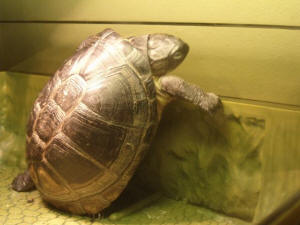 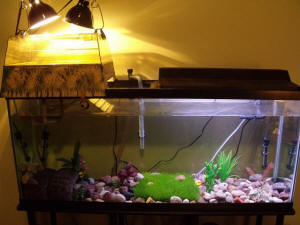
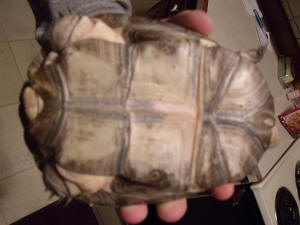 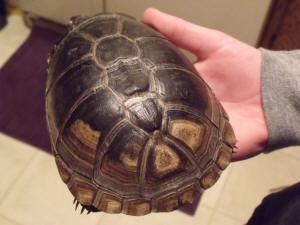
|
|
Musk turtle shell
2/25/11
Hey
<Hiya! Darrel here>
I have 2 Common Musk Turtles which are just over 2 years old.
I'm pretty sure one is male and the other is female (but
I'm not positive). The carapaces are around 3-4 inches long
now. They are fed every other day.
<About right>
Their diet consists of ReptoMin turtle sticks and frozen brine
shrimp/turtle food/crayfish alternately. They also get 4 drops of
Beaphar Turtle Vit every day (as per the
Instructions of the place I bought them and the packaging). They
are fed in the water because they like to bite (especially the
male!).
<Yes they do! Mud and Musk turtles tend to have short
tempers>
They have recently moved into a new home: a 240 liter fish tank
kept about a third filled. I am using the canister filter that
came with it so it is definitely more than good enough to keep
the water clean. There is a reptile UVB bulb (one of the ones
that goes in the lid of the tank) and a ceramic heat lamp
centered on the platform for basking. The light is kept on all
day from about 7am to 10pm.
<Maybe just a tiny bit long. They wouldn't encounter that
it the wild>
They have lots of dark places to hide but also have a platform
and plenty of things they can climb on to bask on. I rarely see
them basking though but I gather from some research that this is
about right for musk turtles.
<They DO bask, not as often as other turtles -- and
they're more likely to do it is secret - retreating to the
water at the first movement or vibration - so even though people
don't SEE them basking, the UV and the heat lamps are still
important.>
The water is 78 degrees (measured with a thermometer) and is kept
at this temperature with a heater.
<Too warm. They'd never find 78 degree water in nature
unless they were vacationing in Hawaii. Water should be 68-73
degrees, in other words "Room Temperature" and them
they have a CHOICE between cool water and warm basking>
I do a part water change every 2 weeks and give the tank and
filter a good clean about once a month. They are not next to a
window.
<Other than the temp - everything sounds GREAT. Remove the
heater completely and let the water be room temp.>
So the problem is with their shells. Over the last couple of days
they have developed what looks to me like a white/grey deposit
(?)/coat on their shells but the shells are still hard. I've
attached some pictures but they're not that clear because the
turtles wouldn't be helpful and sit still (one has some glare
on it from the light too)! I'm worried that it's shell
rot but I read a few posts on the website and saw one about
mineral deposits and now wonder if this could be the case but as
I couldn't find any pictures I would be really grateful if
you could tell me what you think. I live in quite a hard water
area and there is almost constantly a mineral deposit mark around
the tank so I think it is probably mineral deposits on the
shells. However it has appeared in literally the last couple of
days which has concerned me. They are eating fine and being as
curious/nosy as ever so they don't seem to be suffering any
ill effects at the minute. Sorry for the essay but it says to
include as much information as possible! Thanks in advance!
Kim
<Kim - looks like water spots/mineral buildup to me. Scrape a
small section gently with something hard. Fungus will usually
come off as a sheet or flakes, where mineral deposits just
disintegrate (or don't come off at all). Try washing a spot
with a bit of vinegar.>
<If they stay healthy and active and the shell doesn't
soften or start to smell, then just wash the minerals away a
little bit with vinegar every tank cleaning and put it out of
your mind>
|
|
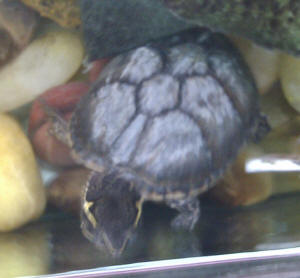
|
Common Musk Turtle that got sick or I bought sick
`12/27/10
Hi,
<Hiya - Darrel here>
I Have a question that I have been trying to find an answer for and had
No luck. I have read this forum many times and I think it's the
best forum in The web.
<Thank you! We think so too!>
Well basically I recently owned a 1 year old Common Musk Turtle that
got sick or I bought sick I really don't know I only had her for a
few months.
Her symptoms were floating sideways, sneezing and coughing,
puffy eyes, she wasn't eating and it would bask almost
24/7. I did everything I could I quarantined her in a 10 gallon because
she had a 1 year old RES for a tank mate and I raised the temperature
of the water and everything. I took her to a local reptile vet and to
be honest he wasn't that good he gave me some liquid antibiotics
that he said should make her better and it didn't and she sadly
died :(
<The Musk Turtle most likely had a respiratory infection. Keeping
her warm was a good idea, antibiotics necessary and she also needed to
be DRY. When I have a turtle with a respiratory infection I keep them
warm & dry for 2 MONTHS putting them in shallow water for less than
5 minutes a day in order to poop, drink and eat>
I wanted to know if the RES could also be infected she is my cousins
turtle and I added her to the tank when my Musky was already acting
weird to be honest I thought having a tank mate would make her
better.
<Turtles are not social animals, Manuel, they actually live a bit
better singly. Red Eared Sliders can be kept in groups, so long as they
are approximately equal size and there is adequate room for turtles
that are acting snippy to get away from each other>
Right now I have the RES in a 10 gallon because I recently bought a 1
year old Razor Back Musk Turtle and I have him in my main 40 gallon
after cleaning it because I didn't know if the tank could still
have the disease in the water. I wanted to know how long do I have to
wait to know if the RES wasn't infected by my Musky that died so I
can put her back in my 40 gallon. So far the RES isn't showing any
signs of sickness and its been in the 10 gallon tank for a week...
<A good cleaning of the tank will be good for all occupants, but
what Musky died of was a common bacterium that is ALWAYS present. Musky
just got weak, possibly from poor care before you got him, poor diet,
etc. and as a result of BEING sick, the bacteria got a chance to catch
hold and grow. The Slider is in no real danger as long as he gets UV-B
light, basking light (88-93 degrees on the basking area), cool water
(68-72 degrees) and good food (I use Koi Pellets because they're
fully balanced and cheap)>
Thanks in advance
<You're welcome>
|
Re: Baby Turtle
identification 8/5/10
Darrel, thank you very much for your response.
<No charge!>
While looking over my first email I realized that I sent you a
mistake.
When Jellybean was first delivered to me he was 2 centimeters
from head to tail, not the five that I typed.
I am attaching more photos of him. These were taken with a
different camera in a different location but they are still not
very clear. He is so small that it is hard to get a clear focus
on him. Also, as an added note his plastron is turning a dark
yellow now from the red it was the last time I touched him in
May.
Thanks again for your help!
<No problem, BW>
<JellyBean is a Mud Turtle!! Known to scientists far and wide
as Kinosternon bauri.>
<In the wild the Mud Turtle is VERY aquatic, rarely out of
water, usually deeply IN the mud, rutting around for snails and
worms & such, but here's what you won't find in
research on-line: They can be housed exactly the
same as a Red Eared Slider, but do VERY WELL in a terrarium,
boggy and damp with just enough water to submerge. The only
caveat is that they will prey on anoles, frogs and even turtles
that are small enough to be caught>
<I keep mine in a 5 gallon aquarium with approximately 3
inches of water and a ramp up to a basking area. They DO bask,
but not as often or as long as the Sliders. Their need for UV
lighting is substantially less than for the slider family, but do
absolutely fine on a diet of Koi pellets with an occasional
earthworm.>
<Hope that gets you & Jellybean started on a happy time
together>
|
  |
|
Agitated African mud turtle 03/20/10
Hello -
<Hiya! Darrel here>
I have a female African mud turtle (Pelusios subniger). Her name
is Ruby. I've attached a couple of pictures (I think
she's the prettiest thing!). I've had her for 10 years,
and, according to the information I received when I got her, that
would make her about 25 to 30 years old now. Ruby has always been
very healthy and hardy. She even survived a 7 hour plane trip
without batting an eye when I moved from San Diego back to
Connecticut..
<She is a cutie!>
Back in 2002 (I'd had her for two years then) she became very
agitated. Kept trying to climb out of the tank, always digging,
swimming.... so agitated. I was getting anxious since she was so
anxious. I did some research online, but just couldn't find
anything that described her symptoms. A few weeks after it
started, I came home from work and found eggs on the bottom of
her tank. They were all crushed by then, and, of course drowned.
Now that I knew to look for eggs, I was suddenly able to find
articles regarding her behavior. She was trying to find dry land
in which to lay her eggs! She had never laid eggs before in the
two years I had owned her, so I just didn't expect it.
Afterwards, I took her to the vet for an X-ray since I had read
that if turtles with eggs can't find dry land, they might
retain an egg or two in the hopes of eventually finding dry land.
And holding on to eggs might require surgery, and surgery is very
bad for turtles. Luckily Ruby didn't have an egg on her. And
she hasn't laid any eggs since that whole episode.
<Usually, when they can't find suitable nesting sites,
they just drop them in the water, but it never hurts to
check>
Now that whole thing, of course, has been kept in my mind, just
waiting for it to happen again. I have found articles barely
describing breeding, but none tell me outright if females kept
alone will regularly produce eggs. If so, how often? Why did she
suddenly produce eggs 2 years after I got her? Although, I did
read the females of some species of turtle can hold on to sperm
packets for up to two years, waiting for the right time to
fertilize their eggs....could that have happened to Ruby? I have
almost no idea of her history prior to my getting her from a
reptile/aquarium shop in San Diego.
<She obviously was a party animal down in 'Diego,
wasn't she? Sneaking out at night, maybe hopping the border
(it would be easy for her to swim the river, after all) and be
back before you woke up. Clever girl!>
Anyway, it's been 8 years since that whole drama, and for the
past 5 years she has been living in a well lit, well filtered,
well warmed 210 gallon tank. She looks healthy as normal. She
lives with guppies, glass shrimp, snails, sometimes crabs,
sometimes mollies or other fishies - all are sources of both
entertainment and nutrition for Ruby. She also has 3 tinfoil
barbs and a gibbiceps as non-food companions (although I've
seen her take half-hearted swipes at them on occasion).
<That is my #1 complaint with live fish-as-food for turtles.
Forget the fact that they're usually not part of their diet
anyway they rarely catch them and eventually you end up with the
fish as pets! Complaint #2 is that feeder fish are very common
carriers of parasites, but I'm not going to be a downer this
morning>
She's almost exclusively carnivorous, but every now and then
I'll also give her some banana plants - she really likes
eating the roots. She (and her tank buddies) also get frozen
shrimp, frozen blood worms, and live meal worms. I did try earth
worms once - never again! What a mess! She snubs turtle sticks.
She has a cave that serves as her underwater shelter as well as
her sunning rock. She has rocks and fossils and things lying
around for her to push and dig up and wedge herself under so she
can take a snooze without floating to the surface. As far as I
can tell, she's happy and healthy. (As an aside, the first 5
years I had her were under the same conditions, except she was
just in a measly 55 gallon tank.) Okay, so that's her and her
current living situation.
<Sounds like the care is great! The only think I watch for in
the mud, musk & snapping turtles is that their
caves/logs/snags are sufficiently big enough that there is no
possibility of getting stuck & drowning>
Back to the questions.
So, it's been 8 years since that whole egg-laying business.
This past week she has become all agitated again. In the fall and
winter she does tend to semi-hibernate, not eating for days,
snoozing under water for hours. And in the spring and summer, she
does become active again, gorging on food, shedding her skin,
growing another mm or two. But the activity this past week... it
makes me think of eggs! She ISN'T trying to get out of her
tank, so maybe I'm paranoid. But I've had her for 10
years - I know her behavior pretty well, and this is unusual. Her
eating has also dropped off quite a bit. Not entirely, but
usually when she's knocking around in the tank, it's to
get some easy food handed to her (rather than hunting it
herself). But she just watches the frozen shrimp sink to the
bottom whenever I try to feed her. And actually, I've also
noticed the guppy population is pretty strong at the moment. I
haven't had to supplement them with fresh blood for a few
weeks now (this time of year she usually decimates them, so
I'm regularly buying new ones to keep the population up.) So.
Right. Question. Should I be worried about eggs?
<Worried, no but help her out a bit: Get a plastic container
(like a small-ish storage tub, fill it 1/4 full with vermiculite
potting soil (not the horticultural type, just the regular
potting soil) and put her in that and leave her for an hour or
so. She'll wander around for a while, try to climb out, etc.
but eventually she'll settle down and either burrow in (which
is a fine way to spend an afternoon) or she may try to dig a few
test holes. It's sort of hard to explain, but the difference
between "get me out of here!" and "Hmm, can I nest
here?" behaviors are pretty obvious.>
Should I even be worried about eggs, or was that a one-time
fluke? And if it isn't eggs, what is up with Ruby? And if it
is eggs, what is the best way to handle it?
<What you have appears to be nesting behavior, even if
there's no nesting. The increased, wrestles activity combined
with loss of appetite is the indicator. These behaviors are
triggered by other events (the presence of males, seasonal
temperature changes and/or day/night cycles, etc) and trigger the
production of eggs (when possible) and the nesting behavior.
It's possible (and common) to have the behaviors without the
eggs and also possible to have infertile eggs, but that's
less frequent.>
....Okay, well, I hope I haven't written so much you stopped
reading somewhere in the second paragraph. I think the world of
Ruby, and I hate it if I can't figure out what she's
looking for.
<Probably just what we all look for Barb -- Good conversation,
a nesting site and a decent Cheese Steak without having to go all
the way to Philly>
Thanks so much for any help you can give me!!
<Yer welcome! Write back when you have more to tell>
Barbara
|
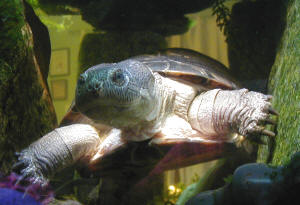 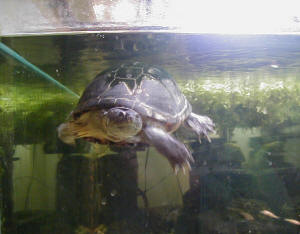 |
| Turtle
identification request - 6/20/08 Dear Crew, <Hiya Colin,
Darrel here today> Any info you can provide is
appreciated.............I've been through many websites and
can't seem to find a good match. he was found in a lake in
central Illinois. he has a distinct ridge down the center of his
shell (does this rule out mud turtle?) has small yellow dot-like
marks around the 'skirt' of his shell edge that you can see
from the top bottom of shell has yellow splotch towards center,
darker perimeter yellow line markings on his neck and limbs, subtle
Thanks! Cj <Your pictures are large and well lighted, but focus
is a bit of an issue. It might be better if you pulled back a bit
and allowed the autofocus a bit more room to work ... but with that
said it looks like the common mud turtle (Kinosternon subrubrum) to
me. Take a look at this link, down near the bottom is a 2 yr old
Mud Turtle (retracted, sorry to say) but compare this to yours and
see if we nailed it> <http://www.xupstart.com/wwm/> |
|
.JPG) .JPG)
|
| turtle
identification request - 6/21/08 Any info you can
provide is appreciated.............I've been through many
websites and can't seem to find a good match. he was found in a
lake in central Illinois he has a distinct ridge down the center of
his shell (does this rule out mud turtle?) <Mmm, no... this
looks like a Kinosternon subrubrum to me...> has small yellow
dot-like marks around the 'skirt' of his shell edge that
you can see from the top bottom of shell has yellow splotch towards
center, darker perimeter yellow line markings on his neck and
limbs, subtle Thanks! Cj <Is one of these:
http://www.chicagoherp.org/herps/species.htm#turtles Bob
Fenner> |
Quick Question About Turtles
and One Comment. 5/18/08 First off right now I have a 75
gallon tank set up with a Jebo canister filter for up to a 250 gallon
aquarium as well as Jebo UV Sterilizer to keep the water nice and
clean. <Sounds great.> I have 4 sliders, 2 musk, and 1 mud all
are under 4 inches. When they get a bit bigger I will be moving them
into a larger tank. Right now they all get along great although in the
past few days I have noticed the 3 larger RES have begun to flutter
their claws sometimes in a triangular formation all three at the same
time - since they are not sexually mature yet - I wonder if they are
just playing or trying to see who will be the dominant turtle of the
aquarium - from reading a lot of your questions and answers on here I
fear that may change - before going out and purchasing the huge stock
tank that I was going to get them for all of them to grow into I was
wondering if I should at some point think about separating them.
<Males do this "fluttering" thing with their front
flippers. You can sex Red Ear Sliders by looking at their front
flippers: males have dramatically longer claws. Males also have a
longer/thicker tail.> I don't want to yet since the sliders
especially seem to be such buddies as well as the 2 musk turtles - the
only one who seems to be a loner is the mud turtle he or she seems to
hang out in a corner by a side of the tank where he can see his own
reflection which makes me feel bad and almost makes me want to get him
a companion. <Juvenile reptiles may well coexist, and may indeed
stick together on the basis of "safety in numbers". After
all, juvenile turtles/terrapins are often easy prey for water birds and
other predators. It's doubtful whether they form
"friendships" as we know them, but there may well be an
instinct that keeps them together. That said, captive turtles of all
ages do fine on their own.> I can tell for sure that one of my
sliders is going to be a boy his tail in the past few months has gotten
extremely long - the other two are still up for debate. <OK.> I
don't want to bring any more slider hatchlings into the world so
would it be the smart thing to do when they get to be mature to
separate the males and females for good or only during mating season?
<No risk of unwanted babies. Reptile eggs are difficult to rear
without an incubator, so if you don't want the babies, then simply
collect and destroy the eggs. The females can become egg bound under
certain circumstances, so it isn't all easy going, but that's a
discussion for another day.> I also had a comment about a question
sent to you in 2005 about a turtle that wouldn't grow (see: Two
Turtles One Problem 12/5/05). <Indeed?> I have a red ear slider
that I got in July 07 at the same time as another turtle here is a
picture of my 4 sliders basking - they are all around the same age -
Squirt to the left will not grow is just over an inch. <Sometimes
happens in animals just as with people -- for whatever reason (diet,
genetics) the animal fails to grow normally. In fact there's often
a lot of variation in adult size among animals, particularly
"lower" vertebrates that don't have a fixed adult size
(as mammals and birds do) but grow continually through their life.
Maximal growth is during the early stages of life, and if for some
reason the animal doesn't eat enough during that phase, it may
never "catch up" with its peer group even if it otherwise
lives a long and happy life. Bullying is actually quite common when
juvenile animals are kept together, with males (being more aggressive)
often monopolizing food to the detriment of the females. This happens
with fish a great deal, but can be observed with many other animals
too. Anyway, assuming it is healthy, I wouldn't worry too much.>
I have had him to the vets and tested for parasites and everything else
under the sun which cost a fortune. And nothing is wrong with him.
<Good!> He is not being bullied in the tank - I feed in a
separate feeding tank and he is fed first so he gets all the choice
food and usually if they pyramid on the other basking site he will
climb on top of the other guys and be the top of the pyramid. <All
sounds fine.> In fact as I am writing you right now he just climbed
up on the basking ramp and squeezed in next to the larger one. So I
don't think he is not growing from bullying. I know at some point I
will have to remove him from the tank for his own safety because I will
be afraid they will crush him as they get bigger but right now he seems
to be doing okay and they are not aggressive towards him at all.
<See how things go. In a large enough enclosure there may never be
problems, but too keep an eye out for trouble. Making sure everyone has
easy access to a basking spot will help, for example.> My vet said
that although she has never come across cases like this she assumes
that it may happen in the wild and that some turtles like people just
don't grow and that in the wild he would have just been eaten by
now by a predator. <Indeed.> I just wish I could find him another
little mini turtle to keep him company. <Not required; reptiles
generally are not gregarious and do fine kept on their own. Indeed, by
forcing them to live together in small containers *because we think
they need company* we're more likely stressing them.> Jen
<Thanks for writing, and all very interesting. Cheers, Neale.>
Here is one of squirt alone you can see he is a nice looking little
turtle - nice and healthy - trust me he goes to the vets. <No
photographs came through at this end!>
|
Mud /musk turtle coming out of hibernation
7/3/07 Dear Crew, <Hiya, Darrel here> My Mud Turtle has
been buried in the dirt for probably 6-7 months. <I'm
going to go off on a tangent here for a moment. If this is an
indoor environment, there'd be no reason for hibernation and
if this is outdoors, unless you live very far north, this is
very, very late to be coming out of hibernation.> He finally
emerged a few days ago. he stayed in their dirt area for a couple
of days, he looks really dry, so I poured some of the tank water
over his shell. That day he finally went into the water side.
<What I see most often in mud turtles is, for some reason,
simply a dislike for a particular pond and they climb out, go
hunting for a new pond and when they come to the fence, they
simply bury themselves. If they're not found fairly quickly,
they're emaciated and unhealthy when they finally come out
again.> And Its been a few days now and all he does is float
around. He hasn't eaten anything. He's gone to the bottom
of the tank a couple of times but he mainly just floats around.
He's I guess shedding some skin. <None of this is
particularly good news, but then again it's not crisis time,
either> There is no drainage from the nose. His eyes look
good. <Good signs> My main question I guess is the floating
around normal after hibernating? Does it take some time for them
to recoup? <Not the way you're describing it -- this
sounds more like the little guys has some problems.> I've
been trying to find information online, but can only find
information on box turtles. <Keep him on land, please. For
now. Go to the pet store or bait shop and get a container of
night crawlers (heavy-duty earthworms). Put him in a shallow pan
of lukewarm water for 10 minutes under sunlight or normal room
bright lights (just not darkness) twice a day and look for
activity -- movements, poking his head out to see what's
going on, etc. and after you see attempts at activity, offer one
worm. If he doesn't chow down, try again tomorrow and
let's give him another 4-5 days to come around. Hydration,
warmth and nutrition are that basics -- once we have those
covered he'll start to perk up.>
Re: mud /musk turtle coming out of hibernation 07/06/07
I wanted to thank you for the quick reply. My turtle climbed out
of the water himself after I sent you the mail. He's been
walking around in the dirt/grass side of the tank, he climbed on
top of the rock. I got some worms and took him out of the tank
and put him in the sink with warm water. He still didn't eat
anything. he kind of pecked at the worm but didn't eat it. He
is moving a lot now, so maybe he's coming around in time.
Again thank you for your advice. I will try the worms again in
the morning. <In a set-up like yours, I doubt hibernation is
an issue. I suspect that he wasn't hibernating as much as he
was trying to get away from your Musk Turtle. The little guy was
probably running away from home, so to speak, and is now just
coming back to that world and acclimating again. This happens
from time to time and it's possible that now, for no
particular reason, everything will be "better" and he
won't do it again. As long as he's doing the right
things, we won't ask too many questions. Keep offering the
food as he gets more active.> p.s. hopefully the pics
aren't too big of a file. the first one is of the 55 gallon
tank set up i have. the second on is of the turtle i was asking
about. <A nice looking Mud Turtle!> and the third one is a
pic of all three of my turtles that are in the tank. <A very
handsome Musk Turtle on the left> the slider i saved from a
death bowl a friend of mine had it living in for like 3 years.
the turtle still looked like a baby. i couldn't believe it
survived that long. i made her give him to me. <Good for you!
Keep up the good work> <Darrel>
|
|
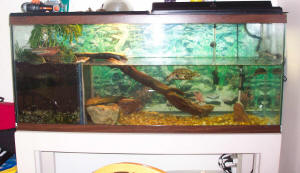
|
Frantic African Mud
Turtle - 06/07/2006 Hello. I have an African Mud Turtle,
given to me 1 year ago in July. Twice now, he has acted very
unusual. He has been running up his ramp, jumping into the water, all
the while looking frantic! Then he proceeds to try to climb out of
the tank by way of the heater, filter, or from the top of the ramp.
He has actually flipped himself over attempting this. I have seen
what I assume is his sex organ, and it seems to coincide
with this crazy behavior. We have him in a 40 gallon tank
with a ramp and basking light. We keep the water temp at
80 degrees, he eats turtle sticks, and about once a month we
give him a few fish to eat. He does not eat while this
behavior is being displayed. What is going on
with him? Do you think his living conditions are adequate? We have
gravel in the tank, which he digs in and tries to bury
himself at the bottom of the ramp. This is something he has
always done, so I'm assuming this is normal. I
have never had a turtle before, so I don't know much
about them. He is a cool pet, we want to make sure he is
healthy and happy! Thanks for your help. <Sometimes
turtle get stressed out by being in captivity and need a place to hide.
I would recommend a cave-like structure be placed in the tank so he can
hide when he wants to stay out of site. The area should be big enough
to allow him and his shell full movement with no danger of being stuck,
but be able to provide some cover. Covering half the tank with plastic
or paper may help too. The other reason may be a desire to find a mate
to breed. Cool the
|
|

