|
FAQs About Tortoises, Terrestrial
Turtles in General
Related Articles: Turtles, Shell Rot in
Turtles, Amphibians,
Red Eared Slider Care,
Related FAQs: Turtles
1, Turtles 2, Red Ear Sliders, Turtle Identification, Turtle Behavior, Turtle Compatibility, Turtle Selection, Turtle Systems, Turtle Feeding, Turtle Disease, Shell Rot, Turtle Reproduction, & by Species:
Cooters/Mud Turtles, Softshells, Snapping Turtles, Mata Matas, & Amphibians, Other
Reptiles,
|
http://en.wikipedia.org/wiki/Boxturtle
|
BOX TURTLE 8/29/19
Hi. I have a box turtle that has places on her carapace that are like small
craters. Is this shell rot?
<If the holes smell bad, then yes, very likely.>
And also on the plastron there are small spots that look like someone got flecks
of slightly off white paint on her.
<Could easily be limescale. If you live in a hard water area, the dissolved
minerals that form limescale in pipes and appliances and also form limescale on
turtles. If you take the turtle out of the water, drop on a
little vinegar or lemon juice, limescale will bubble or fizz. Limescale is
unsightly but harmless, and you can remove it with a toothbrush and a bit of
vinegar or lemon juice periodically without any harm to the turtle.>
It is not soft. It does not come off easy at all. We have well water and it is
hard water.
<Well there we go.>
I have some stuff for treating fungus and bacteria. There is no white stuff in
the cracks but there are also a couple of small holes on the bottom shell. Same
color as the shell just like the craters on the top. When treating how do you
know when it is healed since I imagine that it would take quite some time for
the shell to regrow there and what is the cause of the craters, holes and off
white stuff? Thanks
<Going to direct you to some reading, here:
http://www.wetwebmedia.com/FWSubWebIndex/turtshellrot.htm
http://www.wetwebmedia.com/FWSubWebIndex/RESCareBarton.htm
The important thing is to double-check your turtle has both UV-B light as well
as a heat lamp for basking under (some premium lamps include both heat and UV-B)
and a diet with sufficient calcium. Get these two things right, and you
shouldn't have to worry about Shell Rot. As always with reptiles, prevention is
both cheaper and easier than cure, and most (likely: all) turtle health problems
come down to neglect. Hope this helps, Neale.>
BOX TURTLE 8/30/19
Hi. Thanks for the info.
<Most welcome.>
My turtle is living outside all warm weather.
<Direct sunshine should provide the UV-B, so you should be sorted on that
front!>
It started with swollen eyes and then the shell started caving a little.
<Swollen eyes are the classic symptom of Vitamin A deficiency. Of course other
things (such as bacterial infections) can be explanations too. But checking the
diet of your turtle, and ideally, giving either a suitable Vitamin A supplement,
or getting a vitamin shot from a vet, should fix mild cases. Do read, here:
http://www.wetwebmedia.com/FWSubWebIndex/turteyedisart.htm
As you know, these turtles consume a lot of plant material in the wild, but will
eat meaty foods in captivity almost to the exclusion of fresh greens.
This is what can cause Vitamin A deficiency.>
The eyes are pretty much all better and I've been treating the shell rot, but
how do I know when to stop?
<Are we talking about the Shell Rot here? If the shell smells clean (Shell Rot
smells musty) then beyond simply cleaning the turtles shell periodically (an old
toothbrush works great) and keeping the aquarium/pond clean (water changes and
filtration) should do the trick. Dabbing with a cotton bud dipped in iodine
solution (as used in first aid) does a really good job of sterilising the
wounds. After dabbing, leave the turtle 'dry docked' for at least half an hour,
and then return it to the pond or aquarium. Dry docking involves keeping the
turtle on land, but with plenty of drinking water, especially if it's a hot and
sunny day. Do this clean-and-dry once or twice a day for a week at least, and
you should see
improvement.>
There is no white or red there. It looks like the shell but is deeper.
<Turtle shells are, obviously, quite thick. It is possible for infections to
work their way through to the bottom, but that is very uncommon.
Treating as described above should show marked improvement within a week --
i.e., the shell pits smell clean, there's no weeping fluid (sort of like pus)
and definitely no sign of blood. If the wounds aren't improving after a week or
so, I'd definitely have a vet take a look, or at the very least, an experienced
reptile keeper who you trust to be able to diagnose diseases in turtles. As said
before, treating reptiles is really best done BEFORE they get sick, or failing
that, as soon as things seem amiss. Otherwise, once they get really sick
treatment can become time-consuming and expensive in part because of their slow
metabolism, which means medicines (not to mention their immune system) tend to
operate more slowly than warm blooded animals.>
The turtle is very active and eating otherwise.
<Both positive signs. A quick trip to the vet to get some assurance he's on the
mend would really be the best option here.>
Have any good ideas on how to get the turtle to eat more greens?
<Turtles will eat greens in the absence of other foods. So not providing
anything energy dense, like reptile pellets or worms, let alone meat, is
important. In a pond situation turtles will probably be grazing between
occasional feeds from you, especially if you only feed every few days. In
between the turtle should be consuming pond weeds (Elodea-type things are ideal)
alongside general organic muck they'll dig up in the pond (roots, worms,
carrion, etc.). In an aquarium situation just don't feed anything else, stick a
bunch of Elodea, Cabomba, or whatever cheap pondweed is sold in your local pet
store. With luck, your turtle will chow down on these.
Duckweed is another useful green food that people can grow themselves without
trouble -- it's often a pest in ponds! There are some kitchen greens you can
try, though pale green salads like Iceberg lettuce, while accepted, are nutrient
poor and not especially useful. Better bets are things like Romaine and other
dark lettuces, sliced courgette (zucchini), squashed cooked peas, and blanched
kale or greens. You'll need to experiment a bit, as every turtle seems to have
different tastes. Some will eat a little fruit, too, such as sliced grapes, but
use these very sparingly as they have a strong laxative effect and aren't really
a normal part of their diet in the wild. The key thing to remember is turtles
will ignore greens if meaty foods are offered, much in the same way humans
ignore the salad bar while there's still steak and chicken on the buffet
counter. Cheers, Neale.>
BOX TURTLE 8/30/19
OK. Thank you.
So for a box turtle do you put the iodine on the shell and just leave it?
<Dab iodine onto cotton bud; wipe across hole in shell; allow to dry for at
least 10 min.s. After another 20 min.s, you can rinse off the shell and then
return the turtle to its home.>
On another note, I came across a boxie today and wanted to get a picture of it.
As I came to it, Shell completely closed up. (normal) I sat on a nearby log very
quietly for quite some time and the thing only opened up enough to see the face.
I kept waiting and waiting and then I started to wonder if it was OK. I decided
to take it home just to see if it IS ok.
<Almost never recommended by wildlife experts.>
It's in a cardboard box and it has been a couple of hours and I haven't seen its
legs or head and neck. Is this a veeeeeery shy turtle, or is there possibly
something wrong with it?
<Could be, but hard to say. Certainly a wild turtle transported from its
wilderness habitat into a human home is unlikely to be eager to leave its shell.
Best bet is to call your local Fish & Wildlife agency for their input. There are
(wild) animal rescue charities about (here in England, St Tiggywinkles is the
best known) that might also offer advice.>
I did see the eyes. They looked different? Don't know what to think. Any ideas?
<Without a photo, nope. Sorry! Neale.>
BOX TURTLE 8/30/19
I am hoping to get a look at it to see if it's ok. I took a large snapper, the
size of my steering wheel, to a local vet because someone deliberately ran it
over.
<Yikes! Poor thing.>
I hoped it could be saved but they said the damage was too deep (heart break)
<I would imagine. They're fascinating animals.>
I know I can bring it there because they will help if needed and then release.
<Understood.>
The problem is I can't get a good look at the face and eyes. I might just call
them and ask what they think. Thanks for your help on the other stuff.
<Most helpful, and good luck with your endeavours to help local wildlife!
Always good to know some people are trying to do good, not just messing up the
planet. Cheers, Neale.>
TURTLE CARE 9/1/19
Hello again.
<Hello again Shirley,>
Just wanted to touch base with you to let you know that I found an animal
rescue about 50-60 minutes away and brought the box turtle there.
<Good news.>
It looked like something took a chunk out of it's face and it was
infected.
<Makes sense. Poor little guy!>
They took it in and will try to treat and save the little one and then
return it back to the area it was found.
<Sounds the best outcome.>
Also, I want to return my box turtle outside after eye infection is healed.
<Understood. The main things are to ensure she doesn't become "socialised"
to humans (which should be seen as dangerous by wild animals) and also to
ensure she doesn't come into contact with anything likely to carry
reptile-specific diseases (so certainly pet reptiles, but also equipment
like buckets or boxes used around pet reptiles). The first is about making
sure the turtle keeps away from other people and doesn't see them as
sources of food, which can bring them close to roads, which are obviously
dangerous, as well as pets, like dogs, that might harass or kill them. The
second is because pet animals can carry diseases that may be treated by a
vet, but lethal without a vet, which is the situation for wild animals.>
There is a wooden hide box and a plastic water bowl.
<Sounds fine.>
She hasn't been in there for about two weeks. Is there anything I should do
to it before I put her in there?
<Access to shelter, food and water are the main things. But also that the
turtle can move between warmth and cool easily. While reptiles do like to
bask in the sunshine to warm up, they also need to avoid overheating, so
use things like burrows or shady spots under shrubs to get away from the
sunshine. If this enclosure is outdoors, ensure also that predators cannot
get in: not just cats and dogs, but even things like coyotes, raccoons and
even large birds can be a danger.>
Would you also know if white vinegar is a good cleaner?
<Yep, should be fine. If it's safe to eat, it's a safe cleaner.>
Thank You
<Welcome. Neale.>
TURTLE CARE 9/2/19
Hi. I apologize for not being clear. Originally I was asking you how to treat
shell rot in a box turtle.(I already have one I'm treating.)
<Shell Rot best treated by dry-docking the turtle periodically, and using Iodine
to dab the wounds once or twice a day, leaving at least half an hour before
rinsing the shell and returning the turtle to the water. Do read:
http://www.wetwebmedia.com/FWSubWebIndex/turtshellrot.htm
All the details are there.>
The turtle I found is with the rehab and I will most likely never see that one
again. Even if it heals. I was referring to my boxie that has been living
outside for years in a fenced in area but has had some shell
problems and eye infection. She is doing well now and I would like to put her
back outside. I didn't know if there was something I needed to do in there
before hand so that it is good for her to go back. Just don't want her to run
into problems again.
<Understood. Realistically, if a wild animal has been in your care for more than
a few weeks, it is extremely difficult to return it to the wild. All kinds of
issues. One is that it will have become at least partially tame.
Another is that it may or may not have enough body weight to survive winter
hibernation. If it was sickly when you got it, it might not have eaten enough to
put on the necessary fat as well as repair physical damage (bear in mind that a
sick or injured animal is usually eaten, so 'getting better' isn't often an
option). Consult with a suitable expert who can assess the body mass of the
turtle. Indeed, I'd probably approach someone able to rehome and/or reintroduce
wild reptiles, rather than do it yourself.>
Thanks again for your help
<Most welcome, Neale.>
TURTLE CARE 9/4/19
I'm really puzzled at your answers to my questions.
<Oh?>
Perhaps I am just not explaining the situation very well.
<Perhaps.>
I have a box turtle that stays in an outdoor pen. She got an eye infection and a
little shell rot so I took her to the vet for medicine. Now that she is well I
just wondered if the wooden hide box or the plastic bowl needed to be treated
with something before she went back to prevent reinfection.
<Shell Rot is opportunistic and the bacteria and fungi are all around anyways.
Eye-infections tend to be caused by dietary problems, but can be caused by
physical damage. Either way, while giving your reptile's enclosure a good clean
periodically is a good idea, sterilising them is probably unnecessary. Still, if
you're concerned, bleaching and rinsing the nesting box, and sticking the bowl
through the dishwasher would be quick and easy ways to clean them.>
That's all. But thanks. Take care
<Will do. Cheers, Neale.>
TURTLE CARE 9/4/19
OK. Very well and thanks so much
<Most welcome. Neale.>
BOX TURTLE 10/26/19
Hi again.
Hope all is well.
So I want to put my turtle back outside but I hesitate because there are
two plastic things in the pen that I'm wondering if the germs from
previous eye infection would be in them.
<Possible, but unlikely. Could the plastic items be removed or at least
cleaned using bleach? Obviously rinse thoroughly after cleaning.>
I's only been about a week since the infected turtle was in them and I
sprayed everything with white vinegar twice.
How do I know if everything is OK?
<Same way as when you clean anything -- you really don't know for sure!
If these items are outside, they're probably exposed to ambient
bacteria. Eye infections are usually some combination of physical
damage, vitamin deficiency, and insufficient warmth. So try and get
those right, and the turtle's own immune system should keep it safe.>
Thanks much
Shirley
<Cheers, Neale.>
BOX TURTLE
10/28/19
THANK YOU
<Most welcome. Neale.>
|
Help for my Malayan box turtle (Cuora amboinensis)!
7/24/18
Dear WWM crew,
<Hello Sissi,>
I'm writing to seek help for Andrew, my Malayan box turtle of 23 years.
<He sounds like he's done well so far!>
My parents took care of him for a long time and we mistakenly took him as a land
turtle. He roamed freely on the terrace and had access to shallow water. After
finding out what type of turtle he is recently, I moved him to a tank with water
that covers his shell (he doesn't seem to like the water
very much and tend to float), some rocks for basking and a structure that
provides shades.
<Understood.>
Some background information:
- Andrew does not like basking at all, I've never seen him climbing up to the
rock and bask. Sometimes when the sun is out in the morning, I put him on the
rock and he'll move into the water within 5 minutes.
- I live in a tropical climate, water is kept at 79 - 82F.
- I change 1/3 of the water every day
- I feed him every 2 days, mostly shrimps and bananas as he's a very very picky
eater and won't take a second look at veggies unless I trick him into eating
them.
<I would be careful with such a monotonous diet. Shrimps (and mussels) contain
thiaminase, so over time cause vitamin B1 deficiency problems unless there's
some other vitamin B1 source in the diet. So while these two foods are popular,
I'd use them sparingly. Earthworms and cockles are two popular alternatives,
readily taken by most turtles without complain. Fruit is also okay, in
moderation, but a hungry turtle will consume a wider range of green foods,
including any number of pond and aquarium plants, such as Elodea and Duckweed.
These are highly nutritious, and a far more natural part of their diet than
shrimp and banana.>
- Despite the problems below, Andrew is eating normally, begging for more food
every day. He looks energetic but can be anxious sometimes.
<Do see above, and feel free to starve a turtle for 2-3 weeks until he takes
"proper" food like Elodea or plant-based floating pellets (such as Koi
pellets).>
Since his move to the new tank, Andrew has been having several problems.
- About 6 weeks ago, he started shedding his skin and it is still ongoing.
I saw large patches of his skin hanging and falling off. I suspected fungal
infection but the new skin appears to be normal and Andrew is not affected by
it. However, I'm worried as it's been going on for over a month. Does normal
skin shedding last this long? If not, what could be the reason for this
prolonged shedding/peeling? Is there anything I can do?
<Shedding is normal. Provide there is no odd smell to the shell or body, skin
shedding is probably nothing to worry about.>
- Also about 6 weeks ago, Andrew started having diarrhea (that's what I think it
is). He had watery stools of orange and greenish color. I stopped feeding him
for a few days expecting improvement. However, he's only pooped twice in 4 weeks
after that. Both times I saw a large pile of black somewhat solid poop , orange
watery matter and very strange, white hard thing that shaped like a peanut.
<A lack of fibre could easily account for this. In my experience, water turtles
eating mostly fresh greens have very loose, greenish-black faeces.
This is probable "normal" if you're looking at wild freshwater turtles.
Reptiles that live in dry habitats tend to have more solid faeces that become
whitish when dry due to the uric acid (I believe). Freshwater turtles rarely
produce such faeces, though they may under certain
conditions. In any case, provided the turtle is otherwise feeding normally, and
doesn't appear constipated, then I wouldn't worry overly much.
Providing a varied diet, with lots of fresh greens and/or fibre-rich foods,
should take care of this problem.>
- Andrew is restless sometime, constantly exploring what's under the rocks
(nothing!) and trying to bite the rock. He also started fanning (I've never seen
him doing it, nor did my parents in 20+ years and I was shocked the first time I
saw the huge black blob coming out of his tail)
<Male turtles will "fan" with their front limbs when trying to mate with female
turtles, but they'll also do this when trying to swim quickly, or when digging,
and perhaps when doing other things as well. Again, unless there are obvious
signs of distress, such as trying to escape the tank, I'd not be too concerned.>
I took him to a vet but there's no good herp vet at where I live and I'm hoping
experts at WWM can give me some suggestions. Is Andrew sick? What can I do?
Thanks a lot!!
A worried turtle mom
<Apologies for the lateness of this reply. Our two turtle experts seem to be
'out of town' at the moment, but I've cc'ed them, just in case I've missed
something. Meantime, hope the above helps.
Cheers, Neale.>
Re: Help for my Malayan box turtle (Cuora amboinensis)!
7/24/18
Hi Neale,
<Sissi,>
Thank you very much for the detailed reply! This is super helpful.
<Glad to have helped.>
The shedding has somewhat stopped after 6 weeks.
<Good!>
However, his diarrhea hasn’t stopped. He has pooped some weird stuff again
yesterday. Please see attached photos (it’s a bit gross, sorry!). It doesn’t
look like he has digested anything. I’m very concerned.
<It does look fibrous to me, which suggests plant material. Reptiles digest
plant material poorly, and you'll see lots of the various fibres and other
cellulose-rich parts of the plant passing right through. Soft water plants are
most easily digested, whereas land plants may be digested only minimally.
Perhaps look more closely at the material: if the faeces do indeed appear
fibrous, then what you're seeing is quite normal!>
I tried feeding him water lettuce and duckweed. He did bite them but quickly
spit out the leaves. It’s hard for me to starve him for a prolonged period of
time as he’s always begging for food but I should try it when he’s recovered
from this “diarrhea” situation!
<Do not worry about a turtle starving! It will take weeks for that to happen.
But do try offering small morsels of different things, removing uneaten food
after a few minutes (if meaty) or hours (for plant material).>
I have put Andrew on Probiotic powder at the suggestion of a local vet (who’s
not a reptile expert) but I’d really appreciate the expert opinions from you
guys!
<Do see above; and I would not worry if the turtle is otherwise behaving
normally. With regard to food, a healthy turtle can go weeks without food, so
allowing time to 'clear out the gut' before feeding again is not a problem.>
Thanks a lot and I look forward to hearing from you.
<Most welcome.>
Best Regards
Sissi
<Cheers, Neale.>
|
.jpeg) 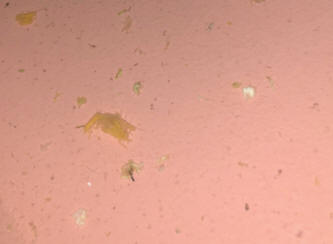 |
|
3 toed box turtle 4/12/18
Hello Darryl (or whoever is covering terrapins today)
<Hiya! Another letter stuck somewhere in my box magically appeared out of the
past>
You might recall our correspondence about 18 months ago, as our family grew by
one small member. Boxy/SlowMo has settled-in well (even if we still haven’t
finalized a name. We hope by the time our kids have kids we’ll all go with
SlowMo).
<I like it.>
I’m reaching out partially to just say thanks again, we’re loving our little
turtle. And also to see if you agree with our assessment that she is, in fact, a
she. I’ve attached a few photos that should help. She was about 6 months old
when we brought her home in November 2016, so she should be close to 2 now.
Thanks for all your awesome help
<No charge!! But if you ever hit the lottery, don't forget that "donate" button
at the top of our page>
PS, we’re still rocking the au natural substrate, though we added a layer of
coconut coir, and a top coat of sphagnum (ethically harvested, if the package is
to be believed; and if you can’t believe advertising, what can you believe?!),
which we can periodically remove and rinse clean. Still no odour issues, other
than a somewhat pleasing earthy/woodsy aroma.
|
.jpg) .jpeg)
 .jpeg) |
Fine porcelain "crackling" Turtle Eggs
7/11/17
Dear Crew,
<Hiya, Darrel here>
My 26 year old Eastern Box Turtles eggs look like a fine porcelain vase, with
small crackling on the eggs. All pictures of eggs online show them looking like
eggs from the fridge.
<The look of your eggs is more in line with my experience. They look white,
shiny and perfect when they are first laid but usually was they dry they get a
matte finish with blemishes>
The four eggs sit in Sphagnum Moss, half of the eggs covered, with moist paper
towel over them, and a lid sitting on top. They are kept at a temperature of
78-82. The container has small hole in the lid and in the base. The eggs are
about 58 days old.
<Sounds perfect>
Anyway, do some eggs have the appearance I've described, and still hatch?
<If they are fertile, yes. They may take anywhere from 75 to 120 days to hatch
based on the temperature swings as well as the average temperature. The rule is
to never give up hope until/unless the eggs collapse and begin to grow mold or
fungus>
Thank you for your expertise, and time.
<no charge! -- good luck.>
<Oh ... when you get hatchlings there may be issues with initial feeding. They
tend to be carnivorous when they are young, so what I do each day is soak them
in 1/8 inch of lukewarm water for a few minutes and then offer them a teeny-tiny
bit of moist cat food on the end of a toothpick. Sometimes it took two weeks
after the yolk sac adsorbed before they showed the slightest interest>
Lori ��
|
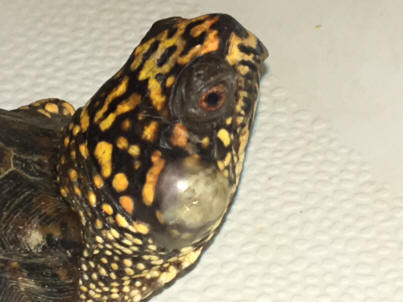
Mass on Head 7/7/17
Morning!
<Hiya, Darrel here>
I've been browsing your site looking for answers on what in the heck this is and
how I should treat it.
<From way over here that looks like a cyst with or without an accompanying
infection>
I saw a similar picture but there wasn't any commentary to go with the image. I
have 2 box turtles and this one was wild and my husband saved it from a busy
highway not knowing where he came from to return him.
<1- thank you for rescuing him. 2- thank you for not releasing him. It’s never
EVER a good idea to release an animal into the wild … even if it’s just a short
transport. There are just too many variables to consider>
Please help!
<I can help – but only a little. This is a classic case of the need for an up
close and personal examination from a trained professional. It’s likely that the
cyst can be burst and excised without anesthesia, but the problem is that no one
will know anything until someone does an actual exam. This leaves you with three
choices. First is a veterinarian in your area that does reptiles (technically
called ‘exotics’ in the trade). Second is a young veterinarian just starting his
practice. At first that may seem incongruous, but here’s the reasoning: If a vet
makes exotics part of his practice, that’s best. If not, all vets do a rotation
in exotics during their med school, so a younger veterinarian may not have the
most dedicated skills, but at least he’s done it in recent memory.>
<Third – look for a Turtle and Tortoise Club in your area. People with larger
collections usually have to, if only for financial reasons, learn to treat
common maladies at home and can help you directly – if not they can point you to
the most qualified vet.>
Meredith
|
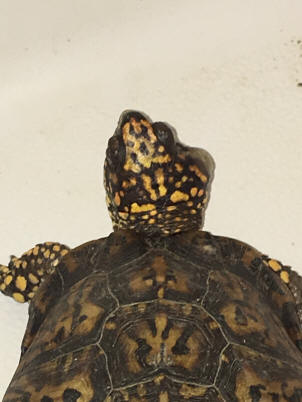 |
weird episode with 3-toed box turtle /Donna 7/3/17
Last night I got up and noticed my box turtle (of 30+ years) seemed to be
stricken in some way. She was acting like a victim of bad-movie stop action
animatronics producer, moving incessantly in quick jerks, and upset with her
front and rear ends. At the back, she would either scrub her butt with her heels
over and over and over, like she had ants in her pants. Alternately, she would
back up against her low feeding dish and keep pushing back, jerky step after
jerky step, with her front legs. I took her out, her butt was fine, I rubbed it
with TP in case it itched,
but that didn't help her-- she continued doing it.
At her front end, she repeatedly, jerkily (every sort of move was fast and jerky
and she NEVER stopped), rubbed with the backs of her front feet at her sides of
her face, not particularly her eyes, but them, too, sometimes. And she also
whipped her head about, one side to the other,
like an angry person trying to make their eyes see small print or focus on
something.
I put her in her water dish (water comes about 1/2 way up her shell) and she
ducked down and put her head underwater for a bit, came back up (jerkily),
climbed halfway out, whipped her head back toward the water,
dropped back down into it, repeated the above about 4 times before finally
climbing back out and continuing to do all the things I first described.
She kept this up for over 4 hours. She was worn out in the morning, just crashed
flat out, chin on her floor, sleeping.
As to food, she has been eating mostly only strawberries and ball bugs for
several weeks (she keeps getting fixated on one or 2 foods each warm season).
She has a couple small spots where the skin (scutes?) over the shell bone has
died and disappeared, but they are not growing. The bone underneath is white and
dry and solid.
I just noticed she has a light yellow spot under one eye. It does not wipe off.
Since the heavy sleep this morning, she has eaten half a strawberry and no
longer looks like some bad movie producer is running her every move.
Any idea what this might be?
Thanks for any help you can give.
Beth
<Hello Beth,
I must apologize for the delay on responding to your question, the situation
that you described in your letter and of the symptoms your turtle showed made me
automatically think your sweet pet was having seizures so I did some research
and sure enough, it does look and sound exactly what is going on.
It could be a one time only happening. Please Google "Turtle Seizure" and watch
the video. There are many other writings and videos. Please let me know if this
helps in any ways. I am not done investigating this situation and you will here
from me again soon.
Again, I am very sorry for the delay in responding.
Here's to good health to you and your 3-toed box turtle!
Respectfully,
Donna >
weird episode with 3-toed box turtle /Darrel
7/7/17
Dear crew
<Hiya, Darrel here>
Last night I got up and noticed my box turtle (of 30+ years) seemed to be
stricken in some way. She was acting like a victim of bad-movie stop action
animatronics producer, moving incessantly in quick jerks, and upset with
her front and rear ends. At the back, she would either scrub her butt
with her heels over and over and over, like she had ants in her pants.
Alternately, she would back up against her low feeding dish and keep pushing
back, jerky step after jerky step, with her front legs. I took her out, her butt
was fine, I rubbed it with TP in case it itched, but that didn't help her-- she
continued doing it.
<I’ve seen this, too>
At her front end, she repeatedly, jerkily (every sort of move was fast and jerky
and she NEVER stopped), rubbed with the backs of her front feet at her sides of
her face, not particularly her eyes, but them, too, sometimes. And she also
whipped her head about, one side to the other, like an angry person trying to
make their eyes see small print or focus on something.
<I’ve assumed in was a nerve disorder, but they seem to get past it>
I put her in her water dish (water comes about 1/2 way up her shell) and she
ducked down and put her head underwater for a bit, came back up (jerkily),
climbed halfway out, whipped her head back toward the water, dropped back down
into it, repeated the above about 4 times before finally climbing back out and
continuing to do all the things I first described. She kept this up for over 4
hours. She was worn out in the morning, just crashed flat out, chin on her
floor, sleeping.
<It’s possible that the phase {or whatever it is} simply passed on its own>
As to food, she has been eating mostly only strawberries and ball bugs for
several weeks (she keeps getting fixated on one or 2 foods each warm season).
<I had a box turtle fixate on strawberries to the exclusion of all else for 11
YEARS. It’s not healthy for them, so I have learned to feed fruit sparingly. I
normally feed snails from a garden that I know has no snail bait and earthworms
from the bait store. Apples and carrots weekly but brightly colored fruits and
berries no more than monthly>
<That said, that’s what I do. If he fixates only “in season” and he’s other wise
healthy keep doing what you’re doing>
She has a couple small spots where the skin (scutes?) over the shell bone has
died and disappeared, but they are not growing. The bone underneath is white and
dry and solid.
I just noticed she has a light yellow spot under one eye. It does not wipe off.
<The scute died, leaving the bone underneath. This is almost always just
mechanical damage, where the scute was rubbed, banged or broken. You have to pay
a tiny bit of attention to the bone underneath … make sure it doesn’t grow algae
or mold. Perhaps swabbing it with hydrogen peroxide once every couple of months>
Since the heavy sleep this morning, she has eaten half a strawberry and no
longer looks like some bad movie producer is running her every move. Any idea
what this might be?
<As I said, I’ve witnessed it in my own animals but it’s never been diagnosed as
a specific disease and they seem to get it, get over it and get past it, so I
wouldn’t worry>
<That said this is a good opportunity to get a general purpose vitamin
supplement like Reptivite from our friends at Zoo Med and dust his food every
day for a few weeks. The reasoning is that certain combinations of malnutrition
or vitamin/mineral deficiencies do cause tremors… so even though I don’t think
it’s his problem … it can’t hurt>
Thanks for any help you can give.
Beth
3-toed Box Turtle 12/29/16
Season's greetings from snowy Toronto.
<Hiya, Darrel here in nice, warm Southern California>
We're about to get a juvenile 3-toed box turtle. I've done a heap of
reading here and a few other resources online. I just wanted to bounce
my plans off the pros, to make sure I'm not missing anything.
<Well, let’s give it a shot>
We have a 65g long aquarium the terrapin will reside in (when it's
bigger, as are our children, it will be given more free range of the
main floor of our house). For now, I plan to fill the bottom of the tank
with mulch, and probably some moss, sink a drip dish from a terra cotta
pot into one corner for water, and a UV-B bulb at the other end.
<OK. Stop right there. Everything you SAY sound like a good idea. Can’t
fault you. But then, it’s just like having children. THAT sounded like a
good idea, too… until they came and turned 4 and suddenly that wasn’t so
hot an idea, either. But it gets better! Think you have problems now?
Wait until one of them drops out of college and comes home with a
musician!>
<And that’s just the Box turtle – kids are worse!>
<Seriously. The substrate SOUNDS great until you experience that your
terrapene pees and poops in it and since the traces are small … you
can’t clean it all. This leaves a slow but increasingly aromatic
build-up behind you until one day the turtle’s room smells like the kids
room …>
<Having tried a great number of things over the years I’ve settled on a
strategy that stresses effectiveness over natural-looking. I use
Indoor-Outdoor carpet. I don’t mean artificial grass … that stuff is
horrible to use and maintain on every level. I mean the old fashion
green flat almost felt-looking indoor-outdoor carpet. I cut 4-6 pieces
the size of the tank so I can have one in place, and extra pieces ready
to go when it’s time to change it out. You can’t throw the soiled pieces
in the washer but you can hand wash them in the sink and let then dry
outside>
<For the hiding places, I use an upside down pot or a small plastic tub
with the appropriate size hole cut out, but then using double sided tape
and other adhesives I mount it to the corner about ¼ inch above the tank
bottom so that the carpet slides out. Same with any artificial plants
that you wish to place inside to make a less sterile-looking
environment.>
Our house usually is around 18-20C through the winter (we just wear
warmer clothes), but will the little dude also need a heat bulb or small
heating pad under one spot of the substrate?
<For all my inside turtles, I use a regular incandescent 40w light
placed 6inches above his highest standing position. In other words,
measure him front to back, straight length and add 6 inches and that’s
the height of the bulb. I have it on a timer from 6 to 6 in the winter>
For food, we'll start with wet dog food, and maybe some beef or pork
offal. Can we also start giving veggies as a juvenile? And transition to
Koi pellets when it has grown somewhat?
<This is a critical thing for Box Turtles. They can fixate on a given
food. For me it was Clara and strawberries. She refused anything BUT
strawberries. We had a contest of wills that lasted over 18 months
before she gave in.>
<My suggestion is that you offer him a mashed-up mixture of wet food and
dry food on day one… no more than a teaspoon full every OTHER day until
he gets in the habit of eating it. Then after his entire routine is
settled, add some chopped up fruit to that same mixture (again, every
OTHER day) as long as he gleefully eats what is offered.>
Thanks very much for all your kind advice,
<no charge!>
Chris
Re: 3-toed Box Turtle 1/28/17
Darrel,
Thanks for the reply. So, SloMo is already in the aquarium now, with a
substrate, but I will keep your carpet advice in mind, and when the
aroma ripens, will pull it and replace with easy to clean carpeting. For
now, Mo loves to dig into it to hide (even with a decent hiding place),
especially under the water dish.
So far, Mo hasn't taken any food at all, and has been pretty shy, though
s/he has only been hiding in the terra cotta pot cave —rather than
buried in 3" of substrate— for the past two days, so I'm assuming it is
just an issue of adapting to the new environment, etc. We keep putting a
little bit of food into a small dish in Mo's space, and leaving it, then
removing it
the next day, cleaning the dish, and repeating. I'm assuming s/he will
eat when hungry, and am not too worried at the moment. If Mo were to eat
it, I would hold off for a day until adding more, as per your advice.
Incandescent bulbs are increasingly hard to get here in Toronto (would
have thought you granola-munchers in SoCal would have ditched them a
long time ago!), but I got one of those black heating coil doohickeys on
an A19 bulb end, and screwed it into a 5.5" reflector. It's 100w, and
seems to crank it out, so positioned it a bit higher. My probe
thermometer says it's 26C on that side of the tank, and 22C on the
"cool" side. All seems to be coming along well!
Thanks again for you advice, and best wishes for the new year!
<Yes, even here in Granola Land, incandescent bulbs are hard to get.
Fortunately we live right next door to more enlightened states (Pun!)
and we can go there and bring back bulbs and other things necessary to
Make Reptiles Great Again.>
<Part of the problem is that Mo is an Imperial Turtle and you’re a
Metric country. He’s used to being heated by (f) and fed by Oz but
you’re heating him with “C” and feeding him with “g” and it’s probably
confusing him. Next time you might want to consider having a Canadian
turtle; They’re just like American turtles except a bit smaller, much
more polite and with a very slight inferiority complex.)
<For those who didn’t get it, Chris razzed me about California (Granola
munchers) so I gave it back about Metric Canada. My mom, who was from
St. Catherines, would have been proud>
<Keep up the good work Chris>
D
Desert tortoise almost drowned 6 days ago
4/15/16
Dear Crew
<Hiya, Darrel here>
A desert Tortoise lives in our backyard and has for several years before we
bought the house. For the first time he woke up from hibernation and wandered
straight into the pool. We don’t think he was there long before he was found but
it could have been hours or minutes. We got him out and he was still alive so we
stretched and pushed his front legs and he water would come out of his nose.
<wow>
He seemed to perk up after a day and be doing well and now on day 6 he seems
worse. He is lethargic and barely moving at this point but is still alive. Of
course I am worried about what it would cost to take him to a specialty vet and
then I worry that they will take him from the only place he has lived for years.
<Specialty vets are expensive, but sometimes necessary. The Tortoise has had
water in his lungs (probably still has some) and he's suffering from pneumonia.
The first thing to do is get him warm. Get him somewhere where you can keep him
around 95 degrees or more. A plastic storage tub from a home center with a heat
lamp clamped on the side running 24/7. >
We live in Tucson AZ and I have no idea what to do for him. He is wild although
he has lives in or back yard for years. I just want to help him, we have come to
love him and enjoy his presence. What can I do to help him and what should I do
to help him.
<In this case I would suggest that you reach out to someone like Tucson reptile
rescue
http://www.tucsonreptilerescue.com/ and get a referral on a vet.>
Tortoises... Party animal espied
8/13/14
Hi
<Hiya - Darrel here>
I have 2 Tunisia tortoises
<cool>
This morning my partner noticed 1 of them up on all 4 legs, & it looked
like the insides were coming out :D
<Not really …>
but because there only 1 & 2 years old we don't know the sex yet, I have
seen in a picture it could be his penis, we did have a panic & was going
to go to the vets, but it went back in?
<Yep! That's what you saw --- his Party Animal was out>
It's just my parents have tortoises & I've never seen this before...
<Some tortoises are more shy than others. It's normal and nothing to
worry about>
Could you help me out thanks.
<No problem!>
Marie
|
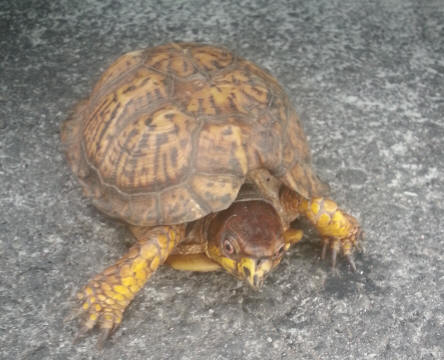
Help, 8/11/14
<Hiya - Darrel here>
We found a turtle and want to keep it.
<Good choice!>
What kind is it?
<That is a Box Turtle (Terrapene carolina) and they are one of
the coolest turtles on the planet. They're smart, personable, friendly,
hardy and easy to care for>
What do we feed it?
<They're omnivores. They should eat fruits, vegetables, berries, snails
and worms. The only things to be careful of are berries - they tend to
fixate on one food and ignore all others… and snails. IF you choose to
feed her snails, make sure they don't come from a garden that uses snail
bait. I personally feed mine chopped up bits of apples, pears and melon
twice a week and 2 or 3 earthworms (from the local bait shop) once a
week>
How should it live?
<Like the rest of us - on a Lanai on the North Shore of Oahu.>
<Seriously … in a fenced garden where the fence goes down at least 6
inches and the top lip is bent inward at least 6 inches (they are good
diggers and great climbers). She would have access to water at least as
deep as her shoulders with nice easy access in and out. I use the base
bowl of a clay pot 12" in diameter and flush it with the hose several
times a week.>
Should it be flailing at the top of the fish tank looking like it's
trying to come out?
<Yes it should be!! It's a land turtle, not a water turtle>
Should I put him back in his holding container (car seat/bin)?
<For now, yes.>
<Also note that box turtles live just fine indoors. I've seen people let
them live "free range" in an apartment as long as the doorways are
blocks, there are no ledges to fall from and people watch where they
step>
|
 |
baby box turtle 7/15/14
Dear Crew,
<Hiya - Darrel here>
I have a baby box turtle that was born in our backyard. He lives in an
aquarium in our house and I keep finding him on his back in his water
rock.
<I assume you mean a little bowl shaped to look like a rock? That's
because as a baby they are too clumsy to climb and out of one of those.
I don't use them at all. I use the upside down lid to a small plastic
bowl ... something with no more than a 1/4 lip on the side. Yes, the
water evaporates but that's ok - his entire environment should be a bit
moist
(some peat or similar material that is saturated every few days) and
then twice a week I just dip water into the lid. Often I take them over
and place them in it as a bath. Generally they are not aquatic, so they
don't need "swimming water.">
Why does he keep doing this??I have bark up to the lip of the water rock
so he can walk in smoothly.
<That will help, but if the water is deep enough that an upside-down
baby can drown, he might>
Please help.
<His diet is earthworms, snails, TINY bits of moist dog food, along with
small bits of fruits and vegetables. Something watch for in all turtles
but ESPECIALLY in Box Turtles ... they'll find a favorite food and
fixate on it and refuse everything else. I had an adult female that
fixated on strawberries and wouldn't eat anything else. I finally had a
contest of wills with her and I offered her only a dab of moist dog food
and a single leaf of spinach ..... for ELEVEN MONTHS. So make sure you
keep her diet
balanced and varied>
My turtle like the shade? 6/26/14
Hi,
<Hello,>
I'm Heidi and I'm an amateur turtle owner. I have a 1 year old (about
5in in length and around 4 in width) female Malayan Box turtle
that was given to me by a college friend who's uncle owns a pet shop.
Petra, my turtle, eats a lot (and I mean a lot. I'm wondering if I need
to control her food) and I try to give her a wide variety of foods, from
veggies, to fish, shrimps, squid and pellets (which she eats).
<Provided you mostly give her plant foods, don't worry about her
overeating. Too much meaty food is bad (so restrict fish or seafood to
once or twice a week) but you are fine giving her plant-based pellets
(Koi carp pellets are excellent) every day and vegetables as often as
she wants.>
Because of her appetite, I think she's happy and healthy.
<Correct; with reptiles, there is a very close link between appetite and
health.>
But sometimes I'm not really sure. I know turtles are supposed to bask
under the sun for a long time but in Petra's case, she avoids the sun.
Is that normal?
<Yes. Reptiles use sunlight to control their body temperature.
Basking alternates with seeking shade (for cooling down). In
the tropics, reptiles may actually spend more time avoiding sunshine
than basking! Think about desert reptiles that are active only at dusk
and dawn. Your turtle will have an extremely good sense of balancing
"warming up" with "cooling down", and in tropical countries, we really
don't need to worry about this.
Provide she has a sunny spot, a shady spot, and enough water to drink,
she'll be fine.>
I'm really worried if she's getting enough sun. I sometimes see her
opening her mouth (is she yawning? or are those signs of respiratory
infection?)
and making clicking sounds.
<Reptiles will open their mouths for a variety of reasons, including
cooling down. If the air temperature is very high, 25+ degrees C, don't
be surprised if she's more worried about cooling down than anything
else.
Turtles (and reptiles generally) can't sweat, so they open their mouths
to achieve something similar. Water evaporates from their mouth,
carrying away heat. As I say, she must have access to water otherwise
she'll dry out doing this. But it's obviously different to respiratory
tract infections (RTIs) that go along with closed eyes, wheezing, often
froth or white discharge around the nose.>
She does't seem evasive since she lets me pet her head from time to
time, and she would sometimes run towards me when I let her out.
<Sounds a well adjusted pet.>
I live in the Philippines (a tropical country) and my province
especially is sunny all year round so I opted for her to stay in a big
plastic tub in our veranda where the sun could hit her tank a few hours
each day.
Sometimes, I would let her out to walk around the veranda and
garage/garden (supervised) for an hour or so. Is that okay?
<Yes. So long as she's happy being moved about like this, it's fine.>
But whenever I do, she would stay under the sun for a couple of minutes
(and when I say a couple, I mean like 5 min or less) and then she would
run to the shade.
<Correct.>
And sometimes, even when she's in her tank, she would go under the
filter or any shade that she can see. And she seem to like the water
lots. I rarely see her come out from the water, Do you think dry docking
would help?
<Nope. She's at risk from overheating. Provided she's eating and
breathing normally (no wheezing) then let her do what her instincts say.
Cuora species spend 90% of their time in the water, and will overheat in
the tropics if the can't find shade and/or water. They only
spend short periods on land. Presumably they bask to top up their
Vitamin D levels, but that's about it.>
My mom said that our weather here in Pampanga might not be good for
turtles. But I've seen snapping turtles live in the creek near our house
and they seem to be thriving well. And there are even soft-shelled
turtles that actually plagues some fisheries in our neighboring province
so I don't think that's the case.
<Quite so.>
I'm not sure what's wrong with her. Something might be either wrong with
her, or something is wrong with me for being so paranoid. I lost a young
RES before because of a lung disease that eventually weakened him so I'm
very very cautious now with Petra. I hope you can help. Thanks a lot.
Regards,
Heidi
<Do have a read of this excellent article on Cuora spp. box turtles:
http://www.chelonia.org/articles/Camboinensiscare.htm
Cheers, Neale.>
Re: My turtle like the shade?
6/27/14
Thanks very much Neale. Really helped me out!
<Most welcome.>
Concerned 3/21/14
Dear Crew
<Hiya - Darrel here>
I need some help about 5 years ago I saw my ornate box tortoise
pooping out a white oblong soft rubbery substance I assumed it was a
still born egg
<it was an egg, yes. No way to know if it was fertile>
so I threw it away and today I went to go feed my 12 year old RES and on
the bottom of her tank was the same white oblong substance a couple were
still intact with like a runny almost yolk like substance and then a
bunch of pieces floating on the bottom I cleaned her tank and returned
her to it can you tell me what is going on I am concerned I don't have
the money for a reptile vet but if she needs to see a vet then I know I
have to come up with the money
<No need for a vet at this point. Your turtle is laying eggs. Turtles
often start to gestate eggs in their normal biological cycle but if the
eggs are not fertilized the female's body just absorbs them again. In
some cases even unfertilized eggs will form the outer shell, in which
case she lays them even through they are not fertile.>
<If your female has not been with a male for the last 5 years, there is
virtually no chance that the eggs are fertile - but if she has… then
they might be and if the eggs were laid on land (in other words not
expelled into the water) then it might be worth trying to incubate them.
http://www.wetwebmedia.com/fwsubwebindex/TurtleReproArtDarrel.htm
in either case, this is nothing to worry about. Just remove the egg
parts and clean the tank and she'll be fine>
Thank you...shanti ~~shanti Simon~~
|
Please identify this turtle 6/18/10
Dear Crew
<Hiya! Darrel here>
My friend in Alaska got this turtle 10 years ago from someone in
an apartment and was told it was at least 10 years old then. So I
assume it was a pet before he got it. He doesn't know what
type it is but has had it in an aquarium with a small pond and a
hiding place and light bulb/heating lamp and feeds it the likes
of mixed vegetables and I'm not sure what else but seems
healthy and happy...as far as I could tell. But for the life of
me... and he never could find out what kind he is...the
"bill" he has...I have no idea how that formed or if it
is the nature of the species but it is hard but thin...like a
toenail...perhaps. His nostrils are above his bill.
<What you have there Laurie '¦ is a 1971 Plymouth
Duster with the 340 cu V8 engine in front of a factory 4 speed
heavy duty transmission '¦'¦>
<Oops, wait '¦ wrong forum>
<Laurie '¦ what you have there is a very unusual
version of a very common animal. That there is a 3 toed Box
Turtle (Terrapene triungis) that is very, Very, VERY badly
misshapen. Without doubt a birth defect from a poorly formed egg,
as you can see if you compare any photos of a 'normal'
box turtle. In the egg, turtles and tortoises develop
"folded over" at the waist '¦ in essence
folded in half. As they grow they straighten out and the plastron
(bottom plate of the shell) is flattened to be "normal"
as you can see in Louise there, her bottom didn't fully
straighten out and is now a bulge.>
<This is one more testament to how resilient our turtle
friends are. Louise (and I just made that up, I have no idea what
her name is - or even if it is a "her") will live a
fine & happy life in spite of some fairly severe
differences.>
<Box turtles are terrestrial, Laurie. It's possible that a
3 toed box like Louise may never actually get to swim in anything
we'd call deep water. Her enclosure should be primarily land
with moss, wood chips and maybe even sand as a substrate with
just a dish of fresh water to bathe in. Normally they start out
as carnivorous as babies, feasting on worms and grubs and
whatever else they can catch -- and becoming more vegetarian as
they age.>
<Now you can look up all kinds of information on Terrapene
triungis and get lots of specific information about her care
(her?? There I go again!!) but at the same time keep in mind that
nothing succeeds like success '¦ whatever your friend
and you have been doing for the last 15-20 years has allowed
something nature would have discarded to survive and even
thrive!! Congrats to both of you!!>
Thanks, Laurie
<Yer welcome Laurie!!>
<Now '¦ I wonder if I told the guy with the
Plymouth to feed it worms and melon and dip it in water twice a
day '¦??>
|
  |
Red eye terrapin 2/18/14
Hi,
<Hiya - Darrel here>
I bought my son a terrapin recently. We brought it from Singapore to
Malaysia. While in Malaysia, the terrapin started to develop white spot
on the shell, towards the tail.
<A white spot can be many things, often it's a sign of fungus which can
often happen when the turtle does not bask in enough sunlight to get
completely dry.>
<If no UV-B light is available, direct sunlight is good as long as the
turtle can get out from under it after some time. 10 minutes a day
in a dry pan under direct sunlight is OK as long as he can then be put
back into cool water.>
Since then, the terrapin refuse to eat. We normally feed the
terrapin with Nutrafin basix which according to pet shop, contains all
the nutrient required by the terrapin.
<I use Koi food which is available in pellets at most pet stores.
It's a great and balanced diet of almost all water turtles and it's very
inexpensive>
Appreciate your advise as I'm not aware of any reptile vet in Singapore.
<No reason to rush to a vet just yet. Please read here and
understand the need for UV-B light and see if you can arrange for some
sunlight for him each day. He should have a warm basking
place and cool water so that he can choose what he needs.
http://www.wetwebmedia.com/FWSubWebIndex/RESCareBarton.htm >
<In most cases a fungal infection will clear up after a few days of
access to good sunlight. If you feel it needs to be treated, read
here about
fungal infections:
http://www.wetwebmedia.com/FWSubWebIndex/treating%20RES%20Dis%20DarrelB.htm
>
Re: Red eye terrapin 2/26/14
Hi Darrel,
<Hiya Esther>
My baby terrapin is still not eating and I notice that is back legs are
coated with a thin whitish coating. I managed to find AZOO bacterial and
fungal drops meant for turtles and tortoise.
<OK, now yes - this is beginning to get serious. The very first
thing to do is to "dry dock" him. Water (and a warm moist
environment) are no longer his friend. We need to keep him
warm and DRY except for a short bath daily. Apply the
anti-fungal drops according to directions, but the dryness and exposure
to proper UV lighting is you most potent weapon against the fungus.
Please read all about it here:
http://www.wetwebmedia.com/FWSubWebIndex/treating%20RES%20Dis%20DarrelB.htm
> Also got Nutrafin slow release calcium supplements. But I'm concern
that the terrapin is not eating. It had been about 10 days already and
it seems to be very weak. Hardly move now. What can do with the non
eating issue and can terrapin continue to survive not eating for so many
days?
<10 days is not a terribly long time to not eat… but not moving and
seeming to sleep all the time is a sign but he has been sick for much
longer than 10 days and we just didn't notice. If it was
possible, I'd ask a veterinarian to give him a multi-vitamin & calcium
injection. Any veterinarian can do this, even one that
treats dogs and cats - since the injections are the same and the dosages
are available from the manufacturer's web site.>
<If that is not possible then it's not likely you can force-feed the
terrapin. Instead, keep him warm and dry and the instructions say…
help him fight off the fungal infection and his daily luke-warm water
bath may stimulate his appetite.>
re: Red eye terrapin 2/26/14
Thanks for the suggestion. Unfortunately the terrapin died last Sunday.
Hopefully we'll be better with the next terrapin. We actually took care
of two terrapin successfully and they are now as big as a small saucer.
Didn't encounter any problems with them. Still can't understand why this
baby terrapin became so sick. Anyway thanks for all the help.
Re: Red eye terrapin 2/28/14
Thanks for the suggestion. Unfortunately the terrapin died last Sunday.
<On behalf of Bob Fenner, Neale, Sue and the whole crew, Esther, please
accept our condolences>
Hopefully we'll be better with the next terrapin. We actually took care
of two terrapin successfully and they are now as big as a small saucer.
Didn't encounter any problems with them. Still can't understand why this
baby terrapin became so sick.
<The fact that he died after 10 days was an indication that he was sick
far longer than that. It's the major drawback of dealing
with reptiles and fish... they work very hard at looking and acting
normal even when they're sick, so by the time they show signs on the
outside they've been sick for a long time>
<the best treatment, they say, is prevention. So the main thing we
can do for our little ones is make sure and double-sure that all of our
care meets their needs>
Anyway thanks for all the help.
<You are most welcome. Send us pictures of the bigger ones!! --
Darrel>
baby box turtle 9/22/13
Dear Crew
<Hiya Jody- Darrel here>
We have had some box turtles in our yard. We had to replace our fence
and I sent the three turtles on vacation to a co-worker that has many
box turtles and a lovely yard designed for them. That was in July
2013.Yesterday, Sept. 18, 2013 I saw a very tiny turtle near the porch.
It was by a group of rocks and didn't move while I was around. I
was uncertain if I should just leave it alone or if I should keep it in
a very large Rubbermaid until my children got a chance to see it.
<It's almost certainly a baby box turtle. I'm ambivalent in such
cases. Box turtles are hardy creatures and in the genuine "wild"
I'd leave them alone - but in an open yard, I'd pick him up and make a
better home for him.>
I went ahead and shoveled some dirt and flat rocks into the container and
set the turtle there with some shallow water and a small piece of lunch
meat. When my family came home we were all checking out the little guy
and I thought it must have just been born because its eyes weren't open
yet.
<The eyes are open at hatching time, but when they're small they do tend
to be shy>
From my internet research (you know how that is) that doesn't seem to be
correct. The eyes seem to be yellow. Almost like when you have
sleep in your eye. The eyes seem almost like they are open and
this yellow stuff is on top of the eyeball.
<I'd guess that, too>
We do not plan on having a captive, pet turtle. We like having the
turtles around and give them food and water in the yard. However,
we are not equipped with large tank and all the supplies.
<Well - of all the turtles in the world, Box turtles require the least
stuff to care for them and they make the easiest turtles for care for.>
We are interested in helping as best we can, but did not plan on vet
bills, etc.
<First, use a Q-tip swab dipped in water to wipe away what you can from
his eyes. If the eyes look puffy or swollen shut, you can try some
vitamin A eye drops from a local health food store. (Internet Research
note: It’s FAR better to deliver all vitamins in the diet,
drops are not nearly as effective, but they're a good start)>
<Start with a tub or container that can allow direct sunlight to hit
him. A board over part of the top to provide shade is necessary.
Sunlight through glass or even window screen is ineffective. If
you plan on keeping him, a $24 Repti-Sun CFL bulb from our friends and
Zoo-Med will provide the UV light he needs.>
<A good diet from the start would be wet dog or cat food.
Sometimes when I've first found them I had to soak them in a shallow
bowl of luke warm water (barely up to their shoulders) and then offer a
tiny bit of the food on the end of a toothpick. Once they
start to accept food, small pieces of beef or chicken liver (and I mean
SMALL pieces- no bigger than the size of your smallest fingernail) will
deliver excellent vitamins and minerals to make up for what may have
been a long time without food.>
Any thoughts or suggestions?
<The other idea is to search the Internet for a Turtle & Tortoise Club
in your area. A baby box turtle is something all of us seek.
You'd have no trouble finding him a forever home>
Jody
Pregnant Diamondback Terrapin
5/21/13
Hello.
<Hiya - Darrel here>
My concern involves my 9 year old female Diamondback Terrapin.
<When I was a kid in Florida and I wanted a turtle, by parents bought me
the basic care book on Turtles - and it had a Diamondback on the cover.
Thinking was THE coolest turtle in the world, I read and learned and got
all set up to have one -- and there was none to be had. All the
pet stores had were Red Eared Sliders, so I never got my Diamondback.
Even to this day I think about them kinda wistfully. Hmmm …
now I'm wondering if that's part of my problem?>
First off, I found her (and a male) 9 years ago off of a Jersey Bay when
I was walking home. The two terrapins were a little larger then quarters
so I imagined they had just hatched. Instead of heading to the bay, the
babies headed into the road and they were the only two out of about 20 I
saw that were still alive. Anyway, about a month ago my female started
wanting out of the tank constantly, attempting to climb out anyway she
could. I had no idea she was pregnant until about a week and a half ago
I found an egg at the bottom of the tank.
<Strange, frenetic activity during the early spring is a typical sign>
Since I found the egg, she would do nothing but lay out on the basking
dock 24/7. After two days of her not eating or swimming, I set up a
separate tank for her with a swimming area and a beach of crushed shells
and sand hoping she would lay the 'rest' of the eggs so she would start
acting normal. Since she's been in this tank she's ate some food, but
she still doesn't seem right. I'm very worried and I just want to know
if she's acting this way because there's more eggs to come, she's sick
or dying?
<She's probably not sick or dying. She probably is gravid (That's
a $5 word meaning 'pregnant with eggs') and she's probably
uncomfortable. Let me give you the general picture about turtles
and eggs:>
<Females often gestate eggs - even when there are no males present.
If the conditions aren't right in any number of ways, her body just
reabsorbs the eggs and that's the end of it. If the conditions are
good enough, the eggs will develop the hard shell on the outside.
Once that happens she can't reabsorb and starts looking for places to
lay them. They become nervous and active and frantically
walking around. Even when presented with a nesting box they'll
search every inch, often digging "test holes" just to see, only to
abandon them in favor of another and another and another. It
always reminds me of my ex-wife shopping for shoes - no male, human,
turtle or otherwise, could ever know what's better about one than
another but if we even dare to ask the question we're liable to get our
heads bitten off.>
<ANYWAY … if no suitable location is found they will often just deposit
them on the floating dock or even in the water - just to get rid of
them. In a very small percent of cases - and I mean one in perhaps
a thousand, the eggs just stay in the oviduct and sort of calcify into
stones. If that happens they seem to lead normal, happy lives, but
their fertile days are over.>
<What you can do for Snickey (assuming her name is Snickey) is to give
her a nesting box. Get a large plastic storage tub with high
sides from a Building Supply store and a bag of peat moss and a bag of
Vermiculite. The Vermiculite now comes only in large (2 cu
ft) bags called Therm-o-Rock. Mix half & half into the tub
until it's about 8 inches deep and then place it in the direct sun.
Place a cover over part, so there is some shade, and then put Snickey in
there and see what she does. You may have to arrange some
sort of additional walls so that she can't climb out, but if you leave
her in there for a couple days and nights, she might decide it's worth
trying.>
<Don't worry about her not eating or basking. She's well
equipped to go a week or two without either of those. On the other
hand, after a few days, if she's just sitting there looking at you like
she has no idea what she did to be put in turtle jail, put her back in
her regular tank for a day or two and then try again>
Any advice would be great. Thank you so much. -Sheena
|
Ornate Wood Turtle won't take calcium! 3/10/13
Hey there!
<Hi thare!, Ho Thare!>
I asked a question here about a year ago for a little Yellow Belly
Slider with a pale spot on her shell. Turns out she was just
shedding after all; she's in perfect health, living safe with my mother;
Mom fell in love and wanted to keep her.
<Could I introduce your mom to my youngest son? Maybe I'd have the
same luck!>
I recently moved to Texas (Corpus Christi),
<Oh dear … sorry to hear that. Was it part of a Court Order
or something?>
And I was in Petco with my partner. We saw this Ornate Wood Turtle
(5" across the shell, female) flopped over in the corner of her tank.
Her tank was very, very moist, with no place for her to dry herself, and
I've actually attached a picture of what she looked like when we brought
her home. We took her to the vet, and we have to take her in for
antibiotic shots twice a week, as well as keep her dry-docked, with
daily soakings for 30 minutes per soaking. Bar for some exposed
bone, she's been looking better, as you can see in the other picture,
but she's now refusing to take her calcium. Her favorite food is
blueberries, but if we put calcium powder on them, she'll look at them
and sulk away.
<I hate when they do that>
We've tried mealworms, night crawlers, squash, kale, and just plain old
wood turtle food, all to no effect. I tried dissolving some
calcium in water and giving it to her via dropper, and while she opened
her mouth and drank a few drops, as soon as she realized what it was,
she tucked her head in and refused to come near the dropper.
<yep>
We got a cuttlebone, and she avoided it like it was going to bite her.
<Also, yep>
Do you think I should just dissolve it in her soaking water?
<Nope. In order to dissolve enough calcium into the water for her
to absorb it - the water would be more like what we call dry-wall.>
As well, do you think Vita Shell would be safe to use on her, to avoid
her shell cracking while she's dry-docked?
<First ... turn the worrying down a few notches. You're doing
fine, Petunia is doing fine and so there's no real need to having
anything but an arched eyebrow here. That whole family of
turtles is notorious for fixating on certain foods, refusing all other
foods until their owners go crazy with worry. I once had one that
fixated on strawberries for THREE YEARS, she wouldn't eat anything else.
It got so bad I changed her name to Queeg (look it up) and she only got
fed once ever 6 weeks … until finally, one day, I put her outside while
I did some yard work and when I looked up she was eating a dandelion.>
<In your case, you've given the emergency treatments or antibiotics and
supplements and Petunia has responded. So as long as she's eating
and active, she'll get a natural amount of calcium and other vitamins
from her diet, sunshine, etc. It takes a little longer, but as
long as the signs are positive, you're OK>
<Remember, vitamins and supplements are necessary for two reasons (1) To
make up for a bad diet, which won't be the case here since you seem to
be a great turtle mom and (2) to correct a past problem - which we're
almost passed now.>
<Make SURE that you vary her diet. If blueberries are her fave -
go VERY sparingly on them (like once every 6 weeks) because she can
fixate on them and drive you crazy like Queeg did to me. Also, it
becomes your ace in the hole … when she DOES want the berries badly
enough, then you can sneak in other supplements with them.>
<Now to the case in point. Ask your vet for a few CC's of calcium
Gluconate. It's calcium in a glucose solution. Put a few
drops on a piece of white bread crust and see if she'll jump on it.
Another delivery system for calcium is snails: Find a local garden that
has snails and does NOT use snail bait and take a few and place them in
Petunia's habitat. Usually, in a few days, the snails and their
calcium rich shells are gone.>
Thanks for your help.
<No charge!!>
|
.JPG)
.jpg) Ornate Wood Turtle Update 9/27/14
Hello again! I wrote about a year ago about a turtle with shell rot that
was being fussy about her calcium. Just dropping in to say that she's
healing up great (no pictures right now). She's got scarring that the
vet
says might not fade, but the exposed bone is peeling up, and there's
healthy scute growth under it. Now that she's healed, she's really
curious and lively, which is a real change from how lethargic she was a
year ago.
Thanks for your help and advice, guys!
<Always nice to hear a happy ending! Thanks for letting us know. Cheers,
Neale.>
|
|
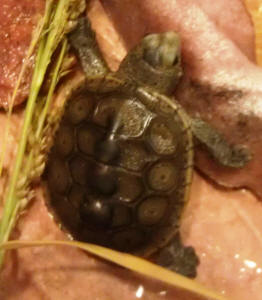
Identifying a turtle
9/13/12
Dear Crew,
<Hiya - Darrel here>
I recently came across a baby turtle during hurricane cleanup in
Mississippi, so I'm not sure if its even a land or water turtle. I'm
attaching a picture in hopes of someone being able to identify it so I
can provide it with proper care.
<Kayla - what you have there looks like a baby box turtle … just about
THE coolest land turtle there is. I'd like to see a side view and one
from 3/4 toward the front just to be sure … BUT from here it looks like
a Terrapene carolina. Lost of documentation on them on-line, great
personable pets!>
Thanks,
Kayla
|
 |
Ornate Box Tortoise, repro. issue? 8/1/12
Dear Crew,
<Hiya Jaremiah - Darrel here>
I am really worried about my estimated eight year old ornate box
tortoise.
She mated with a male about two months ago and I started finding eggs
but it turned out to be another tortoise we have, she however has not
laid any eggs and is becoming lethargic and I am worried she is egg
bound.
<I wouldn't worry too much, Jare - while tortoise and turtles do get egg
bound, it's a LOT more rare than people think. Usually, if
conditions aren't right to lay the eggs and/or they don't expel the
eggs, they simply re-absorb them. They don't become a
problem until the hard shell forms and that usually happens just before
laying>
She won't eat but she will soak in her water in some kind of trance most
of the time.
<I feel the same way many days, recently>
The rest of the time she stays in a trance with her arms, legs, and head
out of her shell.
<That's only because she can't swill Bourbon>
She was digging holes and seemed to be preparing to lay eggs.
<Sometimes they dig around and for whatever reason decides it's not
going to happen, but it's too early to know that yet.>
I cannot afford a vet and it is so sad is there anything I can do to
help her if she is egg bound.
<The only thing to do is soak her in 3/4 inches of lukewarm water for 20
minutes a day. Occasionally that will stimulate expulsion.>
<But if you're asking me, monitor her for now. Let her be.
Offer food every other day or so, but let her go through what she has to
go through.
If she's still in this torpid state by September, then consider the
baths>
Jaremiah
FW: Ornate Box Tortoise 8/5/12
Thanks a lot, I have recently notice she has one eye she doesn't open
and some liquid was coming from it today. So I brought her inside in an
aquarium until she feels better. Is this ok. I personally despise people
who keep turtles in a small confined area, My habitat is almost 100
square feet, but it is over a hundred degrees and she doesn't dig into
the mulch like the other turtles.
<Discharge from the eyes, called 'weeping' is not uncommon in some
turtles, but it's not common in Box turtles. See about
giving her a vitamin A supplement. If she's eating, very
small chunks of liver (beef or chicken) can be given along with their
regular veggies and they usually gobble them up.>
<In a large garden-type area like you describe, are we sure that no one
has used any pesticides or snail-bait? Or fed her a snail from
another garden that did?>
Re: Ornate Box Tortoise 8/7/12
We have used Seven on our vegetable garden that is about ten feet away
from their habitat. We wash everything we give them. Could this be it.
<Snail bait is toxic to turtles - but unless she ate a turtle pellet or
ate a snail that had eaten a pellet, it wouldn't be a factor.>
She is a little lazy sleeping most of the time.
<It's not a great thing that she's sleeping most of the time, but then
again my box turtles are healthy and they're only active during the
morning and dusk hours. In the middle of the day they usually seek
shade and sleep.>
<If you continue to be concerned about her lethargy, bring her indoors
for a few days and see if more moderate temperatures and simply a big
change stimulates her in any way>
Terrapene carolina; repro. 7/29/12
Hi, I have an Eastern Box Turtle that has recently laid 3 eggs.
One she laid and didn't bury, so I'm guessing they're infertile. The
other 2 she laid under her "home". Is there anything special I should do
for her eggs?
<Chuck 'em away? Seriously, rearing turtle eggs is very difficult. For
one thing, if you move them so they aren't oriented with the "up" the
right way, you'll kill them. In zoos they draw an "x" on the top when
they expose the nest, and make sure to carry the eggs with "x" upwards.
In any case, if there isn't a male with the her, or hasn't been for a
few weeks, they won't be fertilised, so they're no more likely to hatch
into turtles than eggs from the grocery store hatching into chickens.>
I have them in a bowl with moist (but not wet) potting soil, they're in
a warm environment, and partially buried. I spray them everyday just to
make sure they're not drying out, I'm using distilled water because I
read tap water wasn't good for them. Am I not doing something, or should
I change something, because I would like to have at least 1 baby turtle
live. I caught her in the wild, so I know nothing of her past. Also, is
there a way that I can tell if anything is forming inside the egg?
<Yes, holding up to a light can reveal what's going on inside a few days
after laying. It's called "candling" because candles have been used in
the past. Google "candling eggs" and you'll get some photos. Infertile
eggs are just a dark mess after a few days, but fertilised eggs will
have visible blood vessels inside you can see. Smell is also a good
clue.>
-Miranda
<Cheers, Neale.>
|
Please help me to identify my little buddy
5/26/12
Dear Crew
<Hiya - Darrel here>
Can you please help me to identify my turtle? My children found
him in September in the cold rain, I believe he was just hatched, but
needless to say, I have fallen in love with his little turtle face!
<They are neat, aren't they?>
I believe he is healthy, but would like to know what kind he is, so I
can better care for him.
Thank you so much,
Jenna, Michigan
<Jenna - what you have there is possibly THE coolest turtle on the
planet!! It's a Terrapene carolina … a Box Turtle.
They are fun, friendly, develop distinct personalities, inquisitive and
easy to care for.>
<They're not water turtles, per se. They live on land, usually
NEAR water because they do like to swim. They mostly eat
snails and worms as babies and juveniles and then transition to more
fruits and vegetables as they get older. Just make sure, if
you feed him snails, that there has been no snail-bait used.>
<For now, he belongs in the terrarium-type setup. I make mine
starting with a long plastic storage box from a building supply store …
you can use actual peat moss on the floor if you want, but I usually buy
a couple pieces of indoor-outdoor carpet (not the stuff that looks like
fake grass) and put that in the bottom, then I place some tiny potted
plants in various places. He requires a source of UV-B and this
can easily be accomplished with a Reptisun CFL bulb from Zoomed and a
plain ordinary clamp-lamp with reflector that you get at the building
supply store.>
<He'll grow slowly and as he does his shell will start to become much
more domed. He's likely to live over 80 years, too!>
<The only thing to warn you about is that they can tend to fixate on one
kind of food and ignore everything else. I had a box turtle named
Bud that decided he wouldn't eat anything but strawberries.
It is a difficult habit to break.>
<Have fun - that little guy will be pleasure to have!>
|
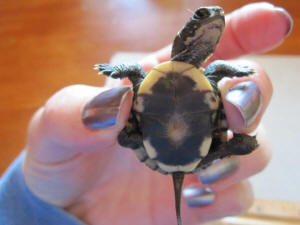
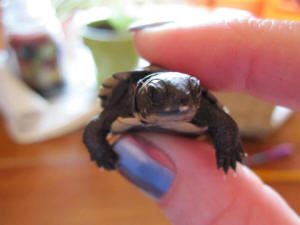
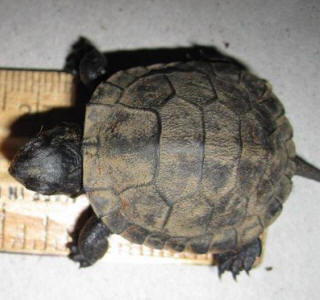 |
|
It's a baby
turtle! 3/28/12
We just found the baby turtle near the nest that we fenced as you
instructed. Photo to follow...
<Congratulations, Christine!!! You're the proud
parents of a baby Box Turtle (Terrapene carolina).
They tend to be a bit more carnivorous as babies … I feed mine
the amount of wet cat food that will fit on a toothpick twice a
week. I soak them in about an 1/8 inch of tepid tap
water for 5 minutes and then offer the cat food. Usually
within a week or so of hatching they'll start chomping
away. You can leave greens and fruits in his indoor
enclosure for him as well. Keep in mind that when he is
small, he is easy prey for rodents, birds and the like, so a
small terrarium setup is best.>
<Also, the eggs are laid 4-6 at a time, so be on the lookout
for some brothers & sisters!>
|
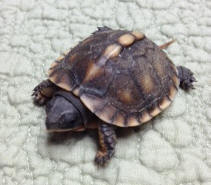 |
|
Turtle Identification 3/1/12
Dear WWM Crew,
<Hiya - Darrel here>
Please help me identify my turtle.
<His name is Gary. He's the son of Odman and
Clara Scmitterman>
I made the mistake of asking our local pet shop when we first
acquired the turtle from my father-in-laws golf course. However,
I have never been sure that they were right (they said yellow
belly Cooter)
<Wow! They're not only NOT right … the only way
they could have been more WRONG is if they told you he was a
toaster-oven>
and am afraid that my poor turtle may not have the proper
conditions he needs, in fact I found him at the bottom of the
aquarium almost dead from drowning this morning.
<He's a land turtle!>
He has a heater, turtle dock, UV light, and filter in his
aquarium but honestly all my research makes me think he is not
even a water turtle. Thank you so much for any advice you can
give me. My girls and I love Squirt very much but I don't
want him to suffer because they wanted him as a pet.
<Sorry it too so long to get back to you, Bree. I hope
Gary is OK>
<Gary (or whatever you named him, is a Box Turtle
(Terrapene carolina). They are some of the cutest
and friendliest turtles around - and there is much information
about them.>
<To start, they live on land. They do swim sometimes,
but usually just soak in shallow water. His enclosure
would be a solid floor covered in anything from newspaper to dirt
or peat or even that indoor-outdoor carpet (it looks nice being
green & all and you can take it out & wash it in the
sink!)>
<He needs a heat lamp over part of his enclosure, but not a
tremendously hot one (I used a normal 60 watt incandescent bulb)
and he needs a UV-B lamp - the kind used for water turtles is
fine.>
<A shallow bowl of water that he can climb into and soak in is
good>
<Food-wise they eat snails, worms, grubs as well as fruits and
veggies. As a youngster he'll tend more toward
the snails and worms. I feed my young ones am
earthworm or two every Saturday morning (Pet stores carry
earthworms called night crawlers) and I offer a melon piece or a
carrot end & top every Wednesday or so.>
<One thing they tend to do is "fixate" on one food
and refuse all others. I had an adult Box turtle that
fixated on strawberries and wouldn't eat anything
else. It took years to get her back to eating regular
foods>
Thanks,
Bree Scott and daughters :)
<Yer welcome!>
|
|
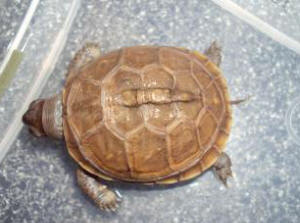 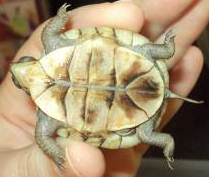
|
Restless Russian Tortoise
1/4/12
Hello,
<Tracy,>
I am a first time Russian Tortoise owner and I got my little guy 4 days
ago.
<I hope you bought a book first. Trust me when I tell you that
tortoises are not easy pets, and you need to do your research
carefully. A close friend of mine keeps three, and she's had them
for decades. While low maintenance in many ways, you do need to
understand things like body weight, diet, hibernation, and activity
levels at different temperatures.>
Now I am having trouble keeping him contained. I read up on care sheets
and how to properly house him indoors. First, I warily had him in a
glass reptile tank. I taped up the side with cardboard and textured
paper so he couldn't see out through the sides. He was doing
alright the first 2 days with that, just exploring and what-not with
occasional napping but the next day he started crawling at the corners
endlessly. He bangs against the sides and pushes himself up against it
just crawling.
<How big is this enclosure? Few tortoises are truly happy in glass
tanks, and even one that looks big, say, 75-100 gallons, is tiny from
the perspective of a tortoise. Bear in mind many species cover
surprisingly big distances each day, and they often alternate time on
the ground with periods in burrows as well, so they have quite complex
demands in terms of activity. It's best to keep tortoises at least
partly outdoors. Here in England, it's pretty standard to let them
outside in summer, and then bring them indoors only when it gets
cooler. But they're amazing escape artists, and as you're
observing, if they feel trapped, they *will* try and get out.>
Anytime I got near him, even outside of the tank, he would hiss at
me.
<Yes. This will pass in time.>
I was getting considerably more worried that he was getting very
stressed.
<Likely so. How big is this enclosure?>
So today I bought a Rubbermaid container with solid sides and set it up
as the care sheet I was following told me to as well, thinking this
would solve the problem and make him feel safer and better contained,
also so he couldn't see through the sides thinking this would stop
his corner crawling.
<Possibly, but it'll instead make him think he's called into
a pit.>
Within 5 minutes he started to crawl at the corners. I've sat to
watch him just to see if he was trying to get use to the new
'cage' and he has been going on for an hour now crawling at the
corners and I don't know what else to do. I am worried about him
being stressed out and I've tried searching the internet for a
similar case, but I can't find any information and was wondering if
you could help. I am doing something incorrectly that is causing this?
And what can I do to fix it?
<Need to know about the size of the vivarium you're using and
what you're doing to provide complexity to his habitat, e.g.,
substrate, caves.>
Thanks,
Tracy
<While he may settle down in time, the size of the vivarium is a key
issue, plus the fact tortoises really aren't easy to keep in
vivaria compared to ones given the garden to roam around in. Hope this
helps, Neale.>
|
I have a question.. 10/13/11
*Hello,
<Hiya - Darrel here>
I was driving down the road today and witnessed a truck almost
hit a turtle that was crossing the road.. My niece instantly fell
in love with it and wanted to keep it.
<I understand>
Im just wondering if you can identify the species of turtle it
is, and what to feed it..
<Yep - it's a Box Turtle!! (Terrapene
carolina) and one of the coolest, neatest, personable
turtles you can possibly have.>
<They like to swim, but they live on land can be very happy in
a fenced garden, patio, etc. But I've even had them as house
pets as long as you dont have a toddler to drop them or a dog to
try to play with them - anywhere she's not likely to get
stepped on.>
<At that size, her diet is mainly veggies and fruits, but they
like snails and earthworms if they can get them. If you feed her
snails, make sure they're not from a garden that uses snail
bait, since that is toxic to her as well.>
I will enclose a few pics of him/her..
Thank you for your time...
<My pleasure! - one of my favorite turtles ever>
|
|
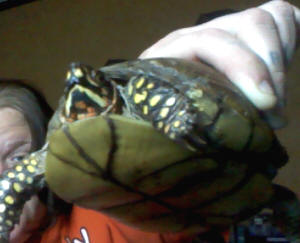 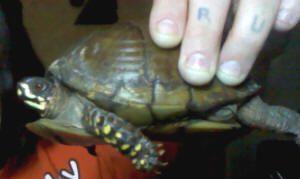
|
|
Turtle identification 10/07/11
Dear Crew,
<Hiya - Darrel here>
We live in Mobile Al and found this turtle in our back yard. We
live close to a large lake. It laid eggs in the ground in the
shade of a pine tree. Can you identify it for us?
<Sure. Her name is Alvis Box. She's 26 years old, daughter
of Henry and Docka Box. She enjoys walks in the moonlight,
70's rock music and male turtles that are not afraid to
cry.>
<Unless you wanted more generic information?>
<What you have there is a Gulf Box Turtle (Terrapene
carolina major) one of THE coolest turtles on the
planet. Smart, friendly and interesting. They are terrestrial
turtles, living around the edges of water and not so much in the
water. They enjoy swimming, but live mostly on land. As adults
they eat mostly vegetables (the same kinds our parents tried to
get us to eat) but will never pass up a snail or an earthworm if
given a chance. They make great pets.>
<You have two choices with the eggs: Leave them where they are
and let nature take it's course - in which case you need to
place a 3 foot wide ring of chicken wire or hardware cloth
fencing (enclose the top, too) to contain the babies when they
hatch next year.>
<-OR- you can dig the eggs up and incubate them yourself with
a much greater chance of the eggs hatching (if they're
fertile, and not all layings are fertile). The trick here is to
GENTLY dig them up, without breaking them or changing their
orientation. It's tricky work just like the archeologists you
see on TV "digging" 10 foot deep holes with paint
brushes it takes patience but hey, what ELSE were you going to do
tomorrow?
Here is a link on what to do and how to do it: http://wetwebmedia.com/FWSubWebIndex/TurtleReproArtDarrel.htm
>
<If you get babies, write back!!>
|
|
|
|
What is this turtle?
8/15/11
Dear Crew,
<Hiya - Darrel here>
I was recently given a baby turtle about an inch around in
diameter.
<How cool>
At first I thought it might be a snapping turtle but I am not
sure.
<Nope>
I don't know what to feed it or if I should keep it in water
or not. It seems to like light and being on dry surfaces. It has
two knot like bumps on it's head and a sharp pointed down
lip. Can you help me figure out what kind of turtle it is?
<What you have there is probably the absolute most coolest
turtle on the planet, Amanda. That's a Terrapene carolina a
Box Turtle. They live on land, mostly and they eat bugs, snails,
veggies, flower petals, etc. I feed mine most fruits and
vegetables with an occasional snail from the garden (NOT a garden
where anyone uses snail poisons)>
< A perfect setup would be something like a terrarium, but
they are VERY easy and forgiving on care. A Tupperware container
with sand, dirt, peat or even shredded newspapers will do. They
need UV-b or natural sunlight (not filtered through glass or
window screen), fresh, shallow water to drink & bathe,
etc.>
<The thing about Box turtles is that they develop very
distinctive and usually friendly personalities. It's not
uncommon at all for an adult box turtle to seek out your company.
I've had adults that were free-range in my house that would
walk past their fresh food to come to the living room to look
around and be close to the family.>
<It was a lucky find and a happy gift!! Enjoy>
Merritt's go 8/15/11
I was recently given a baby turtle about an inch around in
diameter. At first I thought it might be a snapping turtle but I
am not sure. I don't know what to feed it or if I should keep
it in water or not. It seems to like light and being on dry
surfaces. It has two knot like bumps on it's head and a sharp
pointed down lip. Can you help me figure out what kind of turtle
it is?
<That is interesting that who ever gave you this baby
didn't tell you what species it was or how to take care of
it. First, from the picture it looks like a land turtle
(tortoise) but if possible try to get some straight over so we
can see the patter on the shell, one of his underside and a few
of his head. A few more pictures that aren't dark will help
with obtaining a proper id of the little guy. Looking forward to
the pictures. Merritt>
|
|
|
|
what kind of turtle is this.
6/23/11
Dear Crew
<Hiya - Darrel here>
My family and I found this little turtle crawling in gravel by
our old apartment.
<Yep>
We have put it in an aquarium and gave him/her rocks and
light.
<Sorry - but NO! An aquarium isn't quite the right
environment. That baby needs a terrarium>
We have been feeding him insects and dried brine shrimp and such
as well as baby turtle food from out local pet store.
<Nope ... Fruits, vegetables, the occasional earthworm or
garden snail>
We would really like to know what he is and if he is going to be
a dangerous little guy/girl .
<Not only not dangerous, but one of the most personable and
friendly turtles you're likely to ever run into>
Please help us identify him/her.
<Her name is Clarissa!>
<Oh wait ... you meant species, etc. didn't you?>
<What you have there is a Terrapene. A baby Box
turtle. When they're babies, they have a normal
(flat-looking) carapace and look just exactly like the little guy
you have there. As She (or he) grows up, the shell becomes much
more domed-looking.>
<Do some research on them starting here:
http://www.wetwebmedia.com/fwsubwebindex/TurtIDSueG3.htm
>
<They are some of the nicest and friendliest turtles ever!!!
Good luck with yours!>
|
|
|
Box turtle growing out of shell
8/11/10
Hi,
<Hiya - Darrel here>
Unfortunately I'm writing again about one of my land turtles, an
eastern box turtle. I'm not sure if you can offer advice since it
is not aquatic.
<I offer advice on everything, Denise!>
<Even things I know nothing about!>
<But fortunately for you, Box turtles are one of my favorite turtles
of all time, so I know a great deal>
As soon as the vet is back in the clinic, I'll be bringing my
turtle in to see what the heck is happening.
<Always a good choice - but mainly if you have a vet that is truly
experienced in reptiles and exotics. Most places have a turtle and
tortoise club and they will know the good vets in your area.>
<The very best in the world is in Marathon, Fl if that helps anyone
out>
After closer inspection, it looks like he is growing out of his shell!
It is noticeable from his rear end and on the under sides of his shell
in-between his front and hind legs where the bottom shell connects to
his carapace. It's almost as if he's getting fat but I
don't feed him too often. If anything, my other land turtle eats
most of the food. I'm thinking, not enough calcium but the sun
shines in there home most of the day and there is shelter for them to
get out of the sun. Maybe he is not getting enough exercise? They have
plenty of water in a dish 1 1/2"- 2" deep. I feed them
bananas (not often, they don't seem to care for it), strawberries,
staple food about 3-4 times a week, and romaine and butter lettuce. It
looks very healthy, shell is beautiful, is strong and seems to move
quickly which is why I never suspected there to be a problem. I'm
very worried and fear bad news and hope I am not too late.
<Two things, Denise. Edema - which is a swelling of the soft tissues
often due to disease, or obesity which is simply over-eating. Very hard
to tell from here. It's not exercise or activity like in humans
simply more food than their metabolism can handle.>
<Is he active? Eyes bright and alert looking? Will recognize when
you have food and come toward you? All those are good signs, lack of
any/all are bad signs.>
<Edema is usually OBSCENE amounts of swelling to the point where he
can't easily move. It's also sudden onset - not weeks or months
of noticing small amounts of puffy skin>
<If it's just "a little" swelling/fatness and not huge
amounts, then it probably is a touch of obesity. As an adult, that will
probably stay with him for life, but you can help by cutting the
feedings to twice a week in summer, once a week in spring/fall and of
course, none at all from November to February>
ASAP, we're going to the vet. I was hoping for some more insight to
calm myself down.
Thank you. Denise
<Can't say for certain from here .. but if it was me, I'd
calm down and see what the vet says - it doesn't sound life
threatening>
|
wild turtle with lump on neck 8/3/10
Dear Crew
<Hiya - Darrel here>
After following the information on your site regarding ear
abscesses, I would like you to view the attached pictures to
verify if this might be the turtle's problem.
<Yep - what you have there is a very handsome Terrapene
carolina carolina - the Eastern Box Turtle. Probably named Butch
and yes, Butch has an abscess or possibly a tumor>
To give a little history--about 3 weeks ago a wild box turtle
appeared and stayed under my car. We live in a remote area of
eastern West Virginia. After about 4 days I contacted a local vet
who advised to feed the turtle
and place water outside for it. He does not treat turtles but
offered to have him given to a wild life habitat for turtles. I
started feeding him tomatoes and gave him water. During the very
high temperatures of 100 degrees he did not leave from under the
car. However, after feeding him for several days and the
temperatures cooling slightly he began to move around the
property but never going very far. Every morning he reappears
under the car and after eating will go over to a near by tree or
bush and rest. He can pull his head inside his shell but will not
stay closed and will open back up quickly. One night his neck was
extended, eye closed appearing to be asleep. I thought he had
died but in the morning he was back under the car waiting for his
food.
Thank you in advance for can information or guidance you might be
able to provide.
<Charlene - Box turtles make some of the niftiest and
personable pets in the reptile world. They are easy to care for
and usually are problem-free.
Treating an abscess of this nature isn't all that hard,
either. I'm not suggesting that you try it yourself, but
calling around to a few vet might find you one that can excise it
and prescribe some antibiotic cream. Most areas now have an
Emergency Vet Clinic -- one that is open or on call when all the
other vets are closed (most vets in an area will help sponsor
such a place or at least know of the Emergency Referral Hospital
in their area).
The point is that these hospitals are often staffed by newer,
younger doctors that still have at least that 6 week exposure to
reptile medicine fresh in their mind>
<Failing that, even an experience hand from your local turtle
and tortoise club could possibly drain the wound for you and you
could treat it with daily coatings of simple triple antibiotic
cream from the local drug store>
<Once past the abscess, the only problem I've ever had
with Box Turtles is that they tend to fixate on certain foods,
such as strawberries and melon, and then refuse any other food --
for decades at a time.>
<A sturdy fenced enclosure (part of a garden would be perfect)
that he can roam and forage and have you supplement that with an
occasional earthworm and pieces of fruit and Butch (or whatever
his name is) will be happy for years!>
|
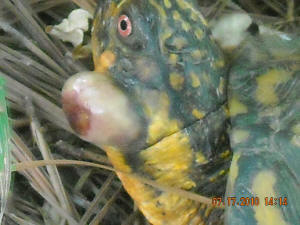
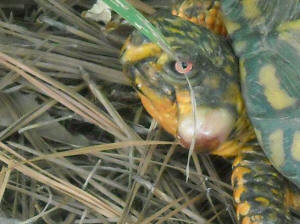 |
|
Re: wild turtle with lump on neck
8/5/10
Thank you Darrel for you information regarding the turtle
"Butch". Name fits perfectly although to this point had
not named him.
<Yer welcome>
I have several additional questions:
This morning Butch showed up minus his lump. It appears the
abscess opened itself during the night. The question now is
should I begin putting triple antibiotic cream on the area where
the abscess had been. The skin there looks saggy.
<Yes, I would.>
Also, how do you keep the head extended in order to apply the
cream.
<LOL - that's the million dollar question. Box Turtles can
close up tight as a drum and it really, REALLY hurts to get a
finger caught in there when they do. Here's what I'd do:
Get a LARGE dab of the cream on a Q-Tip (excuse me Q-Tip Brand
Cotton Safety Swab) then pick up Butch by the sides of his shell,
while holding the swab next to where his neck would be still and
steady. He may clam up for a while, but if you can hold him still
long enough, he'll release and poke his head out. Now
operating as swift and silent as a Ninja assassin you press the
swab into the wound and hopefully get a bunch on the right area
before he closes up again. Then set him down. Repeat
tomorrow>
You suggested fencing in an area to keep him safe. My next
concern is I believe turtles hibernate for the winter. Our ground
here is mostly rock and shale. Shall I prepare a special place
for him. I don't know even in my garden if Butch can dig deep
enough to be safe through the winter.
I have been reading about hibernation, etc and still am uncertain
as to the best action for Butch. The nearest reptile vet if
either Baltimore, Md. or Parkersburg WVa. Unfortunately presently
my husband is ill and I can't not make either trip with him
at this time.
<No problem. Come the first cold snap of the year, pick Butch
up and place him in a cardboard box that contains shredded
newspaper and a few old towels and place this box in the garage.
Put a small shallow bowl for water and offer food every day.
After about a week or two, Butch will stop showing up for food
and just bury himself in a corner. After a week, you'll know
he's shut down for the winter. Close up the box, place it in
a dark corner of the garage and wait for the first blooms of
Spring.>
< OR-- Just bring Butch indoors and give him the free range of
the house. As long as there is no balcony he can leap from or
basement stairs he could fall down or Dog who might chew him, he
can just hang out. They don't eat much, poop very little (and
it's easy to clean) and don't stay up late at night
ordering pay-per-view movies like other reptiles do>
Once again thank you for your advice and guidance.
C Pietra
|
Russian Tortoise Behavior?! 7/27/10
<Before we get started here,
I want to announce that this is my
FIVE HUNDREDTH LETTER
On behalf of Wet Web Media!!!!!>
<Five hundred seems like a lot .. until I realize that my colleague
Neale Monks seems to answer that many during a 3 day weekend, but still
I'm proud of myself, the effort I've put in and am pleased to
announce that at least 412 of my answers were correct!!!!!>
<ahem>
Hello.
<Hiya - Darrel here>
My name is Noemi and I'm wondering what my tortoise's behavior
means, if anything. I've had my turtle (Sochi) for about a month
now. I've been informed it's 7years old, and its past is still
not well known... Anyways, I've been taking my turtle to exercise
(walk) on grass a few times during the month. I usually take it on
sunny days around noon, by then it's pen is outside already.
<I'm guessing that you mean that the tortoise has an outdoor pen
where it can get fresh air and natural sunlight, but in addition you
take him for walks on the grass>
Anyways, today I let it walk around on grass, but afterwards moved it
to a shady area of dirt/little bark dust. I was walking alongside it
while observing it, and of course it could notice my presence. Then I
decided to return it to its pen, and squatted a ways away from it but
in front of it (so Sochi noticed me before I scooped it up). It stopped
walking and observed me, then did the weirdest thing! Sochi repeatedly
tucked its head in its shell and out its shell, over and over without
moving any other part of its body. I thought it meant Sochi wanted me
to move out the way or it was annoyed/mad at me, so I moved from its
path. It stopped doing that behavior and I let it walk...then I decided
to test if the behavior was because of me and moved in its way again.
Sochi didn't do the behavior again, so I picked it up. What did
that head tucking behavior mean?
<Noemi Russian Tortoises (previously known as Testudo horsfieldii --
but now classified as Agrionemys horsfieldii) is one of the nicest,
friendliest and most personable tortoises there is. Each and every one
I've ever had or been exposed to has had it's own unique
personality>
<In your case, Sochi was excited, but there's no telling if it
was excited as in happy, scared or annoyed. I've not witnessed that
exact behavior before, but as I said they're highly
individual>
Also, Sochi recently started "clawing" me whenever I picked
it up to take it somewhere (clawing as in the swimming motion
turtle's do, but with more feeling!) Whatever these behaviors may
mean, I've decided to give Sochi more alone time--and not be in its
pen so much (I'm in its pen when replacing food and water, and
moving the pen outside/inside house. Or just briefly cleaning its
habitat......)
<The scratching *IS* normal in many of them, Noemi .. they just
don't like being picked up or (I guess) that feeling of flying. But
I wouldn't let that make you think she wants to be alone. More
importantly, the things you do while around her are critical to her
well being. By all means continue to see that she gets food, water,
natural sunshine and exercise>
Also! I call Sochi "it" because I don't know if it's
a male or female. Thanks!
<It also doesn't matter because she has no ears and can't
hear what you call her anyway. I suggest that you keep up your close
and personal relationship with Sochi and in time I'll bet
she'll calm down and enjoy it>
|
Terrapin shell problems 04/22/10
Dear Crew
<Hiya - Darrel here>
I have recently been given this terrapin, which had been kept in
very poor condition! I have provided him with good lighting, diet
and space etc but I would like to know what is wrong with his
shell?
<From the picture Rebecca, it appears as if she's just had
a hard life. IT appears that you have a Cooter (Pseudemys
cocinna) or a Yellow Belly (p scripta). The green discoloration
is from algae that will lessen in time as she has access to clean
water and proper basking conditions but even in the wild many
adult Sliders and Cooters have algae on their shells. The scuff
marks on the shell can be just signs of wear and tear and nothing
to be alarmed about>
<Is the shell nice and hard? If you look really closely at the
shell, the whitish areas -- is the material soft and smelly like
a fungus? Does it scrape off? Or does it simply appears as the
scutes themselves are discolored? The more explanation you can
provide, the better I can advise you>
also if I could treat the problem myself before I take him too a
vet?
<If her shell is hard and he's active and eating, I
don't see a reason to be alarmed just yet. Keep her clean,
make sure he can get really warm and dry and try cleaning her
shell with a cotton swab every few days and let's just see
how she does>
<Care sheet: http://www.wetwebmedia.com/FWSubWebIndex/RESCareBarton.htm>
<Treatment:
http://www.wetwebmedia.com/FWSubWebIndex/treating%20RES%20Dis%20DarrelB.htm>
|
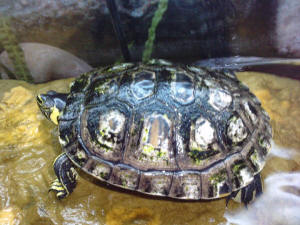
|
Re: terrapin shell problems
4/28/10
Hi Crew
<Hiya - Darrel here>
This is a picture I took today of my terrapin. After
removing all the black stuff off his shell there is more
white patches underneath...they are hard like the rest of
his shell and don't smell at all...he is eating and
behaving normally but I am still very worried because it
looks so bad. Any information you can give me I would be
extremely grateful.
<Looks normal to me, Rebecca. In fact I have a number of
ones that look just like that in my pond. She's just
lead a harder life than some. Keep up the good work and
don't worry>
Rebecca
|
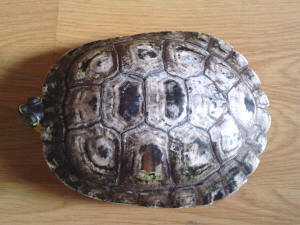 |
|
My tortoise is gaping and there is a clear bubble in
her mouth 2/28/10
Hi. My name is Jordan. I have had two Russian Tortoises (also know as
Horsfield's Tortoise, Testudo Horsfield, or Central Asian Tortoise)
since I was 4. (I am 12 now). One is a male and the other is a female.
Both of them have been healthy for the first 11 years of their life but
now we think Shelly (the female tortoise) is sick. I briefly noticed 2
days ago, that she was constantly opening her mouth, while lunging her
front and hind legs forward. Tonight I decided to further investigate
and found out that there was a thick clear-looking bubble in her mouth.
I though maybe she couldn't breathe so I got a tooth-pick and every
time she opened it tried to pop it but the bubble was really strong.
After a couple tries it would pop and with a dropper, I would force
feed her water since she was not drinking or eating on her own. When
she closed her mouth again the bubble was back!!! I kept do it and it
coming back. She looks very uncomfortable, but has pooped and peed
tonight. I have no clue what to do and I am very worried about her.
Please help as soon as you can!
Thanks,
Ms. Jordan
<Greetings. It's probable that your tortoise has a Respiratory
Tract Infection. These cause a build-up of mucous and bacteria in the
nose, throat and lungs, and ultimately bubbles appear in the mouth and
nose.
Breathing becomes laboured, the animal becomes stressed, and eventually
the animal dies. This isn't a disease that can be treated at home.
You absolutely must take this tortoise to a vet. Invariably antibiotics
need to be prescribed, often alongside optimisation of the maintenance
of the animal with respect to temperature, vitamins and UV-B light, all
of which are crucial to long term health.
http://www.wetwebmedia.com/fwsubwebindex/turtrespart.htm
Hope this helps. Cheers, Neale.>
Marginated tortoise, hlth.... Terr. Chelonian sys.
1/20/10
Thank you for your informative answer on my question about the slider
and painted turtles social behavior. I love this website.
<Good to know.>
I have a marginated full grown male
<We really aren't experts on non-aquatic animals. This tortoise,
Testudo marginata, is a completely terrestrial species as you
presumably realise, and I cannot stress too strongly how important it
is to solicit expert advice. There may be equivalent reptile sites to
WWM, but you really should contact a vet. Most small animal vets have
plenty of experience handling tortoises. Here at WWM, we try to help
people with fish and invertebrates largely because vets have little or
no experience of such animals.>
who is about 11 and was in good shape until last year when we advised
to change his bedding. We switched from rabbit pellets to shredded
wood.
<As in sawdust or simply wood shavings? The latter sounds
daft.>
He got a lot of it stuck in his beak and had to have his beak trimmed
and reshaped.
<Who did the trimming and reshaping? I can't think of any good
reason why you would need to trim a tortoise's beak because of
sawdust or even wood shavings. The beak is, as you realise, keratin,
and constantly growing.
Normally it gets trimmed somewhat by what they eat. Wood is too soft to
cause damage, and while bits of wood shavings might possibly get wedged
here and there, it shouldn't be difficult to remove them with
forceps and cotton wool buds. If the tortoise genuinely has a problem
with its beak, for example can't eat properly because of overgrowth
or improper growth, then that's a whole other issue not related to
the wood.>
I noticed that he is having trouble walking and all of the skin on his
legs are peeling.
<A certain amount of skin sloughing is normal, and over the last 11
years you should have been able to get a feel for what's
"normal" in this regard.
But if this tortoise is losing a lot of skin, and if its motor
coordination isn't working, then you may well have a deeper
problem. In the first instance, you might think about environment. Cold
is a major issue this time of year. Unless you're in the tropics or
subtropics, this animal should be hibernating from about October to
April, plus or minus a month or so depending on the clemency of your
particular local climate. In any case, in January, it should be asleep,
UNLESS, you're keeping it in a HEATED habitat. Room temperature for
humans isn't warm enough; we're warm blooded, and turn calories
into heat, reptiles are cold blooded, and get their heat from their
environment. In short, it should have a basking lamp (preferably with
UV-B as well) if it is being kept active through winter. Countless
tortoises die each year because people don't do this. You should
also think about poisons. Wood shavings from a workshop could very
easily carry across chemicals used to treat or otherwise process wood.
You shouldn't use anything not expressly sold as suitable for pets.
Review other possible poisons: bug sprays, herbicides, paint fumes,
etc.>
He will get up on his legs, walk a little and go back down. he does
walk but is not as fast as he was.
<They don't move properly when cold, so that's the first
thing. But if he does have a heating lamp, and is getting UV-B, and doe
receive a balanced diet and clean water to drink, then you may well
have some other, more serious problem.>
I am concerned about the shredded wood with his respiratory system. He
is a beloved pet-how can we help him.
<Trip to the vet is in order here.>
thank you in advance
Amy
<Good luck, and hope the vet can help your tortoise. Cheers,
Neale.>
|
Turtle id 10/24/09
Can you please id this turtle shell. Thanks in advance!
<Hello Pat. While I'd hazard a guess this is some species
of Testudo, or perhaps Geochelone, beyond that I can't offer
any kind of helpful answer without extra data. It's certainly
what here in England we call a
"tortoise" -- that is, a terrestrial rather than
freshwater/brackish water "terrapin" or a marine
"sea turtle" (in British English, the three kinds of
chelonian are separated, rather than lumped under the single word
"turtle",
even though etymologically, "turtle" and
"tortoise" mean the same thing).
Identifying chelonians from their shells alone is a bit of a fine
art since there's much variation. We're primarily fish
people here, and while Darrel and I are probably familiar with
the more common freshwater
turtles/terrapins kept as pets, your chelonian shell isn't
one of those species. I'd suggest getting in touch with the
herpetological department of your nearest zoo or natural history
museum and finding out if they can
help. Cheers, Neale.>
|
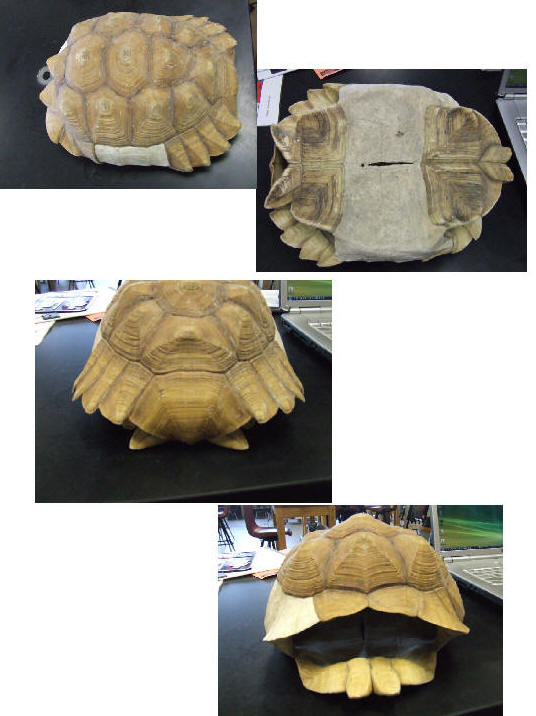 |
How to make turtle food. 10/17/09
Hello
<Hello - Darrel here>
I am Haider Ali Adnan from Lahore, Pakistan. I have a 7cm long Kachuga
smithii.
<Often called a Brown Roof Turtle>
How should I make a mixture of vegetables with an appropriate
composition of the ingredients?
<Ali, not much is well known yet about this turtle, much of the data
is conflicting and the what we know comes from the unfortunate process
of trial and error. At present it is assumed that it will thrive in
captivity on the same basic diet that the other Emydid turtles such as
Red Eared Sliders require. My first recommendation would be prepared
Koi pellets, as they would be cheaper in the long run because they can
be kept indefinitely. Fresh fruits and vegetables have a fairly short
life even if refrigerated. If you must make it yourself, start with 75%
dark leafy greens or green beans mixed with 25% Squash or
carrots>
I also wanted to ask how do they brumate in the wild and in
captivity?
Since I keep it in a tub, what type of changes should I make so that it
gets the right environment for brumation?
<If your pet is indoors, then I recommend that you do nothing.
Maintain heat and light through the winter as you would in the summer.
Any room temperature suitable for you is fine for his water and
he'll still have his basking area when he desires heat. Brumation
(a general slowing of the metabolism in colder weather that is not
quite a full hibernation) is basically hard and stressful on the
animal, so there is no reason to go through it unless they are
outside.>
<If he's outside and there is no place to bring him in during
the cold months, then I recommend that you start reducing his feedings
2 months before the cold weather ... stopping entirely 2-3 weeks before
your traditional winter. Make sure his water is deep enough that in
helps insulate from nighttime low temperature swings. In Spring, wait
until you're SURE that the cold weather is gone and you see him
actively swimming and basking BEFORE you resume feeding him. When you
start, one small meal the first 8 or 9 days, perhaps 2 meals the next 8
days and then 3 every 5 days during the summer.>
|
turtle identification 10/10/09
Hello :)
<Hello,>
A friend of my daughter's found this turtle in the woods. I
already scolded him for taking it from its habitat, but now
I'm not sure what to do with it.
<Generally best to release it where found, as soon as
possible. Ideally, contact your local Fish & Wildlife
department to see if a park ranger can take you to an optimal
release site away from things like busy roads.>
I am wondering if I should take it to the pet store even though
my daughter wants to keep it.
<Certainly shouldn't take it to a pet store. For one
thing, wild animals can catch diseases from pet animals, and
_vice versa_. On the other hand, staff at a good reptile and
amphibian store may well know something about the reptiles local
to your bit of the world.>
He is rather small (about as big as the palm of my hand) and the
bottom of his shell is a bit soft.
<Appears to be an Eastern Box Turtle, Terrapene carolina. This
is a highly variable species, but the dome-like shell, brown
colour, and hooked beak are characteristic. The front of the
lower shell is hinged, so when the head is pulled back, a
trapdoor closes off that part of the shell. Males have red eyes,
females brown. I'm assuming you're in the United States
somewhere, where this is species is _by far_ the most common
terrestrial turtle (what here in England we'd call a
tortoise).>
He has a short neck, dark eyes and the bit of yellow colorings
that I can see. seem to be much darker at times and DO appear
much brighter in photos.
<If the eyes are brown, and this is Terrapene carolina, then
"he" is a she.>
He is currently in a large bird cage which we have attempted to
convert for his needs. (Frisbee filled with water, dirt for
burrowing, half of a potters pot for shelter and
"hiding" etc.
<Wild-caught specimens don't especially well in captivity,
though you have covered the key things, particularly water. They
like to bathe, but the water shouldn't be so deep (or the
bowl so steep around the edges) it cannot get out easily. If it
gets through the first few weeks, and eats and drinks normally,
the species can last a long time in captivity. High humidity is
important. Bear this in mind if you decide to keep this animal;
kept properly, it'll outlive you! The record for a wild
specimen is 138 years, and between 50-100 years seems fairly
common. In captivity you can expect upwards of 30 year lifespans,
and up to 60 years has been reported.
Like all reptiles, you need to provide a heat source of some sort
if you do not plan to hibernate the animal. Generally,
hibernating reptiles is tricky unless you have fattened them up
carefully beforehand, and I'd recommend against it, at least
for the first year. The heat source of choice is a lamp, and it
should be one that produces UV-B as well as heat, because they
need UV-B to synthesise Vitamin B1 and convert calcium into bone
and shell.
In short: they need a big vivarium, a bathing pool, a source of
heat, and a source of UV-B. This will be fairly expensive to pull
together, and while there's no rush, you will need to have
all these bits and pieces before it starts getting too cold. In
the wild your Box Turtle would be looking for a resting place to
hibernate, somewhere cool, dry, secure from predators and safe
from flooding. If you want to keep your turtle, you're going
to have to provide a warm, humid alternative.>
He moves very quickly and seems to be quite smart lol. (He found
a way out of the cage within a few minutes of putting him in it
and we were thankful we were there to see it or we never would
have believed it - it's fixed now. - and he already prefers
one shelter corner over the other!).
<Shelter is indeed very important. It's also critical to
make sure predators, particularly pet dogs, can't get into
the cage. Even a "playful" dog could wound or kill a
Box Turtle.>
I have attached some photos and am very curious to know what kind
of turtle he is, how old, gender etc. and most importantly what
he should be eating and what I should do with him.
<As I said, likely Terrapene carolina, probably female if the
eyes are brown rather than red. Age difficult to say; seems to be
full grown, so could be anything from 10 to 100 years!>
we've tried many types of food (lettuce, bugs, cooked eggs,
cooked pork, fruit etc. - so far he seems to prefer the eggs and
pork but only ate each of those once along with a small bit of
cucumber. He seems to eat one day but not the next.
<Avoid "meat", i.e., anything from a warm blooded
animal. The fats in these foods coagulate inside the turtle,
causing problems. Instead opt for mostly greens, romaine lettuce
and curly lettuce being ideal. Augment with soft fruit (melon,
tomato, berries) and offer small amounts of things like
earthworms, mealworms, and white fish. Very occasionally you can
offer them cooked chicken bones, which seem to go down well, but
not too often.>
Thanks in advance for your help.
Brenda
<If you plan to keep this animal, do spend some time reading
up on keeping Eastern Box Turtles in captivity. There are some
excellent reptile books available for pet owners, and one of
those would be a sound investment.
Keeping reptiles in captivity isn't easy, and not something
to do on a whim. It's a shame to capture an animal that can
live for 100 years in the wild, and then kill it after a few
months through neglect. So, make your choice: buy all the stuff
it needs to thrive, or else return the animal from whence it
came, ideally after calling the local wildlife bureau in your
neighbourhood. Hope this helps. Cheers, Neale.>
|
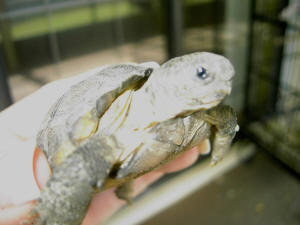 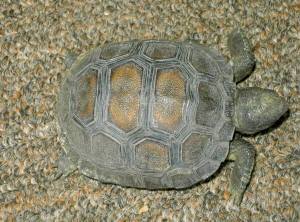 |
Re: turtle identification
10/10/09
Thank you so much for a speedy reply.
<My pleasure.>
Based on your information, we have decided it would be most fair to
this little lady if we called our local wildlife bureau and let her
have her chance to live to a ripe old age.
<Good move.>
You have been most helpful.
PS - we Live in Florida, USA. Although we are a very warm and humid
state, we do have our cold days in winter so she would still need
much care.
<Air temperature all year around should be fine if this animal
was kept indoors in a room that wasn't air conditioned. The
main thing is to avoid extremes of heat and coldness; anything
between 15-30 C should be fine, assuming it has access to water (to
keep cool) and a basking lamp (to warm up). But there's no
getting around the fact reptiles are all expensive pets in terms of
setting up their habitat, even though compared to cats and dogs
their long term costs are low (they don't eat much; kept
properly, rarely get sick; and don't need such procedures as
neutering). Still, they're not pets for everyone. Cheers,
Neale.> |
Turtle Identification
7/14/2009
Can you all identify this baby turtle for me?
<Yeah -- I think his name is Gary.>
<He might be a baby Box turtle (Terrapene) or any one of a
number of Emydid (water) turtles. The problem is that the straight
on top angle gives us just a vague outline. We can tell he's
not a mud, musk, soft-shell or snapping turtle. Not a Tortoise or a
sea turtle. He's not a Clydesdale Horse either, but I suspect
you already figured that out.>
<What I'd really like is a couple of face shots and one from
the side.
Not glamour shots of course, no hair or makeup needed .. just a
better angle to see his distinct features.>
<Unless you mean that OTHER thing .... that's not a turtle
at all, that's a quarter!>
<Regards - Darrel> |
 |
|
A brand new Baby Box Turtle 8/25/09
Hi!
<Hiya - Darrel here>
I'm Josie. I found this tiny little thing in my garage,
covered in cobwebs and dead bugs stuck to her! She is SO skinny
and lost one eye! So, of course I had to take her in and settle
her in her new home, because she would've died being out
there all alone, with only one eye, starving, and only being a
baby. I put her in with our 2 year old box turtle that lives in a
(supposed to be) sandbox built-in underneath my children's
play set.
They have a mini pond and a tomato plant out there. I just found
her today.
I know that it's a female because of the cloaca on her tail.
I would just like to know what specie she is, because that would
help me take care of her. I named her Cyclops since she has one
eye.
<What you have there, Josie is a baby box turtle! Cute as a
button and right about that size. I wouldn't go as far as to
say she's female from anything you can see at that age, but
it's as good a guess as male, so
let's go with it.>
<Cyclops appears to be a common box turtle (Terrapene
Carolina). She's omnivorous but will prefer meat initially
and live food, such as earth worms or snails when she can catch
them. She needs fruits and leafy greens like Apples and Collards
as she grows, so keep offering a little bit of that in the diet.
If you offer her small snails, make sure that no one has used any
form if snail bait around -- snails absorb it and it is extremely
toxic to turtles.>
Write back soon. -Josie
<done!>
|
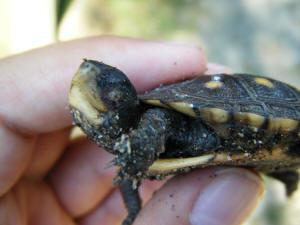 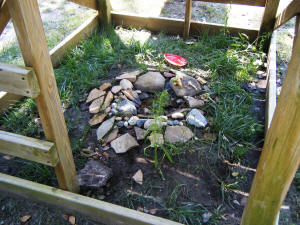 |
|
Re: A brand new Baby Box Turtle 08/26/09
I have been trying to feed her lettuce, tomatoes, apples and
grapes along with Lexi, our older turtle, but she won't eat
them.
<Be careful with lettuce. Collards are good, as are mustard
greens, etc. Romaine is BARELY O.K. and Iceberg is between
useless to actually bad for them>
We always fed Lexi fruits and veggies. I did not know that they
prefer live food.
<As they get older, they tend more toward a vegetable diet,
but it's unusual to find a Terrapene that won't hunt an
earthworm if offered.>
Cyclops is always avoiding Lexi, and our other terrapin,
Fredrica, when I put them together.
<What kind is Fredrica?>
Any advice about that? Thanks for the other info
<Cyclops is frightened, for one thing. For another, turtles
are not social animals. They live in colonies many times (colony
is a geographical area to which they confine themselves and
therefore often cross paths) but
except for mating they mainly ignore or tolerate each other. What
I'm trying to say is that Cyclops is not going to get
companionship or moral support by being with others of her own
kind. In fact, if an adult male
encounters a sub-adult male they've been known to attack
them>
<My suggestion is that you make a sub partition for Cyclops --
just for a while. Let her get used to being out in the world
again. You might try giving her a slightly warm shallow bath for
10 minutes and then offering
her a tiny bit of cat food on the end of a toothpick. That's
how I get my baby box turtles to start eating when they're
"stuck">
Write back soon. -Josie
<Done-- Darrel>
Re: A brand new Baby Box Turtle 8/27/09
Thank you so much for all your help!
<Yer welcome!!>
You gave me so much good advice!
<YES WE DID! It's why we're here!>
I will do the sub partition.
<Thank you for TAKING the good advice -- you'd be amazed
how many people
asked it and then don't>
Thanks.
-Josie
<Darrel>
|
Turtle Identification
7/14/2009
Can you all identify this baby turtle for me?
<Yeah -- I think his name is Gary.>
<He might be a baby Box turtle (Terrapene) or any one of a
number of Emydid (water) turtles. The problem is that the straight
on top angle gives us just a vague outline. We can tell he's
not a mud, musk, soft-shell or snapping turtle. Not a Tortoise or a
sea turtle. He's not a Clydesdale Horse either, but I suspect
you already figured that out.>
<What I'd really like is a couple of face shots and one from
the side.
Not glamour shots of course, no hair or makeup needed .. just a
better angle to see his distinct features.>
<Unless you mean that OTHER thing .... that's not a turtle
at all, that's a quarter!>
<Regards - Darrel> |
|
Box Turtle Spills Water 7/6/08 Hi Crew,
<Hiya Jay -- Darrel here> My female box turtle lives alone in a
24 gallon Rubbermaid container with cypress mulch substrate. She is
always burrowing under her plastic water dish and spilling the water,
so I am always bailing out the spilled water and refilling the dish.
<Welcome to the world of turtles. For some reason they seem to know
what causes the most mess for us and they head straight for it> She
has a nice hide box at the other end of the container, but she prefers
to hide under the water dish. If I attached the dish to the container,
the dish would be hard to clean; if I gave the turtle a very heavy
dish, she might get trapped or crushed underneath. <First, no dish
you put in is going to crush her. If she's strong enough to push
her way under it then she's ten times strong enough to withstand
it's pressure> Do you have any suggestions to discourage this
water spilling? <Why .. as it turns out ... I do! Chalk it up to 20
years of breeding turtles and a Box turtle named Clara being the first
to lay eggs for me.> <First, I'd like to say that I'd
like to see her in a bigger container if possible. That said,
here's how you solve the problem: Use a rectangular water dish,
such as a smaller Rubbermaid tray or a shallow shoe-box sort of thing.
Next, take two small wooden dowels from the local hardware or building
supply store and attach one to either end of the tray so it points
upwards (so if you pick up the ends of the rods, the tray is suspended
below like a basket. (wire ties will work for this) Now set the tray in
the end of the big container and clamp the sticks to the rim of the big
container -- so the two sticks, clamped to the side, would prevent the
tray from being lifted or pushed. When you need to clean, just unclamp
the sticks and lift!> I appreciate your helpful advice. <Jay ---
it was very brave of you to call my advice 'helpful' before you
even got it -- thanks!> Jay Smith
Russian tortoise... vac. fdg. during cold season... 6/9/08
Hey, I am thinking about getting a Russian tortoise sometime soon and I
am worried about when I go on vacation for a week this coming November,
how do I provide for my tortoise while I am gone? <Make sure it has
access to drinking water and can't overheat. Food isn't
required.> I know I will not be able to take the tortoise with me
for I am going on a plane and I don't have any one to care for it
while I'm gone. I do have an idea but I would like to run it by you
first. If I plant some edible vegetation a few months prior my vacation
the plants should be big enough to last a week or more. And for the
water supply I thought it would be best to buy one of those water bowls
that have a canister on top that holds water for several days worth and
distributes it through a little hole in the bottom of the bowl so
it's always full. I think it would be best to tape the canister to
the inside of the turtle box so he wont knock it over. And I live in WA
so the tortoise will be inside it's not ever warm enough here to
keep outside overnight. I would like to know if my plan will work or if
you have any other ideas that are relatively cheap to do I would like
to know. <For short term vacations, your best bet is to keep the
tortoise in its indoor enclosure with water and shelter. Put the
(essential) UV-B lamp on a timer so that it can bask during the day
time. But that's really it. Provided you're offering all the
standard care for your reptile the rest of the time, caring for
holidays is easy.> I know I don't have the tortoise yet but if
this plan will not work then I will have to wait to get the tortoise
after my vacation is over which I rather not do because I don't
want to wait that long. But if I have to I will. Thanks, Lace <Most
pet tortoise deaths come from predation (foxes, dogs); overheating; and
dehydration. Starvation isn't really a problem. So keep the animal
safe, watered, and neither too warm nor too cold, and you'll be
fine. Cheers, Neale.>
Putting my turtles to hibernation 11/19/07 Hi
<Hiya! Darrel here> I have a Three Toed Box Turtle (about 6 or 7
inches long) that I have had for 6 or 7 months. I keep him in a large
outdoor 5x8 cage built out of cinder blocks 2 high and lined with
bricks sunk in the ground inside to keep him from digging out. There is
a small shallow pond in it and I also have a chain link cover over the
top. Our dirt is mostly clay so I mixed up a patch of it with lots of
sand for him to dig in but he never digs. <Box turtles seldom dig
actual holes. They're more likely to just find a natural depression
at the base of some plant and hunker down for the evening or the season
that way.> It is starting to get colder so I figure he should go
into hibernation soon. The thing is he doesn't dig so I don't
know if he will just go sit somewhere and hibernate. That would be bad
for him right? <"Bad" is a relative term, Amanda. Winter
causes their systems to shut down to a minimum for the season, but you
have to remember that in nature, not all of our animal friends survive
each winter. When possible or practical, I arrange for my animals to be
spared the entire process> I also considered putting a box stuffed
with hay for him to dig into in his cage so he wouldn't have to go
underground. <Two course of action here. You could find a bigger box
of cardboard or wood, put some straw or hay in the bottom and bring him
inside, maybe to your room, and spare him the whole hibernation
process. Two, you could get a smaller box, fill it with straw as you
suggest and place him in a safe place on your porch or in your garage
and let him shut down for the season. You don't say where you live,
so I'm not sure just how cold or dangerous your winters are. More
on this in a moment> Should I stop feeding him yet so his food
won't rot in his stomach? <As fall approaches their appetites
should start to shrink and yes, you should slowly reduce their
feedings, both in amount and frequency> I also have a Map Turtle
(about 4 or 5 inches long) I keep in an outdoor aquarium. Last year I
just put him in a smaller container and put him in our glassed in porch
(its unheated) and he hibernated on the bottom of the tank. Is this an
okay way for him to hibernate this year? <A lot of the same advice
applies, Amanda. For my inside animals and individual specimens, I
bring them inside the house or porch and add a little heat and avoid
hibernation, but for my outdoor ponds I have no choice but to let
nature take it's course. The worry is that the pond is deep enough
and the body of water large enough to maintain some temperature balance
(cold or hot) and here's the reason: Most of our reptile and fish
friends from temperate climates can hibernate over winter without
problem, but what I call "almost winter" can be lethal to
them. "Almost Winter" is where it is clearly winter and their
metabolisms shut down according to plan, but it's not cold ENOUGH
to shut down all the way .... or it has too many warm periods where
they reheat and become semi-active only to be hit by another cold snap
.. these transitions can be lethal to them.> <Here's an
example: Yes, you could put your Map turtle in a large enough tank and
allow him to over-winter, or you could keep the water warm to around
65-70 and a basking area warm to 88-90 and avoid winter altogether. BUT
.... if you were to let the water become 50 or 55 and still have the
basking area active, his only choices would be TOO HOT (for winter) and
TOO COLD (for summer). Personally, I'd rather see the Map Turtle in
a tank on top of the dresser in your room all year 'round than
outside.> I would appreciate any reply to this. Thanks. -Amanda
<You're welcome & best of luck to you!>
Re: Putting my turtles to hibernation 11/24/07
Thanks for all of the tips but I have a few questions about what you
said. I live in Southern Louisiana and the weather has been going under
35 for a few days and back up to 85 for awhile from what you told me
this is dangerous for them. <Well, see .. this is where more
information is better. Southern Louisiana doesn't really have
"winter" in the conventional sense. Your turtles won't
really "hibernate" in the traditional sense but rather slow
way, way down to a state we call "torpid".> Should I just
take them in the garage where the change is less severe until the
weather levels out? <In the climate you have as I now understand it,
they'll both be fine outside during the winter PROVIDED that (A) -
They are healthy, active and properly fed until this winter started,
(B) - you stop feeding them until the weather warms permanently and (C)
- the winter is more or less "normal" and starts warming
again in late March or April> I would bring them both inside for the
winter (the Map Turtle all the time) but my parents have a no pets in
the house policy. <I have two sons. Reptiles and fish are welcome in
my house ... it's a no KIDS inside policy I'd like to have!>
How big would a box for the box turtle have to be for him to live
comfortably if I were to take him inside? <For "over
wintering" not very big at all. Twice his length would be fine,
but in Southern Louisiana I wouldn't worry about it.> I
don't have a basking lamp for my map turtle but I have his tank
where the sun hits it in the morning and afternoon sort of a natural
lamp does he need a real lamp? <Make sure the sun isn't filtered
through the glass. Standard aquarium glass and even window glass filter
out a great deal of the healthy UV waves and can over heat them as
well. If you do that, you should be fine. Make sure that all animals
that get direct sunlight can also get OUT of that sunlight when they
choose.> Thanks again for a reply. Amanda
Box turtle threw up 7/10/07
Hello Crew <Hiya MM - Darrel here today> I have a box turtle who
lives in my room in a 55 gallon tote bin. I feed my turtle every other
day and I leave the food in the whole time. A while ago my turtle was
in her water dish that had fresh water in it and she threw up stuff.
She doesn't look sick or anything, but I'm a bit concerned
about her because she has never done this before. So if you could help
me I would really appreciate it because I don't know what to do.
<At the moment, nothing big. Cut back on her food just a bit and
take it out after she's had an opportunity to eat -or not- say a
half hour. If she's otherwise healthy and active and her appetite
is still there, then I wouldn't worry about it. It happens to all
of us. BUT ... if her appetite or activity is off for more than a week
or she throws up again, then we may have to take action.> I feed my
turtle fresh fruit, vegetables, romaine lettuce, and happy tails dog
food that she has been eating her whole life. <AFTER we see her
through her tummy troubles and after she gets back on her feed ....
let's slowly cut back on the dog food. It's not something that
ever should have been part of her diet (she doesn't need anywhere
near that much protein or fat) and in the long term it's not good
for her liver. BUT ..... and this is a BIG BUT .... do it SLOWLY! Box
Turtles can be very picky and very persistent about their foods and if
they fixate on something they can go a YEAR without eating ... until we
mortals give in and give them what they want. So cut back in tiny
fractions over the next 6 months so that she doesn't notice.>
MM
Please Help! Box Turtle won't
eat 06/11/07 Hi Everyone <Hi Shelby, Darrel here> I
have had my box turtle for about 4 years now. We start a hole for her
to dig into every winter, and every spring she has come back alive and
well. It always takes her a while to start eating again, but this year
it has been different. She came up a little earlier this spring because
we had some pretty warm weather for a couple days before the winter
settled back in again (this was around April). It's summer now, and
we haven't gotten her to eat yet. We're really worried that
there's something wrong with her. <Not necessarily, Shelby. An
otherwise healthy box turtle can go over two years without food, so
it's not time to panic just yet.> I've heard that turtles
grow according to the size of their environment. <No. That's
fish, not reptiles> Well, she's been in the same pen since we
got her. We keep her outside. The pen isn't small. We put in lots
of weeds and a dirt area to make it seem like rest of the outside. My
dad built a little wooden box for her to stay in. We have a big water
dish that she can climb into. She hasn't gotten but just a little
bit bigger since we first got her. Could this be a problem? <I doubt
it, Shelby. Box turtles are thought to live to be 100 years old and
based on average temperature, type of diet, amount eaten and amount of
time in hibernation they can grow quite slowly.> Also, sunlight
doesn't always reach her pen. Should we get a lamp to shine into
her pen? Is that going to make a difference? <As long as it gets
SOME sunshine and a lot of ambient light (that's like indirect
sunshine) I wouldn't worry about it -- at least not right now.>
We couldn't get her to eat lettuce and carrots, so somebody told us
to feed her crickets and worms (when we first got her). She's
always ate them, but like I said earlier, we can't get her to eat.
Should we try to change her diet after this many years? Do you have any
suggestions? <Yes, I have lots of suggestions. First, don't be
worried. I suspect that all that's wrong is that she hasn't
come out of hibernation properly and her systems just aren't up to
speed. What I'd like you to do is this: Put her in a cardboard or
plastic box that's at least 3 times as long as she is, with sides
high enough that she can't climb out and bring her indoors --
somewhere in your house (maybe in a corner of your bedroom or den).
Make sure she can't get out and any curious dogs or cats can't
get in. Don't worry about heat or light right now .. what we want
is a place where she doesn't get TOO hot or TOO cold, OK? Normal
light that you have in a room during daylight is fine. Now every day,
place a shallow bowl with lukewarm water in the box and place the box
turtle in it. No more than a half inch deep and no more than 85 degrees
and just let it soak. After the soak, remove the water and place a tiny
bit of food in the box with the turtle. One Strawberry, a very small
slice of melon, Night Crawler earth worm is good (cricket or mealworm
is not). After a half an hour, remove any uneaten food and just keep
doing this, day after day ... for a couple of weeks. My bet is that
your turtle will get with the program and start to eat again.> My
mom said that if she doesn't eat soon, we're going to have to
let her lose somewhere. I really don't want to do that, and
don't think she would make it. <Please don't do that,
Shelby. That's the one thing I'd say NEVER do -- is take a
captive animal and let it loose. If it's sick, it won't get
"well" just by being outside of your pen and it might spread
it's sickness to other turtles. And even if it's not sick,
there's a good chance that it's come to depend on you for food
and care and wouldn't be able to fend for itself. So please,
please, please tell your mom that a real expert said to never, ever
ever do that, OK? If your Mom or Dad or you decide you can't or
don't want to keep it, you can find reptile or turtle clubs in your
area that will find it a new home. If not, write back and we here at
WetWebMedia will help you find someone.> Please, can you help us!?
<that was the first things to do, Shelby -- I hope it helps. If not,
or if the turtle doesn't move or seems to get worse, please write
back>
Feeding a Box Turtle
5/25/07 We rescued a male box turtle from a parking lot nine
days ago and put him with our larger female box turtle in her
well-equipped 24 gallon Rubbermaid box. <That was nice of you,
Jay> But unlike the female, the male does not eat anything. I've
tried live mealworms, crickets, shrimp, prepared turtle food, lettuce,
tomatoes, apples, even put the food up to his mouth, but he will not
take a bite. He enjoys the water dish and the basking lamp, he has a
daily walk outside, he gets along well with the female (no fights), he
is active and seems otherwise healthy, but I do not know how long he
can survive without eating. <Jay .. Few turtles or tortoises can
match a box turtle for being stubborn about eating or not eating. If
he's otherwise healthy he can go for many months without eating, so
I simply wouldn't worry about nine days.> What do you recommend?
<I use a diet of fruits (like apples and pears), vegetables (like
green beans and broccoli) along with night crawlers (big earthworms)
for mine, Jay. I also prowl the garden looking for snails (only because
I never ever use any form of snail bait or poison!) and they LOVE
snails! The books say that as they get older they're supposed to
become more vegetarian and less carnivore (more fruits & veggies
and less meat) but that has never been my experience. Mine appreciate
the apples and pears and SOMETIMES the veggies but mostly they wait for
what we call "worm day." Mealworms and crickets can be like
candy -- filling but not nutritious and not really that good for them.
Same with lettuce and tomatoes - forget them & If you're going
to feed leafy greens, try collards and chards and other dark green
ones. At least ... that's the way it should be, Jay. The truth is
that Box turtles can be easy feeders, in which case you should think
about my menu above -- or they can be fixated eaters. A Box I had I
once swam in the pond and ate Koi pellets along with my water turtles
and wouldn't touch anything else, so sometimes we have to adapt. Do
this, Jay: 1) as long as he's active and otherwise fine, don't
worry too much 2) Try to offer different things like above and whatever
you think of 3) Eventually when you hit the right stuff on the day
he's hungry, he'll eat> Thank you for your advice. Jay Smith
<you're welcome
Re: Feeding a Box Turtle 6/10/07 I'm happy to report that your
advice worked on my male box turtle who wouldn't eat. <Great! We
like giving advice that works.> I kept offering Harley different
things as you recommended until he finally ate something -- chopped
strawberries, which he carefully separated from chopped apples. <Box
Turtles are among the geniuses of the turtle & tortoise world, so
it doesn't surprise me at all that he took the time to separate the
foods he likes from what he doesn't.> Now I hide meat and
veggies in his strawberries and he eats it. <The next step is to
slowly reduce the amount of strawberries in that mix until he becomes
the OMNIVORE that he's supposed to -- and you don't have to try
to horde a seasonable fruit like strawberries. (Did you know that
strawberries are the only fruit with the seeds on the outside?)>
Thanks very much for your help. Jay Smith <You're very welcome,
Jay>
Re: Turtle Expert Needed 12/19/06 Chuck, Thank
you so much for your answer. I know your time is valuable. I wonder if
I could buy some "turtle consult" time? I am worried that her
behavior is not normal, about how long her "laboring"
behavior will go on and what are signs of distress I should know. I do
not have the sand medium she will want and this is her first
"beach" I have crafted in a 135 gal tank, as she is easily 8
inches across and needs swimming and basking space. Anyway, I have lots
of concerns and will be happy to pay you privately if you would
consider some time for me. Thanks, Penny < Go to tortoise.org and
you will come upon the California Turtle and Tortoise Society. They
have care sheets for general turtle care and there you will find
headings for turtle egg incubation can that can be done either
naturally or artificially. While your offer is greatly appreciated I
feel that these people are the real experts in this field because they
do this day in and day out and are up on the latest techniques for
hatching turtle eggs. I have hatched turtle eggs artificially many
years ago but I really feel you be best served. In the meantime, get a
rectangular plastic container from the hardware store. It should be
about 12 inches wide, 15 inches and 6 inches deep. The important thing
here is that it will fit in one end of the aquarium. Dimensions, except
for depth are really unimportant. Fill the plastic container with sand,
not gravel. Any kind will do. Get the sand damp but not soaked. It
should stick to your hand when you touch it. Lower the water level in
the tank to the top of the plastic container and place the container in
the tank. You want the female turtle to be able to swim up to the edge
of the container and crawl in. There she will excavate a shallow
depression and lay her eggs. Remove the nosy male because he may jump
in and eat the eggs are at least disturb her. After she lays her eggs
you can remove the container. Refer to the Turtle and tortoise club
website for hatching techniques. If you have any questions you can
always write back anytime. The crew is here to help.-Chuck>
Old Box Turtle 5/26/06 My name is Stacy I am 14.
Hi Stacey, Pufferpunk here.> My sisters boyfriend found this box
turtle on the side of the road on a rainy day. When he got home he gave
me the turtle. I noticed that my turtle has 2 holes in her shell.
<This is common with older turtles. Had some shell damage in the
past but should be fine & be able to live a long life with
this.> On his right back leg that he only has 1 nail on it and the
other has all 3. <Yes, you have a 3-toed box turtle with 1 deformed
foot. No issues there.> I was wondering what I could do to fix
everything that's wrong with her. <Nothing to fix. Just things
that happen to a turtle in the wild. Be sure to give it at least a 20
gallon tank, with a shelter on one side (an overturned box with the
side cut out will do & a water bowl large enough for it to bathe in
on the other side. Be sure to change the water daily, or it will be
drinking poop water. Mulch is a great substrate for them. It's
cheap & you can buy large bags even at most gas stations during
gardening season. Just make sure not to use cedar, it poisonous! Change
every 2 weeks & hand clean any poop daily (most will be in the
water). You will also need a reflector lamp for warmth. Food: dark
green veggies (no iceberg lettuce--mostly water), any fruits. Frozen
mixed veggies (defrosted 1st, of course) work well. So do fruit
cocktail, well rinsed, for quick feedings. They love red foods. Canned
dog food or dry soaked in water. Crickets & earthworms (found in
wild-box turtles tummies when dissected), are a favorite treat. Dust
the food with reptile vitamins (be sure they have calcium in there, for
the shell). If kept properly, a box turtle can live over 30 years!
~PP> Thanks a lot, Stacy Cline
| Wood Turtle With Bumpy Shell - 05/22/2006 This is my
turtle Woody, a north American wood turtle, if you look at her
shell, it looks really bumpy, is this normal? - Celia < The
bumpy shell is caused by a diet too high in protein. This is
usually seen in tortoises that are fed monkey chow. As turtles grow
they require less protein and more vegetable matter. You probably
kept your turtle on a hatchling type diet too long.-Chuck> |
|
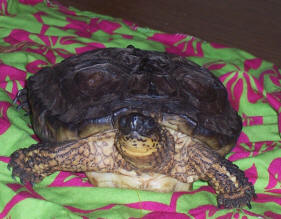
|
Turtle Bites 7/16/05 Hello, For the past couple of months my
male 2 Ã'½ year old has been nipping at his
left arm (about midway up) He eventually stopped and the sores started
to heal but he has now started again to the point where it looked
infected (an open wound) and I took him to the vet. He gave him an
antibiotic shot and now I have to give him 1 shot every 3 days. I am
really nervous about sticking my turtle with a needle and the vet had a
hard enough time doing it himself. Any tips? He is in a 40 gallon tank
with UVB, the Fluval 204, a ceramic heat lamp, and a spot lamp in the
middle with some nice basking rocks. His diet consists of Reptomin
sticks, Anacharis, and about a half dozen feeder fish once every 2
weeks. (Sort of a treat for the 2 week period) What would cause him to
bite himself to the point of causing this wound? Should I lower the
water level because he only seems to bite himself while in the water?
Is there any chance this infection could have permanently damaged his
potential for a long and healthy life? It is not massive, but
proportionally, if this injury was on a human, it would look like a
6" gash on our arm. I do love the little guy...Please help. Jay
< The fact that he only bites his left arm makes me think that he
has a bacterial infection on that arm and biting it is his only way of
scratching the irritation. I would include vitamins, kingworms,
crickets and earthworms to the diet. Increase the temperature of the
basking spot to 100 F. Get a Dr Turtle Sulfa Block for the water and
dip the turtle in Repti Turtle Sulfa Dip. Use the Repti Wound Healing
Aid to quickly heal the wounds. I think this bacterial infection is
brought on by waste products staying in the water too long. I would
clean the tank more often especially if it smells. That is ammonia and
it feeds disease causing bacteria.-Chuck>
Box Turtle with Greek Tortoise 8/27/05 We currently have a
Greek tortoise. Someone dropped off a box turtle in our yard, and my
sons want to keep it. Are we able to keep them both in the same
habitat? < I would not recommend it. The box turtle requires a
higher humidity, slightly lower temps and an area to get wet. The
tortoise comes from dry arid areas while the box turtle comes from a
moist humid forested type of habitat. The increase in humidity could
cause respiratory problems for the tortoise over a long
time.-Chuck>
Russian Tortoise with Chalky Fecal Matter 7/9/05 Thank you
for your response. I should have told you that it's a Russian
turtle. Does the same rule apply? < Somewhat. They like more
vegetable matter in their diet but they can still eat the
worms.-Chuck>
Russian Tortoise Problems 7/11/05 Thank you. Last question...
I promise! The Russian Turtle has white, chalky diarrhea.. same
solution? (Sorry.. I'm researching this for a friend who didn't
give me all this information at the same time. Again.. last question.)
Thank you Chuck!!!! < A Russian tortoise with diarrhea is not good.
Unlike turtles that are in the water the entire time you don't have
to worry about them getting dehydrated. If is a different story with
land turtles. Diarrhea can quickly kill a tortoise if it lose to much
fluid. I would recommend that your friend take the Russian turtle to a
vet for a complete check up. Your friend has no idea on how to care for
this animal and this little info I have given you really isn't
enough for long term success.-Chuck>
Wood Turtle Info - 05/15/06 Where can we
go to get info on how to take care for a jeweled woodland turtle ??
Juli < I could not find any specific info on a "Jeweled
Woodland Turtle", but I suspect that you have a wood turtle. Go to
woodturtle.com for specific info on keeping these turtles and maybe see
a photo of you turtle species.-Chuck>
Box Turtle Lost In Washington State 8/20/05
I'm in Spokane, Wa. and I was driving home when I found a turtle
sitting in the middle of the road. That's really odd, due to the
fact that I, personally, am about 5 miles from the nearest water source
other than a hose spigot. I'm not sure what type or what to do
about it. It's about 6" long, dark brown shell, with yellow
markings. This may sound really stupid, but I know absolutely nothing
about turtles, but the skin is rough and has small red
"flecks", if you will. His shell, (if it is a he), is about
3.5" high. I really don't know what else to tell you, but I
also want to know how to care for it and so forth. I'm really
worried that some poor kid is probably worried sick that their pet
turtle is missing. Any advice at all is welcome. Thanks for your time,
Katlin and "Bogart" < Sounds like a little box turtle lost
his way. Keep him in an aquarium /terrarium setup of about 40 gallon
size (3Ft). They must have water that they can get in and out of. They
need a basking spot on land with a good heat/sun lamp. They love snails
but will eat many fruits and vegetables. They live for a very, very
long time with proper care. Do a google search on box turtles and you
will be busy reading for hours.-Chuck>
Box Turtle Care & Feeding 11/21/04 <Hi, Pufferpunk
here> This may be normal behavior, or I may have been misinformed on
care. I have a box turtle-about 1.5 years old. She is in a 10 gallon
aquarium w/sand or aquarium gravel on the bottom, about 2 inches of
water and about 10 1 inch-ish rocks scattered about for basking. There
is also a fake plant and a decorative rock in there with her. My
problem is that she seems almost sad. She always hides under the plant,
doesn't eat very well-refuses to eat the pellets they gave me at
the stores and is partial to iceberg lettuce and any fruit. She has
done really well today, but I'm worried she may be lonely. (A
friend found the baby nest in a river behind his house, gave some away
when old enough and returned the rest where they were found). My
brother got her, or I would have asked for 2 lol. I was wondering a few
things 1) Am I caring for her properly 2) Would it be a good idea to
get her a "buddy" 3) If so, what kind of turtles get along
well with box turtles? Any advice would be wonderful, and I apologize
if I re-asked a question, I'm not a good skimmer. <1st thing, I
must ask you to please use proper capitalization in your letters. These
go to our FAQs & I have to fix them myself, before sending it. That
takes away from time I could be answering other questions. If you do
really have a box turtle (high arched shell, brown in color, locally
caught ones usually have 3 back toes), then it is a land animal, not
water. It will need a container large enough to soak in for water, but
mostly a dry area to hang out in. I use cypress mulch about 3"
thick, so it can bury itself, if they wish. It will need a 20g long
tank, so you can have one cool end (with the water bowl) & a warm
end (with a reflector lamp above). You need to change the water as soon
as it gets dirty, as this will also be it's drinking water. It will
also like a cave to hide in (a large shoebox with one side cut out will
do). There is prepared box turtle foods made, but it can get expensive.
When wild box turtles have been dissected, they found mostly earthworms
in their stomach, so that should be #1 on their list. Usually I mix up
some frozen mixed veggies, & diced fruit, mushrooms & canned
dog food. If you haunt your local grocery, you can sometimes see them
taking old, soft fruit off the shelves. Ask them if you can have it.
Iceberg lettuce has no nutritional value, as it is mostly water. The
greener the better. You can make up larger amounts & put into small
1/2 cup portions & freeze, to feed later. Also, find a good reptile
vitamin to "salt" it's food with. If you want more
turtles, you will need 20g/turtle. I'd stick with only box turtles
as companions, but they really don't care if they live alone. Here
are some good sites on turtles: http://www.turtletimes.com/ http://www.turtletimes.com/market/index_store.htm
Good luck & enjoy your turtle--it will live for around 30 years if
you take good care of it! ~PP (My name is Jeni too!)> Thanks again,
Jenni
Sad Turtle 12/1/04 Hello, again. <Hi, it's Pufferpunk
here again> We upgraded to a 20 gallon aquarium with mulch and a big
bowl for swimming, etc., and she absolutely loves it, but she still
won't eat. I did the mixture you said and she turned her nose up at
it. <Have you tried warming her up in her bowl (with warm water)
before offering her food? also, they seem to be attracts to red foods,
especially earthworms). After two days of not eating I started to worry
and gave her some apple which she gladly accepted, <Red foods,
see?> but even the fruit she eats only bite sized amounts (to you or
me) a day. I've tried feeding her 2 or 3 times a day-giving her a
fresh piece of something different-but she barely eats. Are there any
vitamin drops that I can drop on the food I give her to keep her
healthy? Or should I consider carrying her to a vet? <I don't
think a vet is necessary. Turtles will try to hibernate in the winter.
Try to keep her warm & keep offering her lots of variety, to find
out what her favorite foods are. You can buy good reptile vitamins form
a pet shop. Also, adding cod-liver oil to her food & rubbing it on
her shell & legs is very good for her. ~PP> Thanks for all your
help. Jenni
South American Wood Turtle I am having trouble finding
anything on the Suriname wood turtle. Is it the same as the North
American turtle? <No, totally different species.> And also what
type of habitat, food they need to have for a long healthy live. thank
you for your time < Your semi-aquatic (Rhinoclemys punctularia) will
need an area that is partial aquarium and partial terrarium. They can
be kept like regular wood turtles except that they need to be kept
between 75 and 85 degrees. North American turtles are sometimes cooled
down for hibernation. Do a Google search on the scientific name or
South American Wood Turtle and you will find lots of info on your
turtle.-Chuck>
Wood Turtle Not Eating - Please Don't Send Queries in
HTML Hey Crew, A few months ago I bought a 7 year old Ornate Wood
Turtle from my local pet store. She's a hyper turtle that loves
swimming in her water and burying herself in wood before bed. The
problem is, she eats very sporadically. Sometimes she eats her food
daily, other times she avoids it for a week or more. Is this healthy?
I'm worried about her starving. I change her water daily and food
at least every other day *depending on if she eats it*. Please help me,
I don't want to see her sick. Thank you! < Wood turtles from
Central America like it hot and humid. They should be treated like
North American box turtle regards to diet. I would try lots of
different veggies , king worms and regular garden
|
|

