|
FAQs About Snapping Turtles
Related Articles:
Turtles,
Shell Rot in Turtles,
Amphibians,
Red Eared Slider Care,
Related FAQs:
Turtles 1,
Turtles 2,
Red Ear Sliders, Turtle Identification, Turtle Behavior, Turtle Compatibility, Turtle Selection, Turtle Systems, Turtle Feeding, Turtle Disease, Shell Rot, Turtle Reproduction, & by Species:
Cooters/Mud Turtles, Softshells, Snapping Turtles, Mata Matas, Tortoises, & Amphibians,
Other Reptiles,
|
|
|
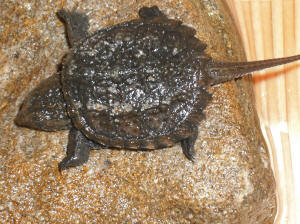
Snapping turtle; hlth. 2/8/20
We own a 45 lb. pet snapping turtle. Gimpy T.Turtle (find him on
Facebook) has been our pet since he was the size of a bottle cap. Gimpy
has his own 100 gallon heated swimming pool, a heated pillow and UV
lighting in his pool. Gimpy is very intelligent,affectionate,and
organized. Gimpy is now 4 years and 8 months old. Gimpy only eats and
goes to the bathroom in his pool which is filtered and water changed
every two days. Gimpy eats only at 6:00 am and 6:00 pm,if we are late to
feed him he gets angry and walks away to the far side of the pool and
will not eat.Gimpy sleeps with us nearly every night depending on what
he chooses. If he wants to sleep with us he'll walk to the bedroom door
at 8:30 to 9:00 pm and wait for us to come to bed. If he doesn't want to
sleep with us he'll crawl back into his swimming pool.Gimpy will cuddle
up to me and lay his head on my shoulder to sleep at night. Every
morning after he eats at 6:00 am he gets out of his pool and makes his
rounds through the house. If a towel is changed on the towel rack,he
notices.If a picture on the wall is different,he notices.If a plant is
moved in the house,he notices.How do we know this? Gimpy will walk up to
the towel,or the plant,or the picture and stare at it for 10 to 15
minutes occasionally looking at us to let us know something has changed.
<Well, turtles are known for their adherence to routine... moving water,
food dishes can be trouble>
After his rounds in the house Gimpy crawls into his heated pillow for a
nap.Later when Gimpy
wakes up he may go to Denise (my wife) and snuggle with her on the
couch,or he will come to me sitting in the recliner and crawl up my legs
and slide back down several times. If I sit anywhere other than my chair
he pulls on my pant leg to get me off that chair. If I don't lye on my
side of the bed Gimpy will force his way under me,stand up,and push me
out of bed. Gimpy eats turtle food in the morning and pork or honey ham
in the evening. We've tried fruits and vegetable but he refuses to eat
them. Here's the problem,Gimpy's left rear leg is getting weaker. He
use's it to go forward but cannot use it to lift as he walks.Our vet
can't find anything wrong other than weak muscle or muscle
deterioration.What do you suggest?
<Mmm; really, a visit to another vet.; hopefully one who specializes in
herp.s.
I suspect some sort of nutritional deficiency is at work here. A shot
now may solve this issue short term, but longer will likely involve
adding supplements to the food this animal does take. Bob Fenner>
|
.jpg)
.jpg)
.jpg)
.jpg)
.jpg) |
|
Turtle Compatibility. RES, Snappers
6/10/18
Hello Staff!
<Hiya – Darrel here>
I have a red eared slider approximately 10 years old. We acquired (him) CRUSH
about 8 years ago crossing over a tennis court at a high school going away from
the pond in 110 degree weather
<Thanks for saving him. He probably would have been road kill>
So, we happened to be driving down a highway and saw a truck advertising turtles
so we stopped. He had yellow bellies, soft shell, mud and snappers! One snapper
left.
<Uh-oh>
<Folks –as a general rule for a happy and healthy life, don’ buy turtles
from a guy in a truck on the side of the road or sushi from a gas
station/Mini-mart.>
She picked him up and he stretched out his neck and she rubbed his head and then
under his neck he loved it! Looked like a little dinosaur. So, he came home with
us! We set him up in a 30 gallon tank with basking ramp and heat lamps. I read
where the young need to bask the adults not so much they prefer the muddy murky
waters hiding waiting for their prey to swim past. Well, SNAPPER (ironically)
did great with her holding him daily and of course he grew rather quickly from
the 2" little swimmer to a 4" handful. He would still let her reach in the tank
and pick him up and she would sit on the couch watching shows rubbing his
head/neck. THEN, she decided to give him a small goldfish that Crush had in his
pond. That did it! The hunting instinct was now awakened and from that point on
no one could pick up Snapper without being snapped at. Snapper is now 11' long
and NOT at all willing to let a hand go inside his tank, not even for cleaning!
Daughter has since moved on and left Snapper to be taken care of by "grandma"
(me)! I have him in a 75 gallon tank with no more heater or basking lights. I
have a great set up for him with bricks and paver creating at cave for him to
hide in. Gravel on the bottom (actually small river rocks from Lowe's not
aquarium gravel). I have two regular fish filters one at each of the 4' ends and
two long air tubs hidden under the bricks so he can't move or chew on them. He
loves it. I love it too as I keep the tank water (well the filters do) very
clean I do let the algae build up sometimes just enough that I have to squint a
little to find him then I'll drop in my sump pump and exchange that water for
fresh. That happens only like twice a year. I mainly feed him strawberry tops,
romaine lettuce hearts, floating pellets, dehydrated crickets, meal worms and
occasionally goldfish.
<To be honest, I never feed my turtles live food. Both the Slider and the
Snapping Turtle can grow from hatchlings to full-sized adults and even breed –
with a diet of high quality Koi pellets and an occasional (once a month) Earth
worm. Some of the things you’re feeding Snapper are the nutritional equivalent
of Reese’s Peanut Butter Cups.>
He is NOT an alligator I have 90% confirmed this. He is not a common though
either, I forget what species I found with a science teacher that came to see
him.
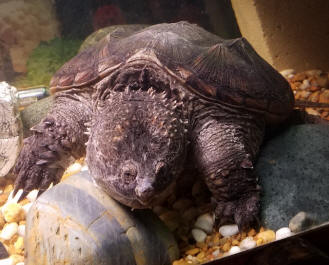
<For the pictures you have there, you have a Chelydra serpentine .. the common
snapping turtle>
I on occasion will carefully catch Snapper (although not for about three months
as he bit through the largest net I have, I'm afraid to catch him with my hands,
I know what pain feels like!)
<But you don’t know what losing a finger feels like. The proper place and method
for picking up a common snapper is to grab the tail, right at the base and lift
him up from there, allowing him to hang downwards. The tail is VERY strong and
this causes him no discomfort at all – except that we can assume he doesn’t care
for being hung face down from his tail any more than we would.>
<He can bite and latch on to anything touching anywhere on the front half of his
shell!>
Anyhow, now that you have a detailed history of the two shelled kids I have.
<Yes – some details are edited for space>
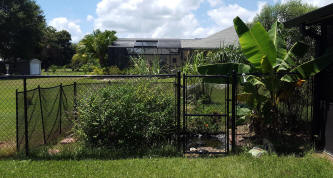
My dream is to dig a 10'x8'x3' pond with caves and surround it with tropical
plants and a small fence to keep BOTH turtles inside away from our Jack Russell
dog, Marley and our 2 years old grand-daughter, Byron. I would think and hope
that a 10'x8' would be large enough pond and the total surface area would be a
triangle (I'm angling this INSIDE our fencing from the back fence to the right
hand side) the triangle to the back will keep the above ground filter and
possible waterfall to help with circulation. I have a 100 gallon tank that is
currently the housing for feeder goldfish. I have some that Crush never caught
and when Irma came through we scoped all those fish from his pond and put into
this tank. I found some in that as large as my hand!!! They look like baby koi!
But those will eventually go into this dream pond too. I know Crush will never
catch them but Snapper may. LOL
<Also know that Snapper will have no mental or ethical reservation of catching
and eating Crush, either.>
My question is do you think with a pond of that size and a yard for Crush to
cruise do you think the turtles could cohabitate?
<no>
I don't care that they are "friends" but as long as they don't attack or hurt
one another. I don't think Crush could do so well against Snapper but then the
day that Irma hit (she got us late at night) us my husband was out and on his
way home saw a small turtle crossing the road and was far from a pond he stopped
and brought it home. It was a small snapper about 3". I kept him inside for
about two weeks but I didn't have a filter for that tank and I didn't want to
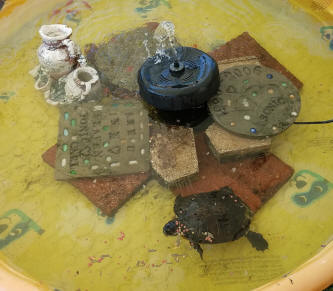
spend the money for one so I put him then in the kiddie pool we had Crush in
(didn't trust him to be roaming yet so he was kept inside a kiddie pool with
bricks in the middle for basking. Well, that lasted for about a month then one
day I couldn't find IRMA (we named him/her) I carefully moved the bricks so I
didn't get bit and found her facing the back of a brick but she looked strange.
When I tapped her she floated up and I picked her up to see that she had no back
legs and no belly. Just shell and head!!!! My only answer was Crush had trapped
her/him and eaten his body and legs!!!! Cannibal-turtle!
<Almost all water turtles are opportunistic omnivores. I only house
turtles of similar size AND temperament together. For example, soft
shells or snappers are ONLY housed with their own kind and ONLY of similar size.
Sliders and Cooters of course can intermix but still I never house smaller ones
with larger ones>
So, I'm not sure about housing them together I don't want to lose either but I
feel Snapper is getting too big for his tank. He can twist and turn very easily
right now even with his long tail but I just think he would be much happier (not
that he knows different either) in a larger area. Selfishly though part of me
knows I then losing the enjoyment of actually having a snapper because I will
never seen him again. Unless I build a glass front above tank for them, which I
am also considering. Much like a decorative koi pond where I can have the tank
near the front and use glass/acrylic with dirt etc in the back for Crush to
cruise around. Then we could enjoy the fish and Snapper if he comes out of any
caves.
I've attached some photos hope they aren't too large. You can figure out what is
what I'm sure.
Thanks! For your opinions, suggestions and advice!!!
Connie in Florida
<Connie – when raising a snapping turtle you should know from day one that there
will be a day when you will be saying goodbye. Worse, you can’t (or shouldn’t)
release him into the wild for a myriad of reasons I won’t go into here. There
are several people in Arkansas and Missouri than have huge private ponds that
will accept snapping turtles, but in Florida I imagine you could also find a
private collector that has the room and the patience and discipline to keep
him.>
<Just like Alligators, they don’t make good pets.>
|
 |
|
what type of turtle is it? 9/19/16
hello i live in Indiana, i found a turtle a couple weeks ago almost dead i
took him and made a house for him or her. i think he's a boy so i named him
Trent. I've been doing research and all i have found id that he is a
snapping turtle but that doesn't make sense. i get him out of his cage
everyday and he lays on me crawls in my hand even my little 5 year old
brother holds and plays with him with adult supervision. he has never bitten
or anything. even a dog tried to eat him all he did was crawl away. i love
him or her to death. can you please tell me what type of turtle he is and
what his habitat should be like and what he should eat because i don't want
to do any harm to him. (no i don't release animals back into the wild they
have a better chance of survival when i take care of them) please let me
know asap! thanks!!!!
<What you have there is a common snapping turtle (Chelydra serpentina).
They make interesting pets, they can thrive on plain old ordinary Koi
pellets without the need for any kind of live food.
There are only three warnings
1) They can bite fiercely and strike almost anywhere around the front HALF
of their body, so the only way to hold them is by the tail with fingers
support the rear of the shell
2) They have a really short temper which means warning#1 is nothing to
forget about
3) They get REALLY big and then you have a huge, unwanted, dangerous animal
on your hands. DarrelL>
re: what type of turtle is it? 9/19/16
Thank you for contacting WetWebMedia. We appreciate your email, but
unfortunately cannot reply because it's in a format that we can't post on
the site. Please correct your grammar, punctuation, and spelling, make sure
the question isn't written in ALL CAPS or no capitalization at all and send
it to us again. We aren't trying to be the "bad guys" here, but we are ALL
volunteers, and we get dozens of questions every day - we just haven't got
enough time to correct questions that aren't formatted properly. Please take
some time to fix your question and write back; we will greatly appreciate
this respect. Thank you,
Gabe
<Gabe; am wondering if the writer here is a child. I/we try to make wide
allowance for children, non-native speakers and folks of apparent diminished
capacity. I sent this along to Darrel, and he has responded.
BobF>
|
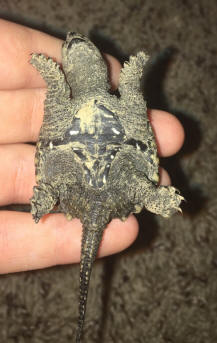 |
Alligator snapping turtle 5/8/16
Well he's not dead cause we took him out and he was moving and opened his eyes a
little, I guess he's sick then! I don't know anything about
alligator snapping turtles but he has been in a big fish tank since we got him
under a fish tank light but never sun light so I don't know if that makes a
difference or not. We also have fed him shrimp and some other things in the past
and I read on the website that they r supposed to have vitamins or something and
we never did that either.
<Yes, sadly, improper care can lead to illness and even death>
So do u think I should set him free somewhere and maybe he could survive or do u
think he's dying?
<first, we never EVER set a captive animal free. Ever. Too many things can and
will go wrong. Either the animal will die because it doesn’t have the skills to
hunt and protect itself or worse, it will communicate a disease to the native
animals. Don’t ever do this>
< The Chelydridae (the snapping turtle family) are fairly easy to keep and
relatively hardy, but once they become ill it’s harder to help them recover than
many other turtles. My suggestion is that you follow the procedures for
dry-docking (keeping him warm and dry for 6 weeks or so) so that his body has an
easier time of trying to recover. That said, if he hasn’t had proper sunlight,
vitamins and nutrition for a very long time this may be a classic case of too
little, too late.>
<I can’t help but wonder why you didn’t pay attention to what you read back when
it would have been easy to keep him healthy>
Alligator snapping turtle shell problem (Urgent)
12/29/15
Dear WWM,
<Hiya – Darrel here>
I really hope u guys can help me out with my alligator snapping turtle problem.
This issue has been going on for years and my turtle's shell have gone from bad
to worst. I have taken pictures to keep my turtle updated on this forum (link
below), but no one seem to be able to help me out with this shell issue. Is it
possible for you guys to take a look?
<I did>
Recently there's a big piece of scute from my turtle that came off and I found
it inside the tank, and it seems that the spot after the scute peeled off looks
black/grey. It really worries me to look at it everyday and I've been reading
your website and it seems to be under the ''Dead or dying scutes , When good
shell goes bad'' category. ''In some cases of fungal, bacterial or physical
damage, a scute (the plates that make up the top part of the shell) may be so
damaged that the underlying tissue that supports it may die and just slough off
the entire scute. This is clearly identified by the scute being partially or
completely missing and the underlying tissue turning hard and white.''Is it
possible for you guys to confirm the issue with me so that I can start on my
treatment asap? Thank you so much!
<Kevin – Snapping turtles are enigmatic in a sense. They seem to need slightly
acidic water. Even ‘pristine’ water from a tap or a filter … that is clear,
clean and top-notch healthy water for almost all other turtles, from Sliders to
Soft Shells to Musk turtles, seem to promote shell disorders in the Chelydridae
(That’s a $5 word for the snapping turtle family). What I see in your photos
appears to be just a shell infection. What’s interesting is that when a scute
completely dies the underlying bone is usually very, very light colored (almost
white) and not the darkness seem here.>
<That all said, the treatment is the same. Dry dock him, scrub his carapace and
plastron with Betadine (Iodine) on alternate days (let it dry in place) and on
the other days cover the affected areas in an anti-fungal cream (athlete’s foot
cream). Keep him dry and warm from about a month, except for a daily 15 minute
bath so he can drink, poop and maybe eat …. Except your little guy seems fat
even by the standards for his type … so if he doesn’t eat I wouldn’t work.>
<http://www.wetwebmedia.com/FWSubWebIndex/treating%20RES%20Dis%20DarrelB.htm>
http://www.monsterfishkeepers.com/forums/threads/alligator-snapping-turtle-shell-help.567704/page-7
|
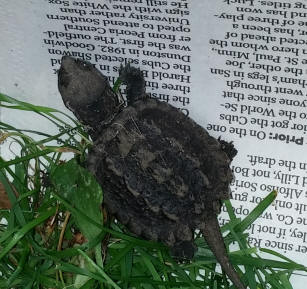
Baby turtles 9/20/15
My husband and I found these two baby turtles. We are thinking they are snapping
turtles. Could you maybe give us some tips for caring for them please. I've
attached some pics.
<These are indeed Snapping Turtles. Telling juvenile Macroclemys (Alligator
Snapping Turtles) from Chelydra spp (Common Snapping Turtles) is somewhat
difficult without having them in front of you. Basic care is similar, of course,
but adult size is very different, Macroclemys getting A LOT bigger.
I will direct you to some reading first:
http://chelonia.org/Articles/chelydracare.htm
Snapping Turtles are NOT EASY to keep, and as well as being difficult to keep,
they are extremely dangerous animals. So I have to assume that you're both
expert turtle keepers. If you're not, release these turtles back where you found
them (but only if they have NEVER been in contact with any other pet reptiles,
to avoid the risk of transmitting diseases) or else contact your local wildlife
charity (who will be able to rehome them as required).
It may well be that these turtles are a protected species where you live anyway,
since they are somewhat endangered in the wild. So anyway, back to assuming
you're expert, and that it's legal to keep them where you live.
The main issue with these turtles is their large size and heavy demands on
filtration. Despite looking very rugged they're actually quite sensitive to poor
water quality, more so than the average Red Ear Slider. The secondary challenge
is diet. They are more or less strict carnivores, but as with all carnivores,
that means you can't easily get the right vitamin balance into their food
without some degree of forethought. The old style approach of lobbing a few
feeder fish into the tank is deprecated now, and family Cyprinidae fish (carp,
goldfish, minnows, etc.) should never be used because of the Thiaminase and fat
problems they cause. Earthworms and mealworms work okay for juveniles, ideally
dusted with vitamin powders or gut loaded with fish flake before use. As the
turtles mature you'll need to scale up their diet to include crayfish (gut
loaded) and strips of fish fillet (Thiaminase-free species of course, such as
haddock, tilapia and coley). Balancing the quantity of food with the need to
keep the water pretty clean is tough, so we're talking about big tanks, heavy
duty external canister filters, and very frequent water changes. There are
virtually no situations where man-handling Snapping Turtles is a good idea, so
cleaning their tanks will require great care. They can't be housed in pairs
either, so assuming you keep both, that means two tanks, and for these
hatchlings 20-30 gallons each, and adults upwards of 100 gallons each, and the
more space, the better. Don't forget they need to bask, and while they rarely
haul themselves out completely, they do like being able to beach themselves a
bit, and on that sloped area you'll want to position the UV-B lamp that will
ensure proper bone development. Nothing terribly difficult compared to your
experiences of keeping Red Ear Sliders, only bigger, and with the strong
possibility of losing a finger or two if you don't work around these turtles
properly. Does that help? Cheers, Neale.>
|
 |
Hungry Hungry Turtle 4/30/15
Hello.
<Hiya - Darrel here>
So, I have a common snapper who is not quite two years
old (this is his second spring). He is living in a custom built 70g
aquarium that is 12 inches deep with lots of places for him to both hide and
swim around. I feed him a varied diet of protein, green leafy veggies, and an
occasional treat that I dust with trace minerals and vitamins. He's been eating
at a fairly measured pace of about 2 times a week (he typically stops eating on
his own, even if I accidentally give him too much food) and gnaws on his calcium
block and assorted live pond plants whenever the fancy takes him. I keep his
water at 75 degrees F and cycle it 6 times per hour through a 3-stage bio
filter. He has a full spectrum UVA/UVB basking lamp, but every weekend I still
bring him outside to play in the sun; he's gotten to enjoy it so much that he
doesn't wiggle when I lift him out anymore.
<Sounds great! The only thing I want to warn you about is handling him. There is
a reason they are called "snapping" turtles - and they never EVER get so tame as
to not be capable of a vicious bite. No fingers, hands or ANY body part should
ever be within the front half of his shell or within twice his length!>
My worry is that, all of a sudden, his appetite is through the roof! He has
already eaten more in two days than he normally eats in a week, and the splashes
from the food hitting the water haven't even settled before it's halfway down
his gullet! He's torn every live plant to shreds, his entire calcium block to
rubble, and turns his head to follow me every time I pass his tank the way he
usually only does on feeding days.
<It's summer. The days are longer, the weather is warmer and he is growing. No
worries here -- but DO NOT … I repeat DO NOT give into him. A Snapping turtle
(Chelydra serpentina) should be fed mainly a high quality Koi pellet (same as
ReptoMin only cheaper) with an occasional piece of beef liver or an earthworm)
but in total - no more than he can eat in 5 minutes - 5 times a week in summer
and 2-3 times a week in winter>
Have I been accidentally slowly starving him? Should I be worried? I'm not sure
what I should do.
<No Aaron, you are not starving him. Snappers are scavengers and ambush
predators, which means that they dedicate all day every day to trying to catch a
meal - and most days they fail. They are programmed to eat when there is food
because there may NOT be food tomorrow>
<Ask any veterinarian and they'll tell you that the rarest of all cases of pet
care is LACK of nutrition. With the exception of complete animal neglect cases,
animals don't die from not getting enough food - they die from TOO MUCH food --
or the wrong KIND of food. Your snapper will eat like a PIG if you let him.
He'll eat until he becomes so obese that he can barely move and then will die
from complications of that obesity, so keep in mind that, when he's hungry and
active and chasing you around the tank … he's healthy enough to BE that
active!!>
<Sorry about the plants, but yes - in the long run, their housing is best with
rocks and wood as decoration.>
My turtle is still tiny... 3/17/15
Hello! About a year ago I found a tiny little turtle in my friends yard. I
THINK he is a snapping turtle. He has a really long neck when
he extends it and he is a feisty little thing.
<Hmm... a photo would help... there are various other long-necked turtles...
Florida Softshells for example. Most long-necked turtles tend to be more
predatory than the common Sliders, and potentially much more dangerous to you.
Do get a photo, send to me, and I'll do my best to ID.>
He was about the size on a quarter when I found him. He lives in a 10 gallon
tank with rocks in the bottom, some fake plants and a rock for him to hide
under. He seems happy and healthy, but he hasn't grown very much (maybe the size
of a silver dollar). He still eats the baby turtle food because I feel like the
adult food is too big for him. I also give him some dried shrimp but he doesn't
seem to like them much.
<Indeed not. Without identifying this beast, it's hard to say what his diet
should be. Short term, try offering slivers of white fish fillet or live
earthworms. If he goes for these, he may well be a carnivore, in which case
pellets aren't the best diet. Indeed, pellets aren't much use for turtles across
the board, despite their wide sale.>
I am wondering what I can do to help him grow or if he is on track?
<He is definitely undersized if he's still coin-sized a year after collection.
Do let's see this chap! Cheers, Neale.>
|
Snapping Turtle Baby ; beh., hlth.
8/16/14
Dear Crew,
<Hiya, Darrel here>
I recently came across a few baby snapping turtles in a marshy area. Two seem to
behave normally while one is very sluggish and usually moves a little then rolls
its head back over its shell.
<A strange behavior but I've seen it before>
It looks to me like some kind of mental retardation
<Retardation? Does it run for political office?>
but I'm no expert on turtles or mental health let alone combined.
What could it be?
<I've witnessed that behavior on occasion but never traced it to a specific
thing. I assumed it was a reaction to a parasite in the trachea but never had a
reason to get that up close and personal. The sluggish behavior is actually more
troubling. That would be indicative of an infection or a parasite, etc. The
problem is that without a trip to an experienced Herp Veterinarian there is no
definitive diagnosis and therefore no treatment.
If you check out of Turtles page from the link on every page you can read about
treating for various illnesses. Specifically, dry-docking him for a week or two
might give him a better chance to heal... keeping in mind that a bacteria, virus
or parasite bothering him is at a disadvantage away from the warm moist aquarium
water>
|
 |
Snapping turtle... beh., husbandry
5/24/14
Hello,
<Hiya, Darrel here>
I'm sorry to bug you
<LOL - It's no bother, we like it>
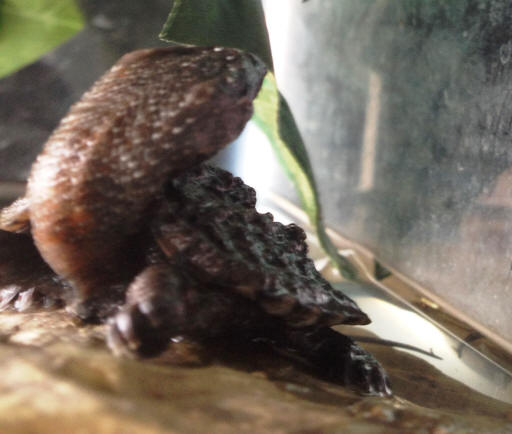
But I have a tiny issue concerning my brother's turtle that he rescued
underneath his truck. I don’t know much about turtles except that they
are really cute. Anyways, my brother rescued this turtle about a few
months ago. About a week ago I went into his room to fetch the remote he
stole out of the living room and I happened to glance at this wonderful
turtle well, it didn’t seem like he was living in the best living
conditions and I so happened to be right. It wasn’t like really dirty or
anything but he didn’t have a USB light or a basking area I believe from
looking at pictures he is a snapping turtle.
<I wish you could snap a couple pictures with your camera phone and
share with us>
And from the first time I saw the turtle he hasn’t grown at all, and I
also noticed he is constantly shedding…like a lot.
<As turtles age, their growth slows down, so without knowing the species
and the size I can't really advise you on growth>
From looking at his tank he is eating and pooping. What are things that
I could look at and keep an eye on to make sure he is healthy little
turtle.
Here is the basic set of instructions:
http://www.wetwebmedia.com/FWSubWebIndex/RESCareBarton.htm but
this supposes that he is a member of the hard-shelled water turtle
group. Mud, Musk and Snapping turtles are basically the same, but should
have more attention to water quality. That's why pictures would be
helpful. If he's a box turtle, this would be exactly wrong for him,
etc.>
I love animals and I believe that if you are going to take an animal
from its natural habitat you should give it a better life then what it
had before and I don’t think my brother is doing that.
<It doesn't sound like it -- but underneath a truck is not a natural
habitat. A free roaming turtle around people is a disaster waiting to
happen>
And can you help on giving me list of things I need to buy and know
about caring for a turtle. BTW he is really tiny, like really tiny. I
kinda decided to take on the responsibility on taking care of this
turtle 4lyfee.
Thank you,
Katie
<Send us pictures, Katie!!>
Re... snapping turtle 6/1/14
I'm sorry to bug u but I am truly worried about this turtle.
No worries, Katie!
<What you have there is indeed a snapping turtle, Chelydra serpentina.
He'll do just fine in clear room temperature water. Do does need a place
to haul out and bask every once in a while, but he'll do that rarely. A
good basic diet is regular old koi pellets - no more than he can eat in
5 minutes, 3 times a week - with an occasional earthworm as a treat. >
>One thing, Katie, snapping turtles never really get what you call
"tame" or really well accustomed to people or to being handled, so never
ever EVER put any body part in striking distance of his head. Also
remember that the name "serpentina" comes from "serpent" because they
have a LONG neck. When I handle them, I pick them up by the thick part
of the tail and let them sort of hang. If your hand is just about
anywhere on the front half of his body, he can bend his neck
around and bite you almost instantly.>
|
Dead Snapping Turtle 1/18./2013
Hi,
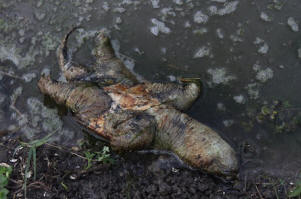
Okay, so I run at this park near my house a lot, and coming out of the park yesterday, I saw that this small ditch outside was empty, which is just a seasonal thing, so I figured I'd go look inside the tunnel that connects the ditch to the other side of the road. There was water inside and I could tell that was where people's houses must drain because the water looked gross and there were soapy bubbles where water was draining into the tunnel. I looked for a while and turned to run home, and there was a small pond where the water was not connected to the water inside of the tunnel. And there, floating in the small pond-thing, was a dead, bloated looking common snapping turtle. I have pictures attached. I know that common snapping turtles typically do look quite bloated and fat, but this didn't look normal. It seemed much too small to have died of old age or natural causes, and animals rarely just let themselves die while floating in a pond, they usually go hide somewhere and die (although I'm not entirely sure with snapping turtles, but I've never seen dead ones floating around, so I'm just guessing). When I flipped it over, it seemed extremely light and hollow and—again—bloated, but then again, I've never flipped over a dead snapping turtle before. After running, I went back with my camera and took pictures. I got pretty curious about how and why the turtle just died there. Was it because of natural causes and this is normal?
<Without an autopsy, impossible to say. Mortality among juvenile turtles is extremely high, said to be over 99%, but once they reach this sort of size they're pretty well immune to predators and suffer from relatively few sources of mortality. There are infections that can cause problems -- just as with any pet turtle, particular respiratory tract infections -- and heavy metal poisoning is a ubiquitous problem for freshwater predators in industrialised countries. Do read:
http://www.tortoisetrust.org/articles/snappers.htm
It's an interesting article.>
Was there something in the water that made it die right away? I'm in an AP Environmental Science class at school,
therefore I have access to all kinds of basic lab equipment to test water for things, and I'd love to test the water and figure out what the problem was; however, my problem is that I'm not entirely sure what to test for. pH? Salinity? Dissolved oxygen?
<Water chemistry is always interesting, but unlike fish, turtles are "sealed off" from the water because of their tough skin, so pH and hardness isn't a major issue for them. Salinity can be an issue of course, these are freshwater not marine turtles, but unless this specimen was found somewhere close to the sea (close enough for seawater to get into its pond or river) then salinity isn't likely a factor either. Since they're air breathers, oxygenation of the water doesn't directly affect them, though stagnant water may cause problems in other ways, such as lack of food.>
I'd love to hear back from you about what to test for, what a normal living condition for a snapping turtle is, and what could have possibly caused the turtle to die, and I'd be happy to go get a water sample and test it. I'm excited to hear back from you! :)
Thanks! Addison
<Really, the best thing is to freeze the animal and get it to your local Fish & Wildlife department for them to comment on. That may not be practical, but zipping them off an e-mail about your observations may encourage them to come visit the body of water in question and perform tests as necessary. Thanks for writing, Neale.>
|
 |
Releasing a 7 year old
turtle! 3/6/12
Hi guys!
<Hi Pam! Sue here with you.>
I know someone who has raised a snapping turtle from a
hatchling, to a very large 7 year old. He keeps his
"pet" in a 30 gallon long tank. I saw it the other day and it
truly broke my heart. This poor guy couldn't even turn around
in the tank, never mind see the light of day.
<Yes, at this age/size he should be in a much larger tank.>
The owner said he never gave this beautiful snapper sun ... "he
doesn't need it," he said.
<Well – maybe not in the same way that semi-aquatic turtles need
it, but he still does need it nonetheless. While snapping turtles may
not bask as much as their semi-aquatic *counter-parts*, they still need
UVB to maintain their shell and bone health – a UVB light over the
enclosure so some rays can reach him, a Vitamin D3 supplement and an
hour or so outside every now and then. Some owners even provide
these turtles with a basking area with UVB overhead because they will
on occasion bask.>
The tank was filthy and smelled polluted. There was one rock in the
middle and not enough water to totally submerge. Just disgusting!
<Yes I agree. And the fact that since they ARE mostly aquatic
and spend much more time in the water than semi-aquatic turtles makes
water quality all the more important an issue.>
I suggested that he let the turtle go free and his response was;
"oh no, he'd die! He doesn't know how to hunt!
" I don't know much about turtles, but I don't buy
this. Could he not just let the turtle go once our weather gets warmer?
I bet he would acclimate just fine! What do you think?
<Well, Pam, actually on this point he IS correct. Yes, he
would likely die if he was released into the wild after spending his
entire life in captivity, but there's more to it than what he
said. It's true his turtle might not initially recognize food
right away. What's more likely, though, is that his turtle has
become too debilitated to hunt in the wild because of the poor care
he's provided - and as a result would most likely land up as prey.
Wild animals have a keen sense of the *weak* amongst them. And
even if he WAS lucky and didn't die this way, releasing him into a
pond would compromise the lives of all the OTHER life in that
pond. This is because of the foreign germs he would be
introducing into the pond – and vice versa. He would also be
affected by exposure to foreign germs. Add this fact to the
likely probability that his immune system has been compromised because
of the poor conditions he's been living in for so many years, and
this makes his chances of survival even slimmer in the wild. >
<Our particular state uses a cut-off of 3 months for release of a
captive animal into the wild. I’m not sure how they came up with this
number, but either way his turtle is 9 years and 9 months beyond this
point! In either case, it’s the same reason why scores of
native American Indians perished after the arrival of the early
settlers – and why scores of them perished, too! (Fortunately
for me, my ancestors survived not only that but their 1st brutal winter
and all the wars that followed!) >
<However – though he’s correct as far as not releasing him into
the wild, that’s the ONLY point where he’s correct. The living
conditions that you describe are animal abuse and neglect. Below
are a couple of links that offer some advice on what steps you can take
in a situation like this. The first one offers some ways you can
try to *assist* him. The 2nd one to the ASPCA has a link within it to a
database of 5000 or so to shelters around the country. >
<http://www.aldf.org/article.php?id=237
http://www.aspca.org/Home/Fight-Animal-Cruelty/report-animal-cruelty.aspx
You could also try to seek out the advice of a local veterinarian
and/or see if there are any turtle clubs, rescue groups, wildlife
museums, nature centers, even university science classrooms in your
area who would be willing to adopt him. >
Thanks for your time.
<You’re welcome, Pam, good luck with it! In looking up these
links I also happened to come across a disturbing *festival* that
occurs once a year in Indiana called *Snapperfest* where they actually
torture these poor creatures in the name of *fun* – and with their
young children looking on no less! I keep thinking nothing will
surprise me anymore and then I come across stories like these.
Unfortunately they are a very misunderstood species. We only wish
there were more concerned people out there like you! Let us know
if we can be of any more help.>
Pam
Re: releasing a 7 year old turtle! Snapper
2/8/12
Hi Sue!
Thank you for your very informative and caring response to my
letter.
<You’re welcome!>
I care about every living thing that is kept in captivity. I pride
myself in creating the best and healthiest living environment I can
attain. And always strive to make it better and better!
<Same here; when I take away an animal’s choices and control over
their life, I feel like the least I owe them is to try to make their
life at least as good as or better than the one they had before!
The reward for me with my turtles comes when they finally swim TO me
instead of away from me, *ask* me to pick them up, and allow me to hold
(and sometimes even pet) them instead of squirm away!>
My friends living environment is not only unhealthy for his animals but
for himself as well. I don't know how people can live in such dirty
environments, but I guess this explains why he thinks it's okay for
his animals to live the same way.
<This may have been what’s happened with your friend, but you’d
be surprised how many people land up in the same place he is right now
with his turtle. Unfortunately, most people either don’t do
their research before they get them, or do but don’t fully *take in*
the meaning of *lifetime commitment* when they buy one and then land up
getting in over their heads. >
He's a good guy, really, just maybe a bit sad? Anyways, I'm
thinking my best approach would be to offer my help in maybe cleaning
up?
<I actually DREAM every night of someone making that offer to me
(and not stopping with my turtles, either) LOL!>
Not sure, I'll have to think on this one. Thanks for your
advice Sue. It was a pleasure talking with you! Take care.
<You also; I’m sure whatever gesture you make he’ll appreciate.
One word of advice though (because he IS a *snapping* turtle) -- if he
DOES accept your offer to help, make sure HE’S the one who picks up
the turtle! This is one of those “Don’t try this at home
unless you know what you’re doing” situations!>
<On a more serious note, though, please do remember that you may be
this turtle's only *advocate* and set of *caring eyes*. So if for
whatever reason your friend doesn’t accept your help, I do hope you
can convince him that the best and most humane thing for him to do is
to locate a good home (or nature center, etc.) for him before he
becomes seriously ill (if he’s not already). >
Pam
Snapping Turtle Biotope
Setup 2/1/12
Hi Crew,
(Disclaimer: This may end up longwinded, sorry about that!!)
Forgive me if I missed an article on this topic - I've searched for
information on the subject but can't seem to find quite what
I'm looking for. I'm a turtle & fish keeper, have been for
years, although I'm currently down to a single tank setup. About a
year ago I was lucky enough to receive a juvenile common snapping
turtle from a local high school's Biology class (making ownership
of the turtle legal in my state). The turtle was maybe 6 months old and
the teacher had been keeping the babies in a bucket with ~1 inch of
water. Long story short, the turtle I took home has in rough shape but
has fully recovered in the past year. He (not sure of sex yet, so I
call it a "he") has learned to swim, how to hunt feeders
& worms, and is getting very chubby and BIG! While he hasn't
quite outgrown the 20-L I currently house him in, he's double the
size he used to be and I want to give him more space. Last night I
purchased a 40-breeder tank (36"x18" footprint) to keep him
in until I find a good deal on a 125g or 150g tank.
I'm a big fan of "Nature Aquariums" as well as biotope
setups, and have had built several species-themed tanks in my day. I
plan to set up the new tank in as snapper-friendly a way as possible,
and am looking for some advice with that. Currently the 20-L has an
array of African Mopani wood, many small/medium sized smooth pieces of
granite, mixed sand & gravel substrate, lots of "moss
balls" (not sure of Latin name of the plant, but he loves tearing
them apart and then hiding in the free-floating moss) and a surface
covered with Duckweed. I will be reproducing the same bog-like effect
in the new tank, and will be building a small shallow-water
"shelf" on one side by siliconing a sheet of Plexi-glass
vertically to the bottom & sides and filling the cavity with
gravel. I've got a 75-W heater if necessary, although the room
he's housed in is temperature controlled at 72*F and I won't be
running the heater constantly. I also have two Fluval canister filters
ready to go, I forget which models (at work at the moment and can't
check) but they're each rated for a 75g+ tank. I know it's a
ton of throughput for a 40g tank but snappers are messy little buggers
and I can always remove a filter if it proves to be too much.
<Heavy filtration is precisely what you need.>
So anyway, with all of the above information in mind, I'm looking
for suggestions on how to make my tank more of biotope, if that's
even possible. I'm looking for any & all suggestions pertaining
to live plants I could try (so far, only duckweed and the
above-mentioned moss have survived the jaws of death).
<Snapping turtles are partially herbivorous, so providing regular
offerings of green foods is sensible. Any/all plants are likely to be
consumed or at least bitten, so don't use anything you don't
mind being eaten. Clumps of Pondweed is probably the best thing to use.
Floating plants are worthwhile, too.>
I've seen setups for other turtle species that use terra-cotta pots
as submersible planters (for things such as grasses, sword plants), as
well as set ups that use hanging plants. I don't have experience
with either of these, especially combined with a snapper, and was
wondering if you have any advice on the subject??
<Adult Snappers are normally kept in very large, very bare aquaria
that provide ample space for these big, messy reptiles.>
I'm also looking into possible tank-mates for the turtle, aside
from the feeder guppies/minnows/comets he gets for stimulation.
<I would strongly recommend against using Thiaminase-rich feeders
altogether (Goldfish, Minnows, etc.) and that the only other feeders
you use are those bred at home. Buying store-bought feeders is like
keeping a cat and feeding it mice you know are infected with parasites.
Store-bought feeders are just about the easiest way to ensure your
treasured pet becomes sick. You'll notice that zoos and public
aquaria don't use them, and they're the folks that keep these
animals best. Feeders aren't even available in the UK any more, but
for whatever reason, the US trade is clinging on to this backward,
dangerous, practise.>
The species that come to mind include the common Pleco and N. American
freshwater fish such as perch, sunfish, "pumpkin-seeds" as we
call them in New England (unsure of real name), etc. I'm a bit
hesitant to introduce a Pleco, as I feel their fins are a big fat
target and that their spines may inflict damage on the turtle. I've
been curious about the other species I mentioned, as well as any other
N American freshwater fish that I might not have thought of. I'm
totally inexperienced with these fish though, and would love any
information you might have on keeping them. I am very much so a
researcher, so please don't trouble yourself with detailed
explanations - I just need a few good ideas to start out with!
<Any, all fish kept with a Snapper will be viewed as potential
prey.>
Additionally, any other tidbits of info you happen to have would be
great as well. I know a decent amount about keeping turtles but am
always looking to learn more!! Thank you for your time & help, I
appreciate it very much =)
Sincerely,
Matt
< Chelydra are not difficult to keep or feed, though admittedly,
they make poor pets. They are very VERY big, very VERY messy, inactive,
and potentially dangerous. But if you have a few years' experience
of keeping turtles and terrapins, and you understand issues like
Thiaminase, calcium supplements, UV-B, and water quality management,
and also you have an aquarium or pond a couple hundred gallons in size,
you should be able to keep Chelydra successfully. Feeding is a snap, to
coin a phrase. About one-third their diet is greenery, so that's
easy, and in the wild, the rest is a mix of fish, invertebrates and
carrion. So if you replace the live feeder fish with healthier fare,
like earthworms (which they LOVE!) and tilapia fillet (cheap and
Thiaminase-free) you'll be all set. Cheers, Neale.>
Re: Snapping Turtle Biotope Setup 2/1/12
Hi Neale,
Thank you for the quick response!
<My pleasure.>
I wanted to clarify a few things and I apologize for not being clearer
in my first message, especially skipping details about feeding. My
feeding practices are as follows:
-ReptoMin pellets every other day, doctored up with calcium &
vitamins. I feed him small amounts over a span of an hour or so,
instead of one large feeding.
<Good. While many carnivores eat a lot in one fell swoop, then go
without for days, even weeks, I don't think that makes sense in
captivity. For a start, it places a heavy load on the filter. Better to
offer small amounts of food that the filter can handle if regurgitated
and/or excreted. Secondly, reptiles (like fish) have pretty poor
nutrient uptake, so much of what eat is passed straight through their
gut without having its nutrients extracted. Above a certain amount
then, anything they eat will be wasted.>
-Maybe 2-3 live feeders per week, usually guppies and always fish that
I've had quarantined for several weeks.
<Still'¦>
I keep a bare 10gallon next to the turtle table, and always quarantine
feeders. Additionally, I only buy my feeders from a gentleman I used to
work for -- he runs a small scale breeding operation out of his store
and he's my exclusive source for feeders.
<Fair enough, but I would still strongly recommend against.
You'll find few, if any, professional reptile keepers at places
like zoos using live feeder fish. Even if you quarantine them for a
month, you won't know for sure they aren't carrying anything. I
understand the urge to provide "stimulation" in the form of
hunting, but that urge is something we feel, not the reptile. If you
want to see hunting behaviours, there's just as much fun to be had
"teasing" the turtle with meaty treats impaled on something
like a satay stick.>
-He has a continual source of greens from the moss / duckweed. I see
him nip the duckweed quite frequently, although he's not big enough
yet to wipe it out before it grows back.
<Give him time'¦>
-In the summertime I dig up the occasional earthworm and feed it to him
in a separate tank. Given what I just learned about the
minnows/goldfish, I'll probably start using earthworms more often,
maybe once or twice a month as treats. Would it be safe to use
earthworms sold as fish bait? I've also seen various worms sold by
Petco & PetSmart, are these worth looking into?
<Should be safe, yes, because earthworms come from a terrestrial
habitat, not an aquatic one. That means any parasites they carry (and
they'll surely carry a few, just as we do) will be terrestrial
parasites that can't infect aquatic animals. Fish, by contrast, can
(and are) intermediate hosts for all sorts of parasites that infect
animals in aquatic environments.>
As for the Thiaminase-rich feeders I had been using, I honestly
didn't realize they were a dietary concern and will stop using
them. My rationale had been to use various species for stimulation (for
both him and for me) but of course health concerns far outweigh
entertainment value. Thank you very much for pointing that out to
me!
<The whole Thiaminase issue is relatively recently discovered. But
if you survey the reptile literature, you'll see it's now
strongly implicated as a major health problem for reptiles. To be
honest, a Snapper is eating one-third green foods and two-third meaty
foods, so in reality, the greens should be topping up the Vitamin B1
levels nicely, so the risk from Thiaminase is small. But still,
it's one more thing to think about, and if you can eliminate
Thiaminase from a reptile's diet almost completely, then so much
the better.>
Additionally, I've decided to forgo pursuing tank mates. My dream
had been to setup of a 150g (or bigger) tank as a North American
biotope and was all hot & bothered to have a great looking setup
with lots of fish, but I was trying to put a square peg in a round hole
so to speak. I had it at the back of my mind that there would be some
species of fish out there I wasn't aware of that would fit the
bill, but I'm going to have to make my peace with a fish-less
turtle tank. And hey, the turtle has always been my first priority so
that's not a terrible thing.
<Quite so. They're fascinating animals, and amply rewarding if
you have the time, space, and experience. They don't do much to be
sure (adults are notoriously static) but when they do move, they're
like dinosaurs, they look so ancient.>
Again, thank you for your insights, and for reaffirming the fact that I
shouldn't try introducing long-term tankmates. Assuming it's
okay on your site I'll try remember to post some pictures of the
tank when I'm done aquascaping it.
<Please do.>
I spent a few hours last night cutting the acrylic retaining walls and
siliconing them in place, so the hardscape is coming along nicely. I
hope to have it set up, filled & cycling before the weekend. Oh!
Random question for you, as I always had a 120g for my sliders and have
never transferred turtles before. Do I have to let the tank cycle in
the same manner as a fish tank?
<Ideally, yes, but unless the filter is gigantic, you'll never
see a zero ammonia level. Because reptiles have impermeable skin, the
ammonia shouldn't really do them too much harm, at least not at low
levels (high levels can irritate the eyes, I'm sure).>
My plan was to 'seed' the new tank with media from my old
tank's filter,
<Great idea.>
as well as with pieces of driftwood and stone. I was then going to let
the tank sit for a week or two to allow the bacteria colonies to build
back up before introducing the turtle. Do I have this right?
<Pretty much! Would be even better if you can connect the mature
filter to this tank alongside the new one, for at least a couple weeks.
You could then move the turtle right away.>
Thanks!!
<Most welcome. Cheers, Neale.>
|
Turtle Help! 8/16/11
Hello Crew,
<Hiya- Darrel here>
I am in desperate need of some help for 'Snappy', my
Snapping turtle...
<Chelydra serpentine>
He's been acting very weird for the past few weeks ~ Little
movement, floating around funny... & he recently stopped
eating. He's getting very thin & boney, & it appears
as though there is some sort of air pocket in his side that's
making him float kinda sideways... I've attached a photo of
him which will show you what he's been doing for days
now.
<Yes, Snappy is clearly in distress. More than that, a
snapping turtle of his age and size should be pudgy
almost fat.>
I've tried all of his favourite foods & he won't even
open his mouth! Before, he'd go crazy snapping all the treats
I've been trying to offer. :(
<He's ill, that's for certain>
I've been in contact w/ a vet in my area, but they don't
really deal w/ Turtles, let alone a snapper, & they would
charge $150 just to look at him. I'm guessing it would be a
money grab, as they probably know less that I do.
<I agree that in this case I'm not sure it would do much
good, but it would still help>
I've had snappy for over 12yrs now & he's never acted
like this before. Please let me know if there's any advice
you can give me that you think will help restore him to his
normal happy self!
Sincerely,
Krysta
<Get Snappy out of the water IMMEDIATELY and until further
notice. Right now!>
<The immediate concern is that he's going to get so weak
that he
wont
be able to get his head above water to breathe. Put him on the
floor while you find a cardboard box or plastic tub
anything .
Get him on dry land!!! What Snappy needs right now is to be warm
and dry while we figure out our next step>
<Now, my concern is that a snapping turtle of his size -- to
be so thin and emaciated - this has been going on for a long
time. Either he's medically diseased
perhaps a bowel obstruction, tumor in the stomach, etc. or he is
metabolically distressed from lack of proper diet and/or improper
conditions.>
<If possible, I'd have a veterinarian administer
injections of Calcium lactate (250 mg/kg IM) and a multi-vitamin.
You may be able to obtain Calcium glubionate over the counter at
a pharmacy. You give that orally (opening his mouth will be a
very dangerous challenge) and use a syringe with no needle to
squirt in 1ml twice a day>
<Now
that constitutes emergency treatment. The next step(s) are up to
Snappy and I'm sad to say that the outlook is not good. As I
stated, if it's a serious internal medical condition it would
be very hard to diagnose and even harder to treat. If it's a
metabolic emaciation, he may be too weak to recover.>
<In this article, it tells how to keep a turtle warm and dry
for a period of weeks.
http://www.wetwebmedia.com/FWSubWebIndex/treating%20RES%20Dis%20DarrelB.htm
Snappy needs the warmth and he needs the rest.>
<Place him in a shallow bowl of water
just barely up to his shoulders
and allow him to drink and (maybe) poop. Try to get him to snap
at a piece of beef liver and perhaps an earthworm. After a few
days of being dry and warmer (the warmth is important) he may
perk up enough to eat
and eating/nutrition is critical to his recovery.>
<In the event that he perks up and begins to eat again,
it's important that he get calcium in his diet, either as
natural foods, such as whole fish or as a supplement.>
<Krysta - my concern is that for Snappy to be so skinny at his
age .. this condition has been going on for a LONG time and
someone either didn't notice or didn't know what he was
supposed to look like
both are failures on the part of the pert keeper.>
<Keep him warm and dry, try to get him foods high in vitamins
and calcium
and we hope everything works out for you>
|
|
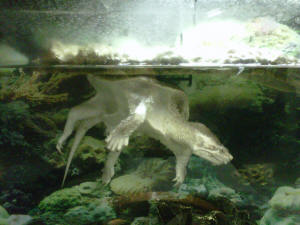
Re: Turtle Help! 8/21/11
Thank you very much for your help, Darrel,
<No problem!>
I'm on it right now! I had him out of the water & sitting
in my bath tub last night for a couple hours & he seemed to
be doing ok & has started passing bowel movements
again...
<Always a proud moment for a parent, huh?>
I don't know if there was a blockage or something? But he
only stopped eating a few days ago, so hopefully whatever it was
has passed. He still looks pudgy when he's sitting flat in
the tub, so I guess that's good, but he looks thin when
he's outstretched form his shell... & It happened so
quickly! :(
<That's the big challenge with our reptiles, birds and
fish, Krysta - they look great on the outside even when
they're getting sicker on the inside
so by the time they show really distinct changes on the outside,
they're very VERY sick>
I haven't done anything crazy or different in his diet, so
it's really weird... But I did some investigating &
apparently the store from which I purchased some of his live feed
from recently had a problem w/ their feed about a couple weeks
ago & had to stop selling them! :S
<That's one of a dozen reasons NOT to feed live feed,
Krysta. Even with my snapping turtles, I feed a base of Koi
pellets. I supplement that with whole, but very dead, previously
frozen fish.>
But they said it was a type of fish disease that wouldn't
affect a turtle...
<Probably not, but then unless they're sending samples out
to the lab, it's also safe to say that they only know what
they noticed, not everything going on>
At any rate, I have taken him out of the tank & will
administer the care that you have outlined for me. Thank you for
all your advice, I sincerely appreciate it! Fingers crossed
Snappy can pull through!! He's a fighter, that's for
sure! :)
Best Regards,
<Yer welcome, Krysta. Keep us posted, OK?>
Krysta
<.>
<PS: Krysta, I deleted the reference to your web site -
(folks, Krysta is a singer, songwriter, model and actress!!) --
because of the creepy stalker-types. Not in our audience, of
course
.
But the creepy stalker types on our crew!!!!>
Re: Turtle Help! 8/31/11
Hello again Darrel,
<Hiya!!!>
Thank You for following up on my message.
<No problem>
I'm very impressed with your attention to detail & speedy
response.
<We appreciate hearing that.>
Thank You SO much for your time & knowledge, it's greatly
appreciated!! =)
I just wanted to send you an update in regards to
Snappy's condition. He has had a miraculous turn
around & is doing a LOT better!! :D
<I wonder
was Snappy faking it in order to get attention?>
That same day I heard back from you, I decided to take him in to
see a Vet I found in my area who knows how to work w/ Turtles.
She injected Snappy w/ some special Vitamins & also
anti-biotics as she believed he may have had some type of
infection that required medication. She sent me home w/ a
vitamin/medicine combination to give Snappy orally every day for
2 weeks, & she also suggested I get a special UV Lamp for him
- Which I ran out & got right away!
<Good. People think because Snappers,
Soft-shells and mud/musk turtles don't bask as often as the
slider family, they don't need UV-B and that's
inaccurate.>
That same day he ate for the first time in days! Woohoo! Then the
next day, I took your suggestion of the Beef Liver & he ate 2
pieces of that! & I was also successful in administering his
medicine, no problem! :D
Then ever since then, he's been taking his medicine, moving
around more, & eating the Beef Liver non-stop just like his
usual self! He also has his colour & his strength back, &
he's gaining weight rapidly! Yay!! :)
<Excellent!>
Indeed, I am a proud Momma & I don't think I could have
done it without your help, & the aid of the Vet as well.
Thanks again SO much!! You've done a really sweet job, &
I'm very Grateful! :D
<We're here to help, Krysta!! And for the free
food!!>
Have a Good one & Thanks again! Cheers! =)
|
Snapper out of water
6/10/2010
Hello Crew
<Hiya - Darrel here>
I found a baby snapping turtle (I think) its about the size of a silver
dollar.
<That's baby sized alright. Whether or not it's a snapping
turtle is another story>
Should I keep it as a pet?
<That depends. Read on>
Is it big enough to fend for itself and survive if I let it go?
<Yes. Turtles hatch from eggs and are self sufficient as soon as
they crawl out. Many, if not most do perish, usually to birds, lizards
and other animals that prey on them, but that's the way nature
is>
What should I do.
<That's a tough question - read on>
I was going to buy my daughter a turtle for her birthday .Any WAY BUT
THIS ONE IS WILD.
<All turtles are wild. As far as anyone can tell there's never
been a difference in temperament or even the ability to survive between
wild caught and captive raised turtles.>
I cant imagine how it got in my pool.
I don't live near any water. <They really are amazing that way
-- but it also may mean that it's not a Snapping Turtle>
Thanks For your help.
Dawn from Connecticut
<Dawn, Connecticut would be pretty far north for a snapping turtle.
And seeing as how that are VERY aquatic turtles and haul out of the
water rarely if at all, my guess is that it's another kind of
turtle. Since you asked, Turtles only make good pets for people who
enjoy watching them. They're not appropriate to "play
with." What that means as far as your initial question is that
snapping turtles can be as good a pet as any other turtle except that
they have a nasty bite and a short temper
so one must be EXTREMELY careful on the occasions that they have to be
handled. Have I had snapping turtles as pets? Yes. Did I enjoy them?
Yes. Would I get one for a child? No.>
<That said, you probably have some other kind. I picture, even from
a cell phone camera, would help clear things up. In the mean time, go
onto Google images and search for "box turtle", "Wood
turtle" and "Snapping Turtle" and see what pictures come
up>
<If we do identify it, write back and I'll give you some care
instructions>
Re: Darrel's FAQ re snapping turtles - Dawn Villanova
6/10/2010
Mmm, Sue, where is this FAQ located that you're referring to? B
Bob
Its
in the WWM
File
Sent
folder
the FAQ at the top that was sent to
dawn Villanova
for posting tomorrow. -Sue
Oh! Thank you. Will amend/addend. B
Re: Darrel's FAQ re snapping turtles - Dawn Villanova
6/10/2010
Hi Bob,
Just a comment I wanted to pass along on a turtle FAQ
I had a moment to check messages and happened to notice one Darrel
replied to in your
Sent file about snapping turtles. It could very well be as he said that the
turtle the woman found in Connecticut is not a snapping turtle because they are
mostly aquatic and don't typically venture out of the water to wander around
(unless it was just a hatchling out of a nest). I would like to add, though,
that living on a pond in Connecticut as I do, I can tell you for sure they're
not rare at all in Connecticut! In fact, the pond here is loaded with them!!
Some are even almost 2 feet long! Also, every spring for years now, a female
snapping turtle leaves the pond to dig a nest and lay eggs in nearly the exact
same spot of a garden bed on the side of the house. In fact, there's
a nest there now! So just wanted to add that in. Though as Darrel said,
without a picture and based on the rest of the information she
provided, what she found may very well have been another species of
turtle. The only other main
(not Maine homonym!) species of turtle
Im
aware of that is native to the area here and also plentiful in the pond
is the Eastern Painted Turtle.
-Sue
|
Care of a 2 in. alligator snapping turtle
9/30/09
Hi,
<Hiya - Darrel here>
My granddaughter found a small black turtle with a beak and spiny
back on September 26 in the middle of a barrier beach of Smith
Point County Park on Fire Island, Suffolk County New York. My
husband had spotted a similar turtle a few days earlier in the
middle of the camp ground road and he moved it to the marshy area
on the bayside of the barrier beach. We feel we rescued it but
want to know what to do now!
<That would be a long way out of the range of an alligator
snapping turtle, but within the normal range of a common snapper,
Barbara. Alligator snappers are common only to the drainage basin
around the Mississippi river. Assuming there's no chance that
it's an escaped pet or even a sea turtle (Sea turtles have
flippers and no claws)?? What I'd really like at this point
is a couple of photos, even if just from a phone camera. Face,
side and from front & above would help clear up a number of
questions>
We have it in a clear plastic container with wet beach sand, a
clump of wet kelp and a sea sponge and a clam shell to provide
habitat and a receptacle for fresh water and food.
<None of those would be common environment of either snapping
turtle>
We offered bits of cooked chicken ,chopped meat and lettuce at
different times without much interest.
<Based on it's environment it probably is in no mood,
maybe even no condition to eat>
It has been active at times, climbing to the top of the sponge
but is mostly burrowed into a thin layer of sand under the kelp.
Aside from removing the old food and 'poop' and
occasionally peeking under things to assure that it is alive we
haven't disturbed it much. Now the question: is it keepable
as a pet for an 8 year old under supervision, or should we
release it and where?
<Well whether or not it's keepable is dependent on a great
number of question unanswered. Snapping turtles are notorious for
biting hard and having short tempers, so they don't make a
good lap pet. But with that said, even a Red Eared Slider can
inflict a nasty bite if handled incorrectly -- so really it all
depends on the level of maturity of the 8 year old. Turtles are
good pets to house, care for and observe, but not to play
with.>
<As far as the other thing ... NO!!! NO!!! We never EVER
release any animal into the wild, even when it's with our
best intentions.
Territories, sub species, communicable diseases ... just a few of
a hundred reasons. If he survived at all, he'd possibly
contaminate others, so we never ever release into the
wild.>
<Once we find out what it is -- send pics!!! -- we'll
decide what to do.
In the mean time, the link below will give you some basic
information.>
<All snapping turtles are more aquatic than sliders. While
they do it less often, they DO haul out & bask and still need
a warm dry place to soak up some UV rays ... so for the purpose
of the time being only, read the enclosed link and set up a basic
environment to specifications. Meanwhile send pics and we'll
go from there>
Any help or advise you can give would be most appreciated!
Sincerely Grandma
< http://www.wetwebmedia.com/FWSubWebIndex/RESCareBarton.htm>
Re: care of a 2 in. alligator snapping turtle
9/30/09
Hi Barbara,
Yes, what you have there is the Common Snapping turtle, Chelydra
serpentina. They make interesting pets but frankly they are a bit
dangerous. The rules for keeping a snapping turtle are that you
never, ever, ever ... for any reason .... put anything you care
about anywhere near the front half of that animal. They're
not actually mean ... but they have a very limited tolerance for
anything moving around in front of their face before they'll
strike out at it -- and once they grab a solid hold, they have
the ability to hang on for very long periods.
A 20 gallon aquarium (or similar container) with shallow water
(no deeper than 4 inches) and a small place to haul out and dry
off under a basking light is all that is required initially. If
it's not an actual aquarium, make sure the sides are high
enough that it can't climb. Feeding is simple -- ReptoMin
food sticks or Koi Pellets from the local pet store (same
ingredients, just cheaper) will provide a fully balanced
diet.
They're interesting, low maintenance pets but on the other
hand, they're very hardy animals that, with even minimal
care, can grow to an extremely dangerous size in just a few
years. So my advice on keeping it? ...
maybe .. maybe not. But if you decide not, inquire around your
city for a turtle and tortoise club to find someone with the
desire and experience and please just don't release it.
Best wishes
Darrel
|
 |
|
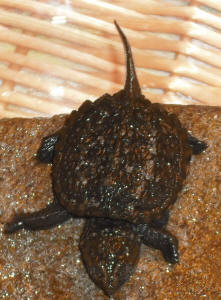
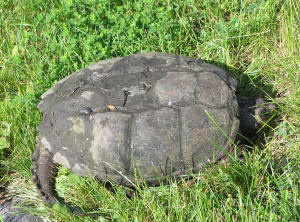
what kind of turtle and how old is it
6/27/09
I know the attached is not a snapping turtle but I have never
seen anything this big that was not, what is it and how old.
<It's a Common Snapping Turtle (Chelydra serpentina).
Alligator Snapping Turtles (Macrochelys temminckii) generally
have a row of spikes along the midline of the shell running along
the spine, whereas Common Snapping Turtles do not. As for age, I
have no idea. Captive specimens routinely live well over 20
years, and the record is around twice that. Given the apparent
size of this specimen, it is probably going to be well over ten
years old.>
found in the Metro North Parking lot, in June, 2009 land put on
side of road and let go. /Westchester County, NY
<Cheers, Neale.>
|
 |
Re: what kind of turtle and how old
is it 6/27/09
I would never have guessed a snapping turtle. Thank you for your
very prompt reply. John H Vargo, Publisher, Boatingonthehudson.com
and boating on the Hudson & beyond mag.
<Happy to help. Cheers, Neale.> |
Snapping turtle mating
& comp. 1/25/09 Dear Crew, <Hiya Sucari, Darrel here
tonight> I have a 2 year old 7 inch snapping turtle and, age unknown
5 inch Red Eared Slider in a 50 gallon tank. <Actually, what you
have there is a tragedy just waiting to happen.> They lived in the
same tank for about a year now with no problems they get along great.
<Get along great? Tell jokes? Like the same movies? Enjoy lively
political debate without crossing the line?> For about a month now I
have noticed that they are trying to mate. I was wondering if I should
have any concerns? <I sure would have concerns, Sucari. For one
thing, these mixed relationships rarely work out. What would the
neighbors think? What about the in-laws? And the kids? Red Eared
Snappers? Snapping Sliders?????? And the kids! Think of the kids!!!!
How sad to have a clutch of babies that swim into the pond to try to
lay in wait to ambush a piece of river grass or hyacinth?> Thanks
<OK, seriously, Sucari. All kidding aside, most turtles are very
tolerant of dissimilar species. They don't compete for food, no
mates to speak of and no territorial issues that really matter. Neither
see each other as a threat. And I too have seen Sliders and Snappers
and Soft Shelled turtles all kept together in relative harmony ...
until that day when one of them is just GONE. Sliders are non specific
scavenging herbivores and Snappers are ambush predators with very short
tempers and an instinctive, vicious 'ambush' strike that pretty
much destroys what it touches.> <This is not to say that all
snappers are mean or evil, Sucari. My snapper, Biff, is mild tempered
and easy to handle and he puts up with a LOT before he starts to show
any signs of stress. But still, I never EVER forget that he is a wild
animal with a tiny brain.> <My point ... if there is any chance
it has escaped anyone so far ... is that everything will be just fine
right up until JUST the moment that the snapper attacks and kills the
slider. Will it ever happen? Maybe not. But how will you feel if it
does?> <Please separate them as soon as possible> <Regards,
Darrel>
Mixing Turtle Species Together
04/30/07 I have had an adolescent red eared slider for a couple
weeks now. Its shell is just about an inch an a half to 2 inches round.
Today I got a adolescent snapping turtle that is 3 1/2 to 4 inches
long. I know that snapping turtles are nippy and have short tempers but
I was curious to know if they would get along together and if they
would be healthy together? Both seem to be healthy and I am not sure of
the sex of them thanks for the help Alex =) < I would not recommend
placing these two turtles together. The snapping turtle is actually a
poor choice as a pet. The risk of injury to the other turtle and to
yourself is too great.-Chuck>
Turtle With Prolapsed
Colon 12/15/05 Ok, I've had my snapper turtle (I think its an
alligator snapper) for like 1-2 years now. I got him when he was small,
anyway, today I am cleaning his tank and when I picked him up he had
what appears to be a pink sack on the bottom of him, near his butt.
Please tell me what's wrong and write back ASAP. < When we keep
pets we usually feed them once a day. Sometimes this can be a pretty
big meal. Especially when the turtle is acting like it is starving.
When turtles eat a lot at one time then this puts stress on the rest of
the digestive tract. Instead of small bowel movements many times a day
you get one large one that may take some of the colon tissue with it. I
believe that this is what you are seeing. Try smaller feedings many
times per day to see if will go back in. If not then you may need to
see a vet for further advice. Try the Calif Turtle and Tortoise club at
tortoise.org for possible other solutions.-Chuck>
Mixing Turtles 9/7/05 I have a smaller painted turtle and I
was just given a baby snapper. For now I understand my painted is safe
but in the future would it be ok if the shared a tank? thank you Alex D
< I would not recommend ever putting these two turtles together.
Snapper gets too big and much too mean.-Chuck>
Snapping Turtle Shell Growths (continued)
Bob, Mike ????<It's Mike D here again> I know that algae will
grow on the shell but when I saw a white film on my snapper's head,
I became concerned.<Aha! I would too, but not knowing it was white,
I was at a disadvantage! **grin**> He has always eaten very well but
seemed to not be interested anymore. Over the aquarium I have a
Slimline Reptile Fixture with super 15 watt UV lamp (it produces 3%+
UVB and 7%+ UVA) and a Daylight Blue Reptile 60 watt bulb.<I thought
you probably would have, as you didn't sound like a novice, but had
to ask> I have put some Neosporin on his shell and rubbed it on his
neck and legs.<Now there's some creative thinking, although it
shouldn't have much effect if it's indeed a fungal growth, with
Neosporin being for bacterial infections> Now that the weekend is
here I will put him out in the sun for a few hours while I am at
home.<Good idea, but use care as once his body temperature hits 92
degrees it could be all over. I'm assuming that you know NEVER to
sit a terrarium/aquarium in the sun as the sun's rays are magnified
by the glass creating a rudimentary Dutch Oven> He seems to be
perking up a bit but still has some algae (fungus) hanging from his
neck.<You might want to consider making up a fairly strong salt bath
and soaking him in it for a few minutes at a time for several days.
Many true funguses are extremely sensitive to salt and might die very
easily. I'd suggest no longer than 20 minutes or so for the soaks
as snappers have no regulatory mechanism for secreting excess salts>
Thanks for your help.<Best of luck and keep us posted> --
SUE
Turtle Mixes Is it ok for a snapper turtle and a red eared
slider to be together in the same tank? <Not a good idea, you would
need a huge tank for the snapper, and there is a good chance that your
slider could get hurt. Best Regards, Gage>
Snapping Turtle I'm really hoping you can answer a
question for me. My aunt gave me a snapping turtle because they had no
room for it. it is 1 yr old and I am worried about salmonella. Is there
a way I can see if it has it or anything else. I have a 9 yr old
brother and I would like to know where to get it treated to figure out
if it has it and if it does what options are available. I really
don't want to get rid of it I would like to know where to take it
to figure out whether or not its clean. I researched salmonella and its
not pretty and I'm a little worried because I don't want to get
it. I wash my hands every time I hold it and I would REALLY appreciate
it if you guys could help me out. Thanks a bunch >> Only a
laboratory can test to see if your turtle has Salmonella. The best way
would be to see if maybe someone at your local university can help.
Good Luck, Oliver
|
|

