|
Snail nix cure? re: better!!....re: Salt for fungus?
(Bob, any obs. re: Java Ferns and snails)<<Most don't eat. B>>
11/24/12
Neale,
The snails are almost finished devouring the plants. There's too
many...it's too out of control. The plants were expensive and
they're almost all gone.
<These are Java Ferns, which are toxic, so few animals eat them. Fish
certainly won't, and generally snails and shrimps leave them alone too.
So try and identify the snails. Melanoides, Physa, Physella and
Planorbis snails will not harm Java ferns or indeed most other healthy
plants (Melanoides, whatever their other faults, won't eat *any* healthy
plant of any kind, even seedlings). Nerite snails of all kinds are
equally safe. About the only truly destructive snails commonly kept or
encountered by tropical fishkeepers are the Apple Snails and their
relatives: Pomacea spp. and Marisa cornuarietis. In virtually other
situations where snails are "eating" the plant, they're actually eating
at dead or dying plant material. Of course there are exceptions for some
of the softer plants or for seedlings, where possibly an excessive
number of Physa spp. might cause harm. But ordinarily, and especially
with something as inedible as Java fern, the question is why is the
plant failing not why is it being eaten by snails. For what it's worth,
Java Ferns are not as easy to keep as many suppose, and are (in my
experience) much less reliable than Anubias spp. One issue may be that
"fake" Java Ferns are traded at the budget end of the market, and these
simply don't survive for long underwater. But otherwise do review the
needs of this species. While undemanding in terms of water chemistry and
temperature, it will not do well planted too close (let alone in) the
substrate and is best kept an inch or two clear of the substrate
attached to bogwood rather than rocks or ornaments. Strong water
currents seem to fragment the plant, and algae-eaters, especially
raspers such as Panaque spp., can cause real damage very quickly. It
grows slowly, and because of that, doesn't do well if constantly
buffeted or pecked at. To be brutally frank, it's a plant I've given up
with years ago, as I have with Neon Tetras among fish, because there are
better, more reliable options available. One last thing. Your Anubias
looks fine, and my golden rule with plants is this: buy one of whatever
you like to begin with, see what does well, throw out what doesn't, and
buy more of the species that seem happy. Your aquarium looks a bit
sterile, and my gut feeling is any snail and algae problems you have is
more to do with the lack of "balance" than anything else. Try and grab
some floating Indian Fern (Ceratopteris thalictroides, but as floating
plants, not the more difficult to keep rooted plants, though if you snap
off fronds from the rooted plant, they'll grow into floating plants just
fine). This is the #1 plant, I think, for jump-starting an aquarium.
It's easy to grow, seeds the tank with plenty of good bacteria, provides
food for herbivorous fish, grows rapidly enough to shake off any
nibbling by snails, and helps to prevent algae. Sure, it looks a bit
scrappy to begin with, but a thick canopy of the stuff below the
waterline has its own beauty (I tend to trim away over the waterline
growth before it burns under the lights). It also provides shade, which
Java fern and Anubias really appreciate.>
I've had two local fish shops recommend Skunk Botia to nix the snails
and they have hard water too...though the one is selling water too so
they have non hard water available.
They're the smart shops...not just a chain store.
<Skunk Botia, Yasuhikotakia morleti, are social (keep 5+ specimens),
aggressive amongst themselves and towards other fish, and grow quite
large. Think very, VERY carefully before purchasing.>
One lady said they're perfectly ok in hard water.
<Up to a point, yes, like most loaches they're tolerant. But they do
prefer soft to moderately hard, pH 6-7.5 water.>
The guy I just spoke with (at the shop that also sells water) suggested
skunk Botias are ok with Mollies, which actually implies they tolerate
hard water based on Molly's sensitivity to soft!
<Not a wise combo. Do visit those folks over at Loaches.com for second
opinions, or read over the excellent Loaches book some of them wrote on
behalf of TFH.>
When I checked my facts online it looks like it's not so though....the
skunk Botia looks like any other Botia in water preference..but these
hard water folks say it's great for our water!!! You say you have hard
water....do you know of people keeping skunk Botia in hard with any
success (fish thriving)? Is it a flexible species?
<It is, but there are better choices. The Horseface Loach for example
can thrive in even slightly brackish water (around SG 1.002) and as such
can be kept with Mollies.>
I think I definitely shouldn't keep it with Mollies. They like
marine salt to thrive, a loach no no.
<For the most part, yes, loaches avoid brackish water, though some
species enter slightly brackish water, notably around the Caspian Sea.
Among traded species, Acantopsis choirorhynchos, the True Horseface
Loach, is the classic slightly salt-tolerant species. It's a fun species
and will eat small snails, but does need a sandy, not gravel,
substrate.>
I think I can get my water to 7.5 with mixing it like you said. I
think that would probably be alright for a Botia.... Should I add peat
filtration too?
<No real need and unpredictable anyway.>
Do you know of anyone using this water system for filtration with
success?
<Peat filtration is fiddly (not to mention questionable in terms of
environmental sustainability!). Remember, few fish care about the pH
_per se_, and provided you reduce the hardness down to around 10 or 12
degrees dH, soft water fish can thrive at pH 7.5 without the least
trouble.>
It looks like this removes hardness and even the water softener's salt.
I could do 50/50 with this water and the outdoor spigot that's hard
water that I have been using.... The filter is at this link:
http://www.drsfostersmith.com/product/prod_display.cfm?pcatid=4484
I just thought....I wonder if there's something out there to filter
water for tanks, and I checked online and there it is. How good is
it, is the question?....$40 is inexpensive comparatively.
<Still a waste of money. Your fish don't need this kind of
molly-coddling. If we're talking standard community tropicals -- barbs,
danios and whatnot -- then a 50/50 mix of hard tap water with RO bought
from your local retailer will be just fine.>
Reverse osmosis not practical...it wastes too much and is too slow!
<Indeed.>
Since I have the million snail thing going on........do you think the
Botia could tolerate it if temporarily I put a whole bunch of fake
plants in the tank?
<Likely so, but Skunk Botia are a unwise bet for a small tank in many
ways. You need 5 or more, and they'll get to around 10 cm/4 inches in
length, and they fight amongst themselves a lot, and they chase
slow-moving fish. Do read up carefully on this species.>
The guy suggested it would be easier to get rid of them if there were
less food supply for them. However Botias like a heavily planted
tank. And are known to be aggressive and territorial. I'm
wondering if they'd tolerate fake plants..or is that an issue?
<Do try floating plants as mentioned above before giving up. Remember,
if you switch to fake plants, algae will make up the difference; few
tanks without plants are algae-free without huge amounts of hard work.>
In a 29 gallon what is a good ratio of females and males to keep with
this species? He said 5 to 10 fish..... I'm ok if it's my only
fish species. I can live with that. I just remember I
understocked mollies and had issues and I wonder if 9 is best, or is it
ok to start with 5 since the plants will be fake in the beginning?
I want to make sure there are enough and not too many, if that makes
sense.
<Are we talking about the Skunk Botia here? An odd number, with more
females than males is the ideal.>
I really want living plants and the java fern was absolutely covered in
baby snails last night even with adding the plant food and an increased
light source. They look like java-lace-fern and there's not much
more to eat on them!!!
<Bin 'em.>
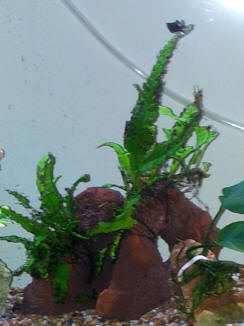
I attached a picture. They were $8.00 lg investments!
<This is actually a low, too low, price for Java Ferns, which is my
concern. Here in the UK, a good sized "mother plant" Java Fern growing
on a bogwood root will cost around £25, that's around $40 US. That's a
bargain mind you, because a healthy Java Fern mother plant produces lots
of baby plants on the tips of its leaves, at least some of which can be
removed successfully and transplanted to new bits of wood. Such a
healthy plant will live for many, many years so is a sound investment.
But cheap Java Ferns may or may not be a bargain. If money is tight,
there are many better species that I'd recommend.>
I want my tank back and I am willing to work with the skunk Botias based
on their reputation of being snail annilators!
Jill
<Don't expect any fish to annihilate snails. Just isn't that easy.
Dealing with snails demands an holistic approach, not just removal, but
also understanding why they're thriving at the expense of your plants.
Cheers, Neale.>
|
 |
|
Re: Snail nix cure? re: better!!....re: Salt for fungus?
(Bob, any obs. re: Java Ferns and snails) 11/25/12
Wow....this is embarrassing. I had bought a replacement bulb a couple
months ago and that's when the plants started to noticeably go down hill.
The guy really sold the bulb, he had claimed it was SO much brighter and
great for plants too, so he said. It was what HE uses. I should
have known better. The bulb he enthusiastically sold to me is called
actinic.
it doesn't even grow coral!
<Actually, actinic tubes are used, alongside white tubes, in marine aquaria,
and yes, they do encourage good coral growth. But you are correct that
they're mostly for looks, helping to make the blues on marine fish really
bright blue.>
There is so much misinformation in this hobby.
<Hard to argue with this. But perhaps a more charitable opinion is that
there are many different opinions on things, some based on experience, some
on sales and marketing literature, and sifting through these for what'll
help in your situation isn't always easy.>
There should be a class for fish store employees because people will ask
them questions and they will give out free advice.
<Can't speak for where you live, but here in the UK, yes, there is college
called Sparsholt College that has vocational courses on fish husbandry,
including one aimed at retailers. It's been running for some 20 years now
and is very well respected. There may well be others offering equally useful
courses, and I agree with you, it'd be helpful if retailers made an effort
to train their staff more fully. If nothing else, mis-selling equipment such
that hobbyists end up with dead fish or plants pretty quickly dampens any
enthusiasm. That in turn means such people leave the hobby, never to come
back. Proper training means sales staff can nurture good aquarium practice
in their customers, and long term, such customers will come back for more
stuff over the many years they stay in the hobby.
Cheers, Neale.>
Re: Snail nix cure? re: better!!....re: Salt for fungus? (Bob,
any obs. re: Java Ferns and snails) 11/25/12
Thank you Neale!
<Jill,>
I had been totally sold against skunk Botia in spite of their supposed snail
eating prowess, due to the negative things I'd read about their temperament.
But then the LFS were selling it as a miracle cure to snails and downplaying
what I'd read about it's aggression. As there were two LFS
recommending it, they'd convinced me against my better judgment to get them.
Thank you for confirming that it's a bad idea!!! I was ready to go and
buy a bunch and it probably would have been a disaster.
<Could well have been. On the other hand, Assassin Snails (Clea helena) are
generally safe, being harmless towards fish (though probably not fish eggs
and fry) and much slower to multiply than plant-eating snails. Do consider
these.>
I wouldn't do a pea puffer either I don't think...but the lady at LFS
recommended a pea puffer for snails instead when I'd told her I worried
about skunk loach aggression, and she said it wouldn't bother other fish if
I just got one. She said it's mouth was too small!!!! LOL!
It sounded so cute I was tempted. But all the authorities say it
occasionally does ok with Otocinclus (because they're bottom dwellers and
they swim FAST enough to get away), but that it will attack larger fish and
it ought to be in a species only tank. Also it's freshwater not
brackish tolerant so I couldn't keep it with mollies.
<While I'm sure the Dwarf Puffer will tolerate a little salt without the
least complaint, you are quite right that they're a bad species for mixed
communities. Some people have had success mixing them with a variety of
other fish, but on the whole, the results have been poor.>
They guy at the other LFS actually told me I could just keep a school of pea
puffers but that also disagrees with everything else I've read, as they
fight each other once they mature. (His were young stock.)
Anyway they're so small..... they probably wouldn't make much of a
dent on millions of snails in the amount I could keep of them!
<Indeed. Big scheme of things, it's often easier to remove snails manually
(or, _in extremis_ with snail-killing chemicals) as far as possible, then
add something that will stop the remaining snails multiplying too quickly,
such as the Assassin Snails. Adding big but harmless snail species that
compete with pest snails can also keep snail populations down; Tylomelania
spp for example don't eat plants but do eat leftover fish food. They're big
(up to about 10 cm, but commonly around 6 cm) and valuable, so any new
specimens that appear can be removed easily when they're 2-3 cm long and
returned to retailers or shared with fishkeeping friends.>
I will buy a whole bunch of Indian fern and return the hideous plastic
plants I purchased last night!!! I will also build up stock of fish again.
I think I'll go all female this time, and I'll chose baby mollies about the
same size as the two that I have now so they're equal.
<Good luck with all.>
Hopefully I can balance the tank and with regular plant feedings and some
supplemental light or a better bulb, the plants will grow again.
I'll offer more vegetable to the fish so they don't live on flake and algae
alone. Neale, ironically, I've had incredible success with java ferns in the
Betta setup, and that's why I was freaking out that they were failing in the
large tank...it seemed such a hardy and durable plant in the Betta setup.
<For sure. Java Fern is one of those plants that either thrives amazingly
well or fails abysmally; it rarely seems to just potter along.>
They do reproduce, hundreds of little off shoots which come loose and I
stuff those into the java moss where they grow. They grow super slow
of course, but predictably.
<One issue its lighting. If overhead lighting is strong, red algae grows on
the leaves (typically blue-black brush and hair algae, which are red algae
despite the colour). Anyway, these algae are a sure sign that the Java Fern
isn't in a good place. In the wild the Java Fern lives in shady places,
usually above the waterline to be sure, but places like waterfalls in
rainforests where the overhead light is filtered through trees and shrubs.
If you just dump a Java Fern in bright light, then this algae problem is
common. Does the algae cause any specific harm to the plant? I don't know;
but I've rarely seen Java Ferns thrive when covered with red algae.>
I did think they looked inedible... I think I'd also read somewhere that a
fish that nibbles plants won't eat them.
<They contain poisons, supposedly, like many other ferns, and even if fish
bite them, they don't like the taste, and won't eat them again. Snails of
course have different metabolic systems to fish, and may well be able to
handle eating Java Ferns. But that said, neither Bob nor I have seen much
sign of snails eating them in our tanks. Indeed, I have a tank with lots of
plants and lots of snails, and the snails do no harm at all.>
I was therefore shocked that the snails were devouring it. So I
suppose I have the notorious apple snails.
<You would know if you have Apple Snails, Pomacea spp. -- they're very big.>
Though....the javas in the big tank aren't reproducing. Maybe they are
imposters!!! wow. That Anubias had more leaves. At least it's
holding stable. I'll buy a ton of Indian fern.. hopefully
I can find it. I'll feed it too. I suppose that was the issue
too.
<Do be careful with feeding. Anubias grows slowly, and like Java Fern, will
become covered with algae if exposed to bright light. If you have a mix of
Anubias and Indian Fern, I'd dose the tank at about 25% the amount the
bottle says, only going upwards, to maybe 50%, after a few months if you see
signs that the plants need more minerals (e.g., the leaves are going yellow,
not green). Too much fertiliser will simply promote algae growth (and waste
money, too).>
My tank became sterile as plants died back and I had trouble with mollies
bullying and they slowly died out. The guy I spoke with yesterday at one of
the shops said he's found if he does a vegetable like zucchini twice a week
it really helps to curb molly aggression. I tried squash to catch
snails and while they ignored it....the mollies loved it. I think I'm
struggling for lack of experience at this!!!
<Perhaps. But you're gaining experience, and that's the main thing. As I've
said before, look for what works, and stick with it. If some plant or fish
simply doesn't work with you, then skip it.>
I am going to try this cool home made snail trap today..... i think
the shrimp pellets will be more enticing than lettuce or zucchini. I
have a small plastic container. I hope I can thin their population
somewhat.
http://www.aquariumadvice.com/forums/f20/diy-pond-snail-trap-126550.html
<Worth a shot, but generally traps are less than stellar in their
performance. Here's what I'd do: strip the tank down to the glass. Put the
fish in a bucket with the plants. Stick the filter into this as well, or if
possible, into another pail of water big enough for you to leave the filter
running (though switching it off for an hour won't do any harm at all,
especially if you can open the filter to let the bacteria inside "breathe").
Clean everything as thoroughly as possible. Bin whatever you can, preferably
the gravel if nothing else because removing all the snails from that is a
chore. You can buy snail-killing potions that work well if you want to
sterilise the gravel, but that may or may not be cheaper than replacing with
new gravel. You can also use boiling water to clean the gravel, but that's
surprisingly ineffective unless you do it in batches so that all the snails
are killed. Dead snails tend to come to float to the surface if you stir
small batches of gravel. But honestly, replacing with new is easier. Anyway,
do this and then rebuild the tank. Fill up with mostly new water, and then
top up with water from the buckets. Reconnect the filter and heater. With
everything shipshape, net the fish out and put them back. They're doubtless
be a few snails in the buckets that hitchhiked their way in on plants and
filters, so don't pour them in by accident. Now go buy some Assassin Snails,
4-6 per 10-15 gallons of water. Add to the tank. They'll vanish into the
gravel or sand, but if they take, they'll breed slowly, and they'll be a
built-in anti-snail system!>
I thought horse faces get to 11" so I hadn't thought him an option, but I
searched again today.
<Ah, they do get quite large, around 15-20 cm/6-8 inches being typical. I
couldn't remember the size of your tank. Suitable for, say, 55 gallons
upwards.>
There's a 2" variety that is rare, but is totally cute if I could find some.
Then there's also a 4.5"- The link to 4.5" here:
http://www.loaches.com/species-index/acantopsis-octoactinotos
<This species is quite aggressive and predatory compared to the "true"
Horseface, Acantopsis choirorhynchos.>
I guess it needs a small group due to the species.
<With these semi-aggressive loaches, they're best kept singly or in groups
of 5+.>
I wonder if it would it bother full grown mollies? (The article said
it finds danios tasty.)
<Indeed Acantopsis octoactinotos has a rather poor reputation as a community
aquarium fish!>
I'll see if a LFS could order the dwarfs..... I like the look of them and
they're a perfect size.
<The smaller Acanthopsoides species like Acanthopsoides robertsi are fairly
tolerant, schooling fish, but being so much smaller, their impact on snails
will be much less intense.>
Thanks again, Neale, enjoy your weekend.
<So far, so good.>
These issues I have will take some time to resolve I think. There's a
learning curve for sure. (Especially with LFS selling imposter plants
and trying to get people to purchase mean tempered fish for a smallish
aquarium.)
Jill
<Soon enough, all will click into place. Do spend time reading a good
aquarium book, there are many, but here are two inexpensive ones you might
like:
http://en.microcosmaquariumexplorer.com/wiki/The_101_Best_Aquarium_Plants
http://en.microcosmaquariumexplorer.com/wiki/The_101_Best_Tropical_Fishes
Both are written my former aquarium magazine editors with lots of
fishkeeping experience, and both take pains to point out species you
shouldn't keep as well as ones that should do well. If you're looking for
used book bargains, both "An Essential Guide to Choosing Your Tropical
Freshwater Fish" and "Interpet Guide to Community Fishes" cost pennies on
Amazon and cover the basics well (indeed, the second book named was my very
first aquarium book, bought in the early 80s!). I like the "Complete
Aquarium" by Peter Scott as well, even though it takes the quirky approach
of step-by-step descriptions of around 20 different types of tank (about six
pages for each). Do try and look at this one, it's inspirational!
Cheers, Neale.>
Re: Snail nix cure? re: better!!....re: Salt for fungus? (Bob, any
obs. re: Java Ferns and snails) - 11/25/12
Wow, I'd love to attend those classes! I suppose they have something
in TX at College Station or maybe in a University near the coast, but it's
likely more commercial and not for hobbyists.
<Likely so.>
I'm studying real estate classes now, though I read a lot about fish in my
spare time, and having some classes to help me better understand the
chemical biology of tanks would be useful. Now I know the actinic is what
caused the downward spiral with the plants. I'm mad at myself for
letting myself be sold on that bulb in spite of misgivings, but I guess if I
get a two bulb strip I can use it in the future beside a plant bulb.
<Possibly.>
I appreciate your educated advice!
Jill
<Most welcome, Neale.>
Re: Snail nix cure? re: better!!....re: Salt for fungus? (Bob,
any obs. re: Java Ferns and snails) - 11/25/12
Thank you, Neale, I'll try those books, the used book I started to
read last night contained outdated info and I was wanting to find some
reputable ones! The last book sounds like fun. I have a short book on
biotopes that I love, and it sounds like that one's even more detailed about
the different kinds of tanks.
<It is a good book.>
No one had Indian fern….
<Do search under "Water Sprite", another name often applied to this
species.>
but soft hornwort was working reasonably well before the light bulb change,
and it's popular locally.
<Hornwort tends to be demanding (of light) in tropical conditions, but it
can do well, yes.>
A guy's going to give me a huge bunch free this Friday as they throw it out
at that shop anyway....it's just what their cherry shrimp are shipped in.
(I'm hoping I'll find a tiny shrimp or two in it!) Other stores sell
it and claim it grows like a weed.
<Indeed, though I've found not indefinitely in tropical tanks without strong
lighting.>
I ordered a bunch of Indian Fern from him also as no one carries it but the
farthest away store who was out Saturday and needing to reorder… These
plants will provide a quick planting replacement, the hornwort bridging the
gap until the Indian fern grows larger.
<Sensible.>
This way I don't have to spend a lot and I can rebuild my plant stock
gradually. I may temporarily hook hornwort to decorations to simulate
rooted plants... To give more hideaways. I'm sure the fish won't
be picky.
<But the Hornwort; it does prefer floating, especially if lighting levels
are low to middling.>
I'm up to 5 assassins..... I've been buying them weekly. It looks like
a couple of them are growing larger...probably from the massive food supply.
<Perhaps.>
I guess it will best to wait till the new plants arrive next weekend to do a
thorough clean and gravel switch, as I don't want it to get too sterile.
I have a Quick Start too...whether or not that will be helpful remains to be
seen.
<It's not that helpful, and if the tank is already cycled (if you don't have
an undergravel filter, of course) then it's pointless because hardly any of
the bacteria you want are living in the existing gravel.>
Thanks again. I'm going to hit up some garden stores now for fine
gravel. It's cheaper to rinse it than pay all that money for the
gourmet pet store variety.
<Correct.>
Though I saw some on sale claiming to already have the bacteria......
That is tempting and may be worth a little extra cost.
<It's not.>
But Quick Start was $3 and claims to be the bacteria needed.
<It's a claim, and not one many experienced aquarists take too seriously.>
I could probably soak a little of the gravel in it and add it that way to
make sure it takes as opposed to just dumping it into the water.
<Rinse well; the silt is messy. Otherwise, the existing aquarium fixtures,
especially the filter, have all the bacteria you need.>
Jill
<Neale.>
|
Snail mug shots thanks
again!! re: Snail nix cure? re: better!!....re: Salt
for fungus? (Bob, any obs. re: Java Ferns and snails)
11/28/12
Thanks Neale. Yes, it's called Water Sprite here, and I used
the Latin name too when asking around.
<Real good.>
The chains used to carry it I think, ages ago, but they all went to
small packaged plants...only one chain store still has a plant tank
except for the specialty stores....and they all carry limited stock in
their plant tanks, planted in gravel not substrate, with a few fish and
apparently lots of tiny snails and every kind of algae imaginable!
That's why I like the ones packaged in moisture beads that are clean!
They also have the Latin name. The only fern they carry is Peacock
and it isn't the same Latin name.
<Ah no. This isn't even an aquatic plant; a species called Selaginella
willdenowii that inevitably dies underwater.
http://www.wetwebmedia.com/fwsubwebindex/keepoutfw.htm
Not even sure why this plant gets traded.>
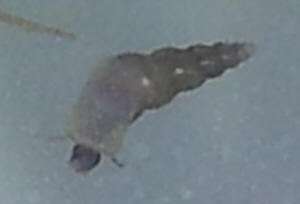
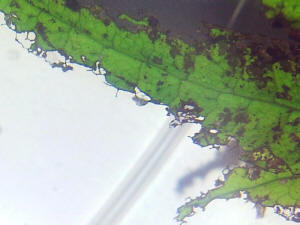
Here are some mug shots of the snails. If you don't really look you
might not know they're there.
<Most of these seem to be Melanoides spp.; they're harmless to healthy
plants.>
The one on the java is dead center and harder to spot. I use a
paper towel to wipe-capture as many as I can from the glass but some
still fall back into the gravel so restarting is the best option. Thank
you again! I'll take your advise and see if I can save this tank.
I guess if it works, thinking very optimistically, I'll need to drop
live food occasionally for the assassins?
<Nope. They're as much scavengers as predators, and need very little
extra food beyond the odd bit of fish food they'll find themselves. But
they aren't herbivores, so they don't eat plants.>
Maybe a little live food is ok for Mollies even though they're primarily
vegetarian.
Jill
<Cheers, Neale.>
|

 |
|
Carinotetraodon travancoricus water changes, and MTS control
11/14/12
Hi Folks
<Salve,>
I've been in touch recently about removing Trumpet Snails from
substrate,
<Good luck on that! Easiest to replace all the substrate, and thoroughly
clean the filter. Even then, expect a few to remain: remove these on
sight, before the multiply.>
in preparation for a Dwarf Puffer system, and I have done a fair bit of
reading on the fish now but still have some questions regarding
maintenance. I can see that water changes are going to need to be about
50% per week.
<Or thereabouts. In very small tanks, yes, 25-50% water changes per week
are essential. But if you were keeping 5 specimens in a 10, 15 US
gallon/37, 60 litre tank, then fewer water changes would be fine. The
fact is that many people try to squeeze them into tiny tanks, and for
that to work well you do need a lot of water changes.>
Ordinarily I'd never change more than 25% in one go, so would I be
correct in saying that they're going to need 2 x 25% water changes per
week?
<That's ideal.>
Would 1 x 50% water change be safe in occasional circumstances, e.g. if
I'm going on holiday?
<Yes. You can change 90% of the water if you want, provided water
temperature and water chemistry stay steady. That's the common
misconception. Think about it, a fish in a river is never in the same
water twice; it's always moving through "different" bits of water, so to
some small degree is always being exposed to slight changes in
temperature and water chemistry. So long as any changes are slight, then
there's no harm changing as much water as you want. But if you can't be
sure the new water has the same temperature and water chemistry as the
old water, the doing small water changes (around 20-25%) ensures that
any swings stay small.
Make sense?>
Also, I gather the fish have rather voracious appetites.
<Yes. Or at least, in the wild they eat a lot of indigestible material:
snail shells, insect exoskeletons, etc. They probably eat some algae
too.
All this fills their stomachs so they feel full. In aquaria we give them
nice meaty food which is easily digested but not very filling. It's much
like humans: fibre-rich food is filling (like vegetables) while
energy-rich food (like chocolate) isn't. Anyway, the puffers seem hungry
because they feel hungry, even though they're getting all the energy and
nutrients they need.>
Normally, if I go away for a week, I just leave my other fish to it and
resume feeding when I get home. Will I need to get someone in to feed
the puffers?
<Not for a week or two.>
Getting someone else feed my fish is something I'd really like to avoid
as I've read far too many horror stories.
<For sure.>
The system is planned as follows, just in case there's anything I've
misunderstood:
A 60 litre tank (c. 2'x1'x1') with sand substrate and lots of
thin, root-like, bog wood. Heavily planted with what is likely to be
Limnophila sessiliflora (both floating and rooted), Amazon Swords and
Vallisneria sp. Filtration will be provided by a 600 litres per hour
internal filter with a spray bar angled at the glass and temperature
will be around 26C. I'm planning 5 puffers, hopefully more females than
males, and the LFS has indicated they should be able to help me out if I
end up with a bad ratio.
<Sounds good.>
My tap water is usually pH 6.8-7.0 and very soft. I'm planning to get a
hardness test kit to make sure I'm over 5dH, attenuating with Rift
Valley salt mix if necessary.
<Again, sounds fine. These puffers are very adaptable. I'd leave water
chemistry alone unless you find pH drops significantly between water
changes, but by default, aiming for around 10 degrees dH, pH 6.5-7.5 is
ideal.>
Feeding will be twice daily with frozen tropical fish foods, initially,
until I can figure out what is pet fish friendly in the frozen fish part
of the local supermarket. I've got a little Ramshorn Snail farm going in
a 12 litre tank for them too and will feed the fish very small ones. I
know someone with Clown Loaches, so if I get an excess of large snails
in the farm I can give them to her.
<Sounds good.>
Hopefully my research, both here and elsewhere, is complete but it would
be great if you could cast your eye over it and also give me some advice
on my initial questions. I'm probably over-complicating things as usual
but I'd rather ask first than send you a panicked "Help my puffers are
dying" email.
<Sounds to me you're planning ahead.>
Thanks, I really appreciate you giving your time to help me out.
<Welcome.>
By the way, if it is Sabrina that picks this up, I chose to freeze the
substrate for four days since someone told me they had tried boiling
with no success. I'm on day three now, but if it works, I'll report
back. It might be of use to someone else in the future.
<Will post this on the WWM Daily FAQ and let Sabrina know it's there.>
Cheers
Gord
<Cheers, Neale.>
Re: Carinotetraodon travancoricus water changes
11/19/12
Hi Neale
Thanks for your answers and your reassurance. I'm ready to start setting
up the system now that the last few pieces of the jigsaw are in place. I
think this setup is going to be a brilliant experience, so thank you for
helping me to realise it.
Cheers
Gord
<Real good. Much written about these puffers online, but they are
basically easy to keep provided the aquarium is fully cycled before
they're introduced. You can use Cherry or Amano shrimps for that, if you
don't have mature aquarium filter medium lying about. Cheers, Neale.>
Dwarf Puffers and Malaysian Trumpet Snails (Sabrina's Old
Nemesis!) - II 11/04/2012
Hi Sabrina
<Hi, Gord!>
Yes, me again! I'm like a bad penny. Thanks for a very entertaining
email. I read that over my morning tea and you had me in stitches. It
really set me up for the day.
<Hah! I'm glad.>
I can only assume that you don't like Trumpet Snails then?
<Can't imagine where you got that idea! *grin*>
Given what you've just told me, I'm not too sure I like them now either
and it's not because of their evil laughter and pointy beards! Eat my
plants? No way!
<Many/most folks will claim otherwise, but I've seen it firsthand.
They do eat any/everything else first, but as they grow too populous for
the tank, they'll take down plants too.>
The worst thing is I put 4 into my community tank (60 litre, Barbs and
Tetras) a week ago when I decided to conserve some Trumpet Snails for
future use. I feel it might be time to go on a snail squashing spree and
give the Barbs a little extra protein.
<My opinion is that trumpet snails aren't for my tanks. Your
mileage may vary.>
I'd be hesitant to take on life purely to rid a tank of a pest,
<Botia striata really are a wonderful fish, if you've got the room for a
small school. Quite a delightful little loach.>
so that leaves me with your buddy’s nuclear winter idea for the puffer
tank.
<Heeee!>
I might go for a different take on this, though, and boil the substrate
then sieve out the bodies. Unless these super-snails are immune to 100C
water, that is! To my mind, it shouldn't be any different to cooking
whelks. I wonder if you can eat Trumpet Snails? I have some quite big
ones (kidding).
<Mmmm, tasty.... Or not.... Wait 'til you smell 'em.
DO NOT do this if you have a significant other in the house, or if
family is going to visit. Trust me.>
Anyway, thanks. I think I have a way forward that doesn't involve too
much hassle now.
<Good luck! I, personally, prefer the loach option, as for some
reason I can't bring myself to kill things in one way if I think there's
a "better" way, and for something to become a meal is, in some messed-up
way, "better" in my mind. It's an odd quirk. I don't even
kill spiders in my own home. I guess I'm a pretty weird case.>
Thanks for clearing up the filter bacteria issue. It made sense to me
that equilibrium would be reached, but often I think that there might be
something I've overlooked in an aquarium setting.
<Seems like you're a pretty sensible guy, Gord.>
It is useful to know since I don't like moving fish just to keep feeding
a filter, nor do I like feeding empty tanks.
<Feeding the empty tank just keeps a higher load of "waste" - mimicking
having fish in the tank, basically, so that there will remain a greater
amount of nitrifying bacteria. Nothing wrong with doing that.
If you don't, and the tank is left alone, it just means being slow and
careful when you add fish again. No biggee either way.>
Cheers
Gord
<Best wishes again and always, -Sabrina>
Dwarf Puffers and MTS (and filter bacteria)
Dwarf Puffers and Malaysian Trumpet Snails (Sabrina's Old Nemesis!) -
10/31/2012
Hi Folks
<Hi, Gord! Wait. Gord? You again?! Just kidding. Didn't realize this was
from you until I just now scrolled down to take a look to see to whom I
should be saying hi. I just happen to have a soft spot in my heart for
eliminating Malaysian Trumpet Snails.>
I'm planning a Dwarf Puffer setup in a 60 litre tank
<Neat!>
that currently holds a pair of Lamprologus ocellatus with a sand
substrate.
The N. ocellatus will be going to a new home at the weekend. I had
introduced Malaysian Trumpet Snails (MTS) into the tank,
<Nooooooooooooo! Malaysian Trumpet Snails.... My old nemesis! Every time
someone says, with an innocent tone, "I added some trumpet snails!" a
piece of my soul cries.>
since I'd read they keep the sand aerated and I have positively
encouraged them to thrive.
<.... I have nothing good to say here. I'm trying. See, I do know people
actually seek them out intentionally, and add them to tanks, but.... I
just can't wrap my brain around it. THEY'RE EVIL. Complete with little
pointy beards and moustaches, and maniacal laughter. Not kidding, listen
closely to your substrate. They're laughing at you *right now*.>
However I also read that puffers can damage their teeth on MTS.
<I wouldn't be surprised. And these little trapdoor devils can thwart
puffers, too. I only know one fish that can definitely dispose of them.>
I'd like to use the same substrate for the puffers but I think I need to
get rid of the MTS to do so (please correct me if I'm wrong).
<I would get rid of them, but for other reasons. Your reason, however,
is reasonable, too.>
My options as I see it so far:
1: Dump some molluscicide (copper?) or bleach in there and wait a month
for decay to complete. Wash substrate and tank.
<DON'T do this. Trumpet snails may survive it, for one, and for another,
the copper that leaches into your substrate may release at some time in
the future - and your puffers are very sensitive to copper. Don't do
this; it's not worth it.>
2: Starve them. Don't feed the tank for a few months.
<Won't work. Evil doesn't need to eat. Okay, the snails *do* need to
eat, but there's plenty for them, whether you feed them or not. Even if
only one of these livebearing nightmares survives, you'll soon be
repopulated.>
3: Sieve the whole substrate.
<Won't work. Newly born baby snails will still make it through. And they
grow up to be evil.>
4. Dump the substrate and start again.
<An excellent option. But there are others.>
5. You tell me I don't have to get rid of the MTS, I celebrate.
<Well, you could do this. But I think you're not unreasonable for being
concerned for the puffers' well-being.>
Obviously I'd rather go for option 3 since it doesn't involve decaying
organisms in the substrate but I don't know what size the newborns are
and whether they would pass through the sieve.
<They will.>
I have a feeling option 5 isn't going to happen.
<That's up to you, and how risky you feel it is. I, personally, for just
the reason of the puffers' teeth, would probably eliminate them.>
Any guidance on this would be most welcome. I feel bad asking since
there's already so much on ridding tanks of snails on WWM but I'm in a
(to me) fairly unique position of being able to do it without any
livestock in the tank and have an opportunity to break the system down
if necessary. I'm not trying to get rid of an outbreak but a
deliberately cultivated population.
<That concept still makes me cringe. Anyhow, you have a couple of other
options. One of them stinks, literally, and one of them involves Botia
striata. I have seen, firsthand in my own tank, Botia striata suck
Malaysian Trumpets out of their shells with no problems at all. It's
like the trapdoor isn't even there; they just knock the snail over and
suck, and it's empty. I don't know how successful other Botia would be
at this, but B. striata are a dream come true. They're also super cute.
Try 'em, you'll like 'em! The smellier option a buddy of mine tried with
success.
It's less than ideal, if you ask me - even cruel, perhaps - but it
works.
Microwave the substrate. He did his in microwave-safe casserole dishes
for an extraordinarily long time, and said the smell was appalling. But
he was giddy with glee to have gotten rid of the little soul-sucking
demons. Just don't miss a single pebble, nuke it all. Or just get a
little school of B. striata. Oh, and drying the substrate out - for
months - won't work. Been there, tried that. They just shut their little
shells and nap, only to wake up and laugh when they're wet again. Why do
I hate these snails so, so much, you might ask? They are really, really
good at growing to a huge population and eating every speck of anything
in the tank. Folks say they won't eat plants, but after they eat
everything else, they most certainly do. And when they get to that
point, they're like lawnmowers. First it's any decaying bits (they
really don't take the live parts until last), but eventually, they just
plow through everything. And have you ever seen, just after lights-out,
how the substrate starts to crawl, and then they march up the sides of
the tank like they're coming to take over the world?
Evil.>
Also, while I'm writing, can I clarify a concept that's been bugging me
for a while?
<I'll try. No promises!>
To my mind, if I remove all of the livestock from a cycled tank and the
bacteria is no longer being fed, it will START to die off,
<Eventually>
and release the nutrients it held back into the water column. If this
happens then there will be ammonia present from the decay and the
remaining bacteria will eat that, grow and die again when it completes,
so the system should stay cycled, albeit to a lesser degree.
<Yes, to a lesser and lesser degree over time, until a balance is
struck.>
Would this equilibrium occur?
<Yeah, basically.>
It's relevant if I need to fallow this system to get rid of the snails.
<Still won't work. So sorry.>
I can't thank you enough for your help and resources. You've taken a guy
that didn't even know what cycling was to overcomplicating it with
questions like that!
<Haha! Isn't life, and learning, just wonderful?? So glad to have added
to your life in this way.... and for you to have added to all of ours,
and our readers'!>
I've also managed to do about 4 hours reading on Dwarf Puffers long
before I've even set up the system, thanks to the influence and hard
work of the Crew.
<Wonderful. Wonderful. Thank you, Gord, for your very fun questions, and
for your kindness and encouragement.>
Cheers
Gord
<Best wishes to you always, -Sabrina>
|
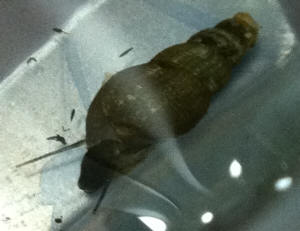
Please help me to identify this snail!
Hi
I recently started a new aquarium and I noticed 2 snails in my tank.
According to the fish shop, I should remove an snails I see as it will turn
into an infestation over time! Oh, I live in Singapore if it will help the
identification.
However, I'm inclined to leave it be if it doesn't do any harm to the
aquarium. So can you please help me to identify this snail and tell me if it
can go with my guppies, cardinal tetra and fire shrimps? Many thanks!
Cheers
Melissa
<This is a Melanoides spp., like Melanoides tuberculata, often called the
Malayan Turret Snail. It's harmless and in fact does some good aerating the
substrate as it burrows through it, but Melanoides tuberculata breed
notoriously quickly. They don't eat healthy plants and only eat dead animals
and plants, algae, fish faeces, etc. but it's best to remove them on sight
if you want a snail-free aquarium. Some aquarists hate them, others view
them as a blessing. Personally, I don't mind them, but do try to keep their
numbers down, for example through the use of snail-eating snails (Clea
helena) and prompt removal of uneaten food, dead fish, and so on that would
drive excessive population growth. Cheers, Neale.>
|
 |
|
Re: Please help me to identify this snail!
Thank you very much for your help and your prompt reply. We have decided to
keep them :)
Cheers
Melissa
<Cool. But do make sure you understand the risk -- these chaps breed
quickly, and once you have them, removal can be difficult (though certainly
not impossible). Keep the tank clean, and every few weeks go on a "snail
hunt" removing all that you can see. Rest assured, some will be hidden away
and those will quickly make up the numbers.
http://www.wetwebmedia.com/FWSubWebIndex/MollusksFW.htm/MalaysianSnailsF.htm
Cheers, Neale.>
|
Snail Infestation 7/31/12
Hello!
First of all, I would like to thank you for your site. Your articles and
FAQs have been very helpful in establishing and maintaining my tank.
<Glad it's helping you.>
I have a 29 gallon freshwater tank. The current inhabitants are 2
mollies (one is still very young), 2 South American puffers (*Colomesus
asellus*),
<Not always a good community fish; in fact, usually nippy.>
one barred spiny eel (*Macrognathus panculus*),* *and some sort of bushy
nosed plecostomus.
<Ancistrus sp.>
The tank has sand substrate and the decor includes lava rocks,
driftwood, java fern and Anubias. About 20% of the water is changed
weekly and the water parameters have remained consistent - no ammonia or
nitrites, nitrates stay low, and ph usually tests around 7.8 (but my
testing kit doesn't seem to be the most accurate). The tank has been
running for about 8 months. Now here is my problem - I have what
appears to be a Malaysian trumpet snail infestation.
<Yes.>
When I first saw the snails, I was surprised (I haven't added anything
new to the tank for several months), but I assumed the puffers would get
them.
<Yes and no. SAPs will eat the very small ones if hungry, but if they're
hungry, they'll also nip fins. So the obvious solution -- don't feed the
SAPs and let them eat the snails -- isn't an option.>
I am aware that this type of snail has an exceptionally hard shell and
that they can crack puffer's teeth,
<So it is said, but that *is* what Puffers have teeth "designed" to do.
They aren't so stupid as to bite something that will damage their teeth
too seriously.>
but at the time they were quite small snails and I wasn't too worried.
<As/when you see them, squish the shells, and let the SAP eat them.>
At this point, there are hundreds, and many of them are quite large. The
puffers have paid absolutely no attention to the snails, I'm hoping it's
because they know better than to go for such hard shelled snails, but I
am still a bit worried about them. I'm a little confused as to why they
haven't gone after the small snails, though. I have not fed them snails
of any type for about 6 months, so maybe they've forgotten how delicious
snails are?
<Possibly, but the thing is that an established population of Melanoides
snails will produce more baby snails (they don't lay eggs) than the two
SAPs will eat.>
The puffers currently eat pellets and freeze dried shrimp and krill (and
a few worms every now and then). This diet has done wonders at keeping
their teeth down, so I haven't felt the need to feed snails (but I do
wish they'd help me control the population of the MTS!). Another reason
that I'm concerned about the snails is that they've been eating my
Pleco's algae wafers.
<Is what they do.>
I feed her at night when the snails are out, and they converge onto her
food immediately. From what I've read, the snails will continue to breed
as long as there is food for them... but I don't want to starve my
Pleco, so I can't exactly stop feeding them.
<Indeed.>
The main reason that I want them gone is that I recently lost my black
molly. One day, out of the blue, she was sitting at the bottom of the
tank, panting and covered in snails. I tried to rescue her from the
snails, but now I can't even find her. I assume she didn't make it, but
I can't even find her body. Since these snails are supposed to be
peaceful, I assume that there was something wrong with her before the
snails latched on... but at this point, I've lost my tolerance for these
snails.
<Melanoides snails can, will consume dead bodies -- but so will your
Plec.
In fact, the Plec will be far, FAR more active in this sense. If the
body of a fish is gone overnight, it won't be the snails but the Plec
that are to blame.>
So... I'm hoping for tips to get rid of them.
<I see.>
From what I've read, it seems that the options are: add chemicals to the
water,
<No. Bad idea.>
pick them out by hand/trap them,
<You will be doing this regardless of any other ideas.>
or introduce predators.
<Specifically, Assassin Snails.>
I am very reluctant to add any chemicals to the water, and I don't think
it's very feasible to pick them out by hand, so I may end up adding a
predator. I'm not sure what to go for, however. I'm worried that my
puffers would pick on an assassin snail.
<Possibly.>
I definitely don't have the space for a group of clown loaches.
<For sure, and loaches are poor snail controllers.>
I hesitate to add another South American puffer since the two I have get
along so well (it'd be a shame to mess up their social structure), plus
it's not like they've been going for the snails anyway (and even if they
did, it could be an issue for their teeth). Are there any kinds of
loaches that are big enough to eat the snails (and not get eaten by my
eel), but small enough to avoid overstocking my tank?
<Nope.>
I'm also concerned that my eel might not tolerate the addition of some
bottom feeders, since they are supposed to be territorial. Are
there any other options?
<Clea helena, the Assassin Snail is the best snail-killer. But
otherwise, here's the deal. Either live with the snails, or else take
apart the tank, remove all the snails (may be easy to throw away the
substrate) and rebuild the tank snail-free. Add some Assassin Snails if
you can, because there's a risk some baby snails will survive, e.g.,
inside the filter media. If you must use a snail-killing chemical, do so
*outside* the tank, e.g., to wash gravel and plants.>
Thank you so very much! This is my first tank, so I've never dealt with
snails before. I'm at a bit of a loss.
<Hope this helps. Cheers, Neale.>