|
FAQs on Betta
Diseases/Health 18
Related Articles: Anabantoids/Gouramis & Relatives,
Betta splendens/Siamese Fighting
Fish, Betta Systems,
Betta Diseases, Improved
(Better?) Products for Bettas!,
Related FAQs: Betta Disease 1, Betta Disease 2, Betta Disease 3, Betta Disease 4, Betta Disease 5, Betta Disease 6, Betta Disease 7, Betta Disease 8, Betta Disease 9, Betta Disease 10, Betta Disease 11, Betta Disease 12, Betta Disease 13, Betta Disease 14, Betta Disease 15, Betta Disease 16, Betta Disease 17, Betta Disease 19, Betta Disease 20, Betta Disease 21 Betta Health 22, Betta Health 23, Betta Health 24,
Betta Health 25, Betta Health 26,
Betta Health 28,
Betta Health 29,
Betta Health 30,
Betta Health 31,
Betta Disease
Causes/Etiologies: Determining/Diagnosing, Environmental (By far the largest cat.),
Nutritional, Viral/Cancer, Infectious (Bacterial, Fungal) , Parasitic: Ich/White Spot, Velvet; Senescence/Old Age, Cures/Curatives/Treatments,
FAQs on Betta Medicines: Betta
Medicines period, Antibiotics/Antibacterials, Anti-Protozoals (Metronidazole,
eSHa...), Copper, Formalin, Malachite Green, Anthelminthics, Organophosphates, Salts, All
Other Betta Med.s,
|

|
 |
Betta Success
Doing what it takes to keep Bettas healthy long-term
by Robert (Bob) Fenner
|
New owner of beta (as usual), got a couple
questions 4/20/08
Hey! I'm a very young owner of beta,
12 years old (me, not the fish!),
<And a character!>
and I've got a couple questions. I have a tank that has a divider for my 2 beta.
<Bettas>
There were 2 dividers. There was a clear and a purple solid color. I haven't put
the solid one in yet, so I put the clear one in. I understand that they are both
males, and I shouldn't put them in the same space, but they can still see each
other through the clear divider.
<I would not have them view each other continuously... a few days, a week, then
use the more solid divider. Too exhausting...>
I had them for about a week. As I told you earlier in the message, I put the
clear divider in, and they weren't fighting. Today I come in to feed them, and
they were flaring their gills, and trying to fight each other through the
divider. Do you have any
<... is natural... part of the reason for their common name: "Siamese Fighting
Fish"...>
suggestions of why they started this out of no where?
I also would like to know if it would hurt to put a few extra pellets in their
tank. I went to spend the night at my friend's house. I forgot to tell my dad to
feed my fish before I left, so I was kind of worried. When I got back, my dad
said he fed them about 5 pellets.
<Won't starve. I would not overfeed if just a day or two...>
I told him he should of only fed him 3 because they are easy to be overfed, but
I couldn't yell at him because he didn't know. I was just happy he fed him, but
kind of scared to know if anything bad will happen for feeding them more than
what he should have (by the way, I'm feeding them the Hikari Bio-gold pellets).
Is that dangerous to the beta in anyway besides them being bloated? The last
question I'm going to ask is, if I was to put them in a bigger tank, would they
still fight even if I put more fish in the tank with them?
Hope this is enough information
-Brogan Sheets
<Please read here:
http://wetwebmedia.com/FWSubWebIndex/betta_splendens.htm
and the linked files above; and the Net more widely, perhaps some library
reading on Betta splendens... employ and enjoy your time wisely and enjoyably...
through applied knowledge and understanding. Bob Fenner>
Re: Betta sick - follow up
4/20/08
Hello,
Thank you again for your help. I have been out of town for the past week so I
was not able to send you a thank you response earlier. I will take our Betta off
the pellets and try the foods you recommended today. Thank you again.
<You're welcome. Good luck, Neale.>
Fish parasite or fungus? Betta
4/16/08
Dear WWM Crew:
<Heidi>
I have a male Betta in a 5.5 gallon filtered, heated tank. The tank has been set
up for about a month. I use a sponge filter for up to 10 gallons. Temp is 80.
It's still in its first cycle. Yesterday morning I noticed that on one part of
his body,
<... this system is still cycling and you have the fish present?>
it looks like a scale is raised and a small white something is attached to the
area. Or maybe his scale isn't raised and something else is attached to it.
Upon closer inspection with a magnifying glass, it looks like there is something
white that is under his scale, causing the scale to protrude. OR something
whitish a bit translucent is covering a scale.
When I look from the side, whatever it is is protruding very slightly. I saw no
signs of distress yesterday or today and he is eating well, good appetite, color
is good, no rubbing against anything, no darting or flashing, normal activity
level and interaction, red streaks or signs of injury. Whatever is on him looks
completely unchanged today. If you look from the side, it still looks like his
scale is pushed out a bit, or something is still attached. I did a 50% water
change this morning, ammonia and nitrites are at 0.
<Good... and nitrate?>
I've researched different parasite and fungus possibilities, but the white stuff
doesn't look cottony and he hasn't been injured that I know of.
<Though this is the most likely scenario>
I guess it could be a parasite, but if so, it's doesn't seem to be bothering him
at all. The white spot is not moving, nor does it seem to look like an anchor
worm, fish lice, or Ich. Could it be early stages of cauliflower disease?
Sincerely,
Heidi
<I suspect this is a mechanical injury... But you'd do well to have aquatic
systems fully cycled, THEN introduce livestock. I would do nothing medicine-wise
here. Bob Fenner>
Re: fish parasite or fungus? Betta
4/17/08
Bob,
<Heidi>
Thank you for your reply.
<Welcome>
Yes, clearly I have learned my lesson to never, ever trust what the
local fish shop says, ever again. Clearly I should have cycled my tank
first and done more research before buying my fish.
<Ah, yes>
However, I am doing the best that I can with the situation now. I
suspect you were right about the mechanical injury and secondary fungus.
Yesterday I discovered that my Betta was also showing signs of fin rot;
black/red at the edges, a fin split beginning, and fin degeneration at
the edges. I've done another pwc to keep his water as clean as possible
as he recovers. Although you suggested no meds at this time, it seems
that with the additional fin rot, I should treat him with an
anti-bacterial/anti-biotic.
Sincerely,
Heidi
<Some folks would suggest such. Please read here:
http://wetwebmedia.com/FWSubWebIndex/FWFinRot.htm
and the linked files above. I am more conservative (generally) in my
approach here.
Bob Fenner>
my fish died... Betta reading
4/15/08
Hi,
I am hoping you can help me to understand why my fish died.
I got him as a wedding token about 5 months ago.
He is a Betta splendens and I read all the information about keeping
him.
<lo dudo>
I change his water regularly,
<... in a filtered, heated system?>
I feed him small meals (tropical fish pellets from the pet shop) 3 times
a day.
<... need more than this>
He was fine. One minute he was swimming like crazy in the tank and the
next minute he was unmoving on the bottom.
What happened?
I attached his picture. Please help me.
Sarita
<Please read here: http://wetwebmedia.com/FWSubWebIndex/bettasysart.htm
and the linked files above. Need info. Bob Fenner>
|
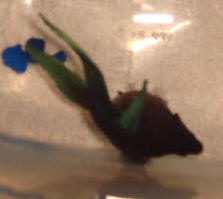
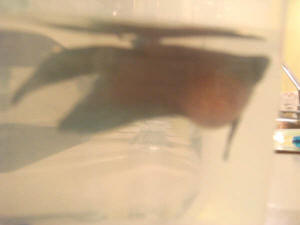
Bloated Betta... no useful data...
Bowl... no reading 04/14/2008
Hi Guys,
We were wondering if we could get your advice. We seem to have a very
sick fish. My boyfriend usually feeds the fish but has been out of town
lately so I have taken over their feeding schedule. He noticed that one
of our fish appeared to be getting "fat" for the past couple weeks or so
but he wasn't too concerned. Since about three weeks ago, however, we
noticed that he wasn’t eating properly and had lots of food left at the
bottom of his tank
<... mis-over-fed... with what?>
and in the past couple days I have become quite concerned with his size.
His stomach has expanded so much that his scales now appear pink as they
have been stretched so much. At this point, because he has seemed to go
so far, we are not sure what to do. I have been reading some of the
concerns from others writing to you but none seem to be as far along as
our fish is. We cleaned his tank
<What does this entail?>
this evening and placed him in a shallower bowl
<... not bowl-fish>
as that was one of the recommendations previously stated. He seems to
still have energy and was moving around quite well when we switched his
tanks to clean him. He is also always usually on top of the water and
does not recede much to the bottom of his tank. His fins seem to be
moving at an increased speed so I'm not sure if this is because he is
having trouble breathing. We feed him pellets and have another fish who
is always hungry and appears quite healthy. Any advice you could give us
would be greatly appreciated. I've also attached various pictures in
order to help with his diagnosis.
Thank you,
-Tara
<Read: http://wetwebmedia.com/FWSubWebIndex/fwlvstkind2.htm
the second tray... Need tropical, filtered circumstances... perhaps
different food... Might be able to recover with Epsom Salt, better
environment, nutrition. Read. Bob Fenner> |
|
 |
Fish cruelty! Betta et al. hlth., rant
4/13/08
Hi! My Betta is very VERY sick to the
point where I am contemplating ending its life... I knew truly nothing of Betta
fish when I bought it as I believed what people around me told me about them
(the usual stuff like that they only need tiny cups and no care blablabla....which
all ended up being useless crap ). It lived in a .5 gallon for a while, I
realized it seemed to want more space and gave it a 2 gallon (I had from when I
was a kid) afterwards and it seemed much happier. I took great care of it,
keeping the water at 77-83, very calculated careful feeding of dried blood
worms, frequent water changes etc, and he was always very active and had bright
colors....until a month ago! :(I sometimes have to travel to another town in
order to see family, friends and boyfriend and it takes 4 hours to get there so
I decided it was better to leave my roomie take care of my fish....WRONG! :SI
knew they did not take good care of it, as when I would come back the tank was
FILTHY LIKE HELL!!!!! After only 2 days and a half she managed to overfeed like
CRAZY!!!! :(I told them many times to not overfeed and change the water....which
they did...perhaps 1 in the many times she "cared" for it.... the major problem
was when I had to leave for a week....When I came back the water stenched as
hell, rotten bloodworms were EVERYWHERE in the tank and no water had been
changed....and my fish was not very well-looking! :(She even placed the tank
near the window for the whole freakin week when it was freaking cold and snowy
outside!!! :SI finally discovered it had velvet! :It has been very sick for a
long time and I was not there to care for it so the disease was pretty advanced
when I diagnosed it! Its got a heavy patch of gold dust behind one of its fin,
it does not eat, stays hidden, lays at the bottom of its tank all the time and
barely ever goes to the surface to breathe! :( It has had velvet for about a
month (did not eat for a month) and a week now. After 2 weeks of intensive care
(salt baths, salt in aquarium, darkness, warm water and copper medicine) I
managed to get him healthy-looking again, he finally started eating again, would
swim normally and flare! :) He looked happy again, the gold vanished, and he
became curious and colorful again! :D He was fine for 3 days....until I had to
leave again for urgent reasons....with no possibility to take him with me! :(I
really had NO other choice than leaving my pets behind, and though I felt bad
about this I though that my OTHER roomie was a responsible person....WRONG!!!
:She could not tell a dead fish from a thriving one! :She overfed....NO water
changes, took him away from his heat source and near the FREAKIN OPEN WINDOW
(guess she did not feel like keeping the tank and all on her desk! :( )She did
not even feed my Amano shrimp, which is kept in a separate tank because of the
copper treatment (I don't know what the hell she thought I had put the shrimp in
her room for???!)I came back...3 days later and the fish is sicker than ever!
:(I have tried everything again and he is just getting worst and worst now! I
guess it was too much for him! His colors are fading like never, a dark blotch
appeared on his ventral fin, his scales seem to be falling of at some areas of
the head! :( The gold splotches are on his fins again and he looks so miserable!
:(Is there any chances of it getting better now? :( I got a 5 gallon with filter
and all so that my fish could stay the weekends in my room from now on, warm,
with acceptable water parameters, and FAR from my roomies... but I don't even
feel its worth it anymore! :*( He looks so bad now and I know he has been
suffering for SOOOO long! :(Should I keep on trying or try a painless way to end
his life? Will the gill damage from a month and 2 weeks of velvet attack ever
recover?
<Possibly>
:(Thanks for taking the time to read and answer me! :)Oh and I was wondering as
well....You see, my two roomies each purchased a purple passion Danio fish
(almost a month ago), and one of them has a small male Amano shrimp of 1 inch
long with that. Each animal is in a separate.... 1 litre tank! :( Actually... 1
litre would be generous as there is a thick layer of very bad quality (rusting)
gravel in the bottom, the water stops at a good 2 inch from reaching the top,
and the tanks all contain java moss, which takes up pretty much all of the
space! :I'm amazed the fish survived so long! Especially considering the water
is scarcely changed and they overfeed! :O How long do you believe that purple
passion Danios can survive in these conditions?
<Not long>
:(How long can the Amano shrimp survive like that? Can it?
<No>
:One of the Danio looks like its on speed, always rushing in the tank side and
swimming at a furious rate, while the other stays lethargic at the bottom and
always try to behind the java moss. The shrimp also looks pretty lethargic! :O I
REALLY want to let them read your answer because they don't believe me when I
tell them that they are torturing the poor animals, and thus professional advice
might wake them up a little! My roomie with the lethargic one does not even
think the fish is sick because quote: "it moves! See!", (yeah when she shakes
the tank it moves...for about 2 seconds before laying to the bottom again!) and
she thinks he lays like that all the time because quote: "he is just sleeping,
when you sleep you don't move duh". Well...one of them at least, the other does
not care and always says "its just a fish who cares", but the other girl gets
defensive when I tell her that her fish looks sick, so I think she might care a
little! :O I hope your response can make these fish discover a slightly better
life! (for now I am making sure that they don't get any new pets! one of them
wants a salamander....)
<... don't know what you're looking for here... My advice, either hire someone
to come in to take care of your pets while you're away for days time, or take
them into a shop to have them do the same. Bob Fenner>
The blight of the Constipated
Betta - 4-11-08
Hello Crew, please kindly
forward this email to Neale since he has been such
a great help to me in the past. The situation is:
<I will... but will also give this a go... as Neale has taken on some
more work, and has very little time currently for WWM>
5 gallon established tank with 1 Betta
Ammonia 0
Nitrite 0
Nitrate 5
pH unknown but has a piece of driftwood and I use Tetra blackwater
extract Temp 80 F
Diet Hikari BioGold Betta pellets x 4 once a day, occasional
bloodworm/brine shrimp treat (I now know that in future I should be
soaking the pellets and feeding less, of which I have learned the hard
way!)
Its about day 17 now where my Betta has been extremely constipated with
very bloated belly (swelling is localized only to belly and scales are
not sticking out - no dropsy) that is not getting worse or better. The
first week I noticed it I fasted him for 4 days to try to clear it.
Nothing, I fed 2 pellets,
<I would leave off with the pellets... look for live or frozen brine
shrimp, Daphnia... much more laxative effect>
waited another 2 days nothing. Fasted for a few more days and then fed
some boiled pea pieces with skin taken off. Fasted another few days and
nothing. Repeated pea treatment again and nothing. About 5 days ago I
did an Epsom salt bath for 30 minutes with conditioned water that was
brought up to same T as the tank.
<Good... but if the other occupants can tolerate it, I'd add the Epsom
directly to the system>
The next day nothing. Then about 2 days ago I just went straight ahead
and added Epsom salt to the tank at 0.5 tbsp for the 5 gallon tank.
<Oh! Good>
Yesterday I fed him a bit of brine shrimp for a bit of roughage and
nothing again. His behaviour is normal, still looking for food, no swim
bladder problems, no lethargy, no flashing, color is the same and he is
active. The one thing I notice is that since the beginning of this
starting on one of his sides has what looks like a few scraped off
scales that have left a lighter color on his side. Other than all this
he seems fine but I do not know what else to do and he looks like he is
about to burst and I am worried that he might start to develop swim
bladder issues if not resolved soon.
My questions are:
What else can I do?
<Mmm, more of the crustacean feeding>
Are there other treatments that I am not aware of that I can do?
<None that are safe, efficacious>
How long will this take to resolve?
<Should have by now>
I know you cannot give me a straight answer but I'm just wondering if I
should be waiting longer or if I am not doing something correctly.
<Do leave off with all dried food use>
Does my Betta have parasites?
<Mmm, possibly>
I cant visually see anything externally
(except for the 2 or 3 scraped off scales). I bought a pack of Jungles
parasite Clear.. but none of the symptoms for parasites I have read
about include large belly swelling?
Thank so much for your help.
Cheers
Terri
<I urge patience here... and the above leaving off with pellets, feeding
exclusively with small crustaceans. Bob Fenner>
The blight of the Constipated
Betta, NealeM - 4-12-08
Hello Crew, please kindly forward this email to Neale since he has been
such a great help to me in the past. The situation is:
<I will... but will also give this a go... as Neale has taken on some
more work, and has very little time currently for WWM>
5 gallon established tank with 1 Betta
Ammonia 0
Nitrite 0
Nitrate 5
pH unknown but has a piece of driftwood and I use Tetra blackwater
extract
Temp 80 F
Diet Hikari BioGold Betta pellets x 4 once a day, occasional
bloodworm/brine shrimp treat (I now know that in future I should be
soaking the pellets and feeding less, of which I have learned the hard
way!)
Its about day 17 now where my Betta has been extremely constipated with
very bloated belly (swelling is localized only to belly and scales are
not sticking out - no dropsy) that is not getting worse or better. The
first week I noticed it I fasted him for 4 days to try to clear it.
Nothing, I fed 2 pellets,
<I would leave off with the pellets... look for live or frozen brine
shrimp, Daphnia... much more laxative effect>
waited another 2 days nothing. Fasted for a few more days and then fed
some boiled pea pieces with skin taken off. Fasted another few days and
nothing. Repeated pea treatment again and nothing. About 5 days ago I
did an Epsom salt bath for 30 minutes with conditioned water that was
brought up to same T as the tank.
<Good... but if the other occupants can tolerate it, I'd add the Epsom
directly to the system>
The next day nothing. Then about 2 days
ago I just went straight ahead and added Epsom salt to the tank at 0.5
tbsp for the 5 gallon tank.
<Oh! Good>
Yesterday I fed him a bit of brine shrimp for a bit of roughage and
nothing again. His behaviour is normal, still looking for food, no swim
bladder problems, no lethargy, no flashing, color is the same and he is
active. The one thing I notice is that since the beginning of this
starting on one of his sides has what looks like a few scraped off
scales that have left a lighter color on his side. Other than all this
he seems fine but I do not know what else to do and he looks like he is
about to burst and I am worried that he might start to develop swim
bladder issues if not resolved soon.
My questions are:
What else can I do?
<Mmm, more of the crustacean feeding>
Are there other treatments that I am not aware of that I can do?
<None that are safe, efficacious>
How long will this take to resolve?
<Should have by now>
I know you cannot give me a straight answer but I'm just wondering if I
should be waiting longer or if I am not doing something correctly.
<Do leave off with all dried food use>
Does my Betta have parasites?
<Mmm, possibly>
I cant visually see anything externally (except for the 2 or 3 scraped
off scales). I bought a pack of Jungles parasite Clear.. but none of the
symptoms for parasites I have read about include large belly swelling?
Thank so much for your help.
Cheers
Terri
<I urge patience here... and the above leaving off with pellets, feeding
exclusively with small crustaceans. Bob Fenner>
<<Concur with Bob 100% here. Dried pellet foods simply aren't a good
food for most freshwater fish when fed as the dominant part of the diet.
Too much protein, too much fat, too little fibre, too little moisture.
Wet-frozen bloodworms and mosquito larvae would be about perfect food
items for Betta spp., being essentially what they eat in the wild.
Compared with freeze-dried foods wet-frozen foods are much cheaper and I
find fish take to them much, much more readily. I'd certainly switch to
some high fibre live foods (daphnia, brine shrimp) immediately, and
perhaps try using cooked/tinned peas as well (bizarrely enough, some
predatory fish like Betta spp., happily go for them). Use this regimen
for the next 2-3 weeks. If the fish doesn't eat, don't worry. Try again
the next day, and the next... Epsom Salt should help. With luck these
will all help clear the blockage. Do take care not to overfeed: 4 meals
per day for a fish that basically doesn't do anything and has nowhere to
swim and no water current to swim against is A LOT of food. So he may
merely be fat! One meal a day should be oceans, and to be honest one
meal every other day would probably be fine. In terms of bloodworms or
mosquito larvae, that's perhaps 5-10 pieces per day. Fish need miniscule
amounts of food compared to equivalent sized mammals, so we often wildly
overfeed our fish. Not only does it cause problems for the fish, it also
wallops water quality too. As for parasites... possible, but rather
uncommon, especially with a fish that's been kept "in solitary" for
months/years. Of course intestinal worms can cause abdominal swelling,
but to be honest in 25 years fishkeeping, I've only ever seen one
(freshwater) fish that, after autopsy, actually had sufficient worms
that its body was distended. Every other time it's been things like
'dropsy', constipation, swim bladder infections, teratomas in the
uterus, and so on. Cheers, Neale.>>
Re: The blight of the Constipated Betta
4/19/08
Hi Neale and/or Bob,
<Terri>
Thank you both for your reply. I am very worried now since I wrote last week
because my Betta has not improved. Since I last wrote (7 days ago) I have been
alternating by every second or third day feeding either very small amount of
mashed pea/brine shrimp and then fasting in between. About 3 days ago I saw this
very thin, thinner than a human hair white filament coming out of his anus.
<Mmm... could be...>
The filament I am pretty sure was not a worm, it was somewhat irregular along
its length, and was not moving. To be sure I treated the tank with .5 tab of
Jungles Parasite Clear fizz tabs (with .5 tbs Epsom salt already in there from
the days previous).
<Good>
Next day was nothing. Through all of this my Betta was swimming well, active and
begging for food. However, he is now starting to look a lot thinner to his
"backside" where he is starting to waste away from not digesting any food for a
total of 3.5 weeks.
Then last night I got sort of desperate and did a 75% water change and added 2.5
teaspoons Epsom salts to the 5 gallon tank since I read somewhere that amount
would be good to "purge" the Betta. Today nothing and when I came home my Betta
looked very miserable, pale and in fact the missing scale on his one side got
worse and now it looks like a few more scales have come off his side. The
missing scales are not ulcerated but it is noticeably bigger with sort of white
edges to it. I am now extremely worried as he is getting worse so I went ahead
and changed 50% of his water to relieve him of the high Epsom salt concentration
and since it was not doing anything for about 2 weeks (well for 2 weeks the
concentration was at .5 tablespoon for the 5 gallons, I am not even sure that
was high enough to do anything) I have just decided to not put anything at all
and give him a break. I fed him 3 tiny pieces of brine shrimp as well.
Also tonight when I came home again a spindly thin white filament was hanging
from his anus. It is not a worm I am pretty sure and is not mucusy but just
looks very thin, almost transparent and spindly. I am stumped as to what else to
do. Help!!!!!!!!!!!
<Do please read here: http://wetwebmedia.com/FWSubWebIndex/fwwormdisfaqs.htm>
Please if you have any suggestions as to what is going on or what else I can
do...my Betta is wasting away before my very eyes and it must be so
uncomfortable for him in this state. any help is greatly appreciated. thank you
so much for your time.
Regards,
Terri
<I would treat this fish, quickly... as per the notes/symptoms of Camallanus.
BobF>
Re:
The blight of the Constipated Betta, NealeM – 04/21/08
Hi Bob,
<Terri>
I read the link you suggested and other sources on Camallanus and I am pretty
certain that my Betta does not have this. He has never exhibited worms coming
out of his bum (or anywhere else) ever and I observe him pretty intensely
everyday. The white strings I mentioned previously do not look like any pictures
I have seen of worms or white stringy poo symptoms. The strings were so small
and spindly. maybe 8mm in length. I was thinking it was more indicative of mucus
or something coming out...or something like that it did not look like a worm. Is
there another reason you think he may have Camallanus Bob?
<Mmm, no... but w/o pix this is a poor guessing game>
As I am still not sure what to do, my poor Betta is now deteriorating and he is
lying very still on the bottom of the tank and has stopped eating. His missing
scales on the side (like a sore but not ulcerated at all, just whitish with
frayed edges) is still quite large and his belly is about to burst. I cannot see
any worms coming out of this sore nor attached to it. I have no idea what is
going on. I cannot see any flukes and there is no fish lice present. I only
treated with Jungles Parasite Clear once (about 4 days ago now) and it seems
ever since I treated him my Betta has gotten worse. At least before he would
move around and eat but now he looks terrible.
<Mmm, my next best guess is that this might be Anchorworms, Lernaea... see the
Net, WWM re pix...>
I live in a remote area and will have to order Levamisol on the internet as I
read that it is a laxative as well. but the internet takes about 7-10 days for
my order to arrive...I hope its not too late!!
Why isn't the Epsom salts in the tank working as a laxative?
<Sometimes don't w/o being dangerously high in concentration, duration... the
cause may not be treatable thus... Could be a teratoma...>
Is it possible to refer my inquires to Neale to get a second opinion please?
<... will do>
I am stumped as to what is going and do not know what else to do. I have added
now 2.5 teaspoons to the 5 gallon tank. No other meds administered...help!
Thanks everyone....
<Photos please. Close ups, files of size. BobF>
Re:
The blight of the Constipated Betta 04/21/08
<Hi Terri,
I have to concur with Bob; without a photo, it's very difficult to diagnose
problems like this. All I can do (and likewise Bob, I'm sure) is run
systematically down the list of things we've encountered that produce similar
symptoms. At the end of the day treating internal problems of small fish is
limited: treat for constipation; treat for worms; and treat for internal
bacterial infections is basically it. Optimising environmental conditions is
always worth doing, of course. But that's really about it (so far as I know; in
the US, access to off-the-shelf medications may be different to here in the UK).
Cheers, Neale.>
|
|
Betta's tail fins lost colour, no
data - 3/21/08 Hi. I have had this red Betta for a
year. Just today, the end part of my Betta's tail fin
decolourised from a red to a translucent gray. Overall, my
fish's pretty fine, all robust and active and blowing bubbles
and all, but the end part of he's fins are still translucent
grey!!!! Could it be due to stress that's causing this??? Pls
reply asap at <Done>...THANK YOU. <Likely simply
"old age"... perhaps with a bit of environmental stress
tossed in... Please read here re proper Betta Care:
http://wetwebmedia.com/FWSubWebIndex/bettasysart.htm
Re: Betta's tail fins lost
colour... idiocy , 3/22/08 R u
<... no net-speak, please> serious,,,,old age???? I wont
think it is a problem since i had him for just eight months.....
<Actually... if you had read re Betta splendens... you'd
know something re their lifespans> anyway...my Betta's
fins has regained colour. Also, another Betta EXPERT told me my
fish had the marble gene in him, <Like the ones loose in tu
cabeza?> that it was nothing to worry about. How can it be old
age??? <Uhh, time going by... Stop feeling, start reading...
B>
|
Sad Betta owner... no
reading 3/12/08 I guess I'm
not a very good Betta owner.. I had two male Bettas, and they both died
two days apart from each other. I kept them in bowls, which I
didn't realize was a problem (as long as they had their heat
light). Kelpie, who I had for a year died on Saturday, he exhibited
signs of Swim Bladder disorder.. when I got home after being out all
day, I saw that he was already pale and almost swimming upside down to
get to air before sitting motionlessly at the bottom for minutes. I
read that he could be saved, but I needed frozen peas.. and I dropped
him into a salt bath just before I left since I knew that I would be
out to the store for peas for the recommended 15-20 min.s. When I got
back, I saw that he hadn't moved at all since I left.. I tried the
peas anyway, of course he never moved to eat them, it was already too
late. But the site expressed that feeding peas to Bettas once a week
can be a good way to prevent constipation - which was likely the cause
of Kelpie's Swim Bladder Disorder. I fed peas to all three of my
other fish, they were skeptical at first, but ended up eating the peas
just fine. My other male Betta, Mini Moose's bowl was right next to
Kelpie. I never realized that Kelpie's fins had some fin rot until
I researched his disorder (I feel really foolish not reading on Betta
diseases when I first got them).. and I noticed that Mini Moose had it
too, but only a tiny bit - Kelpie's fins were torn from an
"aquatic" rock fixture that I had in his bowl. I went to the
store, and bought some medicines - Bettafix, aquarium salt, Algaefix,
Pimafix, and Melafix, as well as some other meds for other "first
aid" needs. I also bought a huge kit to test the ph, ammonia, and
nitrate levels. the pH was 6.5.. a little low but within range. Ammonia
was .25.. I didn't get to the Nitrate, I didn't have time last
night, and now he's dead. I cleaned his bowl, and did drops of the
Bettafix, Algaefix, Pimafix (even though there weren't signs of
fungus, it was recommended for fish rot on another Betta FAQ site), and
Melafix, <Worthless> as well as aquarium salt. Neither fish
showed any signs of infection other than fin rot. In the evening he was
lethargic, by the next morning/afternoon, he was barely moving, and
starting to look pale. I thought maybe he was depressed that the other
male wasn't next to him anymore. After work, I went to the store
and bought another male Betta, hoping that it was cheer Mini Moose up,
and I thought I would change his bowl decorations to give him something
entertaining to look at. When I got home, I saw that he was dead.
It's weird to me that they both died so close in time to each
other. I'm not sure if maybe I overmedicated Mini Moose.. maybe the
Algaefix was somewhat toxic <... posted> (I generally really like
the API brand). I'm worried if I somehow passed some germs on from
Kelpie's bowl to Mini Mooses.. I still have two female Bettas, and
they are their usual perky selves. Any ideas/suggestions? Just
don't ream me too much for being a bad fish mom, I feel awful
enough already. <Read here: http://wetwebmedia.com/FWSubWebIndex/bettadiseases.htm
and the linked files above. B>
Sick Betta?? 03/11/2008
I recently bought two male Crowntail Bettas after
going to Wal-mart and seeing them half dead on the shelf I couldn't
just leave them. <Buying them just perpetuates the practice...>
So now I have them at home and I thought everything was going good! It
wasn't until yesterday that I noticed this large bump (see pic).
The other Betta doesn't have the lump that's why I'm
thinking this is abnormal. I tried looking it up on the web myself but
I cant find anything!! Is it a tumor? Or is he deformed? I had planned
on putting them in a 10 gal divided tank. Other than the bump, he is an
active Betta! He flares when I hold the mirror up, eats his food, swims
around fine. Hoping for some help -Samantha <Read here: http://wetwebmedia.com/FWSubWebIndex/bettadiseases.htm
and the linked files above. Bob Fenner>
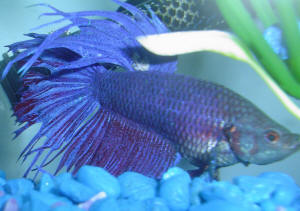
| Re: Betta sick - follow up
4/13/08 Hello again, <Ave,> I had
written to you in March regarding our Betta's illness
(Lymphocystis). Now I am providing you with an update. <Very
good...> Since your advise 1. our Betta has been transferred to
a 5 gallon aquarium from the 2.5 gallon tank, <Good.> 2. a
new heater has been added and the water temperature is maintained
at about 76 degrees F, <Also good.> 3. we replaced the Nano
filter with a Whisper Power Filter (for up to 20 gallon tanks). He
is the only fish in the tank. <Sounds great, but do take care
the filter doesn't create so much water current he can't
swim easily.> For the past 2 tank cleanings, we have also
started using Prime ("removes chlorine, Chloramine, ammonia,
detoxifies nitrite and nitrate and promotes slime coat")
instead of just a chlorine remover. <All good stuff.> The
Lymphocystis seems to have gotten wider but looks as if it does not
protrude as much as it did in the previous photos I submitted to
you. Also, the Lymphocystis now can be seen on both sides of the
fin, before it was seen only on one side of the fish. <It is a
viral disease, and simply doesn't get easily treated. On the
other hand, assuming it doesn't affect the internal organs, it
doesn't cause death either. It can take many months, even years
to come and go. You just have to keep plugging away, maintaining
optimal water conditions and hoping for the best. Realistically, a
fish as short-lived as a Betta may well be dead before the
Lymphocystis runs its course. Or not, as the case may be. It's
difficult to predict.> Also, I think our fish has developed
dropsy (swollen belly, reduced appetite, not cones). <Looks more
like constipation and/or too much food. Bettas are easily overfed.
Stop using dried foods altogether for a period of several weeks.
Use either live or (wet) frozen daphnia and brine shrimp. If your
Betta will eat them, tinned/cooked peas are useful too.>
Regarding dropsy, I have searched the web for photos and found fish
with pine cones. The only picture that showed just a swollen belly
was at Nippyfish. Could you kindly provide me information to
confirm if it is dropsy and if the Lymphocystis going away or if
something new is developing? <Dropsy is relatively uncommon and
tends to follow on from systemic bacterial infections, typically a
failure of the fish to maintain its internal balance of salts and
water. By that time, a fish will be close to Death's door, and
will have stopped eating and likely not be doing much of anything
else.> I have attached 2 pictures of our Betta. <Indeed you
have.> Thank you again. <Cheers, Neale.> |
|
|
|
I have a female Betta fish. Ich & More...
no reading 3/6/08 I have
had her for about 3 months. She was a healthy fish when I bought
her.? She has a bulging belly. I haven't changed anything in
her diet and I change the water regularly. She lives in a
ten-gallon aquarium with 2 other female Bettas and an algae
eater. There? are live bamboo and lily plants? in the tank. It
has an internal filter. None of the other fish are having any
problems. There are pictures from different angles attached. The
bulge is only on one side. I have moved the fish to a? bowl so
that the other fish wouldn't mess with it. It has low energy
and is not eating well.? Can you help me? <... This fish has
white-spot, Ich... Read here:
http://wetwebmedia.com/FWSubWebIndex/fwich.htm and the linked
files above till you understand... I would be raising the
temperature... at least... Read, understand, act... and soon. Bob
Fenner>
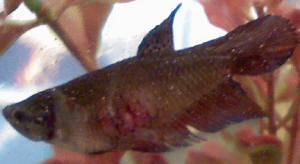
Re: I have a
female Betta fish. Ich 03/11/2008 Thank-you for the help. The Ich has mostly fallen off of the
fish and she is no longer bloated, but now she has a hole in her
side. I have attached a picture showing the hole. Is there
something I can do about this? Is it caused by anything? Please
get back to me ASAP. <... just keep reading where you were
referred to. BobF>
|
|
|
Am I treating Ich? Betta,
reading? 2/27/08 I am
relatively new to owning Bettas; I have four now, two Veiltails and two
Crowntails. I was housing the two Veiltails temporarily in a tiny
divided tank in order to transport them from my home to my college
dorm, and placed them back in half-gallon bowls. The day I transferred
them back, I noticed small spots that matched the descriptions of Ich
that I'd read about previously. I assumed that perhaps the stress
of the move (about 200 miles in a car) had lowered their immune
functioning, and combined with the smaller transportation
accommodations, they may have contracted the parasites. <Mmm, had
the parasites already... likely the stress, lowered temperature,
brought it to the fore> I double checked some photos online to make
sure that they didn't have early signs of velvet, and I'm
fairly sure that they do not. In fact, they seem perfectly healthy
aside from these minimally present salt-like spots. They eat regularly
and are as active as ever. Have I just caught the Ich so early that
they aren't physically effected yet? <Always effects to a degree
when present> I've been treating them with Ick Guard for two
days now, just to be sure. I don't want to medicate them
unnecessarily, though. Am I doing the right thing? Cindy P.S. Each of
my Bettas is in a half-gallon bowl with regular pH levels and a fairly
stable temperature in the high seventies. I do water changes at least
once a week, usually twice because they are not filtered. They are fed
on a combo of pellets and freeze-dried bloodworms. <I would be
reading on WWM re Ich: http://wetwebmedia.com/FWSubWebIndex/fwich.htm
and the linked files above, using the search tool for files on Bettas
and Ich, and likely just using elevated temperature (perhaps with half
doses of Malachite) to effect a permanent cure here. Bob Fenner who
says, get reading>
Very Old Betta Questions
2-24-08 To Whom it May Concern, <Hello!
Merritt here today!> I've looked everywhere but have found
little info on behavior changes and care for elderly Betta fish. My
favorite Betta "Rainbow" just celebrated his 5th Birthday.
<Wow! That's an old Betta, you must take great care of him!>
He was so small when we bought him and he is as big as a whale now.
Anyway I digress, proud mother I guess. Rainbow has been remarkably
healthy his whole life. But last year he developed a cloudy eye but
since it didn't swell up right away and I thought maybe it was a
cataract associated with old age. <Very possible> A few months
later his eye did swell and so I treated him for Popeye with Maracyn 2
and he seemed to respond. <Smart move!> Then the swelling
re-occurred a few months after the first treatments so I treated him
again. His eye returned to normal size but he seemed to developed a
translucent disc under the cornea and if I look down into the eye I
think I see blood pooling. <When he hit his eye (hence the Popeye)
he probably caused permanent damage> As he has gotten older it has
become difficult to feed him. He has a hard time seeing his food since
I think he is now mostly blind in that one eye. <Yea, I would bet he
is blind, but that will not decrease his lifespan any> He still
moves the eye like he can see but he only responds to food I place on
his good side. In his forth year he simply couldn't eat live worms
anymore because he couldn't catch them and forget shrimp they were
just way to fast, so I was forced to feed him only pellets. Now he
can't seem to open his mouth wide enough to fit the pellets in at
all, or he just can't open it fast enough to create the pressure
change that forces food into a fishes mouth I'm not sure. <I had
the same problem with my three year old Betta. The Hikari pellets were
too big and he could not eat them anymore. I found a excellent Betta
pellet brand named Tetra Betta Floating Mini-pellets. They are the
perfect size for him to grab and eat> The pellets just get pushed
around on the surface of the water. Consequently, he can no longer eat
his pellets at all! Now I'm hand feeding him worms with chop
sticks. <Keep it up though, he will benefit from your hard work by
living longer> Not an easy task. I don't feed him everyday
anymore because he doesn't move around much. So he gets one, two or
three worms every few days. It takes a lot of patience on my part, we
have to try over and over before he finally gets one. When he does our
whole family celebrates for him. Bless his little fish heart but it
seems like a lot of work for him and he keeps on trying and trying. Is
there anything you could recommend as far as food for such an old fish?
This winter I bought him a heater for his 2.5 gallon bowl. He seemed to
be suffering in the cold. <Temperature affect Betta fish greatly, he
is thanking you for the heater> I'm having a difficult time
because the heater seems inconsistent. I know I probably should have
gotten a real fish tank but I have four male Bettas and no room or
money for four real aquariums. <The heaters sold for small aquariums
only increase the water temperature a few degrees. If you want his
water temperature to stay the same move him in the house where the
temperature doesn't change as much. Keep him away from windows and
doors> Rainbow's color has changed a lot over the last couple
years. I haven't thought much of it other than old age but the last
few days Rainbow has been especially lethargic. He has been sitting on
the bottom of his tank. Today I changed his water and even that left
him nonplussed. I thought to myself, he seems much more gold flecked
than I ever remember. So I poked around online and found out about
velvet. I haven't seen any itchy like behavior from him but he is,
as I said, lethargic and the info I found said temperature changes
could trigger velvet. So I started thinking about that heater. How can
I tell if the metallic gold flecks on his body and fins are really
velvet? <It doesn't look like velvet. To be sure shine a flash
light at him with the lights off and if you see a small layer of fuzz
on him then it is velvet. But from your picture it doesn't look
like he has it> He doesn't seem to be stressed but we had a
really hard time feeding him today I think he only got about a worm and
a half and he wasn't as motivated to eat as he normally is. He
seemed tired. He didn't even come to the surface:( I hate to treat
him with medicine at his age unless I'm sure he is really sick and
not just really really old! <I wouldn't want to treat him
either!> I added extra salt to his water today (1.5 tsp salt instead
of 1 tsp to 2+ gallons water) and I covered him with towels to keep out
the light. <His behavior is mainly to due him not being able to eat
the pellets. The pellets are more nutritionally complete than the worms
and once he starts eating the ones I recommended his behavior will
return to normal> I've attached photos from today. I hope they
help. The first photo shows the gold more than the others. The others
look more like his normal color. Can you see why I named him Rainbow?
<He is a very pretty Betta! When he starts eating more, his color
should return> Please write back I want to make his last days good
ones. He has certainly made my days good and I really love him lots
<Hope I helped! Thanks!> Kind Regards, <You are welcome!>
Andy <Merritt A.>
|
Sudden death of male Betta,
age, env., genetics? 2/19/08
Good morning Crew, <Nicole> Thank you for
taking the time to read this. I am hoping to get some input
following the sudden death of my male Betta. Here's what
happened to lead up to this point: First off, some tank specs. He
was kept in a 15 gallon tank with 3 harlequin Rasboras, 4 (used
to be 6) Rummynose tetras, and one Bloodfin tetra which I
received by accident a couple of years ago when I was purchasing
entirely different fish. He seems fine alone, since he schools
with any other schooling fish he encounters - mostly he is just
wildly interested in eating! <Always a good sign> The water
chemistry in this tank is nitrate 10, nitrite 0, total hardness
and alkalinity both 300 ppm (off the charts), and pH somewhere
between 7.6 and 8.0 - sorry, the strip test kit I use is
difficult to read, I keep meaning to get a liquid pH test kit.
Whatever the pH value is, it is rock steady! I know this is an
unusual tank to have soft water fish in, but these are old fish
from before I moved into a house with "liquid rock"
Florida well water. The Rasboras have spawned once (I actually
saw them embrace and scatter their eggs!) so they seem to have
adapted well to the harder water. All in all, this has been
(until just recently) a healthy, death and disease-free tank
before I moved, and has continued to be so for as long as
I've lived in this new place - about 6 months now. The male
Betta has always been an eager, if slow, eater. I had to sort of
hand feed him to be certain he got enough to eat. Yesterday
morning, I noticed he wasn't coming up to eat and was
slumping on the bottom. He had always adopted a resting position
on the bottom, intermittently, but as soon as he saw me he would
shoot to the top and wait hopefully. This time he didn't eat
anything from the top, but did take a chomp at the sand which I
found unusual. Incidentally, I feed all my tanks a varied diet of
quality flakes and pellets, frozen bloodworms, and occasionally
treats such as pea and shrimp mash, mussels, earthworms, and
other bits of meaty or vegetable foods. <Wow!> Yesterday
night, the Betta was between a rock and a plastic Cabomba. He
seemed to be draped over the plant, resting on both objects. I
gave him a little nudge with a drinking straw. He shot to the
top, but then he kind of spiraled back down, as though he had
lost control of his body. I had already done a 50% water change
on the tank the night before, because I noticed that one of the
Rummynose had gone missing, and I later found it recently dead in
the corner. Let me explain about that. I have had two Rummynose
for ages (about 4 years) which were the two survivors of their
kind, following an Ich outbreak back when I was a less
experienced fishkeeper. I've been looking for companions for
these two, but had never encountered Rummynose again until two
weeks ago. In the display tank as well as my tank, they all
exhibited bright colors and lively behavior. Unfortunately, I
found that one, and then one more, died following the same
symptoms - going off to be by themselves, trembling but still
colorful, then dead the next day, still looking perfectly fine.
Following their deaths, I changed 50% of the water, just in case.
The remaining two from the new batch seem to be doing fine so far
- active, schooling, with healthy appetites. Now, back to the
Betta. Since he was acting so unusual, I decided to put him in a
12 gallon tank with about a dozen adult Heterandria formosa and
numerous fry. This is a breeding tank of least killifish, with
lots of Aponogeton crispus growing in some utilitarian terracotta
pots, and clumps of floating plants, I believe a Salvinia of some
sort. The lighting is subdued and the substrate is a loamy,
reddish pond soil. Of all my tanks, it strikes me as the
mellowest. After acclimating him slowly, I put him in the tank.
He sunk right to the bottom and stayed curled, just as he had
been before. His color did return (he had previously been very
pale) and intensified after resting on the bottom for a while.
Once in a while, he would shoot to the top for a gulp of air, and
then come back down. This seemed to exhaust him and he would turn
white again, around his "chin" especially. Once when he
was headed for the top, I noticed he seemed to have become almost
translucent, his fins were reminiscent of onion skin paper. Also,
when he took on this disturbing translucence, I could see that
his abdomen appeared hard and distended. By now, I was awfully
depressed. I turned off the light and hoped for the best, but I
knew that when I woke up the next morning and looked in the tank,
that he would be dead. Sure enough, he was. He must have been
freshly dead at nine this morning, because he still looked and
felt alive and supple, if motionless...in the back of my mind, I
thought he would spring to life at any moment. I took a post
mortem picture just in case it helps. I had this Betta for about
a year and a half, so I am assuming that old age played a part in
his debilitation. I just wonder - what went wrong? <I do think
this may "just" have been senescence... "old
age"... accumulation of genetic defects... with perhaps the
hard, alkaline water having some role in shortening the life
span> Could it be that living in this new, harder water
shortened his natural lifespan? <Ah, yes> I don't
believe the Rummynose brought anything in with them, but their
deaths make me wonder if there is something off in my tank. No
painting, spraying, or other suspicious activities have occurred
in the house. Should I run some carbon in the tank just in case?
<Likely a good idea> Other than water changes, I don't
know what else to do. Medicating the tank seems wrong, since as
far as I can tell, everyone is healthy and thriving...but the
Betta's sudden, peculiar death makes me question this. I do
apologize for this novella! Any comments or suggestions would be
much appreciated. Thanks ever so much, Nicole <For your
livestock that prefer somewhat softer, more acidic water quality,
I'd get/use an RO device, and mix/blend this water with some
source for their use... and use the RO for your cooking and
drinking uses. Bob Fenner>
|
|
|
Sick Betta
2-18-08 Hello. <Merritt here today!>
Thank you for your amazing site. I've spent hours reading some of
the material. <Thanks!> I have a Betta who lives alone in a 2.5
gallon aquarium which is filtered and heated to a constant 80 degrees.
The water conditions are ammonia-0, nitrite-0 and nitrate-20 and I
change 1/4 of the water weekly. <Sounds like a nice Betta set-up>
My Betta and I lived peacefully for 4 months and then a month ago I
started noticing some strange behavior. I feed my Betta twice a day
alternating between freeze dried bloodworms and Hikari pellets. He gets
only 2 at each feeding so I'm fairly certain I'm not
overfeeding him <Good variety of food!> A month ago I noticed
that Poseidon's belly just kept getting bigger and bigger. Knowing
that Bettas do sometimes get constipated I tried not feeding him for a
day and giving him a pea instead of his other food. I did not notice
any improvement and then one day I saw him throw up a big undigested
clump of food (about a centimeter in diameter). And yes, I actually
witnessed this. <Does sound like constipation> Things were better
for a few weeks and then this past week the same thing happened.
Poseidon is now acting very lethargic which did not happen the last
time this happened. He spends great amounts of time laying on his side
at the bottom of his tank which he never used to do. He even seems to
have lost interest in food (not that I blame him, I don't think
I'd want to eat if that was happening to me either). <His change
in behavior is due to his constipation, once that is cleared up he will
be back to normal> Sorry this is so long, I just wanted to try to
provide as much detail as possible. <Detail is always
appreciated!> But on to my question. There hasn't been any
change in his food but is it possible that he just can't digest it
for some reason? <Some fish food is just difficult for fish to
digest and their intestine and stomach get overloaded, hence the
vomiting. Due to the recent advances in fish care, fish food is
becoming easier for fish to digest> Is there other foods I should
try? <My Bettas just love live blackworms and frozen Mysids> Is
it possible that he has an internal parasite that is preventing him
from digesting the food? <Your Betta is suffering from constipation
or an internal parasite, but I am betting on the constipation. To help
your Betta just add 1/4 teaspoon of Epsom salt per gallon to his tank.
The Epsom salt will promote osmoregulation and relieve constipation.
You will see a nice improvement in his behavior once the constipation
is relieved. I would start only feeding him once a day to prevent
another episode, and it is always good to skip one feeding a week to
let his digestive system relax> <You are welcome!> Thanks so
much, Shelby (and Poseidon too) <Merritt A.>
|
Betta fish with black spots on
fin 2-15-08 Dear Crew, <Hello, Merritt here! Yay! It
is Friday!> I have a Betta that I've had for about 4
months, and he's recently developed fine black spots on his
top (dorsal?) fin. <Interesting> This fin has always been
kind of weird shaped (the top is sort of "wrinkled" and
the end is split into two "points" where it healed
incorrectly from fin rot after I first got him) but over the past
week or so it's grown these sort of "bone-like"
things that look like ridges sticking out (not coming through the
skin) of the fin. <Sounds like rays, bone-like structures in
the fins of fish that allow them to literally spread their fins,
could be regrowing due to the tail rot> Also, the entire tip
of the fin is sort of "crumpled" and doesn't look
as rigid as the rest of the fin. I had assumed this was genetic
and not worried that much about it. Then last night I noticed
that a large amount of that fin (and *only* that fin) was covered
in small, pinpoint sized black spots, fairly evenly distributed
along the entire fin. <Not good> Also, Kappa (my Betta) has
been fairly susceptible to fin rot, but I'd finally gotten it
under control (better water quality mainly) and it had not been a
problem for about 3-4 weeks. <Fin rot is due to poor water
quality, you should change you water more frequently> Right
before this fin started looking really mangled, though, his tail
had a significant relapse so I put him on Maracyn TC
(tetracycline) to clear it up (it healed in a couple of days).
This morning Kappa had significant rot on his tail again. Would
this be related to the black spots, or not? <The black spots
are due to the recurrences of the tail fin rot or could be a
external parasite, does your Betta rub on items in the tank,
gravel and plants, like it's trying to scratch itself?>
The ammonia level is somewhere between a trace and .125 or so
(the tetracycline tends to mess up the reading but before I
medicated him it was at .125 and today it was reading just a
trace) and the nitrites and nitrates are 0. <Any amount of
detectable ammonia is stressful to fish - this should always be
zero> Since I've been trying to get the tank to cycle
(accidentally killed off the bacteria when I took him home over
winter break and didn't realize that my parents' water
has chloramines in it instead of chlorine, so he was in
Chloramine-filled water for about 3 weeks-- now I use a water
conditioner) <Were you not using a conditioner with the
chlorinated water before?> I've been changing 50% of the
water every 2-3 days. Kappa's normal food is a frozen
bloodworm and a Hikari Betta pellet each meal, twice a day. He
still seems to be eating/behaving normally, although yesterday he
was a little more lethargic than normal until I changed his
water, then he seemed more normal. <Good variety> (sorry
there's no picture, since the dorsal fin is hard to describe,
but Kappa is horribly camera-shy) <Sounds like your Kappa is
suffering from an external parasite with the black dots appearing
on the dorsal fin. The addition of my favorite cure, Epsom salt,
to your Betta tank will get rid of the black spots. If they
don't go away, then you know it isn't a external
parasite. I would try the Epsom salt and try and change the water
more frequently to stop the tail rot from reoccurring. Use 1/4
teaspoon of Epsom salt per gallon, and if possible try an snap a
picture of your Betta. It would be greatly appreciated!>
Thanks for your time, <You are welcome!> --Kyra <Merritt
A.>
Re: Betta fish with black spots on fin Part
II 2-18-08 Dear Merritt, <You are welcome!>
Thanks for your help. I changed my Betta's water and added
the Epsom salt yesterday (so it's been in the tank for about
24 hours). The black spots are still there although maybe there
are a few fewer...how long does it take for them to go away?
<I should take two weeks with one additional week to be sure
the parasites are gone> They also do not appear to have spread
to other fins, etc. since I first noticed them. How long after
the spots disappear should I keep adding the Epsom salt? <Add
the Epsom salt another week after the spots are gone> Also, I
forgot to mention in my last email that I have been adding
aquarium salt (1/4 tablespoon per gallon, as per the directions
on the carton) to help with Kappa's fin rot. I didn't add
any more but some residual is still in the tank- will that cause
any problems with the Epsom salts being present as well? <Is
will not cause any problems with the Epsom salt, just don't
add anymore now that you are using the Epsom salt> Kappa
doesn't appear to be rubbing/scratching at the fin (or any
other body parts for that matter). <That's good news!>
He is still active and eating well, behaving normally. I have
been changing 50% of the water every other day (it's a 2
gallon tank)-- how much more often would you recommend changing
the water (since I'd seen other places saying that even
changing that much that often is not entirely desirable)? <I
wouldn't change the water anymore frequently then you are
now. You could even decrease that to a 50% change every 2 days,
but if your Kappa appears to be doing better with the frequent
water changes I wouldn't change> Thanks again for your
time, <Anytime!> --Kyra <Merritt A.>
|
|
Several Sick Betta's
2-14-08 Hi Guys <Hello, Merritt here and not studying!>
(2nd try, forgot some info and spelling was bad in first) I am
somewhat of a Betta fan, 12 at home and 6 at the office. <They
are like potato chips, you can't have just one> I have 2x4
gallon tanks at work, each have 3 Betta's (I had these tanks
made specifically for my Betta's, false wall at back for the
heater and filter) <Nice setup!> Last weekend, one of the
air hoses from my pump, came loose from a joiner and majority of
the water siphoned out of the tank. <Oh no!> This tank
normally has 0 nitrate and ammonia, stable pH, nitrate between
20-40ppm. I also add a little aquarium salt once a week. Temp at
80-81 I change 25-35% of water (depending on nitrate levels) 3
times a week. I feed a variety of freeze dried blood and black
worms, pellets, flakes and frozen foods also (I find they like
the variety) <Great!> Issue is, as 70% of water was lost in
one tank, the ammonia levels spiked. <Yikes!!> I worked on
Saturday and all was fine when I left at approx 12.30pm, so this
all happened between then and when I returned to the office at
8am on Monday morning. As a result of the ammonia spike and loss
of heat, due to heater automatically switching off when water
level got low, my guys picked up velvet, that I have been
treating with aqua master multi cure (active ingredients
malachite Green, Methylene green and Acriflavine) and darkness
<Well, you are on the right track> They did seem to be
getting better, however, this morning, they seem to be producing
an excess amount of slime and have tendrils of slimy stuff
floating off their bodies. Also, one has fin rot, that I have
managed with water changes. <Um, not good. First cure the
velvet, it will be much harder then the fin rot> All 3 are
eating and getting around the tank well still. <That's
really good to hear> Can you suggest anything else that may
assist getting rid of this without losing my boys?? <I would
increase the amount of salt in the tank or switch to Epsom salt
and change the water more frequently. Velvet is caused by a
parasite and is very contagious. I know of one product that works
amazing on velvet (has saved several of my fish!) called
Maracide. It is a concentrated medicine that cures external
parasites. I buy it from here:
http://www.drsfostersmith.com/product/prod_display.cfm?pcatid=4723>
Regards <You are welcome!> Theresa Zonneveld <Merritt
A.>
Re: Several Sick Betta's
2-16-08 Hi Merritt and thanks for
your response, <Glad to help!> I looked for Maracide, but
live in Australia and unfortunately it is not available here. Any
other suggestions, as I attempted to order from the link
provided, but no options were available for shipment to
Australia. <Sorry, didn't know you were in Australia. If
the Epsom salt doesn't work, then retry the medicine you were
previously using. But, I am sure the Epsom salt will work> In
addition, they seem a little better this evening, for which I am
extremely happy. I have actually been changing 30-40% of the
water every day this week, as they have not been well.
<That's good, keep up with the water changes> Thanks
for being patient, one last question, how much Epsom salt should
I add and how often, and does the salt break down, or continue to
accumulate in the tank? <You should use 1/4 teaspoon of Epsom
salt per gallon. Epsom salt should be replaced only if you change
the water. And do not completely re-dose, just add 1/4 teaspoon
or two to the new water you are adding to the tank when you
perform a 30-40% water change. The salt will not accumulate
unless you don't change the water and just keep adding salt,
don't do that. The salt will break down but it will take much
longer than it will for you Betta to recover> Thanks again
<You are welcome again!> Theresa <Merritt A.>
|
Severe Betta Neglect 2-14-08
Hello Crew, <Hello, Merritt here!> I'm ashamed to be writing
because I've completely neglected the well-being of my Betta while
keeping two healthy reef aquariums. <At least you are trying to fix
the Betta now> My Betta appeared to have cataracts... now, after a
long look, my Betta is also bloated and obviously suffering from
constipation. Epsom salt doses will begin immediately. <The Epsom
salt will help with the Betta being bloated and the constipation>
The Betta will be taken off of "Betta pellets" (temporarily)
and fed every-other-day sparingly) with adult brine shrimp. <Adult
brine shrimp are not very nutritious unless you are feeding the adult
shrimp a vitamin rich diet. I would only feed the brine shrimp for a
short while and then continue with the pellets. You could also mix up
the Betta's diet with some Mysid shrimp, mine love them!> The
Betta is in a 3 gallon planted tank, kept at 78+ degrees and gets water
changes every couple weeks with RO/DI. <Sounds great! But change the
water more frequently, at least until the Betta gets better> The
Betta can see the pellets at this point but it seems the
"cataracts" may hinder that in the future. <Those
"cataracts" will clear up when the other ailments are taken
care of> I've included a few pictures that will hopefully help
the WWM crew with diagnosis. <Please resend the pictures, they were
not attached to the email. I would like to see your Betta> Thank
you! <You're welcome! Please don't forget sending the
pictures! Merritt A.>
Sick Betta, possibly
pop eyes? 2-11-08 Hi! <Hello!
Merritt here taking a break from studying> Sorry to be a bother but
I think one of my Bettas has pop eye in both her eyes. My set up is a
2.5 gallon tank with live plants, Betta divider (I have 2 girl Bettas
in the tank), a new red sea Nano filter (bought last week) and two
Chinese algae eaters. <Wow, that's a large amount of bio-load
for a 2.5 gallon tank. You should think about purchasing a larger tank
(10 gallons) for the Chinese algae eaters> I started using the Nano
filter last week since the week before I noticed an oily film that the
currently sick girl was swimming in. <Possibly due to low water
movement (nice move with the purchase of the filter) and ammonia in the
water> I noticed last week that both girls' "arms" had
a little tiny white maybe fin rot starting. <White spots?> But I
wasn't sure. I left the girls over the weekend and came back with
one of the girls with both her eyes swollen, I searched your website
and I think she has pop eye. Now what do I do? <Becalm, its okay>
I tried feeding her tonight and she just swims past the food and
sometime launches herself half way out of the water. I don't want
to lose her. <It is normal for Betta fish to stop eating if they are
having health issues, she will regain her appetite when she is feeling
better> Can I dose all the fishes with Epsom(?) salt? <The rule
of Epsom salt is to use 1/4 teaspoon per gallon, it would be fine to
use it for your Betta> Should I go to the pet shop and buy some
medication? <You can purchase medication if you don't feel
comfortable with the Epsom salt, I would recommend Kanacyn or
Maracyn-Two> Medic ate all the fishes? <Good question, usually
pop eye is caused by the environment so it would be fine to treat your
girl Betta with Epsom salt. But just to be safe, I would quarantine the
sick girl Betta and watch the other fish for possible pop eye> I
don't think the tank is dirty, I clean it every week. Do you think
there's still time to save her? I've been gone for the last 4
days. HELP!!! <Your Betta should be fine, usually they get over it
without the use of medicine but that can result in loss of an eye. So
try the Epsom salt/or medications (I prefer the Epsom salt considering
you found those white spots) and watch your fish for a few days. Also,
change your water more frequently due to the small aquarium you have,
don't worry! Merritt A.>
Re: Sick Betta, pop eyes? Part II 2-12-08 Okay, so Epsom salt is
in. The pet shop that I went to didn't have the medication that you
recommended but they did have Maracyn-TC. <That will work fine, but
first try the Epsom salt; don't try the Maracyn-TC just yet>
Hopefully that's okay since the package says it's good for
Popeye, gill disease and fin and tail rot. I also bought tap water
conditioner (I don't know why, I always seem to have problems with
fish and bottled water) since I'm switching back to tap and some
water test strips to check levels. <I have always used tap water
with no problems occurring when I use a tap water conditioner> Do I
add Epsom salt every time I do a water change, because I usually only
do 50 to 75% changes? <When you do a complete water change I would
completely re-dose the water, with the partial changes only add a small
amount of Epsom salt, add about 1/4 teaspoon> Should I do a 100%
change after the medication? <Continue to use the Epsom salt until
the female Betta's eyes are normal and still use it a week
afterwards just to be sure, then perform a 100% water change with out
the salt> Use the tap water conditioner along with the Epsom salts?
<Yep, it should work just fine> The tap water is in bottles and
sitting in the same room as the Bettas to age. <Sounds like
everything is going well, if she doesn't get better after a week,
add a little more Epsom salt. Merritt A.>
|
Fish Splitting? I was noticing my
Betta resting on the bottom of his tank a lot. When he did swim
up for air I spotted a bulge under his stomach. I thought it was
perhaps from over feeding, so I cleaned his tank and fed him
smaller amounts. <Bettas often are overfed, which can lead to
health complications....> The other day I saw a mass actually
splitting out of his stomach leaving him with a pretty decent
since hole in his body. <Now, THAT's
bizarre. Doesn't sound like overfeeding.> The
ball burst with blood (nice right?). <Uhh, wow, yeah, this is
not at all something that is by any stretch of the imagine
"normal". I don't guess you stopped to
snap any pics that we might look at to try and help determine
what this is/was?> I don't exactly know what to do. He has
a huge hole but isn't dead yet. What happened to him? <In
complete honesty I do not know. Even an image of the
fish currently that shows the hole may help. I am
entirely at a loss at this point.> -Abby <Sorry for the
lack of help on this one.... if you can send in some
images, or a very, very explicit description of the mass, and
how/where the hole is, this may help. Wishing you
well, -Sabrina> Thank you, Jessica Jepson
Betta With Serious Problems - Caution, Very Graphic
Images - 02/06/2007 There is a post on your website titled
Fish Splitting?, written by Abby on 9/17/2005. I am having the
same problem with my Betta. I keep him in a 1-gallon bowl with a
water heater (the water stays at 80), thermometer, polished
marble rocks, and a plastic plant. I alternate pellet food and
freeze dried blood worms and I do a 70% water change once a week.
<Wonderful! I'd rather see it be a larger space
with finer, more porous substrate (e.g., aquarium gravel), but
honestly, this is fine.> Last Wednesday I noticed that his
stomach was huge and he had a white spot on the bottom of his
belly. <Yikes....> I keep him at work and coworkers told me
that I was over feeding him. I did some research on line and
learned that I was, indeed, over feeding him. <How much were
you feeding him?> I fasted him for a day and then gave him one
pellet the next morning, but I noticed that the white spot had
gotten larger. It also looked like it had some blood on it, like
it was an open sore. <Ouch!> I went to Pet Smart and they
gave me Melafix, which is supposed to treat all open sores,
<Mm, unfortunately, the efficacy of this
"medication" is questionable. This is just
the extract of Melaleuca, or "Tea Tree". It
would not be helpful in your situation, I fear. I tend
to recommend against using this. Not worthwhile stuff
at all, in my opinion.> but it's been getting worse every
day. Up until today, he was acting like he feels fine, but today
he's just been lying at the bottom of the bowl and only comes
up for air. The sore looks like what Abby described, like his
stomach just split open. <Poor fellah....> I'm thinking
now that it has to be a tumor. Surely it couldn't have
happened from over feeding him, which I haven't done for a
week. When the sore first appeared I thought maybe he cut himself
on the plant, so I took that particular one out and replaced it
with a soft silk plant. I'm including two
pictures. <These are very clear, very well-taken
photos. This animal did not just cut himself on the
plant, or any other simple problem like that. He did
not have something you could have easily prevented or cured,
either. I can't be certain from the images, but he
either has tumors/granulomas from an illness (possibly
Mycobacteriosis - not easily preventable, not curable, and
increasingly common in Bettas) or a very large-scale parasite
problem (Cestodes/tapeworms or something of that
nature).> <<Is RMF's guess as well>> I've
only had him (his name is # 9, Spicy) for two months and I just
adore him. I want to know if he'll get better or if he's
suffering. <I feel terrible for you, and
him. Though it hurts me to say it, I really do not
think he can recover from this. However, I really want
you to know you didn't do anything wrong. The
habitat you provided for him was just fine. I really
think you couldn't have easily prevented this. If
he seems to be suffering, if I were in your shoes, I would
consider euthanizing him.... I don't say this
lightly; I feel horrible for you. If you feel you must
try/do *something*, I would suggest treating with Kanamycin or
Nitrofurazone, or other broad-spectrum antibiotic, in hopes of
keeping his awful wound from getting infected. I would
not feed him at all during this time, and would just "wait
and see". I fear the worst, my
friend. I am so sorry.> I can't find anything
online that sounds remotely like what he's going through,
with the exception of Abby's email. I am going to copy it
below so that you don't have to look it up. <I appreciate
this. And I do remember this email as
well. The images you included speak much better than
words can. I am hoping that this email, archived with
the other and with these images, will help others in the future
as well. I wish all the best to you and # 9, Spicy,
and I thank you for taking the time to research your pet's
trouble and seeking for help. I only wish there were
more that I/we could do for him. Wishing you
well, -Sabrina>
|
|
|
| Betta With Serious Problems - II -
02/07/2007 Sabrina, <Hi, Jessica!> Thank you so much for
your quick response. Unfortunately, when I came in to work this
morning, #9 was dead. <Oh, I'm so sorry....> In a way
I'm relieved because I know he had to have been suffering.
<Yes, I imagine so.> Your e-mail is actually a great comfort
to me, knowing that it was nothing I did wrong.
<I'm glad to have brought you some comfort. Thank
you for caring for him so well.> I'm hesitant to get another
fish, and if I do, <You will, I'm sure of this.> it will
be awhile (out of respect for #9 who, despite his numerical name,
was the first fish I've ever owned). <When you're ready,
I'm sure you'll find a new finned friend.> I will take
your advice and get the next fellow a large bowl and better
rocks. Thank you again. <Very glad to be
of service to you.> -Jessica Jepson, Phoenix, Arizona
<Wishing you well, Sabrina Fullhart, Silicon Valley,
California> |
|
|
Betta Success
Doing what it takes to keep Bettas healthy long-term
by Robert (Bob) Fenner
|
|
|