|
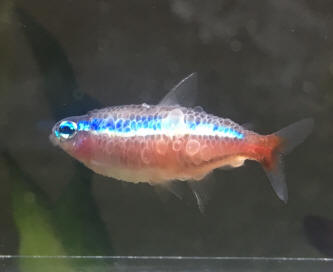
Cardinal tetra with balloon like scales
10/8/19
Dear WWM,
My cardinal developed a single, large, solid white, ball-like spot on its
flank about 2 weeks ago. It seemed completely active and normal otherwise
and the single spot was unlike anything I could find pictures or
descriptions of. After speaking to the fish store who didn't think it looked
fungal, I decided to watch and wait. The "spot" disappeared after 7 or 8
days. At this point the fish developed some fluffy cotton wool like patches
which seemed more classically fungal, and another in the shoal of 8
cardinals also seemed to show a small patch of something similar. I put the
two fish in a hospital tank and started to treat with a treatment called
Dessamoor, which contains copper sulphate, ethacridine lactate, Methylene
blue, and Acriflavine chloride. I followed the dosing instructions
accurately but when I checked in on the fish after about 4 or 5 hours (who
had seemed pretty normal behaviourally despite the cotton wool), they had
lost most of their colour. I guessed that if I left them there they would
die. So I put them back in my community aquarium and just watched. Over the
next week, the fish with the more obvious problems seemed to get more of the
growth. The other one's possible cotton wool tuft seemed to clear up. Then I
realised about two days ago that the scales of cardinal with the greater
problems seemed to have swollen up hideously - see picture attached. I'm not
sure when this started - it's possible that the 'cotton wool' appearance was
an early stage of the process. It was a bit difficult to see well in a well
planted 120 L tank.
I have now put this poor fish in a separate container (my "hospital" tank is
currently occupied by an aggressive dwarf gourami). I will buy a new
hospital tank for the cardinal tomorrow. I wanted to try salt but I've read
that cardinals tolerate it poorly. I have just bought Melafix and Pimafix
and was going to try these empirically - but having read other advice on
your website it seems these don't do anything. So I am at a loss. I have no
idea what to do or what the disease is. Oddly, the fish is active and until
I separated it was behaving as normal and eating well. Now it's stressed,
buzzing intermittently about its container, and won't eat, but I am pretty
sure the latter is stress-related rather than due to the illness. The 7
other cardinals all look fine, as do 3 corys and an Ancistrus. I've a couple
of dwarf gouramis as well. They occasionally seem to get agitated and brush
against plants as if they are itching these past 3 or 4 days. But they have
no external stigmata thus far, and most of the time look and behave normally
and seem happy enough.
Finally, the problems seemed to start when over a 2-month period I cleaned
the tank about 2 times only given holidays etc. Usually I do a partial water
change (approx 30%) weekly. After separating the cardinal a couple of days
back, in the absence of knowing what if anything to treat the main tank with
I did a 70% water change and rinsed all the plants, driftwood, gravel. My
water parameters are nitrite 0, nitrate 25 mg/L, general hardness >16°,
carbonate hardness 20°, pH 6.8, Cl2 0.
Please help...!
Sanjeeva
<I am not optimistic here. The bubbles are epidermal tissue that has
swollen up with tissue fluid, and now protrudes past the scales.
It's the sort of thing we'd call Dropsy if the swelling was internal.
There's no obvious solution here. A good antibiotic might be worth a shot.
The use of salt, at 2 gram/litre, is perfectly safe with Amazonian fish such
as Cardinals for short periods (a few days or weeks) and is actually much
less stressful than traditional medicines such as formalin and organic dyes.
It's a tough one. If this fish is stressed, then humanely destroying it will
be the best move. But if it's feeding and otherwise behaving normally, you
might elect to medicate. Good luck, Neale.>
|
 |
Issues With High pH, Suitable for Cardinals?
4/16/19
Dear WetWebMedia,
<Hello!>
Thanks for your advice from a couple of weeks ago. I have completed
cycling my tank but am currently having some further issues with my
tank's pH. I would appreciate your advice.
<Sure thing.>
I won't repeat all the details of my tank/water here but I guess the
pertinent info is as follows:
Tap water:
Total Ca/Mg: about 20 dGH
<A bit too high for Cardinals.>
Alkalinity: 216mg/l = 9.9 dKH
<Also too high.>
pH: about 7.3-7.8 after standing/aeration. I have noticed the tap pH has
increased in the last couple of days, perhaps the water company is
adding something to the water.
<Possibly. Best ask them.>
RO water:
No detectable hardness on my test kit.
pH similar to the tap water.
<Should be around 7; ideally exactly 7 if the RO filter is working
properly.>
Tank water:
Total Ca/Mg: about 7 dGH
Alkalinity: 108mg/l = 5 dKH
pH: 7.8-8.0 in the morning and up to 8.2-8.5 in the evening before the
lights dim.
<Interesting the pH goes up, but that can happen if there is a lot of
photosynthesis going on. Plants remove dissolved carbon dioxide during
photosynthesis, and since dissolved CO2 is carbonic acid, removing CO2
causes the pH to rise. Furthermore, some plants, such as Elodea and
Vallisneria, can absorb carbonate and bicarbonate ions from the water,
and use these as a carbon source for photosynthesis. It's called
'biogenic decalcification' and can cause the pH to drop as well. You
know plants are doing this in some cases because crystals of white
minerals (a bit like limescale) appear on the leaves.>
The tank is fully cycled but uninhabited. It does however contain a few
Cryptocorynes and a bundle of something that I think is Elodea that I
have left to float on the surface. These have been in the tank for a
week and a half and the Elodea in particular has taken off - some of the
roots that have grown from the stems have grown so fast that they have
actually reached the substrate and anchored themselves!
<Elodea is a classic "hard water" plant. It often does badly in soft and
acidic conditions. So if it thriving, chances are your water is (at
least) moderately hard and alkaline.>
I was aware it is a fast grower but it is astounding to see how vigorous
it is in reality!
<Indeed! Fast-growing plants can need to be cropped every week if they
are doing really well.>
The issue I am having is the elevated pH, despite using 50/50 RO/tap
water as you suggested. I had initially set the alkalinity to 9dKH with
additional baking soda but when I noticed the high pH I stopped this and
have now only used the RO/tap mix for water changes. This has not
lowered the pH although as expected the alkalinity is half that of the
tap water.
<Correct.>
As you may remember, I had planned to keep cardinal tetras (captive
bred) so I had the LFS test their system water. They report Ca/Mg at 5
dGH and alkalinity at 5 dGH, but their pH is 6.9-7.2 despite their using
a 50/50 RO/tap mix as well. Our tap water is unlikely to be much
different as the distance separating us is less than 5mi so I am unsure
why there should be such a large difference.
<See above re: photosynthesis. The use of a pH-controlled, automated
carbon dioxide fertilisation system can help here. But that's expensive
and fiddly to use.>
I can only think it is because either the LFS system contains a large
amount of organic acids due to their bioload (they don't use peat);
there is something in my water produced by the plants/algae/bogwood that
is alkaline in nature; or my plants deplete the CO2 in my tank water
faster than it replenishes at night (or all three).
<Ah; would bet on the third explanation.>
In any case, I am not sure what to do now.
<Well, one approach would be avoid using plants that grow too rapidly,
particularly those capable of remove carbonate and bicarbonate from the
system. So reduce the amount of Elodea, and Vallisneria if you use them.
Of course removing plants means algae can take over, so I'd suggest at
least some floating plants that use CO2 from the air but minerals from
the water.
These suppress algae quite effectively. Failing that, plants that are
less adapted to high hardness conditions, such as Hygrophila, might work
better.>
I am not keen to forcibly adjust the pH with acid or buffer and I also
want to avoid a CO2 system because it is a lot of work and I don't think
I am ready for that.
<Understood.>
I guess peat filtration might be an option but I am also reluctant to do
this as I understand this is hard to control, will deplete the
alkalinity, and the water staining may impact my plant growth. Do you
have any other suggestions for lowering the pH, or should I just leave
it alone and focus on keeping the alkalinity stable?
<As the tank stands now, pH is cycling in quite a normal way, up and
down through the day/night cycle. Alkaline condition fishes would handle
this fine. Your Cardinals mightn't be so happy though.>
If I am unable to lower the pH significantly, should I abandon my plan
to keep Cardinals?
<If you don't change the tank, perhaps you should try something better
suited to alkaline conditions.>
I haven't been able to find much on whether they can be kept in water
with this particular chemistry (low/medium hardness and alkalinity but
high pH) and I don't want to force my fish to live in conditions that
will make them unhappy or stressed. If you have any other suggestions
for similar shoaling fish that would be happier in these tank conditions
then I would also be grateful for those.
<It's actually not the pH that matters, but the hardness. Fish don't
really care about the pH anything like as much as people think. Provided
the hardness was low to medium, farmed Cardinals could adapt, regardless
of the slightly basic pH. I just can't be 100% sure.>
Many thanks for your time and advice.
Wesley
<Hope this helps. Neale.>
<<A brief/kibitzing note to look for cultured (orient) specimens rather
than wild-caught (Amazon) Cardinals here; as they may well be more
hard-water tolerant. BobF>>
Re: Issues With High pH, Suitable for Cardinals?
4/17/19
That has not entirely been my experience, Bob. What they gain in
adaptability, they seem to lose in exposure to Pleistophora. My avowed
preference is for wild-caught Cardinals, isolated from Neons at all
points, and maintained in soft to moderately soft, more or less acidic
to neutral water chemistry.
<I see; and only have much experience w/ ones produced in Singapore;
always disassociated w/ Neons>
If medium hardness (or more so) water is inescapable, there are much
better options: Pristella maxillaris, False Penguin Tetras, and Emperor
Tetras.
All these handle medium to hard water well. Do also rate the old-timey
Cherry Barb as an excellent Southeast Asian alternative.
Cheers, Neale
<Thank you (as always) for sharing. BobF>
cardinal tetras with clear blisters and tiny white worms
6/8/13
Hi Crew,
<Dan>
I have a planted 13 gallon tank....well established for 2 yrs. 2
of my 7 cardinal tetras have developed clear bubble like blisters
(mostly near their pectoral fins and mouths). On close inspection there
appear to be tiny white worms within or just adjacent to these blisters.
My other species (Ram, Corys, platy) are unaffected.
<Mmm, could be... Nematodes, other>
Others have posted about this problem on other websites but there are no
definitive opinions on diagnosis or treatment. I am suspecting
they are tiny roundworms. It is interesting that this seems
somewhat unique to cardinals.
<Yes; possibly>
Any suggestions would be appreciated. If I can get a good picture I will
send it.
<If you can, please do>
kind regards,
Dan
<I would try introducing an anthelminthic via foods... lacing ahead of
offering. Okay for all to consume. Likely Praziquantel would be my/your
first compound to trial. Bob Fenner>
|
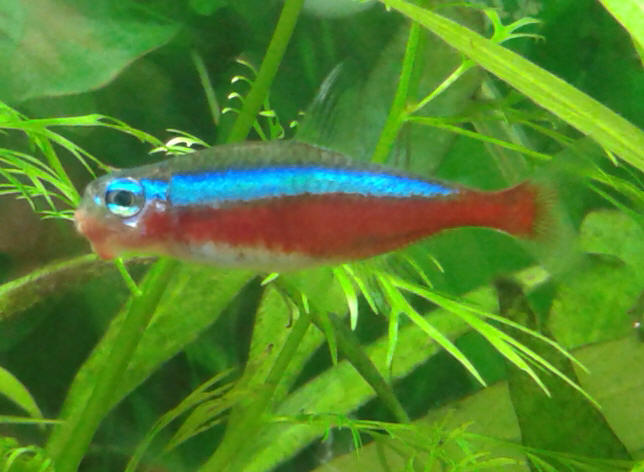
Cardinal tetra with tumor just below its mouth
3/3/13
Hi there www crew,
hope all is well with you.
I have attached photos of a cardinal tetra I have had for several
months.
It has been slowly developing a mass just below the mouth. He is
otherwise fine and eating well. The others in the shoal are fine.
It is a well established planted tank. Do you have any ideas as to a
specific diagnosis?
thanks
Dan
Toronto
<There's a small chance that this is Columnaris, in which case you could
treat with an appropriate medication (it's a gram-negative bacterium, so
choose with that in mind). Kanamycin and tetracycline are ideal. If the
fish can still feed, then any lasting damage after treatment will be
more cosmetic than anything else. But do bear in mind Columnaris is hard
to treat, harder than common Finrot. However, Columnaris usually comes
about quickly, rather than across many months, which would indeed seem
to suggest a cyst of some sort. These are untreatable, and if the fish
is suffering, it should be euthanised (a litre of aquarium water with 30
drops clove oil stirred into it makes a good "killing bath" that
destroys fish humanely).
Cheers, Neale.>
|
 |
A question for Mr. Neale Monks, Cardinal Tetras sys. (hard
water) (Bob F., maybe you know better?) <<>>
8/29/12
Dear Mr. Monks,
I have been reading up your article about hard water in freshwater
tanks:
http://www.wetwebmedia.com/fwsubwebindex/fwhardness.htm
This following passage caught my attention: "Dissection of neon and
cardinal tetras has revealed damaged kidneys in specimens kept in hard
water aquaria."
That cardinals and neons do best in soft water was part of my "basic
knowledge set" of aquarium keeping, but an online forum I have stumbled
across recently have very "respected" posters claiming that because they
have managed to keep cardinals alive for 6 years in hard water showing
nice colours, it proves that cardinal tetras do just fine in hard water.
<<Eugene; what is stated as "hard" water... alkalinity, GH, KH...?>>
This of course goes contrary to much of the advice given and data that
is often thrown around in literature, online or otherwise.
Could you perhaps help me out in this discussion by citing the source of
the findings of the dissection? It would be of great interest to me to
dig deeper and enrich the admittedly superficial knowledge I have as an
"ordinary" aquarist.
Best regards
Eugene
<Hello Eugene. I read the mentioning of the kidney problems in Cardinals
and Neons from an aquarium encyclopaedia of the 80s, but I can't
remember which one! I'm on vacation at the moment so can't look at my
collection of books to try to find the quote. But a quick look on Google
Books reveals a few mentions of the "calcium salts in the kidney"
problem with regard to Neons and Cardinals, for example in Baensch's
Aquarium Atlas 1 and a copy of Tropical Fish Hobbyist magazine from the
mid 80s (vol. 35, but can't tell which issue). This latter suggests the
calcium salts were spotted by one biologist who dissected the fish (the
source is mentioned as one "Dr Schubert" there) and then informed the
author of the TFH magazine article.
I don't have this magazine so can't read the whole article. Likely this
"factoid" has been repeated by other writers thereafter, as in
Freshwater Aquarium Models by John Tullock, first published in 2006. I
haven't been able to find anything specifically about this problem in
the modern scientific literature, though I haven't spent much time look
either! But with that said, a little time spent using the search terms
"Paracheirodon" and "hardness" on Google Scholar reveals some
interesting papers, such as a short paper called "The red neon,
Paracheirodon axelrodi (Schultz, 1956), is able to survive in distilled
water" that reports not only that the Cardinal can survive in pure water
for significant periods of time but breeds best when spawning takes
place in pure water! In any case, I believe that the poor survival rates
of Neons these days has less to do with water chemistry and more to do
with their poor quality and often poor care at all steps in the retail
and hobby chain. Neons can certainly do well at moderate hardness around
the 10-12 degree dH mark, which would be about pH 7-7.5 in most cases.
But Neons are bred to a price rather than a quality, overstocked on
farms and retail tanks, sold as beginners fish, and usually kept much
too warm all along the chain (they prefer cool water, 22-24 C/72-75 F).
Neon Tetra Disease may be a real threat in many cases -- it certainly
spreads very rapidly if infected fish are not immediately removed -- but
many sick fish seem to be suffering from opportunistic bacteria rather
than the Pleistophora parasite, in which case environmental stress is
surely a major factor. To be honest, I stopped recommending Neons many
years ago. On the other hand, Cardinals are largely wild-caught,
<<Considerable numbers are now captive produced... have seen many
millions in Singapore>>
and if kept in warm, soft, acidic water are not difficult to keep and
should live for 3-4 years without any problems at all. Hope this helps,
Neale.>
Re: Question and comment re A question for Mr. Neale Monks (Bob F.,
maybe you know better?) Cardinals, hard water 8/31/12
Thank you both for your help.
<Welcome Gene>
<<Eugene; what is stated as "hard" water... alkalinity, GH, KH...?>>
The claims come from somebody who kept Cardinals in KH 6, GH 14
water.
<Mmm, moderate...>
He keeps telling me because they lived for 6 years, the conclusion is
that they do fine in hard water.
<I'd agree>
The magazine Mr. Monks makes mention of "captive bred strains" of P.
axelrodi in the USSR, that they seem to be more resilient in this
regard.
<And to this. Those bred/reared and shipped through Singapore appear to
be fine in harder water>
I am in Berlin, Germany, and the ex-East Bloc is just a stone's throw
away, literally (Berlin wall and so on) - my local fish dealer told me
that he gets his Cardinals from the Czech Republic, but is not sure if
they are wild-caught imports or captive-bred.
<I want to make the comment that the last 10--20 years shows at
Nuremberg/Nurnberg, have shown many fishes, plants, live foods cultured
in the Czech Republic>
Could it be that the Czechs are carrying on the "tradition" of
successfully breeding Cardinals?
<I would not be surprised at all. In fact there are some Net reports of
such:
http://www.seriouslyfish.com/species/paracheirodon-axelrodi/
http://www.aquaticquotient.com/forum/showthread.php/59249-Wild-Cardinal-Tetra>
Best regards,
Eugene
<And you, Bob Fenner>
cardinal tetras in a discus tank 6/12/12
Hello,
<Hi there>
I just read your post regarding the keeping of cardinal tetras. So
you've never had any problems with your adult discus preying on your
cardinal tetras? Do you also keep angelfish with your discus?
Would they prey on your cardinals too?
<I have had both Cichlids eat cardinals if there was too large a size
discrepancy, not enough space, the cardinals added to the tank already
occupied, or the former especially hungry>
Regards,
Howie
<And you, Bob Fenner>
Research on Cardinal Tetra re: food and
light 3/2/12
Hi
<Lachlan>
I am doing research at the University of the Western Cape to see
if Cardinal Tetra can be trained to expect food just after a light has
been turned on in their tank. Please can you direct me I have had very
little success searching the web.
Thanks
Lachlan
www.artvarkie.co.za
<neat>
<Best for you to seek the assistance of a reference librarian, have
them help you formulate a computer-based bibliographic search strategy.
Please read here re: http://www.wetwebmedia.com/litsrchart.htm
Bob Fenner>
|
Re P. pulcher biffo debrief and now a
parasite! 2/20/12
Thanks a lot Neale,
<Ah, someone who can still spell "a lot"! Seems to
be increasingly rare these days>
You confirmed most of my suspicions about what may have been
going on re: the Kribs acting like Mr. and Mrs. Smith, plus its
interesting to know that Kribs operate effectively as harem
spawners in the wild.
<Quite so. Was a surprise to me when I learned about this. Do
try and find books such as "The Cichlid Aquarium" for
more.>
My pair split parental duties for the first set of fry amicably,
with the female taking the lead. So far this time around it's
definitely a female-only affair, with the male hiding in another
cave and pretty much keeping out of the way while his wounds
heal. He is getting better though. Hopefully he's learnt his
lesson to stay away for next time - amazing how the female really
beat up on him, even though he's half as big again as she
is.
<"The female of the species is more deadly than the
male...">
Another issue falling into the category of never-seen-before has
cropped up in my 15 gallon tank recently. Inhabitants are 13
Cardinal tetra and 3 Amano shrimp, parameters NH3 - 0, NO2 - 0,
NO3 - 10-15 ppm, pH 7.2, KH 3, 28 deg C. From consulting your
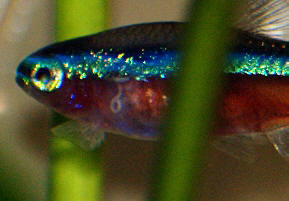
dichotomous key, I suspect one of the cardinals to have a
parasitic worm/fluke/fish louse attached to it (see picture).
Being white, not red, leads me to believe it's not an anchor
worm.
<I agree. A worm of some sort. Looks like a roundworm
(nematode).>
Regarding treatment, I'm thinking a 35g/L salt bath (as per
your article on the subject of salt use) OR some kind of
commercial medicine.
<Hmm, would try a seawater dip first, as you say. Usually
these worms can't reinfect fish in aquaria because of a
missing host. Some exceptions, like Camallanus, but worth a
shot.>
Can you recommend a course of action? Does the whole tank need
treating or just the individual fish?
<Individual fish in terms of dips; otherwise, a standard
anti-helminth like Praziquantel or Levamisole for the whole
tank.>
Thanks a heap crew.
All the best,
Duncan.
<Cheers, Neale.>
|
|
|
Cardinal tetra twitching 9/12/11
Hello there,
I first want to say I'm so glad to have come across this group.
There are tons out there but none are as right on as you guys (and
girls). So starting from the beginning, I have had my community tank
for about 4 years, 30 gallon. So the fish are not the originals but the
set up is.
Right now I have 6 cardinal tetras and 6 albino Corys (well 5 as of 3
days ago.) The one Cory that just past away was a baby, 4 months old.
He never grew over an inch long, which I thought was unusual though I
have nothing to base my opinion on. It was the only egg left that I
could save before mom and dad ate the rest. Needless to say it breaks
my heart to even talk about the loss of little Tiki. I only mention it
because it may be useful information for you to know.
<About it and you>
So about 2 weeks ago I transferred everyone and everything to a new
tank, a 45 gallon. I even waited to change the filter to make sure
nothing went wrong. I only use R.O. water,
<Not suitable>
rime for water changes, and Seachem mineral powder to add KH and GH to
the water. I never add aquarium salt due to the Corys, (always thought
they could not tolerate it, is that true?)
<Some species to some extent>
My readings right after Tiki's death were 0 Amm, 0 Nitrites, and 10
or 20 Nitrates (I had a hard time reading the difference on the color
chart) the GH 0-50 and KH 3. I know that's a little too low but the
mineral supplement says not to go by the reading because some of GH/KH
are not detectable, does that sound right?
<... no. There is hardness or not... measurable>
My problem is two of my cardinals seem to be stressed, they are opening
and closing their mouths more than the others and have faster more jerk
like movements than normal, almost like they have to paddle more to
stay horizontal.
<The RO>
They are also the smallest, males maybe?
<Nah>
I have had all six of the cardinals for 1.5 years and the Corys for
about a year. Any ideas what could be going on? Thanks so much for
taking the time to help all us fish lovers out!
Katie
<Am surprised to find detectable alkalinity w/ a system w/ reverse
osmosis water in use... What shall we say to you? What manner of
instruction might serve to waken to your consciousness... finishing Bob
Fenner>
Re: Cardinal tetra twitching 9/13/2011
Thanks much Bob,
I kind of suspected the mineral ratio could be a problem. I used to
have my aquarium professionally cleaned so I was following
instruction...so I thought, obviously I missed a step somewhere. I
thought they used RO with Seachem Equilibrium or sometimes Kent RO
right. (I put in 1 teaspoon for every 5gallons). Are you thinking that
is why my albino Cory baby never grew?
<Could well be>
I am going to do another water change today. I got some hard water from
the well by bypassing the softener and it's testing 25°
GH and over 400ppm KH. Would you recommend a 1 to 10 ratio from here on
out with hard and RO combined or should I just add a gallon every
fourth change?
<The latter would be my approach>
Thanks again - Katie
<Welcome. BobF>
Sickly Cardinal Tetras (was: Re: Panther Crab)
2/19/11
Ok well, you probably remember when I sent a question regarding my
crabs death, but now my Neons are dying too!
<Oh dear.>
Before my crab died he was acting very strangely, usually he would
always be hiding and never would come out while any light was on. He
would wait for absolute darkness. Then for the last maybe five days of
his life he was always out in the light, and he would just climb this
plant or a plant that looked like this one (Picture at top).
<Nothing attached. Do remember to keep images small, 500 KB or
so.>
He was decently large and the plant was not too supportive so I
don't know how he was supported by it, but that's all he would
do. Sit at the top of that plant day and night and do literally nothing
else.
<Trying to get out'¦?>
Then he died and fell to the bottom of the tank. I then bought a moss
ball since it looked quite nice, but it ended up being full of mold and
was disintegrating, so I threw it out.
<Moss Balls do need quite specific conditions -- cold not tropical
temperatures, lots of water circulation, and medium to bright
light.>
About a week after that happened all my fish (except Crayfish which are
seeming to be unaffected) were growing green dots on them! All of those
smaller red fish that I had before have disappeared before this
happened strangely. I don't know how they did it since my crab
couldn't of eaten him and neither could my crayfish have since they
are small crayfish that don't even have claws. The only other
explanation is that my fish turned into cannibals'¦.
<No, but once sick or dead, they may well be nibbled on by
others.>
Already maybe 3 tetras have died and one looks like it is on the verge
of death, since its body is turning a glowing green which happens
before they die and is just floating around and swimming upside down,
not really caring what direction he goes in. What exactly is going on,
could it of come from my crab? Was he already infected and that was the
cause of his death? Or could of the disease come from the dead crab?
Was it my moss ball? If not what other objects could it of been, and
how can I fix it?
<Almost certainly your aquarium simply isn't being maintained
properly. Can't offer anything useful without data. For now,
let's review the needs of Cardinal Tetras. Firstly, the water must
be very soft, 1-3 degrees dH is ideal, and no more than 10 degrees dH
at the most. The pH needs to be on the acidic side, 6.0-7.0, but NEVER
change the pH without first lowering the hardness (including the
carbonate hardness) AND fully understanding what general hardness,
carbonate hardness, and pH are all about. Temperature should be
medium-high, around 28 C/82 is ideal. Water circulation should be very
gentle, preferably air-powered. Any aquarium suitable for Crayfish will
be unsuitable for Cardinals because they need COMPLETELY different
things. That your Crayfish is still healthy may be a clue. Hope this
clears things up for you. Cheers, Neale.>
parasitic worm infecting cardinal tetras? (RMF, other
ideas?)<<Sporozoans, Microsporideans?>>
2/19/11
Dear Crew,
<Hello,>
Hoping you can help me - I've scoured the site and can't find
anything that accurately describes the situation we currently have.
Last night I noticed that one of my cardinal tetras had a fluid filed
sac protruding from just underneath the gills on one side,
<Do occasionally happen, for no obvious reason I'm aware of,
though the usual culprits such as physical damage, stress, and
parasites of various sorts can be considered.>
the fish doesn't seem to be in any discomfort and we observed it
feeding ok, however on closer inspection of the other cardinals
we've noticed that three of them appear to be affected by some form
of worm - the fish are each showing one large 'blister' of
around 3mm on their sides which appear to have a thin white worm
inside, no more than 1mm in diameter. We tried unsuccessfully to remove
the affected individuals from the tank last night, when examining the
fish this morning one of the blisters appears to have ruptured as it
now resembles a wound rather than a blister, and I noticed one of the
worms attached to another tetra, but without the surrounding
blister.
<Indeed. My guess would be that the blister rather than the
"worm" will be the healthcare issue, because most worm-like
infections can't actually complete their life cycle under aquarium
conditions. They need intermediate hosts like birds or snails for that
to happen.>
The tank is a 500l (134 US gallons, or 110 UK gallons) tropical
freshwater system, heavily planted and is maintained at 25-26 Celsius
(77-78.8 F). Ammonia, nitrite and nitrate are all undetectable, and we
do 15% water changes weekly (including gravel siphoning). The current
stock are:
shoal of mixed tetras (15 cardinal,
<Angelfish food.>
5 lemon, 5 Pristellas, 3 Congo)
10 juvenile angelfish (1.5 inch body length)
6 Corydoras catfish
6 Bristlenose catfish
So far the only fish that seem affected are the cardinals but I suspect
if it is a parasite without a specific host then it will spread to the
other fish in the tank.
<Unlikely.>
Currently, the plan is to increase the number of water changes to
reduce parasite load in the tank
<Water changes are a good idea for other reasons, but won't
really dilute the concentration of parasites in any meaningful
way.>
however am not sure whether we should also treat the tank with an
anti-parasitic medication as well, and if so what would be best?
We've not been able to get a photo of the affected fish but hoping
you might be able to offer some advice without one'¦
Here's hoping,
Carolyn
<Would recommend nothing more than acting as per physical damage for
now: observe the fish, and if they show signs of their wounds not
healing, medicate with something like the excellent eSHa 2000
Finrot/Fungus medication. Without a positive ID on the parasite,
medicating further would likely be pointless and could well stress the
fish still further. Cheers, Neale.>
Update on sick Cardinal
1/20/11
As I was typing my first email, my Cardinal died. I found him floating
in the Hornwort...which maybe is a blessing because no one got a chance
to snack on him. I have been reading fish diseases/symptoms all morning
and I can't figure out what it could have been. He wasn't
eating at all either.
Please, if anyone has any ideas what it could be. Nothing new has been
added to the tank in months..the last was a batch of cardinals and
everyone was ok. I'm am so upset and worried I may lose my entire
school of Cardinals.
Thanks so much for your time,
Laurie
<Hello Laurie. Cardinal Tetras don't live long in hard, alkaline
water. So first make sure your water is soft and acidic. Ideally, 2-5
degrees dH, pH 6.5. At the hardest, the water should be 10 degrees dH,
pH 7. Anything harder than that, i.e., moderately hard or hard, and the
Cardinals will die off one by one, usually across a few months.
Secondly, they are somewhat prone to Neon Tetra Disease. Perhaps less
so than Neons, but prone nonetheless. There is no cure. The disease is
transmitted by healthy fish nibbling on dying or dead fish. Remove
sickly fish at once, and destroy humanely (30 drops of clove oil in a
litre of aquarium water works well; see the WWM article on Euthanasia
for more). Cheers, Neale.>
... FW... pH... --
1/20/11
Dear Neale,
My ph is generally between 6 and 6.5.
<Do check the pH is stable'¦ biological filter bacteria
aren't happy below pH 6.5, and from 6.0 downwards may not work at
all. The use of a pH buffer to fix the pH at 6.5 is useful.>
I use a mix of RO water and tap. Any idea what the black splotches
could be, as per my first note?
<Black blotches are commonly ammonia burns'¦ possible if
the biological filter is working poorly or intermittently. Do see
ammonia burns on Goldfish for examples. Very common in bowls and
unfiltered tanks. Otherwise some sort of secondary infection perhaps.
Not sure. Black patches aren't a common symptom. Almost all the
Cardinals I've seen die have done so through wrong water chemistry
and/or Neon Tetra Disease. Stress from handling, tankmates, etc., can
also be factors. Do check water temperature is on the muggy side, 28 C
is about perfect, and that water current is minimal. Overhead light
should be filtered through floating plants or otherwise minimal.
Cardinals come from sluggish, shady streams and react badly to bright,
open, fast-water maintenance. Despite their wide sale, they adapt
poorly to the average community tank, hence their reputation as being
"delicate" fish.>
I'm sick over this,
<Agreed, and I have largely given up with this species and even more
so the Neon as far too difficult to maintain.>
Thanks,
Laurie
<Cheers, Neale.>
my cardinal tetra is sick 3/8/10
Hi , I just bought 15 cardinal tetras for my 25 gallon heavily planted
aquarium I already had 17 neon's
<Neons generally don't like the warm water required by Gouramis,
so be careful here. Neons are happiest at 22-24 C, whereas Dwarf
Gouramis need around 28 C. It's hard to please them both at the
same time, one reason
both species are often considered "delicate" fish.>
and 1 dwarf Gourami ( I think I spelled Gourami wrong),
<Indeed, it's Gourami.>
but I put the cardinal's in the tank and at first I thought they
were just stressed because being in a new tank and 1 died shortly
<Cardinals also need warm water, and shouldn't be combined with
Neons. Cardinals need soft, acidic water at about 28 C, and Neons
prefer cooler water and more soft to moderately hard, slightly acidic
to neutral water.>
and 3 more got sick they started to get distressed and 2 more died 1 of
them before I quarantined them and 1 after
<If these fish are dying within days of purchase, they may have been
in bad shape before you bought them. But that said, if your aquarium is
very different in water chemistry and water quality to the conditions
in the retailer's tank, then moving them could be stressful. Just
to recap, you need 0 ammonia and 0 nitrite.>
it looked like the scales around their head and gill's were coming
loose, the 1 is still alive and is no longer distressed an has colored
up, but, it still has the weird stuff on its gills and head , it does
not look like worms or neon tetra disease and it has me stumped !
Please Help !
<Difficult to say anything sensible without a photo. Cardinals
generally don't get Neon Tetra Disease, though it happens
sometimes. Cardinals are sensitive to poor water quality, and they
never do well in hard water. If you decide to send a photo, to
remember, keep photos to 500 KB. That may mean you need to resize them
in iPhoto or whatever.>
No other fish have it, but I'd like to have an idea what it is and
how I can treat it just in case it show's up on any other fish !
Thanks.
<Review water quality, chemistry. Check water temperature. Do make
sure the Cardinals aren't being attacked or bullied. Cheers,
Neale.>
re: my cardinal tetra is sick 3/8/10
Hey, thanks for all the tips they were very helpful .
<Good.>
I added some salt and sodium bicarbonate an Epsom salt to the
quarantine tank (my grandpas advice he has had tanks all his life and
has bread neon's and cardinals and other freshwater fish)
<He bred Cardinals? That's pretty impressive! In any case, salt
may have a slight beneficial effect, but sodium bicarbonate hardens
water, and that's usually a bad thing so far as Cardinals and Neons
are concerned. If your
water was insanely soft, and pH was bouncing around wildly, then
hardening it a bit would help. But otherwise neither sodium bicarbonate
nor Epsom salt serve any great purpose.
http://www.wetwebmedia.com/FWsubwebindex/fwh2oquality.htm
>
and the fish seems to be getting better, the weird scales or whatever
they are starting to go away the fish is more active ! If the stuff
comes back I'll send a Photo and see what your thoughts are.
<OK.>
Thanks again!
<Cheers, Neale.>
Cardinal tetra gaping 2/4/2010
Dear Crew,
<Hello,>
Wondered if you could shed some light on a problem I've noticed
with one of my cardinal tetras - for the last few weeks the fish has
been gaping and doesn't close its mouth, although it appears to be
feeding without problems.
<Yes, have seen this problem. Precise causes unclear to me. Possibly
genetic if the tetra has always been like this, the lower jaw simply
not properly developed. While most Cardinals were wild-caught in the
past, breeding on farms is increasing, and like Neons, farms tend to
produce fish to a price rather than a standard.>
I noticed the same problem with another cardinal about 3 weeks ago,
however that fish was in a bad way (swollen abdomen although scales not
sticking out, seemed to lack balance and died very quickly after the
problem first
occurred).
<The thing with Cardinals is that they have very specific needs.
They must be kept in soft water, and simply don't do well in hard
water. They also need quite warm water. In this regard they're the
opposite of Neons, which
need quite cool water. You're aiming for a pH around 6.5, hardness
around 5 degrees dH and certainly no more than 10 degrees dH. The
temperature should be around 28 C.>
The cardinals live in a 110gallon tank with a variety of other tetras
(10 head and tail light tetra, 10 Pristella tetra, 20 green neon
tetras), two dwarf bristle nosed catfish and 7 Cory catfish.
<Corydoras spp. don't like such warm water, with the exception
of Corydoras sterbai, so be careful here. If they're constantly
darting to the surface to gulp air, that means they're feeling
stressed.>
I've not seen any aggression between any of the tankmates, they all
feed well and all swim to the side of the tank when anyone passes by so
they're all good and alert! Ammonia is 0, nitrite also 0 and
nitrate currently at 5ppm, the tank is heavily planted with some bog
wood to provide cover and is kept at a temperature of 28C (82F - we
have a small group of young discus currently finishing QT before being
added, however they're staying there till I know everything is
well!).
<OK.>
Did wonder if the two affected fish may have fought each other and
damaged their mouths as a result? The problem first surfaced while they
were living in a 40l Nano while the larger system was being set up and
cycled.
<It's possible this is related to exposure to poor water
quality, but to be honest I don't think so. Usually fish with
dislocated jaws get into that state by fighting, but it's hard to
imagine that's the case with Cardinals.
In any case, there's no "treatment" as such, and if the
fish can't feed, it'll need to be euthanised. Otherwise,
it's a case of wait for the fish to get better by itself, perhaps
as whatever damage or swelling gets undone.>
Hope this all makes sense,
Carolyn
<Cheers, Neale.>
Shrimp and cardinal tetras 12/6/09
Dear aqua experts,
<Hello Janet,>
I have only found conflicting advice in trying to find the answer to my
question, so I come to you to get my answer. I have 2 established
freshwater tanks. The 10 gallon houses 14 red cherry and Amano shrimp
as well as 10 zebra Danios that are about 6 weeks old and growing.
<Very good.>
The 20 gallon houses 3 zebra Danios and 6 cardinal tetras.
<I'd up the number of Cardinals if you could. I'd also make
the observation that Danios prefer cooler water to the Cardinals, so
one or other group of fish isn't going to be completely happy.
25-26 C would be about the best
compromise, but even then, not ideal.>
I would like to move the Danio juveniles into the 20 gallon with their
parents and have a Danio-only tank.
<Very wise. Danios like things on the cool side, around 22-24
C.>
I would like to move the cardinals into the shrimp tank.
<Okay.>
Both tanks are planted, the 10 gallon heavily. I'm sure (?) the
shrimp are very happy in their current tank with only some baby Danios
to keep them company. Can I add the cardinals to the shrimp tank (after
I move the baby
Danios) without the shrimp becoming reclusive, boring, anxious and
eaten?
<Yes; Cardinals pose minimal threat to the Shrimps, even Cherry
Shrimps, and the two species will coexist nicely. Since Amano shrimps
like things a little on the cool side, they're ideally kept with
Danios rather than Cardinals.>
Thank you all knowing ones.
Janet
<Cheers, Neale.>
Good tankmates for Cardinal tetras
10/8/09
Hi: I have 12 Cardinal tetras and 1 Bristlenose Pleco in a 37 gallon
planted tank. PH in the tank is 6.5 and the temperature is 80-82
degrees Fahrenheit.
<Sounds great.>
I'm looking for tankmates that are a little more active than the
Cardinals but won't eat my tetras or harass them or overload my
tank.
<Indeed. Good choices might be found among the dwarf cichlids.
I'd avoid Mikrogeophagus ramirezi because the quality of the stock
sold in pet stores is incredibly low, and instead look at things like
Apistogramma cacatuoides, a wonderful little cichlid that does fine up
to 28 C/82 F.
Apistogramma cacatuoides is available in several colour varieties such
as "triple red" and "half orange". It is also,
exceptionally for Apistogramma, relatively hardy and easily maintained.
Apistogramma are generally harem fish, so to avoid chaos and
aggression, keep one male to two or more females. Each specimen will
expect a cave of its own; flower pots, hollow ornaments, and halved
coconut shells all work well.>
My LFS has Electric Blue Jack Dempsey's. They told me the those
would be o.k.
<The retailer who told you this is an idiot. Rocio octofasciata is
an extremely aggressive hard water cichlid in no way suitable for a
planted community aquarium like yours.>
tankmates for the Cardinals but it seems they would eat them when they
were full grown.
<Among other potential problems, yes indeed...>
Can you recommend something?
Thanks for your time.
Marilyn V.
<Cheers, Neale.>
Re: Good tankmates for Cardinal tetras
10/9/09
Thanks Neale. Those are beautiful fish. Can't wait to get some.
<Yes, they are lovely fish. Do take some time to hunt down good
quality stock. Some of the specialist cichlid forums and clubs in your
particular part of the world may be able to help you find good breeders
and
retailers.>
Marilyn
<Cheers, Neale.>
Paracheirodon axelrodi question, stkg.
9/21/09
Hi! I plan to set up a Bow front 16 gallon (tall) tank with live plants
and a driftwood centerpiece, to serve as a species tank (except for a
black Kuhli loach) for Cardinal tetras. My question is, how many would
be suitable to add, and what would be more suitable, Cardinals or
Neons? And what kind of plants would be best to add? (My pH. s around
7.5-8.0, with lights that came with the tank. Thanks! -Jack
<I'd go with Cardinals. Two reasons. Firstly, they do better in
warm water than Neons, which prefer cooler water (around 22-24 C) than
Kuhli loaches enjoy. Secondly, they're generally hardier, partly
because they're wild-caught rather than farmed (and the quality of
farmed Neons varies wildly) and partly because they don't seem to
prone to Neon Tetra Disease.
Allow about one Cardinal per gallon. If all seems well, you could even
up this a bit, to around 20. Cheers, Neale.>
Did Neale write a Cardinal Tetra article?
5/4/09
Hi! Did Neale write an article about Cardinal Tetras in one of the
American fish magazines a month or so back? I am wondering if I am
missing an issue.
Thanks,
Michelle
<Hi Michelle. Yes, I did write an article on Cardinals (and I think
Neons too) for 'Aquarium Fish International' magazine, an
American magazine based in California. It was scheduled for the March
2009 issue. Cheers, Neale.>
Re: Did Neale write a Cardinal Tetra article?
5/4/09
Thanks for the reply! I'm going to give them a shout.
Cheers,
Michelle
<Hi Michelle. I suspect the issue with the article might be in the
shops now; some copies of the magazine have apparently been delivered
to my 'back-up' address in the US. Cheers, Neale.>
Keeping Rams and Neon/cardinal tetras. Sel., sys.
mostly 1/24/09 I have a basement tank, 36/ 18 by 14, 52
gallons. I plan on using a river sand bottom, <Soft sand will be
appreciated; the name Mikrogeophagus means "little
Eartheater", and like the true Geophagines cichlids, these fish
(in the wild) sift the sand for algae, invertebrates and decaying
organic material.> my tap pH is around 6.8 to 7. but I plan on using
RO water (With a ph of 6.0), they make for you at World of fish, (its
voted best LFS in twin cities). At the store they sell blue angel rams,
$30 a pair, from a local breeder. These fish look much better, more
vigorous and brightly colored then the regular rams they also sell
(blue/German) they keep the angel rams in RO water but the others they
do not. <Locally bred fish infinitely better and worth the expense.
Farmed Mikrogeophagus ramirezi are of variable quality and often
"juiced" with hormones and antibiotics; consequently their
survival rate after shipping is dismal, even though they look nice in
the shops.> The tank they are in is labeled NFS, as they are
treating for ich, but all fish on the mend, no signs of ich on the rams
at all (Corys had it), rams are showing territorial/natural behavior
and they use the same RO, water I'll be using if I get them, at the
shop. <If you have locally bred fish available, buying farmed
specimens would be dumb.> I'm planning on buying a high intense
light, and planting with live plants and driftwood. What kinds of plant
do Rams like or that grow well in their water? <In the wild they
live in sun-baked shallow pools with mostly amphibious vegetation that
mostly grows above the waterline. So there's not really much
"authentic" you can go for. Instead, concentrate on species
that will tolerate the conditions in the aquarium. The very high
temperature (minimum 28 C/82 F) will stress some plant species, while
the necessary soft water will stress others. To be honest, I'd
probably go with floating plants initially, such as the Limnobium, and
leave rocks and hollow ornaments across the bottom for the fish. If you
wanted rooted plants, buy species in pots that you can easily fertilise
with tablets since the sand itself will contain no nutrients (unless
you put a layer of pond soil or whatever underneath the sand).
Cryptocoryne species would be ideal.> What are good foods for these
guys? <These are quite fussy fish that tend to have favourite foods.
I've never seen Mikrogeophagus show much interest in flake or
pellets, though I dare say some will eat the stuff. Mostly they seem to
require a varied diet of live or (wet) frozen foods: bloodworms,
Glassworms, mosquito larvae, daphnia, etc. Remember to vary the diet;
if they get just bloodworms, you're setting them up for a vitamin
deficiency in the long term.> I talked to the staff at the LFS and
they said add tetras first after cycling then wait a month or more
before aiding rams/ change like 5 to 10% of the water a week.
<Likely far too little in terms of water changes. Mikrogeophagus
ramirezi are acutely sensitive to nitrate, and tend to develop things
like Hexamita at the first sniff of high levels of nitrate. In part
this is surely why they die so quickly in most community tanks. So
rather than estimating a water change, grab a nitrate kit and keep
track of the nitrate level each week for the first few months.
You'll get a picture of how quickly nitrate levels rise, and can
act accordingly. You're aiming for under 20 mg/l nitrate, and
ideally 0-10 mg/l. Part of this is avoiding overfeeding: these fish
need only small amounts of food to do well.> I was think 1 or 2
pairs of rams and 12 to 15 tetras in a school. <Ok.> I was
wondering if a school of neon, rummy nose or cardinal tetras would be
good dithers ? Are there any other good tetra-like fish to keep with
them or is it best to keep the Angel rams separate? <Neons need cool
water, so they're not an option for use alongside the warmth-loving
Mikrogeophagus ramirezi. Cardinals can work well, and probably make the
best bet. Rummynose tetras would be good in some ways, but they're
hyperactive fish, and need to be kept in a decent sized group to school
properly; if they just mill about looking nervous, that'll have the
reverse effect on your Mikrogeophagus. If you don't mind switching
continents, Harlequin Rasboras work well too.> I do understand the
fancy type of rams are less hardy but I will be moving in five years +
anyway.( though I am planning on taking the tank with) <You'd be
lucky if most of the farmed specimens last 5 months, to be honest. They
really are abysmally poor fish. I wouldn't touch them with a barge
pole. Like pouring money down a drain.> thanks <Cheers,
Neale.>
Re: Keeping Rams and Neon/cardinal tetras. 1/24/09
Thanks I will research more, I'll also make a video of it- the tank
I mean. <Sounds good. Look forward to hearing/seeing more in due
course. Do try and pick up one of the books on Dwarf Cichlids, there
are many. Even the old TFH one by Jorg Vierke (used, less than two
dollars on Amazon) will be a useful read in terms of understanding the
ecology of these fish in the wild and their specific requirements in
captivity. Mikrogeophagus ramirezi are nice fish, but the reality is
most people fail to keep them alive for more than a few months, at
best. Cheers, Neale.>
Re: Keeping Rams and Neon/cardinal tetras. 1/24/09
When/if I get them should I use jungle parasite clear on them when they
go into the main tank, or should I use a separate, tank.?
<"Scattergun" approaches to healthcare rarely work.
Quarantine all new livestock, and if signs of illness appear, diagnose
and treat as required. The main killer with Mikrogeophagus ramirezi is
Hexamita, and it is likely latent in all specimens, certainly those
produced on fish farms. Hexamita becomes a problem when the fish are
kept too cold, exposed to high nitrates, given a poor diet.> Also is
it better to use fake plants then live? <No difference so far as the
fish are concerned. Use whichever you want.> I know if I did so it
would save on lighting and help reduce care in an already
"Demanding" setup. <Cichlids would prefer tanks without
lights at all, so do whatever you want so long as there are shady
places for the fish to swim. Cheers, Neale.>
Re: Keeping Rams and Neon/cardinal tetras, Ram
sel. 1/28/09 Do you know of any local Ram
breeders that sell decent/or excellent quality rams? I'm going to
wait a few years before getting them, but I wanted to look for
breeders. I live in St Paul MN. <Well, since I live in
Hertfordshire, England, I'm afraid I can't comment on the local
fish breeders in Minnesota. Obviously the first step is to find your
city or state fish or aquarium club, and get in touch with them. There
is certainly a Minnesota Aquarium Society for example:
http://www.mn-aquarium.org/ Join up and attend their meetings.
They'll surely be able to get you in touch with people in your area
who breed fish. One of the great things about this approach is that the
people in aquarium clubs are typically advanced hobbyists, and so are
likely to be breeding fish you've never heard of, or don't see
in aquarium shops. There are lots and lots of lovely dwarf cichlids
that rarely get traded, so you might find some real treasures this way.
Cheers, Neale.>
|
Sick Cardinal Tetra, env. likely
10/22/08 Dear Crew: I always appreciate your articles
and help from time to time. I hope you can help me again. <I
as well> I've looked and looked and can find nothing that
helps me identify what's wrong with one of my cardinals. In a
10 gallon tank, I have: <Mmm, small/er volumes are hard to
keep stable, optimized... a bigger tank would be better> 9
cardinals - most are about 1.5 inches. Have had most of these
since July of this year, when this tank was established. 2
Otocinclus 2 Corydoras julii Medium-not quite heavily planted
with a little driftwood Aquaclear 5-20 filter -well-maintained
Ammonia 0 Nitrates 0 Nitrites 0 pH 7.8 always tap water is
usually 8 <Yikes... this is too high... and likely
accommodated with high alkalinity. The fish life you list really
appreciates lower pH, hardness... See WWM, Fishbase.org...>
Temp 80 F Water changes 40% min at least once a week - usually
twice a week. <Mmm, I would restrict such change out
percentages to no more than 25%... use water that has been set
out a few days to a week ahead of time before use... Again, gone
over on WWM> Menu - fed twice a day - variety of flake, Hikari
micro pellets, Tetra veggie crisps, Aquadyne flakes, live baby
brine shrimp and the occasional crushed snail that shows up.
Today, I noticed a orange-red spot near the head/cheek of one of
the cardinals. It looks like a cyst of some sort - almost like an
angry pimple. The spot protrudes from the skin and is about 2-3mm
in circumference. The spot seems kind of clear or translucent
(not fuzzy like fungus) and the center of the spot is more orange
in color - like the head" of the pimple - like a bullseye
with just one outer circle. <Mmmm> I have treated this tank
for Ich in the past and I don't think this is Ich. No white
spots on any of the fish. No flashing or fin clamping. Aside from
the spot, they all seem fine. None of the other fish show any
signs of it - yet. Usually very healthy. <Could easily be
"something" brought in with the fish, even
non-pathogenic> Nothing out of the ordinary - except about 4
days ago - our temp dropped a bit (60's at night in Orlando,
FL) and I had to fiddle with the thermostat to get it to maintain
at 79-80 F.. I usually maintain at 79, but the fluorescent
compacts heat up the water too much, so I back off the heater.
But I had to raise the heater this week as the night temps were
too low. <Mmm... what wattage is this heater? They're
thermostatic... should keep any given temperature... not add to
outside heat sources> One morning the tank temp was 76 (before
lights on) and then by late afternoon, it was 82. So I do know
they have been stressed, but they seemed OK and I didn't
notice anything until today. Temp has been stable again at 79 for
the past 2 days. I see in some articles by Alesia Benedict that
Cardinals like warmer temps. What is the ideal temp for them?
<http://wetwebmedia.com/FWSubWebIndex/tetragonopterinae.htm
23-27 C.> Do you know what this is - and how do I get rid of
it? <Mmm, nope... might help to see a pic, but likely would
require dissection, microscopic examination> Any help you can
offer is appreciated. With kind regards, Sandy <I would not
try to "treat" this with a "medicine"
Sandy... Instead, look to improving the environment here. See WWM
re water hardness... perhaps starting here:
http://wetwebmedia.com/FWSubWebIndex/fwsoftness.htm and the
linked files above. Bob Fenner>
Re: Sick Cardinal Tetra 10/22/08 Thanks Bob.
<Welcome Sandy> The spot is actually just behind his gill
cover. Today, still none of the other fish seem affected. I do
notice a small dull patch on the opposite side of this same fish
- like something starting there as well. Tried to get a picture,
but none are focused enough to show anything you could really
see. <Hard to do, I know. Have seen similar markings many
times on this species> I read the whole article and the other
webpage. Thank you. My big problem is that our water supply is
also buffered. <Mmm, best to start with cleaner water from
filtration then... RO, perhaps RO/DI... and add just some (likely
a tenth) of regular tap water to this> So any attempt to
artificially adjust the pH would take a lot of adjustment, on a
regular basis, and with each water change, and would likely
stress the fish more than having them acclimate to the water
supply. <A valid concern... but not hard to adapt/adopt a
simple water softening routine... again, simply using a mix of
cleaned up tap with just some regular re-added for minor
buffering> These Cardinals - I was told - were farm raised in
Florida and so should be "used to" our water - as much
as they can, I suppose. <Mmm, I fully suspect that the water
used for this species, and Discus... is actually greatly
softened, has much of the TDS removed to facilitate spawning,
rearing> I have looked into getting peat inserts for the
filter and can find nothing in my area. Do you have any practical
suggestions? <Again... reverse osmosis... We have "liquid
rock" water here in S. Cal. as well and use such for most
potable, cooking, and some house plant needs... the tap is quite
unpalatable... I would argue, not really healthy for human
use> The driftwood has been in for over a month and is
releasing some tannins, as water changes show slightly yellowed
water, but not enough to affect the pH. <It would do so if
there was not so much alkaline reserve... again, captive systems
are reductive... they tend to "go" acidic with time...
But not with such high alkalinity> Will back off the water
changes as suggested and will try to use aged water as much as
possible. <Good> I would like to move these fish to a 20
long, and just keep this 10 as a quarantine/hospital tank. but
that will take a while to accomplish. We'll have to live with
this set up for at least a few months. Heater is a Marineland
Stealth Submersible 50W. <Mmm... I would move up to a hundred
watter here... and use it in your upcoming 20 long...> Do you
think a salt dip would help - or hurt this little guy?
<Hurt> Or do nothing and watch? <This is what I would
do. BobF> Thanks again, Sandy
Re: Sick Cardinal Tetra 10/24/08
OK to all. Thanks again much. Will have to wait and see about the
RO
system though.
Warm Regards,
Sandy
<RO devices of a few models are a wave of the future... Very
easy to install, operate... Useful for human uses to eliminate
the vast majority of contaminant issues. Bob Fenner, who has used
them for decades>
|
Tetras (Neons & cardinals) dying one by one in the dark in a
planted aq. 8/7/08 I hope you can help. Please forgive the
length, but I wanted to give you all the info I could think of.
<OK.> 30g L, been up for about 8 weeks (cycled with seed filter
from friends established tank), custom hood with AHsupply 96w CF bulb
(3.2W/gal), eco-complete substrate mixed with fine gravel. Fluval 205
filter. Stealth 100W heater. <All sounds good.> Tank has the
following plants (most of which are thriving): Cabomba (2 bunches of 5
stems each), Moneywort (4 bunches of 3 stems each), Melon Sword, Chain
sword (just a baby), Microsword (2sq in patch), Ruffle plant, Wisteria
(just finally establishing its fine submerged leaves - 1 bunch of 3-4
stems), Broad Ludwigia (1 bunch of 3-4 stems), small Java fern, small
Anubias nana, and a large bunch (about 15-20 long stems) of Anacharis
(from a friends established tank). Sounds crowded, but you'd be
surprised how open it really still is. <At least some get pretty big
-- Echinodorus osiris for example will quickly take over a 30 gallon
tank if it thrives; mature plants can be 50 cm tall and 30 cm across!
Echinodorus martii likewise.> To this there's the following
fish: 5 spotted Corys, 6 Otos, 3 "mystery" snails, 6 zebra
Danios, and originally 8 each Neons and cardinal tetras. <Right,
well one issue here will be temperature. To wit, Neons prefer cool
water, 20-24 degrees C; Cardinals need warm water, 25-28 C. There's
no "happy medium" at which both can be expected to do
perfectly well. Corydoras, Otocinclus and Danios are also cool-tropical
fish, and will thrive at 20-24 C (I'd go for 22 C). But that's
too low for the Cardinals. So one way or another, at least some fish
are going to be heat or cold stressed.> The light is on a timer to
cycle 6 hours on in the morning, followed by a 3 hour off break mid
afternoon, then another 6 hrs on in the evening. Then off for the
remaining 9hrs overnight. <OK.> All was well, the plants are
thriving, the fish too. <Good.> Then I added the Anacharis about
2 weeks ago. Suddenly I'm missing cardinals and Neons overnight,
just 1 or 2. at a time. Never noticed any trouble with the
actions/attitudes of the tank mates, everyone pretty much sticks to
their schools. But the losses continued. Everyone looked fine when the
lights are on... healthy, active, feeding. It was great. Well it's
a great mystery alright. <Well, Neons and to a lesser extent
Cardinals can be plagued with "Neon Tetra Disease" and will
drop off one by one until the cycle of infection is broken. But it is
also possible the new plants brought in a predator, such as a Dragonfly
nymph.> I finally started watching closer at night and I found that
after the lights been off for about 90 minutes (+/- 15 minutes) I
notice a gradual and frightening change. Both the cardinals and Neons
lose nearly all coloration going nearly white/clear. <Quite
normal.> Then one or two of them start going bonkers and lose their
equilibrium swimming upside down, backwards and on their sides,
barrel-rolls, tumbling end-over-end, etc., then death. <That is
odd.> Turn the lights back on and gradually (within 20-40 minutes)
all coloration has returned and activity resumes normally. <Ah, now,
this is curious. Have you checked how pH is affected by photosynthesis?
When plants photosynthesise they remove CO2 from the water, allowing
the pH to rise. When they stop, CO2 accumulates and pH goes down.
Alternatively, some (but only the minority) can perform "biogenic
decalcification", and I believe Anacharis is one of them. What
this means is that they remove carbonate and bicarbonate from the water
as the source of carbon for photosynthesis instead of CO2. This is why
these plants prefer hard water. Anyway, in the process the water loses
its carbonate hardness and consequently its pH buffering capacity. The
net result will be that pH will drop while these plants are
photosynthesising, and the water pH will also become less stable with
regard to other pH altering processes.> My water parameters have
been rock solid since the beginning: Nitrite 0; Ammonia 0; Nitrate
"nearly" 0; kH 5deg; GH 12deg; pH 7.6; chlor. 0. I've
even tested right before and after a light cycle and saw no appreciable
difference. Temp stays between 78.5 and 80.5F. <Do check the pH and
carbonate hardness through the day to test my hypotheses above.> My
thought were CO2 poisoning - but the zero change to pH leads me to
believe the CO2 isn't reaching toxic levels. Second thought - The
plants are using up all the available O2 (I'm not aerating) at
night thereby starving the smaller, more sensitive tetras. So I added a
small airstone to the corner of the tank and set a small air pump to
kick on when the lights go out (my timer has day/night outlets). It
didn't seem to help. <Leave CO2 off for a few days and see what
happens. Won't harm the plants.> Last Saturday night was the
worst, within 2-1/2 hours three tetras gone (down to 6 now, 2 cardinals
& 4 Neons left), and all the fish (except the 5 Corys, 2 largest
Danios, and 3 largest Otos) were pale. Even with nighttime aeration.
<Hmm...> So as a stopgap measure I retooled the timer to cycle
the light and dark to 3 hrs light, 2 hrs dark ('round the clock).
Two nights of success now with no casualties... but even though there
is the requisite "amount" of light and dark I cannot imagine
the rapid time cycles are any good for either the fish or plants
long-term. <It isn't good for the plants; they need a certain
length of time simply too start photosynthesising, and 3 hours
won't be enough.> My next attempt will be to get a larger air
pump and drive an 18" bubble wand across the back of the tank
rather than the small airstone driven by the smaller air pump. I know
this will drive out more CO2 to the detriment of the plants (though
probably not too much), but it should eliminate the worry of CO2
poisoning, and should add O2 in the dark for the plants and fish to
(hopefully) share. Also, I'll be raising the filter spout up closer
to the surface to provide a little more surface agitation (currently
its about 2in below with no agitation). <Not sure this is the
issue.> Finally, since this all started after adding the fastest
grower in the largest number/mass plant-wise (the Anacharis). It's
possible that plant addition might've pushed the balance over the
edge with respect to CO2 and O2 respiration. So I'll be pulling
that out and trimming it back to a more manageable (2-3 bunches of 4-5
"short" stems each) size. <Hmm...> Hopefully then I can
gradually return to slowly extending the light/dark cycles to a more
natural rhythm and keep my fish healthy and my plants growing. Any
thoughts? other suggestions? etc? Anything I missed? Mark <Cheers,
Neale.>
FW Cardinals, and something sinister- Stressed Fish
Start To Have Problems 06/15/08 Hello WWM crew.
First, I have to thank you again for this great resource- your time and
expertise help so many people. You helped me a great deal in the past
with the curious subcutaneous worms plaguing my Cardinal tetras. Thank
you so much. < Thank you for your kind words.> Treating the tank
with Seachem's Cupramine at ¾ of the recommended FW dose
worked well; every single Cardinal pulled through! The only
"casualties" were a clutch of eggs that my male M.
altispinosus decided to eat despite his mate's valiant efforts at
guarding them (they are usually a great breeding pair). That being
said, something sinister seems to have creeped into the tank. About a
week ago, I found a Cardinal looking emaciated and lethargic. He had
hidden too well in the plants and I had not found him in time to effect
any positive change. A few days later, a heat wave struck. When I
arrived home, the temperature was close to 90 degrees F! Everyone was
either floating oddly or lying on the bottom. Off with the lights, on
went the AC, and I floated sealed bags of ice on the surface.
Remarkably, everyone recovered fully except for one large female
Cardinal, who I found the next morning. Yesterday, another Cardinal
started "shedding"- imagine a dog shedding its winter coat,
but a fish shedding its scales. He also appears to have Popeye! This
evening, another Cardinal appears to have the beginnings of Popeye. One
Cardinal could have been an isolated incident. The second could have
been an accident. But four Cardinals within a little over a week? I
DON'T like those odds. Everything sounds environmental, but-
Ammonia = 0, Nitrite= 0, Nitrate=0 (aquarium is long
established/cycled, I just have a lot of very happy plants), water is
soft (RO mixed with tap, cleaned at least weekly), pH is 6.6,
temperature is 82 degrees F. Is there something else that I should be
testing for? Could there be another connection between these incidents?
There has only been two recent change to the tank: one day before the
first Cardinal's death, I added a new Fluval canister filter to the
existing tank filtration (which remains in place), and I had begun
using new ferts for the flora (iron enriched "Plant Gro" by
Nutrafin, since I can't find Flourish with iron locally- but I do
use Flourish root tabs). Coincidence, correlation or causation? Tank
mates include: 28 Cardinals (not that I can actually count them) 4 M.
altispinosus 3 Otocinclus (Very fat and happy) 1 Longfin Bristlenose
Plec 1 SAE Last edition to the tank was the Plec, but I have had him
for a long time and transferred him to my main tank because guests
always commented on how beautiful he was. Everyone was quarantined for
no less than one month prior to their introduction to the tank. Their
diet (in case it is relevant at all'¦) consists of mashed
peas, thawed frozen bloodworms, Nori (which I think they play with more
than actually eat), Spirulina flakes, Tetra granules and Nutrafin Max
flake food (and whatever eggs/fry tank mates manage to steal from the
rams and the Otos). I would greatly appreciate any insight into my
Cardinals' plight- advice, guidance, suggestions, musings,
criticisms or reasons why atmospheric pressure is conducive to the
integration of pachyderms into society. Thank you so much, and enjoy
your weekend, Tianna < Here is what I think is going on. During the
heat wave your fish and biological filtration were stressed. Oxygen
levels were low and metabolism was up. Not a good combination. You fish
may have somewhat recovered but the stress made them vulnerable to
bacterial infections. For a short time period you probably didn't
have much biological filtration because the beneficial bacteria died
off during the heat wave. If nothing else their numbers may have been
affected. As bacteria start to colonize the canister filter they
consume oxygen. Some filters get to the point they consume all the
dissolved oxygen going into the filter. Make sure that the return tube
forces the returned water to the surface so it can be oxygenated. The
infections can be treated with Furanace but this will turn the water
green, and the plants and bacteria will be affected. I would recommend
to isolate any diseases cardinals and treat them in a hospital tank
with Furanace type of antibiotic.-Chuck>
| Cardinal with blister/worm?
-05/07/08 Hello WWM Crew! First, I have to thank you for
the invaluable resource that you provide to all aquarists. Your
website is brilliant: a veritable mine of information! That being
said, I (of course) have a problem. <Thanks for the kind
words.> One of my cardinal tetras has me stumped. At first, I
thought he/she had mechanical damage from running into something in
their habitat. Later, a sizable white spot developed inside of a
large, clear blister. Additionally, on this individual only, a
large swatch of black has developed beneath the eyes bilaterally,
stretching from the mouth towards his/her gills. The black
"stripe" lies beneath the iridescent blue scales that
cover the cardinals body. For the time being (and since the
"blister" started to develop some time ago) the cardinal
is acting entirely normal, schooling with the 29 others, eating
extremely well, full cardinal colour, no scratching or abnormal
behaviour. A second cardinal has begun to show the lighter/clear
patch of discolouration that preceded the "blister."
<Ah, given the "syndrome" is spreading, I'm
obviously thinking about Pleistophora as a possible cause. Whilst
Cardinals do not seem quite as susceptible as Neons, they can still
catch the so-called "Neon Tetra Disease". There's no
known cure, beyond breaking the cycle of infection, which seems to
be sick/dead fish releasing infective stages that get into healthy
fish. Isolating symptomatic fish is the preferred first step.>
Tank specs: ammonia, nitrite, 0. Nitrate, less than 5, more than 0.
Soft water, pH 6.8, mixed treated tap and RO. Fluorite substrate,
heavily planted. Tankmates: 30 cardinals (two symptomatic), four M.
altispinosus (asymptomatic), one SAE (asymptomatic). The tank has
been fully cycled for about 6 months (fishlessly, so much easier!
Why doesn't everyone do it this way?). The tank is kept at 82
degrees F. Partial water changes are done at least weekly (often
times more often 'there is still sediment on all of the
plants from the Fluorite!) and the gravel is vacuumed each time
(around the plants). <All sounds ideal for tetras.> I found a
reference on WWM to worms growing in blisters on a Raphael Cat. Is
this one and the same? <Blisters can of course be caused by a
variety of things. People get blisters from things as diverse as
badly fitting shoes and Bubonic plague. So one should be very
careful about assigning causes to just one symptom of this type.
What's more specific to Pleistophora is changes in colouration,
loss of appetite, shyness, and then eventually death. Infected
fish, particularly species other than Neons, can last for many
weeks even months before death.> I found the reference here:
http://www.wetwebmedia.com/FWSubWebindex/catfshdisfaqs.htm .
However, the same individual got two different answers from two
different experts (you guys really are): "This is likely some
sort of "worm" parasite (more likely a digenean
trematode/fluke but maybe a nematode)'¦ The Paragon might
help... there are other vermicides... Levamisole, Fenbendazole,
Piperazine... that might be tried" and "The blisters are
really bacterial infections eating away the flesh of the fish.
Treat with Nitrofuranace after you do a 30% water change and
serviced the filter." <Blisters can indeed be caused by
both these things. Unless you're a microbiologist, it is really
impossible to know what the problem is. So the best you can do is
run through the likely causes one at a time, trying different
treatments.> There was also a reference to Dieter
Untergasser's "Handbook of Fish Diseases":
"There is one treatment method suggested in there that sounds
like it should work (method C6)." I am afraid that I do not
have this book, as I have never had any trouble with disease in any
of my tanks (well, I rehomed African Cichlids for someone else that
had been horribly abused, but that required nothing more than
better husbandry and a larger tank). I checked local libraries with
no success. I will purchase it now, but I'm afraid it will be a
couple weeks to arrive. May I enquire as to this "method
C6"? <No idea I'm afraid. In any case, with very small
fish, the fish often doesn't last long enough for the treatment
to work. It's simply a size issue. So while I'd certainly
consider isolating and treating infected fish as best as I could,
in this case if it *does* seem to be "catchy", I'd
perhaps painlessly destroy both fish to stop the problem
spreading.> If this is what is mal-affecting my cardinal(s), how
should I treat? Should I treat everyone in situ or should I remove
the affected individuals to the hospital tank? Do I need to tear
down the tank to stop everyone getting infected if this is a
parasite? Would they best be treated orally or as a bath? If I have
to treat in situ, is there a medication that is plant safe, or do I
have to remove the plants? I have attached a photograph of the
cardinal (and learned that cardinals are camera shy, and move
fast!) that shows the blister, white spot, and black under his/her
eyes. I just noticed that the photo makes the cardinal look like it
has Popeye, but I can assure you that it is only a trick of the
light. <Isolate the infected fish for sure; perhaps maintain
them for 2-3 weeks simply by providing good food and water and see
what happens. Treat with an antibiotic or antibacterial if you
want. It is possible the blister is nothing worse than a secondary
infection caused by (for example) fighting. In this case, you
should see some signs of improvement. But if the fish continue to
deteriorate, get back in touch. At worst, you've isolated the
potential source of infection and your other tetras should be fine.
I have long since given up keeping Neons because of the plethora of
mystery diseases they seem to come supplied with. Cardinals, though
more expensive, are tougher and better value in my experience. But
even so, you might be unlucky.> Sorry for the novel of an email,
but I wanted to provide you with all of the information I could.
Thank you for all of your help, and the excellent resource you have
compiled for all of us (it is becoming harder and harder to resist
that reef tank'¦). <So they tell me.> To you and
yours, a wonderful day and weekend. Thanks, <Cheers,
Neale.> |
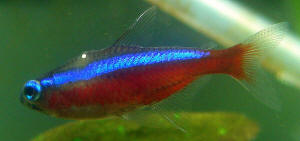 |
| Re: FW Cardinal with blister/worm?
05/08/08 Hello Neale,
Thank you for your advice on my cardinal issue. I have isolated
him/her in a separate tank, and am working on catching the second.
I hadn't even thought of NTD! Urg! The possibility didn't
even cross my mind, since the fish is just as active as the rest of
the school, and still the first to food. <Which all sounds
positive, so fingers crossed the blisters heal by themselves.>
There is also no white necrotic tissue present- only a clear
blister (still with regular, bright colouration beneath, despite
how the picture appears'¦), with an ich like spot inside.
<Odd.> But...alarm bells ringing! When I took the cardinal
out of the tank, I noticed that it does have a "lumpy"
appearance. I hadn't noticed, because it is so subtle that you
can't see it except when looking at the cardinal from above.
<Well, keep an eye on things. Do provide the isolated fish with
shade and good clean water so it isn't too unhappy.> As far
as an anti-parasitic, do you have a recommendation that may work?
<Wish there was. So far as I know, nothing works reliably, or
even half the time.> I figure that if it is NTD, an
anti-parasitic won't do any more harm. I would rather not
sacrifice the fish if I do not have to, but in the event that they
do begin to suffer, I will certainly break out the microscope.
<I certainly hope the boffins at the "fish medication"
labs come up with something for Pleistophora; it's a real
plague and so depressing to watch. But breaking the cycle of
infection/re-infection is essential, which is what you've
done.> Thanks again, Tianna <Good luck, and keep us posted.
Neale.> Re: Cardinal with
blister/worm? 5/10/08 Hello again Neale, I hope you
are enjoying your weekend! <Indeed I am! A lovely summery sort
of day here in England.> I think the mystery of the
white-sphere-filled-blisters on the cardinals has been solved. I
went to perform a water change on the hospital tank, and ARGH! What
appeared to be nematodes, of all different lengths, free swimming
in the tank. The white spot (which, I guess, is a mass of
subcutaneous parasites) in one of the cardinals had shrunk
considerably. <Never seen this, or even heard of it. Sounds
quite nasty. In any case, I'd immediately use some sort of
antibacterial/antibiotic to prevent secondary infections caused by
the burst cyst. An anti-helminth drug such as Prazi Pro should deal
with the nematodes. But that said, most worms have complex life
cycles that can't be completed under aquarium conditions (for
example, they need to go through a bird or snail before they can
back into a fish). So provided there were no secondary infections
and the Cardinal otherwise recovers, I'd actually be cautiously
optimistic.> This brings up another question that I will beg
your help with. <Indeed?> Since removing the two symptomatic
cardinals from the display tank, the "mystery illness"
had gone wild. Nearly half of the cardinals are now showing
symptoms. Clearly, there are nematodes in the tank that I can
neither see, nor remove. Would it be more beneficial to just treat
the entire display tank, and stop torturing the poor fish in a
"naked", uncycled hospital tank (especially if there are
parasites living in the display that will simply reinfect the fish
again)? <In an uncycled tank, you can use Zeolite to remove the
ammonia directly, and that's cost effective and reliable with
very small fish like Cardinals.> As my hospital tank is only 10
gal, I cannot realistically move all 30 cardinals plus the other
inhabitants to tear down the display to disinfect. I could be
wrong, but I think this would do more harm than good.
<Agreed.> Before the "big break" in this mystery, I
had purchased some of Seachem's Cupramine as a shot in the
dark. Would this be effective against the subcutaneous nematodes,
or would I be better served by exchanging it for something like
Praziquantel (if I can find it)? <Cupramine is certainly worth a
shot before trying anything else.> I always quarantine new
livestock, so seeing this now, after several months in the tank and
having been quarantined for a month prior to moving to this display
is mind numbing. I guess nothing is fool-proof! <Quite. As I
say, this disease is something I've never encountered. Possibly
Bob Fenner can offer more advice.><<Sorry to say, RMF is
out traveling and without sufficient internet access. -S.M.>>
Thank you so very much for all of your help (both on this mystery,
and the rest of this website!) <We appreciate your kind
words.> Have a great weekend, Tianna <Enjoy your weekend,
too. Cheers, Neale.> |
|
Treating Discus with Ich - 8/14/07 Hi Crew, <Hi Greg,
Pufferpunk here> I apologise for the long email up front.
<It's ok, we need to know what's going on & how
you've been treating.> I am having a bit of a problem
getting rid of White Spot (Ich) from my well planted low-tech
6x2x2 Discus & community aquarium. The tank has been up and
running for seven months and was fully cycled after three months.
From day 1 the temp was set at 30C (approx 86F) and I didn't
have any problems at all with disease etc, but Ich must have been
in the tank somewhere as when I recently lowered the temp down to
28C (approx 82F) to help the plants grow I suddenly had an
outbreak of Ich that I am having problems getting rid of it.
<That's your problem right there. Discus' immune
systems are compromised at lower temps. Never mind the fact that
ich dies off mush faster at higher temps (86-88 F).> So far
I've had four 'attacks' against the Ich as follows:
1st Attack - I used 'Rapid Ich Remedy' which contained
Formalin and Malachite Green, followed instructions as per the
bottle (5mL per 20L = approx 150mL per dose) on days 1, 4 and 7
which cleared the Ich for about a week, then it came back. 2nd
Attack - I again used 'Rapid Ich Remedy' following
instructions as per the bottle (5mL per 20L = approx 150mL per
dose) in terms of dose rate but I dosed on days 1, 4, 7, 10 and
13 which again cleared the Ich for about a week, then it came
back. 3rd Attack - I used Waterlife's 'Protozin' (the
double strength version) which I assume also contains Formalin
and Malachite green as it looks & smells the same as the
'Rapid Ich Remedy' medication, followed instructions on
the bottle (2.5mL per 75L = approx 25mL per dose) on days 1, 2, 3
and 6. This again cleared the Ich for about a week, then it came
back yet again. 4th Attack (currently I'm on day 4 of this
'attack' & I'm getting desperate)... I'm
again using Waterlife's 'Protozin' in combination
with an Anti-Parasite medication for fish ponds (made by
Interpet) which contains Formalin. I'm dosing as follows
(don't freak out): A 13 day attack plan, where I'm dosing
the Pond Anti-Parasite medication (25mL per 1,100L = approx 15mL
per dose) on days 1,2,3,4,5,6 and 7 at 7:00AM and I'm also
dosing Protozin (2.5mL per 75L = approx 25mLs per dose) on days
1,2,3,4,5,7,9,11 and 13 at 7:00PM i.e. each medication for the
first 7 days is 12 hours apart. Note: I'm not performing any
water changes during treatment but I usually change 20% of the
water twice per week. Bad idea! Discus need 90% weekly water
changes. During ich outbreaks, 80% every other day is necessary
to remove the free-swimming parasite from the water column. It
shouldn't be necessary to treat ich with any meds at all.
High temps & 2tbsp salt/10gallong should be sufficient, along
with large bi-daily water changes. Using all those different meds
are just making the ich stronger & the discus weaker.> I
figure the 4th attack will either kill the Ich, and/or kill (and
probably permanently preserve) the fish with all that
formaldehyde, or perhaps the Ich and the Fish will survive and
I'll likely give up and accept that I am stuck with Ich for
the rest of this tanks life. I guess I could get rid of all the
plants and fish except the Discus and then raise the temp up to
31 or 32 degrees C (approx 89F), as I figure the Ich will not
cause too many problems at this temp for Discus. However I really
don't want to go back to running my tank above 30 degrees C
(approx 86F) as the plants (mostly Amazon swords, Ambulia and
Water Sprite) don't like the higher temps at all, as
everything looks and grows much better at 28C. I really like
having a planted Discus aquarium and since all the fish get along
so well its a shame to have to give into this single celled
monster! <I have a fully planted discus tank. I don't use
any of the plants you have listed. All my plants are also
low-light species. Right now, I have many species of Crypts,
Anubias, Java fern & Crinum. See:
http://www.aquariumplants.com/Warm_Water_Discus_Plants_s/20.htm
Many plants require CO2 supplementation (which I don't use).
In addition, I add Yamato Green weekly (www.yamatogreen.com)
& poke Jobe's Spikes under their roots, every 6
months.> Now you may be wondering how everything has held up
through these multiple attacks against the Ich? Well during all
the treatments so far I have not noticed any effect whatsoever on
my biological filtration (no measurable NH3 or NO2) but then
again the plants may well be taking care of NH3, NO2 and NO3 as
they are still growing just fine through all of this.
<Anti-parasitic meds do not harm biological
filtration.><<Mmm, I would NOT make this statement. Many
compounds sold as such definitely WILL affect, stall
nitrification... directly and/or indirectly. RMF>> Even all
the fish (including the supposedly fragile Cardinal & Rummy
Nose Tetras) don't even seem to notice that they are being
medicated at all, which makes me wonder if the medications are
being negated by the plants or perhaps by something else? Like I
said my 4th attack is quite brutal and I'm likely to suffer
losses but I'm prepared to do almost anything to get rid of
this stubborn Ich once and for all. Maybe I need to increase the
dose rate? Maybe I need to try NaCl and raise the temp? <Now
you're thinking in the right direction!> I have an 80L
quarantine tank that I use for all new fish but it is not big
enough to move all the fish in there for separate treatment. The
QT is usually set at 30C and all fish that go through it get
nuked by Multi-Cure (basically Methylene Blue, Malachite Green
and Formalin) and then I watch them for a minimum of two weeks
(total of a 3 week stay in QT) before fish are transferred into
the main 6x2x2 display tank. I've never lost any fish apart
from the odd Cardinal or Rummy nose using this method but I find
them rather delicate at the best of times when purchased from the
LFS - they always look starved! In case you need to know the tank
is setup as follows: 6x2x2 glass aquarium with approx 600L of
water 1x Eheim 2228 canister filter 1x Aqua One 2450 canister
filter (UV-C is off during treatment) 1x air stone running 24/7
Temp at 28C (approx 82-83F) pH = 7.4 Hard tap water (treated with
a double dose of Prime during each WC) 10 healthy young Discus
(see attached photos) 5 Black Neon Tetras 12 Cardinal Tetras 15
Rummy Nose Tetras 5 SAEs 3 BNs 2 Sterbai Cory Catfish 4 Kuhlii
Loaches Well planted (actually the plants are growing really well
even throughout the treatment - see attached photos taken 3 days
ago for reference) <Sounds/looks like a lovely tank!
Lighting?> Any suggestions on what I'm doing wrong or what
I can do to win this battle would be appreciated... thanks Crew!
<Try my suggestions above. The plants may not be strong enough
at this point to handle the treatment but I think the fish are
worth the risk. ~PP> Regards, Greg Simpson Perth, Western
Australia
Re: Treating Discus with Ich (or Neons in this
case)... actually Cardinals... Poor Advice... 8/15/07
Thanks for your quick reply Pufferpunk! <Sure!> It's
actually not the Discus that seem to be effected by the Ich,
it's the Cardinals! <That's what I get for
assuming...> After a few weeks it's like they are slowly
being sprinkled with salt and they 'flick' against the
stems of plants (classic Ich symptoms in my opinion). I guess the
poor Cardinals are feeling poorly from the anti-parasite
medications and thus cannot resist the Ich as much as the
stronger fish. <Yes, I believe so many meds will actually
weaken the fish's immune system.> What about Copper based
treatments? I hear copper can be quite effective too. <Copper
is very effective but extremely dangerous, especially on weakened
fish or used incorrectly. You could try a saltwater dip on them
but they are so tiny!><<RMF would NOT SW dip small S.
American Characins>> I guess after round 4 of my
'attacks' I'll try the higher temp & salt
combination as round 5. <I think this is your best bet.
Don't forget to do huge water changes every other day, trying
to clean the substrate (as best you can with the plants), to
remove the free-swimming parasites.> If that fails Copper
based meds might be round 6. I hope this does not turn out to be
a 12 round fight! I've kept tropical fish for 24 years and
have never had such an issue with disease as I have this time
around. I've had Ich before in smaller/less planted tanks and
usually after a basic Ich treatment it's resolved for good. I
must have a bad/resistant strain of it!!!! <Add Melafix to
heal the wounds from the parasite boring into the fish. Good
luck, let me know how it goes. I'm sure there is tons of info
on ich treatment at WWM. You can also read this: http://www.thepufferforum.com/forum/library/hospital/fwich/
~PP><<This citation has NOTHING to do w/ FW ich
treatment... RMF>> Regards, Greg
|
|
|
I am obsessed with keeping freshwater cardinals! I just can't
keep them alive! 5/13/07 Hi! <Hello!> Hope all is
well with you. I have a question I hope you can help me
with. I have had reef and saltwater tanks for a couple of decades, and
I do pretty well. I even have a 600 gallon one in my kitchen wall!
<Sounds nice. Though if you prepare sushi in the kitchen, I imagine
the fish get rather nervous wondering if they're next...> But I
am obsessed with keeping freshwater cardinals! I just can't keep
them alive! <I we talking those neon tetra look-alikes, Cheirodon
axelrodi, or the freshwater examples of the marine cardinals such as
Glossamia aprion, the "mouth almighty"? I assume the
tetras.> I have a 45 gallon tank with a sump. (an old reef tank). I
had it setup with a BioWheel, and gravel on the bottom. I suctioned the
gravel monthly, did a 33% water change monthly, and no luck with the
cardinals. <Cardinal tetras can be tricky for a variety of reasons,
but once settled in they're basically tough little fish. The main
problem in my experience is Neon Tetra Disease (NTD), which works its
way through cardinal tetras at about 50% mortality, i.e., if you buy 20
cardinals, and you get the dreaded NTD, you can lose up to half of
them. Better than Neons, where you lose all of them, but still
annoying. Another issue with cardinals is they are all wild-caught. In
fact, they're the most numerous exported tropical fish from South
America. Anyway, by the time they reach the market countries around the
world, they might not have eaten for weeks. My guess is that healthy,
well-fed cardinals are more or less NTD resistant, but when weakened
and cooped up in a retailer's aquarium, they are far more
susceptible to this disease. So as with any wild-caught fish, buying
when a new batch arrives can make sense, and then quarantining and
feeding on a variety of live/frozen foods makes all the difference.>
I then added an undergravel filter (I know....dumb idea, but I was
desperate!) <There's nothing intrinsically wrong with UG
filters. They do a good job of maintaining water quality. The problem
with UG filters is their incompatibility with aquascaping and rooted
species of plants more than anything else.> No luck. Nitrates off
the chart. Dead cardinals. <Odd, given how small cardinals are. They
don't eat much (and don't need to eat much, either).
They're classic "pinch of flake a day" fish in my book.
When you say "off the scale" you mean above 100 mg/l? What is
the nitrate level of the water out the tap/faucet? I have to confess to
keeping mine in rainwater with a bit of tapwater added. Seems to work
well.> Someone suggested bioballs. Would not that make
the nitrates even higher? <Worth trying I suppose but I don't
find nitrate removal systems in freshwater tanks to be of much value.
Freshwater fish don't care that much provided the rise in nitrates
is slow, and even between 50-100 mg/l you shouldn't get mass
die-offs of fish except with certain species (Tanganyikans for
example). Simple water changes are, IMO, a better approach to nitrate
management, and the filter is best devoted to biological filtration,
i.e., ammonia/nitrite management rather than nitrate.> I have used
Amazon rain additive (is that stuff any good?) <Not really. Looks
nice, but doesn't really do anything if you have hard, alkaline
water. In softer water, may help acidify the water a little, but
approach the concept of acidifying water with caution, as it's easy
to mess up.> No luck. PLEASE do you have an
ideas? Thanks! <Have a read of this: http://www.wetwebmedia.com/ca/volume_2/cav2i3/cardinal_tetras/Cardinal_Tetras.htm
for some more ideas.> Ron <Cheers, Neale>
Hey Bob, Tetra sizes 3/9/07 Hiva, I was
looking through some pics on WWM and noticed this page http://www.wetwebmedia.com/FWSubWebIndex/tetragonopterinae.htm,
specifically the cardinal tetras listed at length 2.5 cm/2 inches
<Mmm, one> ...these are not equal measurements....and Neons lists
at 2.2cm...that's not quite an inch...seems quite small to me?
<Yes... I just looked... lifted these from fishbase.org... though I
swear I've seen bigger. BobF>
Neons vs. cardinals 7/21/05 Hello, wondering if I could get
an opinion on these tetras. I'm planning on a 108 gal. community
and want to have either neon tetras or cardinals as the main schooling
species. What would be your recommendation with these fish for overall
color, adaptability with other community fish and most of all
hardiness? I know both require the same water conditions. That's
it. Neons or cardinals? Appreciate any input on this
subject?..........Regards, Craig P. <Mmm, am a big fan of both
species, but will side with the Cardinals... for bigger size, greater
longevity, relative hardiness. Bob Fenner>
Re: Neons vs. cardinals 7/22/05 Mr. Fenner thanks for your
response and the cardinals sound good to me as well. I received a
response from you on the Hagen lights for my tank last week; again Ty.
I realized that your name was familiar and dug up one of my FAMA
magazines from years past and found your article. Showed the e-mail I
sent you to my son and then your picture and he was really impressed!!
"Dad he's an expert", <Heeee!> were his words.
He's 11. I've been in the hobby for about 10 years now and
still enjoy it very much...... just ask my wife, lol. It's good to
know expert advice is a click away.......... Thanks again. I live in
the province of Newfoundland Canada and the hobby has really taken off
here this past few years; both fresh and saltwater, but I find staff
with any knowledge are few and far between. Anyway, I had to drop you
this note to let you know, it's great to get advice from the
"expert"..................... much regards.....Craig P.
<Hmm, whenever I hear the term, I always think of "ex
spurt"... as previously married and flow under pressure... Thank
you, Bob Fenner>
Cardinal problem Date: Sun, 13 Mar 2005 Hey there, I was
wondering if you'd be able to help me with something. I have had FW
tanks for a long time but have not had any real luck with setting up a
school of either Neons or cardinals. My current "failure" is
a discus planted tank. It is a 46 gallon bowfront tank with 6 discus
and 3 clown loaches. <Too crowded... Please read here: http://www.wetwebmedia.com/FWSubWebIndex/discusfish.htm
> The water conditions are NO3 is 20ppm,
NO2 is 0, hardness is 120, alkalinity is close
to 0 and pH of 6.4ish. Temp is 85F. The discus are doing fine and I do
daily water changes of 5-10 gallons using RO water mixed with 1/2
gallon of regular non-RO water (for the plants). <Good
practice!> Discus show no signs of stress and live normally. I
brought home 11 cardinals about a week ago which I bought at a LFS.
They all seemed fairly ok even though a lot of them had skinny stomachs
(due to lack of food I'd guess). <Yes, common> I first placed
them in a quarantine tank, losing about 4 in a few days. After 5 days,
and the rest of the cardinals looking ok, I moved them to my discus
tank hoping for some survival. few days later, I am looking at 3 fish
left (which do eat) but are covered in ich. <Yikes... should keep
quarantined... for a few weeks> none of the other fish show any kind
of ich or other diseases. The temp is high (for discus) and I was
thinking ICH wouldn't live, but these cardinals are covered.
<Likely will die there> I am at a loss here. Please help if you
can see what I am doing wrong. Thanks, DK (P.S. I'd even go to
Neons if that meant they would live better, but I read somewhere that
cardinals take the high temp better.) <This is correct... I would
try again, with a new batch of Cardinals.... but quarantine them
longer... slowly raise the water temperature (am sure the store did not
have them in the 80's F) to the Discus water conditions, fatten
them up first. Bob Fenner>
Going To School Will cardinal tetras school with neon
tetras? What other types of tetras will school with Neons?
<Well- as far as schooling "with" the Neons, any tetras of
similar size could join up. However, I have seen Neons school with
Cardinal Tetras, Glowlight Tetras, and even Rasboras on a few
occasions, so anything is possible. Usually, in my experience, anyways,
the Neons seem to school with Neons, Glowlights with Glowlights, etc.
Keep an eye on these little guys- their behavior is very interesting!
Enjoy! Scott F.>
|
|

