|
FAQs on Freshwater Angelfishes
2
Related Articles: Freshwater Angels, Discus, Juraparoids, Neotropical Cichlids, African Cichlids, Dwarf South American Cichlids, Asian Cichlids, Cichlid Fishes in General,
Related FAQs: Angels 1, Angelfish Identification, Angelfish Behavior, Angelfish Compatibility, Angelfish Selection, Angelfish Systems, Angelfish Feeding, Angelfish Disease, Angelfish Reproduction, & FAQs on:
Wild Angels (P. altum),
Cichlids of the
World, Cichlid Systems,
Cichlid Identification, Cichlid Behavior, Cichlid Compatibility, Cichlid Selection, Cichlid Feeding, Cichlid Disease, Cichlid Reproduction,
|
%20vert.jpg)
|
20 gallon okay; FW, stkg., single angel?
6/1/13
I have a standard 20 gallon tank set up for over 3 months its sole
tankmates up until now have been a school of 7 zebra danios to cycle the
tank. I was wondering if I got rid of the danios- gave them back to the
store. If my tank would be okay for 1 Angelfish?. Or would it get too
large?- How long/months would it take to outgrow the setup?.
<You could keep a singleton Angelfish or a mated pair in 20 gallons; if
just the singleton, it would cohabit well with some suitable, peaceful
tetra -- X-Ray Tetras would be ideal and easy to keep.>
Would the cackoo Apsios be a better choice?.
<Do you mean Cockatoo Apistogramma (Apistogramma cacatuoides)? These are
nice fish, but somewhat delicate compared to farmed Angelfish, so do
ensure excellent water quality and the right water chemistry (i.e., not
too hard, around 2-15 degrees dH, pH 6-7.5).>
Thanks Alex
<Cheers, Neale.>
Got my new Angelfish. 6/1/13
Well I got my new Angelfish a marble. and introduced it to the tank.
right now its the only fish in the tank. i have some plastic plants
downstairs i will put in to make it feel more at home. Right now its
hiding behind the sponge filter taking smaller trips outside to explore.
i got some flake food for it. I may try live black worms from the Betta
shop- later when I
get paid Friday. How long should it be before I feed it and it starts to
swim around and act more normal.
<Cichlids are generally settled in and looking for food by the following
morning. As always, be careful to check water quality after adding a new
fish -- a fish takes many weeks to starve, but can be killed by poor
water quality within days.>
The water is around 75 or so is that too cold?
<For Angels, yes; aim for 77-82 F. Do read:
http://www.wetwebmedia.com/fwsubwebindex/fwangelfishes.htm
Do also remember the FAQ is the place to come for help; if you want to
chat about your tropical fish and get opinions on tankmates, feeding and
the like, then mosey on over to the WWM Forum, here:
http://wetwebmediaforum.com/forum.php
Lots of nice folks there who'll be pleased to talk. Cheers, Neale.>
Re: Got my new Angelfish. fdg, child-like 6/3.5/13
I fed it flakes this morning and sure enough it ate them with gusto. I
was wondering what kinds of foods could I give it other than flake. I
was thinking either wingless fruit flies or black worms . Maybe hatch my
own brine shrimp in my room. Frozen foods are out because my little
fridge isn't powerful enough to keep it frozen. And I don't think the
house ( I live in a group home as I have Autism) will let me use their
freezer for worms/shrimps/ ect frozen.
<A good quality flake food makes a fine staple for Angels and there's no
need to buy/use anything else. If you want, you can augment its diet
with tiny bits of fish and seafood if you happen to have them in the
house, plus occasional squashed cooked peas after a period of starvation
(very good for avoiding constipation). Cheers, Neale.>
Moving with angelfish 10/17/12
Hello:
<Judy>
I have a question about moving. I have two rare black angelfish
in a 46 gallon. We are moving from Georgia to upstate NY. This
is a sixteen hour drive with a night in a hotel. The angelfish
are about 5 inches by 5 inches. I would be taking them in a
five gallon bucket with lid (the lid would have holes)
<Mmm, no, I wouldn't do this... Better by far for them, you to have
bagged (double) and oxygenated, sealed, boxed by a friendly local fish
store... shipped/driven anesthetized as such, in the dark. They'll be
much better off than being light-exposed and sloshed about in a bucket>
My husband said the sponge filter can be run via the air pump that is
plugged into the cigarette lighter. We would be stopping at my husband's
parents when we arrive for two days. We have a 10 gallon and my husband
thinks that we could keep the angelfish in that for 2 weeks until we get
set up with the 46 gallon in an apartment.
<Likely so; add the shipped water to it/this>
My husband said if we change the water every day
<Not all of it>
in the 10 gallon it would be doable for the weeks, but I am worried the
stress of being in a tank that small for that long would cause serious
aggression. The only other option would be to rehome the angelfish and
order new ones of the same type shipped. What about a divider in the 10
gallon?? Thank you!!
<The divider might prove of use. Bob Fenner>
travelling with an angelfish, FW
7/3/12
Hello:
<Judy>
My husband and I are from Georgia in the US and we have travelled to
upstate NY for the week. We are leaving NY on Friday and it is a two day
drive back home with one night in a motel along the way. Up the street
we dropped in to a aquarium store that has beautiful black angelfish.
The kind that you get from breeders. Anyway I was wondering if anyone is
familiar with buying an angelfish that far away and travelling with it
home and, of course arriving with the fish alive?
<Ah yes... am an olde veteran of the trade>
The car is about 80 to 85 degrees and I was thinking of buying a five
gallon tank with heater for the trip from Wal-Mart and then refunding
the tank when we get home?
<Mmm, no... better by far to have the dealer double bag and tie it... in
a large-enough bag... WITH oxygen (most shops have), AND pack in an
insulated fish box or cooler... and leave the fish (packed singly) in
the dark for the two days>
Or do people travel with angelfish in buckets, like a three gallon bucket
or something, maybe the bucket could handle a heater?
<Again... IF the transit were more than the two days... maybe so>
Anyway are angelfish delicate when it comes to travelling???
<Through unnatural selection... they are not>
Is this something that is not worth it?
<Is worth it. Done "all the time">
I am only considering it because the stores at home never have angelfish
like that and buying
from a breeder is really expensive. Also are black angelfish more
delicate?
<Mmm, unfortunately the darker they are... yes. More so than other
sports of Pterophyllum>
Anyway thanks for any info
<Certainly welcome. Bob Fenner>
Re: travelling with an angelfish 7/3/12
Hello:
The other question I have is that the fish store does not open until
11am on Friday morning so we have to get the fish before closing on
Thursday as we have to leave early Friday morning, so would a bucket
with a lid with a heater be better for the fish from Thursday at 5pm to
Saturday mid afternoon? Thank you
<Better by far to have in a sealed/insulated box, double-bagged, w/
oxygen... Have the shop stop feeding the fish now... Bob Fenner>
Re: travelling with an angelfish 7/3/12
Hello:
<Hey Jude>
I do not know if replying to e-mail is allowed or I have to start a new
e-mail.
<Either is fine>
They will not stop feeding the fish until we get it on Friday as it is
part of a big group.
<Ah good>
I just got back from there and they have no oxygen tank to fill the bag up
tight with O2 for the trip. Instead they sell a $20 battery powered
oxygen bubbler, and do not sell those oxygen tabs that turn the water
blue.. Thank you
<Mmm, look to finding another store for re-bagging the fish/es... don't
rely on the bubbler or tabs. Call around; a larger store will have O2.
B>
|
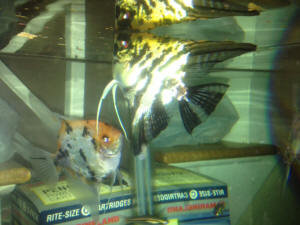
Just wanted to send a picture of 2 of my amazing angels
5/18/12
I also have a black marble, 6 Koi/marble, 2 chocolate, 2 platinum, and 2
tequila sunrise. They look amazing in my tank all together! Thank you
again
Heather
<Real nice looking fish. Do stop by the Forum, here,
http://wetwebmediaforum.com/
if you want to share photos and chat with other aquarists. Have fun!
Cheers, Neale.>
|
 |
Keeping wild angels
1/29/09 My friend Danny recently got a tank, 52 inches long,14
inches high, 12 inches wide. After cycling, he got three wild caught
angelfish, about 3 inches apiece. I don't know if they are altum or
another type- but he's lucky that he lives in an area with very
acidic water- ph a little above 6.0. I told him angels grow big and
live along time, i talked him out of rams after what you told me. (is
this good advice) <Wild Angels are indeed wonderful fish, and if you
have soft water already, you're all set. They mix well with Rams,
but I wouldn't risk commercially bred Rams. Partly because farmed
Rams don't live long, and partly because I'd be worried
they'd introduce something nasty into a tank of Angelfish. Since
both fish are cichlids, they can and will be subject to similar
diseases.> will three such fish outgrow a 53? How big of a tank will
they need at maturity? <Should be fine in this tank, though a pair
of Angels can be very territorial. Assuming the tank has lots of tall
plants, bogwood or other hiding places, they should be fine in a tank
this size.> He wants to put more fish in, is this a good idea?
<Dither fish of some sort, e.g., Hatchetfish or Rummynose Tetras
would be a great idea. But take care to avoid any nippy barbs or
tetras. If you want to breed them, you'll likely need to buy a few
more. Angels cannot be sexed, so usually need to be kept in groups of
six to allow pairing to occur naturally.> What are good foods?,
right now the fish get tetra flake and some frozen cichlid diet.
<Wild Angels will expect primarily insect larvae, e.g., Bloodworms,
Glassworms, Mosquito larvae, etc. Once settled I'd fully expect
them to consume a wide variety of things, including good quality flake
and pellet foods.> Does he need crushed coral to balance and buffer
PH, with fish like this, pet store person wanted him to do it.
<Assuming he changes the water regularly, the pH shouldn't
change too much between water changes. I wouldn't add crushed coral
because that would raise the pH and hardness. But I would use a pH 6.0
or pH 6.5 buffering product. There are many available, usually
containing phosphoric acid. Used carefully they work very well. Do see
here: http://www.wetwebmedia.com/FWSubWebIndex/fwsoftness.htm > How
long do angels live? <Potentially 10 years or so. Kept properly they
breed readily, so your friend may soon get lots of F1 wild-type
Angelfish to share with you and your local aquarium shops.> Thanks
<Cheers, Neale.>
Need Help With Angelfish -
10/11/06 Hello, I am Alissa F. I am doing a project on Angel Fish.
See I was wondering if I could email you a few questions then u answer
them. (phone is not required, only emails) please. and thanks you.
Alissa. Please email me back at. <Ask your questions. We will do our
best.-Chuck.>
Starting With Angelfish -
08/12/06 My sister is giving me a 10 gallon tank. I want
to get 2 angelfish, nothing else and put them in the tank to
see if I even like caring for fish. Please suggest Kristina
<Angelfish originally came from the rivers of South America. Now
they are bred by the millions in the orient and imported into the U.S.
Domesticated angelfish are fairly sturdy aquarium fish once they get
established. You will need to heat the water to 80 F. A filter that
pumps 30 gallons of water per hour will keep the water clean. Feed them
only once a day and only enough food so that all of it is gone in two
minutes. Remove any left over food with a siphon hose. Change 25% of
the water each week with treated tap water. With only two fish, one
will soon start to bully the other. They are in the cichlid family and
this is normal. Over time your fish will get bigger and probably need a
20 gallon when they are at an adult size. You may already have a
bacteria bed established in the existing tank. These bacteria are
needed to break down the fish waste. Check out the WWM site for
nitrification for further reading.-Chuck>
Angelfish Book Recommendations - 08/05/06 Hi I am
a long time user of your website from India. Recently I have set up a
50g tank for angelfish. It is a planted tank with Val.s & E.
tenellus. Can you suggest some good books on angelfish?. Thanks Sandeep
R < Not too many books dedicated to angelfish these days. I would
recommend "Enjoying Cichlids" by Ad Konings. It is available
from Cichlid Press. it is a great book that will help you will all
aspects of keeping cichlids. Angelfish are cichlids by the way. lots of
info on feeding, filtration and water chemistry to keep any cichlid you
want.-Chuck>
Angel/s...? FW, SW? No useful info.
7/22/06 Today, this afternoon, I noticed a little
"growth" on my angel fish. It is behind the pectoral fins (I
believe those are the 2 long ones on the stomach side of the fish
right?) <Mmm, yes... the pelvics are further down below, near the
vent> and right at the base of the anal fin. <Oh, these are the
pelvics, P2's> I believe this is also where they excrete waste.
It looks like a pimple and is a light tan color. It just popped up
today and I was wondering if it is something I should look out for or
treat. <Mmm, not necessarily> I have also seen an increase of
aggression between the 2 angels, one of them is missing 2 scales,
should I do something about this or just let them work out their own
problems? Thanks <... is this marine, freshwater? See WWM re the
species in question. Bob Fenner>
Mysterious Death In A Long-Established System - 11/05/2005
Hello to all - I have a question about my freshwater aquarium, but
before that, I would like to thank all of you for sharing your
knowledge and advice. <Your kind words are so very
appreciated.... Thank you.> I have WWM dailies as my homepage and
every morning, before I do anything else (except turn on my aquarium
lights and say hello to my buddies, of course) I read through your
questions. I have used your search tool many times, rather than asking
directly, and I find all the answers I need, and more! <Ahh,
delightful! Would love to know how to make this easier/more obvious to
other folks....> I can't seem to find the answer to this mystery
though, so please forgive me if I have overlooked. <No
worries.> I am not new to fishkeeping, but everyday there is
something more to learn, I know. <As with everything in life.
May I always be ignorant, that I have something to look forward to
learning!> I also know, learned from my 30+ years of aquarium
keeping experience and confirmed through your advice on WWM, that
regular water changes, patience and quarantine will practically
guarantee success. I haven't lost a fish in 8 1/2 years until today
and I am devastated because I loved my baby. <Oh dear. So sorry to
hear this....> Here goes: 125 fully planted tank, magnum canister
filter w/ carbon changes every 2 wks, output powering 2 BioWheels, set
up for 4 years. 10 gallon water change on Mondays, 5 gallon on
Thursdays, just a siphon water change-not a gravel vacuum because the
tank is so heavily planted. <All sounds great so far.> This
tank has been running for 5 yrs, set up because my angelfish in the 55
gallon was really tall and I wanted him to have more room. His
tankmates were 3 lemon tetras and 1 upside down catfish in the 55g. I
regularly change light bulbs for the plants, prune them weekly, feed
very sparingly, if at all. I have the 55 still set up with spare
plants, thinned from the big tank, and I sell them to pets shops and
give them to others. <Excellent!> Only fish in the 55 until
recently was small school of zebra Danios to keep it interesting. For
some reason, I thought my 5 fish in the 125 g needed friends after 5
years <I admit, your stocking scheme is actually more conservative
than my own. Surprising.> and so went to the LFS and bought 6 neon
tetras, 5 Cory cats, 3 guppies and 4 Otocinclus cats. These new fish
were placed in quarantine in the 55 for almost 7 weeks
(patience). <Patience, indeed!> After the quarantine, and
everybody still was in great shape, I transferred the newbies in with
the old timers. The big community was all happy for 2 wks, then,
horror, my 8 1/2 year old Andy angelfish died. <Devastating.... I am
so sorry....> He had just been hovering in the corner for the last 2
days and hadn't been coming up and eating the little pinch of
frozen bloodworms from my fingers like he did every morning for the
last 8 yrs. Andy was very big-much bigger than the palm of my
husband's hand and kind of old, I guess, for a fish.
<Yes.> I don't know what the lifespan of an angelfish
is. <'Bout Andy's age. They can live for a long time,
but Andy was a ripe oldster.> I took him out, did an emergency 25%
water change, started my search on WWM, and looked over to see my 3
lemon tetras (5 yrs old) hovering in the same corner. <Hmm....
perhaps coincidence.... and, on the other hand, perhaps not.> They
didn't come up to eat even, and they are piglets.
<Disconcerting, to be sure.> Everyone else is having a ball-even
the upside down catfish (also 8 1/2 yrs). So, my questions: Was Andy
just so stressed out because his world had changed? <Mm, I do
suspect disease.... perhaps viral.... or pathogenic.... My thoughts
here: Your five fish had not had anything "new" in some
years. No introduction of "normal" pathogens that are
ever-present on nearly all fish to some minor degree. This
long-established, healthy system may have just been too
"healthy".... perhaps the new livestock had something that
they brought with them, not in virulent amounts, that transferred to
your angel, who was perhaps free of whatever it was for several years.
As old as the fellow was, it took him out. This is all just
speculation.... but is my first best guess.> Could I have done
anything differently? <No, hon. You could not have foreseen
something like this. You did everything perfectly.> Are my lemon
tetras traumatized too? What is their lifespan? <Mm, tetras
for the most part are MUCH shorter-lived than fish like angels.... if
these guys are 8.5 years old, not only will I be surprised, but
I'll be moving into your fish tank in short order, in the hopes of
extending my own lifespan.> Should I try to remove them or will that
just cause everybody to go nuts? <If they are exhibiting
obvious signs of illness, I would strongly consider removing them to a
quarantine system to observe them apart from the other, healthy
livestock.> Sorry for the novel, but I am just stumped (and very
upset). <Completely understandable.> Thanks so much. You
guys are great. <As are you.> I need a poster of Bob and
Anthony and the whole crew to put up in my fish room. <Hey, now
that's not a bad idea! Maybe we should have a
"centerfold" Crewmember in the CA online mag, eh? (grin)>
Patty <Wishing you well, -Sabrina>
Mysterious Death In A Long-Established System - II -
11/07/2005 Sabrina- thanks so much for your insight about my fish
traumas. Sadly to say, my lemon tetras have passed on. Andy and Flipper
(the upside down catfish were and are 8 1/2 years old. The lemon tetras
were barely 5 yrs old, their records going back to October, 2000. (I
consider the day I bought my fish as their birthday!) <Wow. Some
geriatric characins, I think. I'm not so knowledgeable about
characins, but I do think that's pretty aged for most smaller
tetras....> I had not really considered that these old timers had
lived in a "bubble" and thus were not able to fight off
normal fish pathogens. <Again, just a theory.> As I said, I
will always be learning. <As will I/we.> You all have
convinced me that saltwater isn't as hard as I had always heard it
to be, and I have had a healthy tank going now for over a year. Water
changes and even more patience required than freshwater, huh?
<Mm, yeah, pretty much.> I also have a very low stocking scheme
in the saltwater half of my fish room, as you advise, and I have never
had a problem. <Ahh, very good!> I don't believe I will
be adding any new fish though. I'll just set up another tank! (good
excuse) Thanks again for your time and generosity in sharing your
knowledge, Patty <And thank you again for your kind words.... All
the best, -Sabrina>
|
|
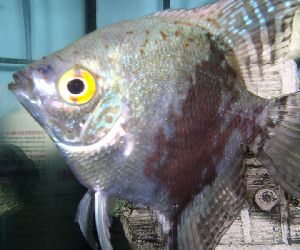
| Angelfish, Bacterial Infection, Great Images -
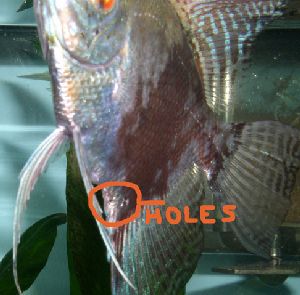
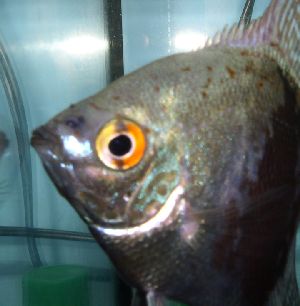
11/05/2005 Hi, I really need some help regarding my freshwater
angelfish. I have already posted my problem on a number of
different forums and it seems no one knows what I'm dealing
with. My angelfish has developed black wormy things underneath his
skin. <A picture is worth a thousand words.... your images
are excellent.> It first started out as a white lip fungus but
then I noticed black things burrowing underneath in his head area.
These worms (or bacteria) started pushing through his skin and
leaving black protruding bumps. Then, the next day, almost as
quickly as they came, they disappeared back into the skin and left
a small hole. I first tried 50 percent water changes every day and
since that didn't seem to help, I put him on MelaFix and
PimaFix. <These are worthless in my opinion. Really of no
quantifiable value.> Again, this worked very little so I
switched to Jungle Fungus Eliminator. This cleared up the holes
very well until I noticed three more near his anal fin. I can also
still see the worms inside him. <I do not believe these
are worms. Your images appear to me to suggest a bacterial
infection quite clearly.> Someone else told me that probably the
only solution is to humanly destroy the fish, sterilize the tank,
and then start over. <I very much disagree.> I would
really like more options than this. <There are.> I have
also attached pictures. Thanks for any help you can offer. <I
would treat with a broad-spectrum antibiotic (Kanamycin sulfate is
one good option, or perhaps Oxytetracycline in food, if you can
find). At Anthony's suggestion, I treated an Altum angel with
extremely similar symptoms successfully with salt - bringing the
specific gravity to 1.003 for a couple of weeks. You could try this
instead. This animal is not a "lost cause".... likely can
be medicated with success.> <Wishing you well,
-Sabrina> |
|
|
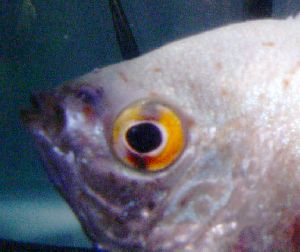
F/W Angelfish, Hole-in-the-Head - 10/28/2005 I have a black
angelfish that has a white lesion above one eye. It started out as a
simple spot a week or two ago, but now it looks as if it's grown
and is protruding out from under the skin. Meanwhile, it also has some
pinholes appearing in the area behind his eye and gills. <A
very classic description of "hole-in-the-head" disease, or
"head and lateral line erosion" (HLLE).> His fins (and the
rest of his body) are fine. None of the other fish have been affected.
The attached photo isn't great (the tank background is black) but
you can see the brightness of the spot (part of it is glare; the spot
itself is probably about 2mm in diameter) and maybe the pinholes if you
look closely. <Your description is actually a little clearer
than the pic - thank you for sending the image as well.>
<<Photo...??>> <<<Photo was lost in the recent
webmail weirdness we've experienced. -SCF>> The
system: 50 gallon tank with two angels, two Balas, 2 rainbows, 1 zebra
loach, 5 T-Bone Rasboras, some live plants. The tank has been
established for 2 1/2 years, with the most recent livestock (Rasboras)
being added about six months ago. I have a Penguin 170 hang on/BioWheel
filter and a Magnum 350 canister filter. I vary their food: flakes,
granules, freeze-dried brine and frozen bloodworms and vegetable
matter. Any idea what it is and/or what I can do for it? <First, I
note that you make no mention of your water quality. Test ammonia,
nitrite, and nitrate, and maintain ammonia and nitrite at ZERO, nitrate
less than 20ppm, with water changes. Next, take a look here: http://www.wetwebmedia.com/FWSubWebIndex/fwhllefaqs.htm
and here: http://www.wetwebmedia.com/hllefaqs.htm
for further information and ideas. Make sure to take the opportunity to
check out the links in blue at the tops of those pages, as well.>
Thanks, -Melissa <Wishing you well, -Sabrina>
Angelfish With Internal Bacterial Infection 10/27/05
HELP!!!!!! PLEASE!!!!!!!!! <We will try.> I have three angelfish
who are swimming on their sides. They started out in a 55 gallon tank
with 3 other angels,3 snails and a black moor. < Goldfish and
tropical fish together are not really s good idea. Eventually one or
the other will get sick from being either too warm (goldfish) or too
cold (angelfish).> One by one they seem to start floating on their
side. They are trying to eat and swim on their sides. I did a water
change and bumped their temp to 82. I am treating them with
PimaFix and MelaFix. Also their blushing angels and the red spot seems
to spread from their cheek outward. A larger circle. I noticed my
other angels seem to be redder too in that area. One angelfish's
lips look swollen. I have the three that are swimming on their side in
a sick tank. Please any advice. I called my LFS where I bought them and
they just said to flush them. I can't do that. They are trying so
hard to live. Any response is appreciated.-Brandy and Melody < Do a
30% water change, vacuum the gravel and clean the filter. Treat with a
combination of Metronidazole and Nitrofurazone with some rock salt
added to the water. Do a 50% water change every other day and
remedicate on the days you don't change water. This should take
care of the organisms causing the problems but it may take a while for
your fish to completely heal if they survive the
treatment.-Chuck>
Marble Angelfish With Community Fish - 10/24/05 Hello My name
is Amy. I have a nicely sized marble veiled angelfish, whom recently I
noticed is getting coppery/orange hues around her/his eyes and the top
of its head and top fin. The fish is at least silver dollar sized, no
other symptoms or problems seem to be present. It swims great eats
well-happily and voraciously--no change in shape/size/behavior and no
one is aggressing it. Just wondering if there may be a problem I need
to fix. The tank just got changed, no high ammonia levels. Is there
copper in a tank? < The colors you describe are normal for marble
angelfish. This is in the genetics of the fish. May be somewhat
affected by diet and lighting.> I am moving in the next month and
will be giving the fishes to friends and don't want to contaminate
their fish in their tanks. < Good idea.> Also, can you have 2
angelfish in a tank that is a 100+ gallons with 2 discus 1 angel fish
some guppies/loaches/o-cats? < Angelfish go well in a community tank
set up as long as the smaller fish can't be eaten by the angels. I
would watch out for the guppies.-Chuck>
Half-Black Veil Angelfish, Breeding - 10/14/2005 Hi my name
is Kenneth and I recently, finally came across 5 half-black veils for
sale after 6 months of looking online and inquiring for them in my
local area... I would love to breed them as they are so hard to come
by. <A good idea.> Right now they are nickel size but I would
like to know what are the first signs that a pair is pairing up?
<Usually they "hang out" in a pair, eventually begin
defending a territory from other fish, especially other angels. It
won't be for a while yet if they're just nickel sized.> I
have them in tank also with 4 jet-black veils of the same size I
haven't had any luck with the black veils ..they ALWAYS DIE... (
I'm not bitter!) I was told that their immune systems are not as
strong as other types of angels. Is this correct? <Mm, I for one do
not agree.... There is some sort of root cause; best that you find it
and fix it (if possible).> But anyways, I decided to give it another
stab if they live and the half-blacks pair up with them that is ok with
me too. I kind of thought it might help to strengthen the black veil
species immunity <Mm, not a species.... just a domestically bed
color morph.... still Pterophyllum scalare.> seeing as half-blacks
tend to be sturdier and easier to get to survive. Is this erroneous
thinking on my part? <Most highly selectively bred fish (angels,
guppies, Bettas) might have somewhat weakened immune systems or genetic
troubles.... I think half-blacks will be as "problematic" as
all-blacks.... Angels that are less extensively inbred (looking for
something other than a recessive gene, perhaps) like silvers or
marbles, might be less prone to problems. Breeding angels for specific
traits and then mixing a pair of differing traits will provide you with
different results than you perhaps want or expect.... Try a Google
search on "angelfish genetics"; you will find out a lot about
this topic.> Thanks for your time and attention. Kenneth B
<Wishing you well, -Sabrina>
Eye Fungus Angels 10/15/05 Hello, <Hi, Catherine
here> I have a quick question. <1 period is
sufficient.> I have a 10 gallon tank with two adult Angelfish
in it. <What! Depending on the species adult angels need 30-50
gallons.> A few weeks ago I thought I had an ick problem or
possibly an external parasite problem. <What were the
symptoms? Could you not tell the difference?> So I
<it's I> bought some CopperSafe and began to treat the
tank. They seemed to get better but tonight I noticed that the white
spot on one of the fish's eye came back and he is beginning to swim
sideways again. I did a water change, added some more CopperSafe and
cleaned out the filter. I don't know what is causing this white
spot to appear on their eyes. Any ideas? <Yes. Eye fungus
(white stuff over the eyes) is typically caused by poor water quality.
Please check your ammonia, nitrites and nitrates. The readings should
be 0,0, and less than 20. Ten gallons is far too small for that
much fish. On top of that, the medication probably killed the good
bacteria in the tank and now you are recycling and getting ammonia and
nitrite spikes. Extremely short term solution: 50% water changes daily.
A new tank is necessary -- I'd also buy some BioSpira from
Marineland to seed the tank and make it cycle faster. Please look
around WWM for information on angels, freshwater disease, and
cycling.> Thanks, Marikate <Anytime, Catherine. Also, in
the future, please use correct capitalization and punctuation, so I
don't have to fix it.>
Urgent!!! Help PLEASE!!!!! Angelfish fry deaths 9/26/05 We
have been breeding Angel Fish for approx. 6 yrs now. We have
come across a problem we can't seem to find a remedy
for. All our fry are dying within 3 days of hatching and
never seem to come up to swim. We have quite an elaborate
system set up in our basement. Each tank having its own
filtering system (to avoid cross contamination from other tanks) and a
large holding tank where the water is filtered, heated and tested
before use in changing water in the fish tanks
themselves. Currently we have 1-150gl tank, 9-70gl
tanks, 1-35gl tank, 3-30gl tanks and 4-10gl tanks. Our 10gl
tanks are the ones we use for fry hatching away from the
parents. We are on a well water system. 3 months
ago we had a lab come out and test the water in the
well. All came back within normal limits with Iron (Hard
water) being just a tad on the high side of the normal, but still
within the normal limits. Our batch that hatched 2 days ago
were all found dead this morning. Out of no where it almost
looks like white dust floating all in the tank. What ever it
is, they appear to be floating/swimming on their own. Not so
much as ONE fry is left anywhere to be found. Only these
white specks. Is it possible, that when the well water is
brought up to temp in a tank, it wakes up some kind of "bug"
(for lack of a better word) that is killing our fish?? Have
you ever heard of anything like this before or are aware of anything to
correct this problem. We are quickly running out of Angels
here and it is becoming very frustrating. We have checked
and double checked all levels in tanks, holding tank and well system
and can't seem to come up with any reason our fry keep dying off.
>> I would have to guess, but it is likely that you have a
parasite on the loose in your tanks that is not affecting the adults.
Best guess would be Cryptosporidium which is famous for killing fry.
You can treat the water with general antiparasitic medications and see
if this resolves the problem, after that you should check to see if
there is maybe some heavy metals in your source water that are
affecting the fry. Good Luck, Oliver
FW Angelfish aren't Behaving Like Angels 9/24/05
Dear WWM Crew, I read through all the questions on your angelfish page
and could not find a question that involved my particular concern. Me
and my husband have a freshwater tank, quite large, 20 gallons I
think. I have several different types of fish in it, and
they all seemed to get along well until recently. I have two angel
fish. Both are quite large as I've had them for years.
One is a very pretty colour, silver with black stripes, and the other
slightly bigger one has faded stripes and is more bluish-gray in
colour. They always seemed to get along well, but within the
last few months, they are always attacking each other.
First the smaller silver one (who is still big in his own right) would
constantly attack the other on his neck area, below his
mouth. The skin in that area seemed to be torn and was being
affected. Eventually that died down, and then the other one,
the larger bluish grey one, started constantly attacking the silver
one, biting his mouth all the time. Over time, his mouth
became red and the skin connecting his mouth to his face became ripped
at the sides and he literally had holes on either side of his
mouth. I became VERY CONCERNED, as I love that fish above
all others. I thought that if this did not stop, his mouth
would come off and he would die (I keep saying 'he', although
I'm not entirely sure it's a 'he'!). So I put a barrier
in the tank and isolated the silver wounded angelfish, and kept all
other fishes on the right side. Both angels kept trying to
'bite' each other through the plastic, and seemed desperate to
get back together. Many mornings we'd wake up and the
bluish angel fish would be on the other side of the barrier! We
don't know how he got through -- maybe pushed the plastic to one
side and squeezed through, or jumped over the top of the barrier, as
the barrier does not read the top of the tank. Every time
they would get back together it would be biting time all over again
(not constantly, but still very much) and again we'd separate them.
At first we thought it was the blue one trying to get to the silver one
to attack him, but one time we separated the blue one into isolation
and kept the silver one on the right side with the rest of the fishes,
and he was DESPERATE to get back to the other side to his mate! If he
was weary of being attacked, why would he do that? He kept pushing
against the plastic and I though he would hurt himself, so we switched
them and put the silver one back on the left side of the tank on his
own. He calmed down after that. My questions are: 1.Why are they
behaving like this? <Angelfish are cichlids and are very
territorial. You may have two males that are disputing territories in a
small 20 gallon tank.> 2.Is what they're doing aggressive
behaviour? (I don't see how it couldn't be as the silver
one's mouth was practically coming off!) < Many times cichlids
actually go for things like the eyes but the defending fish intercepts
the attack with it's mouth.> 3.Is it because they're too big
now? < No doubt they are sexually mature by know and this makes me
thing that they may be two males.> 4.Should we remove one from the
tank and find it another home? < That would probably be the best
long term solution.> 5.If we do remove one (it will probably be the
bigger one, because, as I said, I have a fondness for the silver one),
is it safe to buy another small baby angelfish and introduce it into
the tank (As I love angelfish!)? < Not unless you get a bigger tank.
You best bet would be to get six young angelfish. As they grow they
will pair up. Each pair can be placed in a 20 gallon tank of their own
for spawning.> 6.Should we remove the barrier and keep them together
again and see what they do? < They will probably just fight
again.-Chuck> I'm sure you have tons of questions, but please
reply as soon as possible - this matter is very unsettling!!
Many thanks, Waheedan Jariwalla
|

|
Features: |
|
|
