|
FAQs on Freshwater Angelfish
Reproduction/Breeding
Related Articles: Freshwater Angels, Discus, Juraparoids, Neotropical Cichlids, African Cichlids, Dwarf South American Cichlids, Asian Cichlids, Cichlid Fishes in General,
Related FAQs:
Angels
1, Angels 2,
Angelfish Identification,
Angelfish Behavior,
Angelfish Compatibility,
Angelfish Selection,
Angelfish Systems,
Angelfish Feeding,
Angelfish Disease, &
FAQs on:
Wild Angels (P. altum),
Cichlids of the World,
Cichlid Systems,
Cichlid Identification,
Cichlid Behavior, Cichlid Compatibility, Cichlid Selection, Cichlid Feeding, Cichlid Disease, Cichlid Reproduction,
|
|
Reg. Angelfish Breeding
8/8/18
Hi,
<Hey Shriram>
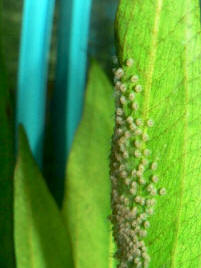
This morning I was surprised to see that one of my angel fish pairs had
laid eggs over the driftwood.
The pair has been guarding the eggs from other fish.
<Ah yes>
But I do see that the number of eggs turning white was gradually
increasing over the day.
<Mmm; yes. A "first batch" is often "weak"; and... there is some chance
that the eggs were not fertilized, even... that there may be two females
at work here!>
This the first time I have seen angel fish lay eggs.
<Enlivening eh?>
Is it advisable to move the driftwood with the eggs to a nursery tank or
do I need to move along with the pair.
<As this is already ongoing... I'd leave all as is. IF you're interested
in breeding, rearing young... DO consider moving the pair to their own
system, employ a slanted (placed) piece of slate for them to place the
spawn on... and READ on WWM, the Net, books... re the option of moving
the spawn (adding Methylene Blue, an airstone), OR leaving the spawn w/
the parents, moving them when the young are free-swimming>
Since the eggs are turning white is there still a chance that I may have
angel fish fry.
<Yes; the white/fungused ones are gone; but the clearish ones may still
be viable. >
Please suggest what should be my next course of action.
<Again, I would leave all as is here currently; move the parents to
another system (20 gal. tall or larger)....>
Thanks and regards,
Shriram Natarajan
<Thank you for sharing. Bob Fenner>
Re: Reg. Angelfish Breeding 8/9/18
Hi Bob,
<Shriram!>
Thanks for getting back.
<Welcome>
As of now I have decided to leave the eggs wit the parents.
Today morning I could see that they were trying to move the eggs which
had not turned white to another bark of the driftwood.
<Ah, good>
That looked promising to me..
Keeping my fingers crossed, hoping to see at least a small number of the
eggs turn up to beautiful angelfish fry.
<They will breed again... every few weeks... shorter when eggs, young
removed>
Will keep you posted...
<I thank you>
And yes really excited with the first batch of eggs\hatching..:)
<Oh yes>
Thanks and regards,
Shriram Natarajan
<Cheers, Bob Fenner>
Angelfish egg bound? 2/21/18
I have a 500 litre aquarium running with two external canister filters a
UV steriliser and an ocean free internal filter. No water quality
problems, I test weekly and change a third of the water weekly.
I have four angelfish
and seven comet goldfish, that have been living together for six months.
<Mmm; not really compatible. Like different water quality...
hard/alkaline vs. soft/acidic; temperate vs. tropical... OVER eager
eaters vs. more shy.
Different temperaments as well.>
The temperature is 24 C. My goldies spawn about once a week throughout
the summer and occasionally in the winter. Two of my angels paired up
and have spawned for the first time a couple of weeks ago, although they
tended the eggs for about four days they didn't hatch.
<Might be two females...>
The problem I have was with my other angel. I am pretty sure she is
female as the other female and her bicker, nothing vicious though.
<Shouldn't be too problematical in a system this size>
My other male looked like his breeding tube was down and has been
swimming with her. Anyway she got really fat and I thought she was
gravid as she has been eating well until she refused the last feed I put
in the tank but she seemed fine, swimming normally not hiding,
interacting with the others. I went to the other room to feed my discus
<!? You have Symphysodon too?!>
came back and she was on the bottom of the tank on her side and died
within minutes, no previous signs of distress only that she looked very
fat. What happened?
<Got me. Bizarre>
I was only gone for 20 minutes. Was she egg bound and ruptured or
something? Or was she constipated?
<Can't tell from here>
When my fish poop, it normally breaks of straight away and doesn't hang
there. I am trying to convince myself to cut her open to check but I
don't think I can do it.
<Did you refrigerate the corpse? Time enough to get on down to a large
library and check out a book on fish dissection. Look for the name Ed
Noga>
If she was egg bound is there anything that can be done if it were to
happen again to my other angel?
<More small crustacean food in their diet. Brine Shrimp, Daphnia...>
She had no outward signs of disease or injury, her belly was just very
bloated. I felt her stomach and the swelling was softish not hard and I
could feel some tiny hard lumps. I feed mostly frozen food,
bloodworm,
<I'd delete these; see WWM re>
brine shrimp, krill and an insect based dried food.
I do feed peas once a day but I think the goldies eat most of them and
the angels spit them out. Any advice greatly appreciated so that I can
take immediate action if my other angels start getting swollen. All
other fish are pooping normal, with no obvious signs of internal
parasites. I have some Praziquantel to hand if you think I should treat
with it but I don't want to medicate for no reason.
Thanks Zoe
<If you have another system, I'd separate the goldfish and angels. Bob
Fenner>
|
Male or female? /RMF
9/5/16
This little guy has been breaking my girls heart by eating her eggs instead
of fertilizing them. I want to confirm he's a male, just so I know I'm on
the right track prior to breaking them up.
<This looks like two females to me>
I have great video of their spawning posturing, but you guys don't take
vids.
<Oh! Better to post on YouTube or such and just send us the link>
�� I think you can see his tube is short, sharp, narrow and small. Could
this be a female without eggs posing as a mate?
<Again...>
My girl is serious and sincere.
Norma Von O~
<Does happen! I'd separate, or trade one in; try some other male/s. Bob
Fenner>
Male or female? /Neale
9/5/16
This little guy has been breaking my girls heart by eating her eggs instead
of fertilizing them. I want to confirm he's a male, just so I know I'm on
the right track prior to breaking them up.
<If the photo you sent is anything to go by, the male's on the right, female
on the left.>
I have great video of their spawning posturing, but you guys don't take
vids. ��
<Nope. Nothing to stop you posting on YouTube or similar, and sending a URL.
But hardly matters in this case...>
I think you can see his tube is short, sharp, narrow and small. Could this
be a female without eggs posing as a mate? My girl is serious and sincere.
Norma
<Farmed Angelfish are lousy parents, and some NEVER manage to rear their own
young. In the wild there is a strong selection pressure in favour of good
parenting. Those with poor parenting genes leave fewer (if any) offspring.
So over time evolution favours Angels that are good parents. But in
captivity, breeders select which "pretty" males and females they want to
spawn from (rather than by selecting the ones with the best parenting
skills) and when spawning occurs, the breeders pull the eggs out and look
after them manually, encouraging the parent fish to spawn again. So over
time the lack of a selection pressure in favour of good parenting means that
bad parenting genes are spread as easily as good parenting genes, and the
farmed Angels we see in shops end up lousy parents. Make sense? It's good
ol' evolution at work, and unless we actively start selecting good parents
from the Angelfish gene pool, it'll never get any better. Now, with all this
said, even good Angels will eat their eggs if they're spooked by something.
This is their way of recycling the energy that went into the eggs, which
they decide to do because they don't think they can rear offspring at the
time/place where they are. So looking around the room to see if anything is
spooking them might help. Breeding Angels like dark, quiet tanks with no
other fish. They don't like noise or activity outside the tank. Sometimes,
just sometimes, "bad" parents get it right after a few attempts, so it is
worth persisting. But otherwise you may need to replace the male for
another. Hope this helps explain the situation, Neale.>
|
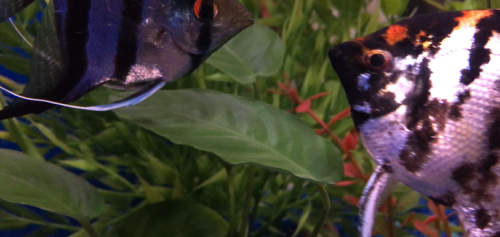 |
Angelfish Fry. 7/23/15
We have a pair of fresh water Angel Fish who are a mating pair. So far we've
left them alone (all fry eaten),
<Par for the course...>
Separated the parents and the fry from the rest of the tank (all fry eaten
twice).
<Again, what normally happens. Angelfish often make poor parents -- having been
bred (and the fry manually reared) over many generations on fish farms, the
selection pressure for good parenting skills has been largely lost. Sometimes
leaving the parents with the eggs works eventually, though you will lose a few
broods in the process. But if you're anxious to rear baby Angels, pull the eggs
and take a 'do it yourself' approach.>
Separated the parents and fry from the rest of the tank for four days, then
removed the parents when they got to the wiggly stage. Removed the parents and
the fry got to free swimming stage, then mysteriously buried themselves in the
rocks two days ago and died. What are we doing wrong?
<Almost certainly a combination of lack of food and latent bacterial infection
cause by environmental shortcomings. To be clear: you want the eggs in a
bare-bottomed 8-10 gallon tank that can be easily spot cleaned (e.g., with a
turkey baster) as required. Use Methylene blue to keep fungal infections at bay,
and place a small airstone/bubbler nearby the eggs to keep a (gentle) flow of
oxygenated water moving past them. Air-powered sponge filtration is a must in my
opinion, partly for keeping the water clean, partly because the sponge develops
infusoria/algae the fry can/will eat, and partly because other types of filter
will harm the fry if the water current is too strong. Feed 4-6 times daily on
suitable foods immediately the fry are free swimming, usually 5-6 days after
hatching; baby brine shrimp the classic first food, but some success can be had
with Hikari First Bites and other modern fry foods (i.e., not Liquifry, which is
better suited to larger fry such as Danios and Kribs). Frequent (daily)
substantial (50%) water changes are necessary whenever rearing egg-layer fry,
and the use of an antibiotic can be helpful if you find fry dying across the
next week or two. Do bear in mind fry are very sensitive to
changes in water quality, chemistry and temperature.>
Thanks,
Doug
<You're welcome, Neale.>
Dying Angelfish Wigglers
5/7/15
Hi,
<Barb>
We have 8 pairs of breeding angel fish and have enjoyed this hobby for about a
year now.
<I see>
Our most successful pair have been breeding for about 4 months every 10 days or
so. They produced large numbers of very healthy fry until the past month.
The last four batches the eggs make it to wiggler stage and on about the 4th day
as wigglers right before they should be free swimming they all die.
They look well formed and normal. We have not made any changes to how we keep
the parents or care for the eggs.
<Mmm; perhaps your water supply has changed w/o your notice, notification>
We do raise them ourselves by removing the slates and keeping them in jars with
dechlorinated water
<What do you use for this method, chemical wise?>
,methalyne blue and airstone. We do water changes daily .
<With water that you've prepped and stored for a week or more I hope/trust>
As I said we have had many successful fry and currently have about 300 of their
fry in grow tanks. All of our other breeders wigglers are doing fine. The only
failures have been with this pair for the past month.
<Oh!>
We are not sure how old the pair is but we guess they are 2-3 years old.
Any ideas of what could be happening?
<Mmm; because it is only the one pair... am given to speculate that "something"
genetic may be at play here... OR something in their placement, your routine
that is somehow poisoning just this one sets young>
Oh we feed our Breeders high quality foods. Every other day they get frozen
blood worms.
<Do see WWM re this sewer worm larvae... not as safe as years past. IF using, DO
use a brand that is well cleaned, sterilized (e.g. Hikari)>
Their diet has a variety but a high percentage of protein. They are all very
healthy.
What do you think?
<Can only guess; and not very well; at this point. I'd try moving this one pair,
swapping them out for another... switching out their spawning substrate (are you
using flower pots, lead strip, slate?<< Ahh, see above it is slate; I'd switch
this piece out for new>>)>
Thanks,
Barb
<Thank you for sharing. Bob Fenner>
Dying Angelfish Wigglers /Neale
5/8/15
Hi,
<Hello Barb,>
We have 8 pairs of breeding angel fish and have enjoyed this hobby for about a
year now. Our most successful pair have been breeding for about 4 months every
10 days or so. They produced large numbers of very healthy fry until the past
month.
<Great!>
The last four batches the eggs make it to wiggler stage and on about the 4th day
as wigglers right before they should be free swimming they all die.
<Not good.>
They look well formed and normal. We have not made any changes to how we keep
the parents or care for the eggs. We do raise them ourselves by removing the
slates and keeping them in jars with dechlorinized water, Methylene blue and
airstone.
<Fine.>
We do water changes daily. As I said we have had many successful fry and
currently have about 300 of their fry in grow tanks. All of our other breeders
wigglers are doing fine. The only failures have been with this pair for the past
month. We are not sure how old the pair is but we guess they are 2-3 years old.
Any ideas of what could be happening? Oh we feed our Breeders high quality
foods. Every other day they get frozen blood worms. Their diet has a variety but
a high percentage of protein. They are all very healthy.
What do you think?
<If your protocol for rearing Angelfish fry works for all your other pairs, just
not this pair, it could be a genetic flaw. Some strains (Koi
for example) are noticeably more delicate than either wild-types or the older,
less inbred varieties (such as Marble Angels). Other than that, you could check
the obvious: Are you feeding at the right stage? Is water temperature
the same as the others? This will effect development rate and in turn when they
need their first food. Have you tried alternate foods, such as
Microworms or Artemia nauplii instead of non-live foods? Basically,
look to see what might be different, and act accordingly. My hunch though is
genetics. Either approach the fry with more care (water quality, pH
stability, softer water, live food) or try swapping one of the adults for
another, proven adult and see what happens.>
Thanks,
Barb
<Cheers, Neale.>
Angelfish wigglers die in large numbers /RMF
3/29/15
Hello:
I had about 150 Angelfish wigglers in the 75 gallon as I moved the parents to
the 20 long. I fed the wigglers First Bites,
<You haven't been reading>
and everyday over about 4 or 5 days they died off. So they are gone and the
parents are back in the 75 gallon.
<...>
The filter was off while they were in there to prevent them getting sucked in
it. Maybe the deaths were from them being in hard/alkaline water and they
couldn't handle it, or maybe this is extremely common. I think it would have
been better had the baby fish hatched in the 20 gallon.
<....>
Are large deaths like that common??.
<...>
I may put the parents back in the 20 let them breed there, that way I will not
have to move eggs or wigglers. Thank you
<...>
Angelfish wigglers die in large numbers /Neale
3/29/15
Hello:
<HI Judy,>
I had about 150 Angelfish wigglers in the 75 gallon as I moved the parents to
the 20 long. I fed the wigglers First Bites, and everyday over about 4 or 5 days
they died off.
<Feed more and more often, remove uneaten food; rinse and repeat. Really do need
6-8 meals a day, but such young fish are extremely sensitive to water quality
issues, including nitrate. Do also try offering alternate foods.
How old is this packet of fish food? First Bites is good, but like all these
prepared foods, I think loses its "savour" quickly. I kept mine in the freezer,
tightly wrapped with a rubber band to keep air out, decanting only the amount I
needed for a few days into a suitable small container (like one of those tiny
paint pots you can get at craft stores). Keep it cool, airtight, bone dry, and
away from sunlight. Probably useless after a few weeks at room temperature and
ambient humidity.>
So they are gone and the parents are back in the 75 gallon. The filter was off
while they were in there to prevent them getting sucked in it. Maybe the deaths
were from them being in hard/alkaline water and they couldn't handle it, or
maybe this is extremely common.
<Do keep the filter running except for a few minutes while feeding, if that. Are
you using an air-powered sponge filter? If not, then do so.
Pretty much essential in breeding tanks with egg-layer fry. Even with the air
on, the "suck" is feeble, so you can feed the fry while leaving the sponge
filter in use. Fry will also pick at infusoria that grow on the sponge,
especially if it receives a little natural light.>
I think it would have been better had the baby fish hatched in the 20 gallon.
Are large deaths like that common??
<Yes, and almost always starvation and/or water quality. But do also get the
timing right. The eggs hatch within 2 days, but for the next 5-6-7 days you will
see them wriggling but attached to yolk sacs. No feeding needed.
But once the yolk sac is gone, they will need food, and quickly. Don't worry too
much about what the books say in terms of when they're ready to feed. Look at
your fry. Higher temperatures will speed things up. Better to feed early, and
waste some food, than late, and starve your fry -- but this is only true if you
can keep ammonia and nitrite at zero and nitrate as low
as practical. Hence the need for mature biological filtration.>
I may put the parents back in the 20 let them breed there, that way I will not
have to move eggs or wigglers. Thank you
<Hope this helps. Cheers, Neale.>
re: Angelfish wigglers die in large numbers (Neale)
3/29/15
Hello Neale:
<Judy,>
The packet of food is new. I have only been feeding 1/8 tsp once or twice a day.
<That's one problem right there. Baby fish can digest only tiny amounts of food
at any one time. They're easily starved. Six or eight meals a day is better.>
The 75 is so big for these wigglers. The 20 gallon long has a running air power
sponge filter for a 40 gallon which was in the 75 for a long time. I may get
another hang on filter for the 20.
<I would not use an HOB filter on a fry rearing tanks. Sponges much better.>
There is a disconnected small 10 gallon sponge filter in the 75 that the angels
laid their eggs on along with the usual Aquaclear 110. They hung on to that
small sponge filter until they finished with the egg yolk and started letting go
in groups to free swim. Will the angels breed if I move them back to the 20 long
or will that be to stressful for them?
<Angels are commonly bred in 20 gallon tanks, albeit "high" rather than "long"
style tanks.>
I would rather the babies be in the smaller tank instead of moving them.
Thank you for all your info. I know I am being a pain
Judy
<Glad to help. Neale.>
Angelfish laid eggs on UV sterilizer tubes /Neale
3/21/15
Hello:
<Hello Judy,>
My angelfish parents laid eggs for the third time on the tubes for the UV
sterilizer. The last two times the wigglers disappeared. I wanted to transfer
the eggs or the wigglers to the 10 gallon, but the UV tube is a big and long. I
do have a 20 gallon long. Is it better to transfer the eggs or the wigglers?
<Six of one, half a dozen of the other. It's always best to remove the adults
and leave the eggs/fry where they are, assuming you want to rear the eggs
manually. Eggs can survive exposure to air for a few seconds, and you're more
likely to damage them by removing them than exposing them to air. So, if you can
disconnect or otherwise move the "nest" from one tank
to another, so long as it's a really quick journey, it's not a huge problem, and
while you might lose some, you won't lose them all.
Alternatively, you can "roll" the eggs with a fingertip, very gently, and let
them fall into a suitable container held underneath them. Lift the container out
of the tank, and the eggs can be moved without being exposed to the air at all.
"Rolling" eggs is a bit of an art, and you'll probably squish a few, but you'll
get the hang of it pretty quickly, and once you're able to do this, it's a
fairly safe way to move the eggs. Finally, the best approach of all is to
encourage fish to lay eggs on something removable,
like a slate. Move the slate into a container held underwater, life, and
transfer the whole lot to another tank. This is by far the best way to move fish
eggs, but takes some planning ahead of time. Moving wrigglers is eminently
doable too, using a turkey baster. Just suck them up and then deposit them
wherever. Providing you suck and squeeze gently, this is very safe, just be sure
not to leave any fry in the baster! Easily done, so flushing the thing out a
couple times with breeding tank water is a really good idea. The problem here is
of course that those fish parents likely to eat their eggs might not leave the
eggs alone for long enough for wrigglers to hatch. There's some argument to
allowing Angels to work their problems out with successive broods, and sometimes
they get it right -- albeit after many rounds of brood cannibalism! Pro
Angelfish breeders more often let their Angels breed in a small tank, then
remove the parents, thereby avoiding the quandary you're facing.>
I read that the eggs made not survive being exposed to air. I can't find
anything on the WetWebMedia about transferring eggs and the books I find just
give basic info about angelfish breeding. I could set up the 10 gallon and maybe
gravel vac the wigglers into the 10 gallon from the 75 with the small gravel vac
when they have been wigglers for a few days. The 75 is a
bare bottom tank. The other tank would have the water from the 75 with a sponge
filter. Thank you
<Hope this helps. Cheers, Neale.>
Angelfish laid eggs on UV sterilizer tubes /RMF Simulcam!
3/21/15
Hello:
<Hey Judy>
My angelfish parents laid eggs for the third time on the tubes for the UV
sterilizer.
<Mmm; on the PVC pipe covering this I take it. No worries>
The last two times the wigglers disappeared. I wanted to transfer the eggs or
the wigglers to the 10 gallon, but the UV tube is a big and long.
<Mmm; remove it, and give the spawners alternate substrate... an inverted "red"
clay flowerpot perhaps, a strip of slate....>
I do have a 20 gallon long. Is it better to transfer the eggs or the wigglers?
<The eggs... Have I not directed you to WWM re?
http://wetwebmedia.com/FWSubWebIndex/fwangelreprofaqs.htm
I read that the eggs made not survive being exposed to air.
<Best to keep them underwater... >
I can't find anything on the WetWebMedia about transferring eggs and the books I
find just give basic info about angelfish breeding.
<Many folks use plastic or glass, "pickle jars" or large candy.... dunking into
breeder tanks... which are often 20 highs, 29s.... putting the spawning media in
the submerged container.... adding Methylene Blue, an airstone...>
I could set up the 10 gallon and maybe gravel vac the wigglers into the 10
gallon from the 75 with the small gravel vac when they have been wigglers for a
few days. The 75 is a bare bottom tank. The other tank would have the water from
the 75 with a sponge filter. Thank you
<Read the above; maybe look for Steven Dow('s) old Angel Book... and I'll add
the title to my writing list.
Bob Fenner>
Re: Angelfish laid eggs on UV sterilizer tubes
3/22/15
Hello:
I tried to move the eggs to the 20 gallon long, by moving the disconnected UV
sterilizer tubes. I lost almost all of them.
<? They're adhesive....>
Anyway when they lay eggs again in two weeks I think I will remove the parents
and let the wigglers have the 75 gallon. The parents would have to go in the 20
long. I heard that moving parents to a new territory(tank) can cause them to
"break up" and they may not reconnect and breed again. Would this be true?
<Rarely>
Also I hope the 20 long is not two short for them, but it is only temporary
Thank you
Judy
<B> Freshwater Angelfish egg surprise 2/21/15
Hello:
I have four angelfish in a 75 gallon. Two paired up and today I found a
bunch of eggs on the heater. This was a total surprise as I never had
any luck with angels breeding.
Anyway I turned off the heater and put another heater in there. Do I
need to put a little Methylene blue in the tank to prevent fungus?? I
have a cycled 20 gallon long also. Maybe the pair needs to go in that. I
don't know what to do
. Thank you
<Methylene Blue is usually used when the eggs are "pulled" and reared
manually. If adult cichlids stay with their eggs, they will remove
unfertilised eggs and any that become infected with fungus. The
challenge for you is that Angels are usually lousy parents, having been
farmed intensively for so long without any selection pressure in favour
of good parenting. Sometimes Angels figure it out and become decent
parents, but if you're desperate to get baby Angels, you may want to
pull the eggs and rear them yourself. Moving the pair of Angels would
almost certainly cause them to eat the eggs, so if you must remove some
fish, removing the Angels that aren't breeding. That said, in 75 gallons
they might spread out themselves,
and you can take a gamble on the mated pair defending their eggs
successfully. (They have no chance of doing this against catfish or at
night, so remove any Plecs and other nocturnal feeders such as loaches.)
Does this make sense? Cheers, Neale.>
Angelfish parenting 3/17/15
Hello:
<Judy>
I have a freshwater angelfish pair that bred in the 75 gallon tank a while back.
I think the small Pleco may have gotten the eggs at night.
<Ah yes; very common>
I moved the Pleco. Three weeks later, more eggs that became wigglers and the
parents seemed to be protecting them. I had the 110 gallon Aquaclear filter and
I did not turn it off, so they may have gotten sucked into that.
<Possibly>
There is no way to know as they could have eaten them also.
<This is also common the first few spawns... see WWM re Angel repro.>
The wigglers were on the sponge filter and the parents guarded them there for a
few days, until they were moving around on their own. I fed them "First Bites"
placing the food in where they were swirling around. I do not know if the
parents tried to eat the First Bites, even though it is like a powder and got
the wigglers also, or if they went up the filter. Anyway if they breed again I
think I will have to get either the eggs or the wigglers to the 10 gallon,
although how anyone catches wigglers is beyond me.
<... see WWM.... move the spawn...>
I was wondering if it is only the farm raised angels that are bad at parenting?
<Mmm; no; wild-ones are much harder>
One of these angels came to the LFS from a breeder and is a "blue marble" the
other is a plainer marble. Are angels in the wild on the side of being bad
parents?
<See above>
I would think not since obviously they survive in large numbers in the Amazon
wild. Thank you
Judy
<The reading. Bob Fenner>
|
Re: My male angelfish (RMF, second opinion)
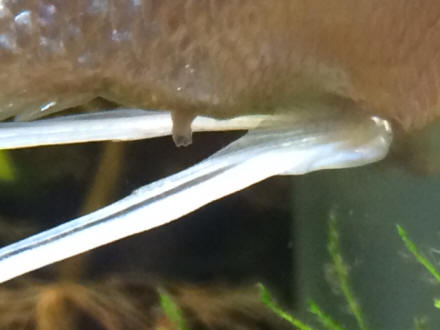
10/31/14
Hi again Neale, sorry to be a bug but I need more expert advice if you
don't mind:)
<Fire away, Kathryn.>
Firstly, I got a really close pic of that presumed females private part
just before I scooped her up to take to my LFS as they were willing to
take her back (esp. because I grew her 6 inches from when I bought her
there and
she's beautiful) and I showed the manager the pic and he picked her up
and said she's for sure a female!
<Hmm... maybe. Angels are very, very difficult to sex, and certainly
impossible to do so by looking at them! Spawning tubes are the only
reliable method, and the photos we saw didn't look like the spawning
tubes
of a female.>
So I took her back home...I bought a divider and the males eyes have
been healing nicely, all healing good there.
<All sounds good.>
Secondly, today after I did a WC I noticed the female had gone on that
side of the tank (2 inch space at bottom due to aquascaping
restrictions) they looked peaceful so I took out the divider. Within
minutes she was
attacking him!
<There you go. I'd still assume "she" is a "he".>
His white scales flying everywhere looked like it was snowing in my
tank:( she was going for his eyes but this time with much more
aggression (now they're worse again). They were both doing that
shake/shimmy thing and he DID retaliate a bit this time and she now has
minor scale damage on her side now too:(. Divider went back in
obviously, and they are doing that twitchy shake thing through the clear
plastic screen.
<Now, the pelvic fin twitch in Angels is aggression or at least
irritability/frustration, so do be careful.>
Here's the pic of that same female (or male? Idk) their behaviour looks
like two males fighting but their shake thing looks like spawning
rituals.
<I agree.><<I as well. RMF>>
Help!! I can return the female still, but don't want to if there's still
a chance she's a female and they will eventually spawn.
<Well, it doesn't sound as if these are a compatible pair, no matter
what sex they are. Honestly, I'd hit the reset button here. Switch one
or other fish. Better yet, return them all to a group of 6 adults, and
let them pair
off. Ultimately, that's the easiest approach if you have space/other
Angels. I'm very skeptical of anyone who says they can sex an Angel by
looking at them. Growing up, all the books I had would have sketches of
forehead bumps and stuff like that which you were supposed to use for
sexing Angels. Some older Angels do indeed develop these "nuchal humps"
and many of those are males, but other males never develop them, and
they're not apparent on younger (yearling) specimens anyway. There's
supposedly a way to tell looking at the slope of the body between the
throat and ventral area, but that seems even less consistent. Scientists
consider Angels to be monomorphic, i.e., the opposite of dimorphic,
i.e., males and females look alike (unlike sexually dimorphic cichlids
such as Kribensis). If it's any consolation, Discus are even harder to
sex.>
As always, a big thank you!
Regards, Kathryn
<Welcome, Neale.>
Female as the LFS mgr says? I think it's too skinny for a female but he
said the end has that transparent covering in females.. Hmm did he have
his facts wrong, because I'm seeing pics on the Internet of that on
males:/
<Stopped clocks tell the right time twice a day. While there are lots of
supposed tricks for sexing Angels, variation within the farmed hybrids
we see today is probably much greater than the differences between males
and females of the pure species from the Amazon. As the years pass, our
fish are less and less similar to the wild fish, and more and more
varied. So tricks that might have been worthwhile in the 1960s are
hopeless now, but yet those tricks get passed on down the generations.
Keep an open mind, look at the spawning tubes, observe their behaviour,
and act accordingly.
Cheers, Neale.>
|
 |
|
Re: My male angelfish 11/3/14
Thanks for your advice. You make perfect sense, and I do agree that she is
likely a he:) I think I'm going to return both and try my luck with some
Altums.,, my LFS gets them periodically, not wild caught, so hardier, and
are truly my favorite type of Angel:)
<Hardier, but not hardy. Do need soft or at least not hard water to do
well.>
I hear they are harder to breed,
<Again, need soft water for this or the eggs don't hatch.>
and am not worried if they don't, I'll just enjoy them and leave it at that!
<Indeed. >
Again, many thanks!
Kathryn
<Most welcome. Neale.>
|
|
|
My male angelfish 10/22/14
Hello, I'm having a problem with my angel pair. I've had a female for a
couple years solo in a 90g discus focused community tank.
<Discus and Angels aren't a great combo; but I guess yours were okay.>
She appears to be female (although never seen eggs), so I moved her to a
40g a couple months ago and introduced a male (presumed). They've been
friends and the male has had his papilla out most of the time.
<Indeed; clearly a male.>
She hasn't shown interest until recently, like over the last 4 days, and
they've started to shimmy and do the mating rituals, her papilla out,
cleaning the back wall and sword leaf).
<Cool.>
They gently peck or kiss each other but the female seems to be getting
less gentle. He doesn't move away, kind of tilts over at her mercy. His
pectoral fins are getting shredded (area she pecks at him) but the worst
is his eyes. They've been damaged to the point he can't see:(. I noticed
last night his eyes were looking cloudy and raised, and tonight they've
gotten much worse. I can see blood on the lower part of his eye!
<Indeed. Separate them. The female can/will reject the male, and vice
versa, and in the wild would go looking for other partners. If they
can't get apart, then trouble can develop. An old trick is to use
plastic egg
crate so the fish are separated but can see each other. Sometimes they
get "that loving feeling" back pretty quickly. Other times takes longer.
All else fails, return one/both to the main school of Angels, and wait
for
pairs to form again. If it's an option, isolate the injured fish for a
few weeks to heal up. Angels can be terrible bullies towards injured
fish.>
It's a planted tank and very cared for. Both my aquariums are pristine
in water quality and care. I have 2 pairs out of 6 discus who breed in
my 90 weekly:) the 40g angel tank is the same quality, and the Angels
have been thriving and in perfect health (as are my 7 neons and 3 Corys
in the 40).
I know this isn't disease, and don't want to salt the tank because of
the plants. Just wondered if I leave it alone will it heal, and is this
behaviour common to Angels or even heard of?
<Quite common with all cichlids. The flip side to having good parenting
instincts is a certain pickiness when it comes to partners.>
Is she going to continue this damage? He's still shimmying with her,
poor guy:( My discus are so peaceful in comparison, never experienced
this before.
Thank you for any advice you can offer.
Kathryn
<Most welcome, Neale.>
Re: My male angelfish 10/23/14
Thank you very much for the advice. My LFS suggested separating them also, and
wondered if the "female" is possibly a male?
<Angels are difficult to sex *except* during spawning. Males have the obvious
spawning tube, long and pointed, and at a slight angle. It's visible for a day
or two before spawning, and in some cases partially
visible all the time. The females have a thick, short spawning tube with a
rounded tip, and rarely visible except a few hours before spawning.>
I suppose it's possible since I've never witnessed her lay eggs.
<Same-sex pairs do happen with Angels, so always a possibility.>
I've added Melafix to the 40g now and will keep close watch, since they're
peaceful again.
<I'm not a fan of Melafix. It rarely helps and sometimes makes things worse.
Good clean water will often prompt a healthy recovery from moderate fin damage.
Serious damage best treated with antibiotics or
antibacterials.>
Any more aggression by the female and I will scoop her up and put her back with
my discus since she always got along well with them (I know it's not a good mix
but I've had her the longest and I guess my discus respect her as their gentle
leader lol)
<Fair enough. To be fair the big risk is Angels introducing diseases Discus
can't handle, but if you've had them together for years, that risk has probably
passed.>
Egg crate is another excellent option I will consider.
Thank you again for your quick, and always reliable advice,
Kathryn
<Glad to help. Good luck. Neale.>
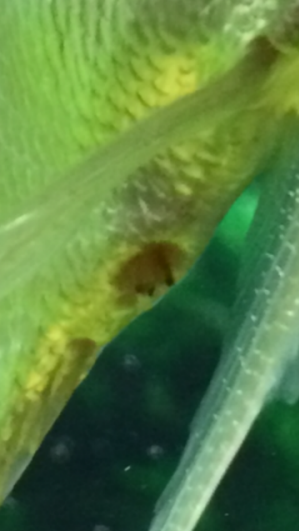
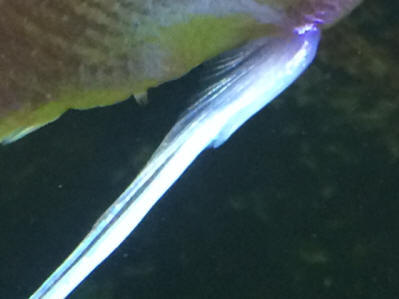
Re: My male angelfish (RMF, second opinion) 10/24/14
Hi again, I managed to get some pics of the presumed females papilla today,
maybe you will be able to confirm the sex of this fish? It would help me decide
better in their living quarters especially if your thoughts are that it is a
male.
Again, thank you! :)
These are all of the same fish:
<Looks like a male to me, but will ask Bob to chime in here. Cheers, Neale.>
<<I concur. RMF>>
|
 |
|
Re: My male angelfish (RMF, second opinion)
10/25/14
Thank you Neale, I agree it can be very difficult to sex Angels and Discus
as well.
<Impossible, even.>
My proven male/female discus pairs exhibit such similar papilla at times,
the hatching of eggs is almost the only way to be sure.
<For sure.>
But still much appreciated:)
Kathryn
<If it's any consolation, Angels and Discus get it wrong too... possibly as
you experienced here. Some pairs form, spawn a few times, then realise
they're the same sex! Cheers, Neale.>
Re: My male angelfish (RMF, second opinion)
10/25/14
Aww, very cute.
<Or depraved... depending on whether you're a liberal or conservative!
</British humour>>
Well now I will definitely separate and re-home one. Thank you again for
your expert advice!
<Cheers, Neale.>
Re: My male angelfish (RMF, second opinion)
10/26/14
Haha well I'm a liberal at heart, and support gay rights for the most part, so I
guess we'll say "cheers" to gay fish, but will at least give my boys an
opportunity to experience a female lol!
Regards,
Kathryn
<Indeed. Sounds the right approach. In all seriousness, Angels generally pair
off correctly if returned to the school, but it may take a few turns before they
(a) find a compatible mate and (b) figure out how to rear their offspring rather
than eat them. Cheers, Neale.>
|
Angelfish Reproduction 3/25/14
Thanks once again for the great site and your patience.
<Thanks for the kind words.>
I have a tank of three smokey blue angelfish in a 45gal tank filtered by
a aquaponic growbed. All water parameters are in check.
<Meaning what? Do understand that Angelfish are somewhat touchy about
water chemistry when it comes to spawning, and low nitrate levels are
crucial to success when rearing the fry. You're aiming for a hardness
between, say, 1-15 degrees dH, the lower end of the range being better,
and a pH between 6 and 7.5, and again, the lower end of that range being
ideal. As with all cichlids you're endeavouring to keep nitrate below 20
mg/l if at all possible, and the lower the better when rearing fry; as
nitrate goes up, invariably you find the quantity of fry that survive
the first few weeks decreases.>
I have a female full of eggs and two males. Should I remove one male and
risk stressing my female or let it be.
<Since these fish pair off, what should happen is a single pair work
together and push the surplus male off to one end of the tank. At that
point you will need to assess whether that male will need to be removed
(for example, it's harassed to the degree it can't rest or feed). On the
other hand, having a possible threat in the tank can help strengthen the
pair bond, so leaving a "target fish" (as Loiselle calls such) can be
helpful.>
It will be her first spawn.
<So manage your expectations! Farmed Angels are notoriously poor
parents, primarily because farmers raise the eggs themselves, so they've
selected for colour and fin length rather than parenting skills. So
there's been no discrimination between competent Angelfish and idiotic
ones, and to be honest, most seem pretty useless at parenting. Eating
their eggs is
extremely common. Even in the wild parenting is a learned skill, and
failures with the first couple of broods is normal. Sometimes farmed
Angels "get it right" after 4 or 5 attempts, but not always, in which
case you'll have no choice but to pull the eggs out the moment spawning
is finished.>
I haven't seen any aggression but its an outside tank, so I don't
monitor activity all that often. The males seem evenly matched. Aloha
Brandon
<Good luck, Neale.>
Angelfish Breeding Pair... or not
6/8/13
Hello
<Jesse>
About two months ago I had two of my Angelfish in a 125 planted tank
pair off and lay eggs. Excited I set up a 20 tall and waited.
I had read that you should let the pair breed a couple times in the
original tank before you move them to a breeding tank.
<A good idea, practice... to establish the pair, practice>
Two months rolled by and they didn't breed again. As of yesterday
the female was laying eggs with the male not the one she originally
spawned with.
<Happens; the original might not have been a male/breeder in actuality;
the eggs sterile>
This male never has displayed a tube for fertilizing the eggs while the
other male does.
<Bingo...>
So I'm thinking of going out on a limb and placing the original male and
female in the breeding tank. I had thought that Angelfish pair off
and stay that way, not switch up. What are your thoughts?
<I'd leave all in the original, larger system till a true (breeding,
hatching young...) pair is established. Bob Fenner>
Angelfish stopped laying eggs– 04/10/13
Hi there,
<Aleta>
I have a breeding pair of angelfish that stopped laying about 4-5 months
ago. Her tube has been out for about 2 months, they are in a 10 gallon
by themselves,
<Really too small. Many commercial breeders utilize 20 talls, or 29
gallon stock tanks...>
clean their normal laying spot often,
<A good idea to switch out spawning media period... try strips of slate,
clay pots...>
but still no eggs. I have been feeding them freeze dried worms,
<Meh; not a good food/nutrition source. See WWM re feeding Pterophyllum>
but they won’t eat them. I have done water changes frequently. They are on
a table in a quiet place in the house so I know they aren’t being
disturbed. I have been adding Amazon Extract solution to their tank and
still nothing. In the past, they have laid multiple batches (about
10-15) and have been successful at raising the fry to adulthood. I read
somewhere that she might have run out of eggs?
<Nah; not likely. These dihybrids do "go sterile" at advanced age, and
do have periodic reproductive "checks", but these are almost always of a
few weeks duration; not months. The food/s/nutrition and system are
likely at fault here>
I live in Southern California and thought it was because of the cooler
weather during the winter, although the house was always heated to about
75-80 degrees daily so I don’t think that would make much of an issue.
<///? Need a heater, warmer, consistent temp. And the larger world>
I am at a loss. Can you please help me!!
Thank you for your time.
Regards,
Aleta
<Do read where you've been referred... Bob Fenner>
Re: more questions on wild Angels <breeding>
1/31/13
I was looking at a book. breeding and raising angelfish by ed stansbury
and i came across a wild angel called Pterophyllum Leopoldi I was
wondering are they hard like Altums to keep and bred in ph/ gH 7 water?
<Pterophyllum leopoldi is the species that used to be called
Pterophyllum dumerilii, and that's the name you'll see it under in many
aquarium books. It has a distinctive black blotch under the dorsal fin
between two of the vertical bands. It also has a
characteristically-shaped head different to other Angels. In terms of
care it isn't especially delicate; anything between 1-12 degrees dH, pH
6-7.5 will suit them fine. They don't mix well with other Angels though,
so be sure to keep separately in their own tank, either singly, in
matched pairs, or groups of 6+ specimens.>
I also found a mag at barns n noble for 7.99 called Amazonas The Jan
2013 issue of it has articles on Angelfish breeding and genetics. Do you
think this is a good buy for someone interested in breeding/ keeping
wild angels.
<Do you mean Amazonas Magazine? It's a good magazine, anyone planning to
keep Angelfish seriously, i.e., to breed them or to keep wild-caught
specimens, will find the January 2013 issue well worth reading.>
I plan on getting a 90 gallon, 18 w 24 h and 48 L sometime this June and
cycling it sometime this summer/ fall. I'll go with sand for substrate
and aquarium eco earth (for plants) I'll add the eco earth on the bottom
and sand on the top. I'll do as you said and start after cycling with
the warm water Corys and after awhile add tetras before getting some
angels last.
<Real good. Cheers, Neale.>
Re Some questions regarding Angels... Sys., repro.
10/21/12
I spoke with the person who keeps/runs Angels plus. He told me that his
Manacapurus are kept in hard water/wild caught fish and have spawned for
him. ( though he wont tell me the ph he says my water would be much
better then what he has,) Should I be wary of this. You told me my water
was fine so I assume it is.
<... likely so>
The photos on his website look great but could the spawns have
reproductive/health issues from hard ph, ect.
<No such word... etc. is a contraction for et cetera res>
Another thing If I do get the 2 Manacapurus I plan on getting to pair up
and breed. What do i do with the Synodontis catfish/ Rummynose tetras?
will they harm the spawn/fry?.
<The Mochokid may well consume them... I'd remove all, or the
parents/spawners to elsewhere... This is gone over and over...>
What filters are good for breeding tanks?,
<... see WWM re>
I know power filters would suck up free swimming fry, maybe its best to
just start with as juveniles the same filters I'd use in the tank in
case they breed as adults. Steve did tell me he has seeded sponge
filters to cycle tanks much sooner then the 6 to 8 weeks you said would
cycle the tank. Although I think to be wise I'll take my time cycling.
<Yes>
Another thing he said in his site that black worms live are not a good
idea to feed angels as they might contract a disease, is that true.
<See WWM re this as well... the search tool on every page, the indices.
Bob Fenner>
pics of angelfish; now sexing – 07/18/12
Hello:
<Hello.>
I have a blue "cobalt angelfish 'that must be male as no eggs were ever
laid in the three months I had "him". I also have a half grown platinum.
I really wish there was a sure fire way to tell a male from a female.
<So does everyone else who has kept Pterophyllum spp.>
Is it true the only way to tell one from the other is two put a bunch in
a tank and see who breeds or just buy from a breeder??
<Pretty much.>
Is it possible for me to email you pics of the fish I have and maybe you
could tell?? or maybe not.
<No need. Images are worse than useless. At best, inspection of the
genital papillae will reveal the gender of mature fish, especially
within a few days of spawning. Otherwise Pterophyllum males and females
are essentially identical, despite all the claptrap about different
shaped foreheads, behaviours, etc.>
Thank you!!
<Welcome, Neale.>
Male vs. female angels 7/20/12
Hello:
Is it possible to have a female freshwater angelfish that just doesn't
lay eggs?
<Sure.>
or to have a male that will not fertilize eggs?
<Also possible.>
Is that really rare??
<No more rare than sticking two of any sort of animal in a box and
assuming they'll mate. If they don't like each other, don't value one
another's genes, or don't like their environment for some reason, they
won't breed.
Fish breeding requires effort and patience; there's an ample literature
on breeding Angelfish -- go read it if you want to breed them. Chris
Andrews'
"Guide to Fish Breeding" is a cheap, easy to read book that covers
Angels and a whole range of other popular species.>
The "Blue Cobalt" angelfish I have must be a male, but if there are
females that will not lay eggs then it could be a female. Thank you
<Cheers, Neale.>
Another Question, FW Angel repro. – 07/18/12
Hello,
I am writing you again because my angels have laid eggs and they're now
to the "wiggling" stage. my question is that I was unaware of their
spawn and I hadn't taken the eggs out like I usually do (I've bred them
for a while).
I'm very surprised that they've raised their eggs to this point, they
usually eat them. So my question is, Should I remove the eggs even
though they are taking care of them?
<If you want.>
Or should I let them take a shot at raising them on their own?
<Sure. There's no real risk here. If they eat the eggs, they'll spawn
again in a couple weeks. If they do a good job, you'll get a few young
Angelfish you can remove to the rearing tank to grow on. The biggest
issue is feeding, so do whatever makes it easy for you to feed the fry
whilst also maintaining good water quality.>
I also had a question about angelfish fry, I've heard many conflicting
statements, Aquarium salt is needed for angelfish so I was wondering if
I was doing something wrong by keeping their fry with aquarium salt
water?
<Angelfish do not need salt. End of story.>
I've read you're supposed to start them without it and gradually bring
them onto it, but they're laid in those conditions so I'm a bit
confused. Thanks for your time, Looked on your website and found results
way off of my question. Seems to happen whenever I try your website.
Perhaps I am doing something wrong.
<Perhaps.>
Allison.
<Cheers, Neale.>
Freshwater Angelfish and <bent> ventral fins
6/19/12
Hello:
<Judy>
I have an angelfish pair in a 46 gallon, one Blue Cobalt and one
Platinum.
The Platinum is still a juvenile. On the juvenile one of the ventral
fins is very bent. Is that a genetic "defect" or when the fish grows
will it straighten out? Thank You
<Quite common aberration... and most likely developmental
(ontogenetic)... raised in cramped quarters w/ too many siblings...
these "tweaks" happen.
Not self-correcting, but no problem in terms of the life/health of
specimens, nor the outcome of their own breeding. Bob Fenner>
Eggs!! FW Angel repro. 5/31/12
Hi Neale, hope you are well,
<Well enough. Looking forward to half term though…>
now the latest news, one of my Angels (the marbled one)
attacking two of them (the 2 black), (I have 4) so we assumed they had
paired up, and all of a sudden I notice a string of little eggs all over
a plant leaf (photos attached) this marbled Angel is being very
protective and the white one (maybe the female) as well, against the
other two.
<I see.>
I decided to separate them in the same tank with a spare glass I had for
that purpose.
Is this a good solution?
<Not the best solution but can work for a while so long as water
circulates around the tank adequately.>
I don´t want the "parents" to harm the other two which look really
scared the other two were attacking and cornering them a lot, after I
observed them I realized they were keeping them away from the eggs.
I don´t think they liked a lot the glass.
<I bet.>
I got them on January when they were very little they have grown up a
lot and its the first time I notice an aggressive behavior or eggs on a
leaf!
<These things do happen.>
Please advise!
thanks,
Lorena.
<Welcome, Neale.>
Re: Eggs!! 5/31/12
Half term holidays? what are you studying?
<Ah no, it's my students who are studying; I'm merely the teacher.>
Hi, I removed the glass this morning, and they are doing ok. Should I
remove the leaf with the eggs or will this stress mom or dad?
<Removing the eggs annoys the parents to be sure, but they get over it,
and usually start spawning within a day or two!>
thanks.
<Welcome, Neale.>
Prevent Spawning of Freshwater Angelfish /Neale
5/16/12
Hi! I have a 100 gallon well planted tank with five adult
freshwater angelfish and one Pleco (about 10" in length). I had no
intention of trying to breed the angels, but I have ended up with two
breeding pairs.
One pair are so far bad parents (which definitely seems to be the norm
from what I've read on WWM).
<Quite so!>
The eggs are laid and fertilized, but the eggs are not well guarded and
get eaten. The other pair are very good parents. Both the
male and female will fan/guard the eggs, collect any loose wigglers, try
to corral the free swimmers, etc. They are extremely vigilant and
will even attack me if I'm trying to do anything in the tank. (The
male will even jump out of the water and "bite" me on the hand if it's
near the water surface.) It's very interesting to watch the
behavior, but the level of aggression in the tank is becoming an issue.
It's not too bad until the free swimming stage is reached, then the
territory of the pair expands way too much.
<Yes.>
The worst is when the other breeding pair is in the process of spawning,
too, especially for the one angel with no mate who has to exist in a "no
man's land" between the two pairs. He/she spends quite a bit of
time hiding in the plants when that happens. Ideally, I'd like to move
the vigilant pair to their own tank, but I unfortunately do not have the
space for another. (I opted to use my little remaining space for
raising some of the fry I removed. The "FAQs on Freshwater
Angelfish Reproduction/Breeding" has been great, by the way.)
<Thank you.>
Is there a way to prevent them from spawning? I've read that
dropping the temperature can help,
<Yes, but go too cold and the cichlids become sickly, so this is
something to approach with care.>
but I live in a warm climate, and the room temperature is usually at
around 80 degrees (the tank is kept slightly warmer at 82 degrees), so I
can't drop it by much until the winter. The other option I
considered was trying to give the angels a more favorable substrate to
lay on (they use the glass right now), so I could easily remove and
discard the eggs.
<Yes. Often done. Near-vertical slates leaning against the glass are
good, as are Discus-style terracotta "spawning cones" put somewhere
attractive, like in a shady corner.>
Any advice would be greatly appreciated! The only injuries so far
have been extremely minor (i.e. bits of dead skin), but the aggression
keeps getting worse with each spawn. The "bad parenting" pair has
actually been gradually improving over time which is not helping the
situation.
<There's no sure-fire way to stop cichlids spawning -- if conditions are
right, they'll spawn. Some predatory fish might be useful, such as
Ctenopoma acutirostre, which get along with Angels but would view
juveniles as prey. Some catfish and spiny eels are especially good at
this because the adults can't defend the eggs at night. But your idea of
removing eggs is the easiest approach, barring of course simply not
keeping mated pairs of Angels (for example, you might keep just females,
generally the least aggressive of the two sexes). Cheers, Neale.>
Prevent Spawning of Freshwater Angelfish /RMF
5/16/12
Hi! I have a 100 gallon well planted tank with five adult
freshwater angelfish and one Pleco (about 10" in length). I had no
intention of trying to breed the angels, but I have ended up with two
breeding pairs.
<Happens>
One pair are so far bad parents (which definitely seems to be the norm
from what I've read on WWM). The eggs are laid and fertilized, but
the eggs are not well guarded and get eaten.
<Also>
The other pair are very good parents. Both the male and female will
fan/guard the eggs, collect any loose wigglers, try to corral the free
swimmers, etc. They are extremely vigilant and will even attack me
if I'm trying to do anything in the tank. (The male will even jump
out of the water and "bite" me on the hand if it's near the water
surface.) It's very interesting to watch the behavior, but the
level of aggression in the tank is becoming an issue. It's not too
bad until the free swimming stage is reached, then the territory of the
pair expands way too much. The worst is when the other breeding
pair is in the process of spawning, too, especially for the one angel
with no mate who has to exist in a "no man's land" between the two
pairs. He/she spends quite a bit of time hiding in the plants when
that happens.
Ideally, I'd like to move the vigilant pair to their own tank, but I
unfortunately do not have the space for another. (I opted to use
my little remaining space for raising some of the fry I removed.
The "FAQs on Freshwater Angelfish Reproduction/Breeding" has been great,
by the way.)
Is there a way to prevent them from spawning?
<Mmm, no; not as far as I'm aware... Other than separating the sexes>
I've read that dropping the temperature can help, but I live in a warm
climate, and the room temperature is usually at around 80 degrees (the
tank is kept slightly warmer at 82 degrees), so I can't drop it by much
until the winter. The other option I considered was trying to give
the angels a more favorable substrate to lay on (they use the glass
right now), so I could easily remove and discard the eggs.
Any advice would be greatly appreciated! The only injuries so far
have been extremely minor (i.e. bits of dead skin), but the aggression
keeps getting worse with each spawn. The "bad parenting" pair has
actually been gradually improving over time which is not helping the
situation.
<I'd trade, sell, give away the pairs that are spawning... Bob Fenner>
|
my angelfish laid eggs!
2/3/12
Hi Neale, Crew,
First, thanks for the advise on my PopEye angel and Epsom salt in
a future nursery tank.
<Most welcome.>
The angel was not recovering after a couple of weeks and stopped
eating.
we thought she would die, so I put her in my outdoor pond (700
gallons) with some Koi, goldfish, and a pair of blue gourami
(they were exiled for being bully's to their tankmates, and
like seem to like it out there) so she could die in peace. (not
to worry, we live in south Florida) We also needed the tank back
for some newborn mollies. Well, angel is actually doing great,
very active now after a week in the great outdoors.
<Ah! Yes, good environmental conditions will often effect a
recovery. It says a lot about the problems of maintaining good
conditions in aquaria (even spacious ones) that ponds can provide
dramatically better, therapeutic conditions.>
Meanwhile, back in the main tank, we have 110 gallons with
pineapple swordtail: 2 adults and 9 juveniles; assorted
platys: 6 adults and 5 babies (2 months); mollies: 2 black
(babies in the nursery) and 4 Dalmatian lyre tail; tetras, 2
white skirted x-ray or ghost, 4 Serpae;
<Watch these like a hawk; very nippy.>
and 3 angels: 1 Koi male, 1 black marble female and a striped
female. (the female Koi was sent to the pond) . Now,
when i came home from work today i see that female striped and
male Koi have laid eggs on the filter arm that goes about 18
inches down into the tank.
<Great!>
I have no idea what to do.
<Up to you. Do you want to breed them?>
If the eggs hatch,
<Parents will almost certainly eat them before that happens;
Angels are very bad parents.>
i am afraid the filter will suck the newborns in,
<Possibly.>
or they will get eaten by all the others, like the baby black
mollies, I could only save 8.
<For sure.>
Should I try to put up a partition in the tank to separate mom,
dad and eggs from the rest of the tank and just take chances with
the filter.
<Could do. But see above re: parents.>
I have never seen baby angels and am just thrilled but also
afraid of seeing them be eaten.
<Baby Angels are very sweet, and don't have the flat shape
at all, but only grow into that shape.>
If the eggs were on anything else, i would move them, but on the
filter!?!?
<A problem. Ideally, you're remove the tubing, replace
with another (many pet stores sell spares for a given filter) and
put the tubing in a fry rearing aquarium. No need for parents.
Add Methylene blue to the water to stop fungus, and put an
airstone nearby for oxygen-rich water to flow close by. Start up
a simple biological filter (some ceramic media or filter floss
taken from the mature filter is a great way to do this; stuff
into an air-powered box or corner filter). Keep water at 28 C/82
F. Remove fungused eggs on sight. The fry will hatch after about
6 days, and become free-swimming (i.e., feeding) about a day
later. Ideally, use newly-hatched brine shrimp, but reasonable
results can be had with certain powdered flake foods, e.g.,
Hikari First Bites. You'll get fewer fry (some fry only take
live brine shrimp nauplii) but it's less hassle.>
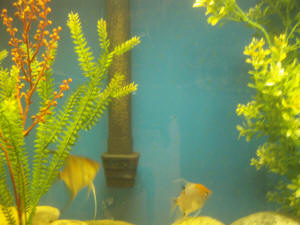
Could you please give me some advise? I am attaching the
best picture I could get of the tank.
Thanks so much for your help,
Lynn
<Do read:
http://www.wetwebmedia.com/fwsubwebindex/fwangelreprofaqs.htm
Most good aquarium books will have a section on fish breeding,
and Angelfish are a staple of the hobby, and not difficult to
rear. Even I've managed it once or twice! Cheers,
Neale.>
|
|
|
Female angels <sexing>
and driftwood <use> 1/26/12
Hello:
<Judy>
I found something very interesting on YouTube. A guy did a talk about
how to sex male and female angelfish
http://www.youtube.com/watch?v=h7Q02zrMq8A
I do not know if I am allowed to post a YouTube link
<Certainly>
It is about the little difference in shape when you look at the fish in
profile. If this is the key to sexing angelfish then do they have this
difference as juveniles??
<Hard/er to discern when young>
Also if someone had two or three females in a large enough tank would
they be territorial or does the magic number of six still apply for all
female angelfish unless it is just one?
<Would be territorial if spawning in particular>
I was also wondering about the importance of carbon in a filter.
<See WWM re: http://www.wetwebmedia.com/FWSubWebIndex/fwchemfiltrants.htm
I have an Aquaclear 70 filter which uses a sponge, a bag of
carbon on top of that and these little pellets that absorb ammonia.
<Mmm, not>
Someone on the net said to just use two sponges and forgo the
carbon package, is this true?
<Can>
Is it ever ok to use driftwood from the beach if it is soaked and
tested for contaminates?
<See WWM re treating...>
Or are there some possible contaminates that would not show up in any
test available?
<Of a certainty, yes>
I'm thinking it is too much of a risk and it would be best to stick
with ceramic driftwood due to the high cost of real driftwood. Thank
you!!!
<Or ones from freshwater source... Bob
Fenner>
Any hope for my little
angels? 12/16/11
Hi!! How are you? I have a 70 gallon tank with 6
freshwater angelfish. 2 are a pair and have laid eggs
three times now. The first two times, they ate all the eggs :( This
third time went better and the eggs are now tiny fish. They've just
started swimming. My question is, is there any chance that any
will survive?
<Yes, but you will probably need to move them to their own aquarium.
There are three issues. First, Angels aren't good parents, and the
other ones could very well view them as food. Secondly, you need to
feed them 4-6 times per day, albeit small meals (Hikari First Bites is
a good food, but newly hatched brine shrimp are the best). Thirdly, you
need to do frequent water changes to keep nitrate as close to zero as
possible (obviously nitrite and ammonia need to be zero). Standard
operating practise is to rear Angelfish fry in a 10-20 gallon tank with
an air-powered sponge filter and a heater set to about 28 C/82
F.>
One of the parents is guarding them pretty good. Chasing away all the
other fish (including the other parent). And when he/she notices any of
the fry swimming away, goes and "eats" them, and then spits
them back out on their plant.
<Unusually good behaviour from what I assume are farmed Angels. Wild
Angels do behave like this, but generations of captive breeding have
removed these instincts from almost all specimens.>
I have seen a few swim away and unfortunately get eaten by other
fishes. I would like to leave them in the main tank in hopes of having
a few survivors, and maybe some time in the future, set up a breeding
tank for them. I do have some empty tanks lying around. :)
Thanks!!!
Lindsay.
<Hope this helps. Cheers, Neale.>
Re: Any hope for my little angels? 12/16/11
Thanks for your reply. The other angelfish parent has joined in and is
helping guard the fry now. It's adorable, when the fry swim too far
away, the parents take them in their mouths and spit them back out on
the plant.
:) Some of the babies have unfortunately gone missing during the night
though. Thanks for your advice! Lindsay
<Glad you're enjoying fish breeding so much. Angels who can be
good parents are rare indeed! You're very honoured to be able to
watch this.
Nonetheless, after a month you will need to move the fry, as the adults
will stop viewing them as their offspring and instead seem them as
threats to their *next* batch of fry. Cheers,
Neale.>
egg bound angelfish,
FW 8/31/11
Hi crew,
<Laura>
I have an angel fish that is egg bound. I read on the site to do a 50%
water change, turn up the temperature to 82 and cover the tank.
<... cover the tank? What re the use of Epsom Salt... Are you sure
you're referring to WWM?>
I have done all of the above and she is still real swollen this
morning. Is there anything else I can do for her?
<Read here: http://www.wetwebmedia.com/FWSubWebIndex/dropsyfaqs.htm
and here: http://www.wetwebmedia.com/FWSubWebIndex/SaltUseFWArtNeale.htm
She is in a 56 gallon tank with a Betta, another angel fish which I am
supposing is a male, and a juvenile angel fish. I feed flake food,
<Cut back on this>
frozen brine shrimp, and blood worms. They only get fed once a day.
<Feed twice...>
All parameters are good. She did lay some eggs but the other angel fish
was keeping her pinned at the bottom of the tank so I took her out and
put her in the 75 gallon when I realized that she had more eggs to lay.
She is now back in the 56 with the adjustments that I mentioned
above.
Thanks
Laura
<Welcome. Bob Fenner>
re: egg bound angelfish 9/1/11
Bob,
<Laura>
Do you mean for me to feed the blood worms and brine shrimp twice a day
and stop the flake food?
<Cut the dried food to a minimum>
I added Epsom salt to the water at a dosage of 3 teaspoons of salt per
gallon, dissolved in warm water. I also gave them some frozen peas. I
have to go get a stronger pump to put more aeration in the water with
the higher temperature. Is there anything I did not get from my
reading?
<Sounds like you're on your way. Relax. BobF>
Thanks
Laura
re: egg bound angelfish 9/6/11
Hi Crew,
<L>
This fish is now doing back flips and trying to keep her nose up by the
surface of the water. I figure the eggs have caused an internal
infection but I am unsure what to treat her with. Will the salt still
help her or should I try something else?
<... already answered.>
I have watched her for an hour now and she can not right herself.
Should I put her in a breeder box to keep her from running into stuff
and hurting herself? Help please. Is there anything I can do to cure
her or is she certain to die? If she is not curable then should I
euthanize her? I am unaccustomed to losing fish, so this is hard for me
to watch.
Thanks
Laura
<B>
re: egg bound angelfish 9/6/11
She died this afternoon.
<Sorry for your loss Laura. B>
Solitary adult female angelfish laying
eggs
Female FW Angelfish Lays Eggs Alone
8/9/11
Dear Crew, I have raised a solitary female angelfish for the past two
years since I bought her as an inch-long juvenile. She is now almost
four inches in length and five in height, and currently lives alone
(save for two remaining neon tetras) in the 16-gallon tank she has been
raised in.
Within a week she will be transferred to a 30 gallon tank to
accommodate her growth. For the past 8 months I have noticed that she
regularly lays eggs on a black plastic portion of the heater almost
once a month. There is no adult male angelfish to fertilize them and I
believe she eats them after a day and a half. Should I try to add
another adult angelfish of equal size in the hopes that it might be a
male that she can pair off with, or will she be fine living a solitary
life always to lay her unfertilized eggs? I realize there is no
guarantee that she would even accept another angelfish regardless of
gender. In addition, even if I do not add another angelfish once I move
her to the new tank, should I find a piece of slate or a flat dark rock
that she would prefer to lay her eggs on?
Many thanks for your time and advice! -Alistair
< Your mature angelfish is in very good condition and is ready to
spawn but has no mate, She will be fine. Finding male may be problem.
Pairing adult cichlids can be risky when it comes to
aggression.-Chuck
|
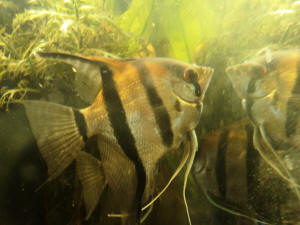
Angel fish questions, repro.
6/16/11
I have a couple questions. I'm unfortunately unable to use
your search tool for some reason. It says:
"We're sorry.... but your computer or network may be
sending automated queries. To protect our users, we can't
process your request right now."
<Thank you for this notice. Have just tried it w/ the same
result. Have asked DarrelB to look/see>
In any case I searched through the archives and found several
helpful tid bits but I still have questions.
I have a pair that have spawned for me a couple weeks ago so I
know I have a male and female by the development of the eggs.
(They got about 8 hours from hatching before they were eaten by
the other fish that were in the tank at the time. They have since
been removed.) The tank is a 40 gallon breeder with multiple
types of plants in the tank. The PH is 6.9 Dh is 6 the temp is
82. They have multiple spawning sites from which to choose. My
main question is that I've read here and other places that
they're more likely to fight if there's no other fish in
the tank.
<Mmm, not necessarily. Most commercial breeders do w/o
"dither fish" with their spawning pairs>
Because the eggs were eaten I'm a little gun shy to putting
other fish in the tank with them. I was wondering that because of
the complexity of the decorations and such in the tank what are
some fish that I could put in there that would either be easy to
remove once the eggs hatch or that could stay with the eggs and
fry with out much fear of them eating the eggs or fry. I know all
fish will
eat fry given the chance. But some are faster than others. Would
Oto catfish work? I know they like the temp a little lower than
82 degrees so I'm not sure. But those seem like a good
fit.
<I would leave out other fishes... and likely most all decor
but a spawning media you can remove... Do a bit more looking,
reading into how folks produce Pterophyllum. Much easier to
remove the spawn... Bob Fenner>
|
|
|
|
Re: Angel fish questions
6/16/11
I will definitely leave them alone. I tried taking decor out once
and they threw a fit. They wouldn't eat... got really
skittish like and lost their color.
<... takes time>
So I won't be doing that again. I have one escapee in the
tank I noticed. I'll try to hunt him down and remove him.
Crafty fish hid from me for 2 days. I'll definitely let you
know how it works out.
<Thank you, BobF>
Re: Angel fish questions
6/16/11
I have an issue... I cannot catch this Krib!
<Drain the water level down low, remove the decor>
Is one fish going to a big problem.
<Likely so>
There's also 4 Oto's in the tank with them. The Oto's
I could catch but this Krib.... crafty Krib.
<Two nets... use one per each hand>
If he sees me coming now he ducks for cover! I even tried blood
worms!!! I don't want him to be a threat for my Angelfish
fry....
<Remove this fish. B>
Re: Angel fish questions
6/17/11
I caught him using a different method last night. Since I'd
already done a 75% water change with some fresh rain water
I'd stored up mixed with the tap water to keep the same water
chemistry I simply took the driftwood out.
I placed a cichlid cave in there and came over. As soon as he saw
me he ducked for cover in the Cichlid cave.
<Ahh!>
I picked it up fish and water inside and transferred him to the
other tank.
Didn't stress him out as much nor did it stress the angels
out as much. Win win. Thank you for your help though! Oh and my
female Angel is plumping up again. I'm feeding Mosquito
larvae (lab grown and fed with some vitamin supplement stuff),
Blood worms, frozen beef heart
<Grind well, and limit...>
and rounding it off with New life spectrum and Danichi Cichlid
pellets.
They've both done tremendously well on this diet and will
probably spawn for me as early as next Wednesday. That's
exactly 2 weeks from this last batch. We'll see how their
parenting is now that there's only me to "threaten"
the eggs. When there was a bunch of other fish mommy was VERY
good at mothering. She stayed by the eggs constantly fanned them
often checked them for fungus (None got fungus) and removed the 6
out of close to 100 eggs that were infertile. She lapsed when it
started pouring outside and the male harassed her to breed again.
She got confused and abandoned the eggs.
<Within a few more batches, I encourage you (again, the
reading...) to remove the media w/ the fertilized eggs, add
Methylene Blue, a mechanical aerator...>
Crushed me really. But then I knew... community tank... I gave
them a 1 in 10 shot of living. But since they'd made it to
the 8 hour countdown I was hoping maybe they would pull it off.
And they probably would have had it not poured and the male
confused her. THERE'S ALWAYS NEXT TIME THOUGH!
Patience...if I got nothing more from your fabulous site it's
that with Cichlids, especially when you're trying to let them
breed naturally, patience is key. Had I taken the eggs out I
probably would have 6 day old fry right now. But you live and you
learn. And with these guys cranking eggs out on a regular basis
it's easy to fix mistakes. I think though I'll let them
do it themselves. It was such a treat to watch them spawn and
care for the eggs and I want to see them care for wigglers. As
soon as they start eating them though... the gig is up and
I'll siphon them out to another tank to rear.
<Press on Kim; you're doing fine. BobF>
Re: Angel fish questions,
repro. 6/22/11
I believe I'm going to have eggs very soon. Probably within a
day or two.
The signs I'm seeing point to this. The female is plump again
with eggs.
They're actively cleaning a leaf, and the funny thing is that
even though the plant is in a different spot they've found
the same plant and the same leaf (I kid you not) to use again I
think. We'll see if they choose it.
It's at an awkward angle now (not directly against the glass
anymore).
<... I believe I've asked you to read re commercial and
not breeding of Pterophyllum... there are whole books in English
on the topic... I definitely would use a removable, re-useable
medium... as a spawning substrate>
They're much darker in what I call their "breeding
colors" The rusty color on their crowns is deeper and
extends from the tip of the nose into the top fin to the point
and down the back. The black stripes are very defined and dark.
The eyes are red and clear and they have DARK stripes in their
fins now.
<Good observations>
An interesting thing I'm witnessing is that the male this
time seems much more engaged (or maybe I didn't see enough of
the first spawn). He's cleaning leaves and doing something
very comical. He will peck the leaf for a minute or two and then
swim against it hard and push it to the ground and pin it there
for a few seconds and then do the same to another leaf. He's
situating the honey moon suite I think. Or trying too. He's
chased his reflection a few times too and when I reached in to
try and reposition the leaf against the glass I got pecked
relentlessly until I stopped. (The leaf remains in the same
position). This is all very promising behavior. I even have a
five gallon tank that's fully cycled and ready to go, should
they not feel like parenting these eggs, for manual hatching.
<Good>
My Infusoria culture is going strong and I've got a brine
shrimp hatchery on stand by. Now all I need are the eggs! Wish me
luck!
<I do! Bob Fenner>
Re: Angel fish questions 6/22/11
I did read it and they're ignoring the piece of slate I have
propped against the back in favor or the plants.
<Heeee! Well, plants/leaves it is then! In time, perhaps w/ a
humongous production facility, the same size garden using daily
water change volumes, you'll remove plants, have more
standardized media, practices>
And they love their plants and it helps me keep the water very
clean for them so I don't want to take them out. BUT... the
plant they've chose grows very fast so I can clip the leaf
off and pin it with a veggie clip on each end in the hatching
tank if I choose and they can have the eggs that are on the side
of the glass. I would really like to see them spawn and raise the
brood on their own if they will.
<Mmm, can be done... Not the most productive (but who cares?)
method... longer intervals to further repro...>
If not then I'll do it that way but I'm not really in it
for the commercial value of the fry I'm in it for the
experience, learning mostly.
<Ahh, thank you for this clarification>
We might be having a storm come in tonight. If we do I'm
going to do a 50% water change with some clean rain water mixed
with tap (to keep DH and PH constant).
<Excellent>
Trust me for days I've done hours and hours of research about
this to make sure I know what I'm doing. I want to let them
try on their own.
<Real good. Thank you for sharing. BobF>
Re: Angel fish questions 6/22/11
Well it's good that brood care interferes with the interval
because lets face it... in my tiny house with 7 tanks all of
which are occupied to some degree I do not have room to be
constantly caring for 500 Angel fry.
<Ah, Kim... the madness is just ensuing!>
Sure the ones I do get can be sold for a little bit of spending
money or store credit to help care for the tanks I have but
I'm not in it to make big $$$.
<Assuredly, there are no-such in our interest>
If I was I'd have 4-5 pairs 50-100 rearing tanks (Or more)
and plain empty tanks with ONLY the breeding slate in them so
that they would have to use it or the glass. I would love to have
the experience and one day maybe I can make a little money but
for that I would really need a more rare strain (Altums
perhaps)
<Mmm, not as sale-able...>
more experience, a more commercial set up. This is for my
pleasure and for a bit of first hand research on the subject
(I'm highly fascinated with Angelfish and Betta's). At
the moment the male is trying to woo his female companion.
My goal: To get and raise successfully to adolescent size
angelfish fry. To save some money to put a Central filtering
system on my tanks and a 75 gallon planted Angelfish tank. Small
goals that will take some time to get to.
<We'll see my friend. B>
Re: Angel fish questions 6/23/11
One last observation and I'll leave you alone until they
spawn. Do angelfish "test" the strength of a spawning
site?
<Oh yes; and the parents each other>
The male especially keeps pushing on things. If they move he move
onto another leaf or surface. Then they found the two pieces of
slate I put in there. He keeps pushing on it and it won't
move. So he'll look around and come back to it. Now they seem
quite interested in this one piece of slate (since I took the
flimsy plant they were obsessing over out). Do they test to make
sure the item they want to spawn on is stable?
<For its suitability altogether>
Sorry if you can't tell I'm quite fascinated by their
behavior.
<Nothing wrong w/ directed fascination... tis or can be the
beginning of a creative process. B>
Re: Angel fish questions, repro. 6/24/11
They spawned on that piece of slate. They're doing very well
so far as I can tell. I'll get pictures soon. Moving that
piece of slate up higher and doing a 40% water change with RO/tap
water helped I think. Couldn't have hurt anyway. Both parents
are actively caring for the spawn. She'll fan then and then
he thinks he has to do it too. No "divorce" that I can
see.
How many Fry do you think I can successfully raise in a 40 gallon
breeder with perfect parameters? Like how many to what size?
<You could well have several hundred fry hatch, but that
number will plummet unless you rear the fry under perfect
conditions. Specifically, that means daily water changes to keep
nitrate as close to zero as
practical (obviously nitrite and ammonia have to be zero) and at
the same time feeding 4-8 small meals so the fry are basically
eating almost all the daylight hours. Obviously the more you
feed, the worse water quality gets, so balancing meals,
filtration, and water changes is incredibly hard to do.
Realistically, few beginners are able to do this perfectly first
time, so they usually end up with most of the fry either starving
or else being poisoned, and for a beginner, rearing 20-30
Angelfish fry would be a
significant achievement. In any event, you'll want to
"pull" the fry to their own 20+ gallon tank ASAP,
because Angelfish parents rarely make good parents -- at least,
not farmed Angelfish. Cheers, Neale.>
Re: Angel fish questions 6/24/11
Hence why I keep plants.
<While plants remove nitrate, they don't necessarily do so
quickly enough to keep up with water quality on their own, and
obviously they don't do anything to remove the need for daily
water changes. Plus, and this is important, planted breeding
tanks don't necessarily work well -- the leaves trap silt,
the silt promotes bacterial blooms, and the bacteria kill baby
fish. You'll notice virtually all serious breeding tanks
don't have plants or even gravel. Right now I'm rearing a
bunch of Javanese Ricefish fry in a planted tank with the
parents, but I've only got a fraction of the fry that hatched
from their eggs, and I'm doing it this way just for fun, not
as a serious breeding project.>
I tested this morning and the levels are as follows. Ammonia 0,
Nitrite 0, Nitrate ZERO! I have to add flourish Nitrogen to keep
my plants alive.
<Something like that��>
There were two bad eggs this morning out of many. I have the
capacity to do daily water changes and I most likely will.
<You will need to, especially once the fry are about 14-21
days after hatching, which is were the feeding puts a real strain
on water quality management. Have done this many times with many
species.>
I'll test the water at the end of the day and if it needs
changing (Nitrates above 0) then I'll change it. I'll be
feeding Brine shrimps (newly hatched every day) micro worms,
infusoria and powdered fry food at LEAST 5 times a day.
<Cool.>
When they're large enough I'm going to feed Copepods too.
There's a great many in my culture and plant mulm is a great
way to get them. Those will be in a HOB refugium I'm setting
up on the fry tank so that they get constant food during the
hours that I'm away at work. Like I said... I've been
doing research so that I can be as successful as I can be.
I'll let you know how the refugium works out.
<Sure. Do consider the WetWebMedia Forum as a place to post
such notices, along with photos and such. It's best to keep
the Daily FAQ feature for emergencies. Over at the Forum
you'll find people more able to join in and discuss things,
and you can swap ideas and post observations as and when you have
them.>
I'm culturing them using plant mulm I'm taking out of my
planted tank during water changes (strained through several
cheese cloths to get the majority of the water out) and I'll
then put it on the Angelfish tank when the fry are large enough
to eat them. And while they're not large enough to eat them
when I work I get breaks and I live 2-3 minutes from here so
during breaks I'll run home and feed. That way they don't
go hungry. I'm going to pull at least 20 of the free swimming
fry to raise manually and leave them the rest and see if
they'll raise them. That way I have a manageable amount of
fry in a 20 gallon long (cycled since November 2010 so it's
matured) and they get the chance to try and raise them
themselves. I'll let you know how it works out. That 20
gallon long is also densely planted, only runs sponge filters,
has the same PH and DH as the 40 gallon and also has zero
ammonia, nitrites, and nitrates! I use it as a fry tank for any
fry I get. But since the only fish I have that I actually want to
raise the fry are Angelfish it will be used solely for this
purpose. It's kept cycled with some guppies that I'll
move back into the display tank when the time comes. But the
plants and matured media do a very good job of keeping all levels
at zero. I'm a planner. I have a excel chart I could show you
of the tests I do each week and ferts I dose and temps, and
feeding as well as documentation of illnesses or "sudden
deaths" of fish (haven't had any in a long while) that I
encounter and what I do about them. So I think I'm about as
prepared as I can be.
<Quite possibly. Good luck, Neale.>
|
Mated Pair of Angels Fighting
7/21/10
Two freshwater angels successfully spawned 5 times and raised the fry
themselves (more really but I had no room and allowed other fish to
enjoy the eggs). I fondly described "mom" and "dad"
as liking each other. Then, they started fighting while moving not yet
free swimming fry.
<Does happen. Inbreeding of Angelfish has meant that most are
"screwy" at some level. Very few make reliable
parents.>
The fighting has gotten worse. Next spawn all is going well, but on the
second day, I woke up to find all the eggs gone. Fighting getting
intense. Spawn again and with the light out, fighting is minimal and
all is going well. On day 2 after the spawn, increased and prolonged
fighting even with light out. Dad rushes and eats eggs. I scoop him up
and put him in another tank. Mom is now taking care of eggs by
herself.
<Okay.>
As a result of the aggression, both mom and dad are showing swollen
lips and possibly some fungus around the mouth. And both appear with
ragged fins. Water quality is excellent on all parameters.
<��>
The big questions are "Why the sudden fighting?"
"Recommendations to end the fighting?" "What do you
recommend to treat the trauma?" "Is their pair bond broken
not to be rekindled?"
<There's no simple answer here. Cichlid pair ponds often depend
on the presence of a threat, what we call a "target fish",
for which a school of large Danios might be tried. The idea is to make
both parents think they need to work together to defend the eggs.
Obviously the tank needs to be big enough for the target fish to swim
away safely, so a 20 gallon breeder tank wouldn't be acceptable as
the target fish would be either harassed or battered. But a 40 gallon
tank should be okay. But once the bond is broken it may need to be
reforged anew, and that requires separating the fish and then
reintroducing them. One approach is to use egg crate as a divider that
is coarse enough for the fish to see each other, but still sufficient
to keep them separated. Another approach would be to return them to a
large community tank, ideally with other Angels, and allow them to pair
off again naturally. Removing both fish from the existing tank, moving
all the rocks and plants around, and then putting them back again might
work. Really, you're trying to make them think they've just
met. But as I said earlier, the quality of farmed Angelfish is so low
that their mentality is often irredeemable, and you just have to face
up to rearing the eggs yourself and working around their inability to
form stable pairs. As for damage to the lips, white shreds are often
just dead skin and this should heal naturally given good water quality,
but if it wasn't looking better within a few days, treat as per
Finrot.>
You're answer make so much sense to me-greatly appreciate the
knowledge you've shared with so many!
<Do try and find a copy of Paul Loiselle's "Cichlid
Aquarium" for details on how cichlid pairs form, why they fail,
and what you can do to fix them. Cheers, Neale.>
Angelfish... FW, "pair", sys.
1/02/10
I just ordered a proven blue German pair of angelfish that I will be
putting in a 30 gal. Tank with a heater, upside down flower pot, potted
sword plant and sponge filter. Will this set up work to breed them?
Thanks
<In theory, yes. However, there are some issues to bear in mind.
Firstly, paired angelfish in one tank don't necessarily stay paired
when moved to another. Secondly, angelfish are notoriously bad parents,
so even if they
do spawn, you're going to need another tank to remove the eggs to
and then rear the fry yourself. Very, very few captive-bred angelfish
can be trusted with their eggs, let alone their fry. Finally, do
confirm you have a market
for any fry you do produce. While angelfish are generally easy to sell,
it's best to check this before you end up with hundreds of
juveniles.
You'll need to rear these juveniles for about 3 months to get them
to marketable size, and that will need a tank at least 20 gallons in
size separate from the one the adults are kept in. Cheers,
Neale.>
Re: angelfish, FW, repro., Artemia for young...
�� 01/03/10
Yes once they have babies ill put the pair in my big tank. I can't
get brine shrimp babies.
<You don't get... you grow them. Brine shrimp nauplii are
purchased (online, if necessary) and then hatched in a soda bottle of
seawater aerated with an air stone. Cheap and easy. After a few days of
these, baby Angels are ready to move onto powdered flake food, e.g.,
Hikari First Bites.>
I can only get frozen bloodworms and brine shrimp. Can I chop those up
to feed the babies?
<Not really. Brine shrimp nauplii are by far the best first foods
for Angels. Hikari First Bites or similar might also work, but to a
lesser degree, meaning fewer baby fish reared per batch. Cheers,
Neale.>
Angelfish Mating/Cory Cats Schooling
8/20/09
Hello Crew, Hope all is going well. I have a question, please. I have a
75 gallon fw tank with 6 medium sized angelfish. I have read that if 2
pair off for mating they can get aggressive towards others in the
aquarium.
Does this mean that they have to be removed or is a 75 gallon tank
large enough so that the others can still live in peace?
< The pair will defend the eggs and fry. As the young become free
swimming and began to wander their territory will expand. I would let
them breed in the 75 gallon tank first and see how it goes.>
I also have a question about cories. Right now I have 6 pandas. I have
read that the more there are the more they will school and the minimum
number should be 6. But if I purchased 3 or 4 of another type I know
they would not school with the pandas, but will usually stay with their
own kind.. But when there is less than 6 of a certain type of Cory can
they still be happy together in the smaller groups even though they
won't school? Thank you for your help. James
< If they want to school then they will form their own little group
regardless of the species. They will probably join the pandas if they
really feel threatened.-Chuck.>
Re: Angelfish Mating and Cory Questions
8/22/09
Angelfish Possibly Mating
Thanks, I really hope none do mate because then I have to go and take
out all the fry so the tank won't be overloaded as they grow.
<Actually watching cichlids like angelfish spawn is one of the most
rewarding events in any freshwater aquarium set up. I hope you get to
see it at least once.-Chuck>
Breeding marble veil tail angelfish
8/12/09
Hi, I'm writing you this because I've read a great deal on the
site already, and I'm in need of some sage advice.
<Hmm... sage advice out of stock. Will parsley advice do? Or perhaps
thyme advice?>
I have 2 breeding marble veil tail angelfish, among other fish, in a 45
gallon tank. They are healthy, as are all the other fish, and the
female is laying eggs approximately every ten days.
<Sounds good.>
However, the eggs are eaten by the male as soon as they are out,
sometimes he will even keep his mouth at the end of her breeding tube
and catch the eggs as they come out.
<Unfortunately, absolutely typical for farmed Angelfish. The issue
is that since breeders (including fish farmers) always remove the eggs
after spawning and rear the young themselves. This means that
there's no
"selection pressure" in favour of good parenting. Idiot
Angelfish and Dutiful Angelfish have the same chances of passing on
their genes. Over time, the fish we call the domesticated Angelfish has
-- genetically speaking -- largely forgotten how to look after it's
offspring. Now, having said that, if the parents feel nervous, even the
best parent cichlids will eat their eggs, hoping to recycle the energy
in those eggs so they can spawn again when they feel safe. The presence
of other fish in this aquarium can be one reason the fish feel nervous,
and for Angels, the best approach is to keep just a single pair in a
bare tank with a upturned
flowerpot or similar that they can spawn on. Floating plants enhance
the feeling of security; bright lights have the opposite effect. You
may even want to cover the breeding tank with a blanket, so that only a
little light
gets in.>
The first time she laid some eggs on a leaf, and the other on the side
of the tank itself. Yesterday she was putting them all on one leaf, but
they never stood a chance. I would really like these eggs to end up
being
something more than a supplement to their fathers diet, but am not sure
how to make this happen.
<You really can't.>
I've read that I should remove the male from the tank, but I hardly
see how this can help since the male is needed to fertilize the eggs,
(which he has shown no interest in doing.)
<Very typical.>
I've also read that after the first couple of times she lays the
eggs he might stop eating them.
<This does, sometimes, happen. However, if you spend any time
talking with Angelfish breeders, you'll discover that bad parenting
skills are very common. So while you can, perhaps should, let your fish
practise their breeding skills, if, after a few months, they still
aren't doing things right, they may well never learn.>
Any advice would be greatly appreciated.
<Cheers, Neale.>
Re: breeding marble veil tail angelfish
8/12/09
Thank you for your prompt reply.
<My pleasure.>
I assure you I'm not going to make a habit of sending you e-mails
every time a question concerning my fish comes to mind.
<We don't mind! But you may find using the Search tool speeds
things up.>
There is so much conflicting information to be found on the internet,
that I typically end up with more questions than answers, and the folks
at the local pet shop don't seem to be interested in telling me
anything that might keep me from making a purchase.
<There's a great book called "A Fishkeeper's Guide to
Fish Breeding" by Chris Andrews that has been out of print for a
while, but you can pick up used (e.g., Amazon) for very little money.
Indeed, at the moment I see Amazon has it listed for one measly cent.
It covers all the basic information you need, and goes into significant
depth with regard to the breeding of the most popular species,
including Angels. See if your library has a copy, but failing that,
picking up this book from a used book store or online would be well
worthwhile.>
Of course it could very well be that they simply aren't that
knowledgeable.
<Some may be bluffing, others quoting from books. Sometimes things
change over the years, as fish species become domesticated or inbred. I
bred Angelfish around 1989, just before I went to university. Even
then,
egg-eating was very common, but without the Internet, we mostly gleaned
information from books. Since the books were written in the 60s and
70s, inbreeding of Angelfish wasn't such an issue, and most books
merely said it took time for the parents to get it right. Mine never
did, so I pulled the eggs, and reared the fry manually.>
So I do appreciate you taking the time to reply. Anyway, I normally
like to do things on my own, for the most part, and all the fish seem
to be doing well, and have been for months now, so there will be no
more
questions, unless something truly peculiar happens, like they begin to
sprout wings and fly around the room like birds.
<We'd need video evidence of this before publication...>
I will try your suggestions, and maybe even put some soft music and
candle light on for them, and hope for the best. Thank you.
<May well help. Since there's no real need to breed Angelfish,
it may well be worthwhile letting nature take its course. You might
also try and track down a copy of Paul Loiselle's "Cichlid
Aquarium" book. Although far from an easy book to read, and a bit
dated in its approach, there's much on Angelfish in there, as well
as plenty of information on breeding. In particular, he covers the use
of things like "target fish" to make adult
Angels bond better, and "dither fish" to make them feel more
secure. An example of the former would be a harmless but well armoured
algae-eater, like an Ancistrus, that the cichlids would see as a
threat, but not an
invincible one. For the latter, things like Danios or Hatchetfish might
be used, since these would convey to the Angels that there are no
predators about, while not themselves being big enough to be seen by
the Angels as potential threats. If you adopt a more
"scientific" approach and view the whole thing as a problem
to explore, understand, and perhaps solve, then it may well be less
frustrating than it is. Cheers, Neale.>
Re: breeding marble veil tail angelfish
8/13/09
Thanks again for the valuable input.
<You're welcome.>
At this point I'm baffled. Yesterday I moved both Angelfish to
another aquarium, a 29 gallon that had already been set up and cycled
long ago. I removed the few fish that were in that tank and temporarily
placed them in the 45. I placed a flowerpot in the lovers tank and
turned off the light, as I suspected it wouldn't be long before the
eggs would be laid. I was right. About 3 hours later I looked into the
tank and one of them was laying eggs, not on the flowerpot, but on a
leaf. Nothing surprising there at all. I was excited, as I didn't
see the other fish eating any of the eggs. I had visions of little
wigglers in a day or two, I was so happy I was even going to name the
first wiggler after you, since you helped make it all possible. Now
comes the baffling part- the fish I clearly saw laying the eggs this
time is the fish that I thought was the male eating the eggs the
previous time. I have now seen BOTH of these fish lay eggs.
<Ah, I see.>
It is clear they are a couple, that they have paired off, but it also
appears that they are both female.
<Happens. Do look carefully at the spawning papillae. Those of
females are shorter, thicker, and have a rounded profile. Males have
longer, thinner, sloping papillae with a distinctly tapering
profile.>
I have two Black Lace Angels in the 45 gallon they came from as well,
but they are not mates with the Veil Tails, of that much I'm sure.
Maybe you have heard of this before, but it's new to me, and I am
unable to locate any information online about it.
<Actually, same-sex partnerships among Angelfish are quite
common.>
I Googled 'Lesbian Angelfish', and that search produced many
interesting results, some of them even about fish,
<The mind boggles!!!>
but nothing that would shed any light on my problem. So, in the
proverbial nutshell, I have two female Angelfish that are mates, so
there will be no fry.
<Indeed.>
You're far more experienced than I am with all of this, so I ask
you, have you ever heard of this?
<Yes. Do look carefully at the fish to sex them by their spawning
papillae.
But otherwise, there's not much you can do. Adding them to a group
containing some males should encourage them to choose more appropriate
spawning partners. I wouldn't add a male directly in case this
"pair" start attacking him as a threat. Or rather, if you try
this approach, keep an eye on the male, and act accordingly. Cheers,
Neale.>
Will two male angelfish pair up?
8/10/09
I have searched everywhere and even asked my local fish store a
question about two adult male angelfish pairing up.
<Hmm... one problem is that Angelfish are difficult to sex except
when spawning. So unless you've seen the shapes of their genital
papillae, you don't know if your fish are males or females. As the
Bene Gesserit would say, "Do not count a man dead until you have
seen his body. And even then you can make a mistake." Just so with
Angelfish; just because you've seen two Angels spawn, it
doesn't mean they're a boy or a girl. Neither are the shapes of
their bellies, the humps on their heads, or their social behaviours of
any value at all.>
When my tank was initially set up, I had two angelfish that appeared to
have paired up. They were cleaning a site, had breeder tubes extended
and would keep all other angels at the other end of the tank.
<The males will have quite narrow, somewhat angled, genital
papillae.
Often, these are visible a day or more before actual spawning. Females
have shorter, blunter, more rounded papillae, and often these are not
visible until spawning actually begins.>
I moved them into a separate 30 gallon tank by themselves and left them
there for a couple of months. There were no eggs laid. In talking with
my local fish store owner, he said he thought that maybe the angel I
assumed to be female could have possibly aborted the eggs she was
carrying due to the move. After purchasing additional angelfish, one of
the new angels was very definitely a gravid female.
<How can you tell a gravid female from a fat male? I certainly
couldn't tell them apart. Let me be crystal clear on this:
Angelfish are virtually impossible to sex except when they are actually
spawning, when you can see one fish laying eggs, and the other
following along behind her, that second fish having a genital papilla
of different shape. "Homosexual" pairings of females have
been reported from time to time, so simply because on fish is laying
eggs doesn't automatically mean the other one is a male You MUST
check the genital papilla. Obviously, if a pair produce healthy eggs
and fry, you have a pair.>
I separated her along with two angels that I knew to be males. After
the male from the first pair paired with her, they laid several times
and I now have babies.
<Good.>
Unfortunately that female died from what I think was a swim bladder
problem.
<No such thing. The "swim bladder problem" is along the
lines of "gremlins causing airplanes to crash". It
doesn't actually mean anything. Hobbyists use the term "swim
bladder problem" when they have no idea why their fish died. Nine
times out of ten, the problem was an opportunistic (i.e., avoidable)
bacterial infection brought on by a water quality, water chemistry, or
dietary issue.>
I have now put the first two angels back in the same tank together.
They immediately dropped breeder tubes and began showing a bit of
aggression toward each other. They are the only two in the tank.
<If both fish showed their genital papillae quickly, there's a
good chance both are males.>
It has been a week now and they do occasionally show some light
aggression with pecking at each other and chasing each other, but
nothing major and breeder tubes are still extended.
<Again, consistent with having two males.>
My question is could two males possibly pair up.
<Unlikely to pair, but they could well develop some sort of social
bond.
Outside of spawning, Angels swim about in groups, so they alternate
between being pair-forming and school-forming fish. Hence, two fish of
the same sex could well school together.>
I know from looking at other posts that two females will in the absence
of a male but no one has answered the question of two males. Their
breeder tubes look almost identical.
<Female genital papillae are obviously different, and only visible
immediately before spawning.>
The one that I cannot tell the sex on does not have fullness through
the abdomen like my female that died. The other angel is a proven male.
Your help in this matter would be greatly appreciated
Thank you,
Shannon
<Cheers, Neale.>
Pterophyllum (compatibility, breeding
behaviour) 6/26/09
Hello All
So I have a 55 g setup, established, running for a year and a half.
Everything is balanced, I do regular water changes. My fish count is a
little high, but I have a powerful filter, along with the
aforementioned regular water changes. In my aquarium, I have:
1 Ctenopoma acutirostre
3 Pangio kuhlii
4 Corydoras (various)
1 Gobioides broussonnetii
<A brackish/marine fish; doesn't really belong here, and
won't live its full lifespan under freshwater conditions.>
1 Ancistrus spp.
1 Macrognathus siamensis
1 Epalzeorhynchos frenatum
3 Kryptopterus bicirrhis
2 Unidentified rainbowfish, most likely Chilatherina bletheri
And, my most recent acquisitions, 2 Pterophyllum scalare
I mainly have a question regarding the angelfish.
<Fire away.>
I plan to get two more, but also give away my E. frenatum, as he is
getting too aggressive.
<I'd be very careful about adding more Angels; adult Angels are
pair-forming, and unless kept in reasonably large groups (six or more)
mated pairs often bully other Angels kept with them.>
I want to possibly breed the angels, and I will have homes for the
remaining two that are unpaired.
<Ah, this being the case, I'd get six, let them pair off, and
then rehome the surplus four.>
My current two are quarter-size. I do not want my K. bicirrhis being
attacked whatsoever, as they are some of my favorite fish in my
aquarium. I also understand that the C. acutirostre may eat any young
angels, but I can deal with that when the time comes.
<Provided the Angels are deeper than, say, a Congo Tetra, your
Climbing Perch will be completely trustworthy.>
So, overall, the question that I put forth from this is: How aggressive
are spawning/breeding P. scalare?
<Potentially, very aggressive, and will try to maintain an area of
clear space about 30 cm radius around the breeding spot.>
Thanks
-L.K.
<Cheers, Neale.>
Angelfish Spawn 6/9/09
Hello,
<Hi there Lily>
For months I did research on Discus Fish because I thought they were
amazing fish, so I did all the research I could, I had all my previous
fish in an established tank die off,
<!?>
so I planned on getting Discus. I bought 2 little Discus fish to start
off and to accompany them I got 2 small Angel Fish as well.
<Mmm... need to really start with more than two individuals... and
these two species are not good to mix...>
(I have been using only RO water, temperature is consistently 84F and
PH is 6.2 and nitrates and nitrites are checked every week and are
always good as well.) A couple weeks later I got a larger Discus fish
and as time has gone by I have added 2 African dwarf frogs and 2 clown
loaches. This entire time I have been researching Discus fish and their
water quality and temperature requirements and little do I know I came
home from work on Friday 6/05/09 and one of the leafs on my real plants
is covered in little white eggs. Not knowing anything about Angelfish,
because I've been doing so well keeping up with keeping the Discus
alive I realized the Angelfish were the ones that had spawned. I
started noticing the Angelfish and the Discus eat at the leaf with the
eggs, so I instantly decided to put the leaf into a floating breading
tank with in my 30 gallon tank. It has only been about 4 days and
nothing is happening.
<Mmm, at a similar temperature? That is, 78 F.? Likely the eggs are
not fertilized... Not uncommon with "new spawners"...>
Again, I have no knowledge of angelfish and did not know what else to
do.
At that time I wasn't even sure if it was fertilized or not. I
tried doing as much research as quickly as I could. I didn't find
too much information at that time. I was then referred to this website,
so here I am. My question is, how do I know if it is fertilized.
<Will hatch or no... often fungus (turn white... decompose) in time
if not...>
Right now the leaf is covered in all white very fuzzy looking eggs.
(probably dead by now).
<Ah yes>
Also, was that ok to do?
<To move them? Yes... There are some techniques... adding gentle
aeration,
perhaps an antifungal (Methylene Blue is very safe, summat
effective)...>
It was not planned and very unexpected so I do not have a separate tank
I can use to put the parents or the leaf covered in eggs into. I just
went to the local fish store where I bought the angelfish pair and they
sold me Methylene Blue.
<Ahh!>
What are your thoughts about this product?
<See above, WWM>
I have not had another spawn just yet, I just had the first one a few
days ago. I definitely want to be more prepared next time. Any words of
advice are much appreciated.
THANKS
Lily
<Please read here:
http://www.wetwebmedia.com/FWSubWebIndex/fwangelreprofaqs.htm
and the linked files above... and consider visiting a public library
and the Net (used and new) for books on this cichlid's culture...
There is much known, to be shared re Pterophyllum successful husbandry.
Bob Fenner>
Raising Baby FW Angelfish
4/19/09
I have tried to raise angelfish with their parents and was successful
only twice. They love to eat the eggs or spawn.
<Normal for tank-bred Angelfish. Because they're artificially
reared on fish farms, and have been for generations, we've not
selected for good parenting in the way "the wild" would do.
Net result, Angels that don't know how to look after their babies.
Sometimes they learn after a series of failed attempts, but often they
never do.>
Since then I have been trying to raise them in a 3 gallon tank at 80
degrees, but they develop for 10 days and then die (just before
they're ready for swimming and food).
<Right, the thing with cichlid fry is this: they need both the right
food, and good water quality. It's easy to offer them too much
food, ruin the water, and end up with dead fry. For this reason,
although the babies are
tiny, you'll actually find an 8-10 gallons tank a much better
starting point. I can't see how you could use a 3 gallon tank with
any hope of success. It's just too little water to dilute water
quality problems.>
I do not understand why they will not start swimming and eat. I have
offered them APR (artificial plankton rotifer) and live baby brine.
<Domesticated Angelfish fry should eat just about anything, even
quality powdered flake foods, such as Hikari First Bites. Indeed,
cichlids generally are very easy to rear because they are large enough
to consume
most foods. So assuming you're providing food at the right time
(3-4 days after hatching) feeding them shouldn't be too difficult.
Rotifers would be a bit small, in my opinion, but brine shrimp nauplii
are certainly taken, and within a few days (perhaps even immediately)
finely powdered flake should be taken as well.>
My lack of success stumps me. Any suggestions?
<If you haven't already bought/borrowed "Fish
Breeding" by Chris Andrews, I'd highly recommend it; it's
cheap, easy to read, but packed with useful information on breeding
Angels and lots of other popular species. I bought my copy in 1986, and
it's still in print!>
Gary
<Cheers, Neale.>
Angelfish breeding 10/29/08 I
have a pair of young angel koi in an overcrowded, 50 gal. community
tank in my office. (No chance for another tank. I need to be
practical.) <While this is fine from a human perspective, you
can't expect animals to make allowances -- millions of years of
evolution in favor of one particular set of breeding conditions
aren't easily undone.> The angels seem to have had eggs about 4
times and each time, something has happened - Plecos got them, I stuck
the net in, etc., to lose the eggs or fry. This time, however, with new
silk plants in the tank, they picked a spot dead center of the tank.
The mass is hatching and the leaf is shaking under the wriggling mass.
Not yet free swimming. <OK.> Without space for another tank or
additional equipment, I would like to see about saving some fry it at
all possible. The parents seem to be doing a great job - having about
15 other fish cowering in corners of the tank - including a couple of
large silver dollars. Should I just leave everything as is or should I
move the mass? <With commercial Angelfish -- like your Koi Angels --
it is almost always best to remove the eggs to another tank and rear
them yourself. Inbreeding over the years means that Angelfish usually
make bad parents. They're all manually reared on farms, so
there's been no selection in favor of "competent"
Angelfish so far as breeding goes. That yours haven't eaten their
eggs is actually pretty unusual!> Should I wait for them to be free
swimming? If I move the fry, will the parents stop attacking the other
fish in the tank? <When you remove the eggs or fry, the parents will
potter about recharging their batteries for a few days, and then set
about cleaning a spawning site and then spawning soon after.> My
only option seems to be to move the fry to a floating baby tank which
is lined with a mesh bag since last time the few fry I had fell through
the bottom. <Floating breeding traps and nets are a bit of a racket
really, and no serious fishkeeper uses them except perhaps for
isolating livebearer fry from their parents. You're free to
experiment with different traps and nets, but that's likely good
money after bad. Up to you. The Angels will certainly pump out batches
of eggs every month, at least, so you're got leeway for errors from
that perspective.> I know that I will have an issue with feeding,
but I am going to try with frozen baby brine. <Baby Angelfish are
very easy to rear, initially with brine shrimp nauplii if you have
them, but even good quality baby fish food such as Hikari First Bites
will work adequately well.> Thanks for your help. Doug
<Seriously, the only reliable way to rear Angelfish fry is with a
10-20 gallon tank into which you can add the eggs, together with an
air-powered filter, and a few drops of anti-fungal medication. Once
they hatch, wait for them to become free swimming, then feed. Letting
the adults rear the fry is usually unsuccessful. I can't imagine
rearing the eggs in a net or trap will work, but feel free to
experiment and prove me wrong! Baby Angelfish grow rapidly, and even if
you're lucky in the floating trap, after a couple of weeks
post-hatching they will need bigger quarters anyway. Obviously
they'll be eaten by larger fish, but in their own tank are pretty
robust if a little prone to water quality issues. Much like any other
cichlid, really. Good luck, Neale.>
|
Veil Angelfish sick Hello, I searched your sight
<site> till I was cross eyed from reading but I didn't
see anything to answer my question completely. <Much, much
more to go!> I purchased two small veil angelfish for my
established 35 gallon aquarium two weeks ago. The marbled is
doing just fine, the other one is not. The sick one is white and
I chose "her" because she was solid white, you
couldn't see through to the internal parts like you can on
most white angelfish I've seen. They share the tank with 2
Gouramis, a Cory cat, Pleco & rainbow shark. All other fish
are fine. A few days ago I noticed she wasn't eating well.
She seemed interested but always just followed food around for a
long time, when she decided to take a bite she would grab it then
spit it out. I tried flakes, shrimp, softened algae tabs,
I've never seen her keep anything in. Now she's becoming
thin and somewhat transparent. I also noticed she is hanging at
the top with her snout out of the water and her belly pressed
against the glass. I turned the air up but that didn't seem
to help. When she swims it's mostly with her tail down and
snout up. <Very bad...> You can tell she is weak. Any
advice? Thanks--Kim <... this one angel may be just too
genetically off to make it... Many small Pterophyllum do die
"mysteriously" as a consequence of poor heritage.
Otherwise, there are periodic "plagues" with Angels...
mainly Hexamita/Octomita imported problems from Far East
breeders... or contamination from same. Let's hope this is
not the case here. Keep reading. Bob Fenner>
Re: Veil Angelfish sick Thank you for your quick
reply. She died in the middle of the night.
<Ahhh.>
|
Blue best? FW Angel
repro. �� 03/20/08 Our angels we purchased from a
friend have bred five, maybe six times now. At first most of the eggs
were clear/ amber indicating fertilization (we hope). But after a
couple days most turned white (not fertilized? fungus?) <Mmm,
yes> so mom and pop munched 'em. All seems in order... water
temperature in the low 80s Fahrenheit, water quality, etc. The last
batch we put in another tank (a mirror of mom and pops) with Methylene
blue, yet after a couple days most turned white, and the rest
didn't hatch. Is there a better alternative to the
"blue", or are we simply missing something? <Mmm, might be
two females! Yes, does happen... or the male may be sterile... not
uncommon either... You might try using/trying softer water (harder
definitely lessens sperm vitality) This pair has produced hundreds of
the most amazing marbles I've ever seen and we'd love to see
many more... Help requested from the most informed crew on the planet.
Thanks, Clintonite <Welcome! Bob Fenner>
Urgent question! Angelfish
repro. 11/30/07 Good morning! <Hello,> What
a great and informative site, thanks for that! <You're
welcome!> I do have a question however that I have not been able to
find an answer to, some come close, but not quite what I am looking for
so maybe you can help me? My angelfish suddenly started to spawn, I was
not prepared at all, never thought 2 randomly picked angels would fall
in love, turn out to be a boy and girl to begin with. Anyway, of the
first eggs I have 7 left, which will be 3 weeks old tomorrow, as of
hatching. Yesterday morning the largest one, and strongest, so I
thought laid dead on the bottom, very, very disappointing and
discouraging. I have no idea what killed him, especially because he was
just fine the night before, and the weaker smaller ones are still
alive. <Hmm... this does sometimes happen with egg-laying fish. The
main problem is usually water quality. Bacteria and fungi can work
their way through eggs and small fish. Because the small fish stay
close to the substrate, the bottom of the tank is a potential source of
infection. Most breeders like to use bare-bottomed tanks so they can
siphon out detritus from the bottom of the tank every day. Sand or
gravel collect detritus and consequently bacteria and fungi.> My
problem now is that some of the others are laying sideways on the
bottom, sometimes they swim around and seem just fine and then they go
and lie on the bottom, sideways but making an effort to swim. They are
voracious eaters, so that gives me some hope, also that this has been
going on for a couple of days and they still eat and everything. What
could it be? <My guess would be water quality. In any case, since
the adults will spawn every few weeks, you can change your procedure
for rearing the fry until you find a system that works.> I am little
by little weaning them of the distilled water they have been living in,
now I use half/half distilled and drinking water, I will eventually
change to 100% treated tapwater. <Why distilled water? Contrary to
myth, Angelfish do not need very soft water. They do not live in the
same blackwater environments as Discus. Something around 5-10 degrees
dH and pH 7.0 is just about perfect. This is especially true for farmed
Angelfish, which are a hybrid not a true species and will live and
breed perfectly well in tap water.> I do regular water changes, that
is everyday, I feed them 3 times a day freshly hatched brine shrimps
that are never older than 24 hours, most of the time much less and I
clean up the "mess" after every meal, which is when I replace
the water I have taken out with new water. <I'd recommend
varying the diet. Brine shrimp nauplii are a good "first
food" but their nutritional value is not great. Once the fry are
swimming about, you should quickly wean them onto baby fish flake or
liquid fry food. Angelfish will normally accept these at once. After a
couple of weeks, they should be taking finely ground flake and
Daphnia.> The tank has a sponge filter and bubbles and they seem to
be just fine, not gasping for air or anything, just swimming sideways
or lying on the bottom in that way. Yesterday I added some Epsom salt
to the water, at a ratio of 1 TBSP/10gallons, just in case it is
swimming bladder disease, which it does look like, right? <Not
really, no. I wouldn't be adding Epsom salt to a breeding tank.
What baby fish require is CONSTANT water chemistry. Doesn't really
matter what it is... if the eggs have hatched, the water is probably
fine. But you do need to avoid changes in chemical composition.> But
would they have not already died? I mean, they seem otherwise
healthy??? I do not dare add the recommended dose of 1 TBSP/5 gallons
because they are still babies, or should I??? <No.> What is in
there now does not seem to do the trick. As some more background info,
when the eggs where laid at first I left them in a breeding net in the
parents' tank and moved them to another container the next day, but
in the net, hanging in that container and in water from the
parents' tank, mixed with some distilled water and Methylene blue
that I filtered out as they hatched. Many hatched but most died
eventually, lying on the bottom of the net, bloated. <You should
ALWAYS keep the eggs in constant water chemistry. Changing the water
chemistry -- even to the "better" -- can cause problems. Much
better to change the water chemistry in the breeding tank before
spawning.> The thing is that while I constantly changed the water
back then, I was not able to clean the net material and I wonder if
those bloated fry that died were attacked by bacteria? <Very
likely.> I read that somewhere. And could it be that these 7 ones
that survived have a bacterial infection??? <Yes.> You can't
tell by their (outer) appearance, they look quite normal, some are a
little crooked, but that wasn't a problem before... The strange
thing is that they were not always like this, it started just a couple
of days ago... The second "batch" was placed in a glass
container, in distilled water with Methylene blue, so I corrected many
mistakes from the first time... <As you say, you do need to keep
trying new methods. Angelfish breeding is not especially difficult, but
I would recommend leaving the parents to rear them if you can. Often,
the adults eat the first few batches, but if you let them 5 or 6 times
they should "get the hang of it". Cichlid parents clean the
eggs much better than we can, and usually you end up with more baby
fish.> I have a second "batch" of babies, 12 days younger,
they are doing quite well and are much livelier than the first ones and
they seem to be doing great, no dead ones this morning, I think mom and
dead are preparing for yet another spawn. The second "batch"
was placed in a glass container, in distilled water with Methylene
blue, so I corrected many mistakes from the first time and I can notice
the difference... <Exactly so.> I do hope you can help me because
it is so frustrating, I know it is up to me to do something, that I am
doing something wrong, but what??? By the way, this sideway swimming
started when they were still swimming in 100% distilled water, so it
could not have been the change in the mix of water. The water
temperature is quite stable, about 80/82 degrees, that is not much of a
problem since I live in Miami. <You seem to have a fair idea
what's going on already. For what it's worth, I concur with
your hypothesis. Try again, this time keeping the tank as clean as
possible (no substrate and treat with anti-Fungus/Finrot medication)
and DO NOT change the water chemistry once the eggs have been laid.>
I look forward to your advice and thank you in advance! Best regards,
Linda <Hope this helps, Neale.>
Re: Urgent question! 11/30/07 Hi Neale,
<Linda,> many thanks for your quick reply, I am now planning the
following, what do you think? (Sorry to bother you so much...)
<It's fine...> The babies are in bare bottom tanks, the
parents spawned in the community tank and I took them out after mom and
dad were done, and moved them to bare bottom tanks of which I syphon
out any dirt on the bottom once or twice a day before they hatch and
feed and afterwards after each time I feed them, so the bottoms are
pretty clean, I think. <Good. Use a pipette or similar to remove any
silt as and when you see it. The cleaner the tank, the more babies will
survive.> With regard to the water quality, I take your advice
seriously, and now I would like to take them out of the Epsom salt
water. What do you advise: can I just make a 100% water change to
treated tap water? <No. What's done is done. With baby fish,
rapid changes in water chemistry can be lethal. Go slow. Maybe 10% per
day water changes in this case.> That way I get rid of the Epsom
salt right away and I get them weaned off the mixture they are in. Or
should I do this gradually (considering what you say about constant
water chemistry)? <Yep.> Also, you mentioned a fungus/fin rot
treatment, I have something with Malachite green (Quick Cure), can I
use that and do I use the indicated dose, or less? Won't this kill
the sponge pump? <Use half-dose for now, but even full dose will do
no harm to filter bacteria *if used as directed* on the bottle!>
After treatment do I change the water little by little to clear out the
medicine, as in the community tank? <If you want. In practise most
medications get metabolized by bacteria within a few days anyway, so
it's debatable whether much is left behind. A water change would do
no harm though.> If not, what do you recommend? This is your advice
for the first batch, the once swimming on their sides? They seem to do
a little better now, it comes and goes, but they are always hungry so
that gives me hope... All of this is about the first spawn, the second
ones are doing good so far, getting weaned off to treated tap water
little by little and I will feed them according to your suggestions.
<Breeding egg-layers is always a bit funny like this. Basically you
want to do two things: avoid germs, and avoid water chemistry changes.
Provided you do this, you should be fine. As for the sick baby fish
now, I think it best to see how things go.> They are now in a
separate tank but with only bubbles, no sponge pump or anything, can I
balance the water chemistry by making frequent water changes with
treated tap water? <Yes, but don't change more than 25% in one
day. Big changes will do more harm than good, given we're playing
around with water chemistry here.> This is all overwhelming but I am
desperately trying to keep all the fry alive! <Don't get too
stressed. Remember, fish produce lots of eggs because most never make
it in the wild. Think about the thousands of eggs produced by Oscars,
but in the wild only a couple will reach maturity. So don't invest
too much emotion in every single baby fish! Rather, step back, and use
each batch of fry as a learning experience. Make notes of what you did
each time. You can then compare results, and find what works best *for
you*.> My plan for the next spawn, which I am afraid will be
tomorrow is to take out the leaf the parents LOVE to spawn on and put
it separately in water out of the parents tank, which is treated, but
then how do I make the change to regular treated tap water? Or can I
just take out the leaf and put it in a bare bottom tank with treated
tap water and Methylene blue and take that from there? <Hmm... in
this instance, take water from the spawning tank and put that into
egg-hatching tank. Move plastic plant to the egg-hatching tank, which
will now contain water from the spawning tank. Top-up spawning tank
with dechlorinated tap water.> It is in any case to maintain water
chemistry that way. <Yes.> That is the nice thing about distilled
water, it is chemically stable and easy to change, the second batch is
being weaned off it gradually and is doing much better than the first
at their age! <Ah, but distilled water isn't stable. It's
very UNSTABLE. Because it lacks carbonate hardness, pH fluctuates
wildly. In addition, almost no fish cannot thrive in it. You need to
mix distilled water with some hard water. I recommend a 50-50 mix for
angelfish, so you have 5-10 dH and around pH 6.5-7. I've bred
Angelfish in the hard, alkaline water of Southern England (around 20 dh
and pH 8) so water chemistry is far from critical with the popular
Angel varieties sold in shops.> Right now it is impossible for me to
get mom and dad a separate tank and have them raise the kids
themselves, I totally agree with you that would be the best. (besides
my husband would have a fit if they would start eating their eggs...)
<Every angelfish I have ever seen eats its eggs for the first few
batches.> When it comes to food, I will go out this afternoon and
see what other baby food I can find, the first ones are in any case big
enough for finely crushed (baby) flakes, I will experiment with that as
you suggested. <Just regular flakes, ground up using teaspoons or a
pestle/mortar will do the trick. Hard-boiled egg yolk, in tiny amounts,
is also surprisingly good.> I would really appreciate your helping
me to make a plan of action for the first babies, if you can agree with
what I am planning or how should I do this? I am sorry to bother you, I
read a lot on the internet and try to learn as I go, but sometimes I am
so in doubt... <Do read Bob Fenner's intro to Angelfish, here --
http://www.wetwebmedia.com/FWSubWebIndex/fwangelfishes.htm . It's
ironic, Angels are so popular but are actually quite tricky to breed at
home. Patience and practise are the keys.> Many thanks and regards,
Linda <I hope this helps, Neale.>
A question... Finding culture info. FW
Angels -11/27/2007 Sir, I m Fatima, PG student in Aquaculture
at CIFE Mumbai. I would like to know about the works done on Angelfish
Pterophyllum spp. (e.g.. effect of temperature on the reproduction of
angelfish). this will help me to continue my research on angelfish .
please help me for the same with your valuable knowledge Thanking You
Fatima S. Hameed M.F.Sc Aquaculture CIFE Mumbai <Mmm, much of the
more recent pet-fish literature is picked up by citation services... Am
very sure you're familiar with computer search bibliographies, and
am as sure that all pertinent culture info. for Pterophyllum is
available... Bob Fenner>
Angelfish repro. 4/27/07 Hi. This is
Glenda. How are you? <Fine, how are you?> It's been a long
time since I last wrote to you on the 25th July 2006. I guess
that's because everything has been going ok with my fish so far.
Now, I just watched my angelfish (black & silver female) laid eggs
about an hour ago and the male (orange & white) fertilized them.
Actually they are still at it. I never knew they crossbred. <They
aren't crossbreeding. They're the same species so it's
about as surprising as people of different skin colour breeding, i.e.,
not surprising at all.> Quite interesting but my problem is they
laid them on the tube of my Aquaclear filter. What do I do from here?
<At best, take the tube out and replace with another from the store.
Rear the eggs yourself in another tank. Angels are terrible parents,
and routinely eat the eggs, so almost all angelfish breeding is done
manually. Actually, wild-caught angels are very good. But mass-produced
angels are very poor.> I believe the other fish (2 gouramis, 2
Plecos, 2 guppies, 1 black ghost, 2 upside-down catfish, 1 yoyo loach,
2 rainbow sharks, 1 albino shark) in the tank will eat the eggs or the
young ones when they hatch. <Yes they will. The catfish or loaches
during he night.> Thanks for your advice. <Good luck,
Neale>
Maybe Angel Fish Eggs 4/12/07 Hello
everyone how's it going. <Well, it's going...> I have a
45 gallon show tank with two angel fish, now I have reason to believe
that they have laid eggs on my filter tube. <Not impossible. But be
sure not to confuse with snail eggs. If they're arranged one at a
time on the tube and about 1 mm across, they're fish eggs, if
they're a lump of jelly with lots of tiny eggs inside them,
they're snail eggs.> There little white and clear circles which
I believe to be eggs of the angel fish because 1 of the angel fish wont
let any of the other fish near them not even the other angel which is a
little bit smaller. Ever since these eggs showed up my two angel fish
have been fighting each other locking lips and biting off scales.
<Sounds nasty. Keep an eye for infections, and if the fins start
looking tatty or you see red sores or wounds, add Melafix or
equivalent.> Why do you guys think there fighting all of a sudden...
<Difficult to say. But wild angels are *not* schooling fish when
spawning, and pairs will naturally hold a territory (usually a bit of
wood) and shoo off any other angels. As with other cichlids where the
males and females are similar, angels works as a pair and share child
minding duties more or less equally. The problem is that mass-produced
angels simply don't behave in the same way as wild angels, and are
very difficult to predict, with some specimens being gentle and
harmless and other homicidal (piscicidal?) maniacs. This is why
angelfish breeders tend to get six or more juveniles, rear them
together, and then isolate matched pairs that seem to be working out
and get rid of the rest. Putting two together and hoping for the best
doesn't normally work, even if you can sex them (which you
can't, at least not reliably).> ...and do you think that's
those white and clear balls on my filter are eggs, do you think I
should remove one of the angels? <Angelfish make, in my
opinion/experience, terrible parents. Any natural skills they had for
rearing baby angels have long since been bred out of them by
generations of commercial spawning in favour of colours, longer fins,
etc. They are the complete opposite of Kribs, which are the most
amazing parents even in community tanks. So if you want baby angels,
yes, remove the eggs. If you don't care, leave them in. Usually the
angels eat the eggs after a day or two. Anyway, there are lots of
Angelfish resources here; start at
http://www.wetwebmedia.com/FWSubWebIndex/fwangelfishes.htm
and work outwards.> Thanks <Cheers,
Neale>
Breeding Angelfish For
The First Time 9/20/06 I bought 2 angels about 6 months
ago and they are now making babies. We were out of town for the weekend
and when we got back there were babies. My question is this. The male
(?) is taking care of the kids but is very aggressive to his mate, is
this normal? < New, young parents are often confused about what to
do and when to do it. After a few spawns they seem to figure out that
they both are on the same side.> I put in a glass divider for now
and tomorrow I will be getting some brine shrimp eggs. Did I do the
right thing in dividing the tank or is this just breeding behavior and
they are going to lay more eggs? < Sometimes when a mate is
separated it affects the pair bond. They really need to sort this out
between themselves. You may have saved some of the fry but affected the
pair. Keep them separated until you remove the fry. They should be
taken away from the parents unless that two weeks are they may be
eaten. After that put the pair back together.> Please advise thanks.
< Once they get going they spawn as often as every two
weeks.-Chuck>
Feeding
Baby Angelfish 9/9/06 Hello Crew, I have about a dozen and a
half angelfish fry (the rest died because of stupid mistakes
made by me - I feel so bad because there were so many!) So
they were just coming out of their eggs two weeks ago. So I guess
that would make them about a week and a half. I have been
feeding them baby brine shrimp ever since they hatched but
how old should they be before switching them to flake food?
<You can start adding finely crushed flake food at any time.> I
have tried to crush some up but the don't take it. What
are some ways you can transfer them to flake without
starving them? What other foods can I feed them, foods they
will eat and are healthy? Thanks < You have them
imprinted on baby brine for now and that is all they know. feed them
three times a day. Give them the brine on the first and third feeding
and give them the crushed flake on the second feeding. Eventually give
them crushed flake food on the first and second feeding and top them
off with baby brine on the third feeding. Microworms will work well
too. When they get older you can add daphnia.-Chuck>
Breeding FW
Angelfish Are Aggressive 8/19/06 Hello Bob and Crew,
Ever since one of my angels laid eggs, she has been
extra aggressive towards the other one. She was always
dominant, but it is getting pretty bad. I figured that if I
add in another angel and switch the decor around that would
give her more to think about. We have some angels at the
pet store where I work that are similar of size but the one
I have permission to take is the most aggressive in the
tank. Will this be a problem if the new one wants to be the
dominant one? I just don't want my angel to get beat up
because she's real pretty and all she "can" do
is hide in the back corner beneath the plants. Thanks for
your help and advice! < Angelfish are cichlids and really
don't like other fish around when they have fry or eggs. An over
protective mother with guard the eggs from her mate if she thinks that
he is going to eat them. Adding more fish will give her more fish to
beat up. If she has no mate then reduce the temp to the mid 70's
and she will stop breeding and she will not be as
aggressive.-Chuck> Angels Breeding 7/23/06 I
happy to say that my female angelfish is laying eggs... one by one.
<Mmm...> The only problem is that when the female rubs up to the
plant, the male comes by and eats them.... <Mmm, trouble...
happens> all of them! Is there anything I can do to keep him from
eating the eggs, and have him fertilize them? <Best to "let
practice" here a few batches... provide as calm a setting as
possible... removing other tankmates that may be making them
"nervous", less foot-traffic outside the tank. I urge
patience here> My angels are pretty young, about 6 months so could
he just not be experienced enough to know he has to fertilize them?
<Ah, yes, good way to put this> Also, I felt that if the eggs do
hatch if he stops eating them, I would leave the fry in there. What
should I feed them and is there any special care I need to do, should I
move them away from my other fish? <Please read here: http://wetwebmedia.com/FWSubWebIndex/fwangelfishes.htm
and the linked files at top> (I only have a spare 10 gallon) I have
a Gourami, platys, angels (only the 2 that are laying eggs) Cory cat
and swordtails. Will the angels protect them from the other fish to
keep them from being lunch? <Mmm, to an extent, for a period of
time... but there are related issues: The angels may well damage the
other fishes in such defense...> When can the fry be on their own if
they survive? <When of size... read my friend> Thanks! - Any
background, not so obvious, info would really help as I have only been
in the aquariums business for about 6 months! <A hobby, personal
interest of ever filling wonder for minds that are open to possibility.
Bob Fenner>
Overfeeding Angelfish
Fry Hello, I have about 250 Angelfish fry that are about 6 weeks
old. My question is can you overfeed the babies. After feeding them
fresh baby brine they seem to get so fat I'm afraid that they are
going to "pop". Any response will be so helpful. This is my
first attempt at raising angels and I love it. Debbie < Yes you can.
Feed them less and make the work a little harder for their
food.-Chuck> Breeding Angelfish Cichlids - 2/28/2006
Dear WWM crew, Whenever I have problems or concerns with my aquariums I
you are ready to help. It's priceless and my fish and I are very
much grateful for everything. Usually my topics are saltwater as far as
I'm fairly new in that part of the hobby. I have many-many years of
freshwater experience and considered myself an advanced fish keeper.
But I got a pleasant surprise. In my Amazonian 30 gal set-up my 2
favorite angelfishes decided to pair and have babies. It started over a
month ago. One morning I just noticed some fish eggs on a leaf of a
Swordplant and my velvet black and black lace angelfish guarding it. I
set up a nice 2 gal hatching tank with a heater, lights and sponge
filter. Added water from main tank , adjusted temperature to match and
transferred eggs on a leaf there. All eggs died, nothing hatched. It
was very sad. Two weeks later there were eggs again. I waited until fry
hatched. Then, while they still were attached to the leaf but hatched I
transferred them to the same little tank. Some of the fry started free
swimming. I attempted to feed them frozen baby brine and Cyclop-eeze.
But no luck, next day they all were dead. Once again my beautiful fish
are guarding their eggs and now I'm planning to leave fry with the
parents and just put a tank divider to separate breeding pair from
other fish. Hope fish will know what to do better than me. My question
is - is it fairly safe to leave hatchlings with the parents? When
should I transfer free swimming fry into separate tank? And, mostly,
what I did wrong so first two attempts were such a fiasco? I read all
the information on WWM and whatever I could find on the net and
everything sounded so-o-o easy. What can be my problem? Thanks again
for all your support! Inna < Some domesticated angelfish strains
like blacks are very weak and survival rates can be down right
depressing. To increase the odds gets the parents conditioned with lots
of frozen /live foods and clean water. Angelfish eggs have a much
better hatch rate if the pH is usually kept under 7. If you parents are
the dominant fish in the tank then I would let them try to raise a
spawn. The eggs usually hatch in three days and the fry
are hungry and usually free swimming in another three days.
Try to hatch some live baby brine or get some micro-worms for their
first food. The fry starve very quickly without two to three feedings a
day. Remove the fry in a couple of weeks as the parents will be getting
close to wanting to spawn again and they will be less protective of the
fry. Frozen baby brine and Cyclop-eeze are very easy but not as good as
the two alternatives I have recommended.-Chuck>
| Re: Breeding FW Angelfish - 3/1/2006 Thanks for
your reply! Baby-angels started hatching today, they keep moving
and I can see little tails. Parents are really great - constantly
checking on the fry? Catching those which are trying to fall. I
left the family in the main tank, just installed a divider. Now I
have another question. Some sources suggest to add some Methylene
blue or similar agent to keep infectious agents low. Should I do
something like this? < When fish spawn sometimes the males
don't fertilize all the eggs. After a short time these eggs die
and start to fungus. Parental cichlids remove these dead eggs to
prevent the fungus from killing the viable eggs. When the eggs are
hatched artificially or away from the parents the eggs are not
removed and the fungus can quickly spread to the good eggs and kill
off the entire spawn. Antifungal agents reduce the rate of the
fungus spreading until the eggs hatch.> And another question -
how much of baby brine should I add per feeding? < Feeding fry
in a big tank is a problem. When the fry become free swimming they
need to be fed. In a big tank a teaspoon of live baby brine will be
all over the tank with very little being available for the fry at
the bottom. You need to raise enough baby brine to fill the
fry's stomachs as least three times a day. Concentrate the baby
brine to a fine soup and suck some up in an eye dropper. Squirt the
baby brine into the school of fry. Don't worry about putting
too much in the tank because the adults will eat any
leftover.-Chuck> Thanks again for your help! Inna |
|
Breeding Angels 2/9/06
I have recently set up two 20 H breeder
tanks for my angels. They are bare bottom tanks, heated to 82 degrees.
I use hydro sponge filters. One pair of angels laid eggs on a breeding
slate about 36 hours ago. At first the eggs were a translucent amber
color. Now about half of the eggs are white. The white eggs seem to be
larger than the others. Is this normal? <Mmm, yes... for a first few
batches of eggs... to fungus> Do the eggs turn white after being
fertilized or is this a fungus? <The latter> The tank has no
measurable ammonia or nitrite. The nitrate reads somewhere between 5
and 10. Thanks for your help. This is the first time for the angels to
lay eggs outside of my community tank, where the eggs were always eaten
in the past. <Not to worry... remove the bad eggs (with a siphon or
the whole batch), and they'll spawn again in a few weeks. Bob
Fenner> Breeding FW Angelfish 1/26/06 Good
Morning, First, I would like to thank you all for the excellent advice
and time you have devoted to guiding fellow aquarists. I currently have
a 55g F/W planted community tank. The inhabitants are 4 angels, 2
discus, a Pleco, and 3 Chinese Algae Eaters. I noticed my angels
pairing off a few weeks back. When I got home from work on Monday, I
noticed a pair of angels defending their eggs, which were attached to
the tank wall. I tried to help them by making a divider out of egg
crate, covered with nylon screening to keep hungry fish away.
Unfortunately the Algae Eaters were able to squeeze through and ate
their eggs. It was a bummer, but I am still happy to now know that I
have a pair. I decided to use a 29g breeder tank to see if I can
successfully breed my angels. The 29g will have a bare bottom, a strip
of slate for eggs, a heater, and a sponge filter. The tank has a NO
24" fluorescent tube and a strip of under counter LEDs purchased
from Home Depot. The LEDs are not actually the same as moon lights, but
do make great subdued lighting for the tank. I was thinking about using
the fluorescent on a 4-6 hour cycle with the LED's coming on 4
hours prior and 4 hours after. Do the Angels need the fluorescent
lighting in this breeder tank or would the dim LEDs make them more
comfortable? < If they are properly set up it should not matter.>
I am using 50% RO/DI and 50% treated tap water to fill the tank. Due to
the simplicity of this tank, it should be easy to do frequent water
changes. I was thinking 50% 2-3 times per week. I am not so sure how I
should cycle this tank. Should I just let the water age for a couple of
weeks? Should I maybe transfer a power filter from my community tank to
give it a boost? I would hate to subject my beautiful angels to a tank
that is not stable. < Use the sponge filter. Place it in the
original tank for a couple of weeks to get seasoned. Siphon any waste
out of the bottom of the tank every day. Add Bio-Spira to get the
sponge filter started immediately.> Also, if I am successful, do you
recommend using an antibiotic medication for raising fry? < Not
unless I see a specific disease.> I plan on leaving the pair to rise
their fry and hope that they will make good parents. I do have space
for grow out tanks, if this endeavor is successful. Thank you for your
help. Have a great day! Steve < At 80 F the eggs will hatch in three
days. The fry will become free swimming in three more. Remove the fry
after two weeks or the parents may eat them as they get ready to spawn
again.-Chuck>
Half-Black Veil Angelfish, Breeding -
10/14/2005 Hi my name is Kenneth and I recently, finally came
across 5 half-black veils for sale after 6 months of looking online and
inquiring for them in my local area... I would love to breed them as
they are so hard to come by. <A good idea.> Right now they are
nickel size but I would like to know what are the first signs that a
pair is pairing up? <Usually they "hang out" in a pair,
eventually begin defending a territory from other fish, especially
other angels. It won't be for a while yet if they're just
nickel sized.> I have them in tank also with 4 jet-black veils of
the same size I haven't had any luck with the black veils ..they
ALWAYS DIE... ( I'm not bitter!) I was told that their immune
systems are not as strong as other types of angels. Is this correct?
<Mm, I for one do not agree.... There is some sort of root cause;
best that you find it and fix it (if possible).> But anyways, I
decided to give it another stab if they live and the half-blacks pair
up with them that is ok with me too. I kind of thought it might help to
strengthen the black veil species immunity <Mm, not a species....
just a domestically bed color morph.... still Pterophyllum scalare.>
seeing as half-blacks tend to be sturdier and easier to get to survive.
Is this erroneous thinking on my part? <Most highly selectively bred
fish (angels, guppies, Bettas) might have somewhat weakened immune
systems or genetic troubles.... I think half-blacks will be as
"problematic" as all-blacks.... Angels that are less
extensively inbred (looking for something other than a recessive gene,
perhaps) like silvers or marbles, might be less prone to problems.
Breeding angels for specific traits and then mixing a pair of differing
traits will provide you with different results than you perhaps want or
expect.... Try a Google search on "angelfish genetics"; you
will find out a lot about this topic.> Thanks for your time and
attention. Kenneth B <Wishing you well, -Sabrina>
Freshwater Angelfish Question I have had a single angelfish
in with 2 Bala sharks and misc. community fish in a 30 gal. aquarium
for about 5 years. Tonight I noticed the angelfish viciously protecting
hundreds of little clear eggs stuck to the under gravel filter tubing
daring any of the other fish to even venture to that side of the
aquarium. Since there is no male how did this happen? <Merely
unfertilized eggs laid out of frustration and desire to reproduce.>
Is there any way they could hatch <No> and if so is there
anything that I should do? This fish generally eats every other fish in
there that is smaller than her. <Have a nice night. -Steven
Pro>
ANGEL FISH FRY Dear Bob <Winston> My angelfish fry are
free swimming and I raise them in a 10 gal tank with no filtration but
50% daily water changes. They are fed freshly hatched brine and
Liquifry food twice a day. <I would add some biological filtration
and aeration ASAP. Maybe a conditioned sponge filter... or a corner
filter with the top off and just some "dirty" filter wool>
I have originally about 400 fry but I lost about 20 daily for the past
3 days. I noticed also that some of the fry have bloated stomach that
are almost bursting. <I encourage you to switch to very fine/crushed
flake food instead of the Liquifry> Is the loss of fry normal as
nature makes sure that the weak doesn't survive or are
they underfed or overfed. <Undernourished, overfed> Should I add
a sponge filter and reduce feeding or increase feeding. <Add the
filtration, aeration and change the feeding. Do continue the water
changes> Need your urgent advice as it pains me to see losses daily.
Winston <Life to you my friend. Bob Fenner>
If you're going to make an omelet you have to fertilize a few
eggs. No wait, that's not it! Can you help me
please....! <I can try.> My one and only Angel Fish has laid eggs
on the side of the filter in my tank. She is guarding them all the
time. There was another Angel fish in the tank (about 6
months ago). Will these eggs Hatch? Could another
type of fish fertilize them?? <The male Angel would have needed to
be there to fertilize the eggs, so these eggs will not
hatch. She does not know this and will continue to guard
them, they will eventually get gross and should be siphoned out.> We
have had a power cut and since Friday ( 5 days) the light has not been
working. Could this have caused the fish to lay the eggs??? <Stress
and/or environmental changes can cause some animals to reproduce, I am
not sure if this can be said about Angels, but I would not be
surprised.> any help would be appreciated. Thanks Janet <Try
searching on google.com for breeding angelfish, you will come up with
loads of results with information on breeding theses
fish. Best Regards, Gage>
Angelfish Genetic Problems and Breeding About a year ago I
swapped some large fish for smaller ones including a half dozen tiny
angel fish that had been spawned at the fish store. The
angels have grown up into gorgeous glittering fish and I am now
thinking of breeding a pair before I trade some back to the fish store
for other small fish. Of my 6 angels, 2 are genetically
deficient (one has no lower fins, one has too many lower fins), one has
been single eyed (so swims like a flounder) probably through early
accident but has good body conformation otherwise.
<Okay> I am assuming that the larger fish in each of the
naturally occurring 'pairs' forming in the tank is a different
gender than the noticeably smaller other part of the pair.
<Actually, it's almost impossible to tell until they do
breed. Size does not necessarily mean much in sexing these
beautiful fish.> My most perfect large angel has paired with a fish
with bulgy eyes and puckered lips who otherwise has good
form. (I think of this smaller fish as 'she' so
forgive me if I am using the wrong pronoun here.) She has
had the puckered lips and bulgy eyes for three or four months and seems
to be the equal of any other angel in the tank in terms of eating and
other behaviors. <Okay, so this sounds to be much more
likely genetic deficiencies rather than illnesses, especially with the
other deformities mentioned.> When I stopped by the fish store the
other day I noted that in the pair who are parents of my brood, the
smaller fish also has the puckered lips and bulgy eyes. When
I asked about it, the fish store owner said he didn't know why but
that the fish has been that way for as long as he can
remember. My question is whether this sounds like a disease
and/or parasite to be treated or whether I should assume the genetics
are just wrong for breeding. <I'd put my money on
genetic deformities.> If disease/parasite, I can turn the tank I am
ageing for a breeding tank into an infirmary tank if I know what/how I
am treating the fish. Since a pairing seems to have
occurred, would I be wise to keep 'her' with her mate in the
infirmary tank? <Well, I don't think there's anything to
treat for, especially if she's been like this all her
life. Please, though, do reconsider breeding the fish with
obvious genetic problems. Continuing to breed deformed fish
will contribute to weakening the species. Also, since these
fish are from the same spawn, there's even more chance at
deformities. And we can only see the deformities that
manifest as malformed fins, poor body shape, etc; we can't see the
other weaknesses that may be lurking underneath all that, like a
greater susceptibility to illnesses, or malformed organs in the
fish. If you do breed them, though, please do cull any fish
with obvious deformities. I know it sounds horrible, but it
really is necessary with such inbred strains of fish to try to keep the
strain healthy.> Thanks for any suggestions you may have.
Cathy <I'm sorry if I've been the bearer of bad news - but
it may still be possible to breed your most well-formed angel with
another well-formed angel from a completely different
source. This would help get some new genes into the mix,
rather than strengthening bad genes with breeding fish from the same
spawn. -Sabrina>
Angelfish Genetic Problems and Breeding, Follow-up I do have
several in the batch who appear perfect enough to be worthy of
breeding--hopefully they are opposite sex :) I do recognize
the need to not breed malformed fish. When I got mine they
were smaller than a dime and you really couldn't tell that much
about them yet. And since even though not perfect they add
charm and beauty to my tank they sort of become
'family'. Certainly no deformed fish will be leaving
here to exchange back into the pet store. <Thank you very kindly for
understanding. I do very much agree that even the deformed
fish are a hundred percent of the personality of well formed
fish. Thank you also for seeing to it that no malformed fish
get back into the trade, where unsuspecting buyers may breed them and
worsen the strain/species some more.> While I would love to get a
different genetic line in here I have seen no goldens in fish stores
around here that practiced enough sanitation I would be willing to take
a fish home. <Do take a look at some of the reputable
online angelfish breeders.> So we will give this a try and if there
is too high a percentage of deformed offspring, not let it happen
again. <Sounds like an excellent plan.> Certainly appreciate the
advice. Cathy <You got it. -Sabrina>
Angelfish Species Hybrid - 8/15/03 Dear Anthony, Sorry for
the confusion. The female scalare has spawned successfully for
the past few times. I'm just wondering if it is possible to cross
her this time with my male altum and get feasible spawn as they seem to
be pairing up. <ahhh... I understand now. Although I am a bit sorry.
I would not encourage the hybridization of two legitimate species.
Frankly, with so many beautiful naturally occurring species, it seems
like a scourge on Mother Nature to me to muddy the blood. I admit that
I am quite outspoken about this> From other forums, it seems that
crosses between altum and scalare doesn't give feasible
spawns. Thank you, Winston <I am very grateful for this. Let
me amend my advice to state clearly - that I do not encourage a cross
of scalare or altum at all casually. best regards,
Anthony>
Altum /Wild Angel Spawning - 8/16/03 Dear Bob, <Anthony
Calfo in his stead... Bob is away in Indonesia presently getting
tattooed... er, well... at least plastered> My wild angel has been
breeding for 4 times already and this time around it has been hanging
around a male altum. What's the feasibility that I can have the
eggs hatched and survive, or should I not waste the eggs but let her
have her old mate instead. Winston <I'm not sure I follow your
question, my friend. Has this female spawned unsuccessfully four times
with another male? Or simply by herself (common)? At any rate, do leave
her with the new/current male to see if a successful rearing isn't
possible. I'm hoping that your water has been adjusted to be very
soft and acidic. They will not be as likely to hatch or be fertile in
harder water. Anthony>
Angelfish genetics Hi, I would like to know what type of
angelfish I would get when I cross a silver with a
chocolate. I would like to give them a
name. Thank you for any help you can give me. <Well,
crossing a wild-type (silver) angel with a chocolate angel will give
you 100% Smokey angel fry. Being that this is a well known
strain, it already has a name (as above,
"Smokey"). More on angelfish genetics
here: http://www.aquaworldnet.org/tas/ASgenetics.html
. -Sabrina>
German Red Angelfish fry Dear Sirs: I have a pair
of German Red Angels. < These are a domesticated strain that are
many many generations removed from the wild.> They have
laid eggs many times and never grow longer they
5/16" before they all die. I hatch the eggs
out in 2 1/2 gallon tanks with methyl blue added to the water to
prevent fungus. After they become free swimming I
start doing 1 gallon water changes every day. The pH is
about 7-7.4. The adult angels are doing fine in my
water. I feed them newel hatch brine shrimp
daily. The temp of the water is about 78-82. I would
really appreciate any and all help you can give me with these fish as I
have looked on the internet with no- avail. I have at
present about 1000 baby angels swimming of various sizes. A
total of 4 pairs of adults including the Red's. All the
other baby angels do fine with the above regiment. I am at a lost as to
what is happening with the Reds. < The fact that all the other fry
from the other pairs of angels are doing fine and your only problems
are with the reds makes me think your problems are genetic and not
environmental. These aquarium strains often produce offspring that are
somewhat week and touchy to even the slightest conditions. Start with
checking ammonia levels in the fry tank. Even with a large water change
they could be building up in a small tank with lots of fry. The fry may
not like the large water changes either. Maybe a little larger tank
with smaller water changes. I would recommend that you start keeping a
journal and vary the routine with these fish. Try different foods,
different temperatures and different pH's. Change only one
parameter at a time and keep track of the results. Eventually you will
come up with a formula for maximizing the survival rates of each spawn.
Your fish are probably very inbred too and may need to find some new
stock from a different bloodline to strengthen the gene pool.
-Chuck> Thanks Everett Martin
Threatening to Breed Have been wondering if you ever found
the reason for your angels dying? <Hi again,
Lorraine! Unfortunately, it's still kinda-sorta up in
the air what took my batch of Altums. Having talked with
Bob, though, I'm rather confidant that this "angel
plague" is just Hexamita, and I should've treated with
Metronidazole in food, rather than just in the
water. I'm equipped with a decent microscope now, so I
hope to get some skin scrapes of infected angels and discus from the
local stores to look at.> And really need your help. My 6 angels
have done great and when I saw they were getting bigger, got my 55 gal.
tank. ( Had a 20 gal.) I had great luck cycling by using the old water
from the 20 gal, part of the gravel and a sponge that had great
bacteria. I put in 3 Harlequin Rasbora to finish up the cycle.
<Sounds great.> Over this time, I noticed the fish starting to
pair up. I put 2 of the pairs in the big tank and left the gold pair in
the smaller tank. <Yay!> But, I DO NOT have room for more tanks
and DO NOT want fry. <Oh. Then, boo!> How would you
recommend that I separate them? <Frankly, I wouldn't separate
them at all. I'd keep the pairs paired up - perhaps even
divide the 55 into three chambers (plastic needlepoint mesh works
great) and let them do their thing. If you've still got
the 20 up and running, it could be your "grow out" tank,
then. And then your angels could reproduce and help pay for
your hobby. If you absolutely *do not* want to do this,
I'd still leave them paired up, the two pairs in the 55 and one in
the 20, or if necessary, all three pairs in the 55 (watch for
aggression). Put in some nice pieces of slate for them to
lay their eggs on, and when you see eggs, pull 'em out and dispose
of 'em.> Males in the big tank and females in the small?
<Good luck on THAT! Sometimes even the angels can't
tell for sure who's what gender, let alone us. Until
their breeding tubes are out, or you catch 'em in the act, it can
be *extremely* difficult to tell genders.> I wish some one that
wants to breed would have this " problem". Ha. <Heh, what
a problem to have, eh? Perhaps you could turn the 20g into a
tank for some kind of smallish predatory fish and get rid of the fry
that way? I do think it's best for nature to take its
course and deal with the "problem" eggs and fry as they come,
rather than trying to prevent the inevitable.> Sincerely, Lorraine
<Good to hear from you again! And wonderful to hear how
great things are going! Congratulations on happy, healthy
"problems", I wish we could hear of more like
this. Wishing you well, -Sabrina>
Substrates in Angelfish breeding tanks Hi guys I need some
advice on what kind of flooring a fish tank should have for breeding
angelfish babies are coming but they go under pebbles we turned off the
tank filter because we thought the fish were get sucked under but then
we found out that the fish just go under .Help what do I do.
GREAT WEB SITE THANKS. SIL. < Angelfish breeders don't use any
substrate at all. Just a bare tank with a sponge filter and a piece of
slate for the adults to lay their eggs on. You could always pull the
rock that they are breeding on and hatch the fry artificially-Chuck>
Silvia
Get the fry to eat dry? Hello, wondering if someone could
tell me how I can get my angel fish fry to start eating dry food. They
are about 3.5 weeks old and all they've ever eaten is newly hatched
brine shrimp. I've put in crushed flake and pellet but they will
not take. Even tried them on frozen daphnia- no go. Should I quit the
shrimp and they would have to eat the dry because of hunger?
<Try smaller feedings of brine shrimp once a day. Offer them crushed
flake food first thing in the morning. Make sure it is a high quality
flake food. And then try the baby brine late in the day. See if the
adults eat the flake food. Try OSI brine shrimp flake to start and then
a general flake with brine shrimp flakes in it later on.
-Chuck>
Can a Silver angel and a Black angel breed? <
Absolutely.> Also, I have a Black Ghost Knifefish about 4.5" in
a 30 gallon tank, How long do I have to wait until I upgrade? In the
Future I am thinking about planning a 55-gallon tank for him. <
Depending on how he is being raised and the kind of food he is eating I
would say when he gets around 8 inches he will be ready for that 55
gallon. How long that will take will depend entirely on you. Good food,
clean warm acidic water should have him growing in no time at all.
-Chuck.> Jahner
Angelfish Problems I have a pair of Marble Angle fish. The
last set of fry are about 3 months old. We removed them from the
parents tank about three weeks ago from our 30 gallon tank. Recently,
the female had not been eating, and 2 days ago she was laying upside
down on the bottom of the tank. I thought for sure she was dying. The
next day she seemed fine. Today we noticed her straight up in the
bubbles, kind of acting like she wasn't getting enough air. Then
after doing that she went back and laid on the bottom. Is
there anything I can do to help her?? <The stress of breeding has
taken a toll on her and it sounds like she has succumb to an internal
bacterial infection. Do a 30% water change, vacuum the gravel and clean
the filter. Treat the tank with Metronidazole as per the directions on
the package-Chuck>
FW Angelfish Flaking Out 7/16/05 I have one breeding pair of
angelfish in a 32G tank with 4 clown loaches and 1 black ghost knife
fish. The angels used to spawn quite often but maybe because I failed
every time to keep the fry alive so they seems to be gradually
slowing down with the spawning now. However, the female would still
become full of eggs with a very round belly fairly quickly after the
last spawning but she is holding the eggs longer and longer each
time and she produces less and less eggs each time too. Sometime she
carries her eggs up to 1 month (maybe even longer). I
understand that the pair is acting weird probably
because It realize that the fry won't survive (due to my
failure). But I'm worry if all this egg carrying will cause the
female any harm. < Egg bound females do have problems.> Also,
even though they are not actually spawning and there's no eggs or
fry around, they still chase the other fishes around like
crazy. I believe that this is because, in their mind, they are still
preparing to spawn, right? < When preparing a territory to spawn the
make no secret about it to the other fish.> Therefore I'm
planning to remove all the other fish to another tank already. But
I'm wondering if there is any kind of fish I can put into the
same tank with a breeding pair of angels? Since I have
heard even with breeding pair of discus or Oscars, they can
still have some tankmate. Is my tank not big enough to do that?
< I would recommend that you leave the pair of angels alone in the
tank.> Finally, I noticed on the label of the New Life Spectrum
flakes it says that although flakes can sustain small fish,
it is not good enough for big fish due to low consumption and they
suggest pellet food. However, my angels only eat flakes. I just
cannot get my angels to eat pellet, and they used to love the frozen
food before but now they barely want them too. All they want is
flake. How can I make them start eating pellet(s want them to have
more varieties)? I have this problem even with my marine tank. <
Some Marine fish never seem to eat anything.> Is there special ways
to start fish eating pellet? <Feeding medium sized fish pellets is a
good idea. Feed the fish the same time every day. Only feed them enough
food so that all of it is gone in two minutes once each day. Feed them
95 % flake and 5% pellets the first day. Increase the pellets by 5% per
day while reducing the flakes by 5% per day. In a couple of weeks your
fish are converted over.> What caused the change of taste with my
angels? Why did they suddenly stop taking the frozen food? <The
frozen food may have been defrosted and then refrozen. This would
change the texture and possible the taste.> Will my angels be fine
with just flakes? < Depends on the brand of flake food. Some are
better than others. Fish can survive on anything. But for breeding and
to keep your fish looking the best then I use only the best foods out
there.> For you information, The male angel is about 3.5inches long
and the female is a bit smaller at about 3 inches. Thanks for being
such a great help all the time! < Thank you for your kind
words.-Chuck> Re: Egg-bound FW Angelfish 7/16/05 Hi again,
You said that "Egg bound females do have problems". So,
what might happen to my angel and what can I do to stop it?
<There are three things that can happen with an egg-bound female.
The first is you can get her to spawn. Usually increasing the temp to
82 F and a big water change (50%) will usually do it. Second is they
might be reabsorbed into her body. The third is they can get infected
and rot. The latter usually happens with older fish.-Chuck> Thank
you for your help! Breeding Angelfish The two angelfish in my
32G tank have been spawning for almost a year. Ever since it start to
breed, it's been very nasty toward any other fish, making all the
other fish to hide almost all the time (especially the Clown Loaches).
My question is, is there any kind of fish I can keep in the same tank
of a breeding pair of angels without having any conflict, since I
cannot afford to get another separate breeding tank for the angel( I
don't have the time to raise the fry anyways), and also, I really
want to have them in my main display. < Welcome to the wonderful
world of cichlids. Part of the attraction of cichlids is the way these
fish protect their eggs and fry. Unfortunately as you have found out
when space is limited these fish can make their tankmates lives a
living hell. I would recommend that you trade in these breeding angels
to a local fish store to someone who would appreciate them and take the
time to raise the fry.-Chuck>
Angelfish Eat Eggs 7/4/05 Hi again, By the way, I actually
did try to raise the fry in the first couple times but every time I
failed to keep them alive for more than a few days. < A problem with
food or water quality.> Then, I started to do research on the
internet to see how to properly raise them. But then I think it was
after the third spawning the male started to eat all the eggs right
after he fertilized them. And ever since that time he has been eating
the eggs every time. What caused the change in the male's behavior?
<Your fish still have the desire to breed but have come to the
realization that there is a problem and will not waste this resource so
continue to eat the eggs and make us of this protein and fat
source.> They used to care take and protect the eggs so well in the
first two or three spawning. Are there ways to fix this problem? <
Breaking fish of this habit can be difficult. First i would recommend
that you feed the fish very well with some live and or frozen foods.
After they spawn I would still feed them well. When the eggs hatch it
sometimes triggers a feeding response and the adults try and eat them
then. To be safe I would remove the eggs right after spawning and hatch
them artificially.-Chuck>
|
|

