|
FAQs on Freshwater Ich, White Spot Disease: Case
Histories of Use
Related Articles: Freshwater Diseases, Ich/White Spot Disease, Freshwater Medications, Formalin/Formaldehyde, Malachite Green, FW Disease
Troubleshooting,
Related FAQs: FW Ich
1, FW Ich 2, FW Ich 3, FW Ich
4, & FAQs on: FW Ich Causes,
Etiology, Diagnosis, Ich
Remedies That Work, Phony Ich
Remedies That Don't Work, Ich Remedy Sensitive Livestock, Ich Medicines, &
Aquarium Maintenance,
Choose
Your Weapon: Freshwater Fish Disease Treatment Options
by Neale Monks, Freshwater Infectious
Disease, Freshwater Fish
Parasites, African Cichlid
Disease 1, Cichlid
Disease,
|
Read... and heed, the triumphs and travails of
others noted here.
|
Re: Newbie that did EVERYTHING wrong-UPDATE
with a few more questions, FW, Ich, temp.
f' 3/7/12
Good morning,
<Car-bear>
Thank you for all your advice and answers last week. I think
things are looking up in my tank. I have tested daily and the
water quality has been consistently good (ammonia=0, nitrites=0,
nitrates=5.0, ph=steady somewhere between 7.2 and 7.6 on my test
kit). The good water has lifted everyone's spirits, I am
really seeing evidence of your knowledge that water quality is key.
<Yes>
Based on your site, I have also changed to a higher quality food and am
alternating between a general tropical flake and a Spirulina flake,
with an algae wafer for the Pleco every other day or so.
The one thing that I cannot kick is the Ich. I have read all of
your links on freshwater Ich, and I am noticing a difference of opinion
amongst your experts regarding the most efficacious and least stressful
treatment. I suspect this is the case in all areas of expertise,
it certainly is in mine (which obviously has nothing to do with
fish). I also see that advice is highly dependent upon particular
circumstances, again common among all fields, I imagine.
<You are correct>
Anyway, because of this I am back to seek your advice with my
particular circumstance. I elevated the temperature in my tank as
you suggested. It is now between 82.0 and 82.6
<...?! Needs to be steadily 85-86F.>
depending on the time of day (the temperature in my house fluctuates
quite a bit, and I think my heater struggles to remain constant).
<Need a larger wattage likely>
I read several cautions in the "Ich files" against
temps higher than this for the platies, neons, Kuhli loach and Pleco,
so I was scared to go higher.
<Don't be. Is fine temporarily>
The temperature has been up since Sunday, and the Ich
is not getting worse, and in fact seems somewhat improved, but I see
one or two new spots every day. Those disappear quickly, then
just when I think all the spots are gone, I spot one or two others.
Also, some of the fish still flash, although ironically, the
"flashers" are the ones without any visible spots at all.
<The spots are only symptomatic, not the protozoan itself... All
fishes here are infested>
My questions are these: 1) is this temperature high enough?
<No>
2) how long should I keep the temperature elevated?
<... posted.... a week or two>
2) with this method, when should I expect to see improvement? and 3) is
a slow, steady improvement typical of the heat treatment method, so
patience is in order?
<... read again>
Thank you once again. I feel like we (the fish and I) are turning
a corner and if we can just "lick the Ich" we will be
healthy. If that happens, I swear I will NEVER, EVER introduce a new
fish without quarantine.
<Good>
Regards,
Carrie
<And you, B>
Heat
& salt for white spot in community tank?
3/6/12
My question is do we have the heat up enough as husband wants to
increase a little more but I am very nervous to do so, are we adding
enough salt, again I'm being cautious for the clowns and
Bristlenose and can you confirm how long we need to keep this up for
after the spots have disappeared?
Basically we discovered white spot in our community tank 6 days
ago. We are new to this hobby (our first tank) and this is our
first case of white spot. We have a 400L tank / external canister
filter Aqua One 2700L with UV. Ammonia 0, Nitrite 0, Nitrate 5,
PH usually 7 (though this has raised slightly since we added the
airstone), GH 10 KH 5, temp usually 26 /27 and two 25% water changes
per week and it's a planted tank. Our community consists of 2
Dwarf Gouramis, 10 Black Skirt Tetra's, 1 Bristlenose, 4 boesemanni
Rainbows and 4 clown loaches (all fish between 1 & 2.5
inches). We very stupidly did not quarantine our two new clowns
when we picked them up from our local pet shop. They looked fit and
healthy, but within 10 day's 1 single white spot appeared on one of
them. We read up on the salt and heat method and decided to go this
way. We added 1 tablespoon of salt per 5 gallons and slowly
started to raise the temp in the tank at 1 degree per day but found
that our heaters were not really up to the job and we couldn't get
above 28 (2 x 200 watt aqua one). In the mean time our two original
clowns had now also shown 3 or 4 white spots on each and two of the
black skirts had 1 each on their tails. Drove the 40 min.s to the pet
shop and picked up 2 x 300 watt heaters that have now been in for two
full days, temp now sitting at 30. All the white spots have fallen off
the clowns and tetras, but one tiny single spot has shown up on one of
the rainbows this morning. We currently are doing a 25% water change
daily, vacuuming the gravel and plants, have added an airstone for more
oxygen, and adding 1 table spoon of aquarium salt per 5 gallons in the
replacement water along with stress coat. Everyone appears happy, all
eating and swimming together, clowns are out all the time and seem to
be enjoying the warmer temperature, I really hope we have caught this
early enough as we would be devastated if we lost any of these guys. Is
there anything else we should be doing? Many thanks in advance
Rebecca
<Mmm, not much more... you could add a bit more salt, read here:
http://www.wetwebmedia.com/FWSubWebIndex/SaltUseFWArtNeale.htm
but I wouldn't raise the temperature much more than where you have
it now (about 85 F for non-metric users).
Bob Fenner>
Re: Heat & salt for white spot in community
tank? 3/6/12
Thanks Bob, I have read the article and we will keep going then with
what we are doing, will go for a heaped table spoon per 5 gallon
(giving a little extra) and leave at 30. Can't see any spots
today so will start counting down the 14 days from now unless any do re
appear then will re count. No one's stressing yet which is a good
sign (except for me!!). Again thank you for coming back to me, your
site is very informative. Regards Rebecca
<Ah, good. One more thing I'd mention; do make up and store that
daily change water... at least a day in advance. Cheers,
BobF>
Re: Heat & salt for white spot in community tank?
Sorry for my naivety Bob, why would we need to do that?
Rebecca
<Sorry for the lack of clarity. There are a few "plusses";
please read here: http://www.wetwebmedia.com/FWSubWebIndex/treath2o.htm
B>
Re: Heat & salt for white spot in community tank?
3/6/12
Thanks Bob, I have had a read. Our water is from a bore on our
property we pump the water directly from under the ground in to a large
storage tank.
<Nice>
We don't treat it with anything and when we bought the
property we had the water tested by a professional company, which came
back pretty good with a natural PH 6.8. With this in mind would we
still need to rest the water?
<I would add a bit of sodium bicarbonate to bring the pH up... to
the low 7's... and aerate it a bit ahead of using>
Also I only add the stress coat to the water just in case of any
metals and to help the slime coat on the fish (not sure if we need to
or not!!). Thanks your help is much appreciated, Rebecca
<Welcome. B>
Re: Heat & salt for white spot in community tank?
3/6/12
Thanks Bob, we will give that a go too. Fingers crossed all will be
good and our little fish will survive our stupidity...I will buy my
husband a quarantine / hospital tank for his birthday next month
LOL!!........
Rebecca
<Sounds very good. BobF>
Clown Loaches with ick
2/18/12
Hello WWM crew! Quite thankfully this is the first time I've needed
to contact you guys for any help, so I guess I've been doing things
right for a while! Down to the problem. I recently switched my 125
gallon aquarium over from saltwater to freshwater. Things have been
going well and looking good for the past month and it looks
spectacular. Current stock in the aquarium consist of nine Australian
Rainbowfish, four Bala sharks, a three spot gourami, a tiretrack eel,
an albino Senegal Bichir, and seven clown loaches (two along the three
inch mark and five at about an inch and a half, two inches). I try to
keep the diet offered as varied as possible, with more than half of
their meals being frozen foods (with vegetable matter being offered at
least once or twice a week), frequent feedings of live brine shrimp and
black worms, occasional offerings of dried seaweed, and when I flake
food I use a mixed preparation of Omega-One tropical flakes, a garlic
enhanced pellet food, and algae flake food. Anyways today I noticed
that one of the larger clown loaches had a few Ich spots on it, and I
wanted to really nip this in the bud, because it's the first time
I've been able to get a nice little group of clowns together. After
reading multiple sites online (yours included of course) and it seems
that the most commonly agreed upon ideas being that clown loaches are
sensitive to medications, and that salt and elevated temperatures seem
to be very helpful in these cases. I was planning on gradually upping
the temperature up to 85, and I have some salt that I can add to the
water but was unsure of the amount to use in this situation. Aside from
elevated temperature and salt, is there anything I can do to help aide
my squad of loaches? Thank you guys so much!
<Greetings. Salt + heat will be the best approach
here, and your fish shouldn't have any trouble tolerating
the 2 g/l required for success. Heat alone, ~30 C, can effect a cure
too, but I've never used this approach personally, though Bob F.
recommends it. Either way, you need to run the system thus for at least
a week. Medications containing copper and formalin are the ones most
likely to stress loaches; medications that don't contain either,
like eSHa EXIT, should be safer. Loaches.com is a good site to get
reports on specific brands/medications. Cheers, Neale.>
Re: Clown Loaches with ick 2/18/12
Just verifying, but 2 g/l would be 2 grams of salt per every one litre,
correct?
<Yes indeed. Do read:
http://www.wetwebmedia.com/fwsubwebindex/SaltUseFWArtNeale.htm
Cheers, Neale.>
|
P. pulcher in quarantine has Ich... but a little
confused? 11/25/11
Hi crew,
<Duncan>
Thanks always for an awesome resource and for putting up with us
all who write in.
<A pleasure to share>
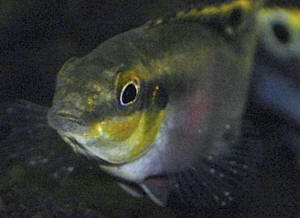
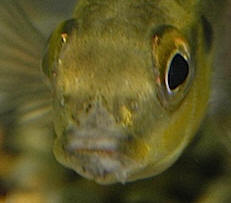
As per photo attached, I believe the female Pelvivachromis
pulcher I bought and put into quarantine 1 week ago has Ich.
<Agreed>
I noticed this today - yesterday there was no sign of the
protozoan. She shares the tank with 1 male Krib and 1 Aplocheilus
Lineatus - there seem to be no major aggression problems.
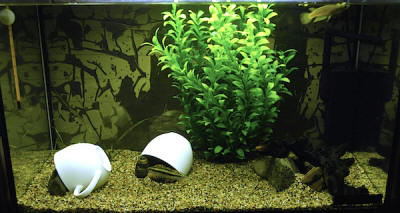
I've also attached a photo of the entire tank - any potential
causative agents you can see (sorry about the shocking quality of
the photos - best I could do)?
<Very nice>
She looks to be in the early stages (spots on pectoral fins and
just a few on caudal fin only) - going by Bob's article I
expect to see the spots spread to her body over the next 24
hours. Today has seen no observable flashing, clamped fins,
heaving gill-pumping or lethargy. She's eating normally as
well.
Tank vitals: 15 gallons, 28.5-29.5 deg C (Singapore ambient room
temp!), pH 7.0-7.2, NH3 0, NO2 0, NO3 10-20 (half-way between 2
colours on the chart), GH 4, KH 3.
Timeline of events:
7 days ago - acquired female (one day after male) and placed in
tank. Male chased occasionally for 1-2 days but then settled
down.
5 days ago - swapped 2 Ctenopoma acutirostre (went into 55G
display tank) out and put in 1 Aplocheilus Lineatus (was
fin-nipping gouramis in display tank). Kribs seem to hold
seniority in tank - Killifish stays well away.
Put clean coffee cups in to add extra caves.
4 days ago - Kribs both becoming less timid and seen out of
hiding more often.
1 day ago - added a few V. spiralis and C. thalictroides plants
from display tank, plus added spray bar to established low-output
internal filter (agitation/aeration).
I have 2 points of confusion if I may:
1. With my tank temp (28.5-29.5 deg C), I'm a little
surprised that the Ich has made an appearance at all.
<Happens>
2. Why did the Ich take so long to appear after placement of
female Krib in tank? Bob's article says a few days at most to
see it turn up in new arrivals.
<There's variation in the onset, causes... and who knows
where the infestation came from? I'd be keeping an eye on the
Ctenopomas wherever they are>
Please critique my intended course of action (in order).
- Tomorrow: 25% water change and then dose tank with 2g/L salt
(table salt will do? Or do I need FW aquarium salt from an
LFS?).
<Mmm, synthetic seasalt... None other. Please read here:
http://www.wetwebmedia.com/FWSubWebIndex/SaltUseFWArtNeale.htm
- Leave salt in tank for 7 days and re-assess at this point.
- Assuming all is well, wait a further 7 days before introducing
Krib pair to display tank.
<I'd also be raising the temperature a bit higher; to
30-31 C>
One last thing - from reading WWM, live plants and male
Krib/killifish will handle this treatment?
<Most plant species offered in the trade, yes, and the fishes
for sure. See the WWM Brackish section re>
Sorry for the long, rambling email but I've never seen any
disease in either my q. tank or display tank, so I'm
appropriately naive and worried.
<Oh, and most importantly, read here:
http://www.wetwebmedia.com/FWSubWebIndex/fwichremedyyes.htm
Thanks SOOOOO much all,
Duncan.
<Welcome. Bob Fenner>
|
|
Re: P. pulcher in quarantine has Ich... but a little
confused? 11/27/11
Thanks so much for your help Bob and the extra link
directions.
<Welcome Dunc>
Today I did a 30% water change, then raised tank temp to a steady
30 deg C, then added 2g/L sea salt. The Ich on the female has not
progressed further, and the other two fish in the tank are still
showing no symptoms.
<Good>
The 2 Ctenopomas went into the display tank at the school I teach
at 5 days ago - I won't get a look at them until Monday, but
on Friday they were all clear and feeding well. Will check ALL
fish in display tank fastidiously on Monday nonetheless.
<I take it this/they are C. acutirostre; one of my
faves>
As an interesting aside, the female Krib with the Ich was
observed doing a slightly bent body 'shimmy' in front of
the male about an hour ago - isn't this the pre-cursor to
mating/reproduction?
<Can be... as well as territorial display et al.>
I know Kribs reproduce readily in aquaria, but 1 week after
moving into a new tank and with one of them having Ich?
<Could>
Thanks so much again Bob, and I'll provide an update on
recovery or otherwise in due course.
<Thank you>
Cheers,
Duncan.
<And you; BobF>
Re: P. pulcher in quarantine has Ich... but a little confused?
12/2/11
Hey Bob/crew,
<Msieu Duncan>
I'm providing promised Ich recovery update herewith.
<Ok>
The female Krib has been clear of Ich symptoms for two days now,
and neither of the other fish in the tank ever showed symptoms.
So a good news story it seems - the 'ol salt/heat for Ich
does it again!!
<Yay!>
Now I'm pondering how/when to scale back treatment and
ultimately introduce the Krib pair safely into my 55 gallon main
tank safely. Below is a possible plan (retrospectively starting
at first sign of Ich infestation).
Fri 25th Nov - Ich first noticed (on pelvic fins only), wrote to
WWM.
Sat 26th Nov - treatment started:30% water change, heat raised to
30 deg C, 2g/L sea salt added.
Wed 30th Nov - Ich symptoms gone, having never gotten worse than
when first noticed on 25th Nov.
From now I'm thinking the following - too soon? Do I need to
slowly dilute the salt content of the water with small water
changes, or just plonk the kribs from 2 g/L salt in the
quarantine tank to 0 g/L salt in the main tank?
<Better to dilute... to less than 1 g/L>
Sat 3rd Dec - water change to dilute salt, drop tank temp to 29
deg C.
Sun 4th Dec - drop tank temp to 28 deg C (normal tank temp here
in Singapore).
Mon 5th Dec - introduce kribs to main tank.
So, 8 days from beginning treatment to effectively ceasing
treatment, and 5 days from seeing no more symptoms to ceasing
treatment. Am I moving too fast? Thanks so much crew - the
greatest.
<I'd stretch the period out to two weeks myself>
Duncan.
P.S. I see you guys/girls seem to recommended half-dosage for
liquid fertilisers in planted tanks (I use Seachem Flourish
comprehensive). Why is this (control algal growth, plants
don't need any more than this)? Thanks!
<As you surmise, many folks are prone to over-dosing... esp.
due to miscalculation of actual water volume... Many tanks are
such and such gallon "style" rather than real water
capacity; minus displacement for substrate et al... Better too
little than too much in these cases fert. wise. Bob
Fenner>
|
Re: P. pulcher in quarantine has Ich... but a
little confused? Other hlth. issue/damage
11/28/11
Hey there Bob/whomever else may answer this,
<Back with you D>
Right so the Ich on the female Krib seems to be receding
already (only a few spots left on each pelvic fin) after
only 2 days of treatment but now another problem seems to
have cropped up.
<Oh?>
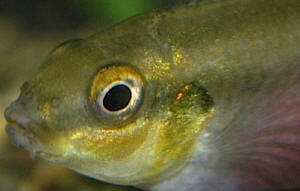
As per photos, the female Krib now appears to have
mechanical damage to her mandibles/mouthparts. I don't
believe there's dislocation, although certain angles
have me a little worried (like the photo called
"krib4.jpg").
<Mmmm>
I've not seen her fighting with either the male Krib or
Aplocheilus Lineatus she shares the 15G quarantine tank
with (not that this means it's not happening!). Is it
possible this damage is as a result of the substantial
gravel moving/spitting she and the male indulge in, or
something else I haven't thought of? The male Krib
shows a vastly reduced version of the same damage.
Should I just "wait-and-see" on this, or take
some proactive action?
<I would do the former... NOT treat>
Cheers and thanks so much for again fielding my fishy
issues,
Duncan.
P.S. Checked the display tank with the two C. acutirostre
and not a hint of Ich,
<Good>
on the bushfish or any other of the inhabitants. Will
continue to monitor carefully. As you (Bob) seem to have
been, I was taken by the C acutirostre as soon as I saw
pictures, as since getting my two 5cm baby fish, I am
becoming obsessed. I find them to be fascinating, amazing
fish in all respects.
<Ahh, me too. Cheers, BobF>
|
|
|
|
Ich Quarantine 8/9/11
Hello.
<Hi there Alyssa>
Last month, I decided I was going to upgrade fish tanks, going from a
Marineland 5 gallon to a Marineland 12 gallon. The 5 gallon housed my
three-year-old ADF, Simon. After setting up the 12
gallon, I let it run for two weeks before moving Simon into it,
<Along w/ some olde water, substrate, filter media I
hope/trust>
and decided to keep the 5 gallon running.
<Good>
I also decided to buy neon tetras for the new tank.
<Mmm, Characins/oids really don't like "new
systems">
It has been a week since I bought the fish, and the tetras have been
dying left and right. Now only two tetras remain, and I am fairly
certain one has Ich. I just noticed tonight the tetra has beige-colored
granules on his body. Depending on where the tetra is in the tank, the
granules are either noticeable or they aren't.
So here are my questions.
I have read ADF's are sensitive to Ich medication. Is it better to
relocate Simon to the 5 gallon, while I try to treat the Ich, or to
move the tetras into the 5 gallon?
<Yes I would>
Do I move both tetras, or only the infected one?
<Move the ADF, leave all else in the 12, treat>
If I move Simon, how can I make sure I am not somehow also transporting
the parasite to the quarantine tank?
<Yes, but will die off in a few weeks for lack of a suitable
host>
Will Simon be all right in the bare 5 gallon for the amount of time it
takes to remove the Ich from the 12 gallon?
<Yes>
What is the best approach to removing the Ich?
<Please read here: http://wetwebmedia.com/FWSubWebIndex/fwich.htm
and the linked files above, particularly re "sensitive
fishes"... Likely a thermal approach alone will work here>
This is my first time dealing with Ich and I'm a little freaked,
thus all the questions.
<No worries.>
Thanks so much for your help,
Alyssa
<Welcome. Bob Fenner>
Ich on Red Tail Shark Fish 4/30/10
Hello,
<Hello,>
I really hope you can help me. I have been researching this topic for a
while. My roommate initially purchased 2 red tailed sharks (he
didn't realize how incompatible they would be).
<Psychotically incompatible.>
As the little one (female by the gray stripe on her belly) was getting
picked on, we moved her to a 5 gallon tank until we could get something
larger and I took responsibility for her.
<Far, far too small. This species is difficult to maintain in tanks
below 55 gallons.>
I purchased a powder blue Gourami to keep her company and they were
getting along really well.
<Not for long.>
I would like to add that we are fairly new to the fish experience.
<Read a book. Web sites are fine, and some, like this one, are
written by experts. But a lot of information out there is variable in
quality, so having at least one good beginner's book with you will
save much time, money and lives. Do see here:
http://www.wetwebmedia.com/FWSubWebIndex/bookswwmsugg.htm
>
But I have spent countless hours researching my fish as well as my
roommate's fish and have also contacted almost all the pet stores
near my area multiple times for advice on various things regarding
them. Anyways, since we didn't really know about the cycling thing
when he got his fish, we have had to cycle our tanks with fish in
it.
<Usually not a good idea.>
We have purchased a lot of different fish care products over the month
or so since we started doing this, including... Aquasafe, Stability,
Prime, PH Neutral, Tetra Safe Start, Stress Coat / Stress Zyme,
CopperSafe, Quick Cure, and Nox Ich. Here is what led to where I am now
and my concern...
<...>
Roughly 2 weeks ago is when this all started, my blue dwarf Gourami
died.
<Not surprised. Dwarf Gouramis (Colisa lalia) are very bad choices
for most beginners. They appeal because they are bright and shiny, but
in terms of quality they are poor, and there are lots of health
problems with the species.>
I am not sure if it was because I used tap water, when I had been using
strictly filtered water before, or if it was because my roommate
removed the filter without telling me.
<"Filtering" tap water is neither here not there, and
mineral-free water is lethal in the long term. You absolutely must
learn about water chemistry and water quality. By default, unsoftened
tap water is best, treated with appropriate water conditioner to remove
chlorine, chloramine, copper and ammonia. The aquarium needs a heater
and a filter.>
I could tell he was have trouble breathing but was not in time to
prevent his death. They had been together for a little over a week up
to that point. I should also mention we didn't know anything about
testing the water, but I had gotten into the habit of doing a 15 - 25%
water change everyday (because my tank went from being crystal clear to
cloudy / smelly).
<How was it filtered? And if less than 20 gallons, you'd be hard
pressed maintaining good water quality with these two species
together.>
Previously, because my roommate's tank had ich (he has 3 Bala
sharks and the other red tail), we had used quick cure with a 25% water
change everyday to no avail. We switched to CopperSafe, which had been
recommended to us by the PetSmart employees and after researching the
positive results, decided on that. It worked great in his tank, so as a
preventative measure, I used it in the 5 gallon tank as well. It killed
my plant (I forgot to remove it / didn't realize I needed to) and
the dead needles fell into the water even though some of the plant
seemed like it
was still going), but my grass survived.
<Dead needles? What sort of plant has needles? You aren't making
any sense here. Dechlorinator shouldn't kill plants. Most beginners
get suckered into buying non-aquatic plants that die anyway. Again,
reading is crucial; as a
beginner, the value of books CANNOT be overstated. Buy no plant you
don't recognise from your aquarium book. About 50% of the plants on
sale in the average PetSmart-type pet store are NOT aquatic and WILL
NOT live underwater.>
So after my Gourami died, a combination of things happened. My red tail
shark refused to come out of her cave. I didn't see her (except
could sometimes see her lurking in her cave) for about 2 days.
<Likely poor water quality.>
I tried to entice her with shrimp brine but that didn't work
either. She wouldn't eat at all.
<Which, as any book will tell you, tends to imply you have problems
with water quality.>
After 2 days I finally coaxed her out of her cave and to my surprise
and horror she had turned gray all over and her tail was white almost
transparent, but the worst part was all the ich spots I noticed all
over her tail and bottom fins (or whatever it is called that she uses
to swim around). That was when I realized that while doing water
changes (one time up to a 50% water change after my Gourami passed on),
I was not retreating with the CopperSafe. I immediately retreated with
a 1/2 to 3/4 treatment.
I also borrowed my roommate's heater to increase the temperature of
her water to 82 degrees.
<Did you not have a heater before? What part of the phrase
"tropical fish" don't you understand? The
"tropical" part means they need a heater, and the
"fish" part means they need good, clean water
conditions.>
For a while after that, when she would leave the cave on her own, she
would hide behind my carbon filter (I have a Penn Plax for 10 gallon
tank that suction cups to the inside of the tank) or heater but she
would stay absolutely still at the bottom of the tank.
<I bet.>
Though I didn't mention this before, my roommate gave me a plant
from his tank that my red tail use to munch on all the time. What we
didn't realize is that the plant had also died because of the
CopperSafe and was in fact responsible for the nasty smell I mentioned
earlier.
<Actually, I don't think the copper medication has anything to
do with the dead plant, and the smell is surely caused by something
else. Dead plants have little to no odour because they contain so
little protein. Ever smelled a compost heap? Actually smells quite nice
and earthy. But bacteria, decaying food and fish faeces can, will smell
quite bad.>
We promptly discarded it. Also, we realized that we had not siphoned
the gravel (at all) since we started our tanks.
<In a filtered tank, all you should need to do is stir the gravel
every couple of weeks. If the gravel is getting dirty, either your
filter is woefully underpowered or you're massively overfeeding the
fish.>
We did all those things and even managed to get test kits / one for
ammonia and another to test everything else. Our ammonia was relatively
low about 5(but we knew it should be 0), nitrite and nitrates were a
little high
(Sorry but I do not really remember the exact levels they were back
then).
It was at this time that we started using Stability and Prime (shortly
thereafter a 5X treatment to bring down the nitrite levels with every
water change).
<I don't think you understand what these products are for.
Adding water conditioner makes tap water safe. That's it. Nothing,
repeat, NOTHING, you add by way of chemicals removes the need for good
filtration and weekly
water changes.>
After about a week or so, my red tail finally started eating again and
even managed to have a little pink / red in her tail again, however,
her ich spots remained almost unchanged. I also noticed that she had
somehow managed to tear a piece of her tail. At about this time, a
friend of ours gave us a really good deal on a 29gal tank, complete
with power filter, liquid testing kit (though it was a saltwater tank
he had previously), and heater.
<I cannot believe you didn't have either a heater or filter
before. Crazy. Please read something before buying pets. Imagine I
bought a cat, but had no idea it needed a warm bed and meaty cat food.
So instead of these things
I kept in a cold basement with only concrete to lie on, and I fed it
grass. When it got sick, I just ignored it, and hoped for the best.
I'm sure you'd call that animal abuse, right? That is what
you're doing here. Read:
http://www.wetwebmedia.com/FWSubWebIndex/fwset-up.htm
>
Unfortunately, it took us a week to set it up because we had to get a
hood and a sturdy surface to put it on. The good news is by this point,
my tank was ammonia and nitrite free with only low levels of nitrate.
Chlorine free as well. All levels are what they should be.
<Which are...?>
But I am still keeping an eye on them.
<Good.>
I managed to get the new 29 gal tank set up (It has only been about 4
days now or so) and water levels seem to be maintaining that of the 5
gallon.
No ammonia, Nitrite or Nitrates. Chlorine free, Ph is a little high
around 7.8.
<Don't worry about pH.
http://www.wetwebmedia.com/fwsubwebindex/fwh2oquality.htm
Do read, understand about water chemistry.>
I also treated the new tank with Prime, Stress Coat and Stress Zyme,
CopperSafe, Ph Neutral.
<Do not mess about with pH. You are not nearly comfortable enough
even with the basics of fishkeeping. Messing about with pH will simply
kill your fish. Concentrate on temperature, water quality and
maintaining a steady water chemistry ONLY. In other words, keep the
temperature at around 25 C/77 F for this species and most other
tropical fish, keep ammonia and nitrite levels at zero, and make sure
water chemistry stays about the same from week to week. That's
it.>
Apart from the power filter, I also have the Penn Plax filter for
additional filtration and oxygen. When I finally put her in her new
tank she was extremely happy and swimming absolutely everywhere. I was
so happy. She even seemed like she was getting a little bigger. I
should mention that my roommate's red tail has already gained a
couple of inches.
But I was still concerned about the ich.
<"Concerned"? You do understand Ick can kill fish,
right...?>
It looked unchanged. In the other tank, the CopperSafe started working
right away and the white spots became smaller and clearer until they
fell right off. But with my red tail, it is still white. I think,
though I am not certain, that there could be less of them. I had
noticed that she was having problems swimming. Previously, she
wouldn't be able to flap one of her fins (presumably because of the
ich) and the she would try to swim up and end up floating back to the
bottom. However, she does not seem to be having those problems anymore.
But her tail is still literally covered with ich spots, though it does
not seem to be affecting her as it did when she was in the 5 gallon
tank. I also went and purchased Aquarium salt and that has not helped
either. For a while there she actually looked a little
bigger.
<Fish don't shrink.><<Mmm, actually... they can at
times, deprived, poor conditions. RMF>>
Through my frustration and heartbreak, I went to my local pet shop, who
recommended Nox-ich to me and said that the ich spots should literally
fall off in 2 days or so (even though it is a 3 day treatment at 1/2
dosage because she is a scaleless fish).
<Again, do read and try to understand what you read. Ick is a
parasite with a distinctive life cycle. At tropical temperatures, the
cysts stay on the fish for a few days but invariably burst as they
release the "spores" of the next generation. These
"spores" swim about for a day, and then find a fish to latch
onto, perhaps the same one, perhaps another. Whether you treat with Ick
medication or salt, it ONLY kills these "spores", not the
white cysts. Finally, Red-tailed Black Sharks are NOT scaleless, and
whoever told you that shouldn't be trusted to offer any more
veterinarian advice.>
They also said I could use it in conjunction with the CopperSafe but to
take out my carbon filter. I took out both (but left it running for
oxygen along with an airstone where the PennPlax normally is). So now
it has been only 2 days, but her ich is still unchanged.
<See above. You're medicating the "spores", not the
cysts.>
Not only that but now she looks even smaller than she usually does. Her
color keeps fluctuating when I turn on the light.
<Normal to a degree, but stress will cause similar.>
She will be gray with her tail almost white. After a few minutes
though, she turns darker and her tail gets pink. She is actually
scavenging now, where she wasn't doing that in the 5 gallon (over
the past couple weeks).
She is still active though and will rarely retreat to her cave.
Sometimes though she will stay up by the heater and just look even when
I try to feed her. I did reduce the heat in the tank to 79 yesterday. I
vary her diet.
80% of the time I feed her fish flakes and 20% of the time Shrimp
brine. I feed her max 3 times a day. (I like to feed shrimp brine to
her especially after a water change because, I don't know mentally,
to make it easier for her and stress her out less?)
<...>
So I am hoping that you can please please please shed some light on
this ich situation. I am so frustrated.
<Please read, learn.>
I have spent literally hours and hours doing research on ich and ich
treatments and fish diseases. What am I doing wrong?
<Many, many things, mostly based on a lack of planning,
reading.>
Is there another product I should try?
<Your brain. Amazingly, it's the single best tool for successful
fishkeeping. All you need to do is visit the public library or
bookstore, find a book on aquariums for beginners, and have a read. The
basics you need are incredibly simple.>
Thank you in advance for one... taking the time to read through all of
this and two... for any future insight you can provide me.
<Always glad to help. Forgive my slightly sarcastic tone but
I've only had one cup of coffee so far, and that means my patience
is a little limited. But better you get snappy helpful advice than kind
rubbish, that's what I always say.>
Trisha
<Good luck, Neale.>
Re: Ich on Red Tail Shark Fish
5/1/10
Hello Neale,
<Hello Trisha,>
Thank you for your response. First I do realize that I wrote a lot of
information. There are just a couple of things I would like to
clarify.
First of all, I would like to impress upon you the fact that the red
tail shark was not my fish!
<Okay.>
I saw that RTBS get picked on and did the most humane thing I could
think of which was to get her away from a bad situation and to take
responsibility for her, as my roommate didn't care that she would
get picked on until she died.
<Understandable. Unfortunately, "rescuing" fish is a
somewhat problematic action. Simply because a fish is removed from one
bad situation doesn't automatically mean it's going into a
better situation. In some instances, returning the fish to the pet
store, or else euthanasia, are the best ways forward.>
My roommate who favors the bigger, more aggressive red tail thought the
more "humane" thing to do is flush her down the toilet
because she is sick.
<Obviously cruel and unethical.>
I was against fish keeping from the beginning as we have limited
funds.
<Wise.>
But after deciding to care for this red tail, I had no control of
anything.
The tanks and filters, etc... belong to my roommate and he did what he
wanted with them. I was fortunate to get the 5 gallon tank and filter,
even if it was temporary. I purchased gravel and a cave and water
conditioners and such to try to create the best environment for her
given that she was in such a small tank.
<OK.>
Forgive me for not making this clear in my initial email, but the Penn
Plax carbon filter that I have was in the 5 gallon tank with her.
<Carbon is actually of relatively limited value. I'd argue none
at all. In any case, it's biological filtration that's
required, plus enough water to dilute the wastes produced by the
fish.>
It actually has a 10 gallon capacity (which I had to replace as it only
has a shelf life of 2 - 4 weeks). Even though I did not have a heater
(just a thermostat), when I performed water changes I used lukewarm
water to keep the temperature constant between 77 -79 until I spotted
the ich and had to convince my roommate to lend me his heater to raise
it to 82.
<See, even if you add warm water, you're likely exposing the
fish to copper from the hot water tank in your home. You need to make
sure your water conditioner removes copper. The water cools down
anyway, so before too long it'll be at room temperature anyway, so
adding warm water isn't going to ever remove the need for a
heater.>
I had to buy him another heater and am now allowed to keep that heater
for my 29 gal tank.
<A step in the right direction.>
Also, the CopperSafe killed the plants. There is a warning on the
bottle that states that it will kill most aquatic plants.
<Seriously, if it kills plants, you shouldn't be using it! It
can, will do far worse to your biological filter.>
"Dead Needles" was the closest description I could come up
with they were not hard but soft and judging by the brownish color of
the plant and all the "dead needles" falling from it, I am
assuming that means it was dead.
<Probably, though a great many plants sold to inexperience aquarists
aren't true aquatics, and will die no matter what you do short of
lifting them out of the tank and planting them in soil.>
After researching Gourami care, I found they like big plants that hang
over the top of the tank and when I went to PetSmart that's what
they gave me and actually both my red tail and Gourami loved that
plant, until it died that is.
<Indeed. This is all fairly trivial stuff. While it's good to
make an effort, these sorts of things are icing on the cake. Space,
water quality, heater, correct water chemistry are the things that
matter.>
After reading all of your responses, I have to say that I am extremely
disappointed.
<Sorry to hear that.>
I understand some of your criticisms and such because I had to learn
the hard way, as I am sure you can understand after reading the rest.
But in all honesty, I am surprised that you, as an expert, had not one
piece of advice to give me regarding how to rid her of these ich
"cysts".
<As I stated, you don't eliminate the cysts. They're inside
the fish. You can't do anything at all about them. What you do is
wait for them to burst, and then kill the free-living stage. This is
done either using the salt/heat method or a commercial Ick medication.
These are described in great depth elsewhere on WWM.>
I am not sure if you think I am taking the easy way out by attempting
to ask for your assistance.
<Not at all.>
I will assure you again, even after reading the multitude of times you
mention reading a beginner's book, that I have done nothing but
read everything on red tail sharks that I have been able to find, there
is just limited information online.
<As I say, you need books. People who write books are experts, and
the stuff they write is edited. Online sources are highly
variable.>
I have read about what they like, i.e. caves and such, what they eat,
temperature, preferred Phs, things of that nature.
<Good.>
Along with that I have read many forums and guides online about
starting a tank, cycling, etc... But the real things I am interested in
is how their behavior reflects what is going on with them. Why is she
unhappy?
<Almost certainly chronically poor water conditions. Until you tell
me what the nitrite level is, or the ammonia level, and you don't
tell me what the water chemistry is, or the water temperature, I
can't say anything other than that.>
How can I make her happier?
<Epalzeorhynchos bicolor requires water with 0 ammonia, 0 nitrite,
pH around 6.5-7.5, hardness 5-20 degrees dH. Water temperature should
be middling, 24-26 C is fine. It is an active and territorial fish that
requires a large aquarium, realistically 55 gallons, though you might
get by with less if you don't mind keeping it on its own. This
species is extremely hostile towards fish it deems territorial threats,
usually other minnow or shark type fish, but sometimes other fish as
well. Aquarium decorations should include at least one cave, together
with tall plants and rocks that the fish can "graze" while
nibbling on green algae. Diet should be mixed, with things like algae
wafers and bloodworms being most appreciated.>
That is my main concern and to be honest with you, I don't care if
that makes you think that I am an irresponsible fish owner.
<Far from it.>
As I mentioned earlier, I have a limited income, I am on unemployment
and receive approximately $250 dollars a week,
<Frankly, more than me most weeks! Being a freelance writer is not
known for its great rate of pay...>
and I have already spent over $200 just to do what I can to keep this
fish from dying and to give her the best possible environment.
<Good.>
I was actually relieved to find a website that has dedicated a section
to Bala and red tail shark diseases, because I was hoping to get some
sound advice about how to make and keep her happy, starting with how to
get rid of these ich spores as you called them.
<As you did.>
I really regret that the best advice you could give me was "read a
book".
<Because Ick is a disease caused by two things: environmental stress
and careless introduction of new, i.e., unquarantined, fish. Ick is
easy to treat if the conditions in the tank are optimal, but if the
fish is stressed, e.g., too cold, then all the cures in the world
won't help.
Really is as simple as this.>
guess that I can be content that while I am reading this great
"book" on how I should raise fish, and while she dies from
ich, that maybe by the time I finish, the "expert" that wrote
that book will have the insight I need to tell me how to prevent that
same thing from happening.
<Look, the issue here is that without understanding, good intentions
don't count for much in the real world. Looking after pet animals
requires acceptance of a certain number of non-negotiable demands. If
this was a pet dog, you'd understand it needs an hour or two
exercise a day, a warm bed, regular visits to vet, socialisation with
family members, and so on. Fish aren't anything like as demanding
or expensive, which is why they're so popular with people living in
apartments and on limited incomes. But there are some things you
can't get around. In the case of tropical fish like Epalzeorhynchos
bicolor, that includes things like good water quality, the right size
tank, and the right water temperature. What a book will do is lay these
things out fair and square. I'm volunteering here to help out on
"road apple duty", trying to help people fix the problems
after they've occurred. But nine times out of ten fish problems are
the sorts of things
that are easily prevented.>
Sorry about my sarcastic tone, I have had no coffee today and not a lot
of sleep because I am so worried (or perhaps not concerned enough)
about my red tail.
<I understand and sympathise, and believe me, I wouldn't be
volunteering for an hour a day here if I didn't share your feelings
for pet animals and have my own desire to help others. So forgive me if
I seem cranky.>
You know, I should also mention that that was really insensitive of you
to suggest that I am not concerned enough about the ich.
<The lack of a heater in the aquarium, plus no real mention of water
quality suggested you were focusing on the wrong issues. Let's be
crystal clear here: I'm not saying you're a bad person or an
animal abuser, but I am saying that these are all simple issues that
would have been revealed by an afternoon spent reading a good fish book
for beginners.>
Do you really think I spent an hour or more writing this email and the
last and researching all this, if it wasn't my absolute top
priority?
<Good intentions are one thing, but practical help is what matters.
Fish couldn't care less about being loved, any more than any other
animal. But what does matter is that you provide the environmental
conditions they require.>
I have also similarly posted things on different forums with no
success, hence, I turned to you as the expert! Thank you anyways for
your time.
<Always happy to help.>
Sincerely,
Trisha
<Cheers, Neale.>
Re: Ich on Red Tail Shark Fish
5/2/10
Hello again Neale,
<Trisha,>
Sorry if I wasn't clear enough in my earlier emails when I said my
water conditions are where they need to be. Let me clarify...
Ammonia is 0
Nitrite is 0
<Both fine.>
Nitrate - 0-5.0 ppm
Chlorine - 0
Water hardness - between softness and hard - 75 - 150ppm
<Relatively low, and fine for this species and indeed most tropical
fish except perhaps livebearers.>
Alkalinity - 120 - 180ppm
<Ditto.>
Ph - 7.8 (this fluctuates though not by much, but that's why I
started using the Ph neutral, because from what I have read RTBS prefer
Ph closer to neutral 7, though I have not been able to achieve that, I
have been able to get it down to 7.2)
<Don't mess with the pH. You can't lower it in a sensible,
stable way without reducing carbonate hardness/alkalinity, so much
better to leave it where it is.>
The reason I have not mentioned much on water chemistry is because once
having achieved what I believe to be optimal water quality, I have been
testing it regularly to make sure they stay that way. Of course that
was my primary concern from the beginning, but as these levels have
stayed constant, I see no reason to think there is anything wrong with
the quality of the water in my tank.
<Perhaps.>
Also, you have kept mentioning water conditioners. I use prime ( I
believe I mentioned that a few times), especially when doing water
changes, but as I live in Niagara falls, ny and our water quality is
not fit for
humans, I would hate to subject the fish to that as well, hence I use
filtered water.
<Tap water, if safe to drink, should be fine for fish. Don't use
water softeners like those fitted in homes to remove lime scale from
appliances. These add sodium to replace the calcium, and that's bad
for fish. In fact, I doubt your drinking water as supplied is actually
"unfit" for human consumption, even if it doesn't taste
that great. There are a billion people on this planet who genuinely
don't have access to drinking water from a tap; you aren't one
of those people. Now, I mention this because a key to fishkeeping is
regular water changes, and if fussing about with the tap water via
filters, RO devices and so on makes water changes expensive and fiddly,
you're not likely to do so many water changes.>
I try to use warm water so that I don't shock my fish / overly
stress them, when doing water changes. I have yet to see any drawbacks
to doing this, even though I now use a heater as well.
<Good.>
Someone did mention to me that having my nitrates at 0 means my tank
has not cycled yet. Is there any truth to this? I thought no nitrates
was good.
<Yes and no. You can have zero nitrates because the filter isn't
cycled, but you can also have zero nitrates because the test kit
isn't very accurate or isn't being used properly, because
plants/algae are removing
the nitrate, or because there's nitrate removal by anaerobic
bacteria somewhere in the tank. So it's complex. Oh, the thing
about test kits and using them properly isn't a dig at you. Some
types are notoriously inaccurate, especially dip strips, and detecting
the colours on the chart does depend on your colour perception, which
varies from person to person.>
I just wanted you to know that my Red tail is now in the process of
shedding her ich spots.
<Good.>
I realized what the problem was. It was actually something you said
that help me quite a bit in this. You mentioned that Red Tails are not
scaleless as the pet store told me. I realized you were right and they
are
idiots. I read so many conflicting things, like someone that wrote they
are catfish and scaleless on one site relating to the same problem!
<Catfish are indeed scaleless, and even the armoured ones have
plates of skin rather than scales. But most other so-called scaleless
fish are actually species with modified or very small scales, as with
loaches.>
This confuses new fish owners (I, in fact wrote to that site and asked
them to correct that info!) I know that they are minnows and in fact
have scales.
<Correct.>
I royally screwed up when I used the Nox-ich. See I misunderstood the
directions.
<Happens.>
I thought I was supposed to treat once for 3 days wait a day then 3
more as needed. Which now that I thought about it doesn't make any
sense. I was suppose to treat the water for 3 full days and not treat
for a day and continue for 3 more days and so forth. Also because I
thought she was scaleless, I only used a half dosage which was why it
didn't seem work at all.
<Often doesn't, hence the recommended dosage.>
Last night, I gave her the first full dose, she wasn't too happy
about it at first, but this morning almost all the spots are gone and
her tail is getting redder by the minute!
<Good.>
I still plan on doing a water change in the next day or two. Put the
filters back in for one day and retreating again.
<You should have the biological filter running all day, every day.
Carbon is something you can throw out. Least of your problems here is
the build up of organic acids that carbon can help with. Concentrate on
biological filtration.>
I was told a week minimum.
<I would leave the filter running throughout treatment. The filter
is the life support system, and switching it off because you're
medicating makes no sense to me. Look, if you unplug the biological
filter because you're
worried the bacteria will die, then they're going to die anyway
because they die within about half an hour or so of the time water
stops running through the filter. If you leave the biological filter,
the medication may
kill some bacteria, but it won't kill them all unless you're
really unlucky. As for carbon, you don't need it: chuck it
out.>
So now that you are up to date on all of this, I would like to thank
you again for your time. I was actually moved by what you wrote about
reading a book, that I was prepared to go down to the library yesterday
and get a book, but they were closed. So I plan on doing that
today!
<Very good.>
Cheers,
Trisha
Bad Quality Water and ICH --
04/22/10
Hello,
<Hello,>
I was wondering if you can help! I have a 46 Gallon Freshwater tank
with 2 Pictus Catfish,
<Schooling... will not settle down as just two specimens.>
1 Tin Foil Barb,
<Also gregarious; too big for this tank.>
2 Giant Danios,
<Another schooling fish...>
1 Pleco,
<Much too big for this tank...>
and 1 Rainbow Shark. I have had the tank for almost 2 months which was
an upgrade from a 10 Gallon tank which I have since given away.
<I hope you didn't have all these fish in 10 gallons!>
Last Saturday I did a 20% water change and on Monday I noticed 2 of my
fish with very minimal ICH spots on their fins.
<There's really no "minimal" here. Ick is like
pregnancy; it's either there or it isn't. So just as you
can't become slightly pregnant, even seemingly minimal Ick problems
are serious. The standard heat/salt method should work
well here, though you might choose to use commercial medications, with
the understanding that Pimelodus catfish can react badly to copper and
formalin.>
I immediately went to an aquarium store with a water sample. The
Ammonia was high (0.50)
<Indeed, potentially lethal.>
and the PH was between 6.8 and 7.0. I think they tested the N's
(sp?) levels.
<Nitrite? Nitrate?>
They didn't tell me how off the N's were only that I saw that
the water turned dark purple. I was told that I cleaned the tank way
too early in the cycle and that I could have wiped out the
"good" bacteria in the process
<Unlikely if all you dead was clean the tank. The filter bacteria
are in the filter, and couldn't care less if you stuck the rocks
and gravel through a dishwasher!>
therefore I was given Nutrafin Cycle to add the "good"
bacteria back in
<Hmm... a quick sale made right there.>
and Quick Cure for the ICH.
<I hope you told them about the Pimelodus catfish. Quick Cure
contains Formalin and Malachite Green, both of which can be toxic to
some catfish. In fact they're toxic to everything, but they're
more likely to stress catfish, loaches and some other
"sensitive" fish that the more tolerant barbs and tetras.
Malachite Green can stress filter bacteria and plants, and Formalin
even more so. Formalin is recommended for use only in quarantine tanks
where Zeolite is being used to remove ammonia.>
On Monday evening I took the carbon out of the filter added both
products to the tank,
<OK.>
raised the temp slowly to 82 as instructed and followed with 2 more
days of ICH treatment of 1 drop per 2 gallons as well as had the lights
off since and as of tonight all of my fish with the exception of 2 have
developed ICH and the ones who already had it are infested with the
white spots although you would not be able to tell by looking at them
because they are swimming around the tank and eating as if nothing was
wrong.
<Good.>
The levels of the water are still off as well
<Will be if it is still cycling...>
and the water is very cloudy which is a problem I have been having
since setting up the tank.
<Common in tanks that are cycled, over-stocked...>
I do not have a separate QT tank. Please Help!! Am I doing anything
wrong?
<More "everything" than "anything". Too many
fish in a too small tank... the schooling fish are in the wrong numbers
to be happy, so are stressed and therefore have weaker immune
systems... choice of medications are going to hold back filter
cycling...>
I read somewhere that Quick Care destroys the "good" bacteria
in the cycle.
<Can certainly do so. Always compare the ingredients on a medication
against your preferred fish health book. I like the "A-Z of
Tropical Fish Diseases & Health Problems" and the
"Interpet Manual of Fish Health", but there are others. All
good books will state clearly what the risks of any given medication
might be.>
If this is true than adding Nutrafin Cycle will not help the cycle?
<Sounds pretty daft.>
If not what else can I do?
<Hope for the best really. You've created a mess, and until the
medication has run its course, you can't do water changes. If this
was me, I'd put the Quick Cure down, do a big water change, 25-50%,
and then treat using the
old salt/heat method.
http://www.wetwebmedia.com/FWsubwebindex/SaltUseFWArtNeale.htm
I'd then do 10% water changes every day or two while the filter was
cycling, remembering to replace old water with appropriately salted
water so the salt concentration stays the same [i.e., add to the new
bucket of water the right amount of salt for that bucket of water, not
the whole aquarium]. Cheers, Neale.>
Re: Bad Quality Water and ICH
Thank you for the quick response!! Ok lets see if I can answer some of
your comments: Lets start with the Fish, I never had these in a 10
gallon,
<I didn't think so, but I thought it worth mentioning for the
sake of the other readers.>
I used to have some of my smaller 10 gallon fish in this new 46 Gallon
just to cycle and I have since taken them out gradually when
introducing the bigger fish for fear they will be eaten. All are doing
great and are in a new home!....All of my 46 gallon fish size are
currently in the range of 2-4 inches and was told the max they will
grow is up to 8 inches with the exception of the Tin Foil Barb which is
only 4 inches at the moment.
<These get massive. Dinner plate size. And will do so within a
couple of years.>
I have somebody who will be taking him once he gets too big.....I plan
to get more Pictus Catfish and Danios but I wanted to slowly add them
in, instead of all at once.
<Okay.>
My Pleco is a Bushy Nose Pleco and was told he will only grow a max of
4-5 inches. (I should've been more clearer in my email) which he
already is about 3 1/2 inches at the moment.....
<Right, that's Ancistrus, the Bristlenose Plec. A good choice
for a tank this size.>
As far as the ICH, I woke up this morning and the fish seem to be doing
great!
<Good.>
The spots seem to be falling off of the ones who just got them.
<They don't fall off. Remember, the medication DOES NOT treat
the white spots on the fish. These mature and burst by themselves. When
they burst, they seem to have gone away. But [a] the wound can become a
site of
secondary infection; and [b] the free-living stages that emerge from
the cysts are now swimming about the tank. That's okay, because
it's the free-living stages that salt and medications
treat.>
The ones who are infested with a lot of the spots are still doing
great, acting normal. No new outbreaks on the ones who dont have ICH.
Because I am seeing improvement should I stop the meds as you suggested
and do the
salt/heat method and a 25% to 50% water change.
<If everyone seems fine now, carry on with this course of medication
until completed.>
Should I gravel vac and take out fake plants and decor and rinse them
really good?
<Pointless in terms of preventing/treating Ick, but as part of a
monthly tank maintenance programme, go ahead.>
I also have driftwood in there. Should I take this out as well and
rinse?
<Ditto.>
I have an Aqua Clear Filter with the sponge, carbon (which I took out
while medicating), and BioMax (rocks in the net). I cleaned the filter
last Saturday, should I clean again?
<Would tend to not wash filters more then once a month, maybe once
every 6 weeks. More than that you risk doing more harm than good,
unless you notice flow rate of water has dramatically dropped. Cheers,
Neale.>
Re: Bad Quality Water and ICH
Again WOW for the quick response!! ....Ok I will continue with the Meds
treatment. I was instructed with the meds to do a 20% Water
change/gravel clean on every 4th day of med treatment for 2 weeks
(which is today).
Should I add salt with the new water?
<No. Use salt only as a medication with these fish, not as a regular
additive.>
I already had 3 tablespoons of salt in the water already?...
<Why? Don't add salt unless you are using it as a medication.
See the article to which you were directed before. Folks will sell you
salt, but it doesn't necessarily do good.>
BTW I forgot to mention, I have the temp up to 84 which was a gradual
increase within the past 3 days. Is it too high?
<Outside of treating Ick, yes, it's too warm. Cheers,
Neale.>
Re: Bad Quality Water and ICH -- 04/22/10
The salt was due to incorrect instruction from one of the sales people
when purchasing the Pictus Catfish.
<He/she said you need to add salt when keeping this species?
Bizarre. It's a soft water Amazonian catfish. The use of salt plus
heat is certainly a way to treat Ick or Velvet on this species, since
it is sensitive to copper, formalin and malachite green. But you
certainly shouldn't be adding salt to an aquarium with Pimelodus
pictus on a regular basis. Are you sure you or the retailer are not
confusing Pimelodus pictus with the Colombian Shark Catfish, Sciades
seemanni? The two species do look similar, and Colombian Shark Catfish
do indeed need brackish to marine conditions.>
I haven't added any salt but I thought that with the ICH outbreak
it would be good for the fish. Ok, no more salt!... Off to do my water
change. I will check in in a few days to update..Thank you so much for
your quick response and assistance!!
<Good luck, Neale.>
Re: Bad Quality Water and ICH -- 04/22/10
Later on that day I was suspicious about what the sales person has said
to me about the salt for Pictus Catfish so I began to do an online
research and nowhere had said that they needed brackish water so I
called and they told me that the salesperson gave me the wrong info but
I had already added the fish and the salt in......
<Hmm....>
So a mini update about my tank..So I did a little bit over a 20% water
change/gravel cleaning and what came out was filthy brown water.
<Oh dear.>
I also discovered when removing the decorations were algae wafers that
I was feeding to my Pleco. I thought he had eaten them but instead they
floated underneath the decorations.
<Yuck.>
Who knows how long they have been sitting under there. Needless to say,
the tank was gross! I wanted to continue cleaning but I was afraid to
take too much water out so I stopped and just netted the rest of the
filth floating around.
<It's well worth changing as much water as you can in situations
like this, provided water chemistry and temperature of the new water is
the same as the old water. If you can't be sure about water
chemistry, then doing a series of 20-30% water changes a couple of
hours apart is almost as good, and should minimise the fish's
exposure the variations.>
Could this be a possible reason as to why my water levels became out of
whack suddenly as well as the cloudy water?
<Rotting food can certainly raise ammonia, nitrite and nitrate
levels.>
Before purchasing the Catfish (which were the last two I purchased
before ICH) I had my water levels tested and they were good hence the
reason why I purchased them....Also, do fish need light?
<Depends on the fish. Cave tetras obviously don't need any! Most
fish are fine with bright light provided there's some shade
provided, e.g., by floating plants. Leaving the tank lights off for a
few days is fine, but
any more than that and your live plants will start to suffer.>
As I stated earlier I have had the lights off for 3 days while
medicating and only turn on to observe the ICH progression on the fish
and to feed them (which I have only been feeding once every other day
upon instruction from the aquarium place.
<The use of darkness to control certain parasites is helpful,
notably with Velvet, but so far as I know it has no effect on Ick. Do
remember though that this darkness needs to be absolute, i.e., a
blanket over the tank, and in pitch darkness day-active fish such as
barbs and cichlids cannot feed.>
Please let me know if this is ok) but I read that fish do need lights
during the day.
<If treating Ick, would leave the lights on their normal setting, 12
hours on, 12 hours off. Cheers, Neale.>
Re: Bad Quality Water and ICH 4/23/10
After an extensive research on Malachite Green/Formalin and how toxic
it is to myself and my fish I have decided to completely stop using
Quick Cure!
<Fair enough.>
I cant believe they would sell such a toxic product. This needs to be
banned!!
<Likely a matter of time. Anyone who works in science or medicine
will be aware that formalin is a nasty carcinogen and generally
avoided. I would expect that over time its use will become steadily
more restricted.>
(note to self ..ALWAYS do an extensive research on all chemicals added
to my tank before use)...
<Which is why investing in a fish health book is always wise. A used
copy of something like the Interpet Manual to Fish Health would cost
pennies, but will save you much time and worry in the future.
Ironically perhaps, people who own and read these books tend to
pre-empt fish health problems in the long term, so actually end up
buying fish medications far less often.>
What are my next steps in helping my fish get through this ICH
outbreak?
<Once the cycle of Ick infection/reinfection is broken, it
shouldn't come back. There's no evidence it lies dormant in
aquaria.>
I did 5 days with quick cure and one 20% water change, and now only two
of my fish still have the spots as oppose to three. The spots do seem
to be getting better on both fish.
<Maturing, bursting... not getting better. Remember this. You treat
the free-living stages, not the white spots.>
My water quality is still the same, (ph is at 7.0, and ammonia is at
0.50 )
<You will need to get that ammonia level down to zero. Do what you
have to do here, otherwise Finrot and other problems become serious.
Don't feed the fish at all for a few days, do lots of water
changes, and generally assume the tank is either overstocked, overfed,
or has an immature filter. Cheers, Neale.>
Re: Bad Quality Water and ICH
Note taken..Will definitely buy the book!!....Other than no feedings
how much of a water change/gravel clean can I do considering I did a
20% yesterday?
<It's best not to do more than 20-30% water changes per day,
unless you absolutely must. Doing water changes this small will
minimise changes in water chemistry.>
I did dose the tank today with quick cure before deciding to stop, will
it be safe to put my hands in the tank?
<Yes, though you're far more likely to get salmonella from an
aquarium than cancer. And that isn't very likely at all, unless you
have a compromised immune system (I've drunk a gallon or two of
aquarium over the years, I bet).>
Now I am really worried!!.. What about salt and high temp method for
treating the tank? Will this method still be necessary because I am
stopping the meds?
<If the Quick Cure worked, there's no need to use salt. Cheers,
Neale.>
Re: Bad Quality Water and ICH
Thank you!!....I will update in a few days.
<No problems. Good luck, Neale.>
Re: Bad Quality Water and ICH
One more question, should I place the carbon back in the filter
considering I still have fish affected by ICH?
<Carbon is fairly useless, so I'd always recommend using the
space inside your filter for more biological media rather than carbon.
But in theory, carbon can be used freely provided you aren't
medicating.
Cheers, Neale.>
Re: Bad Quality Water and ICH 4/26/10
Good morning,
<Afternoon here!>
I tested my water this morning and an interesting thing happened..the
Nitrates went down to 10 but my PH shot up from 6.8 to 7.6. The Ammonia
is still standing at 0.25. Should I be worried about the PH level?
<Perhaps. But I'd be more worried that the ammonia hasn't
gone down. Do also check you're using, reading the test kits
correctly. Cheers, Neale.>
Re: Bad Quality Water and ICH
Hello,
So I have a question that is off the topic.. I did a 20% water change
today and when I was all finished I noticed one of my catfish had a red
mark on his nose. Almost as if he banged into something while trying to
dodge the gravel vac and hurt himself.
<Quite possibly.>
Now he is just sitting at the bottom of the tank, once in a while he
will swim around low in the tank but not with the energy he normally
has, but for most part he kind of stays stationary (this is not the
catfish that has is ICH).
<Perhaps not, but Ick cures that contain copper, formalin and
malachite green can stress/poison catfish.>
Is there something I should do, or should I just leave him alone and he
will get better over time?...
<See above, and if you suspect one or other of those chemicals was
used, prompt water changes to dilute such chemicals will be
required.>
And on the topic of water quality, considering I just did a 20% water
change how long should I wait until I test my water again?
<Whilst you're medicating and cycling the tank, doing at least
an ammonia and/or nitrite test once every second day would be
worthwhile. Cheers, Neale.>
Re: Bad Quality Water and ICH
I stopped using the medication a few days ago so how can it be poison
from the meds?
<Could be previous exposure, but only now showing the symptoms. I
honestly can't possibly know. It's all about me putting
possibilities in front of you, and you using observation and guesswork
to try and figure out which is
most likely. If the problem was poisoning, then if you've done a
few water changes, the damage should be stopped now, and the catfish
will recover.>
Can the medication still be present in my tank even though I have done
several 20%-30% Water changes since halting the meds?
<In theory, yes, to trace levels they may remain. But while copper
can sit around in tanks for a while, the organic medications such as
formalin and malachite green should break down (be metabolised by the
filter bacteria) within a couple of days.>
Also I looked inside my filter (Aquaclear) and I noticed the sponge
turned completely blue from the Quick Cure.
<Oh! Both methylene blue and malachite green can stain things
irreversibly.
I believe Quick Cure contains the latter.>
Can this prevent the "good" bacteria from building up in my
filter hence the traces of Ammonia considering Quick cure destroys the
bacteria in a tank?
<Yes, malachite green can kill filter bacteria. If in doubt, replace
50% of the sponges.>
I have extra filter inserts, there is one called BioMax (which is the
bag with the rocks), it says it helps enhance Ammonia and Nitrite
reduction.
<These are just ceramic noodles. They're a great filter medium,
and I use equivalent products all the time.>
Considering I am not adding the carbon back in again should I add the
BioMax to where the carbon should go, now having two BioMax and the
stained sponge?
<By all means replace the carbon with either new sponges or ceramic
noodles, as you prefer.>
There is another filter insert that goes with my filter that is called
Zeo Carb which is an activated carbon and Ammonia Remover all in
one.
<This is just Zeolite, which removes ammonia but then needs to be
replaced.>
Should I use this instead?
<No, it's fairly pointless unless you're able to use enough
Zeolite, and replace that Zeolite weekly. As such, Zeolite is used
mostly where biological filtration can't: quarantine tanks,
hospital tanks, tanks with pH below 6.>
Any suggestions?.....By the way, I just tested my water again and my
levels are as follows Ammonia still at 0.25.....PH went down to 7.0 as
oppose to 7.6...and Nitrate still stands at 10. Did a 20% water change
today and fed the fish very very minimal food before water change They
ate everything though I dont think my cat fish ate anything today
because everyone else got to it before it can float down to the bottom.
They haven't eaten in two
days because I stopped daily feeding until the ammonia goes down. poor
guys.
<Better they be hungry than dead. Feel free to add green foods, like
a bit of cucumber, for them to nibble on. This contains minimal
protein, so has little impact on water quality. Cheers, Neale.>
Re: Bad Quality Water and ICH
Good morning, or rather Good afternoon to you!
<Bon après midi indeed!>
So my Catfish are doing fine today.
<Cool.>
Both are swimming around and being themselves again, even the one that
still has the ICH. He is a fighter!
<Catfish generally are; that's why we love 'em!>
His spots have multiplied though (Poor guy) but he is still eating and
swimming around the tank like nothing is wrong. Wish there was
something I can do for him but have to deal with the tank issue at
hand!....
<You can't do anything about the cysts; all you can do is
prevent a new generation infection him once these ones are
done.>
Thanks again for all of your great advice!!...
<Glad to help.>
I was wondering, should I invest in a better filter?
<Never a bad idea.>
I have an AquaClear 50 which is for up to 50 gallons (I have a 46
Gallon)?
Maybe getting the one that is one up from mine?..
<When filter manufacturers class a given filter as being suitable
for an aquarium of size X, I myself do by at least the next model
up.>
When you say reduce the sponge by 50% what did you mean by that?
<Reduce? No, replace. You can replace up to 50% of the sponge(s) in
a filter within any one six-week period. Concentrate on the concept,
not the words. The biological media is the stuff you worry about.
Mechanical media
(for removing silt) and chemical media (like carbon) can be replaced as
often as you want. But biological media takes 6 weeks to mature, i.e.,
the cycling process. If you have a filter that's been matured, what
we're talking about is the biological media inside it. Of that
biological media, you can replace up to half without serious problems.
Replace more than half and water quality will drop according to how
much mature media you leave behind. If in doubt, be conservative, i.e.,
conserve biological media, and do nothing more than rinse it in
aquarium water every month or two.>
Did you mean cut it? I do have another sponge..... By the way, I just
tested my water again and my levels are as still the same, Ammonia
still at 0.25...
<Will drop, but could be a false positive to chloramine. Do add
water conditioner to some tap water, and see what ammonia reading you
get. If you have 0.25 mg/l ammonia in the tap water after adding
suitable water conditioner (for removing ammonia and chloramine, as
well as chlorine) then you've solved the riddle. So also will some
amine-containing medications such as Cupramine. If a false positive,
you can largely ignore it, provided the fish are happy. While it'll
probably do your head in -- does mine, anyway -- the folks who make
AmQuel go into this at some depth, here: http://www.novalek.com/kordon/articles/KPD62.htm
>
Nitrates at 10... and PH is 7.0. Still cant figure out why I still have
Ammonia. Maybe I will do a much larger water change and see how that
goes?
Because I am trying to build up and bio load, will 50-60%% be too
big?
<50% water changes are fine.>
Also I heard about a product called Prime as a water conditioner which
helps remove the ammonia temporarily? Any thoughts?
<If you have ammonia in your tap water, or chloramine, then yes,
adding water conditioners that remove them is wise. Cheers,
Neale.>
Re: Bad Quality Water and ICH "Squawk!"
Did the tap water test with the water conditioner I use (API Stress
Coat) and it came back as 0 (darn Ammonia is still a mystery!!).......
I dont remember if I ever mentioned it but the water in my tank is
cloudy. Like a white Hazy color.
<This is common in "unstable" tanks, for a variety of
reasons. Typically harmless bacteria or diatoms, and will settle down
in time. Silt from improperly washed sand/gravel can cause similar, as
can a messy tank with inadequate mechanical media (filter floss, fine
sponges) or insufficient turnover.>
This is something that has never gone away since the beginning. Even
now, after several water changes. Can this be a symptom of something
that can possible be a reason for the Ammonia? (Just trying to look at
anything and everything to solve issue) I have attached a few pictures
to show you.
<Cheers, Neale.>
Re: Bad Quality Water and ICH
4/27/10
Hello There!
<Hello,>
So I purchased the Aqua Clear Filter 70, which is the one up from the
one I currently have, along with the insert that filters the ammonia
out, as well as a bottle of Prime, came home and did a 50% water
change.
<Okay.>
I waited a few hours to check the Ammonia and ALAS I finally got better
results. pH still stands at 7.0....Ammonia is in between 0 and 0.25 but
more towards 0 (I tested twice)...Nitrites 0...and Nitrates 5... Should
I do another water change tomorrow if I get the same results?
<By all means.>
If so how much?
<20, 25%.>
Also should I feed my fish tomorrow or hold off until I can get the
ammonia down to 0 ( I did not feed them today)?
<Sure. Fish can go quite a few days without food. But a small meal
won't make things much worse.>
I heard that adding a fine filter pad to my filter to trap some of the
ICH spores can help in reducing the amount that may multiply once they
fall off. Any thoughts?
<This won't work. The free-living stages are too numerous and
too small for standard mechanical filtration to remove.>
If this is true can you recommend a fine filter pad to add to my
filter?
<Irrelevant.>
I am tired of asking sales employees at the stores because I feel like
they never give good advice and most likely I walk out with items that
dont work.
<Cheers, Neale.>
Re: Bad Quality Water and ICH
Good afternoon!
<Hello,>
I just tested my water and things went right back to the same levels as
they have been for 4 days (with the exception of the 50% water change)
PH 7.0...Ammonia 0.25....Nitrates 20 and now I have Nitrites readings
which
are 0.5.
<If the tank wasn't properly cycled before, and now ammonia and
nitrite are going up, that's hopeful. It should mean the cycle is
past the first stage, where you don't have enough of the bacteria
that convert ammonia into
nitrite. With luck, the ammonia will drop down to zero within the next
few days, and nitrite will rise and then fall down to zero within a
week or so.>
The only thing that changed is that my water is not cloudy anymore.
<Good.>
All the fish are doing great.
<Also good.>
The water doesn't seem to be affecting them. The catfish that has
the ICH is now completely covered in the ICH but is still doing
good.
<If he's covered in white spots, that's not good, and if
there are more than there were seven days ago, then you likely
didn't break the Ick parasite life cycle. You absolutely must do
this!>
I dont know where to go from here?? These levels are not moving? Should
I continue doing 50% water changes on a daily basis or a 20% to 30%
until I am Cycled?
<Yep. If you cycle with fish, then unfortunately water changes are
required.>
or should I wait a day so the bacteria can build up?
<Don't have any choice here; if ammonia and nitrite rise to the
levels that would speed up cycling best, they'd also kill the fish.
Fishless cycling methods aim for around 3-5 mg/l ammonia, but
that's lethal to fish. Cheers, Neale.>
Re: Bad Quality Water and ICH
how would you suggest breaking the ICH cycle..heat and salt method? I
really dont want to go back to the meds.
<Sure. 2 to 3 level teaspoons (12-18 grammes) of aquarium/tonic or
kosher salt per gallon (3.8 litres) should do the trick. Watch the
fish, since what we call "primary" freshwater fish aren't
wild about being exposed to salty water for too long
("secondary" freshwater fish like cichlids, livebearers and
killifish are far less bothered). For short periods of a week or two,
this shouldn't cause undue harm, but watch them anyway.
Alternatively, choose a medication that doesn't contain formalin,
copper, or malachite green, since these are the medications most likely
to stress catfish, loaches, etc. Cheers, Neale.>
Re: Bad Quality Water and ICH 4/27/10
ok I will start this method immediately. How high can I take the temp
up to?...
<28 C/82 F is a good minimum, with 30 C/86 F being the maximum, if
your fish will tolerate it. Remember to compensate for the reduced
oxygen concentration of the water with extra aeration and
circulation.>
My Pictus Catfish who is infested is now swimming at the top, looks
like he is trying to get some air but he does not look distressed yet.
I read about a salt dip?
<Irrelevant here. You're killing the free living stages in the
water, not the cysts on the fish. You CANNOT kill the cysts on the
fish, since they're INSIDE the skin -- please try and understand
this.>
will this help him?
<No. Cheers, Neale.>
Re: Bad Quality Water and ICH
4/30/10
Hello There,
I just wanted to give an update....So the water has been crystal clear
since my last message two days ago... the levels are all still the same
(since last Friday), Ammonia 0.25... PH 7.0 and Nitrates are 10. What
went down was the Nitrites which are down to 0 from 0.5 for two days
now. How far along in the cycle am I? ...
<Difficult to say; at most cycling takes 6 weeks, but if the tank
has been running a few weeks, even a "second" cycle should
only take 2-3 weeks since there'll be at least some bacteria in the
system.>
The ICH has gotten better with the heat and salt method. My Pictus
Catfish who has ICH is doing good. He is eating and swimming around and
seems to be unaffected by the ICH spots on him (which has improved). He
is pulling through beautifully! No knew outbreaks on the others. I am
now only doing 25% water changes daily as oppose to 50%.(I hope this is
ok).
<Is fine, so long as nitrite/ammonia stay fairly low,
near-zero.>
I have resumed feeding them daily but I am only giving them 1 frozen
bloodworm cube to share. It seems to be enough for everyone and they
seem to really enjoy it!
<I bet. Sounds like things are improving. Keep up the good work!
Cheers, Neale.>
Re: Bad Quality Water and ICH
Thanks again for all of your help!! I will check in in a few days :
)
<Good luck! Neale.>
|
Freshwater Ich, med. use 04/18/10
Hi, I have a 100 gallon freshwater tank with 2 juvenile blue
Acaras, 3 juvenile Uarus and 2 Cory cats. This tank is
'blackwater' with Mopani driftwood and peat filtration. I
run an Aqua Clear 300 and 500 (one on each end) and a hydro
sponge filter in the middle. The water parameters are good
(ammonia and nitrite being zero). I do bi weekly water changes of
about 15 gallons each of aged water (not direct from the tap but
in a storage bin with peat and a heater).
<Good>
This tank has been up and running for several months now with
fish being in it for about 6 weeks. All of a sudden last week the
dreaded Ich arrived.
I think it was a delayed reaction to shipping stress from the
Uarus. I have been treating the tank for 7 days with
Paraguard.
<Mmm, a good medication, but hard to maintain-sustain a
therapeutic dose in such a setting...>
The temperature has always been at 82F (a little too warm for the
Cory's possibly but the Uarus love it) The Acaras showed a
little of the parasite but seem to be cleared up. The Cory's
don't show any signs of the parasite. The Uarus have it the
worst. Over the course of treatment, the parasite has covered
them completely. They don't seem worse for wear however. They
still eat aggressively, swim like normal, no increased
respiration or clamped fins. My question to you is, will this
particular treatment be effective or should I change up and do
the salt method?
<Not salt, but I would elevate the temperature...>
If so, what is the salt method exactly? And when can I switch,
apparently with Paraguard, it is 'gone' from the system
within 24 hours. Thank you,
Edey
<Read here: http://wetwebmedia.com/FWSubWebIndex/fwich.htm
and the linked files above. Bob Fenner>
Re: freshwater Ich, med. absorption 4/18/2010
Thanks for the quick response! Not sure what you mean about
Paraguard being hard to maintain/sustain in this setting. Do you
mean with the peat, the types of filters (there is not carbon) or
the size of the tank?
<The peat extract, wood, "detritus"... See WWM re...
where you were referred.>
Just want to make sure I using a good but safe treatment
method.
Edey
<Understood. B>
Ich? Yes! Reading? NO! 4/19/10
Hi, these are the juvenile Uarus Bob F. wrote back to me about. I
am sending three pictures in hopes that someone can confirm my
diagnosis of Ich.
<Good gosh! It sure looks like a terrible case of
Ich<thyophthiriasis>.>
I moved them into a hospital tank yesterday, bare bottom, temp
85F and continued treatment with Paraguard - Day 8 today
<Again... this treatment is doing no good here. IF it were,
the spots would all be gone by now... The Paraguard
(Glutaraldehyde) is being absorbed...
- keeping my fingers double crossed.
Thanks, Edey
<You need to move these fishes to a treatment tank... NOW!
And/or raise the water temp to the upper 80's F. One last
time, PLEASE read where you were referred to initially.
BobF>
|
  |
Re: Ich? 4/19/10
I did move them to a treatment tank yesterday. Bare bottom, temp
85F, sponge filter, no organic material at all. Just some PVC
hides.
<Great! I would use another/different "Ich remedy",
and still elevate the temp. a few degrees F. B>
Re: Ich?
Do you recommend salt at this point or not 'strong'
enough?
<I don't suggest salt/s for Ich remedies...>
If so, can sea salt (for salt water aquariums) be used or just
plain aquarium salt?
<... read here:
http://www.wetwebmedia.com/FWSubWebIndex/SaltUseFWArtNeale.htm
and....>
Also, should I change some water to remove today's dosage of
Paraguard?
<... read the label... I would>
Edey
<... Please start searching, reading... and not writing. Your
fish/es will be dead if you delay. B> |
Ram with resistant Ick? 4/16/10
Hi I recently contacted you about a Koi Angelfish I was having problems
with, unfortunately she died. Thank you very much for your help on that
issue.
<Sorry to hear things didn't work out well.>
But....I have another one in a different tank. I have 2 German blue
Rams in a 20 gallon tank, I have noticed for quite some time now that
they have had white spots on there fins, none on the body what so ever,
so I assumed
it was Ich.
<Perhaps. But might also be Velvet or for that matter Lymphocystis,
both of which have vaguely similar symptoms. Velvet is finer than Ick,
and tends to have a golden sheen, hence the name. Lymphocystis is a
viral disease the causes distinctive, often quite large, nodules to
develop on the fins and body.>
I treated with quick cure and raised the temp a few degrees to 84F.
<<The treatment occurred in the main/display tank... Likely
materials in the system absorbed the medication. The formalin in the
QuickCure, if treated at therapeutic dosage, will have killed off the
nitrifying microbes... RMF>>
<Raised? You do realise that Mikrogeophagus ramirezi needs to be
kept between 28-30 C/82-86 F all year around? It gets sick when kept
cooler, and this is one reason it's a poor choice for community
fish.>
I treated for a couple weeks but the spots did not go away. They
don't seem to be bothered by them but lets face it they are ugly to
look at, the spots not the fish, and I would love to get rid of them.
Do I need to treat longer?
<Ick cysts should only last a few days. The cysts themselves burst,
releasing "larval" parasites that swim about and then affect
the fish again, so what you have is a succession of generations. Now,
the cysts can leave behind wounds, and these can become infected with
Finrot. Curing Ick depends upon breaking the cycle. You CANNOT treat
the cysts at all, so by raising the temperature you cause them to burst
more quickly. Then whatever you put in the water kills the larval
forms, and hopefully that puts a stop to the whole thing. Standard Ick
medications work well provided carbon is removed from the filter.
http://www.wetwebmedia.com/FWSubWebIndex/fwfishmeds.htm
Note that some Ick medications are toxic to catfish, loaches, and
certain other species, so check the instructions carefully before use.
Alternatively, the use of salt at up to 2 g/l can work well and is less
risky. Do see here:
http://www.wetwebmedia.com/FWSubWebIndex/SaltUseFWArtNeale.htm
>
Maybe change the meds I'm using? I use QuICK cure. Water parameters
are excellent: PH6.5, nitrate 0ppm, Nitrite 0ppm. Let me know your
thoughts <Cheers, Neale.>
2 Female/ 1 Male Blue MM Platies... Ich, reading
09/14/09
Hello WWMC!
I recently introduced 3 gorgeous blue Mickey Mouse platies to my 10
gallon tank 2 weeks ago. I also have 1 zebra Danio, 1 panda Cory (used
to have 2 but one died), 1 albino Cory, and 2 neon tetras. I regret not
being able to quarantine the new fish, as they came down with a case of
ich (or is it ick?)
<Either one is fine>
2 days later. Since I have cories in the tank, I did not want to use
the salt method, although I did raise the temp up to 84 degrees.
Usually the temperature is at 75. I went to my LFS to search for
Rid-Ich, which was recommended by many people on myfishtank.net, as it
seems to have good results with even sensitive fish. Since the store
didn't have Rid-Ich, I bought API's liquid super ick cure.
<Mmm... is Malachite Green Oxalate:
http://cms.marsfishcare.com/files/msds/super_ick_liq_112807.pdf
Quite toxic to Neons, scale-less fishes...>
I poured half the recommended dose into the main tank and waited
another 48 hours until the second dose. By the third day the ick seemed
to have gotten better, but my one male MM seemed to become lethargic
and lie on the bottom of the tank (I don't think it's an oxygen
problem since the others are fine) under a fake plant when I wasn't
looking at the fish. I decided to put the male in a small
clip-on-to-the-side tank so it would be easier for him to get fresh
oxygen.
One of the females still had a eye-sized white spot on her tail, so I
just put all three platies in the clip on tank and put a quarter dose
in the clip on tank. Btw, all my other fish haven't gotten ick (yet
hopefully). I also did a 50% water change yesterday with a siphon (with
dechlorinated replacement water). I noticed yesterday that the males
gonopodium was slightly red, more pinkish than red actually.
I am feeding all the fish TetraFin goldie flakes (I know it's the
wrong food but I only have a little bit left so I'm using it up),
algae wafers, and shrimp pellets. I plan to buy Spirulina flakes for
the platies. I've tried putting in small pieces of broccoli and
cucumber but none of my fish seem to touch it.
Any feedback on my issues will be greatly appreciated.
Pearl
<Please read here:
http://wetwebmedia.com/FWSubWebIndex/fwich.htm
and the linked files above. Bob Fenner>
Re: 2 Female/ 1 Male Blue MM Platies
9/17/09
Hi again! Another problem this time! I tried searching around the site
for a problem similar to mine, but I don't think there's
one.
<Okay...>
The platies still have ick,
<Odd... Please review the article and Related FAQs on WWM re FW Ich.
It may well be that the medication is being absorbed by something
here.>
and even after I vacuumed the gravel 3 days ago, the male platy's
condition became worse. There's an open wound at the side of his
body and I think the fish have fin rot! I'm really worried about my
fish and I don't want the male to die, as I don't think there
are any more blue MM platies at the fish store. I am still continuing
with the Rid-Ich every 48 hours. I tried putting a little bit of salt,
and my cories were okay with it, so I just put a teaspoon more. All the
fish are swimming fine except for the male platy. Is there any hope
left for the male?
~Pearl
<Here: http://wetwebmedia.com/FWSubWebIndex/fwich.htm
BobF>
Re: I have a new tank! (FW; selection)
11/18/08
Hi Neale,
<Sarah,>
I have another question!
<Oh?>
I set up my Rio180 with one of the sponges from my 60 ltr tank, let it
run for a week, but decided not to transfer my platies in as there were
new teeny fry in the tank (I have 4 babies now), instead I went off to
Maidenhead aquatics in St. Albans and bought 12 little (about 1 inch
long)
5 banded barbs and added them to my new tank (oh, I tested the water
first, which was all good - zero everything)
<Puntius pentazona; an excellent community species, though not hardy
and a bit on the shy side.>
Day 3 after I added the fish I had a nitrite spike (0.3) so I did a 30%
water change.
Day 4 - I noticed a few tiny little white spots on their fins, which by
the end of the day had increased in number (at most maybe 6 on one
fish, one or two on some of the others). I sat next to the tank with
laptop in hand and decided it was definitely ich - so I went to the
very nice man in Amersham pet shop and he agreed that it sounded like
it from my description, and I treated the 180 with eSHA Exit for 3
days.
<Good diagnosis and an excellent treatment, in my experience, though
remember to remove carbon from the filter, if used. I believe the Juwel
filters have a carbon sponge installed.>
Not a single little white spot remains (and I have been sat there
watching the little things as they dart about - they hide from me
mostly so a lot of watching has been done). (Interestingly I have two
friends who also recently bought at MA in St. Albans and they have had
ich brought home with the new fish as well - which is why I was on the
lookout for it)
<Whitespot/Ick is pretty well ubiquitous in the retail side of the
hobby.
It's incredibly difficult to stop it moving between tanks unless
you employ strict quarantine and isolation procedures on everything
from the fish and plants through to nets, hose pipes and buckets.
Because whitespot isn't deadly if treated promptly, it's not a
major problem.>
My question is - How long should I leave it now before I can add the
platies and Ancistrus from my 60 ltr tank? I have tested water daily
and no further nitrite / ammonia spikes have been detected.
<I'd wait 1-2 weeks after the last sign of Whitespot.>
I am keen to shift at least one platy as he is being bullied - there
are two males in the tank and one is very aggressive towards the other
- if he comes out of his hiding place to eat the other chases him until
he hides again (he's managing to eat OK though, I check).
<Feel free to move the "persecuted" male at once. Lesser
of two evils...>
When the aggressive male isn't chasing him he either hides or tries
to chase the females - but as soon as the other one sees him, he chases
him back to his hiding spot. Do platies usually show such aggressive
behavior towards other males? He chases one of the females (the
largest) a lot also.
<Completely normal behaviour, I'm afraid. I'd recommend
keeping Platies in big groups, with females outnumbering males by at
least 2 to 1. Otherwise, a single male with 2-3 females works well. The
thing with livebearers is that in the wild males "fight" to
keep access to harems of female. Their instinct is to drive off any
male that comes too close. In big groups, say, a dozen, it's
difficult for any one male to become dominant. But in smaller groups,
what you describe is very common, perhaps standard behaviour.>
Once the platies are moved and settled I can look at getting some more
little fishy friends.. but not from St. Albans I think!
<Ah, wouldn't be too hard on St A's. It's a great shop
with some good staff. Whitespot isn't something I'd use to
make-or-break my patronage to a store. I'd be much more concerned
about Finrot (signs of aggression/poor water quality), dead fish in the
tanks, and things like obviously underweight herbivorous catfish or
specialist predators.>
Thanks once again for your help...
Sarah (still watching fish instead of working!)
<Some of us get to do both! Cheers, Neale.>
Tank Crashed After Ich Treatment 12/21/06 Hello. I
hope you can help me. I have a 55 gallon aquarium that recently came
down with ich. Originally, it contained mollies, platies, guppies,
Neons, other assorted tetras, and one Pleco that is about 12"
long. Since we had the tetras, we were told we had to use a chemical
known as Rid-Ich Plus to treat the tank because they could not handle
anything stronger. After 8 days of treatments with this, they all died
along with a good majority of the tank. We switched to Quick Cure. It
was at this point that our levels in the water sky rocketed. Our
nitrites actually were at toxic levels. We took a sample to an aquarium
shop and they told us they had no idea how anything was alive in the
tank. :( While treating with the Quick Cure, we were doing 50% water
changes daily to attempt to fix the water levels. Which brings me to
the new tragedy in a very long road for this poor guy. We have tested
his levels daily and they are fine. He has developed a film over his
eyes. I am told this was a protective layer his body created during the
ich cycle which has scarred him for life and he will never see again.
(It reminds me of cataracts.) I have also been told that this could be
a bacteria infection. He has blood under one of the capsules. I am
guessing it is from him hitting his head when he would try to jump from
the tank and hit his face on the hood of the tank. He also has red
spots right above his dorsal fins that almost look raw. As if he needs
anything further... he has white spots on him that would make me think
he had ich, but the remaining 2 mollies in the tank do not show any
signs of it and with everything else he is displaying... I am not sure
that it is not fungus. Can you please tell me what is wrong with him
and what is the best thing to do for him? Also, with the holiday we
will be out of town for two days so I am not sure how that would affect
any treatments that we would need to administer. This tank is a month
and a half old. It was originally set up as a pond, but we started the
cycle over again when we changed the gravel. I thought you may need
that information as well. I appreciate any help you can give me. Have a
wonderful holiday! Mikaelah < The prolonged treatments affected the
biological filtration and created deadly ammonia and nitrite spikes.
Most of the fish were killed off directly with the fish that are left
have been stressed by the treatments and the spikes. Unfortunately the
Pleco has come down with a bacterial infection too. Let start by
getting the tank stabilized. Do a 50% water change , vacuum the gravel
and clean the filter. It would be best to place the Pleco in a separate
20 gallon hospital tank. Either way then, make sure the water temp is
up to 83 F. Increase the aeration. Add a tablespoon of rock salt or
aquarium salt per 5 gallons of water. The mollies will love this and it
will make the Pleco develop a protective slime to fight the ich. Treat
the tank with Nitrofurazone as per the directions on the package and
the Rid-ich II. The next day do a 50% water change and treat again. Do
not feed the sick fish. They will not eat and the food will rot and
cause the spikes you had before. Do this for three days. If you are
leaving then on the last day just do a water change. When you get back
check on the fish. If everyone is alive and the infection has cleared
up then add some high quality carbon for the filter to remove any left
over medication. When the tank is cleared of any medication you can add
Bio-Spira from Marineland and you tank will be cycled very soon. Then
you can start to feed your fish again. New fish need to be quarantined
before placing them in the main tank or this will happen all over
again.-Chuck>
|
Can you please help me cure my ich. 1/6/07 <<Hello,
Chris. Tom with you this time.>> Can you please help me
cure my ich. <<Likely your fish have Ich, Chris. If
you've got it, we're in trouble. :) >> I have a 10
gallon tank that we purchased the day before Christmas. We have 1
Oranda, 1 calico fantail and 1 gold fantail. <<The
tank's too small for these fish, Chris. Aside from that,
it's highly unlikely that your tank could have
'cycled' in this short period of time. In all
probability, they're dealing with high levels of ammonia
and/or nitrites. Potentially both. Not a good situation.>>
The 2 fantail's came down with ich and the case seems pretty
severe. It is all over their bodies. As soon as I noticed the
bumps I went out and got Quick Cure. I have been adding 10 drops
once a day like the instructions say, but nothing appears to be
getting better. I have changed out 20% of the water yesterday
which was day 3. Today is day 4 and the instructions say to not
use but 3 times. What should I do? I have taken out the carbon
filter and left it out. <<Skip the Quick Cure for the time
being and do a massive -- 90% - water change. If you have a
heater, slowly raise the temperature up to 80 degrees. If you
don't have a heater, get one. At the same time, purchase some
aquarium salt. In conjunction with the water change, add aquarium
salt to the new water, along with a good water conditioner. The
final destination here is to have a ratio of three tablespoons of
salt per gallon of aquarium water and a temperature of, at least,
80 degrees. The salt will kill the juvenile parasites and the
elevated temperature will speed up the life-cycle of the Ich so
that the salt can do its job. (Only works on the juvenile stage
of the critters. The adults -- the ones on the fish and the ones
encysted at the bottom of your tank - are immune to
anything.)>> The 2 fantails are only active when it is
eating time now. That is not usual for them. 1 of them appears to
not like the light and hides out often'¦then came the
ick so I think the light stressed the fish out and it spread. I
don't have a vacuum for the tank. Should I get one?
<<Absolutely. When you do the water changes, you'll
need to vacuum the bottom of the tank heavily to try to get as
many of the parasites before they break out and go searching for
a host, i.e. your fish. Much to be learned, Chris. Wish I could
offer you a 'silver bullet' here but you've gotten
yourself, and your fish, into a bit of a pickle. You need to get
this tank cycled and, not to impugn a Christmas present, upgraded
to, at least, 30-40 gallons if you want to keep the Goldfish. Two
tanks are better anyway, and we can help make sure the ten-gallon
tank won't be wasted. As a final recommendation (as if you
wanted one!) get yourself a water test kit and test your
parameters religiously. You're 'flying blind' right
now and can only guess at what's going on in the tank.
Guessing ain't good. You need to know what the ammonia and
nitrite levels are along with pH and nitrate levels. The first
two are most critical as these will stress or even kill your
fish. Hang in there, Chris. These things just got out of order.
Otherwise, you'd only (casually) be looking for an upgrade to
your current tank.>> Thank you, Chris Dickert
<<Please get back if you have further questions. In the
meantime, I wish you success and good luck. Tom>>
Re: ich... How do I control the ammonia & nitrate
levels? 1/7/07 <<Hello, Chris.>> How do I control
the ammonia & nitrate levels? <<Let's do this
first, Chris. The nitrogen cycle goes like this: ammonia ->
nitrites -> nitrates. So, it's actually the ammonia and
nitrites that you need, immediately, to be concerned about. Those
are the serious toxins in the tank. The nitrates are the
'caboose' of the nitrogen cycle, so to speak, and will be
handled with regular, small water changes after the tank cycles.
Normal maintenance stuff. (That's down the road,
though.)>> When I do the massive water overhaul what do I
do with the fish? Do I leave them in the 10%? Will this shock the
fish? Should I take them out and clean the entire tank and start
over? <<All of this can be simplified to where you wondered
why you were worried to begin with (beyond the 'obvious'
problem, of course). Purchase a five-gallon bucket from your
local hardware (Home Depot, Lowe's or even the LFS). Give it
a good cleaning in hot water with a little bleach and rinse it
thoroughly. Siphon five gallons of water out of the tank. (The
fish will be fine for this very short time.) Add in the fresh,
conditioned water and you've just cut the polluted solution
to 50% of its original toxin level. Repeat. You've cut it to
25% of the original. Repeat. You've cut it to 12.5% of the
original. One more time and you're at 6.25% of the original
toxin level. In short, with four five-gallon changes, you've
effectively performed a 93.75% water change. (Rigorously
speaking, this isn't 100% accurate. It presupposes that the
ammonia and nitrites remaining after each five-gallon water
change instantly mix into 100% of the tank water. Real people
terms? Close enough! ;) ) Now, assuming we're starting from
scratch on the aquarium salt, If you dissolve in 4-6 tablespoons
with the last five-gallon change (completely dissolved, by the
way), you'll bring the cumulative salt level to 2-3
tablespoons per five gallons in the tank. Lots of labor but no
'rocket science' here.>> I took some water by the
local wet pets and they said the ammonia was high but it was
normal since it hasn't cycled thru. <<Uh huh. Same as
saying it's normal for all of your bones to be broken because
you dove, head-first, into the Grand Canyon. Ammonia and nitrite
poisoning kill fish in a painful and ugly way. Plain and simple.
At the low end of the spectrum, this contributes to stress
promoting infestations like Ich due to the lowering of the
fish's immune system. Sound familiar? I'm not picking on
you but the fact that the folks you spoke to didn't give you
the same information that I just did 'bothers' me! On the
lighter side, I guess it would put me out of work, eh? :)
>> How do the ammonia levels get out of hand? <<In
your case, they haven't gotten 'out of hand', Chris.
Just part of the natural process of cycling an aquarium. The
beneficial bacteria that feed on ammonia, and nitrites, just
haven't had time to populate your tank adequately to keep the
levels where they need to be, which is at zero. Can take some
time, weeks, in fact, depending on how you go about it. Once
things get squared away and, you've taken some time to do
some research, this will all seem like a no-brainer. Trust me. In
the meantime, keep me posted, if you will. Tom>>
Re: ich 1/7/07 <<Hello, Chris.>>
Before I received this email back from you I completed the 90%
overhaul of the tank. I went out and purchased a vacuum along
with a ph balancer, ammonia stripe test, a heater, and something
called "cycle." <<Chemically treating for a
specific pH level is a crapshoot, Chris. It's generally
considered best, by today's standards, to acclimate the fish
to the pH of the water you have readily available. The thinking
here is that keeping the pH stable is far better in the long run,
whether it's 'optimal' or not, than to tinker and
potentially send it swinging back and forth. Changes in pH are
what endangers the fish far more than holding it steady above or
below the ideal. As for the Cycle product, it's not going to
do the deed for you. There's only one product of this type
that I or, any of the rest of us here, would recommend for
'instantly' cycling a tank and that's BIO-Spira from
Marineland. This product must be kept refrigerated as it contains
live bacteria, Nitrosomonas bacteria to control ammonia and
Nitrospira bacteria for the nitrites.>> I took 1 gallon out
of the tank and put it in a 1 gallon bowl with the 2 fish. They
are really looking weak. <<Sorry to hear this but it
doesn't come as a surprise given the circumstances.>> I
added 2 tablespoons of salt to the tank (as the directions said
to add 1 rounded tablespoon per 5 gallons) and I added 90% of a
teaspoon of aqua safe (for the chlorine). <<Okay. No real
need to be too precise on the conditioner since you can't
overdose the tank with it but, so far, so good.>> I went
ahead and installed the heater and added a dose of cure all (for
the ich) even though the fish are in the 1 gallon tank.
<<The medication and/or salt only works on the parasites in
the juvenile stage, anyway, i.e. the ones that have burst out of
the cysts at the bottom of the tank.>> I lost the Oranda
yesterday. <<Sorry, Chris.>> I tested the ammonia in
the 1 gallon bowl and it is on the "danger"-worst mark.
<<Understandable.>> I tested the new water in the 10
gallon tank and it says "stress." <<An
improvement, anyway.>> By the way, my wife won't let me
get a bigger tank than 10 gallon. She about freaked when I got it
for Christmas. She was thinking a Betta in a bowl. <<If we
can't get this squared away'¦fast'¦she
might just get her wish.>> One of the fantails appears to
be sloshing the white stuff off her coat, but they are definitely
looking like sloth's....hardly moving...just breathing.
Should I introduce them back to the tank or hang it up.
<<Into the 10-gallon ASAP! Do NOT dump the water from the
bowl into the tank. Likely it has parasites in it that have
dropped off the fish. The salt will assist their breathing though
there's no way to tell, from my end, what kind of damage the
ammonia may have done to the gills. It will also help in the
healing of the wounds on the fish where the parasites were buried
in their flesh. Whatever kind of 'math' you have to do to
keep the salt levels, at least, where they are now, along with
the Ich medication, you're going to have to perform
additional water changes, the way I suggested in my last e-mail,
to get the ammonia levels down to as low a level as humanly
possible. Three a day if that's what it takes. (If the salt
levels go high, this won't be a problem as you probably noted
from our last correspondence.) As long as those fish are alive,
'hanging it up' is not an option. Tom>> Re:
ich 1/8/07 <<Hi, Chris.>> Thank you, Tom,
for all the feedback you have given me. <<Not a problem at
all.>> Unfortunately the 3 fish have now passed. It's
very sad to see that happen. <<Agreed. No life is
'disposable'.>> I emptied the tank out and washed
off the rocks and every item in the tank with hot water.
<<Sounds good.>> I put everything back together and
am now in the 24-hour break-in period. <<'Break-in'
period for what, Chris?>> I am not going to introduce any
fish until tomorrow. <<No, Chris, you're not going to
introduce any fish tomorrow! That tank is, effectively, brand
new. It needs to cycle! The fact that it didn't is what
killed your Goldfish. We're going to do this right this
time.>> I was thinking about a couple of tetras. What do
you think? <<I think that you and I have to talk about how
to properly cycle an aquarium so that 'any' fish you
introduce don't die. I want you in the hobby for a very long
time and the fastest way to leave it is to keep losing fish
unnecessarily.>> I want to break the tank in the right way
this time without any fish that might stress like the gold fish.
<<Good start, Chris, and it means cycling the tank
'without' fish. When you put your next 'guys' in
there, it'll be ready and safe for them.>> My little
boy keeps asking about Nemo and it is wearing me out.
<<Understood. You can't imagine what I put up with
around my house!>> I have to get it right this time.
<<You're going to.>> Do you suggest that I get
that cycle stuff that you have to refrigerate? <<If
you're speaking of the BIO-Spira, absolutely. Get a small
filter, if you don't have one already (an AquaClear Mini
would do well), and add the BIO-Spira according to the
directions. Do this in the morning, and, by the afternoon, you
can add your Tetras. A few Corydoras (itsy-bitsy Catfish, for
lack of a better way to put it) will also do very well in your
10-gallon tank. No salt, though. Catfish (scaleless fish)
don't tolerate salt well.>> Any other advice?
<<Yes. Add your fish sparingly. Once your tank is
established, the beneficial bacteria reach a type of equilibrium
with the ammonia and nitrites produced. Too many fish at one time
(you don't have that much room, anyway) will upset the
balance resulting in what's known as a 'spike'.
(Back, potentially, to the Goldfish situation.) Take your time!
This is for the long-haul. Beyond that, teach your little guy the
right way to care for fish. So very much to learn, Chris, and
very rewarding.>> Thanks for all the help. <<You know
where to find me, Chris. My best to you. Tom>>
Re: ich 1/9/07 <<Hi, Chris.>> Would
you recommend putting the Bio-Spira in before I add any fish?
<<Yes, but the irony (if you want to call it that) is that
you'll need to add fish almost immediately, within 24 hours
of adding the bacteria and preferably within about 12 hours. The
fish will continue to feed the bacteria with ammonia or else
you'll get die-off of most, if not all, of an expensive dose
of BIO-Spira.>> Can the tank cycle without fish?
<<Oh, heavens, yes! Any source of ammonia will help to
seed/feed the bio-colonies. Many folks use raw seafood, for
example. Shrimp are probably the most popular of these sources.
Regular old fish food will also do the trick. If you'd like
to take this to a higher level, you can add pure ammonia -- not
the typical household cleaner variety. Should be able to find the
pure stuff at a hardware store. (For our purposes, the cheaper
the ammonia is, i.e. no special additives to drive the price up,
the better. If it isn't 100% pure ammonia, don't get it.
Might also go by pure ammonium hydroxide, for what it's
worth.) You'll want to spend some money on a decent test kit,
though. The progress of the cycling is rapidly increased using
the pure ammonia method and if you don't test the water
regularly it's like trying to lose 10 pounds of weight
without ever weighing yourself to see when you accomplished your
goal. On a parting note, if you count yourself as a patient guy,
this is a much cheaper way to go than the BIO-Spira (sorry
Marineland). Still pretty quick, however. Be talking. Tom (P.S.
Chris, if you would, toss my name in at the beginning of posts
you want directed specifically to me. Makes the mail easier to
direct on our end. Thanks.>> Re: ich 1/9/07
<<Hey, Chris.>> Thanks Tom. <<No
problem.>> I was told that you had to let the tank sit for
24 hours before bringing any fish into the environment.
<<By folks who haven't stayed on top of their game,
Chris. 'Old school'. We've learned to cycle without
taking/endangering life in the process.>> I will look for
the Bio-Spira before I even consider bringing home some tetras. I
already added aquarium salt figuring that if there was any
leftover Ich in the rocks that it would hopefully kill the left
over. <<If the juveniles don't find a host in a short
time, they'll die, Chris. I like the addition of the salt,
anyway. A little 'payback', if you will. :)>> I
will wait until you give me the go ahead for the new fish. Where
can I find some Bio-Spira? <<Any good fish store should
carry the product. I wouldn't bother with the 'chain
stores'. BIO-Spira is pricey (sorry) and I know, for a fact,
that my local PetSmart, for example, doesn't carry it. My
regular LFS does, however'¦which is why it's my
regular LFS, among other reasons. You could buy it online if all
else fails.>> Will it by in the local wet-pets fish store?
<<Could be, Chris. Give them a quick phone call.>> I
have checked the pH a couple of times and it is in the safe area
right now. <<Good.>> I would like to eventually get
back to a couple of goldfish because my son takes to them, but
for now and the next while (months) or however long it takes to
do this right I will go with whatever you recommend. <<I
don't like to seem like I missed something since we last
spoke but did we lose the Fantails, Chris? (I suspect, sadly,
that we did. If so, I'm very sorry.) Okay. The bottom line is
that we have to get the tank cycled. Plain and simple. Best to
get a test kit to keep an eye on this yourself. Easy way to go
about this? When you start to detect nitrates, things are moving
in the right direction. It means that the bacteria are doing
their job. Get the ammonia and nitrites to zero, nitrates <20
and we're 'golden'. (Eventually, the nitrates may hit
zero as well but that will come with time. No need to wait that
long.) The nitrates are going to be the key for you. When those
are detectable, it means that both sets of bacteria are working
in your tank. From there, you can slowly add your new fish. Now,
wasn't that easy? :) Best of luck, my friend. I'll be
here if the need arises. Tom>>
|
Ick treatment for 100 gallon freshwater tank,
plus cycling tips <Jorie's go> 4/25/07 Hi, <Hello>
I have a relatively new 100 gallon tank setup (about 6 weeks). <Did
you cycle it? If not, please read here: http://www.wetwebmedia.com/FWSubWebIndex/fwestcycling.htm
> Up to this weekend, we had 10 very small fish living peacefully in
it. <Hopefully not all added at once - again, please refer to the
cycling article.> We have 2 mollies, 2 tiger barbs, 2 albino rainbow
sharks, 3 Bala sharks, and 1 glassfish. <Generally speaking,
livebearers, including mollies, need to be kept in 3:1 female:male
ratios, to avoid letting the male unduly harass the females. Here's
a good livebearer article: http://www.wetwebmedia.com/FWSubWebIndex/poeciliids.htm Tiger
barbs generally do best in groups. Also, be aware that these fish are
very fin-nippy...do watch out for the mollies, especially if they have
fancy, long fins. http://www.wetwebmedia.com/FWSubWebIndex/BarbsDaniosRasborasArt.htm
See here for helpful article on Bala (and rainbow) sharks and their
requirements: http://www.wetwebmedia.com/FWSubWebIndex/bala_sharks.htm Do
be sure to fully understand the fish you have and each of their
respective requirements prior to adding any new livestock!> Most of
these are less than 1-2 inches long. <They will grow...>
Unfortunately, the tigers were showing signs of ick so I pulled all the
fishies out and put them in a clean empty 10 gallon tank I had.
<That's pretty crowded for 10 fish - hopefully you are doing
regular water changes, and there's a good filtration system on this
QT...> I have the filter box running for water movement with no
cartridge and no gravel. <You need to very carefully monitor
ammonia, nitrite, and/or nitrate build-up. I understand why you
aren't using a filter cartridge (for medication purposes) and no
gravel (for easy vacuuming of the ich), but just watch out. You should
be doing daily tests for toxins (Aquarium Pharmaceuticals makes a
Freshwater Master Test kit that I really like)> I am using this as a
hospital tank and using RidIch+ to treat them. Each morning I am
vacuuming the tank about 25%, adding fresh water with AquaSafe water
conditioner, and 1 teaspoon of the RidIch. I'm also leaving the
light off as I read somewhere the light makes the medicine not as
effective. The fish seem to be doing better as most of the spots are
gone from the tigers. <That's good, but do be aware that the ich
parasite has a lifecycle, causing it to go through various stages, some
of which aren't visible to the naked eye. Do read here for info.
and various treatment options: http://www.wetwebmedia.com/FWSubWebIndex/fwich.htm My
question is what should I be doing to the 100 gallon tank? I read
several places that not having fish will cause the ick to die with no
other actions needed. <This is true - it's called letting the
tank run "fallow". You'll need to leave it fishless for
at least 4 weeks, safer option is 6.> The temp of both tanks is
right around 76 degrees. <Raising the temperature (gradually when
fish are present, obviously) speeds up the parasite's
lifecycle...> I do not have heater for the large tank as the room
temp will never get lower than this. <Never say never. You
definitely need a heater, as it is extremely important to keep aquarium
temperatures stable. Here's some options; I prefer the submersible
ones - http://www.drsfostersmith.com/Product/NavResults.cfm?N=2004&Np=1&Ntt=heater&Ntx=mode+matchallpartial&Ntk=All&Nty=1&pc=1
How long do I need to keep the large tank empty? <4-6 weeks at
current temperature, less if temp. is increased.> I am also trying
to complete the cycling on this tank so would like to repopulate before
the load gets too low and I lose my good bacteria. <Ideally, you
should have cycled the tank prior to adding fish. Indeed, now you can
accomplish this buy adding a small bit of fish food, and allowing the
ammonia, nitrite and nitrates to spike, then decrease, on their
own.> I'm still doing partial water changes on the large tank
daily to reduce the nitrites and finally have them in an acceptable
range. <By doing this, you are not allowing the cycle to complete.
Without fish in the tank, you've got the luxury of allowing the
toxins to build-up; do see above link for cycling info.> Thanks,
Beth <You're welcome, Beth. Take this opportunity to allow your
main tank to cycle. Keep a close eye on water parameters in the
hospital tank - you'll need to do daily 25% - 50% water changes,
with such a heavy fish load. Do read the links I've provided, and
consider investing in a helpful beginner's book by David E.
Boruchowitz, called "A Simple Guide to Freshwater Aquariums"
- it will help you better understand many of the aspects of this
wonderful hobby. Regards, Jorie> Ick treatment for 100 gallon
freshwater tank 4/25/07 <Chris' go> Hi, <Hello> I
have a relatively new 100 gallon tank setup (about 6 weeks). Up to this
weekend, we had 10 very small fish living peacefully in it. We have 2
mollies, 2 tiger barbs, 2 albino rainbow sharks, 3 Bala sharks, and 1
glassfish. <Not small for long, the Bala can reach 14 inches, the
Rainbow around 5+.> Most of these are less than 1-2 inches long.
Unfortunately, the tigers were showing signs of ick so I pulled all the
fishes out and put them in a clean empty 10 gallon tank I had. I have
the filter box running for water movement with no cartridge and no
gravel. <Ok> I am using this as a hospital tank and using RidIch+
to treat them. <I am not a fan of this medication, better off using
a copper based treatment.> Each morning I am vacuuming the tank
about 25%, adding fresh water with AquaSafe water conditioner, and 1
teaspoon of the RidIch. <Ok> I'm also leaving the light off
as I read somewhere the light makes the medicine not as effective.
<Its just plain nasty stuff, too toxic for my liking.> The fish
seem to be doing better as most of the spots are gone from the tigers.
My question is what should I be doing to the 100 gallon tank?
<Regular maintenance, maybe a little food to keep the bacteria
going.> I read several places that not having fish will cause the
ick to die with no other actions needed. <Yep, leave it fallow 4 to
6 weeks.> The temp of both tanks is right around 76 degrees. I do
not have a heater for the large tank as the room temp will never get
lower than this. <Stability is key, how hot does it get?> How
long do I need to keep the large tank empty? <4 to 6 weeks.> I am
also trying to complete the cycling on this tank so would like to
repopulate before the load gets too low and I lose my good bacteria.
<Unnecessary to put the fish through this, a little food every
couple days does just as well.> I'm still doing partial water
changes on the large tank daily to reduce the nitrites and finally have
them in an acceptable range. <If there is nothing alive in there let
it be.> Thanks, Beth <Chris>
FW Ich 9/12/07 I had 2 moonlight
Gouramis in a 29 gallon tanks with 3 Dalmatian mollies. The Gouramis
started getting tiny white spots on their fins. One developed the white
spots on its body. I thought this might be ick so I moved them to a 10
gallon tank to treat with medication. The one with the spots on the
body kind of jerks in the corner, the other swims fine but still has
spots on the fins. How long should I treat them? Will they be okay in
the 10 gallon without gravel and decorations (I have no money to buy
extra things right now)? <Hail. Yep, the white spots are
whitespot/ick. It needs to be treated at once. Left alone, it becomes
serious and can kill fish quite quickly. You actually treat the tank --
not the fish -- so moving fish with whitespot doesn't serve any
purpose except to infect yet another tank. So, you need to treat both
the 29 gallon tank and the 10 gallon tank. The medication doesn't
kill the white spots you see on the fish, but the free-swimming larval
stages in the water. Treat precisely and exactly as described on the
bottle/package. Raising the temperature a couple of degrees often
helps, too. Do not do water changes while treating the tanks (obviously
this will dilute the medication). Remove carbon from the filter (carbon
neutralises most medications). Cheers, Neale>
Re: FW ich 9/12/07 Thank you so
much for the prompt response. I will definitely be coming to you guys
for advice in the future. I have treated the 29 gallon tank and I put
the moonlight Gouramis back in it so they will have a less stressful
habitat. I used the Wardley, malachite green, ick treatment. I have
read on other treatments that they prevent second infections, but the
Wardley treatment does not say that. I also read that ick in the water
can only be treated at a certain stage and that stage is a few days
after the white spots fall off my fish. Will I need to treat the water
again after the white spots fall off my Gouramis? <No, the
medication is usually a one time thing. Treat according to the
instructions. When the parasites fall off the host, they're dead.
They don't re-infect the fish. It's the (invisible to the naked
eye) free swimming baby parasites they've been pumping out prior to
their death that infects other fish. Sometimes, one series of
medication isn't enough. There's something called "Super
Whitespot" doing the rounds in the UK. No-one knows if it truly is
whitespot or something else entirely. Either way, you need to do a big
water change after one course of medication, and then begin a second
course. That usually does the trick. This varies depending on the
medication used, and some brands kill it off first time. Whitespot
isn't difficult to treat, and there's no reason to get paranoid
about all your fish dying. Cheers, Neale>
Salt treatment for Ich, FW...
9/2/07 Dear crew, I have a 10 gallon FW tank with hang on
bio-filter and heater. This is really my son's tank that he
received as a birthday gift a month ago but as he is 2 I have been
designated the caretaker. This is my first foray into fish keeping and
I have been reading as much as possible to learn how best to care for
the fish. We have the following fish: 2 Neon Tetras 2 White Skirt
Tetras 2 Female Platys 2 recently departed male Swordtails (died within
2 days of each other) The Tetras have been in the tank for 1 month, I
am still in the process of cycling the tank. On Tuesday my in-laws
surprised (sabotaged) us with 6 new fish. I believe the 2 swordtails
died due to stress/high nitrites. (Ammonia=0, nitrite=1.0, nitrates=20
before today's water change) I have been doing water changes about
twice a week to keep the Ammonia/Nitrites in check during the cycling
process. Now to my problem: It appears that I have an ich outbreak in
the tank. I want to treat the Ich with high temperature and salt. I
have read differing opinions on salting with tetras so I wasn't
sure if a medication would be a better solution. Also, I have been
using Aqueon Water Conditioner to remove Chlorine/Chloramines from my
tap water; will this nullify the effectiveness of the salt? I have read
that it is necessary to remove the carbon from the filter while
medicating, but is it necessary with the salt treatment? One last
question, I have only fake plants/decorations in my tank, should I
remove these while treating the fish? Thank you for all of your help.
-Rusty <Rusty, I would not recommend treating the tank with salt to
kill whitespot. While it can work, it doesn't always work, and you
are correct in suspecting tetras react badly to it. Neons come from
mineral-poor waters and do not like salt in the water. To a lesser
extent this also holds true for the white-skirt tetras (Gymnocorymbus
ternetzi, notorious fin-nippers and all round nasty fish). Anyway, use
a proper anti-whitespot medication of your choice for more reliable,
easier to manage treatment. Naturally, you MUST remove carbon before
treating the tank with medication. In fact carbon is a complete and
utter waste of time in a tank like yours, where you should be doing 50%
water changes weekly just to maintain stable water conditions. Given
that, the ability of carbon to remove dissolved organic waste is
redundant. Far better to give over the space in the filter to more
biological media. Carbon is basically a con, used to get money out of
inexperienced fishkeepers. It doesn't serve much purpose in the
modern hobby, though decades ago it was useful because people kept fish
in a different (and inferior) way. You also have the problem of a very
small aquarium (totally unsuitable for swordtails and white-skirt
tetras, and only marginally acceptable for platies). I'd HIGHLY
recommend re-thinking your stocking with a view to getting fish likely
to work well in a 10 gallon tank. For some reason you aren't
keeping your schooling fish in groups. Two is unacceptable, and they
will never settle down and likely die. Neons are fine fish for a 10
gallon tank, but they should be groups of 6 or more. If you wanted,
I'd suggest replacing the white-skirt tetras with 6 Glowlight
tetras, and together with 4 more Neons, you'd have a nice little
group of fish there with eye-catching colours. If you got rid of the
platies you could also add a couple or three kuhlii loaches. These are
fun bottom dwellers and very pretty little fish to boot. I hope this
helps, Neale>
Second bout of Ich in two years
9/2/07 Hello- We're in recovery from our second bout of Ich in
the past two years. The first case was sheer ignorance, and I (and the
fish, of course) owe WWM's crew a debt of thanks. Your site has the
best comprehensive info on so many things we needed to know. For this
recent outbreak, after exhaustively searching your site, I have only
one unanswered question: Can Ich be introduced to a tank from frozen
brine shrimp? Our 25 gal tank has been stable for over 18 months and
then just three weeks ago the dreaded Ich appeared again. It wiped out
all four of our black tetras before we could catch it, but by using
your recommended salt & higher temp treatment the 2 yo-yo loaches,
Pleco, 2 angel fish and 2 Danios are now symptom free. I plan on
keeping the salt and temps up to complete a three week treatment, but
really do not want to re-introduce the brine shrimp until I know what
could have caused the recent outbreak. To my knowledge, nothing else
went in the tank. FYI, the tank is a typical freshwater tropical tank,
with mostly artificial plants but a few live ones. Any ideas where the
recent Ich may have come from? Thank you very much, Roseann &
Barry. <Greetings. It is extremely unlikely whitespot came in with
frozen or live brine shrimp. Artemia spp. live in hypersaline or
temporary lagoons where nothing much other than algae lives. Certainly,
there are no fishes there, which is how such primitive crustaceans as
Artemia can even survive there (Artemia are not found in regular
freshwater habitats or the sea). Anyway, this means that they
aren't exposed to fish parasites of any kind, and why they are
considered the "perfect" live food in terms of safety. Some
aquarists believe whitespot lies dormant in all aquaria, and becomes a
problem only where conditions allow (i.e., the fish are stressed in
some way). While there's no evidence to support this that I'm
aware of, it's certainly possible. Regardless, once you've
treated the aquarium, ideally with a proper medication rather than
salt, all the dormant whitespot cysts should be killed. So short of
adding new fish, you should be whitespot free. Good luck,
Neale>
Ich infested tank. -- 08/27/07
Hello! I've recently discovered your site, and find it to be a
fairly good resource, despite the fact that I've had some trouble
getting my questions answered on the forums. People post links that
contradict each other, and just all around end up confusing me. My tank
has ich. It's 10 gallons with black tetras, blue Congo tetras, and
a Pleco (yes, tank is small for when he starts growing, however,
I've already made sure of trade in policies and may even get a
bigger tank when the time comes). I've done a lot of research on
ich, I know the basics of the lifecycle, and the common treatments.
When I went to the fish store, they suggest heat and aquarium salt
(added as per the directions on the box, which is 1 level table spoon
per 5 gallons) This is what I've been trying, I've raised the
temperature to 86F or so, and added in the salt, adding a little bit
more to the new water bucket when I do a water change so that the
concentration doesn't change. I'm reluctant to just jump into
medication as I don't want to risk harming my biological filtration
and end up stressing the fish a bit more in the long run while my tank
re-cycles. What I want to know, is if I'm doing anything right, or
if I should do some things different. The ich just dropped off my fish
almost all at once, so I'm hoping that I will be done with it.
However, I would love some advice incase this happens again, or incase
the outbreak isn't over yet. Thanks in advance! Krys. <hello
Krys. Ick (whitespot) can be a problem. Personally, I don't
recommend the salt method for treatment. You need quite a high salinity
for it to be effective, and high temperature, and together these things
can end up stressing the fish more than the medication would. So while
it may be useful for some situations (e.g., clown loaches, which are
intolerant of copper and formalin medications) for run of the mill
community tropicals life is simpler to go use standard ick medications.
I've found "eSHa exit" particularly good; it seems to
work well against the "super-whitespot" doing the rounds here
in the UK, and doesn't seem to harm catfish or puffers, both of
which sometimes react badly to standard medications. Properly used, an
aquarium treatment shouldn't harm the filter bacteria. This did
sometimes happen back in the pre-history of the hobby (i.e., before the
1980s) but nowadays it isn't something to worry about. The main
mistake people make is to leave carbon in the aquarium filter. The
carbon removes the medication, so the fish stay sick. Anyway, as you
realise medications and for that matter salt don't kill the
parasites on the fish. Warming the tank is a way to speed up the life
cycle so those adult parasites become life expired and fall off the
host. Where the medication or salt comes into play is with the
free-living larval parasites. Assuming your treatment worked, your fish
should not be re-infected with another batch of white spots, i.e.,
adult parasites. So watch and wait, and see what happens. If they come
back, skip the salt, and go use an Ick medication of your choice.
Cheers, Neale>
Re: Ich infested tank. 8/28/07
Thank you very much for your reply. I've gone out and bought some
Nox-ich. I've read a bit about it, but just have a couple of quick
questions before I do a light treatment of my tank (likely a little
less than half the regular dose). The instructions on the packaging are
minimal, and some website searching is turning up little that's
definitive. I've read that it can leech into almost anything in my
tank. I currently have some fake plants, an ornament, lava rock, and
driftwood. Should I take any of these out before treating my tank? If
so, which? I've heard people recommend taking out ornaments and
fake plants so that they don't get stained. I'm just wondering
if the medication may leech into the wood or rock and potentially cause
problems later. What would you recommend? If I take these things out,
should I cover my tank with something so that the fish have somewhere
to "hide"? With the plants gone (and the wood and rock if you
recommend it) they won't have anywhere to hide, and I don't
want to stress them too much. <Greetings. I'm not familiar with
"Nox Ich". But it's a type of Malachite Green organic
dye. So read Bob's page on these, here: http://www.wetwebmedia.com/malachitefaqs.htm . I don't
use these types of medication myself -- too much hassle, no real
advantage. Hope this helps, Neale>
|
Treating Discus with Ich - 8/14/07 Hi Crew, <Hi Greg,
Pufferpunk here> I apologise for the long email up front.
<It's ok, we need to know what's going on & how
you've been treating.> I am having a bit of a problem
getting rid of White Spot (Ich) from my well planted low-tech
6x2x2 Discus & community aquarium. The tank has been up and
running for seven months and was fully cycled after three months.
From day 1 the temp was set at 30C (approx 86F) and I didn't
have any problems at all with disease etc, but Ich must have been
in the tank somewhere as when I recently lowered the temp down to
28C (approx 82F) to help the plants grow I suddenly had an
outbreak of Ich that I am having problems getting rid of it.
<That's your problem right there. Discus' immune
systems are compromised at lower temps. Never mind the fact that
ich dies off mush faster at higher temps (86-88 F).> So far
I've had four 'attacks' against the Ich as follows:
1st Attack - I used 'Rapid Ich Remedy' which contained
Formalin and Malachite Green, followed instructions as per the
bottle (5mL per 20L = approx 150mL per dose) on days 1, 4 and 7
which cleared the Ich for about a week, then it came back. 2nd
Attack - I again used 'Rapid Ich Remedy' following
instructions as per the bottle (5mL per 20L = approx 150mL per
dose) in terms of dose rate but I dosed on days 1, 4, 7, 10 and
13 which again cleared the Ich for about a week, then it came
back. 3rd Attack - I used Waterlife's 'Protozin' (the
double strength version) which I assume also contains Formalin
and Malachite green as it looks & smells the same as the
'Rapid Ich Remedy' medication, followed instructions on
the bottle (2.5mL per 75L = approx 25mL per dose) on days 1, 2, 3
and 6. This again cleared the Ich for about a week, then it came
back yet again. 4th Attack (currently I'm on day 4 of this
'attack' & I'm getting desperate)... I'm
again using Waterlife's 'Protozin' in combination
with an Anti-Parasite medication for fish ponds (made by
Interpet) which contains Formalin. I'm dosing as follows
(don't freak out): A 13 day attack plan, where I'm dosing
the Pond Anti-Parasite medication (25mL per 1,100L = approx 15mL
per dose) on days 1,2,3,4,5,6 and 7 at 7:00AM and I'm also
dosing Protozin (2.5mL per 75L = approx 25mLs per dose) on days
1,2,3,4,5,7,9,11 and 13 at 7:00PM i.e. each medication for the
first 7 days is 12 hours apart. Note: I'm not performing any
water changes during treatment but I usually change 20% of the
water twice per week. Bad idea! Discus need 90% weekly water
changes. During ich outbreaks, 80% every other day is necessary
to remove the free-swimming parasite from the water column. It
shouldn't be necessary to treat ich with any meds at all.
High temps & 2tbsp salt/10gallong should be sufficient, along
with large bi-daily water changes. Using all those different meds
are just making the ich stronger & the discus weaker.> I
figure the 4th attack will either kill the Ich, and/or kill (and
probably permanently preserve) the fish with all that
formaldehyde, or perhaps the Ich and the Fish will survive and
I'll likely give up and accept that I am stuck with Ich for
the rest of this tanks life. I guess I could get rid of all the
plants and fish except the Discus and then raise the temp up to
31 or 32 degrees C (approx 89F), as I figure the Ich will not
cause too many problems at this temp for Discus. However I really
don't want to go back to running my tank above 30 degrees C
(approx 86F) as the plants (mostly Amazon swords, Ambulia and
Water Sprite) don't like the higher temps at all, as
everything looks and grows much better at 28C. I really like
having a planted Discus aquarium and since all the fish get along
so well its a shame to have to give into this single celled
monster! <I have a fully planted discus tank. I don't use
any of the plants you have listed. All my plants are also
low-light species. Right now, I have many species of Crypts,
Anubias, Java fern & Crinum. See:
http://www.aquariumplants.com/Warm_Water_Discus_Plants_s/20.htm
Many plants require CO2 supplementation (which I don't use).
In addition, I add Yamato Green weekly (www.yamatogreen.com)
& poke Jobe's Spikes under their roots, every 6
months.> Now you may be wondering how everything has held up
through these multiple attacks against the Ich? Well during all
the treatments so far I have not noticed any effect whatsoever on
my biological filtration (no measurable NH3 or NO2) but then
again the plants may well be taking care of NH3, NO2 and NO3 as
they are still growing just fine through all of this.
<Anti-parasitic meds do not harm biological
filtration.><<Mmm, I would NOT make this statement. Many
compounds sold as such definitely WILL affect, stall
nitrification... directly and/or indirectly. RMF>> Even all
the fish (including the supposedly fragile Cardinal & Rummy
Nose Tetras) don't even seem to notice that they are being
medicated at all, which makes me wonder if the medications are
being negated by the plants or perhaps by something else? Like I
said my 4th attack is quite brutal and I'm likely to suffer
losses but I'm prepared to do almost anything to get rid of
this stubborn Ich once and for all. Maybe I need to increase the
dose rate? Maybe I need to try NaCl and raise the temp? <Now
you're thinking in the right direction!> I have an 80L
quarantine tank that I use for all new fish but it is not big
enough to move all the fish in there for separate treatment. The
QT is usually set at 30C and all fish that go through it get
nuked by Multi-Cure (basically Methylene Blue, Malachite Green
and Formalin) and then I watch them for a minimum of two weeks
(total of a 3 week stay in QT) before fish are transferred into
the main 6x2x2 display tank. I've never lost any fish apart
from the odd Cardinal or Rummy nose using this method but I find
them rather delicate at the best of times when purchased from the
LFS - they always look starved! In case you need to know the tank
is setup as follows: 6x2x2 glass aquarium with approx 600L of
water 1x Eheim 2228 canister filter 1x Aqua One 2450 canister
filter (UV-C is off during treatment) 1x air stone running 24/7
Temp at 28C (approx 82-83F) pH = 7.4 Hard tap water (treated with
a double dose of Prime during each WC) 10 healthy young Discus
(see attached photos) 5 Black Neon Tetras 12 Cardinal Tetras 15
Rummy Nose Tetras 5 SAEs 3 BNs 2 Sterbai Cory Catfish 4 Kuhlii
Loaches Well planted (actually the plants are growing really well
even throughout the treatment - see attached photos taken 3 days
ago for reference) <Sounds/looks like a lovely tank!
Lighting?> Any suggestions on what I'm doing wrong or what
I can do to win this battle would be appreciated... thanks Crew!
<Try my suggestions above. The plants may not be strong enough
at this point to handle the treatment but I think the fish are
worth the risk. ~PP> Regards, Greg Simpson Perth, Western
Australia
Re: Treating Discus with Ich (or Neons in this
case)... actually Cardinals... Poor Advice... 8/15/07 Thanks
for your quick reply Pufferpunk! <Sure!> It's actually
not the Discus that seem to be effected by the Ich, it's the
Cardinals! <That's what I get for assuming...> After a
few weeks it's like they are slowly being sprinkled with salt
and they 'flick' against the stems of plants (classic Ich
symptoms in my opinion). I guess the poor Cardinals are feeling
poorly from the anti-parasite medications and thus cannot resist
the Ich as much as the stronger fish. <Yes, I believe so many
meds will actually weaken the fish's immune system.> What
about Copper based treatments? I hear copper can be quite
effective too. <Copper is very effective but extremely
dangerous, especially on weakened fish or used incorrectly. You
could try a saltwater dip on them but they are so
tiny!><<RMF would NOT SW dip small S. American
Characins>> I guess after round 4 of my 'attacks'
I'll try the higher temp & salt combination as round 5.
<I think this is your best bet. Don't forget to do huge
water changes every other day, trying to clean the substrate (as
best you can with the plants), to remove the free-swimming
parasites.> If that fails Copper based meds might be round 6.
I hope this does not turn out to be a 12 round fight! I've
kept tropical fish for 24 years and have never had such an issue
with disease as I have this time around. I've had Ich before
in smaller/less planted tanks and usually after a basic Ich
treatment it's resolved for good. I must have a bad/resistant
strain of it!!!! <Add Melafix to heal the wounds from the
parasite boring into the fish. Good luck, let me know how it
goes. I'm sure there is tons of info on ich treatment at WWM.
You can also read this: http://www.thepufferforum.com/forum/library/hospital/fwich/
~PP><<This citation has NOTHING to do w/ FW ich
treatment... RMF>> Regards, Greg
|
|
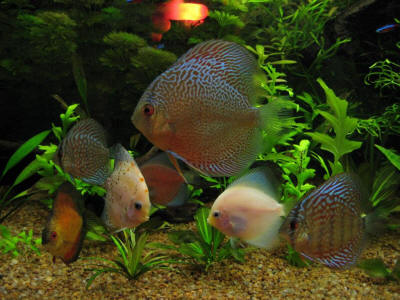
|
Frustrated with Fish, FW Disease, Ich
5/14/08 I have a 55Gallon goldfish tank. It has been up and
running for a few months now. The numbers are as follows Ammonia = 0
Nitrites = 0 Nitrates = 60ppm this number is due to a problem with
source water, recently I switched to using spring water as recommended
by my LFS. This seems to have solved that problem. <Might want to
look into an RO/DI unit, could be cheaper in the long term depending on
what the spring water costs you.> I am now battling ich. I used
Maracide to treat the tank. <Malachite green, pretty toxic stuff.
There are less toxic means to fight this, see here
http://www.wetwebmedia.com/FWSubWebIndex/fwich.htm . > I treated the
tank exactly per the instructions. I also brought the temperature of
the tank up to 76F to try and speed up the life cycle of the parasite.
All but one of the goldfish died (there were four fancy in total). The
little black moor that is left is on his way out and the strange thing
about it is that the ich never actually left the bodies of the fish.
Over the course of treatment of seven days the ich never dropped off
the fish. The black moor has more ich on him now then when I started
treating. Is there anything that can be done for him? <Could try a
formalin bath, but be wary, formalin is also fairly toxic to people, so
may not be appropriate for a work environment. Don't want to get in
trouble for bringing a carcinogen into a doctor's office.> Also
I cannot let the tank go fallow because it is set up at a prominent
doctor's office and it also houses two ACF's, which by the way
are doing just Jim dandy. I need some help. I am getting frustrated and
losing fish and my boss is losing confidence in my ability to manage
the tank. Please help... <Can be frustrating.> Treat with an
alternative medication? (After a huge water change and running carbon
so as not to overdose the tank on meds.) <I would probably try to
avoid medications here since you can not QT these fish, most
medications will destroy your biofilter and lead to water quality
issues. I would try using salt first, "about 1 teaspoon per 5
gallons for two weeks."
http://www.wetwebmedia.com/FWSubWebIndex/gldfshdisease.htm .> Is
Maracide typically an effective solution? <Yes, but it leads to poor
water quality which can cause even more problems to the already
weakened fish.> How do I get the critters off of the fish so I can
kill them? <They pretty much have to cycle off themselves, most
treatments attack them in their more vulnerable free swimming
stage.> When might I ever be able to have fish again? <Without a
fish host their lifecycle is about 2 weeks. Best bet here is to QT any
new fish before placement in the tank to avoid these types of
problems.> Can I add fish while I medicate to ensure they do not
contract the disease? <I would not add anything to the tank while
treating. However if the tank is devoid of fish not treatment is
necessary, without fish hosts the tank will be ich free in about a
month.> What about the ACF's they handled the Maracide well but
I researched it and contacted Mardel to make sure it was safe, is an
alternative medication also going to sit well with them? <Amphibians
are going to be very sensitive to any chemical you put in the water, so
best bet here is to just let the tank run fishless for a month since
the Ich cannot host on the frogs.> I read that adding salt could be
effective but I also read that ACF's do not tolerate salt well?
<They do not generally do well with salt. My advice here is to let
the frogs run the tank for a month, then add new fish after a month
long QT to make sure they do not bring in any new diseases.> Oh and
finally, I forgot there is a little butterfly loach in there as well.
He seems to be fine although determining his health is tough because he
isn't very active. <If he remains in the tank, so will the
Ich.> Also I do know the benefits of a quarantine tank and I am
kicking myself but my options are limited because of the fact that I am
not able to make my own decisions about the tank. <For a display
tank like this a QT tank is almost mandatory, for the simple fact that
can't easily break down the tank and run it fallow. I think the
doctor would hopefully understand the old "ounce of
prevention" saying if you explain the benefits to him/her.>
<Chris>
African Cichlids
scratching 5-1-08 Malawi Cichlids With Stubborn Itch
Hi Chuck, We wrote to you back in January 2006 about
an issue with our fish scratching on rocks, gravel, etc. I've
included the e-mails below. Just wondering if we could ask for your
advice one more time! I'll give you an update... After your advice
we treated for Ich/ Protozoa infection on two separate occasions. The
first dose didn't stop them scratching so our local fish shop
recommended a second, prolonged treatment with a different brand (ie 2
treatments back to back). That proved to be a disaster; it not only
failed to stop the scratching, but also killed many fish. We were left
with a few P. saulosi, P. acei and some Synodontis catfish. We spoke to
many fish shops and no one could help us or suggest any further
treatments. One said it could be the water conditioner or that it could
just be natural behaviour. Having lost so many fish we had given up on
treating them any further and just thought we'd see how things go.
Over the past 2 years we've completely changed the rock, the sand,
all water conditioners/hardeners/etc., tried different foods, got a
bigger canister filter, put in some powerheads, added Seachem Purigen
to the filter (changed monthly) and maintained good water conditions
throughout. (Phew) All the fish seemed very healthy. They bred many
many times (to the point that there were far too many for the tank) and
even our Synodontis population tripled using the saulosi as hosts.
Everything was perfect...except they were STILL scratching! A week ago
we sold all the fish except the Synodontis and bought a colony of 5
large venustus (1 male 25cm, 4 females 20cm). Unfortunately I noticed
the male scratching last night. I can't see anything visually
wrong, no spots or anything. We checked the water conditions and got
the following: GH = 22 deg., KH = 10 deg., pH = 8, ammonia = 0,
nitrites = 0, nitrates < 5ppm (didn't register any on the test).
I'm absolutely stumped and very frustrated. It seems obvious that
it's a parasite... Do you have any ideas on what it could be? Is
there any way of testing the fish before trying to treat them? Any
natural remedies that won't kill the fish? Any non-parasite ideas?
Sorry about the long e-mail! Thanks in advance. Carl & Monica <
Ideally you take a sample of the protective slim from the skin of the
fish and look at it under a microscope. Look for parasites that may be
causing the irritation. If you tried the Rid-Ich, then I am surprised
that it didn't work. Generally new fish are stressed and they
produce lots of this protective slim. Sometimes they produce enough to
overcome the parasite and the organism becomes less of a problem. To
increase the slim you could add aquarium or rock salt. You don't
want to add too much because the slim will coat the gills and impede
respiration. Other natural remedies would be to increase the water temp
to the mid 80's F. Higher temps increase the metabolism of the
organism and they cannot keep this up. Think of it as giving your tank
a fever to fight a cold. I would start by adding a tablespoon of salt
per 5 gallons of water and raise the water temp to 83 F. If the fish
act too stressed then reduce the water temp until they feel more
comfortable. If the eyes are also cloudy then it could be bacterial.
Try Furanace, it works well on both bacteria and funguses. Minerals and
metals may also cause the irritations. You could set up a quarantine
tank and fill it with treated R/O or treated distilled water. That way
you are in control of the minerals/metals in the
water.-Chuck>
Are the white spots overfeeding or
temperature related ? - 03/27/06 Hi! I need some help.
Yesterday three of my fish died of Ick or Ich. (White spots) They were
fine for a month now but recently just stopped being their selves and
started developing the white spots. I used the Ick Treatment (blue
liquid added to tank). I have a 1 1/2 foot tank and there are (or were)
15 fish. 4 Guppies (now 3) 4 Platies (now 2) 1 Siamese fighter Male 2
Swordtails (1 jumped out when retrieving guppy babies before they were
eaten) 1 Algae Eater 1 Glass Fish 1 Mollie A beautiful array of fish
and wonderful to watch. I need to know are their deaths related to over
feeding (I feed them twice a day, or temperature related? My tank is
set at 26 C. Since one of the death of a blue platy, one of the
swordtails has started being a happy and swimming all around like he
used to before the platy arrived, was he bullied of felt threatened? He
is back to being the father of the tank! Thanks and keep up the good
work ! <Sounds like they died of an Ich infection. Totally unrelated
to your temperature or feeding schedule (but cut back to one feeding a
day and skip one day a week). Read here for all the info you will need
to rid your system of Ich. http://www.aquariumadvice.com/article_view.php?faq=2&fldAuto=32
Personally, I prefer the salt and heat method. All your fish can handle
the level of salt needed to kill off the parasite. As to your
swordtail, sounds like the platy was "top dog" in the tank.
Now that he is gone a new alpha fish is taking over. This can happen in
small systems with closely related species. One point about your
livestock, if the "Algae Eater" is what is commonly called a
"Chinese Algae Eater" he will get very large and aggressive
over time. Best to remove him now. Not a good community fish. Don>
What are these things! FW Neons, Ich... 3/27/06 Dear WWM Crew, I
have recently had all my neon tetras die. The first one to go (thing 1)
had dropsy and was really sad because he had been a part of my aquarium
for over a year. I went to the local aquarium to get two replacements
to keep my second neon company. Within 2 days both of the new guys
died. I tested my water and everything was fine. <Can't tell
from here> The following day I bought another neon tetra and named
in speckles (It had white dots sprinkled over its body and fins).
<Perhaps if you named them after prophets...> This one soon died
too, followed by my second neon tetra (thing 2). I noticed my other
fish began having white dots as well. <Oops... likely not related...
but ich> (I have a flame tetra, two Gouramis, a serpae tetra) Doing
my research, I assumed ich and began treating the tank with Coppersafe,
as recommended by the aquarium store. <... I would NOT treat small
characins/Tetras with Copper products... but half doses of Malachite
Green, elevated temperature... posted on WWM> Paying closer
attention to the tank, I can see many tiny white bugs moving on the
glass and floating in the water that were not there before. <These
also are very likely unrelated...> Can these white bugs be what is
on my fish? Are they parasites hurting my fish? Thank you for your
time, Jackie <The initial losses were probably due to simple
differences in your store/sources water quality, acclimation and your
system... the ich was likely imported on some of the new fish... the
bugs are likely living on the nutrients, food... You need to "step
up" your maintenance, treat the ich with something less toxic
(likely clean the tank a bit first, or better, treat the fish
elsewhere...), and not worry re the apparent "bugs". Please
read here: http://wetwebmedia.com/FWSubWebIndex/fwich.htm
and the linked files above. Bob Fenner> HELP! Ick Infestation...
FW Ich City! 3/27/06 Hello to all of you, <And you> This is
my first time asking a question "on line" so I'll try to
add all the info you need. I am relatively new to this hobby (which I
am starting to LOVE). Anyway, first tank: 33 gallons 2 months old, 3
platys and 5 rainbow fish (praecox) one cherry barb. Ammonia 0, Nitrite
0, Nitrate 20ppm, 25% water changes weekly. No new fish added but March
16 noticed barb flashing and with 2-3 spots. Started treating with
Quick Cure. <... I would not use Formalin in your main tank...
perhaps Malachite Green alone... with elevated temperature... Posted on
WWM> Removed carbon, cut feedings in half, raised temperature to 81
degrees <I'd raise to mid-eighties> and kept lights off.
After 3 days, barb getting worse and spread to platys. Started to treat
with ICK GUARD. Have treated for the last 5 days with 20 % water change
every three days. Temperature stable at 81, reduced feeding and limited
lights. Barb died on March 20. Platys sometimes swim around but often
rest on the bottom. Tail fins still have several spots and look
clamped, not spread out like normal. Most of the Rainbows haven't
eaten in the last two days. One swimming almost upright (nose up) with
a slightly ragged tail fin. If it gets under the filter current it just
gets plummeted to the bottom. Doesn't seem to have any strength.
Another Rainbow just hovering at the surface not moving. Another
Rainbow just shimmying at one end of the tank. Tests done every second
day - Ammonia and nitrate still 0, Nitrate still 20ppm. Second tank -
10 gallon set up about 3 months ago. 5 Harlequin Rasboras, 2 cherry
barbs. I full size Rasbora, I almost full size, 3 very small (about one
third the size of the full-size), cherry barbs slightly smaller than
full-size barb. Ammonia and Nitrite 0, Ammonia about 20ppm. 25% weekly
water changes. Checked with major aquatic store if OK to add 4 black
neon barbs question my PH 8.0 level. <... too high...> They said
it would be OK as they were tank reared and that was the PH range of
their tanks. Within three days...ICK. Have been treating with ICK GUARD
for the past 6 days. Water temp 81%, lights off, carbon out, limited
feeding. <...> Relatively new 20 gallon - 4 platys. Within 3 days
ICK. Ammonia and Nitrate 0, Nitrate 25 ppm. Live plants. Increased temp
to 81degrees, am limiting food tiny (I mean tiny pinch every other
day), removed carbon. I've cruised around 100 web sites for info on
ick. However, my questions are: how long do the spots last?
<Depends... in "one generation" cycles about four days at
this temperature... but/however, over time, the cyclicity of Protozoans
gets more complex, overlapping... continuous...> Even though the
Rainbows in the 33 gallons seem to be deteriorating, I'm hesitant
about cutting back/discontinuing with the ICK GUARD as I'm aware
about the part of the ick cycle when the parasite can be effectively
treated. How could they have gotten ick in the first place? <Was
present already... likely on other fish/es> I ensure that the
temperature of the water during the water changes is exactly the same -
and no new fish were introduced??? <Can be easily transferred on any
wet gear...> I really need help. Although I'm kind of new at
this, I don't want to sound sappy or anything, but I've really
gotten attached to all these little guys/gals. Thanks for any
help/thoughts you can add. Lisa (aka.. bad fish momma) <Lisa...
raise the tanks temperatures, use Malachite Green... and soon. Read on
WWM re this disease, its treatment, prevention... use quarantine...!
Bob Fenner> Re: HELP! Ick Infestation 3/27/06 Thanks so much
for the speedy reply. Just a bit of clarification for me if it's OK
I'm in the process of raising the temperature in all three tanks to
about 84-85 degrees (should be there by tomorrow evening) Can all the
fish, Rasboras, black neon tetras, platys and remaining rainbows
sustain that temperature and for how long or how many days? When you
say use Malachite Green, is there an actual product sold named that or
is it an ingredient in ICK medications? <There are a few: http://wetwebmedia.com/malachitegreen.htm>
If it is, which is the best name brand to use. I searched WWM again and
got confused whether the Rid-Ick + was a good or bad product to use.
And yes, valuable lesson learned re quarantine. When this is all over,
the 10 gallon will be "quarantine headquarters" Thanks again
and have a good night <Sounds good! Bob Fenner>
Ich--Out of Control! 3/19/06
<Hi, Pufferpunk here> I am in tears right now over my fish. I
recently set up a brackish tank because I fell in love with the puffer
fish. One of the first fish that I added into my BW tank was two zebra
puffers. <Colomesus asellus? See: http://www.thepufferforum.com/articles/puffer/sapuffer.html
> I had some scats in the tank to cycle the water and everything was
fine until I got a couple GS puffers and 3 F8s from another pet store.
<A lot of bioload to add all at once. Scats grow as large as dinner
plates & require 50g each (adult size). Green spotted puffers grow
to 6", require marine conditions as adults & 30-40g each. F8s
like low-end BW (1.005), need 15g for one & 10 more for each extra
puffer.> I was then informed that the Zebra puffers were not BW
fish. <Correct.> So now I had two fish that had no place to go. I
do have a FW tank, but it is pretty full and I thought that I saw some
ick on the Z puffers, so I did not want to spread into my other tank. I
decided to remove the Z puffers. Yes, they had ick... <This species
in particular, is very sensitive to ich. Must be quarantined &
treated right after purchasing.> So I am thinking that maybe they
were stressed from the BW conditions and I moved them into a small,
already cycled 16 gallon tank. I treated the ick in the 16 gallon with
JUNGLE Ick clear, along with my BW tank. I saw a few spots on the scats
and a couple F8s by this time. Well, I treated both tanks for 3 days
and the ick cleared up in both tanks. <Just long enough for them to
become immune to the treatment. It's like not using antibiotics for
the full recommended period.> About 6 days later I noticed that the
Z puffers in the 16 gallon FW had signs of ick again, so I immediately
used JUNGLE ick and I had gotten 2 glass fish for the BW tank and I
swear, by the time I got them home and dumped them in the tank - not
more than 1 hour passed and the glass fish had ick spots, so I also
treated that 40 gallon BW tank with JUNGLE Ick again also. Well, after
3 days of treatment, my Z puffers had not responded to the treatment
and have gotten steadily worse. My BW tank has held its own but still
no signs of improvement. I then put the carbon back in the 40 gallon BW
tank (Fluval) and the 16 gal tank, waited 12 hours, did a 25% water
change and switched medicine to Kordon Prevent Ick. I used that for 2
days in both tanks, cutting the medicine down a little bit because of
the puffers being sensitive and all of my fish seemed to have gotten
worse. So, I then changed medicine AGAIN with Kordon Rid-Ick. Now,
after 3 days all of my fish that were infected are either the same or
worse. The Z puffers look so bad - one is also starting to get fin rot,
that I have thought about putting them out of their misery, ether by
having a friend of mine freeze them or me flushing them. <Overdosing
with clove oil is best (found in the toothpaste isle of the drug
store).> My BW tank with the three F8s seems to be getting worse and
I just don't think I can see any more of my fish suffer so. I
talked to a friend of mine at the pet store and he told me that there
are all sorts of strains of ick, and that all medicine might not kill
that strain. <There is FW "ich" (Ichthyophthirius
multifilius) & SW "whitespot" (Cryptocaryon irritans),
with similar habits to freshwater ich.> I do not understand how ick
could be living in my BW tank with the temp being 80, and the
hydrometer reading at .006 - .008. <You could be making the strain
resistant to meds, with all the different meds you are using, for not a
long enough time.> So to sum it up I have a 40 gal tank with 2
scats, 2 knight gobies, 1 GS puffer, 3 F8s, 2 butterfly gobies, 5
Bumblebee gobies, 2 glass fish and 2 black Mollies. <Waaaay
overstocked! With that kind of overstocking there is always going to be
constant stress & lowered immune systems--no chance of fighting
disease at all in there.> The 3 F8s are steadily getting worse and I
am sure my fish are stressed from constant 24hr water changes along
with new doses of ick medicine. <Water changes are the very best
thing you can be doing right now. Here is an article on Treating
Puffers with Ich: http://www.thepufferforum.com/forum/viewtopic.php?t=9
> My 16 gallon tank has 2 Z puffers and 2 white mollies COVERED with
ick. I do understand that it takes more than 3 days to clear up ick but
I have had ick in the past in another tank. <The parasite have a
greater hold on scaleless fish.> I have - a FW 40 gal and after 3
days the ick has always maintained the same appearance or gotten a bit
better. So, if you are wondering why I have not waited before trying a
new med is because every day, even with the ick medicine the puffers
have gotten steadily worse. As of now I have put the carbon back in the
tank and am going to try a new medicine called Super Ick Cure, by
Aquarium pharmaceuticals Inc. I am still debating as whether to do
another 20% water change before attempting this. I feel that the more
water I take out and put in, the more stressed the puffers get. My Z
puffers are suffering so, I know that I cannot watch any more of my
fish get that bad so please, if you have any answers on how to get this
under control - PLEASE write back. If I have to watch my F8s suffer
like the Z puffers, I don't think I'll be able deal with having
any more fish. :((((( <I understand your affection for these
wonderful fish! I'm afraid your tanks are in trouble with all the
fish you have in there. Please read the links I have given you. You can
also add Melafix to help with the fin rot--caused by the parasite
eating off the fish. Look through the other articles on the species you
have & consider many larger tanks for all your fish--if they make
it. For now, leave the meds alone, heat & water changes, water
changes, water changes. Be sure it is the same temp & use Prime to
DeChlor. ~PP> Kathleen
Treating ich--how long? 3/3/06
Howdy crew, <Hello> I have a threadfin rainbow in a QT tank with
a moderate case of ich. I am using Aqua-Sol to treat-- copper sulfate.
<Yes, nowadays... used to be a silver salt> The product label
didn't specify how long to treat, # of repeat doses or anything.
<Smart... or disingenuous... or both> When I called the company
to ask, they said one treatment is all that's needed. <Mmm, not
likely. I disagree, but can understand this blanket statement. One
needs to know actual concentrations (ambient) and re-apply as necessary
(likely), rather than risk (easy) over exposure with copper/cupric
ion> This doesn't jibe with what I've read on WWM and
elsewhere about the effectiveness of medications on the trophont and
tomont-stage buggies. <Ah, yes> I've set the QT tank to 85F
to speed up the ich life cycle. Based on that, should I keep dosing the
copper sulfate for X days, or wait X days and re-treat? <Let's
add to the bit of info. re copper use in FW (much of this is gone over
in the Marine/root web)... There are a few substantial and a handful of
minor factors that determine the "life" of copper added
here... Depending on aspects of water quality, the amount of
"bio-gunk" and livestock, the copper can/will "go
away" in a very short while... And w/o having a "given
standing concentration" there is no benefit... Hence the call for
suitable test kit... measuring, re-applying when the concentration
drops below 0.15-0.20 ppm free cupric ion... Bob Fenner> Thanks!
-Dave
Re: Treating ich--how long?... FW
Q., feeding 3/4/06 Thanks Bob. That's exactly the piece I was
missing. <Okay> Unfortunately, the rainbow died last night,
partly due to not eating for the past 3 days on top of the infection,
increased temp, etc. Which makes me wonder-- are there any tips to
getting fish to eat after moving them to QT? <Mmm, yes... use of
vitamins (in the water, soaked with the foods), changing water...
including temperature (usually elevation), use of feeding
ditherfish> Most of the fish I've QT'd have failed to
eat/thrive despite my best efforts at easing their transition (using
water from the display tank to fill the QT tank, etc). The rainbow was
eating fine before I moved him. <Bob Fenner>
Treating A Tank With A Bio-Wheel -
2/28/2006 Hello, Have been combing the archives and I can't
seem to spot this question/answer. I have a 12gal Eclipse with a bio
wheel, when you're medicating a tank (ick)-after you're done,
what do you do with the bio wheel? I've gotten rid of the carbon in
the filter and have a new one ready to put in after the treatment, but
am not sure what to do with the wheel-if anything or how to proceed.
Thanks, Judy < Before treatment, take the Bio-wheel out of the
system and place it in a little dish/bowl with some aquarium water and
place it in a cool dark spot like under the aquarium. Keep it moist but
not submerged. Treat the tank for ich for at least three days as per
the recommendations on the bottle. After the treatment is complete you
add carbon to remove any medication. When the tank is clear you can
simply reinstall the bio-wheel. Without a fish to host the parasite it
will die off in a few days depending on the water temp. This is one of
the great things about the Bio-Wheel. This is especially useful when
treating with antibiotics.-Chuck.>
Re: Medicated Tank with Bio-Wheel -
3/1/2006 Thank you Chuck for the quick response! I of course acted
first and asked second! :-( What would I need to do (I pulled the bio
wheel after I started treatment) in this instance? Should I get a new
wheel and treat the water with a Bio Spira product after the treatment
and about a 50% water change? I was so anxious to treat the white spots
that I remembered the carbon but wasn't sure about the wheel.
Thanks Again, Judy < When the fish are cured add carbon to remove
the excess medication. Start feeding after adding the carbon. Be very
careful not to overfeed and remove any excess food after a couple of
minutes. Check the ammonia and nitrites. If they start to get up there
then I would add Bio-Spira.-Chuck>
Guppy with Ich, no QT -
2/26/2006 Hello, <<Hi Lala>> I am a very new aquarist
(aquariumist??). <<Aquarist was right :)>> I have a
29-gallon aquarium with 6 white clouds, 4 dwarf rainbows, 2 algae
eating shrimp and a limpet. <<No plants in the tank/left then I
assume.>> Added three guppies a week ago - one of them developed
ich two days later. <<Quarantine is the best way to exclude
problems like this.>> I immediately consulted the LFS, started
AquariSol treatment and raised temperature to 80. Only one fish has
ich. The ich started on the top of the back, then two days later, it
looked like the skin was perforated. The fish was eating, and showed no
visible distress, then the fish disappeared!! Have not seen her in
three days now. The aquarium is lightly planted and has some driftwood
and stone but I think it should have been visible. Could she be dead
and eaten??? Or buried in the gravel? <<Any of the above, yes.
Likely consumed quickly by the limpet.>> Another concern is that
the other female guppy seemed to be pregnant. What should I do with the
fry - should I place them in breeder tank? Will it be infected?
<<Search on WWM for guppy reproduction and breeding.>>
Thanks <<You are welcome. Lisa.>> Lala
Stubborn Ick 02/12/06 I have a
small community tank that was recently overcome by Ick. I think it was
brought home with my latest additions which were 4 cherry barbs. I
would really love some direction as to what products I should use.
<... posted... on WWM> I have read everything on the net as well
as on the bottles, but there is just so much contradicting info out
there! I have already lost the 4 barbs. I also have 2 female
Betta's that were in the tank and I moved them back to bowls after
their scratching nearly left them finless. I am currently using
Coppersafe to treat the betas in the bowls but they don't seem to
be getting any better. I actually think one has a bacterial infection
on top of all this on her tail (its red/brown and splitting). So.
what's the best to use for quick, safe, and effective treatment? Is
there anything out there that will kill the parasites attached to the
fish or do I have to wait for them to fall off? Can I combine the Ick
treatment with others such as Stress Coat, Salt, or Antibiotics?
What's the best thing for the bacterial infection? And lastly, what
is the likelihood that the Betta's will actually recover at this
point? Sorry for the loads of questions in advance! <Read: http://wetwebmedia.com/FWSubWebIndex/fwich.htm and the linked
files above. Bob Fenner> Confused, Amber
|
Please help! Gourami with Ick Emergency
3-28-06 I think I may be losing my powder blue Gouramis to
Ick. Last night I lost my CAE. <Other members of the Crew may
be holding their breath to see what my comment here would be>
I have a total of 8 Gouramis and they are showing small white
spots tonight but they are very bad on my 2 powder blues. I
rushed to Wal-Mart tonight when I got home from work (they were
the only place I could go to at 11pm at night) and I purchased
Wardley's "Ick Away". I followed the directions and
removed the carbon filters but when I went to turn my filter back
on nothing would circulate throughout it with the filters intact
so I unplugged it completely. <Looking for surface agitation
here, Jennifer. Filtration at this stage is unimportant> So my
Gouramis are in the tank without anything circulating and I
don't know what to do about that. I poured the blue solution
into the tank and did a 50% water change with my gravel cleaner.
Then I removed all my live plants. I read that the hotter
temperature could kill the Ick so I placed my heater inside the
tank. Well after a few minutes it started smoking and I husband
unplugged it and said it broke. <From bad to worse is sounds
like> So I added hot tap water mixed with fresh start to the
tank in hopes that will bring up the temperature. <Won't
do the deed for you. Temperature must be raised and held,
preferably above 85 degrees F.> So the temperature is now at
78 in my blue watered tank without any circulation and my dying
fish. Would someone please tell me what I can possibly do to save
them. I have invested so much money and time into these fish and
I need some direction please. Is there still hope for my fish?
<If your fish are still alive, there's certainly hope.
We've not alternative but to try. If you're prepared to
spend the money, purchase a hang-on filter of suitable size
(AquaClear would be my choice), a new heater (no preference here
but I wouldn't skimp) and "aquarium" salt (not
"marine" salt). Pull your current filter off the tank
and install the new filter with no filter inserts. Do a 50% water
change, vacuuming the gravel heavily, to remove as much of the
old medication as possible as well as any encysted parasites as
we might get lucky enough to catch. That done, install the new
heater and slowly begin raising the temperature (1-2 degrees per
hour) until the tank temperature is at 86-87 degrees. (Note:
I'm not familiar with the Wardley's product however some
Ich medications shouldn't be used at elevated temperatures
which is why I recommend removing it.) Once you're reasonably
satisfied that the old medication is out of the tank - as much as
possible - we're going to do the water changes again, this
time adding the aquarium salt at a dosage of 2-3 tablespoons per
five gallons of water to the water-change bucket (not the tank!)
- five-gallon buckets are typically sold at most LFS's and
would serve well here. This process should be done slowly over a
one- to two-day period to avoid "shocking" the fish.
(Keep the tank water level a little lower than you normally would
so that the output of the filter "disturbs" the surface
sufficiently to increase oxygenation. This is very important at
higher temperatures!) Now, catch your breath while I catch mine
;). Okay, the combination of salt and heat should be maintained
for about 10 days. You may see a disappearance of the parasites
in less time than that but it doesn't mean they're gone.
In the meantime, keep an eye on your pets for signs of stress
over and above what the Ich may be causing. Unlikely that this
level of salinity or the elevated temperatures will do any harm
to your Gouramis but let's "first, do no harm". If
need be, do a small, unsalted water change but I don't think
it will be necessary. At the end of this time, do water changes
to remove the salt and "very" slowly lower the
temperature back to normal. (Fish can acclimate to elevated
temperatures faster than they can to decreased temperatures.)
Also take notice that your tank will need to re-cycle as you
might imagine. Bio-Spira (Marineland) can speed this up
enormously. Pricey, but well worth the cost. Best of luck,
Jennifer! Tom> Jennifer Groenendaal
Re: Please help! Gourami with Ick Emergency 3/31/06 Hi
Tom, <Hi, John> You have helped me to save the lives of my
fish because of your prompt and detailed response. <If that
didn't make my day, nothing will. Thanks> The first night
I didn't think my 2 blues were going to make it but I woke up
the next day and they were still alive, read your email, and
bought a new heater. Now I did end up back at Wal-Mart b/c the
closest fish store is almost an hour from where I live so I ended
up with kosher salt b/c I thought I read here before that it can
be used and didn't see any marine <aquarium> salt as
you instructed. Is this ok? <Absolutely> I couldn't
find a hanging filter but I am going to the fish store tomorrow
as I have more time to purchase one. Tonight I did another
partial water change and added some more salt, some more fresh
start and pH adjuster. The temperature also reached 85. <Good!
One or two more degrees wouldn't hurt but you should be in
good shape> I got rid of all the live plants and took out all
the fake plants and the fish started to seem stressed with all
the activity going on with their tank and probably also b/c there
was no more plants in there. <Understandable> The reason I
thought they were getting stressed is because they pace back and
forth really quick or swim up and down at the corners of the
tank. <Not uncommon when fish are stressed> Anyways, I then
soaked the fake plants in hot water and kosher salt and floated
some on the water and planted some. They all seem to have their
appetite back and are swimming normally. <Very good to
hear> Except out of the 8 of them I still see a bump on the
top fin of one of my blues and the other one still seems to
scratch itself against the rock. <These guys sounded to be the
worst infected and it may take a little extra time. Not to worry
at this point> Would you like me to continue this for the next
10 days before removing the salt, adjusting the temp. back to
normal, and putting the carbon filters back in? <Let me offer
you an option here, John. When you're satisfied that the fish
are clear of any infestation, continue this course of action for
three additional days. If you've any doubts, then let's
run with the full ten-day plan. Much beyond ten days and we start
getting into a position where we may start doing more harm than
good from a standpoint of stress on the fish. The higher
temperature should certainly help to speed things up since Ich
can rarely survive temperatures in this range and it speeds their
life cycle up significantly. In short, the stage of life in which
the parasite is vulnerable will develop much sooner than if we
were treating a colder temperature environment, a pond, for
example.> Thanks again for your time Tom and I hope to hear
back from you when you get a chance!! <Happy to get back and
keep up the excellent work. The credit really belongs to you!
Tom>
Re: Please help! Gourami with
Ick Emergency - 04/04/2006 Hi Tom, <Hi,
Jennifer> Not sure if you are able to help me at this point
but my 2 powder blue Gouramis do not look like they are going to
make it. I believe I completely got rid of Ick by following your
instructions b/c I do not see anymore salt-like spots on their
bodies but now I see small white patches of skin on them or maybe
just areas where their beautiful blue coloring is faded into
white. <Likely the result of wounds left behind after the
adult parasites "dropped" off.> They are both at the
top of the tank in the corner near the heater and moving slow and
"tilting" to the side and they only move their fins
when they see me come close by. Note that I have 6 other
Gouramis-gold, opal, moonlight, and three-spot that seem to be
just fine. <Glad to hear that, anyway...> Once I thought I
treated the tank of Ick, I got the temp back to 80 degrees and
put the carbon filter back in. I went to the pet store and they
tested my water and told me my water was hard and needed to add
bacteria, so I bought Stress Zyme and Stress Coat and added them
in conjunction with each other into the tank. I also added a pH
adjuster and new live plants to float on the top. <Jennifer,
the activated carbon will probably "undo" any
medications that you place in the tank. Cease the use of both for
the time being.> The blues still didn't look good so I
added them individually into a glass container with warm water,
kosher salt, and some Ick Away. I kind of "dipped" each
one in it individually and added them back to the tank. They
still don't look good. Do you have any idea what else could
be wrong? <Okay, let's start doing water changes - 20%
every other day...starting now. Do NOT add anything more to the
tank. (We need to get "control" over water conditions
and the additives aren't helping.) Please, look into
purchasing a water test kit. (Aquarium Pharmaceuticals makes a
great "starter" kit and is easy to use and read.) The
water changes will oxygenate the tank and control, if necessary,
the toxicity of the water. We need to get your Blues under
optimum conditions!> Thanks, Jennifer <Please, keep me
posted. Tom>
|
Whitespot Wipeouts
4/21/06 Greetings, I'm still fairly new to the world of
aquariums (less than a year) and am trying my hardest to keep my fishy
friends happy. The set up is a 54 litre tank with live plants, with 25%
water changes weekly. Nitrate, nitrite and ammonia levels are pretty
low and algae (brown and green) is minimal. I follow all the advice
that came from my tank manufacturer. However, I got whitespot in March,
and it keeps recurring. I had to replace a Tuxedo Platy who died (no
obvious cause), and the new fish brought the dreaded tomites along with
it. The most of the original inhabitants (4 other Platys, 3 Zebra
Danios, 9 Neon Tetras and Hoover, my beautiful Upside-down Sailfin
Synodontis) were literally covered in spots before I knew what was up,
and died over the next few days. I treated the tank throughout with
Interpet "Number 6" Anti-Whitespot (which is a blue liquid
with needs to be diluted before adding to the tank), Melafix, Pimafix,
and bi-daily water changes (approx 20%). After the massacre, I was left
with 2 Danios and Big Dave the Ghost Shrimp. I also noticed that the
dying fish spent a lot of time swimming at the top of the tank. So,
Some four weeks later, I returned to my supplier - who admitted that
they'd had a major whitespot outbreak (and that they'd
knowingly sold ill fish without warning customers) - and agreed to
replace all of my fish free of charge. Obviously, I couldn't
replace them all in one go as the filter would overload, so my tank
population went up to 1 new Synodontis (Flymo), 5 new Platys (bought in
two lots) and an additional Danio. They were introduced over a period
of three weeks. Annoyingly, one of the final Platys seems to have
brought whitespot back with it - despite showing no obvious infection
(the spots appeared almost two full weeks after introduction). I
immediately started treatment (and had deliberately added some of the
Interpet "Number 6" before introduction as a precaution)
though it doesn't seem to have any effect. My Platys spend 30% of
their time apparently asleep during the day and 30% of their time
swimming vigorously swimming at the surface (possibly gasping for
air?). This morning, three of the Platys lost swimming control and died
soon afterwards, and it appears that one of them gave birth to fry
overnight! The dead fish were literally covered in whitespot, and it
looked like their flesh was shredding. The other Platy seemed to be
immune (except for the sleeping and surface swimming which began this
morning) though I think I spotted some small spots on them just before
lights out this evening. The Danios appear to be unaffected at this
time. I've read the FAQs here, though none of the questions seem to
cover my situation closely enough for satisfaction. What can I do to
get rid of this horrible disease before I lose the rest of my fish?
"Brother" Steve <Start by getting a quarantine tank. Place
the new fish in the tank for at least 2 weeks and set the temp for 82 F
and add a tablespoon of salt per 5 gallons. If spots appear then treat
with a malachite green and formalin combination. Sometimes for really
bad cases you may need to add some copper sulphate as well. When all
the fish are completely cured, usually after 7 days they can be moved
to the main tank. In the main tank the temp should be increased to 82
to 84 F with a tablespoon of rock salt per 5 gallons of water. Some
medications can present a problem for scaleless fish like your catfish
so read the labels.-Chuck> Problems with aquarium ... FW,
ich... stkg. 4/9/06 Hello, I was wondering if you could help me
with a problem that I am having. <Will try> I set up my aquarium
(the first one in 15 years!) and proceeded to perform a fishless cycle.
The aquarium is a 96 Litre (25 gallon) tank. It is a planted tank with
both live and plastic plants. I used ammonium chloride to initiate the
cycle <... a bit dangerous... easy to overdose> and measured
nitrites and nitrates to observe the spike and subsequent drop. I could
not test ammonia levels as in Switzerland I have yet to find an ammonia
testing kit. <Interesting. Likely "against the law" due to
the toxicity of the test reagents. They are> The tap water has the
following natural parameters: pH: 8.0 <A bit high for your Cardinals
mentioned below> KH: 5d GH: 7d Tank temperature is kept at 26-27C. I
stocked the tank with fish when the nitrites were at 0 ppm and the
nitrates at 12ppm. I put in 4 male guppies and 10 cardinal tetras and 1
Pleco (which I now fear may outgrow the tank). <Most species sold
for aquariums, yes> To acclimate them to the new water I placed them
in a plastic bag floating in the water for about 20 minutes. I then
introduced about 1-1 and 1/2 cups of tank water into the bag every 20
minutes for about 1 hour. After this time I removed the fish from the
plastic bag and set them free in the tank. I tried to avoid adding any
water from the plastic bag into the tank, but maybe a little bit (i.e.:
some drops) entered the tank. I disposed of the mixed water and bags.
For the first 4-5 days everything seemed fine. The cardinals and
guppies and Pleco seemed very happy. On the 5th day I thought I noticed
some white dots on one of the tetras, noted it in my journal, but
didn't take action. I am a bit rusty after 15 years... <I'm
permanently fused after forty...> Two days later, it was as I
feared. Almost all the tetras had what obviously appeared to be ick.
Bad. I raced to the fish shop and purchased a preparation based on
malachite green. I treated the tank at half dose (because of the cards
and Pleco) <Good> and treated at the same time with anti-biotic
(1/2 dose). Temperature was raised to 28C. <Very good> Thirty
percent water changes were done every 2 days along with substrate
vacuuming. Over a period of 3-4 days I lost all the tetras. I was
devastated. After I lost the tetras, the guppies started exhibiting
lots of white spot. I continued the treatment. I am on about day 8 of
the treatment now and the guppies seem to be doing much better. The ich
is visibly gone, but I will continue to treat. Two guppies have
developed what appeared to be tail rot, so I upped the dose of the
anti-biotic and added some anti-fungal medication (at half dose also).
They finally appear to be doing better (tail damage seems to have
halted) and seem to be eating. But now, one guppy (with the biggest
tail) seems to be getting picked on by two other guppies. It looks to
me like they are trying to nip his fins, and his tail fin is already
quite damaged (from the rot, I suspect). My questions are: 1. Can I do
anything to discourage this nipping behaviour? <Mmm, more decor,
plants, more frequent feeding... perhaps isolating the
"nippers" for a few days in a floating/breeding trap...>
2. How long should I continue to treat with the malachite green?
<Every three days for two weeks maximum... Is toxic> (Just today
I noticed no more white spots, so all the cysts have probably fallen
off in the last 24 hours) <... Yes... I might risk even elevating
the temperature another C.> 3. Will the anti-biotic treatment kill
my biological filter? <Could> 4. When is a reasonably safe time
to add more fish given I have just treated for ich? <A few to
several weeks> 5. What type of (and how many) fish will do well with
the guppies and water chemistry? <Posted... on WWM, fishbase.org...
elsewhere> I have a choice of Gouramis, blue rams, platys, mollies,
cardinal tetras, angelfish, glassfish, penguin tetras, harlequin
Rasboras, meekis, ramirezis, <Same as "Rams"> and neon
tetras. (25 gallon tank, 5 fish current inhabitants) <I would stick
with soft, acidic, tropical OR hard, alkaline, cooler water choices...
other than the two you have indicated above here> 6. Any idea what
could have caused the ich infestation? <Oh yes... You bought the
fish/es with this... One of the "in the good old days"
statements one might make. Livestock nowadays is far more likely to
have problems...> I appreciate your time and assistance with my
questions, <I appreciate your writing, sharing. Thank you and good
life to you and yours. Bob Fenner> Thank you, John Theal.
Help Bala shark with ich 4/8/06
Hi my name's Brandy. I have a ten gallon tank set up for 4 months
now and was running smoothly. Ammonia is 0 ppm nitrate is less than 5.0
ppm. <Good> I haven't been testing for nitrite or ph. I have
an outbreak of ich which I treated today with Super Ich Cure by API. My
tank had aquarium salt added a few weeks ago. The problem is that when
I added the treatment for the ich on of my Balas stopped swimming.
<Yes... is rather toxic... BTW, this minnow-shark species needs to
ultimately be in a much larger system> He is still breathing, but
lying upside-down on the bottom of the tank or on a plant (fake btw).
<Yikes... very bad.> I am not sure what I can do for him at this
point. <If it were me/mine, I would add some activated carbon to
your filter, flow path... to remove the "medicine"
quick...> I vacuumed the gravel and did a 30% water change because I
was afraid that he would get more infested if I waited. <Good
move> I would like to try a salt dip, but don't want to push him
over the edge. I have a 3 blue pearl Danios, a Cory cat, a small Pleco,
and two Balas. Every one else is fine only the Balas have ich I think.
I do know how (now) big they get and was planning on moving them into
my 38 gallon this weekend, but alas the ick struck! Thanks for all your
help! <Please read here: http://wetwebmedia.com/FWSubWebIndex/fwich.htm
I would only use half-doses of Malachite Green on "sharks",
small Characoids, catfishes... and elevated temperature to treat ich.
Bob Fenner>
Ich in a FW Community
Tank 4/26/06 First, thanks so much for providing this site with all
of its information; I've learned a lot and certainly have become a
better aquarist because of it. Second, does the following sound about
right for an ich treatment? After five months of waiting and cycling
and more waiting, I finally stocked my 120 gal with seven juvenile
(2"-3") discus last weekend (no QT, I know, but I can only
have one tank). Its continuing inhabitants include ten cardinal tetras
and five Corydoras. There are no live plants. Two days ago, I noticed
that three discus had come down with ich. There were only 2-4 spots per
fish, but they were definitely there. I started treating immediately:
daily 25% water changes with gravel vacuuming followed by a daily 110
gal-size dose of Rid-Ich+ (produces a concentration of 15 ppm formalin
and 0.05 ppm malachite green), combined with a gradual temp increase. I
made sure to remove the carbon from my filters; should I also remove
the peat as well? < If the treatment looks like it is working then
leave the peat alone. If not then remove it.> I have the tank lights
off except for 2-3 hours each evening for feeding (after which I
gravel-vac and treat the tank) and keep the tank covered to prevent
light from degrading the medication. Is that enough light for the fish,
even for the duration of a two-week treatment? < Sounds good for the
short duration of the treatment.> I currently have the temp up to 85
degrees F. - can I take it higher without harming the Corys? < Leave
it alone for now.> (They are C. trilineatus, C. axelrodi, and C.
leucomelas.) Or is it too high already? < A little high but OK if
the fish are acting normal.> Yesterday spots appeared on two more
discus, and today three of the tetras show spots. None of the visibly
infected fish has more than six small spots, so I hope to catch this
outbreak before it really takes hold. None of the fish appears to be
unduly stressed and all were willing to take food this evening. Tank
parameters are stable at: (I am testing daily) NH3 - 0 ppm N03 - 0 ppm
N02 - 0 ppm pH - 6.8 KH - 100 ppm GH - 50 ppm Am I doing the right
thing? I plan to continue this treatment for two weeks, or longer if I
observe spots after the seventh day. Any other advice? Thank you so
much, Danielle Gilbert < The parasites should be gone in a week if
the treatment is working. If spots continue to appear then you might
want to add some copper to the treatment.-Chuck>
Problematic tank/Ich
6/22/06 Dear Crew, <Hi> My family has been trying to keep a
fresh water aquarium for a year now. The first nine months were pretty
sad; most of our information came from a large pet store chain, and two
books which I have now discarded. <Everyone has their own
methods.> The last 3 months things had been looking better, now I
fear I have gotten ahead of myself again. <Will try to help.> I
am unsure of the best way to proceed. I have done time on the web
searching and have found some answers, but I seem to come up short in
finding the connecting answers. I hope you can point the way to getting
my fish back on track. <Lets give it a try.> My current status
has me with one community tank for display; it is a 55 gallon corner
tank, a 100 gallon canister filter. A bed of gravel (pea sized,
randomly shaped) a few hidey hole items made from fish safe resin, 2
pieces of coral, I would guess the 2 pieces would weigh half a pound
together. <Coral skeletons can be problematic, causing Ph
shifts.> I live in Georgia and my tap water is soft and low ph. This
tank has been running since mid December. About the end of March I
stopped messing with the tank, after the umpteenth fish death.
<Disheartening for sure.> Low and behold by mid May the trail of
tears seemed to end with 4 barbs left alive. Other then bi-monthly
water changes I had done nothing, the water in the tank settled down to
mid sixes ph and 0 for ammonia nitrite and nitrates. <Sometimes time
is the best thing.> The 4 barbs looked to be comfortable and settled
in. I tossed out the snake oils I had used in the first nine months and
let it be. <Good> My children (three and four years old)
didn't seem interested in the tank anymore. I came across a little
local fish shop I had never noticed. To make a long story short the
store did not look retail, the fish and tanks looked cared for, the
people seemed to enjoy the place and talking about fish. <A good LFS
will help immensely.> I told them my tale and they asked me to bring
in a water sample, a month later and quite a few hours watching the
store's fish and listening to advice from the employees I started
getting fish for the tank. I added the 2 pieces of coral to buffer the
ph. <Better to work with the natural Ph of your tap water and find
fish that are appropriate for it rather than attempting to alter it.
Stability is the key.> Which now hovers between 6.9 and 7 ph. Then I
added another 20 fish. They were added a few at a time with no QT.
<Oops!> I checked levels nightly and they stayed where they had
been before the new fish. I did water changes every other day, and did
some work in the gravel with a siphon weekly. Things were going good
until on one of my nightly checks I Found the fish had Ich. <A very
common problem.> I went down to the 24 hour store with a small pet
section, I purchased QuICK cure by Aquarium products, active
ingredients Formalin and Malachite Green, at one drop per gallon.
<Not a big fan of this stuff, really toxic. Copper is better in most
cases. Also please make sure the kids stay away from the QuickCure,
Formalin/formaldehyde in particular is quite toxic.> That was a week
ago, since then I have been glued to the net reading, and kicking
myself for letting the cart get ahead of the horses. <A learning
experience. Guessing QTing will now be part of all future plans.> I
have been watching the fish closely they have shed most of the cysts; 7
of the fish still show visible signs of the ick, its limited to 1 to 2
spots but its there. <May come back due to the lifecycle of
freshwater Ich parasite.> I have been adding SeaChem stability with
the ick cure. <Not familiar with this product beyond its web page.
Seems better than most products in this category, at least a chance of
working. Seachem generally has a quite good reputation in the
hobby.> They all seem very happy other then the spots. Now my
problem is I have too much information that I don't fully
understand. I would like to save these fish that ill lucked into my
care. <They could definitely have a worse custodian, believe me, we
see/read it all. A caring owner is far better than what most fish end
up with.> I intend to set up a QT tank; I have several tank options
20g 30g 75g that are sitting empty. And a 10 gallon tank that I was
attempting the fishless <?> My questions. If the display tank is
currently medicated, does the bio media become a bad choice for seeding
the QT. <I would not use it, better to get some Bio-Spira to
jumpstart the QT cycle.> I commonly see a reference to sick fish and
moving the fish, as if singular, what if the count is higher. <Can
all be treated together in the hospital/QT tank as long as it is big
enough. Without knowing what types of fish you have its hard to say.
Although there is nothing wrong with splitting them up between tanks if
they are available.> If you buy more then one fish at a time, say a
mated pair of something. Do you QT them in separate tanks?
<Generally if my fish came from the same tank/filtration system at
the fish shop I will QT them together, figuring if one has something
the other will as well. When getting fish from different sources
separate QT tanks is best, no need to unnecessarily expose a fish to
something nasty.> When you do chemical tests. Is rinsing the test
tubes in tap water a contamination? If I rinse them in tank water will
the traces left in the tube spoil future tests? <Rinse them in tap
water and then dry them.> If anything I introduce to the tank is a
possible bacteria that will make them sick. How do you make it safe to
work with the tank? <Like for humans most bacteria is harmless to
fish. Also most diseases that effect fish are not transferable from
people/dry sources, only come through other aquatic environments/hosts.
Of course there are exceptions but generally anything you use and feel
ok touching is biologically safe for the aquarium. When dry objects do
cause problems it is more often a chemically toxic scenario.> The
Display tank tests 6.9 ph and zero ammonia, N02 and N03. Which leaves
me confused about the ick medicine, I thought it was going to bust up
my colonies until it was out of the tank system. If it did it seems
doubtful that the SeaChem stability is caring for all that waste.
<Probably not, may not be at a high enough level to kill the
biofiltration.> I am also wondering about moving the fish to the 75g
tank and letting the 55 display go fallow after reading an article this
morning on your site. <They only way to rid the tank of the Ich
parasite.> But I come back full circle to the problem of a healthy
cycled tank, or lack there of. <A problem, but able to be overcome
with religious water changes. Just need to monitor the water quality
closely. A dose of Bio-Spira may also help, as well as the Seachem
Stability.> Sincerely, Robert <Hope this helps and good luck.
Remember to always go slow, nothing good every happens fast in an
aquarium.> <Chris>
Fighting Fish Help! Betta dis., ich
- 06/30/06 Hello, <<Greetings. Tom here.>> After
reading your web site I realized my Betta has the ich.. white dots all
over...I am concerned he might die. <<We won't let that
happen. :)>> We have 1 gallon tank with bottom filter and a pump.
How much Sea Salt do I need to put in and for how long...? <<I
would recommend 1/2 tablespoon for this size aquarium. (The normal
recommendation is 2-3 tablespoons per five gallons. Decimally, this
works out to between 0.4 and 0.6 tablespoons per gallon, so I'm
splitting the difference.) The time period is going to be a bit
problematic so I'll explain this at the end of your post.>>
How do I raise the temperature of the tank? Can I put it on a sunny
spot? <<Don't put your tank in the sun. With a large tank
this might not be a big deal, especially if you're fond of algae
but, with such a small tank, you'll be warming and cooling the
water much too quickly for your Betta's well-being. Good news? The
salt alone will deal with the parasite. The downside with this is that
the Ich's lifecycle won't be sped up as it would be if you
could raise the temperature - safely - into the mid- to high-eighties.
Without a heater (which you could always purchase, of course), I would
continue the "salt treatment" for three weeks. This may have
to be extended if you still see any infestation on your pet. (Sidenote:
If you do a water change during this time, you'll be reducing the
salt concentration accordingly. For instance, if you remove 1/2 gallon
of water, add only 1/4 tablespoon of salt to the new water. This will
maintain the appropriate 0.5/1 ratio of salt to water.>> Thank
You! Love Always, Jared & Palma & Sophia <<My best to all
of you. Tom>> <Need that heater. RMF>
| I have been reading about ich and
quarantine tanks. 7/30/06 Hi Bob, <<Hello, April. Tom, in
Bob's stead.>> I have been reading about ich and
quarantine tanks. <<Good.>> Guess too late though.
<<Uh oh.>> I set up a 16 gal. tank 4 weeks ago. Added 3
platys 2 weeks ago. <<Bigger "Uh oh".>> I
thought 2 platys had a white spot on their tails, but I just
observed. Then woke to white spots all over the fish a week or so
later. Went that night to LFS and he sold me ParaGuard. I did the
ParaGuard, removed carbon filter, 20% water changes, raised the
temp to 80. 2 days later 1st died, next day 2nd died, next day last
died. <<I hope it goes without saying that I'm very sorry
to hear about your pets. I'm not familiar with ParaGuard so I
can't comment on how effective it may, or may not, be in
combating Ich.>> I have cleaned out the carbon filter and did
a 3 gal water change. <<If by "cleaned out" you
mean that you removed it from the filter and threw it away, good.
Activated carbon cannot be re-activated and when used for the
purpose of medication removal, regardless of how little time
it's been in the filter housing, you should simply toss
it.>> Will I need to cycle again? <<I would if it were
up to me. Normally, I would recommend purchasing BIO-Spira
(Marineland) and adding it to the tank to give the cycling process
a huge 'jump start'. Not in your case, though, April. The
reason? I couldn't state with any degree of certainty that the
Ich was eradicated from the tank. Without "host" fish,
the parasite (in the juvenile stage) will die within hours. Better
to raise the temperature of the tank to the mid- to upper-eighties
and wait. The increased temperature will speed up the cycling time
and greatly decrease the Ich's chances of survival, however
small the possibility may truly be.>> Can I keep my plants
alive and add new fish in 30 days? <<Most common plants
should be tolerant of the elevated temperatures but I'd keep an
eye on them to be sure. As for adding new fish, only testing the
water parameters will let you know for sure whether, or not, the
tank has cycled. Strongly consider purchasing a test kit and check
the water, at least, every other day. If, after the 30 days,
ammonia and nitrite levels are at 0 and nitrates are below 20, you
can add new fish with confidence.>> I know now that all plant
and fish will be quarantined before adding, but it seems now that
I'm back to square one. <<Not by any means. You've
gained valuable, if unfortunate, experience. It's only the tank
that appears to be at square one.>> Spot, Tigger and Mickey
will be missed. Appreciate your help knowing what to do next. April
<<Again, sorry about your fish, April. Best of luck from here
on. Tom>> Re: What next? 7/31/06 Tom, Thanks so
much for your help. <<Hello, April. Happy to be of whatever
help I can.>> I will replace the carbon filter.
<<Good.>> I thought I would go ahead and put it back in
until some more of the ParaGuard (ich medicine) was gone with water
changes. <<Okay, this won't hurt.>> This is where
I'm confused. You said to keep checking the water before adding
fish. Didn't the ich meds also kill the bacteria in the bio
wheel? Will there be anything to check in the water? <<My
apologies for not being clearer on this point, April. First,
I'm frankly operating from the standpoint that the medication
damaged, if not wiped out, the beneficial bacteria that had started
to colonize. (It may not have killed a single bacterium but, if
there's a time to err on the side of caution, it's now.)
What this means is that we're going to treat this tank like a
new one. This is going to require a test kit (I use the Aquarium
Pharmaceuticals test kit, myself) and, a source of ammonia. We
could use fish food or fresh shrimp - without cocktail sauce - but
I'd like to take this up a notch with your help. At your local
hardware store, you should be able to find 100% pure ammonia
without all the goodies like scents and the like added. It may be
labeled as 'Clear' ammonia, as well. The main thing is that
it can't have additives. With test kit at the ready, add enough
ammonia to the tank ('baby' increments) to bring the
ammonia level up to where the tank water reads about 5 ppm when
tested. Keep track of how much you add because this will be done on
a daily basis. (Too much hassle? This will cut your wait from 30
days to perhaps 10-14 days. Might even be less if your bio-colonies
didn't take a big hit.) Now, here's where the daily testing
comes in. What you want to see are nitrites being produced. This
will indicate that ammonia-oxidizing bacteria are developing(*).
Once you detect nitrites with the test kit, cut the ammonia dosage
to 1/2 of the original amount per day. Continue with this dosage
until you test and find both readings at 0. At this point,
you're ready for some pets. (*)Someone is sure to ask what
would happen if the beneficial bacteria were never harmed, i.e.
wouldn't the bacteria keep reducing the ammonia and nitrites to
0 and turn this into an indefinitely long process? In a word,
"No." 5 ppm (mg/l) ammonia is far more than fish will
produce daily, therefore, regardless of how "cycled" a
tank "may" already be, the bacteria will still have to
multiply to handle the load and nitrites will be produced.
We're "overloading", in a manner of speaking, except
that no fish will die or, be harmed, in the process.>> Then,
if there is still good bacteria in the water, should I get a sponge
filter and start to run it in my 16 gal. tank so I'll be closer
to having a quarantine tank ready -or- should I get the 10 gal.
quarantine tank ready with a new filter and get fish in it first?
<<Put the sponge filter in and allow it to cycle in the big
tank. When the big tank is cycled, your sponge filter will be
cycled, as well, and ready to be moved to the 10-gallon
tank...QT-ready. That's not just "advice", April. I
keep a hang-on filter in my main display tank all the time for QT
purposes. :)>> I'm not sure which tank (a new quarantine
tank or the existing tank that was medicated) will be safest for
new fish. <<Won't make any difference since your new fish
will be spending at least two weeks in the QT. Properly handled,
you'll be enjoying your new fish, albeit it in the QT, while
your big tank continues to square itself away. No worries.>>
I don't know if I can handle more fish dying! <<Actually,
April, our job is to try to have your fish die...of old age.
:)>> April <<Please get back to me if there's
anything at all that isn't crystal clear.
Tom>> |
Ich In A New Tank - 08/26/06 Hi
Bob, My name is George, I know everyone prefaces like this but take the
credit my distant friend; I've been reading articles and info on
your site for years. With your help I have raised Arowanas, clown
knife's, Oscars, and more. I wish I had the big bucks for saltwater
but I come to you with a fresh water question. I have always used
bio-Spira to get the tank cycling. It is my understanding, and this
practice has worked many times before in my own experience, that you
add fish within twenty-four hours of bio-Spira. It is clear to me that
you need the bacteria then you need ammonia via fish to grow more
bacteria. So, to the specs: It's been about a year since having a
tank setup, this time I have a 55gal. tank, a good enough size penguin
bio wheel filter a foot -foot and a half wide], running at 79-82
degree's F, pH of 7, ammonia and nitrites at zero for a week,
~12ppm nitrates. Primetime right, wrong! After running the tank as set
up for a week I added bio-Spira within 30 hours I added three clowns
loaches and a Pleco, all around three inches, thought they'd be ok
starters... I know that clowns aren't the heartiest of fish but I
thought I'd try, their certainly not Arowanas. After adding the
fish, I dosed the tank again with bio-Spira as I usually do just to
make sure I didn't skimp on anything. In the next couple of days
the nitrites barely spiked (<.3 ppm) and ammonia went up to about
.25 ppm, not a deadly level but the tank is definitely cycling. By day
three I had two clown loaches and a Pleco. This one seemed much less
active than the other two anyway, might not have been my fault I hope.
So, by day six, everyone but the Pleco has ich! Giiiaaarrr!!! Yep like
a pirate. So I dig into my handy bag of fish goodies [I know anyone
who's had fish through the years keeps one of these] and come up
with some ich attack, I read something on your site where you actually
contacted the "well known" guy about this stuff. He claims it
doesn't harm the biological filter, which it doesn't and that
you can dose higher than suggested on the bottle to get rid of bad
cases better, so I'd suppose its a good product. I put 3-4 tsp.
every 12-14 hours [a suggested method in fact according to the site].
Now on day 10 I have a Pleco, today is the fourth day of ich treatment,
one died yesterday one today, both looked like they were about to get
better, the marks were coming more to the surface of their skin, their
energy was coming back more, etc. I don't want to kill any more
fish!!! The current plan is to keep dosing the tank for another four or
so days, do a 25% water change, put the carbon back in the filters, and
buy more fish...Awaiting input. Thanks ahead of time. George < This
is always the catch-22 with a new tank. Trying to get the good
nitrifying bacteria going while fighting a disease. The first thing to
do would be to quarantine new fish. Easier and cheaper than treating
the entire tank. When the tank got ich you could have done big water
changes , added some salt and raised the water temp to a solid 82 F. In
a week or so it would have been gone and the fish and bacteria would be
fine. Every time you add a medication it affects the nitrification
cycle. The ich medications always say they will not affect the cycle
but in my experience they always do. I would have only added 1/2 of the
Bio-Spira and saved the rest until the nitrites began to so up on the
test kits. Right now you need to cure the ich. Medicate as needed until
the fish are cured. Do a 50% water change, vacuum the gravel and clean
the filter. Add carbon the remove the medication after treatment. When
the tank is cleaned then add Bio-Spira as needed.-Chuck>
|
Goldfish with Ich 10/11/06
Thank you so much for answering my initial questions!
<You're most welcome.> I bought a 10 gal. tank tonight
and have it filtering now with power filter. <Wonderful - the
fish will be much happier in there!> I unfortunately have a
new problem... my white fantail apparently has ich. There are
tiny white grains on the tail fins. <Yes, does sound like
ich.> I did read the link about ich, but much of it reads like
Greek to me. <I understand - it's like learning a new
language from scratch.> Could you please explain in
layman's terms what I need to do for this poor fish? The new
tank will have filtered for 24 hours at about 10 p.m. on 10/11.
Do I need to treat the fish before or after transferring to the
new tank? I'm afraid to leave the fish in the small container
any longer than necessary, and do not have another suitable tank
available to quarantine the ichy fish. <So let me understand -
you have two goldies, one affected with ich and one not? Are they
currently together in the 1 gal. you previously referenced, or
are they separated? If they are separated, that's good.
I'd recommend moving the healthy one into the new 10 gal.,
and keeping the affected fish in isolation. Ich is a parasite,
and if at all possible, you want to keep from introducing it into
the main tank. I understand you are concerned for the fish being
in a too-small container, but for temporary purposes, with
sufficient water changes, it should make-do for a suitable
"hospital" tank. With regards to treating the ich, you
generally have several options, ranging from medication,
increasing temperature of the water, increasing salinity.
Personally, I like to use the heat/salinity method as opposed to
medication. You'll need a heater, a thermometer, a hydrometer
(to measure the water's salinity) and aquarium salt. Slowly
(no more than 1 degree an hour) raise the temperature to about 80
degrees. Additionally, add aquarium salt (again slowly) to raise
the salinity to around 1.002 or 1.003 (pure freshwater is 1.000).
These heat will speed up the parasite's lifecycle and the
salt will kill it. Make sure you are doing water changes while
treating the fish - you should keep him isolated for about 4
weeks. Do check the other one closely for any signs of white
spots...this disease is highly contagious. If both are affected,
then obviously treat both. Again, you are lucky since you
haven't introduced the parasite into your main tank...I'd
suggest treating them in the 1 gal., then moving them in a month
or so, when all is well. Here's a helpful article describing
the parasite and its treatment in more detail: http://www.kokosgoldfish.com/IchPrevention.html
- you can also read on various medications that treat ich, should
you want to go that route instead.> Thanks for your time and
patience! Pam Bass <Hope I've helped. Again, do check out
the book I previously referenced - it also discusses ich (along
with other diseases) and how to treat and prevent. Best of luck,
Jorie>
Goldfish with Ich...follow up
questions - 10/13/06 Hi, Jorie. <Hello Pam>
Here's my trouble. 1. Both my fantails are in the 1 gal tank.
<OK> 2. Only one shows signs of ich. But I assume both must
be treated as both have been exposed. <There are always
parasites and bacteria present in fish water; if a fish is
healthy enough, its immune system should kick in to prevent it
from becoming sick. Never a good idea to medicate when no
symptoms are present. If you are positive the one shows
absolutely no signs of ich, I'd suggest moving it to the 10
gal. Do keep an eye on water parameters, as that tank isn't
cycled yet.> 3. I chose to go the medication route as I have
been ill myself the last few days and haven't been able to go
looking for a hydrometer. <Am very sick also- I
understand.> 4. The medication (Formalin and Malachite Green)
instructs to remove the carbon from filter during treatment, but
the model I have has bio filter and charcoal built into one unit
(I am now using a power filter instead of the undergravel
filter). The water is continually dirty. <Remove the entire
filter, as it will only suck out the medication if you don't.
Do larger water changes - 75% at a time if you must.> 5.
I'm having extreme difficulty keeping the ammonia, nitrite,
and nitrate levels down even with 25% water changes daily,
Ammonia Clear and Cycle (nitrifiers) <Ditch the Ammonia Clear
and Cycle and simply increase the water changes. This will go a
long way towards helping your fish, even more so than the
medication. Once you get the water clean, start the medication (I
still suggest the heat/salt method, as QuickCure is a *very*
harsh med., but I understand why you are doing what you are
doing.> 6. Both fish are not happy. They keep hanging out
under the water flowing back into the tank from the filter.
Trying to breathe? They don't *seem* to be struggling to
breathe. <If there's ammonia in the water, this explains
it. Change as much water as necessary - leave only a little in
the tank for the fish, and change everything else. Don't
overfeed.> 7. They are not lethargic, lacking appetite, or
gasping for air at the surface. <That's good.> What is
my best route? Should I go ahead and transfer them to the main
tank? <The non-affected one, yes - I wouldn't move the
affected one.> More water changes? <YES.> I don't
want to stress them out more than they already are. <I
understand, but fish cannot survive with toxins such as ammonia
and nitrites in there water. The two products you are adding are
cr&p, in my opinion - throw them away and simply increase
your water changes. Again, once the ammonia and nitrite levels
are good, you can medicate if you so choose, following the
directions on the package.> I would love it if you could point
me in the right direction. Thanks for your time Pam Bass
<You're welcome. Jorie>
Re: Goldfish with Ich...follow
up questions - 10/21/2006 Dear Anyone, Jodie's
email never made it to me. Don't know what to do about this
fish. Getting VERY worried. The pustules on her body are huge now
and they've turned yellow. Her fins are disintegrating and
turning a kind of bloody color. She's hiding in the hollow
log and won't come out unless she knows I've put food in.
I've increased heat and salinity, but I'm afraid
she's getting too sick to make it. Desperate for help now.
Would be grateful to hear from anyone. Thanks, Pam Bass I'm
curious how much salt is currently in the water - can you measure
with a hydrometer/refractometer? it shouldn't be more than
1.002 or 1.003...goldies won't tolerate TOO much salt. For
what it's worth, I think you are doing everything in your
power to help this little fish...it may just be too late. Keep in
mind that euthanizing is always an option if things are truly
awful...pure clove oil will slowly put the fish to sleep,
comfortably... Sorry for your pain/troubles. Hopefully the other
goldfish is still doing well in the 10 gal? Best,
Jorie>
|
Ich In An established Community Tank
10/11/06 Hello, I have a 46 gallon tank. I have 5 dwarf gouramis,1
blue ram, 5 guppies, 2 mollies, 3 platys, 1 small angel,1 clown Pleco.
My readings were all zero and I had my temp at 80 degrees. I noticed a
couple of the fish showing signs of Ich. I treated my tank with Quick
cure (Malachite/formalin). I followed the instructions on the package 1
drop per gallon, so I put in 40 drops every 24 hours for 2 days, had
the filters out and kept the light off. Then I started losing fish
fast, my water was still perfect and my tank is clean and well kept. I
believe they were poisoned by the meds. It seemed to hit the Gouramis
the worst, lost 3 of them overnight, lost ram, and 2 guppies. I could
tell as one was dying he was oxygen starved. I did a 30% water change
and put the filters back in, I am also trying to slowly drop the temp
to 75-76 degrees, since I was misinformed the first time on tank temps.
I can still tell a few are acting abnormal. Now, I still have to deal
with the Ich and my angel fish has a sore where he pectoral fin meets
his body (not sure what it is). Can you please give me some
suggestions. My Beta also has Ich and is in a 5 gallon tank. thx Jason
<This is why we recommend quarantine tanks for all new fish. The
medication probably affected the good nitrifying bacteria. This means
that you probably had an ammonia spike. As the fish started to die the
ammonia got worse and the fish got worse. I would of recommended a 50%
water change, vacuuming the gravel and cleaning the filter. Then
medicate while raising the water temp to 82 F. If the fish seamed
stressed then I would have done an additional 50% water and cut the
meds in half.-Chuck>
White spot treatment, water changing and carbon
filter removal Dear WWM Crew, <Jason> Firstly,
congratulations on your great website. As a novice to keeping tropical
freshwater fish I've found it a fantastic resource. I know I'm
not the first to thank you for the time and effort you put in, but your
willingness to share your knowledge has made getting started that much
easier. <Ahh, good> I've tried to avoid asking any questions
up until now but I've hit a wall, so I would appreciate your help.
<Will try> Firstly, let me give you the background. I have a
Juwel Rio 180 litre tank stocked with the following: 2 x Male Platies,
2 x Mollies (1 Male, 1 Female), 6 x assorted Guppies (All male), 2 x
Dwarf Gouramis (Male), 4 x Rosy Barbs (2 Females, 2 Males) and 1
Crowntail Siamese Fighter (Male). <Okay... do hope the size of your
system affords the male guppies space to avoid nipping by your barbs,
Fighter> These fish have been added around 4-6 at a time over the
past month or so. The water in our tank matured for 40 days before we
added any fish, although I planted it after a week with a mixture of
the most common plants, grasses and ferns. It also has a natural slate
pile for cover and a large artificial tree root. The temperature is set
to 25 degrees Celsius. I test the water using nitrate and nitrite kits
once a week and perform 20% water changes once a week. The nitrate
reading is always 20 or below and the nitrite is zero. (I'm sure
this is too much info, apologies - this is my first post!) <All
sounds good thus far> Anyway, a few days ago we introduced 2 rainbow
guppies who settled in well on day 1, but by the following day were
showing white spot. As I'm trying to go 'by the book' and
look after my new pets as well as possible, I had already purchased
some Intrapet No6 white spot treatment (I didn't want to leave it
until the advent of disease - the store is too far away!). I have read
on WWM about using salt as an alternative, but I didn't feel
confident enough in applying a safe but effective amount so went with
the chemicals.... <Likely wise here... your plant species mix will
not likely tolerate much salt> I followed the instructions and
treated the water the same day, removing the carbon filter first and
slightly raising the temperature to 26 Celsius. Now, 3 days after
treating the water two things have happened. Firstly, the white spot on
the infected guppies is showing signs of reducing. I know I need to
retreat the water tomorrow (4 days after the first treatment) to
completely eradicate this, but I wanted to ask your advice about
conducting a water change before this second treatment. This is because
the second thing that has happened is one of the other, non white
spotted guppies has died. <Perhaps unrelated, but I WOULD do the
water change> I have tested nitrate/nitrite again and these both
seem good, but I'm a little perplexed at what may have caused the
little fella's plight. I'm also aware that I'll need to
leave the carbon filter out for another week after the next treatment,
and that leaves me unsure about a water change. On the one hand I'd
like to clean and change the water, but on the other I'm worried
about the effect of introducing hard water treated with my usual
'tap water anti-chlorine' treatment (sorry, cant remember the
name/brand) into a tank without a carbon filter. Please can you advise?
I'm still on a steep learning curve when it comes to understanding
water quality issues, the use of chemicals and such like and I'd
greatly appreciate a more experienced fish keepers perspective. Thanks
in advance for any advice you can offer. Keep up the good work! Jason
<Will endeavor to do so. The bit of chemical mixing from the water
change is no problem... Do re-treat your system... and please do
consider the advantages of having a separate quarantine/treatment
tank/system... for at least isolating new livestock to prevent these
issues. Bob Fenner>
Ich Follow Up Hello Don. Thanks for your
response. I read the article you suggested and I have a few questions.
The article mentions that raising the temp to 86 Fahrenheit would
likely kill the parasite. That is what I did in addition to adding a
little more salt. Is that wrong in your opinion? I am a tad worried
about salt on my plants so I do not want to overload the system with
it. I have an Amazon sword plant, an Anubias, a Hygrophila, two pygmy
chain swords, and a bunch of Italian Val. How much salt do you think
those species can handle? I have a 44 gallon pentagon and I originally
had just 4 teaspoons in it but I just doubled that to help with the
Ich. Should I add more? Should I drop the temp? Should I use commercial
meds instead? My tankmates include 8 mollies, 7 platies, and 4
swordtails, all of which I am pretty sure can handle the salt/temps.
But I also have two Bengal Loaches (I know these guys shouldn't
have harsh meds), two diamond tetras, two beacon tetras and two Serpae
tetras that I am not so sure about. Any suggestions? You mentioned that
I will have to recycle my tank. What will kill the bacteria? The salt
or the temps? Should I remove the carbon from my filter? Thank you so
much for your time. Sincerely, Walt <There have been reports on Ich
being cured with water changes along with higher temps. The idea is to
remove as many from the bottom before they can reproduce. Then kill the
free swimming larvae with the heat. Not always 100% effective. If many
parasites survive the heat your fish are in for a massive outbreak. If
you opt to try this you should remove the gravel from the tank. Clean,
boil, dry and store away for after treatment. Be aware that at 86 you
will be near the upper limits of your waters ability to hold enough
O2 to support the fish. Add an airstone or
two. The plants will have to be kept in a fishless condition for at
least 30 day, longer if kept cool. Any hitch hikers will starve without
a fish host. If you had that QT tank now we could move the fish for
treatment and allow the main to go fallow for 30 days. You could then
leave gravel, plants and inverts in the tank. A temp of 82 to 84 would
speed things up and ensure they starve out. Either high salt levels or
almost all meds will kill your bio- filtration. I don't think a
temperature of 86 alone will cause a big problem. But I still think you
should add more salt, even with the loaches. I would measure out enough
to get your concentration to around one tbls per two gallons. Remember,
you already have some in there. Then make a brine and add it slowly
over two or three days. Watch the loaches for breathing problems,
discoloration. If they seem stressed stop adding the brine and do a
small water change. This is really not the best way to use salt. You
really should weigh out an exact dose. The size of the crystals makes a
huge difference in the actual amount of salt in a tablespoon. But we
should be close. Good luck. Don>
Ich Problems I have a 55 gallon tank. Water
quality fine - nitrate at 40 though. < Too high should be under 25
ppm.> Did water change and filter change on Thursday. Put feeder
cube in on Friday morning and left town. Came back on Monday to find
fish covered in white spots - 3 Bala sharks, 4 Gouramis, 1 Pleco (who
was added to the tank 2 weeks ago w/o a quarantine), 1 striped Raphael,
1 Cory catfish, and 1 black ghost knife fish. All 3 Bala sharks died on
Tuesday before I could medicate. Removed the BGK to small fish bowl
(with aeration) and treated the tank with Rid-Ich (after partial water
change. Did water changes and treatments again on Wednesday and
Thursday. Raised temp to 80F and added salt as well. Lost the Pleco
today and the Raphael is laboring. The sickest fish appear to be the
Gouramis. Not sure what to do at this point. Please help. Thank you.
Michelle < Check the ammonia levels. The medication may have
affected the good bacteria and the elevated ammonia levels are adding
to the stress of the fish. Rid-ich is a very good product that I
recommend often. Keep the tank clean and don't overfeed. If they
are sick and don't feel like eating then don't feed them. They
will be OK for awhile. You got a late start on the treatment and the
dead fish added to the elevated ammonia levels. I would continue with
the water changes and vacuum the gravel as well. You should be seeing
some improvement today.-Chuck>
Persistent White Spot Outbreak Hi, We have been
admiring your site for a while now and sadly are going to have to ask
for some help ourselves. We set up a new 150 litre tank about a month
and a half ago and put in a pre-prepared filter from another tank to
minimize cycling time. We also planted it fairly heavily (maybe 15
various plants). After about a week we began to add fish since the
water tested ok. All was going well until we naively bought some
'Blue Tetras' which turned out to have been dyed. These fish
had obviously been stressed by their appalling treatment and introduced
a white spot epidemic that has wiped out a lot of our fish so far, with
little signs of improvement. We have lost a Cory, a guppy, a harlequin
and 12 Neons. The Blue Tetras have gone back to the shop who admitted
that the fish had been treated for whitespot when they came in. We
started treating the outbreak with Protozin as per the instructions.
<Mmm, wonder what is in this product... the manufacturer does not
state: http://www.waterlife.co.uk/waterlife/protozin.htm
but it's used for most all metazoan, protozoan complaints> i.e.
Days 1, 2, 3 and 6 but saw next to no improvement in the condition of
the fish and, in fact, began to lose fish. We then realized that we had
accidentally left the carbon pad in place in the filter and removed it.
We spoke to the LFS and they advised treating on a daily basis (or even
double dosing) until the outbreak was over and raising the temperature.
We went up to 28C but since we have Corys in there we don't feel we
can go any higher at the moment. <Correct> After the second week
of daily dosing and steadily losing 1, 2 or 3 fish a day, we removed
the 4 remaining Neons and 2 heavily infected Corys to a hospital tank
(with a pre-prepared filter) and dosed them with Methylene Blue on the
basis that there was no longer anything to lose. We have so far seen an
apparent improvement in the condition of the Corys and have moved them
back to the main tank and have lost 2 more Neons, with their mates
looking as though they will follow them. Some of the Harlequins now
look as though they have white and/or orange fungus on them and we fear
that we are going to lose all of the fish in the tank. There are
currently 7 Corys, 4 Guppies, 9 Harlequins and a few baby Platies that
we (unfortunately) put in there for safe keeping. We have water
chemistry as follows: pH=7.7 NO2=0
NH3=0.6 NO3=6 But
here's the strange bit, GH=100 & KH=40. We had 3 rocks in there
that we got with the tank, but didn't know the history of, so they
have been removed for testing when they have dried out. We have added a
supplementary filter to scrub up the water while we tip chemicals in
there. Today I did a 20% water change to get the NH3 down a bit. Please does anyone have any idea at all what
we might try next? We, and everyone else we've asked, are pretty
much at a loss now and we feel as though the advise is going round in
circles. The amount of fish we have lost now is very distressing (and
tragic for them) and although it may be argued that we stocked a little
on the quick side, we have got away with this before by constantly
monitoring the water condition. Hope you can help and TIA, Mike
<Thank you for writing so thorough- and lucidly. I do have input on
how I would have treated your fishes... including quarantine of all,
avoidance of infested fish/es... of course. And a S.O.P. here: http://www.wetwebmedia.com/FWSubWebIndex/fwich.htm.
In your case I would have elevated temperature in a separate treatment
tank and used half doses of Malachite Green solution... and done
otherwise as you have... testing for water quality, making water
changes... I do hope your travails are over soon and you have no more
troubles with disease. Bob Fenner>
Bluegill with Ich 8/11/05 Hello, <Hi there>
I'd like to say thanks for the previous help you've given me. I
have an ich problem with my bluegill right now. Its 2" long in a
30 gal tank (only fish), and I'm using 300 gal/hr Whisper filter w/
carbon. I think it would stress my fish to raise the temp over 75
degrees, which is what I have now (the bluegill is native to US and I
believe it goes to cooler/deeper water when it gets hotter but I may be
wrong). <Nope, you're right... rare for this fish/species to
occur in warmer water> I wanted to use aquarium salts, but I
wasn't sure if bluegills could handle 1ppm of salt - <They
can... if in good health> I think they should. Also, could I remove
the plants in the aquarium and carbon in the filters and treat with
salt in the display tank? <Probably best... and I'd use a
Malachite Green product as well...> If not, can my hospital tank
(and in the future, QT tank) be a 5 gal plastic tub with a sponge
filter? Suggestions? Thanks in advance. -Andrew <Please read here:
http://www.wetwebmedia.com/FWSubWebIndex/fwich.htm and the
linked files above. Bob Fenner>
Treating Corydoras paleatus in main tank 8/24/05
Hi again, I have a question about treating my main tank for ich. I have
a 10 gallon tank with 4 peppered Corys in it right now. I've
recently moved my 3 goldfish into another 10 gallon tank and don't
know if I want to keep it as a QT tank or keep them in there for good.
<... you were keeping Callichthyid (tropical) catfish with coldwater
goldfish?> I also moved my 4th goldfish into a temporary 3? gallon
tank. I plan on either giving that one away to a friend or a pet store
because it's getting way too big and it's pretty aggressive
towards one of my goldfish. I know... too many goldfish for a 10 gallon
tank haha <Ahh, not funny...> I didn't know/read about fish
when I got them for my birthday so here I am with too many. <Very
common> Now I'm trying to get rid of them. Anyways the
goldfishes are being treated for ich in the other tank right now but I
don't know what to do about the ich that could be in my main tank
and my Corys. I want to just treat them in the main tank but I heard
ich med kills the beneficial bacteria. <Likely so> I wanted to
try treating the tank with salt but I don't know how well my Corys
would do in it. <Don't like> Is there a way to treat my main
tank with my Corys still in it without the risk of any dying? <Half
dose/s, elevated temperature> They are doing really well and I
don't wanna jeopardize their lives. And does salt kill the
beneficial bacteria? <Yes, can> Whenever I treat fish in a QT
tank they always seem to get so sluggish and I don't know if
I'm doing it right or not. <Good question, speculation> Oh
and one more thing! This is just for the future if I wanted to keep
other fish. I want to add 2 more Corys to the 4 that are already in the
tank. Will any kind do or should I stick with peppered Corys? <Can
mix> I would also like to add a few fish that aren't bottom
feeders. Which kind would do well with Corys and also won't make my
tank overstocked? Thank you so much your help. It's great to know
that I have a reliable source to direct my questions to! Wayne <Read
on my young friend... re livestock selection, ich... the latter here:
http://www.wetwebmedia.com/FWSubWebIndex/fwich.htm and the
linked files above. Bob Fenner>
Ick Medication Related Question 11/24/05 Hi: I
hope you might be able to answer my question regarding the ick
medication I am currently using. <Will try> I have a 50 gallon
tank with two Black Moors and one Fancy Goldfish. Two weeks ago one of
my Black Moors developed ick. I put him in a separate 10 gallon tank
<Mmm, need to treat all> and added Coppersafe medication by
Mardel in it. <I would use Malachite Green on goldfish here> It
has been two weeks now and he has developed even more tiny white dots
all over his fins and body. He looks very stressed, sits on the bottom
of the tank and does not eat at all. I do know that this medication
takes up to 20 days to work <Mmm, no... not for this, other
protozoan complaints> but I am afraid that my fish might die before
it is actually treated. <Likely so> So, I was thinking of either
adding an Ick Guard by Jungle Products or either adding salt to the
aquarium. Should I change all of the water first or could I add the new
medication given that the water Ph, Hardness, Alkalinity, Nitrite and
Nitrate levels are within the normal ranges. Thank you so much for you
answer, Iana <Please... take your time reading what we have archived
on WWM re FW ich: http://www.wetwebmedia.com/FWSubWebIndex/fwich.htm and the
linked files at top... then on to Goldfish Disease... Bob
Fenner>
Sick fish 11/22/05 Hi, hope you can give me advice please....
<We'll see> 3 weeks ago I bought 3 new fish to add to my tank
which was currently containing just 1 fish - a 9 year old goldfish.
Three days later the new shubunkin had tiny white spots on it <...
the new fish introduced ich, a parasite> - I didn't have a spare
tank to isolate it in & so bought a white spot treatment &
treated the whole tank. The spots disappeared only for me to find ALL 4
fish covered in them a few days later. <The disease just
cycled...> I've continued treating the tank as per the
instructions on the treatment bottle but the shubunkin died on Friday
after being really lifeless with a ragged tail fin, the black moor had
the same ragged fin & white spots & died on Saturday. <The
make-up of the system "uses up" the medication...> My Blue
Oranda is swimming about still with a couple of spots but is very
active & feeding. My original goldfish has spent the last week
lying at the bottom of the tank with his head in an ornamental pot
(coming out occasionally to a circuit of the tank before returning to
the bottom). His shine has gone & he looks dull & a there's
a grayish white fuzziness look about him, especially on the fins. I
really don't know where to go from here - continue with the white
spot treatment or is something else wrong? <Need to do a few things
more here... Remove any chemical filtration (e.g. carbon), vacuum the
gravel, perhaps remove it if this is the only tank you have, and the
gravel is "natural" (i.e. not coated, colored... as it
is/will absorb the medication... and test daily for ammonia, nitrite...
keep these below 1.0 ppm by changing water> My tanks is 11 gallons
with a filter running. I've had the original fish 9 years with not
a problem. I did an ammonia & ph test today which were both normal.
Help please!!! <An eleven gallon tank is not large enough for even
the one goldfish... all new fishes should be quarantined... Sorry to
read of your troubles. For review, please see here: http://www.wetwebmedia.com/FWSubWebIndex/fwich.htm.
Bob Fenner> Ich troubles, and a lack of detail 11/20/05 A
week ago I noticed our Oscars and tinfoil barbs were itching on rocks
and had white spots on them. <Yikes> We started treating them
with Rid Ich, but it made my largest Oscar mad and he started attacking
the barbs. <Interesting> We tried to keep the barbs alive but
they are all dead now. Our Oscars still have ich, their eyes are cloudy
and the white Oscar has red streaks on his fins. They are barely eating
anything. Should we stop giving them Rid Ich and give them Maracyn 2
instead? <... need much more information here... as in the history,
make-up of this system, what your water quality tests show, what else
you have done thus far... Maracyn (1 and 2) are antibiotics,
Ichthyophthiriasis, caused by a protozoan... Please read here: http://www.wetwebmedia.com/FWSubWebIndex/fwich.htm
and the linked files above... and quick... I would be elevating water
temperature, checking for ammonia, nitrite... Bob Fenner>
Ich Vash! Betta is Ich-y 11/30/05 I bought this Betta a week
and a half ago. His name is Vash. He has white spots on his body. He
was acting healthy yesterday and I saw no signs of anything wrong.
Today I noticed the ick and went to the store and bought Ick Away. I
clean his water very regularly, but I'm afraid I feed him too much.
Could that have caused it? <You should feed very, very sparingly in
this small tank.> I'm so confused. He is in a 2.5 gallon tank
and seemed extremely healthy (flared fins and playful movements).
<Yup, betas are great.> Why did he get this disease? I just lost
another beta exactly a week ago. <He may have already been carrying
it at the store (the life cycle of Ick is around 4 weeks).> This one
is my favorite and I really don't want him to die. I'm sorry, I
didn't have time to read through all the sites on WetWebMedia. Is
there anything else I can do? I'm afraid I will lose him very soon.
Please respond as soon as possible. <I would gradually raise the
temperature in the tank (you'll need a small submersible heater) to
over 85 degrees. This will speed up the life cycle of the ick. Add
aquarium salt according to the directions on the package to kill
parasites. Replace part of the water frequently with dechlorinated
water of the same temperature, salted enough to keep the salt
concentration at the correct levels. When removing water from the tank,
try to suck it from the bottom. Continue this treatment (heat and salt)
for a couple of weeks after all symptoms have disappeared. After this,
do read up on nitrogenous wastes (ammonia, nitrite and nitrate), and
how to keep them in check.> Thank you. -Katie- <Welcome. Best of
luck to you and your Anabantoid friend. John>
Ich! Vash! Getting Better 12/1/05 Thank you so much, John,
for the quick reply. <You're welcome> You probably saved my
fish. Vash is clearing up. He only has a few spots now. <Good to
hear. Remember, Ich has a 4-week lifecycle... and is only visible on
the fish for one week of this, so be sure to follow the recommended
course on the bottle through to completion. Vacuuming off the bottom
will also help to get rid of parasites which have dropped off the
fish.> I wasn't able to go purchase a heater last night, but I
turned up the heat in the dorm. <Stability is key here> The Ick
Away seems to have done the job for now, but I am still concerned.
Should I continue the treatment? I'm afraid I have become rather
paranoid about Vash after Wolfwood (my other Betta) died last week.
Wolfwood's bowl sat next to my "super loud" alarm clock.
Could that have been a factor in his death? <It's always
important to limit stress factors in fish, especially in such small
quarters> I don't know what was wrong with him. He wouldn't
eat and he laid vertically at the bottom of the bowl with his tail
straight up. He swam on his side and had to do complex acrobatics just
to get up for air. It became increasingly harder for him to do so. He
eventually gave up and dove down into the rocks as fast as he could and
didn't attempt to get air any more. I don't know if it was the
lack of air or the force of the impact that killed him. Could he have
had a swim-bladder problem? <I'd suspect water quality
issues.> As for Vash, do I have to look online for a heater for so
small a tank (2.5 gallons) or can I get one at Wal-Mart or PetSmart?
<I can't say (don't have such stores locally). It may even
be cheaper to just buy a cheap 5g tank and a 50W heater. Then, with a
small hang-on filter, you have the perfect tank for a Betta.> Also,
should I purchase rock salt and pH test strips? <Nitrite and ammonia
test kits will be of more use here.> Another question I have
concerns my friend's betas. She keeps her room fairly cold
(probably around 60 degrees), and she keeps them in rather small bowls.
Her fish have been doing fine for months now. Is this a fluke? <It
can be done -- these fish are very hardy. Unfortunately, they
all-too-often suffer for this.> I gave her Vash's old bowl after
I bought the tank for him, but it still doesn't seem big enough.
Her fish often change to a grayish color when the water gets dirty but
become vibrant again once their bowls are cleaned. She changes the
water once a week, but that doesn't seem enough for such a small
bowl. Sorry for writing so much. <You're very welcome. Good luck
with Vash.> Thanks again, Katie. <Best regards, John>
Freshwater good and bad news Greetings to all! The bad news
is that I recently bought a number of fish to stock my
recently-established 180 gallon freshwater tank and now a couple of the
fish have a "light" case of ich. The good news is that I
started them (and have kept them since purchase) in a QUARANTINE tank!!
I have read through your site a number of times, and the importance of
using a quarantine tank has been stressed repeatedly. Although I have
been doing this for more than 20 years without quarantining new fish,
(dodged a lot of bullets, I guess) I took your advice and I'm happy
I did. <Me too! The general quality of freshwater livestock has
vastly disimproved over the last decades> The quarantine tank is my
old 58 gallon Oceanic with established biofiltration. The new fish
currently residing in the Q tank are clown loaches (small), two small
Cory catfish, small Pleco and a couple of blue Gouramis, several small
glass catfish and Hatchetfish. Right now only one Gourami has spots --
just a couple on tail fin and a couple on the body. I have begun
raising the temperature from 79 F to the goal temperature in three days
of 84F. I am hesitant to medicate the tank, because the fish look so
good otherwise. They are swimming, eating, and active. Is the
temperature treatment enough to "cure" the outbreak? If I use
medication, do you recommend the Rid-Ich (malachite and Formalin?)
Should I get the medication and watch and wait and only medicate if the
problem worsens? <Yes. This is what I would do. Wait a good few days
to a week... see if the ich "cycles off" and doesn't
resurface... another week and you are past a "highly
virulent" phase... with little likelihood of a recurrence. Bob
Fenner> thanks for your help! tom
Freshwater Frustration (Fighting Ich) But this recent
freshwater ich problem has got me frustrated. In an earlier post that
Bob Fenner responded to, I wrote that I had an ich outbreak in a 60
gallon FW quarantine tank. I have a few of several types of fish,
including clown loaches, glass catfish and blue Gouramis. In any event
things were going fine for a couple of weeks when I noticed the
characteristic appearance of ich spots. I raised the temperature to 84
and began medicating with Rid-Ich+. I meticulously kept up the
instructions for about 8 days ( using the optional 12-hour dosing
schedule), with absolutely no improvement in appearance of the fish,
except that the clown loaches got worse (they look like the rim of a
margarita glass). So, I changed out enough water to assure most of the
malachite and formalin were gone, and added Coppersafe. The temperature
is now at 86, with heavy aeration and filtration. Carbon and PolyFilter
have been removed. I am also running a Diatomagic diatom filter (mostly
for the aeration, but also in the hope of snagging a few free-swimming
parasites). Other than looking encrusted, the fish are behaving well
(other than some scratching, of course) and eating with gusto. I plan
to do daily partial water changes, as well. Any other suggestions for
this frustrating problem? <In this instance, I'd follow the full
course of Copper Safe and observe the fishes carefully. With good food,
a correct therapeutic dose of copper, and a little time, you should see
some improvement in a matter of days...> PS The 180 FW tank
they're destined for when they're better houses two 7-inch 13
year-old clown loaches and a ten-year old Pleco. <I love those
fish...Especially the gnarled-out old ones! That's a longevity
record to be proud of!> I am really glad I used a quarantine tank --
best advice I've ever read (and heeded)! <Glad that you feel
that way! It is so essential to fishkeeping success that I hope it
becomes part of everyone's routine! Quarantine just plain
WORKS!> thanks tom <My pleasure, Tom...Just stay the course, and
don't give up on the fish...You've done great so far- keep it
up! Regards, Scott F>
Ich Cured Finally Finally got the virulent outbreak of ich in
my FW quarantine tank cured. I tried the popular malachite green and
formalin medication with no results. <yes, they are normally more
harmful to the fish than the ich!!> Finally raised the temperature
to 87F and switched to CopperSafe, (monitored with a test kit) which
cleared the infestation in less than a week.<Copper Sulfate is the
best way to treat parasites> I left the copper in the tank for
another week, and a week ago began removing copper with PolyFilter (is
that stuff great or what -- pads turned bright blue-green!).<yes,
this really works> I lost fewer than a third of my infected fish
(all prior to use of CopperSafe). <sounds good except for the third
of livestock lost> Of course not happy to have lost any, but glad
the survivors made it. <agreed> I am planning to move the
survivors into my display tank in about another week (total of 3 weeks
since last ich spot seen). Is that enough time?<I would let it go
4-5 weeks, you would be surprised how long ICH can live without a
host!!!..better safe than sorry my friend, Good luck, IanB> thanks
tom
Ich medication is not working Hello there, I am having a
problem treating ich in my tank. I have a 29 gallon freshwater tank. I
have a few hatchet fish, and some black phantom tetras (I did have
cardinal tetras, but they all died) <A tough fish to keep, indeed;
very, very sensitive to medications and water parameters.> The
hatchet fish were the first to show symptoms. I also have a wood
shrimp, which I took out before adding any medication. <Ahh, good
move!> First I got Kordon RidIch, I have been using this for over a
week and it does not seem to be doing anything. <It may take a while
for the meds to become effective, especially if you are using it
half-strength (recommended with sensitive tetras, etc.).> After I
started using it, I noticed that the black phantoms started to get
spots, it looks like the hatchet fish have more ich now than when I
started. <It may appear to get worse before it gets better. I would
strongly recommend reading the following article for a better
understanding of this illness: http://www.wetwebmedia.com/FWSubWebIndex/fwich.htm
> I have been following the directions, and doing a water change
before each treatment. <Wonderful.> I went to the pet store today
and bought some Mardel Coppersafe, it doesn't give me very much
information about it. I also read some where that if I use copper in my
aquarium, I won't be able to put any invertebrates in the tank, and
I would like to put my wood shrimp back in. <You are *exactly*
correct! Copper will adhere to your substrate, decor, etc., and leach
out slowly over time. Returning the shrimp to the tank after copper
treatment is very, very risky - I would not use the copper, at all.
Ananda introduced me to a product called "Eco-Librium FW"
made by Fish-Vet; she has informed me that it works very, very well,
and has thus far been safe for her scaleless buds - but I do not know
how shrimp-safe it would be; no ingredients are listed. Here is the
manufacturer's rundown: http://www.fishvet.com/pages/disease2.tmpl?sku=09202001140509
.> Do you have any suggestions? <By far, your best option is to
remove the fish from the tank and use whatever medication you prefer on
the fish in a separate quarantine/hospital tank. Then, you will not
have to worry about the shrimp, and he can go back to his home after
you clean the RidIch from the tank.> Thank you so much, <Any
time.> Leeann Pippert <Wishing you well, -Sabrina>
Bristles in Yer Nose! I recently acquired a breeding pair of
Albino Bristlenose Plecos, I put them in a 20 gal. QT tank along with a
few Rummynose tetras. My goal was QT for 6 weeks and than to introduce
them into my 92 gallon discus tank, which I have had set up for over 3
years, with no problems. I also I have a 55 gal Discus tank never a
problem. After 2 days I notice ich on the RN Tetras, I immediately
raised the temp to 84 degrees, increase air and began to use Jungle
labs Ich Guard II. (Formalin 37% solution, Victoria green, Nitromersol,
and Acriflavine) I called Jungle Labs prior to use and they assured me
that it would treat the problem without harming the Plecos or the
couple of plants in the tank. It has been 8 days of 1 teaspoon per 10
gallon treatment with the 84 degree temp. The RN Tetras seemed to be
looking better, but today one of them had a lot of spots beginning
again. Both Plecos seem to be free at this point, all fish in tank are
eating aggressively. I did read all other posts regarding ich, my
situation is slightly different than any of those. Any insight would be
appreciated. < If you still having problems then I would try a
different medication. I personally use Rid-ich by Kordon. It is
basically Formalin and Malachite green. Follow the directions on the
bottle. Ich is a protozoa that spends some time infested on the fishes
skin and gills. At this point it is almost impossible to kill. It does
leave its host to reproduce and is vulnerable at this stage. Sometimes
it can stay on the fish for a few days. So be patient change some water
and try a water treatment that includes and additive that adds a
protective slime coat on the fish.-Chuck> Jim P
My catfish have Ick! Help! Hello, My name is Debbie. I am new
with fish and just purchased some really neat 6 inch long catfish. I
can not remember what they are called. But they are white with black
spots all over the place. I also have 2 two inch water crabs in the
same 10 gallon tank. When I woke up one morning, my catfish were all
laying on the rocks not really moving. I noticed white spots all over
their bodies. One of their bodies starting losing all of it's
spots. I called someone I knew, she said that my fish developed Ick
(Ichthyophthirius). I quickly purchased Wardley Watercare Ick Away
medicine. What am I supposed to do besides adding a teaspoon of the
medicine every 24 hours and turn off my filter? Am I supposed to wait
and keep using the Ick Away every 24 hours? Plus how am I supposed to
give them baths? Is it too late to save them? Please contact me on my
email at DebbieXXXX.net as soon as possible. Thank You. <<Your
TEN gallon tank is way too small for a pair of SIX INCH catfish. Are
they even still alive?? Why did you turn your filter off, please turn
it back on. When medicating fish, you need to remove the carbon, do NOT
turn the filter off! Your best bet is to take these SIX INCH fish back
to the store you bought them at, and exchange them for a couple of
small, hardy tetras. And tell the store you have a TEN GALLON tank,
that has not been cycled yet. If you tell the store people your tank
size, they will surely know better than to sell you such large fish. By
the way, depending on the medication you are using, it may kill your
crabs. Please ask the store some questions and make sure you understand
the answers before buying anymore large fish OR medications.
-Gwen>>
|
Oof - Spots on Cat my catfish I believe has ick, he has
spots around his gills and fins, I've treated the water
twice, do you think he will be ok ,do I need to keep treating
him. < White spots are definitely a sign of ich. Catfish can
be sensitive to ich medication so read the directions carefully.
It takes at least 3 days to cure it. Maybe longer if the
medication is cut in half as some recommend. Make sure you do a
water change in between treatments. Raise the water temp. to 82
degrees will help too. When the spots are gone the parasite may
still be in the water in an almost invisible larva stage so
follow the directions on the package.-Chuck> (WWM
Crew's usual admonition - please use proper punctuation &
capitalization!)
FW catfish, ich follow-up yes my fish is better, but
his gills look awful raw and red around them, is there anything I
can do or will it heal up. thank you so much. and when can he eat
minnows again < It may be awhile for the gills to heal
completely. Keep the water well oxygenated and you can drop the
water temp down to 78-80 degrees. If you must feed minnows it is
best to quarantine them before adding them to your main tank.
Feeder fish are a major source of introducing diseases to
aquariums so should be used cautiously.-Chuck>
|
Ich - catfish, rope fish Hello! Hope all are
doing well today. We have read through a great many of your articles
and postings and we have used this information to successfully treat
ich once before, though we did accidentally kill our first rope fish by
giving him a 'salt dip.' So this time, we are writing to ask
about our specific fish. We are very concerned over losing them, and we
hope you can help us. <Will try> We have ich - there's no
question about it. I believe we obtained it through a group of feeder
fish (Rosey Reds) that I did not quarantine. It was a busy day and
rather than 'going through the trouble of quarantining,' I
simply came home and dumped them in our beloved tank. <Yikes> The
occupants of our tank are as follows: 1 upside-down catfish, 1 Pleco, 1
crayfish, 1 tiger shovelnose catfish, 2 parrot fish, 1 rope fish, 3
tiger barbs, 2 gold snails, and 1 fiddler crab. <Quite a mix... am
sure you are aware of how large the Shovelnose cat will get... its
propensity for swallowing tankmates> We are particularly concerned
about the treatment of the rope fish and the tiger cat. We found
articles concerning treating the other types of fish, but not those two
in particular. So far, we have increased the water temperature from 77
to 80 degrees, removed the carbon from the filter as well as the
ornaments from the tank, and we have used the gravel vac. We are unsure
what measures to take now due to the tiger cat and the rope fish. <I
would raise the temperature further... to the mid eighties F., and use
half doses of ich medicine... likely malachite or copper based>
Thank you in advance for reading this and, hopefully, for your help.
Sincerely, Gary and Melissa Kramer <Bob Fenner>
Goldfish and Pleco Tank with Ick We have 3 goldfish that we
have had for over 3 years without a problem. But our tank seems to have
a lot of algae, so we got a Pleco from the pet store. As soon as he
went into the tank (after the normal adaptation process), the goldfish
started acting weird. First, they all lay clumped down together on the
bottom corner of the tank, hardly moving, then they all were doing tail
stands, all fins pulled in. My husband did water changes, and tested
the water. The nitrates were high, but that was all, so he kept doing
water changes. Then, a couple days later, I noticed the ich. Tiny white
spots all over. So we started treating with IckAway. Now, on the third
day of treatment, their tails are all mangled and eaten away. One had a
long beautiful tail, and not its all just strings practically. What do
we do? Where did we go wrong (besides bringing the algae eater into our
lives)? And how do we fix it before they all die? Thanks so much!
<Hi Don here. I would continue with the water changes, without the
Ick medicine, until nitrates are below 20ppm. Both Goldfish and Plecos
are massive waste producers. And the Ick med may have killed off the
bacteria needed to process that waste. This could be the cause of the
fin rot. Check for ammonia and nitrite. Do water changes to keep both
at zero. Add about one tbls of aquarium salt to every 2 gallons of
water to kill off the Ick and help the fins grow back. Mix the same
concentration in the replacement water before adding it to the tank.
Watch the Plec for signs of stress, Clamped fins, rapid breathing. He
he's OK, increase to one tbls per gallon. These two fish need
different water temperatures. The Goldfish around 70, the Plec around
80. During Ick treatment, raise to around 78 and add an airstone. Keep
the salt in the water for at least 3 weeks after the last spot drops.
Then reduce the salt and lower the temp to around 74. that should keep
everyone comfortable. BTW the "normal adaptation process" for
any new addition is 30 days in QT to prevent Ick and others from
getting to the tank in the first place. Now you see why>
|
|

