|
FAQs on Freshwater Ich, White Spot Disease:
Medications, Useful and Not
Related Articles: Freshwater Diseases, Ich/White Spot Disease, Freshwater Medications, Formalin/Formaldehyde, Malachite Green, FW Disease
Troubleshooting,
Related FAQs: FW Ich
1, FW Ich 2, FW Ich 3, FW Ich
4, FW Ich 5, FW Ich 6, FW Ich 7,
& FAQs on: FW Ich Causes,
Etiology, Diagnosis, Ich
Remedies That Work, Phony Ich
Remedies That Don't Work, Ich Remedy Sensitive Livestock, Ich Cases, & Aquarium Maintenance, Choose Your
Weapon: Freshwater Fish Disease Treatment Options by Neale Monks, Freshwater Infectious
Disease, Freshwater Fish
Parasites, African Cichlid
Disease 1, Cichlid
Disease,
|
Many situations are
mis-un-treated... don't be one of these.
Do know that there is no
"one right way" to treat all types of systems,
species...
Treat... with knowledge, careful
observation, precognition of what you'll do... in
case...
|
Copper Power Green/ ICH in 110gal community tank
8/28/18
Hi guys,
<Hello Megan>
I have searched your forums and your site, I have found various posts
and questions regarding Copper Power Blue (Saltwater) but nothing really
for the freshwater version. We recently moved some juvenile
loaches from a 55gal along with their tank mates - various live bearers
and some Danio's, Otos and 1 albino Bristlenose.
<Mmm; the loaches and Loricariid catfishes really do not like copper or
Nickel, Zinc...>
Filters were kept the same but had a disaster with the sand we first put
in. So literally 1 week after moving we had to drain tank and switch to
gravel - during this switch we found that we most definitely have Ich.
My LFS recommend and sold us Copper Power Green. 11oz was added to the
tank in increments to avoid shocking the fish, the temp was raised to 84
degrees.
<I'd raise the temperature up to 86, 87 F. and use carbon to
remove the medication... AND add aeration; less oxygen
available/soluble at high/er temperatures and metabolisms increased. The
heat alone will kill the Ich.
After a week or so post-symptoms, lower the temp. back down a degree or
so every two days>
I have not found much on the web regarding the Copper Power - and am
unsure how long I should leave the temps elevated while using the med.
<I would NOT use this (fine) medication w/ the fishes you list that I've
mentioned>
So far the clowns are handling everything remarkable well, but my platys
are struggling a little along
with the swordtails. Just reaching out to see if you guys know of and
are familiar w/ the product and its efficacy.
Thanks,
Meg
<Again; just elevated temperature will effect a cure here. Bob Fenner>
Re: More re: Help (RMF, thoughts on very weird water
chemistry?), GF, Ich 1/1/11
Hello Crew
<RMF jumping in here as I deem your situation dire>
My 75 G with 4 5" telescope butterflies began to show the first
sign of Ich and some yawning. (my city water had changed the GH from 53
to nearly 400 and I did not catch it right away.) My water has been
very stable and very clean for many months and the fish have been
thriving... until this happened. By coincidence, two of these fish were
new and I had quarantined them for 3 weeks and saw no problems. I had
just introduced them to the main tank when this snafu with the General
Hardness happened.
When I discovered it, the GH had been close to 500 for 3 days. I did
water changes until the GH was back in an acceptable range and
following this, the Ich symptoms appeared.
<Mmm, okay... the general hardness stated is "not that
bad" for goldfish... if not otherwise
"challenged">
I raised the temp to 80 slowly (from 76)
<I also treat GF w/ elevated temp. for Ich (and some other
conditions)... up to 85 F, with added aeration>
and added 1% aquarium salt.
<Mmm... Of dubious value to state this mildly.>
Everyone was happy and eating the next morning and I added salt up to
2%.
The fish almost immediately started to show oxygen distress... gulping
frantically, and two of them piping desperately at the surface. One
began to show swim bladder problems and one was doing a headstand in
the corner.
By that evening, I had gotten the temp back down to 78 and done small
water changes (very small)...not knowing what else to do when these
symptoms were getting worse. I put heavy carbon in the filters.
<Okay...>
the next morning the fish were all piled on top of one another in one
corner. They would swim out to eat, dorsals up, and then immediately
pile in the corner again, motionless But now with very very slow
breathing, very lethargic and now two of them showing some blood in
their fins and beginning of fin rot.
<Understood, understandable>
I backtracked through all the steps I had taken, looking for a solution
and discovered that my box of aquarium salt had a faint odor. It was
half of a box that I had opened a few months previously and it had been
stored in a big cabinet. In the farthest back corner of that cabinet, I
found a partial box of Miracle Grow Plant Food and Fertilizer. I know
that salt absorbs everything in the atmosphere, along with any
chemicals in the air.
This is the salt that I used when I dosed the tank up to 2%.
I think I poisoned my wonderful fish.
<Mmm, maybe>
Luckily I had another cycled 75 G tank. I did a topical Bio
Bandage/Neomycin treatment on the bad fins and I moved them all into
this new clean tank. Water parameters all the same in both tanks.
PH 8.3
KH 130
GH 225
nitrite 0
ammonia 0
nitrate 5
They are still lethargic but breathing more normally and they all seem
to be quite a bit more comfortable. Two are still doing some bottom
sitting but their dorsals are up and they are eating.... and exploring
the new tank a little bit. I plan to just keep pristine water and good
food... but I am going to have to treat the Ich and fin problems here
at some point.
Frankly I am afraid to do ANYTHING and would appreciate some advice in
how to proceed with treatment.
<I would treat, full-strength with a Malachite Green based Ich
remedy and return the temperature to something in the low 80's
F>
Dumb question, but I am assuming the contaminated tank should be
sterilized and recycled?
<A good idea, yes... Likely chlorine bleach... a SOP protocol is
archived on WWM re>
It's a bummer because this is my oldest and most stable tank. It
has awesome filter media. :{
Many thanks for your input on this mess I have created for my poor
fish.
Happy New Year ! (At least my fish are still alive and have not
dropsied !!!)
Amy
PS
My filters on the new tank are Filstar Rena XP4, Emperor 400, and a
Fluval 400 submersible pump, stuffed with media.
<Will have to remove the chemical media during treatment of course.
Cheers, Bob Fenner>
Re: More re: Help (RMF, thoughts on very weird water
chemistry?) 1/2/11
Everyone was happy and eating the next morning and I added salt up to
2%. The fish almost immediately started to show oxygen distress gulping
frantically, and two of them piping desperately at the surface.
<<Am I reading this right, Amy? You raised the salinity to 2%?
Let's be clear about how salinity works, and why I avoid using the
percent scale when talking about salinity. Normal seawater has a
salinity of 3.5%, in other words, 35 parts of salt per thousand parts
of water. Among marine biologists -- like me! -- it's usual to
simply call this a salinity of 35 grammes per litre. Very easy to
understand that way: 35 grammes of marine aquarium salt mix per 1000
grammes of water, i.e., 1 litre of water, since 1000 grammes of water
equals one litre of water. I know Americans sometimes get scared of the
metric system, but for this sort of thing it is extremely simple. So
anyway, if you're creating seawater for a fish tank, you add 35
grammes of marine salt mix to each litre of water. When treating
freshwater fish, you normally want much lower salinities. The usual
concentrations are around 2 grammes per litre, i.e., less than
one-tenth normal seawater salt concentration. To each litre of water,
add 2 grammes of marine salt mix. At this concentration you'd not
cause your fish any stress at all. Now, let's look at 2% salt
solution. That's 20 grammes of salt per litre, or about six-tenths
the salinity of seawater. That will very quickly kill any freshwater
fish not able to adapt to brackish or marine conditions. Goldfish will
certainly be killed by such conditions. When using salt to treat
freshwater fish, can I strongly urge you to use the grammes per litre
approach, however much you might think the metric system is a socialist
plot to bring down America? Do read, here:
http://www.wetwebmedia.com/fwsubwebindex/SaltUseFWArtNeale.htm
If you have exposed your fish to strongly saline conditions like these,
replace at least 75% of the water with plain freshwater immediately.
Yes, doing massive water changes normally stresses fish, but 2%
seawater will kill Goldfish within hours, so there isn't much
latitude here. Cheers, Neale.>>
Re: More re: Help (RMF, thoughts on very weird water
chemistry?) 1/2/11
Neale,
So sorry, I neglected my decimal point..... .2%.
<Ah, yes, makes a difference.>
Supposedly the recommended dose for using aquarium salt to treat Ich.
(?)
<Salt can be used this way; 2 grammes/litre.>
Three teaspoons of salt per gallon. .1% added three times, 12 hours
apart.
<How much salt is there in a teaspoon? Do you know? That's the
problem.
Salt absorbs moisture from the air, so over time puffs up. Estimating
salinity using teaspoons is extremely inaccurate. Enough to kill your
fish?
Probably not. But certainly enough to cause problems with salinities
that are too low to kill the Whitespot parasites.>
I shall take your advice about learning metric under advisement.
<Trust me, it's easier. One level cooking teaspoon of fresh
marine salt mix should weight about 6 grammes. Use kitchen scales to
check. If you have a bucket containing, say, 15 litres of water, then
at 2 grammes per litre, all you do is add 30 grammes of salt.
Couldn't be any easier. You don't need to
"understand" anything -- merely know how big your bucket is
in litres, and then weigh out the salt on kitchen scales.>
Though I have already clearly demonstrated how inept I apparently am
with my own mathematical system. I'm afraid a foray into Metric
territory would be even more disastrous for my fish and frustrating for
you!
<Sometimes the easiest way to do something requires learning
something new.>
But I will try to consider the merits of such.
<Cool.>
My fish are in the new tank safe, swimming in fresh water and handling
the first dose of Ridich (malachite green) very well. Thanks so much
once again for your quick advice.
Amy
<Glad to help. Cheers, Neale.>
Water changes & green water after meds,
11/12/10
Why do my fish get ICH when I do water changes?
<They already have Ich, the stress from the water change just allows
it to take a greater hold.>
I medicate with ICH Quick Cure,
after a few days, the spots go away and I have a few dead fish
(don't know why) and greenish water.
<Probably because of the Quick Cure.>
Put the charcoal filter back in and fish look healthy no signs of
stress. Does the green colored water hurt the fish.
<It is green from the malachite green in the Quick Cure. This is not
really a medication to be messing around with, it can make you sick
too.>
I don't see any algae bloom.
Victoria
<See here and related FAQs for more,
http://www.wetwebmedia.com/FWSubWebIndex/fwich.htm
>
<Chris>
Fish Tolerance to Aquarium Salt
7/1/10
Hi,
I discovered today that I have an Ich outbreak in my 20 gallon tank
which I attribute to the mollies that I just added. As I am going away
for the weekend on Friday, I would like to use the heat/salt method to
treat the
tank. I am worried, however, that some of my fish will not tolerate the
salt. The tank is stocked with: 4 Mollies, 2 Platies, 3 Danios, and 1
Bristlenose Pleco. Is it ok to add salt to a tank with these fish or
should I only raise the temperature and skip the salt? If the salt will
work, how much would you recommend using? Also, ammonia, nitrite, and
nitrate are all good. Thank you in advance for all of
your help.
-Alex
<At the low dose required -- 2 to 3 teaspoons of salt per gallon --
salt will not cause any stress to your fish. Indeed, the key thing
about salt is that it is LESS stressful to freshwater fish that the
more widely used alternatives such as formalin. That's why you use
salt when medicating sensitive fish like stingrays and Mormyrids. In
fact I just finished using the salt/heat method to treat an aquarium of
my own that contained soft water fish including Corydoras, a whiptail
catfish, a cherry-fin loach and Celebes halfbeaks. One quick tip
though: add the salt it batches. Count up how many teaspoons of salt
you need, add to a jug of warm water, and then add that to the aquarium
in 3-4 batches across an hour or two. Cheers, Neale.>
Ghost knife fish and White spot/ich?? 4/20/10
Hello, iv a young GKF around 3-4inchs in length, I've noticed that
it has lots of tiny White dots along it's body, I suspect White
spot..
<Is certainly possible if you recently added some new fish to the
system.>
so far the rest of my fish aren't displaying signs and appear
healthy
<For now.>
and happy.
<So far.>
My tank us 80litres and I have 2 pearl Gourami's, 5 Endler guppies,
2 Pygmy puffers and 2 bumblebee gobies, they have lived in harmony for
many months with my previous GKF until he died several months ago.
<Black Ghosts can live 15 years, and should certainly live more than
10 years. This should be a warning sign. Do understand in no uncertain
terms that your aquarium is a disaster waiting to happen. Puffers will
nip the Guppies and Gouramis, the Gobies will eventually be Knifefish
food, and the Knifefish will reach a length of up to 60 cm/2 feet given
good conditions, though 45 cm/18 inches is more typical. Read.
http://www.wetwebmedia.com/FWSubWebIndex/bgkfaqs.htm
Among other things, you must understand that Apteronotus albifrons, the
Black Ghost Knifefish, lives in well-oxygenated, relatively cool
streams and shallow rivers. It needs excellent water quality, lots of
space, a strong water current (which your Guppies and Gouramis will
loathe) and a water temperature no higher than 25 C/77 F. In your
aquarium, these Knifefish have a life expectancy of months, not
years.>
The shop I bought my new GKF had an outbreak of whitespot allegedly
weeks prior to me buying him, I'm afraid he has brought the disease
with him.
<More than likely.>
The shop advised me to use methylene blue due to it's copper
property and safeness for the GKF?
<The salt/heat method would be safer here.
http://www.wetwebmedia.com/FWSubWebIndex/SaltUseFWArtNeale.htm
http://www.wetwebmedia.com/FWSubWebIndex/bgkdis.htm>
I used about 2/3rds of the dosage as I was afraid it would make him
I'll, his fin now is beginning to look ragged.
<Finrot likely here; again, the salt can help here, but
fundamentally, it's a water quality issue, because poor conditions
are allowing secondary infections to get into the wounds the mature Ick
parasites leave in the skin.>
Iv increased the temp slowly to 30 degrees to help finish off the
whitespot but I'm at a loss what to do next as I've now read
the methylene blue us ineffective??
<Far too toxic to use with these fish.><<Really Neale? Are
you sure you're not confusing this w/ Malachite Green?
RMF>>
Any advice what I should do to save my little GKF would be
appreciated??
<Read, learn, act thoughtfully. Praying to the Fish Gods
wouldn't be out of line either.>
Yours hopefully
Lindsay
<Cheers, Neale.>
Re: Ghost knife fish and White spot/ich??
Bob,
Yes, you are correct, I was thinking of malachite green (or copper, or
formalin, any one of which would be risky with Apteronotus spp.). So
far as I know, methylene blue has limited value against whitespot/Ick
anyway, so
shouldn't be used in this situation.
Cheers, Neale
"<Far too toxic to use with these fish.><<Really
Neale? Are you sure you're not confusing this w/ Malachite Green?
RMF>>
Any advice what I should do to save my little GKF would be
appreciated??
<Read, learn, act thoughtfully. Praying to the Fish Gods
wouldn't be out of line either.>
Yours hopefully
Lindsay
<Cheers, Neale.>"
|
Freshwater Ich, med. use
04/18/10
Hi, I have a 100 gallon freshwater tank with 2 juvenile blue
Acaras, 3 juvenile Uarus and 2 Cory cats. This tank is
'blackwater' with Mopani driftwood and peat filtration. I
run an Aqua Clear 300 and 500 (one on each end) and a hydro
sponge filter in the middle. The water parameters are good
(ammonia and nitrite being zero). I do bi weekly water changes of
about 15 gallons each of aged water (not direct from the tap but
in a storage bin with peat and a heater).
<Good>
This tank has been up and running for several months now with
fish being in it for about 6 weeks. All of a sudden last week the
dreaded Ich arrived.
I think it was a delayed reaction to shipping stress from the
Uarus. I have been treating the tank for 7 days with
Paraguard.
<Mmm, a good medication, but hard to maintain-sustain a
therapeutic dose in such a setting...>
The temperature has always been at 82F (a little too warm for the
Cory's possibly but the Uarus love it) The Acaras showed a
little of the parasite but seem to be cleared up. The Cory's
don't show any signs of the parasite. The Uarus have it the
worst. Over the course of treatment, the parasite has covered
them completely. They don't seem worse for wear however. They
still eat aggressively, swim like normal, no increased
respiration or clamped fins. My question to you is, will this
particular treatment be effective or should I change up and do
the salt method?
<Not salt, but I would elevate the temperature...>
If so, what is the salt method exactly? And when can I switch,
apparently with Paraguard, it is 'gone' from the system
within 24 hours. Thank you,
Edey
<Read here: http://wetwebmedia.com/FWSubWebIndex/fwich.htm
and the linked files above. Bob Fenner>
Re: freshwater Ich, med. absorption 4/18/2010
Thanks for the quick response! Not sure what you mean about
Paraguard being hard to maintain/sustain in this setting. Do you
mean with the peat, the types of filters (there is not carbon) or
the size of the tank?
<The peat extract, wood, "detritus"... See WWM re...
where you were referred.>
Just want to make sure I using a good but safe treatment
method.
Edey
<Understood. B>
Ich? Yes! Reading? NO!
4/19/10
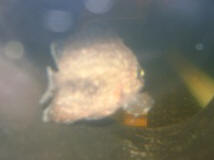
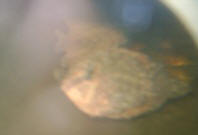
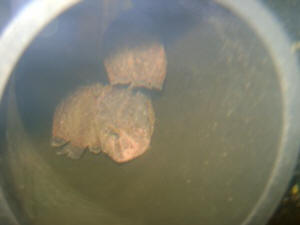
Hi, these are the juvenile Uarus Bob F. wrote back to me about. I
am sending three pictures in hopes that someone can confirm my
diagnosis of Ich.
<Good gosh! It sure looks like a terrible case of
Ich<thyophthiriasis>.>
I moved them into a hospital tank yesterday, bare bottom, temp
85F and continued treatment with Paraguard - Day 8 today
<Again... this treatment is doing no good here. IF it were,
the spots would all be gone by now... The Paraguard
(Glutaraldehyde) is being absorbed...
- keeping my fingers double crossed.
Thanks, Edey
<You need to move these fishes to a treatment tank... NOW!
And/or raise the water temp to the upper 80's F. One last
time, PLEASE read where you were referred to initially.
BobF>
|
   |
Re:
Ich? 4/19/10
I did move them to a treatment tank yesterday. Bare bottom, temp
85F, sponge filter, no organic material at all. Just some PVC
hides.
<Great! I would use another/different "Ich remedy",
and still elevate the temp. a few degrees F. B>
Re: Ich?
Do you recommend salt at this point or not 'strong'
enough?
<I don't suggest salt/s for Ich remedies...>
If so, can sea salt (for salt water aquariums) be used or just
plain aquarium salt?
<... read here:
http://www.wetwebmedia.com/FWSubWebIndex/SaltUseFWArtNeale.htm
and....>
Also, should I change some water to remove today's dosage of
Paraguard?
<... read the label... I would>
Edey
<... Please start searching, reading... and not writing. Your
fish/es will be dead if you delay. B> |
Ick Problem/ Dilemma 12/23/09
I got home from work today to discover one of my platys has Ick.
I'm going to visit my parents for Christmas and I leave tomorrow
afternoon. I don't have another tank to put the platy in. Should I
treat the tank for ich ASAP
and perform a water change right before I leave? (20 hours from now).
My room mate was going to feed the fish while I was gone, but I
don't think he's going to want/ be able to perform a water
change. I will be gone for 10 days.
Thanks again WetWebMedia for the invaluable help.
Andrew
<Just treat using the salt/heat method.
http://www.wetwebmedia.com/FWSubWebIndex/fwich.htm
This will cause no problems for your Platies, and the Ick parasite life
cycle will be broken. If you're keeping Platies on their own or
with other livebearers, then you can raise the specific gravity up to
1.003 (5-6 grammes/litre). Otherwise, aim for about half that dose.
Raise the temperature to 25 degrees C, maybe slightly higher (Platies
as you know should be kept cooler most of the time, 22-24 C being the
ideal, much above that being stressful over the long term). Cheers,
Neale.>
re: Ick Problem/ Dilemma
So performing a 50% water change with a good gravel vacuum before I go,
treat with aquarium salt, and raise the temperature should be
sufficient.
<Yes.>
And hope for the best over the next 10 days?
<Well, they will need some food. Feeding blocks are useless, but a
couple of blanched lettuce leaves and a wedge of courgette should keep
them going, Platies being herbivores. Weight these down with that lead
strip used to
hold aquarium plants in place.>
I have 3 gouramis and a Pleco in the tank, will this change
anything?
<Not really.>
Thanks again,
Andrew
<Cheers, Neale.>
re: Ick Problem/ Dilemma
With a 25 gallon aquarium with fish other than live bearers (gouramis),
am I right in assuming I should add 25-30g of salt?
Thanks again,
Andrew
<In US gallons, you're aiming for 2 to 3 teaspoons of salt per
gallon. One level teaspoon is about 6 grammes, or 0.22 oz. Cheers,
Neale.>
Is Ick Medication Harmful To Aquatic Turtles? /RMF
12/09/09
Hello
<Good morrow Scott>
I have a 75 gallon tank that has an assortment of fish and 3 aquatic
turtles.
<Mmm, in almost all cases it's a poor idea to mix these. Most
turtles are fish eaters (given circumstances) and too "dirty"
to keep in a system and keep clean enough to have fishes do okay as
well>
I recently added some new fish to the tank and a few days later noticed
they had ick. I removed them and put them in another tank to medicate
them.
Only to have more fish in my big tank get ick also so I removed the
turtles ( red eared slider and 2 florida red bellies) and medicated the
whole the whole tank. So my question is is the Ick medication harmful
to the turtles
and after I do a 40 % water change and add the carbon back in will it
be safe to add the turtles back into the tank?
Thanks so much in advance
Scott
<As far as I'm aware, the few active ingredients that make up
freshwater Ich medicines (Malachite Green, Methylene Blue, Salts,
Copper and Silver compounds, Acriflavine...) are not toxic to turtles.
Some may stain their
shells, but should not harm them health-wise. Bob Fenner>
Is Ick Medication Harmful To Aquatic Turtles?
/Neale 12/09/09
Hello
<Hello Scott,>
I have a 75 gallon tank that has an assortment of fish and 3 aquatic
turtles.
<Curious. Usually fish and turtles make poor companions for a
variety of reasons, not least of all the fact turtles produce so much
waste that only a massive filter (and equally massive water changes)
stand any chance of
ensuring good water quality and stable water chemistry. If you're
having problems keeping your fish healthy, do review this
aspect.>
I recently added some new fish to the tank and a few days later noticed
they had ick. I removed them and put them in another tank to medicate
them. Only to have more fish in my big tank get ick also so I removed
the turtles
( red eared slider and 2 florida red bellies) and medicated the whole
the whole tank. So my question is is the Ick medication harmful to the
turtles and after I do a 40 % water change and add the carbon back in
will it be safe to add the turtles back into the tank?
<Potentially, yes, formalin and copper are both toxic to terrapins.
A safer approach would be to use the salt/heat method, which will have
minimal impact on your reptiles. You won't have to move the
terrapins, and there's nothing to remove when you're done
beyond regular water changes.>
Thanks so much in advance
Scott
<Cheers, Neale.>
Re: Is Ick Medication Harmful To Aquatic Turtles?
12/9/09
Hello Again
Thank you very much for your quick response. The only problem with the
two answers I received is that they both say something different.
<Actually, they don't. Re-read mine... "<As far as
I'm aware, the few active ingredients that make up freshwater
Ich medicines..." As far as I know, the amount of free copper in
fish medicines is not therapeutically toxic to Chelonians... Perhaps
Neale knows more/differently here>
One says that the copper in the ick medications is harmful to turtles
and the other response says that it is not. So I am unsure where to go
from here wondering if someone could help me out again thanks so much
in advance
Also if it is of any help the Ick medication we are using is made by
Kordon and is called Rid~Ick+
<The formaldehyde here could indeed be problematical. I would
separate the turtles, actually permanently. BobF>
Scott
Re: Is Ick Medication Harmful To Aquatic Turtles?
12/9/09
Hi Scott, Bob,
<Hello Neale>
I just looked through my handy-dandy list of fish medication
ingredients.
Copper is present in some but not all anti-ick medications, usually as
copper sulphate or copper chloride. Copper is, across the board, toxic
to animals, though as Bob correctly observes, the amount in medications
usually isn't. There are exceptions though, with some fish and most
invertebrates being acutely sensitive to copper. The scientific and
veterinarian literature on reptiles essentially boils down to "we
don't know" with regard to reptiles; there just haven't
been sufficient studies on the toxicity of copper to reptiles to argue
one way or another. Since copper isn't present in many ick
medications, the safest approach is to avoid risking problems by not
using a copper-containing therapy.
<Agreed>
As for formalin (often listed as formaldehyde) this is present in very
many ick medications as well as various "tonic" and
"cure-all" medications too.
Whether or not it is immediately toxic to turtles I don't know, but
it is certainly toxic in the long term, as it is to other life forms
including humans, and is best avoided. Those of us who've worked in
labs for any length of time will be familiar with formalin, and one of
its prime uses is as a preservative, precisely because it kills even
the hardiest bacteria.
It's a known carcinogen. That said, it should be metabolised by
filter bacteria very quickly, likely within a day or two, so simply
removing the turtles while treating the fish should ensure their
safety.
<Also in agreement>
(Bob may be able to confirm either way here, but my understanding is
that copper is different. It can bind reversibly with carbonates and
other minerals in things like limestone. This means that it doesn't
get flushed out in a predictable way, and can leach back into the
system over the long term. So far as I know, activated carbon does not
absorb copper.)
<Most all, once it is precipitated, stays insoluble "under
aquarium conditions">
You may well be safe using standard ick medication alongside turtles,
but I'd adopt a precautionary approach. Since we don't know how
toxic these medications are to reptiles, and brands formulated for fish
aren't tested
for safety with reptiles, there's no reason to assume they'd be
safe. You have to be very careful with how animals react to medications
(or even foods) they aren't meant to be exposed to. The famous
example is how flea powders safe for dogs are used on cats, and the
cats are quickly poisoned by the Permethrin. Since you were keeping
non-standard turtle species, the amount of data in the vet literature
would be even less helpful, so we're operating from a position of
almost total ignorance.
Hence my argument that you should avoid using these medications, and
use salt/heat instead, which would be completely safe. Reptiles tend to
be tolerant of even quite brackish water because their ability to
excrete salt
is quite well developed, even among freshwater species.
Cheers, Neale
<Sound advice. Again, in the long/er term, I would not keep the
fishes and turtles in the same system. BobF>
Ick Guard by Jungle Labs 10/22/09
Hi Crew,
<Hello Lynne,>
Do you know much about an Ick Treatment called Ick Guard by Jungle
Laboratories in Texas. The ingredients on the bottle are sodium
chloride, Victoria green and Acriflavine.
<Sodium chloride is of course just plain table salt. Victoria green
is another name for malachite green. It's an organic dye, and
relatively toxic, so tends to be dangerous around sensitive fish
(Mormyrids, spiny eels, puffers, Knifefish, stingrays, some catfish and
loaches, etc.).
Acriflavine is an antiseptic (as opposed to an antibiotic) and
presumably helps reduce the risk of secondary infections.>
What are these chemicals and are they any good in treating Ick?
<Yes, this medication can be used to treat Ick/Whitespot, assuming
you remove carbon from the filter (since carbon will adsorb organic
chemicals).
But that said, it's a "harsh" medication, and not one
you'd use without thinking about the types of fish in the system.
If in doubt, the old salt/heat method works more safely.>
Lynne
<Cheers, Neale.>
Rid Ich+ Treatment 9/21/09
Gang:
<Just me at this hour in the AM.>
thanks for all the great work! I started treating two sword tails with
Rid Ich + today (got them last week at a decent LFS, but I guess you
can never know. I am using a bare-bottom 20g quarantine tank, 84
degrees water temperature, and am going with the full dose- 10ml/2
teaspoons after a 25% water change. I have one specific question: When
I do my 25% water change tomorrow, do I a) add 2.5 ml (1/2 teaspoon) b)
add 10ml?
<No, don't do a water change. You need to expose the fish to a
continual bath, since you don't know precisely when the cysts will
burst and the free-living stages will emerge. It's ONLY the
free-living stages that salt or Ick medication can kill. Ick medication
typically decays over time, if for no other reason than the biological
filter breaks it up. To compensate for this, the manufacturers will
have scaled the dose to allow for this margin of error, and often you
need to add medication across several days.
So, to keep things simple, do a water change before adding medication
or salt, and then add the medication or salt, and then leave it running
for the full period of time as required. In the case of Ick medication
that's typically a week or so, in the case of salt, usually a
couple of weeks, in either case assuming tropical temperatures.>
Over the last 6 months, I have read just about every ich article/FAQ on
your website, and while it seems that I saw the answer to that question
at some point, I can't seem to find it now. Googling "Rid Ich
dose" etc. did not help.
<Haven't used this particular medication, and where
salt-tolerant fish were concerned, such as livebearers, I'd be
using the heat/salt method instead anyway.>
Apologies for asking a most likely redundant question.
Thanks a lot!
John
<Cheers, Neale.>
qt question 3/5/09 If ich can remain hidden in the
gills, should all fish be treated in a qt tank with copper for ich
regardless of symptoms? <Yes. If one fish has Ick, it's almost
certain all the others do. If we're talking about freshwater fish,
then treat the entire tank; if a marine aquarium, remove all the fish
to the quarantine tank, treat, and leave the reef tank
"fallow" for a few weeks to wipe out any free living
parasites in the water column. See WWM for details on both scenarios.
Cheers, Neale.>
Tetras with Ich 09/17/07 Dear crew, <<Hello,
Evan. Tom with you.>> I have a 10 gallon tank with 4 Glowlight
tetras and 3 neon tetras (I had 5 Neons originally but 2 died soon
after arriving home from the LFS). That raises a question; one of the
dead Neons was completely colorless when I found it. Could the cause of
death been NTD? <<Could be, Evan, but not very likely. Your other
Neon Tetras would have almost certainly contracted NTD by now and I
cant guarantee that the Glowlights wouldnt have been affected, as
well.>> If so: how long before any of my other fish exhibit
symptoms? Its been over 2 weeks and I havent noticed the fish acting
sick. <<Theyd have shown signs by now, Evan.>> Sorry for
the digression, back to my original question. <<No
problem.>> My tank has 0 Ammonia, 0 Nitrites and less than 20 ppm
Nitrates, temp 84F, pH 7.8. <<The pH levels are high for the
Neons in particular, Evan. Not necessarily a problem but might account
for some stress in these fish.>> 10 days ago I noticed the start
of ich on a couple of the Glowlights and I started a treatment of
Aquarium Pharmaceuticals Super Ick Cure (Benzaldehyde Green and
Povidone/Colloid mixture). I have been treating at half dose but
following Doug Thamms recommendations found here:
http://fins.actwin.com/articles/disease/ick2.php. I have the
temperature at 84F and have performed 2 full administrations (5 mL
initial dose followed by 5mL more 48 hours later, followed by WC after
another 48 hours, and repeat) and I am in the middle of the 3rd
administration (10th day). I have done 50% WC in between each. The
treatment appeared to be working as the Glowlights had lost all of
their white spots. <<Glad to hear this. Nice description of your
regimen, by the way.>> Yesterday evening I noticed one of my
Neons with ich spots on its tailfin and body. Is it normal for the ich
to re-emerge during treatment? <<Not necessarily normal but
certainly possible. Difficult to determine the resistance the parasites
may have to the medication particularly at partial dosages.>>
Should I increase the dosage strength to 100% doses? <<I wouldnt
do this unless the problem looks like its getting the better of you and
the fish. As I alluded to earlier, your Neons prefer water thats
soft/acidic. Their preferred pH levels top out at about 7.0 which means
your water is much higher in pH than they really like. This alone can
contribute to diminished resistance to infestations such as Ich. Since
medications also lead to stress, the least effective dosage that you
can treat at will be far better in the long run.>> Should I just
continue my treatment until no spots are left? <<Yes.>>
Should I change medication to something like Quick Cure with Malachite
Green/Formaldehyde? <<Not unless the API medication just doesnt
do the job for you. The Malachite Green is highly effective but isnt
without problems of its own. Highly toxic and has been described as a
potential carcinogen. Not a treatment protocol to take lightly.>>
Besides the ich, the fish seem healthy, they are active and eat well.
<<Very good signs, Evan.>> Thank you for your help. -Evan
<<Happy to be of assistance to you. Good luck to you.
Tom>>
Salt&heat or Meds for Ich? 03/10/08 Hi,
thanks in advance for all your help. I discovered just a few ich spots
on my platies, and the different kinds of treatments I read about sound
intimidating. I have aquarium salt on hand that I use regularly since
they are livebearers, but I hesitate to put my fish through the high
temperatures and lower oxygen. What would you suggest as safest for
platies? Salt&heat, or do I make a run to the pet store tomorrow?
If salt&heat, what's the recommended course of action (how
much, how long, and what temperature)? Thanks so much. You people are
awesome. ~Jen P.S. Specs of the tank, in case it helps: 20 gal
freshwater Species tank of 3 varieties of platies: total of 10 fish
between 1 and 2 inches each Regular dosage of 1 Tbsp aquarium salt per
5 gallons during water changes <Jen, to be honest I'd just use a
standard copper-based Ick medication. Platies are sufficiently hardy
that copper intolerance isn't really an issue. That said, you can
raise the salinity to SG 1.003 (6 g/l), perhaps even SG 1.005 (9 g/l)
with care, and the Platies should be fine and even without additional
heat the Ick will die off quite quickly. Raise the salinity across a
few days, leave it there for a couple of weeks, then bring it down
again. Cheers, Neale.>
|
Question re: FW Ich and
salt 6/9/06 Hi Robert, I've been reading the
Ich FAQs and articles on Wet Web Media and various other forums,
and the recommendations are so varied out there about the usage
of salt that I'm wondering if you can advise me about a
particular question. Here's the situation: Ich
just showed up on one fish of a newly cycled 37 gallon tank
(currently containing 4 swordtails and numerous plants). <Many
plants are salt-intolerant... adding salt may stop or forestall
cycling...> After much debate, I decided to go
with meds and added the recommended dose of Jungle Ich
Clear. The fish did not react well to this at all,
<Not surprising...> and within 3 hours were not swimming
and were gasping for air in the corner of the tank. (I
have an AquaClear 70, so more than adequate
filtration/circulation for this size tank.) <Maybe... you may
have killed off, or metabolically stopped necessary cycling
microbes> I decided to bail on the meds and did a 50% water
change, and added the charcoal back in my filter to get rid of
the rest. This worked and by morning they were
swimming all over and looked happy again. So now
I'm trying the salt/heat method, which should be successful
since this species is pretty tolerant of
both. I've gradually increased the temp up to
85/86 (sort of right on the mark between the two), and have
gradually added Jungle aquarium salt to the point where it is at
1 Tbsp/5 gallons - fish seem vigorous, even the one with spots
which have largely dropped off at this point. This is where my
main question comes in - what is the amount of salt that truly
should be added and maintained to destroy the
parasite? <Not always efficacious...> The
advice I've seen out there ranges from 2 Tbsp/gallon (which
seems awfully high) to 1 Tbsp/5 gallons which is where I am now.
<Somewhere twixt these values, depending on livestock
mostly> There are also a lot of arguments that measuring salt
in Tablespoons is useless b/c the amount being added depends on
the grain size of the salt (mine is about as fine as Kosher salt)
and the only good way to measure it is with a
hydrometer. However, hydrometer readings are affected
by heat, so that needs to be calibrated, and even the recommended
hydrometer readings seem to be pretty varied. I did
buy a cheap one that starts at 0.000 and goes up in increments of
0.002, but that's probably not sensitive enough. <You are
correct> So what is your take on
this? Can you set the record straight? <Can... but
is not a simple formulation. All waters have some
"salt" (ionic combinations of metals and non-metals)
present... and adding more can be tricky... And it's not
obviously as simple as "salt", as there are a few
"types" available... the best, some sort/mix of
"sea salt" (i.e. not sodium chloride alone)... And
there is a huge differential in tolerance/range to salt content
and its rate of addition, reduction... some animals can put up
with quick, large changes, others not...> I know salt levels
can only be as high as your species of fish can tolerate, but
there also must be a minimum level that will be effective against
Ich. <Yes... and if put in slowly, this protozoan can/will
adapt...> Also, if I can sneak in one more - as I said, my
fish seem to be thriving at 85/86 degrees. Should I go
for 87 or even 88 for some extra insurance if they take it just
fine? <I would, yes> One article I found (on The Skeptical
Aquarist) mentioned that some heat-resistant strains of Ich have
been detected out of Florida that can survive at
90. Having a biology background it seems logical that
if you only raise the heat to 85, and any of the organisms
survive that, they can reproduce into a strain that is more heat
tolerant, so the higher you can go the better. This is the same
reason I don't want to mess with half-doses of meds. <You
are wise here> Half doses may kill many of the parasites, but
if any survive the lower dose they could reproduce and develop
into a resistant strain - the same reason you should never take
less dosage of an antibiotic or for a shorter time than a doctor
prescribes - it could lead to nastier bugs. Sorry for the long
post, but I'd love to get some clarity on this. Regards,
Jason Arlington, VA <Now... finally my pitch/resolution here.
I would treat this situation with a Malachite Green solution IF
you can monitor its effect, and maintain the high/er temperature.
Please read here: http://www.wetwebmedia.com/FWSubWebIndex/fwich.htm
and the linked files above. Bob
Fenner>
Re:
ich: salt and heat question 6/22/06 Thanks Robert
- appreciate it. Below is the message I sent you a
couple of weeks ago. Also, as an update to what I
wrote earlier - after 2 weeks, so far so good - all 4 fish seem
to be prospering under current conditions (temp = 85/86 and salt
= 1 tbsp/5 gal), and no physical signs of
ich. (I've also learned my lesson and set up a
quarantine tank.) ORIGINAL MESSAGE: Hi Robert, I've been
reading the Ich FAQs and articles on Wet Web Media and various
other forums, and the recommendations are so varied out there
about the usage of salt that I'm wondering if you can advise
me about a particular question. Here's the
situation: Ich just showed up on one fish of a newly cycled 37
gallon tank (currently containing 4 swordtails and numerous
plants). After much debate, I decided to go with meds
and added the recommended dose of Jungle Ich
Clear. The fish did not react well to this at all, and
within 3 hours were not swimming and were gasping for air in the
corner of the tank that has very little "current".
<Yikes... this medicine is broadly label able as a
"proteinaceous precipitant"... in effect it poisons the
fishes to produce more body mucus... which can/does interfere
with respiration...> (I have an AquaClear 70, so more than
adequate filtration/circulation for this size tank.) I decided to
bail on the meds and did a 50% water change, and added the
charcoal back in my filter to get rid of the rest.
<You are/were wise here> This worked and by morning they
were swimming all over and looked happy again. So now
I'm trying the salt/heat method, which should be successful
since this species is pretty tolerant of
both. I've gradually increased the temp to 85/86
(sort of right on the mark between the two), and have gradually
added Jungle aquarium salt to the point where it is at 1 Tbsp/5
gallons; I plan to keep this up for 21 days, which I understand
should mathematically eliminate the chance of the parasite
surviving given its lifecycle (if the conditions I've set are
right). <Sounds good> This is where my main question comes
in - what is the amount of salt that truly should be added and
maintained to raise osmotic pressure high enough to destroy the
parasite? <Mmm...> The advice I've seen out there
ranges from 2 Tbsp/gallon (which seems awfully high) to 1 Tbsp/5
gallons which is where I am now. There are also a lot
of arguments that measuring salt in Tablespoons is useless b/c
the effect on "salinity" depends on the grain size and
type of salt (mine is about as fine as Kosher salt) <A good
choice, though "marine aquarium synthetic salt/s" are
better> and the only good way to measure it is with a
hydrometer. However, hydrometer readings are affected
by heat, so that needs to be calibrated, and even the recommended
hydrometer readings seem to be pretty varied. I did
buy a cheap one that starts at 0.000 and goes up in increments of
0.002, but that's probably not sensitive
enough. So what is your take on this? Can
you set the record straight? I know salt levels can
only be as high as your species of fish can tolerate, but there
also must be a minimum level that has to be reached to be
effective against Ich. <... a real answer would require some
discussion re what salts are (combinations of metals and
non-metals) and the fact that there is/are some salts in all
source waters... and that sometimes the mixing/blending, addition
of some salt/s can be toxic... The lower limit you're using
should be fine for most all aquarium plants, and is fine for
Xiphophorus exposure> Also, if I can sneak in one more - my
fish seem to be thriving at 85/86 degrees. Should I go
for 87 or even 88 for some extra insurance if they take it just
fine? <You could... but margins of safety grow small with
increased temperature... less dissolved oxygen, higher metabolic
rate...> One article I found (on The Skeptical
Aquarist) mentioned that some heat-resistant strains of Ich have
been discovered out of Florida that can survive at 90.
<Yes> Having a biology background it seems
logical that if you only raise the heat to 85, and any of the
organisms survive that, they could possibly reproduce into a
strain that is more heat tolerant so the higher you can go the
better. <One way of stating...> This is the same reason I
don't want to mess with half-doses of meds. Half
doses may kill many of the parasites, but if any survive the
lower dose they could reproduce and develop into a resistant
strain - the same reason you should never take less dosage of an
antibiotic or for a shorter time than a doctor prescribes - it
could lead to nastier bugs. <A mis-statement/understanding...
These resistances are not developed so much as organisms with
"what it takes" are selected, persevere...> Sorry
for the long post, but I'd love to get some clarity on this.
Regards, Jason Arlington, VA <Bob Fenner, San Diego,
CA>
|
Troubles with
Ich 7/7/06 Hi, Larry
here. My son started a FW 20g planted tank with
Cardinals, Blue Rams, Thread fins and a Clown and Kuhli
loach. Unfortunately the clown loach had ich. < Common
problem with this fish.> We treated with Maracide which is basically
Malachite green as directed on the bottle and the ich disappeared for a
few days only to come back. So we retreated 2 more times and
the ich has returned. We raised the temp to 82F and switched
to Quick cure which is M. Green and formalin and have had no luck in
effecting a cure. The tank uses a Fluorite
gravel. Do you think the Fluorite is absorbing the
malachite? < No but any organics would absorb this medication.>
<<Could easily be. RMF>> The water does not stay blue green
very long. Our plants by the way have done very well through
all this. We have now moved all the fish to a 29g QT tank that I
normally use for my Marine fish. We are now treating with
Cupramine copper. Now how long do we have to leave the 20g
fallow before we can put our fish back into the tank? < At 82 F the
ich parasites need a host. They will die in 7 days without a host
fish.> I was also thinking about treating the 20g tank with Epsom
salts as I have read in WWM FAQ's that this can be effective,
what's your opinion on this? < Salt increases the slime coat on
the fish and make it more difficult for the parasite to get established
on the fish. You don't want to add too much because this will also
increase the slime coat over the gills and prevent the fish from
breathing properly.> We also have an African frog and some Japonica
shrimp which have survived the Malachite and formalin much to my
surprise. It is my understanding that they do not act as
hosts or reservoirs for ich. Will they be ok if we treat the
tank with Epsom salts and what dose do I use? < I think your problem
is that you don't let the medication stay in the water long enough.
If I had ich in my tank I would do the following. Raise the temp to 82
F. This makes it more difficult for the parasite to survive because at
higher temps, water has less holding capacity for oxygen. Secondly I
would do a 50% water change. This automatically removes 50% of the free
swimming parasites. Third I would clean the filter and remove any
carbon. Fourth I would vacuum the gravel to remove any organics and
make any medication more effective. Then I would treat with Rid-Ich by
Kordon. It is a combination of malachite green and formalin. Follow the
directions on the package. I would add a teaspoon of rock salt per 5
gallons of aquarium water. The ich should be gone for good in a week.
Now to prevent any further outbreaks I would get a quarantine tank. No
fish goes into the main tank without a minimum two week quarantine
period. Much easier and cheaper to medicate in the QT tank.-Chuck>
What a frustrating mess, I have a 120g FOWLR marine tank
that I tore down because of battling ich for over a year thanks to a
blue tang that I FW dipped and QT for 2 weeks. Thanks for
the advice and all the wealth of knowledge that the WWM crew supply.
Larry, basking in the sun in Minnesota! <<... need to remove the
shrimp, frog... and I'd raise the temp. to the mid to upper
80's F. RMF>>
Salt Treatment For Ich - 10/22/2006 Hi there. I have a few
questions regarding the use of aquarium salt as treatment for Ich. My
first question involves my husbands Goldfish tank. My husband has a 10
gallon tank containing 3 Fancy Tail Goldfish, 2 Royal Plecos, 1 Rubber
Pleco and a yellow Apple Snail. I know the tank is overstocked, the 10
gallon was meant as only temporary quarters. The PH is 7.0, Ammonia is
0, Nitrite is 0 and Nitrate is 20. Temperature is maintained at 76F. A
much larger tank is on its way. My husband just purchased the 2 Royal
Plecos approx. two days ago. Both appeared fine when he got them and he
did not quarantine. I just did a 25% water change on the tank and
happened to notice that both Royal Plecos are now lightly dusted with
white spots. Dreaded Ich! None of the other fish are showing signs at
present so I'm more than fairly certain that the Royals were
already infected when they were introduced to the tank. I have
successfully treated Ich, using a salt/heat combo, in two of my tanks
(Severum/Channel Cat tank and a Livebearer tank) in the past and would
like to use salt as my medication of choice. Can the Goldfish, Plecos
and Snail all handle the level of salt and heat needed for treatment? I
use normal Aquarium Salt. 2 Tablespoons per 5 gallons, raise the
temperature to 80F and allow to remain for 10 days. Would this be okay
for my husbands tank? I'm most worried about the safety with the
snail. Would it be best to move him/her to a covered container (my
quarantine tank is occupied so I can't place it there), like an old
butter dish with holes poked in the lid, while the salt/heat treatment
is happening in the main tank? <IMO salt is the way to go. But the
snail gets thirty days in QT without fish, or salt. He can not be
infected but he can carry it in and on his shell. A month without a
fish host will starve out the parasite.> My second question involves
my Angelfish community tank. I have a False Julii Leopard Cory Cat, 3
Peppered Cory Cats, 2 Panda Cory Cats and approx. 20 pea to nickel
sized Angelfish in this tank. PH is 7.0, Ammonia is 0, Nitrite is 0 and
Nitrate is 25. Temperature is 78F. Yesterday, one of my husband's
Goldfish uprooted a plastic plant in their tank so I removed it and
placed it into my Angelfish tank. The plant was still wet when I placed
it into the Angel tank. I'm afraid that I may have infected my tank
via the plant. Is this possible? Nobody in the Angel tank has been
acting ill. No flashing or other signs of Ich. Would I be wise to go
ahead and use salt/heat in this tank as well? I have several rare
varieties of Angels in this tank and don't wish to lose any.
I've heard that Corys and Angels don't tolerate salt well but
others have said they do fine. Which is true? Would my 2 Tablespoons
per 5 gallon be safe and tolerable for both species? Is there a lower
concentration I could use that would be just as effective against Ich?
Should I wait and see if anyone develops Ich before adding salt to this
tank or do you feel I'd do well to head it off before it hits by
treating as I would if they were actively showing signs of infection?
Thanks for your prompt help. Heather <You are correct to be worried.
I would salt the tank now. I salted my Corys while they were in QT
without a problem. But this does go against "common
knowledge". Something I seem to do a lot. If they seem stressed do
a small, salt free, water change to lower the concentration. Another
method would be to use heat alone. But you would need to get the temp
up to about 90 and add extra airstones. Don>
On the battle field with ICK! Dear WWM crew, I
know you get a lot of questions about ick, <Too many! I do wish
folks would utilize caution, good selection (yes, including dealers!),
quarantine all incoming livestock... OK, off my soapbox>
so here is another one. I have a 33g FW aquarium the
inhabitants are 5 guppies, 5 scissortail Rasboras, 4 platies and 3
swordtails. This morning I noticed that on of the swordtails had small
white dots on her. Then looking closer I saw that almost all of my
other fish have then too. I have had a few encounters with ick in my
other tanks but this 33g is my biggest and I'm just not certain on
what to do. The medications that I have are: Pimafix, Fungus
Eliminator, Ick Guard, Maracyn, and Maracyn-Two. I would like to know
if any of these would work or if you have any suggestions on other
things. Please Help Me. I won't add any medication until I hear
from you. Thank you very much: Wendy Laresser <Only the Ick Guard is
of use here... do read: http://www.wetwebmedia.com/FWSubWebIndex/fwich.htm
and the Related FAQs (linked, in blue, at top) and elevate your
temperature... Bob Fenner>
Persistent ich problem, not mixing medications
Hello Robert, <Jamie> Sorry to bother with this most surely worn
question, but my aquarium has an infestation that seems resistant to
treatment (I know how it got there, and it won't happen again).
<These can be... trying> Based on all that I have
read re: ich, this should have cleared, as there has been treatment in
the water for a minimum of two lifecycles. Current water
conditions: 82F; pH 7.0, NH3 0.0; NO2 0.0; NO3 10-15
ppm. Fish: 3 Head and Taillight Tetras, 3 Lemon Tetras; 5
Neon Tetras; 5 Zebra Danios; 3 Peppered Corys and 1 Spotted
Cory. Aquarium is artificially planted 45 gal. w/Penguin
300gph filter. On 1-27 I noticed one spot on a Neon. I
immediately replaced the filter cartridges with new with carbon removed
and added QuickCure - 35 drops. Repeating this daily, on 1-31 I added 4
tbs. salt @ 1 tbs. per 10 gallons (I've read that Cory's
don't like it but thought some would help). <Yes>
On 2-2 I increased temp. to 82F and added 50 drops of
Aquarisol @ 12 drops per 10 gal. <Mmm, you switched from a formalin
to a copper-based remedy... for?> Through all this seeming
over-treatment, the spots continued to show in an obvious but not
rampant manner. On 2-8, one of my Peppered Corys was
obviously becoming washed out in color (I assume due to salt and
probably toxicity of the QuickCure). <Likely> I also
noticed that one of the Lemon Tetras had inflamed gills and was
experiencing difficulty w/respiration. I did a 50% water
change and vacuumed the gravel. <... did you check for integrity of
your biological filter? You're treating your fish in their main
tank... not a separate system?> Treatment with QuickCure
resumed. On 2-10 I noticed some tail rot on a Head and
Taillight Tetra and performed another 50% water change. I
also discontinued use of the QuickCure and began treatment with
Coppersafe to a tested 1.5-2.0 ppm copper concentration per
instructions and also began daily treatment with TriSulfa - 4 tabs. @
1/10 gal. for the secondary bacterial infection. <...? Not
warranted> As of tonight, my fish are still glancing and flashing
and there are still visible spots. Have I not given all this
time to work, or have I encountered a resistant strain of ich?
<You've induced some problems here with the mixing of two quite
toxic medicines... likely killed off your nitrogenous microbes...> I
would like to raise the temp to 86F as well, but in my research the
temp. range of my fish is well below that. Any help you
could offer would be greatly appreciated. Thanks, Jamie <I WOULD
check for ammonia, nitrite... AND settle on just ONE of the medications
(likely the CopperSafe), AND elevate temperature to the mid-80's F.
Bob Fenner>
Paragon vs. Quick Cure Hi, folks! <Ted>
I've a 60 gallon with 4 3 inch fancy goldfish and 3 weather
loaches. Recently, the goldfish developed a VERY nasty case of
Ick overnight. The loaches scratch, but I don't see any spots on
them. <Can/could still be there... the spots are actually a
reaction, not the ich itself... like slimy bumps from irritation> I
had used Paragon on just the goldfish before for fish lice and it was a
smashing success. However, I was told not to use Paragon this time for
Ick because of the loaches. Even at half strength, it would harm the
loaches. <Yes> Quick Cure appeared to be the most popular
alternative. I've read the instructions and it is one drop per
gallon. No problem. It will discolour the water, but colour will
disappear in a few days. No problem. However, when I tried the Quick
Cure, the water is tinted blue only for about an hour or two before the
water is clear again....not a few days. What gives? <Ah, good
observations... the compound that yields the color is
"disappearing" (complexing with other material in the
system)... and likely the more "active ingredient"
(formalin)> I've taken out all carbon. Only filter left is an
reverse-flow undergravel filter and a spray bar jetting out water
through floss media and Biomax-type rings. There should be nothing that
takes up the colour of the Quick Cure. <Mmm, mulm, gravel,
other "stuff" that makes up your water... even the livestock
themselves will absorb...> Am I missing something here? Am I losing
the Quick Cure before it can even do its job? <Bingo> There is
absolutely no carbon. Just floss filter, Biomax-type rings and massive
aeration. <Ahh, the biota on the rings also is absorbing...> I
intend on following the instructions with a one drop per gallon DAILY
regiment for a few days, but don't want to lose the medication
before it actually does its job! As usual, thank you so much for your
help! Ted <Ted, rather than going on with the present circumstances,
please read here: http://www.wetwebmedia.com/FWSubWebIndex/fwich.htm
and the related file links above.... And switch treatments... elevate
temperature, use a malachite based med... half strength... and test for
ammonia... as your nitrifiers have and will take a beating... Bob
Fenner...>
Re: Paragon vs. Quick
Cure Thank you so much. I did learn a few things.
<Good> One issue I have noticed is that while it is widely
recommended to do many water changes during treatment (I intend on
keeping up with the Quick Cure, minus the Biomax ring that remains
oddly white), there is no mention of whether the fresh water should be
treated with the medication before adding to the tank to keep up the
concentration. <Good point... all treatments (I DO wish there were
ready assays for active ingredients to all) should be re-added per
changes, time frames> The way I see it, if I do a 25%
water change every day or two, I'm diluting the
medication. Does this make sense? Thanks! Ted
<Does indeed... and at least a quarter re-application is therefore
called for. Bob Fenner>
| Ich... goldfish... blitzkrieg med.s... not
studying... Ive scrolled through lots of your comments on
questions. You seem to be more knowledgeable than anyone
at the fish store here in NYC. <Heeee!> I bought a new 48
gallon tank for two goldfish (one comet, one is a generic I dont
know what it is called) w/an Eheim canister filter. The store
installed it when I was out of town big help. The less
strong one (comet) developed ich, the other one has more or less
fought it off. They first recommended Coppersafe.
<Mmm, better to use Malachite Green, rather than copper-based
med.s on goldfish> I followed the directions. They
continued to have the spots, but were as active as
always. We left for eleven days and came back to one
dying fish and the other lethargic. A person from the store came
and serviced the tank and added Coppersafe. The weaker
fish just sprawled out. I didnt think it would survive
the night, but it did. The store then recommended Rid
Ick. <Is copper and Malachite...> I dont like using
carcinogenic stuff, but . I followed their instructions,
which were to re-dose every two days (not enough according to the
manufacturer). <... should be done daily> After
the first two doses, I stepped this up to every 36 hours, thinking
they were too weak to take more. Somehow or other, these
fish are still alive. Actually, it seems that the
medication is the only thing keeping the stronger one
down. The weaker one hasnt eaten in at least a
week, probably two, and mostly sits at the bottom
listlessly. The other one occasionally swims around and
ate today. I do not want to use any more Rid
Ick. The store recommended Aquarisol, which I bought.
<Another copper salt solution...> I have set up a
QT (old two-gal tank, cant leave these 1 ½ yr olds there long)
so that I can remove them and let the tomites in the display tank
die. I havent yet moved the fish. Frankly, I have no
idea what to do, but this is taking a HUGE amount of time. Any
thoughts??? <Yes... please read here: http://www.wetwebmedia.com/FWSubWebIndex/fwich.htm
and the (many) linked FAQs, starting with the ones above... and
Goldfish Disease... set upon one plan and adhere to it... I would
add salt, one of these ich medications (if it were me/mine I would
use just "Nox-Ich" or another just Malachite Green
solution (like Kordon's)... monitor water quality... and the
ich should be gone in a week. Bob Fenner> Thanks. Re:
Ich 9/16/05 Thanks for the comments and for the direction
to your ich treatment comments. <Welcome> Sorry to ask for
more comment, but I have been getting so much conflicting advice
including, just yesterday from the fish store, to slowly cool down
the tank. <... no...> According to your info.,
that wasn't such a great idea. My problems with the
Rid-Ich+ (or Nox Ich) is that the active ingredients are
carcinogenic for me! <Much less so than putting gasoline in a
car...> After a week of sticking my hand/arm in the water during
water changes, etc., it occurs to me that I am not wild about doing
that. Also, I am not seeing any encouraging response at
all from the weaker fish; it remains listless and rocks
side-to-side a bit. And just for good measure, I put in
Aquarisol this morning for any lurking tomites. Clearly,
I've been all over the lot. <Yes... randomly, surprised you
haven't hit a proverbial light post> My instinct is to try
to get the weaker fish moving and eating again, then bomb the
ich. It may be too late, though. What would
you do at this point? <Read> One other
question. How do you know when they are
"cured" (presumably returning to normal swimming around)
and how quickly should all of the spots be gone? Thanks again.
<Please don't write... read where you've been sent, the
linked files beyond. Bob Fenner> |
Ich and Popeye-Together Again 9/26/05 Hi~ I have a 12
gallon tank and I just recently noticed that most of my fish have
little white spots on them and then one of my kissing fish has Pop Eye
in both eyes. For the Ick I bought a bottle of Cure-Ick and for the Pop
Eye I bought Maracyn-Two. My question is can I use both of these
treatments at the same time or do I need to wait?? Thank you!
<Usually not a good idea to mix meds unless they are from the same
manufacturer and they clearly state they are safe together. Not sure
about this combo, so lets err on the safe side. First thing to do is a
large, 50%, water change. Siphon from the bottom using a gravel vac.
Ich reproduces at the bottom of your tank. Popeye almost always starts
with poor water quality. Especially a lot of organic matter. The water
change will help both. I use salt for Ich. Not as harsh on the fish.
But after the med of your choice is in place, raise the temperature to
82 to 84 degrees. Continue any treatment for at least three weeks after
the last spot drops. Test the water and do water changes if you see any
ammonia or nitrite. Add three level tablespoons (1 per 4 to 5 gallons)
of Epsom salt if the Popeye is not helped by the water changes.
Don>
Medication For Ich. 10/5/05 The pet shops here
don't have that medicine (Rid-Ich). They suggested to buy
tetracycline. What proportion will I use? < Tetracycline will not
work on ich. Save your money and increase the water temp to 84 F and
increase the aeration.> Is it ok if there will be other fishes in
they same aquarium but it has a divider in between. Once again thanks
< Dividers will not stop any medication if there is any water flow
around it.-Chuck>
Loaches, Ich, Salt, and Copper - 11/08/2005 Hi Crew, <Hi
Brian; Sabrina with you, today.> First let me give my thanks, Bob
Fenner replied back in late June concerning our highly alkaline well
and the use of SeaChem's "Acid Buffer" on incoming water
to bring our FW tanks down from a pH around 8.2-8.4 to a much more
reasonable 7.0-7.2. After a lot of experimentation, it seems about 1/4
tsp Acid Buffer added to water mixed at 2:1 - 3:1, RO/DI: well does the
trick, when combined with occasional small water changes at 6:1 RO/DI:
well with no Acid Buffer to give back some alkalinity and thin out the
GH. <Great.> Now on to my questions. I've got a 29
gallon tank setup with 7 red swordtails, 2 honey Gourami, and 8
checkerboard barbs. Water parameters consistently check fine - no
ammonia, no nitrite, ~15mg/L nitrate. Two medium sized Amazon Sword
plants, one medium tiger lotus grown from a bulb, and a small chunk of
Java Fern reproduced from another tank. Water temperature is at 77 deg
F, pH = 7.0. One of the swordtails, male, has been steadily
looking worse and worse over the last month and a half or so, with no
other symptoms apparent on any of the other fish. Best description I
can give of the swordtail is that he's lost a lot of his color on
the bottom half of his body. His lateral line is very evident as a
greenish line down the length of his body, and most of the damage seems
to be at or below his lateral line. The lower area near his tail has
also really washed out. With the lights out, the bottom half of the
fish looks almost grey, with lights on it is more a faded red with some
silverish looking parts. I'm fairly certain it is not ick or any
other transmissible disease as none of the other fish look at all
affected. <Is possibly nerve damage.... from an injury, or
developmental/genetic disease....> My only theory is that he has
been spending way too much time hanging out by the tank's heater,
which is placed horizontally instead of vertically to try to provide
more efficient heat dispersion. I've added an airstone near the
heater to try to discourage him from resting from near/on the
heater. <Even better, get a plastic guard to go around the
heater, or wrap the heater in airline tubing with "gaps"
between the coils of tubing if you are unable to find a guard for it -
and couple this with the airstone.> For about 2 days in a row, about
a week ago, he was doing a little flashing on the Amazon Sword leaves
and the bottom, but that seems to have subsided. I have not added any
treatments to the tank, other than my usual water change schedule which
includes a trace (less than 1/2tsp for 3 gal) of salt, along with
0.1mL/gal of SeaChem's "Prime", and Acid Buffer for pH.
New water is aerated and temperature matched for about four hours
pre-each water change, haven't set up a system for longer term
aging of water yet but can certainly do so. <Your current
maintenance sounds plenty adequate.> He still eats readily (flake
food and dried Tubifex worms, which he devours), does not appear to be
struggling for air or otherwise moving erratically. Even before he
showed any of these symptoms, back when he was much smaller and being
reared only with the three other fry from his batch, he looked a little
different -- he has always had a tinge of green and a much more readily
visible lateral line compared to the other swordtails from the batch.
All the other swordtails that made it beyond fry stage have survived,
with the exception of one female that died a few weeks ago, pregnant,
that we deemed to be physically incapable of giving birth. Back when he
was a small small fry (looking back over my notes) there was one point
where I was afraid he was going to die, acting very lethargic and darty
and not swimming straight at all. I added a large amount of
"LiquiFry" food and after eating that he seemed to perk back
up and seemed okay for several months. <Quite possibly this is
just genetic/developmental, then.> His feces I must admit have
appeared nothing but white and stringy for the past month or so,
haven't seen anything that looks comparable to that of the other
fish in the tank receiving the same food. <This is
disconcerting.... I have to ask, are these Tubifex live? Please do be
aware that live Tubifex (and even freeze-dried) can transfer parasites
to your fish. If you must use live worms, please instead use
Blackworms, which are much less hazardous (though there is still some
degree of risk involved with them). Better still are bloodworms or
other insect larvae.> This fish (along with the other swordtails in
the tank) is the offspring of a pair of swordtails we had months ago --
the father was a fish I was always worried about once we bought him, as
he had a very obvious green coloration to him (along with the very
visible lateral line) that I at first attributed to illness, then to
just genetic makeup giving more of a wild type coloration. <The
green could indeed be just coloration - there are plenty of swordtails
with prominent lateral striping and green coloration.> Is this a
nutritional deficiency? Genetic problem? Velvet? <I highly
doubt velvet.> Is he just sleeping on the heater and baking the
color out of him? Any thoughts would be appreciated. We've already
mourned his loss a week or two ago when he just looked a little worse
than before (that's when I started feeding the Tubifex worms
again), but he keeps fighting back and does not look ready to give up
the ghost just yet. My apologies for the length of the question,
I've just been battering around so many different possible theories
for so long and don't want to just leave the guy to waste away.
I'm going to try to get some pictures of him, but it's tough to
get one where the degradation is clearly visible. It may be what I need
to do is add more hiding places (tank has only plants and a large
rock), in case the fish are just feeling that the heater is a safe,
hidden spot, and burning themselves thusly. Our blood parrot cichlid
(in yet another tank) managed to burn herself pretty well a couple
years by leaning on the heater, ended up covered in black spots before
the problem was fixed with a higher tank temp. <Please, please
consider using guards or wrapping those heaters! They do present a
danger to your fish.> Second question, hopefully easier. We bought
two clown loaches (2") at the LFS on 5 Nov. After getting them
home and placing in the 10g QT tank, it was fairly obvious that one of
them had ich. After a lot of reading I decided the thing to do was to
get the temperature up (was at 77 deg F, now at 82 deg F, aiming for 85
deg F) and start adding salt to the tank. The QT tank is planted (good
sized Java Fern, Amazon Sword almost too big for the tank, plus some
floating Wisteria), so I know the salt may not be good for the plants
but I can handle plants dying much better than fish doing so. The next
day (6 Nov), figuring that the QT tank was already exposed to ich and
that the clowns would be happier with more than just two around, we
went ahead and got three more that the LFS had from the same tank, also
obviously exposed to ich. Maybe that was a stupid move, bringing more
ich to the QT tank, but I wanted to try to reduce stress on the clowns
by increasing their numbers. <I must point out that it is
almost invariably a bad idea to purchase fish with obvious symptoms of
disease....> Also bought some Aquari-Sol (copper sulfate salts) at
the same time, but have not dosed any into the tank yet. <I
wouldn't.> By this point, I figure I have added a little over 2
tbsp of salt to a tank with estimated 9 gallons of water, over a couple
days. <You'll need a LOT more than that. Please read this
article: http://69.44.152.177/showquestion.php?faq=2&fldAuto=32
.> The loaches are eating well, they've nearly de-snailed the
entire tank already. I know I need to find some longer term foods for
them, and that they sure won't be living in the 10g any longer than
they have to beat the ich. So, my treatment plan is this: Increase tank
temperature to 85 deg F and keep it there. Increase salt levels in the
tank to some number of teaspoons per gallon (wish I had a way to
measure salinity down in the 1.00X ranges). <A refractometer
is really your best bet, here, followed by a hydrometer that measures
low levels.... there are at least two brands readily available, of box-
swing-arm type hydrometers that do read quite low levels. Just be aware
that there is some significant degree of inaccuracy.> Removed carbon
from the filter (Whisper 10), added an airstone on a pump for more
oxygenation of the warmer water. Replaced the Purigen in the filter
with fresh Purigen (~15mL), in hopes that the synthetic beads may be
capable of removing some of the encysted or free swimming ich, <Mm,
I wouldn't hold my breath on that.> I'm prepared to replace
the Purigen every 48hrs or so if that's a valid theory, or just
leave as is if not. If there is no obvious improvement in about three
days from now, my plan would be to begin dosing the Aquari-Sol at about
50% of the label directions (12 drops per 10 gallons per label, I would
add about 5 drops to the tank) and test copper levels frequently,
combined with daily water changes to combat ammonia/nitrite buildup
from loss of nitrifying bacteria. <Try to avoid the copper if
at all possible.... Salt and heat alone should affect a cure.> My
hope is the plants may help with some of the excreted ammonia if the
salt/copper/heat do not completely hose their metabolism. I've used
SeaChem's "Flourish Excel" in the past in the tank to
provide more available carbon to the plants, have stopped for now to
deal with ich but can continue if increased plant respiration would be
indicated. I'm even considering eyedroppering in a little bit of
22ppm colloidal silver. <I wouldn't.> Is this a
reasonable treatment plan? I've seen people say copper salts work
great with loaches at low doses for ich, but I've seen just as many
say not to ever use copper with loaches. <I am more of the
latter batch of folks - though have used copper in the past with
success. I am much more a proponent of salt in this case.... Less
harmful to the animals.> Are my salt levels within an order of
magnitude of what could be expected to help? <Not yet.> Is
it pointless to try to treat with simply heat + salt, and instead I
should be getting the minimal dose Aquari-Sol in there ASAP?
<Mm, as above, heat and salt WILL work, at the proper levels....
you'll get there, no worries!> I've purchased a copper test
kit and verified no free copper in the tank at this time, so I should
be capable of maintaining an appropriate level of copper if it comes to
that. I really appreciate the time taken to read and consider these
issues. -Brian Pardy <And thank you for your kind words. Wishing you
well, -Sabrina>
Rid-Ich Affecting Catfish 11/7/05 The guy at the pet
store told me it was ok to put Rid-Ich in the tank with my Raphael
catfish. He started staying up at the top of the tank gasping for air.
I took him out and put him in another tank. He is on the bottom
breathing very hard. Looking swollen. I checked the water and others.
Ok. I have a horrible feeling my baby is going to die before you get
this. I wanted to know if it was to late for him or is there something
I can buy to make him better. Peetsi <Rid-Ich is a very good
medication. Rid-Ich is an older form of a malachite green and formalin
combination that was found to be very toxic to scaleless fish such as
catfish and loaches. It is to be used at half the recommended dosage
and says so on the bottle. A new formulation came out a couple of years
ago called Rid-Ich+. This is suppose to be a safer medication
than its earlier formula. The clerk may have confused between the two
different bottles, especially if both were on the shelf. They still
look almost identical. You did the right thing by removing him from the
tank. Place him in a net in a quiet corner of the tank with plenty of
aeration and hope for the best. There is no antidote for you fish and
it will try and purge the copper from its system over
time.-Chuck>
Ich troubles, and a lack of detail 11/20/05 A week ago
I noticed our Oscars and tinfoil barbs were itching on rocks and had
white spots on them. <Yikes> We started treating them with Rid
Ich, but it made my largest Oscar mad and he started attacking the
barbs. <Interesting> We tried to keep the barbs alive but they
are all dead now. Our Oscars still have ich, their eyes are cloudy and
the white Oscar has red streaks on his fins. They are barely eating
anything. Should we stop giving them Rid Ich and give them Maracyn 2
instead? <... need much more information here... as in the history,
make-up of this system, what your water quality tests show, what else
you have done thus far... Maracyn (1 and 2) are antibiotics,
Ichthyophthiriasis, caused by a protozoan... Please read here: http://www.wetwebmedia.com/FWSubWebIndex/fwich.htm
and the linked files above... and quick... I would be elevating water
temperature, checking for ammonia, nitrite... Bob Fenner>
Ick Medication Related Question 11/24/05 Hi: I hope you
might be able to answer my question regarding the ick medication I am
currently using. <Will try> I have a 50 gallon tank with two
Black Moors and one Fancy Goldfish. Two weeks ago one of my
Black Moors developed ick. I put him in a separate 10 gallon tank
<Mmm, need to treat all> and added Coppersafe medication by
Mardel in it. <I would use Malachite Green on goldfish here> It
has been two weeks now and he has developed even more tiny white dots
all over his fins and body. He looks very stressed, sits on the bottom
of the tank and does not eat at all. I do know that this medication
takes up to 20 days to work <Mmm, no... not for this, other
protozoan complaints> but I am afraid that my fish might die before
it is actually treated. <Likely so> So, I was thinking of either
adding an Ick Guard by Jungle Products or either adding salt to the
aquarium. Should I change all of the water first or could I add the new
medication given that the water Ph, Hardness, Alkalinity, Nitrite and
Nitrate levels are within the normal ranges. Thank you so much for you
answer, Iana <Please... take your time reading what we have archived
on WWM re FW ich: http://www.wetwebmedia.com/FWSubWebIndex/fwich.htm
and the linked files at top... then on to Goldfish Disease... Bob
Fenner>
|
|