 |
|
| Home | Marine Aquariums |
Freshwater Aquariums |
Planted Aquariums |
Brackish Systems |
Ponds,
lakes & fountains |
Turtles & Amphibians |
Aquatic Business |
Aquatic Science |
Ask the WWM Crew a Question |
| Please visit our Sponsors | ||||
New 46g Newbie trying to Correct, New Tank Set Up Problems, FW -- 09/08/07 Your site has been invaluable; < Thanks for your kind words.> unfortunately, I discovered it (almost?) too late. I am one of the millions who have fallen prey to the "here's the package, pick your favorite fish, all will be well" sales pitch. On a Saturday night my boyfriend (who has a 75g with zero ammonia but 6 Oscars and 2 Dempseys) and I set up this 46g tank with the BioWheel Penguin 200, natural-looking substrate rock gravel, set heater at 78, Greek-themed decorations with two having air stones underneath, and two foot-long air sticks. Then we added: algae eater, aqua safe conditioner, pinch of table sea salt, <Why?> dechlorinator, Topfin bacteria, parasite clear and quick cure. < Why are you treating for things you may not have?> We let it sit for two days while the fish that I was assured would 'do well together' were put in the 75 gallon established tank on the other side of a divider to keep out the Oscars and Dempseys. We were obviously horribly misinformed. We added the fish, which were: 2 brown knives each nearly 6", 2 black ghost knives each 4-5", 3 Bala sharks each 4", 2 black spotted silver bottom dwelling catfish 3 inches each, 2 Plecos 6" each, and 8 apple mystery snails. The needle nose fish had died in the bag before he could make it to the temporary tank - could have been because the bag the LFS chose was more narrow than his length? < This is actually a brackish species that get pretty big. A small bag could have stressed it to the point that it could die.> I tested the water with the only two tests we were advised to use: ammonia and nitrites. Both were zero, but pH card by SeaChem on the tank wall looked very high (around 8.2) but ammonia card says it is in the safe zone. < New tanks can be ammonia free for a few days.> I fed everyone bloodworms twice a day but didn't think twice about the uneaten portion lying on the bottom - "great, more for later for them!" Wrong. One day later one brown knife died - skin on his nose was missing and his nostrils had turned very white, along with parts around his eyes and even a part into one eye. A trip to the store ended in a result of nothing but a replacement brown knife. They offered no advice, no explanation. This left me uneasy and committed to self-research. I found your site and felt very blessed. < That's why we are here.> Next day I found one of my Plecos looking dry on the floor by my couch at 2am when I couldn't sleep. Crying, I woke my boyfriend who picked him up and put him into the tank. He's acted fine since and I am puzzled how he lived and my cats didn't eat him. Next day one of the balas has white spots in the black eyes. Spider webby flotations are noticeable, slight cloudy water, and decorations feel slick. Since then I have gone into emergency mode and taken these remedial steps based on your site and I would like some guidance to see if I'm heading in the right direction now: 1. I know understand the need to have waited until the tank "cycled." I pray I'm not too late. I added substrate from the 75g established tank and replaced the one pad in the Penguin 200 filter with one of his 'dirtiest.' Then I added one of his uncleaned Tech 30-60 (330gph) to my tank as well. I see that 5-10 times your gallons per hour is best and now with 530 for my 46g, am I pushing it? < Continue to monitor the ammonia and nitrites until stable. It may take a few days for the bacteria to get established. The fish you have selected all get very large and will appreciate the extra filtration.> 2. Salt is horrible for scaleless fish like knives. Won't do that again. < Salt has its place but unfortunately most of the species you have selected don't really like salt.> 3. Bala with white eyes is isolated in a one gallon bucket with an air stone and hose. Maybe bacterial infection or onset of Ich? < White cloudy eyes are a bacterial infection that usually responds to a Erythromycin treatments. The best cure for Ich is a treatment of Malachite Green and Formalin found in Rid-Ich by Kordon.> Added one drop of Quick Cure. Quick Cure has Malachite Green so in the future if I treat the knives or other scaleless fish it will be at half strength? Or are there better treatments for Mr. Bala and the Knives? < For scaleless fish look at Rid-Ich+.> Does he need a heater too? < Your fish are tropical and need to be in the right temperature range to survive. If the water is not around 80 F then you need an additional heat source that will warm the water up to that temperature.> Covered the top with saran wrap and he is inside a dark cabinet away from drafts. 4. I raised the temperature to 80 one day, then 82 the next because your site said not more than 2 degrees a day. < This temperature is suitable.> 5. Algae wafers were put in for the Plecos and snails who were probably starving to death. How can I avoid the feared "algae bloom"? < Lots of algae info on the website. Too much light and waste cause algae.> 6. Yesterday (Day 4) I did a 25% water change because ammonia was at .5ppm. The new water only had dechlorinator added to it. After the change the tank is at .25 which is still scaring me but I will do a 30% water change on Day 6 and every thereafter to keep this down. Hoping to avoid the dreaded ammonia spike, the subsequent nitrite spike, and the slightly less evil nitrate thereafter. Will test daily. 7. The tank is overstocked. Fish should have been chosen according to a formula of one gallon per inch at maximize size? < Not really a hard and fast rule. When the tank is stabilized you need to keep track of the nitrates. Keep them under 25 ppm with water changes. If this cannot be done in between water changes then you need to reduce the bioload and keep fewer fish in the tank.> In that case, I needed a hundred more gallons! I need advice on compatibility; some sites differ. Regarding the black knives - no one but one site said they should be solitary and one other said just to never have two males together. Sexing was suggested by length differences (25cm for female and 30cm for male) and female adult head looks like juvenile head. This was unhelpful because both are 4-5" juveniles. Brown knives seem to be ok, but all knives I now realize need covered hiding places. I purchased an acrylic tube but that's not enough for them. Greek themed decorations don't seem to offer this covering. < The knife fish you have chosen are nocturnal predators that require a dark area to hide in during the day. Without this area they will become stressed and prone to disease.> The cats are voracious eaters; they consumed each one cube of the frozen bloodworms whole while I worried about the temperature affecting their intestines. < Sounds like typical catfish.> Balas chase each other around and now have split fins on top (just a couple splits) and I believe that is because of poor water and needing to school with more. Shall I return them because they obviously will outgrow the tank shortly? < Think of a long term plan for stocking your tank. If the balas are not in the picture then remove them.> The Plecos seemed overjoyed to suck on the algae chips. Should I remove the remains uneaten after two hours or trust the snails will get the leftovers? < I would remove them after the Plecos are done. The snails always seem to find enough food without specifically being fed.> Shall I return one of the Plecos, or both and search for a smaller breed of Pleco? < Go to Planetcatfish.com to identify the species of Pleco you now have. I don't think you need more than one unless you really like these Plecos.> Mine seems to be the chameleon common black spots on brown/grey color that grows a foot long. 8. I added more air to the water by connecting the air hoses to a 50 and a 70 pump separately. 9. I am panicked about the pH but have read enough to be more scared of trying to change anything rapidly or with chemicals. Should I resort to peat moss to bring it down ever so gently? < Forget trying to modify the pH until everything settles down.> Will the natural cycling help me get there? < The nitrification process will effect the pH in a very soft water aquarium. Don't worry about it in you situation right now.> Should I just pray they are hardy enough stock to cope? < You have bigger problems to worry about then pH right now.> Knives are more acidic loving and prefer 6.2 to 7 pH you say.' < If you decide to keep these knife fish for the long term then lowing the pH would be beneficial.> 10. My apple mystery snails seem to have cracked, lighter colored shells. I have read I need to keep the water level down a couple inches from the top so they won't stress out from having no space to lay egg sacs. This I have done as well. At this moment my tank isn't cloudy, no one seems ill yet except for the one Bala in the treatment bucket. My pH is still around 8.2. Please help, I feel like a terrible idiot for trusting these well-meaning, dangerous breed who are selling these poor helpless creatures. Should I add the Bio-Sphere liquid that so many rave about? < The Bio-Spira from Marineland is the real deal. I recommend it to new aquarists. In your situation though it may not be needed.> Should I try to figure out how to vacuum the substrate? < Gravel vacuuming is a very useful tool in removing the detritus that has accumulated in the gravel.-Chuck> Thank you for your altruistic patience with newbies and your love of fish, Michelle Many problems, please help! FW maint., Dis. troubleshooting, env. 8/22/07 Hi there. I have had my tank established for about half a year now and up until now, it has been doing rather well. I managed to eradicate a serious white spot problem without any losses, and was feeling very happy with the health of my fish and the water quality. I have a 120L Juwel Rekord aquarium and about 30 fish, most of which are no bigger than 5cm and some that are smaller. I recently had a serious outbreak of hair algae, and so changed all of the water, got new plants and completely cleaned the gravel and decorations. The tank looked wonderful and clean, until I decided to change a few filter sponges, and it soon became completely covered in dirt. I waited for the dirt to settle and then did a thorough gravel clean and hoped that the filter would suck it up again (which it did), Anyway... This seems to have all culminated in a serious problem that I cannot solve. The water is now full of floating particles that look like specks of cotton wool. They get sucked into the filter and then seem to come straight back out again. two of my neon tetras have weird, raised white patches on their mouth and gills (I have 6 altogether) . Many of my fish are also acting erratically, flicking themselves on the gravel and occasionally darting about in zig zag motions. I treated with an anti fungal medication but I haven't noticed any improvements. I know that this is usually a sign of white spot, but I have not noticed a single speck (for now, anyway...). I keep my airstone activated at all times to provide extra oxygen as I may have overdosed on the med. When it is turn off, my mountain minnows will often hang about at the surface, gasping. I have been trying my hardest to keep the tank clean and do regular (about once a week) water changes of 50%, and I am now at my wits end. I just get the feeling that my fish are suffering. Many of them have red gills and their behaviour is not what it was. I regularly test my water and nitrites and nitrates are both almost 0, the PH is at about 7 and the water is hard. I just don't know what to do. Could the illnesses be related to the weird stuff floating about? and how on earth can I get rid of it when I don't have a clue what it is? I am feeling so frustrated. Any help will be appreciated so much as I love my fish and just want the best for them. Thank you in advance for the wonderful service you provide. Anna <First, clean out your filters. Take the sponges from the filter box in the corner of the tank and give them a thorough clean in a bucket or two of *aquarium water*. Do not run them under the tap! What you want to do is wash away all the solid waste while leaving the bacteria happy in the sponge. Replace the rather pointless carbon and nitrate sponges with a couple of new regular sponges, maybe one mechanical filter sponge and one biological filter sponge. Your filter will now perform its job much more efficiently. Now, remove about 50% of the water, and replace with new water (dechlorinated, of course). While you're siphoning out the water, stir up the gravel a bit so you can suck out any detritus. From the way your fish are behaving there can be only one of three things going on: [a] The temperature is too high; [b] The biological filter isn't working; or [c] Something toxic has got into the aquarium, such as insecticide or paint fumes. The white threads in the water are most probably colonies of blue-green algae. These form slimy mats or bushes on flat surfaces, but when disturbed the threads float about, often in vast numbers. Dealing with blue-green algae is difficult, because nothing much eats it. So you need to get back to basics, making sure the conditions in the aquarium don't favour the blue-green algae. High nitrate/phosphate levels, sunlight, overstocking, and decaying organic matter all seem to promote blue-green algae. I sometimes find it easier simply to take a tank apart, keep the fish and filter running in a bucket, and then thoroughly clean the tank from top to bottom. Otherwise, installing fast-growing plants like Hygrophila is a good way to deal with algae, assuming you have enough light for them (the default Rekord hood doesn't have enough lighting). Finally, I suspect you will need to treat for Whitespot, though in this case stress is probably the immediate cause of the problem and will need to be fixed as well. Hope this helps, Neale> Re: Many problems, please help! 8/22/07 Hi Neale, thank you very much for your help. It's funny you should mention paint fumes, as we have been doing some painting around the house recently so that could indeed be a part of the problem. <Ah, the plot thinnens. Keep the door closed to the "fish room" and open a window, so the air can freshen up. Do big water changes to dilute the toxins.> I was just wondering if you feel it would be okay to put fresh gravel in the tank, as whenever it is disturbed, lots and lots of algae begins to float about the tank and then settle right back down again. <Not only is it safe, it's advisable, if you think the gravel is irredeemably dirty. The exception here is if you use an undergravel filter. Assuming you do not, then change the gravel if you want. This will have no effect on biological filtration.> Would it be okay or should the current gravel just be cleaned thoroughly, I'm not sure if getting rid of it would upset the biological balance of the tank. <Unless you have an undergravel filter, you can change the gravel once a week if you want.> Also, would it be okay to change 100% of the water or would this be very upsetting for the fish? <Treat as if you were introducing the fish to a new aquarium: put fish in bucket of old water. Replace 100% water in new tank. Make sure pH and hardness are roughly the same as before (slight differences don't matter, but going from pH 6 to pH 8 would be bad!). Now empty half the water from the fish bucket. Every 5 minutes, add a litre or two of "new" water from the aquarium into the bucket, so that over the next 30 minutes the bucket is filled up with half old water and half new water. Empty out 50% of the bucket, and repeat the process. By the end of the hour (which should be, say, 6 or 7 additions of water) your fish be completely acclimated to the new water conditions. Catch them with a net, and put into the aquarium. Don't put any old water from the bucket into the aquarium. I've done this many, many times even with delicate things like halfbeaks and never had problems. It's a variation on what marine fishkeepers call "the drip method". Freshwater fish are, almost by definition, able to tolerate quite drastic water chemistry changes (e.g., droughts, heavy rainfall) but still, you don't want to take advantage of it.> Thank you, Anna <Cheers, Neale> 125gal question... FW... maint. 8/8/07 hey i have a 125gal tank that's been running since April. <Hey? Hey? Is that how people address others these days? Ugh.> It houses 2 motoro stingrays, one that's 10 inches and one that's 6 inches. I also have 1 peacock bass about 8 in and an Oscar about 10 inches. <Hmm, quite possibly overstocked and certainly not an ideal combination. Cichlids have a high metabolism and dump out ammonia and train their keepers to overfeed them. Stingrays are sensitive to ammonia.> Everything was fine and dandy until one day about two weeks ago the rays eyes became cloudy. <Check the water quality...> Checked ammonia and it was off the charts. <I bet.> I added ammo lock and the rays eyes cleared up. <What did you think Ammo Lock would do? All that does is neutralise small quantities of ammonia, primarily from water supplies treated with chloramine. It provides no long term solutions to anything else. Obviously your tank has a cycling problem, and you need to focus on the biological filtration.> Now my water is so cloudy i can't see more than a few inches in tank, its been like this for a week or so now. <Sounds as if the filter has packed up. Obviously you need to be doing AT LEAST 50% water changes EVERY DAY until things resolve themselves.> All fish are eating added bio Spira enough for 120 gal to see if maybe i killed bacteria in tank some how. <Why are you feeding your fish? Please stop. When the filter system stops working, the first thing you do is stop adding food to the aquarium. This not only prevents more ammonia from being added to the biological filtration cycle, but it also causes the fish to slow down their metabolism, so they produce less ammonia. Big fish can go weeks without food.> Had a black out for 45 min or maybe two many water changes, cleaned filter bad, don't know cant figure out how or if that's problem. <Yes, after a 45 minute blackout, the biological filters inside pressurized filters (canisters for example) will be dead or at least stressed. When this sort of thing happens, you should open the filters and place the sponges (or whatever) into buckets of aquarium water so that they have access to oxygen. Inside a pressurized filter without a flow of water there's no oxygen and this is what kills the bacteria.> But no matter how many water changes i do, water clarifiers don't work nothing is getting water clear. <They won't. The problem is water quality, not silt.> I have a Fluval 405, Emperor bio wheel 400, and Eheim 2237 filter in tank. Just added powerhead today. Any suggestions? <Yes. [1] Sit down and think about what's going on. [2] Stop adding food. [3] Do a 50% water change right now. [4] Repeat step 3 at least once daily, until the ammonia levels revert to 0. [5] If you have access to filter media from another tank, add some to these filters to kick start them. Failing that, use Bio Spira or Tetra Safe Start.> Rays started eating again. <And now you can stop feeding them.> How many water changes should i do weekly until this fixes up. <There's no set number. There's a goal: ammonia has to be less than 0.5 mg/l, and ideally 0 each day. Frankly, anything above 0 is going to kill your stingrays this side of tomorrow, so there's no space for messing about here.> I've been doing them almost daily to help but nothing works help am getting worried if water will ever clear up. Its almost sludgy on top <Make a note of the pH, hardness, and temperature. Take the fish out. Put each fish in a bucket. Empty tank, and thoroughly clean. Check for uneaten food, faeces, etc. in the sand. Clean out the filters to a certain degree, rinsing the sponges/media in tank water. Maybe replace 1/3rd of each with clean filter media if you want. Rebuild tank. Fill with water, and adjust water chemistry and temperature to match the original values. Put cichlids in. Slowly dribble aquarium water into the buckets with the stingrays over an hour or so, so they can acclimate to the new water. Lift the stingrays out carefully and return to the tank. Under no circumstances let "old" water get into the "new" aquarium. Now, let's review your filtration. By my reckoning, the Fluval 405, The Bio Wheel 400, and the Eheim 2217 (there's no 2237) sum 1004 gallons per hour turnover. That's a total turnover of about 8 times the tank volume per hour. Realistically, because of head pressure and clogged media, you're probably getting around 6x per hour. That's rather less that I'd consider safe for a selection of fish as demanding as yours. A lot of stingray keepers go with marine-style wet/dry trickle filters instead. These provide excellent water quality, and because they are open to the air, they provide excellent conditions for the biological filter bacteria. They're also bigger and easier to maintain. What you have is workable, but it depends upon using excellent filter media and maintaining the filters very carefully. Also, your tank, while big, is probably below the optimal for even one stingray, let alone two PLUS a couple of jumbo sized cichlids. A 250 US gallon tank is closer to the mark. The issue isn't so much volume, though that matters for diluting nitrate, but surface area, both at the top, of oxygen to get in, and at the bottom, for the rays to move about. It's generally said that stingrays need a tank twice as wide as their disc, so an average species that gets to 18" wide will need a tank about 36" across. There are smaller species, but they aren't much smaller (16" maybe) and there are lots that are substantially bigger. Anyway, I hope this helps. Neale> Re: 125gal question, FW... 8/10/07 Hello my friend, I absolutely appreciate your service and in fact without it I am sure that all my fish would have ended up dead because I was missing something. So far so good water is clearing and added more Bio-Spira today. I am from New York, Staten Island to be exact and I guess were I am from people just speak different, no one way is correct but to each there own I guess. Thanks again and your service is good and timely. Thanks amigo. Hope my English was sufficient this time <Cool. Enjoy your fish, and good luck! Neale.> New 38 gallon freshwater setup 8/3/07 Hi! <Ave,> I am a new reader on your site, and so far it has been invaluable! I am so glad that I have found help. I had a 16 gallon (high) aquarium with a Penguin 150, 75 watt heater. I since moved up to a 38 gallon (was told it was 30 but I did the math, and it's a 38 gallon) setup with a 200 watt heater. I got antsy and transferred my fish over in about 48 hours. Before I found your site, I had decided to use the Penguin 150, so that I would get the benefits of the bio wheel that had been used in the other tank. Now, I realize that it's too weak for this tank and am going to need to move up to the next size! Is there a best way of going about this? <Not really. Just buy another filter and add it to the tank. Two filters are better than one. Most people don't have enough filtration. You want turnover equivalent to around 4x to 6x the volume of the aquarium per hour. So a 38 gallon tank needs turnover ~160 to ~240 gallons per hour. The Penguin filter has a nominal turnover of 150 g/h, with real world turnover going to be a bit less than that because the filter media itself impedes water flow. So adding another filter of similar size to the system will work nicely, giving you good water quality and lots of water current. With rainbows and barbs, this water current is important, because it allows these fish to exercise themselves.> My old fish (4 black neon tetras, 2 neon tetras, 1 Australian Rainbowfish, 2 other tetras which I cannot remember the type and one that I believe to be some type of barb, but I cannot figure it out (about 1 inch in length!) seem very happy in the new setup and are doing well. I wanted to add some fish to the tank, but just realized through research that the Rainbowfish should be in a larger tank!! <What matters with rainbows is [a] water current and [b] swimming space. I wouldn't keep the standard species in anything less than 1 metre long aquarium, and ideally something even longer. They're active fish, and like room to play.> He's about two inches in length now and have had him for over a year. I did have two, but lost one to a suicide (wedged behind the heater a few months back). <Fish don't commit suicide. Fishkeepers do dumb things, and the fish dies as a result. So let's rewind a little. If a fish gets stuck behind the heater, then either place the heater inside the filter (not possible in your case, I don't think) or fit a heater guard to the heater to keep fish away. Heater guards are cheap plastic cages that go around the heater. Some heaters come with them anyway.> I wanted to add some Boesemanni Rainbows, but now I am questioning it. If I add a few, am I going to overload the tank? <I don't think your tank is overloaded in terms of water quality, but the volume of the tank isn't the critical factor here, tank length is. If your tank is less than 1 metre long, then no, Rainbowfish probably aren't a very good choice. Adult Boesemanni get to around 10 cm long, so you're talking about a fish with the bulk of an angelfish but the high speed of a Danio.> I really love the rainbows. <Look at Melanotaenia praecox, the "dwarf" neon rainbow; this is a beautiful fish, but at half the size of the standard species it's easy to accommodate in relatively small tanks. It's a beautiful fish and quite widely traded.> The other fish that I have (other than the rainbow) have been with me for about 4 years now! What can you suggest as an addition to the tank that would suit? <There's so many fish that could work well. Puntius pentazona (5-banded barbs), bleeding heart tetras, glassfish, platies, Danios, and Corydoras are all examples of fishes the right size for your aquarium.> I don't have it planted, but I am considering doing so. Right now I just have some rocks, small gravel on the bottom and a few fake plants. <Research plants carefully; while they can look amazing and do a good job of killing off algae, they require an investment in lights and substrate that not everyone is prepared to make. Inadequate lighting especially is the deal-breaker. Under poor conditions, plants are a waste of money.> Also, I do not have an air stone in there (from lack of knowing how to use it) so I am wondering if I should add it. <Air stones aren't magical and aren't vital. All they do is improve water circulation. Despite the bubbles, they don't "pump in" oxygen any better than a strong filter splashing the surface of the water does.> I started the larger tank for my two year old daughter to enjoy. she has a brain tumor and her speech is delayed and it has really helped her open up since I got this new tank started. It really gets her talking, so I want to keep it as colorful as possible! <Ah yes, fish tank therapy. I'd perhaps buy or borrow an aquarium book, and maybe flip through the pages with her, talking through the options. Let her get involved with the choosing of the fish. Relate to her the factors involved so she can empathise with the fish and make judgment calls accordingly. So discuss water chemistry, size, social behaviour, need for friends of the same species, and so on. One thing all children like is to see baby fish, so perhaps choosing a livebearing species, I'd recommend platies, and then use your old tank to rear the babies safely away from predators. Over the weeks and months, it's rewarding for children to see the baby fish grow.> Thanks for any help you can give! <I hope this helps!> Christen in PA <Neale in Berkhamsted, UK> White Fuzz on all plastic plants??? Need some assistance, I have a 90 gallon community tank. what is in the tank= 1 Large Pleco , 5 dojo's small, 3 Bala sharks, 2 Cory catfish, 2 rainbow fish, 4 creme sickle mollies, 6 red wag platies, 4 sunset platies, 12 small neon. <A curious selection of species because these fishes all have different water chemistry requirements. While most of these fish will prefer hard and alkaline water (mollies, platies, rainbows, and dojo loaches) or at least tolerate such conditions very well (Plec and Corydoras) the neons in particular tend to be short-lived in hard and alkaline water.> The Issue is I did my regular water change today 20% & I put in my normal chemicals for growing bacteria, removing chlorines & tap water conditioner. <The "bacteria growing chemicals" are not required at this point. Contrary to the marketing for the stuff, once a biological filter is established, it becomes more or less self-sustaining. You can replaced all the water in the tank and the bacteria in the filter won't be harmed in the least. By the way, if you can do bigger water changes, then so much the better. Plecs especially are heavy polluters and throw a lot of silt into the water as they mature. This silt clogs the biological filter media, reducing water flow and efficiency.> The one change I did make was I noticed my Ph was down so I put in 1 1/2 teaspoon's of "API pH up" as directed. <Curious. What is the normal pH/hardness level of the aquarium and what is the pH/hardness level of the water from the tap? In general, aquaria do have a tendency to become more acidic over time. This is called "acidification" and is a result of decaying organic matter. In tanks where the water is hard and alkaline, the effect is usually trivially small, especially if you perform big, frequent water changes. But in soft water aquaria the pH drop can be noticeable. Either way, it is almost always easier to eschew "pH up" and "pH down" chemicals in favour of selecting fish that thrive in your ambient water conditions and then use bulk water changes to act as the "buffer" by removing water before it has a chance to become acidified.> After I was done cleaning up. I went away for about an hours & came back to see White Fuzz on all my plastic plants which do have normally green algae on them. <White fuzz covers a lot of ground. It could be silt for example. But it could also be chemicals precipitating out of the water because you changed the pH. Undissolved chemicals can also produce a white fuzz, but the product you are using is a solution not a powder, so not likely the issue here.> My temperature is normal 76 degrees & so are all the test score's on the test strip except for the pH & alkalinity which are low. <Define "normal". What is normal for a neon tetra is very abnormal for a molly, so you can't have normal in one tank containing both those species. It's either too hard/alkaline for the neons or too soft/acidic for the molly.> I am running a Rena Xp3 Canister filter & I changed the carbon filter today & the white foam filter that goes above that. <For reasons I seem to have to explain once or twice a week, bin the carbon since it does nothing useful in a properly run freshwater aquarium. Put filter wool in its place. This will remove silt very effectively.> Should I be worried??? <Certainly keep an eye on things. Siphon out the white powder at once, and do a 50% water change. Ensure the pH and hardness are appropriate for your fish. There really isn't an ideal pH or hardness for your collection because they are fundamentally incompatible fish, but aiming for pH 7.2-7.5 and moderate hardness (i.e., 10-15 dH) is perhaps the safest thing in the short term.> Thank You, Joseph <Cheers, Neale> Tank is Too Clean 3/30/07 I have no idea what is going on. I cleaned my tank a month ago and two weeks after the water turned foggy. So I washed everything in the tank filled it with new water. now three days ago, the water turned muggy again and my smaller angel fish tail is slightly torn along with her fins and she has white stuff on her eyes like cataracts. Im going to put her into a separate tank put sea salt into it and aqua plus, what else could I do? < When you cleaned the tank a month ago you did too good a job. You removed all the good bacteria that breaks down the fish waste. The foggy water is an ammonia spike. This is deadly to fish. If it doesn't kill them outright then they get bacterial infections such as the one you are witnessing. In the separate tank treat the angelfish with Nitrofuranace. In the main tank add Bio-Spira from Marineland to the bacteria up and going again.-Chuck> Loaches, guppies....and cats 3/14/07 <<Hello, Celeste. Tom here.>> As per a previous correspondence: (And will the loaches be good fry control in the 37 gallon? <Mmm, snail fry only> ) Just wanted to let you know (for future readers) that we have seen our loaches (angelicus Botia) chase down and eat a few guppy fry (as well as devour any and all snails we put in there). Obviously not enough to control our guppy population from 11 females, 4 males, but they have eaten a few. But we've moved our guppies to their own 29 gallon tank and are finding alternatives to fry control. <<Thanks for sharing this with us, Celeste. Many of our readers are perhaps more familiar with Clown Loaches (Chromobotia macracanthus) in the hobby and, while these are described (on paper) as 'harmless' fish, readers have occasionally shared stories that indicate that this isn't always the case. Still a bit surprising, however.>> I do have an odd question re: cats and aquariums I was hoping you'd have some fresh ideas for. I have no problem with the cats staring, batting, and running into the aquarium. (The loaches in particular seem to fascinate them, and I even have a feeling they love to tease the poor cats as they rest right by where she is and only swim away after she's pounced on the glass.) I do, however, have a problem with a cat sitting atop our 10 gallon. (We have three tanks in 6 months...and planning more....) It currently only houses pond snails to breed for a loach treat, and her jumping atop doesn't seem to bother them, but we are in the process of converting it to a Betta home and I'm afraid it will scare/stress the Betta more than the snails. We've had to put a board on top because she kept jumping on the plexi-glass, which bowed it. Will her jumping atop scare the Betta fish? <<Realistically, I doubt it. Your Betta won't have a clue as to what a cat is. My Betta's in a high traffic area and wouldn't care if Godzilla sat on top of his tank if he thought there'd be some food in it for him. Even water changes and vacuuming seem to be grand sport for him so I don't think your cat would rattle your Betta very much. Still, it's appropriate to take measures to protect your fish just as you would with any pet.>> We've tried spraying her, citrus rings, scaring her when she does, but she mostly does it at night when we're sleeping. (The 10 gallon is in our bedroom, so I hear it.) It's only one of our cats. Any fresh ideas? <<Actually, this is an old idea I've used with my dogs in the past. (Ivan Pavlov would be proud'¦sort of.) Place a half-dozen pennies in several empty soda cans -- I've been told beer cans work just as well but, of course (cough), I have no personal knowledge of this - and place some tape over the top to cover the opening. Keep these handy in the bedroom and, when you see the cat looking 'interested', gently toss the cans in his/her direction. Don't worry about hitting the cat with the cans. They'll be too light to inflict any harm on the animal. One, or two, of these sessions will 'sensitize' the cat to the sound of the pennies rattling in the can and, afterward, simply rattling a can will stop it from doing whatever it's up to. In the evenings, place these on top of the aquarium so that there's no chance of 'Kitty' hopping up without knocking over the cans. I'm betting your cat will lose interest in perching on the Betta's aquarium pretty quickly.>> I hope you guys never tire of hearing our accolades and thanks for what you do. I again add mine. Celeste <<Thank you most kindly from all of us, Celeste. Best regards. Tom>> Changing rocks in an established tank - 03/10/07 Thank you so very much for your time and help with my occasional questions. My fish and I appreciate it. Hopefully this one is a very quick one. I'm bored with the current color of the gravel rocks in my aquarium, so I bought enough bags of a new color to replace the old ones with. Are there any concerns I should be aware of before making the switch; i.e.. Remove the fish temporarily into a container while doing the change? <<Catching on your fish may prove more stressful than working around them, especially if it is pebbles and not cloudy. My only concern might be the amount of your bio-filter that will be removed with the substrate. Might be prudent to remove in smaller amounts over time.>> When opening the bags of gravel rocks, should I wash them first? <<Rinsing will do.>> Should I put a new filter in my tank (old one is okay, but just want to be safe)? <<Not unless you want a new/additional filter.>> Are there any additives or extras needing to be put in the water? <<Aside from dechlorinator, no.>> This is my first ever tank which I set up about one year ago so is well established, no unusual deaths (not counting the live fry eaten by the parents). Been using a product called Nitraban, <<No need to use this in an established tank.>> Do partial water changes regularly to keep from nitrate build up. <<Partial water changes are key to a healthy tank. Keep it up.>> and about once a week drop in an anti-ammonia dissolving tablet just in case. <<This is not beneficial to your tank. Nitrifying bacteria feed on ammonia, and your tank is well cycled, so no ammonia should be readable; these tabs aren't necessary.>> The youngest fry are currently 2-3 months old -unless I have more hiding somewhere since I keep abundant decor so everyone can hide if they want. Also, my tank is in a room in an underground basement, so it's impossible for any outside light to get in. I don't have a bad problem with algae, but noticed it builds up faster the longer I have the tank light on, often for several hours per day. Tank is by the computer and I really enjoy them, and named most of my fish. I've read that using anti-algae formulas will do something that "starves out oxygen" in the tank. Is this true? <<Can be, are often hard on biofiltration, and ignore the source of the problem. I am not a fan at all. Try limiting the hours the aquarium light is on.>> I do have an aeration pump. I've just been cleaning the fake plants and decor by hand and discarding the filthiest of rocks, hence a part of the reason I want to dump the white rocks and put a new color in also. I've already read mollies are a vegetarian type of eater, so am I right to assume it's okay to leave some algae on plants to allow them to peck at? <<Not strictly vegetarians, but certainly need lots of vegetation in their diet. It is best to leave some algae for them to pick at.>> My Corydoras I read are carnivorous and blood worms are healthy for them. The mollies enjoy them also. Are blood worms healthy for mollies? <<Can be part of their diet certainly. Do be sure to offer all of your fishes as varied a diet as possible for optimum health. Lisa.>> SK Red spot fungus, likely BGA 3/6/07 Hi I have kept fish for 10 or more years, last year I noticed a kind of red fungus on the walls and rocks in my tank, my local fish shop suggested that I use a razor blade to scrape the fungus of the walls and scrub the stones until they were clean, this was really impractical as I have a lot of rocks and stuff, anyway after a lot of effort I cleaned the tank with no after effects to the fish, I have noticed that the fungus has returned and quite honestly if I have to go through the clean that I had done last year I would properly just bye or get hold of more rocks, is there a treatment that I can use? Mike <Mmm, useful avenues include competition, nutrient deprivation, allelopathy... Through the growth of purposeful photosynthates, chemical filtration, bolstering denitrification... not chemical algicides... This is very likely a Blue Green Algae... Please read here: http://www.wetwebmedia.com/FWSubWebIndex/fwbgafaqs.htm and the linked files above... Bob Fenner> White spots and Tiger Barbs - 03/02/07 Hi, <Hello> I am very confused. <Hopefully we can help with that.> I don't know what is wrong with my tank. I have a 30 gallon freshwater tank. My particular concern is with the tank itself. There are white, salt-like dots on the inside of the tank. When you run your fingers on the tank walls, they feel bumpy and come off fairly easily. I also think they are on the live plants I have. They do not seem to be getting worse, but I don't know what to do. The pH is 7.0, temp is 79-80 (I have airstones), ammonia, nitrates and nitrites are all negative and I have verified this with two different test kits. I cannot attach a picture because any pictures I have tried to take, you cannot see the dots. <Wondering if it might be calcium precipitate? Do you have very hard water? Are they hard to the touch or squishy?> Also, I have three tiger barbs, and I think one of them is bullying the other two, to the point of extreme stress. <Not atypical for this species.> One of the tiger barbs is changing colors and not due to the light. <Stress coloring.> One second he is his usual darker color and the next second he is very very light. This color change happens so quickly and is constant. I have also noticed he sometimes hides in a corner with his head pointed down. <Hiding from the aggressor.> I do not know if this is a symptom of bulling or not. <Yes unfortunately.> He seems to be eating fairly well, however he does not like to come out from his corner a lot. <As long as he is still eating there is hope.> He has never been incredibly social, but he is becoming more and more withdrawn. <The weakest of the trio, lowest in the pecking order.> He is also breathing very fast. I have not noticed anything on him, such as cuts, parasites, etc. Should I remove the other fish from the group or is he sick? <Well stress often allows illness to take hold, but without more symptoms I would guess he is just getting picked on. Might want to remove the Alpha fish for a couple weeks if possible, give the weaker ones a chance to fatten up and establish themselves. Depending on other stock might want to add a few more so one does not get all the attention, best if kept in odd numbers, so add 2 or 4 more. Watch the weak one closely for signs of disease and be prepared to separate if necessary.> Thanks for your help. Sara <Chris> Whitish Slime on Gravel 2/27/07 Hi there, <Hi Casie, Pufferpunk here> I have a 38 gallon fresh water tank. I have 5 tetras, (not sure what kind of tetra), a kissing gourami, a peppered loach and 2 angel fish. <Those pink "kissers" are quite aggressive & grow to a foot.> Yesterday both of my angel fish died =(. It looked like they had been getting picked on in the eyes. I believe the kissing gourami is a little meaner than I thought. (I just added him last week). <Sure is!> This morning I woke up to this whitish/clear substance in some of the gravel. It almost looks "squishy". I didn't want to bother it not knowing what it was, (eggs or more likely bacteria maybe?) <Bacterial, caused probably by over-feeding & under-cleaning.> Some of it is now floating in the water and I did scoop that out. Could this of caused the angel fish to die? <An end result, I'm sure.> I should mention that I also have sand in the bottom of the tank along with gravel. It was from my saltwater tank that I no longer use. I bleached it and it's been in there some time now but maybe it's from the sand? <Depending on how deep the sand is, if you don't stir it weekly, anaerobic (toxic air pockets) can develop in the sand.> I've searched the internet for about an hour looking for it, everything I find refers to saltwater. Any clue as to what it is? <It sounds to me that you aren't doing enough regular weekly water changes or cleaning the substrate. Weekly 50% water changes are the very best thing you can do to insure healthy fish. Clean the gravel with a gravel cleaner, while removing the water. That should remove most of the "gunk". If you haven't done a water change in a while, then 2 consecutive 25% water changes within 2 days will be best, so you don't shock the fish. Be sure to match the water temperature 7 dechlorinate (I prefer using Prime)> Let me know if you believe it could be harmful. Sorry to drag on about what I think it could be, obviously I have no clue *smile*. Thank you for your help. <I'd find another home for the gourami. It would have been best to leave your tank stocked as it was. Perfect balance of fish. ~PP> ~Casie L. Cleaning Algae from Equipment - 1/20/07 First of all, can't thank you enough for the massive amounts of money you have saved me from reading your site and the generous advice and education you have provided me. Not a day goes by where I don't recommend your website to two or three people.. <Thank you for this, Keith.> I have a 55 gallon salt water tank and a 40 gallon freshwater tank with two baby red ear slider turtles and a few freshwater plants and tiny tetras. <Unsure if you are aware, but the tetras are too likely to become a snack for your turtles with time...> In the freshwater tank, I have a waterfall I purchased from a local pet store that has become a bit overtaken with algae. I wanted to clean it and get it looking like it was brand new again. I thought if I soaked it in white vinegar (works for my pumps in my fish tank) overnight, I could get everything off of it but it didn't come close. <Yes, vinegar works best when that which you are trying to remove is calcium deposits.> Today, I was chatting with a gentleman from my LFS and he told me I could soak it in Clorox overnight and then rinse it off and let it sit for 24 hours, and that should do the trick. He also mentioned I could make a Clorox spray bottle and just to make sure I thoroughly rinsed it before putting it back in the tank? <Not sure I understand the purpose of the spray bottle, but he is correct about the bleach soak. If I were to do this, I would put 2 to 3 capfuls of bleach in the water for the soak. However, another crew member recently suggested that the bleach alternative, OxyClean, will serve this purpose as well, with the benefit of not being overtly toxic like bleach. A scoop of OxyClean per 5 gallons should be plenty, if you go this route. I recently used this method to clean up some decor in my mother's aquarium, and it worked wonders! Do realize that you will likely need to do some scrubbing with a toothbrush, to get it as close to original as possible.> Is this ok to do? Should I use pure Clorox or mix it with water? At what ratio? Is there a better way of cleaning items? Is this safe? Thanks!!!! <Pure bleach would be far too potent here, likely to damage the plastic of your equipment somewhat. See my suggestions re above, and you should be fine. Hope this helps! -JustinN> <Mmm, I'd refer the readers to the article/action plan archived on WWM re cautionary remarks concerning dechlorinator use, air-drying... RMF> Redundant Q's - use the search & index 1/16/07 Heyyy!!! What's Happenin? <A-hoy-hoy> Hello WetWebMedia crew, my name is Josh. <Hi, Josh, Graham T. here.> I've gotten into this beautiful hobby about a year ago and definitely still new to the game. I just have a couple of questions doesn't everybody) <seems that way... ;) > in regards to the fish that I keep and their future. Currently, I have a 10g tank w/ plenty of fake plants that runs at a consistent 78 degrees. <I>n this tank, I have two blue gourami(1 male,1 female) two gold Gourami( 2 males), and a kissing fish unsure if it's male/female). The setup is temporary due to the types of fish and their potential size. <Ahh... good.> Planning on getting a 55g once <I> have the funds for it. I've had a hard time finding the answers to what seems to be an easy question which leads me here: 1) what are some other fish that are compatible with these fish once I get the new tank? since <I> don't want to get rid of them if I don't have to. <See here re http://www.wetwebmedia.com/FWSubWebIndex/gouramicompFAQs.htm and all related links.> 2) <W>old I be able to use these fish to cycle the new tank? <Yes, but don't be so mean! There are kinder ways to cycle a tank, without livestock at all. http://www.wetwebmedia.com/FWSubWebIndex/fwestcycling.htm > 3) <I>f not, are there other fish that <I> can keep to cycle the tank that are compatible w/ my fish <I> have now? <See above...> I plan on buying all testing supplies for the water around here...currently, <I> just do 20% water changes weekly w/ a dechlorinator. LFS's say that the water around here is clean enough for fish. but <I> had a question on what type of testing kits <I> should use. <Covered here: http://wetwebmedia.com/FWSubWebIndex/fwtstkitfaqs.htm> 1) Is it better to buy testing "kits' that test for everything in one "shot" or is it better to buy the test strips where each strip can test for an individual result? <Test strips are a menace...> I know it's ridiculous that I haven't bought any of these already. <True... but I forgive you.> but for the 55g tank, I want to have fish that aren't as forgiving of my mistakes which is why <I> plan on purchasing the testing materials. <One way to look at it.> One last question, if I have/use the factory hood and lighting on my tanks, is there any harm in putting an aluminum foil backing behind the light? I just did it today and it seems to brighten up the tank a little more. <No, many hobbyists do this, but you will need to replace it every now and then, obviously.> Thanks in advance for reading this and for ANY advice, Josh <BTW, please give this a thorough read before posting... http://wetwebmedia.com/faqstips.htm All answers given are already here in abundance. -Graham T.> Help Por Favor... FW maint. I guess 12/20/06 ¡Hola! Okay so I have some fishy issues to address and I would love for some advice. I have had fish for about a year and I just acquired a new ten gallon to join my One gallon fry tank, is that okay for guppy fry?, <Mmm, the ten gallon is large enough... to be stable...> and my twenty gallon community tank Problem 1 Ok so I was looking at my tank today and noticed these little white things stuck to the glass on my tank they look almost like eggs. My grandpa thinks that they are snail eggs but I can't figure out how snails could have gotten into my tank! The only thing I can think of is that the dang things got in there when I got a new plant. <Oh, very easily, yes> But I already had small spiral shaped snails in my gravel and nothing like this ever happened. So I scraped them off my tank and tossed them I was totally grossed out what could this be? <Quite a few possibilities... but snails, their eggs most likely> Problem 2 Getting rid of snails. How do I do it? I need a safe way to get rid of the pests. <Please read here: http://wetwebmedia.com/FWSubWebIndex/fwsnails.htm and the linked files re Compatibility... above> Problem 3 Recently my sparkling clean twenty gallon tank has been a bit cloudy all the ph levels are fine held a 7.0 and all I have in that tank are guppies, swordtails, mollies, platies, a odd out Serpae tetra, two Plecos, and some strange sardine looking fish. Are there to many fish? <More likely insufficient filtration and/or mis-feeding> I know I need to get rid of a few guppies but I don't know how is there a proper way? I use aquarium buddies to keep the ph level and the tank all proper and what not I clean my filters but I don't know whats up. Plus I can't seem to keep any aquarium plants alive! <Please peruse the Planted Aquariums subweb on WWM...> I'm actually thinking about totally redoing my twenty gallon getting new gravel, decorative plants, rocks, etc. Problem 4 For my new ten gallon I need fish that are eye catching, fun to watch, and some what easy to care for. Any ideas? Muchos Gracias Maria <Por nada mi amiga... Read on. Bob Fenner> General Tank Set Up 9/18/06 <<Hello, Anne. Tom with you this afternoon.>> First, I have a 29 gal tank with one Red Fin Tin-foil in it. Is that what it is really called, because I can't seem to find any information on him. He is very large, silver with red fins. <<It's a Tinfoil Barb, Barbus schwanenfeldi, though there are other synonymous names for these, Anne.>> He has managed to kill whatever else (Angels, Catfish) that is put in there so we've just let him have the tank to himself because he is cranky. <<He's not cranky, Anne. He's a rogue. Tinfoil Barbs are, generally, peaceful fish, though they grow far, far too large to be kept in a 29-gallon aquarium. This may be a contributing factor but I wouldn't consider this to be normal behavior in the least, even for a "cranky" fish. Assertive or territorial, perhaps, but murderous? Nope.>> Just curious if you can tell me what I might have. (Lovely husband brought it home so I have no idea). <<I sense some sarcasm there, Anne, but now you know what you've got. :)>> Second, I am looking at a 55 gal tank and want large fish. Not wanting to upgrade later, I know that Oscar's are out. What type of large fish do you recommend, how many in that tank etc.? <<An American couple vacationing in Ireland happened along an old man seated on the side of a country road. The American fellow asked the old man where they might find some places where they could take some picturesque photos, whereupon, the old man looked up and said, "Well, now, it's hard to know what's in another man's eye." What suits your "eye", Anne? What are the parameters of your tap water? (Easiest to keep your fish in parameters as close to what you have available, out of the tap, as possible.) What do you think is "large"? (A 55-gallon tank doesn't go as far as you might think, depending on what size fish you have in mind.) What type of "decor" do you envision? (African Cichlids generally rearrange their entire tank making live plants not only unsuitable but out of keeping with their natural environment.) Are Goldfish "interesting" to you? (Several "fancies" would do well and prosper but, that's only an opinion.) Lots of things to consider here, Anne.>> I've always turned to you for advice and you give the best out there! Thanks for your help! Anne <<Don't know that I did in the way you hoped, Anne, but I'll be happy to "bash around" some ideas with you when you like. Tom>> Re: General Tank Set Up 9-19-06 Thanks for the info. <<Happy to help, Anne.>> So the tinfoil in and of itself (by itself) will outgrow the 29 gal? <<In its natural environment, about 15-16 inches! In an aquarium, you're more likely to see an 11- to 13-inch fish, everything going well. You can see the handwriting, I'm sure.>> If so, maybe he should be moved to the 55 gal, and leave the 29 to smaller species? <<These Barbs enjoy the company of their own kind, actually. Unfortunately, I would be reluctant to add even other Tinfoils with the one you have, which is kind of a shame. Additionally, I think you'd have to acquire a tank double the size if what you plan on to keep several of these at adult size. My thought is that, once he's in the 55, he'll be the only fish that can live there. Your thinking is sound but I believe you'll be "cramping" yourself, if that makes sense.>> I LOVE goldfish, but my issue with them is algae. How is it controlled when they are coldwater fish? <<The irony here is that, in their natural environment, Goldfish feed primarily on algae. They're just not good at it, or inclined toward doing it, in aquariums. (Why bother when there are other "nummies" being fed to them?) As with other types of fish, lighting and feeding are critical in controlling algae growth. Nitrates also have to be kept at the bare minimum, if not zero. Worst case? Dig in and clean. :)>> You can't have a Pleco because they are of the more tropical variety. <<Exactly.>> Suggestions on algae control would be helpful for keeping goldfish in the 55 gal. as our local pet stores are clueless to this fact and suggest that goldfish be kept at warmer temps to accommodate the Pleco. YIKES! <<In reality, Goldfish can do quite well into the mid-70's range of temperature (F.) but, now, you're doing a "balancing act". Not what I would recommend or promote.>> My likes are simple actually. I love large colorful fish, I just don't want to overcrowd my tank, have water quality issues, etc. As far as the tap water I am not sure what you are looking for. <<Sorry. I should have made myself more clear here, Anne. Experience has shown that keeping fish that are accustomed to parameters that are close to what you have readily available at the tap is best for all concerned, you and your pets, included. For instance, if you have well water that's particularly "hard", it becomes extremely problematic to maintain an aquarium with fish that thrive in "soft" water. The converse is true, as well. My tap water, for example, tests at a pH level of 7.0-7.2. Much as I might like, I'm not inclined to keep Cichlids that do well at a pH level of 8.4. There are just too many choices abounding that do well at a neutral pH level for me to start "toying". I won't put the lives of the animals at risk and, frankly, I want to enjoy my aquariums, not be a "slave" to them. (My fish, not to mention my wife, already think I give them too much "quality time". Well, my wife does, anyway. The fish can't get enough, it seems.) :)>> I currently test my water for ammonia, nitrates, nitrites and PH. All levels in my 29-gal are good. I water change once per week, 20-40% based on the water test. <<40% is a little high but I trust your good judgment on this. Otherwise, I'd like to see everyone doing the same.>> Anne <<Good "chatting" with you again, Anne. Please, get back if you have more questions. Tom>> Re: Used tank , filters, stand etc questions. Tom straightens out, explains all... with style, ease and grace... as usual 9-19-06 Dear Bob (or whoever gets to this), <<Tom this time, Nan.>> Thank you so much for your swift reply and the great advice. I have a couple follow up questions, if you have time... and then I feel certain that all else we need to know is to be found on your site. Somewhere. :) <<Entirely possible. If not, you know where to find us. (May do a little "editing" here for readability in the FAQ's, Nan.)>> We've been feeding sparingly twice a day. Although they are such little beggars, worse than our cats (who are, fortunately, ignoring the fish)! We will stand firm, however. Down, Munchlax, down. <<Fish have to be the best beggars in the world. Haven't even swallowed what they have in their mouths and are already pleading for more. It's pitiful, really.>> I'm having trouble "getting" the whole nitrate/trite cycling thing straight in my head no matter how much I read about it. <<And you're asking me? (Just kidding.) Let's see if we can work through the sticky parts of this...>> We finally saw nitrates, were thrilled, but now suddenly the nitrites are going up. <<Completely possible. The Nitrospira bacteria that convert nitrites to nitrates are woefully slow in multiplying - by bacterial standards, anyway. If memory serves, they only double in population every 32-36 hours. What this means is that the ones that are there are doing their jobs but there just aren't enough, early on, to keep pace with the nitrite load.>> Immediately did a water change (approx 25 %, a little less), but saw no change. <<Not likely to, Nan. Water changes are necessary for nitrate control but won't do a whole lot for nitrites, or ammonia, for that matter. At least not in the 25% range. You'd likely need to get yourself into the 75%+ range to see some significant drops in readings.>> Will do another change today--was afraid to do more in the same day (didn't have enough extra water at the right temp ready for them, either). <<Okay, Nan, but consider that readings of 0.5 ppm nitrite are considered in the "danger" zone. Nitrites strip the hemoglobin in the blood system of oxygen effectively suffocating the fish. Not looking to scare you but it's something to keep in mind when you weigh the pros and cons of water temperature differences against oxygen deprivation.>> Am I getting this straight: first the bacteria start developing and convert the ammonia into nitrates. <<Ammonia is converted to nitrites. Nitrites are converted to nitrates.>> At first, there are so few of them (bacteria) that we see no nitrates *or* nitrites. <<True, at least with the test kits 99% of us employ.>> Then we start to see some nitrate (in our case it's been a month), which means the bacteria have multiplied enough to start (and only start) the tank on its cycling journey. <<I'm being redundant deliberately but small amounts of nitrites will be seen as ammonia levels continue to peak. When the ammonia has peaked and fallen to zero, you'll see the nitrites begin to rise. These will continue to rise to a peak and also fall off to zero leaving you with detectable nitrate levels. Nitrate levels should be maintained below 20 ppm via water changes.>> If we start seeing nitrites, this means that the bacteria are now releasing their own waste (as nitrite) (or are some other things converting the nitrate into nitrite?), and more bacteria is needed to maintain the nitrites at a safe (zero) level? <<What you are saying is correct. I don't know if it's what you mean but it's correct. For the purposes of clarity, there are two different bacteria involved here which may, or may not, be confusing to you. Nitrosomonas bacteria do the ammonia conversion to nitrite. Nitrospira bacteria convert nitrites to nitrates. It's not a matter of increasing a single population but, rather, the development of two different bacterial populations.>> Is this basically the norm, then, and the real danger for the fish, then, is this part of the cycling, when the nitrites also start to spike before there is enough balance to offset them? <<If you can read either ammonia or nitrites, the fish are exposed to danger.>> So now there's not only "fresh" ammonia in there but also nitrites and (hopefully only a safe amount of) nitrates? <<In an ideal setup, ammonia and nitrites are consumed as quickly - almost - as they're produced. This is why the ability of your filter to produce water exchanges is so critical. An optimum exchange would be in the range of 7-12 times the volume of the tank per hour particularly for messy fish like Goldfish.>> I have also treated the tank with ammo lock after the water change (since I tested before and after that water change, and still showed ammonia/nitrites) and will be changing the bio bag (not the sponge) today, as I think (for goldfish in small environment) it's time (3 weeks since last change--maybe even too long?); we double the carbon that comes with the bag, and add ammo chips. Does this make sense? Are we on the right track? <<Not exactly, Nan. The Ammo-Lock chemically removes ammonia, which seems to be the good way to go. Unfortunately, this "starves" the bacteria and limits the bio-colony growth. In a rather ironic twist, what you want to get rid of most is what your bacteria need most in order to get rid of what you want to be rid of. (Have a cocktail, or two, and that'll actually make some sense. :) ) Seriously, there are times when you have to let things follow their own course. As for the carbon, I'm not going to say, "Yea" or "Nay". Bear in mind that it's only effective for three to four weeks before it has to be tossed out and replenished with fresh carbon. Usually, carbon media is "reserved" for removing medications from the tank but there are plenty of highly placed experts that promote its use on a continual basis (Dr. Tim Hovanec from Marineland is one).>> Probably another "go read stuff" question but since I'm already here... Are there circumstances where air diffusion is either unnecessary or not recommended? <<Probably unnecessary when a HOB-style filter is used in a tank since the return flow of water keeps the surface agitated sufficiently for proper oxygen exchange. As for not being recommended, there are certain species of fish that prefer calm water. A small "curtain" of bubbles may not be problematic but airstones churning up the whole tank might cause stress/distress.>> <<Tom's note: Regards test strips being more precise but less accurate than "cheapy" liquid reagents...>> Um, hmmm, got a little lost here... more precise but not as accurate? Not as accurate but more precise...? I'm trying, here... "Precise" meaning it shows the actual numbers whereas the reagents mixtures have to be judged by the human eye? "Not as accurate" in the sense that the "precise" number may not be the "accurate" number?? <<Bob's background in chemistry is going to come up and bite me in the seat of the pants here, Nan. What he refers to is that, precision-wise, you can't screw up the test with a strip. With liquid reagent tests, the tube(s) must be filled with sample water according to a "protocol". Filled improperly, the results may be "skewed". All things being equal, the liquid reagent tests yield more accurate results than do the test strip tests but this presupposes that both tests are done "exactly" as they should be.>> Moving on, "cheapy" liquid reagent kit has a negative connotation to it, product wise, but could also have a positive connotation if one is reading this from the perspective as a "thrifty" soul (aka cheapskate)? Scientifically speaking, of course. Basically, are you saying, it doesn't matter which we use--just do something to make sure the water is safe? :) <<Both yield results close enough for hobbyist use, Nan. I prefer the liquid reagent tests because I find them easier to "read". What you've suggested is exactly right. Use something! :)>> Thank *you*, again, and we look forward to the fun. Nan J <<Hope this made things a little more clear than a little more cloudy, Nan, and best regards. Tom>> Re: Used tank , filters, stand etc questions?/re: Ammo-Lock and thanks 9/20/06 Thanks again for your help! One more clarification, if I may, re this: <<Fire away...>> *<<Not exactly, Nan. The Ammo-Lock chemically removes ammonia, which seems to be the good way to go. Unfortunately, this "starves" the bacteria and limits the bio-colony growth. In a rather ironic twist, what you want to get rid of most is what your bacteria need most in order to get rid of what you want to be rid of. (Have a cocktail, or two, and that'll actually make some sense. :) )>> * (Heehee maybe I will) The manufacturer of the Ammo-Lock claims it only binds up the ammonia somehow, making the water safer (for a while--36 hours or so) but that it's still available for the bacteria to munch on. <<I'll take a "hit" on this one, Nan. Ammonia is not "removed" but, rather, "converted" to ammonium, which is <relatively> non-toxic to our fish. This is, of course, dependent on pH levels. Should pH levels shift upward, the ammonium (NH4+) will lose its extra hydrogen ion (H+) turning it back into toxic ammonia. For those taking notes, ammonia and ammonium are doing a "teeter-totter" act with one another in our aquariums. At low pH levels, i.e. more active hydrogen ions (H+), ammonia is converted to ammonium. At higher pH levels, the opposite is true, hence, there's less chance of ammonia poisoning at low pH levels.>> Problem is, from my perspective, there's not any way to verify the water's "safety" because the ammonia still shows as present, even though it's no longer harmful to the fish, in the form it's in. Or so they say. <<Ahhh... You've latched onto the "kicker", Nan! Our test kits, the ones most of us use anyway, test for "total" ammonia. This includes both ammonia and ammonium. How do you tell the difference? In short, you can't. The product might be doing exactly what it says it will or, you've wasted your money.>> Do you believe them? <<I believe in positive results. When a product fails to deliver, it goes on my "list".>> And, do ammo *chips* also cause this starvation problem? <<Ammo chips, reportedly, bind the ammonia to them. They lose their effectiveness after a short time, however.>> I'm going to assume that they do... and that if Ammo-Lock's claim is true, we're better off using that than using the chips to get through the rough spell. (plus water changes of course) <<To be honest, Nan, I'd go with the Ammo-Lock along with water changes. It deals with chlorine and chloramines, which are an absolute necessity when changing water. That alone is worth the price. If it comes through on the ammonia issue, we've got a winner.>> *<<Hope this made things a little more clear than a little more cloudy, Nan, and best regards. Tom>>* Yes, very much so, especially re: the cycling and the oxygen content being the more important issue at stake; much clearer than the tank was a couple weeks ago... Thanks again. Nan J <<Happy to help, Nan. Good talking... Tom>> Cleaning a Bare Tank 9/6/06 Hi, sorry to bother you on your e-mail account, but I cant find the answer that I am looking for. If my tank is empty, and I clean the inside of the walls with vinegar to get the scum or deposits off, do I need to do anything special with the tank afterwards so when I fill it up and begin cycling it, it doesn't kill the fish? I used white vinegar and took an algae scrubber pad and scrubbed on the inside of the walls. I just need to know if this is going to affect the fish later on. I will rinse it out with warm water and all, but just needed to know if it will ever cause any damage. Thank you for your time, Kyle. < Fill the tank up outside with clean water and let it sit for a few days. Get yourself some single edged razor blades from the paint dept of the local hardware store. With the tank full of water you should scrap down the calcium build up from the inside glass. After soaking for a few days it will become softer and easier to scrub off.-Chuck> Professional "advice" sought. Oooh, does this mean we're getting paid? FW set-up, no useful info., poor English 8/21/06 Hello WWM! Ok, my setup consists of an 60gal tropical tank, 2xFluval304 with just bioball media, no undergravel filtration with a gravel substrate 2.5inch depth, 2x240watt heaters maintaining an temperature of 80deg, I'm struggling with ammonia <Mmm, why?> and made the brash decision of changing ALL my sponges and to cap it all off was doing 50% water changes, <Yikes> i <I> realize iv <iv?> made some mistakes, help. i have some inhabitants that so far have braved the storms 2gouramis, 2mollys, 4neon tetra, 7green barb, HOW can i get my tank ON TRACK? <? Time going by... mostly> of course i haven't once mentioned an "refugium" so this I'm hoping is a walk in the proverbial park! <Mmm, don't need a refugium...> oh and to get really technical iv added 12Tspoon's of aqua salt which i understand is the only reason why i still have fish in my tank? thank you in advance. <Is this the end of your message? Please read here: http://www.wetwebmedia.com/FWSubWebIndex/fwset-up.htm and the linked files above. Bob Fenner> Some Freshwater questions... tank mis-over-too-soon stocking... 8/21/06 Hello, and thank you for your website, and help. I recently purchased a 55 gallon tank kit. I wanted to purchase everything separately, but my girlfriend insisted on some tank kit. <Don't hold yourself in bad faith... make up your own mind, or agree that you coalesced> It's a 55 gallon freshwater, with an Aqua-tech 30-60, and has been a major headache for me. <Take it back> Unfortunately, the tank is not at my house, so I cant keep an eye on it as much as I can with my 3 20 gallon tanks. Okay, now, for what we have in it. We have: 3 dwarf gouramis (the largest being maybe an inch and a half long), 2 silver dollars (each about two inches), 2 Bala sharks (maybe three inches), 6-7 painted tetras (the biggest is an inch), a Pleco (maybe 2.5 inches), and two striped blue Raphael catfish (the biggest being about 2.5 inches.) I know this is a lot of information, <Mmm, nope> but I just was wondering: Is this too much for the tank at the moment? <If it's not cycled, for sure> My girlfriend went out while I was at work one day and came home with the tetras and the catfish, so I wasn't even planning on getting them. I understand and know how big all of these fish can get, and will be buying a bigger tank in the future to accommodate those. Is my tank overstocked? <Will be> Secondly, the water in this tank tends to be cloudy, <A bad sign... isn't "completely" cycled...> and if I look closely, I can see tiny particles floating in the water. I was wondering what the cause of this could be? <Likely bacterial population explosion...> Could I need better mechanical filtration? Should I invest in a better filter? <... please read here: http://www.wetwebmedia.com/FWSubWebIndex/fwh2oqualfaqs1.htm and the linked files above> I was looking into buying a Penguin 350 or an Emperor 400, since I've heard good things about both. Should I invest in one? <Can> And if so, which? <The bigger the better> If I got the 400, I'd have to cut more of my hood out to accommodate it, since the hole I have now is only fifteen inches, which from what I understand, will fit a 350 well, but not the Emperor. Is the difference that much to make it worth the cutting? I'd really like crystal-clear watering it, which I haven't had yet. Lastly, lately, I've had algae appear in the tank. I don't think this is related to the cloudiness, since the water has been cloudy for months, while the algae is just recently. It's a dark brown algae growing on the glass and decor. My girlfriend swears that it's not because of excess sunlight, because she doesn't let sunlight hit it. Is it possible there's another reason? Or is she just trying to cover it up? Also, are there any recommendations for anything I might want to add to help the filter or cloudiness? And any recommendations on whether I can add live plants or not. Thank you for your time and effort, I really appreciate it. I've never had this much trouble with any of my tanks, and it's driving me insane. -Brian <Have just skipped down... Learn to use/read WWM. Bob Fenner> A few questions, Small FW, Algicide Use, Colisa Gourami Comp., Overcrowded, Snail Un/Desirability, Java Fern Un/Palatability, Learning To/Using WWM Search Tool, Indices, Reading 8/7/06 Hi, I've been reading your site for a while and have been having a couple of problems that I'd like to try and get resolved - I've been getting very conflicting information from the two LFS's I visit - even store staff in the same store contradict each other! <As "we" do here at times... listen to the input, sift fact from opinion and advice/commentary... make up your own mind. And do consider that there is often more than one "good answer"...> Firstly, I'll tell you a bit about my tank and whats in it. Tank Specs: 7.9 gallon (30 litres) tank, 6W power head + undergravel filtration, temp 24-28C (75-83F), pH 6.4-6.8. 10-15% water change every second week, using AquaSafe and EasyBalance as directed on pack. Planted with java fern, fertilized with Plant-24. Occasionally treat with AlgaeCure <Dangerous to use algicides... particularly in such small volumes... Please read here: http://wetwebmedia.com/FWSubWebIndex/fwalgcontrol.htm and the linked files above> to keep a fairly pesky hair/thread algae problem under control. <Seek to understand the root cause/s here... and address them> Lit (1 x fluorescent tube) 12 hours a day, on sunset timer. <Might want to reduce photoperiod... even just turn on manually... to reduce algal problem... If you don't have live plants... Oh, never mind, I see this below> Fish I have: 1 x opal blue dwarf Gourami (currently separated), 1 x flame dwarf Gourami, 2 x blue rams, <Mmm, need more room than this> 2 x golden sucker catfish, 10 x neon tetra, 2 x cardinal tetra, 1 x flame tetra. Feeding: very small amounts 2-3 times a day of VitaPet Premium tropical flake mix, daily feeding of a couple of Aquarium Bottom Feeder Shrimp Pellets for the catfish, once weekly defrosted brine shrimp. So these are the questions. 1) I recently bought the flame dwarf Gourami after checking with the LFS owner if there would be problems with another dwarf Gourami, in the smaller tank that I have. He assured me that it should not be a problem, <Mmm, a gamble...> especially since my tank is well planted and decorated with plenty of hiding places. However, every time I put them in the tank together, the opal Gourami relentlessly bullies and pecks at the flame Gourami, the first time it seemed nearly to the point of death (the flame Gourami just sat near the top of the tank, not responding at all to the pecking). I then separated the Gouramis within the tank (both spending some time alone in a plastic bag floating in the tank, which I regularly swap the water inside with tank water, and have placed a small airstone into). My question is, is there any hope of reconciliation between the two? <No, not likely... the one Colisa lalia is a bit of a "rogue"... only one male per system...> The pecking/chasing behavior looked like it was going to be fatal initially, and the second time I tried to put them back in the tank together it happened all over again. Should I give one of the fish away? <Yes, or trade one back to the store> They are both seemingly in very good health, eating well and quite active, thought refer to question 2 for one point of concern. 2) There is a small light colored dot on the surface of each of the flame gourami's eyes. It doesn't seem big enough (yet?) to cause vision problems, but I'm closely watching to see if it grows. What does this sound like to you? <Very likely a "secondary" bacterial involvement from a net scraping the corneas of this fish in capture/moving> If it's something bad or contagious, is there a treatment procedure? <Mmm, there is, are, but I would just rely on overall good maintenance to aid in self-cure> (I've checked all the other fish with large enough eyes, and the separated Gourami, but none others seem to have this dot). 3) The opal dwarf Gourami was a littlie 'bulgy' for a while, towards the front of the belly, and was only excreting very long clear strings (what I've read is a pretty good indicator of either constipation or parasites) - <... too likely the latter... Have you read on WWM: http://wetwebmedia.com/FWSubWebIndex/GouramiDisFAQs.htm> it's starting to excrete normally but still alternates between the normally fish poop and stringy stuff. The bulging, for the most part, has cleared up. Should I do anything further by way of anti-parasite meds, or just watch and see? <A tough one... I would treat with Metronidazole/Flagyl if it were up to my choice> 4) I know I have a very small tank - do you think the number of fish I've listed is too many? <Yes> Could I add more safely? <Not really. I would consider switching out the Rams...> The last thing I want to do is overcrowd the aquarium. My nitrites and ammonia are typically 0 after a water change every time I tested, and Nitrates always 15-20 range or lower (using the Aquarium Pharmaceuticals Inc Master Test Kit). <I would not allow this to get/be any higher> 5) I have snails in my tank, they're brown with a creamy swirly pattern on their shell. The don't bother me that much, and they aren't taking over the tank, but is this something which I should be concerned about or aware of? <Mmm, up to you... See WWM re...> They do seem to help clean algae from the rocks and glass, so I'm happy to leave them in there if it won't cause a problem. And finally, 6) As mentioned before I have java fern, which doesn't seem to be affected by excessive nibbling by the fish (the LFS telling me it was because they tasted bitter) <Agreed, non-palatable to most fishes> , but every other plant I've planted (near the back, close to the 25W heater) has been destroyed within days, 3 different varieties! Are there any plants which the fish don't like to eat to destruction, or are more nibble proof? <Yes... covered on WWM> Sorry to deluge you with all these questions but I've been reading for a while and wanted another opinion on these matters, for which I've been getting very varying opinions. CJ (Melbourne, Australia) <Keep reading. Bob Fenner> Various questions again (resubmitted after reviewing FAQS, corrected spelling, made more concise, etc). Still not reading 8/8/06 Sorry I initially skimmed over your question guidelines, I've gone through and edited my questions a little. Bear in mind that I did try and Google search many of these, but its hard to get the phrasing or combination of keywords right, especially when dealing with generic descriptions like "dot". EDITED EMAIL FOLLOWS: Hi, I've been reading your site for a while and have been having a couple of problems that I'd like to retry and get resolved - I've been getting very conflicting information from the two LFS's I visit - even store staff in the same store contradict each other! <Mmm, there may well be more than one answer...> Firstly, I'll tell you a bit about my tank and what's in it.. Tank Specs: 7.9 gallon (30 litres) tank, 6W power head + undergravel filtration, temp 24-28C (75-83F), pH 6.4-6.8. 10-15% water change every second week, using AquaSafe and EasyBalance as directed on pack. Planted with java fern, fertilized with Plant24. Occasionally treated with AlgaeCure to keep a fairly pesky hair/thread algae problem under control. Lit (1 x fluorescent tube) 12 hours a day, on sunset timer. <You have read on WWM re the use of algicides... dangerous, esp. so in such tiny volumes> My stock: 1 x opal blue dwarf gourami (currently separated), 1 x flame dwarf gourami, 2 x blue rams, 2 x golden sucker catfish, 10 x neon tetra, 2 x cardinal tetra, 1 x flame tetra. <Still overcrowded with the Rams> Feeding: 2-3 times a day of tropical flake mix, daily feeding of a couple of Aquarian Bottom Feeder Shrimp Pellets for the catfish, once weekly defrosted brine shrimp. So these are the questions. 1) I recently bought the flame dwarf gourami after checking with the LFS owner if there would be problems with another dwarf gourami, in the smaller tank that I have. He assured me that it should not be a problem, especially since my tank is well planted and decorated with plenty of hiding places. <Can be a tussle...> However, every time I put them in the tank together, the opal gourami relentlessly bullied and pecked at the flame gourami, nearly to the point of death (the flame gourami just sat near the top of the tank, not responding at all to the pecking). I then separated the gouramis within the tank (both spending some time alone in a plastic bag floating in the tank, which I regularly swap the water inside with tank water, and have placed a small airstone into). My question is, is there any hope of reconciliation between the two? <Not hardly any> The pecking/chasing behavior looked like it was going to be fatal initially, and the second time I tried to put them back in the tank together it happened all over again. Should I give one of the fish away? <I would, yes> They are both seemingly in very good health, eating well and quite active, thought refer to question 2 for one point of concern. EDIT: I've now read that if they are both male, in this size tank, that could be an issue - is there any easy way to tell the sexes between dwarf gouramis? (tried searching this, can you point me to a URL?) <Very easy... Males are exceedingly more colorful... See here: http://www.wetwebmedia.com/FWSubWebIndex/anabantoids.htm and the linked FAQs file above on Reproduction> 2) There is a small light colored dot on the surface of each of the flame gourami's eyes. It doesn't seem big enough (yet?) to cause vision problems, but I'm closely watching to see if it grows. What does this sound like to you? <Secondary infection from a net scraping...> If it's something bad or contagious, is there a treatment procedure? <Cannot be practically treated here... time going by should find it self-curing> (I've checked all the other fish with large enough eyes, and the separated gourami, but none others seem to have this dot). 3) The opal dwarf gourami was a littlie 'bulgy' for a while, towards the front of the belly, and was only excreting very long clear strings (what I've read is a pretty good indicator of either constipation or parasites) - it's starting to excrete normally but still alternates between the normally fishpoop and stringy stuff. The bulging, for the most part, has cleared up. Should I do anything further by way of anti-parasite meds, or just watch and see? <See WWM... Gourami Disease...> 4) I know I have a very small tank - do you think the number of fish I've listed is too many? <Yes> Could I add more safely? <Not w/o taking something out> The last thing I want to do is overcrowd the aquarium. My nitrites and ammonia are typically 0 after a water change every time I tested, and Nitrates always 15-20 range or lower (using the Aquarium Pharmaceuticals Inc Master Test Kit). <This is a/the practical high limit> And finally, 6) As mentioned before I have java fern, which doesn't seem to be affected by excessive nibbling by the fish (the LFS telling me it was because they tasted bitter), but every other plant I've planted (near the back, close to the 25W heater) has been destroyed within days, 3 different varieties! Are there any plants which the fish don't like to eat to destruction, or are more nibble proof? EDIT: I've read a couple suggestions, but I'm really terrible with remembering Latin names for plants (even after college-level biology courses!), some common names would be much appreciated. <Posted... on WWM> Sorry to deluge you with all these questions but I've been reading for a while and wanted another opinion on these matters, for which I've been getting very varying opinions. I'd like to thank you for having such a thorough resource on the net. CJ (Melbourne, Australia) <Same advice: Keep reading. There are a myriad of related facts, ideas that you will become aware of by perusing the site.... that you need to know to make sense of what you have, what your possibilities are. Bob Fenner> More canal fish (more is not merrier), Poor English, child/ish 7/26/06 I have many fish that I have caught from the canal. They are in a 2.5 gal. tank, and I might have to upgrade to 5 or when (if) I get a bigger tank for my cichlids ill <I'll, not ill...) put my canal fish in the ten gal. <Will need much more room than this> I'm just going to say how many of the fish I have then talk about them. i <I> have 4 Dalmatian mollies (your <You're... contraction for you are... not "your" possessive) probably saying this is to many fish to begin with). I have this one molly that who chases his tank mates around except for this pregnant guppy who teaches him a lesson. The other mollies are fine, but this one smaller molly who hide behind the filter, which is an underwater filter. This is probably cause by over crowding and he's scarred. I have a flag fish this time! <Jordanella floridae... a neat species... and indigenous here> he's pretty big and he used to hide under the filter but he's <He's... am just skipping the rest of this poor message. See below> good now. There are these small fish that have the same pattern, same color same spot, located in the same place, but the small fish have a small dot at the end of their top fin. My guppies, oh boy. I have 2 pregnant guppies and 1 male. After the babies I'm just going to put the male in my pond. What should I do for the babies, get a mesh breeding thing (can't remember the, if any, name) that hangs over the tank? I am probably going to keep 2 maybe one from each female or 2 from each. I bet that's all that's going to survive. I don't remember but I think the smaller female had babies before (I email you guys about one guppy having babies). oh! that's right it was a big female because it came from my cichlids, OK. Speaking of babies, I'm so excited about this! I have caught 10 baby catfish! I am feeding them a mixture of 2/8 water with 1/8 baby fish food and 1/8 of the food I'm feeding my other canal fish (a mixture of blood worms tropical flakes and the food that I bought). The first time I caught a catfish I left it in the canal water to try and save it because I was afraid if I put it in regular water it would get stressed and die. Well it died, my dad said it could have died because of all the bacteria in the canal water (I also forgot to feed it :-/ but it had some plants...) but it made sense because the 2 tadpoles I did the same to also died. I clean their tank (a hexagon beta tank) often, and trust me they need it. They have a few canal plants and a small water beetle. I have this one fish (used to have 2, poor brother) its a female, so brother was actually a sister. When my friend and I caught brother (she named her) we looked in this fish field guide and the closes thing to it was a black nose dace, but they live up north, and to save some time its not a blunt nose minnow because the tail shape is different. I'm pretty sure brother was a female because just a few days ago I caught 3 of these fish that look the same but they have a red tail and blue top and bottom fins. I assume they are males. Also I put a divider in and the female was one side and all the males were on the other, before the divider was completely out of there the female was on the other side. I also have a least killifish. Which I'm excited about because my other Killies don't last. I guess its because they're small. I have some shrimp too, which I'm not so happy about because the day before I caught them I bought 2 shrimp but that OK. I have 2 Sailfin mollies too. One is pregnant (caught that way). I wish I had a male but I can't find any more. These canal fish are like, migrating. In the beginning all I caught was males now I can't even find a male. I also can't find a Dalmatian molly. Oh! I always forget about my gobies. I'm not completely sure, but they look like saltwater gobies and move like them too. There is this huge tadpole that I have, its about 3" long and it doesn't even have legs! Do you have any clue what kind of frog tadpole it is, a bullfrog? Do they even live in FL? I think that's it. Thank You for all your help, I have some other questions so expect some emails from me. veronica <Have just skipped down... due to your poor English... Please use your spelling and grammar checkers to teach yourself, spiff up your correspondence before sending out... This "system" is entirely inappropriately stocked... as you seem aware. Do keep studying, saving up for more and larger tanks, filtration... Bob Fenner> Re: more canal fish (fixed) 7/28/06 I have many fish that I have caught from the canal. They are in a 2.5 gal. tank, and I might have to upgrade to 5 or when (if) I get a bigger tank for my cichlids I'll put my canal fish in the ten gal. I'm just going to say how many of the fish I have then talk about them. I have 4 Dalmatian mollies (you're probably saying this is to many fish to begin with). I have this one molly that who chases his tank mates around except for this pregnant guppy who teaches him a lesson. The other mollies are fine, but this one smaller molly who hide behind the filter, which is an underwater filter. Is he hiding because it's over crowded I have a flag fish this time! He's pretty big and he used to hide under the filter but he's good now. There are these small fish that have the same pattern, same color same spot, located in the same place, but the small fish have a small dot at the end of their top fin. Would these be juvenile flag fish <Possibly... though more likely some livebearer young> My guppies, oh boy. I have 2 pregnant guppies and 1 male. After the babies I'm just going to put the male in my pond. What should I do for the babies, get a mesh breeding thing (can't remember the, if any, name) that hangs over the tank? <Either that or move them to where they won't be consumed> I am probably going to keep 2, one from each female or 2 from each. I bet that's all that's going to survive. I have had a pregnant guppy before but it didn't go so good. She had her babies but I was at school so most of them died. Then I put the 3 that did survive in a cup with the mother. The next day one was dead but after that things were good. Then another one died. Then one day the mother ate the last baby. But this time I'll separate the mother and the babies and put them in a small tank instead of a plastic cup. Speaking of babies, I'm so excited about this! I have caught 10 baby catfish! <Hopefully these are in a larger, other tank> I am feeding them a mixture of 2/8 tsp water with 1/8 tsp baby fish food and 1/8 tsp of the food I'm feeding my other canal fish (a mixture of blood worms tropical flakes and the food that I bought). The first time I caught a catfish I left it in the canal water to try and save it because I was afraid if I put it in regular water it would get stressed and die. <You are wise here> Well it died, my dad said it could have died because of all the bacteria in the canal water (I also forgot to feed it :-/ but it had some plants...) but it made sense because the 2 tadpoles I did the same to also died. I clean their tank (a hexagon beta tank) often, and trust me they need it. They have a few canal plants and a small water beetle. <Watch that beetle. Many are fish eaters> I have this one fish (used to have 2, poor brother) it's a female, so brother was actually a sister. When my friend and I caught brother (she named her) we looked in this fish field guide and the closes thing to it was a black nose dace, but they live up north, and to save some time its not a blunt nose minnow because the tail shape is different. I'm pretty sure brother was a female because just a few days ago I caught 3 of these fish that look the same but they have a red tail and blue top and bottom fins. I assume they are males. Also I put a divider in and the female was one side and all the males were on the other, before the divider was completely out of there the female was on the other side. I also have a least killifish. Which I'm excited about because my other Killies don't last. I guess it's because they're small. <Possibly> I have some shrimp too, which I'm not so happy about because the day before I caught them I bought 2 shrimp but that's OK. I have 2 Sailfin mollies too. One is pregnant (caught that way). I wish I had a male but I can't find any more. These canal fish are like, migrating. In the beginning all I caught was males now I can't even find a male. I also can't find a Dalmatian molly. Oh! I always forget about my gobies. I'm not completely sure, but they look like saltwater gobies and move like them too. Freshwater goby? <Likely more brackish than fresh... I'd try to find an identification on the Net... "Florida canal gobies"... look at the Google Images...> There is this huge tadpole that I have, its about 3" long and it doesn't even have legs! Do you have any clue what kind of frog tadpole it is, a bullfrog? Do they even live in FL? <Think so> Sorry about all the misspellings before, my spell checker doesn't check things like that and it was late and I was tired. <Thank you. Bob Fenner> Pregnant Danio, same child, Poor English, not reading/using WWM 7/26/06 one of the zebra Danios that I gave to my sister may be pregnant, very pregnant. There are 2 in there. Are Danios livebearers or egg layers, <The latter> just how do my sister and I deal with this. <Read: http://wetwebmedia.com/FWSubWebIndex/BarbsDaniosRasborasArt.htm and the linked files above. Bob Fenner> veronica FW, cycling, stocking, not reading 6/24/06 Hey guys: <... and some ladies> I have been trying to cycle my 40 gallon for a little over two months now, but the nitrite levels just don't seem to drop at all. <Mmmm...> They stay constant at about 35 ppm. <... Not nitrite... nitrate> What do you suggest? <Reading: http://www.wetwebmedia.com/FWSubWebIndex/fwestcycling.htm and the linked files above> Also, I picked up some "lace rock" at my LFS, and was wondering what I should do before I put it in the tank. <... read on WWM re> What are some good tankmates for a Ropefish? Angelfish maybe? <... no... read...> What do you consider the best way to lower the pH of your tap water. Mine is at about 8.4, leaves nasty stains on everything in the tank. Thanks <These matters are addressed on WWM. Bob Fenner> Problematic tank/Ich 6/22/06 Dear Crew, <Hi> My family has been trying to keep a fresh water aquarium for a year now. The first nine months were pretty sad; most of our information came from a large pet store chain, and two books which I have now discarded. <Everyone has their own methods.> The last 3 months things had been looking better, now I fear I have gotten ahead of myself again. <Will try to help.> I am unsure of the best way to proceed. I have done time on the web searching and have found some answers, but I seem to come up short in finding the connecting answers. I hope you can point the way to getting my fish back on track. <Lets give it a try.> My current status has me with one community tank for display; it is a 55 gallon corner tank, a 100 gallon canister filter. A bed of gravel (pea sized, randomly shaped) a few hidey hole items made from fish safe resin, 2 pieces of coral, I would guess the 2 pieces would weigh half a pound together. <Coral skeletons can be problematic, causing Ph shifts.> I live in Georgia and my tap water is soft and low ph. This tank has been running since mid December. About the end of March I stopped messing with the tank, after the umpteenth fish death. <Disheartening for sure.> Low and behold by mid May the trail of tears seemed to end with 4 barbs left alive. Other then bi-monthly water changes I had done nothing, the water in the tank settled down to mid sixes ph and 0 for ammonia nitrite and nitrates. <Sometimes time is the best thing.> The 4 barbs looked to be comfortable and settled in. I tossed out the snake oils I had used in the first nine months and let it be. <Good> My children (three and four years old) didn't seem interested in the tank anymore. I came across a little local fish shop I had never noticed. To make a long story short the store did not look retail, the fish and tanks looked cared for, the people seemed to enjoy the place and talking about fish. <A good LFS will help immensely.> I told them my tale and they asked me to bring in a water sample, a month later and quite a few hours watching the store's fish and listening to advice from the employees I started getting fish for the tank. I added the 2 pieces of coral to buffer the ph. <Better to work with the natural Ph of your tap water and find fish that are appropriate for it rather than attempting to alter it. Stability is the key.> Which now hovers between 6.9 and 7 ph. Then I added another 20 fish. They were added a few at a time with no QT. <Oops!> I checked levels nightly and they stayed where they had been before the new fish. I did water changes every other day, and did some work in the gravel with a siphon weekly. Things were going good until on one of my nightly checks I Found the fish had Ich. <A very common problem.> I went down to the 24 hour store with a small pet section, I purchased QuICK cure by Aquarium products, active ingredients Formalin and Malachite Green, at one drop per gallon. <Not a big fan of this stuff, really toxic. Copper is better in most cases. Also please make sure the kids stay away from the QuickCure, Formalin/formaldehyde in particular is quite toxic.> That was a week ago, since then I have been glued to the net reading, and kicking myself for letting the cart get ahead of the horses. <A learning experience. Guessing QTing will now be part of all future plans.> I have been watching the fish closely they have shed most of the cysts; 7 of the fish still show visible signs of the ick, its limited to 1 to 2 spots but its there. <May come back due to the lifecycle of freshwater Ich parasite.> I have been adding SeaChem stability with the ick cure. <Not familiar with this product beyond its web page. Seems better than most products in this category, at least a chance of working. Seachem generally has a quite good reputation in the hobby.> They all seem very happy other then the spots. Now my problem is I have too much information that I don't fully understand. I would like to save these fish that ill lucked into my care. <They could definitely have a worse custodian, believe me, we see/read it all. A caring owner is far better than what most fish end up with.> I intend to set up a QT tank; I have several tank options 20g 30g 75g that are sitting empty. And a 10 gallon tank that I was attempting the fishless <?> My questions. If the display tank is currently medicated, does the bio media become a bad choice for seeding the QT. <I would not use it, better to get some Bio-Spira to jumpstart the QT cycle.> I commonly see a reference to sick fish and moving the fish, as if singular, what if the count is higher. <Can all be treated together in the hospital/QT tank as long as it is big enough. Without knowing what types of fish you have its hard to say. Although there is nothing wrong with splitting them up between tanks if they are available.> If you buy more then one fish at a time, say a mated pair of something. Do you QT them in separate tanks? <Generally if my fish came from the same tank/filtration system at the fish shop I will QT them together, figuring if one has something the other will as well. When getting fish from different sources separate QT tanks is best, no need to unnecessarily expose a fish to something nasty.> When you do chemical tests. Is rinsing the test tubes in tap water a contamination? If I rinse them in tank water will the traces left in the tube spoil future tests? <Rinse them in tap water and then dry them.> If anything I introduce to the tank is a possible bacteria that will make them sick. How do you make it safe to work with the tank? <Like for humans most bacteria is harmless to fish. Also most diseases that effect fish are not transferable from people/dry sources, only come through other aquatic environments/hosts. Of course there are exceptions but generally anything you use and feel ok touching is biologically safe for the aquarium. When dry objects do cause problems it is more often a chemically toxic scenario.> The Display tank tests 6.9 ph and zero ammonia, N02 and N03. Which leaves me confused about the ick medicine, I thought it was going to bust up my colonies until it was out of the tank system. If it did it seems doubtful that the SeaChem stability is caring for all that waste. <Probably not, may not be at a high enough level to kill the biofiltration.> I am also wondering about moving the fish to the 75g tank and letting the 55 display go fallow after reading an article this morning on your site. <They only way to rid the tank of the Ich parasite.> But I come back full circle to the problem of a healthy cycled tank, or lack there of. <A problem, but able to be overcome with religious water changes. Just need to monitor the water quality closely. A dose of Bio-Spira may also help, as well as the Seachem Stability.> Sincerely, Robert <Hope this helps and good luck. Remember to always go slow, nothing good every happens fast in an aquarium.> <Chris> FW tank foam on surface - 06/22/2006 Hi, <<Hello, Kate. Tom>> I have a 38-gallon aquarium that is currently housing three juvenile M. callainos. <<You'll probably want to look into bigger quarters for these down the road, Kate. Not so much because of their adult sizes but due to potential "territorial" disputes.>> A couple of days ago, I noticed some white foam collecting on the surface of the water at the corners of the tank. I skimmed off the foam, but it has reappeared? <<Can/does happen until we get it "cleaned up".>> What is causing this, and how can I correct it? My water parameters and maintenance schedule are listed below: -NH3 0 ppm -NO2 0 ppm -NO3 0 - 5 ppm -Temp approx. 79 F -25 - 30% water change and gravel vacuum weekly -Feed once a day, as much as they can eat in about a minute <<Foamy, cloudy or "soapy"-feeling water is the result of particulate and/or dissolved organics (carbons) in the aquarium. The particulate variety derives from fish waste/food, typically. The dissolved types are the end product of bacteria feeding on the particulate organics. (Bacterial and algal "blooms" are common conditions found when the problem is significant.) Enough of the science stuff. The first thing to look at is your mechanical filtration, i.e. foam pad, activated carbon media (if used). The foam pad is the first line for catching particulate matter and, in your case, should be cleaned every few days for now. Activated carbon will capture the dissolved organics though its utility will be, pretty much, gone in three to four weeks. (Don't bother washing the carbon media. Won't do a bit of good and the carbon cannot be re-activated so toss it and put in a new bag or cartridge. Sidenote: No, the "collected" organics cannot be washed back into your tank from the carbon media despite what some otherwise reliable sources would suggest. I only add this because it's a myth that floats around in the hobby (pun somewhat intended) that needs to be dispelled. The pH levels in your tank would have to be either so low or, so high, for the chemical reaction needed to take place to release the "bad stuff" from the carbon that your fish would have a very serious case of "dead" before this occurred.) I would also recommend that you look into the size of your filter, particularly the amount of water changes per hour that it's capable of. Ideally, your filter should process 8-12 times the size of your tank per hour. Roughing up the math a little, between 320 and 480 gallons per hour would be great for you, higher being better.>> Thanks for your help! <<Hope I have, Kate. Good luck with it. Tom>> Re: foam on surface 6/29/06 Hi again, Tom. <<Hello again to you, Kate.>> Thanks for the quick reply. I followed your advice: replaced the filter cartridges (it was getting to be about that time anyway), and I rinse them in a bucket of tank water (dechlorinated) every few days. The filter is an Emperor 400, by the way, with the foam/carbon cartridges and some floss (changed every couple of weeks) in the extra media baskets. <<Change the floss every week, Kate. This adds some "polishing" to the water.>> The bubbles disappeared for a couple of days, but now they're back! <<Drat those bubbles! :) See above...>> What do you recommend? Extra water changes? <<Once a week is sufficient. More than that falls into the "too much of a good thing" category. Deeply vacuuming the gravel - all the way to the bottom - will help. Oh, you'd be surprised what lies beneath! (Find those little pockets that you don't generally get to. Amazing the amount of "yuck" you'll pull out of there!)>> Reduced feeding? <<Shouldn't be necessary. It sounds to me like you feed your pets quite properly.>> A bottom feeder (although my swimming piggies rarely let any food hit the bottom of the tank, lol)? <<Nah...unless you want one. I've got Corys and Brochis (look pretty much the same; different genus) and I still have to do some serious deep vacuuming to get the "crud" out of the tank...weekly. (Our Saltwater counterparts have options but ours are a bit more limited.)>> Thanks again! <<Any time, Kate. Tom>> Surface Scum Comes Back After Tank Cleaning 6/29/06 Hi again, Tom. Thanks for the quick reply. I followed your advice: replaced the filter cartridges (it was getting to be about that time anyway), and I rinse them in a bucket of tank water (dechlorinated) every few days. The filter is an Emperor 400, by the way, with the foam/carbon cartridges and some floss (changed every couple of weeks) in the extra media baskets. The bubbles disappeared for a couple of days, but now they're back! What do you recommend? Extra water changes? Reduced feeding? A bottom feeder (although my swimming piggies rarely let any food hit the bottom of the tank, lol)? Thanks again! < These fish require hard alkaline water. Foods that are high in fats and protein tend not to dissolve in this water and tend to float on the surface. An active filter will agitate the water and these fats and proteins will cling to the surface of these bubbles. This then acts like a little protein skimmer with these undigested fats, oils. proteins accumulating in the corner of the tank. Try feeding an all vegetable diet with spiraling flakes/pellets and see if things improve over a few water changes.-Chuck> Sick platy?, brown algae, cycling, and over feeding?!!!!! 6/18/06 Hello, <Hi there> First, I'd like to thank you for this incredible resource. I'm always learning something and one of the things I've learned is that I always will be! Second, I'd like to apologize if any of these questions are answered in the FAQs. I have searched several times and for two hours today and haven't found exactly the answers I am seeking. My 2 year old is now awake from his nap and so... here I am! Here's my info: 29gal freshwater set up with fish for 6 weeks. whisper power filter 30 ammonia 0 nitrite 0 to .25 nitrate 5.0 ph 7.8 water temp 78F 2 rainbow platy females 2 marbled? Sailfin balloon mollies (1m 1f) 2 Corydoras paleatus I will try to be brief, but I want to give you as much info as you'll need. My main concern is Sonny, one of our platys. I thought she was pregnant, but now fear she may be ill. Let me just back up and give you some history. I started this tank 6 weeks ago with the 2 platys. Had I found your site before I would have done a fishless cycle, but too late. Water chemistry was good for a week with no detectable ammonia or nitrite and nitrate SLOWLY rising. I carefully added 2 fish at a time over next few weeks and then did a really stupid thing. I vacuumed too much too soon and upset the biological filtration. <Very common> I ended up with really cloudy water and now brown algae that is steadily covering the tank. I was testing 2x a day and of course ended up with an ammonia spike, so I started doing daily 20 to 40% ( depending on test readings) water changes with no vacuuming (all this started about 2 weeks ago). So, ammonia has stabilized and now we are doing the nitrite dance. <"It's just a jump to the left..." Wait, that's the Rocky Horror Picture Show...> The water has gotten somewhat clearer and I have read that the brown algae will subside after the nitrites stabilize. <Generally, yes> The only other things you may need to know is that I feed 2x a day, a small pinch, alternating between a variety of flakes, Cyclop-eeze, freeze dried bloodworms, and sinking wafers for the cats (that seem to end up being devoured by the rest of the fish as well). Also, I use well water from the tap. Eventually I hope to be able to age it but with a two year old a yellow lab and lack of space it is just not possible right now. We are on a well. We have very high nitrates and nitrites in our water so we have a whole house filter and a water softener. I have been advised not to use the water softened water, but our garden hose water isn't run through any filtration. Now finally for the questions. My fish are heartily eating the brown algae. I have only cleaned a very little amount from the glass as I don't want to upset the cycle again. Is this safe for them to eat? <Likely so...> Should I clean some and how should I go about it...where? how much at a time? <Half... one side of the tank per week...> How can I tell if I am over feeding? <Look for excess left over> I was horrified by the amount of food the vacuum picked up as I thought I was feeding correctly. "A pinch" is really ambiguous. The fish eat most of the food and some does fall to the bottom where I assumed the cats and the rest of the fish would eat it as they munch on the bottom for a long while after every feeding. And now to Sonny. She has always been the most sensitive fish. Clearly stressed upon entering the tank and most affected by water changes (really more from my intrusion in the tank than the fresh water as all the fish will come and swim in the stream of water coming in). I realized yesterday that she was not moving around much. She hangs out at the top of the tank in the current of the water filter often...both platys do, but she has been there hardly moving since yesterday morning. She did not eat this morning and had 2 bites this evening. She hasn't pooped today...not like usual anyway since I've been watching. It seems that the mollies and platys are always pooping. It's not so much that she is breathing rapidly just more pronounced and her mouth moves when she does. Otherwise she has no symptoms. Her color is good, no bumps or lumps or fin rot or holes, no bleeding or red gills, no fins clamped( in fact they are all fully splayed) or scales protruding and no scratching. The fish usually hang out together but she's been keeping to herself and nipping the other platy whenever it comes near her. She ignores the mollies. I noticed a few weeks ago that she looked fatter and it looks like she has the gravid spot so I assumed she was pregnant. I have been keeping a closer eye on her and the female molly who is clearly pregnant. I may be premature in my worry but it doesn't seem like breeding behavior. If there is a problem I want to know ASAP so I can treat/help her or at the very least know what I should be looking for. Thank you so much in advance for any info you can give me. Heidi <Fishes show the signs of stress, challenge in a much more delayed fashion that dogs, humans, birds... Hopefully your will recover from this "break in" process. Bob Fenner> Re: Cloudy FW Tank 6/5/06 Chuck, Thanks for the advice. I had a couple more fish contract this illness and began treating them in a hospital tank. Two of the four survived and are recovering well in the hospital tank. I suspect the other two died because I was late identifying the problem and the additional time it took me to secure the medication. Now I have a new problem with the same 125 gallon tank. All of a sudden, the main tank started clouding over last week. This is the gray, milky clouding similar to what you would see in a new tank. It took place quickly too, only in a matter of days. I heeded your warning on the erythromycin and only treated the fish in my 10 gallon QT. I have tested for everything. The pH remains stable at 6.8 which is where it ought to be. The ammonia & nitrite tests came back 0.0 and I tested several times on different days to be certain. My nitrate readings are down to under 5 ppm, probably because I did a 75% water change to alleviate the clouding. A week has now passed since the aforementioned water change and the cloudy water has returned, equally as bad as before. Strangely, the fish still in the tank are acting perfectly normal. In fact, the rainbows are in rare form when it comes to courtship display. I don't know what to do. This tank has been up and running for about a year now. The tank is planted with Seachem Fluorite gravel, two Whisper 60 filters, and a Rena XP3 can filter with CO2 being fed through the outflow. I have shut off the CO2 tank since I have doubts about the plants ability to even utilize it, given the poor clarity of the water. All totaled, I'm straining the water at a rate in excess of 900 gph. I even changed the carbon in the two Whisper filters hoping this might do the trick. It didn't help. As always, your advice is greatly appreciated. Thanks // Brook < Smell the top of the tank. If there is a fishy smell to the water then it may be an ammonia spike, regardless of the test kit results. If you took you tap water an added any kind of pH decreaser or water softener then the chemical in the additive has replaced the calcium in the water and formed a calcium precipitate which would cause the cloudy water.-Chuck> Cloudy Water II - 06/07/2006 Hi Chuck, I have been smelling the water with some frequency since the cloudy water came to pass. I haven't smelled anything like ammonia, or fish for that matter. The water actually smells pretty good as aquarium water goes. The only water conditioner I add is Novaqua, and occasionally Seachem for the plants. I don't mess with the pH or mineral content - never needed to for the kinds of fish I keep. Could this be some kind of bacterial bloom, unrelated to the nitrogen cycle? We can rule out algae, since there is very little of it present in this tank. It just seems odd that a few fish would become ill, an anti bacterial remedy seemed to effect a cure on them in the quarantine tank, and shortly after the display tank starts clouding up. I read a passage from Bob Fenner where he mentions using baking soda to clear a tank, but the passage is missing a key ingredient. Why the tank he makes this suggestion for became cloudy in the first place. Thanks // Brook <Check with your water company for recent modifications to your water and tell them what has recently happened to your aquarium. Something is out of balance and we are just guessing until we get some answers. Take a sample of your tap water to a local fish store and check it against your aquarium water. Hopefully one of the tests will be significantly different from the other and give us a handle on what is going on. You could try some filter media like Poly-Filter or Chemi-Pure to remove all the minerals and then you are able to add back what you want.-Chuck> <<Oh, and sodium bicarbonate can often lead to "pretty" rapid clearing of cloudy systems by simply adding a bit of pH/alkalinity bolstering/steadying... the presence of microbes, particulates can often be easily "flocked" by such. Bob Fenner>> FW Surface Films, maint., canister filters 5/29/06 Bob, <Michella> Thank you for your help! I have another question. I currently have a Fluval FX5 and Fluval 404 running on the tank. For the media, I am using BioMax, prefilter, the plastic bioballs, Zeocarb (not too much, though, as I read too much carbon is not good for plants), and Biomatrix, along with a couple of polishing pads. I also have lunar lights that run at night. Over the past week, I noticed a thin, cloudy layer of film on top of the water, that seems to be somewhat oily. Any idea to what is causing that or what it can be and how to get rid of it? Thanks again for your help! Michella <The film could be external or endogenous in origination... the former from "dust", aerosols in the house... the latter from foods/oil, microbial action... Both/either should be addressed... by having the canister filters discharge/disrupt the surface (or alternatively there are "surface skimmer" attachments that can be fitted onto the intakes), dipping a pitcher at the surface or using clean, white/plain paper towels to wick the surface... Some of these films can be problematical re gas exchange... Bob Fenner> Re: Bowfronts and filtration ... FW maint./op. 5/24/06 <<Tom here, Jasen.>> Thanks for your answer! <<No problem whatsoever.>> A couple more questions (and this time, could you return the answer to this email: XXXX). <<Should work, Jasen. Our replies of the typical e-mail variety so they go back to the address the questions were posted from. Looks like yours fits the bill.>> What is the main reason that aquarium water starts to smell, kind of like stagnant water? Is that because of excess food on the bottom that rots? Or is it because of some kind of bad bacteria? What is the smell, ammonia? <<In a nutshell, all of the examples you've cited will contribute to the bad smell. Toss in some fish poop and you've got quite a smelly combination at work, most of it decaying/rotting and, generally, fouling up the place. As to the ammonia, it's possible that you might detect this but you'd have to have a pretty sensitive nose. Given that the toxicity levels that will kill fish is so low in "normal people" terms, it's a good bet that you'd have dead/dying fish on your hands if you could smell the ammonia.>> Also, what kind of fish can keep that problem to a minimum? Catfish on the bottom? If so, what kind of catfish consumes old food on the bottom of the aquarium best? I know that there are some that don't eat the old food. <<To give you a serious but, seemingly, silly answer, small fish invariably result in a "cleaner" tank for fairly obvious reasons. They don't eat as much as large fish and, consequently, don't urinate/defecate as much. Less uneaten food - assuming they're fed responsibly - and less detritus. Catfish are scavengers, for the most part. I've, personally, got Corydoras and these guys forage non-stop. They'll do it regardless however, I wouldn't think of leaving them to live on what's "left over" from my other fish. Mine are fed sinking types of food, i.e. pellets and wafers, and I'd suggest the same to everyone else.>> Would it be better to have snails instead of catfish, or should I have both? And what about those kind of fish that seem to have their mouths glued to the glass all the time...I don't know what they are called, but I've seen them. <<Some snails can, and will, happily feed on old food and detritus. I'm not a fan of the little buggers but they do, indeed, prove useful in this respect. In stocking my tanks, Jasen, I get the type of fish that I like before I concern myself with what they'll do for their "environment". Doesn't mean we can't have our cake and eat it, too, but I clean my tanks every week with water changes ranging up to 50%. That frees me up to keep whatever kind of fish I'm prepared to properly care for with regard to water parameters, etc. You can make "smart" choices but I've yet to hear of a successful, maintenance-free aquarium...unless it's empty, of course. :) Oh, the fish you're referring to is a Plecostomus catfish, specifically Hypostomus plecostomus. Not the only variety of Pleco available, by any means, but this is probably the species you're asking about.>> Jasen Stoeker <<Tom>> The New Freshwater Aquarist and a sheaf of Questions and Concerns - 05/10/2006 Hey all, <Hey'¦> looking for a little advice now that I've realized there's a lot more to keeping (well, healthy) fish rather than the goldfish in a bowl memories of my youth. I am apologizing in advance for the length!! <No worries'¦> About four months ago, started with a 10 gallon. <That's how it always start'¦then 5 years later you have a $10,000 reef system'¦but that's another story for another time.> At the time I didn't know about cycling or the million other things I needed to really do in order for it to work properly and have healthy fish. <Sadly most don't> Ended up with an overstocked tank, due to my over-enthusiasm. <Another common mistake of 'un-learned' aquarists.> It had 5 red eye tetras (babies), a female guppy, a beta shark, 2 neon's, a Dalmatian molly, a small (baby) Plec, a violet neon, and two tiger barbs (actually one tiger and one green I think I've discovered, though they were both sold to me as "tigers"), as well as two red velvet swordtails (m&f) later on. Yeah - way too many fish <Yes'¦..WAY too many for this water volume.> although, once over the initial bump, and a case of Ich which I thankfully found my way through, the tank appeared fine, albeit I was doing a partial water change every few days -once a week, around 20-30 percent. <Yes but water quality is not the only issue with overstocking'¦real-estate, space for the fish are as well.> Kept the temperature a pretty warm 26-27, <That's Celsius for those Americans reading the FAQ's.> which all the fish seemed to enjoy better. The tank had live plants, a piece of natural driftwood I added. I'm sure you've noticed the lack of mention of any water chem. levels bear with me, I'll get to it, I still hadn't realized that was something I should be testing. <Okay'¦well you now know.> After getting some books and stumbling onto WWM, I realized a few things, one - my fish were young and would grow, two I should have cycled my tank, and three it was overstocked, or would be more so as my fish matured. <Oh-ho, no it's overstocked now as it is.> So I bought a second tank (approx 20 gallons, possibly a bit bigger) about three weeks ago. <Good move.> Used some filter media from the first tank which, along with water and live plants and an already cycled sponge filter to help the new tank along, as well as moved my five red eye tetras and violet neon (which schools with them), as they seem to be very hardy. <Sounds good thus far.> Fish looked even healthier, and after another week moved the neon's, Bala shark, <I would take the Bala shark back to the store, they are jumpers and potential size is 12'.> and barbs as well. In addition over the weekend adopted from someone who no longer wanted them - 2 hatchet fish (very small), a male guppy, 3 golden barbs, two more red eye's, two more red eye's and a small Plec. <What type of Plec? Common Plecs. Get HUGE!> The neon's colors have perked right up, and all the fish are active, and looking much healthier! I planted two more plants in this large tank, for a total of three, and a centerpiece of driftwood - with a lot of hiding places, and a small decoration. Fish seem to be doing great. I am feeding them flake food and freeze dried Tubifex worms, and occasionally a few blood worms. I have also given them algae wafers but none of these fish seem to like them. The Ph, which I just bought a kit and started checking is at 6.8, temp still at 26-27, and now is using just the Hagen filter and no longer the sponge filter. I am hoping this is not overstocking it? <As far as livestock'¦still a bit yes'¦at the least I would remove the Bala and the Pleco.> I will be purchasing the remaining test kits Friday (ammonia, nitrites and nitrate) which I now know is very important to monitor. <Yes.> As for the smaller tank, it is now home to: a male and two female red swordtails, the female Dalmatian molly and a female and male silver Sailfin molly, the smaller Plec, and the female guppy. <Still a lot of fish, mollies get big and messy'¦.and I'm sure you now know my feelings on the Pleco.> The fish seem to be very happy and to my surprise the silver molly gave birth a week after joining the tank and the Dalmatian also appears pregnant. <Mollies are continually pregnant.> I have the four fry I discovered in the morning in a floating breeding trap where they seem to be doing great. <Read WWM re: Breeding Mollies.> This tank is still at 26-27 temp, and the ph is reading at an even 7.0, the fish seem very active and happy. Not nearly as aggressive with the other female's in the tank. Now my latest problem is that I believe the mollies ideally like more space, <Yup!> and with the babies (although two have new homes lined up for later.) I am wondering if this is already considered over stocked? <Sorry'¦but, yes.> I am doing a water change (about 20%-30%) every three days, as it seems the mollies are a little messier. <Very Messy.> The water is clear, though tannin stained from the driftwood, the vegetation healthy and I also have a aerator going in this tank. Should I be looking now for a larger tank for these guys and then use my 10 gallon as a hospital tank? <That would be my choice, if you can afford it look into something like a 30or 40 gallon tank.> Also can I move my males into the bigger tank if I find they are having too many fry? <If you want but that tank is overstocked as it is already too.> I am thinking about adding salt but how will the swordtails and Plec tolerate that? <They won't. DO not add salt to this tank.> I also heard it harms the plants. <True.> So much to learn still and I have put my foot down in the house there will be no more fish added in the foreseeable future. <Good.> My other thought was setting up the twenty gallon as a freshwater with the lower ph and the other with a higher ph, brackish water for the mollies and swordtails. Have I divided them properly? <The mollies can take brackish pretty well, not so much the swordtails'¦the mollies however will be happy in FW all the same.> The red eye's also enjoy brackish water conditions I believe, but seem to be doing better in the FW set-up. I know I still have some things to do for before they are all in an ideal set-up but is there anything I have missed? <No just keep reading'¦'¦.> Thanks for all the help, and an amazing site, learning tons everyday just reading up on others issues and your advice! Mandy <Adam J.> Re: FW Q's... - 5/5/2006 <<Hi, Marc. Tom with you this time.>> 1. That is a good idea, about the pellets. Because they eat... just not fast enough. I have algae thins for my Corys in my other tank and I suppose they will work until I run out. I just hope they will find them on the bottom because they stay in the middle to top levels of the tank. <<Marc, if your Corys are staying at the middle, or the top, of the tank, you've got a water quality problem. These fish are "bottom dwellers" and, only occasionally, venture up. Usually, it's to gulp some air (labyrinth fish) and check out what may be lying around on plants/decorations but, they don't "hang out" in the middle or, the top. That's an indication of a problem.>> 2. I just had this idea but I don't know if it will work. My mom has a pond with some nice - I actually like it... its funny - algae. Now, if I put some of my decorative rocks in her pond for awhile and then move them back into my aquarium for decoration... would that be OK? <<No, it wouldn't. Pond systems are different than aquarium systems. They're subject to different "environmental" influences and you might/probably would, introduce something into an enclosed system that would prove detrimental.>> It is green hair algae and I was wondering if it would smother my plants and get all over the glass if I move it into my tank. Will it? My Neons, Danios or rams probably wont eat it, right, because it would grow back if they do and that's fine with me. <<Let me get this right, Marc. You're looking to introduce algae, into your aquarium, that everyone else on the planet is looking to get rid of from their tanks, simply because it's "funny"? I fail to see the "humor", here, Marc. No disrespect and, admittedly, I tend to err on the side of caution with my fish and tanks but, I don't understand why someone would "toy around" with life of any kind.>> 3. One more. I have a plant that looks a lot like a Helzine (Micranthemum umbrosum). I am just not sure if it is that type of plant. <<Research this plant, Marc, and come back when you're sure. Takes less time...>> The point is that every day I come home from school and I have to yank off a ton of browning or brown, dead leaves from the base of the plant. Is this normal, because I have it in a pot of soil and it has roots. Is it dying? <<Some "preening" is not unusual though not on the level that you're doing, i.e. every day. Some plants are sold for aquariums that aren't really meant to be used for this purpose. Sometimes the aquarist just isn't sure. Might be "normal", however. Hard to know for sure.>> Sorry for all the questions. <<We ask that you do it from an informed standpoint, Marc. We don't like to "guess". (Not how we like to spend our "volunteer" time.) ;)>> Marc <<Tom>> New Plants Stressed The Fish 4/21/06 Hello there! I am writing on behalf of my fish. Here is what is happening: Yesterday I placed about 13 bunches of Rotala macrandra into my 65g tank. This afternoon I noticed that all of my fish are "gasping" for air. I tested my water and the results as follows: pH 6.7, ammonia 0.25 and nitrite was high as well. There also appears to be a film on the surface of the tank water? The temperature is set at 28*c. The inhabitants are a small angel, 3 bristlenoses , 3 Cory cats, 2 dwarf cichlids, a black ghost knife. All were gasping and I'm really worried. What do I do? How can I lower the ammonia and nitrite levels. Everything was fine until i added those blasted plants, do you think the plants may be to blame? Just looking now there appears to be white flaky debris coming from the filter and floating in the tank. Please try to help me the best you can, I followed all the rules re setting up a planted tank and now this. I don't want my fishies to die!! Yours thankfully Jarryd < A couple of things could be going on. If there is lots of junk in the gravel then it became free in the water when you planted the new plants. Bacteria should have handled it but sometimes food/waste become clogged in the gravel and without oxygen the bacteria have a hard time breaking this material down. Try vacuuming the gravel to remove this waste and your waste levels should decrease. When you add plants they increase the oxygen and absorb the CO2 in the water when the lights are on. When the lights are off the process is reversed and the plants absorb oxygen and put out CO2. Too much CO2 creates carbonic acid and can seriously lower the pH in a tank in which the water is very soft. If you added all these plants without turning on the lights then this might just be your problem.-Chuck> Eggs or moldy food? 4/12/06 Dear Crew, I have been on your site for hours. Fascinating. Here are the facts: I have a 4 week old 10 gallon tank with 5 grey Mickey Mouse Platys that I got from a friend. We purchased a "bottom feeder" and an orange Platy. We also added our Betta Fish to the tank a few days ago. "Skyler" (he is blue) was doing fine and had been acclimated to the others because we hand their tanks side by side. We had one week of bliss. The new fish had "Ich" and died. They took one platy with them and our beloved Skyler. We are now treating the tank and hope for an Ich clear-up. (8 and 5 year old daughters are frantic). I have noticed round fuzzy balls on bottom of tank. Could be Betta food with mold or eggs? <The former> Also noticed lots of slimy stuff on the bottom... some with eyes that I took to be "fry". I tried to remove most of this. I have book-marked your site and will stay tuned. THANK YOU. Kathleen Lewis-Workman <Keep reading. Bob Fenner> FW Set Up For Long Term 4/6/06 Hi Chuck, Thanks for your quick response. Unfortunately, I wasn't quick enough to save the medium angelfish described before and lost them within 48 hours. The angel that was a fry when placed in the tank is now 1 1/4" and been named Savage by my daughter. In my frustration at losing the fish, I was prepared to take the Pleco and Savage to a LFS and sell or give away the tank and equipment. My wife convinced me to purchase 6 neon tetras which I did almost two weeks ago. Of the six, I lost two. One got stuck to the intake of the carbon filters, and the second died due to an unknown reason. Meanwhile, I've followed your advice with the exception of a quarantine tank. I've been unable to convince my wife that it would be money well spent, but she's starting to agree. I've also removed 200 lbs of the gravel. On the advice of my LFS, I've begun adding 1 Tbsp of kosher salt per 5 gallons of water when doing water changes and added some artificial plants. Tuesday, April 4, twelve 1"-1 1/2" angels, provided by a different dealer than the previous fish, were added of which two didn't make it through the night and two are improving, but they still show signs of stress. The other eight are beautiful, active, and eating well. Current tank conditions: Population: 11 small angels, 4 neons, 1 large Pleco Ammonia: 0.0 ppm Nitrite: 0.0 ppm Nitrate: 0.0-5.0 ppm Ph: 7.8 Temp: 82 degrees F I'm concerned about the compatibility of the angelfish and the tetras, especially as the angels grow. Should I increase the school size of the neons until I'm able to purchase and cycle another tank? < Depends on what you ultimately want to do. Adult angels potentially will injure or kill neons when hungry. In the best case the neons will be stressed by the larger fish and never really show their colors.> Hopefully, all will do well enough to cause me to deal with the potential overcrowding. I'm beginning to suspect that my Ph is actually higher than my test indicates and have ordered a high pH test kit. Would lowering the pH be good for the fish? < A pH of 7.8 is at the upper end of their range. I would not try and change it unless I was prepared to continue to do this for the long haul. Try and keep the water clean and see how they do with out any pH modification.> I understand from other writings on the website that a consistent pH is most important. However, if I'm able to condition the water in such a way as to make the fishes more comfortable, I'm happy to do it. If yes, what's the best way to proceed? Have I chosen the proper diet for the fish? What else should I be doing to make the lives of the fishes, long, without stress, and disease free while I continue to work at getting a QT tank? Many thanks, Chris < Keep tabs on the nitrates and do not let them exceed 20 ppm. Feed the fish once each day and only enough food so that all of it is eaten in a couple of minutes. Occasionally add some algae wafers for the Pleco, even though the other fish will go after it too.-Chuck> |
|

|
Features: |
|
| Featured Sponsors: |
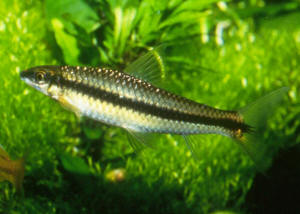
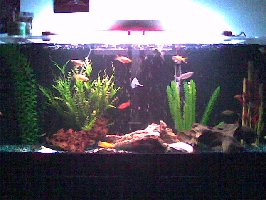
.jpg)
.jpg)
.jpg)