|
Related FAQs: Freshwater Moray Eels,
FW Morays 2, & FAQs on: FW Moray ID, FW Moray Behavior, FW Moray Compatibility, FW Moray Selection, FW Moray Systems, FW Moray Feeding, FW Moray Disease, FW Moray Reproduction,
Moray
Eels,
Related Articles: Freshwater Moray Eels
by Marco Lichtenberger, Moray Eels in General, Brackish Water Fishes, Freshwater Eels,
The Diversity of Aquatic
Life Series
The
"Freshwater" (Brackish to Marine) Moray Eels, Family
Muraenidae
|
|
| Bob Fenner |
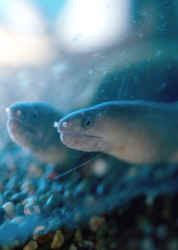
Gymnothorax tile
|
Of the fifteen genera and more than
two-hundred species of Muraenids there are a couple of handfuls that
are known to occasionally enter freshwater in tropical and temperate
areas. Of these, two are of principal use to aquarists, being
available in good numbers in areas where regular collection of
ornamentals is an industry.
The purpose of this article is to
inform the public and industry that these two species are really not so
much "permanent" freshwater residents... but better
considered brackish water organisms (spg 1.005-1.010). Though you may
see them presented in "all freshwater settings" for sale,
they are best kept in partially saltwater as long term
possibilities.
Other literature-noted marine,
venturing into brackish, possibly freshwater Morays are listed, and a
smattering of non-moray Anquilliformes (true eels), as is a mention of a
few of the many groups of fishes called "eels" that are not
true eels.
Most notably more Freshwater to Brackish to
Marine:
Bigger PIX:
The images in this table are linked to
large (desktop size) copies. Click on "framed" images to
go to the larger size. |
|
%20MD.JPG)
|
| Freshwater moray eels (suggested corrections
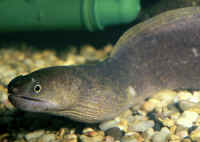
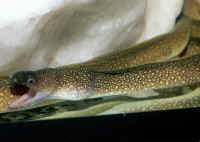
for images, identifications) Hi, the moray eel that is shown on
your website is actually Gymnothorax tile and not Echidna
rhodochilus or Gymnothorax polyuranodon. BLEEKER describes Echidna
rhodochilus as: brown color with "pink" spots on upper
and lower lip. I have attached the original description of Echidna
rhodochilus (BLEEKER). Gymnothorax polyuranodon is yellow with
brown spots all over, a bit like a leopard. I have no picture of
mine, but you find some on : http://www.fishbase.org/Summary/SpeciesSummary.cfm?ID=17227
I have attached two pics of my Gymnothorax tile, they have slightly
different color, but are the same species. I hope that in a few
days my website www.brackwasser.com will be ready, and I hope to
have more picture soon. regards Thomas <Hmm, thank you for
this... In the trade the images referred to are allied with the
scientific names cited. Am familiar (a collaborator) with
FishBase... Will add your notes to the WWM site, identifications of
these two Muraenids there. Bob Fenner> -- Thomas
Flarkemeier Sales Yahoo! Deutschland GmbH Tel:++49 40 /
309508-20 Fax: ++49 40 / 309508-11 Besuchen Sie unsere Online Mediadaten http://mediadaten.yahoo.de |
Other Morays that venture from Marine into Brackish to
and Maybe into Fresh For A While (Temporarily): Rare in ornamental
aquatics.
| Anarchias seychellensis Smith 1962, the
Seychelles Moray Eel. Indo-Pacific; East Africa to Easter Island.
To nearly a foot in length. Brackish to marine. |
|
| Echidna leucotaenia Schultz 1943, the
White Faced Moray Eel. Indo-Pacific; East Africa to the Tuamotus.
To thirty inches. Brackish. |
|
| Gymnothorax afer Bloch 1795, the Dark Moray.
Eastern Atlantic; Mauritania to Namibia. To a meter in length.
Brackish to marine. |
|
| Gymnothorax fimbriatus (Bennett 1832), the
Fimbriated Moray. Indo-Pacific; Madagascar to the Society Islands.
To thirty two inches in length. |
|
| Gymnothorax tile (Hamilton 1822). Indo-West
Pacific; Andaman Sea to Indonesia, Philippines. To two feet total
length. |
|
| Strophidon sathete, Hamilton 1822 is almost
certainly the same species), the Giant Slender Moray Eel.
Indo-Pacific; Red Sea, eastern coast of Africa to Fiji. To twelve
feet in length. |
|
| Thyrsoidea macrura (Bleeker 1854), the Giant
Slender Moray Eel. Indo-Pacific; Red Sea, eastern coast of Africa
to Fiji. To more than thirteen feet in length (world's largest
moray). Found around river mouths, occasionally entering into
freshwater. A food fish that is rarely offered in the pet-fish
trade. A voracious feeder on fish, shrimp, cephalopods. |
|
| Uropterygius concolor (Ruppell 1838), the
Unicolor Snake Moray. Indo-Pacific; Red Sea, East Africa to the
Society Islands. To twenty inches in length. Brackish to marine,
often found in Mangrove swamps. |
|
| Uropterygius micropterus (Bleeker 1852),
Tidepool Snake Moray. Indo-Pacific; East Africa to Samoa. To a foot
long. Brackish to marine. |
|
Other True Eel Families with Members that Live in
Brackish to Freshwater Settings
| More Anguilliform families with freshwater to
brackish members: Moringuidae (Spaghetti Eels), Ophichthidae (Snake
and Worm Eels, Myrichthys breviceps at right). |
|
Other Freshwater to Marine True Eels (Order
Anguilliformes, that turn up occasionally in the hobby).
| Anguillids, family Anguillidae. One genus, fifteen
species of mostly catadromous (living in freshwater as young to
adults, moving to the sea to reproduce, perishing there) fishes.
Shown: Anguilla anguilla (Linnaeus 1758), the European Eel,
at the London Aquarium. Anquilla rostrata,
occasionally offered for sale in the United States, is very
similar. |
|
And of Course, the MANY Marine and Freshwater
"Eels" That Are Not Really Eels:
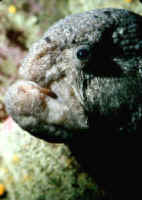
| Family Anarhichadidae, Wolf
fishes, Wolf Blennies, Wolf Eels; North Atlantic, North Pacific.
Two genera with four species. These neat, hand-trainable fishes are
mainly seen in public aquaria as they can be enormous (up to 2.5
meters) in size. Gentle giants that are favorites of Public
Aquariums everywhere. An Anarrhichthys ocellatus at the
Birch Aquarium, San Diego. |
|
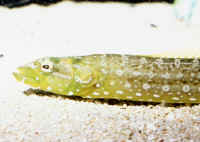
| Eelblennies, the subfamily Congrogadinae, family
Pseudochromidae. Yes, the same family
as the Dottybacks... The most commonly
offered Eelblenny (aka Green Wolf Eel) in the hobby, Congrogadus
subduscens (Richardson 1843) is shown at
right. |
|
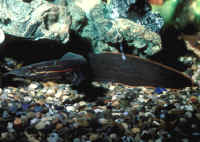
| Spiny Eels (true eels lack spines in their fins),
the Mastacembelids. Found in Africa, through Syria, the Malay
Archipelago and China. Four genera, sixty seven species. A Fire
Eel, Mastacembelus erythrotaenia at right for
example. |
|
| Swamp Eels, the family Symbranchidae. Tropical and
subtropical freshwater, some into brackish environs. Western
Africa, Asia, Indo-Australian Archipelago, Mexico and South
America. Four genera, fifteen species. One Swamp Eel
(Monopterus alba) is often referred to as a/the Freshwater
Moray Eel in the aquarium trade. |
|
Are there more? You betcha. Eelcods, Eelpouts... but these others
are rarely seen in the hobby.
Close:
As you can appreciate, many fishes are capable of
short-term exposure to conditions that are deleterious in longer time
frames. All living things have their tolerance outside of "ideal
ranges" of pH, hardness, dissolved oxygen and such. Salinity is
another of the possible categories of such tolerance. Hobbyists and
dealers in the trade would do well to impress on each other the need
for some salt in the water of "freshwater morays", as well as
sufficient alkalinity, elevated pH.
The "typical" aquarium care of Morays
applies to the partially, temporarily brackish to freshwater species.
They're mainly nocturnal, great at escaping captivity, need large
quarters, with places to hide, not too-bright lighting, and are capable
of eating slow, small fishes, crustaceans...
Bibliography/Further Reading:
http://www.geocities.com/rubentolon/index.html
http://www.fishbase.org/Summary/FamilySummary.cfm?ID=56
http://saltaquarium.about.com/library/weekly/aa090501.htm
Anon. 1981. Where watery worlds mingle... Aquariums Australia 2:1,
1981.
Anon. 1975. Tanks with brackish or mixed water. Aquarium Digest
International 3:4, 75.
Burgstaller, B.J. 1978. The brackish system. FAMA 8/78.
Castro, Alfred D. 1996. Fishes for the brackish aquarium. Pt.s I,
II. 5,6/96.
Castro, Alfred D. 2001. A freshwater moray eel? Saltwater Q & A.
AFM 8/2001.
Dawes, John. 1989. Bolstering sales of brackish water fish. Pets
Supplies Marketing Magazine. 7/89.
Fenner, Robert. 1995. Moray Eels, family Muraenidae. TFH 5/95.
Fenner, Bob 1998. Eels, eels, eels. TFH 7/98
Gibbs, Max. 1995. The brackish aquarium. For the adventurous
fishkeeper looking for something different from the conventional
tropical freshwater or marine aquarium, the brackish tank offers a
challenge. FAMA 4/95.
Gos, Michael. 1980. The brackish system, pt.s 1,2. FAMA 11,12/80
Gos, Michael W. 1977. The brackish aquarium. TFH 10/77.
Monks, Neale. 2001. Giving into temptation. A personal top ten of
brackish-water fish. TFH 9/01.
Scharpf, Christopher. 2001. The American Eel, Anguilla rostrata, In
nature and the aquarium. TFH 3/01.
Taylor, Edward C. 1996. Creating a brackish-water biotope. Pet
Business Magazine. 11/96.
Taylor, Edward C. 1982. Keeping a brackish aquarium, pt.s 1,2. TFH
5,6/82.
Volkart, Bill. 1989. The brackish aquarium: Pt. 1, setting up, Pt.
2, plants, Pt. 3 the fishes. TFH 6,7,8/89
Wolf, Jim. 1998. Fish on the brink (brackish). Odyssea. J. of the
Mar. Aq. Soc. of L.A. 4/98.