|
FAQs about "Freshwater" Morays Eels
2
Related FAQs:
FW Morays 1,
FW Morays 2,
FW Morays 3, FW Morays 4,
FW Morays 5, FW Morays 6,
FW Moray ID, FW Moray Behavior, FW Moray Compatibility, FW Moray Selection, FW Moray Systems, FW Moray Feeding, FW Moray Disease, FW Moray Reproduction,
Marine Moray
Eels,
Related Articles: Freshwater Moray Eels by Marco Lichtenberger, Freshwater Moray Eels by Bob Fenner,
Moray Eels, Other Marine Eels,
|
|
|
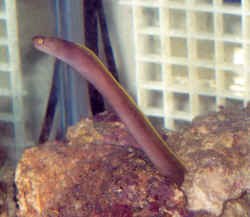
Spaghetti Eel... which reminds me of bugs bunny
11/9/18
Good day Neale, Marco and all you good people in WetWebMedia,
<Hello!>
Neale, I remember this chat in fishforum, many many years ago (2006)
http://www.fishforums.net/threads/got-my-freshwater-snowflake-eel-today.140196/
In the chat you are advising a brackish aquarist to get an Echidna Rhodochilus
(I already have it) and/or Spaghetti eel.
<Ah, yes. Back when I had time to do online forums! A distant memory, sadly.>
Well, since I already have E. rhodochilus (a model citizen, very nice, stay
small and docile),
<Yep, this is the usual experience.>
and I have given away most of my eels to other eel lovers (except for my E.
Rhodochilus), I decided that I still have room for small slimmer non-aggressive
eel, so I asked my procurer to get me a Moringua
raitaborua.
<Nice!>
What he ended up sending me are these two eels (pictures included), which a bit
surprising to me. What bizarre eel, I thought, when I saw them first time. Body
like Monopterus albus, paddle-like tail (like some kind of fish.. well eels are
fish anyway), face like moray... but they behave more like Bugs Bunny!
<The paddle-tail is presumably to help with digging. As you're seeing, these
fish are extremely happy when half buried in the sand.>
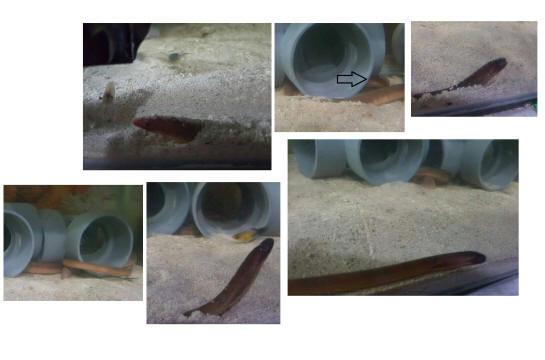
That is, not long after I plunge them to my aquarium, they immediately
burrowing! I just turn my back for a short while, then as I look back, they
already gone beneath the sand. They stuck out their head every now and then
(like Bugs Bunny!), but every time I bring my face closer to my aquarium, they
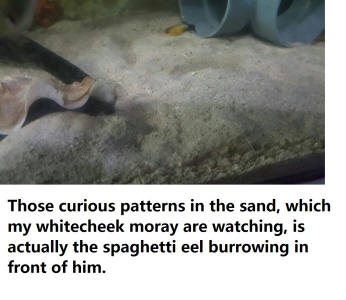
will pull their head back in and swim underneath the sand, making curious
patterns. Even my white cheek moray got confused (I think ;) ) as it remained
home and not coming out at all.
<Neat.>
So, are they Moringua raitaborua? But they are not pink, their color are more
like Monopterus albus. The smaller one is about 30cm in length, the bigger one
is about 40cm. They have slim bodies, shaped like Monopterus albus... kind like
spaghetti :D so the name is proper. They are caught in a freshwater river
several kilometers away from the estuarium, and they were being kept in
freshwater for months before my procurer bought them and send them to me. Maybe
M. raitaborua change colors when they grow bigger? or maybe they are M.
microchir? but isn't M. marine eels?
<It's really hard to say. The pale colour could easily be down to the light
coloured substrate -- many fish adjust their colours, becoming paler if the
substrate is pale. I'd be looking at the pictures on Fishbase for a start:
https://www.fishbase.de/summary/Moringua-raitaborua
https://www.fishbase.de/summary/8051
While both occur in brackish water, as you say, of the two, Moringua raitaborua
is the one more associated with fresh and brackish conditions, and presumably
the more adaptable in the longer term, Moringua microchir being more marine when
adult. That being the case, I'd be maintaining the tank around 1.003-1.005, and
seeing what happens. If the fish stop eating or get ill, upping the salinity may
be required.>
Well, thank you for your time, and have a wonderful day with your fishes!
Best Regards, Ben
<And to you! Cheers, Neale.>
|
 |
|
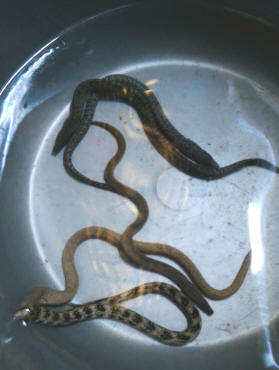
E. xanthospilos in a river & other morays
6/24/18
Hello Marco, Neale, and all you good people at WetWebMedia,
<Welcome back, Ben!>
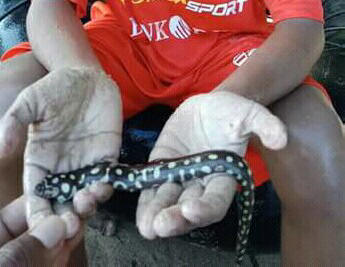
I remember reading about E. xanthospilos being kept in freshwater in a shop in
UK. Then I found this on FB, this kid caught a E. xanthospilos on a river mouth
in Banten, that's the northwestern part of Java Island. Interesting, eh? Maybe
now we can add this species to the list of eels that often wandered to rivers?
<The first time I became aware of this species in trade, it was also sold as a
freshwater species.>
Also, I visited Mr. Eko several days ago, and he showed me a bucketful of morays
he captured from an estuarium north of Java. Again we see the usual: G. pictus
and U. micropterus, which Fishbase listed as marine to brackish, and E.
nebulosa, which are commonly accepted as fully marine, but apparently not the
case here, as they are not rare in our estuaries.
<That's interesting.>
He currently keeps all his brackish morays including the E. nebulosa in
1.012-1.014 sg aquarium. They looks healthy and no deaths so far (except for
those died during transport). I am tempted to keep the G. pictus in my 1.010sg
aquarium, what do you think? Any tips?
<Personally I would not keep such moray eels in brackish water, even when they
were caught in such an environment. It's so much easier to provide a high water
quality in a marine system by using a skimmer and live rock. To achieve the same
in a brackish tank, one has to do regular and large water
changes. The second reason why I would not keep G. pictus in a brackish tank is
that we cannot be sure how long they stay in this environment in nature. Weeks?
Months? A few years? G. pictus reaches up to 1.4 metres and become quite
massive. I think the adults are mostly reported from marine waters.>
Thank you and Keep Rocking! Ben
<Hope this helps. Marco.>
|
|
Re: E. xanthospilos in a river & other morays
6/26/18
Hello Marco,
<Hi Ben.>
Thank you for your very useful info. So, the problem of keeping brackish morays
in brackish are threefold: 1. need frequent water changes since we cannot use
live rocks and skimmers; 2. inadequate data on how long these morays actually
stayed in brackish without getting stressed; 3. In case of G. pictus, it could
grow big.
<Exactly.>
From my part, I can handle weekly water changes, that is not a problem as I am
not far from both seawater and pure groundwater (from a well). I also in good
relations (obviously) with the procurers of the fish, so if I see any sign of
stresses in any of the morays, due to the lower salinity, I can rehouse them
back to the store, or even back to the river where they came from.
However, size will always be a problem, since now I know that G. pictus can
actually grow bigger than 100 cm, I can see that it is not an ideal fish.
The ones offered to me are small for now, but if they can grow to 1.5 meters
then that's too much. Again thank you for the very logical warning.
<No problem.>
I try to contact the people who fished out E. xanthospilos from our rivers, but
apparently they knew it's a prized eel, so they set up rather high prices.
Bummer.
<Usually they are sold around 100$ in the USA and Europe. Sometimes for much
more.>
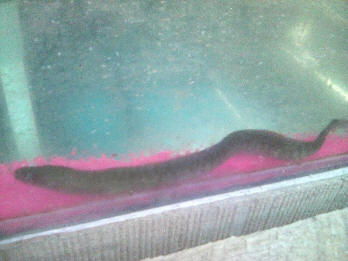
I also got offered G. richardsonii (there is only one left in the aquarium from
a batch captured last month, picture included). In the same aquarium there is
also a White-eyed moray (G. thyrsoidea?). And Mr. Eko offered me the E. nebulosa
from the previous bucket for a discount. All three are juveniles and captured
from the same estuarium. Which one do you think has the best chances of living
happily in a 14 ppt brackish aquarium? I understand that brackish water might be
just a transition for them and they
might eventually need at least 1.018sg water to thrive, so I am willing to
construct another aquarium to move them in the future. Or donate them to other
eel enthusiast who I can trust.
<Probably G. richardsonii. I know all three species you listed and I think G.
richardsonii is the most adaptable among them. Also, it stays quite small.
Still, you may want to try a higher salinity (maybe a skimmer and the use of
live rock), especially when you have easy access to the sea.>
Well, thank you again dear Marco! My best regards to all you good people at
WetWebMedia!
<Thank you very much. Ben.>
|
 |
Re: E. xanthospilos in a river & other morays
6/27/18
Hello Marco,
<Hi Ben.>
Thank you again for your advice. Indeed, Mr. Eko also advised that I raise
my salinity to match his high brackish aquarium (about 1.012-1.014sg now).
So that I can be sure that whatever eels he kept in his brackish aquarium, I
can keep too.
At which specific gravity will skimmer and live rock start working?
<I'd say 1.018. Usual Skimmers are less efficient at lower salinity, because
the bubbles are larger due to a lack of surface tension. With regard to live
rock, it's mostly about the beneficial marine bacteria living on its large
surface, which might be replaced by other strains at lower salinity. Cheers,
Marco.>
Best Regards, Ben
|
|
More observations of Uropterygius Micropterus and other morays in my
brackish aquarium 2/3/18
Hello Marco, Neale and all you good people in WetWebMedia,
<Hi Ben.>
As I promised. here are my latest observations of my FW/BW morays.
Both Uropterygius micropterus are doing fine, they seems to be adapting well in
my aquarium. I am fluctuating the salinity between 1.006 sg to 1.009 sg, to
simulate a semi-brackish river not so far from the estuarium.
The U. Micropterus shows normal behavior, no signs of stress, they even got
brave enough to get out of their hiding spots every now and then to chase feeder
guppies all the way to the surface. They won't run away from
my fingers when I am doing aquarium maintenance. Both eels have their own
favorite hiding spot, the older one likes to hide under a clamshell, while the
newer one likes to hang out with other morays in a pipe.
One behavior in particular that I observed with the U. micropterus, is that they
often opened their jaw in a menacing kind of way, keep it open for 10-15
seconds, then go back to normal breathing. This I never observed on my other
morays.
<Sounds like typical threat display of morays.>
The smallest E. rhodochilus seems to hang out with the U. micropterus a lot,
perhaps due to similar size. I once seen them swimming together side by side
with the same rhythm and same speed. I am still not able to persuade the
smallest E. rhodochilus to eat fro3en food. I observed that when the bigger E.
rhodochilus are eating frozen food, the smallest one seems to be keeping
distance. Perhaps there is a "caste" system among eels based on size?
<It's much easier to train them to take frozen food, when there are no other
fishes around.>
The other E. rhodochilus are getting fatter after I regularly fed them with
thawed frozen shrimps & squids, now they no longer actively chase guppies and
live shrimps, and they even backed off from larger Macrobrachium shrimps if
those shrimps are fighting back. Those shrimps has grown bigger now, and even
the G. polyuranodon are not frightening to those large shrimps anymore. I was
thinking of evicting those shrimps that has grown too large, but then I decided
to keep them, as cleaning crew. Anyway, are they capable of hurting the morays
in any way?
<At their current size? A healthy moray? I doubt it.>
How big will those Macrobrachium shrimps grow?
<Depends on the species. Typically around 7-9 cm, but there are really large
ones such as Macrobrachium rosenbergii, which can reach 30 cm and at this size
may pose a threat to your small eels in the limited space of an
aquarium.>
Speaking of my G. polyuranodon, it seems to have the most diverse diet of them
all: it will take feeder guppies, small bits of frozen shrimps and squids (it's
not interested in big bits), and even bloodworms which I intended for feeding
the guppies and shrimps. It is also the most active of the morays there,
spending equal time between hanging out in its pipe and swimming around, even on
the surface, terrorizing the guppies. It will also making occasional attempts
every now and then to jump out of the water, like dolphins. That's why I keep my
aquarium tightly covered.
<Usually there is a reason when morays try to leave a tank. Happens mostly when
they are new, when the water quality is not sufficient, when the tank is too
full, when there are larger predators or when there are not enough
or sufficient hiding spots. Many also seem to be quite curious and just
investigate their environment above the water level.>
Interestingly, the E. rhodochilus never, ever made any attempt to jump out of
the water, unlike the G. polyuranodon.
<Guess they like it better there.>
Even the U. micropterus made some attempts. Seems like it's a normal behavior
among piscivore morays, but not so normal among Echidnas?
<No certainly not a genus thing. Happens with Echidna species, too.>
Well, that concludes my report for now. Will post more info here soon.
<Thanks for the report, Ben. Very interesting indeed!>
Thank you and have a nice day!
<You too.>
Best Regards, Ben
<Cheers, Marco.>
|
  |
|
Re: more observations of Uropterygius micropterus and other morays in
my brackish aquarium 2/25/18
Good evening, Marco, Neale, and all you splendid people in WetWebMedia,
<Welcome back, Ben!>
Allow me to post an interesting observation.
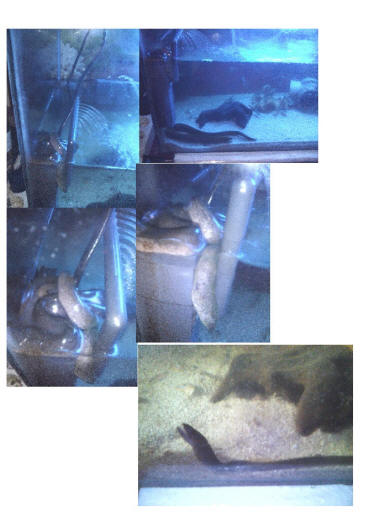
Lately both of my Uropterygius has invented a new way of hunting. They will
climb my filter and remain on top, their bodies outside water, but with their
heads underwater. Then they will *chomp* unsuspecting guppies that comes close.
I noticed that they started this behavior when I reduced my water level to be a
bit lower than before. When they're not on top of the filter, they usually lie
under the filter, with their heads up (making a "J" shape),
intently watching the guppies overhead. They are willing to take frozen shrimps,
but they seems to have their hunting instinct still intact, unlike my other
morays, who has begin to prefer frozen meal than hunting live guppies and
shrimps. (In fact my smallest E. rhodochilus now has begin to eat frozen meal as
well, though in smaller portions).
<Very good. As I said, it might take a while, but all morays can be trained to
frozen food.>
The kind of hunting method that my U. micropterus now used, is actually not so
alien to me,
<Never heard of it either, although I had some moray eel specimens in the past,
which loved to live inside a skimmer.>
I think my Monopterus albus (now sold) also used the same hunting tactics when
it was smaller.
What surprised me is the fact that U. micropterus, despite being morays, are not
afraid to temporarily leave the water to hunt for food. Before, I thought this
kind of behavior only apply to M. albus or other kinds of swamp eels.
<There are actually quite a number of reports of moray eels leaving the water in
the wild, mostly to hunt crabs. G. pictus and also E. nebulosa e.g. have been
reported to do that, but I have not heard of any morays lurking for fishes while
being outside of the water, especially no Uropterygius.>
Too bad they are not popular yet as pets, otherwise I'd love to hear from other
U. micropterus keepers. They are not as easily found as other morays commonly
kept as pets (such as G. favagineus, E. nebulosa, G. polyuranodon
etc), but still very interesting and challenging all the same.
<They sound like a very interesting species.>
Well, that's all for now, have a wonderful day!
Best Regards, Ben
<Thanks for your report. Have a nice weekend. Marco.>
|
 |
Re: more observations of Uropterygius Micropterus and other
morays in my brackish aquarium 2/28/18
Hello Marco, Neale, and all you excellent people in WetWebMedia,
<Hello Ben!>
Thank you for your kind words & input. So it's true that morays, like
swamp eels, can actually leave the water temporarily to chase its prey.
<Oh, yes.>
This actually makes sense for Uropterygius especially the beach
population, if they got stranded in small pools, maybe they will use
their ability to get out of the water temporarily, to move overland from
small pools back to the sea.
This email is my last observation for the two Uropterygius micropterus
that I had. I returned them to Mr. Eko today.
<Oh.>
Now that we have established that U. micropterus can be a good pet in a
brackish water aquarium, I hope he will continue to spread the news to
all other fish lovers and procurers, with a message "don't throw those
ugly, snake looking eels back to the water, they can be good pets!". The
reason I returned them to him, are two folds, Firstly because I think my
observation is done, and Secondly, because I noticed that those
snake-eels, are much more sluggish and too docile compared to the larger
morays, thus are best kept on a species tank.
<Probably.>
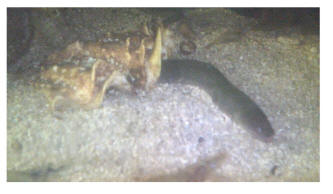
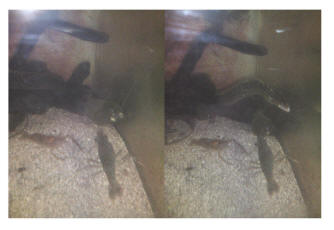
Just a few days ago I recorded a scene where my largest Echidna
rhodochilus literally snagged U. micropterus lunch right under its
nose, while the U. micropterus still blindly trying to figure out where
its food were. This
tells us that, while inter-species aggressions amongst these FW/BW
morays are not observed, the smaller morays are clearly outcompeted by
their faster cousins, and thus are in danger of starvation. Notice that
U. micropterus need to sniff
around a lot to find food, while E. rhodochilus seemed to find food
right away.
https://www.youtube.com/watch?v=EBt7eGzvXCQ
<Interesting. Don't seem to rely on their eyes too much. Also breathing
very fast.>
Therefore, we can assume that it's best to keep U. micropterus in its
own species tank, and away from faster species.
<Actually I think that's best for many morays.>
Since I have no spare space for another aquarium, I returned the eels to
Mr. Eko, who now keeps them in a species-only aquarium. I will off
course continue to post here about my remaining eels (G. polyuranodon
and E. rhodochilus), and also about my future eels if I can get them. I
am thinking G. tile or G. meleagris or E. leucotaenia if I could find
them. Fishbase said they're capable of living in BW and FW, and that
their range extends to my country. So, there is hope.
Well, thank you for your kind attention & input!
<Thank you for your work and reports. You produced probably the first
reports on U. micropterus as an aquarium fish. Now your results are
available world wide for others to learn and continue.>
Best Regards, Ben Haryo
<Cheers and all the best. Marco.>
Re: more observations of Uropterygius Micropterus and other morays in
my brackish aquarium 3/3/18
Good day dear Marco, Neale & all you splendid people at WetWebMedia
<Hi Ben.>
Thank you for your kind words. I will certainly post interesting moray-related
things every now and then, especially concerning those species which are
frequently encountered in our rivers.
One last question about our last video clip (here
https://www.youtube.com/watch?v=EBt7eGzvXCQ ) At the beginning of the clip,
you see a rather large guppy swimming above the U. micropterus. We call it "Cere
Payau", I am not sure what is its Latin name, so what it is?
<Are you sure this is a Guppy? Could also be some Xiphophorus sp. female.>
That guppy has grown a lot from since I put them in the aquarium. I think it is
now too big for all my morays. But it started as very small fish. Now that my
morays all has learned to take frozen food, should I evict those guppies?
<You can evict them if you think the tank is too busy. At some point they still
might become prey. G. polyuranodon do get quite big (at least two feet, probably
more). The large one I once kept would have eaten those livebearers.>
Thank you & have a nice day!
<Will forward this to Neale, who is an expert on livebearers. Cheers, Marco.>
Best Regards,
Ben
Re: more observations of Uropterygius Micropterus and other morays in my
brackish aquarium. 3/3/18
<<The large Poeciliid would appear to be a female Molly of some sort. These are
well established in Southeast Asia, including brackish and littoral marine
environments. Mollies are distinctive in the way their jaws work,
being rather mobile and well adapted for scraping algae. They are facultative
air-breathers will also sometimes gulp air at the surface. So watch for that
behaviour! I've kept Mollies with a wide range of brackish water fish, and while
they are definitely "food fish" for piscivores, they are quite bold and even
aggressive, and hold their own well alongside anything not overtly lethal!
Cheers, Neale.>>
Re: more observations of Uropterygius Micropterus and other morays in
my brackish aquarium 3/6/18
Hello Marco, hello Neale and all you good people in WetWebMedia,
<Hello Ben,>
Indeed dear Neale, those mollies, once fully grown, are aggressive and
courageous. Have a look at this clip:
https://www.youtube.com/watch?v=LVNt0rVcus0
<There's a fine line between 'courageous' and 'stupid', it has to be said...>
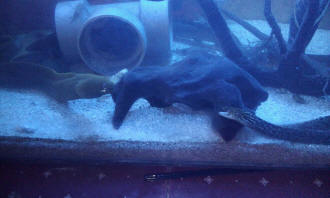
You see that my largest Echidna Rhodochilus (Mr. Emerson) has no problem barging
through smaller fish and got his share. However, my smaller Gymnothorax
Polyuranodon seems to gave up on its food when the big courageous molly were so
determined to eat it.
<Quite so!>
Maybe when the G. Poly has grown bigger, the molly will be lunch :D
<Could well be; I would expect it to disappear during the night, because that is
when Morays typically hunt smaller fish.>
But for now, molly seems to hold its own turf against smaller morays. Are big
mollies always this courageous?
Well, that would be all for now, thank you for watching!
Best Regards,
Ben
<Cheers, Neale.>
|
|
Re: a bunch of morays in a bucket
12/29/17
Hello again Neale, Marco and all you nice people at WetWebMedia,
Dear Marco, thank you for your kind and quick reply!
<You are welcome.>
Allow me to continue my previous story. After seeing what they have to offer me
today, I told the guy that none of the eels that he offered me are the species I
ask for, the brackish-freshwater Gymnothorax tile. I showed
him the pictures from WetWebMedia and that super-cute baby G. tile of yours, he
said he will look for it & it doesn't look alien to him, he had seen those,
though not as frequently as Echidna nebulosa, interesting eh?
<Yes, both are common eels in Indonesia.>
I remember discussing with Neale (or was it you or Mr. Fenner?) about marine
morays entering freshwater (to look for richer nutrients). But, what I witnessed
today, are very small baby morays from species which are
supposed to be fully totally marine and not brackish (G. pictus, E. nebulosa, G.
richardsonii), and yet they are caught in a river (though admittedly still in
the estuarine environment). What are those babies doing in the river?
<Mangrove belts and estuaries are kind of nurseries for many fish species.
The freshwater rivers are rich in nutrients (especially particles of small
size), the mud can be used to hide in and the murky water makes it less likely
to be spotted by many larger predators.>
How did they, marine morays babies, survived brackish water at such young age?
<So far we don't know the salinity of the water they live in. We also don't know
how long they stay there.>
I look at Fishbase, it says that G. richardsonii is totally marine.
<Often occurs in shallow water, doesn't need reefs.>
So how did the baby of G. richardsonii ended up in the river? Chasing shrimps?
<Probably and also to hide.>
The procurer even told me, that if he lower his nets on the estuarium and nearby
rivers, those baby morays are what he usually got, along with other eels and
eel-like fishes (such as Ikan layur / Trichiurus, a popular food-fish here). He
told me that "those from the river and river mouth are not so beautiful
colorful, except for tiger eel (Gymnothorax polyuranodon).
If you want colorful ones, wait until I catch eels around the coral reefs in the
islands nearby, I can get you belut pita (ribbon eels), very beautiful" Off
course I told him that I don't want marine eels, as I don't want
to start a marine tank, and the marine eels that we usually encounter in the
Java sea are the larger ones.
<I found marine tanks always easier to maintain. All my brackish eels sooner or
later were transferred into marine tanks and lived there for around a decade or
longer. Skimmers and live rock make it so much easier to
provide a high water quality.>
G. javanicus and its friends are huge and dangerous! And the legendary
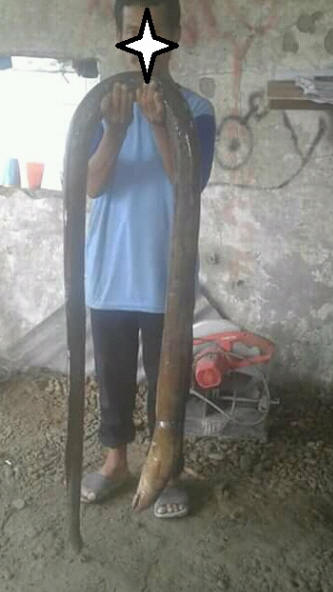
Strophidon sathete are also not very alien from our coastal areas and rivers as
you know already, and to some people they are delicacies. They do get very big.
An FB friend of Mr. Septian caught one of those 3 meters long Strophidon not
long ago, here are the picture.
<What a beast.>
Tonight I am watching my eels and feel happy, we have the big fat Echidna
rhodochilus on the left and the slim and slithery G. polyuranodon on the right.
Now two of my Echidnas has been taught to eat frozen shrimps (thanks
to the directions from WetWebMedia ;) to dim the lights), but the smaller one,
after almost 3 months, still prefer live shrimps, just like the new G.
polyuranodon.
<Patience. All moray eels I personally knew accepted frozen food sooner or
later. As noted before, try feeding in the dark, try the very same food
items they accept alive. Keeping them without tankmates and providing enough
caves also helps.>
If there are certain vitamins to make them interested in frozen food, please let
me know.
<You can try garlic. There is also hooking bait dip sold in fishing stores, but
I would not put this stuff in an aquarium.>
So sorry for the length of the e-mail. As a closing message, allow me to thank
Neale, you and all you excellent WetWebMedia crew for assisting me in enjoying
my hobby as a brackish water aquarist specializing in eels. New
Year 2018 is approaching, and I wish you all a wonderful New Year!
<No problem. Have a good start into the new year.>
Best Regards, Ben
<Cheers, Marco.>
Re: a bunch of morays in a bucket 12/29/17
<Ben, am deleting your messages as your files continue to be too large. SEE as
in READ our requirements. We have limited file space. ONLY send files of
a few hundred Kbytes, NOT Megs. BobF.>
|
 |
|
|