|
FAQs on Freshwater Aquarium Filtration
Involving Sumps, Refugiums
Related Articles: Freshwater Filtration, Know Your Filter Media, A
Concise Guide to Your Options by Neale Monks,
Freshwater Deep Sand Beds
Work by Deirdre Kylie, Power Filter Impressions,
A review of some popular mechanical filtration systems
by Steven Pro, Canister
Filters By Steven Pro, Setting
up a Freshwater Aquarium, Tips
for Beginners,
Related FAQs: FW
Filtration 1, Biological Filtration, Establishing Cycling, FW Sponge Filters, FW Canister Filters, FW Hang-on Filters, Ultraviolet Sterilizers, Chemical Filtrants,
|
|
|
Ammonia, Nitrite & Nitrate Units of Measure
4/10/18
Hello Crew,
<Hey Ray>
I have a 210g, probably considered overstocked, mixed Malawi tank. The
tank is filtered by a submerged media sump with a six times turnover. I
use Hanna meters for my chemistry checks. The ammonia, nitrite and
nitrate
meters all measure using the -N unit of measure (NH3-N, NO2-N &
NO3-N).
The unit of measure for ammonia and nitrite are not relevant since the
goal of both is to maintain 0ppm. Nitrate is the one causing me some
thought. The tank consistently runs 10 - 30ppm NO3-N and I use this
value to determine water changes, as it approaches 30ppm I do a 50% WC
usually every other week. But if I apply the conversion factor
(4.4) to these numbers my ranges are 45 - 130ppm in which case my WCs
should be happening probably twice per week. I recently read
the article, Nitrates in Freshwater Aquarium Systems
by Bob Fenner, which stated "Do check your test kit though almost all
are nitrate ion types on the market nowadays..." I'm guessing doing the
conversion on NO3-N > NO3 is what I should be looking at.
<Yes; agreed>
The tank has been running in its current configuration (mixed Malawi)
for 2 years, before that it was a planted discus tank for maybe 8 years.
Being retired gives me time to think, maybe too much. Should I take the
attitude, "if it ain't broke, don't fix it?" Looking for
confirmation/disagreement.
Thanks,
Raymond M Sugel Sr
<Were it me, mine, I would increase the number/frequency of water
changes as you state (twice a week; with pre-mixed (for pH, salts if you
use them) stored water. I encourage you to look into the possibility of
tying this
tank in with a good size/volume sump as well, perhaps growing live
plants there, incorporating a deep sand bed for denitrification;
utilizing and out-gassing the excess NO3. Bob Fenner>
Re: Ammonia, Nitrite & Nitrate Units of Measure; now sump design
4/11/18
Thanks for the response Bob.
<Welcome Ray>
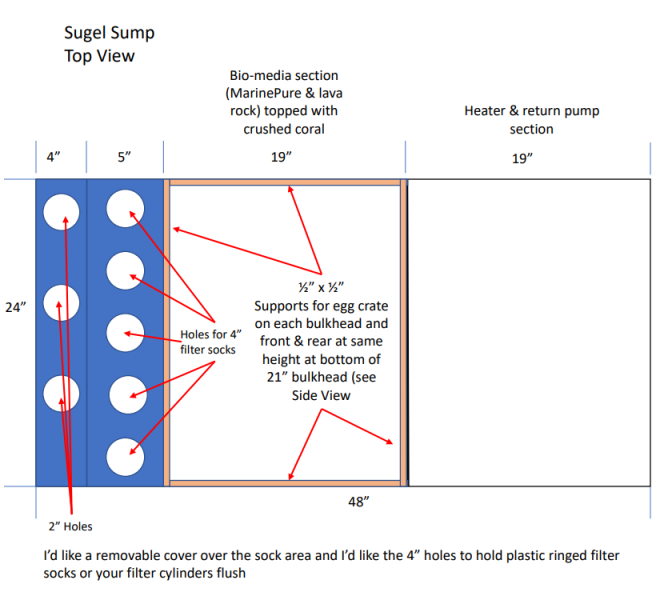
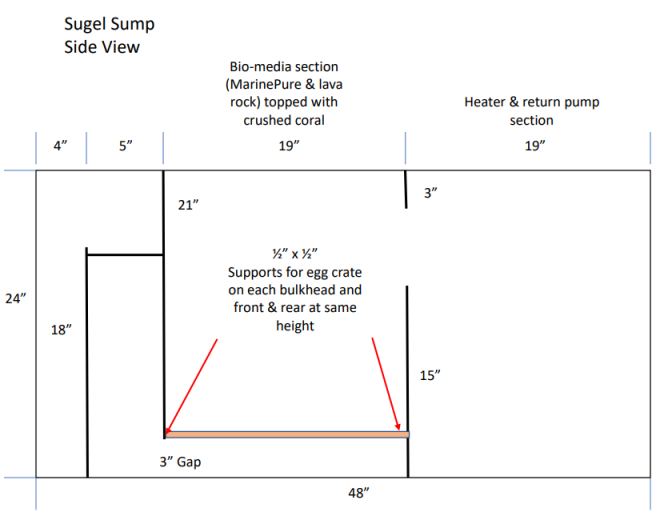
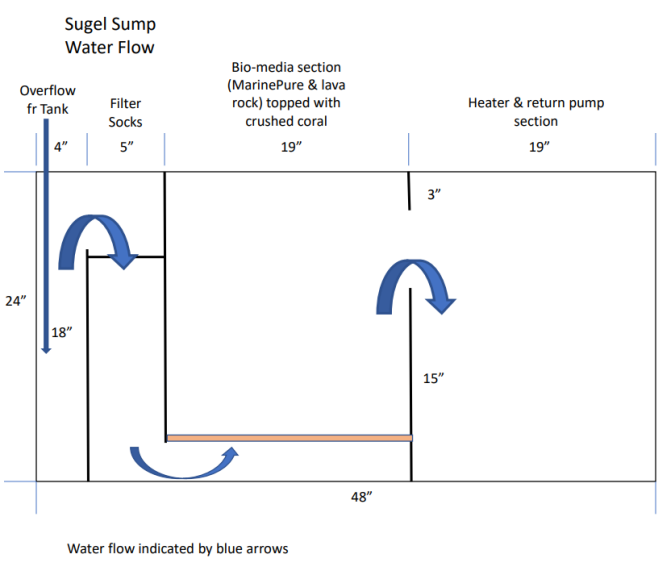
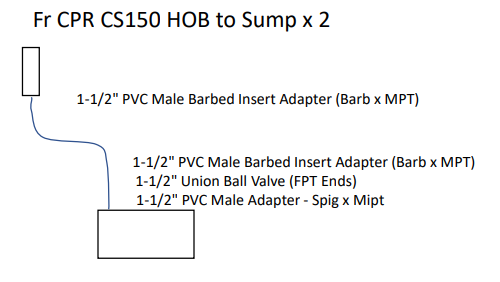
The tank currently uses a 50g sump for filtration, will be up-sized to a custom
120g sump next week (being
delivered tomorrow) (drawing attached).
<I do see this; and have questions, comments>
As you can see the water flow pattern I designed doesn't give me an area for a
deep sand bed/refugium.
<Mmm; if you change your mind later, you can/I would substitute the current mid
area for a DSB and live plant culture/refugium... with a RDP lighting
arrangement (alternating from your main/display light regimen)>
I have researched using an external "aquaponics" set up. From what I have read
Pothos is the commonly used plant but it is toxic to cats (wife has a couple of
them). Just need to find a plant that will work in an aquaponics
system, takes up nitrates as well as Pothos but isn't toxic for other critters.
<There are several choices; including many of "aquarium" plants that really grow
best in the air>
My other thought was to use a continuous water change system. I use a 100g
storage tank where I pre-treat RO water. I'm on a well that I like to describe
as "flowing rock." Its GH is around 700ppm but KH is only 10ppm.
<Interesting; we have high KH and GH water here in much of S. Cal.>
I could set up a continuous change of 1gph, the storage tank would last 4 days
and the 5th day for refilling the tank.
<Really sounds great for your Malawi set up... do assure me that you will have
safeguard/s, alternative overflow discharge/s for potential
overflowing here>
Raymond M Sugel Sr
<Bob Fenner>
|
 |
Substrate for my fresh Water refugium
1/10/17
The
<The? Is there previous correspondence?>
substrate is made of organic potting mix (no fertilizers, at
least as written on a bag)
<I'd be testing... by soaking, perhaps boiling a teaspoon or two in some
water... testing the liquid>
- about 2 inch thick,
<?! This is a BUNCH of material; too likely to "float out"... a mess.
I'd be mixing the soil with fine gravel...>
.5 inch of fine gravel op top of soil and 1-1.5 inch of smooth white
sand (not aragonite) Do you have a tip,
<A tip? I'd be doing more searching here... on WWM, the Krib... Diana
Walstad's works; maybe Takashi Amano. What you have done here so far?...
Not viable>
I set up a fresh water refugium for plants and fry. I bought a bag of
organic potting mix from Menards and put it in the middle chamber and it
just floats.
<Oh yes; assuredly>
Above is from a blog I got from your site and read the same from others.
<Can't tell what is lifted without quotation marks, notes... Maybe have
someone else read what you send out ahead of time to assure it makes
sense.
Bob Fenner>
Freshwater refugium experiment
6/3/16
Hello! I know freshwater refugium questions pop up from time to time so
I thought I'd share my current fw refugium experiment with you.
<Thank you>
I had an Aquafuge hob refugium left over from a previous saltwater tank,
which I have set up on my 29 gallon freshwater dirt substrate planted
aquarium. It's been in place for a couple of months now. It's set up a
lot like the main tank, having a dirt substrate capped with fine gravel
and plants (Bacopa and red Ludwigia). The refugium has its own light for
the plants.
<Do you alternate the light cycles here?>
I added some Gammarus to both the refugium and the main tank. About a
month ago I was feeding some live blackworms so I also added some of
those to the refugium. They are still alive and doing well. I know they
can
reproduce by fragmentation, I'm still not sure if fragments from the
refugium colony will make it to the main tank or if I'll have to harvest
them somehow. At the time I added them I was just curious to see if they
would thrive in the refugium over time. There are also some Ramshorn
snails (the pretty pink ones) and tadpole snails in the refugium. They
are also in the main tank but the main tank has assassin snails and two
pea puffers so the refugium snails are there to replenish the tank
population if / when needed. A few times a week I drop in some veggies
or a few algae tabs for the snails. The snails are all doing really well
in there.
Recently the tank developed a bit of green water, which gave me the idea
of adding some daphnia to the refugium. I got a culture of Russian red
daphnia and put about half of them in a regular daphnia culture jar, the
rest went into the refugium. This was very recent so it's still
uncertain what will happen with them longer term. My hope is that they
will multiply in the refugium, thus taking care of the green water and
also supplying some live food to the tank inhabitants.
<A good idea>
I tried putting some cherry shrimp in there to see how they would do but
that didn't work out. They like to swim around a lot, and one by one
they swam too near the overflow and got sucked and washed out into the
main tank. I guess I could fit a piece of screen over the overflow but
that might defeat the purpose of supplying occasional Gammarus, daphnia,
etc. to the main tank.
So now I'm wondering what other foods might be cultured in there. Any
ideas?
<I suspect a bunch ARE being cultured in the 'fuge... on the plants and
in/on the substrate. I would stick w/ what you have for a few months;
see what develops... before trying adding novel organisms>
What do you think about the daphnia, any chance they can form a long
term culture in this setup?
<Some; yes. I'd run an alternate culture in a "kiddie pool" or such
outside or in the garage.>
Thanks for your interest,
Joanne
<Thank you again for sharing. Bob Fenner>
|
Questions regarding Plumbing in 125 Gallon Freshwater Build
with Sump... reading
4/1/14>
Hello WWM crew,
<Michael>
This is my first attempt at a sump system (have owned 30 gallon and 55
gallon freshwater tanks in the past, but using canister filters). Trying
to
make more room for my freshwater angels, I picked up a 125 gallon DT/55
gallon ST and stand on Craigslist and have slowly been updating and
planning its design. Doing research online has provided me with answers
to a lot of my questions, but I'm a little out of my depth on this
matter of plumbing. I'm not afraid to attempt to plumb the tank myself,
but I'm just not certain about all the factors involved. I was hoping I
could share my schematic with you guys and maybe you could make a
recommendation or two.
<Sure>
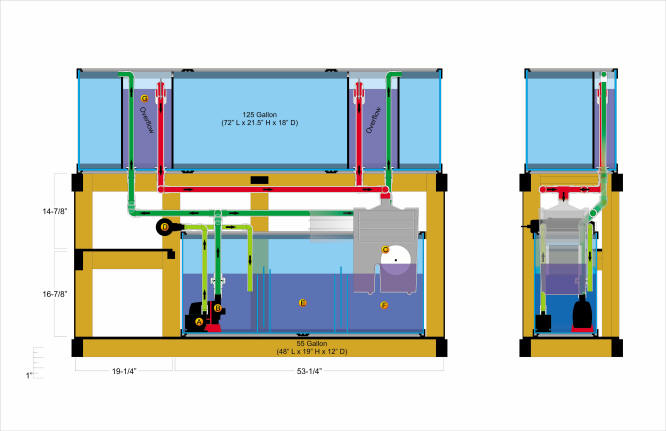
Here it is in its current form. All of the illustrated plumbing
is 1" PVC (Schedule 40)
<Mmm; I'd make the overflows likely 1.5" inside diameter. Do
you want help finding the articles and FAQs re on WWM?>
except for the return lines in the overflow (above the
bulkheads) which are 3/4". Additionally, the plumbing for the UV
Sterilizer is 3/4" (didn't figure it would need 1" since it isn't
pushing the kind of volume the return lines are). The pipes filled with
green are the return pipes. The red pipes are drain pipes. The neon
green pipe is dedicated to the UV sterilizer.
A few system notes regarding accessories I've acquired so far:
-The media cabinet/BioWheel is a Tidepool 2
that I cut the front section off of. I just
wanted it for the BioWheel and the media cabinet, so I didn't have to
build those things from scratch (also got a good deal on the thing at a
local aquarium store)
-The pump is a Fluval SP4, which
nominally pushes 1823 GPH at 0', 1672 GPH at 1'6", 1548 GPH at 3', 1347
GPH at 4'6", 1281 GPH at 5'9", 1135 GPH at 7'2", 805 GPH at 9'5",
499 GPH at 10'8".
<Uhh, yes... the 1" lines won't accommodate this flow>
Sadly, I can't return this even though it's new merchandise due to the
shifty business practices of the store owner (won't be shopping there
again, but doesn't help much in this situation), so I really hope I can
make this pump work with the system.
<You can>
-Standpipes are Hofer Gargle Buster design.
<http://home.everestkc.net/jrobertson57268/HGB/>
-Coralife TurboTwist 6x 18W UV Sterilizer
So my primary question involves the plumbing itself. I assume the layout
presented will be workable (and I apologize if the diagram isn't clear;
would have been vastly better if I'd had time to do a top view as well).
All my plumbing is 1" schedule 40 except the supply pipes ABOVE the
bulkhead, and the UV sterilizer plumbing, which is all 3/4"). I'm
concerned as to whether or not 1" will have sufficient throughput to
keep up with the pump and gravity fed drains.
<They are not. Do read here:
http://wetwebmedia.com/SystemPIX/PlumbingPix/Oneinchart.htm
The holes drilled through the tank were already done when I bought the
tank, and measure 1 7/16" and 1 3/4", allowing for one 1" bulkhead and
one 3/4" bulkhead in each overflow.
<Have these re-drilled. Do NOT rely on siphoning here>
My other question is something that I've gotten many opinions on, just
hoped maybe I could get one from you guys. How to seal the plumbing that
interfaces directly with the bulkheads?
<The bulkheads/through-puts have threaded throats... and gaskets... Use
a bit of Silastic on both sides... will seal, yet allow removal at some
later stage... the PVC to PVC slip joints should be primed and
solvented... the thread to thread connections can be best put together
w/ a bit of silicone lube fingered on the threads>
As illustrated, basically every joint in this system is going to be
solvent welded with PVC cement (except the ones connected to pumps and
accessories). Since I can't fit Union Joints beneath
all the bulkheads I figure I'm going to have to saw everything off if I
ever have to remove the plumbing anyway,
<Mmm; not necessarily; no. READ the linked files above the citation; ask
for some local fish-hobbyist help... and consider the use of a few
true-union fittings>
so I didn't know if it was worth it to use nylon tape on these
particular joints.
<Not really; no... again, the smear of Silicone lube, even Silastic>
Some people have said to solvent weld those joints, others have
suggested a small amount of silicone as being easier to remove if
needed, but more reliable long-term than nylon tape. Any thoughts?
<As stated>
Thank you so much for your time and expertise.
Michael in Overland Park, Kansas
<Welcome. Bob Fenner down in Cozumel, Mexico>
|
 |
|
Re:
Questions regarding Plumbing in 125 Gallon Freshwater Build with Sump
4/2/14
Wow, glad I checked in with you guys before I went ahead with this
build. I wish I'd found those articles you pointed out months ago, could
have saved me a lot of grief and resolved a lot of elaborate planning
more efficiently. Seems as if most of my questions were addressed in
just a few of those articles. Thank you very much for enlightening me.
Michael
<Glad to share... you could of course, just greatly reduce the rate of
flow... through the one inch return lines... and supply recirculation
water flow via internal pumps, powerheads... Cheers, BobF>
|
Sump for a freshwater tank?
12/31/13
Happy new year to all you wonderful people!
<And you Tim>
I've had three smallish reef tanks for four years now, great fun, but
I'm looking to expand my horizons. I'm planning my first ever
freshwater tank, 90 gallons and heavily planted. I've read three
books on the subject so far and ordered a few more. I'm also
but steadily working through the vast material here. But
there is one vital setup issue that confuses me, and I hope for some
wisdom from you.
<Ok>
Every book I've read and every tank I've seen uses a solid tank, with
filtration done by under-gravel, hang-ons, or whatever. Nobody
takes the traditional marine route of having a drilled tank with sump
below.
<Oh; some folks do; have done so>
To me that's a no-brainer. I could keep the heater in the sump,
pump water for the chiller from it, and maybe even rig some kind of
filtration to avoid ugly hang-ons. But it makes me nervous that
nobody seems to do that.
Am I missing something important? Thanks for any advice!
Tim
<Sumps can function for freshwater systems in all the way they do for
marine. A bit more archived here re:
http://www.wetwebmedia.com/FWSubWebIndex/fwrefugiumfaqs.htm
Bob Fenner>
Refugium and aeration 4/27/13
Hello crew!
<Josh>
First time writer, long time reader. Great website! I have a 125 gallon
long aquarium, heavily planted with co2 system, 35 gallon refugium fed
from CPR overflow box and a Fluval fx 5 canister. I currently have a
silly volcano in the center (my girlfriends only request) pushing out
these huge bubbles that agitate the surface. My question is this- Will
the refugium with overflow box cause enough aeration below the tank to
keep oxygen levels adequate or must I have an air source in addition? I
really want to eliminate the enormous volcanic bubbles. Also, I have the
return from the Fluval pointed up to create a good amount of surface
movement. Current stock load is about 20 tetras, 6-8 Cory's, 4 bushy
nose Pleco and 8 discus in transit. Please help! Thank you in advance
for your time and consideration.
-Josh-
<I think you likely have enough surface agitation with the overflow
unless you live in a very hot climate, but do be prepared to act if the
fish show signs of oxygen deprivation. You might consider replacing the
volcano with a sponge filter. Personally, I love sponge filters because
you get surface agitation and you get additional mechanical and
biological filtration.
Clean water is important for the discus and Plecos are somewhat messy.-
Rick>
Tapped sump? FW design
11/12/12
First off, thank you for your awesome webpage, I've spent literally
weeks reading the questions and answers in your forum and have learned
huge amounts here. I'm writing because I'm considering setting up
a new aquarium with a filter sump and I have a couple of ideas which I
think could be useful, but which I can't find any examples of on the
internet.
I'm trying to decide if the reason is that the ideas are original, or if
they've been tried and failed.
<I see; and understand>
First off I'd like to place the sump beside the aquarium instead of
beneath it so that the water level of the first chamber is the same as
the water level of the aquarium.
<Mmm, okay. How will the water get from one container back/forth to the
other?>
The first chamber would then be a settling chamber, where hopefully most
of the muck would settle out of the water before it gets trapped by the
filter. That first chamber would also be drilled at the bottom and
given a tap so that I could place a watering can underneath it,
<Mmm, unless there is a sort of funnel shape to the bottom, better to
just count on periodic siphoning to clean this settling chamber area>
open the tap and drain 10 liters of water plus mulm for watering my house
plants.
<Ahh, freshwater then>
The hope being that with undergravel jets I could also make sure most of
the mulm gets to the sump.
<Likely so>
I know that wouldn't be enough water change to take care of nitrates,
but I'm also playing around with a couple of other ideas for that
(continuous automatic water change system and aquaponics sound really
cool, but it could be that I'm still too far into the pie-in-the-sky
phase of planning a cool project :o)
<Good to dream, plan though>
So my questions are: 1.) Is there a reason all the sumps I'm seeing are
beneath the aquarium?
<Mmm, a few; easier/est to provide for (gravity) feed, and nicer to keep
out of view mostly>
Can a sump be placed beside the aquarium and still "pull" water from the
aquarium well enough?
<IF the water flow rate is slow enough (pumping from one or the other,
allowing water through a mechanism (siphon/less desirable, or
through-put/s/more desirable) sufficiently>
2.) Placing a tap in the settling chamber of a sump seems so blindingly
obvious to me, that there must be some reason I can't find a picture or
comment from someone who's done it. What problem am I missing?
<Just the application for freshwater systems (rare); these sorts of
traps are common in well-designed and built (Koi) ponds.
Bob Fenner>
Thank you,
Myrle
Re: Tapped sump? FW 11/13/12
Thank you Bob,
>Welcome Myrle<
<Mmm, unless there is a sort of funnel shape to the bottom, better to
just count on periodic siphoning to clean this settling chamber area>
OK.
<Mmm, okay. How will the water get from one container back/forth to the
other?>
I'd pump it out of the sump mostly into the right side of the aquarium
and let it "fall" back into the sump through a drilled out hole in the
left side of the aquarium. I'm staying away from a siphon for the
job.
>I think you're wise here... I believe in gravity... though it's always
(bad pun coming) let me down. Do have a large through-put diameter in
both tanks (1.5", really)... and not too-high a flow rate and you should
be fine here<
I have no need to take that risk. Thinking about it, I probably
shouldn't place the aquarium and the sump too close to each other
because the plumbing connecting the two would need to be somewhat
flexible to avoid causing a leak.
>Mmm, the flex PVC to rigid through puts is a good idea<
Thank you for your time. I appreciate the tips. (By the way
I especially liked your websites tips on creating a natural-looking
aquarium:
http://www.wetwebmedia.com/fwsubwebindex/aqscabegart.htm)
>Ahh, danke<
Greets from Germany,
Myrle
>Choos, BobF<
Freshwater sump – 4/19/12
Dear Wwm.
Will installing a sump filled with fast growing plants, on my
planted freshwater tank.
<This will likely drive off CO2. Anything that splashes water, or mixes
it with air, will drive off CO2.>
And reversing the day/night cycle (like a reef system)
<Why? For plants, day length and light intensity are all that matter.>
Would this improve the co2 level in both tank. And is there any other
benefits?
Thank you
From Phil's i4
<Making life too complicated for yourself, I fear. Focus on providing
the best possible (usually: strongest) lighting you can. Then, at the
least minimise CO2 loss, and ideally, provide extra CO2 through an
automated CO2 dosing system. Do understand many plants grow just fine
without extra CO2 and some, like Vallisneria, can use bicarbonate from
the water instead, if needs be, which is why they LOVE hard water.
Cheers, Neale.>
suggestions for "side" sump
9/22/11
I have a 60 gal saltwater tank, fish only with some live rock and a few
invertebrates.
I had the tank made years ago and I divided 20% into a "side
sump". It recently started leaking so I ordered a new one made. On
retrospect, I probably should have reconsidered the design first but
because of the leak - and the tank is in my office - I rushed to get a
new one.
The water from the tank (and also from a hang-on skimmer) feed into the
side sump and then is pumped back through a pipe (I had a hole drilled
at the bottom of the divider), to the other side of the tank. So I have
nice circulation.
Attached are two photos.
<I see these>
Till now I had the water flow into a refugium and then overflow into a
column filled with Seachem matrix and then the water was pumped back
into the tank.
I was thinking of changing this. I asked the tech support at Seachem
and they said the matrix works best submerged (as opposed to bio
balls).
<This is so>
Any comments or suggestions on the set-up? I would love to get your
feedback.
<Feedback...? What you have can be made to work. Am a much bigger
fan of independent sumps for looks and functional reasons... but
space-limiting situations...>
Also, what's your opinion about a sump (filled with matrix pond),
on a 150 gal fresh water tank (as you can guess, use to be for sw but
needed to make life a bit easier so I switched to fw).
<I'd go another route myself, maybe using the Matrix product in
a contactor capacity, utilizing a DSB and refugium area w/ live plant
culture on a RDP schedule to the main tank>
Thanks in advance. I really appreciate and enjoy your site.
Mark
<Thank you, Bob Fenner>
Re: suggestions for "side" sump 9/22/11
Bob,
<Mark>
Thanks for your speedy reply. Regarding my last question, I was talking
about a 150 gal fresh water tank.
<Yes; I understood this to be the case>
People use a refugium with fresh water?
<Indeed they do... Please see here for a bit re:
http://wetwebmedia.com/FWSubWebIndex/fwrefugiumfaqs.htm
Cheers, BobF>
Thanks for your help.
Mark
Re fresh water sump 9/23/11
So for a fresh water sump, the most beneficial and logical order would
be, first the water would flow through floss for a gross mechanical
filtration, then into a refugium with DSB and then through
matrix/matrix pond?
That makes sense?
<Ah yes>
And one thing I always wondered, just having bio balls float in a sump
with a heavy flow, does that do any good or just a waste of space?
<Some good, though for highly variably loaded (metabolically...
think of more/less bio.) systems, aerating them... splashing in air
with water, is more effective/efficient in driving
nitrification>
Again many thanks. On my way to Eilat now to dive. Need anything?
<Enjoy! If the olde and new kibbutzim hotels are there, choose the
latter! Shalom, BobF>
Re: fresh water sump
Shana Tova
<L'shanah tovah tikatev v'taihatem my friend. BobF>
Re: fresh water sump 9/24/11
Amen and one last question. Should I bring back some sand from Eilat to
help seed my new refugium?
Mark
<No my friend. Enjoy your journey. B>
Fresh Water Live Rock 6/25/10
Hello all:
<Hi Richard,>
I am writing to you today as I am preparing to redo a 38 gallon fresh
water aquarium that's going to be home to a few cichlids.
<Do bear in mind this is a VERY small aquarium for our cichlid
friends; unless you're planning on a harem of Apistogramma or some
other Dwarf Cichlids, a 38 gallon tank is essentially adequate for just
a pair of medium-sized cichlids, for example a pair of Keyhole
cichlids, plus some dither fish and catfish. Don't even THINK about
Mbuna -- this tank is way too small for them. There are some
Tanganyikan fish that'd work, but they're not so easy to obtain
as the usual (usually hybrid) Mbuna sold in pet stores.>
I plan on removing the hang on back filter/powerhead and replacing with
a custom built in filter of my imagination and creation.
<Okay.>
I want to use acrylic pieces to make a separate enclosure that runs the
entire length of the back of the aquarium with approximately 25% total
system volume. The water would enter on one side by surface
skimming,
<Be careful with this... some cichlids are notorious
"jumpers" and will be almost suicidal in their attempts to
get through slots and other openings.>
travel through the filter, then exit on the opposite side by
submersible pump. My question is what to put inside the filter.
<Most anything, but veering towards biological filtration plus some
mechanical filtration to keep the water clear.>
I plan on having a spot by the pump to place carbon bags. I have some
dry base rock intended for salt water use that I would like to put into
the tank and filter and give it time to become alive.
<This is the bit that makes me nervous. Limestone such as that used
for marine aquaria will harden the water, and as I stated above, this
tank is far too small for almost any Malawian cichlid and the majority
of Tanganyikan cichlids. Really, apart from dwarf Julidochromis and
Neolamprologus, your sensible choices in a tank this small are all West
African or South American species -- and these WILL NOT appreciate hard
water.>
I would also like to place that rock that's in the filter onto a
deep sand bed about six inches deep.
<A freshwater deep sand bed is certainly possible; see here:
http://www.wetwebmedia.com/ca/volume_7/volume_7_1/dsb.html
>
Would this work for fresh water fish only environments?
<It is certainly possible to create denitrification in freshwater
tanks, whether via DSBs or live rock. The question is whether it's
worth doing. Bear in mind plants do a much better job of nitrate
removal than live rock, and growing plants in freshwater tanks is easy,
much easier than growing seagrasses or macro algae in marine tanks. So
usually adding clumps of fast-growing floating plants or whatever will
do a much better job of denitrification. Secondly, stocking densities
are usually much higher in freshwater tanks than marine tanks. So in
freshwater tanks the main way to remove nitrate is water changes, since
denitrification just isn't fast enough to handle the nitrate in a
heavily stocked aquarium.>
Would I be better off just putting some plastic media into the
filter?
<Good quality ceramic noodles plus some bioballs generally works
very well>
If the rock and sand will work, should mechanical filtration be taken
into account before the water enters the live rock / deep sand bed
portion of the filter?
<No; you need some sort of pre-filter through floss or whatever
beforehand.>
Thank you all for your time.
Richard
<Cheers, Neale.>
Re: Fresh Water Live Rock
7/1/10
Wet Web Crew:
<Richard,>
Thank you for your reply. As you hear a lot, the answer has led to more
questions.
<Indeed.>
First, I have purchased a 55 gallon tank with a reverse flow under
gravel filter
<Incompatible with rockwork, so cannot be used with rock-dwelling
cichlids like Mbuna.>
for the fish and I will use the 38 gallon as a sump.
<Okay. Now, do understand that if you are still dead-set on Mbuna,
that they are interested in SURFACE AREA length x width) not capacity.
So while the 55 gallon tank with a 38 gallon sump makes water quality
management
much easier, you're still stocking as per a 55 gallon tank, and for
Mbuna, that's still very little. I do hope you'll do the
sensible thing and look at alternative cichlid ideas. For example,
there are any number of lovely Julidochromis, Neolamprologus and
Lamprologus species from Tanganyika that would work great in a tank
this size.>
The 38 gallon will house the pump, some undetermined yet biomedia, and
a planted sand bed. I didn't realize the fish were cramped.
<Do understand that Mbuna are fiercely territorial. They demand
space on the rocks. Fish that can't hide in the rocks because they
can't hold a territory will be sitting targets, and usually end up
battered or killed outright. In the upcoming WWM online magazine Mary
Bailey has an excellent article on these fish and how to calculate
stocking levels for them. It should be out in the next week or two, so
check back at WWM regularly.
Without giving too much away, one of the key things she states is that
the upper limit for Mbuna is about 24 inches of fish per square foot of
surface area, assuming the tank is mostly rockwork. She goes on to
explain why a 55
gallon tank is the absolute minimum for Mbuna, and why not all types of
Mbuna, let along all types of Malawian cichlid, can be kept together.
You have to make a lot of hard choices. If you fail to make those
choices up front, the fish will take care of things by the aggressive
species killing off the less aggressive ones. Simple as that.>
Thanks. We have hard water where we live. My question is what type of
rock can I add to the tank to gain some filtration value, aesthetic
value, hidey holes, and won't tweak the water quality too
badly?
<Look for rocks that serve one particular task well rather than
trying to do all of them. Trying that would be a waste of time. Your
choices of rocks is vast. Some aquarists use a limestone called Tufa
rock, which is lightweight, relatively inexpensive, and buffers the
water. Others like Texas Holey Rock, another type of limestone. Plain
vanilla limestone slabs and cobbles work well, but they're heavier,
and consequently more expensive. On the other hand, I think they look
much more attractive than the white Tufa and Texas rocks, which to my
eyes always look bright and ugly (like a failed marine aquarium). When
I kept these cichlids I used inert Aberdeenshire pink and silver
granites, which looked amazing, but were very heavy and did nothing for
water chemistry. A friend of mine used lava rock, which doesn't
buffer the water but is lightweight and easy to use. Really, just visit
garden centres, see what's available, and provided the rock lacks
metal seams and is quoted as safe for water gardens and ponds, it
should be safe to use. If you have hard water and -- I recommend this,
you add home-made Rift Valley salt mix to each bucket of water -- the
use or otherwise of limestone rock isn't all that important.
http://www.wetwebmedia.com/fwsubwebindex/fwh2oquality.htm
Of course do remember that other Malawian cichlids are not rock
dwellers.
Some use rocks only for shelter, like Aulonocara, and mostly swim in
the open water. You can't keep them with Mbuna as I hope you know,
but they're colourful, relatively peaceful, and in many ways much
better aquarium fish.>
Thanks again for your help.
Richard
<Cheers, Neale.>
|
Sump/Filter for Clariid Catfish Farm --
01/29/10
Dear WetWeb Crew
<Hello!>
How are you? Hope all is well.
<Can't complain.>
I need some help I'm stuck I've never designed a sump
before and I would appreciate some help. I am building a catfish
hatchery (Clarias gariepinus) so it needs to be fairly heavy duty
and handle lots of organic waste products produce by the adult
female cat fish while they are in their spawning tanks.
<Indeed! These are very messy fish, and to have acceptable
growth rates to be economically viable, Clarias ponds need to be
well filtered.>
And I also need one for the eggs to keep the water at optimum
levels. I am pushed for space so I am sending you a drawing which
I had in mind which may or may not work you are the best that can
advise me. I have 2 separate 5 metre by 5 metre rooms to work
with, so a separate sump for each.
<Yes, you will need some sort of cover to stop catfish getting
out. Clarias are "jumpy" and well known for escaping
from their tanks. In Florida they are called Walking Catfish
because of this. You will also need to make sure the overflow
into the sump has suitable covers, otherwise the catfish WILL
wriggle into it and down into the sump.>
Any advice would be appreciated
<I can't speak for Bob Fenner, but I'm certainly not
qualified to talk about fish farming.>
Kind regards
Yasi
<Cheers, Neale.>
|
|
Re: Sump design... Clariids...
-- 01/30/10
Hi
<Yasfir>
Erm I was hoping for some sort of help with my diagram, maybe a few
pointers on how to actually build a sump? This Sump will not be
linked to Ponds But to breeding tanks in which females are isolated
so they can receive a hormone injection and then produce eggs which
will then be moved to separate tanks were they will hopefully
hatch. I need to filter about 8 cylindrical tanks all linked in
series with a diameter of 50cm and a length of 1m. I hope this
gives an idea of the volume of water in the system I had hoped to
build a 2m by 50cm by 50cm sump.
with a trickle tower but I am not sure if this is possible.
Cheers
Yasi
<Are all possible. Much background for you here:
http://wetwebmedia.com/marsetupindex2.htm
Though the files specify saltwater/marine, the principles apply to
fresh. Bob Fenner> |
Cleaning prefilter floss in wet/dry filter
9/10/09
Thanks for your quite helpful and informative website, there is so much
useful information!
<Kind of you to say so.>
To learn about wet dry filters, I have setup a makeshift wet/dry filter
by pumping water up out of the tank into a container that the water can
drip through. You note that the pre-filter should probably be cleaned
with tap water (i.e. with chlorinated water).
<To rinse away dust, yes.>
I am worried after cleaning the residual water and chemicals will
affect the filter.
<Not normally a problem.>
What do people normally do? Do they clean in tap water and just plonk
the floss back in?
<Pretty much. The volume of chlorinated water on the filter floss
compared to the volume of dechlorinated water in the aquarium will be
trivially small.>
Or rinse it again with non chlorinated water? Or something else I
don't know about?
<You could certainly rinse it in a some dechlorinated water if you
wanted.>
In case its relevant this is a freshwater tank with a large number of
Corydoras duplicareus, the pre filter gets really dirty within a few
days.
(I have a large number of babies which I need to on sell soon).
<Nice catfish!>
Either way this wet/dry filter has drastically improved the tank water
quality.
Thanks!
Jacob
<Hope this helps, Neale.>
Freshwater Sump??? 7/10/08 Hello...I feel like I
should know all y'all on a first name basis, I read constantly on
your awesome site and have learned sooo much...I work in the fish
department of my LFS and take my laptop to work with me so if a
customer has questions I cannot answer, I can immediately go to WWM to
look for the correct solution for them. I have recently bought a 125
All-Glass system and am planning on setting it up as a planted tank for
Dwarf SA Cichlids, such as Apistogrammas, Borleyii (sp?) and German
Rams. From what I have read and understood, these species should get
along well in a tank of this size with lots of plants and bogwood and
rock. Ok, my concern is this... This tank is pre-drilled as I had
originally purchased it to set up as a reef tank, but have since
changed my mind since I already have a 90 gal reef. Can a sump be
utilized with a planted tank? I looked and looked in your freshwater
filtration section and either overlooked it or overlooked it. I can
think of no reason not to use the sump but then I don't have the
answers...I am one of those misleading LFS people, you know!!! Eagerly
await your reply, Thanks in advance for being there and making your
site and yourselves available to all of us, I have typed up sheets of
paper with wetwebmedia.com on it and cut it up into slips that I give
to customers so they can have access to your wonderful site. Thanks
again for being there. Rj <Greetings, and thanks for the kind words.
There is nothing wrong with use sump-equipped tanks in freshwater
aquaria. Works very well in fact, providing more space for biological
filtration or the use of calcareous rubble to raise carbonate hardness
required for Rift Valley cichlids. The only real issue is that the more
splashing there is, the more CO2 is driven off, and this can cause you
problems if you are using CO2 in a planted tank. Now, one observation I
will make is that Mikrogeophagus ramirezi (such as "German Blue
Rams") are not compatible with Apistogramma. There are several
issues, but the two most important are differences in preferred
temperature and differences in water chemistry. Apistogramma prefer
moderate temperature (around 24-26 C) and slightly acidic to neutral,
soft to moderately hard water depending on the species. By contrast
Mikrogeophagus ramirezi does not do well in anything other than hot
(around 28 C) water that is very soft and acidic. The mortality rate of
Mikrogeophagus ramirezi is incredibly high in captivity, and I simply
don't recommend them any more unless you have a special
"hot" aquarium for them and can source locally bred or
wild-caught stock. So either stick with your Apistogramma, or else add
something like the wonderfully reliable Bolivian Ram Mikrogeophagus
altispinosus. Cheers, Neale.>
|
Beginner Chiller Questions/ Freshwater
Refugium Qs 5/11/08 Bob, <Scott V.
with you, Bob is out and about without web service.> Thank you
again for the help on this topic. I'm sorry to revive it
after you suggested not to use one but... <I would not use one
here either.> I think, after experimenting with fans and
frozen two-liter bottles, over the past two weeks, that I am
planning on getting a chiller. A couple reasons why: I am
planning on adding a refugium to the system. This will add more
heat with the pump (40W Quiet One 3000 pump if that's an ok
pump by your standards) and lighting. I'm going to get a
twin-tube SO 15W-per-bulb light for the 20H refugium and stagger
the lighting so it's on when my tank lights are off. I plan
on only growing algae and Anacharis in this tank, which are doing
really well with my triple-tube SO light in my main tank right
now. Also, here's another reason why: I don't necessarily
trust anyone to take care of my tank while I'm gone for over
a week and a half. <I don't like to either.> I can give
instructions to feed, but requiring them to watch the temperature
closely is just out of the question. <Yes.> So, I'd
rather have a system do it for me. Does this make sense?
<Yes.> I know you still probably think I don't need
one, but I've been struggling whether or not to get one. I
don't feel comfortable without one for some reason. <It
certainly will not hurt anything 'except your
pocketbook!> It's kind of like when I bought my heaters...
most the time I don't need them, but they save me a lot on
heating costs in the winter when I don't have my heat on at
all in the apartment and it rarely gets above 66F in here. My
biggest problem right now is sizing. I used the JBJ sizing chart,
and it is stating that I'm between .09 and .14 HP needed. So
of course it's recommending the 1/5th (.20) HP chiller. My
biggest concern is that this might be cutting it close and the
chiller will run a lot. The next highest size is 1/4th (.25) HP.
<The 1/5 will do it.> My biggest concern with that is
short-cycling the chiller. <This is very detrimental to the
life of the chiller.> I'm at my wits end because I
don't think I know enough about which chiller is properly
sized. They are only about $60 difference, so pricing there
isn't too much of a concern. But I do know this is one case
where bigger isn't always better, <Nope> but at the
same time I want one that can be big enough to handle either a
larger system in the future or potentially get me started on salt
if I decide to go that way. <A larger, possibly reef system
does change things considerably. But, I do feel the ¼
will cycle on and off too fast for what you are looking to do, it
may not have enough of a lifespan to see the larger marine
tank.> Decisions, decisions... For the second half of my
e-mail... I'll phrase it like a separate email so if you
needed you can split it into the different FAQs. I'm going to
be setting up a refugium for my 75 gallon freshwater tank. I will
not be drilling, and the tank is not reef-ready, so I will be
getting an overflow box. <OK, if you intend to use a
continuous siphon HOB overflow, do consider two for
redundancy.> I'm not sure what exactly I'm going to
buy yet. Do I need to use PVC for plumbing the system?
<Generally, yes.> I wanted to somehow control the water
flow out of the tank, so I know I need some kind of ball valve
for the output to the refugium to prevent rapid water flow,
correct? <No, you do not want to restrict what flows out of
the tank via any overflow in any way what so ever. You will want
to control the flow into the tank by putting a ball valve on the
output of your sump return pump.> Next, I was going to use a
Quiet One 3000 pump to use as the return. I have about 4.5 ft of
head to overcome just from the floor to the top of the tank, and
adding in any additional resistance from something like a chiller
and elbows if it is hard-plumbed needs to be added. This
pump has 10ft of head at 0 flow. For the refugium, I'm
confused what I should put in there. I know my heaters will go in
there, but what about air stones? <You can, air stones will
not be necessary with appropriate stocking. The sump/overflow
will provide extra O2 exchange.> What about the canister
filter? I keep that on the main tank, right? <You can, or
provide biological filtration within the sump. Either
or'¦> I can only think that it should go in the main
tank because it's main function is to clear the tank... but
again I'm new to this and reading the FAQs and set-up guide
didn't really get into these specifics. I think because most
people use a sump as the filter with a refugium built in or
separate. In my case, however, I need a relatively low flow
through the chiller and the refugium that I have decided to skip
the sump all together as I already have the canister filter
and have no want to modify the 20H tank I am going to use for the
refugium. <Sounds fine.> Any advice or help you can give me
is, as always, greatly appreciated. <You are on track other
than the points mentioned above.> I think I've got so many
decisions to make that I'm complicating everything and I just
need someone who knows this stuff to bounce ideas off of.
<Happens to all of us entering new hobbies!> John <Have
fun with this, Scott V.>
Re: Beginner Chiller
Questions /Freshwater Refugium
Qs 5/11/08 Scott, Thank
you very much for the quick reply. <Welcome.> You are now
the second professional that has told me not to use a chiller,
and both from this site. I value all of your opinions very much,
for you are out here giving us free advice about things you know
and love. <We do love and live the advice we give.> So,
that being said, please forgive me, as I intend not to challenge
either one of your opinions, but rather seek to understand why
and how. <No problem, we are here to help others understand
what we have learned!> This is due to the engineering/science
background that I have. <Me too, I am the same way.> Why
don't you think I need a chiller for such high temps? I know
the tank will reach 90 degrees over the week and a half I'm
gone. Please, please explain to me in very simple terms why you
think I don't need one, as I'm still very uncomfortable
not getting one with the temps reaching that high. <The
livestock you have are fairly resilient. The need for a chiller
mainly stems from keeping very delicate corals in situations
where the temp. fluctuates quite a bit throughout the day,
usually due to the intense lighting. Even in a full blown reef
tank the temp. can be run into the mid 80's (although not
ideal), so long as this is consistent throughout the day.> I
seek to keep them between 73 and 75 on the high side. Of course,
now that I've had two pros tell me I don't need a
chiller, I am once again second-guessing my potential purchase.
<It will in no way be detrimental to your livestock, we both
just feel it offers little if any benefit in regards to cost.>
Also, reading more and more on reef tanks, I'm not sure
I'm ready yet to get into that. Lighting prices, live rock
prices, the tolerances that these species have, and the fact that
I have no RO machine, no top-off machine, no sump, and the water
here is not the best all tell me that I need to not do a
salt-water tank. <I here you my friend. If this does appeal to
you at all do consider watching the local newspaper or Craigslist
ads. You can find amazing deals on a complete setup.> With the
canister filter and everything I've purchased geared towards
freshwater, these fish, with the money I'm spending on them,
better live for a while. <!!> So, until I can get the first
refugium set up and running and get some experience with better
water quality and the like, I'm probably better off sticking
with FW and the forgiveness that my current species gives with
environment. Hopefully some fish and corals out there are
breathing a sigh of relief right now!!! :) <In
time 'do set your sights.!> As for the overflow
boxes... Thank you for clarifying that I can use PVC. I saw I
needed to use rigid plumbing, but was uncertain whether or not
PVC would leach chemicals into the water and whether or not the
cement used to bond joints was safe for the aquarium. <Hmm,
glue, let cure for 24 hours and install.> I was planning on
going with this one from e-Shops:
http://www.drsfostersmith.com/product/prod_display.cfm?pcatid=18358
<The general design is a good one in regards the HOB boxes in
general.> It is a dual-pipe overflow with 1.5" openings
(I read the first Overflow FAQ and saw I needed more than one and
that bigger can never be too much). <It does have dual tubes
into the posterior of the box, but does sound like only one
1.5' bulkhead. This will limit the flow to an actual 750 gph
or so.> Does one box with two overflows count as more than one
in your suggestion? <In this case with two siphon tubes, yes.
It is the siphon portion failing that is of concern. The bulkhead
gravity drains and gravity has not yet let us down!> I also
wanted to "Y" the two outputs of the box together into
one pipe. Is this ok to do? <No, not on any overflow. The
gravity flow depends on diameter/friction thereof. Combining two
will cause them to flow as if they were just one.> The
blockages normally form inside the box and not the pipes
themselves, correct? <Here or there, blockages are not the
concern. It is more an issue of air entering the siphon portion
of the box, stopping the siphon.> My biggest question with the
HOB as you call it, is how to control the amount of water flowing
down. <By the pump input into the tank. The box will just
remove water above a certain level, the pump will control how
much and how fast above that level.> This box I'm looking
at is rated for 1600GPH as per the FAQ saying bigger is better,
and in a refugium, as well as through my chiller, need much lower
flows from what I've read. I was looking to go about a
six-times turnover rate for it, roughly 120 GPH for my 20H tank.
That's over 10 times less than the HOB flows! <Redundancy
is a good thing with overflows. This unit will only produce about
750 gph, you are still well under that.> How in the world do I
keep my main tank from flowing into the refugium so fast?
<Pump size/flow.> I understand that eventually the tank
level drops, and the HOB stops flowing, but I want to prevent a
mass flood of water to the refugium, a stop in flow, and then the
refugium pump playing "catch up" just to have it start
all over again. Waves of water inside a salt tank are good, but
the last thing I want in my freshwater tank is a wave of water
flowing down to the refugium every couple of minutes! It may
start to sound like a leaking toilet and I don't want that!
<All of the above is a common story with gravity fed overflows
exceeding what they should run. Keep your flow to 750 or less and
this will not be an issue.> However, the lowest HOB I can find
is a single 300GPH device. Two of these still overflows the
120GPH by almost six times. Two of these is more expensive than
the single-box dual outlet as well. <Yes, and if you are
looking at the units I suspect, stick with the first box you have
mentioned. A much better design.> So, I know I'm missing
something. I looked all over your site pages about overflows and
can't find a single item telling me how the return flow from
the pump regulates the flow out of the main tank. See why I say
I'm not ready for a salt-water yet? :) I know these are very
basic questions, but most of the FAQs on subjects like refugiums
and sumps are way more advanced than I am currently at, and the
last thing I want to do is waste money and frantically e-mail you
guys. I'd rather think this through first with lots of
questions instead of getting a lecture later! :) <Hee, I
understand, am currently in the same predicament re diving! The
overflow will simply drain any water in your tank above a certain
level. How fast water rises above this level is dependant on the
size of the pump putting water into the tank, therefore how fast
water is drained off.> Next, I'm trying to determine what
to put in my refugium. I keep seeing deep sand beds as being one
of the best options, but I'm fearful that since I read all of
this on marine aquariums, that it would not work on my
freshwater. <It does to an extent.> I'm not even sure
how deep I should make it. 4"? 6"? Again most of these
questions are answered for marine systems... but not really clear
for FW systems that I found so I'd rather ask. <4-6'
will be fine, generally deeper is better.> I do plan on
putting plants inside of it, but I also want some place to
finalize the nitrogen cycle. I'm tired of changing out water
based on nitrate readings. I want to change out the water on a
25% to 33% as most people do instead of 50% or more per week
because nitrates are too high. Yes, I know, different fish would
have prevented that. Chalk another one up for inexperience before
I found your web site. <A DSB will have a positive impact.>
From what I'm gathering, I can remove the air pump and stones
all together? <Yes.> Even if I use glass-tops on the main
tank and the refugium? When you stated that I can provide the
filtration inside the sump, don't you mean refugium? <Yes,
I'm sorry, most of the people asking here use the terms
interchangeably, I generally don't. Good that you see the
distinction!> I am not going to be using a sump, per se. It
will be refugium only. Sorry if that wasn't clear before. Now
that it is, how would I get the mechanical filtration? <A
filter sock if you wish to get rid of the canister.>
That's also what my canister filter is for. Will I have to
keep it for that? <You don't have to, but continuing its
use is a good option, you do already have it.> Currently it
provides all three filtrations, as it should since I have no
other device in the tank for filtration of any kind. I was also
going to eventually add a second XP4 canister to increase
filtration inside the tank. Does this sound like a good idea or
would that $200 be better spent elsewhere? <Hmm, elsewhere. A
fairly complete SW setup can very often be had used for less than
this!> Last, will I have to clean out the refugium as if it
were a main tank? Gravel vac, etc.? <Same as marine, a bit of
periodic stirring within the top inch or so to keep detritus out
of the sand bed and into any mechanical filtration.> I'm
trying to figure out how to do this if I have a DSB... moving
this around is a big no-no as it oxygenates the bed which is the
opposite I'm trying to do. <Yes.> Thank you, John
<Welcome, you do have fair grasp of what it takes. Try and you
will learn more than anyone can teach! Scott
V.>
Re: Beginner Chiller
Questions /Freshwater Refugium
Qs 5/12/08 Scott,
Thanks again for the help. <Very welcome.> The dual box I
mentioned does have two drain pipes at 1.5" a piece.
When you say single-bulkhead, what do you mean? <The actual
gravity fed portion that gets plumbed into the refugium, separate
from the two siphon tubes that come over the tank. Honestly it
sounds like one 1.5' bulkhead from Dr. Fosters & Smith,
but the manufacturer site is unclear.> I'm not familiar
with the terms yet. The single ones I spoke of were at the same
website, same manufacturer, but just single drains. <Yes.>
If you fear air entering the siphon, does this mean that I should
get two of the lower flow 900 GPH that are still dual-outlets?
<This would be better, giving you four siphon tubes for
redundancy. I must be clear (and somewhat biased), I do
personally advocate against HOB overflows and for drilling your,
or any, tank.> Would this be a better option? How else should
I keep the siphon going? <Maintenance and vigilance to keep
the siphons unobstructed and free of air accumulation.> What
would cause air to enter the siphon? <Air bubbles in the water
getting sucked in, settling and accumulating in the top of the
siphon tubes.> The box I was looking at has a pre-box on it
that is supposed to prevent air from entering the siphon tubes.
Do these not work that well? <The foam is on the gravity fed
lines, I would remove these from the box altogether. Too much
restriction of flow on the tubes, siphon or gravity fed.> The
only thing I meant by joining the outflows together was that I
would "Y" them into a larger pipe. I suppose I
don't know how large it should be, but I definitely would not
restrict flow by using the same diameter pipe. I was thinking
2" or 3" pipe should be ok, but that is getting rather
large. <For dual 1.5' pipes a 3' will be needed.>
With one box that has two outlets, I can run both fairly easily.
With two boxes that have dual outlets, it might become
challenging. <Yes, trust me, if you are at all comfortable
with DIY, do reconsider drilling.> If I did this route, I may
get a 3" horizontal pipe and pipe the four outlets straight
down into that pipe, and let that pipe be the inflow for the
tank. Does this sound ok or is combining the flows like this
still a bad idea? <Into one 3' pipe it will be fine.> I
may be thinking too much like sewer piping and not enough like
flow piping on this point. <In this application it works much
like a sewer pipe, gravity fed, no pressure.> Also, with
regards to the filtering... my refugium is going to be low flow,
so I still need turnover in my tank, correct? I have roughly
450GPH max rated flow in my XP4 (I'm sure it's less due
to filter material, probably around half?) currently, and my
120GPH through the refugium is definitely going to be too low for
the main tank if I need at least 6 times flow. Am I correct on
this? <More flow will not hurt.> If so, I might need to
pick up another XP4 then, right? <Or simply add a $15
powerhead.> As for the filter sock, that will probably be
something I get to prevent any of the main tank's detritus
from flowing into the refugium. I'll look around for some,
but if you have any suggestions I'm open. <Most the filter
socks are fairly standard sizes with brackets that hang on the
side of the refugium. Most Etailers good LFS will have this.>
I'd like something that filters pretty small materials as
goldfish waste can be messy yet incredibly hard to get filtered
out mechanically. I just recently went with double the filtration
that the XP4 comes with by filling two whole baskets with sponge
material made for the filter. <Goldfish are messy.> When
you state that I need to stir up the bed to get the detritus into
the mechanical filtration, I got confused. Do you mean that this
stirred up material will enter the return pump to go back to my
canister filter or the filter sock? <Yes.> Because I had
not planned on using any kind of mechanical filtration in the
actual refugium. Just wanted to make sure I was on the same page.
<We are.> What kind of sand for the DSB do you recommend? I
want a relatively neutral composition as I don't need to
change PH at all (mine hovers around 8.0-8.5). I also don't
want to buy something that is specialized for marine aquariums
and pay the premium for that if I don't have to. I do kind of
like the black Seachem Fluorite material, or even the miracle mud
for the plants, but wasn't sure if that was a good choice.
<You will want a smaller grain than the fluorite for NNR.
Possibly even consider a bottom layer of sand with an upper layer
of fluorite with the two separated by some screen/thin Dacron
felt material.> A pure white sand like the beach would also
look good in the tank, but I'm not sure what type I'm
looking for. I also didn't see any FAQs on specific material,
but if I somehow missed them I'd be glad to take a look if
you would point me in the right direction. <The idea of a FW
refugium is not too widespread, but the same general principles
that apply to marine refugiums will work here too.> I'm
hoping that a twin-tube 24" is going to be well enough for
the algae and the Anacharis I have in the tank. Right now they are
both growing exceptionally well in my main tank, so I think this
amount of lighting should be plenty for these. I was just hoping
to avoid a costlier and hotter solution if I can go with regular
8000K fluorescents. <Look for a 6500K or so bulb for these,
you will get better growth.> Currently I have a single-tube
light on the 20H tank and it was growing algae pretty fast, so
that's why I'm basing my decision on the fact that double
power should be enough. They would be two 18" 15W tubes.
<Considering the close proximity the plants will have to the
light this will work fine.> Lastly, your point on the chiller
is well taken. It brings up one last question for me though. You
stated, and I've read, that stable conditions are far better
than trying to reach ideal conditions with rapid swings. <Yes,
within reason. Stable at 110 deg may be a problem!> With my
species of fish, are they resilient enough to handle swings?
<To an extent, more so than many others.> If so, how much
is too much would you say based on your experience? <A few to
half dozen deg at most in this situation.> I ask because I do
notice that my temps can and do fluctuate anywhere from 3-5 C a
day just with ambient temps around 72F. So it's rather large,
and that too was concerning me and weighed in on my quest for a
chiller. Does this change your prognosis at all? <Not really,
not for these fish.> If not, I may actually reconsider the
chiller as it's a lot of money. But I'll get it if
I might need it. I'm getting more and more excited
about this refugium. I was at first really hesitant because I
thought it was way out of my league. Now that I know a DSB can
help me out, and that I know a little bit more about what I'm
doing, I can't wait to get it purchased and running on the
tank. John <You may be surprised to find much extra
temperature stability with the extra volume/surface area with the
addition of the refugium. Have fun setting up! Scott V.>
Re: Beginner Chiller/Refugium Questions 5/13/08
Thanks again, Scott! Your answers were very helpful!
<You're welcome, happy to assist.> When you stated,
"I must be clear (and somewhat biased), I do personally
advocate against HOB overflows and for drilling your, or any,
tank," did you mean that you do advocate drilling? <Yes,
very much so. I must say I have a 50% share in a company doing
this. The company was started due to my passion for drilling for
overflows, not passion because of the company! I will also point
out to you there is nothing wrong with HOB overflows, drilling is
just a far superior option (IMO)> If so, how long would a pro
shop take? <A day maybe, possibly by appointment to get a fast
turnaround. If they want your tank longer look elsewhere. The
drilling process itself only takes five minutes. It is also easy
enough to do it yourself.> I ask because I have only my one 75
gallon tank that my fish are currently tenants of and it would be
pretty rough on them going back to the 20H tank for extended
periods. <This is one point towards the HOB overflows, you do
not have to tear down your system to use them.> I also have no
tools for drilling holes in glass at the moment (I just started
off on my own) so I'd have to see how much those would cost.
Last thing I need to do is mess it up! :) <All you need is a
drill (a cheap one will do) and a diamond coated hole saw. You can
very well have both for under $40, depending on what deal you
find on drills. Heck you can even rent one at many hardware
centers!> If you do like it, you like the drilling because
it's a cleaner solution and less prone to failure I assume,
right? <Yes to both.> Trying to determine which route to
take. Also, from Drs. Foster and Smith the picture shows the two
drains on the single 1600 GPH (rated on their site) in the
picture. I'll make sure of this before I order. <Yes, do.
This will make a huge difference in flow.> I may also just get
the two dual-outlet 900GPH and be done with it. We'll see.
Again, thank you for your help! John <Welcome, a FYI link for
you regarding glass drilling. Consider all your options and what
suits you best. No one method works for everyone! Scott V.>
http://www.youtube.com/watch?v=zwc3o_rGmLg
Re: Beginner
Chiller/Refugium Questions 5/14/08 Scott, <John!>
Got your link. If I wasn't so worried about my luck and
having a cracked aquarium, I might actually try to do it myself.
I'd like to do it, but I'm still fearful. The last
project I did myself didn't turn out so well!!! <That is
why I sent you the link. If you are not at all comfortable doing
this, by all means don't!> I wouldn't even know where
to start. I think for now I'm sticking with the single box,
dual outlet 1600 GPH 1.5" bulkheads. Does that sound alright
to you? <Yes, plenty.> The other option was the continuous
overflow siphon dual bulkheads that don't use any siphon
tubes, but those are almost twice the cost. <I personally
prefer the continuous siphons with the tubes, it tends to keep
the velocity through the siphon portion higher and the flow
smoother, leading to less bubble accumulation.> If they are
worth it, though, I'll get it. I want to get this right the
first time with what I got. <I here you my friend.> Been
looking around for some substrate, and see that I want a very
fine sand product. <Depends, you will not want too fine a
substrate in the upper layers if you plan on rooted plants in
this FW refugium.> First, I can't even find any so I must
not know what I'm looking for. Second, I'm worried this
will rapidly increase my PH level. <It can, you do not want
aragonite for your application. A silica play sand is likely your
choice here.> Do I need to counter this, and how high should I
expect it to go? I already have pretty hard water here (lots of
dissolved calcium), and the PH out of the tap is 7.2 and the PH
in my tank is currently around 6.8. <Don't use a marine,
aragonite, sand.> Just want to make sure I don't have to
worry about this on a constant basis with chemicals. I planned on
going with a 6-8" DSB for Nitrate reduction, with plants to
help and release oxygen. <Sounds fine.> This won't
leave a whole lot of space in the 20H tank for water. What do you
think? Worth it? Comments? Suggestions? <I don't see how
it could not be worth it, the extra volume alone will
benefit.> Thanks, John <Welcome, Scott V.>
Re:
Beginner Chiller/Refugium Questions 5/15/08 Scott,
<John.> One last question about the substrate: Is aragonite
the same as crushed coral or marine sand? What about Oolitic
sand? <All of the above are generally aragonite. Some
'marine sands' will say somewhere on the bag that they
are safe for freshwater use, in which case they are usually
silica.> I've been looking into getting some sand that is
good for play grounds, but I've been seeing posts that some
contain toxic materials even for humans, so I'd prefer to
purchase from a reputable pet store instead of relying on the
local home improvement stores unless you specifically ok that.
<There is never a 100% guarantee what you are going to get.
Buying at an LFS is not a bad idea.> Also, I think I'm
going to reuse some previous substrate I had for my goldfish for
the upper layers (around 1-2" thick) and then a 6" or
so DSB with the finer material. This should help when cleaning
the tank as I can carefully gravel vac or stir the upper
substrate while leaving the DSB alone. <Yes, do consider some
of the materials we discuss before regarding separating the
layers and keeping them that way.> Thank you for all of your
help. John Lindsay <Welcome, have fun, Scott V.>
Re: Beginner
Chiller/Refugium Questions 5/21/08 Scott, <Hello
John!> If I don't use any top substrate and just plant the
plants direct, do you see any problem with this with your
experience? <No.> I read the substrate faq you sent me (not
sure how I missed this in my search) and I was reading that most
plants grow in anything, but there are optimum substrates for
different needs. <Yes, there are!> I was going to go with
Black Tahiti Island Sand (FW or SW use, fine) which is black in
color, around 5-6". <Although I do like the look/idea of
this sand, it is silica. This can be used, maybe consider
SeaChem's Black Sand Fluorite also. This would be my choice
for this application.> I was thinking at first I wanted the
white sand, but I think eventually the white sand will go dark
the more I use it, so might as well start out with it that color.
<Agreed.> Plus it will help to absorb light in the reversed
cycle I'm going to use leaving less to bleed out into the
surrounding dark environment (the refugium does not fit under my
stand so it will be next to the stand). <A big factor.>
Also, with a filter sock; how in the world do I mount this? I was
thinking I could get a PVC union and a draw-string sock and mount
the union on the end of the inflow pipe to the refugium instead
of having to purchase a (inferior for my needs) 1" mount.
Will this work or will the sock be under much more pressure than
I realize? <This will work, I am developing a similar product
right now.> I don't want it falling off or anything, but
the retail mounts just don't seem to hold up to what I want
or need. <I don't like them either, hence my current
R&D towards something simpler/inline.> Also, will I need
to isolate my pump in some kind of box to prevent it from
ingesting all sorts of this sand? <You will want to assure
sand does not get into the pump, yes.> I was looking to either
place it directly on the substrate, on a square of acrylic, or in
an actual acrylic chamber to help prevent it from sucking up the
sand. <The latter would be the best, with baffles. Something
as simple as a cheap Gladware bowl can work for this.> I
really do appreciate all of your help on this. <Happy to be of
assistance.> I'm getting closer and closer, and am looking
to put in an order here soon and then I will report back once I
get it installed and running! <Please do!> John <Have
fun, Scott V.>
Re: Beginner Chiller/Refugium Questions
5/21/08 Hello, <Hello again John.> I'm setting
up a refugium for my FW 75 gallon tank; I have written in on that
topic separately with Scott's help. I will have a 6? DSB and
a HOB overflow dual-bulkhead 1.5?. I plan on using some kind of
PVC piping to input into the refugium. The bends will be 45
degrees instead of 90 degrees as explained in the refugium
plumbing faqs. <A good idea.> I will be using an Eheim 1260
pump for return (I have a lot of head pressure to overcome,
otherwise I'd use a 1250) and it will be passing through a
chiller (which requires 480 GPH min). <A good choice in pump.
Consider adding a ball valve to the output to throttle the pump
back if you feel you have too much flow.> I was curious if I
needed to hard-plumb the output of the pump and chiller back to
the tank? <No, personal choice.> If it is best to
hard-plumb, should I use the same diameter as the pump and
chiller, or go larger? <The same size is fine.> I ask
because it seems unnecessary to increase size just to decrease
size back to the output fixture. <Agreed.> The output on
the pump is ¾?, the chiller accepts close to this
size, and the return U-pipes are also ¾?. <3/4'
is a good size for this flow.> Thank you, John <Welcome,
Scott V.>
|
Freshwater refugium, co2 questions 12/07/2007
hello; <Hello.> I own a 125 gallon freshwater aquarium with 12
Corys, 2 bushy Plecos, 8 upside-down cats, 2 pictus cats, 4 paradise
gouramis, 4 African butterfly fish, and 15 tiger barbs. the tank is
heavily planted with java ferns, swords, water sprite and moneywort.
there are 2 36" compact fluorescent lights on top. I made a 20
gallon wet/dry filter and connected it under the tank with a hob
spillover box. the whole thing has been set up for 3 years now and I
have had no problems to speak of. <OK.> I am now thinking of
turning my tank into a discus tank, as well as adding co2. I have been
doing a lot of research on-line, but I still have a few questions. a
friend of mine has a cool refugium he made and filled with a milfoil of
some type. I was thinking this would be a good step to take before
getting the discus (I plan on first removing the barbs, gouramis and
butterfly's to make room). <Butterflyfish actually work quite
well with Discus, the two species completely ignoring each other. Your
real problems will be with things like Synodontis and Pimelodus, which
are a bit too active and nippy to really work well with Discus.
Paradisefish (Macropodus opercularis) won't appreciate the
super-hot water Discus like either.> eventually I want 12 discus. my
plan was to simply raise my wet/dry up about a foot and place a 20
gallon plastic bin next to it and use a siphon or spill box to transfer
water. then place my water pump in the plastic bin. is this a good
idea? <In theory, yes. But do remember the more splashing and water
circulation, the more quickly the CO2 will leave the water. High levels
of CO2 are good for plants, but fish aren't crazy about them. In
general, it's often better to focus on either plants or fish. If
you look at the 'Nature Aquarium' type set-ups, fish play a
very minor role, and the stocking level is very low. Discus are quite
demanding fish, and your time is better spent focusing on water
changes, water quality, etc. Discus don't like bright lights
either, limiting your selection somewhat, unless you provide lots of
shade from the very start.> then I want to use a small compact
fluorescent over the refugium and set it to run at night. what are some
good plants for a refugium? <Almost anything. Floating plants that
grow fast and are easy to crop work best, and algae best of all.> do
I have to add any substrate? <Nor for algae of floating plants.>
I would prefer not to. I also want to add a co2 system. does it make
more sense to add the co2 before I get the discus, or after?
<I'd get it first, so that you learn how to keep a constant pH,
which adding CO2 tends to work against. Once you have the perfect
balance of pH with CO2 concentration, and your plants are all thriving,
then get your discus.> all co2 systems I have seen come with a
bubble counter and diffuser. are these things really necessary?
<Yes.> my plan is to just use a cheap foam bubble wand and place
it in the bottom of the bio chamber in my wet/dry. <Won't work.
CO2 is largely insoluble in water, hence the need to maximise the time
the CO2 is in contact with the water. That's what the bubble box
thing does. It stops the CO2 from bubbling up to the surface too fast.
You're also going to have real problems keeping a constant CO2
level if you do it by eye. Adding CO2 at random will do no good to your
plants, since they respond only to steady changes in conditions, not
sudden ones. Obviously adding too much CO2 will harm your fish by
reducing the pH.> will that be harmful to the bacteria? <Filter
bacteria don't like acidic water, so anything that reduces pH is
bad for them. Once the pH gets to 6 or less, they stop working.> if
so, were is the best place to add the co2? <Doesn't matter, so
long as the CO2 level is constant.> will having a refugium light at
night, and plants growing in the day allow me to run co2 24 hours?
<You probably don't want to do this. A 12 hours on, 12 hours off
system should work better. Most plants need a dark period, and
don't thrive under constant illumination.> if so can I use a
regulator without a solenoid. <No idea.> my water is moderately
hard, will I need an RO filter, or will this setup be sufficient?
<Depends on the fish being kept. But as a rule, moderately hard
water with a neutral pH is fine for captive-bred Discus. Wild-caught
Discus are a different matter. In any case, the KH and pH are critical
factors in determining how much CO2 to add to the water, so you will
need to measure those and act accordingly.> I really appreciate any
advise you guys can give. <Cheers, Neale.>
Lighting and pump selection questions 12/1/07 Hey
guys, you are great. Really appreciate the website and the time you
take. <Hello Paul, thank you.> I've got a few questions in
different areas that I couldn't find final answers to on WWM. I am
setting up 120g (4x2x2) glass freshwater rainbow/Pleco tank. It will
have some plants, but pretty easy stuff to deal with -- Anacharis, java
moss, java fern, hornwort. I've been able grow these in other tanks
without typical plant substrate (attaching to lace rock and Mopani), so
expecting to be able to do the same with this tank, assuming I can get
enough light down to them. It will have a black back. Substrate will be
med brown. Lace rock and Mopani will be used liberally. <OK>
First question is lighting. From what I can gather, watts from
florescent strips (T12) to T5/T8/HO/VHO to power compact to metal
halide are not created equal. I.e., you can't just compare wattage
output. Some create more heat; some penetrate into water better; some
are more efficient, etc. <Correct.> I've got 3 48" dual
lamp T12 florescent housings with electronic ballasts from a garage
tear down that are fairly new. I could easily put these inside a DIY
canopy for a 240 watt set up. I've been experimenting with
'daylight' bulbs from local Home Depot that are rated at 6500K
color temperature and have been pleasantly surprised. These bulbs for
40w T12 run about $5 each. <This could work assuming the bulbs have
an adequate CRI and you take steps to waterproof the fixtures.> I
can get a 4x65w (I think that is the wattage) power compact fixture
locally for $150 or so. The price of power compact bulbs seems to be
the most expensive per watt, though. <They can get pricey to replace
bulbs.> Another option is to pick up a T5 or T8 set up. I've
found one I like locally that is 4x54w T5 for about $180, bulbs
included. The output is 216w or so, but the reflectors are much better
than the T12 strips I have, so I would suspect the T5's are getting
as much light to the tank, if not more (am I wrong on this?). I can
also pick up a similar T8 set up for about the same money. <The
T5's will have superior reflectors. These would be my choice,
perhaps with one additional bulb. With these lights it is easy enough
to add additional bulbs on individual reflectors should you want or
need more light later. > Another option is to pick up two MH's.
I can pick up some decent one's locally for about $140/each. <I
wouldn't in this situation.> I've also thought about putting
a bunch of sockets with some compact fluorescents with
'daylight' bulbs. Would these be any good? <Possible, I
would stick with the T5.> So what would you go with if this was your
tank? I am concerned about power usage, replacement bulb cost, bulb
life, ability to 'penetrate' to lower depths, heat from bulbs
and ballasts, etc. Last, what is a pulse start ballast/bulb with metal
halides? Does it matter what you get? <Probe start bulbs have an
igniter to light the lamp built into the bulb, not the ballast. The
pulse starts have just the opposite built in. The bulbs should be used
with their respective ballasts.> Now onto pumps. I am running a
sump. I am looking at pumps. I have two 2" drains in overflow
boxes and a 1" return. The LFS I like best in town, who has never
led me astray and has been 'right' about everything so far,
carries Iwaki, Corallife (or is it CoralSea?) Gen-X and a few others.
They readily admit they make more money on the Iwaki and Corallife, but
say they like the Gen-X very, very much, and a number of the employees
say they have them at home and stand by them 100%. Anyone know anything
about these pumps? If price wasn't an option, if you were looking
for 1000-1200 gph at 4.5' head, what pump would you buy? Why? If
you needed to save a little cash (say, under $200), what pump would you
buy? Why? <Sump style filtration is not optimal for planted tanks
due to the outgassing of CO2, but they can work. Consider lowering your
flow through the sump to a few tank turnovers an hour to help this. I
would personally stick with an Iwaki here just for the reliability of
the pumps. They just run a long time with little or no maintenance. If
you choose to go with a lower flow rate, consider a quality submersible
such as an Eheim.> Last, for drilling sump, should I drill hole on
side wall as low as I can safely? Should I drill in bottom (I can
elevate sump slightly and plumb from bottom, but these seems
potentially a PITA that isn't worth it). Should I just plumb
bulkhead to input to pump, or should I put some plumbing inside sump
(like 90d elbow down off bulkhead to reach down into the sump further)?
<The latter option will work fine.> Thanks for all the help. Paul
<Welcome, good luck, Scott V.>
Re: Lighting and pump selection questions
12/5/07 What about ditching the trickle filter (via sump and bio
balls or bio bale), and attaching fluidized bed to the sump.
Considering price of bio balls, really isn't much of a jump to the
fluidized bed. <You could, this could theoretically decrease your
CO2 out gassing.> I also hear that because they agitate some much,
the detritus accumulation will be almost nil, <Ideally with some
sort of mechanical filtration first. You will end up with a layer of
detritus in the fluidized bed, probably floating on top of the media.
It would get accumulated by the bioballs anyhow. You will be able to
siphon it off in the fluidized bed.> necessitating cleaning at a
rate of *maybe* once a year. This definitely appeals to me (I am
tired of cleaning canister and HOB filters). <Understood, me too.
Good luck, Scott V.>
Freshwater sumps 11/28/2007 Hello again.
You have been very helpful so far and I feel bad about pestering you
for info but again there seems to be a lack of info on this subject. I
am converting from marine to freshwater (most people go the other way)
and have a sump which I want to use with this system. The tank is about
500ltrs with a 100 ltr sump. My question (to finally get to the point)
is what would you recommend to put in the sump. Currently the first
section is bio balls, then miracle mud with colerpera (sorry about the
spelling) and finally live rock with a live sand bed. I know the live
sand will 'die' and the live rock would be a waste. I was
thinking about keeping the bio balls but replacing the mud with gravel
and some sort of plants. The main section was to be changes to gravel.
Have you any suggestions with what I am proposing. Any help gratefully
received. Many thanks Paul. <Hello Paul. Unless you're keeping a
hard water aquarium for, say, Tanganyikan cichlids then don't leave
anything calcareous in the sump. For a standard community tank or
similar, then opting for biological filter media of some type is
probably the way forward. More bio-balls or some sponges would work
well. Because nitrate control in freshwater systems is both easier
(plants, water changes) than in marine tanks and less critical
(freshwater fish largely nitrate-tolerant) there's no real need to
provide denitrification in a freshwater tank. But some people have very
effectively used 'vegetable filters' and 'algal
scrubbers' as part of the filtration system, by placing
fast-growing plants/algae into a brightly-illuminated chamber.
There's a book called "Dynamic Aquaria" that discusses
these, among other such esoteric topics. While hardly a book for the
casual aquarist, it's an interesting read if your library has a
copy. Basically the idea is that you optimise plant/algal growth, and
then crop the plants (even daily!) effectively removing wastes in
"solid form". Some freshwater plants, such as Cabomba and
various floating plants, will grow incredibly rapidly if provided
optimal conditions. I hope this helps, Neale.>
Stepping up to 90 gal with sump 10/28/07
Greetings Crew, <Hello, Scott V. here.> First of all I truly
appreciate the wealth of knowledge available within your postings and
website. I have enjoyed the hobby of keeping aquariums since 2001 when
I began with a 20 gallon freshwater tank. For the last three years I
have maintained a 55 gallon tall octagonal fresh water tank, currently
with 3 parrot cichlids, 3 silver dollars, 4 tiger barbs, bristle nosed
Pleco, and a Botia. I would like to set up a 90 gallon industry
standard tank and for the first time, use a DIY sump filtration system.
<Nice step up and the sump makes servicing much easier. > I am
new to the sump system but am beginning to wrap my mind around the
concept. <Excellent> I would like to use a 20 gallon long tank to
be the sump with the equivalent of a 400 gph (at 4 feet rise to the
tank) pump. Does this sound sufficient to prevent flooding?
<Flooding would depend on your tank's transit volume, how much
flows back into your sump due to water in your plumbing and siphon from
your return.> I am unsure what to use for the best biological
filtration. Are bioballs or a BioWheel best to purchase?? Is gravel a
good choice if put in the refugium?? What is the best for a beginner?
<I am a fan of BioWheels, but you could use the balls. If you want a
planted refugium section, I'd take a look at the peat/African
violet soil type mixes. You can read more on substrates at
http://wetwebmedia.com/FWSubWebIndex/nicebottoms.htm. If you are not
planting in the sump I would not include any substrate, to facilitate
cleaning.> Ideally, I would like to build my own sump, but I know of
an offer for a reasonably priced 6 month used commercial filter
(http://www.carolinafishtalk.com/forum/viewtopic.php?p=22187#22187).?
Allegedly this filter is for a 400 gallon aquarium.? Is it worth
considering for my 90 gallon set up?? Seeing as it would fit in my
cabinet, would it be too large of a filter for my 90 gallon tank?? Or
is it advisable to create my own sump? <Would work, don't worry
about over filtering. But, building your own can be an awful lot of fun
and very satisfying, don't discount your ability to build one that
will not only work fine, but will better suit your specific application
and needs.> Finally, I am researching a MegaFlow 90 gallon tank.? I
have heard good reports about the double paned overflow, but I believe
the drilled holes are in the bottom of the tank.? Is it a bad idea to
get a tank with drilled holes in the bottom of the tank?? Is there
anything that could be done to improve on such a tank? Thank you kindly
for any assistance or direction. I am in the learning and planning
process. <At your flow rate the preinstalled overflow will be near
its safe limit, but will work. Holes in the bottom of the tank allow
you to get the tank close to wall (in some instances totally against
the wall). The possible downside is a leak. Both the overflow and
bulkhead would have to leak, but if they did that's a lot of water.
It is rare, but can happen. There are two other options. First, a hang
on back siphon overflow. They use a siphon created by a powerhead or
pump vacuum to function. If the siphon is broken, water is on the
floor. The other option is an overflow box or elbow near the top. This
has the advantage of a gravity fed overflow and if a leak were to
develop it doesn't involve all the tank's water. See
http://www.momsfishsupply.com/photos.html for some ideas, but I think
the MegaFlow is probably the best option for your application. Hope
this helps, thank you Scott V.>
Freshwater deep sand bed
experiments 7/2/07 Your website alludes to some
experiments that were to be done about nitrate reduction using deep
sand beds in a freshwater system. Any results available? <Mmm, w/o a
"trip" to the/a large library here with access to computer
bibliographic search... I can only state from vague memory (nothing in
my hard files) that I have seen articles in other languages (German,
French, and likely Italian and Japanese) re this phenomenon. There are
discernible "effects", practical implications of DSBs, use in
FW aquariums> There are a couple of problems I could see. The marine
sand beds are dependent on sand sifters and burrowers it sounds like,
<To a larger extent... the variability in the make up physically,
chemically, biologically... of such disparate "habitats",
marine, freshwater and otherwise is huge... Suffice it to state that
many FW bodies have significant infaunal populations. I suggest
perusing a limnology text...> to move material around and prevent
excess stagnation and hydrogen sulfide production, according to some
web site sources. Maybe no such organisms are available for freshwater
systems. <Mmm, perhaps not yet... but like marine "live
substrates" these can be made pretty easily...> Do the sand
beds really work for freshwater? Particularly for a soft water (Amazon)
tank.... <Mmmmm, interesting thoughts... IF one could receive a
starter inoculum... or even just some "muck", what have you,
from an importer of... plants from this region... Bob Fenner>
Is the adhesive on EPDM weather-stripping safe for Fw fish and
plants? 10/24/06 Hello WWM Crew, <Danny> I am
considering using the pressure-locking baffle system for building my 20
gal glass sump with acrylic partitions. I see an article on
using EPDM weather-stripping for the baffles on your
site. Have you heard of anyone else using this with success?
<Mmm, no> Is the self-adhesive safe for the fish and
plants in the tank? <I don't know... but would be cautious
here... at least "do a bio-assay", test this first... in a
bowl...> I am concerned about introducing any potentially toxic glue
into the environment. <Me too> Thanks, Dan <The EPDM itself is
quite safe... if there's a simple way to remove/trim off the
adhesive... I would. Perhaps contacting the manufacturer will get us
some useful information. Bob Fenner>
Freshwater Refugium Substrate - 08/05/06
Dear WWM Crew, <Michael> I'm
just looking for some advice on an appropriate substrate mix for a
freshwater refugium. <There are a few possibilities... depending on
what you want to "do" there... what the make up of the rest
of the system is, your water...> The system is a 150 gallon acrylic
set up as a semi-aggressive community with large
fish. Filtration is remote in a separate filter room and is
basically made up of a large wet/dry and a large canister filter on a
closed loop. Upon taking over this account and running
initial testing I was not surprised to find excessive levels of NO3 and
PO4, not to mention the pH being quite low. My first
suggestion to the client was to change the tank over to a planted
community, but we then decided to go with a 25 gallon refugium as he
had grown attached to his current stock. My question is,
what would you recommend as a good mix of substrate to run in this
refugium that would be good as a plant base and to build a good
anaerobic zone for NNR? Would an inch base of oolitic
aragonite covered with 3 inches of Seachem's onyx plant substrate
be a reasonable mix? My thought on this is that the
aragonite would provide for a good anaerobic layer and at the same time
provide a little extra buffer for the water of this heavily stocked
system plus some added KH for the plants in the
refugium. Any thoughts or recommendations would be greatly
appreciated. Thank you for your time.
M.P. Gillespie. <Mmm, if it were me/mine, I might try
any one of a few types, sizes/grades of various media. My first
trial/go I'd use a medium (#2, nominal 1/8" diameter)
"natural" gravel of four-five inches depth. Bob
Fenner>
Freshwater Refugium - 2/28/2006 Hello WWM
Crew, I was curious to see if you could
guide me in the right direction as far as setting up a
freshwater refugium. I have an AES catalogue with
a section containing a number of freshwater invertebrates such
as copepods, daphnia, blackworms, etc. Would
these critters have the same potential for reproduction and
feed benefits as the organisms in my
salt refugiums? <Yes> Would these critters
also help to maintain a soft substrate within the refugium
and if so would this substrate provide NNR as does a DSB
in a salt refugium? <To a large extent,
yes> Thank you in advance for your advice. Myk. <I would
substitute embryophytes/vascular plants for algae/thallophytic life
used in marine refugiums, but otherwise mimic the technology utilized
in saltwater settings. Please read here: http://wetwebmedia.com/marsetupindex2.htm see a few lines
down, the linked files having to do with refugiums? This and a Google
search on WWM re "freshwater refugiums" (looked at the cached
version), will show what we have on the subject. Please write back re
your experiences/adventure. Bob Fenner>
|
|

