 |
|
| Home | Marine Aquariums |
Freshwater Aquariums |
Planted Aquariums |
Brackish Systems |
Ponds,
lakes & fountains |
Turtles & Amphibians |
Aquatic Business |
Aquatic Science |
Ask the WWM Crew a Question |
| Please visit our Sponsors | ||||
|
The
Myth The reality
Well, half of 600 will be 300 gph. Yes, this is really all it
will flow without other problems. These problems include
siphoning, the water column building up above the inlet of the overflow
and noise. In reality these problems are related, all are linked
to flowing more than the drain line(s) can handle.
Siphoning is perhaps the biggest of the issues. In fact many of
the overflows utilizing 1' lines rely on siphoning to achieve the
advertised numbers. The siphoning can occur as a full siphon (no
air introduced into the line in any way) or a more common partial
siphon where the line is aspirated (air introduced), but not to the
point to completely prevent siphoning from occurring. The problem
with siphoning is it cannot be relied upon to happen. If a tank
is running a 1' drain at 500 gph and the power goes out, it may
take several minutes, if at all, for the siphon needed to drain this
flow to start. What happens in the meantime? You guessed
it, water on the floor! The same scenario plays out should there
be even the slightest obstruction on the line, the siphoning allows for
no safety margin at all.
The
second issue, the water column creeping above the drain inlet is just
as dangerous. As the water flow through the line exceeds the line's
capacity the water level will raise above the inlet of the drain.
As this happens the pressure above the inlet will increase the
flow. When the pump starts up the water will climb, then
drain back down, up, down until it reaches equilibrium at some
point. Siphoning will usually occur in this case also. The danger
is twofold: the water may indeed climb high enough to overflow the tank
before this equilibrium is met. Imagine your sump return turning
on just to watch the water rise to the rim of the tank and over the
top! The second, this is a flow balancing act, one little thing
changes (and it will) and you again have water where it does not
belong. This situation also falls victim to the slightest
obstruction on the line.
The
third problem that occurs above 300 gph with a 1' line is
noise. I cannot tell you how many hours I have spent working out
noise issues with people running too much flow through their overflow
drains, 1' line or not. This issue too generally comes back
to siphoning...notice a trend? The line in full siphon mode can
drain 5-6 times what it can truly gravity fed. So what happens? As the
flow exceeds what the line can handle the water rises above the drain
inlet. Then in a good world a siphon starts. The siphon
quickly drains the tank's water level back down to the inlet of the
drain line. Then air is introduced, breaking the siphon, water
starts to rise again and the cycle just repeats'¦. until the
one time the siphon does not restart! Any of us that have spent
time around various overflows have heard the cyclic flushing/slurping
noise associated with this. The fix? Flow what the drain
can truly handle gravity fed without siphoning, 300 gph in the case of
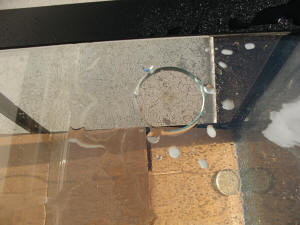
a 1' line! So what do we do about it? Either drill or have drilled bigger holes in your
overflow dang it! I hear from and troubleshoot for way too many people
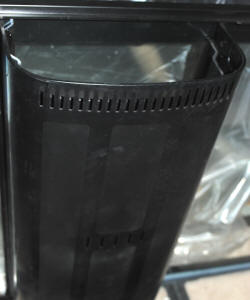
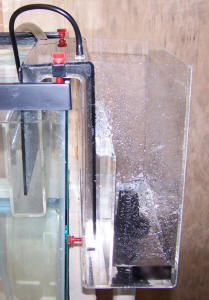
that have bought either 'reef ready' tanks or hang on the back
overflows that are just disappointed with the flow. There is no
way around it, physics is physics. Larger or more numerous drains
are needed. If you think about this before buying or setting up a
tank you are ahead of the game! Drilling your own holes is one
option. It is fairly easy, straightforward and through the last
few years the diamond holesaws needed have gotten dirt-cheap.
Another option is to custom order a tank with larger or more holes
drilled per your spec. Any good LFS can help you with this, if
they won't find somebody who will. The manufacturer will
usually charge X amount per hole, well worth the cost. As for how
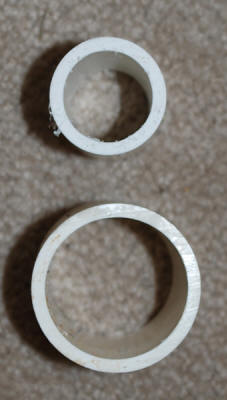
big, how many, I feel the industry standard should be 1.5' lines,
not 1'. A 1.5' line requires a slightly larger hole and
will easily safely flow 750 gph plus! Jump that line to 2'
and you are looking at more than 1300 gph without issues.
So what is a 1' drain good
for? Nanos, pure and simple. I'm not talking
a 40 gallon nano either, more like the 10-15 gallon type! Anything
larger has the space and deserves a larger drain.
Testing the things! Anybody with a
container of known volume (actually measure the thing out yourself) and
a timer can test these flows. Time vs. volume moved is easy
enough to measure. I have personally spent many (if not hundreds)
of hours actually testing such things. A 1' overflow with a
vertical 24' line and no siphoning will consistently yield right
around 330 gph. Add an elbow, horizontal run, strainer (God
forbid) or any other plumbing and 300 gph quickly becomes
generous. Redundancy One last word to the wise. A 1' drain
on a 90 gallon tank can provide enough flow for filtration with 300
gph. Another whole issue is overflow redundancy. That is,
if the drain fails/gets clogged, is there another to take up the
slack? Overflows should always come in twos, double what is
needed! My question I have asked myself for years is
'Why do we even have to deal with this?'! Well perhaps it is
pure laziness of manufactures not testing their product or flat out
misleading customers. The fact of it all is we need and should
have larger throughputs on our overflows. Do not be satisfied
with 1', bigger is better here! |
|

|
Features: |
|
| Featured Sponsors: |