|
FAQs on Otocinclus
Stocking/Selection
Related Articles: Otocinclus, Loricariids,
Related Catfish FAQs: Otocinclus 1, Otocinclus 2, & FAQs on: Otocinclus Identification, Otocinclus Behavior, Otocinclus Compatibility, Otocinclus Systems, Otocinclus Feeding, Otocinclus Health, Otocinclus Reproduction, &
Suckermouth
Catfishes of South and Central America, Loricariid Identification, Loricariid Behavior, Loricariid Compatibility, Loricariid Selection, Loricariid Systems, Loricariid Feeding, Loricariid Reproduction, Loricariid Disease, Catfish: Identification, Behavior, Compatibility, Selection, Systems, Feeding, Disease, Reproduction, Algae
Eaters,
|
|
|
South American lime green Endler's- Oto?
7/25/16
Hi Neale,
<Jill,>
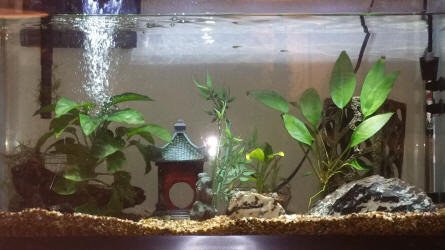
I have a planted tank- see my large photo- of lime green Endler's. I have
had it for a while and the population is now waning, down to 9 small fish.
I am debating whether to wait out till this population passes naturally, or
add more fish since they could reproduce some more still.
<Understood, and been in this situation any number of times.
It seems like safest type to add would be more lime Endler's, but I was
feeling like it might be nice to add a 2nd species for interest.
<A good plan. I gradually switched from Cherry Barbs to Limia in my big tank
over the last couple years. The Cherry Barbs were "life expired" and now I'm
down to a singleton living in the group of Limia. That Cherry Barb seems
happy enough, with friendly company to help him feel secure, even in the
absence of his own species. My point is that if you choose the second
species carefully, there's no reason you can't phase in a new schooling
species even as an existing schooling species dies off naturally.>
I read Otos or Cory's are ok with them, but Cory's are ruled out due to I
have gravel and supposedly sand is best for their barbels.
<Correct. There are some midwater Corydoras though, like Corydoras habrosus,
for which this is far less of an issue than it is with, say, Corydoras
aeneus.>
They also suggested small tetras or Rasboras but seems like it could be a
competition thing if adding a very similar type/style and its not as
interesting if all the fish are little minnows, all looking the same other
than their color.
<A question of taste really. Endler's Guppies will cohabit well with most
"nano" tetras and cyprinids, assuming their water chemistry and temperature
requirements overlap.>
I like this cute catfish "Otocinclus macrospilus" but they do get to 1 1/4",
definitely larger than the little Endler's.
<But very peaceful. One of the standard Otos of the hobby. Don't like very
hard water or high temperatures though, so while perfectly compatible with
Endler's in terms of behaviour, and both species are primarily algae-eaters,
they're not easily combined. I'd be aiming for around 10 degrees dH, neutral
pH, and around 24 degrees C/75 F. Water current needn't be too strong given
Enders are relatively weak swimmers, but Otos do need lots of oxygen, so
air-powered filtration would be my recommendation. Failing that, just avoid
overstocking, and perhaps add an airstone in summer.>
It's attractive and a different species so adds more interest, and larger
looks nice. However, would the Otos be likely to compete with or be
outcompeted for food from the Otos?
<Nope. Add Hikari Algae Wafers or similar, and they'll both nibble away
happily. Otos really appreciate some fresh green algae, too.>
Would Otos trouble my longtime resident fish?
<Otos are good community fish, though as noted, they are quite picky about
living conditions, and in busy, overstocked community tanks tend to die
after a few weeks or months. In the right tank they're not hard to keep.>
Would the Otos eat the fry?
<Unlikely. Like most Loricariids, Otos will have minimal impact on
livebearer populations.>
I think you said most would eat fry, just wondering how aggressively they
would, since they are supposedly mostly vegetarian.
<Correct.>
And should I feed cats algae tabs or will the algae on plants and rocks be
sufficient nutritionally?
<Definitely add extra algae-based foods. Otos frequently starve if left to
fend for themselves. They consume green algae and aufwuchs in the wild, but
are not scavengers and they do not take hair algae, blue-green algae and so
on. Starved Otos will sometimes nibble on the mucous of large, slow-moving
fish, but they're completely safe with fish their own size.>
I do want them to police algae aggressively, but I don't want them to starve
to death if they are picky on the type of algae. I also have some crypts
that I could transplant in there if this tank is not planted heavily enough
for Otos.
<Otos actually like bright, open conditions best. Tall plants, flat stones,
and plenty of places for them to graze, ideally with a decent current but at
the least good quality, oxygen-rich water.>
thanks,
Jill
<Welcome, Neale.>
|
 |
|
Re: South American lime green Endler's- Oto?
7/26/16
Thanks Neale.
<Welcome.>
I will consider my options some more. I will test my water again. I can't.
recall from last time what hardness is, but our water here is naturally very
alkaline and hard.
<Endler's are good; do also look up Micropoecilia (some of which are extremely
colourful) that are similar in size and behaviour. Phalloceros
caudimaculatus is another colourful little fish.>
I do have a log in there too that has an Anubias or something like that attached
to it, and it could have affected the hardness.
<Unlikely. As I often point out, if softening water was as easy as dumping a log
in it, we'd all be doing that! But unfortunately softening water requires either
RO or the collection of rainwater. One is expensive, the other impractical in
many places.>
If it's less hard or alkaline, I could always move the little Endler's to the 10
gallon which doesn't have the log since they're such a small number and prefer
harder water, and try another fish for the 29 gallon.
Jill
<Cheers, Neale.>
Re: South American lime green Endler's- Oto?
7/26/16
Thanks Neale.
I will check those fish.
:-)
<Good luck! Livebearer associations can be a good way to find these fish, and
they're often sold very cheaply at fishkeeping club auctions if someone is
keeping them locally and has fry to spare. Cheers, Neale.>
Re: South American lime green Endler's- Oto?
Thanks.
:-)
<Welcome!>
|
Enough Otos now? 12/7/14
I have a tank rated for 29 gallons by the manufacturer. The tank is 36"
L x 12" W x 18" H. The ph is 8 and nitrates and ammonia at 0. My filter
is a sponge filter rated for 40 gallons. This tank contains 2 guppy
females, 5 neon tetras, 11 platy fish, 1 Otocinclus catfish, and
numerous bladder snails.
Just wanted to update you and let you know I got 2 more Otocinclus
catfish for the one I already have in my tank. Is this considered a
school of Otos now?
<A school is usually at least 6 fish. Smaller groups can work, but often
don't. Otocinclus are difficult to keep in small groups. Indeed, they're
difficult to keep at the best of times. I would keep at least 5, and
ideally 7-8 specimens in a tank your size. Since Otocinclus are so tiny,
they don't add a huge amount to the biological load on the filter.
Keeping even 8 specimens wouldn't over-tax your aquarium. Ditto, to be
honest, the Neons. Cheers, Neale.>
re: Enough Otos now?
Thank you Neale! :)
<Most welcome.>
Continuing Oto stkg 12/8/14
I have a tank rated for 29 gallons by the manufacturer. The tank is 36"
L x 12" W x 18" H.
<Fun fact: 29 US gallon aquaria actually hold 25 US gallons on water.
The aquarium sizes given are nominal and based on the outside
dimensions, not the inside dimensions. The names of the tanks, 20
gallons, 55 gallons, and so on -- in US usage at least -- are purely a
convention and have only a weak relationship to the amount of water they
hold -- which is *always* less than the quoted volume. By the time you
allow for rocks, gravel, etc., your tank probably holds a lot less water
than you think.>
The pH is 8 and nitrates and ammonia at 0. My filter is a sponge filter
rated for 40 gallons. This tank contains 2 guppy females, 5 neon tetras,
11
platy fish, 1 Otocinclus catfish, and numerous bladder snails. Just
wanted
to update you and let you know I am working on getting 5 more Otocinclus
catfish for the one I already have in my tank. Is this enough Otos now
for
my tank? Is my tank overstocked?
<Your tank, once the Otocinclus are installed, sounds just about right
to me, assuming, say, half of those Platies are juveniles. Bear in mind
the Platies will breed quickly given the chance, so you want to be
rehoming/selling Platies as you go along.>
Thank you.
<Cheers, Neale.>
Different types of algae and who
eats/needs them? (for miniature Otos)
8/26/13
Hi Neale, I hope you're enjoying your weekend!
<Did indeed.>
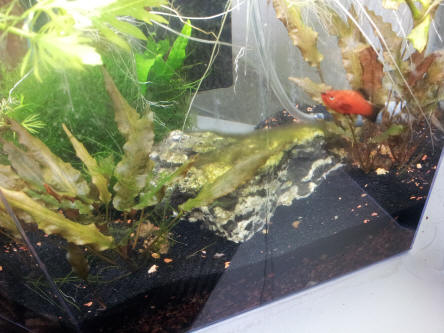
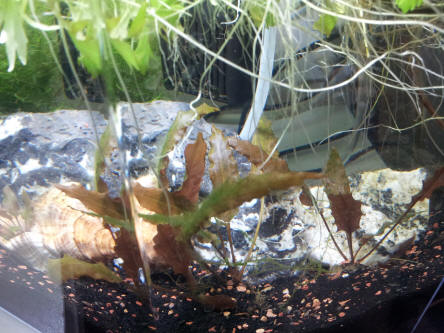
I've attached 2 close up photos of some algae growing in 2 of my tanks.
<Yes.>
Since you've been keeping fish a long while, do you know what fish eats what
type of algae....?
<In my experience, the "fish eats algae" paradigm is only of limited use,
and tends to depend a lot on what other foods are available to the fishes in
question. That said...>
In particular, do my algaes in these 2 pictures look like the type the tiny
1.5 inch Otos like to eat?
<Otocinclus tend to eat green algae and diatoms. Green algae is usually
leaf-coloured and forms patches or low fuzzy tufts in aquaria. Diatoms form
the golden-brown slime on glass and rocks. The dark green to blue-black
beard and thread types are usually red algae (red is the colour when
preserved in alcohol, by the way) and Otocinclus generally don't eat these
types.>
Most store tanks are low on algae and therefore they just feed them pellets
which is less ideal.
<Not sure this is strictly true; good quality algae flakes and wafers should
make an acceptable staple.>
Since I grew some naturally with great success on this rock and the crypts
plants, I wonder if I have an Oto buffet, or would they ignore it and grow
feeble without some other food?
<Try it and see!>
I'm asking because in the forums I have heard people saying this fish eats
this algae but not that algae, and they go on and on about their specific
types of algae and the types that will or will not get eaten by various
types of fish!!!
<Correct. There's some overlap between algae eaters, but each fish species
often has preferences. I'd also add that few, if any, fish is as good as
Nerite snails. Fish simply aren't as methodical. Fish generally ignore the
thread or beard algae types too, with a few exceptions (Siamese Algae Eater
and Ameca splendens spring to mind).>
I'd love to try a small school of Otos, but I want to make sure I have the
right type of algae so they're not just stuck with compressed tablets of
algae.
<Do bear in mind that Otocinclus aren't just eating algae; to a large extent
they're feeding on detritus and tiny animals that live among algae threads,
what scientists call "aufwuchs". So, even if the algae type isn't 100%
right, it'll still be home to stuff Otocinclus can eat.>
Every fish care paper I read says "it's best to have natural algae growing
in their tank," but that's not specific as to what type the species actually
prefers and will eat. I suspect what I have is good Oto food....but
don't know for absolute certainty if these are super picky little creatures.
<They're semi-picky. They are at risk of starving in a new aquarium or one
with dim lighting and hence little algae growth beyond, say, blue-green
algae (which they cannot eat). But in a mature aquarium or one with enough
lighting for plants to thrive, they'll find enough to eat, especially if
their diet is supplemented with a good quality algae wafer. Generally,
competition from other fish tends to be the killer. If they're harassed by
larger fish, then they'll fail to thrive, no matter what other factors are
correct.>
If I move the sword(or swap rocks) to the 2nd tank, they could have the rock
with the heaviest algae, since there will be more of them. Though
they're so little... Not sure even they could make a dent on the furry rock
any more than the sword has. Of course maybe if they had just the
plants and the less algaeful rock, maybe they'd clean those up faster.
That would be nice for the plants.
<Yes.>
And the sword favors the rock. She munches it happily.....I feel a
little guilty to move it to the other tank. Is the algae on the rock
probably the same type as the algae growing on the plants anyway?!
<Otocinclus and livebearers enjoy the same algae types, so whatever the
Swordtail eats will be correct for the Otocinclus.>
And....would I need to supplement the Otos diet with anything else if this
is the right type of algae for them?
<For sure, though less often (once a week, perhaps) if they are nicely
fattened up on algae and detritus.>
I do intend to put a piece of driftwood in their tank as well, as I heard
they like it.
<Correct, though likely this has more to do with culturing algae and
aufwuchs than anything else.>
Thank you, I hope you've kept Otos to know what they like too.
<Yes, have kept them, though much prefer Nerites as algae-eaters.>
I know you like brackish a lot, which they're not, but I think you have wide
knowledge and experience.
<Some.>
Jill
<Cheers, Neale.> |
 |
|
Re: Different types of algae and who eats/needs them?
(for miniature Otos) 8/26/13
Thank you, Neale, very helpful.
I like the little Otos and I'll get some. Have a nice week.
<Most welcome! Neale.>
|
Oto Pics please? 2/9/10
Hello, Sorry to bother you guys again... but could you send me a
picture of a healthy and an unhealthy Oto? bottom and side view is
best. All the images on the web seem the same and I'm not good
enough to tell them apart.
Thanks!
<Do see here:
http://www.wetwebmedia.com/FWSubWebIndex/Otocinclusart.htm
As with other Loricariidae, healthy Otocinclus have convex bellies;
unhealthy ones concave bellies. Very ill fish have sunken eyes.
It's a simple as that. I don't really recommend Otocinclus for
casual aquarists because they are delicate, need specific foods, and
tend to be short-lived in "average" aquaria lacking the
oxygenation and water flow they appreciate. Cheers, Neale.>
|
Betta Eye Problem, & Otocinclus sel.
f' 02/06/09 I bought my Betta about a
year ago. He is housed in a 10 gallon planted tank that he shares
with 4 Otos. I keep the temp at 78. The tank has medium lighting
(2 x 13 watt spiral CFLs) that is set for 10 hours a day. I use a
sponge filter and do weekly water changes of 20%. For food he
gets Betta pellets with occasional freeze dried blood worms and
brine shrimp mixed in (all Hikari products). He occasionally
munches on Oto algae wafers but spits most of it out. The
problem: My Betta has one white spot on each eye. The spots have
been there about a week, unchanged. The spots are opaque and on
the lower half of the eye. His eyes are not cloudy and the spots
are defined, not cottony, and it looks like they are on of the
lens of his eye. He does not show any sign of distress. He's
eating normal, normal behavior, normal eyesight it seems. The
water parameters are all good, ammonia 0, nitrites 0, nitrates 5.
Last PWC 20% on Sunday. When viewed under a magnifying glass, I
can see no swelling, redness, or movement of a parasite. Do fish
get cataracts? Could this be early signs of blindness? I have
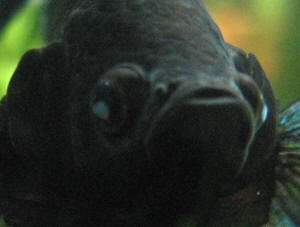
attached a picture in the hope that it will help you diagnose the
problem. Thank you for taking the time to read my email. Heidi
<Hello Heidi. Firstly, well done on keeping your Betta in a
heated, filtered aquarium of reasonable size! If only everyone
did that, there'd be a darn sight fewer sick Bettas in the
world. Now, do fish get cataracts? If we simply mean, can the
clear parts of the eye get damaged or turn opaque, then the
answer is yes. There are two main reasons. The first is physical
damage. If a fish bumps into something, or repeatedly jumps out
and hits the hood, is handled in a rough net, or is molested by
some other fish in the aquarium, the front of the eye can get
damaged, and the net result is the equivalent of scarring. Dead
white tissue forms a lump at the front, obscuring vision. The
second reason is infection, where the damage is caused by
bacteria or a parasite (e.g., Eye Fluke). More often than not,
this follows on from chronically poor water conditions, with
bacteria getting into the fish and causing harm because the
fish's immune system has been weakened. Now, I don't
think that's the issue here because your tank sounds very
good. Otocinclus are much more sensitive to water quality than
air-breathing Bettas, so if the Otocinclus are fine, the Betta
should be too. (As a side note, I'd not recommend keeping
Otocinclus in tanks 10 gallons or smaller precisely because they
are so sensitive to water quality.) There are some less common
reasons eyes become cloudy. One is malnutrition, specifically a
lack of Vitamin A. Again, I don't think that's the issue,
since the diet you're offering sounds excellent. Another
possibility is chlorine, which will cause this symptom among
others if not removed from the water. Assuming you're using a
dechlorinator, then this isn't likely. This leaves two
possibilities we can't do anything about: genetics and
senility. Bettas *are* inbred and genetically quite weak, and
there are lots of problems that they get that aren't obvious
when young but become more serious as they age. As for senility,
wild Bettas are basically annual fish. Since the fancy Bettas
sold in shops are about six months of age, your fish may well be
a year-and-a-half old already, if not more, if it was sitting in
the aquarium shop for a while. So it could be just plain old.
Sure, Bettas can live in aquaria for 2, 3 or more years, but
anything over a year from purchase and your fish is well past its
prime. Can anything be done? Not really; just as in humans,
damage to the eye doesn't usually heal without surgical or
pharmaceutical intervention, and that's not really viable
here. Since fish don't rely on their eyes to anything like
the degree humans do, if its vision is impaired, it will manage
just fine using its other senses, particularly its "built-in
radar" system, its lateral line. The one thing I would keep
alert for is how the Otocinclus behave. I have (repeatedly) seen
these fish attack injured fish, going for open wounds and grazing
on the blood. They may even cause these wounds directly.
Personally, I do not consider Otocinclus community fish, and
particularly warn against moving them with anything slow, e.g.,
Angels, Gouramis, or indeed Bettas. Cheers, Neale.>
Re: Betta Eye Problem 02/06/09 Neale,
Thank you so much for your prompt reply! It seems likely from
your description that either genetics or senility is to blame. As
I said, he does not seem to be bothered by the condition, but I
will certainly keep a close eye on him. I appreciate your advice
about the Otos. I was told by a trusted Betta website that Otos
would be ok with Bettas. To date, I have not seen them attack my
Betta whether he's been sick or healthy. They generally stay
away from him, as he likes to chase them away from his territory.
However, I will be much more alert to their behavior towards him
since I trust your experience in the matter. If I see that they
are giving him a hard time in any way, then I will find them a
new home. Thanks again, Heidi <Hello Heidi, I'm glad your
Otocinclus are behaving themselves. Some do, but some don't,
hence my warning. Good luck, Neale.>
|
 |
Otocinclus Bob, I read your article in FAMA re: Otocinclus/S.
American sucker mouth catfish..., and purchased 2 at a local pet shop.
The salesperson said they were Chinese catfish, but they looked like
the Oto pictured in your article. I want them for algae control in a 36
gallon tank with 3 mature Angel fish---2 egg laying females, and one
male. I chose them as they seem to be more active than the Pleco
species, and because they will make an "active" addition to
the tank. Any suggestions...? Thanks. Dale Fox <Mmmm, suggestions re
what? Enjoy them. Maybe give a read over the materials on the
Freshwater sub web:
http://www.wetwebmedia.com/FWSubWebIndex/fwsubwebindex.htm Bob
Fenner>
Cycling, timing, and Endler's Dear WWMites, <<Kewl.
I'm an official Mite!!>> Well, thanks to the rest of your
site (and I thought I'd read nearly everything before), I've
answered my own questions. Wow, y'all have a lot of
stuff for us to read! I backed out to the home page and
found more links to more info a bit farther
down. Unfortunately, the intense absorption of so much info
knocked most of the third grade out of my head to make
room. Ah, well, third grade was a bust
anyway... To recap: We'll get the Otos much later in the
process rather than earlier, and our earlier decision on five (one per
ten gallons) is apparently a good population. Also, my bride
and I decided we're going to replace several of the silk plants
with live plants, both for the beauty and the Otos. <<Excellent
idea :)>> We'll stick with making larger batches of tweaked
water, and go get a cheapy air pump to aerate it (at least overnight)
before we use it. We're also talking about increasing
the water changes to 20% a week rather than every two weeks, especially
after reading about the sensitivity of Otos and Corys to nasties in the
water. <<It would be a good idea to vacuum your substrate
regularly, Corys are prone to bacterial infections of the barbels.
Nasty stuff can accumulate in gravel beds, and Corys are always
sticking their noses into...it. :P>> We're going to have to
decide which Corydoras to get, since they prefer being with their
own. I'd had the impression that it wouldn't quite
do to mix based on genus rather than species. (Now if I can
just convince my wife to go with the paleatus...) <<My favorite
Corys are melanistius melanistius and adolfoi. You can check out pics
of any species of Cory cat at www.planetcatfish.com/ Maybe you will
both see something inspiring there that you agree on :)>> As I
said in an earlier message, the little speed demon is, indeed, an
Endler's. He's started getting a stronger hint of
green on his caudal fin, and a more definite green tinge on his rear
half. We're looking forward to getting a group of them
after New Year's. <<Nice fish. Easy to keep and not a royal
pain like so many livebearers can be...Belonesox spring to
mind.>> Again, thanks for the wonderful site, and I hope I
haven't chewed up too much of your time. Glen <<You are most
welcome. Happy Fishing. LOL. -Gwen>>
Oto <what? Oto parts?>- 6/1/07 Hi Robert,
after days of hunting for Oto's I feel that it can not hurt to send
you a mail. <Hello, Neale here.> > I am in Shanghai and now
have a discus aquarium. In Europe I have always had Oto's in my
tanks and have always been fascinated by their behaviour and
rewarded by their gentleness. Clean plants no algae growth on the
leaves etc. <Yes, they can be excellent algae eaters. But I hesitate
to recommend them too widely for a variety of reasons, not least of all
the fact they seem to travel poorly and the mortality immediately after
import is very high.> > Plenty of algae (green) on the back wall
of the tank but not a problem. <Your observation of their liking for
green algae is spot-on. Otocinclus are ideal for planted aquaria where
the background level of algae is low and limited to green algae types.
In "unbalanced" aquaria with few/no plants, Otocinclus have
no useful impact and in fact often starve to death because they will
not eat the brown, hair, and blue-green algae common in such tanks.>
> I have hunted everywhere to try and purchase these fellows here in
China > but have had no success. <Given you are keeping discus, I
would *never* keep Otocinclus with them. I have observed Otocinclus
sucking the slime from large, slow fish in my aquaria, and assume that
discus would be an obvious target. Other aquarists have observed this,
with Otocinclus attacking angels and discus. Far better to choose
something a bit large, like one of the "clown" Panaque
species (such as Panaque maccus) or even Ancistrus spp.> > I am
hoping that with your knowledge of these fish and your reference to the
tiger Oto that has been bred in Asia that you may be able to point me
in the right direction to obtain them. I have always had the Otocinclus
affini but any > Oto's would be fine. <I personally don't
know who is importing/trading that variety, but I'm sure if Bob
does know, he'll follow up. As a general rule, placing a
"special order" with retailers is often the way to go.
I've done this many times.> > I apologise if this mail is out
of context as I have no idea how busy you > are or how much mail you
get from your site. > kindest regards > john Ramsey <Good
luck, Neale>
|
Question for Neale about TFH article, 10 gal.
stkg. Otos f' 01/13/2008 Neale,
<Hello Evan,> I read your article in the TFH about 10
Gallon stocking. I was wondering if you had a reason for not
mentioning Otocinclus along with the Corydoras. Is there a
specific reason to not add the Otos to a 10G tank or were you
just limiting yourself to keep the article concise? <Yes,
there was a specific reason for leaving them off: Otocinclus spp.
have an abysmal track record in aquaria generally, the VAST
majority dying within a few months of introduction. I would never
recommend them to anyone without several years of experience, and
even then, only when placed in a mature tank (lots of green
algae/aufwuchs) and excellent filtration. This pretty much rules
out the average 10 gallon tank received as Christmas present,
which was the focus of the article. If you want an algae-eater,
get cherry shrimps; if you want a catfish, get Corydoras hastatus
or some other Dwarf Corydoras. Both these will prosper without
anything more than an "average" level of care, i.e.,
water changes, proper food, etc.> I ask because I have a 10G
with 9 Glowlight Tetras to which I would like to add 3 or 4 Otos
(as soon as LFS orders some). <Think very carefully about
this, and only if you have LOTS of green algae. Otocinclus really
don't eat anything much besides green algae and the
microorganisms therein. Brown algae, blue-green algae, etc.
aren't substitutes! To get green algae growing, you'll
need 2 Watts of light per gallon, at least. There needs to be a
"turf" of green fuzzy algae on the plants and rocks.
THAT'S what these little catfish eat. On top of that, you
need plenty of water flow (at least 4x the volume of the tank in
turnover per hour, and ideally 6+) and above-average oxygenation.
Nitrates need to be close to zero, and certainly less than 20
mg/l. If you can't answer all these demands, then skip
Otocinclus.> I perform 40% WC every 5 days, so I think I would
be able to keep that many fish and maintain good water quality.
What are your thoughts? <Best avoided, frankly.> Thank you,
Evan <Cheers, Neale.>
Re: Question for Neale about TFH article plus
Corydoras 1/14/08 Dr. Neale, <Evan,> Thank you
for your responses to my questions about Otocinclus. Through my
web-based research I thought that supplementing the Otos'
diet with Nori and vegetables would be adequate, so I'm very
grateful for your input on the matter. <You may be fine doing
precisely that, but the cold, hard reality of the matter is that
whatever people do, most Otocinclus don't seem to survive
long in anything other than a big, mature tank with plenty of
algae. Their diet is a subject of some discussion among
hobbyists. They may be partly parasitic as well as algae-eaters:
in aquaria they have been reported MANY times to eat the mucous
and skin from large, slow fish. I have seen this myself, my
Otocinclus causing a significant amount of damage to the body of
an Awaous goby. Do they eat mucous only when hungry? Is it
something they do regardless? No-one really knows.> On the
subject of the Corydoras hastatus & C. pygmaeus: I currently
have medium to large "aquarium gravel" (colored
pebbles) up to about 1cm in diameter. Would this substrate be
acceptable for keeping either of the above Corydoras species?
<Acceptable yes, ideal no. With all Corydoras, the best
results come with lime-free sand, simply because it's more
fun to watch them plough through the stuff. That said, the
midwater Corydoras species like Corydoras hastatus likely
don't care either way.> If not, what kind of substrate do
you recommend? <The best for a small, planted tank is
unquestionably black sand. Looks lovely, and because it removes
upwelling light, fish adopt their brightest colouration.> If I
need to replace the gravel, what is the best method? <If you
have an undergravel filter in your tank, best not to change the
gravel at all. But if the gravel is purely decorative,
there's no real problems. Just take all the fish out, put
them in a tub or bucket with the filter connected to that vessel
so the bacteria stay happy. Then empty out the aquarium, remove
some or all of the gravel, and then add the cleaned sand to a
depth adequate for the plants. If no plants (or at least no
plants with roots, as opposed to epiphytes) then you only need 2
cm/1 inch of sand.> Again, thank you for your help. Evan
<Happy to help, Neale.>
|
How to keep bacteria alive in a
fishless tank? 4/24/08 Hello Neale, <Giuseppe,> hope
you and your tanks are doing well. <Yep, we're all just fine;
thanks for asking!> I have 2 unrelated questions. 1) I will be on
vacation for 2 weeks in June and I was wondering if the good bacteria
would starve to death in a tank without fish. By then I will have all
my fish in the 46-gal, but I would like to keep the established 10-gal
running to try breeding when I'm back. Again my question is whether
or not the good bacteria would starve in these 2 weeks or not and what
could be a solution. Maybe I should leave 1 or 2 Otocinclus and they
would eat the algae in the tank? <Otocinclus aren't my favourite
fish in the trade because their survival record is so poor. But
certainly some hardy algae eater, like an Ancistrus or Hemiloricaria
whiptail, could be left in the 10 gallon tank for a couple of weeks
with a bit of carrot for grazing but otherwise left to fend for
himself. Alternatively, just stick a small frozen prawn in the tank and
let it rot away. Remove when you get back, obviously. Yet another
option would be a plain "holiday block" of the type often
sold for Goldfish and the like. These are basically lumps of limestone
that dissolve away, releasing flakes of food. Again, the food will rot,
producing ammonia. The bacteria couldn't care less where the
ammonia comes from.> 2) How should I feed Otocinclus? I used to have
1 in the 10-gal tank and he did great for 1 year without feeding
anything. When I moved the fish to the 46-gal it died after a couple of
weeks, probably because there was no algae in the tank. When I'll
be on vacation for 2 weeks I will use an automatic feeder loaded with
flakes or mini pallets, which the Otocinclus wouldn't eat. Do you
think the poor guy would starve? <Otocinclus are very difficult to
feed. They almost entirely eat "aufwuchs", the combination of
green algae and micro-invertebrates that encrust surfaces in bright,
clear waters. They are opportunistic to some degree though -- most
notoriously eating the mucous from slow moving fish -- but still,
getting enough food into them within a community setting can be very
hard. They do best (perhaps only do well) in large tanks with
established algae "turfs" on the rocks and plants where they
can feed continuously, supplementing that diet with bloodworms, algae
wafers, and so on. I'd tend to avoid in favour of hardier, more
adaptable Loricariidae, of which there are many.> Thanks, Giuseppe
<Cheers, Neale.>
|
Oto loses colour Hi, We have a sick Oto which has suddenly
lost its pigmentation and is looking a sickly grey. It is swims
weakly, sometimes floating at the surface and drifting in the
current. Otherwise its body, fins, etc. look in good condition.
Can you suggest any remedy or is this something to do with the
tank conditions? We have a 180-litre (40 gallon) community tank
with 9 guppies, 3 minnows, a Pleco and 5 Otos altogether. It has
some live and plastic plants, a couple of logs and a small rock
pile (slate), i.e. there is a relatively large surface area
available for the Otos to graze on. It has been set up for about
3 months, but, about 3 weeks ago, we had problems with water
quality, fungus and white spot. These were successfully treated
with 10% water changes every day and ESHA 2000 and EXIT.
Treatment finished 7 days ago. Current conditions pH = 7.8, KH =
6°, GH = 12°. Ammonia, nitrite and nitrate
levels all low. We have isolated the sick Oto. Grateful for your
advice. Regards, Quentin <Hello Quentin. Let me start by
making a general statement about Otocinclus: they are extremely
difficult to maintain, and the vast majority die soon after
import. The problem is that they feed on really only a single
thing -- aufwuchs, a combination of green (and exclusively
green!) algae together with the tiny invertebrates that live
within that green algae 'biofilm'. Unless you have an
established aquarium of large size with very strong lighting (2+
watts per gallon) so that green algae can flourish, it is
exceedingly unlikely your Otocinclus will be getting enough to
eat. How many months it is before they die is variable, but
starve they will unless ample substitutes are provided. Algae
wafers can work, but Otocinclus find it difficult to compete with
other fish, and the fact you have other algae-eaters,
specifically guppies and Plecs, makes this point critical. For
this reason, I simply don't recommend them as community fish.
Furthermore, while water chemistry itself isn't all that
important, temperature and water quality are very important. Most
people keep their tanks far too warm for Otocinclus, which come
from cool, fast-flowing streams and want something in the 20-25
degrees C range rather than the usual 24-28 degrees C most people
maintain standard community tropicals at. In other words, a
near-subtropical, fast-water tank with things like White Cloud
Mountain Minnows and Danios is much closer to what they want than
a standard Amazon community aquarium. You also mention ammonia
and nitrite levels as being "low" -- but be under no
illusions here, Otocinclus MUST have zero levels of both. If you
can detect either in your tank, it is simply not suitable for
Otocinclus. In all likelihood the sickly specimen will be dead
within a few days, so treatment here is irrelevant. Optimizing
water quality, lowering water temperature, providing ample green
algae and suitable invertebrates would all be things you could do
to help the isolated fish, but that's about it. For the rest,
you need to ensure your aquarium satisfies the demands outlined
above. Hope this helps, Neale.>
Re: Oto loses colour 7/6/08 Neale, Many thanks for your
helpful advice. The Oto has now died, sadly. However, we will
develop the tank environment to make it better suited to
Otocinclus. They are an entertaining fish to watch. <Yes they
are. In the right tank, they can be great fun. In the wrong tank
though... My most recent run-in with this species was a disaster,
some of the Otocinclus deciding to graze on the mucous of some
large benthic gobies. They have a reputation for attacking big,
slow moving fish such as Discus and Angelfish. On the other hand,
aquarists like Takashi Amano make much use of Otocinclus in
planted aquaria, usually alongside Caridina shrimps as a superb
combination for green algae control in brightly lit aquaria.>
Thanks again. Your website is a mine of information and a great
support to the budding enthusiasts in our family. Regards,
Quentin <We're happy to help, and thanks for the kind
words. Cheers, Neale.>
|
|
|

