|
FAQs about Acroporid Coral
Behavior
Related Articles: Acroporids, SPS
Corals,
Related FAQs: Acroporids
1, Acroporids 2, Acroporid Identification, Acroporid Selection, Acroporid Compatibility, Acroporid Feeding, Acroporid Disease, Acroporid Systems, Acroporid Reproduction, Stony/True Coral, Coral System Set-Up, Coral System Lighting, Stony Coral Identification, Stony Coral Selection, Coral Placement, Foods/Feeding/Nutrition, Disease/Health, Propagation, Growing Reef Corals, Stony Coral Behavior,
"When in doubt, do nothing"
|
|
Branching Montiporas retracting polyps 11/12/11
HELP!!!, Why would only branching monti's retract polyps??
<A few general reasons... "something" not agreeable in the
way of water quality... allelopathy from other life in the
system...>
Has anybody else experienced this strange behaviour??
<Sure>
Last week all of my branching Monti's retracted all of their polyps
(which had been fully extended for many months prior to this) and look
like bald pieces of rock. This happened to 3 different digitata's
(peach and purple ones), a ORA Jeremy's Monti, ORA spongodes.
this is really weird and disturbing because ALL other corals (SPS, LPS,
Zoas, etc.
<Likely the Zoanthids are the cause here... again, that mysterious
"something" upset the Zoas, they in turn released chemicals
into the water mal-affecting the Montiporas>
Are not exhibiting this trait whatsoever. I have a sunset Monti and a
Rainbow Monti that are still OK, as well as plating Monti's that
are ok as well, and all other SPS' have extended polyps including
Birds Nests (thick branched and thin), millies, red planet, several
chalices, basically all other living inhabitants are OK! System
param.s: I have a 125 mixed reef tank with 40 gal sump, protein
skimmer, running BRS GFO in a reactor, carbon in a reactor, daily 2
part dosing (Randy Holmes Farley recipe), plenty of flow/water turn
over using RKE wave maker setting with 2 Koralia Magnum 7s and 2 4s,
plus dual returns from sump.
Temp: 78
SG: 1.026 - 35ppt refractometer (calibrated with 35ppt solution)
CA: 420
AK: 9.2 Hanna checker
PO4: 0.00-0.04 - Hanna checker
NO3: 4 - red sea Pro low level Nitrate test kit, confirmed at SEA with
High end Hanna tester.
MG: 1350
15% water changes every 10-14 days
Test param.s weekly
Tank has been set up for 1 1/2 years.
<All the above looks good... I would step up the water changing
regimen, and add a bit of chemical filtrant... Read here: http://wetwebmedia.com/ZoCompF3.htm
and here: http://wetwebmedia.com/cnidcompppt.htm
and as much of the linked files above as it takes to clue you in
here>
Nothing (to my knowledge) has changed in my tank that I can point to
that would cause just branching Monti SPS to totally retract their
polyps, while everything else is fine, especially since Monti's are
supposed to be hardier than most SPS' are.
If anyone has experienced this before and/or can shed some light on
this, I would welcome the input.
<Then you're welcomed in turn... Do write back if any of this is
unclear, incomplete after reading. Bob Fenner>
Re: Branching Montiporas retracting polyps 11/12/11
Thanks Bob, I was reading on your site that removing too much phosphate
can also cause these symptoms of starving the corals, true?
<Mmm, can, as well as too little; but you don't have excessive
HPO4, and you report/ed that your other Cnidarians were fine>
I tested my PO4 yesterday with my Hanna checker and it was zero, so I
took my gfo reactor and carbon reactor off line to see if letting the
PO4 build up some to around 0.04 on my checker would help?
<As well as just simple food additions for your other
livestock>
The reason I am leaning that was is based on what my last PO4 reading
was before the symptom started showing up (my recorded PO4 level was
about 0.05). Could the water be too "clean" for the branching
Montis?
<Not likely; no>
Based on the limited information you have about my system, would you
still lean toward the Zoanthids?
<Some form/source of allelopathy, yes. The Zoanthids/Mats are the
most likely suspect of what you list/ed>
The branching type Monti's that are affected are in different areas
of the tank and have been in the same spot for several months before
this occurred.
<As I surmised>
One final thought (change that I made just before this happened) I had
several smaller power heads for flow in my tank, that were not on any
sort of timers or wave makers, so I replaced them and reconfigured my
flow with the two Koralia magnum 7s on an RKE wave maker. This has
provided a LOT more varied flow for my tank and just after making that
change I noticed the branching Monti's retracting all of their
polyps.
<Could be a factor as well>
Just want to mention that none of the Montis are directly in front of
the power heads and are not getting blasted with flow. Could it be the
increased flow is "stirring up" the Zoas released chemicals
causing this?
<Yes>
Based on this limited info about my situation, what would you do in
this situation?
<Nothing overt. I might increase/pulse whatever source of iodide-ate
you utilize, as well as the items mentioned in last email...>
Looking forward to your responses.
Thanks,
<Welcome. BobF>
|
Montipora ID - Capricornis? -- 03/23/10
Hi,
<Hello there>
I purchased this blue Montipora capricornis some time ago.
It's growing very different from my other Monti caps, it has
mini pillars forming, so I'm wondering if it might be another
type of Montipora.
<Mmm, type...>
It's not very blue, I know, but I just upgraded from 8x24W T5
to 250W MH with 4x24W T5HO so its color is changing. However
I'm not sure it will ever become the bright blue I originally
saw pictured. You can barely see them in the picture, but the
tiny polyps are bright blue, and not as close together as my
other caps.
Thank you.
Debbie
<Is a beauty! And not to worry... this expression of
"polymorphy" is common... even w/in the same species...
due to conditions, prevalent "color"/pigmentation,
photosynthetic pigments. Bob Fenner>
|
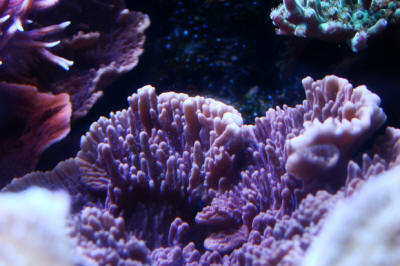 |
Green Montiporas capricornis turning cream colored
1/18/10
Hi, ever since I started in this hobby I've had the same problem
without known explanation: All my green Monti caps turn cream
colored!.
<Mmm>
Before I had a T5 system, and green Monti caps that were military green
in the beginning, became creamy in a couple of months.
<Some aspect of water chemistry likely...>
Then I changed to HQIs and the same, I thought they were getting
bleached but considering that it also happened with T5s in mid of the
tank then I´m not sure its the light.
<Mmmm, may be... where are you locating these? Do you have (access
to) a PAR meter?>
I acquired one of those new Tyree blue polyp Monti caps. And it also
turned creamy colored but the blue polyps remain unaffected!.
I also have all kinds of encrusting montis and they are unaffected, I
also have an orange Monti cap and it remains unaffected as well, I have
green and yellow Acros and they keep their colors, green Monti caps are
the only ones that turn cream colored, I don´t know why.
All my parameters are right and people have told me that its caused by
having very little nutrients in my tank.
<They do need some phosphate, nitrate, other macro and
micro-nutrients. In other words, there is a possibility of nutrient
deprivation>
I do water changes every 1.5 months and change only 15% of the water
and nitrates never get higher than .5ppm.
I´ve been adding phytoplankton at night, and no difference.
Its just weird...
<... stony corals don't eat Phytoplankton. Please read here:
http://wetwebmedia.com/CnidIndex2.htm
toward the bottom of the page... the sections on Acroporids, SPS... Bob
Fenner>
re: green Montiporas capricornis turning cream
colored
Thanks for the info. I've always have a low bioload, but I'm
starting to buy more fish though I don't know if that will
help.
<May well do so>
As I told you phosphates are 0
<... Have you read on WWM re... HPO4? Here:
http://wetwebmedia.com/phosphatemar.htm
and the linked files above>
and nitrates to <too> low, I also have a fuge with Chaeto, but
there's hair algae growing on the glass, I leave the one that grows
on the back so my tangs can feed on it.
Is my tank really nutrient deprived consider that hair algae grows on
the glass?.
<Possibly>
I read the link you sent me, and I think I will start supplementing a
mixture of oyster, squid, shrimp, etc. Corals feed on that right?.
<Some aspects, some species>
Hopefully my green Monti caps will colour up.
<I'd be reading re chemical food ... Vitamins, HUFA
supplements...>
You know, I've seen coral only tanks and I wonder how they keep
them so colorful without fish, but I guess they feed something to the
corals.
<Yes>
Since I don't see any other cause, then I can say that I've
taken so much care of water quality my whole life, that perhaps my reef
is a bit lacking nutrients. Like I said, Monti caps are slow growers in
my tank,
<And wild>
maybe that's a sign of slow nutrients. And the other corals in my
tank don't really grow fast, they grow a bit then stop for a
while.
<Keep reading. B>
Re: green Montiporas capricornis turning cream colored
1/21/10
I just want to inform you of a very noticeable change. Two nights ago I
fed the tank 1 vial of Prodibio reef booster. Turned the skimmer off.
The next day I observed the green montis that are now cream montis to
be sort of "tanned" as if they got a bit of colour from last
night´s feeding.
<Interesting>
This has led me to create my own coral food, how many times a week
should I feed?
<Two, three>
, my recipe:
1 half octopus
10 mussels
2 raw shrimp
bottle of Scott's emulsion original
1 spoon of crab eggs
half little of water
blend it all.
Feeding 1 spoon per night, How many nights a week?
good?
<We'll see. BobF>
|
Question about White Margin Developing on M.
capricornis -- 12/11/09
Hello WWM crew!
<<Hey Kevin!>>
Eleven days ago I purchased my first Montipora capricornis frag.
Except for two small pale spots the frag appeared in good
condition. After the first week the two pale spots nearly
disappeared. However, about three days ago I noticed the white
margin beginning to widen. When I purchased the frag it had a
small white margin (less than 1 mm wide) but now it is 2-3 mm
wide.
<<Is likely exhibiting growth>>
I have attached a photograph of the frag (sorry for the poor
photo).
<<Ah yes>>
I acclimated the frag as I typically do with other corals and
placed it mid-level in my 24" tall tank. I have a PC
lighting system (1-65W Actinic, 1-65W 10,000K and 1-65W 6,700K)
that mimics the diurnal cycle. The lights used by the LFS were
metal halides and the holding tank was about 8" deep.
<<Mmm, quite a difference'¦but not likely the
issue here, and with this specimen>>
My water quality parameters are OK. I also purchased a frag of
Acropora spp. at the same time as the M. capricornis frag,
acclimated it using the same technique and placed it at the same
depth. The Acropora spp. frag is doing very well. I have seen
pictures of wild M. capricornis with similar white margins and
have read that white margins could be a sign of growth.
<<Indeed'¦ And though the resolution of the pic
makes it impossible to be certain, this is what this appears to
be'¦to me>>
I have also read that the coral may be losing its
zooxanthellae.
<<Also a possibility>>
Should I be concerned of the widening margin?
<<Can't say for certain, but I don't think
so>>
Is there anything I should try?
<<Simple observation for the moment (further handling is
going to increase stress)'¦ If it does turn out to be
bleaching, trimming it back to healthy tissue may save
it'¦though often not the case with small pieces like
this>>
Any suggestions will be warmly received.
<<Wait and watch for now>>
Kevin
<<EricR>>
|
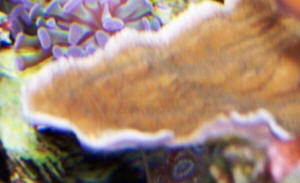 |
Scrolling Montipora flow - 02/08/09 I have a red
Monti cap and I want it to scroll its a rose form. Currently it is
under a 150W 14K HQI bulb. It gets good flow that circles around it.
I've heard that flow/lighting will influence on how this coral will
grow. I'm not sure what those influences are though. I was
wondering if you could help me out with the subject. <Mmmm... along
with feeding, water quality mostly... the lighting is fine period, the
only improvement here would be to have it traverse the surface like our
sun... Water movement needs to be vigorous (20 time plus turns per
hour), non uni-directional... perhaps Koralias, Vortech, or Tunze
Streams on a reversing schedule via a wave maker or other control
device. Bob Fenner>
|
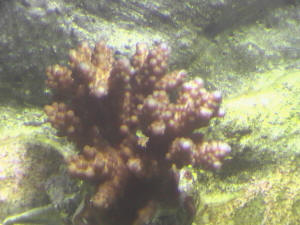
Acropora Question'¦Coloring Up --
10/09/08 Hello Crew! <<Hiya John!>> I hope
that all is well. <<Not bad, thanks>> I have a
question about Acro coloration. <<Okay>> I know that
it is common for the bright colors found on Acro tips to fade to
brown or green during shipping/time spent in poor lighting at a
LFS. <<Among other factors, yes (water quality, nutrient
concentration/availability, allelopathy, etc.)>> Anyway, I
purchased a small Acro colony about 30 days ago. It was
completely brownish/red when purchased. Now, about 3.5 weeks
later, the tips seem to be turning blue.
<<Excellent>> Is this possible? <<Indeed it
is'¦and is what most hobbyists are wishing for/expecting
when purchasing such corals>> Could this have been a
blue-tipped Acro that turned 100% brown due to poor lighting @
the LFS? <Or for other reasons mentioned'¦yes,
absolutely>> If so, is it possible for the tips to turn
blue after only three and a half weeks?
<<Certainly'¦ These corals will generally begin to
'color up' quite rapidly'¦if they are going to
at all'¦though this can be affected by differences among
species, and likely more so due to differences in conditions of
the systems in which they are kept (i.e. -- a brightly colored
coral in one tank turns brown, in another'¦or
vice-versa)>> My concern here is bleaching. <<How
so?>> My water quality is good (<1ppm nitrate and
phosphate, <<The life in your tank requires both of these,
and some hobbyists even dose Sodium Nitrate to feed/improve the
color of their Acropora colonies. The Nitrate level you show is
fine in my opinion (even beneficial), and while it doesn't
have to read '0' this much Phosphate may prove
problematic'¦I would take steps to reduce this to less
than half this reading>> undetectable ammonia and nitrite,
water a bit warm at 80 degrees [Florida summer] <<80F is
fine in my estimation>> and small bioload). I have a 120
with a foam/cement background, crushed coral, remote DSB, sump
w/filter sock for mechanical filtration, and skimmer. I am
currently running two 250W metal halides with 14K bulbs. The Acro
has high placement in the tank, about 3/4 of the way to the top.
I do target feed about twice a week. I will attach some before
and after pics. Sorry, they are not the greatest. <<I see
these'¦and this coral looks fine. The lightened tips are
due to new growth of this coral'¦nothing to be concerned
with>> Thanks for everything that you guys do...
<<We're happy to share>> you're true heroes
to the aquatic community. <<Ah! Thank you for the kind
words>> Also, do you know what the exact species is? -John
Patten <<Not exactly, no. I think it's possible it is
A. valida (like this one here:
http://www.ultimatereef.net/uploads/Picture%2034%20-%20Acropora%20valida.jpg),
but perusing pictures at some of the retail sites may give you a
better 'general' idea. A more exact ID would require
close examination of the coral's skeletal structure. Eric
Russell>>
|
  |
|
Re: Acropora Question'¦Coloring Up --
10/10/08 Eric- <<Hello John>> Thank you so
very much! <<Quite welcome>> The coral's tips are
even more blue today than when I took that picture.
<<Great!>> I'm very excited that my lights/ water
quality are conducive to such good coral growth! I forgot to
mention that I'm using a reactor with Seachem PhosGuard.
<<I'm a big fan of Seachem's product line, for the
most part'¦but there has been some debate as to whether
this 'Aluminum' based product is harmful to marine
systems in the long term>> I have used ion-exchange resins
in he past, but they clog up to the point where water no longer
flows through it. <<Indeed'¦best utilized with an
up-flow/fluidized-bed type reactor>> The PhosGuard's
shape allows water to flow through it without getting clogged.
<<This is a function of the media's size as much as its
shape'¦the ion-exchange resins I have seen/used are also
spherical in shape, but much smaller in size allowing them to
compact more tightly and thus clog more easily>> Is this an
okay set up, or should I try to switch to PhosBan or another high
quality ion-exchange resin? <<I prefer the iron-based media
for Phosphate removal (and there are cheaper products about than
the PhosBan), and the ion-exchange resins are a fine choice if
you can bear the expense or will take the time/trouble to
regenerate them. But do a little research re the effects of
Aluminum/Alumina in the marine aquarium, as well as read Randy
Holmes-Farley's assay of the Seachem product (should be able
to 'Google'), and see what 'you' think. Cheers,
EricR>>
R2: Acropora Question'¦Coloring Up --
10/11/08 Wow, thanks for the quick response!
<<Welcome>> I did read an article (I think it was a
WWM article, actually) about the aluminum problem.
<<Okay>> Then I read a FAQ from Seachem's website
that states that the aluminum is very low as long as the product
is thoroughly rinsed in fresh water before being used in the
aquarium. <<I see'¦but what is 'very low'
I wonder. I do recall that Randy's assay registered
measurable amounts>> Still, I have my doubts. <<Me
too>> I have read that ROWAphos is very good, but again,
I'm worried about clogging. <<Unless used in a canister
filter that can force the water through the media, I find
fluidized-bed filters or reactors designed as such work best as
they 'suspend' the media and reduce
clogging'¦though with the iron-based Phosphate removers,
thorough rinsing to remove the 'very fine ' particles is
still necessary>> The reactor I use is a ViaAqua PR 20/20
with a Maxijet pump. <<Ah yes, I too have/use one of these
with an iron-based Phosphate remover>> Do think this is
contributing to the clogging? <<Mine works very
well'¦as long as I rinse the media very well before
loading the reactor>> If you don't mind me asking, what
phosphate remover do you use? <<Not at all'¦I use
PhosPure'¦and yes, my choice is based on price>>
Thanks so much for your time! <<A pleasure to share.
EricR>>
R3: Acropora Question'¦Coloring Up --
10/11/08 Eric- <<Hello John>> Thank you very
much for all of the information. <<Quite welcome
mate>> You have been very helpful! <<Glad to
know>> I think that I speak for everyone when I say you
guys really do something great by running this website! -John
Patten <<Ah! Very redeeming to hear, thank you. Cheers,
Eric Russell>>
|
|
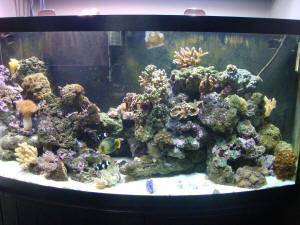
Receding Montipora 10/7/08 ??? Hello
everyone, <Hi Jason - Brian here> I trust you are all doing
well this morning! I am sorry to have to bombard you with more
questions, but here we go... Here are the general details of my
set up: 72 gal bow front 2x250 metal halide bulbs (12 inches
above glass cover) (10.5 hours per day on timer) 4 fluorescent
bulbs in unit also (14 hours per day on timer) 1502 calcium
reactor Ozonator running off my skimmer (Coralife skimmer) 80 or
90 lbs of live rock 2-3 inches of sand I keep a log of my water
tests, which I do 2 times per week. My results average at the
following: SG. 1.023 temp 80-82F ammonia 0 nitrite .1 nitrate
0-2.5 calcium 420-460 ph 8.4 Alk 10-11dkh I am moving the tank
volume at least 10 times per hour through the sump (I also have 3
power heads running in the tank) I supplement with iodide once
per week (half the recommended dose). Water changes are 15
percent every week or so. <First I want to applaud you for the
description or your tank and it's conditions. It makes it
much easier for us to help when done as you have done. Secondly,
your caretaking disciplines are outstanding, way to go Jason!!
The one thing that jumped out at me is that your nitrites are not
0,they should be, based on your other results, I'd bet they
are 0, maybe re-test.> So... I purchased a few sps (over a
couple weeks) about 5 weeks ago. (6 Acropora, and 1 Montipora)
they all seem to be doing fine until yesterday I noticed the
Montipora receding a bit. After discovering this, I promptly went
on to your forum and found several posts on this subject. I think
I have a stock problem as I have quite a mixture. I have several
mushrooms, 4 leathers, hammer, star polyp, xenia, torch,
elegance, flower pot, long tentacle anemone, rose anemone, sea
mat, as well as an assortment of button polyps. I keep the
stoney's located high in the tank, and as isolated from the
other corals the best I can. I also try to keep the leathers low
in the water column to minimize the chemical issues; as well I
use activated carbon in direct flow in my sump. <I looked at
your pictures very carefully and don't see the receding that
you are talking about. I do see a lot of growth (white along the
edges) and what appears to be a very happy Montipora
capricornis.> After reading the FAQs, it seemed like my first
option was to try and move the Montipora, however, it has
calcified to the live rock and doesn't seem to want to let go
(I didn't pull too hard, but it seems pretty intent on
staying where it is!) <This is a good sign, it has grown and
attached to the rock.> I have attached a couple of low rez
pics to give you an idea of the placement, and the inflicted area
of the coral. Can you please advise? Thanks so much for your
dedication to the hobby! <I think that you have laid out the
tank in an excellent way; you appear to being doing what you need
to do and in the right manner. Maybe a better picture would
change my opinion, but until then, don't worry too much, give
it some time and good luck!! BrianG> Jason
|
|
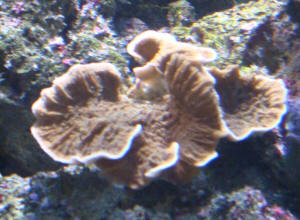
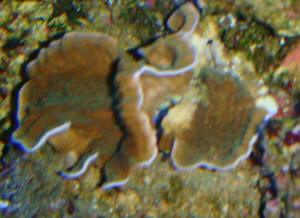
Re: receding Montipora 8/18/08 Hi
Brian, <Hi Jason!> I wanted to resend you some new
photos. I think these pictures help show what I was
concerned about a lot better. On the right side plate of
the coral you can notice that the color is turning white
(particularly where the plates seem to join in the middle.)
It seems to do this on most of the edges, some spots worse
than others. Is this growth or illness? Thanks again for
your time. <Definitely growth!!! You have a happy coral
that is growing. This coral is known for it's rapid
growth so expect to see this most of the time. >
Jason
<Take Care!! BrianG>
|
 |
|
Re: receding Montipora Thank you Brian.
<Thank you for writing us Jason>I think my test kit
for no2 might be faulty. I have never had a reading below
this number... I have however had a higher number when I
cycled my hospital tank, but never lower. Its almost all
gone I suppose I should just get a new test kit.
<It's important to remember that with an established
tank such as yours, Nitrites should always be zero. If they
aren't it should be a red flag due to improper testing,
another cycle or a stale test kit.>
|
|
Acro suddenly looking different... 10/4/08 Guys!
Thank you for all of your help. I have a question about my first small
colony of Acropora. It's been in my tank for around 4.5 months and
seems to have been doing great. The color is a beautiful fluorescent
green(it was brown at my LFS for weeks). Growth has been slower than
I'd like, but it is growing. Polyp extension is what I was going to
ask about. Ever since I bought it, the polyps have been out almost all
day and in a massive way at night. I finally bought some DT's
Oyster eggs about 5 days ago and have fed the correct amount three of
the last five days. Yesterday I noticed that my Acro's polyps were
closed up a lot...all day. <Mmm, likely just
"digesting"> Even last night, much less extension in the
polyps. Is this a result of the DT's (no longer hungry)?
<Probably> It also looks a little irritated on the tips closest
to the light. I noticed my small emerald crab climbing the Acro the
night before...could he have had a little taste of my prized coral?
<Oh yes> I also switched out 2 of my 8 T5 bulbs on Tuesday. I
replaced my stock current 10K and actinic with ATI Aqua blue and Blue
plus. I figure that only changing 2 of 8 bulbs would be safe from any
kind of shock (I've slowly replaced all 8 bulbs with ATI and
Giesemann without missing a beat in the past). Because I'm new to
SPS, guess I'm a little paranoid that it could be declining. All of
my SPS seem to be doing so well, but I keep hearing horror stories
about how one little error could cause SPS to die quickly. All
parameters are good(according to API tests). Bird's nest, green and
orange monticaps, pink Stylophora are all doing well. Any ideas? Thanks
for your time! <Just patience here. Bob Fenner> Seth
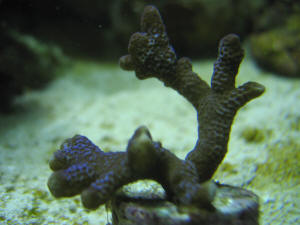
Acropora questions. 6/5/08 Hello!
<Greetings!> I think I have an Acropora Digitata. <Looks
like a Montipora digitata to me...> Bought the little guy from
LiveAquaria.com about 2 months ago. He used to be in a smaller
tank, didn't grow much, and stayed brown. I have recently put
him in my bigger tank with the same amount of light, and more flow,
and he is turning into the purple color you can see in the picture.
<Does happen. Always exciting.> I noticed in the FAQs that it
is simply just utilizing the light in a different way, hence the
color change. Correct? <In essence. Better/more light makes a
need for UV-blocking pigments, and better water flow/ quality
allows for coloring pigments to be produced.> Also! The tips on
the ends of the "branches," seem to be a creamy, off
white. Is that a sign of growth, or is it stunted from being put
into a new tank? It has been in the tank a little over 3 weeks..
<Just the growing tips, as far as I can tell. If you don't
see shrinking tissue and there is continued growth, all is
well.> Thanks! <No troubles. Benjamin> Acropora
questions. Sys. 6/5/08 Hello! <Nicolas> I think I have an
Acropora digitata. Bought the little guy from LiveAquaria.com about
2 months ago. He used to be in a smaller tank, didn't grow
much, and stayed brown. I have recently put him in my bigger tank
with the same amount of light, and more flow, and he is turning
into the purple color you can see in the picture. I noticed in the
FAQs that it is simply just utilizing the light in a different way,
hence the color change. Correct? <Possibly. Could be other
influences, differences in the two settings as well> Also! The
tips on the ends of the "branches," seem to be a creamy,
off white. Is that a sign of growth, or is it stunted from being
put into a new tank? <Let's hope the former. Often the
growing ends/tips of Acroporas are light/er colored> It has been
in the tank a little over 3 weeks.. Thanks!
<Keep enjoying, reading... Bob Fenner> |
|
|
|
Acropora millepora retract
4/29/08 Hi Crew: <Rich> As usual thanks
for the great wealth of information. My tank is a mixed reef with
various Acropora placed middle to high in the tank and some
Zoanthids and LPSs on the bottom. Tank parameters are Alk 9,
calcium 420, magnesium 1350, salinity 1.024. Tank is 125 gallons
with sump and refugium. Lighting 2x250 mh, phoenix bulbs, 2x 54
t5's actinic. Flow is provided by 2 Vortech pumps. I have a
GEO calcium reactor and ATI skimmer which seem to be doing their
job. Other pieces of equipment are a Phosban reactor <...
Acropora need soluble HPO4...> and UV sterilizer. Finally to
the question. Amongst my various types of Acropora are 3 pieces
of Acropora millepora placed in various spots of the tank. The
corals took a few months to acclimate, but then started to grow
nicely. The hairy polyps had great extension and the colors were
alarming. <Good word> Now, all of the hairy extensions have
retracted. The corals still have their color and I can see polyp
extension at night but only on the tips of the coral, not the
hairy polyps seen during the day. My other types of Acropora have
not skipped a beat with regard to growth. I've been
monitoring this situation for the last week, hoping the hairy
polyps would return with no success. Is this natural behavior?
<I do think so, yes... Most Acroporids do "feed",
open their polyps mainly during dark periods... when their
preferred sizes, types of zooplankter foods are out and
about...> I'm assuming it isn't. If not, do you have
any words of wisdom? Thanks again for your time and knowledge.
Rich <I'd be testing for phosphate... leaving some... Bob
Fenner>
Re: Acropora millepora retract 4/29/08 Mr.
Fenner: Thank you for the quick reply. I will shut down the
phosphate reactor and monitor. Rich <Ah, very good. I would
take a look/see during the night... to observe whether this
colony is open then. Cheers, B>
|
Monticap, not Monty Hall - 03/12/07 Dear Sir, <Ernest>
I am just starting on having an SPS dominated tank in my 120gallon reef
tank. 48 inch length x 30 inch high x 20 inch wide. <Okay> The
tank has been set up for about 3 months with initial growth of
coralline algae showing up. (I believe its good news). <Yes...
generally indicative of full-cycling, suitable habitat...> Tank
parameters are on par. <Fore!> And I have just purchased a
monticap (very small ~ 2 inch wide). Which has been in my tank for 3
days now. <For others... this is some sort of new-reef-speak for a
species of Acroporid, Montipora capricornis> My lighting is 400W
12000K Metal Halide, I've placed my monticap halfway up the tank so
around 20 inch into the water. My question would be, for SPS and this
monticap, how deep would I be able to place them in the water before
its not good for them? MH height is 20 inch from water. <Mmm, really
depends on what species, and more importantly, what conditions they
were living under recently (and to a lesser extent what conditions from
some time back...). In practical terms, better to start most deeper...
raise up to shallower in weeks time... to prevent
"burning"/bleaching, stress> I have a Tunze WaveBox for
flow, would adding Tunze stream 6100 be better or 6200 ? <Mmm, the
more the merrier in the way of flow> Also after 3 days I do not see
much polyp extension on the monticap, would this be a cause for
concern? <Mmm, nope... too short a period of time as yet to have
become acclimated... and don't have much in the way of polyp
extension at any length...> There was some slight damage on it when
I first got it, i.e. some small broken tissue, but it was a cheap
pieces so I bought it. Further I am planning on introducing grape
Caulerpa into the sump as a natural filtration media, would that be
advised? <Mmm, no... best to look around for other genera, even
Division (Reds, Rhodophytes)...> There's no Chaeto in Hong Kong
(where I live). Best Regards, Ernest <Mmm, please read here:
http://www.wetwebmedia.com/marine/inverts/index.htm
The tray with Stony Corals... Scleractinians... Bob Fenner>
Crazy Coral Color Issue 12/12/06 Good Afternoon Guys &
Gals: <Scott F. your guy tonight> I have a quick one for you. I
recently obtained a small (1") green Acropora frag. The odd thing
is that half of the frag seems to have lost it's neon colour. I do
not think the tissue is gone as it does not appear any different to the
coloured side except it is not brightly coloured on that side. I just
wanted to ask if you have encountered this before and if you think the
frag is just adjusting to the change in lighting.. <I have
personally encountered such a phenomenon before, and I am not exactly
certain what contributed to it. I speculate that it's something to
do with lighting; one side lit well, and perhaps the other side not
well at all.> It came from 2x250w halide bulbs. I have 2x150 HQI 10K
bulbs that are basically brand new. water params temp: 79-80 ph: 8.2
nitrite: 0 nitrate: 0 ammonia: 0 calcium: 500mg/L alkalinity: 4meq/L
Flow: ~24x turnover Regards, J <Well, J, your environmental
parameters sounds fine. I suspect that it may correct itself once the
frag adapts to your lighting. In the absence of tissue recession, etc.,
I'd recommend staying patient and waiting it out. Regards, Scott
F.>
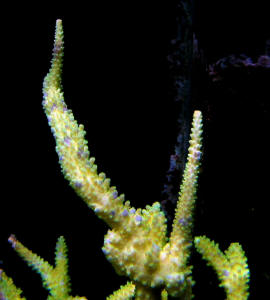
| Purple Spots on Acropora yongei 3/10/06 Hello. One of my
corals (I think it is A. yongei) has been developing a number of
small, purple spots. It does not look like the tissue is sloughing
off in these areas, but I can't see any polyp extension either.
This coral has been in my tank and doing okay for over 2 years. I
did change from 175W to 250W MH, but that was over 6 months ago and
this symptom just started to show up about a month ago and is
progressing slowly. There does not seem to be a pattern, high or
low on the coral. All other SPS and LPS species in the tank,
including other Acropora, look normal and are doing fine. Water
parameters are good. Please see attached. Thanks. <A very nice
pic of a very nice specimen. I do believe this is "just"
coloration returning to the colony... Beautiful. Bob
Fenner> |
|
|
Acropora turning brown Bob: Love your site.
<Adam here today. Thanks for the kind words.> My questions is as
follows. I purchased some Acro's that had different colors. My
125gal. nitrates and phosphates jumped over the recommended limits and
the across turned brown. Now my tank is reading almost 0% phosphates
and nitrates and my across are growing quite well and the tips are
gaining color. I worked diligently to get my nitrates and phosphates
under control. My question is as follows, will the brown part of the
across eventually turn to their original colors or will they remain
forever brown. Thanks, Joey <Ahhh... an easy question! I don't
know. There are many variables that effect Acro coloration. Nutrients,
alkalinity, lighting intensity, lighting spectrum, iron, feeding, etc.,
and often it is impossible to predict, let alone closely control all of
these variables. In many cases, wild Acroporas fail to retain or regain
their wild coloration. This is why those that do and do so under a
variety of conditions are so prized. Sorry for the
"non-answer", but I hope it helps. AdamC.>
Acropora Color Change Bob: <Scott F. in today!> I
purchased some colorful Acroporas and placed them in my tank. In a
couple of weeks, they started to turn all brown. I have since got my
phosphates to 0% and my nitrates to under 5%. The across are starting
to grow with tips being colorful. My question is will the entire
Acropora return to its original color now that I have my water quality
under control? Joey <Great question, Joey. The prevailing wisdom is
that the colors of coral are a sort of natural "sunscreen",
which the coral will manufacture as it needs them. Under intense light
and high water quality, it is certainly possible that the colors will
return to something approaching their original splendor. Phosphates are
well known to inhibit calcification and color in stony corals, so you
were right on in trying to get water quality in order. Interestingly,
you will often get different colors for the same species even under
different lights. Good luck! Regards, Scott F>
Acropora ahoy! "What was I thinking?" "It cost
you HOW much!?" "Throw it in there and pray!"
"Yeah, that's a nice one." "HA! goooood luck!"
Well...so far I've had more luck with SPS than with MPS or LPS, so
what the heck. The colony (Acropora gemmifera as far as I can tell at
the moment) is 3" across and 2" inches high, and NOW I know
what an axial corallite looks like. been eyeing it for 2 weeks since it
came in. perfect coverage, extension. the retailer didn't even have
it under direct lighting. So the adventure starts... do you think
I'm crazy? Chris >> Not crazy, perhaps just enthusiastic
(From the Gk. meaning "the god in you", en thuus, hence the
term theology...) Do take a look at the A. gemmifera and other pix I
have placed in a survey piece (the "Acroporidae") on the
site: www.wetwebmedia.com... More info there re the selection and care
of these quintessential SPS'. Bob Fenner
Re: Acropora ahoy! uhoh. Went out in the Gulf for Spanish
Mackerel and Cobia today. When I got back, my new Acropora (which was
very dark burgundy when I got it) abruptly (in less than 12 hours!) had
changed is tissue color to a light tan-orange. (1 or 2 branches were
still dark), and the polyps were expelling the zooxanthellae w/mucus
strands. The axial corallites have not faded however. Did I waste my
money (I won't give up on it until its dead or thriving)? Is this
even necessarily a bad sign? If it is, is it treatable? thank you,
Chris (PS, I am extremely stubborn and do not give up on anything,
especially corals, so I am definitely an optimist, and don't ever
tell me that something can't be done or at least attempted, because
I'll stand firm and accomplish it or at least try it, and for the
moment, the death of my Faviid polyps has ceased to progress any
further after supplying it with augmented circulation) >> Ah,
good to hear... not a good change in your Staghorn... but not the end
of its or your world... Bob Fenner
Re: Acropora ahoy! Though I'm disappointed in the color
fading in my Acro, and distressed to hear that its a negative change,
the colony really doesn't look any worse for wear this morning (no
bleaching, etc.). maybe the color will return eventually. Chris
>> Yes... the coloring is a "chicken-egg" type of
situation... the predominant pigments residing in your Acroporid are a
function of what's available (made by its zooxanthellae), chemical,
nutrient, physical (circulation, dissolved oxygen, carbon dioxide,
alkalinity, light quality/quantity/duration, presence of other
bio-chemical agents (from other livestock).... and many other
considerations... You can and do easily effect the color... as you will
find. Bob Fenner
Re: Acropora ahoy! pigments or a "function" of
what's available? is that like f(p) = x + y + z +... f(current
pigmentation) = x + y + z (sum of phys, chem, and light, etc. variable
interactions and effects)? <Yes, if you'll allow the addition of
a couple of qualifying additions (derivatives, chain-rule extensions,
exponentials... to some of these variables... Like the Maxwell-Beerman
Light Extinction coefficient (e to the minus ir...)> so by variable
manipulation (after acclimation is complete) thezooxanthellae
pigmentation (function) will change and develop accordingly? Chris
>> Or simple time and variability going by... Bob Fenner
Acropora and Sea Fan questions Hi all! Thanks as always for a
great site. <our pleasure> I don't know where I'd be
without my daily dose of WWM. <out of the Institution, perhaps?>
My first question is really more just curiosity than a problem (I
hope). I've noticed that my Acropora polyps are almost always out
during the day. They close after the lights have been out for a while
or after a feeding. <feeding particulates that is... they prefer
nanoplankton and feeding by absorption instead (some). Thus... no need
or irritation by the turbidly of plankton at night or your feeding>
I'm puzzled because the Acroporas that I've see in the display
tanks at my local pet stores are always closed. <varies by species,
water quality, water flow, etc> The pictures I've seen are
usually too small to distinguish the polyps. What is the normal
behavior supposed to be? <varies> Do I have anything to worry
about? <nope> I've attached a picture so that you can see
what my coral typically looks like. <a handsome coral> I hope
it's not too big, <if only I had a dollar for every time I had
to say that [fill in your own joke here]> was the smallest I could
make it without losing the detail. <[follow up joke inserted
HERE]> I feed them a variety of meaty foods that I blend in a
hand-held blender until very fine. <a nice effort but likely little
help. They do not eat phyto... and prepared meaty foods are grossly too
large. They need nano-sized zooplankton. A fishless upstream refugium
would be a much bigger help> I feed the tiny suspended food to my
small polyped corals and sea fan, <yes... better for the sea fan
indeed> and the larger crumbs that settle on the bottom of the bowl
I feed to my sun coral. <good strategy> My sun coral, by the way,
is doing very well and growing fast. <excellent. Do look in archives
for the old article in Aquarium Frontiers by Joe Yaiullo on asexual
planulation of this coral. Fantastic!> My second question is about
my sea fan. There is some Cyanobacteria growing on the fan -- but no
where else in the tank, <yes... needs more random turbulent flow
here... they have evolved by design to trap particles!> fortunately.
How can I safely remove it? <just better flow bud... tweak your
outlets but no laminar action here. Have two effluents converge above
it perhaps> The Cyano is beginning to smother the fan, but otherwise
the fan seems to be doing very well, even growing. I've included a
picture of the fan. You can see the dark areas where the Cyano is
growing. I have a 75 gallon tank with lots of live rock and about 3
inches of live sand. I keep a protein skimmer and a small carbon filter
running all of the time. My protein skimmer is a Turboflotor 1000
multi. The cup is filled about once a week (is that enough?). <not
really... (hence the Cyano). This is a skimmer with a good design that
needs pampering and tweaking. There are even companies that sell
modified Turboflotors. Browse the archives here and the message boards
for modification tips and tricks.> For lighting, I have a 384 watt
PC with two 10000K and two actinic bulbs. My water parameters are:
>pH = 8.3 >dKH = 9.3 >Calcium = ~400 >Ammonia = 0
>Nitrite = 0 >Nitrate = 10 Thanks, Patrick <best regards,
Anthony>
Acropora polyp extension 3/3/03 Hi Gang, <cheers, bud>
I have a question regarding my Acropora. I have three different
species, some I've had for over three years. My most recent are the
more thicker stem species that look like the Aspera or Tenuis species.
The latest is a really nice tri-color from Walt Smith. The problem I am
looking for help on is the polyps are not extending. In the store I
purchased them from they appear almost fuzzy like due to the polyps.
Mine are smoother due to the retraction. <the list of possible
influences is daunting... in contrast to your dealer's display:
water clarity, age of lamps, color of lamps, direct and total energy of
water flow, DOC levels... etc> The growth rate is good, but I fear
that this may not be for long. <polyp extension is not correlative
to growth rates, bud> My tank parameters are good. T=75, DKH 10,
Calcium a little low 360 (no reactor), Magnesium 1350, <easy on the
Mag with a lower Ca> and ORP 345. I change about 10 gallons a week
in a 125G tank with 35 gallon refugium on reverse lighting with sea
grasses no Caulerpa. main tank lighting is 3-175 watt MH, and 2 VHO 140
Actinic. I also have 2-tangs 6", and 5 small fish 3". I have
never seen any fish peck at these corals. Any ideas?? <the most
common and easiest parameter to tweak is water flow... usually more is
better. Adjust or increase the amount this coral gets... avoid laminar,
of course. The other thing is that LFS waters tend to be higher in DOC
levels, lower in water clarity and light (age of bulbs, salt creep,
etc) due to commercial "business" and setting... all of which
may force a coral to extend polyps further panning for light and food.
It not always a good thing. Extension is good... overextension is bad.
Ciao, bub. Anthony>
Heavily sliming Acropora 5/3/04 Hi, could you please tell me
which Acropora species slime the most heavily? Thanks <Yup. The
slimiest one! Seriously though... Many Acroporas are copious slimers.
The problem is that despite the fact that so many folks attach species
names to their Acroporas, making such an identification is nearly
impossible for the average (even advanced) hobbyist. Comparison to a
picture in a book doesn't work. Even a very detailed analysis of
the gross physical characteristics of an Acropora will usually only
narrow down the choices. In many cases, microscopic examination is
required. Sorry for the rant, but as you can tell, this is a pet peeve.
Best Regards, Adam>
Acropora polyp extension 8/19/04 Hi, I'm
getting sick and tired of my across polyp extension. when I get an Acro
that has long hairy polyps, a couple of weeks after I get them, the
polyps are not hairy anymore, and shrink up inside the coral. What can
I do? thanks, Adam <Hi Adam. Adam here. There are many reasons why
this might be the case. Please write back with some information about
your lighting, water movement, filtration and water chemistry (Nitrate,
pH, Calcium, Alkalinity). Please also list the other fish and corals
that you have. Best Regards. AdamC> <<Anthony here... as Adam
C has stated... there are many possible reasons for this, and it is not
even an indicator of good or better health. Still... if you want to
finesse this, know that inadequate water flow (not enough or not enough
of the right kind... as with powerheads/laminar outlets... yuck).
Nutrient levels are an issue too... some folks cheat by adding a
tablespoon of sugar to the tank on occasion. Not a great long term
habit, but add one spoonful and see what happens (this is safe in one
shot). It speaks to how some sugared supplements trick you into
believing they are effective. Anthony>
Acros only open at night 11/26/04 Hi all, <cheers> I
have read every thing I could find on your site and I still can't
get the answer I am looking for. First let me tell you about my setup.
My 55 gallon tank has been running for 18 months with DSB, remora
skimmer, 15X circulation, PC 260 watts (lamps 5mths old), mech. filter
for charcoal and lots of live rock. My measurements are 1.024,0,0,0, ph
8.35, pH .05, temp 80, cal 400 and alk 8.5. All test are double checked
by my LFS once a month. I have a clown, flame angel and a hawk fish,
all since the beginning. My corals are lots of mushrooms, zoos, one
Xenia and on the top Acros, pink birdsnest, trumpet, plate and a brain
coral. All corals have a good separation. I feed the fish a large
variety of frozen foods. The corals I feed a cocktail of Phycopure and
Cyclop-eeze or DT's and for the larger coral I feed bits of fish
food like Mysis. On Sunday I stir the top of the sand bed, clean my
skimmer, 10% water change and run test. I have no algae problems, lots
of coralline algae and everything is growing and happy. In fact, at
least once a month, I have to pull some of the corals and give them
away. When I first got the Acros, they opened during the day for 2
weeks but for the past 4 months the Acros open only at night. I see
lots of them in other tanks that are open during the day. I have tried
to entice them with food during the day but it does not work.
<hmmm.. since they do not feed organically very well/heavily... this
is not a principal influence (feeding). More likely water flow is the
culprit. And the change from behaviors on arrival is simply their
acclimation (or even suffrage if the flow is too low or way too
high)> However, they eat well at night. I have to believe that my
Acros are getting all they need. I know that I could use more light but
they are at the same level as the birdsnest and if it is growing, I
don't think that light is the problem. <agreed> Do you have
any ideas? <lots... the Pittsburgh Steelers should try to run Jerome
Bettis again this week and give Duce at least another week to rest>
If you think it is the lights are VHO ok? <very fine lights and good
color. I like the URI brand best. Change any brand VHO by 10 months>
MH just put out too much heat. <Ahhh... actually not my friend. It
really is a misinformation. VHOs as close to the water as they need to
be if effective (less than 3") are also hot. And either lamp style
can easily be cooled with a single muffin fan (9 watts) and a
well-designed fixture. MH are a better value by far in the long run
considering lamp life, trueness of color, intensity (bang for your buck
on light produced per watt), etc> PS I owe you all a big thanks. I
have saved a lot of money. Fan vs. chiller in the summer, proper
equipment selection, etc. Thanks <very welcome my friend. With kind
regards. Anthony>
Acroporas turning brown Hi WWM! <Hi Jen, MacL here with
you tonight.> I know you all are so busy these days, I have tried to
research this on my own and can't really find a lot of info on
Acroporas turning brown. I have asked several online dealers and the
LFS, but I get very conflicting information. <I can tell you right
now that's because multiple things can turn the corals brown.> I
have been told I didn't have enough lighting (when I had 2 X 150W
HQI MH), and upgraded to 2 X 250W HQI MH, and now have been told I have
too much lighting. <Did you acclimate the corals to the stronger
lighting? By acclimate I mean did you give them time to grow accustomed
to the stronger lighting by putting them on for less hours or perhaps
higher above the tank?> I don't know how much info you need to
be able to tell me why this is happening, but here goes. . . 80 gallon
tank, setup three years ago. 100 lbs. of LR, 60-80 lbs. LS, Lighting:
2X 250 W HQI MH 14k, 2X 96 W PC Actinics, mounted 10" off top of
tank. Aqua C Remora Pro (upgraded skimmer 6 months ago), 4 Maxi-jet
powerheads, approx 920 gph. Livestock: 1 blue tang, 1 royal Gramma, 1
lawnmower blenny, 1 six line wrasse, 1 citron goby, 3 blue Chromis, 1
cinnamon clown, 15-20 Turbo snails, 10 Nassarius snails, 20 Astrea
snails, 25 various dwarf hermit crabs, 2 blue tuxedo urchins, 2 Mithrax
crabs, 5-10 Cerith snails, 2 brain corals, 1 Favites, 1 Blastomussa, 1
Montipora (also turned brown), 1 Acropora, 1 yellow Porites. The
Acropora and the Montipora are both near the top of the tank, top
10". Water Parameters: PH 8.3 1:30pm, Temp 80, Amm 0, Trites 0,
Trates 0, Phosphates 0, Alk 8.4-9.2 DKH, Calc 375, SG 1.025. I use
RO/DI water for top off and water changes. I top off with one gallon
every night. I change about 5 gallons per week. I use Kalkwasser, turbo
calcium, and Warner Marine's two part A and B. I also started
adding this week Kent's Essential Elements (which I was told I
should be adding every week). <Your levels look great but let me
ask? are you having any ph fluctuation? Also, how long after you got
the corals did they turn color? How long had you had them? Do you have
any idea if they are wild corals? Often wild corals turn colors but
will often regain color after they adjust to the tank. Wild Acroporas
will often change as part of their adjustment. See what I mean by it
could be a lot of things?> Please let me know what you think may be
causing these corals to turn brown. I have also read "high
nutrients" can cause this browning. What nutrients??
<Phosphates can be a problem but generally high nutrients are what
they call the "dirty tank" which is often lots of algae,
plankton, etc.> Where are they coming from? How can I test for them?
If I was overfeeding wouldn't I see a rise in nitrates and
phosphates? I am just completely confused and my head is spinning with
what everybody has been telling me, please set me straight. <No
worries Jen, I think the most confusing part is that Acroporas can
change because of many things and the biggest thing is just to go down
the list one thing at a time to try to isolate what did it. Don't
worry we can help you.> Thank You, Jen Marshall
|
|


.jpg)
.jpg)
.jpg)
.jpg)