|
|
| Home | Marine Aquariums |
Freshwater Aquariums |
Planted Aquariums |
Brackish Systems |
Ponds,
lakes & fountains |
Turtles & Amphibians |
Aquatic Business |
Aquatic Science |
Ask the WWM Crew a Question |
| Please visit our Sponsors | ||||
|
Shipping Acropora 1/20/10
Miami orchid, Acropora... sel. 1/11/09 <Hello Greg, Minh at your service.> I recently traded for a Miami orchid frag. My tank is mostly LPS and I was wanting to know if I would have any problems introducing this coral to my tank? I have Frogspawn, Bubble coral, Open Brain, Blasto, Mushrooms, Candy Cane, and Montipora. Any input would be appreciated. <If this is your first acropora then congratulations on selecting an aquacultured fragment from ORA. This is one of the highest quality specimens available and would yield the highest chance for success. Unfortunately, I do not have enough information about your tank to give proper husbandry advice. If you would like to get a more specific response, please reply with more information about your particular tank set up. For example, flow rate, lighting, basic water parameters along with the major elements such as calcium, alkalinity and magnesium. I would also suggest for you to review these excellent articles on Acroporids: Acroporids 1: http://www.wetwebmedia.com/acropori.htm Acroporids 2: http://www.wetwebmedia.com/acropt2.htm Acroporids 3: http://www.wetwebmedia.com/acropt3.htm> Greg <Good luck, Minh Huynh.> Re: Miami orchid 01/13/09 <Hello Greg.> I have a 55 gallon tank with a 25 gallon refugium. Calcium is at 430. Alkaline is 10.2 dKH. magnesium 1370 ppm. Salinity is 1.026. PH is 8.2. Water temp. is 78. Ammonia, nitrite and nitrate are always 0. <It appears that your water parameters are spot on. The key to Acroporids success is stability in these crucial parameters. A quick note: low phosphorus level is also another important area to look into.> Lights are 260 watt power compacts about 3" above water level. I have 2 600 maxi jet power heads on opposite sides of the tank along with 2 1200 maxi jets returning water from my refugium. <These are two areas for concern. Acroporids are generally found and collected from exposed reef flats where constant brisk water movement and intense lighting is abundant. The PUR (Photosynthetic Usable Radiation) available from Power Compacts may not meet their lighting demands in some cases. To maximize light and flow availability to the coral, I would suggest for you to place the Miami Orchid near the light and flow source.> I have Brillo algae in my fuge along with a aqua c remora protein skimmer. I also have 100 lbs. of live rock. My main concern was if the Miami orchid was peaceful or if it could launch some kind of chemical warfare against my LPS coral. <Allelopathy is certainly possible between various corals including LPS and SPS. However, there are many examples of successful mixed tanks with healthy Acroporids and LPS corals. To limit any chance of allelopathy, maximize their proximity and employ GAC (Granular Activated Carbon).> Thanks for all your help. I have learned so much from your website. <You're welcome. Cheers, Minh Huynh.> Algae and new Acro, reading 10/16/08 Guys, <Seth> Thank you in advance for your help and support! My new Acropora has been in my tank for about 6 days...first few days it had good polyp extension. Over the past 5 days there has been very little polyp extension and some of the "arms" have what looks like algae growing on them(waving in the current). <A bad sign> Here's the weird part...this coral is alive for sure and has color throughout. And....my tank is barren of any nuisance algae. Nothing! Just the typical daily glass wiping. If I stare at my tank for an hour, I can't find any algae that resembles what is growing on this Acro. Should just keep an eye on it? <Mmm, yes> See if I notice any tissue receding? Frag if so? Thanks again! Seth <Mmm, read: http://wetwebmedia.com/CnidIndex2.htm scroll down to SPS, Acroporids... Bob Fenner>
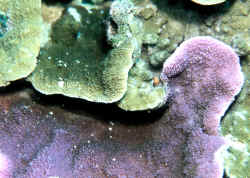
M. digitata? And Care. 2/2/06 Howdy everyone, <Hello.> as previously mentioned this is a great website! <Thank you.> I've been reading a lot since my discovery of it and have learned a lot. <Outstanding.> Attached is a pic of a frag coral that I obtained from my LFS. <Looks to be a Montipora, possibly M. Digita. Also looks to be going through or went through some RTN.> They were not sure of the type of coral so if you could point me to the family or genus that would be cool. <See above.> Also it has a growth on it and a few tubes, I think they are some type of worm. <Likely tube worms, usually nothing to worry about.> Is this growth harmful or is it just part of the corals coloration or maybe a sunburn? <Are you referring to the tubes or the dark spots, either way see the above comment(s).> I have a 65 gal tank with two 10K, 175 MH's and the coral is placed halfway in the tank. <Lighting sounds great, provide lots of water flow an calcium, not to mention low nutrient levels. If the RTN continues, consider fragmenting the unaffected areas.> Thanks for your response and your time! <Anytime, Adam J.> <<Couldn't find file/image. RMF>> Montipora Compatibility Hi, I've had a 50 gal w/75 lbs. LR going for about six months. Corals are two mushrooms, two polyps, pumping xenia, and a devil's hand and a toadstool mushroom leather. Everything seems perfect, water parameters are great. Lots of water movement, great skimmer, etc. Question is, are Montipora digitata compatible with what I've got now? Thanks for your advice. >>>Greetings Brian, I think you should be just fine. Keep in mind though that as things grow, you may run into some chemical warfare issues. You may have to watch that leather, but in the near future, I don't see any issues. Jim<<< Acropora reef tank Lighting 3/10/05 Hello Anthony, It's me again! Sorry, for asking so many questions, but the advice is just sooo good! haha.. <no worries... my pleasure> Ok... I've been checking up on different types of fluorescent tubes to use and I still can't find the kind you're talking about in VHO format. <just ask the sales rep for a warm daylight colored lamp my friend. If they do not have one around 7K with a CRI rating over 90, then someone else will... do keep shopping :)> I looked on the URI site and they have a "Aquasun" bulb, however, this is rated as a 10k bulb. Are you speaking of a different bulb all together? Anyways, I read a plug in CMA about Vita-Lite Bulbs made by Durotest. These bulbs sound killer as far as specs go... but they don't offer them in VHO format. <the company is gone... sadly> Do you think if I ran their standard output bulbs on a digital ballast they'd put out enough light? Any suggestions would be great...Sorry to sound so redundant but I want to make sure I'm catching your drift. I mean lighting is pretty important...Wouldn't ya say?!? <actually... corals are highly adaptable over a very wide range of lighting. Within reason, I'd put lighting behind water flow and feeding for coral health and growth> You said Acros need a lot of flow...but GEEEZ!! I didn't think you needed as much flow as you're talking about. 30x turn over?... <actually... for Acropora, many enthusiasts run towards 60X turnover (diffused). The shallow reefs covered in Acropora are very dynamic environments> Well, that doesn't sound ludicrous at all, but in order for me to have that much flow I'd have to add an extra Iwaki 30rlt on a closed loop. That'd be a 70rt and a 30rlt.....Phew that's a lot of flow in there. Oh.. one thing I was thinking of is, if I were to do this extra pump would it be a good idea to have it on a timer to turn off during the night? <it's a terrible idea, mate... most tanks simply don't have anything near enough flow like on a reef> This pump would be on a closed loop so I could turn it off for about 6hrs in the middle of the night. This could simulate gentle nighttime currents? <bull pucky> My concern is that the pump would be garbage in short order with all that on/off hoopla...ooookk I do believe I'm done for today. Once again thanks for the time and sound advice. Chris <always welcome :) Anthony> Acropora tank 3/8/05 Thank you for the response Anthony it has helped me out. Your answers, however, have spawned more questions (I'm sure all too often). Your advice on the Acroporas and Montis have spurred me to go with strictly Acros. <ah, good... I feel you will be much better in the long term for a more natural and compatible mix of corals> With that said I'm going to run 8 VHOs instead of 7. I figure instead of buying an icecap 430 I'll get a 660 for extra 20 bucks. <a good decision> For lighting...What bulbs of 7k do you know of?? <URI daylights> As far as I know URI makes the only decent VHO bulbs and they don't have a 7k spec bulb. <Hmmm... do check again. I recall they have a 7100K or some such. Maybe their Chroma series. Just ask a rep. Its one of the cheapest and best bulbs for corals... the daylights in the 6500-7500K range> What do you suggest. Either way my ratio is going to be 3 daylight to one actinic which should give me plenty of daylight. <agreed> In your reply you mention Acros like more water flow. The flow on this system will start with an Iwaki 70rt. The tank has a trapezoid center overflow drilled with two 3/4" bulkheads on either side of the box. These two exits will be run off one SCWD. The next set of returns will be 2 3/4" SeaSwirls on either side of the tank. Both of these will also be running on a SCWD. I think this should give me some pretty random turbulent flow with pretty strong current due to the large pump. <try for at least 30X turnover> Now the skimmer I've decided will be a 6-2...How would you set this skimmer up? Due to you're advice I'm going to pull some overflow water out of the overflow box through a 3/4" bulkhead. <correct> Any advice on how to regulate the water level in the overflow box so I can get a consistent water level in the skimmer? <it's a standing overflow... never changes. A dam or a bulkhead in the partition/wall> Do remember there will also be a one inch drain going to the fuge area...I figure once the pump gets turned on and the water flow reaches a equilibrium throughout the system the water level in the overflow box would be pretty constant right? <the skimmer overflow box/wall is to be higher than the sump proper> In the sump there's gonna be an auto top off valve so changes to head pressure on the main pump will be minimized. I don't plan on adding any fish or corals to this system for at least 6months. <this is very good!> I want to get every kink worked out as well as get the refuge area super stable and let the micro fauna really get a hold. Along with letting the tank cycle this way I was planning on using only blue spectrum lighting to keep algae down. Sally Joe at GARF mentions that using blue light encourages coralline algae growth...Is this true? <depends on the coralline species... they run the gamut> Makes sense to me. I was also interested in using calcium gluconate to help encourage more growth. I figure the more coralline I have the less nuisance algae I'll have. <correct> Ok well I have to cut this short a co-worker is breathing down my neck. Thanks a mill Chris aka fishtank <best regards, Anthony> Coral feeding I was reading through the site today and discovered the section on feeding corals. I looked on with stupidity because my LFS has always told me that they get everything they need from light. <It was probably a mistake and it happens.> I have to admit I am still not sure how to feed my corals. I bought some frozen Mysis shrimp, but now what? I have never even seen sweeper tentacles. I have a frogspawn a torch, and a xenia, any suggestions as to how I should feed them (turkey baster method, etc.) or what to feed them (zoo/phytoplankton) is greatly appreciated. EY <Hello, well you are on the right track from what I see. Knowledge is power. You should feed based on the needs of your corals. The frogspawn, and torch will probably take the Mysis depending on size. The best time to feed them is at night using the baster method. The xenia will take the phytoplankton. I want you to remember this. Although you should be feeding your corals, a big beginner mistake is to over feed them when they first start. Start feeding little amounts and work your way from there. Good Luck. MikeB.> Monti Feeding II Hello Crew,<Hey,> On the following response to a question that I asked I am a little confused. I have read on your site that Phytoplankton is not very useful with SPS corals. <There are pro's and con's to using this product. Basically, there could be better food sources out there, such as refugiums. But, in a bind DT's can get the job done if used correctly. Let me stress the word CORRECTLY.> So I question the recommendation of DT's Phytoplankton. I have found BioLife's Coral Plankton and the SPS's seems to eat it (Polyps Expand), I am not sure about the particle size of Cyclop-eeze and will also add the DT's if it is eaten. Otherwise, I look at it as algae food. I do like to feed as much of a variety as possible since I do not want to get into a refugium. Also this is becoming a SPS tank eventually (my favorite) however I do have BTA's with very happy Clowns and one Galaxea, is this a problem? Thank you for all the help! Rich <Rich, the BTA will be a problem eventually and so will the Galaxy coral. They will sting and bother the SPS corals. The problem with feeding food for the SPS corals is that people generally feed too much to the tank. This then causes a spike in water quality and degradation of the corals. I would remove the BTA and the Galaxy coral to another tank if you want to keep the SPS corals long term. Also, use what ever phytoplankton you decide that works best in moderation. Good Luck. MikeB.> Monti Feeding III Hello Mike, Thanks for the reply. The way that I have been feeding my SPS's is to stop all pumps for an hour or so and target feed just enough food to cloud the general area around the coral. I do this twice a week. I think that this is minimal pollution and hopefully (?) enough nutrition for the coral. How does that sound to you? Thanks again for the advice! Rich <Rich, your method sounds fine. I wouldn't consider the food as pollution though. It will provide the sustenance your corals and microfauna will need. Keep it up!!! MikeB.> - Acropora Losing Color - Hello, When I got this Acro it was light brown with purple tips AWESOME! But I have noticed that Its purple tips has been fading away in time. And now the coral It's just light brown. I'm running my 10 gall nano tank with 8 watts per gallon with power compacts. And my water quality is perfect! My LFS said that for Acros I need metal high lights to keep those colors alive and bright is that true? <Quite often yes... what is not always obvious to aquarists is where there coral came from, the light the coral is accustomed to. In the tropics where stony corals are prevalent, the sun just bakes... is very, very intense; aquarium lighting is not even an approximate substitute. The browning of your Acropora is typically indicative of inadequate lighting.> I also have two awesome looking clams on the sand bed and they have not lost their beautiful color with my power compacts, what could this be? <Unless you've had these clams for several years, I would not use their color or current state as any judge of lighting intensity or even their health... clams can look excellent right up to the day before they die.> I have my Acro as close to the light as possible and my calcium reads at 450 ppm. I even have a power sweep power head for some wave action. Is there anything else I can do to get those colors back? <More intense light.> I've just started DT'S live marine as well for my clams that I've had for 5 months and Kent marine Tech 1 Iodine for my other corals. <This is a lighting issue and not an additive one.> Thanks for your time <Cheers, J -- > Lighting Acropora Good Afternoon Mr. Scott <Hello again!> SORRY for so many questions but you give the best advice!!! <Never apologize! Thanks for the undeserved compliment...We have a lot more talented people here on WWM than myself, but I'm happy that I've been able to help you!> Color changing Acropora... I'm running a 10 gall nano reef tank with 24 hour Orbit lighting system with 8 watts per gallon. When I got a Tri-color Acropora from my L.F.S it was nice light brown with dark purple tips and yellow polyps...AWESOME!!! <Sounds hot!> But I have notice when my day lights come on the purple gets real light and the polyps retract. And when my day lights come off the purple gets really dark again and the polyps come out. Is this the norm? What could this be? <Certainly a relatively normal behavior for a coral. Many corals will display day-night polyp retraction. Feeding occurs at night with many corals, and the colony is merely exercising its natural "rhythm". This would be an opportune time to feed the coral..> I have her on top of my live rock close to light as much as possible. Do you think is to close to the light? Should I move her down a bit? My L.F.S. said that is perfectly normal. <I don't think that the reaction you are seeing is a negative one. It's irresponsible for me to generalize, but many Acropora do have very high lighting requirements. On the other hand, it is important to slowly acclimate a coral to its new lighting regime to avoid shocking the coral. Do see Anthony Calfo's excellent piece on acclimating corals for more.> Thanks so much for your time. <You're quite welcome! Regards, Scott F.> Montipora Trouble Hi gang, Quick question (hopefully). I am on my third frag of a very hard to get but popular purple Montipora frag. For some reason, I keep bleaching them. At first I thought it was because I put them about 6" off the bottom immediately after receiving them, and wasn't putting them low enough and letting them acclimate to the light. However, when I received the third frag, I put it all the way on the bottom of the tank, right on the sand. It still didn't help, as one corner turned brown then bleached. However, the middle to left part of the frag is still purple, but I fear the browning and then bleaching is spreading. I had it on the bottom, somewhat under a rock for some shade. Panicking, I moved it up a couple of inches several days after being on the bottom to try and save the frag. What am I doing wrong? My lighting is as follow: 2x250W 10K MH, with one 400W 13K bulb in the middle. Then there are 2x96W PC actinics. I put the coral under the 250W MH, not the 400W. This doesn't seem to happen with my Acro frags, which I've done okay with. It only seems to happen with the Montipora frags. Any thoughts? >>>Hi Brandon, Doesn't sound like a lighting issue to me, but more of a current or water quality issue. Check your parameters and make sure you have decent current where you're placing this frag. Also, are you sure this frag was grown under lower lighting? If not, check into this. Cheers Jim<<< Too much Lighting? Every time I buy a frag of a Montipora coral, they turn brown? Too much lighting? What would cause this strange phenomenon? Most are purple to start with. <Several factors could be influencing this color change. High Nitrate levels, which act as a sort of fertilizer for brown zooxanthellae, could easily be the cause, as could old bulbs or low lighting. Hope this helps, mike G> Water Movement For Acropora Hello, <Hi there! Scott F. here today!> Do Acroporas do better with a direct flow of one power head or with 2 - 125gph Power Sweep power heads? I have a 10 gall nano reef tank with 1 Acro with plenty of room for more! What do you guys think? Thanks for your time! <Well, most of the Acropora that favor high flow will benefit from randomized, indirect flow. Laminar flow directly into a coral can literally peel the tissue right off of the colony. Better to use those Power Sweep powerheads, or even some sort of rotating return device, like the wonderful Sea Swirls! HTH! Regards, Scott F.> Rapid Acropora Death 2/8/05 I just purchased a frag of a gorgeous A. albrohensis. It shipped very well I'm assuming because even while acclimating it, all polyps were out and is still had a greenish hue to it. I acclimated it for an hour, turned the MH lights off in the tank (only 2x96W actinics) running... <All sounds good, although extended polyps are not a reliable source of "happiness" it can just as easily indicate stress.> ...and glued it down to a rock. Polyps still out. <What kind of glue, and did the glue contact living tissue? It is unusual, but have seen cases where tissue recession, or even total loss was caused by contact with glue.> Wake up this morning, and looks like a bone. No polyps anywhere, just skeleton. I quickly turned off the MH that was above it. Checked it several hours later, and maybe one polyp at base of coral. <Two possibilities... first (and far less likely), the coral bleached. If this is the case, the coral will be colorless, but still covered in living tissue. Second, the coral died. If this is the case, you may see stringy or lacy remnants of tissue clinging to the skeleton. If you don't have a lot of Acro experience, it may be a bit tough to tell the difference, but on a dead coral, you will be able to see the rough porous texture of the skeleton.> Is this normal, and it might be fine tomorrow, or did I do something wrong? <This isn't normal, but it doesn't sound like you did anything wrong. It could have been the stress of shipping, or it could be water quality in your tank.> Tank is 125G, 2x250W 10K MH with one 400W MH in the middle with the actinic. Like I mentioned, turned off all lighting but actinic when I put it in the tank. No MHs until the following morning, but already looked bad before MHs came on. <All sounds good. You wisely protected the coral from possible light shock.> I recently read that peppermint shrimp might do this. I have a pair, but nothing in tank but tangs and clownfish. Any thoughts on if it will recover and adjust, or does it sound like it died? <Peppermint shrimp will absolutely not do this. They may pick at some corals, but would only cause minor damage to an Acro. My guess is that the coral died of what is referred to as "RTN" (Rapid Tissue Necrosis) or "SDR" (Shut down reaction). In these cases, the coral tissue "self destructs" in response to stress. The stress can be caused by shipping, but is more often related to water quality problems, including the presence of other aggressive corals. Infection has been implicated as well, but this is questionable. Please feel free to write back with a list of other corals in the tank and a list of all of your test results (actual values please!), please include pH, Alkalinity, Calcium, Salinity, temperature and nitrate. Also briefly describe your filtration. Best Regards. AdamC.> Acropora fading in a tiny tank Hello, <Hi there> I brought an Acro on Saturday and by Sunday some of It's purple color on its peeks are fading away. I have him in a 10 gall nano tank, water checks out fine and I'm running it on 8 watts per gallon. Also I have great flow in the tank. What could this be? Could it be that it is acclimating to my tank? <Not acclimating more like it... if the color, vitality is lost... it will not likely return> I have him real close to the light on top of the rocks is it to close should I move him lower? Thanks for your time!!! <No, thank you for yours. Please study on WetWebMedia.com re small marine systems: http://www.wetwebmedia.com/marine/setup/index.htm and the genus Acropora... Bob Fenner>
Monti Feeding Hello Bob and Crew: I was looking for your advice for target feeding my only SPS a Montipora capricornis (my favorite). I lost a Hydnophora. I do not want to get into a refugium so I have been direct feeding ESV's Phytoplanton and Daphnia. I have been considering Cyclop-eeze, is that too big? I tried to find liquid life's CoralPlankton but it's not anywhere (LFS) and I do not want to pay $25. for overnight shipping. I would appreciate any suggestions, I love this coral and want to do all I can (besides refugium).<Rich, I've heard a lot of good things about Cyclop-eeze. I am using it at the present time, mainly for my Percs, but my soft coral sure seems to be looking better since I've been using this. Other product that is good for this is DT's Phytoplankton. You might call around in your area for this, otherwise you will have to order direct from DT. They tell me if you keep it refrigerated it has a shelf life close to six months. Keep in mind this is live phytoplankton. I don't think DT would charge you 25 bucks to send it to you, just normal UPS charges unless you want it overnight. I wouldn't worry about the Monti while waiting since corals do produce most of their own food. James (Salty Dog> Thanks for the help! Rich Feeding and nutrients for acros Great site! Thanks for all the help. My questions are as follows: what nutrients, other than calcium and bicarbonate, would you recommend for the healthy growth of acros? Secondly, what food would you feed your acros and at what amount and time? Thirdly, is feeding essential? Again thanks for the great info. Joey <Please read here: http://www.wetwebmedia.com/corlfdgfaqs.htm and http://www.wetwebmedia.com/acropt3.htm and the Related FAQs (linked, in blue, at top). Bob Fenner> Acropora turning brown Bob: Love your site. <Adam here today. Thanks for the kind words.> My questions is as follows. I purchased some Acro's that had different colors. My 125gal. nitrates and phosphates jumped over the recommended limits and the acros turned brown. Now my tank is reading almost 0% phosphates and nitrates and my acros are growing quite well and the tips are gaining color. I worked diligently to get my nitrates and phosphates under control. My question is as follows, will the brown part of the acros eventually turn to their original colors or will they remain forever brown. Thanks, Joey <Ahhh... an easy question! I don't know. There are many variables that effect Acro coloration. Nutrients, alkalinity, lighting intensity, lighting spectrum, iron, feeding, etc., and often it is impossible to predict, let alone closely control all of these variables. In many cases, wild Acroporas fail to retain or regain their wild coloration. This is why those that do and do so under a variety of conditions are so prized. Sorry for the "non-answer", but I hope it helps. AdamC.> Acropora Color Change Bob: <Scott F. in today!> I purchased some colorful Acroporas and placed them in my tank. In a couple of weeks, they started to turn all brown. I have since got my phosphates to 0% and my nitrates to under 5%. The acros are starting to grow with tips being colorful. My question is will the entire Acropora return to its original color now that I have my water quality under control? Joey <Great question, Joey. The prevailing wisdom is that the colors of coral are a sort of natural "sunscreen", which the coral will manufacture as it needs them. Under intense light and high water quality, it is certainly possible that the colors will return to something approaching their original splendor. Phosphates are well known to inhibit calcification and color in stony corals, so you were right on in trying to get water quality in order. Interestingly, you will often get different colors for the same species even under different lights. Good luck! Regards, Scott F> Nano Acroporas & clams Good morning crew <Alex> Do you guys know If I can have Acroporas & clams in my 10 gall nano reef system ? I'm running It with 8 watts per gall with a Rio 600 pump. I know I should not have a problem with light & flow, but my LFS told me it could not be done. Clams yes Acroporas no. I know Acros are very aggressive so I should provide a lot of distance from each other. What do you guys think? Thank you for your time! <Mmm, can be done... but not easily... by "clams" I take it you mean Tridacnids... get too big... and Acroporas generally require high and consistent water quality... difficult to achieve in such a small volume... though possible, have seen done. Bob Fenner> |
|

|
Features: |
|
| Featured Sponsors: |