|
FAQs about Acroporid Coral Identification
1
Related Articles: Acroporids, SPS
Corals,
Related FAQs: Acroporids
1, Acroporids 2, Acroporid Behavior, Acroporid Selection, Acroporid Compatibility, Acroporid Feeding, Acroporid Disease, Acroporid Systems, Acroporid Reproduction, Stony/True Coral, Coral System Set-Up, Coral System Lighting, Stony Coral Identification, Stony Coral Selection, Coral Placement, Foods/Feeding/Nutrition, Disease/Health, Propagation, Growing Reef Corals, Stony Coral Behavior,
|
|
|
Acropora id 5/20/14
Hi again Bob,
<Jimbo>
I hope you are keeping well! All is well with the tank but I wondered if
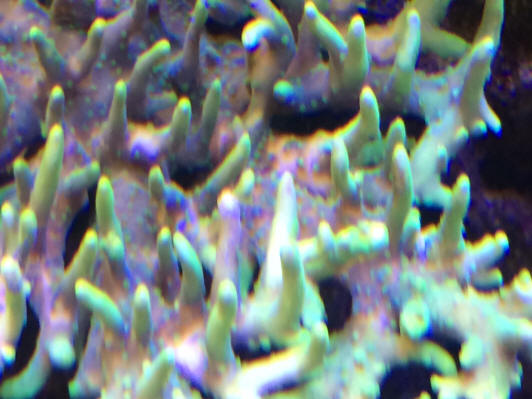
you could help with an Acro ID? I was sold this as an Acro
caroliniana
<Might be>
but I'm not so sure if this is a deep water specimen as it has
been browning out over time?
Tank specs are as follows:
Po4 - 0.0
No3 - 0
<Uhh, photo- and chemo-synthetic life needs measurable soluble phosphate
and nitrate... Look at a general/terrestrial fertilizer bag>
Mg - 1470
Ca - 430
Alk - 10
Ph - 8.2
Temp 25
Sg 1.025
Here is a pic of specimen
Regards
Jim
<And your response. Bob Fenner>
|
 |
|
Re: Acropora id 5/20/14
Thanks Bob,
Was there no photo attached?
Here is another.
<Was attached. Saw it... B>
|
|
Green polyps on an Idaho Grape Monti
7/22/11
Hi folks,
<F.M.>
The other day I discovered that the new growth around the edges
of some of the little chips of Tyree LE Idaho Grape Monti that
are around my tank have green polyps instead of purple. It is
only in the new areas, mostly around edges with a polyp or two or
three on the main area - the rest of the polyps are purple like
normal. Nothing has changed in my system. I would like to know
how such a thing could happen. A fellow WAMAS member conjectured
a possible Zooxanthellae protein exchange in my tank with
something else, but I can't find information about this
topic.
<Might be... or some aspect of water chemistry favouring the
production of this sort of pigmentation here... or even another
Polypoid organism.>
I found one post in the old archives of the RC forum where a guy
reported having green polyps on the Tyree LE Idaho Grape Monti,
but responses were to the effect of it not being that type of
coral (since it was an archived post, I couldn't respond to
it). I'm hoping one or more of you folks can give me some
info or direct me to an info source. My camera doesn't have
good enough resolution to get a decent shot of this, but
attaching the best I could get (the piece of coral with the green
polyps on the perimeter is less than 1/2" in diameter).
Coral's background: I bought a frag of this coral a couple
years ago from a fellow WAMAS member, and have since sold/traded
a bunch of frags. A few months ago I decided that the coral,
which was very thoroughly encrusted, was in a really bad place
and was keeping me from growing other corals do to shadowing and
the amount of space it was taking in an area that I wanted for
Acros. I broke as much as I could off the rock to sell &
trade, then scraped off as much as I could of what remained. Due
to heavy encrustation, I could not remove all of the coral and it
grows like a weed. I glued about a couple dozen tiny chips
(1/4" - 1/2") all over a fist-sized piece of rock from
my refugium, and some 1/2" - 1" pieces to a 6"
Acro skeleton - growth pattern of these bits as they encrust into
each other is very cool. The new growth area where the green
polyps are coming out, are on these chips and bits, plus on the
stuff I couldn't scrape off the main rock structure.
System info: 75 gallon mostly hard coral reef tank, system volume
110 gallons (adding sump & refugium, then subtracting
displacement), running about 8 months (with contents from the
tank I broke before I moved... I've been in the hobby roughly
15 years and some of the liverock is from back then). T-5 lights,
long-term Prodibio Biodigest dosing, protein skimmer pulls dark
thick gunk, shallow sand. Nitrate undetectable, phosphate
undetectable, nitrite zero, ammonia zero, specific gravity 1.025,
avg temp 79f, pH 7.9, Alk is in the "normal" color
range of the test kit color card, calcium 420 (I have trouble
with the definition of "blue" in absence of a color
chart comparison, so the 420 figure may be inaccurate). Using
RODI water.
My post on WAMAS about this: http://www.wamas.org/forums/topic/44483-what/
Thanks bunches! Sincerely,
F. Mills
<I might try fragging a central piece... seeing if you can
culture it w/o the green surrounding biomass. Bob Fenner>
|
|
|
|
Re: Green polyps on an Idaho Grape
Monti 7/22/11
Thanks for responding. I will take your suggestion. There are
some stray green polyps on the main areas of the coral pieces,
just very sparse, so I will use a piece that has no green on it
at all.
<Good>
If it's a protein-type exchange, should I assume it might
have affected the pieces in one area of the tank without
affecting the pieces on the opposite end of the tank?
<Not necessarily, no>
One of the frags I sold Sunday had been on one end of the tank,
while the other on the other end, so I'm waiting to find out
if either of those frags get green polyps on them. Some frags
were dispersed to WAMAS members a couple months ago - yesterday
one person reported on his, saying he has no green polyps, but I
haven't heard about the others (the main piece went to a
vendor for a pair pf purple Firefish - haven't heard from him
either).
I'll get to my experiment and report back if I see green
polyps on the sample. Thanks again.
F. Mills.
<Mmm, well, I do wish there were hobbyist type, cheap DNA
kits... I'd bet most anything that this colony is NOT ALL
Montipora. Bob Fenner>
|
Re: Green polyps on an Idaho
Grape Monti 8/10/11
Hello again,
<FM>
I have an update for you here about this Tyree LE Idaho
Grape Monti with green polyps. I received an initial
response e-mail from Steve Tyree, who said: "We have
seen quite a few cases where the green from
Pocillopora corals have been grafted into other
corals." I'm attaching a different
picture of other chips with the green polyps (please excuse
the limitations of a 10mpx camera on tiny objects). The
chips I sent a pic of before were badly damaged in last
week's major aquascaping mishap & rock cleanup, but
I fortunately had some more pieces on this separate rock
(which itself sat in the sand for a few days.... ). Thanks
for helping me explore this interesting subject :-)
Hope the Crew has a great day!
<Thank you for this follow-up. BobF>
|
|
|
|
|
Coral ID please... Likely a Montipora
7/5/11
Hi crew,
<Hi Kurt,>
I sent this message a few days ago but it may have gotten tied up
or lost in the shuffle.
<First time I saw it, but it's been a while...>
So again thank you in advance for all the help you have given me
and any future advice you may give.
<Happy to help.>
You all are the greatest.
<Flattery will get you everywhere! Heehee!>
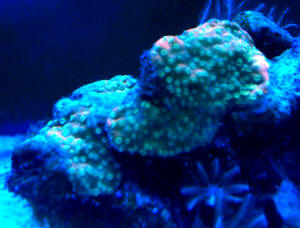
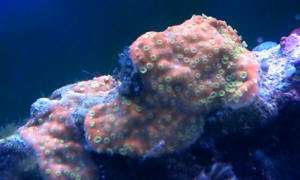
I have this coral, which I believe is a Montipora sp.
<I would agree.>
But haven't been able to find any pictures similar to
mine.
<Hard to tell from photos but reminds me of a Montipora Danae.
More on Montipora here: http://www.wetwebmedia.com/acropt3.htm
>
This beautiful little coral popped up as a very welcome hitch
hiker.
<Gotta love the freebie!>
The body structure is yellowish Orange. It has small, maybe 2mm,
bright green polyps. Under actinic lighting the edges glow bright
Orange.
<Many Montipora fluoresce.> Am I along the right lines with
it being a Montipora sp?
<I think so.>
One photo is with actinic and daylight. The other is daylight
only.
Thank you again for your help.
<Welcome!>
Kurt
<Mich>
|
|
|
|
Re Coral ID please... Likely a
Montipora 7/13/11
Hi Mich,
<Hi Kurt,>
Thank you for the ID.
<You're welcome.>
I was able to find more info once I had the proper name.
<Very good!>
Thank you for your time.
<Happy to help>
Kurt
<Mich>
|
Split coloration of Montipora polyps
7/2/11
Hello Crew, and thanks again for all your help, past and future.
<Welcome Lanny>
Someone on a forum recently posted a macro shot of Reef Farmers'
'Mystic Sunset' *Montipora sp.* showing a crazy
split-coloration of polyps, divided down the median. While I have not
taken note of it personally, a few participants in the discussion
claimed this phenomena was pretty common.
<Mmm, happens, but I would not say/state that it's common... a
small part of one percent...>
We started debating whether it was an advantageous evolutionary
characteristic or just an unnaturally selected mutant. My vote was with
'unnaturally selected mutant', as the only real advantage I
could see to the split was a possible expansion of absorption spectra,
and a guy harvesting corals from a reef will be inherently drawn to the
mutant, or at least rare, characteristics that drive up their
values.
<I'd add that maybe there is some sort of lowered predation
possibly bestowed by this criterion... Due to appearance, maybe
taste>
I have been poking around for a while now trying to find other variants
with similar coloration or really anything regarding the perfect-split
of the coloration and haven't found a thing. It doesn't help
that I have no idea what to call it...and there must be some
rarely-used scientific term for it.
<Not that I've heard>
Naturally, I thought of everyone at WWM, whose combined knowledge seems
sort of like the Library of Reef Congress.
Unfortunately, I do not have my own picture of such a coral and do not
want to go firing around some other persons work so I have included a
link to the Reef Farmers page, where the strange coloration of the
polyps can be seen.
They mention it in the description, but do not speculate as to why it
is such. http://www.reeffarmers.com/limitedmysticsunset.htm
Any ideas as to the cause of such a strange occurrence?
<Different inclusion of chloroplasts/Dinoflagellates... perhaps
preferential support for differing pigments associated with...?>
Is it as common as those ultra-reliable ;) forum-folk claim? If so, any
ideas as to the evolutionary advantage that it would provide? All else
failing, any ideas as to how to research it more myself?
<The usual searching of scientific literature: http://wetwebmedia.com/litsrchart.htm
Again, I want to thank everyone for their incredible contributions to
our hobby. I look up to you all.
Regards,
Lanny Flaherty
PS - Have a wonderful long weekend and 4th of July. Keep those digits
intact!
<Will try to be more careful at volleyball this afternoon. Cheers!
Bob Fenner>
|
Unknown Acroporidae (?) Coral/SPS Coral ID
12/11/09
Hello WWM crew,
<Hiya Kevin>
Thanks for all the help you provide!
<You're welcome.>
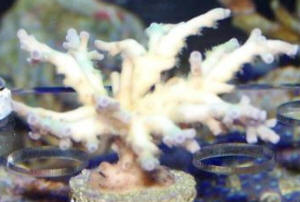
When I purchased the parent colony of the coral in the attached
photograph from a LFS, I was told it was an Acropora spp. Is this
correct?
<Appears to be.>
Can you identify to species level or at least provide some
possible candidates? I have a couple of frags of this coral and I
would like to pass on the species name to the next
reefkeeper.
<Based on comparisons in my photo library, it appears to be an
A. loripes.>
Thanks a bunch!!
<You're welcome. James (Salty Dog)>
Kevin
|
 |
|
Acropora I'd 7/4/09
Hello crew,
<Kiet>
First off, I hope you guys/gals have a happy and safe 4th.
<Thus far...>
On to my question, I recently purchased a starter colony of this
Acropora and was wondering if you could help I'd it. My
initial guesses are that it is either an Acropora valida
<Mmm... maybe this, or A. tenuis, or...?>
or Staghorn.
<? The common name for the family?>
The first picture is of the colony and the second is a close up
of a frag I took off of it. Any help would be appreciated.
Thank you,
Kiet
<Read here: http://wetwebmedia.com/acropt2.htm
and the linked files above. Bob Fenner>
|
  |
|
Acropora Yongei??? 4/6/2009
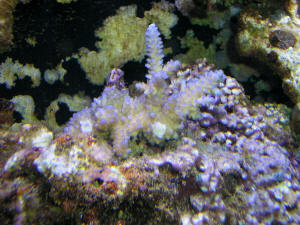
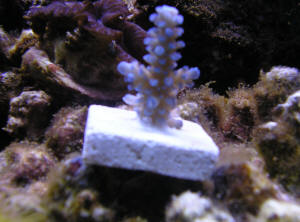
Please help me identify this Acropora I purchased today at MAX in
Southern CA.
<Mmm, I was there both days>
It was sold to me as a Yellow Acro. The guys couldn't tell me
what type of Acro, he said he doesn't know much about sps. He
did say it was aquacultured in Bali. The more I look at it I
think it is just a faded out
Bali Green Slimer or Acropora Yongei. Please see the attached
pictures and your opinion is appreciated. I was hoping maybe it
was a nobilis or formosa.... but now Yongei is definitely
crossing my mind.
<I do agree... this could be Acropora yongei. Bob
Fenner>
|
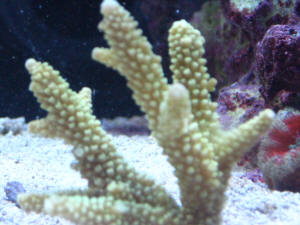 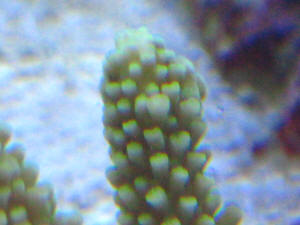 |
|
Acropora Question'¦Coloring Up --
10/09/08 Hello Crew! <<Hiya John!>> I hope
that all is well. <<Not bad, thanks>> I have a
question about Acro coloration. <<Okay>> I know that
it is common for the bright colors found on Acro tips to fade to
brown or green during shipping/time spent in poor lighting at a
LFS. <<Among other factors, yes (water quality, nutrient
concentration/availability, allelopathy, etc.)>> Anyway, I
purchased a small Acro colony about 30 days ago. It was
completely brownish/red when purchased. Now, about 3.5 weeks
later, the tips seem to be turning blue.
<<Excellent>> Is this possible? <<Indeed it
is'¦and is what most hobbyists are wishing for/expecting
when purchasing such corals>> Could this have been a
blue-tipped Acro that turned 100% brown due to poor lighting @
the LFS? <Or for other reasons mentioned'¦yes,
absolutely>> If so, is it possible for the tips to turn
blue after only three and a half weeks?
<<Certainly'¦ These corals will generally begin to
'color up' quite rapidly'¦if they are going to
at all'¦though this can be affected by differences among
species, and likely more so due to differences in conditions of
the systems in which they are kept (i.e. -- a brightly colored
coral in one tank turns brown, in another'¦or
vice-versa)>> My concern here is bleaching. <<How
so?>> My water quality is good (<1ppm nitrate and
phosphate, <<The life in your tank requires both of these,
and some hobbyists even dose Sodium Nitrate to feed/improve the
color of their Acropora colonies. The Nitrate level you show is
fine in my opinion (even beneficial), and while it doesn't
have to read '0' this much Phosphate may prove
problematic'¦I would take steps to reduce this to less
than half this reading>> undetectable ammonia and nitrite,
water a bit warm at 80 degrees [Florida summer] <<80F is
fine in my estimation>> and small bioload). I have a 120
with a foam/cement background, crushed coral, remote DSB, sump
w/filter sock for mechanical filtration, and skimmer. I am
currently running two 250W metal halides with 14K bulbs. The Acro
has high placement in the tank, about 3/4 of the way to the top.
I do target feed about twice a week. I will attach some before
and after pics. Sorry, they are not the greatest. <<I see
these'¦and this coral looks fine. The lightened tips are
due to new growth of this coral'¦nothing to be concerned
with>> Thanks for everything that you guys do...
<<We're happy to share>> you're true heroes
to the aquatic community. <<Ah! Thank you for the kind
words>> Also, do you know what the exact species is? -John
Patten <<Not exactly, no. I think it's possible it is
A. valida (like this one here:
http://www.ultimatereef.net/uploads/Picture%2034%20-%20Acropora%20valida.jpg),
but perusing pictures at some of the retail sites may give you a
better 'general' idea. A more exact ID would require
close examination of the coral's skeletal structure. Eric
Russell>>
|
  |
|
Montipora capricornis Compatibility 03/31/2008 Hey Crew.
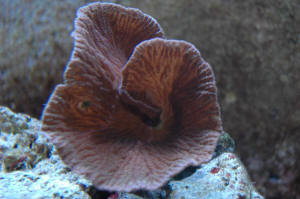
<<Good Morning, Andrew today>> I hope the mice
aren't playing too much while the cat is away. I have a
"professional compatibility opinion" question for you.
I was in my LFS today and noticed a very nice (4" wide and
6" long) coral that I believe to be a Montipora capricornis.
(See attached picture--do you agree?). <<Agreed>>
This coral is in the "all corals in this tank are $25"
tank. I couldn't believe the LFS is selling this for only $25
as I've seen similar corals demanding much higher prices, so
I asked one of the clerks why it was so cheap and he said that
they are trying to get rid of it because it's been at the
store for over 2 weeks with no takers. He tells me that it is an
aquacultured "cup coral" that doesn't have the
coloring that most people like. This coral would look great in my
tank, so I came home and did some research on compatibility and
am a little concerned about its ability to survive/thrive given
my other animals (mostly, my Corallimorphs). I have a 110 gallon
display with 95 lbs of LR and a 30 gallon refugium (DSB, 10 lbs
LR, and large clump of Chaeto). Lighting is 2x250W HQIs (20,000K)
driven by 2 IceCap ballasts and 4x65W actinic PCs. My circulation
is about 15 x per hour between my return pump and my internal
power heads. My coral livestock list is as follows: Corallimorphs
(positioned throughout my tank): 8 small green hairy mushrooms on
one rock 8 medium green Rhodactis mushrooms on one rock 1 small
purple Rhodactis mushroom 14 small red mushrooms spread
throughout my tank 1 medium orange Ricordea mushroom 3 small
cream colored mushrooms on one piece of Tonga branch Soft Corals:
2 large colonies Pulsing Xenia 2 large Capnellas 1 large
Dendronephthya (9 months and thriving!) 1 large red pipe organ
(Tubipora musica) LPS: 1 Pacific Open Brain (Trachyphyllia) 5
polyps candy cane coral (Caulastrea echinulata). I run two 1-cup
portions of activated carbon in my sump that I change out every 2
weeks to help reduce any allelopathy. At $25, this isn't a
huge investment by any stretch, but I don't want to purchase
this coral only to put it in an environment in which it won't
thrive or survive. There is an empty spot about half way up my
tank that is in a relatively high-flow area that would be a
perfect spot for this coral. What do you think? <<Given
enough space / distance between this and other corals, I see no
reason why you could not house this in your system>> Thanks
for your insight/thoughts! Andy <<Thanks for questions,
hope this helps. A Nixon>>
Re: Montipora capricornis Compatibility
04/01/2008 Andrew, <<Andy>> Someone opined to me
that this coral is a Merulina ampliata, not a Monti cap, but the
pictures of Merulina that I've been able to find don't
resemble this coral. However, after reading WWM and elsewhere,
the ridges on this coral make me wonder whether it may be a
Merulina, but . . . Any thoughts on the proper ID of this coral
and, if a Merulina, any difference in your original opinion that
it should do okay in my display? Closer pic is here:
http://i262.photobucket.com/albums/ii81/abulgin/DSC_0654.jpg
<<Ampilata do not roll up as the Monti Cap does. Its a more
flat plating coral. I will stick with Montipora
Capricornis>> Thanks again! Andy <<Thanks for the
follow and query. A Nixon>>
Re: Montipora capricornis Compatibility --
04/1/08 Andrew, <<Hello again>> Thanks for the
reply. This picture is what got me thinking maybe we were wrong:
http://whelk.aims.gov.au/coralsearch/html/201-300/Pix/240-02.htm
<<I still feel confident of this being a Monti cap. If you
review the following photo's of the Merulina ampliata, to me,
I can see the difference..
http://www.reef-guardian.com/fiches-coraux-pic-76.html ..Flat,
not rose, higher pronounced ridges.>> <<Thanks, A
Nixon>>
|
|
|
|
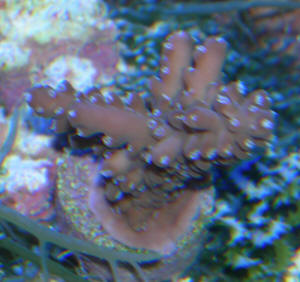
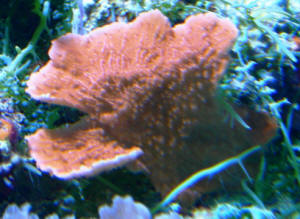
Acro ID... and high alk. -12/26/07 Good
Morning team. Pierre here. <Hi, Sara here.> Just obtained
some nice Christmas frags and wanted your help in identifying one
of them. Here are two pictures. The second shows it in better
focus in the upper left corner of the monti. <I'm sorry,
there's no way I could ID these corals without a very good,
close up picture of the bare coral skeleton. Sorry, that's
just the way it is with most Acropora family coral IDs.> Also
wanting my Acros to color up a little better but fear my
carbonate hardness may be wreaking havoc. <Don't worry so
much about color right now, worry about polyp extension and
overall health. Coral colors can change, but we still don't
know exactly why or how enough to intelligently try and
consistently induce one color over another.> I've been
trying to bring it down doing weekly water changes with Instant
Ocean mix, but the fresh mixed water's alkalinity is high
(over 10dKH) when I test it. <Why aren't you using RO/DI
water?> Fresh water is mixed and circulated for 24hrs before
change is performed. I tried bringing it down using the club
soda/seltzer water method but it didn't seem to work. Any
ideas? <Hmm... this is one reason why most all reef aquarists
use RO/DI filtered (or distilled) fresh water to start with.>
The tank is 125 gallons with a 55 gallon tank as a sump that
houses my skimmer, which flows through a bubble trap into my
refugium (which is on a reverse light cycle), then into my
return. Lighting is 2- 400 watt 20k Hamilton Metal Halides placed
about 10" above the water's surface. Temp control is
with a 1/3 hp Current Prime chiller. Here are my parameters. ph
8.4 day/ 8.2 night alkalinity 12 dKH magnesium 1500 ppm calcium
400 ppm nitrites 0 nitrates 0 I also don't have a lot of fish
so my nitrate stays undetectable, could this also be leading to
the lack of color from my Acros? <Hmm, no, as far as I know,
most Acropora sp. we get for the hobby prefer low nutrient
environments.> My tank has been set up and running and most of
the coral added since April of this year. <Usually, it's
recommended you wait at least a year before attempting to keep
Acropora sp. coral, but that's not a hard rule and I guess
you're close enough.> I also have some beautiful Monti
Capricornis and Pocillopora Damicornis which are colored nicely.
Circulation is provided by my return head Rio 2500+, with head
pressure running around 400gph and an in tank Rio 2100. Growth
from all species is decent but not stunning. <Please feel
encouraged to search the site for more detailed information on
how to best care for all these animals.> Thanks crew. Look
forward to your answer. <Best, Sara M.>
Re: Acro ID 12/26/07 Thanks for your reply
Sara. I did forget to tell you that all my top off and water
changes are made using RO/DI water from my own home system.
<Huh... that's odd. RO/DI water should be nearly pure and
not have any alkalinity to speak of.> I also have a TDS meter
that monitors the output. All the cartridges and filters are less
than a month old. I also dose Kalk with my top off although
I've cut down on the amount while trying to fix my alkalinity
issue. <Ok, that should help.> I've also noticed lately
that the Instant Ocean mix has been rendering a high alkalinity.
I'm at a loss trying to get these numbers back down to
normal. <Hmm... if you suspect the salt mix, maybe try a
different one. Instant Ocean, is notoriously inconsistent. One
bag might be great, the next maybe not so much. In fact, you
might even just try getting a different bag of Instant Ocean. Or
better yet, have you tried Reef Crystals? It's made by the
same company as IO, but it's formulated a little better for
reef tanks.> The alkalinity test I'm using is a Salifert
and I've tested it on completely fresh RO/DI water and it
reacts immediately reading 0 dKH. <Oh, I'm sorry, in the
previous email I thought you were saying that your freshwater was
starting out at 10dKH (which just didn't make any sense).
Sorry about that... so, now I would especially suspect your salt
mix.> The tank itself has been set up for over two years. At
that point I had minimal PC lighting (384 watts) and was just
housing some soft corals and mushrooms. I've just started
keeping SPS and LPS since April when I had the metal halide
lighting situated. I'll wait for the corals to seek their own
ground with coloring. <Good idea... if you want my personal
opinion, I suspect that feeding also affects coloration (perhaps
as much, if not more so, than lighting).> Should I not waste
any more time with the club soda method to try to bring my
alkalinity down? <Yes, I'd stop that for now and try
switching salt mixes. Do water changes with half old and half new
salt first though (to "acclimate" to the new mix). See
if that doesn't help.> Polyp extension has been very good
with lights on or off. Thanks again. You ladies/gents are
fantastic and I love the site. <Thank you :-)
Best,
Sara M.>
|
  |
| A. palmata? Elkhorn coral? 3/5/07 Bob, I got
two colonies of a very odd brown coral from a friend whose tank has
been up for a while. he got it from another guy way back etc etc.
goes back to when Elkhorn wasn't considered endangered or
threatened. <The whole planet is human-endangered... some spots,
biotopes, species more than others is all> he said it was
Elkhorn. and the way he coral is growing it certainly looks like
Elkhorn. Who do we know who could positively ID these two colonies
if i sent a frag or high resolution images? Eric B maybe? or
Anthony? http://i20.photobucket.com/albums/b201/JagerE/tank%20shots%203-3-07/PICT0037.jpg
<For?> I know the picture isn't good. here are some
others that i got as soon as i had the colonies before they colored
up. http://i20.photobucket.com/albums/b201/JagerE/lisa%20the%20puffer%20album/DSCF0078.jpg
http://i20.photobucket.com/albums/b201/JagerE/lisa%20the%20puffer%20album/DSCF0073.jpg
the last one is behind the staghorn coral. Id try to take better
pictures but the camera is on hiatus with my brother. ideas?
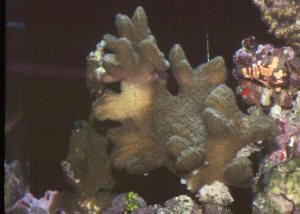
<Does look like an Acropora species... but not A. palmata to
me... the termini of this species tend to be flattened out,
blade-like when at this size... See the attached pic. BobF> |
|
|
| Re: a. palmata? Elkhorn coral? 3/5/07 Thanks
Bob, i was trying to ID closely what it is for my reef club whom am
fragging pieces out for propagation purposes. easier to keep
records of who has what etc when you have names to go with the
corals. <Ah yes> whose tank is that piece in the photo you
attached? tis a gorgeous coral Thanks again Justin <Mmm,
don't know... I only label by date made and what part of the
world... AQ for aquariums everywhere. B> |
Re: a. palmata? Elkhorn coral? 3/5/07 For
what it is worth...it looks to be A. Elkhorn. Captive grown species
tend to be very brittle and small like the piece shown. Wild
specimens tend to be much thicker and look different. Used to have
a thin specimen that grew like a weed! It would always break and
the pieces would grow up in no time. Beautiful coral none the less.
Enjoy! Cheers!
Dr. J / Justin
<Will accrue. B> |
Re: a. palmata? Elkhorn coral? 3/5/07 I'm sorry... I
have to say it. Even from the blur of an image (dreadful pic
quality) I cannot see anything that even remotely suggests that
this coral is an Atlantic Elkhorn Acro. To ID any species by
image is generally irresponsible, but in this case with Elkhorn
being so unique in morphology... its rather easy.
Making the matter easier is:
1) the water flow required to grow Elkhorn in aquaria is so
strong that it would literally peel the tissue off of most
any other coral you'll keep. Instead... they simply
have dismal survivability (read... less than six months)
because no tank really can produce/provide that much water
flow. You cannot name one public aquarium that has these
corals thriving. A. cervicornis yes... but not palmata.
2) the story about these corals being
"grandfathered" before legal collection was
stopped is even less believable than the Easter bunny.
Check the dates when that occurred my friends... decades
ago. Marine aquarists were using air lifts for water
movement back then ;)
Instead... some nefarious or at least ignorant person
cracked open a book and saw a pic of a branching Acro
that was really "rare" (Atlantic) and pitched
that hooey :p
Bobster... do you want the pleasure of telling these
folks how many described species of Acros there are
:D
<Several hundred according to J.E.N. (Charley
Veron). RMF>
Ahhh... we have some zeros on that number, folks.
Once they have been grown in captivity, their
skeletal structure changes and they cannot be
IDed to species. So says Veron and colleagues
FWIW (a lot BTW).
Anthony
|
Re: A. palmata? Elkhorn coral? Hooey!!!!!!!! 3/5/07 Justin,
Are you really even confident that it is an Acropora? It is hard to
pick out axial corallites in your pic. There are some sort of
lumpy-bumpy Montiporas with flattened branches that get called
"Elkhorn". If it is an Acropora, there are certainly
Indo-Pacific species that form solid plates, "moose antler"
and other vaguely Elkhorn type growth forms. FWIW... for a variety of
reasons in addition to those stated by Anthony, I agree that the
possibility of A. palmata being maintained in captivity is vanishingly
small. The last time I was there, the aquarium in John Pennekamp (sp?)
park in the Keys was very successfully growing A. cervicornis from
fragments collected at boat groundings. They were running semi-open
systems. They said they had zero success with A. Palmata in their
systems and they even had poor success when they attached frags on the
reef. It is definitely a demanding critter! Best Regards, AdamC
Re: a. palmata? Elkhorn coral? Hooey!!!!!!!! 3/5/07 you are
welcome my friend... and my apologize if the message last night was
brusque. It was a long day of email as y'all are familiar with :)
But truly... I get chided when I see coral sellers exploit the
eagerness of buyers with flat out lies about corals that are not
actually "rare" in the wild (though they label them so...
like the acans, Ricordea, Montis, etc)... and in this case, an illegal
coral. Creepier still are the dregs that poach corals and call them
"limited edition." Ewwwww. The reality of palmata's
challenges in captivity are so extreme (truly) that you can literally
say that if the suspected coral has been alive and growing for even a
few months next to other acros... then its not palmata. FWIW
Anthony Calfo
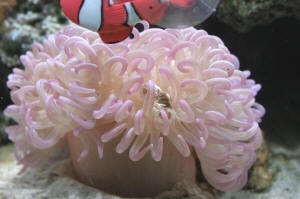
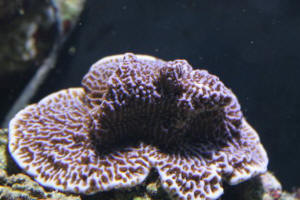
ID Of Montipora And Anemone - 8/10/2006 Hi!
Could you please help me confirm the species of these two animals
(see two attached files). One was sold to me as Macrodactyla
doreensis, but I have a doubt. The other one is an unidentified
Montipora. <The anemone appears to be a doreensis or Corkscrew
Anemone. The Montipora looks like a type of capricornis.>
Thanks! <You're welcome. James (Salty Dog)>
Dominique |
|
|
Algae Over-Growing M. capricornis? - 03/30/06
Hello, <<Howdy>> I looked for an answer to my question but
couldn't find what I am searching for. I hope you can help.
<<Me too <grin>.>> I have a Montipora capricornis
that is supposed to be orange but it has a layer of green algae on it.
<<?!>> I have tried blowing it off with a powerhead and
gently rubbing it off but have had no luck. How do you get algae off a
piece of SPS coral? I don't have an algae problem in particular and
it seems that the Montipora is its attachment point of interest.
<<I'm having trouble envisioning this Pete...algae won't
"normally" overgrow the healthy living tissue. Are you
certain this coral is still alive? And not to be funny but...are you
certain this isn't a "green" Monti? I might be better
able to help if you can provide a sharp close-up photo (.jpg or .bmp
format of no more than a couple hundred KB in size) so I can see what
you're dealing with.>> Thanks in advance for your reply.
Pete
<<Regards, EricR>>
| Acropora IDs 8/6/05 Hi, <Hello> Can someone please
help me identify the 2 Acropora species on the attachment? I
received this picture from graf.com. Thanks Mohamed <Not from
this pic. Take a look at Veron's works and you'll
understand why. Bob Fenner> |
|
|
Acro ID ok, thanks...but in the mean time after looking at
some old issues of FAMA have determined that my Acro is more
structurally similar to valida rather gemmifera <good luck on
morphological second-guessing this genus... time for genetic
mapping/karyoptyping> , which is a relief considering the lack of
adaptability you claim gemmifera exhibits in captivity <just an
average...> ... there is NO sign of my polyps. the tissue is living
and completely covering the skeleton and even the hunk of rock that
accompanied it, except the polyps structures seem empty...hollow
almost... the axial corallites are big and way out, and haven't
faded like the rest of the colony. I checked the tank every hour all
evening , and they were still recessed, even where the previous dark
color remains intact...hold on, going to check again...nope, still no
sign of any extension. and here its 9:00 PM. and during the course of
the day, the tissue darkened just a scoshe (scientific unit of visual
color/light spectrum reflected from living organisms under the
refractive/reflective qualities of water - ok, for lack of better
description of the amount of color change, I made that one
up)<actually, taksan scant transliteration... wakarimasuka
nijongo?... of a Japanese diminutive> ...just had an epiphany...WHEN
I succeed in having this Acropora thrive grow and regain all its
glorious color, I want to take genetically identical frags in separate
<ate> systems, and publish findings of experiments with the
function equations and pigmentation along with the most
efficient/appropriate filtration (adding other species along the
way)...oh the possibilities are pooling like phosphates! - maybe even
write a book. OR A COLLEGE THESIS! what stroke! Your input through
experience and further education would be greatly appreciated (any
suggestions on how to set up the experimentation systems, etc?) Anyway,
any help you could offer with the situation at hand would be even more
appreciated thanks again, Chris >> <Wowzah, glad to... time
for many rep.s and a trip or two to the S. Pacific... and much
discussion of experimental models... just hold on in the meanwhile...
we are stuck in the analog one-time through treadmill... as you know.
Bob Fenner>
Picture of unknown SPS coral Sorry the picture isn't too
clear. I'd like to identify the coral if possible. Any help would
be appreciated. <Looks like a species of Montipora, of the family
Acroporidae... here's a link/URL to the part of our site with
images of this genus: http://wetwebmedia.com/acropori.htm Bob
Fenner> Thanks, Todd
Unidentified Coral - Montipora SPS Hi guys, not sure
who'll be responding so I'll address in plural. <and if
necessary, I'll answer in stereo...> I've been reading and
appreciating your FAQs for a few months now (ever since I started my
reef project about 3 months now) and was wondering if you might be able
to help me identify this coral I saw at the LFS. The owner said it
MIGHT be a type of Acropora but it doesn't match any of the photos
I find to my satisfaction. <close.... it is in the family (an
Acroporid), but it appears to be a Montipora... likely M. digitata>
I was thinking maybe it was a type of Anacropora or even Montipora.
<bingo on the latter... and one of the hardiest SPS around. Very
adaptable to a wide range of light and water flow. Like all SPS it
needs very consistent calcium and alkalinity dosing though. Weekly
testing, daily dosing as necessary to maintain in optimal health.
Really a very hardy species though. Fast grower once established too.
This specimen has seen better days but certainly can recover> This
specimen has some bleaching in its center that I think may be due to
close proximity to a Euphyllia parancora. <oh, ya! That will do
it> My tank is 36x21x12 (roughly) I consider it a 40 tall? I
don't know really. The tank was a hand-me-down. Currently I've
got an All Glass Aquarium power compact fixture with two 55w 50/50
bulbs running on it about 14 hrs/day. <very modest lighting... for
success with corals these bulbs need to be fresh (less than 10 months
old), close to the water (no more than 3" from surface) and corals
need to be in top 10" of surface for optimal health here
(long-term success). See here my friend:
http://www.wetwebmedia.com/marlgtganthony.htm > My other animals are
1 yellow tailed blue damsel, one blue mandarin, one Fire Fish, one sand
sifting star, one red serpent star, two Mexican turbo snails, one
feather duster worm, one reddish looking mushroom that rode in on some
live rock, 3 small green stripped mushrooms, one Platygyra sinensis (on
the substrate), one Euphyllia Parancora (on the opposite side of the
tank about midway up), and some yellow polyps. Any help would be
appreciated about this specimen <hmmm... do consider a larger tank
soon or at least a fishless refugium for the mandarin. The sand-sifting
starfish also will not live to see 2 years old if even one in this
smaller tank. Not enough sand surface area for deposit feeding on
organic particulates.> Thanks! Arthur <with kind regards,
Anthony>
Acropora Confusion I have two small fragments of Acropora
that I got from two different places. The polyps of the two fragments
are very different, so I was wondering if they were both really
Acropora. <It is difficult to tell. Skeletal features may give clues
as to the true identity. Growth patterns are imprecise at best. There
are many growth forms of Acropora from branching, bushy, cluster,
finger, etc.> The first one I got has brown polyps that are about
1/4" in diameter. The second one I got has green polyps that are
barely visible. What's the best way to determine which species I
have? <Impossible for me to do over the internet although photos
would help. Get a copy of Borneman's book "Aquarium corals:
Selection, Husbandry, and Natural History. This book contains lots of
pictures and identifying characteristics. No book will have every known
form of a coral, but this book does contain information on many
commonly kept species of corals> Is it possible that the brown
polyps will change color with time (and the right environment)?
<Your brown Acropora is likely from lower light level and lower
water movement. It is possible for an Acropora to modify its color
(zooxanthellae) due to the effects of lighting> Thanks.
<You're welcome! David Dowless>
|
|