|
FAQs about Health/Diseases, Pests of Soft Corals of the Family Alcyoniidae 9
FAQs on Alcyoniid Disease:
Alcyoniid Health 1,
Alcyoniid Disease
2,
Alcyoniid Disease 3,
Alcyoniid Disease
4, Alcyoniid
Disease 5, Alcyoniid
Disease 6, Alcyoniid
Disease 7, Alcyoniid
Disease 8, Alcyoniid Health 10,
Alcyoniid Disease
11, Alcyoniid
Health 12, Alcyoniid Disease 13,
Alcyoniid Disease
14, Alcyoniid
Disease 15, Alcyoniid Disease ,
FAQs on
Alcyoniid Disease by Category:
Diagnosis,
Environment,
Nutritional, Pathogenic (Infectious,
parasitic), Predator/Pests,
Social, Trauma,
Treatments
Related Articles: Soft Corals of the Family
Alcyoniidae
Related FAQs: Soft Corals of the Family Alcyoniidae,
Alcyoniids 2, Alcyoniids 3, Alcyoniids 4, Alcyoniid ID, Alcyoniid Selection, Alcyoniid Compatibility, Alcyoniid Systems, Alcyoniid Behavior, Alcyoniid Feeding, Alcyoniid Propagation, Soft Coral Propagation, Soft Coral Health, Dyed Corals, Soft Coral Propagation, Nephtheids, Dendronephthya, Paralcyoniids, Nidaliids, Xeniids, Dyed
Corals,
|
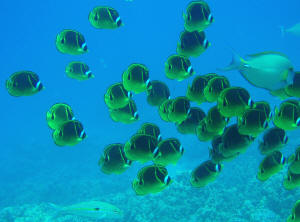 Some fishes will eat
or at least sample some soft coral species.
Chaetodon lunula (Lacepede
1803), the Raccoon Butterflyfish. Some fishes will eat
or at least sample some soft coral species.
Chaetodon lunula (Lacepede
1803), the Raccoon Butterflyfish.
|
|
Unintentionally Kill New Finger Leather? Corallimorph incomp.
in an established sys. 8/30/07 WWM Crew-
<Part> Thank you for everything you guys do - you are a
great resource for many aquarists. <Welcome> I've had
my 75 gallon tank for about 10 years. I started off with
fish-only and in the last five years it's been a modest
"reef." The tank contains the following fish: flame
angel, maroon clown pair, yellow tailed damsel and another yellow
colored damsel - all have bee alive for over three years. I have
the following corals: toadstool leather, many mushrooms, clove
polyps, button polyps and a small colt coral. All inhabitants are
doing fine <Acclimated... used to each other...> and
I've had them all (except the colt that I bought a few weeks
ago) for several years. I've fragged my toadstool several
times (great fun) and my mushrooms have grown from 5 to over 30!
I rarely buy new things for the tank and just enjoy watching
things grow. I also only buy hardy organisms that I'm sure I
can handle with great success. <Good technique, focus,
attitude> I've always wanted a finger leather and I've
heard that they are very hardy. <Can be...> I purchased a
finger leather on Aug 27th. During the 28th it opened about half
way - it was looking okay. For some reason I decided to clean the
tank a little (?!?!?) - I removed some algae, gravel vacuumed the
bottom, and replaced about 15 gallons of water. I also fragged my
toadstool again - it was just too huge - at least 10" tall!
All of my corals are quite hardy (haven't died on me yet!)
and a cleaning rarely causes any problems. However, I should have
taken into consideration the stress of the new finger leather.
The coral has really shrunk and hasn't opened up at all as of
late Aug 29th. There are areas on it that contain dark gray/blue
areas - I hope it is not decaying!. <Appears to be on its
way...> I've also noticed it giving off small squirts of
some slimy substance. The coral also seems to be removing itself
from the rock it's attached to - not completely, it is still
somewhat attached. I hate to waste money and I definitely
don't like causing a coral to die. I've attached several
pictures - does it need help, is there anyway I can save him?
Please help. <Mmm, Daryl... I espy a Mushroom in the vicinity
of this soft coral... This is very likely a simple case of
allelopathy... need to be separated space-wise, perhaps the use
of activated carbon... All covered here:
http://www.wetwebmedia.com/shroomcompfaqs.htm Bob Fenner>
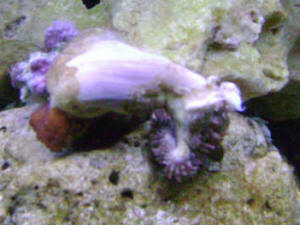
Re: Unintentionally Kill New Finger Leather? --
08/31/07 Thanks a bunch Bob! Love your book... <Thank
you... and thank goodness we're working on a new edition
presently... it's more then ten years old!> The coral is
still with us... I move him away from the mushrooms and placed
him on the bottom of the tank. I've attached a few pictures
of what it currently looks like. As far as the mushrooms go, I
didn't expect them to be a problem as one of my toadstool
leather frags sits right in the middle of a bunch of mushrooms
that touch the base of the leather (see pic). <Yes... but, do
understand, the new animal/colony is the odd organism out here...
it is NOT recognized chemically by the old group of cnidarians as
a "friend" or at least something to be tolerated...
There might be other causes for its apparent poor behavior... but
allelopathy is a very strong candidate... The best would be to
move it elsewhere... to another system> What should I expect
from this coral - is it just dying a slow death, or is there
hope? As you can see in the pictures, it seems as though some of
the fingers are perking up a bit...a sign of hope??? Thanks for
all your help! Daryl <Always some hope... read where you were
referred to... elsewhere on WWM re Cnidarian compatibility... Add
activated carbon at the least... BobF>
Re: Unintentionally Kill New Finger Leather? --
08/31/07 Thanks Bob- <Welcome Big D> I eagerly await
your new book. I've added Chemi-pure and a 12"x12"
poly-filter to my wet/dry. Daryl
<Real good. BobF>
|
|
.JPG)
|
| Sarcophyton w/ severe necrosis
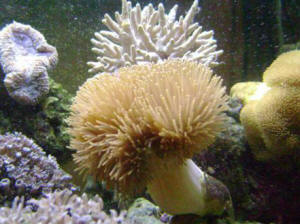
8/8/07 Help! My brown toadstool leather is suffering from
severe tissue necrosis. <Mmm, actually, the whole animal appears
on the skids> It started about a week ago, and I thought it
could recover. So I just siphoned the rotting tissue daily. Now
it's gotten so bad I don't think it will survive w/o human
intervention. It used to have a 3" diameter 'head'
(forgive my vocabulary, but I'm referring to the part where the
polyps are). <This is fine, descriptive... aka at the
Capitulum... meaning "head"> Now it has deteriorated
to less than an inch, and the necrosis has spread to the stalk
nearest the 'head'. But from the base up to the middle part
of the stalk seems to be healthy. Will the healthy stalk survive if
I cut off the rotting part? <Possibly, but...> If so, can you
please tell me how to do it? <If at all possible, move this
animal to another system... "Something" in this one is
amiss per this organism> I've no prior experience in cutting
any coral whatsoever, and I'm a little too desperate and
panicky to research on my own. I hope it's ok to spoon feed an
embarrassed reefer. Hope you guys could help me out. Thank you so
much. I'll attach a before and after pic of the coral. Paul
<And when you have time, please read through here:
http://www.wetwebmedia.com/alcyondisfaqs.htm and the linked files
above... Seeking parallels, clues through others experiences...
particularly re your system water quality, allelopathy, possible
predation here. But first and foremost, MOVE this animal. Bob
Fenner> |
|
|
Hole In My Yellow Fiji Leather Coral 'Do I
Have A Problem? -- 06/17/07 I have a nice 6" diameter Yellow
Fiji, << Sarcophyton elegans I presume>> I noticed the last
couple days that it has been closed and not extending its polyps. Today
it opened back up, but there is a hole in the center of it like it is
going to split. <<Uh-oh>> Is this possible?? <<Not
usually, no 'at least not in this manner>> Or do I have
a potential problem. <<I think so, yes>> My bicolor blenny
spends a lot of time in it, could he be eating it?? <<Maybe, I
have seen this species eat noxious Colt Coral (Cladiella spp.)
before 'or maybe the fish is just irritating the coral by
sitting on it. Another idea is that maybe sand/detritus has accumulated
on the coral blocking light/fostering bacteria and caused the
necrosis 'this is usually attributed to insufficient water
flow (Both intense lighting and strong water flow are important to the
continued health of this species)>> Thanks for your time.. Water
parameters are: 81 degrees Nitrates 20 <<This is another
potential issue'¦ Doesn't have to be 'zero', but
should be maintained below 5ppm when corals are present, in my
opinion>> Phosphates 0 Calcium 500ppm pH 8.1 dKH 12
<<Maintaining both Calcium and Alkalinity at these upper limits
is a recipe for disaster, please read here and among the links in blue:
http://www.wetwebmedia.com/calcalkmar.htm >> Ammonia 0 Nitrites 0
Phosphates 0 <<Regards, EricR>>
Dying Leather Coral,
using WWM -- 06/11/07 I hope you will be able to help me.
<Me too> I recently received a damaged leather coral, probably a
toadstool, in the hopes that I could revive it. The specimen came out
of an overstocked, uncycled system and had nitrate burns all over it.
Aside from nitrate poisoning, I could find nothing else to cause these
black spots. The coral was also under metal halide lighting which I
think would be too strong for a leather. I placed it into a quarantine
tank with a collection of Zoanthids from the same system. <... see
WWM re their compatibility> The lighting is now strong actinic and
sunlight fluorescent bulbs. The Zoanthids recovered almost immediately
and have been placed in my main tank but the leather is just drooping
more and more. It is right under a powerhead so there should be plenty
of water flow and I've added an iodine and vitamin supplement but
it hasn't even opened the head. Is there anything else I should
try? <Mmm, yes... Reading:
http://www.wetwebmedia.com/marine/inverts/index.htm The areas on
Zoanthids... and the tray below on Soft Corals... Bob Fenner>
Re: Dying Leather Coral -- 6/12/07 >Thank you
for your response and I did some more reading on your site. The best I
can pick up is to attempt to remove the necrotic (black) areas with a
razor blade to prevent it from spreading. ><Not necessary or
advised... needs a better setting... one where it isn't the loser
allelopathically> > It is possible also in its previous system
(29 g's) that it was too close to the Zoanthids. ><Of a
surety this was so> > I'm attaching a picture of the current
tank and specimen. I put it into a 55g with liverock, snails, and
hermit crabs along with a few damsel fish. Lighting remains actinic
><Not useful> >and full sun (both coral life with
reflectors). All water parameters are good. ><Ditto info.>
>I'm still not even sure this is a leather since it was given to
me in this condition but the stalk does resemble the standard. Do you
think there is a chance? An additional piece of info, the snails have
all been feeding on the base as shown in this picture.
><Please... read where you were referred to. BobF>
Re: Dying Leather Coral -- 6/12/07 I am sorry to
keep bothering you and beginning to feel as if I am a little dense. I
will include more information on the current tank conditions for this
poor leather coral. It was removed from a stressful situation last
week. I do not know much of the parameters but was told that the tank
had not cycled and that the nitrate readings were off of the chart. The
previous set up was a 29g nano-cube with metal halides and a chiller
attached. The system I placed it into has only live rock which has been
established for over 10 years. I am running the Eheim Wet Dry canister
system rated for 180 gallon tank with an additional powerhead to
increase water flow. The only chemical filtration is Chemi-pure in the
filter. I do not use a protein skimmer on this system as it is
seriously understocked by most standards and I never got anything in
the skimmer. Roughly 100 lbs live-rock, 2 blue damsels, 1 yellow tail
damsel, and a yellow striped maroon clown in a 55g. Water parameters
are as follows: Calcium: 480ppm Temp. 78 Nitrate: .25 Ammonia: 0
Nitrite: 0 PH: 8.23 Lighting: 1 40wt full sun fluorescent tube by
Coralife, 1 40wt actinic tube by Coralife Additives: Kent Marine
Essential Elements 1X week. Seachem Reef complete 1X week Seachem Reef
Plus 1X week. I stagger each additive by roughly 2 days rather than
introducing them all at once. These parameters seem to meet the normal
requirements for a leather coral and certainly keep the coralline algae
happy. This tank has never had corals as I use it for quarantining
anything I intend to put into the 75 set-up which has no troubles. The
specimen was placed approx. 4" under the lights (it was under
halides after all), 2" forward and 2" under the powerhead
return. Aside from the odd little white things on the rock it came on,
there are no other corals in the system to compete with it. I also add
Cyclops 1X week for snails and hermit crabs pleasure along with being a
treat to the damsels. If I do not remove the blackened areas of the
leather coral, it seems the only other thing I can do is wait and see.
<And read. RMF>
Cladiella coral problems 6/6/07 Hello everyone! I
hope you have all been well. I have a bit of a dilemma this morning. My
90 gallon (over stocked) reef aquarium has been doing excellent for
some time now with inadequate filtration (I have been doing 25% and
greater water changes weekly to maintain good water parameters). I
finally got my new filter system in I had Jeff at LifeReef Filtration
Systems make a custom wet / dry sump and a 36" tall by 7"
diameter skimmer for my system to help handle the load. The tank has
nearly 150 lbs of live rock in it and a sand bed about 1" deep
through out the entire display. The new filter system is incredible the
water is so clean now that I have had people telling me it looks like
the animals are floating in air. The skimmer is my favorite part of the
whole system, very easy to clean, worked right away instantly producing
dark matter in the cup and it looks great too. My problem started
before the filter was installed and has progressed to a point that I am
beginning to worry. My large Cladiella coral has had a white powder
like substance gathering on the shelf rock below it for a bit now. I
was thinking something may just be burrowing in the rock below it,
however, I had to do a large water change yesterday and found that it
looks as if the coral is deteriorating below where the arms have grown
out and reached the surrounding rock. One side of the coral (all of
this is happening on one side only) <Possibly a good clue> the
base of the coral is white where it attaches to the rock and seems to
be lifting off of the rock. This coral has been healthy and happy for a
quite a while now so this is quite surprising to me. The water
parameters in the tank check out great <.2 nitrate, 0 nitrite, 0
ammonia, dKH 12, calcium 420, PH 8.4, temp stays between 75 - 77
degrees Specific gravity is 1.035. <Mmm, no... likely you mean your
salinity is 35 ppt, a spg of about 1.025 at this...> Every other
coral in the tank has been healthy and happy (LPS coral: Torch,
Trumpet, and Candy Cane) <Ah, yes... one of these is near the
mal-affected side, and/or the prevailing current comes from...> As a
matter of fact they have doubled in size in the last month and a half
or so. I have two Sinularia sp corals on the other side of the tank (I
am thinking they could be clones) and they are doing well and growing
rapidly as well. Other than those I have one white pulsing Xenia that
has separated into 7 colonies now and is doing wonderful, and a patch
of green star polyps that has grown nearly 3" in all directions in
the last 3 months. I have 3 crocea clams all nearly 5" now, were
3" when I got them. I have two coco worms that have spawned 3
times (that I am aware of) and now I have about 75 very small coco
worms through out the tank that I have seen so far. There are also
several species of fan worms showing up everywhere, some bright orange
sponges have begun to pop up in the shady areas of the tank. <These
could be allelopathogenic as well> We have been seeing a few
different types of brittle and serpent starfish (very small) come out
at dusk to scavenge. The tank has pretty much been thriving. Yesterday
however I came in and my ventralis Anthias that has been eating great,
schooling with the Chromis and staking his claim to the larger cave in
my tank was dead, all the fish were breathing very heavy, the yellow
tang had red streaks on his fins and body, the six line wrasse was
laying on his side gasping, the xenia wasn't pulsing as it normally
does, I thought they were all going to die right then and there. I
immediately did a 40 gallon water exchange (I keep a vat of water
mixing for such emergencies and the convenience of not having to mix
right before I have to work on the tank), I changed out the pads in the
filter added two drops of Lugol's solution, hoping the iodine might
have a positive effect on things as well as the water exchange. My
guess was that something poisoned the water whether it be a sick coral
or an outside source. <Something internal> Today I am glad to say
things have perked up considerably. The fish are swimming around again,
and eating (though not with as much gusto as before the incident) I am
sure it will probably take more than a day for them to get through the
shock of what they experienced. The tang is bright yellow again, no red
streaks anymore, and is acting near normal, the coral beauty is as
pugnacious as usual and seems to be back to normal the green Chromis
are still breathing quickly and seem to be in a bit of shock (staying
together and hiding quickly when anything gets near the tank) as they
did when they were introduced to the tank. Nothing new has been added
to the tank in quite a while (2 months or so) and those animals were in
quarantine for 5 weeks before that. Since I have seen improvement in
the fish since the water change I am not too worried about them. Any
ideas as to what is going on with the Cladiella coral though? Thank you
for your time, Brian <Well... you really need a much larger
volume... which it appears you're aware of... And likely to move
out the Cladiella entirely or the likely cause of this ongoing chemical
warfare... My first guess of what is listed, the Euphyllia... Please do
read re the "Systems" and "Compatibility" of all
the species/groups you have... on WWM... You can/could adopt other
"stop gap" measures to limit the various means of aggression
here (chemical filtration, ozonation, a DSB and macroalgal culture in a
tied-in refugium)... but really... a larger system, fragging to much
smaller size, moving... are more viable options. Bob Fenner>
Re: Cladiella coral problems -- 06/08/07 Hello
Bob, Thank you for your timely response! I took the Cladiella coral out
of the 90 gallon reef and cut away the dead / dying areas on it, then
sent it home with a friend and his 180 gallon reef. since then the tank
has shown more improvement. All fish are going back to their normal
behaviors. I am running Chemi-pure in the system now also. I wanted to
ask you if in the Cladiella place should I put a torch coral,
frogspawn, or hammer coral there would that work out in close range to
the torch, or would there be problems raising from that as well?
<Take a read on WWM re Euphyllias... the family (still listed as
Caryophylliidae by moi)> I am trying to figure out something to fill
in the space the Cladiella left. <Leave this gap for now...> I
suppose putting another torch there would do the trick as well,
<Mmm, again... read... Better to either frag or just wait for the
existing colony to grow... will> or bringing some kelp into that
area. <... read> Your insight on this is greatly appreciated as
always. Thank you, Brian
<Bob Fenner>
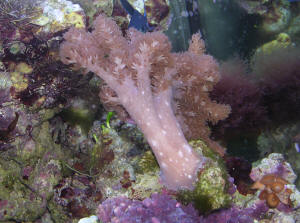
| Colt Coral... hlth.... w/ an Anemone in a
smallish system... no phosphate in solution... 5/29/07 Hi
guys, <Jim> Here is a picture of my colt coral. I have had it
for about 2 months and it seemed to be doing very well. I had to go
out of town for work and my family were away for 2 days. I
haven't returned yet but my son sent me this picture of the
colt. The stalk is wrinkled with spots and he is only out about
half of what he is normally. The "spots" seem to be
somewhat indented. I am looking for some ideas and hopefully
solutions. 55 gallon with 50 pounds LR Water parameters are Ph 8.2,
temperature 80, nitrate, nitrite, ammonia and phosphate are all
zero. Calcium is 450 ppm. <Alkalinity, Magnesium?> Tank
Mates: 1 cleaner shrimp, 1 peppermint shrimp, 2 false clowns
1.5", 1 niger trigger 3", <This fish is mis-placed
here> 1 fox coral, 1 golden goddess Nudibranch, 4 blue legged
hermits, 2 scarlet legged hermits, 1 small LTA (8" from
corals) <Ding, ding, ding... We have a winnah!> and a couple
of polyp colonies. The only thing new is the fox coral which is
about eight inches from the colt. the rest were there before the
colt arrived. I put about 1 tablespoon of Seachem PhosGuard <...
and here. The cnidarians all need some phosphate... essential
nutrient> in the filter system about a week ago to take out a
bit of silica that seems to get through the RO system. I have done
this for a couple of months to control the small diatom bloom I
seem to get at bi-weekly water changes. That is about all I can
think of. Sorry about the huge file size but it is what my son sent
and I have no editing software on this computer. Your help and
advice is greatly appreciated. Jim <Umm, see WWM re the
LTAnemone... Compatibility... and the role of Phosphate... Bob
Fenner> |
|
|
| Toadstool Trouble...Another Case Of Allelopathy
-- 05/17/07 I read through your articles regarding troubled
Toadstool leathers and have found some that look like they might be
what are happening with mine, but I am not sure without seeing any
of the pictures. I had bought one the was purple in
color that stood about six inches high and roughly four inches
across when fully opened. <<Nice>> For the first
several weeks everything was fine, but all of a sudden two weeks
ago, it shriveled up, kinked in the middle at about a 90 degree
angle, white stuff formed on the crown and the sides of the stalk
which are peeling almost like a sunburn does. <<Mmm, very bad
signs...and likely the result of allelopathy>> And now,
today, I noticed brown splotches forming all over it. I
have noted that there were a few whispy, almost spider silk...I
don't know, I guess I could call them tendrils extending from
the crown--I saw 2, to be exact that sounded similar to what was
described in one of the FAQs. I have checked my water
quality and have confirmed that all is within the range it should
be (nitrate, nitrite, pH, hardness, alkalinity, salinity, ammonia,
phosphate) and change my water weekly (15 gallons in a 46 gallon
setup). <<Ah, but the problem here is not what you can
measure, but what you can't...that nasty mix of noxious
chemicals/toxins/poisons/stinging cells exuded and expelled by most
all sessile organisms, and a few motile ones, in the ever present
struggle for life and space to grow and reproduce on the
reef>> I have not seen my clowns harassing it, but they are
seeming to like nesting in my Cauliflower Colt Coral on the
opposite end of the tank, down flow from the leather.
<<'Down flow' or not means nothing
really...'everything is affecting everything' in the tank,
you can be certain of that>> The other corals in my tank are
Fox Coral, Flowerpot, Pink Clove Polyps, 2 Bulb Anemones,
<<These are real trouble in a small 'garden mix'
system>> as well as a final soft coral I cannot remember the
name of, but have included a picture. <<I see it...it is a
very nice specimen of Plerogyra sinuosa, or Bubble Coral...and is
capable of doing considerable damage to its neighbors with its
powerful sweeper tentacles>> I have also included what the
leather looked like before as well as how it looks now.
<<Mmm...definitely on the decline>> I have a dual
daylight/actinic setup (96 watts each) and have good water flow
from a powerhead, which I made sure to position the leather near.
<<Do make sure the powerhead is not blasting the leather
coral directly>> This change happened all of a sudden and I
am not quite sure what it could be. Please help me.
<<I am fairly certain the Toadstool's demise is
attributable to the largely incompatible mix of organisms in your
tank. The 'garden variety' mix of reef organisms
is a very popular 'style' of reef system in the
hobby. But these systems have a fragile balance that is
easily upset, and rarely maintained for the long-term>> Thank
you so much! Scott Jones Riverside, CA <<A pleasure to
assist. Eric Russell...Columbia, SC>> |
|
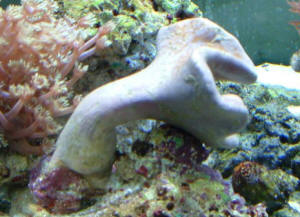
|
Spaghetti leather coral, losing to more established, toxic,
stinging Cnidarians... 5/16/07 It has been about
a year since I put any new coral into my tank. I currently
have a blue candy cane coral, an unidentified type of Favia, Galaxea,
two Kenya tree corals, many mushrooms and Zoanthids, green star
polyps, and a long tentacle anemone. <Trouble... a mix to keep
watched...> All of which seem to be doing great and
growing. I have a Coralife 150watt metal halide over my 36
gallon aquarium. I run a protein skimmer and have a couple
power heads for water movement. My nitrates and nitrites
usually run at 0. Specific gravity runs about 1.027. I
recently purchased a spaghetti leather coral from a local fish
store. It has been shriveled up since I placed it in the
tank two days ago. <No doubt... is a "loser" amongst the
other Cnidarian groups listed... Have you seen the word
"allelopathy" in recent times?> This morning I
woke up and checked on it, and to my surprise it looked like it was
falling apart. It appeared as though the first layer of
"skin" had peeled off and it revealed the brown insides of
the coral. I immediately tested the water for nitrates and
found that it was running a bit high for my tank which was about
20ppm. I am assuming that this spike has to do with the
decaying coral. What went wrong with my spaghetti coral?
<The other stinging-celled life present, and established likely>
There are still a couple fingers left that have its normal white skin
covering on them. Should I frag the remaining healthy
looking fingers? Thanks for your response, you guys are a real asset to
the aquarium trade! Michael Attewell <If fragged, it needs to be
placed elsewhere... Read here: http://www.wetwebmedia.com/cnidcompfaqs.htm and the
linked files above and over to Alcyoniid Compatibility... you have an
unsustainable mix, a close-to disaster situation currently. Bob
Fenner>
Re: Spaghetti leather coral, comp. -- 05/16/07
Wow! This is really eye opening. Just when I thought I was
doing ok, something else comes along and totally changes the game.
<Ahh... a good (periodic) lesson in/about life, eh?>
I am setting my 75 gallon up to house what is left of the
spaghetti coral. <Good> There is a bit of the stalk
left and I am hoping it will regenerate. Thanks for all your
expert advice! Michael Attewell <Very glad to share. Bob Fenner>
Finger Leather Coral, BGA control...
5/8/07 Hi All, About a month ago I purchased a green finger leather
coral to go in my 150 reef tank. Just recently it
started to get little strands of what appears to be Cyanobacteria
algae on its tips. The algae is long, brown, and seems
to constrict the tips of the coral. The coral still
opens fully and appears normal, except for the algae. I
know that I have to get this stuff off or it will kill the coral,
however I don't want to place it under excessive
stress. Could you please offer some advice as to how I
can get rid of the algae and how to prevent it in the
future. Also there none of this Cyanobacteria algae
anywhere else in the take so I don't think that
excessive nutrients are causing the problem. Thanks much, Joseph
<Mmm, yes... alter, improve the environment to favor the
Alcyoniid... disfavor the BGA... less nutrient in solution, more
circulation, higher RedOx... Please read here: http://www.wetwebmedia.com/alcyoniids.htm and http://www.wetwebmedia.com/bluegralgae.htm and the
linked files above. Bob Fenner>
Struggling Colt Coral, likely allelopathy
5/8/07 Hello everyone, hope you are all well. I guess
its probably best to give you information about my set up
first. I have a 110 gallon tank, flow is provided by 2
Aquaclear 150's, 2 powerheads (rated at 200 gph, unsure of the
brand), 1 powerhead (rated at 500 gph, unsure of brand), and a SeaClone
150 protein skimmer (I know, not the greatest skimmer, I have a Aqua C
EV 180, but don't have my sump up and running yet.). <I would
move forward with this project...> Lighting is done with
3 175W metal halides 6700 K, and 2 25W fluorescents, 1 is 10000 K, the
other is blue actinic. Tank inhabitants are as
follows: pair of False Perculas, 2 Yellow Tail Blue Damsels,
Blue Hippo Tang, Diamond Goby, Red Velvet Wrasse, Foxface, Coral Beauty
Angel, Scooter Blenny, Royal Gramma Basslet, Serpent Star, about 10
snails, and 5 crabs. Corals: Leather Toadstool,
Torch Coral, Green Star Polyps, Stylophora, Mushrooms, Button Polyps,
Colt Coral, Hammer Coral, Hydnophora. Water parameters
are: SG 1.026, ammonia, nitrite, phosphate all 0, nitrate
<10(hard to read color, but actually probably less than 5), calcium
380-400. I'm sorry for taking so much time, but I wanted
to give you as much detail as possible because I'm having a little
trouble figuring out what's going on with my Colt
Coral. My best guess is that maybe one of its tank mates is
the problem. <Very likely so... a few of the Classes of other
Cnidarians listed are likely at play here> I have had
the Colt for about 4 months now, and it's looked great until about
week and a half ago. This was about 2 or 3 days after adding
the Hydnophora and the Hammer, <Bingo> which both look fine
now. The Colt is still opening everyday, but not nearly as
full as it did before. Everything else in the tank looks
fine. Do you think either the Hydnophora or the Hammer might
be releasing something into the water that the Colt doesn't
like? Thanks so much for your time. Ryan <Mmm, yes...
Though other factors of water quality might be at play... you can/could
try spiffing up your water quality (the new skimmer, sump especially),
using chemical filtrants... changing a bunch of water... removing the
Alcyoniid... Please read here: http://www.wetwebmedia.com/cnidcompfaqs.htm and the
linked files above. Bob Fenner>
Re: Struggling Colt Coral 5/12/07 Hey
crew! Thanks so much for your reply. Just thought
I would let you know what happened with my Colt. I moved it
to the other end of the tank, away from the Hammer and the Hydnophora,
and it is looking much better after only 2 days. Looks
almost as good as it did before. Thank you once again for
all you do. Ryan <Ahh, congratulations. Thank you for this
follow-up. Bob Fenner>
|
|