|
FAQs about Pistol (including Goby) Shrimps,
Identification
Related FAQs: Pistol Shrimps 1, Pistol Shrimps 2, Alpheid Behavior, Alpheid Compatibility, Alpheid Selection, Alpheid Systems, Pistol Shrimp and Goby Biotopes,
Alpheid Feeding, Alpheid Disease, Alpheid Reproduction, & Shrimp Gobies, Shrimp Gobies 2, &
Marine Shrimps
1, Marine Shrimps
3, Shrimp Identification,
Shrimp Selection, Shrimp Behavior, Shrimp Compatibility, Shrimp Systems, Shrimp Feeding, Shrimp Reproduction, Shrimp Disease, Cleaner
Shrimp, Banded Coral
Shrimp, Dancing Shrimp,
Harlequin Shrimp, Saron Shrimp, Mantis
Shrimp, Anemone
Eating Shrimp, Crustacean Identification, Crustacean Selection, Crustacean Behavior, Crustacean Compatibility, Crustacean Systems, Crustacean Feeding, Crustacean Disease, Crustacean Reproduction,
Related Articles: Alpheid Shrimps, Shrimp,
A Few Common Shrimps for the Marine Aquarium by James W.
Fatherree, Shrimp Gobies,
|
|
|
Pistol Shrimp ID
6/5/19
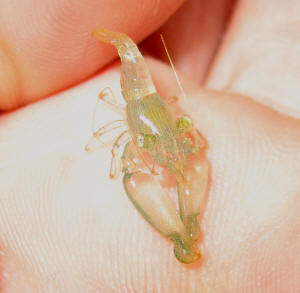
Hey all!
<Hey Luis>
I’ve had a pair of pistol shrimp that hitchhiked into my tank some years
ago - maybe 3-4 years. I would constantly hear them snapping away and would
lose hermits and snails to them. A while ago I took out a suspect rock and
gave it a FW bath. Some time later I found a pistol shrimp, unfortunately
dead. This one was pregnant- so obviously a mate somewhere in the tank as
well. Sure enough, the clicking continued.
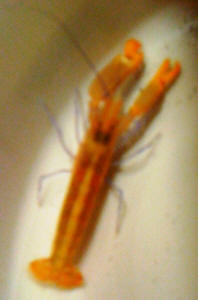
Today, I finally discovered the second culprit. Rinsed a different suspect
rock out, and found him. Tiny in size as you can see here. He survived the
freshwater wash that blew him out of the rock. Any idea on the species? His
mate was roughly the same size, a bit larger. Never grew bigger than this
over all these years.
<Appears to be from the Alpheidae family, probably Betaeus sp. Cheers. Wil.>
|
 |
|
Pistol shrimp ID please 1/28/16
Hi Crew!
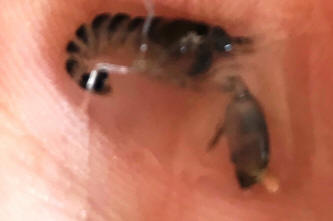
I came across a pistol shrimp at my LFS (pic attached).
<See you've included it/this later>
They claim it is a tiger pistol but I have not seen a color variance
like this one.
<Mmm; Alpheus bellulus do vary>
It is lighter and the claws are bluish with purple tips. It is acclimating right
now but I am hesitant to release into my DT without confirmation. My tank is
very peaceful and I was a tad shocked they had this little guy (~1.5 inches)
with a purple lobster at least 3 times his length, so I am guessing he can hold
his ground lol.
<Yikes; I wouldn't mix these>
Ultimately I would eventually like my yellow watchman and him to pair. I
appreciate any feedback, thank you for your help!
Dani :)
<Thank you for sharing. Bob Fenner>
|
 |
|
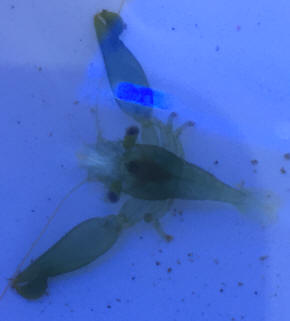
Green pistol shrimp? 6/10/15
Hello,
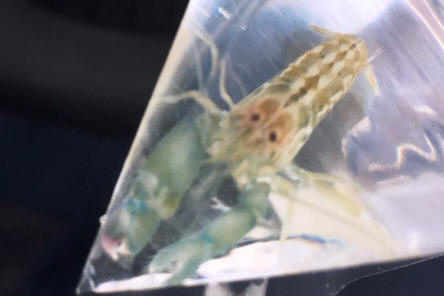
I found a couple of what appears to be green pistol shrimp on some sps corals
and have been unable to find any information on them and was wondering if you
might know what they are and if there safe for sps/reef tank or if they should
be removed?
Thanks,
Craig
<Will have to look; looks like a member of genus Coralliocaris... An Acropora
commensal... I'd leave them be. Do see LynnZ's resp. re here:
http://www.wetwebmedia.com/alphidf.htm
Bob Fenner>
|
 |
|
Snapping Shrimp ID? Nope, Thalassinidean -
8/26/10
Hello all!
<Hello Donna, Lynn here today!>
I own a saltwater reef store in Las Vegas
<Neat!>
..and can't count how many times you guys have helped me
silently.
<That's great, I'm glad we've been able to
help.>
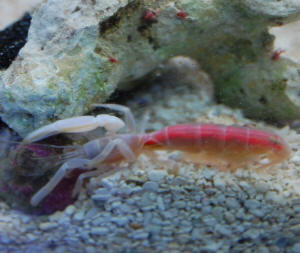
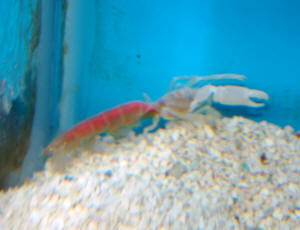
I was sent an "assorted snapping shrimp" and before
selling it I would like to ID it if possible.
<Good for you! The more you know, the better chance that
little shrimp has of ending up in a system that suits its
needs.>
It is without a doubt one of the coolest ones I've ever
seen.
<It is, indeed.>
It does look to be Alpheus Sp. judging by the claws but I
can't find anything that even remotely resembles it on the
web.
<Yep, although the claws do look similar, and are unequal in
size, this is another creature entirely. It appears to be a
Decapod crustacean in the infraorder Thalassinidea, aka
'Ghost', 'Mud' or 'Sponge' shrimps. This
group is typically comprised of deposit/detritus-feeders and
filter-feeders. I believe your individual belongs in one of two
families: Callianassidae ("Ghost shrimps": big-time
burrowers, combination deposit and filter-feeders), or something
in the family Callianidaeidae, (shrimps associated with
reef/rubble habitats that tend to burrow or hang out under
rocks/within rockwork). I wish I could narrow it to one family or
the other, but I can't quite see enough detail to make that
determination. At any rate, I'm leaning towards the latter
family, namely those species in the genus Callianidea. If your
individual came from the Indo-Pacific region, it could easily be
Callianidea typa as it seems to be a fairly common, widespread
specie. As far as diet, I couldn't find any specific
information, but it's likely another deposit/detritus-feeder
that would do best in a mature system with a deep sand bed,
rockwork, and rubble. As with any potential burrower, there's
always the possibility of undermined rockwork and rearranged
aquascapes, so that should be kept in mind for anyone wishing to
take this little fellow home. Please see the following links for
examples of Callianidea typa:
http://24.dtiblog.com/c/calappa/file/20090224111920.jpg
http://www.flmnh.ufl.edu/reefs/guamimg/crustacea/crusties/Pages/Image18.html
Family Callianassidae, genus Calianassa:
http://www.marinelifephotography.com/marine/arthropods/shrimps/callianassa-1.htm
Good basic information link re: Thalassinidean shrimps: http://museumvictoria.com.au/crust/thalbiol.html
>
Thanks in advance for your help.
<You're very welcome.>
Donna
<Take care, Lynn Z>
|
  |
|
Pistol Shrimp Species ID Help, Please: Likely Alpheus
parvirostris or Alpheus bannerorum -- 7/7/10
WetWeb-ers,
<Hello AM, Lynn here today.>
Love your work, have spent many hours enjoying the FAQs.
<Excellent!>
I have a question of my own today:
<Fire away>
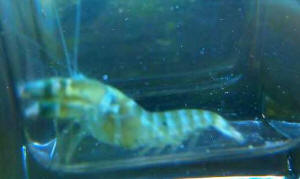
Attached are three photos of [what was sold as] a "Green
Pistol Shrimp", however I am not confident that this label
was anything other than a guess on the part of my LFS.
<It happens.>
The beastie's appearance is not entirely unlike a Tiger
Pistol, but he is distinctly *green* with white bands; the green
was not reproduced well in the photos, however I can assure you
he is somewhere between "an Army Jeep" and "an
overripe lime". Is there perhaps a greenish variety or morph
of a Tiger Pistol?
<Not that I know of, but there are plenty of pistol shrimps
out there with banded abdomens of various colors.>
I also found a single photo on the internet of Alpheus euphrosyne
- "Green Pistol Shrimp" - but the resemblance is not
close.
<Nope, I think what you have is more likely one of two closely
related Indo-Pacific species: Alpheus parvirostris (aka the
Green-Banded Pistol Shrimp) or Alpheus bannerorum (no common name
that I know of). The two are differentiated by the presence of
four spots (not sure what color) on the abdomen (the
banded/segmented section) of A. bannerorum. It's hard to tell
from your photos but I do see what could be at least two, dark,
bilateral (on both sides) spots. Take a close look at the little
fellow and see if you can see those four spots. If you do,
it's likely A. bannerorum. If not, it's probably A.
parvirostris. I can't tell you much about A. bannerorum. The
best information available is within a 1987 study by A. J. Bruce
titled: 'A new species of Alpheid shrimp, Alpheus bannerorum,
from northern Australia'. Unfortunately, I don't have
access to this publication and have been unable to find a photo
of the species anywhere in books or on the net. Thankfully, the
same cannot be said of Alpheus parvirostris. Size-wise, they can
reach 1' (2.5cm) and from what I can tell, usually live in
pairs and may not form symbiotic relationships with shrimp
Gobies. Please see the following links for photo comparison (note
variations in color/claw pattern):
http://calphotos.berkeley.edu/cgi/img_query?stat=BROWSE&query_src=photos_fauna_sci-Invertebrate-Other&where-lifeform=Invertebrate-Other&where-taxon=Alpheus+parvirostris&title_tag=Alpheus+parvirostris
Differences between the two species mentioned on pg. 67 of this
study:
http://biogeodb.stri.si.edu/bioinformatics/alpheus/PDFs/AA2001a.pdf
>
Another unusual feature, you'll notice, is that he has *two*
big claws.
<Yes, I saw that. That's double trouble for anyone, or
anything, foolish enough to mess with him!>
This would seem to be quite a clue, but I haven't had any
luck on the Google's isolating a species that is known for having
*two* of the
snapping appendages (I *have* heard him snap) - one wonders how
he eats??
<They have other smaller claws they can use.>
Is this possibly the result of an injury and less-than-perfect
regenerative logic?
<Something like that, yes. Apparently, Alpheids can
'switch hit', so to speak, when it comes to their
snapping claws. For example, if a snapper is lost then the
smaller claw ('pincer') will be replaced by a snapper,
and what was the snapper will be replaced by a pincer. This
happens within a molt or two, depending on when the larger claw
was lost. That explains why Alpheids aren't consistently
right or left-handed. Having two snapping claws is reportedly due
to injury/nerve damage. For more in-depth information on this,
please see the following link: http://www.accessmylibrary.com/coms2/summary_0286-297403_ITM
>
He has shown no interest in bonding with my Orange Spotted or
Watchman Gobies (despite their repeated advances) - I understand
sometimes love simply does not blossom, but I offer this as grist
for the mill anyway.
<Yep, I saw one bit of information stating that A.
parvirostris doesn't form partnerships with shrimp gobies but
I was unable to confirm it elsewhere. I guess time will
tell!>
Thanks for your time, and opinion.
<You're very welcome, enjoy your shrimp!>
AM
<Take care, Lynn Z>
|
 .jpg)
.jpg) |
|
Re: Pistol Shrimp Species ID Help, Please: Likely
Alpheus parvirostris or Alpheus bannerorum -- 7/7/10
<Hello, Drew!>
Thanks Lynn, that looks like a winner!
<Yay!>
That Berkeley photo side is a big win as well,
<Yes indeed, it's a wonderful site.>
Thanks!
<You're very welcome!>
Drew
<Take care, Lynn Z>
|
Possible Help in Identification, Alpheid --
4/11/10
Hi all,
<Hi Deana, Lynn here today.>
Hope you are having a good day.
<I'm having a great day, thanks, and same to you!>
I had an idea about the identification of one of the pistol shrimps
marked as unidentified.
<Neat>
The caption reads "Unidentified Alpheid in a Crinoid. N. Sulawesi
pic. Yes, it really is THIS red!".
<Ah yes, I know this photo.>
I believe I have the answer (but of course could be wrong). I think it
is actually a Feather Star Squat Lobster, Allogalathea elegans, (or
very close relative). It seems to be nestled in a Feather starfish.
These particular lobsters reach about 1 1/4 in and form a symbiotic
relationship with this particular starfish even changing their colors
to blend with it.
<Yes, while most individuals in this species show marked light and
dark bands running the length of the back/carapace, there is an
exception. That is, an all-red version that lives on red hosts. Pretty
cool, huh?>
They hide within their arms. I remembered seeing a pic almost exactly
like this and went back to my books. *Encyclopedia of Aquarium and
Pondfish* by David Alderton, ISBN 978-0-1566-3678-4, published 2008,
lobster, pg291, starfish pg297. Don't know if I'm right, but,
your site is all about gathering knowledge and this is just too cool a
species (if that's what it is), for hobbyists not to know
about.
<It is indeed an extremely cool species and we very much appreciate
your interest and help. I particularly appreciate it because I know the
time and effort it takes to research these neat little creatures! In
this case, though, the shrimp in question really does appear to be some
sort of Alpheid. You can tell by the large Popeye-worthy claw arm and
distinctively shaped/rounded claw. Allogalathea elegans has long
slender arms with slender claws. Beyond that though, the two do indeed
look very similar, given what you can see in the photo. Here's a
good example of an Alpheid arm and claw.
http://www.biology.ualberta.ca/palmer.hp/People/Pics/Anker-Alpheus.jpg
That thing looks like it would make a good can-opener, doesn't it!
>
This is the link with the "unidentified" shrimp.
http://www.wetwebmedia.com/pistolshrimps.htm Hope you guys are enjoying
yourselves.
<I am indeed. It's always a pleasure to share information with
another hobbyist, particularly one interested in ID work! With that in
mind, I'll pass along something that I think you'll appreciate.
I looked at that same shrimp photo years ago and tried to ID it.
I'm still looking!>
Thanks for all your hard work!
<You're most welcome and thank you!>
Deana
<Take care, Lynn Z>
Re: Possible Help in Identification, Alpheids --
4/11/10
<Hi Deana!>
Oh just another note about this. If I am right, this shrimp that's
name says "lobster", is technically a crab.
<Both are common names that are useful as broad terms, but
that's about it. For example, although the common name for
Allogalathea elegans is a squat lobster, it actually belongs within a
Decapod Crustacean infraorder called Anomura, otherwise known as
'false' crabs. The species itself is in the family Galatheidae
and is related to hermits, porcelain crabs, mole crabs, King crabs,
etc. Although most of those common names include the word
'crab', they're not considered 'true' crabs at all.
There aren't any 'true' lobsters in there either.
Lobsters/crayfish as well as 'true' crabs have their own
infraorders (Astacidea and Brachyura respectively). Basically,
Allogalathea elegans is a 'false crab' that's not a
'real lobster' either! That's the problem with common
names. They can be shared with a myriad of different species and lead
to a lot of confusion! Take care and thanks again. Lynn Z>
Follow-up: Re: Possible Help in Identification, Alpheids --
4/14/10
<Hi Deana>
You are right, I do appreciate that.
<I appreciate your interest and enthusiasm! Identifying organisms
can be a real challenge and goodness knows I've been wrong before
and will be again. It's a continual learning process made easier by
virtue of an interesting topic.>
This will be a "white whale" for me too.
<Heee! Happily, we don't have to end up like old Ahab!>
You are right though. I didn't see that.
<Oh please, I wish I had a dime for everything I've missed along
the way!>
Hmm. As coincidence, BlueZoo started offering the squat lobsters within
the last couple days on their site. Must have been reading my mind.
<Heee!>
Glad for all you do. I am just starting to learn.
<Aren't we all!>
If I ever figure out what it is, I'll let you know.
<Please do.>
Thanks for your time.
<It was a pleasure.>
Deana
<Take care, Lynn Z>
|
Re Mandarin hlth., was fat lip, now swollen pooter...
Alpheid ID, Diatoms 3/11/10
Hey Bob,
Thanks for getting back to me so quickly.
The mandarin seems to be acting completely normal but his issue
persists. I wanted to take this time to ask for some guidance on
a few issues I'm having. I believe I told you that I recently
down-sized from a 75 gallon to a red sea max 34 gallon all in
one. I kept about 20 lbs. of live rock from the big tank and
added to it about 25 lbs. of new live rock from the LFS. I also
saved about 2 cups of sand from the big tank and added 20 lbs of
black pacific reef sand to the new setup. I used 2-3 gallons of
water from the big tank and added new RO/DI salt water in the new
set up. Well the tank has been set up for a month now and I am
pulling my hair out dealing with one issue after another. So I
hope you can help with a few things because I'm losing faith
in my ability to maintain my tank. So here is my current set
up:
34 gallon red sea max all in one
20-24 lbs sand
45-50 lbs live rock
I replaced the regular carbon bag from this package with
Chemi-pure elite and also added a bag of Seachem Purigen.
I am also running a Aquaripure nitrate filter.
I change 5-7 gallons of water about every two weeks, replace with
RO/DI salt water and top off with RO/DI fresh water all bought at
the LFS.
Livestock includes:
Mystery wrasse (moved from old set up)
Green mandarin (moved from old set up)
Yellow watchmen goby (added to new set up after 2 weeks)
Scarlet cleaner shrimp (moved from old set up)
pistol shrimp (added to new set up after 2 weeks)
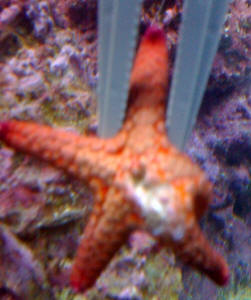
pink tile sea star (added to new set up after 2 days but died
after 2-3 weeks)
orange sun coral polyp frag
green starburst coral frag
green Zo frag
hermits
Astrea, Nassarius, and turbo snails
water parameters:
ph 8.3
nitrate 0-5ppm
nitrite 0
ammonia 0
calcium 420
<Magnesium? I would test for this...>
Alk 14dkh
I feed the fish frozen Mysis and brine shrimp, and blood worms
all soaked in Selcon.
I feed the coral zooplankton or reef chili
I also dose with iodine, purple up, and Seachem liquid buffer as
needed.
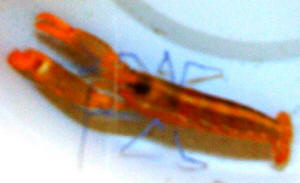
Alrighty then, I was wondering what species of pistol shrimp I
picked up.
<... looks like an Alpheus sp., but I don't see it in my
print ref.s or on the Net. There's summat similar on
Keyscritters.com, but I don't see this listed
elsewhere.>
I have been looking around online and have not found any that
look like him. I bought him so that he might pair up with the
goby but this doesn't seem like its going to happen
<And can even be dangerous. See today's "Daily
FAQs">
and even wondered if he might be responsible for the goby's
injury I noticed yesterday.
<Oh yes, could well be>
Secondly, I was hoping you could tell me what caused the sea star
to perish.
<See WWM re... there is little hope for this Fromia>
He was in the new tank for nearly three weeks albeit he
didn't move around too much and suddenly he has a hole in his
disk and what I can only guess were his guts hanging out. And
last, I have this reddish brown stuff growing all over the sand
bed and the glass and a spot or two on the live rock. Is this
Cyanobacteria or what?
<I think "what"... Diatoms likely. Do you have a
microscope?>
I can clean off the glass or stir up a spot in the sand and
within hours its back. I do water changes and as far as I know
keep the water parameters in check so what could be causing this
stuff to grow so fast?
<... again... learn to/use WWM:
http://wetwebmedia.com/dinoalgcontrmar.htm>
Well I'm sure you are tired of reading by now so I will post
some pics for your viewing pleasure and I hope to hear back from
you soon. Thanks again for all that you guys do...
Frank
<Wish I could be of more direct, complete help Frank.
BobF>
|
  |
Pistol Shrimp ID 3/1/10
Hello,
<Hello Frank>
I was wondering if you could possibly help identify what species of
pistol shrimp I recently purchased.
<Sure, I'll take a shot in the barrel.>
Sorry I can't get a pic now cause he stays in his burrow. He is a
bright orange color, similar to color of clown fish, with light blue
legs with no body markings. He also seems to have no interest in my
yellow Watchman Goby nor does the goby seem to care about him. I bought
this guy hoping he would pair up with the goby but that doesn't
appear to be happening.
<Can take some time before/if this occurs.>
All he wants to do is dig out burrows under all my live rock. If you
can help me identify so I can decide whether to keep him or not, since
he won't pair up with the goby. But it's only been a few weeks
so I want to be patient.
<Please do, as both of these animals are reclusive, it may take some
time before they find each other. As to identifying without a pic, I
could only guess, as there are about 500 documented species of Pistol
Shrimp.
My guess would be the Tri-Color or the Striped Pistol Shrimp. You state
no body markings but the Striped Pistol Shrimp has a stripe running
laterally on each side of the body but this is not pronounced.
You might want take a look at our Alpheid ID FAQ's here.
http://www.wetwebmedia.com/alphidf.htm>
Anyways thanks for your help!
<You're welcome. James (Salty Dog)>
|
Strange Creature In Reef Tank...What Is It?
1/21/10
I found a weird creature in my fish tank last night when I was
feeding the fish and corals. This thing measures about 1'
long, it is like a transparent dark brown/green color similar to
a bait shrimp, the head is like in a flat arrow shape, it has
claws that was using to move the crushed seashells from under the
rock, it has pretty long antennas for his size, I'll say
about 1cm, it moves very fast, it will start crawling out very
slow to try to reach some food pellets but I never got to see the
full body out, I saw most of it but never got completely out of
the rock. I used to have an Engineer Goby that dies and I thought
it was a baby but now, this has a mixed look like a
lobster+shrimp+cockroach <?xml:namespace prefix = o ns =
"urn:schemas-microsoft-com:office:office" / >
<??>
I managed to take some pictures (attached) but they came a little
blurry and I was only able to get the head , I circled in the
image the creature so you can see it. It moves very fast when
goes back inside the rocks so it took me about 10 minutes to take
the picture.
What is this thing?
<Well, as you say, the pictures aren't resolved enough for
an accurate ID, but by your description, I'm guessing you
likely have a shrimp of some type, possibly a Pistol Shrimp or
Mantis Shrimp. Are you hearing any clicking/snapping
sounds?>
Thank you.
<You're welcome. James (Salty Dog)>
|
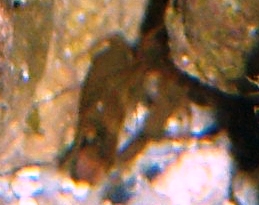 an Alpheid an Alpheid |
Re Strange Creature In Reef Tank...What Is It?
1/21/10
Yes, I do hear some clicking sounds sometimes
<Then you likely have a Pistol Shrimp of some type, but not to
rule out a Mantis Shrimp.
You may want to trap and photograph, and send a couple of pics to
us or ID yourself by Googling. Traps for this purpose are rather
inexpensive and can be had on-line. If it is a Mantis Shrimp,
trouble lies down the road as it grows. For more info on both,
read here.
http://www.wetwebmedia.com/marine/inverts/arthropoda/stomatopods/mantisshrimp.htm
http://www.wetwebmedia.com/pistolshrimps.htm
James (Salty Dog)>
Re Strange Creature In Reef Tank...What Is It? Alpheid
1/21/10
I'll try to take more pictures tonight.
Thanks,
<Sounds good, may want to increase your ASA and use a tripod.
James (Salty Dog)>
Janie
|
|
Pistol Shrimp Hitchhiker: Coral Commensal --
Coralliocaris spp. 5/24/09
Hi Guys, Janet here.
<Hi Janet, Lynn here today>
I bought a colony of Acropora last week and have found 2
hitchhikers in it.
<Neat!>
I know that Acropora generally will come with an Acro crab, but
these little guys are shrimps.
<They sure are. They're small coral commensals, in the
genus Coralliocaris (only around 8-9 species recognized at this
time). Unfortunately, I was unable to find photos of each species
for comparison, but I did find one that looks similar enough to
be a definite possibility. This species, Coralliocaris graminea,
varies in color, but has the same thin, longitudinal lines on the
body, as well as orange-ish tipped legs and claws. Please see the
following links for comparison/more info:
http://tolweb.org/onlinecontributors/app?page=ViewImageData&service=external&sp=26879
http://www.vanaqua.org/aquanews/field/images/yaqara.htm
http://www.seadb.univpm.it/en_Green-Acropora-commensal-shrimp-Coralliocaris-graminea_587.htm
Also, if you happen to have Helmut Debelius' book, Crustacea
Guide Of The World (2nd edition), see page 189. Reportedly, this
Acropora commensal reaches about 1cm in length and is indigenous
to the Indo-West Pacific region.>
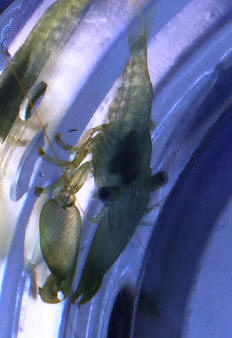
They were inside the Acropora colony, and I managed to
"spook" them out and get them into a container for a
picture and to make sure they were reef safe etc. I am attaching
a picture of one of the two.
<Super, thanks>
The other one has no claws, but is identical other than that. The
2 of them must have had a tussle and one ended up with no claws
out of the deal?
<Perhaps yes, or it could have been due to rough
transit/handling when collected, shipped, etc.>
I currently have them in a 10g emergency tank. Do these guys eat
Acro?
<Not according to what I've read. They're commensals
that likely have little negative impact on the colony.>
It is even a pistol shrimp?
<No. Although these shrimps do use their claws to make
clicking/snapping noises, they're not actually what we
consider pistol shrimps (family Alpheidae). They belong to
another family: Palaemonidae, subfamily Pontoniidae. This group
of shrimps doesn't have the same formidable snapping ability
of the Alpheids. Also of note is that the claws of Coralliocaris
species are matched in size, whereas those of the Alpheids are
markedly different. For more in-depth info on snapping claws,
please see this pdf file:
http://decapoda.nhm.org/pdfs/27238/27238.pdf . It's probably
more than you ever wanted to know, but it's
interesting!>
The Acro colony has had some die off which occurred after getting
it home a few days later.
<Can happen sometimes>
I have another smaller colony of Acropora, but this piece is
fine.
<Excellent>
Because of the die off I started taking a look at the colony to
see if I could determine what may be happening to it. This is
when I noticed these little guys. I actually managed to nab both
of them in my 75 gallon tank without losing them and then moved
them to the 10 gallon tank. As you can see by the picture of the
shrimp in my hand, they are very tiny.
<Yep, that's typical for these guys. The genus as a whole
generally ranges in size from 1-2cm.>
This is a picture of the larger one too. Can you provide any
information as to what they are, and if they are reef safe or
not. Do they prey on Acropora only or any sps coral?
<I haven't come across anything indicating that
they're parasitic, or harmful to corals at all, so you should
be okay.>
Thanks, Janet
<You're very welcome. Take care, LynnZ>
|
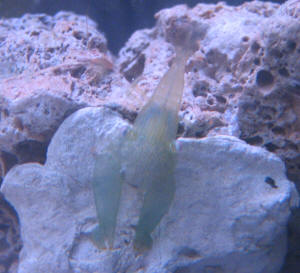 |
|
Re: Pistol Shrimp Hitchhiker: Coral
Commensal -- Coralliocaris spp. 5/25/09
<Hi Janet>
Well, thanks for the great info on my little shrimps.
<You're very welcome.>
I have left them in the 10 gallon as I don't think they will
keep up with my 75 gallon crew of fish and crustaceans. I have a
maroon clown, with a rose bubble anemone and she is rather a
misery and huge! I love her though and would not part with
her.
<I can sure understand. I used to have a tomato clown with all
the charm of a rabid wolverine but I loved her anyway.>
Also a Yellow Tang, tiny Hippo Tang, 1 Coral Perch and 2 Chromis,
2 blood shrimp, 1 coral banded,
<Watch out for this guy. They've been known to kill other
shrimps, hermits and the like.>
..and 1 cleaner shrimp as well as the regular snails, hermits,
serpent stars (also finding baby serpent stars by the dozen, and
also moving them too), and last, 2 sand sifting stars.
<These are neat creatures, but don't do well in most
systems. Unfortunately, they wipe out the sandbed fauna then
starve.>
I also have a Yellow Watchman Goby, and he is paired with a tiger
pistol shrimp.
<Love this combination>
That's another reason why I questioned if these 2 were in
fact pistol shrimps. I did notice that the little guys' claws
were the same size each, but had what looks like the little
snapper.
<Yep, the claws look just like a pistol shrimp's.>
I don't think that whoever shipped this colony of Acropora
would have known they were in there do you think?
<I seriously doubt it. Those shrimps are small, cryptically
colored, and know how to hide within the coral's
branches.>
Sadly there has been more die off and I don't see the
Acropora crab in there anymore.
<Oh? I didn't realize you had a crab hitchhiker as well -
neat.>
Do the Acropora crabs leave the colony if it's not doing
well, or do they die?
<I imagine they stick with the coral until it's pretty
well dead, then move on to another.>
This particular piece was large and nice. It may have been in
rough shape when I bought it, hence the "sale"
price.
<Yep, that's usually a clue that's something's not
quite right.>
I may be able to salvage some by fragging it. Does this make
sense
<Yes, that is if you can't return it for a refund/credit.
Be sure to look over the "Coral Pests and Disease" page
(link below) so you can get a better idea of what's going on
with the coral. If it's rapidly turning white/losing tissue,
it could be RTN (rapid tissue necrosis) or 'white band
disease'. If that's the case, you'll want to remove
the coral and frag it immediately. In the case of pests, follow
the instructions given for each:
http://www.wetwebmedia.com/corldisart.html
More info on Acropora selection, issues, here:
http://www.wetwebmedia.com/acropt3.htm
Good site with a key for diagnosing coral disease:
http://ourworld.compuserve.com/homepages/mccarty_and_peters/coral/Stonyq0.htm
>
..and how should I frag it?
<If it's RTN/WBD, break off healthy pieces well away from
any white areas.>
I have a 30 gallon tall seahorse tank too, but there is also a
blue pistol shrimp in with them. What is your suggestion about
where I could keep these guys?
<Optimally, I'd recommend keeping them with an Acropora
colony. I wasn't able to find any information regarding the
exact diet of these shrimps. They may be like some commensal
crabs in that they feed, at least partially, on the mucus
produced by the coral. I honestly just don't know.>
What about feeding?
<I would try offering a variety of foods and see what they
like, including small meaty bits of marine origin (Mysis shrimp,
silverside, etc), along with some good quality sinking pellets or
even flake food.>
I can just leave them in the 10 gallon as there is nothing
detrimental to them in there. If they are fine in the tank I
don't want to part with them. Did I end up with a rare
find!!???
<Well, it's not something you see every day, but I have
run across other reports of hobbyists finding these shrimps
within their corals. I do believe however, that this is the first
time we've ID'd them here at WWM!>
If the Acropora doesn't make it should I give the skeleton to
them for cover?
<Sure, as long as there's no lingering disease or pests
that might be introduced to any other resident corals.>
It would be a shame to have the entire colony die, I hope to
salvage what I can.
<I sure hope you can too.>
You see when I got it home from the store, I obviously dripped it
and then added it to the large tank. Sometimes I take a turkey
baster and clean the rock of detritus and such. When I did this
around that colony, a lot of the "flesh" pretty much
just blew away exposing the white skeleton.
<Ouch, not good>
I'd only had it a few days. I have a T5 HO lighting system.
Are these sufficient for this type of coral,
<Given enough bulbs and good placement, sure.>
..because I don't want to buy something that won't
survive in my tank, until I can change the lighting system if
required.
<Good thinking. For more information on SPS system
requirements, please see this link:
http://www.wetwebmedia.com/acropt3.htm
>
This is a great site! And thank you so much for the extremely
quick response.
Thanks LynnZ
<You're very welcome. It's always nice to chat with
fellow hobbyists about such neat little creatures! Take care,
LynnZ>
Re: Pistol Shrimp Hitchhiker: Coral Commensal --
Coralliocaris spp. Follow-up 5/25/09
Janet here again:
<Hi Janet>
I noted that you stated the sand sifting stars deplete the sand
bed and eventually starve. I have had mine for at least 2-3 years
now and they are still doing fine.
<That's terrific. They don't fare well in most
systems, long term. Two to three years though, is definitely long
term!>
Although I have heard that theory as well. You weren't
referring to the brittle/serpent stars were you?
<Nope, just the sand sifters.>
I have also heard that the coral bandeds can be devils, but mine
has been ok.
<Good, hopefully he'll stay that way!>
However, that said I did lose a cleaner shrimp. Actually never
found it again at all and did think it may have been him that
nabbed him.
<It's possible, yes.>
The cleaner shrimp was fairly small. As per your suggestion, I
did frag up the rest of the coral that was salvaged from the Acro
colony.
<What was one colony can now turn into many!>
I also fed the little shrimps some or rather a few mysis
shrimp.
<Sounds good>
Thanks again for your help.
<You're very welcome. Take care, LynnZ>
|
Mantis or Pistol 9/22/08 Hi Crew! <Craig>
This is an awesome site 'great job. <Thanks> My
question is regarding a clicking noise in my 55G reef tank. I know the
likely culprit is a Mantis or a Pistol shrimp. I have scoured your site
and others and have seen many times the pistol shrimp's clicks are
typically single or in two's. I have noticed the clicking for a
couple of months only after the lights go out. It was normally one
click at a time and sometimes as many as two clicks every 30 minutes or
so. Tonight I distinctly heard three clicks in a row. Five or ten
minutes later I heard only a single click. Should I be concerned?
<If you're missing valuable animals, yes. This is likely a
Pistol> I had recently written the clicks off as a pistol shrimp.
But the frequency exceeded the normal one or two clicks for a Pistol. I
have not lost a fish or invert in this tank for many months. The only
losses were the result of an uneducated purchase of Banggai Cardinals
that refused to eat. My biggest concern is over my Tiger Sleeper Goby
and by Blue Spot Jawfish (which was well worth the high price tag and
is easily my favorite fish). I have not seen any burrows (other than
the one my Blue Spot resides in) or any molts (other than from my
hermits and Skunk Cleaner Shrimp). What should I do 'if
anything? Craig <I'd hold off for now, continue observing...
There may be an Alpheid here... that the fish are steering clear of,
perhaps the Tiger Goby conspiring with. The Pistol can be baited out
some time later should it prove problematical. Bob Fenner>
Pistol Shrimp ID and commensal host 8/4/03 Good morning,
<cheers> Just a quick id question. I have a small tank that as
made up of "dead" rock, it is stocked with a few hermits, and
a couple of sergeant majors I netted in Florida. <hardy but
ferocious fishes> I also collected some various Caulerpa in Florida
(palm beach area). Here is the kicker now I have a new little friend
who just sort of appeared (my guess hitch hiked in with the Caulerpa).
It is definitely a pistol shrimp, but I can't find any info that
has helped to identify the species. <do seek "Reef Creatures:
by Humann and DeLoach> It has a bright blue head, and bright orange
"arms" and claws. Just to satisfy my curiosity do you have an
idea on the species? <hard to say without a pic> Also I was
thinking of sticking one of the shrimp gobies in with him, which would
be the best species? <you may very well have trouble finding a
Pacific shrimp goby to accept this Atlantic pistol. The pistol you have
may not even be commensal with gobies/fishes. They are often commensal
with echinoderms or other organisms altogether. Lets get a positive ID
first and then seek a buddy> Thanks for your help! <best regards,
Anthony>
Synalpheus stimpsonii Hi Bob I am interested in pictures of
the Crinoid-associated Synalpheus stimpsonii posted on your website. I
work on taxonomy of the family Alpheidae and believe that S. stimpsonii
is a species complex (5 species have been described and later put in
synonymy of S. stimpsonii but I doubt that they are all the same). By
the way, Alpheus bellulus is a species complex, too, with at least 2
new cryptic species to be described. I would greatly appreciate if you
could send me slide duplicates or high resolution jpgs of these 3
pictures and other Alpheid shrimps; of course, all photos will be used
exclusively for scientific purposes and all photographers will be
acknowledged. All the best Arthur -- Dr. Arthur Anker Department of
Biological Sciences - Zoology University of Alberta Edmonton Canada T6G
2E9 <You are welcome to the use of any/all of my slide work on this
group. Am about to scoot out of town, so am asking Jason Chodakowski
here to follow-up with you re re-scans, searching the files here for
what we have. Cheers. Bob Fenner>
Bob, Take Some Pictures For Me, Please? - Synalpheus
stimpsonii Bob, I hope you'll have a chance to take some pics
of shrimps and other crusties in the Marquesas, for instance, I have
nothing from this region my friend Joseph Poupin did some work on
Decapod crustaceans of the French Polynesia (he has a website, too),
but as usual shrimps (especially Alpheids) are really poorly
represented and illustrated today I also saw your wonderful pontoniine
shots. cheers, A -- Dr. Arthur Anker Department of Biological Sciences
- Zoology University of Alberta Edmonton Canada T6G 2E9 <Will do my
best. Am taking 35mm rigs with macro diopters, mainly Velvia (ISO 50)
film... and some tried/true Nikonos and 28mm. framer sets... so
we'll see. Would you like me to cc you on the above groups image
work vis a vis scans of what is deemed worth scanning? Bob F>
Pistol Shrimp Hello all, In my 3 month old 12g tank with
20lbs of Marshall live rock, I've had clicking or popping noises
coming from one area of my tank from the beginning. Early on after
first hearing the noises I pulled my rock and dipped it in carbonated
water in the hopes of shaking loose a mantis or pistol shrimp but no
luck. I've been reading all sorts of posts on noises like this and
the consensus seems to be that its either a mantis, pistol or my
hermits might be slugging it out. I'm leaning toward ruling out the
hermits as the cause as my two Scarlets are the most lazy creatures in
my tank and I don't see them putting forth the effort to sling
their shell at anyone and my dwarf blue hermits are so small that I
can't imagine they can generate enough oompf to make such a loud
clicking. So I figure it has to be one of the two shrimp. What confuses
me is that its been almost three months of this and my head count for
all my critters appears ok so if its a mantis what's he beating on?
Also, I've been peeking at my tank after lights out almost every
night (about 2 hours after lights off) and usually in the morning too
(about 5am) - wouldn't I get a peek at who ever this is or would
they lay that low? And the stupid things have to grow so won't it
eventually have to out grow whatever space he's in thus possibly
revealing himself? And I guess the last thought was could it be
something else? I hear everything from 1 to 4 clicks in some sort of
succession almost every day and usually more than once. I've read
that Pistols usually click in twos and Mantis will beat on something
until they get dinner. I have not tried to trap yet as I'm not sure
its really a Mantis I'm dealing with. And having past my cycle
I'm not excited about the idea of pulling my rock again but I will
if I find evidence that something has been killed. Currently the tank
has 2 very small false Percs, a dozen snails, 7 hermits and a Skunk
cleaner shrimp - all happily going about their business as best as I
can tell. Thoughts? <Matt I am almost sure it is a pistol shrimp, I
have one and know what you're talking about. If it were a mantis,
your cleaner shrimp would be history along with some hermits and
possible the clowns. Pistol shrimp aren't bad to have in the tank.
You will very seldom see them during the day. If mine smells food I can
see his antennae waving out his hole. They do occasionally move from
time to time setting up new quarters. This will be evident by gravel
looking like it was bulldozed around his hole. James (Salty Dog)>
Much thanks, Matt Selchow <You're welcome>
Raising a Pistol Shrimp (3/23/05) I have a few questions
regarding a pistol shrimp. <Shoot. BTW, please capitalize the proper
noun "I" and the first letter of sentences. Also, please use
punctuation like periods and question marks. We post all queries and
replies on our site permanently and want them as readable as possible.
Our volunteer crew will have a lot more time to answer queries if they
don't have to proofread them. Not only that, some of us older
presbyopics have a hard time reading unpunctuated text. Thanks, Steve
Allen.> I just got him from my LFS and he is a baby I want to raise
him and then pair him with a watchman goby... <I have a pair in my
tank. They're very attractive and interesting to watch.> ... but
I am not sure how long it will take to raise him large enough. What he
should be eating as a baby and if the species I have is compatible with
a watchman? <What species do you have? Many genus Alpheus burrowing
shrimps will for this symbiotic relationship. As for foods, if the
shrimp is very small, then you will need something very fine such as
Cyclop-Eeze. If big enough, it will take just about any frozen food
such as Mysis. Many will take ground flake foods or tiny pellets. The
shrimp should be big enough to be with the goby when it's too big
to be eaten and is burrowing.> He is opaque with black stripes and
he looks like he's wearing a prison jumpsuit. <I'd suggest
you compare with pictures in a book that has a lot of shrimp pictures.
If you can send me a clear picture, I may be able to help, but I cannot
make an identification based on this description. I hope this info is
helpful.>
Pistol or Mantis? and adding fish 12/28/05 Hi Crew! Hope you
all had a great holiday. So since the 6 months from my first e-mail to
you, things have gone very well. Tank is very stable, and my skeptical
wife now loves it. We spend at least an hour every evening after we put
our daughter down for the night just watching the tank and talking.
<Ahhh!> She has named all the fish and has identified
personalities in all of them. Even the dog gets into the act. (Dog
barks when my smaller ocellaris "surfs" the current from my
Sea-swirl from 1 side of the tank to the other, which at night it will
do 15-20 times in the last hour before the light goes out!) She has
protested any time I talk about moving rock around. So my point of all
of the above is that the tank is really in a great place and I
don't want to do any major overhauls. <Okay> Tank basics: 72
Bow Front, 100lbs LR, 20g refugium with 8" DSB, 40g sump, 3/4 sand
in display, 2x175w 10K MH on for 9 hours a day, 2x96W PC 420nm Actinic
on for 12 hours a day. 2 Ocellaris Clown (2" and 1 3/4").
Foxface Rabbit (4"), Hippo Tang (2 1/4"), Starry Blenny (4
1/2"), 2 cleaner shrimp (3 1/2" each), 2 peppermint shrimp (1
1/2" - new adds) 2 Mithrax crabs. Oh and 24 Astrea snails, 4
Mexican turbo, 10 Nassarius. So for the last 4 months I have heard a
popping from the tank. I tried trapping, but I kept catching the
Mithrax crabs (damn them). I hear two types of popping. 1 loud popping
that occurs sometimes at full light and definitely under just the PC
and dark. The pops only come in 1s and sometimes in 2s, but I would
characterize as loud. Usually several minutes between pops. The 2nd
type of popping is more of a quiet clicking. Happens just after light
goes out. Happens in multiples, but not rapid fire, usually 15 to 30
second spacing. So my question is Pistol shrimp, mantis, or maybe both?
<Likely Pistol/s... from the loudness, frequency, absence of dead
crustaceans (the Mithraculus would be gone)> What exactly should I
be looking for? <Small Alpheid/s... they hide, especially during
light hours> I have not seen either of them and I have spent many
the hour with a flashlight scanning the tank. Nothing has yet been
killed. I have a healthy population of amphipods that could be feeding
one or both. If they were small to begin with would they have gotten
much bigger in 6 months? <Likely so... most only get to less than an
inch and a half total length> I have herd stories of people having
mantis shrimp in a reef and it never killing fish. Nothing has died
should I just wait and see? <I would, yes> Could I have lucked
out? I have a healthy population of coral too. My rock is secured to a
frame so I have good circulation in front and back (at your
suggestion). So, the only thought I have is to slowly pull out rocks 1
by 1 and rotate them into the fuge until I hear the popping coming from
the fuge. My concern is that I will stress the heck out of the fish
pulling a new rock out every night and of course anything with coral
attached will take a potential hit. <You are wise to consider this
"cost" here... the "alternative hypothesis"... and
to choose the null... to do nothing> My final question is w/ respect
to adding fish given this situation. I am only planning on adding a few
more. 1 Flame Angel (of course my coral and clam may hate me), 1
mandarin goby when the time is right, and a couple of open water
swimmers: fairy wrasse or 2, a Chromis or 2, etc... Thanks as always,
you all are the best. Oh and Tom from the Fish Doctors in Michigan
sends his best (I got lucky and now have a great LFS). <Ahh! Please
do mention back to Tom that I say hello as well! Bob Fenner>
|
|


