Green BTA; beh., repro. f's
6/8/17
Good Afternoon, I recently ordered a couple of fish and a large BTA from
a well-known supplier. The fish were healthy and acclimated well.
However, I was very surprised to have found a severely bleached BTA.
Upon inspection, it was clear there were two very distinct mouths which
I interpreted as the initiation of a stress/starvation induced split.
Once introduced into the tank, I was not surprised that the anemone
moved to a protected area to acclimate to the lighting and I initiated
an enriched feeding regimen to assist in providing nutrients to the
organism.
<Good move>
It has been two weeks now and it does not appear that the splitting
process has continued. I have searched the internet for anemones with
two mouths and all resources encountered address this as part of the
splitting process. Will this anemone complete this process at some
point?
<Likely so; yes; or perish>
While it is still a whole organism, is it necessary to feed BOTH mouths?
(I would suspect not)
<Not necessary>
Are there anemones that start the process of splitting and then simply
halt?
<Not that I'm aware of; no>
I have kept BTAs for several years but have not encountered a situation
where they will begin a split and not complete the process within
several hours to a day.
Thank you so much for your assistance,
JP
<Welcome. Bob Fenner>
Bubble tip split 11-17-14
11/18/14
Hi my yellow bubble tip anemone split on its own while I was at work
today.
<All in one day? Unusual. Perhaps you didn't notice the last week or
so...>
Its in a 55 with a 100 watt led orbit system and a 216 watt fluorescent
also with a built in timer. There is also a rose bubble tip at the other
end of the tank. That one does not like the light so well. I added some
iodine which I think will help the healing process.
<Yes; iodide-ate should be added every water change/week or so>
My question is I since I do not see a mouth on either clone does this
mean it will die since it can not take meat feedings.
<S/b there, but use small bits>
I have zooplankton phytoplankton,
<Don't eat phyto>
trace elements ect.
<Mmm; etc. a contraction for et cetera res, "and other things"... No
such word as ect>
Is there something I should do to insure they both survive.
<? Yes; provide good care; optimized, stable conditions... see WWM re
Entacmaea>
I have a nine year old maroon gold stripe and two one year old yellow
striped clowns that are all fascinated with the anemones will there
constant attention cause them peril or will it help insure their
survival.
<I'd cover the split ones with strawberry baskets or such... to keep the
Premnas away for now>
My thought is in their weekend state they will loose footing off the
rocks they are on. The good news is they are both inflated. This being
said will they sting each other
<No; are clones; recognized as such>
now or is it okay to keep they in close proximity as they are at this
point.
<Leave them where they are>
Thanks for your time.
James
<Welcome. Bob Fenner>
Re: Bubble tip split 11-17-14
Hi
<James>
Actually the yellow anemone was fully open before I departed for work at
2:40 pm and when I arrived home at 11:30 I noticed a piece of rock that
it seemed to have gotten tangled up on. When I went to move the rock I
noticed it was actually slit in two and gave the appearance of being
tangled and unable to move. I think what may have happened is
the maroon clown toppled over this rock perhaps by accident onto the
anemone and as a survival effort the anemone may have then split.
<Ahh, does happen>
My question is what are the odds that both anemones will survive.
<Can't tell from here... but good/better if your conditions are
propitious>
Is there something I should do to help them do this?
<A triple dose of iodide-ate for sure will be helpful>
Should lower the flow current ratio as I have a large skimmer, a double
carbon filter, a wave maker, a internal UV filter pump all on. I do have
timers I can use if this is to much current for the healing anemones to
handle at once. As I stated I did add some iodine. I did this because I
have seen this added when propagation take place by reef keepers.
<Yes>
Will the mouths form and if so how long does it take before they can
take a meat food?
<A few weeks generally>
James
<BobF>
Breeding Cardinals, SPS 9/15/12
Dear Crew (Bob F.),
<Javul>
About a year ago I acquired four Banggai Cardinals. They have grown
considerably, and I would like to look at the possibility of breeding
them, help relieve pressure on nature a bit. Anyway, I feed them Mysid,
and cut up shrimp pieces daily, I also have set up a 6 gallon refugium.
What are some other tips you would have for encouraging breeding
behavior?
<Read here:
http://wetwebmedia.com/banggairepro.htm
and the linked files above>
I was thinking of adding squid meat to their diet. They are currently
being kept in a reef tank, LPS corals, two Firefish Gobies, 1 Tri-color
Wrasse, 2 Thor sp. Shrimp, 1 Yellow Watchman Goby. Water Parameters:
NH3-0, NO2-0, NO3-5ppm, Ca-420, pH-8.3, KH-10. The tank is 55 gallons.
On a side note, I have another 55 gallon, and I would like to keep/breed
via asexual fission a BTA.
<Can be done... read, search on WWM re Entacmaea>
I currently have four 65 watt power compacts above the tank. The lamps
are 2 6500 and 2 10k. Should I look into maybe adding a 75 watt Metal
Halide?
<I wouldn't... too much electrical cost and heat for the intended
benefit>
Would the anemone be doomed without it, or split without it?
<I would cut the anemone (through the siphonoglyphs/mouth...>
I know you don't recommend anemone purchasing, so I also have been
looking and found some "low light Pavona Corals, and a "moderate
light" Acropora, and Montipora. Is this even possible because I am
skeptical, as I have always heard these are high light corals.
<Would have to know what whomever means by "moderate">
I would like to look into getting some SPS at some point in time, but I
don't want to be a fool falling for a scheme. Thanks!
Bryce
<Welcome. BobF>
Re: Lighting Acropora 9/15/12
Dear Bob F,
The "moderate" light requiring Acropora is from Foster and Smith.
Here is a link:
http://www.liveaquaria.com/diversden/ItemDisplay.cfm?c=2733+6&ddid=164511
Is this something you would consider with 260 watts of PC lighting over
a standard 55?(2 65 10k & 2 65 6500) Or, pass and wait for a lighting
upgrade?
Thanks,
Bryce
<Mmm, well, you/one could keep most members of the genus in such a
system, w/ this lighting... if the colonies were placed "up high" on
rock, w/in a few inches of the surface. Much has to do w/ the reflectors
chosen/used for the lighting, and desire for rapid, colorful, optimized
growth. Bob
Fenner>
Rose Bubble Tip Anemone Split and Now
Deflated/BTA Reproduction/Propagation 10/20/11
Hello,
<Hi Jodi>
I've read over your site quite abut <a bit> and appreciate
all your words of wisdom. However, I searched your sight and not sure
that this question is on there.
I had bought a rose tip bubble anemone from a friend that was selling
all his livestock about six days ago. The first two days that it was in
my tank it opened up nicely. It even stayed on the rock that I brought
it home on.
I drip acclimated him as I was told to do for about 90 minutes.
<Too long, causes stress and likely why it split. Thirty minutes
would have been enough time.>
On day three of the RTBA being in my reef tank, it started to move
around (or so I thought) and I watched it closely as I don't want
any of my corals to be in danger. A few hours later I learned that the
RTBA wasn't really moving, but actually splitting. So then there
was three (yes- three)! The RTBA created two clones. My concern is
this- since the splitting, the two clones have crawled into the back of
the tank and are in the dark kind of closed up. The main RTBA has also
not fully opened. I'm going on a few days like this and am worried
about some of these guys not making it. What should I do?
<Wait patiently, the anemones are recovering from the split. May
want to browse here as well. http://www.wetwebmedia.com/btareprofaqs.htm>
Water parameters are all in good range- however, I have LED lights on
my tank whereas the original owner did not.
Thanks in advance!
<You're welcome. James (Salty Dog)>
Hope all is well,
Jodi L. Sardina
Anemone facilities, Entacmaea culture
8/31/11
Greetings, Crew, I hope all are doing well today.
I'm writing now with a question about Aquaculture facilities (I
welcome all answers, but assumed that the amount of travel to which Mr.
Fenner is accustomed may have turned him on to some locations in
particular that others may not know).
<Am sure most all have summat to contribute. Am out in Fiji w/ the
Smith's for a few months... they culture (as well as collect)
Scleractinians and Alcyonaceans, but not Actinarians... the few species
they sell are abundant, easily collected in the wild here, esp. E.
quadricolor which is "picked off" large branching
Acropora/Anacropora very easily.>
By far, my absolute favorite aspect of my involvement with the
saltwater hobby is my BTA. Before ever acquiring a specimen, the
symbiotic relationship between these magnificent creatures and their
hosts intrigued me to an almost insatiable level. Since purchasing my
BTA "Rosey", her care has been the biggest joy I experience
in working with my system. The thoughtful selection and preparation of
her food fits my meticulous nature well, and serves to validate a real
connection between me and my aquarium. The interaction that occurs
between Rosey and my pair of Tomato Clownfish is always a delight to
observe, and the day she split my excitement caused enough concern in
my wife that she began to doubt my psychological stability.
<Never doubt!>
The more I investigate these animals, the more enthralled I become, and
I look forward to many years of enjoying their company and tending to
their needs.
My question is where I might find reputable facilities/individuals who
specialize in the "breeding" (for lack of a better term) and
rearing of common anemones.
<Oh! "They're about"... regionally I've occasioned
several (from the M. English meaning "many") home/casual
culturists of Entacmaea... one I've just written a "Nano"
article for TFH re>
I live in Kentucky, so I'm sure there's a substantial travel
distance to any of these locales, but I'd love to plan a trip to
observe the aquaculturing and/or research of these creatures in person.
Ideally, I'd love to be able to breed them myself in an effort to
give back to the hobby and produce hardier specimens better suited to
life in captivity (and also because I'm now adamantly opposed to
the wild harvest of such naturally long-lived species).
Thanks again for your input and for the wealth of information all of
you have made freely available to the rest of us.
Regards,
Dustin
<Spend some time on the various Bulletin Boards (bbs), hobbyist
sites, posting re your interest, asking who is out there that is
engaged in such activity. Due to issues of economics there are no
commercial producers of BTAs as far as I'm aware. Bob Fenner>
re: Anemone facilities 8/31/11
Much obliged, Bob. I'll certainly post around and keep my eyes
open. And I hope you enjoy your time in Fiji, and will be generous
enough to share anything of interest with WetWeb's avid readers
upon your return!
<Am working on a pitch to present to the next MACNA in TX re helping
establish this collecting station... MUCH work, exhausting, but very
exciting indeed, w/ many new and good friends to work with, virgin
collecting areas... We're just getting the containers and contents
ready to ship w/ the systems, furniture... BobF>
BTA reproduction 8/16/11
Good morning, crew! I hope you're seeing as beautiful of a morning
at your locale as I am here in the Midwest.
<The weather was nicer in Maine this last week than S. Cal!>
I'm writing this morning with a happy discovery I encountered last
Thursday. As I was driving home, my wife called me to inform me that
Rosey (my Rose Anemone; I know, not a very original name) had moved. My
immediate thought was that perhaps she had split (I had been observing
for the previous week that she looked very "bubbly" and full
during the day, but had several hours each night that she would
shrivel). Sure enough, when I arrived home, there was not one but three
little Rosey's sitting in my tank!
<Nice!>
My water parameters are pristine, reading proper measurements for all
measurable trace elements, a specific gravity of 1.026, no ammonia or
nitrate, pH of 8.2, and an amount of Nitrate and Phosphate that barely
reads on a test (close to zero, if not zero). I've had the anemone
for about 12 weeks, during which time I've fed it a mix of
Vita-Chem enriched Hikari Silversides and frozen krill every 3-4 days.
It has stayed in one spot on the rock to which it came attached, and
sits about half-way up my tank under substantial LED lighting (the PAR
in her spot is about 280). It also host a pair of young tomato clowns
(about 2 inches in length, each).
<Can be overly rambunctious as large-size adults>
Considering all of this, I doubt that the split was due to stress.
<Can/might be "happiness">
I had given Rosey a wide berth between her and any possible aggressive
neighbors (a green star colony, but it is several inches away and down
current from her, even when she is fully extended). Nothing fell on
her, or attempted to prey on her, that I'm sure of. All in all,
I'm hoping this was a successful replication due to a very
"happy" Anemone.
That being said, I find myself with two extra Rose BTA's that I
intend to trade to a fellow hobbyist or to my most trusted LFS. What is
the appropriate amount of time to wait for them to recover from the
process?
<Mmm, everything twixt "free" to what the market will
bear. More to be had in trade than sale to stores>
In the last four days, they've been inflating well and healed quite
nicely so far (still waiting on full formation of mouths, but torn
edges are almost indistinguishable at this point).
Thanks for all you help!
-Dustin
<Thank you for sharing. Bob Fenner>
RBTA budding? 3/4/11
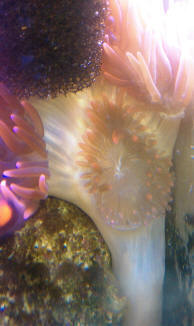
I noticed an extra mouth surrounded by tentacles on the side of my
RBTA today. I've seen them split before overnight, and I've
split them as well.
But never seen this. Pic attached.
<Happens. Bob Fenner> |
|
|
|
Re: RBTA budding?
Do we know what causes it?
<Adverse or propitious conditions... both>
Will it eventually separate?
<Yes. BobF>
|
BTA cloning question
9/13/10
Dear Sir or Madam,
I have spent several hours on WWM and the internet in general searching
for an answer to my question and have not had much luck. Please forgive
me if you have answered these questions somewhere already.
Three days ago, I noticed that my rose BTA had developed a second
mouth, and its column had a cleft in it on each side. It appears to be
in the process of splitting, but has not completed the process.
<Can take weeks>
It looks like two small anemones glued together. Is it normal for this
to take several days?
<Mmm, yes>
It seems from my reading on WWM that it occurs much more rapidly than
this, perhaps even within a few hours (or is it just that the people
who come home from work and have 2 anemones have not been very
observant and
didn't notice the process happening over several days?).
<Bilateral fission takes longer... scission, a tearing off of a
piece can be quick>
I have read that this process can be "ugly" and that the
anemone can look bad during this, but have not found any specific
information. My BTA does not look very good at the moment. It has been
cramming its column further
into its rock crevice. As it gets closer to lights-out time in the
evening, it shortens its column and sort of folds itself like a taco so
that it is pulled further into the rock crevice but with the tentacles
still facing out (looks sort of like a Tridacna clam mantle in
appearance), and the tentacles become short and thin. During the day,
the tentacles fill out again.
Since it is so far in the rock, I can't really see what is
happening. Here are just two examples I found of this phenomena:
http://reefkeeping.com/issues/2002-11/reefslides/index.php
,
http://www.youtube.com/watch?v=sPwi2QcLKao
. I can't tell if this is what mine looks like, because it is so
far in the rock crevice.
Could one of you please describe in some detail what is normal and what
is not regarding behavior and appearance, and provide a time-range for
the process?
<What you are observing, relate is not unusual>
If you happen to have any photos, they would be very helpful as
well.
Thank you in advance.
Sincerely,
|
BTA splitting or dying? 9/12/10
Hi all!
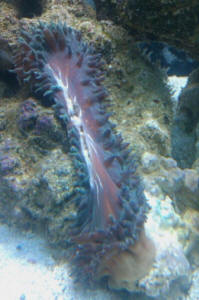
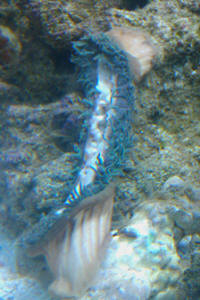
For the past day or so, my BTA has been moving around on his
rock. He began stretching a little yesterday, but I didn't
think anything of it. I thought he was just moving. I recently
added 2 clowns to the tank that have
immediately hosted him ( about 6 days ago). I keep going back and
forth on whether he is splitting or dying. I have researched many
other videos/pictures of BTAs propagating, and all the tentacles
have been inflated.
<Usually, yes>
Mine aren't (see attached picture). This is leading me to
believe that the anemone is just committing suicide and is just
dying.
<Too likely so>
Can an anemone split without having its tentacles inflated?
<Can>
125 gal tank with 25 gal sump/fuge, skimmer, t5 lights (2
actinic, 2 daylight). NH4,0 NO3,<0
<This life needs some soluble nitrate, phosphate...>
NO2,0 pH 8.2-8.4 Salinity 1.026 and Mg 1380.
Thanks!
<Please read here: http://wetwebmedia.com/btareprofaqs.htm
and the linked files above, particularly the FAQs files on BTA
Systems,
Feeding... Bob Fenner>
|
  |
The Unfortunate Battle Of Anemone Versus Filter Intake
:-(/Anemone Reproduction/Health 7/25/10
Hey Crew,
<Hello Manda>
I have some not so good news here, but a double part kind of question.
I have had a Rose Bubble Tip for about 2 months now in my 60 gal tank.
PH 8.2, SG 1.025, Ammonia, Nitrates, and Nitrites all 0.
Along with 200 watts of T5 lighting. Was doing fantastic! Even had it
split into two very happy bubbly guys. About a week ago, I had added a
Yellow headed <Head> Sleeper Goby that went to town rearranging
all of my
sand to create his tunnels. Having returned after a week being gone, I
cannot find our little clone. Is it possible that he got buried in the
substrate?
<Possibly.>
My boyfriend who was taking care of the tank while I was gone said he
had seen him a day and a half ago. If he is buried, is there any chance
of survival?
<Possibly.>
Would he find his own way out?
<Unlikely.>
If he can't and has/will die, what do I do to avoid him
contaminating the water?
<I would make an effort to find him, and if dead, remove to prevent
contamination.>
Second part: The other half of the cloned pair decided to hang out by
the intake of my Marineland C360 filter. It has a cover over it with
lots of little slits in it so I didn't think it would be too
detrimental, however... I just moved the tube away and about half of
the anemone has been sucked up and of course looks awful. It almost
looks as it has been cut in half right down the center. I know you can
cut an anemone in half,
<Whoa here for the benefit of others. I have also read that it is
possible to cut an anemone in half to propagate it artificially, and
that only anemones that naturally divide will predictably survive this
procedure.
In my opinion/experience, the percentage of success is minimal and one
is likely to end up with two pieces of
dead anemone. My advice here....let the anemone divide
naturally.>
so I am wondering if it is possible that he will make a recovery, or if
I need to pull him off of the live rock so he doesn't contaminate
the water.
<Anemones experiencing this trauma rarely recover.>
If I need to take him out, what's the best way to not affect the
other fish?
<The best way is to remove the rock the anemone is attached to and
remove it with a stiff brush.>
The water isn't cloudy, the skimmer is skimming efficiently, and I
cleaned out the intake cover so there are no more pieces stuck in
there. All of this makes me never want to leave for an extended period
of time again!
<Yes, it sure seems that problems always arise when one is gone for
a period of time.>
(I also lost my fire fish who apparently decided a day ago to jump out
of the "covered" aquarium and found him on the floor
today)
<And I'm still wondering how my Flasher Wrasse jumped out
through a 1/8" slit in my "covered tank".>
Thank you very
much for your help!
<You're welcome. James (Salty Dog)>
Sincerely-
Manda
Bubble Tip Anemone/Behavior 6/2/10
Hi WWM crew,
<Hello Adam>
Quick question about the splitting behaviour of bubble tip anemones.
After swearing I would never buy another anemone, I impulse bought a
quarter sized rose bubble tip about four months ago. Lo and behold this
one not
only attached to a rock (the last one launched itself in to a power
head) but thrived. I fed it almost daily and in 4 months
<Too often, have to give the anemone some time to expel the waste
from the previous meal as they eat and expel waste from the same hole.
Yuk, I wouldn't like that.>
it went from quarter sized to large enough to attract the attention of
the male of my cinnamon clown pair. Two days after the clown started
hosting, I woke up to discover that my anemone had disappeared. Like
REALLY disappeared, the only place it could go that would be completely
out of sight would also put it in to complete darkness. That was three
weeks ago, I thought it must have become powerhead soup even though the
water never
went milky and the skimmer never sucked up any unusual goo. Lo and
behold, yesterday it popped back up on the other side of the tank.
Well, most of it did anyway. It's now about the same size as when I
got it, though only one
side of it has adult tentacles, it's sort of oval shaped instead of
round and it's mouth is way off centre. Since it has no scarring,
melted tentacles or appears damaged in any way, I can only assume that
while it was hiding the thing split in two (hopefully the other half
shows up soon).
<Time will tell.>
From what I understand about bubble tips, they can grow to be quite
large, in fact I've seen rose coloured specimens 3-4 times larger
than mine was.
I've looked and looked and I can't seem to find any literature
that would indicate why this anemone would have split so soon.
<If indeed it did split. Keep looking.>
Tank parameters:
90 gallon reef
500 watt metal halide 10 000k
250 watt actinic T5
pH: 8.3
Ammonia: 0
Nitrite: 0
Nitrate: between 2 and 5 ppm
Phosphate: 0, possibly 0.05 ppm but the colour change is hard to
discern
Iodine: 1.0 ppm (I don't dose iodine as it's in my salt and I
think there's plenty in the fish food, Seachem test kit says this
is higher than NSW but still in a safe range)
total Alk: 4.0 mEq/L (KH 11.2)
Borate Alk: 1.5 mEq/L
Carbonate Alk: 2.5 mEq/L
Calcium: 400ppm
Magnesium: 1350 ppm
Silicate: 0ppm in the tank, though my source water has about 0.2 ppm
(which might explain my constant battle with diatoms).
I haven't tested strontium as the Seachem test kit doesn't
arrive until next week.
Tank parameters have been more or less stable for months other than two
drops of total alkalinity down to 2.5 mEq/L over the course of two one
week vacations I went on (tank sitter didn't add enough reef
builder). Is there
anything in those numbers that would make you think that my anemone is
splitting due to stress?
<No.>
Is there anything I can do to encourage it to stay in one piece, at
least so it can get big enough to host the clown fish for any length of
time?
<No again.>
Your thoughts would be greatly appreciated.
<Have you read here and related articles/FAQ's?
http://www.wetwebmedia.com/marine/inverts/cnidaria/anthozoa/bubbletipanemones.htm>
Regards,
<Ditto. James (Salty Dog)>
Adam
RBTA Party But No Party Favors. Entacmaea repro. and Shroom
comp. f's 1/6/10
Hello,
<Hi Eric>
I have a dedicated 29g (initially) housing a RBTA and GSM host. The
system has been up and running for about a year and a half. The live
rock that I'd used for this tank was from an old setup, and one of
the rocks housed a couple green striped mushroom stragglers. Well, in
the time the tank has been running, the couple mushrooms have naturally
spread into a sizeable colony and, surprise-surprise, the RBTA has
recently gave way to three spanking new clones (on x-mas eve, no less!
). So, I'm concerned about any chemical warfare between the
mushrooms and the now 4 RBTA's fouling the water. I do religious 4
gallon water changes weekly, use carbon media in a mesh bag, and run an
Eshopps HOB skimmer, rated to 75g. There is no sump, and for what
it's worth, I run a 150 watt MH fixture. My last resort is removing
3 of the RBTA's (along with the sizable, coralline encrusted rocks
they're attached to) and trading them. I'm however hoping this
is not necessary. My parameters remain within the recommended ranges,
and there are (so far) no visible signs of trouble or stress. I'd
appreciate any thoughts the crew has on this situation.
<Eric, a 29 gallons is a little on the small for keeping just one
anemone.
I would find homes for the others. Mushroom Anemones are high on the
allelopathy list and I would not keep with a Bubble Tipped Anemone in
that small a system. Your anemone splitting is not necessarily a sign
that everything is well. Anemones split to increase their chances of
survival and this generally happens more often from poor water quality
and stress related issues rather than good water quality and no
stress.>
Thanks!
<You're welcome. James (Salty Dog)>
Eric
Encouraging A RBTA To Split/BTA Reproduction/Propagation
10/29/09
Dear WWM,
<Laura>
I have a beautiful RBTA in my 85 gallon reef tank that is approaching
10" in diameter. She is happy, fat, and not showing any signs of
splitting! I really need her to if she is to continue living in the
tank.
<Why?>
She is stunning, but I have moved several corals out of her way to
accommodate her growth.
<Mixing corals with anemones will always create problems, not
recommended.>
She has never moved her foot so much as an inch from her initial
placement in the tank (lower left corner with foot attached behind a
piece of live rock), although she can extend to many different heights
and directions with her foot still in its original spot. Because of
this, she is capable of encroaching on various corals whenever she
opens, depending on the direction she wants to be in. I feed her a
1/4" piece of silverside twice per week soaked in Selcon. She
always eats what is offered to her. She is about a year old.
Is there any way to encourage her to split? My black and white
Ocellaris Clowns are very attached to her.
<Excellent water quality must be maintained. Regular water changes
are a must.
Standard marine water parameters with regard to temperature, salinity,
pH, ammonia and nitrate must be maintained. Anemones are very delicate
creatures, and need to be kept in the best possible conditions.
Keep in mind that when an anemone splits, it doesn't necessarily
mean it's happy, it can also be a result of stress.
You give no system details, filtering, lighting, etc., would help to
know such.>
Also, she has, at times, very briefly had bubble tips. For the most
part, though, her tentacles are thick and straight. I know the bubble
tips are very elusive, but is there any way to encourage these as
well?
<If your BTA is not displaying bubble tips, it's nothing to
worry about and is perfectly normal.
There is no evidence linking the bubble tips with the anemone's
overall health.
Do read here and linked files above.
http://www.wetwebmedia.com/marine/inverts/cnidaria/anthozoa/bubbletipanemones.htm>
Thank you,
<You're welcome. James (Salty Dog)>
Laura Rothbaum
Re Encouraging A RBTA To Split 10/31/09
Hi James,
<Hello Laura, wish you would have responded to the original thread.
I have nothing to look back on now.>
Tank details are as follows:
pH: 8.1
Temp: 78F
Alk: 9 <dKH>
Calcium: 430
Ammonia: 0
Nitrate: <5
Phosphates: 0
Magnesium: 1360
<Looks good here.>
10% water change done weekly with Tropic Marin Pro Reef Salt mix.
<A good salt, use the same myself.>
Add 1 drop Lugol's solution once per week.
<You could go 5 drops here with your water volume.>
Lighting: 150 HQI Hamilton MH with 2 VHO 96W bulbs.
Corals are mostly LPS with several Ricordea mushrooms and Zoanthids. 2
Crocea clams. Various inverts (cleaner shrimp, fire shrimp, crabs,
snails as cleanup crew).
85 gallons total with refugium (Chaetomorpha), and Bermuda Protein
skimmer.
I am at fault in that the RBTA is in a mixed reef with corals, however
when researching anemones, I found conflicting information on combining
the two, which is often the case in this wonderful hobby! The RBTA was
only 4 inches when I purchased her, and I never dreamed she would reach
the size she is currently. Also, most authorities I consulted said she
would split before she ever got to the point of outgrowing her home. As
I see now, not true. I do think she is quite happy, and I am very
grateful for that, and at present, she is a showpiece and not causing
any serious problems.
However, if she gets significantly larger, that is what concerns me. I
guess this is one of those things I will have to wait and see about,
but I was just welcoming any advice/suggestions you may have.
<Thank you for the follow up and well written email. I believe I
have given you all the advice I can.>
Again, very best,
<And to you. James (Salty Dog)>
Laura
Re: Keep your hands out of my tank Marine System and
Maintenance. Now BTA repro. 6/7/2009
Thanks for your reply, it is a refreshing thought knowing that simple
set ups can provide as much enjoyment as other more elaborate systems,
in their own respect of course. My reason for this response is while
reading your reply I happened to look over to the tank and noticed
it's milky white opaqueness. No doubt, the anemones were
spawning...again.
<Can be simple reproduction, or distress - a "last ditch"
attempt to pass on its genes.>
They did the same last night. Story goes like this..
Procured RBTA 5 years ago from a fellow reefer in Charlotte
(reefcrazed, real name withheld). Babied my new baby, of course. It
grew....and grew...and grew..split..and then split again...all over the
past five years. The three have moved nary an inch from whence they
were placed originally, or born asexually. A mother and her daughter,
as it were.
<Not uncommon>
Last week, in an attempt to bring to fruition my ideal rock scape I
needed to move the ladies to their new location, about 6-8 inches to
the right.
Knowing that mushrooms and sponges can sometimes attach themselves to
two separate rocks I kept pulling when I met some resistance. It
wasn't until after yank number three or four that I realized I had
been literally ripping the mother anemone in two.
<Ouch>
I decided to let it be where it was and the section where there was a
huge lesion only days ago has repaired itself and I now have four
RBTAs.
<Good that it healed, many do not survive ripping or
tearing.>
So, last night I fed the tank some raw shrimp (a real treat in my
house) and didn't realize they were such an aphrodisiac.
<Chunks of food that are too large can trigger it as well - you may
want to try smaller chunks.>
Having said all that, I remember reading here somewhere that water
changes, carbon and close monitoring were called for when such a
spawning event occurs.
<Yes.
http://www.wetwebmedia.com/marine/inverts/cnidaria/anthozoa/anemonereprofaqs.htm
>
What, specifically, is toxic to the enclosed marine environment when
this happens?
<It is just a huge release of organic matter that can cause an
ammonia spike.>
As I have mentioned, I let nature take its course in my tank, so what
kind of negative impacts should I see if I do absolutely nothing.
<Depending on your setup, you may not see anything at all, it just
called for caution and careful observation. Corrective action is
necessary only if water quality starts to degrade.>
90g
2x250wXM10kSE
38g sump
CL 220 venturi
softy/Shroom/nem/encrusting sps(cactus Pavona plating on back glass,
green Pavona on rocks) dominated
One Golden Teardrop clam 5"-6"
I Hippo
2 Black/Gold damsels (why? I don't know)
1 6 year old female clown, lonely (all suitors welcome)
<With the lower bio-load that you have, you should probably be
OK,>
<MikeV>
Coral farm 3/28/09
I have a greenhouse that is no longer in use and I have been
entertaining the idea of starting a small coral farm. It wouldn't
be anything too large,
<Even a small greenhouse can take several hours a week...>
but I'd like to do my part in slowing down the harvesting of the
reefs and it seems there is potential for making a decent profit. I
would prefer to use the greenhouse as the natural sunlight will cut
startup cost as well as electric bills. Would concrete blocks and
mortar make for a good holding tank, or would it be better just to use
a long rubber trough?
<There are a few ways to go here... Do you have time to visit some
going concerns? Perhaps Dick Perrin's Tropicorium...>
I am contemplating farming rose bubbletip anemones. I recently heard
Anthony Calfo talking about propagating this coral,
<... not "corals">
and he mentioned it could be safely split every 2 weeks.
<Fallacious... this can't be done... "splitting" such
animals requires that they be in "good shape"... This will
not be the case with this frequency>
How long would it take for each of the two halves to grow back to the
original size?
<Months... a few to several>
Would distributors be willing to purchase the specimens, or would I
have to sell them locally?
<Possibility of both...>
Seems if they had to be sold locally then the market would get flooded
pretty quick. I'm new the supply side of this hobby and wanted some
direction.
<You are correct... a very good idea to "get the pulse" of
the current market... Acanthastreas, Echinophyllias, some Acroporas,
Duncanopsammias, Dendrophyllias...>
Thanks for your time; I appreciate all the time and effort you've
dedicated to expanding and improving the hobby.
<Much study, a good deal of it fun/enlivening, awaits you... I
strongly suggest you attend some local to not "frag swaps".
Bob Fenner>
Escaping Anemone! Beh., repro. 8/9/08 Hi, <Brian>
Thanks for your time and for this great service. <Welcome> I have
a 120 gallon FOWLR. The water has no measurable nitrates or ammonia,
the SG is 1.023, <A bit, too low> I have 480 watts of light from
a T5 HO fixture (equal numbers of actinic and 10000k bulbs), and all
appears to be well. There is a 30 gallon refugium below the main tank
with algae and live rock. I have a protein skimmer running. About
eights months ago, a rose bulb tipped anemone split in two, which was
fun to watch and I hope indicates that all is well (or at least was) in
the tank. Over the next several months, everything was fine. About two
months I moved to the 120 tank I now have from a 75 gallon tank. About
a month ago, for reasons that are still a mystery, a new fish arrival
in the tank killed all but two of my fish through the introduction of
ich and several bacterial infections (like bulging eye, gill rot, etc.)
This happened despite a five week quarantine of the new arrival in a
tank set up according to the recommendations I found on this site.
Before I removed the two surviving fish to a hospital tank, I tried to
treat with ?reef safe? products <There are none of "these"
that are safe AND effective> and Metronidazole to no effect. So, now
I have my fishless display tank, in which all the remaining inhabitants
(two anemone as described above, four shrimp, an urchin, tons of
snails, and tons of hermit crabs of several reef safe varieties) appear
to be doing well in the fishes? absence. I am curious about the
behavior of one of the anemones, which is why I write. One of the
anemones is located in the center of the tank about 10 inches below the
surface on a rock. I appears to be very healthy, goes through the
cycles of eating and expelling waste, and has a terrific appearance.
The other anemone (which is obviously genetically identical) also
appears healthy, but it has migrated from a rock next to its ?sibling?
to a corner of the tank at the surface of the water. It looks fine, bit
I am concerned about its choice of location: does it indicate a
problem? <Mmm, no... or at least, not necessarily... Makes
"sense" does it not, that such behavior might take place,
assuring distribution of the genome...> How will I do a water change
without having to either move it or expose it to air as the water level
drops? <Not really a problem... i.e., I would go ahead and drop the
water level... the animal will move if need be.> Thanks!, Brian
<Bob Fenner>
| Been waiting to send this
question...anemone...slow splitter?? 8/9/08 Hi again...thought
I would shoot this one to you. Been waiting to send b/c I screwed
up a bit. I added a bubble tip anemone to the tank about 3 weeks
ago. Noticed at the shop he was splitting. Now...this is my screw
up. I was very distracted that day w/ my brain working overtime
with work and just put him in my tank without acclimation....Have
you ever heard of such!!?? <Sure. All the time> At any
rate...I feed him a few times since then and. well. I have attached
a pic for your viewing pleasure...any advice on how you think he
may be doing based on visual appearance. and thoughts on completion
of split. <Time going by, continued feeding...> I also added
a pic of my nano coral. When I purchased the nano, it had 3 heads.
Now there are 12+. When the time is right...bigger tank...can I
assist it in spreading to separate rock formations? <You
could... by physically breaking the individual polyps apart... I
wouldn't myself> Crazy stuff...I know....that's one
tough anemone! Thanks Mike <I'd leave this Entacmaea as
it... and learn to make spaces twixt your run on sentence breaks.
Bob Fenner> |
|
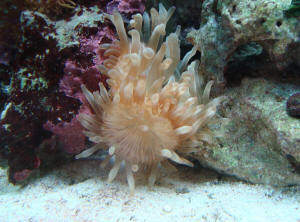 
|
| BTA spawning, no - 07/10/08 Hello WWM Crew,
I believe that my BTA was spawning last night. I was checking
through your site for some pictures of a BTA spawning and
couldn't find a good picture of it happening. I snapped some
pictures, and have attached them. Maybe someone will benefit from
them if they don't know what their anemone is doing. In one of
the pictures you can actually see the gametes coming out of the
anemone (from the white tip). Thanks for the great and informative
site. Joe <Mmm, not this. See here:
www.youtube.com/watch?v=u8LGZaezpV8 and here:
http://www.wetwebmedia.com/marine/inverts/cnidaria/anthozoa/anemonereprofaqs.htm
Actinarians release gametes through their "mouths"
BobF> |
|
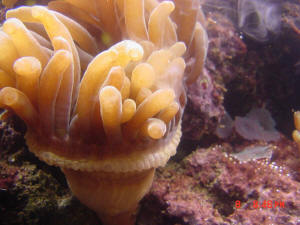 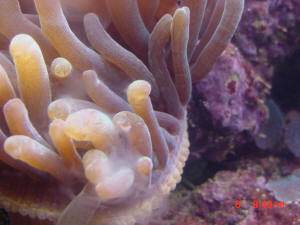
|
|
Odd Appendage on Anemone, repro. 5/1/08 Hi guys, I am
coming to you once again with a question. In the past you guys
have helped me on different occasions with some cool hitchhiker
ID's. Today this might just be my lack of experience in what
I am seeing, and may not be uncommon at all for this to happen.
My apologies if this a J.V. question. I attached a pic of a
bubble tip anemone. From everything I have read and seen, they
reproduce 2 ways sexually and asexually, when reproducing
asexually they split, right? <Yes> To my knowledge the
splitting starts with the mouth and the anemone divides itself
from there. <Mmm, no... there are a few ways this scission
occurs... some from a bit of pedal laceration (a part of the foot
torn away)... or, in your case...> As you can see from the
picture this is not the case. This anemone looks like it has a
Siamese twin, LOL. I have no idea how the process is done
sexually and maybe this is part of it. However I am clueless, any
information is greatly appreciated. Thanks, you guys are
fantastic.. Joe <You too... Yours is becoming two... Congrats.
Bob Fenner>
Re: Odd Appendage on Anemone 5/1/08 WOW... I never
thought Mr. Fenner would be the one to answer my question, its an
honor... Thank you very much... I had an idea it was just my lack
of experience but I wanted to make sure. Joe Brillon
<Heeee! A pleasure to share Joe. BobF>
|
|
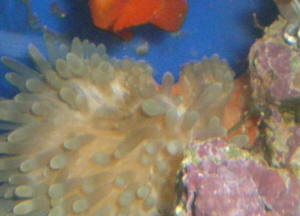
|
|
RBTA help, repro. beh. - 04/14/08 Hello,
how are you today? <Hey Jessica, I/we're good thank you!
Mike I here with you today> Ok, here is my problem a few
months ago I bought a beautiful RBTA probably about the size in
diameter as a softball, this baby was huge. <Nice work!>
Last month it cloned it's self and I thought that was so
cool, the clone disappeared and I have not seen it since. Exactly
one week later sure enough it split again, I was so excited, I
was going to move it into a container so the clone couldn't
disappear but by the time I got a container ready it was gone,
this happened 3 more times since. My BTA has split 5 times in the
last 6 weeks. It has cloned 5 times and now the original BTA is
the size of a half dollar, and I have nothing to show for it,
they are all gone. <Not good, and sorry to hear> Is it
going to clone to nothing and what makes them clone like this?
Did the original eat the others? Did they float off and die? My
water quality is PERFECT. I am baffled any help would be
wonderful and thanks in advance. ~Jessica <Jessica - it's
quite common for one part of split to die unfortunately. On
it's own, this wouldn't concern me. What is concerning is
the frequency with which this animal is experiencing fission.
Really need more information about your tank to make an informed
opinion here (tank set up, water parameters, livestock,
maintenance, feeding. etc) Are you sure these splits have
disappeared - it's not unusual for them to go hiding until
they have healed. Splits happen, apart from natural reproductive
activity of course, because of a trigger - whether that's
food, lighting, water quality, injury, stress etc. Getting to the
bottom of those things is the first thing to do to try an
establish why this is happening. Mike I>
Re: RBTA help. BrendaF chimes in Mike, It
is not common for one half of an anemone to die after it splits.
In fact it is unusual. Something is drastically wrong in this
environment for this to happen, which is obvious by the recent
number of splits. Brenda Furtak
Re: RBTA help. MikeI replies
in turn Brenda, thank you for mailing me - you absolutely
right, and that is what I thought I wrote! I think the spell
checker must have "corrected" my uncommon to common, or
likely my slip of the selection. Just looking in the mailbox now,
this hasn't been published, so will correct back to the
individual, and her answer her reply too. Thanks for the catch
there, - I think I'm a little off tonight after having just
booked a trip to the Maldives in a few weeks time! Bob - to note
for publishing (sorry for this headache!) Mike
Re: RBTA help Thanks for the fast reply, a
little info on my tank. Tank set up 75 gallon, 150 lb live rock,
3 inch LS bed, Ammonia Nitrite 0 Nitrate 10 PH 8.4 temp stays at
82 salinity 1.024, lighting one side is a Coralife long bulb the
other side is the blue actinic. They are in a halide but not
anything like the 10K Wyatt bulbs. Occupants 1 clown (the BTA ate
its mate) 2 dominoes (the BTA ate my 3rd domino) 3~ 4 stripes and
3 yellow tails, 2 serpent stars some turbo snails and hermit
crabs a few Goby's (GS mandarin and one with blue spots,
cannot recall its name). Its diet is brine shrimp and silversides
once a week as it will take them, less often since all this
cloning). Some mushrooms and button polyps sponges of various
colors and sizes, everything is flourishing and doing wonderfully
well, I thought except this RBTA. Right now as we speak it is
open and fully bloomed, has been perched on the same rock that I
bought it on, just moves from side to side. The one clown does
host it, but it doesn't smother it. I just hope that it
doesn't die. Thanks again. Jessica ~Jessica <Hi Jessica.
Straight away I have to correct a part of my earlier email. A
colleague here on WWM spotted my mistake and pointed it out to
me, for which I'm grateful. In my original reply I wrote
"it's quite common for one part of split to die
unfortunately" - this should have read "it's quite
UNcommon for one part of split to die unfortunately" I blame
this on the fact that I've just booked a holiday to the
Maldives today, and I'm on cloud 9 (which means not checking
or mis-handling the spell checker!) - I do apologise for this.
Back to the matter in hand, I say uncommon unfortunately, because
in a healthy stable environment clones tend to do well, so it
does suggest there is something amiss in your system. This would
also tie in with the frequency of the cloning. Only working the
face of the param.s you have posted, a couple of things to
mention. You could increase your SG a couple of points to 1.026
(read up on this before hand). Also, can you clarify lighting -
are they PCs? What strength? Do you use any additives? Where do
you source your food from? Do you keep your sand bed turned? If
you don't already, run some carbon, perhaps run a PolyFilter
(or equivalent) in case there are any other compounds/toxins in
the water. Is there sufficient water movement (and therefore
oxygen/disperse CO2)? Does the animal have any degradation or
jelly etc on it? If I'm missing something obvious, then I
hope the crew will pick up and chip in (will run this past one of
the crew too), but as said above, there's something amiss to
cause this behaviour; hence the questions, you need to examine
all aspects to try and get to the bottom. Mike I>
Brenda, Do you have any thoughts? I would
appreciate them. Mike
Re: RBTA help, Brenda's Thoughts -
4/15/08 <Hello Jessica, Brenda here, assisting Mike on
this one. I've looked this over and I do have several
questions. I definitely need the lighting clarified. If you have
a link to this fixture, that would be helpful. I would
discontinue the use of the brine shrimp, unless you are hatching
this yourself and feeding brine that is less than 24 hours old.
Anything older does not provide any nutrition. What size portions
of Silversides are you feeding? How often are you doing water
changes? What percentage are you changing out? How are you
testing your salinity? The salinity needs to be brought up to
1.026 slowly. You can do this by topping off daily with premixed
saltwater. When mixing coral and anemones I do suggest running
fresh carbon to help with any chemical warfare. I also need to
know the age of the set up, all equipment, and the amount of
flow. Are you using powerheads, refugium, or any additives? Do
you know where this anemone came from? Was it shipped? What
conditions was it kept in before you purchased it? A picture
would also be helpful. As far as the clones disappearing, have
you checked the over flow and sump? Also, powerheads are well
known to shred a roaming anemone. I do not recommend the use of
powerheads when keeping anemones. I can assure you, it wasn't
eaten by the original anemone. Crabs and Serpent Sea Stars have
been known to pester anemones. I personally do not keep or
recommend they be kept with anemones. Work on getting your
Nitrates down to zero. What species and size clownfish is hosting
this anemone? Moving an anemone to a container is not an adequate
environment, and will only add more stress. I suggest leaving
them in the main display unless there is an immediate danger.
More information on anemones found here:
http://www.wetwebmedia.com/marine/inverts/cnidaria/anthozoa/anemones.htm
Please read through the articles and the FAQs at the top of the
link. Brenda>
|
| Anemone Splitting, E. Quadricolor, BTA -
4/1/08 <Hello, Brenda here!> I need help. I think my
bubble anemone is going to die because it punctured itself on a
rock. <It did not puncture itself.> It was healthy (tight
mouth, etc) when I received it and open(s) up normally but has
recently shrunken a little. I've only had it for 1 week. The
anemone set its foot down in a place and the rock has come through
the mouth of the anemone. It only comes through the mouth it has
not split...remains in one piece. <Give it time, it will finish
the split. Start checking your water parameters to see if there is
anything that has stressed the anemone. Brenda> |
|
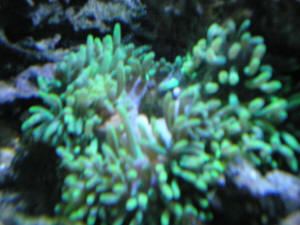
|
|
Bubble tip anemone split, still attached!!!! 9/12/07
<Hi Ryan, Mich here.> Hello once again. <A familiar
email address...> I am sort freaking out at this point. <No
worries.> I've had my green bubble tip anemone for around
a year and a half and came home yesterday to find it split.
<OK... Not uncommon.> Well yesterday when I saw it my jaw
about hit the floor because I did not know what was going on.
<It's called reproduction... and if ya think that's
bad... wait till ya hear about "the birds and the
bees"! Heehee!> They were still attached by a 1-inch
"thread" of anemone. <Mmm... 10 blade...> One of
the two did a lot of walking around the tank (yes a reef tank,
nothing happened, I moved corals :) ) <You're lucky.>
and I was hoping they would become separated by this morning.
Well no such luck, the two are still connected 24 hours after the
split happened? <Mmm, help'em along.> I have one very
large anemone and one very small anemone, not the norm? <Not
abby normal either.> So here are my concerns, how long does it
take for them to fully detach from one another? <Depends, but
you can certainly go in with a scalpel, knife, razor blade and
assist the process along. You may want to add carbon or a
PolyFilter as this split likely caused some nastiness to be
released.> The bigger of the two has a large rip down the
center (from the split of course), will this heal, it looks
rather bad? <It should... give it time... but don't offer
it food for a week or two so that the gut is allowed to heal.>
The larger anemone also looks to be working on something
else.........another possible split? <Possible...> I did
not divide anywhere near equally so I'm wondering if I may
end up with more than two. <Does happen.> Is there a way to
tell? <Mmm, wait and see. Or help it along.> I'm
worried about the smaller of the two living, does it have a fair
chance? <Certainly.> I've read a lot on your site about
splitting but have never found anything about prolonged
attachment, is this abnormal and should I do something about it?
<I think I would. Anthony Calfo frequently does demos cutting
up anemones.> Here's what you've been waiting for, my
tank parameters: <Heehee... I'm waiting for more than
that... perhaps of box of self-realization and self-actualization
in the mail...> Ammonia 0, nitrite 0, nitrate 0, phosphate
tests at 0, alk 12.4 DKH (I'll explain that later), calcium
410, magnesium ~1300, Ph 8.4, temp constant 80, SG 1.026. The
high DKH is due to a newly installed Kalkwasser reactor which
I'm still trying to fine tune to keep my levels steady, I do
know that's too high. Here's what I did before this
happened, Friday I did a water change, Saturday nothing, Sunday I
added 100ml of magnesium (~100 gallons water volume), Monday the
split happened. So I'm not sure if I caused this or if it was
just time, it was a large anemone? <Either are possibilities,
though stress reactions resulting in division are not
uncommon.> I'll include some links to pictures to help you
out with this. First picture is on Monday showing one anemone to
the left and one to the right and the attachment between the two.
Second picture is of the bigger of the two clones. Third is of
the tiny clone. Both of them were inflated and looked healthy
today.....other than the huge rip.
http://i148.photobucket.com/albums/s7/RyanSc_photos/IMG_1209.jpg
http://i148.photobucket.com/albums/s7/RyanSc_photos/IMG_1218.jpg
http://i148.photobucket.com/albums/s7/RyanSc_photos/IMG_1217.jpg
You'll have to trust me about them being attached yet, you
can't see that in the pictures. I hope these links work for
you. <They do.> Thanks, Ryan. <Welcome! Mich>
Re: Bubble tip anemone split, still attached!!!!
9/12/07 Thanks Mich!! <Welcome Ryan!!> One last super
quick question. <Sure!> Assuming the attached tissue is 12
inches long, where should I "snip"? <Mmm, you're
going to have to be the judge here.> Or do I just remove the
attached tissue all together. <An option, and may be viable
third anemone.> In my pictures you can see how much tissue is
attached.....which anemone gets it? <I can't tell from the
pic, sorry.> Thanks, <Welcome!> and yes I email you guys
too much, <No worries. Is why were here.> thanks for all
the help you've given me, now, and in the past. <Is not
just me, but on behalf of all the crew, you're quite welcome.
Mich>
|
|
Re: Bubble tip anemone split, still attached!!!! - 9/23/07
Hello again! <Hello Ryan, Brenda here helping out Mich on this
one.> Thanks for putting up with all of this. <You are
welcome!> I'm so confused at this point I didn't know
where else to turn? Mich I believe you were right about the
connective tissue being a third clone, it now appears to be
attached to the original anemone! I have never had anything in my
tank confuse me this much. I just can't figure this out. So
here's what I've noticed today. The original anemone has
what appears to be 2 mouths, the "regular" mouth is
very clear to see, the other is either a hole in the healing
anemone or a second mouth? <It is possible for one anemone to
have two mouths. It is rare, but does happen. See pictures here:
http://www.karensroseanemones.net/thesplitoftwomouth.htm >
Another very odd thing I'm seeing is a perfectly healed
"line" extending from the mouth of the original anemone
to the outside of its body. I've seen a lot of splits (I work
at a LFS), and I've never seen this before. I don't know
what to do? It's looked like this for at least 4-5 days and
has made a walk across the tank. <Needs more time, possibly
weeks.> I have a very good picture of this healed line going
into it's mouth, and I'm wondering if it would be best to
cut the anemone along this line as it looks like a 3rd anemone
splitting "defect"? <I would let nature take its
course. The anemone may not be able to handle the stress of an
induced split at this time. I would wait at least a month from
the last split before cutting the anemone.> Honestly, it looks
like it's going to divide into 3 more anemones at this point,
however they can be deceiving. <It may split again on its own.
You are also correct in stating it can be deceiving. They can get
themselves into all sorts of shapes.> I'm worried it will
not be able to feed with this "line" going into its
mouth? Should I take measures into my own hands or let nature
take its course? I'm doing a water change tomorrow so I could
very easily set up a tank to hold a cut anemone in. I'm just
worried it's too soon after the split? <I have that same
concern. The anemone does not have an immediate need for food. It
needs time to heal.> This picture is not just the anemone
folding on itself; it's a distinct extremely clear line in
the anemone. Thank you so much for all your help!
http://i148.photobucket.com/albums/s7/RyanSc_photos/IMG_1266.jpg
<It may just be the healing line. If it is, the anemone will
grow into its new body. Not all splits are perfectly shaped in
the first few weeks. I do suggest moving that nearby coral away
from the anemone.> Ryan. I'm back before you even replied!
Here's another picture showing 2 feet in my opinion. I
don't think it's going to finish the split by itself?
<I'm not 100% convinced there are two feet there. It is
hard to tell without seeing the anemone in person. Time will
tell.> I thought you'd be interested in the picture at
least. Thanks, Ryan.
http://i148.photobucket.com/albums/s7/RyanSc_photos/IMG_1270.jpg
<I hope this helps! Let us know if there are any changes, good
or bad. Brenda>
Re: Bubble tip anemone split, still attached!!!! -
9/23/07 Thank you for your help! <You're welcome!>
The link is great too. <Yes, Karen has put a lot of time into
her website. She has helped thousands of people take better care
of their anemones.> I'll keep watching to see what happens
and hopefully neither one of my anemones will take to floating in
the tank like hers did. <Make sure your powerheads and intakes
are covered.> It would probably be the end of them. <Not
necessarily, but may need to reduce flow a bit to get them to
attach.> I really appreciate your help with this. It's
been driving me crazy. <I am happy to help. Let us know what
the results are. If you end up with something unusual, Karen may
also be interested in posting it on her website so that others
may learn.> Thanks again, Ryan. <You're welcome!
Brenda>
|
BTA Split, Entacmaea quadricolor - 8/28/07 I have
read through your forums in detail, but could not find the answers I
was looking for, also thank you in advance. <You're welcome!>
My tank is actually doing very well; All items are within the
recommended limits. <Recommended limits for Anemones, and not coral
or fish I hope.> I have had my Rose BTA for about a year, it was
growing very large of approximately 1 ft across, It split the other day
into 2 similar size pieces, I have read that it is due mostly to stress
or very good conditions. I would like to think the latter since my
corals are growing like crazy as well. <It is most likely related to
some level of stress. Your corals growing like crazy may be the reason
(chemical warfare). It may also be caused from something such as a
temperature swing, large portions of food, old bulbs, new bulbs, etc.
It is also possible that your anemone grew too large for comfort.>
My main question is if there is a healing period that these need to go
through? <You bet! I recommend a water change after all splits. I
also recommend waiting 3 - 4 weeks before removing the anemone, should
you decide to find it a new home.> Also they appear after a few days
to be swelling up a little bit like normal. <This is a very good
sign.> Also should I hold off feeding the 2 for a bit? <You need
to hold off until the mouth is completely healed. This typically takes
7 to 10 days.> Also in my ventures I have heard that the new
offspring will not split, only the original, is this true? <That is
100% False.> Sincerely, John Bailey <Your attachment did not open
for me. If you would like to resend it, I will be happy to take a look
at it. Good luck with your anemones! Brenda>
Anenome problem,
repro. - 07/03/07 Hi, My husband's reef aquarium is 90 gal, we
have had it for 2 years with little or no problems. Tonight, he fed his
fish, brine and Mysis, the usual diet, within 20 minutes the 2 bubble
tip anenomes <Are these clones? I do hope so> were emitting a
white substance that has totally clouded the tank. <Mmm, very likely
sex products...> He tested the water, everything has tested normal,
along with the salinity. The fish seem o.k., along with the corals. We
do not know what is happening with the anenomes. We have no R.O. water
on hand to do a partial change and cannot see into the tank to remove
the anenomes. We only hope that when we wake up tomorrow that we will
not loose <lose> any of our fish. We have no new additions to our
tank, the current fish have been in the tank along with the anenomes
for over a year. Can you shed any light on this? Thanks so much. Janice
<As stated, this is likely a reproductive event...
Actinarians/Anemones do this as well as various degrees of asexual
fission. Neat! I would make the largish water changes... and add
activated carbon to your filter flow path... and spiff up (clean) your
skimmer... Hopefully all the gametes will be eaten, removed, otherwise
not cause a crash here. Cheers, Bob Fenner>
Triple BTA Split, Entacmaea quadricolor - 3/23/07
WWM, <Hello, Brenda here> I hope this is not a bother to you as I
have found some info on your site about a triple split anemone but then
not all my questions have been answered so please be patient. <Sure
will> I bought a BTA about three weeks ago and have been feeding it
small amounts of either brine shrimp or chopped scallops every 2-3
days, it is a quick feeder and puffs right up after it has eaten.
<Brine shrimp has very little nutritional value. I don't
recommend it. I suggest silversides as the primary food. You can also
try lance fish, krill, and raw shrimp along with the scallops. Feed
portions no bigger than its mouth.> The other day I came home from
work to find it had split into 3 smaller pieces on the same rock. I do
3 week water changes and have VHO lights and have been told I know have
5 WPG of light. <Need to know for sure. Also need to know the size
of your tank, and other equipment.> My parameters are within normal
pH, Ca, Ph etc (I know you want exact numbers but am on a break at work
and don't have all the info here with me). <Yes, need numbers,
including salinity, alkalinity and temperature.> I am wondering if
you can comment and perhaps give me some advice? <Will try> You
did comment briefly to someone else that this split is a sign of
stress? How can I make things better? <Could be many things. Tank
mates, over feeding, water parameters, lighting, old bulbs, new bulbs,
being placed in a new environment is also stressful on them.> Thank
you for your time and attention. Tammy <You're welcome!
Brenda>
BTA, Possible Splitting, Entacmaea quadricolor -
3/15/07 Hi, <Hello, Brenda here> I have checked out your
site for more information on my current problem. My Green BTA has
developed a small tear in its column and this morning when I
checked on it its guts were starting to hang out. <Is it
splitting? Or was it injured somehow?> I know this probably
means it is not going to survive too long but I was wondering what
I could do to try and help it recover. <Keep pristine water
conditions.> It appears to have torn itself coming out from
behind a rock but was fine and all puffed up an hour or so before I
checked it according to my husband so I was hoping it wasn't
too late. <A picture would be helpful, but it sounds to me like
it is splitting, and you will end up with two very soon.> I have
a 500 gallon reef tank and the BTA has been in there over a week
now feeding and looking fairly happy other than hiding
occasionally. Thanks for your help. Francesca Wise
<You're welcome. Brenda> |
Re: BTA, Possible Splitting, Entacmaea
quadricolor - 3/15/07 Hi Thanks for your reply, Things seem to
have gotten a lot worse since this morning and I think it's
probably now too late. I have attached a picture. Is there anything
we can try? <The only thing you can do for it now is keep your
water parameters stable. Is it possible that the anemone was
injured by a power head? They have been known to recover from this.
I do agree it doesn't look good. Keep a close eye one it. If
there are any signs of life, the anemone has a chance. Here is a
website with pictures of others that have been injured.
http://www.karensroseanemones.net/coverpowerheads.htm > Thanks,
Francesca
<You're welcome. Brenda> |
|
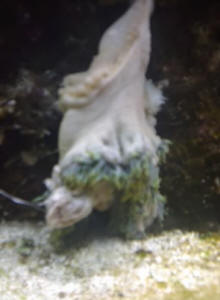
|
BTA reproductive cloud 1/29/07 Hi <Hi Richard.> I'm
a little puzzled today. <Well lets see if I can put you
together.> Yesterday my GBTA was not opened fully. This has happened
before and usually the next day everything is back to normal. Last
night for a few minutes he/she release a dark fluid like substance. I
couldn't figure out why. Today he/she looked much better and was
almost fully open at about 10 inches across and I was thinking .
Tonight, he/she started releasing a milky substance which, of course,
clouded the water. This release has been going on now for about 30
minutes. What could be the reason for this release? <Richard it
sounds a reproductive event, E. Quadricolor can reproduce through means
of sexual interaction as well as splitting (creating clones of each
other)…others have had similar experiences which you can search
for on WWM. I would not be concerned with the actual event itself,
however I am inclined to ask if there have been any recent/drastic
changes in the tank…and would also like to know the tank
chemistry readings as well, just so that we can rule out any potential
problems.> What should I do about it? <Large water change, run
some chemical filtration media/carbon.> Thanks for any help you can
give. <You are welcome.> Richard <AJ.>
Re: BTA reproductive cloud 1/29/07 Hi and thanks.
<You're welcome.> All water chemistry readings are within
good parameters. Calcium 425, Alkalinity 8.3 Nitrates 0, etc. I had
done a water change of 25% (110 gallon tank) on Friday. Yesterday, some
of the rockwork had sagged a little so I rearranged it which included a
slight move on his/her home rock. Perhaps he's/she's stressed
because of that change. <Perhaps.> Last night I changed 10% as I
was almost out of water due to the fact that I had changed the 25% on
Friday. <Sounds acceptable.> Today everything seemed back to
normal except that the button polyps are still closed. The GBTA had
great color. Its tentacles are full and plump but have rarely been
bubble tipped. He/She is active today and has moved to a new location.
I don't believe he/she is eating normally yet, because the Formula
one just sat in amongst its tentacles and didn't make it to the
mouth before the clowns and shrimp poached most of it. <I would hold
off feeding for at least a few days.> Also, shortly after I fed it,
it started to release some more milky stuff. I have Chemi-pure which
I'll start right away. I did read several articles late last night
and noticed the pictures of the "smoking anemone." Those
could have been mine except for the color. I'll also do another 25%
water change ASAP. <Sounds like you're on the right track.>
Thanks again, A. J. <Anytime.> Richard <Adam_J.>
Re: BTA conditions/sexual reproduction 1/29/07 Hello again,
A. J. <Hi.> A little more info. <O.k.> I tried to vacuum
the milky substance as it was released last night. That event lasted
about an hour. I did another 25% water change today. <Sounds
good.> The anemone has moved again and is now looking somewhat
smaller. <This doesn't sounds good...> I don't see
another anywhere in the tank. I was thinking that he may have split
during the night. Oddly though, he had a rather large white solid
looking substance (poop? that finally disappeared) <Or intestines
"insides"....if it is unhappy.> hanging from his mouth
most of today and his mouth has been fairly elongated today, too.
<Also not a great indicator.> His tentacles are fairly plump and
they have good color. Should I continue with the water changes and if
so for how long? <a trio of so of 20% should suffice, and then
continuing with your normal schedule.> The Chemi-Pure is working. I
will hold off on the feeding for a while. <Sounds good.> I've
double checked all water parameters again today. They are the same as
yesterday. <I would just be patient and keep a watchful eye out as
of now.> Again, thanks. <Anytime.> Richard <Adam_J.>
Anemone Splittings BTA beh., tank "size" 10/6/06 Hi
Mr. Fenner & Crew, <Marilyn> 14 months ago, my RBTA did a
split, yielding 1 Clone which is doing super. Well, 12 days ago, the
original RBTA did another split and 2 l/2 days later, it split again,
yielding twin clones : ) so now I have a beautiful tank with the
original RBTA and 3 clones! Problem: the original RBTA is discharging
quite a bit of it's mesenterial filaments. Is this a bad sign or is
this normal? <Mmm... can/does happen... but these should be
"brought back in" within a short while (a few days)> I
don't recall it doing this on the first split 14 mos. ago. My water
parameters are as follows: pH 8.0, dKH 10.75, Alk 3.86, CA 395 - 400,
& sg 1.025. Temp. 76.5 - 78.5F <These all look fine> Another
question - I've been able to find a formula on how to figure the
actual gallons of water a tank can hold but have not been able to find
information as to how to figure out how many gallons of water is
actually in a tank with 100 lbs. of LR and 30 - 40 lbs of live sand ( 2
inch. sand bed) <Mmm, could be calculated given the known density of
both of these... they are variable...> displacement so if I do a 15
gallon water change, what would the percentage of change be? Do hope
you can help me with a formula of some sort. <Well... do you want to
weigh a given bit of rock and sand and measure their displacement
volume to determine densities? Density equals mass over volume, D=
m/V... from here you can/could calculate the volume taken up by both
(on the basis of their known mass... weight on this planet... as in V=
m/D... and "take out" the volume (at about 231 cubic inches
per gallon) of the rock and sand... leaving you with water
volume...> Thank you for your help to my two problems/questions.
Marilyn <Welcome. BobF>
Anemone splitting 8/6/06 Hello, I
am hoping you can help me with this question. I have searched all of
your information about anemone splitting. I did not find the answer to
what I was looking for. My question is, 3 days ago, my Bubble Tip
Anemone split. Both of them look great. They are fully inflated and
good in color. They both have moved around the tank some, but have been
in the same spot for the last 32 hours. I did try finding them some
minced shrimp today, but they both did not accept it. Upon farther
inspection, I did not see there mouths. Is it possible for this to
happen when they split? Does it develop later? My tank is a 55 gallon
long and the specs of the water are in the right zones for nitrates,
nitrite, ammonia and pH. Also do you know if the Regent power heads are
fully submersible? I could not find this information any where on the
packaging nor the directions. I appreciate any insight that you can
give me. Ellen <<Ellen: When my BTA's split, it usually takes
a few days before they start accepting food again. Give it some more
time and they should be fine. I can't tell you anything about the
Regent power heads. Usually, all power heads are submersible. Can you
check with the place you got them from? Best of luck, Roy>>
BTA/Reproduction 5/28/06 My bubble tip split yesterday and now
there is a cloudy discharge coming from one of the two. It has
completely clouded my tank in the matter of an hour. What should I do
if anything. The tank has been up for two years, the bubble tip is year
and half old, water conditions up till now were very good. <I'd
filter the water through a good grade of carbon/Chemi-Pure or Poly
Filter. In the future do cap all "i's" and beginnings of
sentences. Saves us time if we do not have to do it for you.> Thanks
<You're welcome. James (Salty Dog)>
E. quadricolor Sexual Repro... 5/15/06
Hi - I have been reading the anemone sections and not found the answer
to this question. <Okay.> The 2 rose anemones are emitting a
whitish cloudy substance such that the whole tank is now cloudy.
<Sounds as if they are reproducing sexually; http://en.wikipedia.org/wiki/Sea_anemone,
okay in LARGE tanks but not in small ones like yours...can have an
adverse effect on tank mates, run some carbon and do some large water
changes.> Yesterday, before I realized it was coming from the
anemones, I did a 5 G water change, cleaned the sponges and replaced
the charcoal filter. It was clear for about 24 hours until now when I
noticed the cloudy stuff coming from the anemones. <What is your
water quality? At times they do this to increase their chances of
survivability when death appears to be imminent....too small
IMO...water quality can go astray VERY quickly.> Much thanks, Laurie
24 G NanoCube. 1 high fin Cardinal 1 clown 1 cleaner shrimp 2 soft
corals, hermits, snails <Adam J.>
Re: E. quadricolor Repro - 05/17/2006
hmmm. <" "...One of my favorite responses.> So
basically it's birth or death, and you think my tank is too small
for healthy anemones. <Well to small to keep the water quality
stable and nutrients low enough....for average aquarists...to be able
to keep such sensitive creatures.> If the anemones are reproducing,
would there be that kind of emission i.e. cloudy substance for an hour
nonstop (if not longer), two days in a row? <Possibly yes.> When
would baby anemones appear to confirm that it was reproduction?
<Likely won't in this closed system.> Alternatively, what do
anemones look like if they are dying? <Deflated, detached, missing
tentacles....> This morning the tank is clear. <I would do a
water change anyway...lots of them.> Thanks again! <Adam
J.>
Bubble tip Anemone reproduction 3/14/06 Hey guys,
<Lisa> Just a quick esoteric question. When a bubble tip anemone
splits does it first grow a new stomach/gastric pouch etc and then
split, or does the tissue split and then the internal organs develop?
<Good question... some of the mesentery, and its contents do get
"pinched off" in these fission events generally... though as
you likely know, there are incidence where small bit of the
"foot" get left behind and the undifferentiated
"daughter" cells can/do become all the other cells...> I
can't seem to find anything on this and am really curious. I've
been doing a science fair experiment on anemone reproduction and have
been watching them for three years now, but I can't really get a
good look to see what's going on internally. <Unfortunately this
requires the sacrificing, embedding, sectioning and staining of
specimens... can be done though. I worked on Anthopleura elegantissima
as histological specimens in college and did this.> It's not
crucial to the parameters of the experiment which focus's more on
water quality and nitrates, but I'm just curious and a little
frustrated that I can't answer this question. Also if you know any
great books on anemone reproduction I'd love to hear your
suggestions. Thanks, Madeleine B. <Mmm, as far as am aware, the
pet-fish literature is scant re such. Cheers, Bob Fenner>
Green
BTA Triple Split - 03/12/2006 Hi guys! <Robin> Two months ago
I bought my first anemone, a 6-7 inch diameter Green Bubble Tip
Anemone. I've been feeding him/it a thawed Formula One gel cube
about once every three days and he has seemed pretty happy. I did the
usual 20% bi-monthly water change over the weekend and it was
uneventful, but now in the past 24 hours something interesting has
happened to him. When I went to do the usual B-Ionic dosing this
morning I discovered that overnight my BTA had split in two!
<Happens> I thought to my self, "Cool!" and went off to
work. Gotta pay for this aquatic addiction after all. When I got home
from work tonight I was very surprised to see that I now have THREE
anemones! <Bonus!> The larger of the two clones had split again.
Have you ever heard of a BTA splitting itself into thirds like this?
<Yes... usually under some "stressful" cue...> Am I
correct to assume that my anemone reproducing like this means I'm
really starting to get the hang of this reef tank thing? <Mmm,
actually the opposite... this "fission" is most often a
"means" or function of dangerous influence reaction... the
animal dividing to "hopefully" (teleological but
instructive), live by "doubling its chances" in two varying
environments. Bob Fenner> Thanks! Robin
Re: Green BTA Triple
Split - 03/13/2006 Hi Bob, <Robin> Sorry to bother you again.
I have a follow-up question regarding my Bubble Tip Anemone splitting
in three. You mentioned in your reply to my original e-mail that a BTA
splitting is a reaction to stress. <Most often, yes... particularly
multiple fission events> The fact that I got three anemones from one
is very cool, but I don't want my BTAs to be stressed.
<Happens> My question is, what sort of stressors prompt a split?
<Rapid change in physical, chemical, biological make-up in their
environment mostly...> Could it have been the water change and the
resulting slight change in alkalinity, pH or calcium? <Yes> Or
perhaps it's the fact that the salinity creeps up from 1.025 in the
morning to 1.026 in the evening before I get home and can add RO water
to compensate for evaporation? <Could be a contributing cause,
yes> Could another possibility be the daily fluctuation in pH? In
the morning before lights on the pH tends to be low, around 7.8 to 8,
then by the end of the day it's up to 8.2 to 8.4. <Again...>
Nitrate, Phosphate, Ammonia etc. all test negative and the tank
averages between 80-82F degrees. The calcium level in the tank stays
between 400 and 440 depending on the time of day I measure. The only
supplements are 45ml (each) of B-Ionic daily in the morning and 8ml of
Seachem potassium iodide every other day. <I'd cut this back to
once weekly... with measurement> The tank the BTA lives in is 75g
Oceanic display (no overflow) with: * 75lbs of live rock * 1 inch live
sand * CPR BakPak Skimmer powered by a MaxiJet 1200 (I plan to get a
Turbo Floater Multi when I have the cash) * H.O.T Magnum in which I run
Black Diamond Carbon * A small Penguin power filter with bio-wheel
removed that houses only a PolyFilter Pad * Current Outer Orbit fight
fixture with 2x150W MH Lamps and 2x130W power compact actinics
(actinics on from 8am-8pm and MH on from 10am-6pm with lunar LEDs at
night) * 15w Aquanetics UV * 3 MaxiJet 1200 powerheads each with a
Hydor Flo wave maker attached * 1 MaxiJet 600 powerhead pushing water
across the back of the tank In addition to the BTA the tank houses: * A
medium sized colony of Xenia coral (Xenia umbellata - pumping happily
and growing well) * 1 small Amethyst Porites coral frag (Porites annae)
growing with good polyp extension * 1 small Pink Birdsnest frag
(Seriatopora stellata) growing with good polyp extension * 1 small
Leather Finger coral frag (probably Sinularia sp., it was a live rock
hitchhiker) * A few small colonies of assorted Zoanthus polyps * Half a
dozen assorted Mushroom corals * 1 Tuxedo Urchin * 2 generic
sand-sifting cucumbers * 1 Green Mithrax Crab * 1 Skunk Cleaner Shrimp
* 2 Blood red Fire Shrimp * A few dozen Scarlet, Blue Legged and Dwarf
Zebra Hermit Crabs * 3 Mexican Turbo Snails * 1 Astrea snail * 3 Nerite
snails * 2 Ocellaris Clowns * 1 Royal Gramma * 1 Hippo Tang * 1 Six
Line Wrasse * 1 Flame Angel Thanks in advance for your thoughts! Robin
<Sounds/reads like a very nice system... Thank you for the
follow-up. Bob Fenner>
My Bubble Tip Has A Twin! - 01/06/06
Hi Crew <<Howdy>> Not so much a question as a contribution
(which might actually lead to a question, come to think of it).
<<No prob>> About a month ago, I introduced a bubble tip
anemone to my 38g tank (20" deep), to provide some lovin' for
my maroon clown. I know neither needs the other, but you know the
attraction... <<Indeed>> I placed him toward the top of my
"rock wall", which put him about 12-14" below 192 watts
of PC lighting (half actinic/half 10000k). <<Mmm, actually a 25%
to 75% ratio (respectively) would be more suitable for the
anemone.>> I guess he liked it there, because he stayed, where I
fed him a bit of minced shrimp every day or two. <<Ah good, best
to feed very small pieces of food.>> He seemed to be growing (or
at least spreading out), and the clown adopted him within a day or so
of his introduction. At any rate, almost two weeks ago, I upsized my
tank to a 70g (24"deep). I went with this particular tank so that
I could keep my lighting hood (not cheap!), with the reasoning that if
12" below the light worked in the 38g, there was no reason it
shouldn't in the 70g, if I provided more rock to raise him up.
<<Agreed>> The move of all the livestock (five fish,
snails, crabs, a blood shrimp, a couple of mushrooms and my buddy the
anemone) went without any losses (although not without some stress on
my part). I put the BTA in about the same spot he had been in before
(although 4" higher from the bottom), and he stayed put. Well, to
my amazement, two days after the move, he split! <<Likely induced
by the stress of the move/slight change in water chemistry.>>
Both parties seem to be doing well a week and a half later, although
the original party climbed behind a rock for a few days after rubbing
shoulders with his sibling (clone?) for a couple days. He now has
re-emerged and seems as healthy as ever. He is now located about 8
inches away from the other. I'm told that they sometimes need a bit
of time to heal after a split (don't we all?). <<Ha!>>
I guess my question is, can I expect this to re-occur, <<Many
folks report instances of their BTA's splitting/reproducing
multiple times.>> and what's the best way to get one of the
two out of there and back to the LFS? <<Best to remove/transport
the anemone WITH the rock to which it is attached. You can try gently
coaxing it off with a thumbnail if you wish, but be aware that any
damage to the anemone will likely result in death.>> I really
don't want two anemones, although my clown seems to have taken an
equal fondness to both of them. Regards and thanks Phil <<Thanks
for sharing...EricR>>
E. quadricolor Reproduction. 11/30/2005 Hello crew.
<Hello.> I have a Green Bubble Tip Anemone and I am wondering on
procedures to get one to split. <Intense light and feedings of meat
high in protein from a marine origin such as Mysis or squid.
Nutritional supplements like Selcon or Zoe.> I know there is high
lighting and feeding it daily and then the stress but can you elaborate
on this any? <I have heard of this method and must admit I'm not
a fan of recommending it. Simply because most folks who purchase an
anemone to begin with lack the proper environment for it and stressing
it out leads to an even quicker demise. Stressing the animal out so
that it reproduces plays on an instinct of the animals, it reproduces
because it thinks it is dying, it splits in order to increase the
chances that there will be later generations. I have seen this done
accidentally a few times by hobbyist mishaps and more commonly when
transporting the anemone from one tank to another. Quite common for E.
Quadricolor to splitting the first week or two after a move. However
yours seems to be thriving and at this point I would just continue
providing the good care you have thus far. These animals rarely survive
in captivity to begin with and I would hate to have you try something
only to end up with one dead anemone rather than one. I would take
pride that you have been able to keep this animal alive much longer
than the average person.> I have PC lighting with 4x65 bulbs so that
gives you a little on what type of lighting its under. <Hard to
comment on the lighting without the dimensions of the tank but for best
results replace the bulbs every 6 to 9 months.> I don't have
"High" lighting but my anemone has done very well for the
last 6 or 7 months. Any help is appreciated thanks. <Adam J.>
E. quadricolor Reproduction II 12/1/2005 Thanks a lot for the
info. <Quite Welcome.> I feed my anemone a mix of foods (referred
to most as mush). It has shrimp, squid (body and tentacles), scallop,
silverside, Nori and some flakes. Also sometimes I soak it in garlic
(not for the anemone but the fish). <Sounds good.> If my anemone
does not split I agree with you instead of likely killing it I may just
get another of a different color. <Well if you must get another be
sure it is also a E. quadricolor.> Thanks a lot for your info.
<Welcome, Adam J.>
BTA split - 11/26/2005 I had a softball sized BTA that split
two days ago. When it did so it was stretched across the tank. The part
that was stretched eventually separated from the two larger animals.
Now I have two medium sized anemones and a smaller one (consisting of
7-8 tentacles). The smaller one is the only mobile one at this point.
Will it survive? Have you ever heard of an anemone splitting into 3
parts? <I have seen this before, and yes I believe all parts will
survive. Keep a close eye on them and feed them as well. good luck,
IanB>
Rose Bubble Tip Anemone Problems 9/27/05 Hi Mr. Calfo,
<James today> I've had this RBTA now for 2 1/2 years and it
recently split : ) which we're all happy about. However, since the
split, it hasn't looked the same. <Probably won't> 1)
It's tentacles have become twisted/curled, mangled looking (so
painful to look at) and can't figure out why it's like
this.<This happens after a split> SG 1.025, pH 8.2, dKH 11, Alk.
3.8, CA 390, NO 3 (10), NO 2 (0), NH 3 (0) and water temp between 76.5
- 78.5 F. We do a 15 gal water change weekly on a 55 gal tank.
<Good> 2) In addition to the twisted tentacles, it seems to be
excreting a fine grayish/white dust/powder instead of the usual dark
brown poop and it is all over the oral disc area. Can't figure out
why/what is going on. I think the anemone is OK because it's eating
2 - 1/4" pieces of shrimp daily and I can see small new tentacles
growing from where the split did not completely join (approx 1
1/2") at the oral disc. <Anemones need not be fed daily. What
goes in the mouth comes out the mouth. They need time to digest a meal
before another meal can be offerred. A once weekly feeding is fine as
these animals do produce most of their own food under correct lighting
conditions.> Surprisingly, the "Clone" is doing just fine,
eating well, growing and situated on the same LR next to the original.
Can you tell me what's going on with my RBTA? <Have a little
patience and don't kill it with kindness. They are adjusting from
the split and all should be well in time. James (Salty Dog)> Thank
you and looking forward to your reply. Lin
Rose BTA removal
08/23/05 Hello to all, <Hi Kevin> I recently had a Rose BTA
split and I am looking to remove the second BTA and sell it to my LFS.
Currently it is residing on the underside of a rock. I cant take the
rock out b/c the original BTA is on the same rock. What would be the
least damaging way to coax this BTA off this rock. I have read using a
powerhead, or depriving it of light can induce movement. Also i have
read that massaging the base can sometimes cause it to detach. Any
advice would be appreciated. Thanks for all the information. Nice work.
Kevin <All three of these can work... but I would just wait at this
point... let the animal/s rest, regain size... and sell one if
you'd like in a few weeks, months... Bob Fenner>
RTBA Baby boom 7/18/05 Hi. I have a quick anemone question
for you. Specifically, about the RTBA -- E. quadricolor or something, I
think. <This is it> Anyways, I have a 135G full of them. I
started with just one, then one afternoon he disappeared into the rock
work. When he emerged a few days later, he had a little buddy.
Fast-forward a year or so and now I have like ten of them! As long as
they stay put I can just move things out of their way, but every time a
new one pops up they all reposition. <Well-stated... and am sure you
can think of "reasons" for this> For like a week they roam
around stinging pretty much everything in the tank before settling down
again. I know (now) that you're supposed to make a separate rock
pile for them, but I didn't with this tank and its too late now.
Its very old and very stable and I don't want to upset everything
by moving all the rocks around. <Mmm, sell, give away some of
them> Anyways, so I was wondering what else I can do...I have other
tanks into which they could go, but they burry their foot so deep
within the rockwork that I could never get them out without severely
hurting them IF they didn't want to go (and I don't want to
remove the rock). <Why not?> So, is there anyway to make them
choose to let go? <Move the rock to another system where the
individual may choose to let go> I've seen other anemones in
other tanks perform this maneuver when they are (presumably) unhappy. I
don't want to muddy up my water, but perhaps there's something
you can squirt a small amount of in their face? I once saw an anemone
on the discovery channel let go of its rock in order to escape, with
the current, from an approaching predatory crab -- the crab didn't
even have to touch it, the anemone just knew it was about to be lunch,
and split! Anyways, so does anyone know any tricks to make an RTBA
think its in danger? <Not a good idea> I'm not against poking
them a little, just as long as it doesn't do them serious damage.
Although every time I've tried poking them with my finger to get
them away from sensitive corals, they just shrink back into whatever
hole their foot is anchored in and wait for me to leave. So yeah, any
thoughts? Thanks. -Dekon <Sell some... with their rock attached,
replace the rock. Bob Fenner>
Fragging Red BTA Let me start
off by saying that your site is awesome and very informative. I bought
a red BTA and had it my 75 gal. reef tank for about 2 months without it
moving. Recently it moved and attached itself right next to and partly
on my Hammer coral. I noticed the Hammer stinging it from time to time
so I tried to remove it and ended up tearing it from the base upward to
about 1/2 inch from completely tearing it in half. I thought I killed
it for sure. The next day it was fully open and now had two
"feet". I left it for two weeks and then it moved again
towards the Hammer again. This time I finished ripping it all the way
and within one hour I now had two red BTA's, both open and seeming
to do fine, and each going there own way. I now notice both have a
mouth. Is this normal? <Yes, happens> Can anemones be fragged? Do
you think they will be OK? <Likely so> Also, It doesn't seem
that the red BTA's sting the other corals ( polyps, mushrooms,
hammer, Favia, etc.). Are the red BTA's a big danger to the other
corals? <Sigh... yes...> Thanks for the input, CMC <This is
posted over and over... on WWM. Bob Fenner>
BTA Clone feeding Three weeks ago my BTA cloned. The large
anemone is doing fine and eats anything I feed it. The large one is now
bigger than ever. It's probably close to 10 inches across when
inflated. The clone will not eat anything. If I try and feed it it
pulls its tentacles away and deflates. It seems to be doing all right
though. It is staying on the same rock, and just moving around a
little. It seems to spend a lot of its time inflating and deflating.
You can sit and watch it fully inflate, and two or three minutes later
it will be completely deflated. I have never dealt with an anemone
clone before and I am not sure what to expect. Is there anything I can
do to encourage it to feed, or will it just feed when its ready? Thank
you. <Just continue to offer foods as per the other one... a couple
of times a week, don't be too concerned if the clone "moves
away" to another part of the system. Bob Fenner>
Artificial
Bubble Tip Anemone Propagation Hey guys, <Hello John>
I've got a question for you regarding bubble tip anemone
propagation. I read most or all of the FAQ's on your site about
cutting the anemones to divide them. Cutting one completely in half
sounds kind of harsh, and also seems risky. I was wondering if any one
has tried making a small cut on the edge of the oral disk with any
success. I read about making an incision down the side of the anemone,
from the oral disk to where the pedal disk begins, but the description
was rather vague to me. Should the cut be deep, or only superficial?
<Deep> What do you think would happen if you made a small cut on
the edge of the oral disk with some scissors or meat shears? <Better
to use a razor blade or such... much cleaner cuts> To give some
background info, I tried the feeding every three days for two weeks
before a water change thing and it worked fine. I ended up with six
anemones from one. I'm down to two now, one ended up in the sump
after wandering in the aquarium for a while, and I gave the others away
before a move. I want to try to get them to split again, but the heavy
feeding contributes to hair algae, which I have had problems with in
the past, but not since I moved. I cleaned it from the live rock with a
toothbrush while I had it out of the tank, and none has popped up so
far (3 months since the move). Anyways, I would appreciate more
detailed info about artificially propagating them. Any help will be
gladly received. Thanks, John Jordan <Not much more to say... there
is substantial anecdotal input from folks on BB's (ReefCentral,
Reefs.org...) re how often, at what size... Bob Fenner>
Divided
BT Anemone 3/26/04 My BT divided 48 hours ago and the clone does
not look well at all. It has moved between two rocks and is very
deflated and sorry looking. It barely moves its tentacles. The original
BT looks great and appears as nothing happened. The owner of the fish
store I bought the BT said that it is exhausted like giving birth. I
have a hard time believing that. What can I do to help this clone or is
it a goner and is slowly going. Stacy Frakes <Stacy, I would give it
a couple of days to recover. Your LFS explanation is bogus. They are
parts of the same animal, why would one be "exhausted", and
the other not? I think the more likely explanation is that it is
putting energy into moving away. Your anemone should be fine. Do watch
that it can't wander into anything that it will be injured by or
that can injure it. Best Regards. Adam>
Fun With Anemones! Just thought I'd add to the list of
anecdotal stories about Bubble-tip anemone splitting. Given that we are
in the summer months, the temperature in the tank has been slightly
higher than normal (82, rather than the normal 80). All other factors,
lighting, feeding, pH, Na etc etc had all been constant for some time.
Well, yesterday we had an unusually warm day and I'd not turned on
the sump fan. The result was a balmy 88 degree tank temperature.
Nothing looked *too* bad. The frogspawn was deflated and one of the
heads was releasing a tad bit of brown mucus (what is that?
zooxanthellae?) <Quite possibly...Coral have been known to expel
zooxanthellae under stress conditions...Or, it could simply be waste
product!> and the anemone was deflated. Well, the next morning I
notice the BTA has moved slightly and is in an odd position. By the
time I come home, I have two very healthy looking inflated BTAs. They
seem very protective of the portion of the oral disk where they split.
They constantly had it covered so it was nearly impossible to get a
good luck. Of course, I'd do the same if I had an open wound from a
recent split. Doesn't it seem as if this would be a slightly easier
(and less risky) way of inducing a split in BTAs, rather than the whole
"pollute the water and do a water change" regime? Just spike
the temp for half a day. Of course, it would be best to hyper-oxygenate
the water, just in case. Anyhow, just wanted to get the info out there.
<Really interesting stuff! I guess it's a real trade-off between
different forms of stress...Heat or pollution! With your attention to
increasing oxygenation, I suppose that it is safer to go with the
heat...On the other hand, high temperatures can really stress out other
animals, too. All interesting experiments, though. Thanks for sharing!
Regards, Scott F> Stratos Kotzabassi
Bubble tip anemone BTA 5/28/03 I have recently bought a large
BTA and I just wanted to know how long it would take for him to split.
<beyond water quality, it often depends on how well (and what) you
are feeding it> I have talked to many aquarists and they have told
me that I have sufficient enough lighting and plenty of space in a well
established aquarium with corals and several Ocellaris clownfish. <I
am certain that keeping anemones with coral is a bad long-term
arrangement. It's unnatural for most and an unnecessary risk
between motile and sessile cnidarians. And for optimal success
(reproduction) you will fare much better with the anemone in a proper
species-specific tank> My BTA is currently around 2 inches from the
surface and I am feeding it on a regular basis. He seems to be in
perfect condition although sometimes he will totally deflate and you
can practically see through him. <ahhh... riiiiiight. Regular
feedings of an unspecified frequency, and perfect water quality of
undefined parameters definitely makes me want to chime up in agreement.
Especially after hearing that "shrivelly, transparent" phase
it like to got through. Heehee... ahhh, hope you are rested and
receptive to sarcasm on reading this reply <G>. The anemone is
likely all fine, my friend. But I really have little to offer you here
with no information to go on. No tank mates, no age of specimen... no
size ("large" relative to what?)... no tank size, types of
food fed, etc> Thanks for all the great FAQs and messages provided
that have really helped along the way. Best regards, Alex Harris
<our pleasure, Alex. Let me suggest you delve deeper into the FAQs
and articles, my friend. We have quite a lot of articles on BTAs. I
have answered FAQs about artificially propagating them... we have an
article posted describing husbandry and how to induce natural
fission... an so much more. Good reading ahead of you bub. Kindly,
Anthony>
BTA? Induced Schizogyny Bob, Thanks for the great
presentation Thursday night in Phoenix. I had a couple Q's
regarding BTA's reproducing. My two have spilt 4 times over the
last 1 1/2,one just the other day. You mentioned that you knew of a way
that they "repro" quicker? I would like to learn more about
this. If I can prevent a couple BTA's being collected every year,
I'd feel better. <Can be induced... often incidental with an
"accident" that results in "poor water quality". In
purposeful propagation (asexual) by cutting the animal... in the case
of actinarians, across the body wall (but not pedicle) in line with the
mouth slit> Let me give you some stats on my set up: It's an 80g
tank with an 55g rear tank (fed my bulkheads). The return pumps are
692gph going into a pair of SCWD's (wave makers). The tank has been
skimmerless for two years that's when the BTA's started
splitting). I have 6" DSB and about 200# of very alive live rock
(lots of sponges and such). Lighting is combo of PC and VHO (totally
600watts over the 80g).I overfeed the tank everyday and try to manually
feed each BTA twice a week. they are pigs!. I have three species of
clowns (only two of which host in the BTA's, the other Saddleback
hosts in a rock anemone), two A Clarkiis and two Tomatoes (A
frenatus?)(sorry not up on the real names). I'm hoping to get an
Rose BTA, in hopes of reproducing them too. I will be setting up
another 80g tank for that. Any info that you could provide would be
appreciated. Do you know of another way to detach them off the live
rock? <Best to slip a nail or dull plastic card (like an old credit
card) under a part of the foot that appears to be on a flat/ter piece
of rock and slowly (over minutes) nick away at that spot> I've
tried the ice cube in a Ziploc trick and placing an powerhead directly
at the BTA (the BTA after a day just loved the extra current!!) to no
avail. Thanks again. Michael <Be chatting, Bob Fenner>
Bubble Tip Anemone BTA propagation 6/11/03 Good Afternoon WWM
Crew- <cheers, my friend> My name is Tammy and I just turned 16
this year. My dad has a reef aquarium 180 gallons for 6 years and I
help he with it all of the time. <very good to hear... a rewarding
and educational hobby indeed! Perhaps it could lead you to a future
vocation> I feed the fish and the coral 4 days a week. My dad does
it on the other days. He has a rose anemone that split two month ago.
My dad wants to sell it because he thinks two in a tank is a bad thing.
<as clones of the same colony... they are not likely to fight. I do
not see two being any riskier than one. I personally do not care for
them in a reef tank. Mixing motile cnidarians with sessile ones is a
recipe for disaster in the long run. I favor species tanks for most all
anemones> I talked to him and he said that I can have it if it will
be able to do well in a small tank. <I do believe that will work
fine or better than your dads fending itself against stinging corals in
the mixed tank!> We have a 20 gallon long tank that I would like to
setup for the anemone only. <by a window with natural sunlight (east
or south is best) I know that they can grow very big and sometimes
never split. I don't want to be mean and keep it in a tank that is
not right for it. The reason I wanted to mail you all was to ask if
there is a way to keep them in a small tank and once they get big you
can propagate it like a mushroom. <yes... all true. If you care to
e-mail me next week with a reminder, I will build a slideshow of images
and give you the link... our friend Daniel Knop illustrated this in a
German magazine article called Koralle> My dad said he read that Mr.
Calfo was working on something like that. <yes... really quite
simple too... they are just cut in half with a clean scalpel or razor
blade. Returned to same general position/location in the tank to heal.
You can sell off the healed split clones in time> My dad will help
me keep this anemone in this tank and he has a lot of experience
fragging corals. He said I should ask you all if this is a smart idea
or not. <its a great idea in my opinion. I do believe you can enjoy
an anemone this way just fine> I hope it will be ok but I will tell
my dad to sell the anemone if it is not a good idea. My dad said that
if you wanted to talk to him about fragging the anemone when it gets to
big that he will email you. <please feel welcome to do so... and do
remind me again for the slideshow next week for you of the BTA
cutting> Thank you very much and we love your website, Tammy <our
great pleasure, best regards Anthony>
BTA split, now is one stuck? 8/1/03 Hi there, <howdy,
partner> My BTA recently split into three (split into 2 overnight
then over the course of a week, one of them split again). It was about
4-5" wide when fully open before the split and now the anemones
are about 1-2" wide. <outstanding... please do take and share
pics of it> My problem now is I think one of the anemones is stuck
inside my decorative coral rock. I'm not sure exactly what it's
called, but the coral rock is kinda shell-like and hollow and has large
holes. The anemone has its foot completely inside one of the holes and
hasn't moved since the split. <no worries... give it time... and
feed it duly in the meantime. Have patience> Overall, the anemone
seems to be doing well, and I know that a happy anemone stays put. Can
an anemone ever get stuck in a hole like this, not be able to get out,
and be in distress? <no> It always displays bubbles (as opposed
to the other two which never do) and has been eating fairly well.
I'm just a little concerned b/c the hole opening is not that big
and could be constricting if the anemone grows much more. Any advice?
<no worries my friend... and it can be coaxed out with manipulation
of light (half shading) if necessary> Thanks! ---Stella <best
regards, Anthony>
Unequal BTA split 1/8/04 WWM : Hi, I had a single
E. quadricolor Bubble Tip Anemone that split. The clones are doing
fine, but it's been about three months now and only one seems to
have taken its symbiotic algae with it, as evidenced by its brownish
color. The other one is pure white, and has been since the split. What
could cause this and should I worry or do something to help the albino
twin? thanks, SLC <I'm not sure of the cause of a lack of
zooxanthellae here (some stress), but can assure you that it will only
survive and regiment if you feed it several times weekly or better with
very fine (minced) meaty ocean meats and foods. Best of luck,
Anthony>
Unequal BTA split II 1/11/04 Thanks Mr. Calfo,
<always welcome my friend> Are brine shrimp and salmon soaked in
Selcon and Zo? in 1/4" chunks, 3-4X a week OK? <Selcon is an
excellent food supplement for most marine animals (corals, fishes,
inverts)... Zo?I do not personally care for but a little bit of
vitamins (like Vita-Chem) to go with the HUFA supplement (Selcon) is a
good idea IMO. You portion size and frequency are fine... but you need
to offer more kinds and more nutritious items. Salmon is excellent...
but brine shrimp is nearly useless here (nutritively hollow... really
only good for stimulating picky fishes to feed. A temp food). Add Mysis
shrimp, Pacifica plankton, chopped krill or raw food shrimp, fish roe
(grouper eggs from the pet store freezer or Tobago/flying fish roe from
the Asian market (sushi)> That's what I've upped the
schedule to in the last week. Thanks for the advice, SLC The Enemy of
my Anemone is my Enemy <yes... and the rain in Spain falls gently on
the plain. "I think I've got it... I think I've got
it". Anthony :) >
BTA science fair project Mr. Fenner, <Ms.
Maddie> I started a science fair experiment this year with bubble
tip anemone's. We have a 72 Gallon reef set up that has been really
stable for over a year. Our bubble tip anemone split in two about six
month ago and then three months ago one of the anemone's split
again. <Neat> My project involved the effect of food on the
anemone's. I target fed one of the anemones (Subject A) with Krill
every day, the second anemone (Subject B) I target fed every third day
and the third anemone (Subject C) I target fed every 2 weeks. After 4
weeks the first anemone split. That was two days ago. Today I came home
and realized that one of the newly split anemones (Subject A-1) was
pushed up against my crown leather coral. I didn't want it to get
stung so I went to move it and realized that the anemone was in the
middle of splitting again with one piece of it attaching to my coral
and the other part attaching to the rock. I quickly moved the coral
back into place so the anemone would be more whole while it finishes
this process. Have I hurt the anemone? What about my coral?
<Hopefully both are fine... anemones do split more often due to
"stress" of various sorts... perhaps the proximity of the
leather coral hastened the onset of the process (Schizogyny) here>
Also the other half of the anemone (Subject A-2) has crawled up under a
rock and is really small - sort of like the night before it split the
last time. This has been a really cool experiment and I'm glad it
worked but now I'm afraid I hurt Subject A-1. Also my single maroon
clown fish has always taken care of the three anemone's but I'm
afraid he's outnumbered. I guess I will have to move the
anemone's into my Dad's 200 gallon reef tank. How long should I
wait before I make the move to make sure the anemone's are stable?
<I would wait several weeks here. Being genetic clones of the
"mother" colony, these anemones should get along together
semi-indefinitely> Thanks, Maddie Ball P.S. This is for my 5th grade
science fair project at St. John's Episcopal School in Dallas. May
I use your response as part of my report? Thanks. <You are welcome
to cite anything I have written. Bob Fenner>
- Spawning Anemone - Good morning! It the
crazy chick with the sexy tank. Thought I'd send these to you
for kicks. My rose anemone spawned last night and I thought you
might like to see the pictures. I had to work on them in paint
because the stuff the rose put out was very hazy and hard to
capture with a camera. You'll get the general idea though.
Enjoy...
M&M
<Neat - thanks for sharing. Cheers, J -- > |
|
|
Splitting bubble tip anemone Hello, and if this is Anthony,
thanks for speaking in Cleveland, you gave us lots of valuable
information. <thank you my friend!> Anyhow, I have a bubble tip
anemone I want to split. It went from 1" disk to a 12" disk
in 8 months. <outstanding> I started feeding it 4 months ago, and
only fed it for 3 weeks, and that is when most of the growth took
place. <indeed... this is a common realization with corals and
anemones. Most are literally starved in captivity> I stopped feeding
it when it got too big. I realized it continued to grow after I stopped
feeding, it just grew slower, so I started feeding it again - no sense
delaying the inevitable. <very wise> From my understanding, there
are 2 types of BTA, <some say three> colonial and solitary. The
colonial ones split, the solitary ones don't. <I would
essentially agree> But it has to eventually split or stop getting
bigger - right? <at some point yes> Is there any definite way to
tell the 2 types apart? <you almost certainly have the colonial one.
The solitary variety is not encountered much in the trade as of
late> Is there a limit to how big these guys can get? <yep... but
that limit is still way too big for most aquariums> Can anything be
done to propagate a solitary bubble tip? <BTAs do respond favorably
to cutting/fissionary splits imposed on them> I have only recently
found reports of 12" BTAs online - I thought they only got about
half that big. <good heavens, no... even larger in the wild> I
have heard people talk about "encouraging" these to split.
<yep... after Cleveland I showed Michigan a series of slides on how
to do this (This was their second presentation from me this year... had
to give them something different <G>)> Most of this discussion
(cutting directly in half, constricting with fishing line, wounding,
etc) sounds like really bad ideas. <actually quite as simple as it
sounds and relatively safe with a healthy established animal> You
mentioned a German article about cutting anemones, and I wondered if
this meant cutting it in half, or just cutting off a small piece.
<from Daniel Knop... and yes, literally cutting it clean in half
with a scalpel> Has the article made its way onto WetWebMedia yet (I
can't find it)? <nope... we just got it... in German (!)... from
Koralle magazine. No formal permission to reprint yet> Would cutting
off a tentacle, or small section of disk, do any real damage to a
large, healthy anemone? <little damage or help here> Is there any
truth to a large water change helping these split? <it clearly is
not the primary catalyst... such an event it not defined in the wild. I
suspect that it is the vehicle used for stressing or manipulating water
chemistry to induce the animal. I'm sure it can be replicated
another way. For now, its a great idea> If so, any ideas on why it
works? <as above> >I would love to try propagating it, with
proper feeding and care, I think these could grow as fast as Xenia.
<agreed my friend. But do not attempt this in a full reef display. A
cut and stressed anemone forced to deal with the concentrated toxins of
corals and other cnidarians in the water just is not sensible. Cut your
anemone once it is established in a proper isolation tank of its
own.> Brad Bellomo <best regards, Anthony>
Bubble Tip anemone splitting: articles and link to slide show
(Entacmaea quadricolor- BTA) <welcome, my friend!> yes hello my
English is not so good but I would like to ask a question please.
<no worries... it is good to hear from you> I'm at a friends
house and he will help me a little bit with my English grammar so
hopefully this will be correct for you to read. he doesn't speak my
language too well and I'm not speaking English too well so should
be enjoy to read! <actually, you communicate in English very
fine> he has asked this for me elsewhere but no one knows and says
you are the experts and best of best to ask any kind of question. I
have 1 Entacmaea quadricolor. It is violet kind of color a little bit
of rust color and some green too. it is not too big maybe 13cm oral
disc sometimes. it picked a rock to sit on with vertical side so that
oral disc is perpendicular to bottom of tank. one side of disc seems to
stretched some. the part closest to the sand is stretched out some. the
other side is kind of shrink some. the disc now is lopsided with the
tentacles on shrunken side short and getting longer as you go around to
the stretched side and mouth now look not in the middle. it eat shrimps
and clam well I feed once or twice a week. it almost always extended.
it stays in tank with some current I have plenty of lighting for it
too. he looks healthy just do not know about the stretched part and
shrunken part. also it likes to extend very long its body part like a
tree looking. <it sounds like it may be going through
reproduction... a fissionary split. Do read these articles:
http://www.wetwebmedia.com/marine/inverts/cnidaria/anthozoa/bubbletipanemones.htm
http://www.wetwebmedia.com/marine/inverts/cnidaria/anthozoa/bubbletipanemones.htm
http://www.wetwebmedia.com/marine/inverts/index.htm
and check out this slide show on a BTA split: http://reefkeeping.com/issues/2002-11/reefslides/index.htm
best regards, Anthony>
Anemone- thanks! Ok my Entacmaea quadricolor did not split
but it is better now. thank you for advice on it! <our great
pleasure, my friend> also it is color is much darker now and it eats
a lot. <excellent... regular feeding with very finely minced foods
is so important> I might get a percula for it who knows! <if you
like... but know that the anemone will fare as well or better without
the clownfish. More than half in the wild, some say, don't even
host clownfish> the websites you have given me were very good! I
also have a clam but not sure what kind. it brown and cream coloring.
<have you read the sample chapter we have posted from our new
upcoming book here (link to sample is in center of the page): http://wetwebfotos.com/store/nma-ri.html
I have read a book by Mr. Daniel Knop and it isn't answering a
question I have. when placing my clam in tank should a part touching
the bottom of tank where the sand exists be a byssal part or a hinge
part? The byssal opening should be resting squarely on a flat rock that
can be buried in the sand... this protects this port (opening) from
invasion through the sand by worms, crabs, snails or other predators.
Never simply place a clam on the sand bottom without at least a small
flat rock underneath. Best regards, Anthony>
BTA anemone splitting - 2/13/03 Howdy Guys, <cheers,
bub> I don't know if you remember, but I e-mailed you a week or
two about my bubble anemone dividing. It seems that about the time the
two separated almost completely, one of the daughters started dividing
again. <excellent!> I read the bubble anemone section on your
site, as well as most of the FAQ's in that section. I have been
feeding them every three days, like mentioned in the article, but have
made no water change to trigger division. <there are many possible
reasons as catalysts> My ammonia, nitrite, and nitrate are all zero.
The only change I made was adding one hour to the metal halide's on
time. I used to run it 3 hrs, now 4 because in my previous tank I only
had fluorescents. Could this have triggered the split? <doesn't
seem likely, a simple tear or simply the "right time">
Also, do know where I could find some "Pocillopora
damicornis", aka "Bird nest Coral" or "Lace
Coral"? I would of course buy some, but would like to trade an
anemone for a cutting. <do seek a local or regional aquarium society
to you. A great venue for fellowship and trades. We have a list of
aquarium societies in our links section, and many message boards have
links contacts or forums (like reefcentral.com)> Thanks, John Jordan
Oh Yeah, in one of the FAQ's someone said you didn't have many
photos of a bubble anemone dividing. I've got some if you are
interested. <I am very interested in some new pictures, my friend.
Please e-mail me at readingtrees@yahoo.com I'd like
to use some for a new article. Best regards, Anthony>
Bubble tip anemone split Hello again. My bubble tip anemone
split today. When I went to work it was not extended very much. When I
came home half of the anemone was crawling one way and the other a
different direction. <Congrats, this happens... for "good"
and/or "bad" "reasons"... Schizogyny... a form of
asexual reproduction.> I saw it put 2 more inches between its 2
halves in an hour of observations. I assume this is a good sign? I have
had the anemone for 15 months now. It has always been the hardest thing
for me to judge growth wise. It expands variably each day and
hasn't moved in 14 months. <Sounds good> I am pretty sure it
is growing but it is hard to tell. <Well stated> Is the division
a positive sign for the animals over all health? I hope so because it
sure has confused my Tomato clownfish. <How would you feel to find
your house moving, now two?> The division process itself was
fascinating. It looks like it just popped in half. Each half has good
tentacle extension for night and is moving from the original anchor
point. Thanks, Everett. <Thanks for the report... Now if only I can
teach my money to do this... Bob Fenner>
Re: Bubble tip anemone split. What bad conditions could make
an anemone split? <Poor water quality, predation, overall
"stress" factors...> They are 6 inches apart this morning
and have both stayed on their big rock. Hope they don't get
wanderlust I was kind of liking it not moving anymore. Thanks for the
advice, Everett <Me too, not the splitting, but the hoping. Bob
Fenner, who wouldn't, doesn't worry>